

Learn how to keep your food away from hungry critters with these tips and how-to video from Happy Camper, Kevin Callan.
Brave New Board

Meet the Rum Runner by Point 65, the world’s first modular Stand Up Paddleboard (SUP).
Following the success of Swedish manufacturer Point 65’s modular kayaks comes a three-piece SUP, available in two sizes: the Rum Runner 11.5 and Rum Runner 12.5. The Point 65 Rum Runner is an innovative, high-performance, take-apart, touring SUP with a displacement hull, making it a fast, stable, straight-tracking board on which to explore, exercise, and easily take home in the back of your car.
Like the modular kayaks, the Rum Runner features Point 65’s patented Snap-Tap system for ultimate usability both on and off the water. The 11.5’ Rum Runner has a carrying capacity of 265 lbs and weighs 55 lbs assembled. It easily separates into three manageable sections, each weighing as little as 15 lbs, allowing for easy transport in almost any car. Using the longer mid-section, your Rum Runner 11.5 is transformed into a 12.5’ SUP with a carrying capacity of 300 lbs.
The Rum Runner is fast and fun, yet comfortably stable and straight tracking. It is a SUP that snaps apart and reassembles in seconds, making it by far the most easy to carry, rigid SUP. The rotomolded polyethylene construction provides a combination of strength and impact resistance that most other materials can’t match.
Point 65’s Rum Runner features dry storage space with a watertight hatch in the front. The deck is partly covered with a structured EVA foam padding for paddling comfort and grip, and also features D-rings for installation of the optional AIR seat pad. Other features include a retractable fin for shollower draft and easier storage, cupholders, carrying handles on all sections, and scuppers to drain the deck area.
The Rum Runner is in production now and will be widely available at REI, LL Bean and many other retail stores by late winter/early spring 2014.
US MSRP 11.5′ $999
US MSRP 12.5′ $1,099
For detailed specs and to learn more, visit www.point65.com/kategori/5535/modular-sup-new.html
PRESS RELEASE
Tripping Canoe Review: Mad River Expedition 176

Whether it’s for the weekend or a whole month, Mad River’s Expedition 176 is a tripping canoe designed to take on the miles with you. It has the speed, capacity and seaworthiness to excel on long open-water paddles but is sized to handle smaller lakes and rivers.
The 176’s roots lie in Mad River’s famed tripping boat of the ‘70s, the TW Special.
“Tripping boats are essential to Mad River. We hadn’t had a true composite tripping hull come out through the early part of the century and that’s the heart of the canoe market. We wanted to bring it back into the game,” says Mad River Canoe’s product manager Buff Grubb of the 176’s release three years ago.
Mad River Expedition 176 Specs
Length: 17’6”
Width at gunwales: 34”
Depth at bow: 22”
Depth at center: 15.25”
Depth at stern: 18.5”
Weight: Aluminum trim 60 lbs; Wood trim 63 lbs
MSRP: Aluminum trim $2,579; Wood trim $2,799
The Expedition series, designed by Bob McDonough, began with the Expedition 186. Both are classic tripping boats, though the 176 is a foot shorter and more maneuverable. Whereas the 186 is large enough for a summer-long trip, the 176 is a more flexible option.
“The 176 is a boat both for the real enthusiast and someone who’s an aspiring paddler and doesn’t want to limit where they can go,” says Grubb. “It’s a boat that can take you from the Barren Lands to tripping in the borderlands.”
At first stroke, it’s easy to see why the 176 is such a popular boat. Its asymmetrical hull provides excellent forward speed and tracking, making for efficient paddling.
The shallow V-shaped hull offers high secondary stability and superior rough water performance. The lightweight composite construction makes portaging easy, while still providing solid durability.
Side by side with another tripping canoe of a different brand, what you’ll notice first is the outfitting. Mad River’s high-quality wood trim sets it apart from the rest. It boasts a sliding contoured cane bow seat, contoured portage yoke, adjustable stern ash foot brace, cane bucket stern seat and shaped ash carry handles.
[ Paddling Buyer’s Guide: View all Mad River canoes ]
You’ll also notice the Mad River logo laminated into the foam core of the hull. Confident Rabbit, Mad River’s symbol since 1971, was born out of a Micmac legend. While the rabbit sits, smoking his pipe, around him creeps his mortal enemy, the lynx.
But the rabbit isn’t worried—he’s confident in his own wisdom and knowledge. Similarly, canoeists can be confident in the knowledge that they would be hard pressed to find a better canoe to trip in. The only question that’s left is, what’s in the pipe?
Discriminating Divas: All-Women Paddling Events

Flappers and card sharks, gangsters and molls, hippies and celebrities. At the Ladies of the Lake Symposium, held every August in Michigan’s Upper Peninsula, the question of what to wear applies as much to the Saturday night costume party as it does to paddling gear.
Themes for the all-women event’s Werner Paddles party have included the Roaring ‘20s, Las Vegas, Prom, Woodstock and the Oscars. Each year, the costumes increase in creativity and complexity.
Shopping at thrift stores and raiding closets is all part of the fun says West Coast paddling instructor Cindy Scherrer, a regular coach and carouser at the event. “It’s usually a cooperative effort with several friends,” she reveals, “We pool the things we find and have a great time putting it together.”
Ladies of the Lake founder Bill Thompson credits Werner Paddles’ marketing manager Danny Mongno for the unusual tradition. It all started, Thompson says, when Mongno was welcoming participants to the 2007 symposium in Manistique.
“He told them, ‘By the way, tomorrow night we’re having the Werner Paddles party and it’s a pajama party,’” Thompson recalls. “Nobody knew he was going to do that, and we thought, we can’t do that! That’ll never fly. But I went out and bought a nightgown and, lo and behold, all the ladies showed up in nightgowns and pajamas.”
It’s that spontaneity and adventurous spirit that Mongno loves about the event. “There is a bit of a feral attitude amongst participants,” he says, “they paddle a bit harder, they laugh a bit harder. The boundaries of the everyday are thrown to the curb.”
THE BIRTH OF LADIES OF THE LAKE
The ladies have been surprising Thompson, co-owner of Marquette outdoors store Down Wind Sports, since he first dreamed up the idea of an all-female paddling event. Inspiration struck while he was thumbing through a special women’s issue of Paddler magazine at the 2003 Great Lakes Sea Kayak Symposium. He mentioned the idea to Jo Foley, one of the female coaches. Within hours, another female coach approached Thompson to inquire about the new event. The first Ladies of the Lake was held the following summer.
LOL is a traveling symposium. From Munising to Marquette, the Keweenaw to the Straits of Mackinac, it’s hosted in a different location in the Upper Peninsula every year.
In 2013, the event celebrated its 10th anniversary in swash-buckling style with a Pirates of Drummond Island theme. Marooned on the remote Lake Huron isle, the motley crew danced, swilled grog and marauded late into the night.
Thompson says the annual theme party is every bit as important as the kayaking. “As silly as that sounds,” he admits, “Ladies of the Lake is really all about friends getting together and letting loose and having a good time.”
When she’s not playing castaway, Sharon Bloyd-Peshkin is a co-founder of Chicago-based Have Kayaks, Will Travel (havekayakswilltravel.com).
 This article first appeared in the Adventure Kayak, Spring 2014 issue. Subscribe to Paddling Magazine and get 25 years of digital magazine archives including our legacy titles: Rapid, Adventure Kayak and Canoeroots.
Discovering the Bay of Fundy
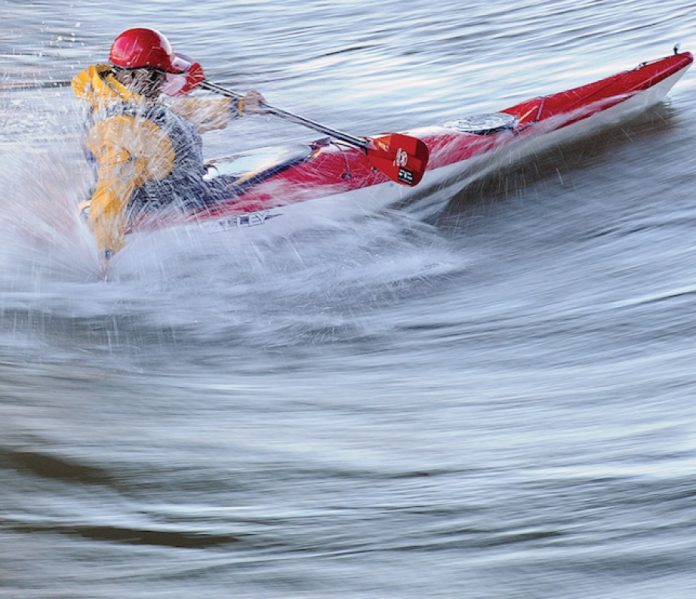
“When a nor’east or a nor’west comes in hard, the arse can really fall out of it,” Christopher Lockyer tells me as the road squeezes to a single lane and doglegs between roof rack-high stacks of lobster pots.
In places, the neck of Cape Forchu is so narrow it’s little more than a causeway. A rugged headland that juts south from Yarmouth, Nova Scotia, the cape’s crescents of surf-pounded sand and rows of weathered fishing wharves are lapped on one side by the Bay of Fundy and on the other by the unforgiving North Atlantic. It’s easy to imagine a northerly blow ripping across here with arse-spanking fury. In a couple of months, the docks will be bustling with lobstermen, but on this bright late-September morning our convoy of kayak-topped vehicles is the only sign of activity.
Colorful local expressions slip easily from Lockyer’s mouth. Beguiling host of the inaugural Bay of Fundy Sea Kayak Symposium, the bay is in his blood. Lockyer has spent most of his adult life on the bay, first as a lobster fisherman and later as a sea kayaker. His family, in- laws and friends have all worked on the bay in boats of various sizes. Now a GIS tech in Halifax, he also runs Committed 2 the Core Sea Kayak Coaching and is raising his own family near the small town of Truro, Nova Scotia, at the bay’s head.
Home to the world’s largest tides and a wildly varied coastline—from the rust-colored cliffs and sea stacks of Cape Chignecto to rugged archipelagos of glacially-formed islands wreathed in fickle currents—the Bay of Fundy is a natural paddler’s playground. It’s remarkable, then, that its potential as a world- class kayaking destination has remained largely untapped.
When Lockyer caught the kayaking bug in 1994, he traveled to paddling events in Wales, Scotland and Georgia to develop the advanced skills that would allow him to play in Fundy’s dynamic tide races and rock gardens. Five years ago, he realized Maritimers needed their own venue for sharing ideas and connecting with other paddlers. Working with Paddle Canada, Lockyer helped develop the Atlantic Paddling Symposium, a multi-discipline event hosted in a different Atlantic province every year. Then, in 2012, the bay called him back.
“All of the Atlantic Symposiums were 75 percent sea kayakers,” he says, “so I figured, why mess around chasing canoeists? Why not do an event just for kayakers?”
There was never any doubt where the new event would take place.
Salted Chocolate
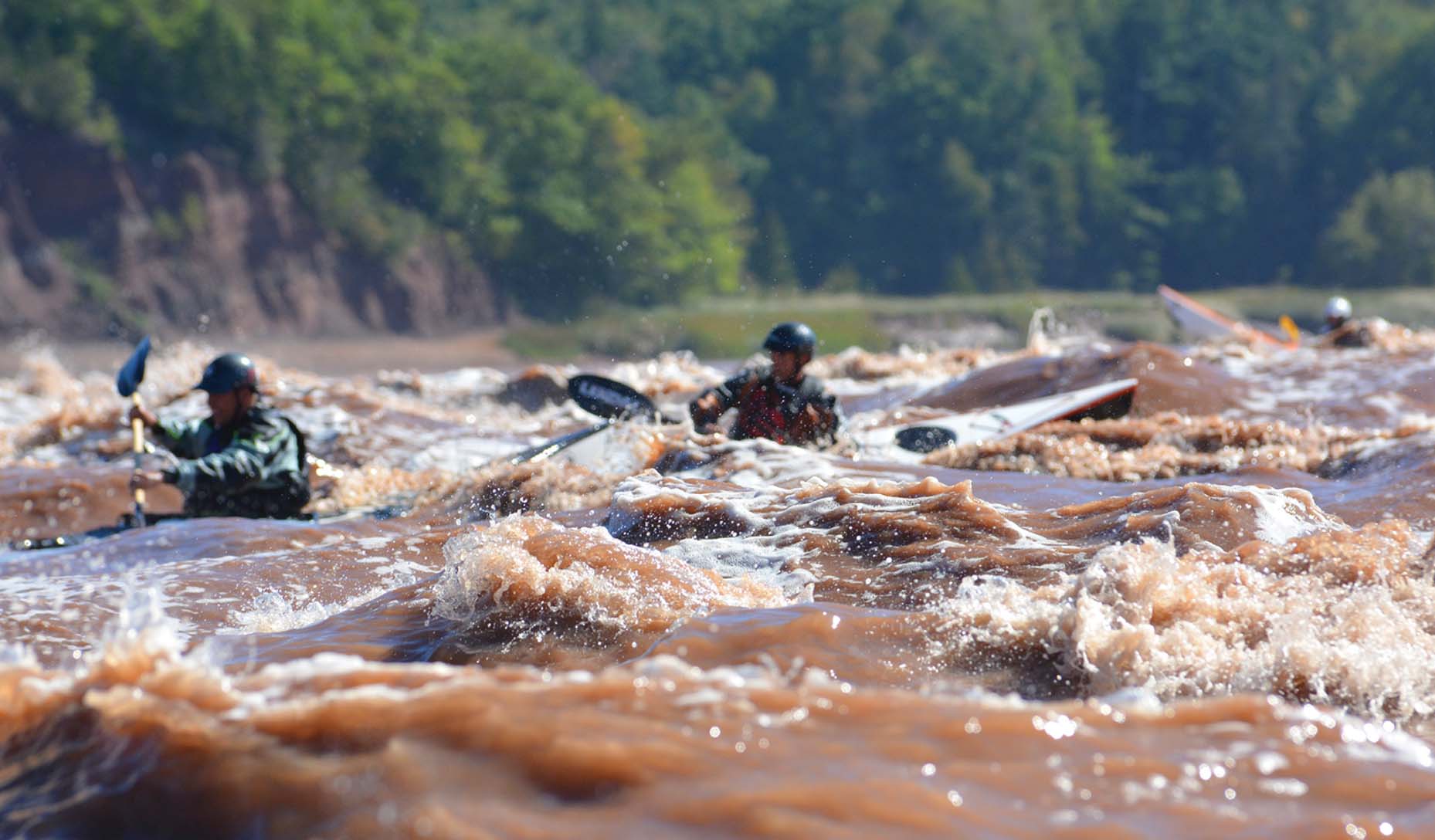
Amidst bucolic farmland and sleepy hamlets, tucked deep inside the Bay of Fundy, the Shubenacadie River plays a twice-daily game of Jekyll and Hyde. When the Bay’s 56-foot tidal exchange is on the ebb, the Shubenacadie—or Shubie, as it’s known locally—flows sedately to the sea. But on a flood tide, the lower reaches of the Shubie transform into rollicking rapids flowing upriver, the bay’s briny seawater charging between high banks of slick red mud. Nothing escapes a liberal plastering of that famous Shubie muck; even the river runs a rich, chocolatey brown.
A full harvest moon has brought the highest tides—and largest rapids—of the month, and Lockyer has brought 10 of the global paddling community’s top coaches to experience his backyard river before the very first Bay of Fundy Sea Kayak Symposium (BOFSKS) kicks off. A dozen eager students have also signed up for the pre-event fun.
We meet in the historic village of Maitland—formerly a shipbuilding center and still home to a wealth of fine Victorian architecture—at sunrise, up early to put on the river before the incoming tide.

potential comes naturally to Paul Kuthe. | Photo: Virginia Marshall
I tag along with guest coaches Matt Nelson, visiting from Washington’s San Juan Islands, and Rowan Gloag, hailing from British Columbia’s Vancouver Island.
We’re joined by Fernando, a local Nova Scotia paddler, and Haris, a sea kayak instructor from Chicago. Matt is tasked with seeing us down (up?) the river safely, as well as hunting out the best play spots along the way.
In the quiet stillness of the morning’s slack tide we wait expectantly, straining to spot the vague ripple on the horizon that signals a coming tidal bore. After an hour of anticipation and holding position against a weakening ebb, the current turns almost imperceptibly, then begins to pick up speed.
The bore—a river-wide, surfable wave that pushes upriver, promising 10- or even 20-minute-long rides—never materializes. Formation of the Shubie tidal bore requires a specific alchemy of factors, including tidal exchange, river volume, wind speed and direction, and the
depth and width of the channel at the river’s mouth on Cobequid Bay—it’s by no means a sure thing. But that doesn’t mean there’s nothing to play.

Wave sets soon develop over under- water sandbars and at constrictions, the features building and flooding out with the rising tide. Imagine watching the daily transformation of a snowmelt or glacier-fed river on super fast-forward. Rides are as fleeting as the features themselves, and we chase Matt around the wide, lumpy channel of the Shubie like hounds on a scent. He seems to have an uncanny sense of where the next wave set will materialize, rising from the coffee-colored water like a surfacing sea serpent.
“I’m so excited to be here!” Dawn Stewart gushes when I catch her bump- ing merrily through head-high haystacks. Backwards. On purpose. Stewart traveled all the way from North Carolina, she tells me, for Fundy’s challenging conditions and the event’s world-class coaches. “I’m star-struck, it’s like…” she pauses, searching for the right word, “Hollywood!”
The day’s best rides are had in the “Killer K” upstream of a bluff known as Anthony’s Nose. Actually, relative to
the sea, this kilometer-long wave train is downriver from the Nose, but directions on the Shubie change with context. “Yeah, it’s a bit confusing,” Matt admits, “just think of the river in relation to the prevailing current.”
Haris scores a dream surf—nearly a minute of carving gracefully on the glassy leading wave. I fall down a four- foot face, sliding sideways into a muddy trough as the Shubie crashes playfully across my shoulders. For a moment, I view the world through a barrel of this strange, salty river and feel as though I’m surfing through one of those TV commercial swirls of molten chocolate.

fruitless to argue with fate | Photo: Virginia Marshall
Home of the Whopper
“Look at the coaches Chris brought in for this event—these are the big dogs, the coaches known for paddling rough water really well,” muses Justine Curgenven. We’re sitting cross-legged on our beds and I’m doing my best to conceal my giddiness—OMG! I’m bunking with a big dog, the fearless, famous star of This is the Sea.
Mercifully oblivious of my hero-worship, Curgenven continues, “If you want to showcase Fundy as an exciting, chal- lenging kayaking destination, these are the paddlers you invite.”
The day before, Lockyer had surprised Curgenven and the other coaches with another local play spot. After our Shubie run, we hustled into vehicles—mud- slicked drysuits still tied around our waists—and followed him through storybook-pretty countryside. Rolling pasture, tidy collections of impeccably restored or charmingly derelict clapboard homes, and the bay’s ruddy waters flashed past the windows. A sign announced our arrival in Walton, “home of the Walton Whopper.” But Lockyer hadn’t brought us here for burgers.
Beneath Walton’s solitary bridge, the tide was ebbing. Before long, what began as an innocuous green tongue had transformed into a chundering, kayak-eating maw—the real Whopper.
The mayhem that followed was not only a glorious spectacle of kayak carnage, but also a lens to focus the diversity of talent gathered in this unlikely spot: West Coast hotshot Paul Kuthe’s controlled carves and foam pile flatspins, informed by years of paddling whitewater rivers. Welsh coach Nick Cunliffe’s inimitably fluid style, as smooth as the wave itself. California surf kayak champion Sean Morley’s hard-charging power, Great Lakes coach Ryan Rushton’s tenacity, Curgenven’s whack-a-mole-like resilience.
Kuthe seemed a lock for the inaugural Whopper win with a series of cartwheels that had onlookers cringing at the audible thuds of his bow and stern striking submerged rocks. Then New Zealand paddler Jaime Sharp entered the fray for a final wild bronco ride. His rightful claim to the title was settled when his borrowed Valley Gemini endered and pirouetted on its bow to the wild cheers of battered coaches and baffled spectators alike.
If the Whopper confirmed Curgenven’s assessment about Lockyer’s choice of BOFSKS ambassadors, it also demon- strated in no uncertain way Fundy’s ability to humble even the most experienced paddlers.

When Life Gives You Bananas
“The ‘check engine’ light has been on the whole bloody drive,” Rob Avery gripes as we pull out of Maitland and turn his well-abused, early ‘90s vintage Chevy Suburban toward Argyle, 350 kilometers distant.
Actually, Avery—an affable Brit now residing in Seattle—isn’t the truck’s owner; it came attached to a trailer full of kayaks he picked up in Rhode Island several days earlier. “I slapped a banana sticker over the light so it doesn’t bother us any,” Avery continues, chuckling with satisfaction. From where I’m seated shotgun, I can just make out the ominous orange glow through a blue-and-gold Chiquita logo.
An hour later, a sudden clunking noise erupts from beneath the truck’s faded green hood and we drift falteringly into the shoulder. Behind us, the convoy grinds to a halt. At least the symposium can’t start without us—half of the coaches are standing with me on the side of Highway 102 somewhere outside Halifax.
One tow, two hours and a spirited round of touch wrestling and tailgate lunches in a Petro-Canada parking lot later, we get the bad news: the Suburban isn’t going anywhere without a new engine. Abandoning the truck and its attendant $4,500 repair estimate at the garage—and cramming the remaining vehicles well beyond recommended capacity with people, boats and soggy paddling gear—we continue the four-hour drive to Argyle.
Ripple Effect
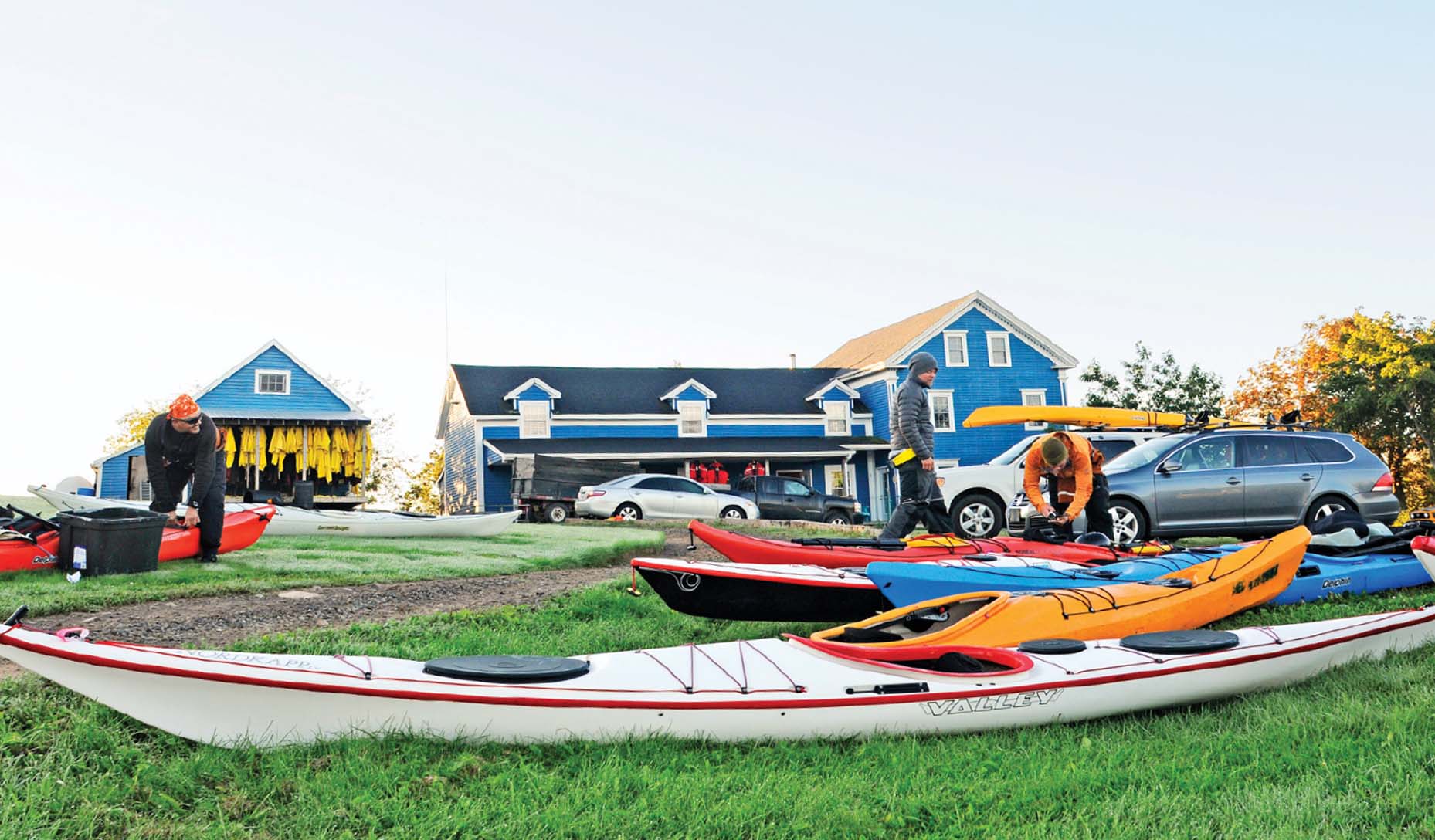
Ye Olde Argyler Lodge occupies an enviable perch steps from Lobster Bay; its spacious dining hall, wide wraparound verandahs and grassy lawns overlook sunset views of the bay’s sleeping islands. Fresh sea air wafts across a clean cobble beach. Lockyer knew the moment he saw the lodge that he had found the Bay of Fundy Sea Kayak Symposium’s home base.
Flung on the very tip of Southwest Nova Scotia, Argyle, Yarmouth and the neighboring villages of the Acadian Shore occupy a scenic but socioeconomically depressed hinterland between the Bay of Fundy proper, and the province’s more prosperous South Shore. Although the lo- cal lobster and scallop fisheries survived the early 1990s Atlantic groundfishery collapse, like the rise and fall of the tides that inform all aspects of Maritime life, an ebb was coming. When the ferry from Bar Harbor, Maine, to Yarmouth ceased operation in 2009, it gutted the region’s all-important summer tourist economy. With the BOFSKS, Lockyer, the organizing committee and their municipal tourism partners hope to help turn the tide.
“There’s phenomenal paddling here, it’s just taken 15 years for the rest of the world to discover it,” Sue Hutchins, a local photographer, avid expedition paddler and Maine transplant, tells me over a plate of the lodge’s fresh Fundy haddock and scallops au gratin. I learn about the fog-shrouded drumlins of the Tusket Islands, of Brier Island’s sheer cliffs and nutrient-rich waters teaming with whales and seabirds. Witness firsthand the hospitality of the proud Acadian French people who have lived and worked on these shores since 1653.
Indeed, it is the warmth and generosity of the locals—more so even than the skills of the coaches or the sublimity of the paddling environs—that sets BOF- SKS apart. After three days—heck, three hours—I feel like a member of the family.
The initial impact of our modest kayaking clan gathering here for a long weekend may not be enormous, but the lasting effects are immeasurable. “You are 130 stones sending your ripples far into the pond,” Lockyer tells the paddlers gathered on the Argyler’s lawn, “spread the word, tell your friends.”

Fame and Forchu
Cape Forchu’s fishing sheds lean with silvered siding and vacant windows into the wind, awaiting Dumping Day, the late-November start of lobster season. Brightly painted trawlers rest at drunken angles on drying sandbars. Swell rolling out of the Atlantic booms against the cape’s polished cliffs, sending spray far above our heads.
I’ve joined Matt Nelson and Jaime Sharp, along with a handful of daring
students, for a rock-hopping session around the cape. This tour, like all of the symposium’s most demanding sessions, is rated comfortable intermediate, rather than advanced, because as Lockyer will later explain, “We wanted to stay away from that scratch-your-balls, bang-your-chest connotation.”
Matt is showing participants Jerome Trottier and Ted Tibbetts how to ride the “swell-evator”—dancing nimbly up and down the cliff face with the surging rise and sucking fall of the ocean swell. The classic symposium stigmas—overstated conditions, underwhelming classes, inflated egos—fall away like seawater down the rocks. There is such a wealth of expertise, abundance of beautiful coast and variety of challenge here; it’s all but impossible to be disappointed.
While the rough water classes enjoy ideal sea conditions, the weekend’s surf sessions find little action on area beaches. Johanne Lavoie, an adventurous Montreal paddler who counts her city’s high-volume Lachine Rapids as a favorite after-work sea kayaking spot, found her Surfing in Style class relocated to the sheltered waters of Lobster Bay, alongside the event’s milder sessions.
“Nick [Cunliffe] started the class with edging our boats on flatwater and I thought ‘F***, not this again! Is this all we’re going to do?’” she tells me later that afternoon, “But then he added a small correction, and then another and another—he kept me busy.” When Cunliffe moved their practice to an area of swift tidal currents and swirling eddies, says Lavoie, “It was the perfect progression.”
Lockyer is enormously pleased with the first annual BOFSKS. As the weekend winds down, he’s already sharing the event’s 2014 dates with participants and coaches, and wondering what effects their small ripples will have on his beloved bay. The tide, it seems, is turning.
The Bay of Fundy is many things—world-class and down-home, brutal and beautiful, intimate and enigmatic, pantry and playground—but it’s no longer a secret.
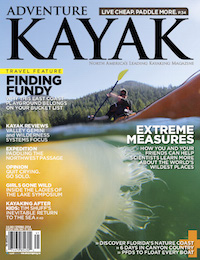 This article first appeared in the Spring 2014 issue of Adventure Kayak Magazine.
Subscribe to Paddling Magazine and get 25 years of digital magazine archives including our legacy titles: Rapid, Adventure Kayak and Canoeroots.
Access Denied in Wyoming

I write this stuck in Wyoming’s Grand Teton National Park—not a bad place to be—but the park is closed, the place is deserted. The river I came here to run is now out of bounds; one of the most famous, historic and flat rivers most paddlers have never heard of.
Here for a risk management conference at a private lodge, we are victim to the U.S. government’s Obamacare shutdown and budgetary deadlock. We’re carrying on with our conference, but the park’s gates are locked. We can leave but we can’t get back in if we do.
Famed landscape photographer Ansel Adams’ black and white The Tetons and the Snake River (1942) seared the jagged skyline of the Teton Range into the American psyche, making them what most Americans picture when they think of mountain peaks. Snow capped, ominous and rising from the western plains, the iconic mountains have served as the center of American mountaineering for over a hundred years.
Adams’ famous photo used the upper reaches of the Snake River to contrast against the triangular peaks: the river’s sinuous curve draws the eye from the foreground, down the bank and up the jagged peaks into the sky above. When I first saw the photo on a Christmas gift coffee table book, the image of the Snake drew me in, left me longing to be pulled down the humble river beneath those peaks. And now I sit here, struck by the reality that the river is beyond my reach, its access controlled by the government’s whim.
Rows and rows of sad-looking rafts and dories sit on trailers on the parking lot of Jackson Lake Lodge, where I’m locked up. They, too, are imprisoned, leaving one of the busiest scenic float rivers in the world deserted like the rest of the park. River guides either mill about with nothing to do or have called it a season and moved on. The same Snake that downstream passes through whitewater Ho-
back and Hell’s canyons, up this high is just flat and swift, dwarfed and humbled by the Tetons. The Snake is often overlooked by seri- ous whitewater paddlers, but is magnificent in views and important in our history.
Grand Teton National Park is one of the birthplaces of commercial rafting and the Snake continues to put any other commercial rafting river to shame—upwards of 200,000 tourists float this section every year.

THE TETONS FAMED HISTORY
The famous and extremely wealthy John D. Rockefeller Jr. was an avid outdoorsman and visited the Tetons in the 1920s. Rockefeller secretly began buying up land with the intention of handing it all over to the government as a gift.
Political and legal wrangling got in the way, and it was not until 1950—more than 20 years later—that his donated land gained of- ficial park status.
Rockefeller promptly set about building Jackson Lake Lodge and hired horse wranglers to take clients down the Snake in WWII surplus inflatable bridge pontoons with sweep oars.
That was the start of commercial rafting in this watershed. Further to the south in Utah and Arizona, Bus Hatch and Norman Nevills were pioneering commercial whitewater on the Green and Colorado, but for Rockefeller, the river was about scenery. He wanted people to float through Adams’ photo, and revel in the spectacle of the mountains looming overhead. When whitewater daredevils were gaining media attention in the mid-60s, a half dozen river operators sprung up and still operate on the Snake, capturing the road traffic through the Tetons and nearby Yellowstone National Park.
As the creator of the commercial float trip, Rockefeller waited out decades of government delay to ensure this land would spread the love of rivers to the masses. Like Rockefeller and so many others, I was drawn to this river, but here I sit, my access denied, looking at a real-life image of the Tetons and the Snake River, and a snapshot it will remain.
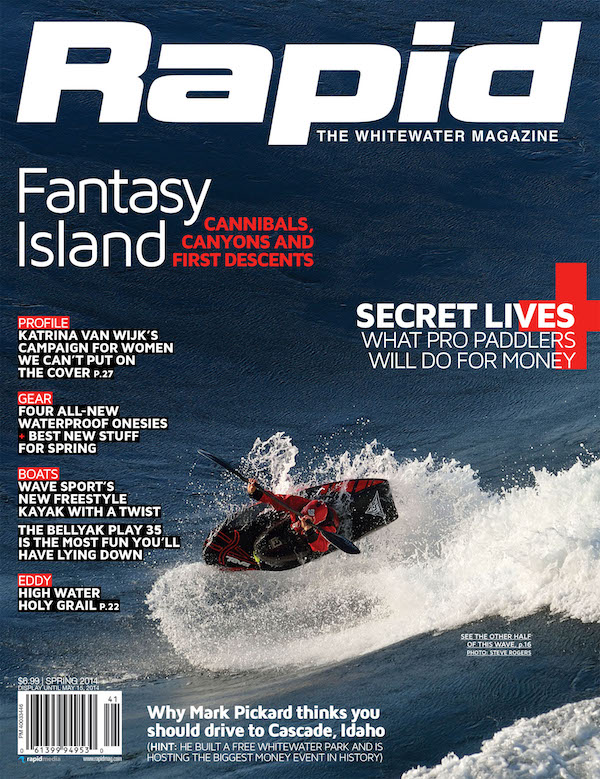 This article was first published in the Spring 2014 issue of Rapid Magazine.
 Idaho: Home of the Best Hole in America

“It’s the sickest play hole probably ever built,” says Junior World Champion freestyle kayaker, Jason Craig. “At least, that I’ve paddled in—and I’ve paddled in a lot.”
He compares the top feature at Kelly’s Whitewater Park to the Ottawa River’s world-class waves, but at Kelly’s, there’s never a line in the eddy.
It’s a ghost town a lot of the time says Craig, who spent a month at the Cascade, Idaho, park last summer—an eerie emptiness that you’d expect to see bustling with big-name boaters and beginners alike, based on the quality of whitewater.
There are four main waves at Kelly’s and the biggest is Craig’s secret training ground, a hole he says is the best in the country for boosting freestyle scores. The bank is landscaped with boulders that form amphitheater-style seating for more than 3,000 spectators near this feature alone, benches that are packed on event weekends when people flood to Kelly’s to join or watch high-level competition.
BRINGING IN BUSINESS FOR CASCADE
Since it opened in 2010, the park has hosted two National Kayak Championships and the 2013 Payette River Games, which drew 14,000 people, including a long list of world- class kayakers, to the park for a weekend of SUP and kayak competition.
The 2014 Payette River Games are from June 20 to 22 and have a prize purse of over $100,000, with $10,000 top prizes in both men’s and women’s categories—the biggest money weekend in whitewater history.
The events are booming business for Cascade, a single-store town that only 1,000 people call home.
Mark Pickard is the man responsible for plopping this world-class whitewater on the map in the middle of Idaho. A retired Wall Street hedge-fund founder, Pickard and his wife Kristina poured funds into the park as an act of philanthropy— a memorial to Kristina’s late sister, Kelly, and an economic jolt for Cascade, a town the New York-Miami Beach couple had fallen in love with.
“We’re not paddlers,” says Pickard, who transplants to the area for a few months each year. But a whitewater park was a long- time dream of the community so Pickard worked with a team of engineers to blast through its planning and construction in a matter of months, turning a donated abandoned sawmill site into what he hopes will become a national tourist attraction.
MORE THAN JUST WHITEWATER
Everything at Kelly’s is completely free, and Pickard didn’t stop with whitewater. Beach volleyball courts, an outdoor concert area, horseshoe and bocce ball pits and an extravagant visitor’s center are all part of the plan to bring more people to the not-for-profit park, on more than just competition weekends.
Between events, the site is scattered with small groups of local kids attending Kelly’s Academy—a program where fifth- to twelfth-grade students from the area get free lessons from world champs like Craig, who agrees that it’s just a matter of time before the park catches on as a whitewater hotspot.
“It feels like paradise. Every level of paddler would love that whitewater park,” he says, adding that it’s only a short drive from Kelly’s to the legendary 15 miles of Class V on the North Fork of the Payette River.
It’s “an incredible place to be a kayaker,” he says.
 This article first appeared in the Spring 2014 issue of Rapid Magazine. For more great content, subscribe to Rapid’s print and digital editions here
Betcha Didn’t Know About…Bears

Bear Brutus is just part of the family for naturalist Casey Anderson. His 800-pound ursine pal attended Anderson’s wedding as his best bear. He’s even sat down with the family for dinner.
Bears can run at speeds up to 35 miles per hour. The average human sprinter clocks in at 12 to 15 miles per hour. Don’t even try it.
Spokesbear for U.S. Forest Service, the original Smokey Bear was an American black bear cub rescued from a 1950 wildfire. After being nursed back to health, he lived at Washington’s National Zoo for 26 years, receiving up to 13,000 fan letters per week.
Though attacks are a common wilderness fear, bears have been responsible for only two to three deaths per year in North America since 1990. By comparison, dogs kill an average of 15 people and lightning kills 80 people each year.
For his show, Man vs. Wild, Bear Grylls has consumed frozen yak eyeballs, camel intestine juice, raw goat testicles, a live snake, giant maggots and live insects. The goat testicles were the worst, he reported—he bearly made it though.
It was Theodore Roosevelt refusing to shoot a tied-up bear on a hunting trip that gave the toy teddy bear its start. Roosevelt’s refusal made the papers, painting the soon-to-be-president as a compassionate man. It boosted his popularity and toy manufacturers jumped on the opportunity, creating the immediately successful “Teddy’s bear.”
 This article first appeared in the Spring 2014 issue of Canoeroots Magazine.
Basecamp: The Forgotten Phase

The nacho chips and salsa were just placed on the kitchen table and already conversation was shifting from how nasty the ski conditions were today to my idea of a family rafting trip down the Coulonge River next summer.
By the time the pizza was coming out of the oven, the mothers were planning the menu. The other dads and I were Googling river levels to see which rapids we could run and which we may need to portage. Sitting at the cooks’ end of the kitchen table, one dad, hearing talk about boxed wine and lawn chairs, suggested we best keep the portaging to a minimum and run everything we can. That was our plan.
If we’d invited Professor Ed Krumpe from the Conservation Social Science Department at the University of Idaho to join us for dinner, he’d say we were deep into phase one of the five phases of a satisfying recreation and tourism experience.
Anticipation and planning is the pouring over guidebooks, route and food planning, campsite booking, travel plans and gear preparation phase. It’s an important step because it creates buy-in and commitment. Done well it sets expectations for the whole group. Done poorly—well, you probably know the answer—the experience would more than likely end in disaster.
The dads were looking for a big water run. The mothers had more of a low-water float trip in mind. The dads were thinking of starting way up north in the spring and stretching the trip over 10 days. The mothers were thinking three nights in August without bugs. Eventually we’d settle on a trip that offered just enough adventure and margaritas on the sand bars.
These important details are best worked out before the travel phase, before the participation phase and before the travel home phase, so the final recollection phase is a pleasant one.
A truly satisfying experience, according to Krumpe, is one where expectations are met or exceeded. How the story will be told après ski in years to come has everything to do with anticipation, planning and setting these expectations before the trip. Our memories are burned into our subconscious and affect the planning or likelihood of follow-up trips.
But we know that family trips never, ever go exactly as planned, especially ones in the backcountry, which is why I believe there is an even more important phase of the outdoor recreational experience. The imperfect recall phase falls somewhere between Krumpe’s travel home phase and recollection phase. You may know this phase better as selective memory.
When planning goes all wrong—shuttles are late, rafts flip, fish hooks enter fingers, tequila runs short and bugs live too late in the season—imperfect recall is our natural ability as parents to remember the good times and block out or make light of the bad. Imperfect recall is really what affects the likelihood of a follow-up trip.
Rounding up our ski jackets and our kids, we’ve already forgotten how cold, windy and icy it was on the hill today. Going out the door, we make plans to meet again early next Saturday morning at the lodge. —Scott MacGregor
This article originally appeared in Spring 2014 issue of Canoeroots Magazine. Subscribe to Paddling Magazine’s print and digital editions here, or download the Paddling Magazine app and browse the digital archives here.
Skills: Night Photography

Of all the great canoe tripping memories I’ve had over the years, some of the best evoke the magic of the night sky and the warmth and comfort of the evening fire. Capturing the spirit of a wilderness trip through the lens can be a challenge at the best of times, but photographing low-light and nighttime scenes demands some expertise and a lot of patience.
Beyond the essential equipment for effective low-light photography, which includes a digital SLR camera, tripod and fast aperture lens (less than f2.8 is ideal), there are some basic concepts to remember when out on your next trip.
The first is that the longer your exposure, which is also known as your shutter speed, the brighter your photo will be because more light is let in.
While you can photograph a campfire after dark, some of the most effective campfire shots are taken during twilight, when landscape detail or silhouettes put the campfire in context. Also, the darker it gets, the smaller your fire needs to be if you hope to balance it with the ambient light. A glowing bed of coals and a few flickering twigs will appear as a crackling campfire after a 10- or 20-second exposure.
On clear, moonless nights, capturing the stars can make for great images. To include foreground elements you’ll first have to expose for the sky, being sure to keep your exposure to 30 seconds or less to avoid blurring the stars due to the Earth’s rotation. Foreground lighting can take the form of a headlamp, off-camera flash or simply the glow from a nearby campfire.
A bright, moonlit night is a great time to make unique images. Moonlight provides backlighting to clouds, shimmers off water and provides an all-round spooky array of shapes and silhouettes. Including the moon as part of a longer exposure will result in a soft, circular glow.
If you’re lucky enough to experience the northern lights, photographing the display makes for an exciting and memorable tripping experience. If the aurora display has definition, keep your shutter speed to 15 seconds or less to avoid washing out the bands of light. Don’t forget to include some foreground to help with framing the image.
View seasoned wilderness traveler and photographer Mike Monaghan’s work at mikemonaghan.ca.
This article first appeared in the Spring 2014 issue of Canoeroots Magazine.




