Home Blog Page 311

Tumblehome: Life After Death for Peterborough Canoes

Photo: Ken Brown Collection
Editorial

This editorial originally appeared in Canoeroots and Family Camping magazine.

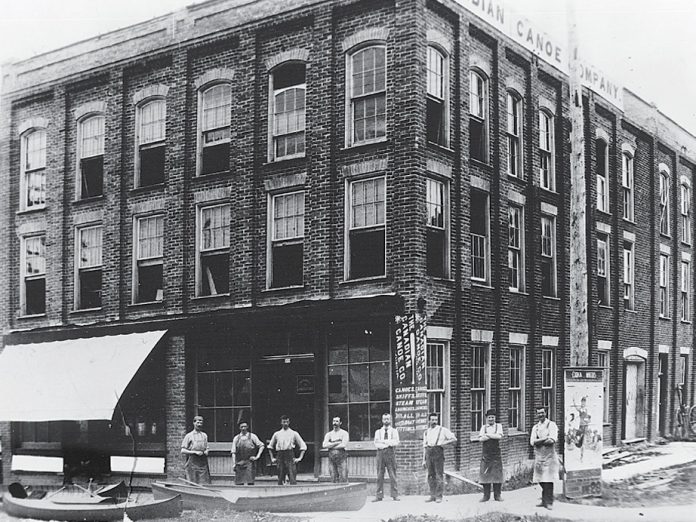
A fabulous new book called The Canadian Canoe Company and the Early Peterborough Canoe Factories (Cover to Cover Press, 2011) has got me thinking about reincarnation.

According to author Ken Brown, canoe building in Peterborough, Ontario, effectively died in the early 1960s with the Canadian Canoe Company ceasing operations in October 1961 and the Peterborough Canoe Company declaring bankruptcy soon after. But the presence of this book and a quick cruise on the World Wide Web indicates that the products of these venerable canoe companies are still very much on people’s minds.

The demise of industrial canoe building in Peterborough was real enough. Companies that had skillfully grown from an emerging 19th century cottage and craft activity into seven or eight canoe-building factories with robust domestic and international markets, struggled after WWII. Aluminum and fiberglass building techniques—innovations honed in wartime aircraft manufacturing— lent themselves naturally to canoe building. But tooling up for new materials and new building techniques was expensive. And training or retraining a skilled woodworking labor force to make canoes out of plastic or metal was also costly. It was only a matter of time before the wooden canoe companies floundered.

Yet Peterborough thrived through nearly a hundred years of uncommon industrial success. Ken Brown tells us that in a country bordering three oceans, in 1930 a quarter of the 778 Canadians involved in the building of small boats were employed in the land- locked center of the continent by Peterborough area firms, generating a third of the annual $2 million sales in this area of the economy.

After WWII, this tapered back and, after the closure of the Peterborough companies, passed to the skilled hands of later generations of small builders and hobbyists who continue to keep the tradition vibrant.

Today, you can buy Peterborough canoes at auction. Reprints of old catalogues are available for sale in hard and soft cover. The iconic company logos are available as decals for the growing corps of builders and rebuilders from Pacific to Atlantic and Arctic to Caribbean who still love Peterborough shapes in their shops.

And then there are the T-shirts and calendars, and the advertisers who for the past 50 years have freely employed canoe imagery. Selling charcoal, beer, milk or maxipads with canoe imagery cashes in on the fact that from explorers, surveyors, itinerant clergy, police and fur traders to modern day hunters, anglers and recreational paddlers, Peterborough canoes have been involved in just about every aspect of life beyond the fringe in North America. They are part of Canada’s heritage and, as Ken Brown reminds us, part of the history of the U.S., U.K. and countries even farther afield. Advertisers know that consumers are drawn to canoe imagery because this vessel—the Peterborough canoe in particular—is part of who we are.

James Raffan is thinking of coming back as an explorer, writer and executive director of The Canadian Canoe Museum.

This article appeared in Canoeroots & Family Camping, Spring 2012.
 

Easy Dock Landing Technique

Photo: Marty Tannahill
Marty Tannahill

This technique article originally appeared in Canoeroots and Family Camping magazine.

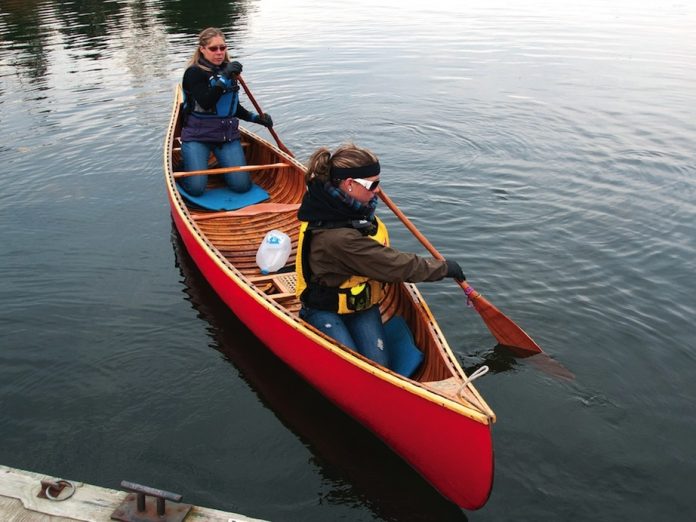
Gracefully bringing your canoe to rest adjacent to a dock or deep rocky shoreline is the aim of a well-executed landing. In this position, paddlers can more conveniently exit the boat, stabilizing themselves by using the dock or shoreline for support.

The ideal landing is completed with the canoe under constant motion, stopping it snuggly against the dock. To make this happen, approach a fixed target on the dock in a straight line, roughly 45 degrees to the landing. As the boat nears the landing point, the stern paddler initiates the turn by using a draw or pry. If the landing is on the stern person’s paddling side, he or she should use a draw. The stern person should use a pry to initiate the turn if the landing is on the opposite side.


Immediately after the stern paddler initiates, the bow paddler reciprocates with a complementary stroke. If the stern paddler uses a draw, the bow paddler can assist with a draw or bow cut. If the stern paddler uses a pry, the bow paddler should choose from a pry, bow jam, crossbow draw or crossbow cut. Just before reaching the target, both paddlers provide well-timed reverse strokes usually followed by some subtle draws or pries to stop the canoe at the intended spot.

Practice the timing of your strokes. Initiating the maneuver too soon will leave you too far from your target. However, waiting too long could result in a collision with the dock.

As you develop this skill, communication between paddlers is important, especially when changing partners. Plan the landing out verbally before you begin. It’s best to start at slow speeds so you don’t ram the dock or damage the canoe. Increase the speed only after you can competently complete the maneuver. Try slightly different approach angles to see what works better for you and your partner. Knowing how your boat responds to the strokes is important as all canoes maneuver differently.

Marty Tannahill is a Master Canoe Instructor with the Ontario Recreational Canoeing and Kayaking Association. When he’s not paddling you’ll find him fly-fishing Ontario’s remote rivers.

This article appeared in Canoeroots & Family Camping, Spring 2012.
 

Handline Kayak Fishing Technique

Photo: Conor Mihell
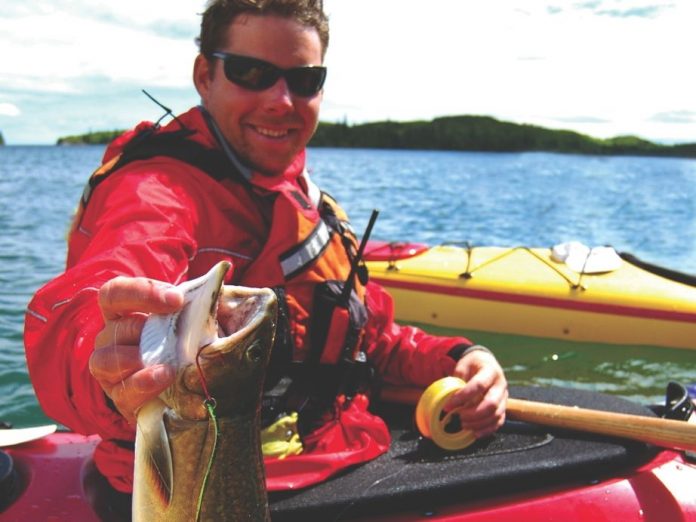
Handline trout.

This kayak technique article on how to catch fish from your sea kayak on a handline was originally published in Adventure Kayak magazine.


Handlines offer fishing without the fuss. A simple plastic spool or wooden shuttle wrapped with 60 to 100 meters of monofilament line, a handline avoids the storage hassles and maintenance
 woes of a rod and reel.

Handlines are dirt cheap to buy (5 to 10 dollars for a 4- to 6-inch spool) and damned easy to make yourself—use a jigsaw to cut 1-inch plywood into an I-shape with one end roughly the width of your grip, and wrap the line around a shaft of 5 to 6 inches.

Handlines are best used for trolling or jigging. Save casting for the cottage; without the mechanical advantage of a rod to assist your toss, you’re more likely to capsize than catch a fish. Kayaks are the perfect vehicle for trolling since most paddlers tour at the ideal pace for spoons and diving Rapalas. Whatever method or lure you use, heavy line (15- to 20-pound test) is necessary since handlines don’t offer the line-saving flex and drag capabilities of a rod and reel.

For hands-free trolling, attach the handline spool to your kayak’s deck line with an 18-inch length of bungee. Play out as much line as you want and tuck the spool under your deck bungees. When you get a bite, the spool will be pulled off your deck and the bungee will dampen the initial jerk, set the lure and keep the spool within easy reach for the retrieve.

Tip: to avoid snags and shredded Gore-Tex, replace troublesome treble hooks with single hooks.

This article originally appeared in Adventure Kayak, Summer/Fall 2009. Download our freeiPad/iPhone/iPod Touch App or Android App or read it here.

Q&A with Justine Curgenven

Photo: Courtesy Justine Curgenven
Round-the-World paddler Sarah Outen with Curgenven (R).

If you’re fond of kayaking, you’ve probably seen at least one of Justine Curgenven’s award-winning This is the Sea films. Maybe, like me, you’ve happily watched one of her five TITS DVDs from start to finish without so much as a popcorn or pee break (an impressive feat given TITS 5, released this year, is up to a whopping three hours). For many, the Welsh filmmaker’s videos aren’t just entertainment—they’re the inspiration to plan a long expedition, learn to surf, teach a friend to paddle, or make kayaking a part of day-to-day life.

Adventure Kayak caught up with Curgenven to reflect on 10 years of TITS, and look at how the sea kayak film has evolved over the past decade. To read the full interview, as featured in the premiere issue of our new monthly magazine, Paddling This Month, click here.

Stern Tap Technique

Adventure Kayak

Adventure Kayak editor Virginia Marshall demonstrates a great two-person technique to help keep a partner’s kayak going straight in windy conditions. 

This originally appeared in the Spring 2013 issue of Adventure Kayak. Click here for more ways to keep your kayak on course when the wind is howling. 

Download our free iPad/iPhone/iPod Touch App or Android App to read Adventure Kayak on your phone or tablet.

Creekboat Review: Wave Sport Recon

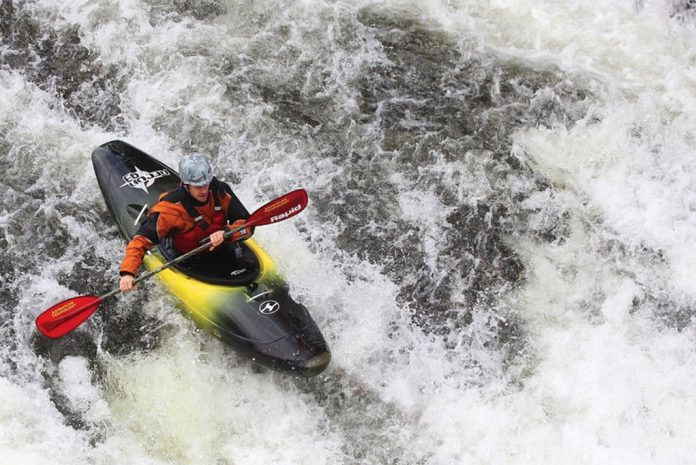
Whitewater kayak on a river
Time spent in reconnaissance is never wasted." —George Washington | Photo by: Jo-Anne Caldwell 

The Recon is a hardcore creekboat designed to take paddlers on the steeps in comfort and safety. If you want a boat that charges down rocky mank this could be the boat for you.

Looking beyond Wave Sport’s stylish, comfortable and easily adjustable Core WhiteOut outfitting you’ll find a boat that performs in Class IV–V+ water. The Recon has loads of integrated safety features: A safety step-out wall, seven points of rescue for boat extractions and an auto-adjusting bulkhead foot brace designed to fill up empty bow space so feet can’t get stuck behind it.

Wave Sport Recon S/M/L Specs
Length: 7’9” / 8’3” / 8’8”
Width: 25.5” / 26.5” / 27”
Volume: 70 / 83 /93 US GAL
Weight: 47 / 50 / 52 LBS
Paddler: 80–150 / 140–200 / 180–275 LBS
MSRP: $1,099
www.wavesport.com

At 50 pounds, the Recon isn’t light on the shoulder, but when I’m slamming into rocks all day I appreciate a beefier build. The soft end handles make the boat easy to drag around and the handle on the step-out pillar helps keep the boat on your shoulder when carrying.

Though the Recon replaces Wave Sport’s former creeker, the Habitat, “It has a new shape and paddles significantly differently,” says David Maughan, a designer at Wave Sport. “In terms of performance and features, we started with a bit of a blank slate.”

With a pronounced and continuous rocker profile, the Recon keeps its bow and stern well above the water. This means it’s super maneuverable, easy to boof and skips over holes. It’s in boulder-choked rapids and on slides where the Recon really shines as it slides up, over and through with ease.

“It’s a smooth and forgiving boat,” adds Maughan. “And its volume distribution makes it easy to roll for recovery.”

With its short waterline, the Recon jumps to top speed with a just few quick strokes. The dome-like stern sheds water and ejects the boat almost instantly. This is great for technical creeks where there isn’t room to build up speed and the moves are stacked close together.

Tilt the Recon on edge and it becomes an amazingly stable platform that you could hang out on all day. Don’t expect to carve around the river or deep into eddies though. With its edges engaged in the water, the Recon spins in and out of the current with authority. It’s perfect for grabbing a break in micro eddies or on runs where you don’t have room to make long, carving turns.

While the Recon can easily be piloted down Class I–III+ runs, it’s way more boat than these rivers require. However, if you love to tackle the Class IV–V+ steep, continuous and rocky rivers of the world, consider the Recon as your tool of choice to get the job done.

[ Paddling Buyer’s Guide: View all creekboats ]

This article originally appeared in Rapid’s Spring 2013 issue. Subscribe to Paddling Magazine’s print and digital editions here, or browse the archives here.


Time spent in reconnaissance is never wasted.” —George Washington | Photo by: Jo-Anne Caldwell 

Expert Tips On Where To Position Oars On A Raft

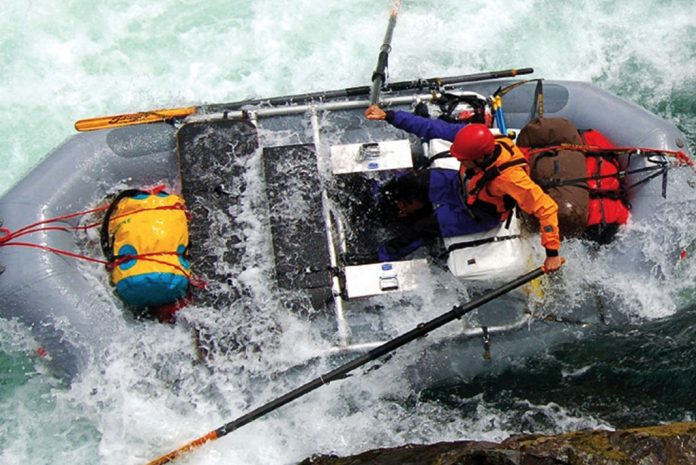
Single person manning oars on a raft in whitewater
Where you position the oars on your raft will affect your comfort and the balance of your boat. | Photo: Tom MeckFessel

You have your raft, you have your trip plan, you’ve carved out the prep time to set everything up. Now what? When it comes to mounting your raft rowing frame, most folks will tell you there are only two options.

Center mounts place the oarlocks at the halfway point along the raft’s waterline, putting the power on the pivot point. This is ideal for very heavy loads, and is the most common setup for multi-day rigs.

Stern mounts put the guide seat on the back tube, sitting high on the rocker with oars in lap. This is a typical commercial day trip setup, where the guide wants to keep the clients in view and away from the oars.

The fact is, the typical recreational rafter’s boat is not loaded with three weeks of food and gear, or with six to 10 passengers.

For a day trip or weekend, a centre mount will likely place passengers forward of the oars, making the raft bow heavy. With a stern mount, you can’t back ferry and the guide’s power is lost in flexing the raft’s rocker, rather than turning or moving the boat.

[ Paddling Buyer’s Guide: Browse all rafts ]

Figuring out a raft oar setup

The ideal position lies in between.

For a light gear load and a couple of passengers, placing the oarlocks two-thirds along the waterline with the guide seat in front of the stern rise makes for a balanced and predictable ride. The pivot stays near the centre of the raft, the guide can hold an angle pushing or pulling, is efficient pulling the flats and doesn’t mess with the stern rocker.

The trick is to experiment with different positions—don’t view the frame as fixed. You’ll find different setups for various load types. Move not only the frame, but also the oarlocks and seat to best position, and then mark those locations on the frame with a Sharpie. Several D-ring placements and long frame straps help keep options open.

Perception Essence Kayak Review

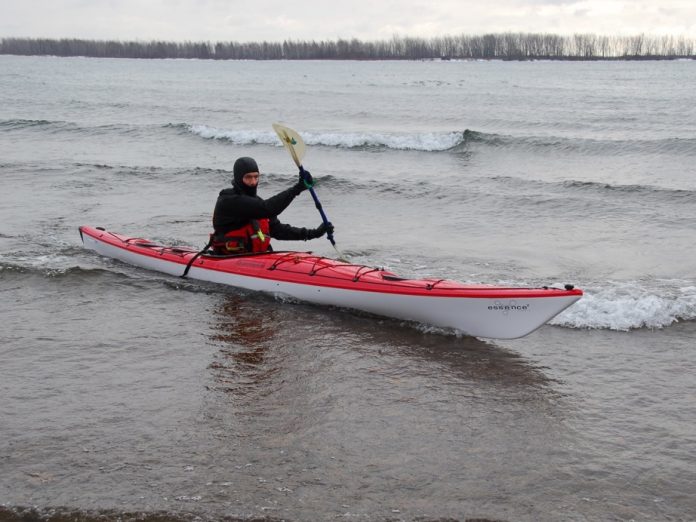
Photo: Tory Bowman
Perception Essence Kayak

When people say the Perception Essence 17.0 Airalite is a “good looking boat”—as they inevitably do—they’re likely referring to the sexy lines of the long, slender bow. For it’s here that the Essence reveals its designers’ intentions to prolong the transition from bow to midsection to make for the finest possible entry lines.

The Essence is a sharp contrast to rough water designs that carry more volume in the ends for buoyancy in waves. Crafted by long-time Confluence Watersports boat designer Bob McDonough to be a friendly, high-performance tourer, it has a sporty feel and excellent capacity and speed for its length. This is achieved by the tapered bow and the Swede form shape, with the widest point rear of the midsection like a racing kayak.

The stern is stockier than the bow—a nod to packability. In McDonough’s words, “You’ve got to carry the volume somewhere.”

The result is capacity for long trips combined with excellent efficiency that is refreshing to find in a plastic boat. The Airalite we tested is the lighter, thermoformed version but the Essence also comes in more affordable poly, and both options are available in a 16.5 length for smaller paddlers.

A limited rocker plus the tapered bow’s emphasis on knifing the water equals strong tracking and minimal weathercocking. There’s perhaps less need for the skeg than for the optional rudder, which novices might appreciate for easier turning.

The hull under the cockpit is a shallower V than other popular British-style 17-footers like Confluence’s Wilderness Systems Tempest 170 and the NDK Explorer. It’s also about an inch wider and the chine is slightly softer, resulting in greater initial stability and more smooth, predictable edging.

For this new top-end touring boat, Perception has taken a winning British formula and expertly honed it to be a tad more welcoming to a wide range of paddlers and uses. And, dare we say, a little faster and more spacious.

With a distance swimmer’s heart for the straight and narrow, the Essence is perhaps not your first choice for a day in the surf. However, like the touring edition of a high-end sports sedan, this kayak is perfectly capable of dialing up the adrenaline and having some fun if opportunity booms. Which, in our books, is the definition of the perfect tripping kayak.


Rudder Ready

In addition to the standard hydrofoil-shaped skeg and easy adjusting SlideLock foot braces, the essence comes rudder-ready with a mounting bracket on the stern and routings for cables.

Handy Hatches

The essence includes a 10-inch bow hatch, 8-inch day hatch and an oversized stern hatch, all with tight-fitting Kajak-Sport rubber lids.

Comfort Outfitting

Perception touts its Zone EXP Seating System as “expedition grade.” It includes a long, padded seat bottom with adjustable height to promote circulation on extended outings, and adjustable padded thigh braces. A long, spacious cockpit accommodates tall paddlers.


Perception Essence 17.0 Airalite Specs

Length: 17 ft
Width: 23 in
Weight: 50 lbs
Max. load rating: 350 lbs
Price: $2,299 US / $2,409 CDN
www.perceptionkayaks.com


This article originally appeared in Adventure Kayak, Spring 2011. Download our free iPad/iPhone/iPod Touch App or Android App or read it here.


UPDATE: The Airalite lay-up is no longer available from Perception, but the Essence 16.5 and 17.0 are still available in polyethylene, retailing for $1,299 US.

Tierra Del Fuego Trailer

Cackletv.com

Watch the trailer from acclaimed filmmaker Justine Curgenven’s new sea kayaking DVD, This is the Sea 5. Curgenven won the Best Sea Kayaking Film award at the 2013 Reel Paddling Film Festival for the DVD’s headline film, Tierra Del Fuego, the story of her and partner Barry Shaw’s circumnavigation of the treacherous, awesome island at the bottom of South America.

To discover more amazing paddling films, and learn where the Reel Paddling Film Festival is playing near you, visit www.reelpaddlingfilmfestival.com.

How to Use a Tumpline

Photo: Andrew Fergusson
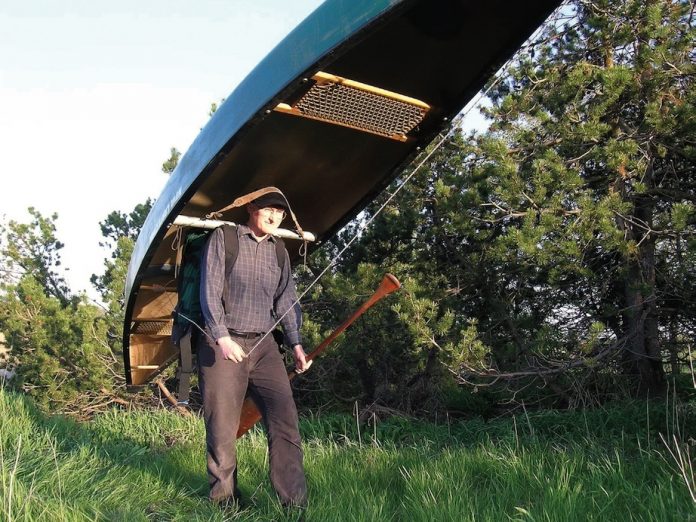
Tumpline carry.

This canoe technique originally appeared in Canoeroots and Family Camping magazine.

For too many, carrying a canoe means suffering through grinding shoulder discomfort and aching arms held high to balance the canoe. Make carries easier by adopting the tumpline method used by Aboriginals and early explorers.

Set up your tump by attaching a leather or nylon strap to either end of your centre thwart. For most canoes and carriers, the tump should hang to almost touch the bot- tom of the canoe when on the water.

Use your normal method to hoist the canoe so the centre thwart (rounded for com- fort, if possible) is resting on your shoulders. Position the tump over your forehead with one hand so that the weight pushes down with your head and neck in a comfortable position. The tump becomes a cushioning leaf spring that takes much of the weight off your shoulders and sends it straight down your spine, where it belongs.

The tump may take a few portages to tune and get used to but it will take you to the good places: canoe, pack and paddle in one trip

This article originally appeared in Canoeroots & Family Camping, Fall 2008.