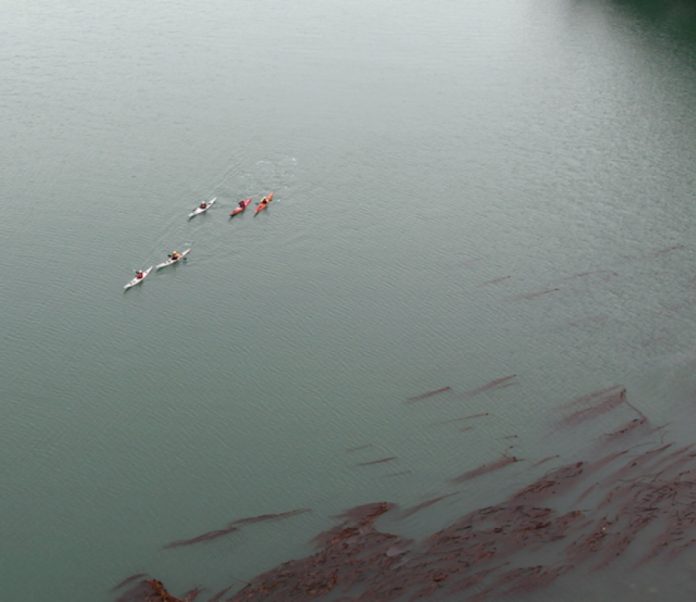
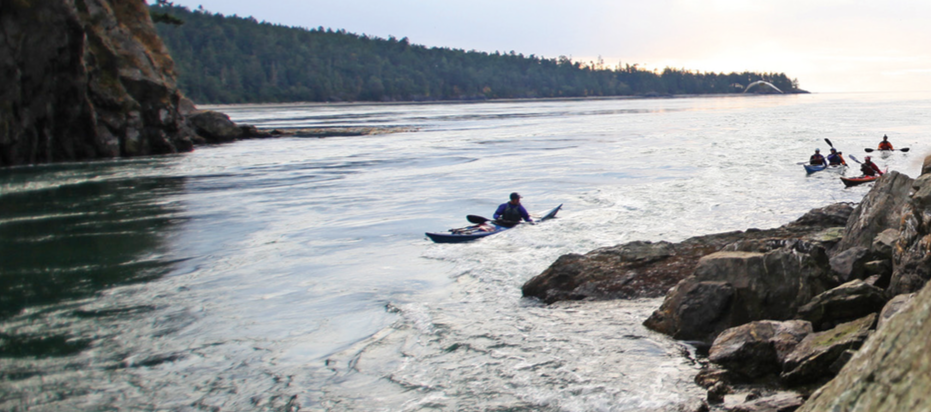
Today, Leon and Shawna have timed our launch with slack tide. We arrive at ebb tide as water begins to spill back toward the ocean and we watch small eddy lines slowly form. In the beginning, they are very subtle, just perceptible enough to spot the division between the current and the calm eddies behind the nearby island and point. Then, before our eyes, the Moon’s mystifying force cranks open a big tap and a rush of water magically begins to flow to the ocean. Over the next three hours, the current’s speed builds to the day’s high of 7.4 knots, creating a smooth green tongue between a clean eddy line and a mushy, confused mess of converging currents and whirlpools.
“We use the 50 to 90 percent rule of currents,” Shawna tells me.“The tidal exchange takes approximately six hours. During the first third of this exchange, the current will be 50 percent of its maximum speed. The next third will build to 90 percent. And the final third we consider to be at its maximum.” And then, predictably the cycle reverses until it’s back at slack tide again. I’ve experienced this before on the Upper Yough River in Friendsville, Maryland, though its cycle was far less romantic. A valve was opened in the morning and closed at night by a man in a hardhat up- stream at the Deep Creek hydro control dam.
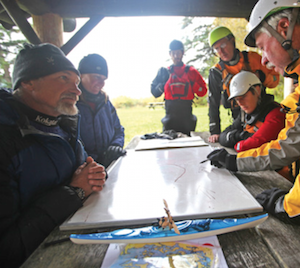
We huddle up on a beach for an intro to currents chalk talk. Leon sketches the features in the sand with piece of driftwood. Rocks. Eddies. Arrows to show the direction of the current. Eddly lines. I’d drawn the same thing hundreds of times while teaching whitewater canoeing. The morphol- ogy of moving water is the same. How sea kayaks react is completely different.
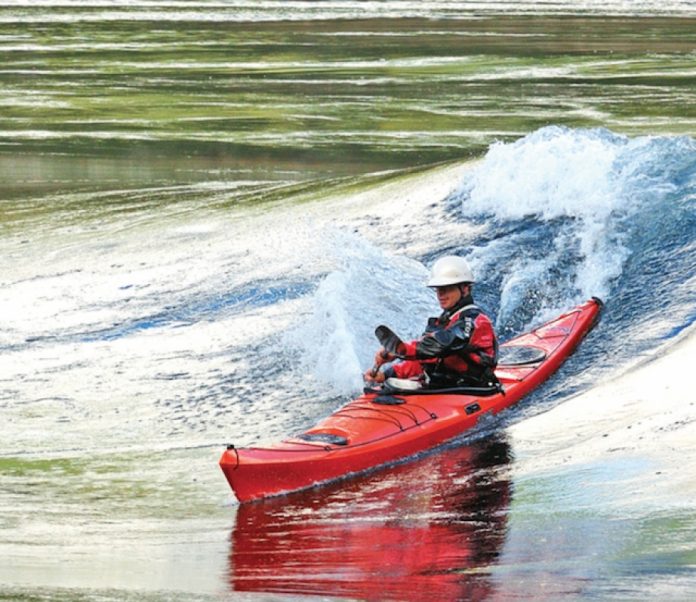
Back in our boats, I realize just how special Deception Pass really is. We begin breaking into and out of the current. We practice ferry glides back and forth. We’re gaining the tactical knowledge of speed and angle that Leon demonstrated with a toy kayak on the beach. We begin in a slight current and, as our skills and confidence progress, so do the speed and level of challenge, almost imperceptibly.
By 90 percent flow, we feel confident, quite pleased with ourselves, maybe even a little cocky. Shawna and Leon figure it is time to up the challenge.
“Okay, now what I want you to do is pull your skirts and get your butts on your stern decks,” Leon was grinning.
Easy.
“Okay. Good. Now ferry out into the current.”
Low brace. Easy. Steady. I balance in the eddy waiting my turn. David, who’d taken a number of Body Boat Blade classes before, taps me on the shoulder,“How about I stick close?”
I burst across the eddy line and then, as David predicted, I flip. This was, of course, the purpose of the exercise. Had I succeeded, Leon would have upped the ante to standing on my back deck, juggling chainsaws. Anything to get us out of our comfort zones and into the water, practicing rescues in the current.
“It’s one thing to understand how our boat is affected by currents and whirlpools but it is equally important to be comfortable in the water,” says Leon. To me it feels like floating down a deep class II river, except saltier.
 Back in my hotel room, I’d watched Body Boat Blade’s first instructional DVD, Sea Kayak Rescues. I learned that my first job as a swimmer is to hold onto my paddle and roll my boat upright, which allows me to hang on to its deck lines, essentially gathering up the yard sale I’d created. I’m still in the current moving toward the Pacific, but at least now I have options.
I can clamber up and straddle my stern deck. Just drop my butt in the seat and stuff my legs in. The cowboy rescue. We learned to do it this morning during our speed launches.
Instead, David is right with me, as he said he’d be. We decide to practice something different. He tells me to grab his deck lines near his cockpit. In seconds, he’s dragged my bow across his lap, rolled my boat upside down, tilted his boat, and effectively emp- tied my cockpit. This took all of 10 seconds. He pulls my boat parallel and waits for me to climb in. He’d seen the video, too.
Deception Pass is not particularly unique. There are tidal currents at many areas in the Pacific Northwest. A few offer faster currents and larger surf. Leon and Shawna have paddled most of them,“In some of our other classes we use the waters in and around the San Juan Islands. These areas are more apt to have standing waves caused by tidal races, or current opposing wind.” The most famous, Skookumchuk Narrows in British Columbia, was featured in Justine Curgenven’s film, This is the Sea 2. “Due to the high numbers of paddlers there on a good tidal exchange, we don’t teach at Skookumchuk as often.” What makes Deception Pass unique is easy access and good clean fun.
Deception Pass’ easy accessibility and Body Boat Blade’s get wet approach to teaching are changing the way people go sea kayaking. By removing some of the variables, we’re allowed to practice technique with little concern for anything else.
We spent two days playing on only 200 yards of water in a state park 30 minutes from where we parked our car, 20 minutes from town.
Leon knows that for some this will become their go-to playground. For others, it is a training ground.“If you can paddle here with success and comfort, you can easily apply this knowledge and experience to your local waters.”
Scott MacGregor is the founder and editor-in-chief of Adventure Kayak. For more information about paddling Deception Pass, visit bodyboatblade.com and parks.wa.gov.
 This article first appeared in the Spring 2012 issue of Adventure Kayak Magazine. For more great content, subscribe to Adventure Kayak’s print and digital editions here.


 This article first appeared in the Spring 2012 issue of Rapid Magazine.