Home Blog Page 326

How to Fix Freestyle

Photo: Kelsey Thompson
How to Fix Freestyle

At its roots, the term freestyle is pretty self-explanatory. You are free to do whatever you want, expressing your style however you want. Freestyle kayaking is no exception; paddlers invent new moves on waves and in holes, and add personal flair to existing maneuvers.

Unfortunately, when it comes to scoring freestyle competitions, freedom and style could not be further from judges’ minds. To do well in competition, paddlers are forced to check their style in the eddy and conform to the definitions in a rulebook.

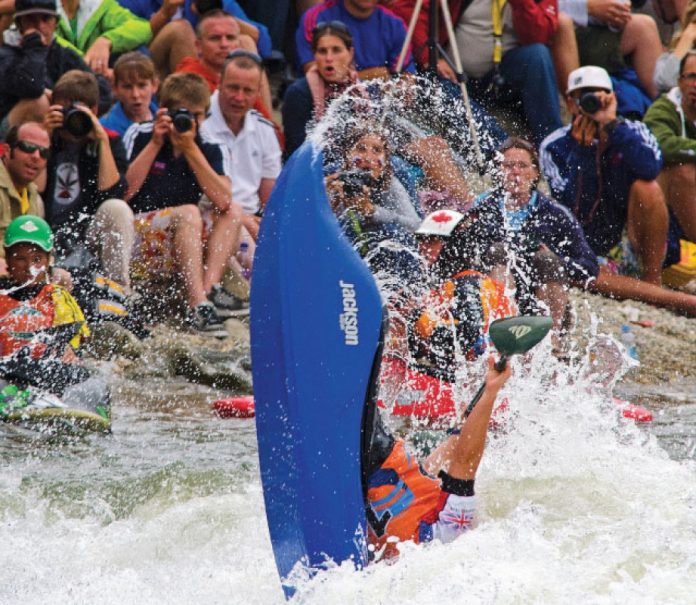
The system rewards speed over execution, assigning the same point value to a move whether it is performed perfectly or sloppily. This often leads to poor form and makes competitions less appealing for spectators. The loss of spectators, and competitors, is the single biggest hurdle facing freestyle kayaking competitions today.

This shouldn’t come as a shock to anyone who’s attended a freestyle event lately. Competitor turnout at freestyle events around the globe has dwindled tenfold in the past decade. The senior men’s class at the World Championships dropped from 131 participants in 2003 to just 70 in 2007 (the 2009 Worlds drew a more encouraging 103).

“Numbers are down at the big events, especially in the pro classes,” multi-time U.S. Free- style Team member and pro circuit competitor Bryan Kirk says. “Although participation seems to be increasing at new amateur events like the World Kayak Hometown Throwdown series, I’m not sure it will ever equal what it was in 2000.”

Decreasing kayak sales, waning sponsorship dollars and a slew of less-than-ideal event venues contributed to this decline, but competition format has played a critical role. Since its incep- tion, the freestyle scoring sheet has changed almost every year, making it hard for competitors to keep track of how they’re judged, and nearly impossible for spectators to keep track of who’s winning.

Fixing the scoring system could help solve the attendance problem. But the change needs to happen at a fundamental level. Simply putting a number value on each move just doesn’t work for freestyle kayaking. The current bonus points for amplitude and trick combinations are not enough.

“The problem with the scoring system is that it produces a big gap between the top paddlers, who can do every trick both ways, and the average competitors,” says Jeremy Laucks, OC1 World Champion and long-time pro tour judge. “The hard tricks are worth so much more…that if you don’t have them wired, you’re not competitive. For a lot of competitors, that’s discouraging.”

A NEW SYSTEM NEEDED

A new system needs to be devised that will reward competitors for flawless execution, style and creativity. Nearly every sport that celebrates the same free and style roots as kayaking is judged subjectively: half pipe snowboarding, freestyle skiing, skateboarding, bmx, figure skating, even baton twirling. A skater is not awarded a set number of points for merely landing her triple axel, regardless of how it is executed. So why is a kayaker?

Adopting a system like this would give athletes a rubric that stands the test of time, no matter how many new moves are invented or how drastically boat designs evolve. More importantly, it would bring freedom and style to competition, and with it the paddlers who are the lifeblood of the sport.

Kelsey Thompson is a four-time member of the Canadian Freestyle Kayak Team and the current national champion. 

This article on freestyle whitewater kayaking was published in the Early Summer 2011 issue of Rapid magazine.This article first appeared in the Early Summer 2011 issue of Rapid Magazine. For more great content, subscribe to Rapid’s print and digital editions here.

Rough Water Revolution: Extreme Kayaking

Photo: Joel Cooper
Rough Water Revolution: Extreme Kayaking

For many, sea kayaking is synonymous with quiet paddles into the sunset and multi-day trips on scenic coasts. Lovely, challenging even, but not exactly thrilling. That’s changing.

Over the past five years, interest has exploded among a growing subset of paddlers in a more adrenalized aspect of the sport: rough water sea kayaking.

Sea kayaking in rough water isn’t new. Small pockets of paddlers have been taking long boats out to play in surf, rock gardens and tidal races for over 25 years. When Stan Chladek founded the infamous Gales of November on Lake Superior in the mid ‘80s, the annual event drew up to 50 of the sport’s top paddlers, including Nigel Dennis and Dave Ide.

Footage of early pioneers like Eric Soares and the Tsunami Rangers careening through impossibly narrow passages and exploding haystacks, along a cliffed-out coast pounded by 20-foot Pacific swell, is still hair-raising nearly three decades later.

Recently, these humble beginnings have been eclipsed by a mainstream fascination with rough water, as more casual paddlers discover the joys of playing in waves.

But why now, and where is this bumpy course headed?

Extreme Kayaking Boat Design

Boat design has played a quiet role in shaping how paddlers get out and play. Five to 10 years ago, the dominating sea kayak designs were high volume boats designed for stability, speed and straight-ahead touring. There was a perception among manufacturers that paddlers were only interested in going on 10-day trips, and the designs reflected that idea.

“Sea kayak manufacturers used to be really slow to react to the changing needs of paddlers,” says Keith Wikle, creator of the sea and surf kayak website, Gokayaknow.com. “ They would release a boat and freeze the design, going a long time without any updates. Valley Kayaks, for example, used to have a really ancient line-up.”

That design deep freeze has begun to thaw. The selection of low volume boats specifically designed and built to perform in surf and around rocks is the greatest ever. Several companies—including P&H, Rockpool and Sterling kayaks—are on the cutting edge and have released innovative boat designs aimed at performance-oriented paddlers. Valley, which still offers the Anas Acuta—first released in 1972 and one of the very first commercially produced sea kayaks—is also launching a brand new play design this year.

“Sea kayaks are changing,” says Rowan Gloag, producer of The Hurricane Riders rough water film shorts. “Speed, tracking and rudders are being replaced by rocker and maneuverability. This doesn’t mean that existing designs are flawed, but it does give people more options based on the type of paddling they choose to do.”

Training and Equipment

The availability of training and suitable gear have also influenced the popularity of rough water paddling.

“The BCU [British Canoe Union] craze that hit the United States in the mid-90s was a result of the credibility of this type of kayaking,” says Wikle.

North American BCU coaches who trained in the U.K. emphasized skills and safety in rough water and current. They brought that rough water experience and the equipment that goes with it—boats and safety gear—with them when they returned home. Wikle says some now-popular rough water gear— such as helmets and rescue PFDs with integrated tow systems— was also adapted from whitewater or swiftwater rescue.

Media

Video depicting “extreme” sea kayaking, readily available via YouTube, Vimeo and Facebook, is perhaps the single biggest growth factor.

Today’s healthy crop can be traced back to 2004’s groundbreaking film, This is the Sea, from Welsh filmmaker Justine  Curgenven. Of course, Curgenven wasn’t the first to make a sea kayak film, but she was one of the first to mount cameras on the boats and send paddlers—herself among them—out in tidal races.

We were no longer watching paddlers from shore; we were right there paddling and hooting down the waves with them.

This is the Sea presented a different vision of sea kayaking. The film inspired countless paddlers to think about sea kayaking as more than just a mode of transportation or an activity for calm waters. Among them were other filmmakers, notably Bryan Smith who took production and cinematography to a whole new level with his films, Pacific Horizons and Eastern Horizons.

“Bryan Smith and Justine Curgenven’s DVDs were a major influence in the creation of The Hurricane Riders,” says Gloag. “I’ve lost count how many times I’ve watched Pacific Horizons. One of THR’s goals was to share rough water paddling—an amazing and visually stunning aspect of sea kayaking—with as many people as possible. Through YouTube, THR has reached over 115,000 people around the world.”

Too Much of a Good Thing?

With popularity and interest at an all time high, some fear that rough water paddling could tarnish the overall appeal of sea kayaking.

“My concern is that this image of sea kayaking will dominate and scare folks away from the sport,” says Michael Pardy, instructor, guide and owner of SKILS paddling school.

Sea kayakers need only look to their river cousins to see how a similar scenario played out in whitewater kayaking in the mid-90s. The whitewater community became gripped by a hot new craze called playboating. It looked fantastic in print, so an eager media helped proliferate the idea that you had to be out in the biggest, baddest whitewater to have fun. Unfortunately, the sport’s gnarly image had an unintended effect. Over the next 10 years, new whitewater paddler participation dropped significantly.

“One related concern,” continues Pardy, “is the potential shift away from touring-oriented training toward rough water paddling.” Overall, he sees this departure from sea kayaking’s roots as a “mixed blessing.”

Keith Wikle disagrees, “I think the popularity of rough water sea kayaking can only be a good thing. It means that more people are excited about paddling and pushing their comfort levels a bit.” He says sea kayaking needs to shake its reputation for being “a lame sport for old graybeards in Tilley hats.”

“The more we excite people about sea kayaking’s dynamic potential, the better.”

Gloag echoes Wikle’s sentiments, “I have learned more techniques paddling Skookumchuck [tidal race] than I ever thought were possible in a sea kayak. I am the paddler I am today because of rough water.”

On the Horizon

The next five years will no doubt witness some big changes in the world of rough water paddling. Expect the combination of more participation and increased media awareness to produce innovators and leaders who will take it to a whole new level.

“Twenty years ago, just sea kayaking was exciting. Now, that’s not enough,” says Pardy. “We see this trend in nearly every adventure sport—skiing, climbing, cycling and surfing have all fostered specialized sub-disciplines, along with their associated iconography, idols and tools.” 

Boat deisng is going to continue playing a key roll in shaping the sport,” predicts Wikle. He says new play sea kayaks like the Romany Surf by Sea Kayaking UK and P&H’s Delphin exemplify a trend toward incorporating design cues from whitewater and surf boats, such as planing hulls and carving rails.

Wikle believes we’ll continue to see more highly rockered sea kayaks in the 15–16-foot range—considerably truncated from the traditional 17–18 feet. “These features are really critical when you want to accelerate down-wave quickly, pivot off the crest or carve turns.”

Growth will also come from the paddling community itself.

“As rough water paddling matures,” Pardy forecasts, “it will coalesce into its own community, with its own social media, equipment, language and training.” He cites events like San Francisco’s Golden Gate Sea Kayak Symposium, Oregon’s Lumpy Waters Symposium and Ontario’s Georgian Bay Storm Gathering as examples. Many paddling schools, he adds, now offer kayak surfing and rough water handling courses alongside more traditional general kayak skills development workshops.

Pardy predicts the rough water community will be globally known but regionally based.“Most folks involved in this sport are day adventurers, so it will be popular in regions with easily accessible, relatively predictable rough water near larger popula- tion centers.” He believes California, the Pacific Northwest and the U.S. Northeast are likely hotspots.

“We are at the base of the mountain and we have a long way to go before the summit,” Gloag summarizes.“Through creativity and a willingness to push this sport, the next few years will be very exciting for rough water paddling.”

David Johnston is a sea kayak instructor and creator of the outdoor industry resource site, paddlinginstructor.com

This article on trends in the sea kayaking world was published in the Early Summer 2011 issue of Adventure Kayak magazine.This article first appeared in the Early Summer 2011 issue of Adventure Kayak Magazine. For more great content, subscribe to Adventure Kayak’s print and digital editions here.
Expert Tips on Expedition Prep

Photo: Bruce Kirkby
Expert Tips on Expedition Prep

Last summer, Minnesotans Lucas Will and Greg Petry fulfilled a dream five years in the making, to sea kayak around Lake Superior. Here’s how they found the 97 days to get it done: “It was easy for us to drop everything because we had little to drop. We work sea- sonally as outdoor educators, so getting time off meant we just didn’t apply for the next job on the list. In order to follow a dream it first needs to be identified. Then you can start making the choices to turn that dream into reality. In the end, we didn’t drop everything, we purposefully put things down in a place where we’d know where to find them when we got back.”

People looking at map for kayak expedition
Above photo: Ryan Creary

HANDLING INTERNATIONAL LOGISTICS

New York-based paddler Marcus Demuth makes a point of going to places where sea kayaks haven’t been, which throws a wrench into logistical planning. In the case of his 2010 expedition to Tierra Del Fuego,

Chile, it meant he and expedition partner Biff Wruszek had to practice their spanglish to figure out how to get sea kayaks to the tip of South America, find charts for an obscure coastline and secure travel permits.

“Until recently, three-piece sea kayaks could be transported on commercial flights. Now fiberglass boats aren’t allowed. This is something I’m willing to take a chance on— how is the baggage handler going to know my kayak isn’t made of plastic? The other option is to send your boat on a container ship. This works great if you don’t mind dealing with high costs and inevitable delays, which seem to range from weeks to months. Or you could use a folding kayak, but in my opinion they don’t offer the big water performance of a hardshell.

“In Chile we were lucky to hook up with a few local paddlers in advance through Facebook and they helped us out big time. We tend to think of the Internet as our best source of information but Biff found charts for our trip by writing letters with pen and paper. Of course you could always go to a more popular destination—my trips to Great Britain, Iceland and Ireland were dead easy to plan.”

{loadposition PTG_AK_Midcontent}

FILM YOUR TRIP, OR NOT

Newfangled digital camcorders, HD-capable digital SLRs, helmet cams and pocket-friendly point-and-shoot cameras make high-quality filmmaking equipment accessible for the masses. The real question is, do you want to do it?

Paddlesports filmmaker Justine Curgenven has made a living toting camera gear to the watery ends of the Earth. She offers this advice: “Small mountable cameras like the GoPro Hero and the Oregon Scientific ATC9K allow the keen kayaker to bring the experi- ence home to their friends in high definition. The challenge is getting the best out of these cameras and creating a story from the foot- age. You have to learn the limitations of a camera and work out ways to get around them: Don’t film into the sun. Treat your lens with a water repellent like Rain-X and have a cloth handy to wipe drops off. The main thing is to practice before you really want to film something. You will make mistakes, so make them when it doesn’t matter.

“The main downside of filming an expedition is that the process is tiring and it can take the focus away from the experience of the trip,” Curgenven admits. “When I’m exhausted I don’t want to pick the camera up and think about capturing a sequence of shots. When dolphins leap into the air beside me, it would be nice to just sit and watch rather than grab for my camera.”

Campsite on a paddling expedition
Above photo:  Phil Tifo

GROUP DYNAMICS

When Norwegian sea kayaker Simen Havig-Gjelseth assembled a team of paddlers to attempt an unsupported circumnavigation of Antarctica’s South Georgia Island, personality trumped paddling skills according to his list of requirements. “It is more important that the person can work in a group, creating a nice atmosphere and not complaining, rather than being an Olympic champion in paddling,” notes Havig-Gjelseth, who went so far as to insist that all four paddlers sleep in the same tent to ensure decisions were made as a group. The strategy worked. In November 2010, the Norwegians became the first to paddle around South Georgia’s rugged 650-kilometer perimeter without external assistance.

SAFETY AND RESCUE

I nstructors and expedition paddlers Shawna Franklin and Leon Sommé, co-owners of Washington-based Body Boat Blade International, like to divide safety gear into group (first aid kit, boat repair kit) and individual (VHF marine radio, flares) items. Franklin doesn’t hesitate when asked which piece of safety gear she’d never leave behind on an expedition: a tow system. “We use tows all the time. On the south coast of Iceland, Leon came out of his boat on a surf break. I was able to tow him and his boat through the break to perform a rescue. Later on the same trip, we used a tow to assist a seasick paddler. It is important that everyone on the trip has a tow system and knows how to use it; we wear ours on our waists.”

TRAINING AND FITNESS

Sea kayaker Joe O’Blenis knows a thing or two about making the most of limited vacation time. Last year, O’Blenis reclaimed his speed record for circumnavigating Vancouver Island, completing the 1,150-kilometer expedition in 16 days. What could’ve been agonizing was made enjoyable by a pre-trip training strategy. “I didn’t get to train as much as I wanted to,” says O’Blenis. “I planned on doing lots of long, eight- to 10-hour train- ing days. But in reality I didn’t have time to do that.” Instead, O’Blenis relied on intense two- to three-hour on-water sessions, including intervals and time trials. His secret weapon in developing speed, power and ultimately stamina was training with a wing paddle. “I had no intention of using it on the expedition,” he says. “The idea was that when I switched back to my normal touring Greenland-style paddle it would feel effortless.”

Campfire pizza on a camping trip
Above photo: Virginia Marshall

HAULING THE WEIGHT

Sommé insists that if you think like a backpacker you’ll never run out of space when packing your boat. Break down your tent into individual components; pack clothing and gear in small drybags; avoid doubling up on group gear like pots and stoves; buy the most compressible sleeping bag you can afford; and do a few dry runs at home so packing doesn’t take all day at the put-in. Sommé is not a big fan of packing things in his cockpit for fear of losing gear and hindering re-entry in the event of capsize. He makes an exception on ocean trips in arid regions where fresh water can be the heaviest item in the boat. Here, Sommé rigs a through-the-deck hydration system behind his seat, storing bags of water close to the bulkheads.

THE EXPEDITION PADDLER’S MENU

Food is often the distinguishing factor between a recreational trip and an expedition. True, you can go gourmet on a long-haul, multi-day journey, but “after paddling six to 10 hours a day the last thing you want to do is prepare a five-course meal,” says Sommé. Franklin and Sommé prefer easy to prepare, one-pot meals that they “can eat over and over,” without gagging or getting malnourished. Typically that means combining lots of carbs with a source of protein and fat like olive oil or gobs of peanut butter. Hard-boiled eggs and dried sausage are staples on Franklin and Sommé’s lunch menu. But that doesn’t mean you can’t eat fresh. “One of the best things we did on our Haida Gwaii trip was a cabbage salad,” says Franklin. “Cabbage keeps forever and by combining it with apples, carrots and an oil and vinegar dressing, it makes a great side dish.”

This article on expedition tips was published in the Early Summer 2011 issue of Adventure Kayak magazine.This article first appeared in the Early Summer 2011 issue of Adventure Kayak Magazine. For more great content, subscribe to Adventure Kayak’s print and digital editions here.
Rock the Boat: Confessions of a Cross-Paddler

Illustration: Lorenzo Del Bianco
Rock the Boat: Confessions of a Cross-Paddler

I am a man. But I have happily used a paddle with the super-girly name Athena. I have paddled a kayak called the Eliza that is allegedly designed specifically for women—although I happen to know firsthand that the Eliza’s male designers quite enjoyed her svelte lines and graceful handling.

I have worn a Lola: a PFD inspired by the bodice of a wedding dress. Alone at home, I have even tried on my wife’s Kokatat women’s Gore-Tex drysuit.

That’s right—I am a cross-paddler.

I rented the aforementioned Eliza from my local paddling shop. The young studly dude at the counter was concerned.

“You know this is a chick’s boat, right?” he asked.

I said I did. There was a prolonged uncomfortable pause. He shifted uneasily and eyed me suspiciously. A Village People song played on the radio. I’m sure you will find / Many ways to have a good time / It’s fun to stay at the Y.M.C.A. The hairy eyeball treatment was really getting to me.

So, with an easy smile, I lied that my wife was looking forward to trying it. The rental counter dude immediately relaxed. We chatted about hunting and hockey as he helped me load the Eliza on my Jetta.

At the beach, I quickly launched the Eliza before anyone else could witness my aberrant behavior. Frightened of being bullied by my male paddling buddies, I went alone. Scorned and misunderstood, the cross-paddler’s life is a lonely one.

What exactly is a woman’s kayak?

Why is it that we men are so hung up on avoiding anything that is marketed as women-specific? It’s just a kayak after all—we’re not talking about bras and tampons.

Try this: In a crowded outdoor store, offer a guy a fleece jacket to try on. It fits him perfectly and is both functional and handsome. He is pleased. Now casually mention that it is a woman’s jacket and watch as he rips it from his body before the vice squad can kick in the door and haul him away for gross indecency.

His reaction is the same as one might expect had he been caught wearing a silver lamé bustier, stiletto heels and heavy eye makeup.

What exactly is a woman’s kayak? What defines it and makes it women-specific? Is it pink and covered in bows? Must you lift its stern and peer under its keel to really be sure? Ridiculous, right?

Women are generally more than willing to try men’s gear. In the past, they had little choice because so few companies offered technical ap- parel and equipment cut for the female form.

So why are men so sensitive about using women’s gear?

I say there is no such thing as a gender-specific kayak or paddle. At least there ought not to be. There is only gear that may be better suited to smaller or larger paddlers, or folks with less or more upper body strength on tap. What paddler, male or female, doesn’t want a kayak or paddle that is light and appropriate for his or her size and paddling style?

Let’s be a little more accepting of those who enjoy cross-paddling. After all, every time you go sea kayaking, I bet you’re wearing a skirt.

Alex Matthews is dead butch. He lives and paddles in a manly way on southern Vancouver Island. 

This article on the confusing status of gender-specific gear was published in the Early Summer 2011 issue of Adventure Kayak magazine.This article first appeared in the Early Summer 2011 issue of Adventure Kayak Magazine. For more great content, subscribe to Adventure Kayak’s print and digital editions here.

Kayaking for the People

Boys paddling on Lake Malawi. Photo: flickr.com/fabulousfabs
Kayaking for the People

In this economically diverse world, paddling can possess a range of meanings for different people.

For westerners, kayaks are not vital. Despite being a passion or even a way of life, for us, paddling remains a recreational pursuit. On the other hand, for millions elsewhere in the world, human-powered watercraft serve as fundamental hunting or fishing tools, or as means of transportation critical to basic local economies.

Though our motivations to paddle may be worlds apart, the kayak shines as a starting point for us to reach out—common ground among different cultures. Traditional approaches to building a dugout pirogue, for example, take skills, tools and techniques passed on from generation to generation. Likewise, the craftsmanship of modern sea kayak builders is built on similar customs.

When we paddle at home, we often acknowledge our local waterways through conservation and management, protecting the places we love. However, when traveling to paddle in underdeveloped areas, we need to broaden our perspective on stewardship. The people should be of as much concern as the surrounding natural landscape. It seems deeply unfair to raise and spend thousands of dollars on an expedition and leave behind little positive impact on local communities.

By keeping informed of global issues, realizing our potential to make a difference and starting small within our kayaking clubs or weekend paddling groups, our awareness may inspire something more.

Distance and economic disparity can be overcome by celebrating a common denominator. Paddling is the perfect fit.

Lake Malawi, or Lake Nyassa as it is referred to locally, is the perfect proving ground for sea kayakers looking to accomplish more through their paddling. Straddling the borders of Malawi, Mozambique and Tanzania, Nyassa is the third largest lake in Africa, the eighth largest in the world. Its waters provide habitat for countless species of fish and its shorelines are home to hippos, monkeys, crocodiles and painted dogs. But in order to overcome the one-sided, consumptive nature of so many international trips, a truly successful expedition must focus on the people who inhabit the massive lake’s coastline.

The region could benefit greatly from navigation safety education to decrease a high annual drowning death toll. To bolster sustainable economic growth, area guides need training to establish a stable and reputable eco-tourism industry. These issues are important to boaters who value life on and around the water, be they western expedition paddlers who are passionate about their lifestyle or Africans who rely on the lake for sustenance.

Distance and economic disparity can be overcome by celebrating a common denominator. For the people of Lake Nyassa, the kayak is a perfect fit. Paddlers planning international expeditions have the potential to show solidarity in their endeavors. By doing so, they’ll give the world at large one more reason to get involved in kayaking—benevolence. 

Joao Simoes is the leader of Kayaking for the People (KFTP), a Portuguese not-for-profit organization founded to tackle third world medical, agricultural and educational projects. For more info on the KFTP project visit kayakingforthepeople.org

1AKv11i2.jpgThis article first appeared in the Early Summer 2011 issue of Adventure Kayak Magazine. For more great content, subscribe to Adventure Kayak’s print and digital editions here.

Editorial: Selfish Tripping – Enjoy Responsibly

Photo: Virginia Marshall
Editorial: Selfish Tripping - Enjoy Responsibly

When you hear about upcoming kayaking expeditions, the purpose of the trips as stated by those undertaking them—along with the standard entourage of bloggers and benefactors—typically fits into one of three universal motivations.

First up are the I’m-Doing-This-For-A-Good-Cause-People. IDTFAGCPs are paddling philanthropists, raising money, aware- ness or both in the name of making the world in which we paddle a better place. Causes that have benefited from the IDTFAGCP’s admirable activism have included children’s aid, the Red Cross, Arctic climate change and multifarious environmental, social, medical and educational organizations.

Those who fall into the next two categories are generally more self-serving. These are the I’m-Doing-This-To-Be-First-People and I’m-Doing-This-To-Be-Faster-Than-The-Last-Guy-People. Sometimes, however, IDTFAGCPs and IDTTBFPs or IDTTBFTTLGPs are found to be one in the same.

It shouldn’t be surprising that the lines defining expedition motives often blur together. After all, why can’t one be first or fast as well as philanthropic? I sincerely believe that most sea kayakers truly do want to make our watery world a better place. Besides, sponsors love first and fast and most causes require money as well as good intentions.

Every now and then, however, some paddlers will announce that their expedition to Shangri- La, Hades-on-Earth or a backyard coast is, well, for them. With frank sincerity, the I’m-Doing-This-Just-For-Me-People admit that the best reason they could come up with to go on trip is simply that they wanted to. I get where IDTJFMPs are coming from—I’ve been one myself.

“The I’m-Doing-This-Just-For-Me-People admit that the best reason they could come up with to go on trip is simply that they wanted to.”

Last summer, when I launched myself on a two-month, largely solo expedition through lakes Superior and Huron, it wasn’t to be first or fastest. The trip had been done many times before (ever heard of the voyageurs?) and I had no interest in being the fastest. Even if I shared their motivations, I could never match the IDTTBFTTLGP’s freakish appetites for masochistic training regimes and 50-mile days.

And it’s not that I don’t believe in helping out a good cause. I do, and I do. It’s just that I already had a good reason for going: I wanted to. Rather than writing appeals and bartering sponsorships for blog content, I called in favors from friends and saved paychecks. Outside obligation would only cramp my style: self-indulgent and carefree.

As we stroke into another tripping season, a slew of new expeditions are hitting the water. Most share the usual triad of motivations, but one stands out for its candid self-indulgence.

This summer, Leon Sommé and Shawna Franklin will depart on the “anti-expedition”— a laid-back, six-week paddle around Vancouver Island. Inspired to slow down by the increasingly speedy circumnavigations of the island (16 days, 12 hours at last count), Sommé jokes, “We want to set the record for slowest circumnavigation.” No o-blog-ations, no 50-mile days—unless they want to.

Now that’s something every IDTJFMP can celebrate.

This article on expeditions for you were published in the Early Summer 2011 issue of Adventure Kayak magazine.This article first appeared in the Early Summer 2011 issue of Adventure Kayak Magazine. For more great content, subscribe to Adventure Kayak’s print and digital editions here.

Freestyle Move: McNasty

Photos: Scott Sady
McNasty how-to

The venerable mcnasty has been around since 2002, when Eric Jackson invented the move—a bow pivot into a front loop—in his backyard rapids at Rock Island, Tennessee, and showcased it later that year at the IR Triple Crown.

For a long time, I studied footage of this move in awe, as the mechanics of it seemed way beyond me. I was finally able to demystify this trick by breaking it down into manageable parts.

1. Sidesurf in a hole with a foam pile. Rotate your body downstream to set up for a powerful reverse sweep.

2. Use the reverse sweep to push your bow into the foam pile so that your stern is upstream in a back blast. Your legs assist with the back blast: shift your weight slightly forward and push down on your heels, driving your feet under the foam pile. This will keep your stern from catching in the upstream flow.

3. It’s easiest to continue in the same direction started by your reverse sweep, using the spin momentum from that stroke. Look back upstream, rotate your torso and reach to your toes for a powerful forward sweep. This stroke pulls your bow deeper under the foam.

4. Drop your upstream edge slightly. This edge is going to catch, so there is a fine line between too much edge and just enough. The dropping of the edge allows you to pivot around your bow.

5. Hold the forward sweep as long as you can and keep pushing down on your heels.

6. When your boat pivots to where you are vertical and pointed upstream, jump forward to initiate a loop. If your loop lacks pop or your mcnastys are crooked, make sure you are facing all the way upstream before jumping.


This article originally appeared in Rapid, Early Summer 2011. Download our free iPad/iPhone/iPod Touch App or Android App or read it here.

Freestyle Move: Airscrew Clean Blunt

Photos: Patrick Camblin
Airscrew clean blunt

The wave won’t do you any favors on this trick. As with most combo wave moves, however, a well-defined shoulder helps, the steeper the better. Once you can do snappy hull-to-hull airscrews on small waves, you are ready to tackle this combo.

These steps outline a left airscrew to left clean blunt.

1. Get high on the wave.

2. Start down the wave, put in a paddle stroke and bounce. Tilt the boat with your hips to land on your right edge.

3. As you land, start rotating your shoulders to the left so your paddle is in line with your boat. Keep the boat on edge and look down at the water—this will start your rotation.

4. As your boat releases, keep looking down at the water between your arms. Fix your eyes on this spot until the moment just before you go upside down.

5. Okay, here’s the key to a snappy airscrew and landing flat and ready for the next trick: Right before you go inverted, look over your left shoulder and PUNCH out with your right hand.

6. Use your right paddle blade as a rudder to keep your boat straight for the landing.

7. Tighten up your right side abdominal muscles as if you’re trying to touch your left elbow to your right knee. Do that now. Feel that? This is what will finish your rotation and get you ready for the landing.

8. Touch down. Now, in one quick motion let go of the rudder, rotate 
to the left and smoothly transfer your weight from your right edge to your left. Initiating this release is the hardest part because you won’t feel like you have a good enough bounce to throw a clean blunt.

9. Pop up and hit the water with your feet as you throw your arms away from your body. Be really aggressive—even if you have no bounce, throw your arms into the trick and look downstream. You may wipe out or just flat spin 180, or you might throw a stylin’ clean blunt.


This article originally appeared in Rapid, Early Summer 2011. Download our free iPad/iPhone/iPod Touch App or Android App or read it here.

4 Types Of Clouds To Help You Predict The Weather

person holding up a glass orb to reflect the setting sun and some types of cloud
Use these tips on cloud types for a quick DIY weather forecast. | Feature photo: Guy Kimola

Using cloud identification to forecast weather is a skill that mariners have used for hundreds of years. Watching clouds is simple and easy, yet it has been empirically proven that cloud observation as a means to predict the weather yields an accuracy of 60–75 percent. Not bad for just looking up. See illustrations of the different types of clouds—and what they mean—below.

4 types of cloud to help you predict the weather

Seasonal weather follows fairly predictable patterns in each part of the world. Different types of clouds form in very different ways in the atmosphere, depending on pressure and the moisture available. Since certain weather produces certain cloud types, observing clouds can tell you how and when the weather will change.

The key here is learning the basic cloud groups. Clouds are classified by shape and height, with names derived from Latin words describing their form. There are three basic categories you should commit to memory, as well as a fourth variation that deserves special notice.

cirrus clouds over a seaside mountain
Photo: Simon Fitall/Unsplash

1 Cirrus

Appearance (above): White, feathery looking patches and strands; usually spreading across the sky.

Prediction: Cirrus are high level clouds. These thin wisps are often the forerunner of approaching bad or unsettled weather. A gradually increasing cover shows that an approaching weather system will bring wind and possible precipitation. By observing their movement, you can tell from which direction the weather is coming.

In much of North America, cirrus clouds in the west or southwest quadrant of the sky usually indicate that the weather will change for the worse within 24 hours.

6583986639 d006655ae9 b
Photo: Wisconsin Department of Natural Resources

2 Stratus

Appearance: Uniform pale gray or white layer, looks like cheese cloth spread across the sky; can be translucent so that the sun or moon shows through as a hazy disk.

Prediction: High or mid-level stratus usually follow cirrus clouds. When they cover the entire sky, weather change is 12–18 hours away.

cumulus clouds over a lake
Photo: Neda Astani/Unsplash

3 Cumulus

Appearance: Puffy white cotton balls; if they begin to tower—become taller than they are broad—with flat bases and tops that look hard like the head of a cauliflower, they are called cumulus congestus.

[ Browse the widest selection of boats and gear in the Paddling Buyer’s Guide ]

Prediction: When cumulus remain the same size and shape and do not show signs of vertical growth, they are called fair-weather cumulus, meaning the weather will remain the same for at least 24 hours. If towering cumulus continue to grow, they can develop into cumulonimbus clouds with showers or thunderstorms within the next few hours.

cumulonimbus clouds at sunset
Photo: Raquel Pedrotti/Unsplash

4 Cumulonimbus

Appearance: Large cloud mass with very dark base and bright top that may flatten into an anvil-head.

Prediction: The rapid vertical growth and anvil-like shape of cumulonimbus indicate high winds within and above the clouds. These clouds can forecast some of the most extreme weather on the planet including very strong wind gusts, heavy rain, hail and lightning.

In North America, when you see these on the western or southwestern horizon, get off the water and seek shelter. The storm is often as little as one hour away, particularly when you hear thunder as well.

Cover of the Early Summer 2011 issue of Adventure Kayak magazineThis article was first published in the Early Summer 2011 issue of Adventure Kayak Magazine. Subscribe to Paddling Magazine’s print and digital editions, or browse the archives.


Use these tips on cloud types for a quick DIY weather forecast. | Feature photo: Guy Kimola


Wanigan Packing Tips

Illustration: Lorenzo del Bianco
How do you pack your wanigan?

This article on how to pack your wanigan and what to put in it was originally published in Canoeroots and Family Camping magazine.

While the traditional wanigan—that bulky wooden box, custom-built to fit snugly within a canoe’s contours—has largely been replaced by plastic tubs or barrels, its purpose has remained true: to cram as much kitchen stuff as possible. But one portager’s perfect stash is another’s albatross. Wanigans reveal trippers’ traits, classifying them as one of three wanigan personalities: extremist, minimalist or middle-malist. And there’s wisdom—and warning—to be dished from each camp.

“Most paddlers want to eat like they do at home,” says Andrew Rafton, an extreme tripper and waniganer who won’t compromise on meals. It’s why he invested in a food dehydrator and vacuum bag sealer, which allow him to fill his wanigan with all the fixings for everything from shepherd’s pie to pizza to cobbler. He won’t scrimp on his eco-friendly clean-up, either; he makes room for three—yes, three—folding sinks.

“That’s not gonna happen on any trip I take,” says Jason Picard. “Not even a luxury one.” A self-proclaimed minimalist tripper, Picard uses his cook pots as sinks, eschewing anything that only has one use.

In Eugene Mohareb’s barrel-cum-wanigan you’ll find plenty of lightweight just-add-water meals. Whereas Rafton needs his full assortment of spices, minimalist Mohareb is happy with his tiny vial of hot sauce. Picard does one better by loading up on individual packets of condiments when he’s at a deli counter.

Your wanigan’s contents may also depend on your camping skills. Take Barb Russell, who describes herself as a middle-malist and worked as a guide and chief cook for a tripping company. “A percolator takes up too much room in my wanigan,” she says, before describing how to make cowboy coffee by literally swinging a pot of hot water above your head. “So my kit always includes a billycan.”


The Minimalist

Swiss Army Knife
Butane canister stove
Folding bowls

One pot, its lid doubling as a pan
Instant oatmeal
Instant coffee, enjoyed black
Instant rice
Mac and cheese
Hot sauce

No utensils—a carved stick for stirring and shovelling food


The Extremist

Dehydrated veggies and meat

Fresh apples

Vacuum packed food

Three foldable sinks—wash, sterilize, rinse
Spice rack
Outback oven with thermometer
Double-burner stove with tins of extra fuel
Dutch oven with charcoal

Titanium utensils—full set

Spatula, ladle and whisk

Plates, bowls, cups and mugs

Percolator and fresh ground gourmet coffee
Tetra-pak milk and cream
Mixing bowls

Flour

Biodegradable dish soap
Dish towel

This article originally appeared in Canoeroots & Family Camping, Early Summer 2011. Download our freeiPad/iPhone/iPod Touch App or Android App or read it here.