Home Blog Page 327

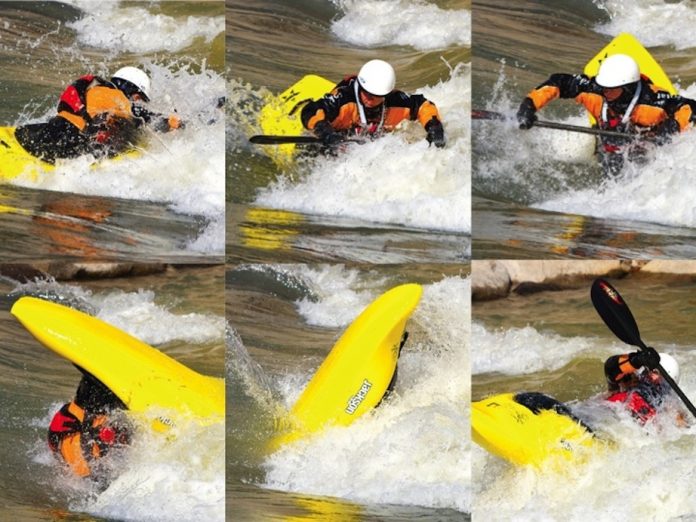
Freestyle Move: McNasty

Photos: Scott Sady
McNasty how-to

The venerable mcnasty has been around since 2002, when Eric Jackson invented the move—a bow pivot into a front loop—in his backyard rapids at Rock Island, Tennessee, and showcased it later that year at the IR Triple Crown.

For a long time, I studied footage of this move in awe, as the mechanics of it seemed way beyond me. I was finally able to demystify this trick by breaking it down into manageable parts.

1. Sidesurf in a hole with a foam pile. Rotate your body downstream to set up for a powerful reverse sweep.

2. Use the reverse sweep to push your bow into the foam pile so that your stern is upstream in a back blast. Your legs assist with the back blast: shift your weight slightly forward and push down on your heels, driving your feet under the foam pile. This will keep your stern from catching in the upstream flow.

3. It’s easiest to continue in the same direction started by your reverse sweep, using the spin momentum from that stroke. Look back upstream, rotate your torso and reach to your toes for a powerful forward sweep. This stroke pulls your bow deeper under the foam.

4. Drop your upstream edge slightly. This edge is going to catch, so there is a fine line between too much edge and just enough. The dropping of the edge allows you to pivot around your bow.

5. Hold the forward sweep as long as you can and keep pushing down on your heels.

6. When your boat pivots to where you are vertical and pointed upstream, jump forward to initiate a loop. If your loop lacks pop or your mcnastys are crooked, make sure you are facing all the way upstream before jumping.


This article originally appeared in Rapid, Early Summer 2011. Download our free iPad/iPhone/iPod Touch App or Android App or read it here.

Freestyle Move: Airscrew Clean Blunt

Photos: Patrick Camblin
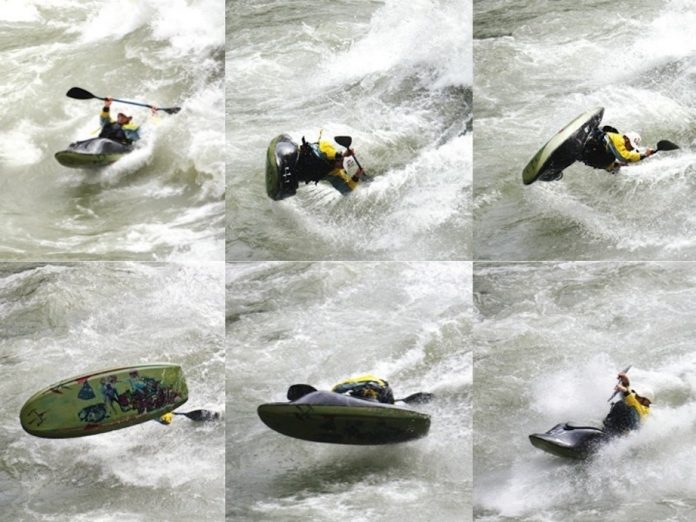
Airscrew clean blunt

The wave won’t do you any favors on this trick. As with most combo wave moves, however, a well-defined shoulder helps, the steeper the better. Once you can do snappy hull-to-hull airscrews on small waves, you are ready to tackle this combo.

These steps outline a left airscrew to left clean blunt.

1. Get high on the wave.

2. Start down the wave, put in a paddle stroke and bounce. Tilt the boat with your hips to land on your right edge.

3. As you land, start rotating your shoulders to the left so your paddle is in line with your boat. Keep the boat on edge and look down at the water—this will start your rotation.

4. As your boat releases, keep looking down at the water between your arms. Fix your eyes on this spot until the moment just before you go upside down.

5. Okay, here’s the key to a snappy airscrew and landing flat and ready for the next trick: Right before you go inverted, look over your left shoulder and PUNCH out with your right hand.

6. Use your right paddle blade as a rudder to keep your boat straight for the landing.

7. Tighten up your right side abdominal muscles as if you’re trying to touch your left elbow to your right knee. Do that now. Feel that? This is what will finish your rotation and get you ready for the landing.

8. Touch down. Now, in one quick motion let go of the rudder, rotate 
to the left and smoothly transfer your weight from your right edge to your left. Initiating this release is the hardest part because you won’t feel like you have a good enough bounce to throw a clean blunt.

9. Pop up and hit the water with your feet as you throw your arms away from your body. Be really aggressive—even if you have no bounce, throw your arms into the trick and look downstream. You may wipe out or just flat spin 180, or you might throw a stylin’ clean blunt.


This article originally appeared in Rapid, Early Summer 2011. Download our free iPad/iPhone/iPod Touch App or Android App or read it here.

4 Types Of Clouds To Help You Predict The Weather

person holding up a glass orb to reflect the setting sun and some types of cloud
Use these tips on cloud types for a quick DIY weather forecast. | Feature photo: Guy Kimola

Using cloud identification to forecast weather is a skill that mariners have used for hundreds of years. Watching clouds is simple and easy, yet it has been empirically proven that cloud observation as a means to predict the weather yields an accuracy of 60–75 percent. Not bad for just looking up. See illustrations of the different types of clouds—and what they mean—below.

4 types of cloud to help you predict the weather

Seasonal weather follows fairly predictable patterns in each part of the world. Different types of clouds form in very different ways in the atmosphere, depending on pressure and the moisture available. Since certain weather produces certain cloud types, observing clouds can tell you how and when the weather will change.

The key here is learning the basic cloud groups. Clouds are classified by shape and height, with names derived from Latin words describing their form. There are three basic categories you should commit to memory, as well as a fourth variation that deserves special notice.

cirrus clouds over a seaside mountain
Photo: Simon Fitall/Unsplash

1 Cirrus

Appearance (above): White, feathery looking patches and strands; usually spreading across the sky.

Prediction: Cirrus are high level clouds. These thin wisps are often the forerunner of approaching bad or unsettled weather. A gradually increasing cover shows that an approaching weather system will bring wind and possible precipitation. By observing their movement, you can tell from which direction the weather is coming.

In much of North America, cirrus clouds in the west or southwest quadrant of the sky usually indicate that the weather will change for the worse within 24 hours.

6583986639 d006655ae9 b
Photo: Wisconsin Department of Natural Resources

2 Stratus

Appearance: Uniform pale gray or white layer, looks like cheese cloth spread across the sky; can be translucent so that the sun or moon shows through as a hazy disk.

Prediction: High or mid-level stratus usually follow cirrus clouds. When they cover the entire sky, weather change is 12–18 hours away.

cumulus clouds over a lake
Photo: Neda Astani/Unsplash

3 Cumulus

Appearance: Puffy white cotton balls; if they begin to tower—become taller than they are broad—with flat bases and tops that look hard like the head of a cauliflower, they are called cumulus congestus.

[ Browse the widest selection of boats and gear in the Paddling Buyer’s Guide ]

Prediction: When cumulus remain the same size and shape and do not show signs of vertical growth, they are called fair-weather cumulus, meaning the weather will remain the same for at least 24 hours. If towering cumulus continue to grow, they can develop into cumulonimbus clouds with showers or thunderstorms within the next few hours.

cumulonimbus clouds at sunset
Photo: Raquel Pedrotti/Unsplash

4 Cumulonimbus

Appearance: Large cloud mass with very dark base and bright top that may flatten into an anvil-head.

Prediction: The rapid vertical growth and anvil-like shape of cumulonimbus indicate high winds within and above the clouds. These clouds can forecast some of the most extreme weather on the planet including very strong wind gusts, heavy rain, hail and lightning.

In North America, when you see these on the western or southwestern horizon, get off the water and seek shelter. The storm is often as little as one hour away, particularly when you hear thunder as well.

Cover of the Early Summer 2011 issue of Adventure Kayak magazineThis article was first published in the Early Summer 2011 issue of Adventure Kayak Magazine. Subscribe to Paddling Magazine’s print and digital editions, or browse the archives.


Use these tips on cloud types for a quick DIY weather forecast. | Feature photo: Guy Kimola


Wanigan Packing Tips

Illustration: Lorenzo del Bianco
How do you pack your wanigan?

This article on how to pack your wanigan and what to put in it was originally published in Canoeroots and Family Camping magazine.

While the traditional wanigan—that bulky wooden box, custom-built to fit snugly within a canoe’s contours—has largely been replaced by plastic tubs or barrels, its purpose has remained true: to cram as much kitchen stuff as possible. But one portager’s perfect stash is another’s albatross. Wanigans reveal trippers’ traits, classifying them as one of three wanigan personalities: extremist, minimalist or middle-malist. And there’s wisdom—and warning—to be dished from each camp.

“Most paddlers want to eat like they do at home,” says Andrew Rafton, an extreme tripper and waniganer who won’t compromise on meals. It’s why he invested in a food dehydrator and vacuum bag sealer, which allow him to fill his wanigan with all the fixings for everything from shepherd’s pie to pizza to cobbler. He won’t scrimp on his eco-friendly clean-up, either; he makes room for three—yes, three—folding sinks.

“That’s not gonna happen on any trip I take,” says Jason Picard. “Not even a luxury one.” A self-proclaimed minimalist tripper, Picard uses his cook pots as sinks, eschewing anything that only has one use.

In Eugene Mohareb’s barrel-cum-wanigan you’ll find plenty of lightweight just-add-water meals. Whereas Rafton needs his full assortment of spices, minimalist Mohareb is happy with his tiny vial of hot sauce. Picard does one better by loading up on individual packets of condiments when he’s at a deli counter.

Your wanigan’s contents may also depend on your camping skills. Take Barb Russell, who describes herself as a middle-malist and worked as a guide and chief cook for a tripping company. “A percolator takes up too much room in my wanigan,” she says, before describing how to make cowboy coffee by literally swinging a pot of hot water above your head. “So my kit always includes a billycan.”


The Minimalist

Swiss Army Knife
Butane canister stove
Folding bowls

One pot, its lid doubling as a pan
Instant oatmeal
Instant coffee, enjoyed black
Instant rice
Mac and cheese
Hot sauce

No utensils—a carved stick for stirring and shovelling food


The Extremist

Dehydrated veggies and meat

Fresh apples

Vacuum packed food

Three foldable sinks—wash, sterilize, rinse
Spice rack
Outback oven with thermometer
Double-burner stove with tins of extra fuel
Dutch oven with charcoal

Titanium utensils—full set

Spatula, ladle and whisk

Plates, bowls, cups and mugs

Percolator and fresh ground gourmet coffee
Tetra-pak milk and cream
Mixing bowls

Flour

Biodegradable dish soap
Dish towel

This article originally appeared in Canoeroots & Family Camping, Early Summer 2011. Download our freeiPad/iPhone/iPod Touch App or Android App or read it here.

Perfect Your Pry Canoe Technique

Photo: Joannie and Gary McGuffin.
Pry technique demonstrated.

This article on how to perfect your pry stroke was originally published in Canoeroots and Family Camping magazine.

All pries use the paddle shaft as a lever against the gunwale to move the canoe away from the paddle. The resulting action of the canoe differs depending on the placement of the pry, whether the canoe is moving (dynamic) or not moving (static), and whether the pry is used in a solo or tandem situation. These four useful solo maneuvers are performed using variations of this adaptable stroke.


Solo Offside Abeam

STROKE Dynamic pry


WHEN Use to move the canoe directly sideways away from the side you are paddling on.

HOW This pry uses short, quick motions to lever against the gunwale. Rotate your upper body toward the onside gunwale and place the paddle at your hip with the shaft vertical and the powerface of the blade against the hull. Pull the paddle grip across your chest. Once your control hand reaches the canoe’s center- line, turn your control thumb out and slice the blade back under the canoe to repeat.

TIP Think of your shaft hand as an oarlock, and keep the paddle shaft anchored to the gun- wale throughout. Avoid rocking the canoe back and forth as you pull.


Solo Offside Sideslip

STROKE Stationary pry


WHEN Use to sideslip the canoe around an obstacle without having to turn, change direction or sacrifice speed.

HOW Get some speed paddling forward. At the end of a forward stroke, turn your control thumb back and slice the blade into the hull at your hip. The powerface is facing the hull. the blade should be slightly angled in the direction you want to go. Keep the blade in this static position. Weight your onside knee so the canoe meets the least amount of water resistance as it moves sideways.

TIP: Adjust the paddle shaft slightly forward or backward of your hip to ensure that the canoe does not turn as it moves sideways.


Solo Offside U-turn

STROKE Sliding pry

WHEN Use to turn the canoe around 180 degrees without switching paddling sides. This elegant, exciting offside turn requires good boat control and balance.

HOW Initiate the turn with a forward sweep, edging the canoe to the outside of the turn. Following the sweep, knife the leading edge of the paddle blade to meet the hull. The paddle shaft is vertical and the force of the water is on the back of the blade. Smoothly slide the vertical paddle shaft along the gunwale toward the bow as far as you can comfortably reach, rotating your onside shoulder forward.

TIP Maintaining an upright body position (j-lean) is essential for keeping your balance.


Offside Capsize Recovery

STROKE Righting pry


WHEN Use to recover your balance and prevent a capsize to the offside. if you are tipping away from the side you are paddling on, the righting pry is a very effective and powerful correction that takes guts and commitment.

HOW Slice the paddle toward your hip, keep- ing the paddle shaft vertical. set the shaft against the gunwale and turn your control thumb back so the blade is parallel with the canoe. push down on the grip to submerge the blade deep in the water. pull the grip toward you, past the centerline.

TIP Push down on the grip and choke up your shaft hand to submerge the blade deep in the water for a successful pry.

—Words and photos adapted from Gary and Joanie McGuffin’s Paddle Your Own Canoe.


This article originally appeared in Canoeroots & Family Camping, Early Summer 2011. Download our freeiPad/iPhone/iPod Touch App or Android App or read it here.

Open Canoe Bracing Techniques

Brace yourself to never flip again. Photo: Virginia Marshall
Brace yourself to never flip again.

This open canoe technique article describes how to effectively brace and was originally published in Rapid magazine.
Any brace is a good brace—even if you high braced when you should have low braced or vice versa. Having your paddle in the water contributes to your stability.


FORWARD STROKE


When to Use: Flipping to either side.


Pros and Cons: The best brace is often a for- ward stroke. When a paddle is in the water with force against the blade, it’s extremely stabilizing. For beginners, doing a forward stroke takes the guesswork out of which brace to choose. The forward stroke has the additional benefit of keeping your canoe moving. Also, some paddlers become habitual low bracers—bracing their way down the river rather than paddling. Using the forward stroke as a brace will help break this habit.


LOW BRACE


When to Use: Flipping to your onside.


How to: With your paddle perpendicular to your canoe, slap the water with the back of your blade and use the momentary support to drop your head and move your body towards the opposite (high) gunwale.


Pros and Cons: Repeated efforts to low brace often result in the paddle sinking and the canoe flipping. Ideally, this brace is a one shot deal to recover and get moving. Doing a stationary brace has one drawback—it’s stationary. A boat is easier to control when it’s underway and this brace doesn’t provide momentum.


RIGHTING PRY


When to Use: Flipping to your offside.


How to: Hold your paddle vertically, blade in the water at your hip and lever off the hull with your top hand.


Pros and Cons: This is an unbelievably solid way to keep your boat upright but it takes presence of mind to employ. The force that’s created from levering your paddle off the hull is very strong. Avoid mashing the thumb of your lower hand between your boat and paddle by keeping it on top of the shaft with the rest of your fingers.

When you’re tipping to your offside, the water feels a long way from your blade. A key part of an effective righting pry is reaching to place your entire blade in the water. Unlike the low brace, the righting pry is often most successful after multiple attempts as you continue to work at finding purchase in the water.


HIGH BRACE


When to Use: Flipping to your offside


How to: Reach your paddle over the high gunwale and grab the water as if you were doing a draw.

Pros and Cons: Much maligned as the least effective brace, it nevertheless looks spectacular in photos. Be aware there is concern that doing a high brace may cause shoulder injury. A good rule of thumb to avoid injury is to stop doing the high brace if you find your lower arm is being forced away from your rib cage.

No matter which brace you use, bring your head and body back over the canoe’s centerline to restore stability.

Remember—even if you have the perfect paddle position for a brace, it’s worthless unless you right the boat and correct your center of gravity.


This article originally appeared in Rapid, Early Summer 2011. Download our free iPad/iPhone/iPod Touch App or Android App or read it here.

Technique: Rappel to the River

Photo: Maxi Kniewasser
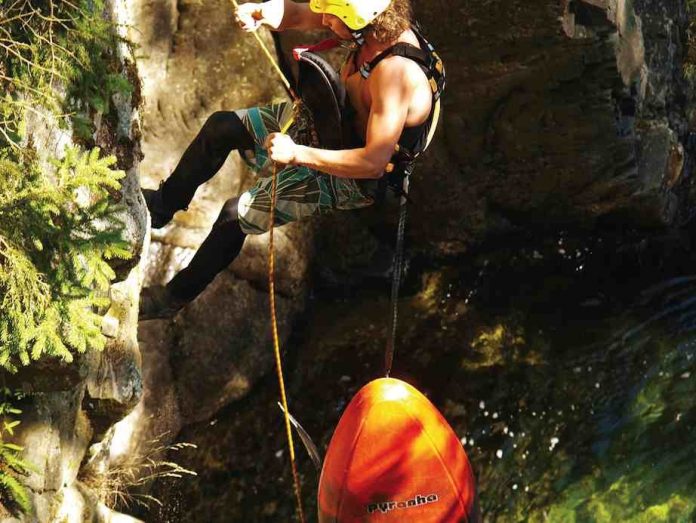
Rappelling to the river.

This technique article discusses how to rappel with your kayak to the water and was originally published in Rapid magazine.

Steep walled canyons make accessing some runs a challenge. Down climbing often seems easier but when done properly, rappelling makes canyon access much safer.

Kayakers don’t usually carry heavy climbing gear so we have to do our best with a limited set of tools. Master these four basic components to a rappel and you’ll be tackling runs otherwise left behind.

Anchors

Sturdy trees make great anchors. Tie a segment of nylon webbing around the base of the tree using a water knot and clip on a locking carabiner. Wrapping the rope direct- ly around the tree can damage both the tree and the rope. If a tree isn’t available, artificial anchors such as nuts or pitons also work, though these require more expertise to set securely. Always place two or more artificial anchors to provide adequate protection.

Rope

Think about rappelling when selecting a throw rope. Only rappel off throw ropes with a Spectra core because it’s the strongest option. Spectra has a low melting point so rappel slowly or wet the rope be- forehand to help dissipate heat from friction. Getting adequate rope length may require tying two throw ropes together using a double fisherman’s knot. To ensure the rope doesn’t get caught, untie it from the bag. Feed the rope through the locking carabiner that is attached to your anchor. On more popular runs, secure a fixed line.

Rappel Devices

A harness can be improvised with a long sling. To control your descent, attach a friction device to a locking biner affixed to your harness’ belay loops. A figure eight or ATC are common mechanical friction devices. If you’re rappelling on a single throw rope or fixed line, a Munter hitch can also be used, requiring one less piece of hardware.

Rappeller

To descend in control, face the wall with feet shoulder-width apart and lean back slowly, keeping the rope taut, until your legs are perpendicular to the slope. The breaking hand controls the speed the rope travels through the friction device and must always remain on the rope.

Boats should be lowered separately unless you are descending straight into the water. In this case, secure the kayak to a cowtail attached to a quick release belt on the your PFD. Be prepared for the extra weight to pull you off balance. Another option that’s easier on the rappeller but takes a little longer is to tie the boat directly into the rope.

When paddling with a large group, keep in mind that rappelling is fairly slow and creates bottlenecks. For more information refer to the latest edition of The Mountaineers Books’ Freedom of the Hills.


This article originally appeared in Rapid, Early Summer 2011. Download our free iPad/iPhone/iPod Touch App or Android App or read it here.

Clipper Sea-1 Canoe Review

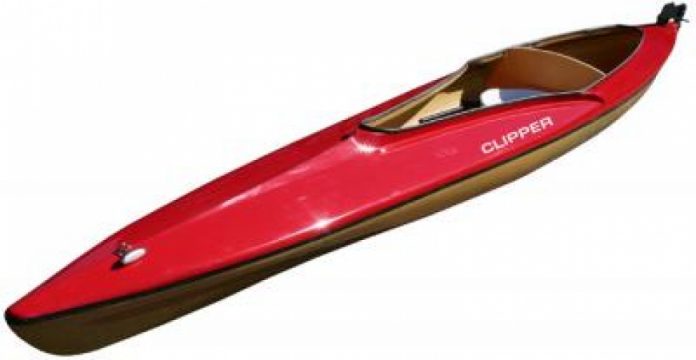
Photo: Clipper Canoes
Clipper Sea-1 Decked Canoe

Review of Clipper Canoes Sea-1 decked canoe from Canoeroots and Family Camping magazine.

The Sea-1 is ideal for wilderness sea touring and can be paddled with either a canoe or kayak paddle. A large cockpit provides easy access to cargo. The flared bow rises over and sheds waves in even the most adverse conditions. The V-hull provides excellent tracking and a rudder is standard. The Sea-1 has built-in foam flotation in the bow and the stern. Nylon spraydeck and contoured yoke are available options.

Clipper Canoes Sea-1 Specs

Length: 17’9″
Width: 28″
Hull Material: Fiberglass
Weight: 65 lbs
MSRP: $2,800
Available in Kevlar: $3,475 and 55 lbs


This article originally appeared in Canoeroots & Family Camping, Early Summer 2011. Download our freeiPad/iPhone/iPod Touch App or Android App or read it here.

Nova Craft Rob Roy Canoe Review

Nova Craft Rob Roy Canoe Review
Feature image: Courtesy Nova Craft

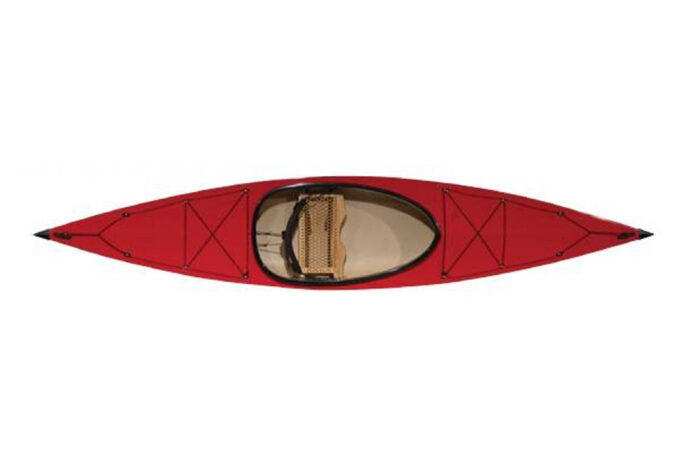
The Rob Roy is an excellent choice for solo paddlers who want a fast, stable cruising boat that still handles well in windy and wavy conditions. Small, easy to portage and highly maneuverable, it has enough cargo space for a week of interior tripping. The Rob Roy combines the enjoyment of canoe tripping with the versatility of a kayak.

Photo: Nova Craft
Feature image: Courtesy Nova Craft

Nova Craft Rob Roy Specs

Length: 13′
Width: 29″
Hull Material: Fiberglass
Weight: 45 lbs
MSRP: $1,699

Available in ultralight Kevlar caron/Spectra for $2,999 at 32 lbs

www.novacraftcanoe.com


This article originally appeared in Canoeroots & Family Camping, Early Summer 2011. Download our freeiPad/iPhone/iPod Touch App or Android App or read it here.

 

Stellar Kayaks S16 Kayak Review

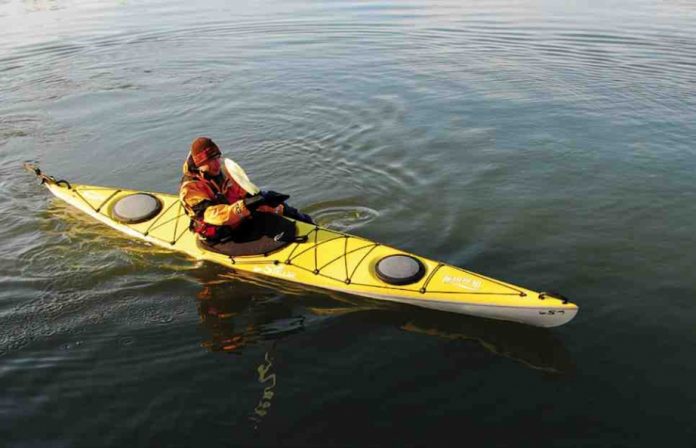
Photo: Tory Bowman
Stellar Kayaks S16 Kayak

A review of Stellar Kayaks’ S16 from Adventure Kayak magazine.

Launched in 2008, Stellar Kayaks is a true child of globalization, harnessing North American and European engineering, Asian manufacturing and the efficiencies of world- wide distribution. The S16 Advantage blends the best of these worlds, offering outstanding value and exceptionally light weight in a capable, all-around day tripper and tourer.

The S16’s hull shape is classic, reminiscent of early West Coast designs—soft chines and a shallow-arch bottom. The streamlined shape stems from the designers’ background in the rowing industry crafting shells for WinTech Racing. Stellar applied sophisticated computer design to the problem of efficiency, stating, “When it comes to speed we strive to get as close to a cylindrical hull cross-section as we can, while still being able to keep the boat upright.” A rounded cross-section produces less wetted surface area with less drag than a comparable hard-chined kayak. Evolution endowed the same common sense hydrodynamics to whales and sea lions.

The end result is a kind of computer-engineered perfection, the optimization of a touring kayak’s various competing requirements—speed, efficiency, stability, carrying capacity, durability, weight and price—in a utilitarian package. The S16’s looks lack some of the personality of more whimsically fashioned kayaks, but it’s hard to argue with a formula that works.

The S16’s initial stability hits the sweet spot, lively in rough water and easy to edge without feeling twitchy. High volume above the waterline provides a reassuring zone of secondary stability and contributes to excellent storage capacity and dry decks. Turning is a breeze—four sweeps to turn 90 degrees on an even keel; just a couple when edging. Tracking is moderate and the rudder helps with any issues there.

Great value all-round touring kayak

Some features of the S16 feel bare bones—simple bolted-on grab handles, absent day hatch, thinly padded thigh braces under the spare coaming of the oval cockpit (I’d prefer a keyhole shape with more surface to grip the thighs). But the deck is clean and neatly finished with recessed fittings and drain channels around the hatches. The most distinctive element is also characteristically functional: cutaways near the knees for paddle clearance during high-angle strokes.

Where the S16 shines brightest is its highly engineered composite construction. Stellar offers four layups priced $1,845 to $4,310 US. Our Advantage, though only the second-tier, is an impressively stiff and svelte 37 pounds and priced well below many comparable, much heavier, competitors. Between layers of fiberglass, Stellar sandwiches a core material called Soric, a polyester membrane also used in fighter jets and wind turbines that adds thickness and strength without the weight of additional glass layers.

Priced to rival plastic, the Advantage offers a stunning value for such a lightweight layup. This feature alone should put it high on the list for anyone looking at a 16-foot, all-around touring kayak in the $2,000 range.

Spacious and Space-Age

Stellar hatch covers are domed to shed water and snap on and off with ease.

Easy Drop Rudder

We love how easy it is to deploy and retract the drop-down Kajak Sport KS- Navigator rudder.

Fancy Footwork

Two-piece pedals with rudder control on the upper half allow steering finesse, power and a stable foot platform—a plus in rough conditions and for rolling.

Stellar Kayaks S16 Specs

Length: 16 ft
Width: 22 in
Weight: 37 lbs
Capacity: 50 lbs
Price: $2,330 US/CDN

www.stellarkayaksusa.com

This article originally appeared in Adventure Kayak, Early Summer 2011. Download our free iPad/iPhone/iPod Touch App or Android App or read it here.