- The Hudson’s Bay Company (HBC) is the oldest incorporated merchandising company in the English-speaking world. When you buy socks at The Bay you’re continuing a 338-year-old tradition.
- During the first half of the 19th century, the HBC held sway over 1/12th of the earth’s land surface—allowing HBC overseas governor Sir George Simpson to be introduced at a fancy 1838 dinner as the “head of the most extended dominions in the known world, the Emperor of Russia and the Queen of England excepted.”
- Although HBC are the initials of English heart-throb actor Helena Bonham Carter (who has never portrayed a beaver but did appear as a chimp named Ari in Planet Of The Apes), HBC also once stood for “Here Before Christ” in the minds of traders frustrated by the company’s monopolistic ways. Those who found themselves inside isolated fur trading posts often left thinking HBC stood for “Horny Boys’ Club.”
- In a related story, it is rumoured that Sir George Simpson sired 70 children between Quebec and the Pacific during 40 years with the HBC, lending legitimacy of a sort to his title of father of the fur trade.
- The original Latin motto of the HBC, pro pelle cutem, meaning “a skin for a skin,” sounds benign enough for a fur trading company, until one realizes that these words were interpreted by employees to mean that to join the fur trade they had to trade their own skin for the brutal and short life of a fur trader.
- The iconic voyageur canoe paintings of Frances Anne Hopkins notwithstanding, after 1820 most HBC freight was carried not in canoes but in boats fashioned after Orcadian dories that were rowed, not paddled.
- Though many assume that 19th-century Canada was buzzing with folk-song-singing French-Canadian and Métis voyageurs, 80 per cent of HBC employees at the time were stolid Scots from Orkney, who had as much trouble carrying a tune as they did their heavy dories.
 This article first appeared in the Summer 2008 issue of Canoeroots Magazine. For more great content, subscribe to Canoeroots’ print and digital editions here.
 This article first appeared in the Early Summer 2008 issue of Rapid Magazine.
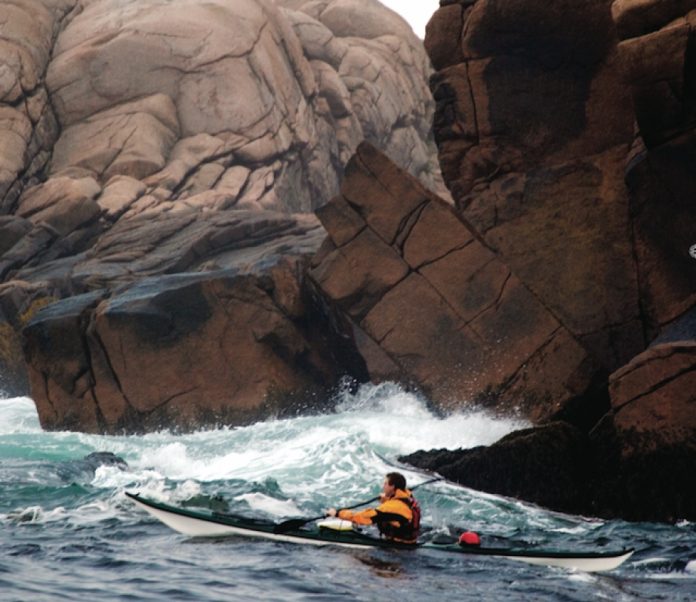
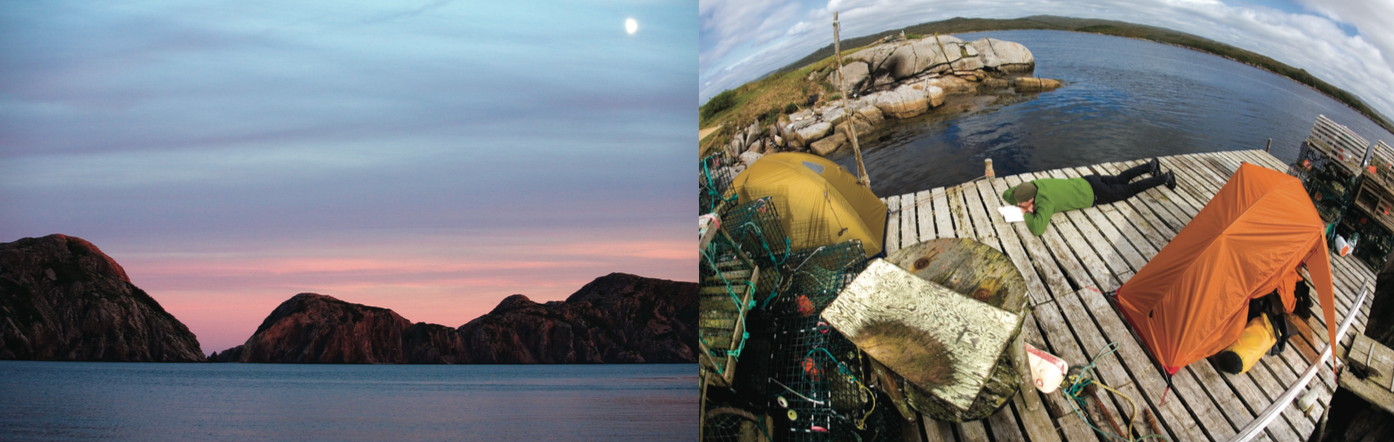
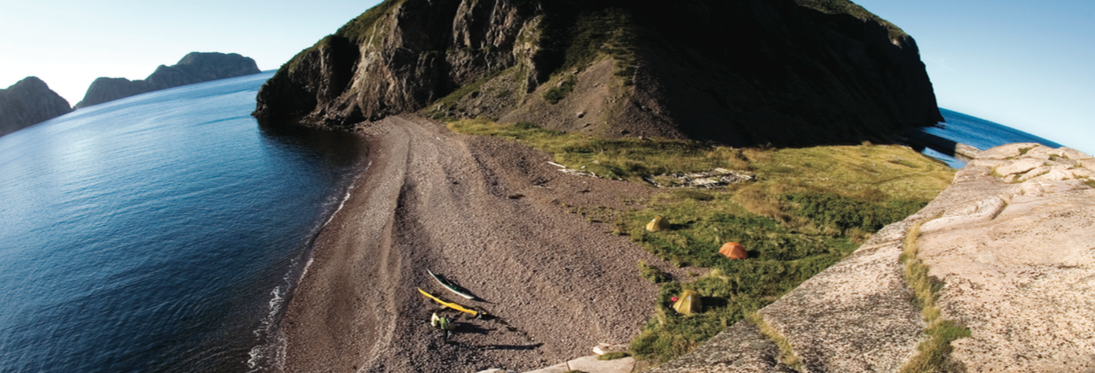
 We spend two days at Cape La Hune not because of miserable weather—by now the Southwest Coast is fully enveloped in a 1,025-millibar high—but because it’s so hard to leave. Hiking up the breadbox-shaped peak behind the campsite oc- cupies an afternoon with scrambling up sloping rocks and crashing through tuckamore thickets of dwarf birch and fir trees. From the top, the Atlantic stretches uninterrupted to Antarctica, save for the inconspicuous dots of the French islands of St. Pierre and Miquelon to the south- east. Facing inland, La Hune Bay cuts a granite corridor through a sweeping expanse of tucka- more and barrens. On the treacherous descent I find an old threadbare rope—proof that the Cape La Hune outporters did more than just fish. Later on, I watch the moon rise over the rockbound coast from within the foundation of the old church, imagining the building itself departing on a barge bound for the horizon.
 This article first appeared in the Summer 2008 issue of Adventure Kayak Magazine. For more great content, subscribe to Adventure Kayak’s print and digital editions