Home Blog Page 345

Getting To Know James Bay, The Schoolyard Bully

Photo: Frank Wolf
Friend or Foe

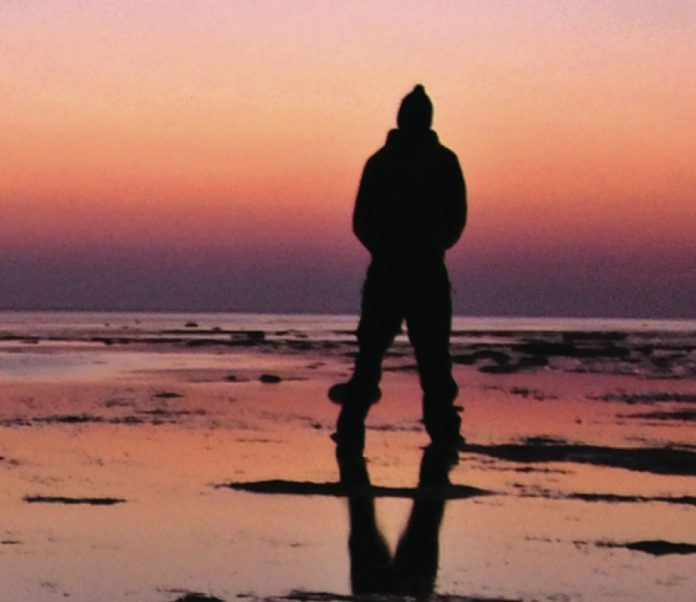
My fear of this bay is leaving me. I’m standing in my shorts, waist-deep in the Arctic Ocean. Silt-laden, caramel water stretches out endlessly in all directions except south, where the lowlands appear as a sliver on the horizon. The late August sun is high and hot, backed by a bluebird sky. Our canoe bobs beside me as I fix the camera to the bow in order to get some tandem paddling shots of my partner Alex and me. He is relieving himself, whistling happily as he takes in the vastness of it all.

Unrelated to Alex’s urinary tract, the water of James Bay is surprisingly warm and sweet. Dozens of giant rivers in Ontario and Quebec pour countless tonnes of freshwater into it every day, raising the temperature and diluting it to the point that its salinity is undetectable. At this moment, lingering in its embrace, James Bay seems more lake than ocean—and is far friendlier than I could ever have imagined.

[ Paddling Trip Guide: View all canoe trips in Ontario ]

It’s our first day paddling the 70-km stretch from the mouth of the Harricana River to Moosonee, Ontario. We began our journey 23 days and 1,000 km ago on Algonquin Park’s Opeongo Lake, but everything leading up to James Bay was merely a preamble. I’ve read accounts of wicked storms, brutal mosquitoes and being trapped out on the tidal flats. Camping is supposed to be marginal at best as the surrounding landscape is made up primarily of wetlands; great for birds and bugs but not so great for canoe trippers. Most groups that paddle the Harricana arrange a plane or motorboat shuttle back to Moosonee in order to avoid the crossing. To me, James Bay was like the schoolyard bully with a bad reputation who no one talked to but everyone feared.

Our magic carpet has been pulled out from underneath us to reveal a damp clay floor that is now our home for the night.

Tidal flats on James Bay sometimes extend 10 km from land. This makes it easy to hop out in the shallows to do your business, but it also means an outgoing tide is capable of leaving you stranded kilometers deep in the no-man’s land between water and shore. That is the only thing on our minds. We are ready to camp one night on the bay, but we know one thing above all else: we do not want to get stranded on the tidal flats.

Using our tide tables, we had planned to hit James Bay on the flood, paddle hard for 30 km to Little Netishi Point to camp on dry land, and then finish the trip off the next day.

Everything is going as planned after starting on time, but we soon find ourselves pulling up a river-like channel as the rising tide rushes in to shore.

The channel is a slog but it lets us avoid the long peninsula-like tidal flat that juts out to the north from the mouth. Once through the channel, we stay well offshore in order to paddle without striking bottom with every stroke.

The end of the day nears and our GPS has us homing in on Little Netishi Point. It’s around this time that we pause for Alex’s pit stop and for me to feel complacent. We are on schedule to make it in plenty of time but, inexplicably, we paddle past and keep going. The next point is just 5 km further, the water is calm, and we can make it easily—or so we think.

A couple of clicks beyond Little Netishi our paddles begin to repeatedly bump the ground. The tide is ebbing. We try to head to shore, but to no avail. When the tide goes out on James Bay, it goes like a drag racer. Within minutes we can no longer see water. We are stranded. Our magic carpet has been pulled out from underneath us to reveal a damp clay floor that is now our home for the night.

Suddenly confronted by another aspect of this bully, he again seems to be a pretty decent guy. The tidal flats are firm and level—exactly what you look for in a good campsite. We deal with the excessively damp surface by lining the bottom of our tent with a tarp. The unencumbered breeze keeps the notorious James Bay mosquitoes under control as well. They’re still present in impressive numbers, but are limited to tucking behind us in the wind-eddy created by our bodies. We merely have to step aside and they are blown into oblivion.

An additional bonus is that, since Nunavut lays claim to all of James Bay and its intertidal zone, we can add a territory to the two provinces we’ve already camped in during our journey.

Before tucking in for the night, we consult our tables and set our alarms for 3 a.m. so we won’t be washed awake by the incoming tide. Stirring at this pre-dawn hour, we’re treated to the full cycle of sunrise over the unencumbered curve of the Earth. With us packed and ready to go, James Bay returns on cue and buoys us to paddle on.

Our final day is hard work. We battle steep chop, a headwind, and the current of the Moose River before making Moosonee by mid-afternoon. Landfall is euphoric. I’ve completed another journey and, more importantly, made friends with the schoolyard bully.

This article originally appeared in Canoeroots & Family Camping‘s Spring 2009 issue. Subscribe to Paddling Magazine’s print and digital editions here, or browse the archives here.


Frank Wolf is a Vancouver-based writer. He last wrote about paddling the boreal forest in the Summer 2008 issue of Canoeroots.
Editorial: Life After Death

Photo: Conor Mihell
Editorial: Life After Death

In this issue’s Tumblehome column, our resident sage James Raffan enthuses that the active chatter on Internet forums allows far-flung canoeists to connect with each other.

Of course, they don’t always agree. Last fall the Canadian Canoe Routes forum debated the removal of the bronze cross on Algonquin Park’s Petawawa River that commemorated Blair Fraser’s 1968 drowning.

The anonymous vandal apparently thought he was defending wilderness by taking a hack saw to a three-foot cross in a park that is 78 per cent tree farm.

True, not everyone who has slept in a tent needs to be immortalized in the wilderness after death, but Blair Fraser wasn’t just any paddler.

Fraser, Eric Morse, Sigurd Olson and a half-dozen others made up the latter-day Voyageurs, a group of prominent Canadians and Americans who, in the 1950s and ‘60s, retraced the fur trade routes of the real voyageurs.

This would be commonplace now, which is just the point. Back then it was a new idea to embark on gruelling wilderness canoe trips for recreation. They became media darlings. The Toronto Star even chartered a plane to intercept them on the Churchill River.

“The media’s interest could scarcely have been greater had the Archbishop of Canterbury been discovered making a northern canoe trip with the Pope,” remarked Morse in Freshwater Saga.

Though the Voyageurs were just out for a good time, the timing was such that they spearheaded a growing appreciation for the cultural history of a nation that had, at its core, a landscape explored, settled and still best-travelled by canoe.

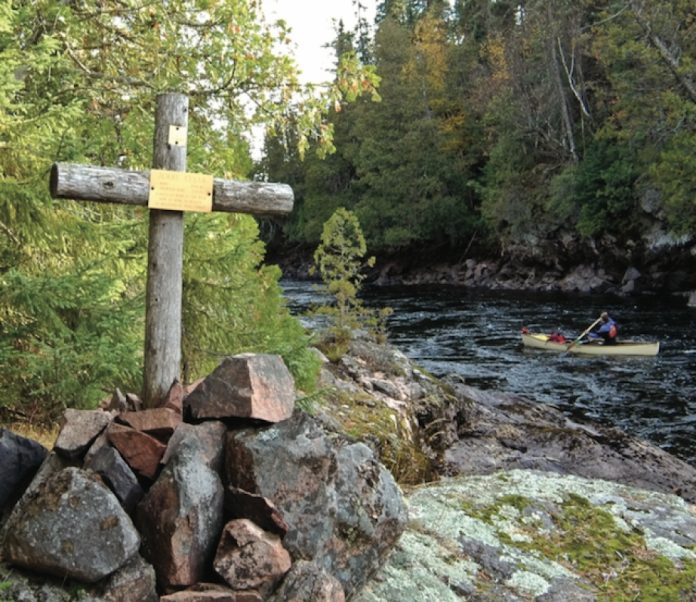
Without the kick start Fraser’s Voyageurs gave to conservation, paddlers would have had a harder time convincing the rest of the country that wild waters are central to our history, our future, and worth preserving. This fight continues. The cross in the photo above isn’t Fraser’s cross, it’s for a paddler who drowned on Lake Superior’s White River. But it might soon also be commemorating the waterfall just downstream. It is the second of three hydro sites proposed for the White, the first site was finished last fall.

Fraser’s continuing relevance can also be read into Amy Stuart’s report on what Canada’s high urbanization and immigration rates mean for canoeing. Fewer and fewer Canadians are growing up with a family tradition of canoeing. Will canoeing be marginalized by changing demographics?

If the answer is no, it’s because of something Fraser identified 40 years ago. In The Search for Identity (a book of political history, not new-age introspection) he wrote of the Canada he knew. “This land is still empty. …its portages still well marked, its lakes and streams still clean. Most Canadians have never seen this wilderness and never will. It is too far away. But it is typical of something that is within the easy reach of every Canadian, urban or rustic—an empty area of forest or plain in which a man can still en- joy the illusion of solitude. This is the quality that makes Canada unique and gives root to Canadian patriotism.”

An idea—and a paddler—worth remembering. 

This editorial article was published in the Spring 2009 issue of Canoeroots magazine.

This article first appeared in the Spring 2009 issue of Canoeroots Magazine.


Making Contact

Photo: Ron Hollingworth
Making Contact

One of the great joys of working at The Canadian Canoe Museum is opening the mystery packages that float in over the transom every so often. The most recent of these was a large padded envelope from St. Albert, Alberta, which contained a story that was as thought-provoking as it was sad.

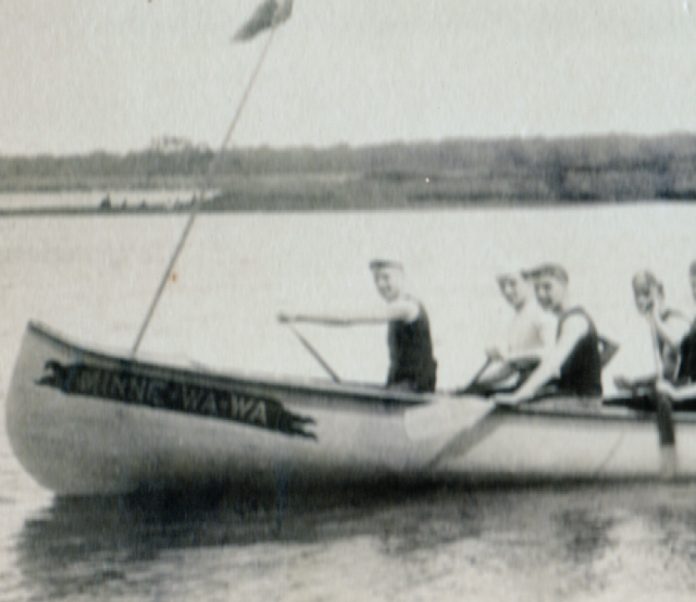
Inside was a matted sepia photograph showing a crew of healthy young men from the Grand Trunk Boating Club in Montreal paddling a 30-foot war canoe called the Minne-wa-wa. It was dated July 2, 1892. There is a mix of characters in the boat— smiling lads in dark singlets showing off their muscles, a couple of aboriginal guys, probably from the Mohawk territory of kahnawake, and even a few older chaps in ties and dress shirts with the sleeves rolled up for regatta action against rival clubs on the mighty St. Lawrence River. There are club caps and fedoras. It’s a crew looking proud and happy after a big win.

The story took a turn when I opened a booklet that came with the photo. What looked like a prize ribbon fell out onto my desk. It said “Minne-wa-wa War Canoe,” but instead of being brightly coloured the rosette on the ribbon was black. And in the program the truth was told.

The crew had paddled from their home boathouse near what is now the base of Montreal’s Champlain Bridge to a regatta downriver at Isle Sainte-Hélène. They triumphed in the race, but on the way home they capsized and six of the crew of 17 drowned. The caption indicated that the photo had been taken about an hour before the accident.

That got me thinking about memory and what we as canoeists choose to remember and share with each other. Who knows what kind of footwear these paddlers had on, or how well suited their clothing was to swimming, or if they could swim at all? And they were certainly not wearing floatation devices (which, of course, was the order of the day for canoeists right up to the late 1960s).

So there was the Minne-wa-wa upset with multiple loss of life in 1892 in Montreal. But, with no apparent appreciation of this unnecessary loss of life, the same thing happened again in 1926 on Balsam Lake in Ontario—war canoe upset, multiple deaths. People then wondered how such a terrible thing could have happened. And then more or less the same thing happened in 1978, when four big canoes upset on Lake Temiskaming resulting in the deaths of 12 boys and a master on a high school canoe trip. 

It’s never been so easy for far-flung but like-minded canoephiles to communicate

True, the Temiskaming kids were wearing lifejackets and most succumbed to cold instead of drowning, but at the time people wrung their hands and asked, “How could this have happened?” As though it had never happened before.

All of which reminds me how important it is that people of like minds and common interests communicate, so that the stories—of triumph and of tragedy—can be passed on. Although the Grand Trunk Boating Club is no more, at least four of the original nine clubs that in 1900 formed The Canadian Canoe Assocation—and many more like them—are there for people to join. 

Recreational paddlers have provinvial organizations and national groups like Paddle Canada devoted to connecting padllers with other and with the stories of the sport. There are films, television networks and magazines like this one that connect people as well.

And, of course, in today’s electronic universe there are growing and sprawling virtual aggregations of paddlers. They travel the waterways of the web, such as the bulletin board at canoecountry.com or the Wilderness Canoe Association’s lively Canadian Canoe Routes forum, twittering with late-night chatter about everything from bollards to books, safety tips to winter trips and recipes to races. Never before has it been so easy for far-flung but like-minded canoephiles to cimmunicate with one another, and that represents a true strength and great opportunity for a different sport such as our own. 

And, when all else fails, there is mail—the venerable Canadian Postal Storage System— where a well-placed package from one paddler to another can pass on an instructive tale or two. Thank you Ron Hollingworth, of St. Albert, Alberta, for taking the time to write. 

This article on connecting paddlers was published in the Spring 2009 issue of Canoeroots magazine.

This article first appeared in the Spring 2009 issue of Canoeroots Magazine.


Editorial: Rock of Ages

Photo: Jim Baird
Editorial: Rock of Ages

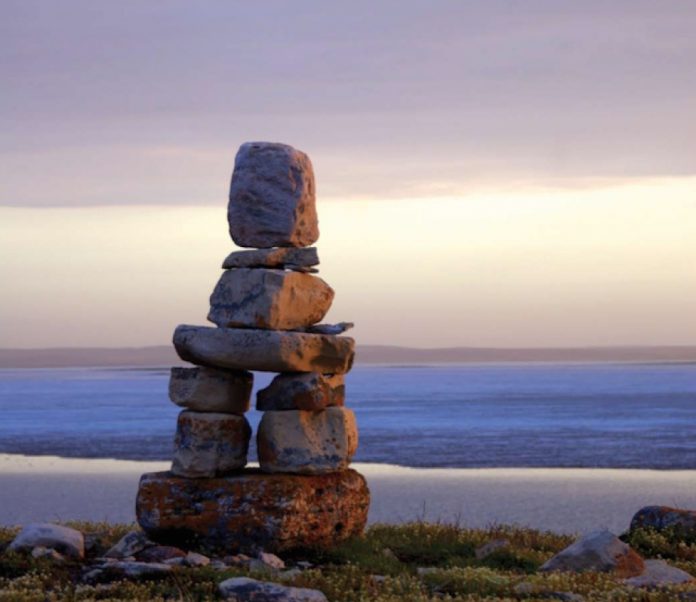
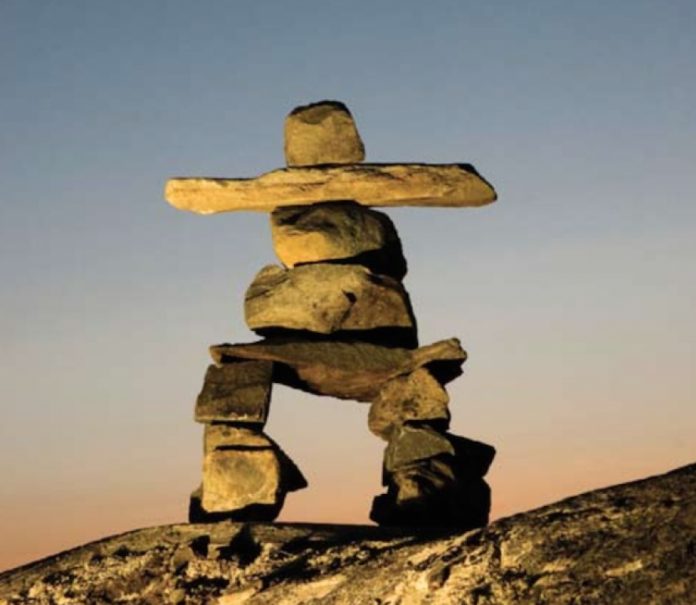
It would be incorrect to say, “I’d like to launch my canoe, but there are so many inukshuks lining the shore I fear for the safety of my shins.” As plausible as this sentence is, the correct plural of inukshuk is inuksuit.

Pluralizing inukshuk was once something you rarely had to do, but enough would-be adventurers now so enjoy piling rocks into human-like figures that the lonely inukshuk has become a plurality.

Killarney Provincial Park in ontario has reacted by declaring them granite non grata. The backlash really got going when an inukshuk was adopted by the Vancouver 2010 Olympic Games. Anti-corporate wilderness travellers declared inuksuit to be unfashionable eyesores.

What’s the problem, you ask? The inuksuit were confusing hikers in Killarney, where trails are marked with stone cairns. other objections are ecological in nature (the rocks are habitat for critters that are entitled to a cold, wet place to live) and cultural (southern inuksuit represent a co-opting of Inuit culture).

To these I add the tragic tale of how they slowed my progress down Quebec’s Noire River.

On day two we began noticing somewhat organized piles of rubble peeking out from rocky points. My trip mate—let’s call him Destructor—decided they had no place on the river and vowed to eradicate them.

The inuksuit ballooned in number as we paddled and Destructor began criss-crossing the river on an increasing frequency. our pace slowed as he tried to squeeze blood from stones.

As Destructor showed, the real menace is that inuksuit might divide the paddling community into two groups: one that likes to create while they recreate and another that won’t abide signs of a human presence near portage landings. But recent events show paddlers can’t afford to be fragment- ed like feuding religious sects.

To see why, consider John and Jim Baird. John Baird is Canada’s minister responsible for transportation. He’s the man who has dismantled the Navigable Waters Protection Act (NWPA), a 126-year-old law that protected both waterways and each Canadian’s right to paddle them. It was a law that said rivers were important for six generations of Canadians, and now it doesn’t.

Last summer Jim Baird and his brother Ted paddled the Kuujjua River on Victoria Island in Canada’s high Arctic. There they saw real inuksuit and stone cairns, some 300 years old, that had been built not because of an excess of ego or spare time, but because they served important functions in a severe land.

At Minto Inlet they stopped at a squat, man-sized cairn that housed a message from a party that had passed that way 157 years ago while searching for the Franklin Expedition.

The Bairds left the cairn standing of course. Victoria Island isn’t the sort of place that tolerates those who act rashly on the land or dismiss the past.

The law John Baird knocked down was only 31 years younger than that stone cairn. By pointing to a temporary downturn in the business cycle as the reason the NWPA had to go, Baird demonstrated all the wisdom of a pile of rocks, but none of the steadiness.

Until the NWPA is reinstated, inuksuit may be the only things standing guard over the places we paddle. Perhaps we should embrace them as our own, and consider them new recruits in an army of resistance gathering where they are most needed. 

This article on inuksuit was published in the Early Summer 2009 issue of Canoeroots magazine.This article first appeared in the Early Summer 2009 issue of Canoeroots Magazine. For more great content, subscribe to Canoeroots’ print and digital editions here.
Field Repair: Bring ’em Back Alive

Photo: Peter Mather
Field Repair: Bring 'em Back Alive

Nothing causes panic on a remote river trip like serious damage to your canoe. However, with a black bag of just five items and the skill of a drunken surgeon you can repair even large, gaping gashes in whitewater hulls.

Even though Royalex boats have a toughness approaching elephant hide, they can rip if a loaded or water-filled boat meets just the right knife-edged rock.

To patch a small tear you need heavy-duty duct tape, which means at least 13-mils-thick with a tensile strength of 45 pounds (look for Polyken by Covalence Adhesives). Normal duct tape is weak, barely adhesive and readily delaminates.

Clean the torn area inside the hull and flip the canoe over so you can slide your camp stove under the canoe below the tear. Apply the duct tape to the inside once the damaged area is clean, dry and very warm. Applying the tape to the outside of the hull or to the inside if the hull isn’t warm is just a waste of great tape.

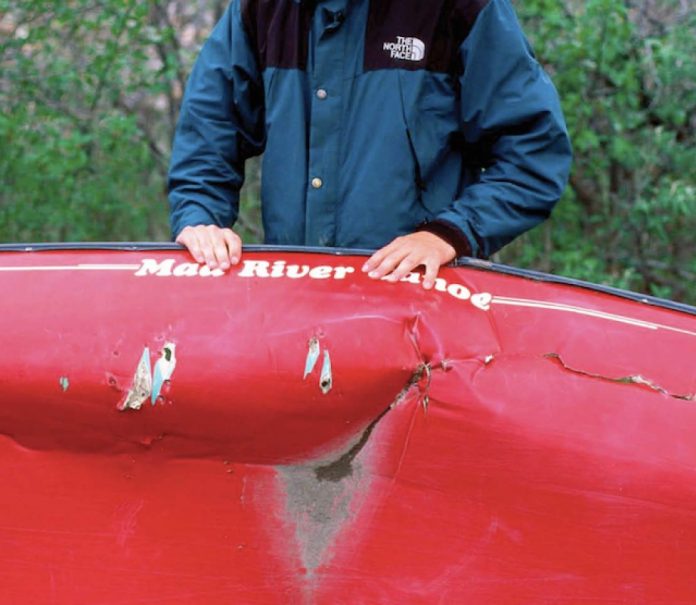
If your ABS canoe wraps on a rock in fast current your hull will likely only become hideously creased, but it is possible that the hull will rip in an even more dramatic way.

WHAT YOU NEED IN YOUR TEAR KIT

Assuming you can drag the carcass off the rock, the repair requires a spool of 19-gauge stainless steel wire (from most hardware stores) and a four-inch nail. Kick out the hull to its normal shape the best you can. Heat the nail and melt holes on either side of the tear, then stitch the boat together with the wire. Cover the fine stitching with proper duct tape on the inside after first warming the hull. With this unbraided stainless wire you can fix any number of things: seats, broken hanger bolts, thwarts, paddle shafts. Don’t leave it at home.

For chemists, there is a way to actually plug the hole left by a tear or puncture. Black ABS plumbing pipe will initially dissolve in acetone before setting to become hardened plastic once again. Before the trip, reduce a section of pipe to shavings with a rasp and pack a small amount of acetone in a can or padded glass jar. If you need to plug a hole on the trip, mix acetone and ABS shavings until they reach the consistency of gravy. Fill deep gashes with a few consecutive layers, allowing the acetone to evaporate and the ABS to harden between coats.

This gunk is about the only material you can use on the outside of ABS boats. Make your job easier by first backing it up with a warm application of duct tape on the inside.

With this tear kit you can float your way out of situations that would otherwise end your trip. 

This article on backcountry canoe repair was published in the Early Summer 2009 issue of Canoeroots magazine.This article first appeared in the Early Summer 2009 issue of Canoeroots Magazine. For more great content, subscribe to Canoeroots’ print and digital editions here.
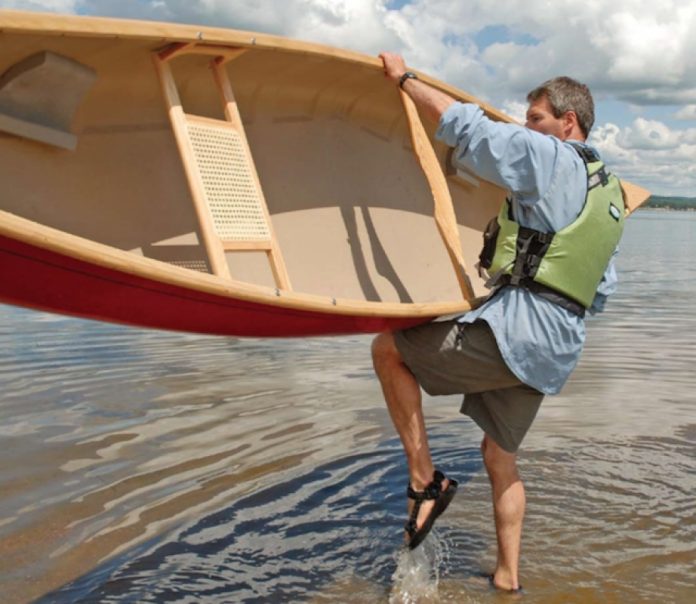
Skills: One-Person Canoe Lift

Photo: Paul Villecourt/Helipress.com
Skills: Get a Leg Up / Photo: Paul Villecourt/Helipress.com

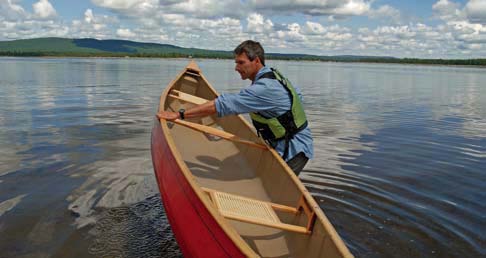
The thought of tossing a 16-foot canoe over your head and down onto the base of your neck can be intimidating—until you’ve been schooled in the finer technical points of the one-person canoe lift. As impressive as it looks, the weight of the canoe is easily managed by most canoeists. The secret is to position yourself properly, let your legs do the heavy lifting and be sure to keep good time when you rock and roll the canoe onto your shoulders.

Skills: Get a Leg Up / Photo: Paul Villecourt/Helipress.com
Photo: Paul Villecourt/Helipress.com

Step 1

Find an area with no obstructions, stand at the centre of the canoe and grasp the closest gunwale with your hands about shoulder-width apart.

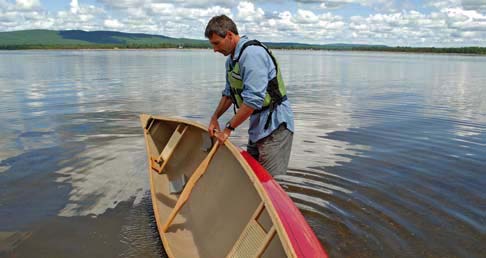
Photo: Paul Villecourt/Helipress.com

Step2

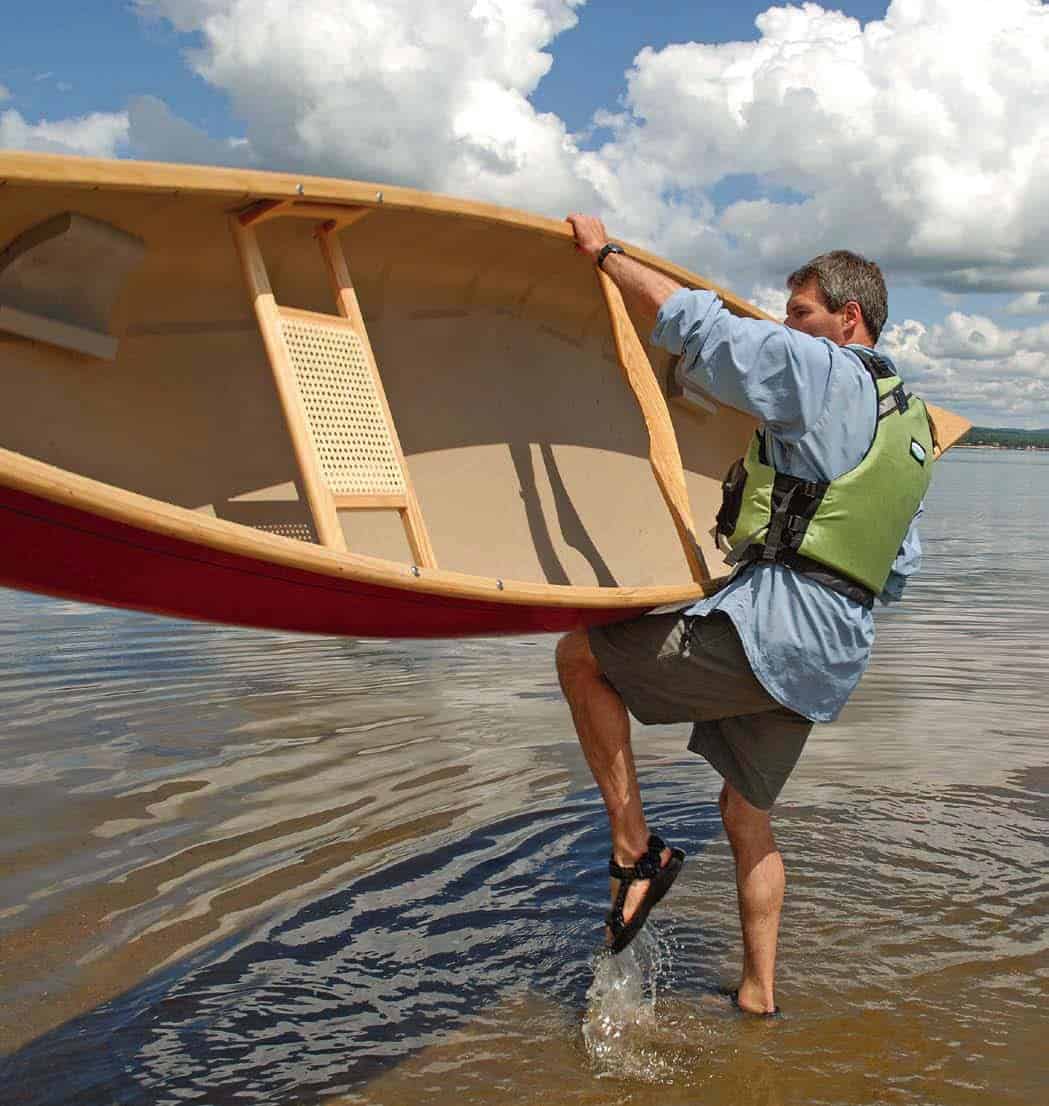
Bend your knees and slide the canoe up your legs so it is resting on your thighs.

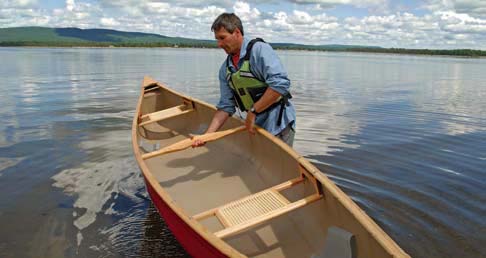
Photo: Paul Villecourt/Helipress.com

Step 3

Begin a gentle rocking motion to build momentum and establish your timing. When ready, use the leg closest to the bow to heave the canoe up so you can grab the far gunwale with your hand closest to the bow. You are now holding the canoe with your bow-side hand on the far gunwale and the stern-side hand on the near gunwale. The canoe’s weight is supported by your bow-side leg.

Photo: Paul Villecourt/Helipress.com

Step 4

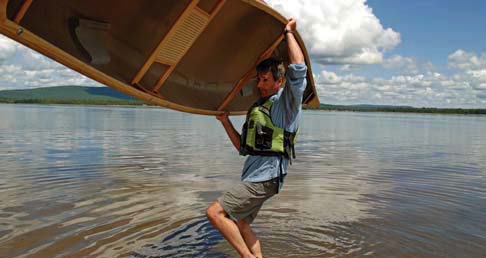
Initiate another rocking motion using the strong muscles of your bow-side leg. Pick your moment and with a lift from your leg flip the canoe above your head so it follows an arc guided by your bow-side arm.

Photo: Paul Villecourt/Helipress.com

Step 5

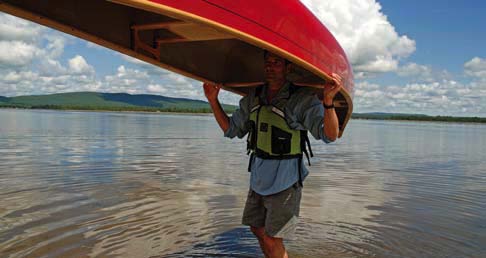
Duck your head forward slightly as the gunwale and yoke finish the roll. Settle the yoke down on your shoulders.

Photo: Paul Villecourt/Helipress.com

Step 6

As you are swinging the canoe over your head you should be rotating your stance so you finish with your body facing the bow.

With a quick hop to help lift the canoe off your head you can reverse these steps to unload the canoe. And though you will be tempted to let other paddlers continue in the belief that this is a strenuous manoeuvre, pass on the tip of using the bow-side leg to propel the canoe upward and you’ll find you soon have other people offering to share the portaging load.

Andrew Westwood is an open canoe instructor at the Madawaska Kanu Centre, a member of Team Esquif and the author of The Essential Guide to Canoeing, from which this article was excerpted. 


This article on canoe technique was published in the Early Summer 2009 issue of Canoeroots magazine.This article first appeared in the Early Summer 2009 issue of Canoeroots Magazine. 

Betcha Didn’t Know About Inukshuk

Photo: iStockphoto.com/Shaun lowe
Betcha Didn't Know About Inukshuk
  • To pluralize the word inukshuk is a literary faux pas. Several of these stone figures are called inuksuit.
  • There are two forms of inuksuit. A figure with arms is called an inunnguaq and translates to “likeness of a person” in the Inuit language. A figure without arms is called an inukshuk, meaning “function of a person”.
  • An inunnguaq is pictured on the cover of Rush’s 1996 album Test for Echo. We’re not sure why.
  • Inuksuit are used across the Arctic from Alaska to Greenland for communication and navigation. In this featureless landscape, they are akin to tree blazes.
  • An inunnguaq’s arms may point in the direction of a navigable channel, a mountain pass or a migration route. An inukshuk can mark a food cache, a site with good fishing or a place where white children were bored.
  • Inuit tradition forbids the destruction of inuksuit in their homeland. This tradition does not hold true for the hundreds of imposters along the Trans-Canada Highway and wilderness park trails. Killarney Provincial Park issued a notice in 2007 urging visitors to “stop the invasion” of inuksuit.
  • In 1999, an inukshuk was chosen to grace the flag of Canada’s newest territory, Nunavut. The stone figure is also the 2010 Winter Olympics logo, in recognition of the inukshuk that watches over Vancouver’s English Bay.
  • The world’s largest inukshuk is located in Schomberg, ontario. Nicknamed Little Joe, it stands over 11 metres high and is formed of 11 granite slabs totalling 82,000 kilograms.
  • Inuksuit have come to symbolize cooperation and friendship. Each stone is chosen for how well it fits together with the other stones and the assembly is secured entirely through balance. 

This article on inukshuk was published in the Early Summer 2009 issue of Canoeroots magazine.This article first appeared in the Early Summer 2009 issue of Canoeroots Magazine. For more great content, subscribe to Canoeroots’ print and digital editions here.
Butt End: Losing my Shadow

Photo: Kevin Callan
Butt End: Losing my Shadow

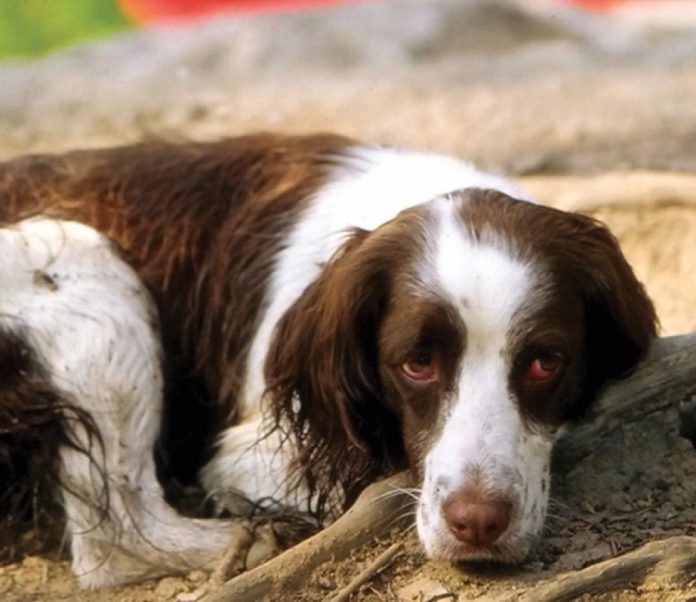
An hour after my canoeing companion of 12 years had been euthanized, I put my feelings about her life on paper. I wrote up a list of Bailey’s faults and strengths, her crazier character traits and the stunts she pulled during a life that included more than 600 nights out on canoe trips.

I posted my thoughts on my blog that evening and by the end of the next day I had received more than 500 emails of condolences from people who either knew of Bailey or were trippers who also rejoiced in canine company.

I wouldn’t have guessed that so many people knew my dog (or read my blog, for that matter) but I suppose it makes sense, since she has appeared in a dozen books and countless magazine articles.

More surprising was the number of people who wrote about willingly subjecting themselves to the maddening appeal of canoeing with a dog. 

A CONSTANT COMPANION

Bringing Bailey along on trips was a challenge. I carried her specially designed pack full of kibble and chew toys more then she. She was the first to have breakfast, lunch and dinner. Her sun umbrella strapped to the gunwale and foam cushion glued to the belly of the canoe made portaging difficult. She insisted the bug shelter be put up for her immediately once we reached camp. I lifted her in or out of the canoe at every single put-in and take-out. 

Bailey was chased by skunks, porcupines, a lynx, raccoons, hawks, snakes, swarms of hornets, one nasty chipmunk, and a couple of black bears (some of which followed her right back toward me). She loved rolling in crap. When she was in the canoe she whined to be lifted out and once out she whined to be put in. Every time I hooked into a fish the ever-helpful dog would try to retrieve it for me.

So, why did I, and all those other dog owners, put up with dog paddling? It wasn’t just because by attracting all the bugs she made a good shoofly-pie, or that she could sense a thunderstorm better than any polyester-clad weatherman or that if it weren’t for her ability to sniff out a trail I’d still be on one particularly confusing portage on the Steel River.

I loved tripping with Bailey because she never once left my side. She was a constant companion, no questions asked. My daughter, Kyla, even nicknamed her my shadow. How I miss my shadow. I doubt that canoe tripping will ever be the same without her.

Rest in peace my dear friend.

Kevin Callan won’t comment on rumours that Bailey was named for his favourite drink. 

This article on the loss of a pet was published in the Early Summer 2009 issue of Canoeroots magazine.This article first appeared in the Early Summer 2009 issue of Canoeroots Magazine. For more great content, subscribe to Canoeroots’ print and digital editions here.
San Joaquin’s South Fork Descent

Photo: Darin McQuoid
San Joaquin’s South Fork Descent

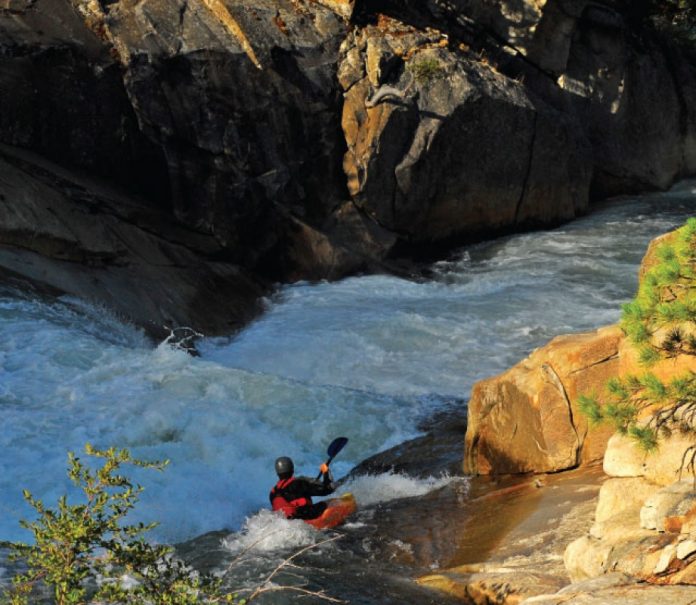
Carving a descent through 6,200 feet of unyielding granite, water from the South Fork San Joaquin has earned a reputation for being the hardest working water in the world. On its turbulent journey, the water is reused nine times as the river runs a gauntlet of lakes, tunnels and powerhouses all part of the Big Creek Hydroelectric Project. Construction of Big Creek began in 1912 and the last powerhouse at Balsam Meadow, built in 1987, is 1,000 feet underground and carved from solid granite. Big Creek, California’s largest hydro project, swallows all but a trickle of the South Fork’s aquamarine waters.

Information regarding the project is held as tightly as the hold on water flows. In late August, American Whitewater volunteer Paul Martzen heard rumours of a release. 

“The hydro project had to move more water than they could get through the generators,” explained Martzen. Thirsty farmers down the valley meant water in the South Fork, and a shot at a first descent. The flow window would be brief and uncertain—the release starting on the Friday of Labour Day weekend. “My contact was fairly sure that the release would last through Sunday.”

With a three-day window, a group of four California and Oregon kayakers decided to go for it. Ben Stookesberry, Darin McQuoid and Matt Thomas drove through the night to meet with Kevin Smith for a once-in-a-lifetime assault on the river.

“It was no surprise that we had to portage large sections of Mono Creek, a small tributary inundated by 500 cubic feet per second,” says Smith. “The Middle Fork San Joaquin is known as the hardest run in California, but the South Fork takes everything about it to the next level.”

The run is filled with inescapable granite gorges, mandatory class V+ rapids, complex portages and pure wilderness scenery. For the first three days the group was surprised at how much they paddled, but late into day three it was painfully obvious they wouldn’t get out in the alloted time.

“Large sieves made us leave river level and portage over gorges,” says Thomas. Increasingly numerous and treacherous portages made for slow progress. As three days stretched to four, Big Creek’s gates closed and the South Fork eased back underground into restless hiding.

 “The South Fork San Joaquin is the hardest of the High Sierras,” says Stookesberry. “It’s an absolute classic multi-day.” 

Too bad it’s gone.

This article first appeared in the Spring 2009 issue of Rapid

This article first appeared in the Spring 2009 issue of Rapid Magazine.


Skills: Sweet Momentum

Photo: Marilyn Scriver
Skills: Sweet Momentum

 Traditional canoe instruction says that the most effective steering strokes are done in the stern; typically stern draws, rudders and pries. But try watching experienced solo boaters and more often than not you will see them steering at the bow. In whitewater, momentum means the difference between catching must-make eddies and falling short. Bow control strokes maintain precious momentum, while steering from the stern essentially slams on the brakes. Choosing to steer from the bow or stern is determined by where you are going on the river and the momentum needed to make your move.

Power Steering

Steering from the bow, called power steering (Rapid Open Canoe Technique V10, I2), relies on adapting your forward and cross-forward strokes to control your boat angle. The advantage of power steering is that these strokes add to your momentum. The efficiency of using forward strokes means that you eliminate the drag caused by momentum-killing strokes like stern pries and rudders.

Picture yourself planning an S-turn across some fast moving water. In executing the move your canoe will begin facing upstream and travelling against, and then progressively across, the current. The swiftly flowing downstream water dragging on a stern draw or pry will kill your momentum and possibly blow the move. Power steering, with propulsion and control coming from forward strokes at the bow, is a much better method of maintaining momentum and controlling angle to pull off the move.

Stern Control 

Stern strokes such as pries, rudders and draws are the traditional steering strokes used by all canoeists. They work incredibly well for steering. Anytime you need to turn your canoe in a hurry, the leverage created by these strokes is practically guaranteed to do the trick. The downside of these friction strokes is that they all slow you down—some more than others. 

So, when is the best time to use stern control? Anytime you have enough momentum to counter the drag of the stroke—like when you are charging downstream and want to eddy out. You are carrying loads of downstream momentum and facing a rapidly approaching 180-degree turn. A sure way to make that eddy turn happen is a stern control stroke. Friction here is not an issue—you are going downhill, building momentum as you approach the turn—heck, you may even want to slow down.

Making the Move 

Making your move every time will depend on matching your paddling technique to how you plan on using the current. Your strategy has to account for the momentum gained or lost from both strokes and the river current. Think of bow control as having less friction and higher efficiency, while stern control gives you leverage and security. In the end, choosing to steer from the bow or stern comes down to one simple rule: Use the type of control strokes that provide you with the momentum you need to make your move.

Andrew Westwood is an open canoe instructor at the Madawaska Kanu Centre, member of Team Esquif and author of The Essential Guide to Canoeing. www.westwoodoutdoors.ca.

This article first appeared in the Spring 2009 issue of Rapid

This article first appeared in the Spring 2009 issue of Rapid Magazine.