Home Blog Page 347

Boat Review: The T-1600 by TRAK

Photo Victoria Bowman
Boat Review: The T-1600 by TRAK

Have you seen The Kayak Transformers? This summer blockbuster begins not long ago in a galaxy not far away (Alberta), where a group of entrepreneurs quietly hatch a plan to create the most successful kayak company in the world.

By the end of 2005 our heroes have raised more than $2.4 million in startup capital and are angling for another $2 million from investors. In 2007 their top-secret invention, the TRAK T-1600, finally hits the water with a big splash. They boldly hype it as “the world’s only performance kayak that goes in a pack” and the media eats it up.

The action begins when the T-1600 rolls onto the scene in an attractive duffel bag with a plastic external frame and built-in wheels. Then it stuns its human owners by transforming into a medium-sized touring kayak in less than 20 minutes—faster than any other folding kayak in the universe. The one-piece hull and deck and aircraft-aluminum frame appear outstandingly engineered and constructed. A battle ensues for the hearts and minds of kayakers everywhere.

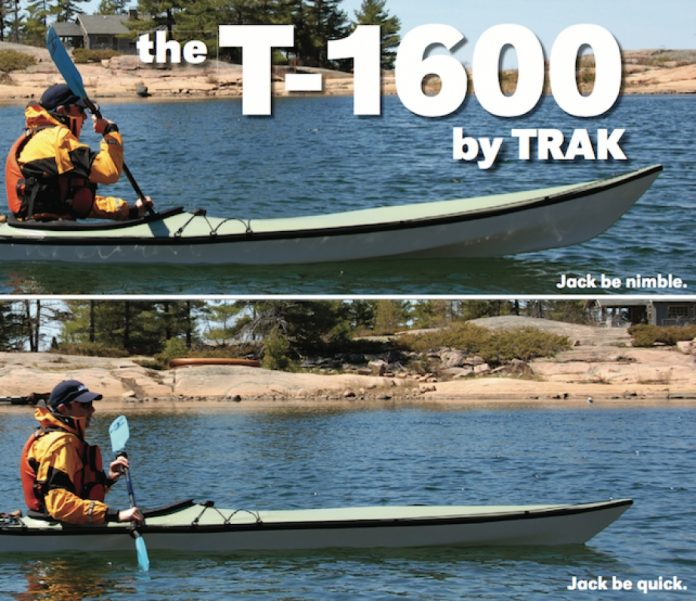
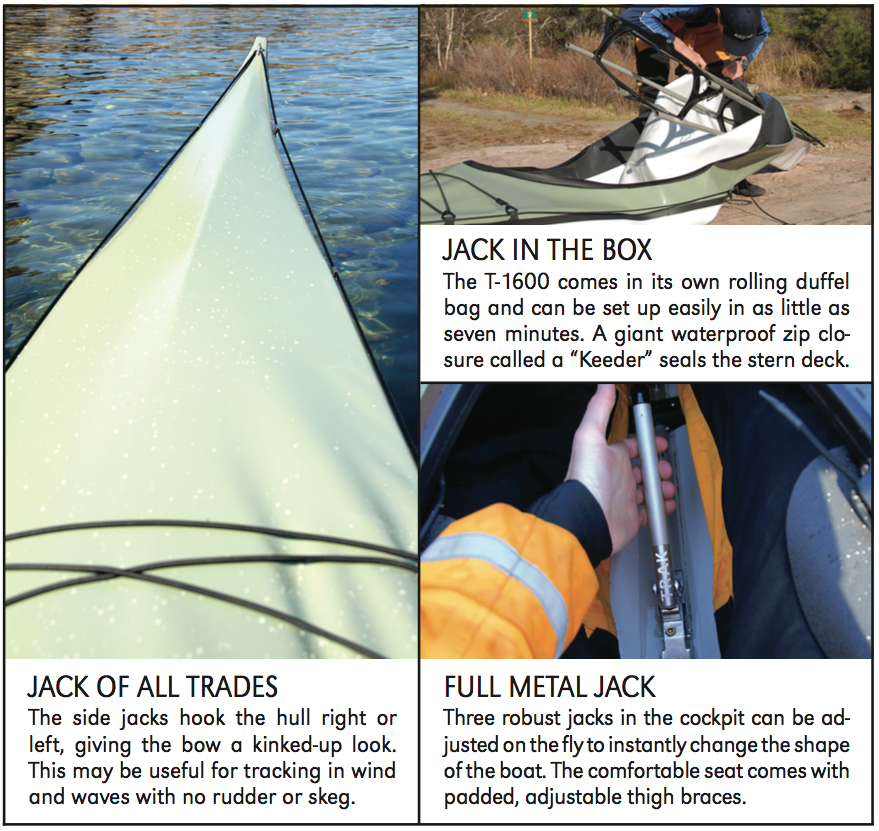
There is a dramatic climax when we discover that there are three hand-powered jacks built into the frame—one on each side of the cockpit and one along the keel between the paddler’s legs. These allow the T-1600 to change shape on the water. In an instant it switches from the flat profile of a rowing shell to the rocker of a whitewater canoe. Egads! Do you realize the implications? Here is a kayak that is immune to the classic tradeoff between speed and maneuverability! It can outrun play kayaks and outplay touring kayaks! Global market domination is virtually assured.

There’s a moment of doubt when we see that the side jacks are designed to hook the hull left or right to overcome turning in crosswinds (because the T-1600, in a gesture of elegant simplicity, has no skeg or rudder). The hard-chine, deep-V hull is not strongly affected by wind, so we wonder if this kinky feature is a strength or a weakness.
 As the saga continues, however, the TRAK T-1600 proves itself to be an awesome transformer. It holds its own against any other folding kayak for its construction quality and ease of assembly alone. Dueling with quality hardshell kayaks in their element is another matter. These old standbys do what they do really well, at a price that’s easier for the masses to swallow. So the battle rages and it will take more time to know if the T-1600 can fulfill its creators’ dream of revolutionizing kayaking the way parabolic skis swept downhill skiing. Things look rosy for now, but just like in Hollywood, you can pretty much bank on a sequel.
Screen_Shot_2015-06-30_at_10.46.18_AM.png

akv7i4cover.jpgThis article first appeared in the Fall 2007 issue of Adventure Kayak magazine. For more boat reviews, subscribe to Adventure Kayak’s print and digital editions here.
Drag-and-Drop

Photo: Steve Arnold
Drag-and-Drop

I set up for shallow slides much the same as I set up for any creek line. I start opposite the side I want to end up on and carry momentum into the rapid to cross the grain of the falling water. On shallow slides in an open boat carrying momewntum is even more important than in a kayak, since an onside forward stroke wants to spin the boat and any strokes in one inch of water don’t work very well.

On the Independence River in New York State I started down a narrow shallow slide that fanned out as it steepened, before dropping into a very tiny cauldron surrounded by sloping granite banks. With some surprise I found myself grinding down angled left as planned to cross the grain, but definitely not moving left. Matter of fact, as I was approaching the landmark rooster tail at the lip of the steeper bit, I was sliding even further to my right toward the cauldron—not at all where anyone would intend to go. Finishing the drop backwards seemed like the best of the worst, and even though there was so little water cascading over the rocks you could hardly call it a rapid, it was enough to drown out the laughter of everyone on shore.

It was several months before I came up with a plausible explanation of why I’d gotten so far off line.

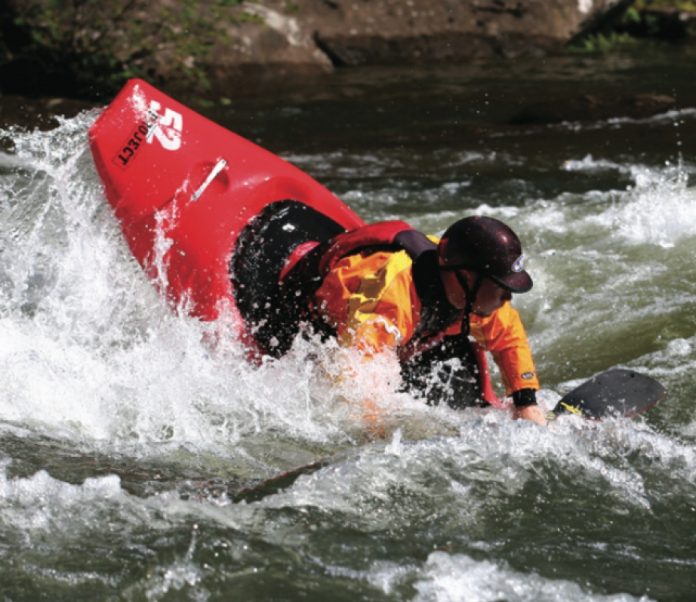
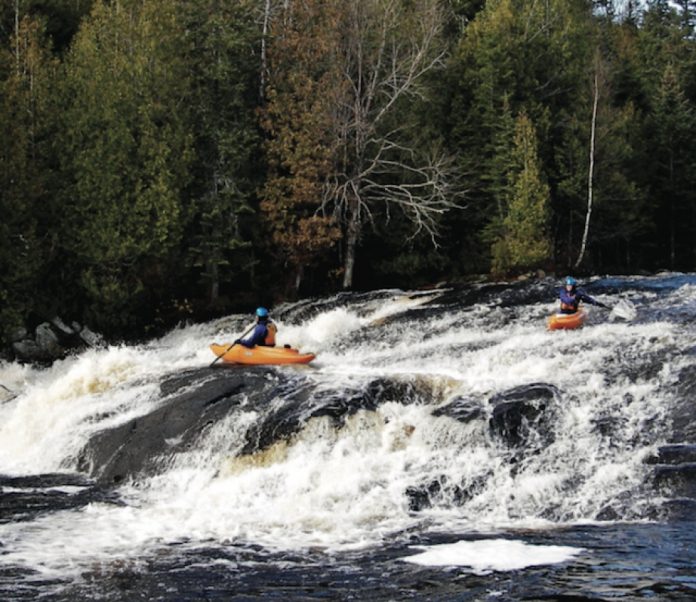
On the Doncaster, a classic Quebec spring run, I watched the same thing happen. In this photo, the boater is trying to drive river left but the water pushes him out towards the middle of the rapid. He either didn’t come into the rapid with enough forward momentum to begin with, or the drag on the bottom of the boat in the shallow water caused the boat to slow down and move slower than the water. Either way, if you’re not moving faster than the water, crossing the grain turns into a scary back ferry.

Think back to the old days when we all used the back ferry to descend rapids slowly. A back ferry works because the canoe is moving slower downstream than the current, due in this case to your backpaddling. The water pushes on the exposed side of the canoe moving the craft laterally across the river.

On a shallow slide you get the same effect when your creek boat is slowed by the friction of the river bottom.

As soon as you lose forward momentum the current begins to take your boat with it. Aligned perfectly with the current, you’re going where the water is going. Any angle in either direction and presto, you are in back ferry mode, whether you like it or not!

So far, I’m not setting up to back ferry down slides. I still much prefer maintaining forward speed and driving toward the direction I want to go.

However, understanding how the friction in shallow-water slides slows my boat, I can always try to claim I was back ferrying when I end up beached on shore.

Who knows, maybe it won’t be too long before we’re all back ferrying off waterfalls… you go first. 

This article on back ferries was published in the Summer 2007 issue of Rapid magazine.

This article first appeared in the Summer 2007 issue of Rapid Magazine.


The Macho Move

Photo: Tanya Shuman
The Macho Move

The macho move is one of the most impressive downstream freestyle moves known to mankind. Invented by Brad Ludden and named by Jay Kincaid, it became mainstream after Ludden and other pros displayed the new move at the 2002 IR Triple crown on the Nolichucky River in Tennessee.

The macho move is simply an air loop, which pops off the peak of a wave while moving downstream. Only two waves are required to get a nice aerial macho move. It is ideal to learn the move on high-volume rivers with medium-sized waves where you don’t have to worry about hitting bottom. The New and Gauley rivers in West Virginia are my favourites for doing macho moves since the potential spots to do this move are endless. Also endless are the potential variations of the macho move. One slight variation of the macho move was done for this particular photo sequence, with the boat popping off the peak with a twist to get more of a space Godzilla macho move. New ways are still being discovered.

The feeling of doing a massive air flip while travelling downriver at high speed is truly exhilarating. once you nail your first macho move the addiction will begin. You’ll never just float down a wave train again.  

How to macho move:

Step 1: Paddle at medium speed into a wave train with fairly consistent standing waves. The greater the spacing between the waves, the more downstream speed you’ll require. Proper timing is crucial for the macho move.

Step 2: The initiation is the classic double-pump technique, started at the peak of the first wave. The key is to lift your bow into the air while moving over the first wave peak, and to drive your bow as deep as possible into the trough between the two waves. This loading of your bow’s volume deep in the trough is where the pop of the macho move comes from.

Step 3: As you begin to travel up the face of the second wave, stand up on your foot blocks just as you would for an air loop. You should time this jumping action so that you are completely standing up just before the peak of the second wave.

Step 4: Snap your torso forwards as if you were flatwater looping off the peak of the wave. You will encounter much less resistance than a normal flatwater loop since the water is dropping away from you as you travel downstream off the peak of the wave. You know you’ve nailed your timing perfectly when you completely clear your stern of the water and you land flat on your hull in the next trough. 

Pro tips:

1. Practice both the flatwater loop and loops in holes, and concentrate on the timing of the jump to increase your pop into the air. 

2. The higher you pull yourself into the air off the initiation wave peak, the deeper your bow will go into the next trough. The deeper your bow goes in the trough, the higher you will be thrown into the air off the second wave peak. 

3. Approach the first wave at a slight angle from the side. This will help you face downstream while vertical on your bow, which will make your macho move loop finish straighter. 

This article on the macho move was published in the Summer 2007 issue of Rapid magazine.

This article first appeared in the Summer 2007 issue of Rapid Magazine.


River Alchemy: Random Beauty

Photo: garyandjoaniemcguffin.com
River Alchemy: Random Beauty

I stumbled on it some years ago on a rambling hike down a dry streambed in Driggs, Idaho. I found a perfect bend in a river. A 180-degree change in direction, carved from the alluvial plain. The gravel bank was perhaps eight feet high; it was plumb vertical, and had a perfectly walled arc, perhaps 100 feet in diameter. From every angle it was astoundingly geometrically perfect. It grabbed my eye and carried it around its curve. I had never seen such mathematical perfection in nature before.

Luna Leopold felt that same sense of awe in nature. As the son of Aldo Leopold, the famous pioneer of wilderness ethics and land protection in the United States, Luna Leopold was the first to set out to study rivers in a manner unheard of—he measured them… in great detail. In fact he spent a lifetime creating formulas to explain just how rivers work, and how it was possible for them to carve the perfect bend.

By and large, he was successful. 

He was the creator of what is now called quantitative hydrology, and in doing so re-established much of the fundamental assumptions of modern engineering.

Starting in 1953 with his obscure (to most readers) text, The Hydraulic Geometry of Stream Channels and Some Physiographic Implications, Leopold pulled rivers apart, feature by feature, and scratched out the formulas that explain their behaviours. Some of his findings are uncanny. Consider these, if you haven’t before: the wavelength a river meanders is, on average, 12 times its width; the Sine coefficient for those meanders is the same coefficient for the compression waves that form on a stream’s surface; and the riffle-pool interval is one half the wavelength of the meanders.

Fascinating.

He created formulas to explain helical flow, wave creation, hydraulics, sediment load and watershed flood rates. The list goes on and on. In my search to explain the perfect bend all roads lead to Leopold’s work. He was incredibly prolific and clearly a genius. While mathematically dazzling, his formula for the perfect bend left me spiritually unfulfilled.

A year later I was handed Barry Lopez in a used bookstore in Smithers, B.C., Lopez lives on the other end of the Sine curve from Leopold; if Leopold is pure science, Lopez is pure poetry. River Notes is Lopez’s river dissection, via a series of short stories so descriptive the book drips with water. His swirling eddies suck you in, carry you into the current, then delicately and surprisingly drop you in the literary ocean of deep thought with his famous single-sentence endings.

Lopez explores the idea of how a river can so seamlessly and completely change direction, while looking for instruction that may be useful to his own life.

Mired in depression, he laboured to examine every aspect of the bend in the river behind his home. If he could figure out this bend, then maybe he could figure out how to turn his own life around. Bed-ridden and feeling no hope at all, he hauls himself down to the stream and dips his hand in the water. The essence of the turn, he realizes, is not in the details (nor in any of Leopold’s formulas), but in some bigger connection between himself and the river.

Lopez’s exploration of the fine details of rivers is in a way an exploration of the human soul, but his life-changing river bend metaphor did not speak to me any more than Leopold’s algebra.

I’ve since returned to the sharp and blocky Canadian Shield rivers, rivers with turns seemingly unaffected by water and time pushing against them. In my lifetime I’m unlikely to find another bend so geometrically perfect.

With every new river I paddle I realize it was not the bend that was so intriguing, it was how the perfectly bending arc grabbed my eye, smoothly railing it around the corner in a new direction. It was not the bend in the river, it was what lay beyond that was so intriguing and so important. The perfect bend is not a complex equation. For me now, the perfect bend is the one just downstream, the one luring me to explore what is just beyond. 

This article on science and poerty was published in the Summer 2007 issue of Rapid magazin

This article first appeared in the Summer 2007 issue of Rapid Magazine.


Editorial: A Drop in the Bucket

Photo: Scott MacGregor
Editorial: A Drop in the Bucket

Driving home from a kayak fishing trip last week I realized I had done what most whitewater paddlers do every weekend—I filled my gas tank and cooler before I left home.

The week before, back at the Rapid office, I had been preparing an economic impact survey to measure the amount of money spent in Palmer Rapids during our Canadian Whitewater Instructor Conference and sixth annual Palmer Rapids River Festival. I’ll use the data from this to present a case to my local municipality, county economic development office and tourism association arguing that whitewater paddling is good for the area.

Meanwhile, the only things I left behind after my weekend in the abandoned-mining-town-turned-tourism-based fishing community were a couple of snagged lures and a case of empties.

For my fishing trip, I easily dropped $250 on gas, groceries and bits of tackle. Buying it all locally would have only cost me $18 more than it did at the highway gas bar and box store supermarket. With eight of us in our group and eight other cabins at the place we stayed, for an extra six dollars a day each, these guys at this one fishing camp could have injected $10,000 into the local economy simply by buying supplies at the Gowganda general store. And that doesn’t take into account the beer!

We need to stop thinking about our rivers as being free.

With increasing pressure on rivers for hydro development, river protection groups have to slap a sticker price on whitewater. These groups are standing up in public meetings across the country convincing local politicians and governments that paddlers will generate more business and more revenue than turbines.

I respect the efforts of groups like Les Amis who are committed to protecting the Kipawa River from hydro development. Unfortunately, this year Les Amis is officially cancelling the 21st annual Kipawa River Rally due to what vice President Peter Karwacki calls the “unsafe, unpredictable situation created by the punitive actions of [the federal government].” Karwacki recommends paddlers send letters of apology to local businesses in the host town of Laniel. Maybe the loss of revenue will spur local businesses to stand up and take notice. Sometimes you don’t know what you’ve got ‘til it’s gone.

We know that economic impact studies sway government decisions when it comes to whitewater paddling.

Whitewater parks are being built all across North America on the basis of their economic returns. Cities like Reno, Nevada and Wausau, Wisconsin have invested millions to create whitewater tourism and are reaping rewards. More complacent communities are letting developers shut off their natural rivers.

We simply have to stop thinking of rivers as being free and be conscious and proactive with our spending. We can pay for a shuttle instead of driving two cars from the city. Stay the night at a local campground, motel or bed and breakfast. Rent our boats locally. Shop at the local grocery store. Fill our gas tanks for the ride home. Plan to meet your friends at the restaurant for breakfast. Buy an ice cream cone. And if there’s a box at the take-out or campground, dude, put your money in the box.

We need to pay where we play. And if it costs us more to do so, it’s not an added expense, it’s an investment.  

This article on shopping local was published in the Summer 2007 issue of Rapid magazine

This article first appeared in the Summer 2007 issue of Rapid Magazine.


Butt End: Danger Zone

Photo: istockphoto.com/Suzann Julien
Butt End: Danger Zone

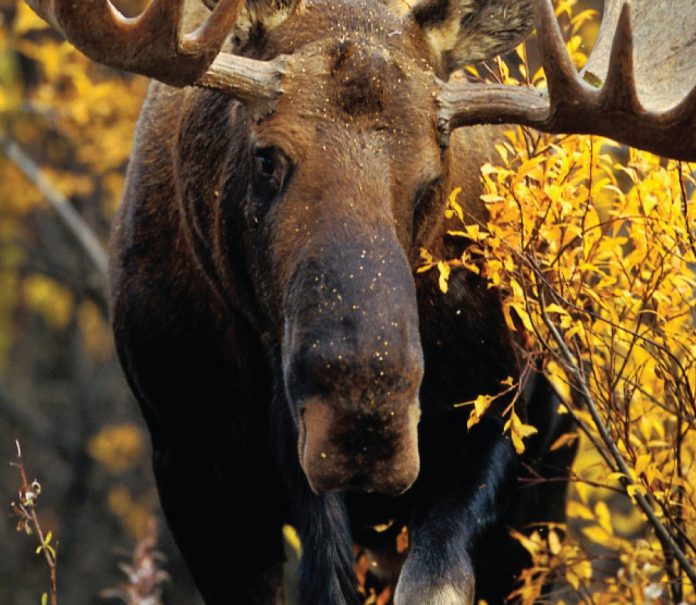
I stood my ground when the moose started to charge, not believing it was a real threat. When it changed its gait from a gallop to a sprint, I reassessed the situation and ran my ass off toward the truck. 

What was I thinking? If I had come across the same animal while out on a trip instead of by the side of the highway I would have admired it from a distance, not blindly walked up to it snapping photos as if it were a supermodel. 

A few seconds into the chase I realized that being part of the high school running club was far behind me, but the moose wasn’t. He was closing in and the only thing to do was to start zig-zagging in hopes of confusing him. 

It was the blast of a passing truck’s horn that saved me in the end. Not my buddy Andy. He was too busy trying to turn on his video camera. The moose jolted at the sound of the horn, zigged when I zagged and gave up the chase.

You don’t have to tell me I’m an idiot. I’m well aware. But it’s not all the time. I’m a safety fanatic while out on a trip. It’s an approach that has saved my hide many times out there. The moment the trip is over, however, I forget all those over-the-top safety measures, as if being reconnected with civilization means I can turn my brain off. 

Prior to the moose attack I had spent two full weeks paddling the Kopka. It’s a remote river in northern Ontario that’s challenging enough in normal conditions but was in high flood during our trip. It was the most testing route I’ve ever done—and at no time did I let my safety slip into question. We scouted every rapid prior to running it. We hunkered down during a wind storm rather than take a chance surfing breaking waves. We encountered 10 bears and gave them all a respectful berth. We even used safety harnesses while portaging an incredibly steep portage around Kopka Falls. We were the poster paddlers for safe canoe tripping. 

It wasn’t long after starting our drive home that we passed the moose feeding along the roadside. We hadn’t seen a moose on the trip, so I pulled over to take a picture. I took the lens cap off and transformed from safety boy to idiot tourist. You know the rest.

And what happened to the moose? He went back into the woods where it was safe, perhaps questioning how humans survive in the civilized realm we call the real world. If I were an evolutionary biologist I’d be worried about us.

Kevin Callan has never been to Pamplona, Spain, but hears it is an exciting place.

This article was originally published in the Fall 2007 issue of CanoerootsThis article first appeared in the Fall 2007 issue of Canoeroots Magazine.


Weighing the Risks

Photo: Scott and Dougie MacGregor
Weighing the Risks

As parents we walk the tightrope, balancing potential risks and benefits all the time. If I let my daughter stick a screwdriver in the electrical socket, the benefit of improving fine motor control would be zapped by the risk of being electrocuted. Whereas falling off a bicycle on a soft lawn is worth the risk of a stained knee for the benefits of learning to balance and enjoying childhood freedom. As parents we make these kinds of decisions all the time. Learning to cut paper versus losing a finger. Having fun fishing versus getting hooked in the scalp. Exercise and adventure from hiking versus getting lost or poison ivy.

In the world of outdoor recreation and education this is called risk management. My friend Matt Cruchet runs Direct Bearing Risk Management Consulting, a very successful business helping organizations manage risk in their adventure programs. Unfortunately, our society is quick to point fingers at the risks involved with outdoor activities, making educators and some parents scared to take kids outside—especially with the ever-looming threat of legal action. Matt works with schools, camps and organizations like the Girl Guides of Canada to help quantify the benefits, identify the hazards and minimize the risks involved in their outdoor programs. 

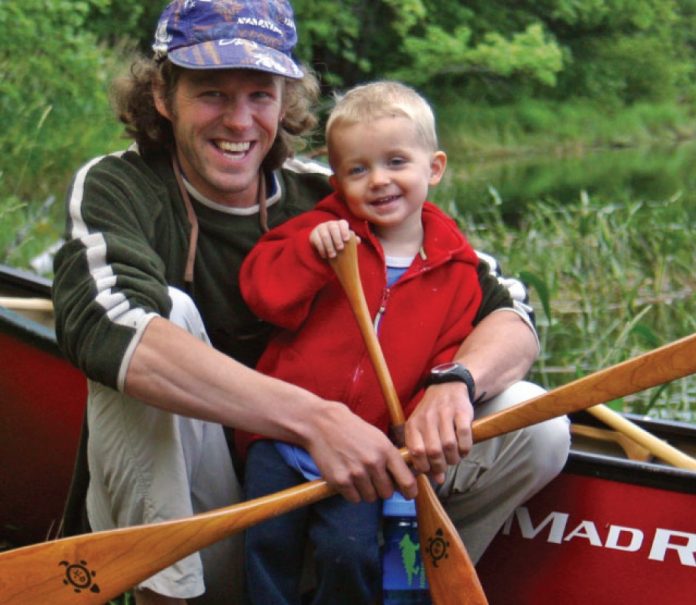
As camping parents we know that summertime is perfect for being outside and being active with our kids. This Canada Day long weekend I took my two-year-old son Dougie on our first father-son whitewater canoe trip. The reaction of other canoeists fell into two camps: one group, “I wish I’d started paddling that young”; and the other group, “What in God’s name do you think you’re doing with a baby in the rapids?” One couple actually paddled over and asked me this…it turns out they are teachers.

My friend Matt uses a diagram to help his clients think about risk. One axis is the likelihood of something bad happening, and the other axis is the severity of the consequences. Mosquito bites, for example, are very likely but result in only minor bumps or itching; the chance of getting struck by lightning is quite low but the consequences are severe. The worst kinds of risk are the ones that are very likely to happen and have severe consequences. And in the first quadrant is where Dougie and I paddle the Madawaska River—the chances of us flipping are quite low, as are the consequences with warm, low water, helmets and PFDs. 

In March, a Commons health committee report concluded that 26 per cent of Canadians between the ages of two and 17 are overweight or obese. Overfeeding and lack of exercise increase the risks of preventable life-threatening diseases such as diabetes and heart disease. Watching Dougie playing in the sand, scrambling over rocks, swimming in the shallow eddies and climbing into his sleeping bag at 7:30, I’m sure I’ve found the cure. For my family, the benefits of being outside and canoeing, hiking (see this issue’s hiking feature) and camping far outweigh the risks—so long, of course, that those risks are well managed.

By noon on our second day Dougie and I had caught up to the teachers. They were scouting Raquette Rapids, a 100-metre-long class II that flows over some shallow ledges and between two rock islands. I’ve run this rapid a hundred times. Dougie and I drifted into the current chatting about sitting still and pointing out rocks to avoid. I could feel glares of disapproval burning through the foam of my lifejacket as we floated past the teachers and down the last little chute into the lakewater pool. A perfect run.

A few minutes later, whistle blasts chirped to get our attention. Guess who was in the water? Their canoe was upside down and their gear was strewn around the rapid like a yard sale hit by a tornado. I’d normally have jumped up from our lunch spot on the rocks and helped them, but I couldn’t leave poor little Dougie on these dangerous rocks by himself. What kind of irresponsible parent would that make me? So I sat there spreading cream cheese on my “baby’s” bagel, wondering if they now think they should have started paddling when they were two. 

This article was originally published in the Fall 2007 issue of CanoerootsThis article first appeared in the Fall 2007 issue of Canoeroots Magazine.


Betcha Didn’t Know About Beavers

Photo: iStock.com
Betcha Didn't Know About Beavers
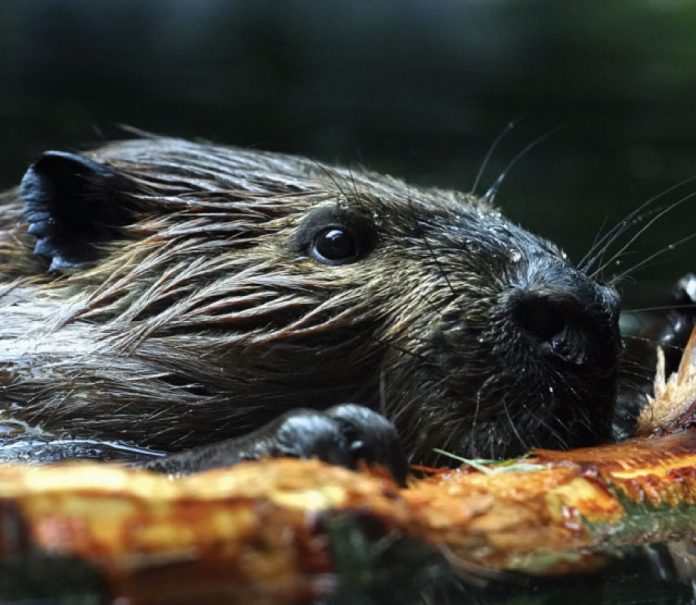
  • Beavers are the second largest rodent. 
  • The beaver was the main currency of the fur trade. Pelts were trapped in the hinterland by natives, exchanged for goods at trading posts and shipped to Europe to be treated with mercury to make felt for hats. 
  • Beaver tails are sweet hunks of deep-fried dough that are popular on Ottawa’s Rideau Canal. They set back sugar-craving ice skaters $3.50.
  • Newborn beavers are able to swim within hours of being born.
  • Beavers were practically wiped out in Europe by demand for castor oil, a bitter excretion that was used to treat pains and is still used to scent perfumes.
  • The buckteeth of a beaver never stop growing.
  • Jerry Mathers gnashed some impressive buckteeth himself as star of Leave it to Beaver, a sit-com that debuted in 1957.
  • Beavers dam waterways with a mass of mud, rocks and sticks to create a pond that provides access to vegetation and protection from predators. The largest known beaver dam stretched nearly 1,500 metres across a river in Saskatchewan.
  • Female beavers tend to grow larger than males. 
  • The mating practices of beaver—of interest to a large number of humans—involve mid-winter romantic dalliances under the ice.
  • Beavers can hold their breath for 15 minutes.
  • The legendary DeHavilland Beaver bush plane has taken more canoeists to more remote put-ins than any other airplane. 

This article was originally published in the Fall 2007 issue of CanoerootsThis article first appeared in the Fall 2007 issue of Canoeroots Magazine.


In Parting: How Kayaking Makes You Smarter

Photo: Tarmo Poldmaa
In Parting: How Kayaking Makes You Smarter

There’s a highly successful and well-paid management consultant who, whenever he gets in a stressful pickle at work, solves his problems by sitting down to do needlepoint.

This is according to a book I am reading to better myself. It’s called The Breakout Principle: How to Activate the Natural Trigger That Maximizes Creativity, Athletic Performance, Productivity and Personal Well-Being. Wouldn’t you like to know the secret to all that?

According to the authors, Herbert Benson and William Proctor, when you get stuck with a problem at work or in life and grapple with it for a while until you aren’t getting anywhere, you can break out of that rut by doing something physically or mentally repetitive. They suggest meditation, walking, scrubbing the toilet—it can be just about anything. The needlepointing business guru supposedly solved a big problem by engrossing himself in a particularly intricate form of embroidery called petit point. Focusing on a repetitive activity pushes the brain’s reset button, allowing you to find new thought patterns for old problems. Your mind evolves and you get smarter through successive cycles of struggle and breakout. The harder the struggle, the greater the enlightenment is likely to be. It’s a “work hard, play hard” philosophy, coming to you from a pair of authors that includes a professor of medicine at Harvard—so it must be true.

Before you rush out to the craft store for needlepoint sup- plies, take it from me that kayaking has all the same breakout benefits while being a lot more fun. I find there’s no better way to get over writer’s block than to go out for a long paddle. The best escape comes in a following sea that’s big enough to make me pay attention but not so big it really scares me—the golden mean between too-easy and too-hard that produces the mental state psychologists call “flow.”

After a few good hours paddling downwind in a moderate swell, the first two things I need to do when I get to shore are 1) pee, and 2) pull out my notebook to write down all the brilliant ideas I just had on the water. Often the two are emergencies of equal urgency. If I start carrying a pee bottle in my cockpit, I will also have to rig a dictaphone to my Pfd. sitting at a computer, though our careers often demand it, is not a great way to be inspired.

I have come to think of my kayak cockpit as “the Oval Office” because it’s where I do my best work. Indoor work can nourish the mind, but it takes water to digest.

This article on increasing your productivity through kayaking was published in the Summer 2007 issue of Adventure Kayak magazine.This article first appeared in the Summer 2007 issue of Adventure Kayak Magazine. For more great content, subscribe to Adventure Kayak’s print and digital editions here.
Kootenay Lake Trip Guide: A Backyard Paddling Paradise

Illustration: Lorenzo Del Bianco
Kootenay Karma: 4 Day Trip Guide to Kootenay Lake, BC

In the Kootenay region of Southeastern British Columbia, the lithic ramparts of the Rocky, Purcell and Selkirk mountains soak their feet in deep, cold lakes held fast by steeply treed slopes. Upper and Lower Arrow Lakes, Slocan Lake, Windermere Lake and dozens of smaller lakes and reservoirs fill nearly every valley. The greatest lake of all, the mother lake, is the Dark Queen herself—Kootenay Lake—the largest natural lake in southern B.C. Nearly 150 km long, this massive inland sea leaves a bow-and-arrow-shaped footprint on the region even larger than her massive blue figure on maps.

The Dark Queen of the Kootenays has it all: superlative fishing (including the largest rainbow trout in the world), soul-soothing mountain views, water pure enough to lift straight to your lips, and a rainbow of colorful communities where you can counterpose a day of paddling with an evening of live jazz or a night in a B&B.


The Dark Queen’s many moods

Nestled comfortably in the cradle of the Selkirk and Purcell mountains, Kootenay Lake has a wild side that belies her seemingly protected nature. Countless side drainages funnel glacier-born crosswinds onto the north-south oriented lake, resulting in exciting and dangerously turbulent waters. Stories abound of boaters drowning or disappearing into her icy depths. Paddlers and fishermen alike know to look to the horizon often and carefully, watching for the telltale black line that signals a change in the Dark Queen’s mood—for the worse.

The lake’s many moods have helped shape the culture of the villages anchored like floats on a fishing net around her perimeter. Each has more than its share of artisans, musicians and outdoor enthusiasts drawn to, and inspired by, the disposition of the Dark Queen.

On the outflow of the lake’s West Arm, the city of Nelson is known globally for its proximity to wilderness and for the quality and availability of some of the best “bud” B.C. has to offer. Not many 7,000-person towns have their own police force, or the staggering array of outlets for expendable income. High-end coffee shops, quality restaurants and trendy sporting goods stores line Baker Street in downtown Nelson, and most locals openly admit that it is income from the underground marijuana economy that is one of the critical drivers of this thriving social scene. Whatever the reason, paddlers can always find a good café, restaurant or live music in Nelson at the end of a great day on the water.


Loggers, orchards and 200 km of freshwater paddling

The small town of Creston lies not only at the far end of the South Arm, on the Kootenay River just before it enters the lake, but also at the polar opposite end of the socioeconomic spectrum from Nelson’s trendy, affluent scene. Steeped in a quaint 1950s air, the Creston Valley supports a unique mix of hard core loggers and fundamentalist right-wing Mormons from the nearby community of Bountiful. A surfeit of senior citizens meander the streets at a septuagenaric pace, and the town has the anachronistic air of a community clinging stubbornly to the last echoes of an unsustainable forest-based economy. Ironically, in the agricultural paradise of the Creston Valley—filled wall-to-wall with apple and cherry orchards, asparagus fields and blueberry patches—the town’s one great restaurant, the Other Side Café, is rarely open (update from 2020: the cafe is now permanently closed).

Between Nelson and Creston lies over 200 km of wild freshwater paddling through remote wilderness. White-sand beaches at Laib and Midge Creeks contrast with the steep granite bluffs that protect much of this backyard paddling paradise. An 8-km, bushy hike up Midge Creek north of Creston will lead you to some of the finest remaining Kootenay old growth forest, while the gruelling Lasca Creek and Mill Creek trails offer access to the alpine of West Arm Provincial Park to only the most committed hikers. Paddlers will share this wilderness landscape with some of the world’s last remaining endangered mountain caribou (as few as 60 of these shy, old growth–dependent ungulates remain in the heavily deforested south Kootenays), as well as the odd grizzly, wolf, secretive cougar—or even a wildly bearded and dread locked West Kootenay local.

At the far end of the northern reach, Kootenay Lake fills the front hards of Kaslo, Argenta and a handful of remote, independent communities. Up here the Dark Queen wears a different robe. Her mountain companions are steeper, higher and more rugged. Summits in neighbouring Goat Range Provincial Park and the Purcell Wilderness Conservancy reach skywards over 3,000 m above sea level—over 2,500 m above the lake. Mossy cliffs crowned with ponderosa pine and Douglas fir lean hundreds of feet over black water, while glacier-fed streams carve their way through steep rainforest valleys—a wild landscape that has attracted inhabitants with a spirit to match.


Home of the draft dodgers

In the late 1960s a wave of talented, intelligent Americans ran for the Canadian border with the Vietnam draft snarling and nipping at their heels. Many of these folks settled in the Kootenays, providing the basis for the communal, semi-pastoral and fiercely independent nature of these remote towns. Up here at the north end of Kootenay Lake, if you are wearing clothes on a lonely pebble beach, you are the weird one.

These expats from the Lower 48, where the grizzly has been wiped out of 98 percent of its historic range, found solace and inspiration in their wilderness surroundings. Many passionately led the fight for the myriad of protected areas in the surrounding mountains—West Arm, Kokanee Glacier, Goat Range, Kianuko, Stagleap, Bugaboo, Purcell Wilderness and a host of smaller provincial parks—that help to make Kootenay Lake one of the last, best freshwater wilderness paddling destinations on the planet. All that with access to a cappuccino and a gourmet restaurant meal, if that’s what suits your fancy.


Trip itinerary for Kootenay Lake

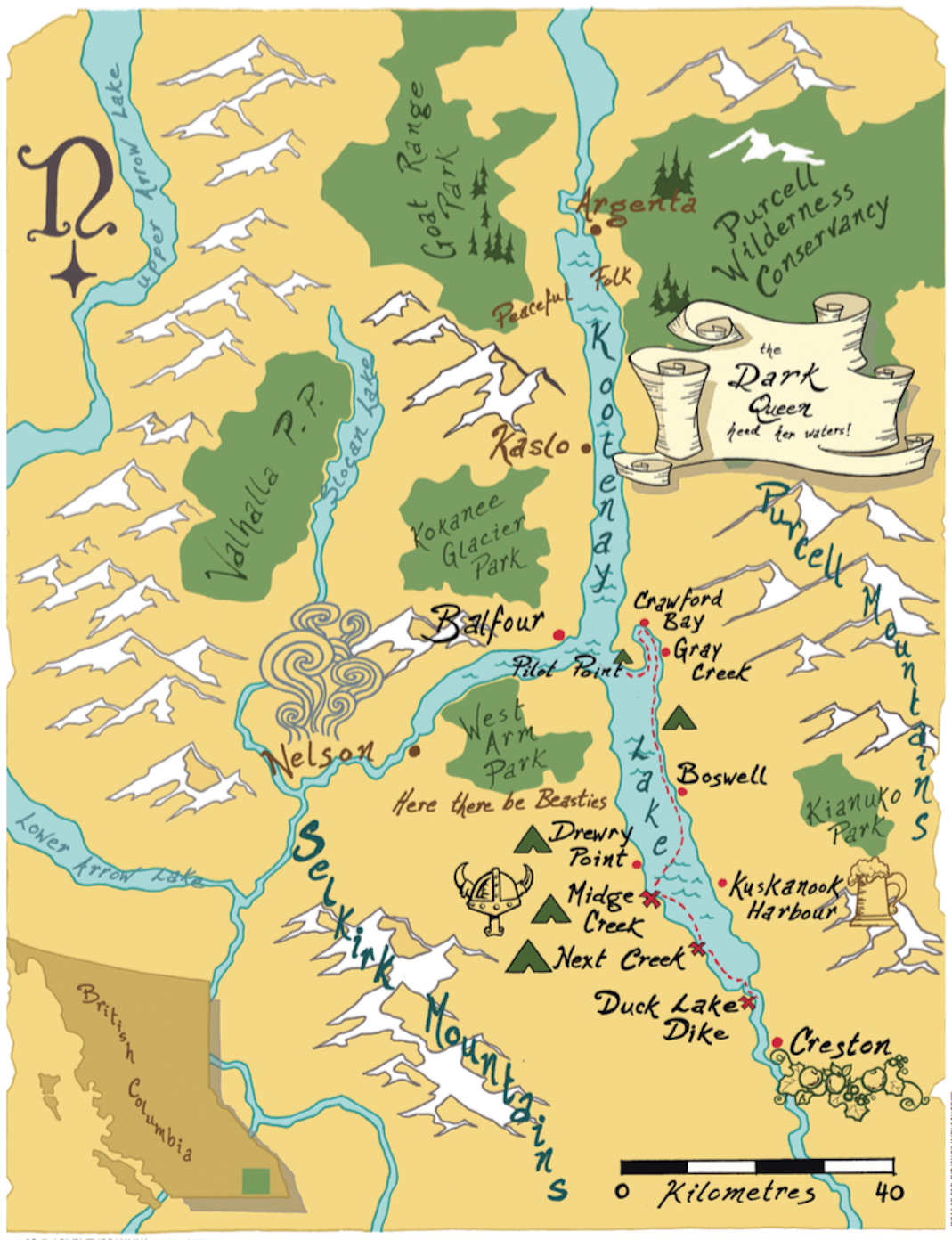
Hand-drawn illustration of Kootenay Lake area
X marks the spot. | Illustration by: Lorenzo del Bianco

If you have at least four days to explore Kootenay Lake, this route from Creston to Crawford Bay offers a little bit of everything the region is famous for. Start with a mandatory tour of the Columbia Brewery (home of the world-famous Kokanee glacier beer) in Creston, put in at the southern tip of Kootenay Lake, stop for a day to enjoy hiking among old growth forests and mountain ridges, then explore the communities of the east shore before paddling or shuttling back to your car.

Day 1

To reach the put-in at the Duck Lake dike, head west from Creston on Highway #3 across the Kootenay Valley. Head North on Lower Wyndell Road (you will need to turn left and go under an overpass). At kilometer 6.9, head left on Duck Lake Road for another 6.8 km. A lovely opening allows access to the East Channel of the Kootenay. From here paddle south (upstream) for 200 m to enter the current of the main river channel.

This first day of leisurely paddling carries you under the old railway lift bridge and out onto the Dark Queen herself. The nicest paddling, and camping, is along the west shore. Several small beaches provide camping, but the nicest spot by far is the sandy beaches of Next Creek—a B.C. Forest Service Recreation site with pit toilets and picnic tables.

Boats & Guides
Kaslo Kayaking (Kaslo)

kaslokayaking.com

Nelson Paddleboard & Kayak Rentals (Nelson)

nelsonpaddleboardandkayak.com

Inner Journeys
Yasodhara Ashram (Crawford Bay)

yasodhara.org

Environmental Info
Wildsight

wildsight.ca

Visitor’s Info
Kootenay Lake Chamber of Commerce

kootenaylake.bc.ca

Parks & Camping
BC Parks

bcparks.ca

Day 2

On the point north of Next Creek, look for pictograms left by the Ktunaxa First Nations over millennia. The 230-hectare Midge Creek Provincial Park has more than a kilometer of white-sand beach. Maintained tent sites here are available for $5 per person per night.

To go for a hike on Day 3, base yourself here for two nights. Alternately, head several kilometers north to Drewry Point Provincial Park for more spectacular, and free, camping. Both these parks are boat-access only, with pit toilets and wilderness campsites that are available on a first-come basis.

Day 3

For a day of hiking from Midge Creek, follow an old, overgrown mineral exploration road up the north bank of the creek through spectacular old growth ponderosa pine. For views down the lake, follow an obvious ridge upwards to the north, 1.6 km upstream. This ridge is crisscrossed by numerous game trails and offers a mix of dreadfully thick vegetation and lovely open rambling. Rugged, exceptionally committed hikers might make it 11 km upstream along the old road to find some of the finest original cedar and spruce old-growth forest left on Kootenay Lake. Cedars in this stand were saplings when Leif Ericson landed in North America in AD 1,000.

Note: past the end of the old road this route follows many old game trails and involves some route-finding and creek-crossing skills—not recommended for a leisurely sashay on a lazy afternoon.

Day 4

From Midge Creek or Drewry Point, cross the lake to explore the east shore communities of Twin Bays, Boswell, proudly metric-free Gray Creek, and Crawford Bay. Crawford Bay has a world-renowned collection of artisans and craftsmen—from glass blowers and ironsmiths to potters, weavers and broom-makers. Nearby, Yasodhara Ashram offers introspection in a stunning setting.

[ Paddling Trip Guide: View all paddling trips in British Columbia ]

There are many camping options along the shore between Boswell and Gray Creek, and also a nice spot called Steep Beach on the west-facing shore of Pilot Point. At the end of your explorations, shuttle back to your vehicle—or hitchhike, an illegal yet thriving form of public transport in the Kootenays.

This article originally appeared in Adventure Kayak‘s Summer 2007 issue. Subscribe to Paddling Magazine’s print and digital editions here, or browse the archives here.


Dave Quinn is a freelance writer, photographer and guide based in Kimberley, B.C. 

The Dark Queen’s throne room. | Photo: Dave Quinn