Home Blog Page 359

Modern MITH-ology: Carving Eddylines

Photo: Carole Westwood
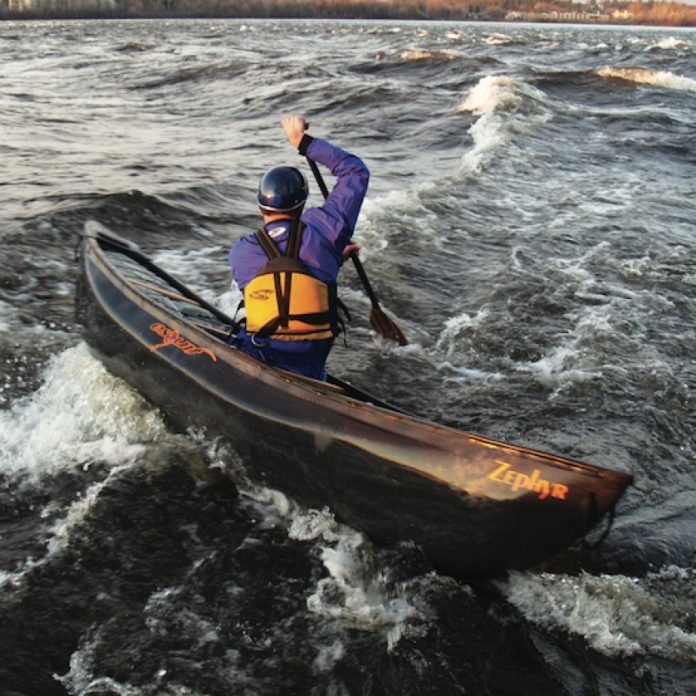
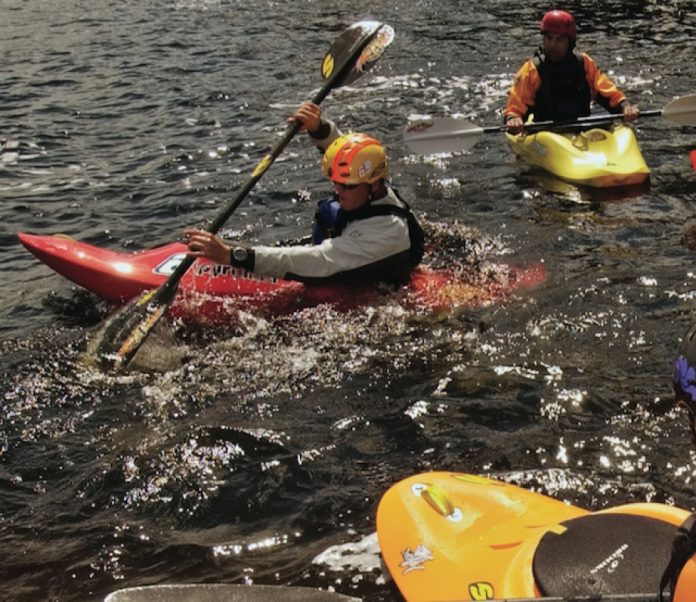
Andrew Westwood smoothly exits an eddy in his Esquif Zepher.

Entering and exiting eddies can trick even the seasoned paddler into complacency if they are not paying attention or rust has coated their skills over time spent away from the river. MITH is a simple way to remember the breakdown of skills needed to execute eddy turns regardless whether you are in a kayak, OC1 or tandem. Much of what we teach in introductory canoe courses is a product of stories passed down from generation to generation, spread by oral tradition. Sometimes these skills are eventually written down in manuals, but sadly some of the greater meaning can be lost in the process. Take P.A.T. for example; the process of using power, angle and tilt to get into eddy pools. PAT is an oversimplification of the turning skill needed to get beginner paddlers across eddylines.

The concept of carving the canoe is missing from PAT. Modern MITHology introduces momentum, initiation, tilt and hold as the tools needed to unlock the secret behind carving supernatural eddy turns. MITH addresses the shortcomings of PAT and better describes the technique used by advanced paddlers to carve their canoes smoothly into eddy turns, s-turns and peel outs.

MOMENTUM combines an object’s mass and velocity. The amount of momentum required to carve an eddy turn depends on the friction you need to overcome to cross the eddyline and how far up the eddy pool you need to travel.

It’s better to think about eddy turns in terms of momentum rather than power because, for example, a tandem boat with very little speed, or power, can still carry plenty of momentum into a carve be- cause of its mass. PAT implies you must be powering or paddling forward, but really it’s not about you paddling, it’s about the canoe having enough momentum, either by you moving it forward or by the current doing it for you, or simply by the sheer mass of an ABs canoe moving toward the eddyline. In many cases you don’t need to be powering at all, because the canoe will have enough momentum just from the speed of the current and its own mass. So to carve a great eddy turn your canoe will need just enough momentum to cross the friction of the eddyline and carry you through the carving turn and up the eddy pool.

Every turn you perform has to begin with a carve. INITIATING a carving turn can be as straightforward as performing a stern pry or stern draw stroke, or as subtle as crossing the eddyline paddling an inside circle either on your on or off side and allowing it to tighten into a carving arc as you cross an eddyline. The critical product of this step is that you need to initiate a carve and set the canoe travelling an arcing path toward the eddy pool.

Only canoes that are TILTED on edge will carve turns. Canoes that are paddled into turns flat will spin out, or worse, flip over. A tilted hull presents the bottom of the hull partially slanted on its side, or edge, so that the water pushes the hull around the arc. This pushing effect on the hull is what causes the boat to carve. Different amounts of tilt

will change the shape of the arc as will different hull lengths and shapes. Regardless, your goal in a carving eddy turn is to paddle along an arcing path from out in the river, across the eddyline, and into an eddy pool. Tilting your canoe will help to maintain the carve.

Travelling from any point A to point B takes time. During a carving eddy turn you must HOLD your tilt throughout the duration of the manoeuvre. The moment the hull is allowed to flatten out, your carve will be lost and your canoe will begin to spin—your carving momentum changes into spin momentum and your crisp eddy turn will stall. holding the tilt is the key to success. Practice gripping your canoe’s outfit- ting with your legs, not just for a moment, but for long periods of time. In whitewater, holding your boat is as vital as holding your paddle. Only when your canoe slows and the turn is complete should you relax your tilt and allow the canoe to completely level out.

If you are already familiar with PAT then moving up to MITH will come easily. Momentum, initiation, tilt and hold are the next steps to getting your canoe carving smoothly into eddy pools. With a little practice, carving supernatural eddy turns will become less fiction and more modern MIThology.

Andrew Westwood is a frequent contributor to Rapid. He’s an open canoe instructor at the Madawaska Kanu Centre and a member of Team Esquif. 

Whitewater’s Greatest First Descents

Photo: Wolfgang Weber/NWT
Whitewater's Greatest First Descents

For every sport, there are defining moments, brief seconds in time that last forever, recognizable by fans and non-fans alike. The shot heard ‘round the World, the immaculate reception, Gretzky’s 894th goal, whatever they are, these events resonate and things are a little bit different from that moment forward. We don’t have a World Series, Super Bowl or Stanley Cup. Instead we etch first descents upon whitewater’s hypothetical mantle as our greatest achievements. Sometimes first descents are more than the birth of new runs; sometimes they make us believe anything is possible. 

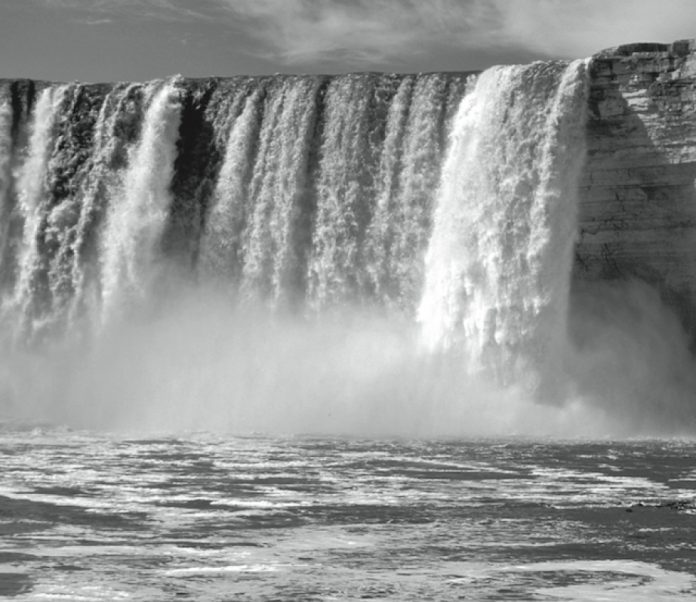
ALEXANDREA FALLS, TWIN FALLS TERRITORIAL PARK, NORTHWEST TERRITORIES

By Neil Etienne

When Tao Berman successfully cleaned Alberta’s 98.4-foot upper Johnston Falls in 1999, the paddling community perked up. Waterfall descents have increasingly gotten higher but this one not only gave hope the century mark could be broken, it was proof a 100-foot drop was really just a matter of the right river, the right levels and the right stuff.

Although he was washed from his kayak, in 2002 Tim Gross paddled himself over Oregon’s 101-foot Abiqua Falls, setting a new limit to test. In 2003, seasoned waterfall runner and extreme steep creeker Ed Lucero serendipitously discovered Alexandra Falls and all the pieces fell into place.

Heading into the Northwest Territories for a few days of surfing on the Slave River, Lucero, then 37, was shown the first major jewel on the fabled Water- fall Route, NWT Highway 1.

“I had no idea Alexandra Falls even existed so I wasn’t heading out to break any records by any means,” Lucero explained. “Once I saw it, I almost immediately saw the perfect line. It became a crossroads for me. I went there for a week and a half and plotted out whether or not I should do it.”

Topping out at nearly 106 feet, Alexandra Falls would have been the ideal location to plummet into fame for many paddlers. Lucero saw something more; a 105.6-foot-high soapbox, the ultimate chance to make a statement. He would stand up to fear in the hopes others would too.

“We were a country living in fear. We were at war, people were afraid to live their lives. I stood there and said ‘I think I can make a statement. I think I can make this fall.’ The message was to overcome fear,” he said.

Although he too swam from his boat, the bar was reset four-and-a-half feet higher.

Lucero said he won’t look for a higher drop, but suspects waterfall running will spur on its own industry and technology, pushing the vertical limits even higher. His own experiences led to the introduction of a specially armoured PFD, Stohlquist WaterWare’s Mark 1, which he designed for the impact of waterfall drops.

“The response I got at the bottom of the falls was incredible and I think a lot of people and manufacturers are going to want to get in on that. It’s prob- ably going to take on an industry all of its own and who knows how high people will be able to go.”

As of presstime, three and a half years later, Lucero’s run on Alexandra Falls remains the highest waterfall paddled and survived. 

GRAND CANYON OF THE STIKINE RIVER, BRITISH COLUMBIA

by Neil Etienne

The Stikine River carves a 700-kilometre path toward the ocean through B.C.’s rugged north country and the dangling leg of Alaska, about 240 kilometres south of the Yukon border. The tail end of a transcontinental highway for the Hudson’s Bay Company’s canoes, she fed the fur trade and the Klondike gold rush.

Her crowning glory, the Grand Canyon of the Stikine, towers sentinel over a narrow 80-kilometre stretch of vicious class V+ that even after a handful of descents, the surrounding provincial park advertises as strictly unrunnable.

When the first bridge crossed the river’s banks in the early 1970s, paddlers began to imagine the possibilities. British paddlers scouted a portion of the river in the mid-’70s and even ran the river below the canyon (mostly class III), but were unsure of the upper reaches.

Around the same time, Rob Lesser was frequently planning and running expeditions in remote rivers throughout B.C. and Alaska. The famed whitewater expedition paddler and 2005 inductee to the International Whitewater Hall of Fame was running the highway back and forth during several years in the late ‘70s from his home state of Idaho, to his park ranger job in Alaska, keeping his eyes open for prime spots. He shared a few notes with the British paddlers and started plotting in earnest.

River information was scarce; this was not the enlightened Internet age. There was some information through B.C.’s hydro company and it appeared to Lesser the gradient was reasonable, even if flows for most of the year were not.

Finally, in August 1981, an all-star cast including Lesser, Lars Holbeck, John Wasson, Rick Fernald, Don Ban- ducci and an ABC Sports television crew, complete with helicopter, slipped into the Stikine.

The levels were so intense the television crew quickly had all the glorious and jaw-dropping footage they needed, cutting the trip short and flying the paddlers to the mouth for final shots. It left a good portion of the canyon unrun.

In 1985, Lesser and Holbeck, along with Bob McDougall, did what had been building for nearly a decade and returned to make a full descent. 

MEKONG RIVER, TIBET TO VIETNAM

by Kyle Dickman

Iron age farmers, Marco Polo and Maoist revolutionaries all had to accept the unbridled power that kept southeast Asia’s Mekong River un-run for millennia. It wasn’t until the eve of the 21st century the mekong’s unfettered tradition was to be challenged by well-equipped expeditionaries and the demands of a changing civilization.

en route through its seething 4,600-kilometre, source-to-sea run, the mekong pounds down 3,000- metre-deep gorges, across six national borders and between some of the world’s most biologically diverse temperate forest. It is a source of food, water, transportation, energy and frequent fear of flooding for some 60 million southeast Asians living along its banks.

Western interest in paddling the Mekong began as early as the 1600s but the first serious expedition, led by french explorer and diplomat ernest Doudart de Lagrée, wasn’t attempted until 1866. After two years of barefoot portaging (apparently portaging wooden dories is a bit rough on 19th century footwear), struggles with violent rapids and a tenacious case of amoebic dysentery, Lagrée discovered what the Chinese already suspected, the river was unnavigable.

For 130 years the frenchman’s assessment stood. In the mid-1990s, interest in the Mekong’s whitewater rekindled. Teams from China, Australia, Japan and the U.S. began probing the nether gorges of its Himalayan high-country.

After seven years of wading through Chinese bureaucracy, American rafter Peter Winn secured permits and logged a handful of first descents before Australian kayaker Michael O’Shea connected the dots to complete the first source-to-sea expedition in 2004. After seven months of enduring chilly Tibetan temperatures and swarms of multi-national mosquitoes, o’shea conquered the whitewater responsible for centuries of defeats.

Conquered, perhaps sadly, seems to be the Mekong’s destiny. In reaction to a multiplying population and a ballooning economy, China has entered a dam-building era unseen since U.S. engineers trowelled off the concrete of the Grand-Coulee and Hoover dams in the 1930s and ’40s. Already three dams have been completed on the mekong with plans for as many as 100 more.

Fortunately, in 2006 American Travis Winn, son of Peter Winn, and a handful of rafters caught one last ride—a famous final descent if you will—down a river that may not be run for another millennium.

NARROWS OF THE GREEN, ASHEVILLE AREA, NORTH CAROLINA

by Neil Etienne

A little less than 20 years ago, North Carolina’s Narrows of the Green River was nothing more than a portage route that joined the more gentle stretches upstream and down.

Long touted as unrunnable, it wasn’t until 1988 when creekers Tom Visnius and John Kennedy finally executed a full-on descent that the Green Narrows began its torrid ascent to popularity. In a few short years it became one of the most popular class IV–V+ stretches in the U.S.

Earning a first descent on the Narrows was difficult enough in a kayak, certainly no one would have any business running them in a canoe, right? Particularly when the river—controlled by dam release—could be pumping out a savage 8.5–11.33 cms, unlike modern flows, which seldom top 5.66 cms.

Dave “Psycho” Simpson stepped up to the Green’s banks with his Dagger Encore about a year after Kennedy and Vis- nius, but before word had really spread about the 11 gnarly class IV–V+ rapids in quick succession.

“It was overwhelming,” Simpson described his first meet- ing with the Narrows. “At the time I thought it was completely unfeasible to run. I thought it would be suicide.”

So, Psycho set out, bringing along trusted partners Bob McDonough and Forrest “Woody” Callaway. Over a couple of days they picked away at the rapids, only a couple of which had been named. The most beastly would earn its name on that trip—Gorilla.

“At the time it was completely uncalled for,” Simpson said. “It was unrunnable. The guidebooks said it was unrunnable, ev- eryone said it was unrunnable. Then I thought ‘Oh, the guide- books are wrong; what else could they be wrong about’.”

The Narrows would remain a favourite for Simpson as he would run it every chance he got, sometimes twice a day. It inspired him to tackle the Gauley, Tellico, Watauga and Russell Fork when its releases were far more substantial.

Simpson was not the only one inspired by his runs of the Green Narrows, they marked the beginning of OC creeking. Many single-blade paddlers began to think of the possibilities; an open boater had not only survived a steep class V, he had done so with grace.

Wayne Gentry’s Green Summer, the 1992 National Paddling Film Festival’s “Amateur Best of Show” showcased the Nar- rows and Psycho’s skills at that year’s Gauley Fest, where a young Eli Helbert, now at the forefront of open canoe creeking and the only open boater to enter the Narrows of the Green River Race, watched in awe.

“I remember thinking that guy’s crazy, I could never do that. But because Psycho did it first, a lot of us were willing to do it too when the time came,” Helbert says. “When I saw the movie I knew I had to try.”  

OTTAWA RIVER, BEACHBURG ONTARIO

by Neil Etienne

There are few rivers in Canada that compare historically with the Ottawa. It’s a river that built a country, yet it was forgotten or at the very least overlooked, as a paddling industry raged on without it. How does a river that now rivals all others as the ultimate playboating, training and testing ground remain only a logging and trade route until the mid-1970s?

Simple. Lumberjacks don’t paddle and farmers don’t swim.

The Ottawa borders the TransCanada highway but the rapids lay hidden at the back of privately owned farmland where whitewater is more of a burden than boon. Local landowners saw no jewel and the whitewater remained a well-kept secret.

In June of 1974 Hermann Kerckhoff, founder of the Madawaska Kanu Centre, took his daughter Claudia to the Ottawa. he was there to disprove rumours that there was whitewater on the river.

Putting in on the Quebec side at what is now known as McCoy’s, the duo was pleased by what they saw, if only briefly.

“It was a total surprise to my dad and I to see any whitewater at all. After McCoy’s Chute it gets flat, so we still didn’t expect anything much downriver,” Claudia explains. “Then we came to a split and the river got our respect immediately.” Choosing the right path, they discovered what is now known as the Main Channel.

“It was total euphoria. we’d never seen such big or friendly whitewater,” Claudia recalls of the river that would someday be the host of two world freestyle championships. “This was the find of a lifetime.”

That summer expert paddlers from MKC began running the remaining branches and by 1975 others began to take note of the Ottawa’s potential.

Ed Coleman, an American rafting company owner and a mentor of sorts to Wilderness Tours owner Joe Kowalski, flew over the rapids that year and several weeks of trial rafting runs ensued.

“It just never occurred to us that there may be rapids on the Ottawa but it’s got world-wide attention now,” Kowalski says. “There’s no place better for rafting and for kayaking. The Ottawa is prob- ably the best playboating river in the world.”

Thirty-three summers later the Ottawa River will be the stage for the world’s best freestyle paddlers. International athletes will be pulling off moves created on the Ottawa and paddling boats designed and tested on it.

Not bad for a river that wasn’t supposed have rapids.  

UPPER JOHNSTON FALLS, BANFF ALBERTA

by Neil Etienne

From the moment a 19-year-old Tao Berman and crew began testing Upper Johnston Falls in Alberta’s Banff National Park more than seven years ago, it has been kayaking’s greatest focal point for the general public.

Before what would become a world-record event even happened, its appeal was obvious. More than 100 dumbstruck onlookers, some even wailing in fear, lined the park’s pathways and lookout spots just to catch a glimpse of what was going on. Almost instantly, video circulated worldwide in easy-to-digest, jaw-dropping simplicity.

On August 23, 1999 Tao Berman’s run of Johnston Falls broke the waterfall record for height at the time by about 20 feet but he also broke another barrier—whitewater kayaking became mainstream extreme.

“I didn’t realize just how much exposure that drop was going to get. With that one I wasn’t looking for exposure, just a 100-foot fall to run. People started to recognize me who had never paddled before. That’s when I noticed things were starting to get different.” Berman explains.

The plunge made headlines on NBC, Sports Illus- trated, Extra, and even Ripley’s Believe It Or Not. Since then, it has been a whirlwind of attention for Tao, and in turn, kayaking. NBC’s Jeep World of Adventure Sports approached him in 2004, asking what he was up to next. “Lacy Falls, British Columbia,” was Berman’s reply.

More rock quarry than waterfall, it is difficult to fathom the remote coastal stairway sluice of Lacy Falls as one of the more pivotal locations in recent whitewater history. But it too dropped extreme kayaking into a mainstream audience. This time with 20 different camera crews on hand, footage hit CNN, Fox News, the Discovery Channel, Real TV, the Outdoor Life Network and far, far beyond.

Careening down the slick, snaking conduit of inches-deep water, hitting more than 65 kilometres per hour, Berman’s 280-foot toboggan ride to the Pacific Ocean was so enthralling, terrifying and immediate, it was ex- actly what mass media and the TV viewing public con- sume and respect.

“Tao’s descent of Lacy Falls was watched by roughly a million viewers on NBC’s Jeep World of Adventure Sports in its premier airing,” explains the show’s Executive Di- rector Rufus Frost. “Not surprisingly, we were drawn to cover Tao and his attempt at this descent because it was a dramatic feat that would resonate with viewers who did not follow the sport of kayaking.”  
This article on first descents was published in the Spring 2007 issue of Rapid magazine.This article first appeared in the Spring 2007 issue of Rapid Magazine. For more great content, subscribe to Rapid’s print and digital editions here.

Dry Food: Why You Should Invest in a Dehydrator for Your Next Trip

Photo: flickr.com/mlcastle
Dry Food: Why You Should Invest in a Dehydrator for Your Next Trip

With apologies to Napoleon and his dictum that an army marches on its stomach, paddlers know that canoe trippers float on their bellies. Nutritious, delicious and non-perishable food is the fuel you need to power your canoe every day.

Before forking over for freeze-dried food in fancy packaging, consider that paddlers used to nourish themselves for months at a time on simple dried foods like cracked corn, beans and pemmican. Foods that are dried slowly are nutritionally superior to canned food, often don’t require added chemicals or preservatives, are simple to pack, easy to prepare, offer an unbeatable calorie-to-gram ratio and can keep for years.

So how do you dehydrate your own food? Well, you can experiment with drying over a forced-air heat register, or by building your own dehydrator with some plywood, screening, a light bulb, a fan and a thermometer. Or you can buy your own simple, reliable and inexpensive unit from companies such as American Harvest.

Start at the grocery store. It doesn’t matter if the food is fresh or comes in a can, in a jar or from the freezer. Read your dehydrator’s instructions, plug it in, spread the food across the drying trays and sit back and wait. Once you see how simple it is, you’ll realize your next trip’s menu is limited only by your imagination.

Vegetables

Vegetables bring variety and colour to any meal and are important for their nutritional value. You can even use bags of frozen peas, beans, corn, carrots—they all dry very nicely with no washing or chopping necessary.

Canned Beans

Canned beans are nutritious, cheap and easy to dry. The standard “baked beans in tomato sauce” are a snap to rehydrate. Mix a variety of beans with slices of rehydrated vegetables and rice for a simple, nutritious meal.

Applesauce

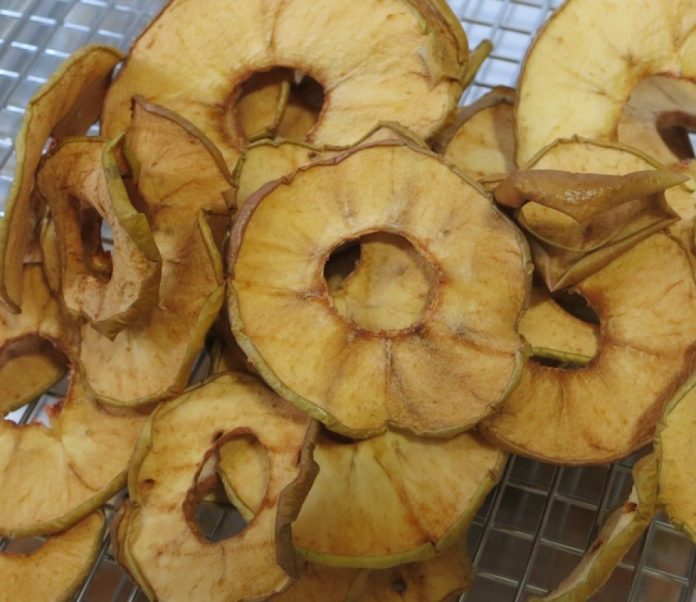
Use applesauce for fruit leathers. Applesauce is full of pectin, which binds the goopy mess into a tough sheet of “leather” when dried. Just spread the mixture onto plastic sheets that come with the dehydrator. The leather can be eaten as a snack, or rehydrated into a sauce for bannock or pancakes.

Beef

Make up a batch of beef jerky for your carnivorous friends. Cure lean ground beef with curing salts, add your favourite spices, roll into three-millimetre thick strips and dry for five to eight hours.

Spaghetti Sauce and Salsa

Spaghetti sauce and salsa resemble the sole of an old leather shoe when dehydrated. They rehydrate back into a remarkable resemblance of the original after just a few minutes in hot water. But don’t buy cheap spaghetti sauce!

It usually has a higher water content, and takes longer to dry. Gourmet brands with large pieces of vegetables should be blended before drying.

Max Finkelstein canoed solo across Canada between 1997 and 1999. 

This article on camp food was published in the Fall 2006 issue of Canoeroots.This article first appeared in the Fall 2006 issue of Canoeroots Magazine. For more great content, subscribe to Canoeroots’ print and digital editions here
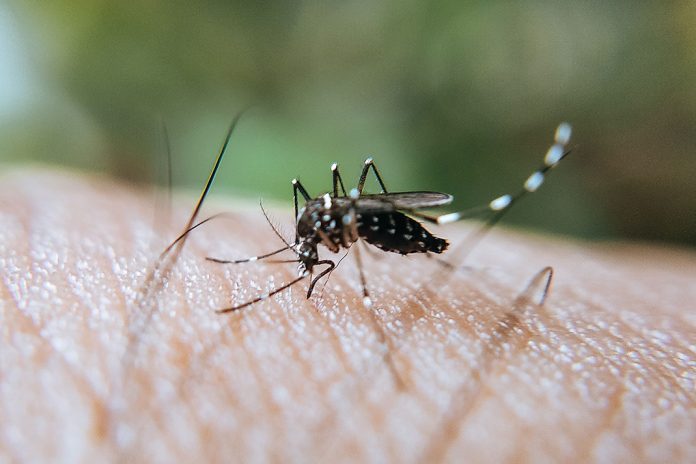
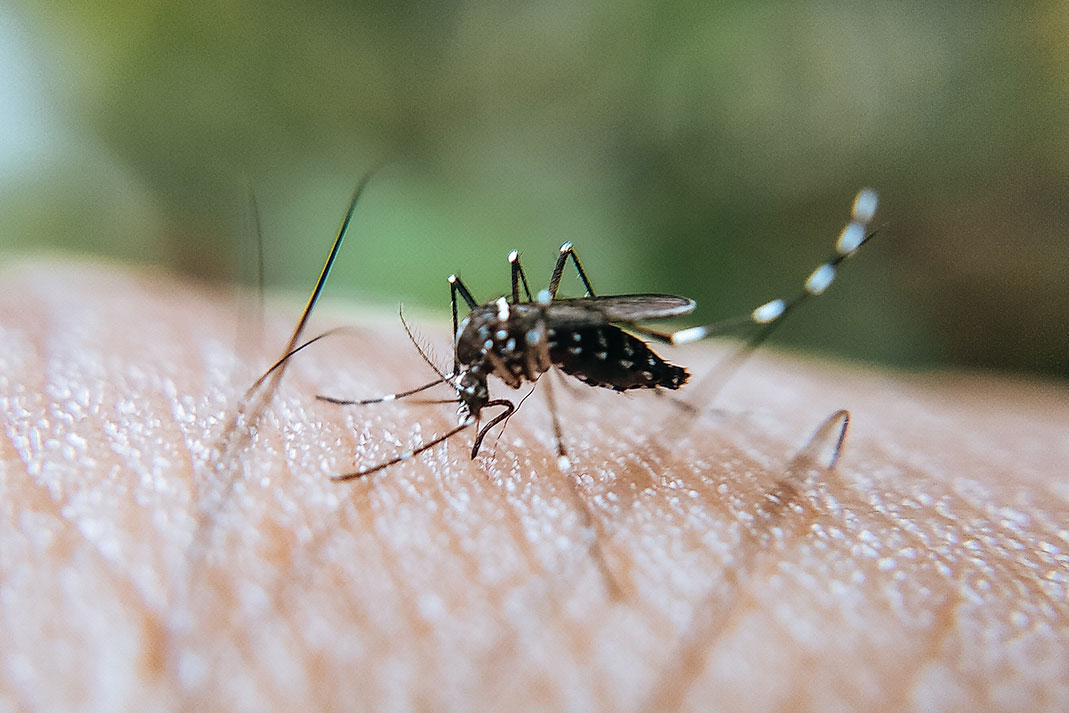
13 Things You Didn’t Know About Mosquitos

Photo Courtesy: Ravi Kant from Pexels
1 Female mosquitoes suck protein-rich blood from mammals and birds to nourish their young. Males, mean- while, nibble on flowering plants until they are needed.
2With their wings revving at 400 beats per second, mosquitoes can cruise at a speed of five kilometres per hour.


3Mosquitoes make frequent meals for fish, bats, birds, frogs, toads, beetles, and spiders.


Photo Courtesy: Ravi Kant from Pexels


4Mosquitoes find prey by honing in on wafts of carbon dioxide.

5There are 40,000 mosquitoes for every human being on earth.


6The Mosquito Ultrasonic Teenage Deterrent is a noisemaking device used in the United Kingdom to drive away loitering teenagers. The device annoys only teenagers by taking advantage of presbycusis, a form of age-related hearing loss in which high frequencies (18-20kHz) become inaudible to people over 20.

Photo by doTERRA International, LLC from Pexels
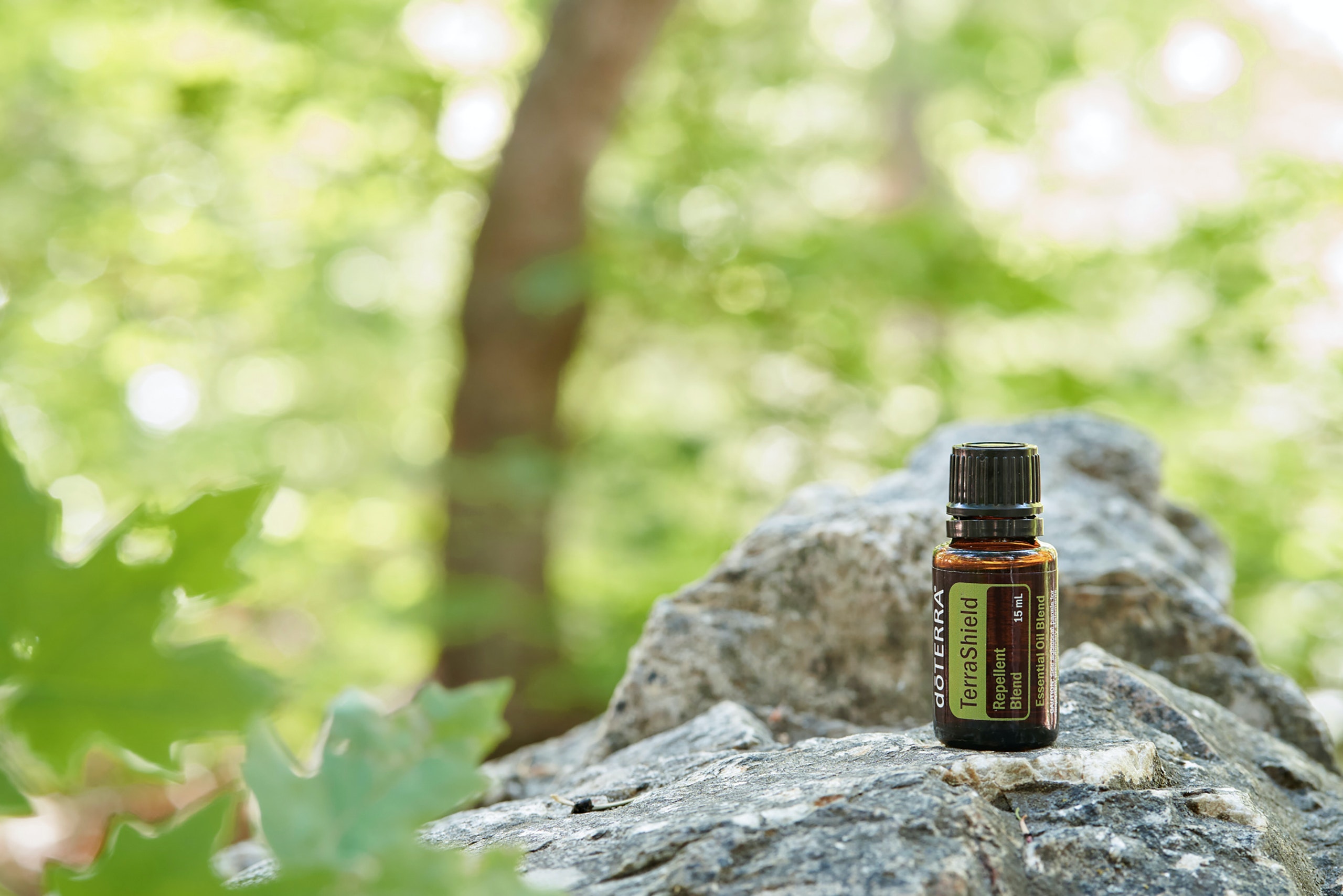
7Mosquitoes dislike citronella oil because it irritates their feet.
8It’s typical for a mother mosquito to feed and breed eight times in her lifetime. Feeding mosquitoes employ an anticoagulant to thin the blood and keep it flowing. It’s this anticoagulant that causes bites to be itchy.

10Ever a cultural mosaic, Canada is blessed with 74 different species of the pest.

11Mosquito larvae hatch in ponds of snowmelt in April and May across southern Canada, living off of decaying vegetation for up to four weeks before taking to the air as the trees bloom.

12In 300 B.C., Aristotle referred to mosquitoes as “empis” in his Historia Animalium where he documented their life cycle and metamorphic abilities.

13

The Mosquito Coast (Zaentz)

Based on Paul Theroux’s best-selling novel, The Mosquito Coastis the adventure story of how a family’s quest for paradise becomes a terrifying fight for survival. The Mosquito Coast (1986) stars Harrison Ford and follows eccentric inventor Allie Fox as he sells his house in the United States and moves his family to Central America to build an ice factory in the jungle. Mosquitoes turn out to be the least of Fox’s worries.

RENT ON AMAZON


Photo: Kaydi Pyette
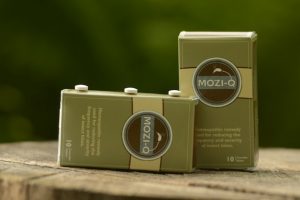
Mozi-Q oral insect repellant | Photo: Kaydi Pyette

Gear: Oral Mosquito Repellant

At first we were skeptical; insect repellant in pill form? But after eating an all-natural Mozi-Q tablet we did seem slightly less desirable to the blackfly and mosquito population in buggy May. According to Mozi-Q, active ingredient Delphinium makes all sorts of insects, including head lice and bed bugs, less inclined to bite.

From the manufacturer: “Mozi-q is a formula containing five homeopathic remedies: Staphysagria, Ledum palustre, Urtica urens, Cedron and Grindelia. They are in low C and D potencies, thereby acting at the physical level for their common indication, to reduce the frequency and severity of insect bites.”

Would you try it?

$9.95-$24.95 | mozi-q.com

BUY ON AMAZON


Photo: www.thermacell.com
Thermacell Mosquito Repellant Lantern | Photo: thermacell.com

Gear Review: Thermacell Mosquito Repellant Lantern

This double-duty lantern will light up your dinner table and save you from becoming the main dish. Insert the butane canister, insect repellent cartridge and four AA batteries, and with the flick of a switch, you have up to four hours of protection from insects. Two settings allow you to change the intensity of the LEDs. Size and basic construction make it perfect for a dinner dockside and car camping.

$32 | thermacell.com

BUY ON AMAZON

Becky Mason: Keeping a Fine Balance

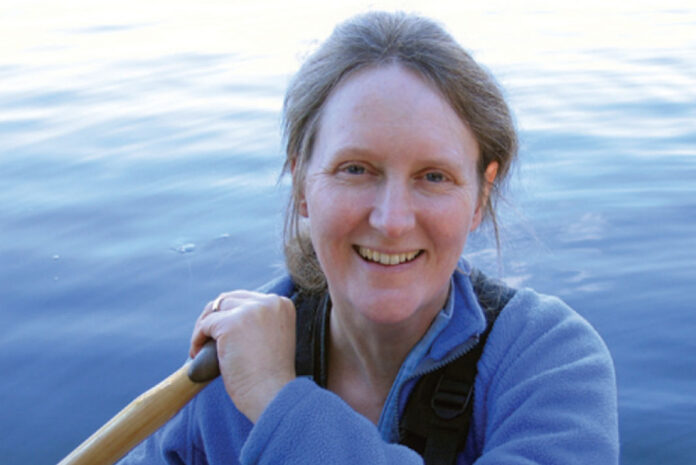
portrait of canoeist Becky Mason on the water with paddle in hand
Becky Mason: Keeping a Fine Balance

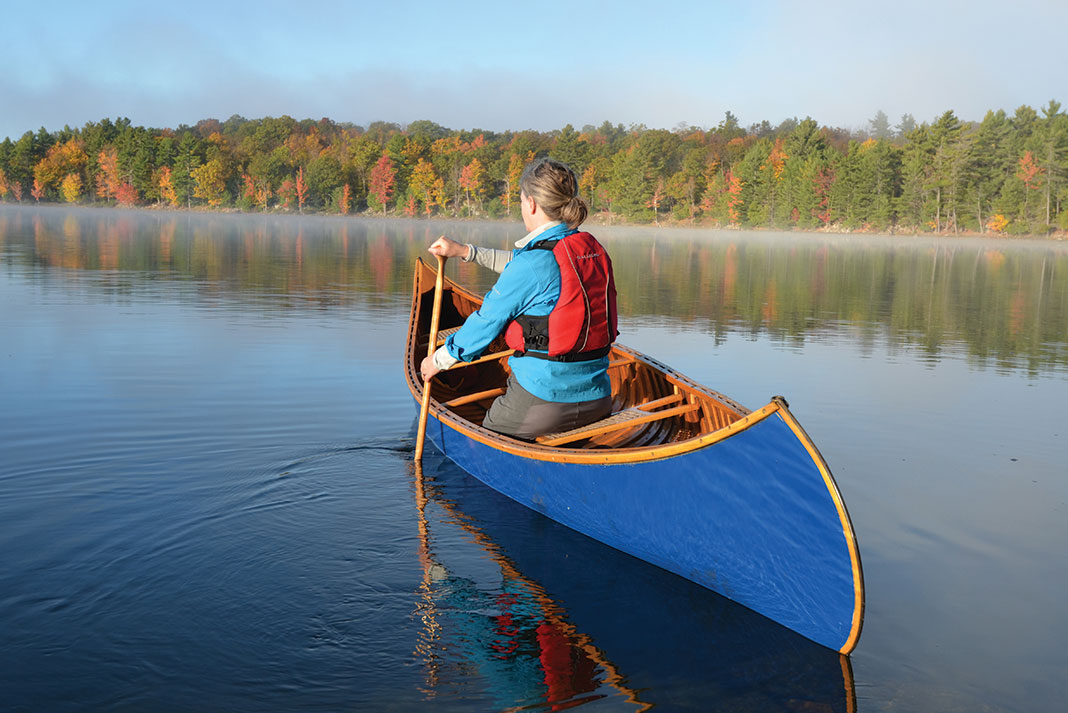
When Becky Mason paddles, she’s rarely on an even keel. She kneels against the side of her canvas canoe so it heels over so far the smallest ripples threaten to slip over her gunwale.

That’s why she paddles early in the morning, when the biggest obstacle is the mist that obscures her view of the Gatineau Hills north of Ottawa. She’s no stranger to whitewater, mind you. Now 42 years old, she guided for Black Feather for seven years in the 1980s on rivers like the South Nahanni in the Northwest Territories and the Petawawa in Ontario, but she prefers calm water where she can concentrate on just one thing.

Becky Mason: Keeping a fine balance

She isn’t so lucky for the rest of the day. As an artist, canoe instructor, filmmaker and environmental activist she’s off in many directions once she lands, and it shows when you speak with her and try to follow the path of unfailingly cheerful conversation as she jumps from one topic to the next.

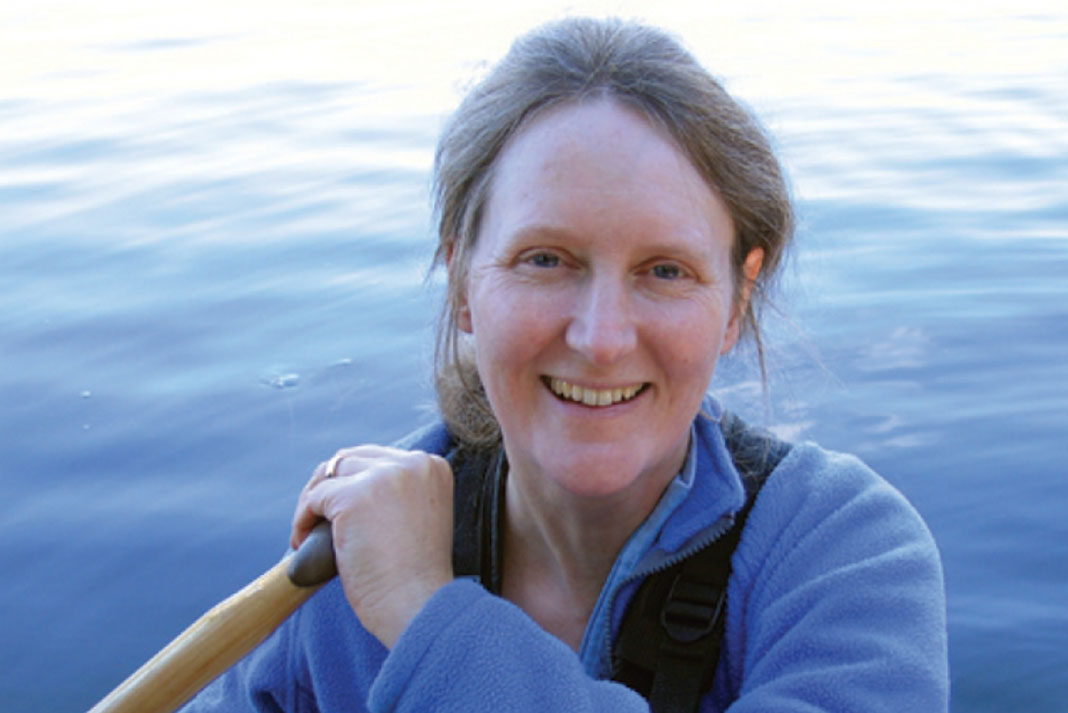
portrait of canoeist Becky Mason on the water with paddle in hand
Canoeist, artist and activist Becky Mason maintains a fine balance. | Feature photo: Reid McLachlan

In summer she seems happiest to talk about her flatwater solo canoe courses, which were the basis for her instructional video Classic Solo Canoeing in 2000. Having the late canoe icon Bill Mason as a father and first instructor provides her with a lot of credibility in canoe circles and she draws students from as far away as England and Italy.

“There are a lot of ways to paddle, but I focus on the strokes that will move a tandem canoe through the water with finesse. Soloing is not about brute force,” she explains, stressing that the key to efficient paddling is held gently in the grip hand.

Artist and activist

The graceful strokes don’t stop once she climbs out of the canoe. Mason is a watercolour artist by trade and shares a studio in Chelsea, Quebec, with fellow artist Reid McLachlan, her husband and canoe partner, whenever Mason agrees to paddle with another person.

Mason says it’s the places her canoe has taken her that inspire not just her painting, but also her work as a spokesperson for the Canadian Parks and Wilderness Society. Her activism on behalf of conservation and wild spaces is another thing she inherited from her father.

She recalls asking her father why he wrote so many letters to governments, urging them to create parks or stop dams. He told her he believed that governments knew that for every person who wrote a letter, there were 100 who wanted to write but never got around to it.

“It was an eye opener for me,” says Mason. Now she takes satisfaction in thinking that whatever small ripples she makes in official circles can have a far-reaching effect. As she knows from the water that eventually soaks her pants during her morning paddles, a lot of little ripples can add up to something.

Cover of Canoeroots Magazine Fall 2006 issueThis article was first published in the Fall 2006 issue of Canoeroots Magazine. Subscribe to Paddling Magazine’s print and digital editions, or browse the archives.


Canoeist, artist and activist Becky Mason maintains a fine balance. | Feature photo: Reid McLachlan


Editorial: Paddle to the Sea

Photo: Bill Mason Productions
Editorial: Paddle to the Sea

I went to school on snow days. snow days are those days when school boards deem the roads too snowy or icy for the school buses to travel. Most kids stay home, go toboganing, build snow forts and drive their moms batty. I, however, nagged my mom to take me. She barrelled the family oldsmobile through the drifts to our school where a dozen kids who walked to school and a couple teachers gathered in the basement to watch National Film Board films. Whenever the winter storms set in I knew that I had a good chance of seeing the late Bill Mason’s classic film Paddle to the Sea.

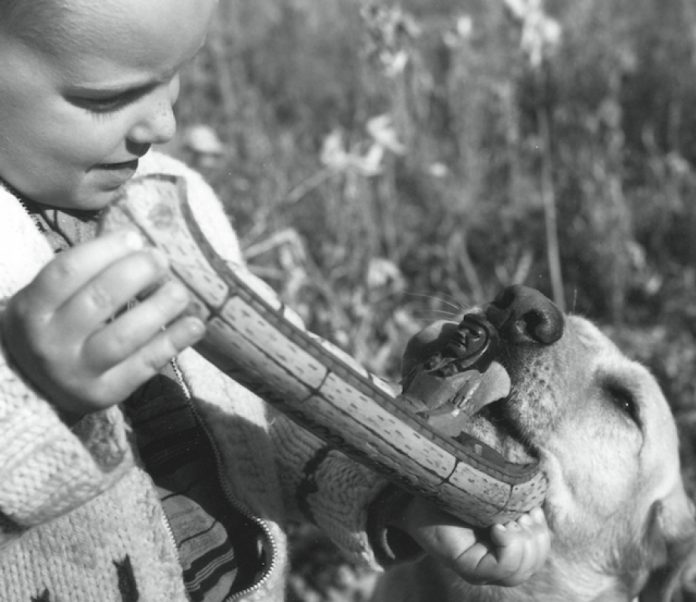
Kyle, a little boy who lived in a cabin north of Lake Superior, had a dream. he dreamed of a journey; he dreamed of paddling from his home to the ocean. this was a journey he knew he couldn’t make himself, so he carved Paddle out of a cedar log—a stoic native traveller in a birchbark canoe. the boy painted Paddle and poured lead into a groove in the bottom so the canoe would pop upright if it tipped over. In the bottom on the canoe the little boy carved the words, please put me back in the water.

The rest of the film follows the adventures of Paddle on his epic journey through the Great Lakes to the Atlantic Ocean. He braves forest fires, huge ships, curious gulls, noxious pollution, Niagara Falls and the worst threat of all—little boys like me, who couldn’t resist wanting to keep him.

I didn’t know it at the time but Paddle to the Sea topped the National Film Board library’s most-borrowed-film list. The film was used by teachers, not just on snow days but in the classrooms, all across Canada. Most school children in the late 1960s to the early ’80s were shown Paddle to the Sea at least once. I suspect many of you remember it.

Twenty-five years later, I have paddled and explored most of the path Paddle followed on his journey to the sea, with the exception of Niagara Falls of course. I have dreamed of great journeys and have followed some of those dreams. looking back I can see that I’ve made a life of putting myself back in the water.

I wonder where is Paddle now? The last we see of him, the lighthouse keeper tosses him off a bluff into the Gulf of St. Lawrence. did he catch a ride on the Labrador Current to the Gulf Stream then out into the North Atlantic drift to Norway and beyond?

I believe he did.

On a snowy day this past February, a day I deemed too dangerous to drive to the office—a snow day—I ordered a copy of Paddle to the Sea from the National Film Board’s online store. Forty years after Paddle to the Sea was released in 1966, it is still the most popular DVD in our house. It is as good today as it was in the basement of Jerseyville Public school.

This winter, share with your kids Paddle’s incredible journey. Then in the spring, take them to your local creek with a piece of cedar.

Who knows where their dreams will take them.  

Screen_Shot_2015-11-20_at_1.19.33_PM.pngThis article first appeared in the Fall 2006 issue of Canoeroots Magazine. For more great content, subscribe to Canoeroots’ print and digital editions here
Kirk Wipper: The Passion of the Collector

Photos from the collection of Kirk Wipper
Kirk Wipper: The Passion of the Collector

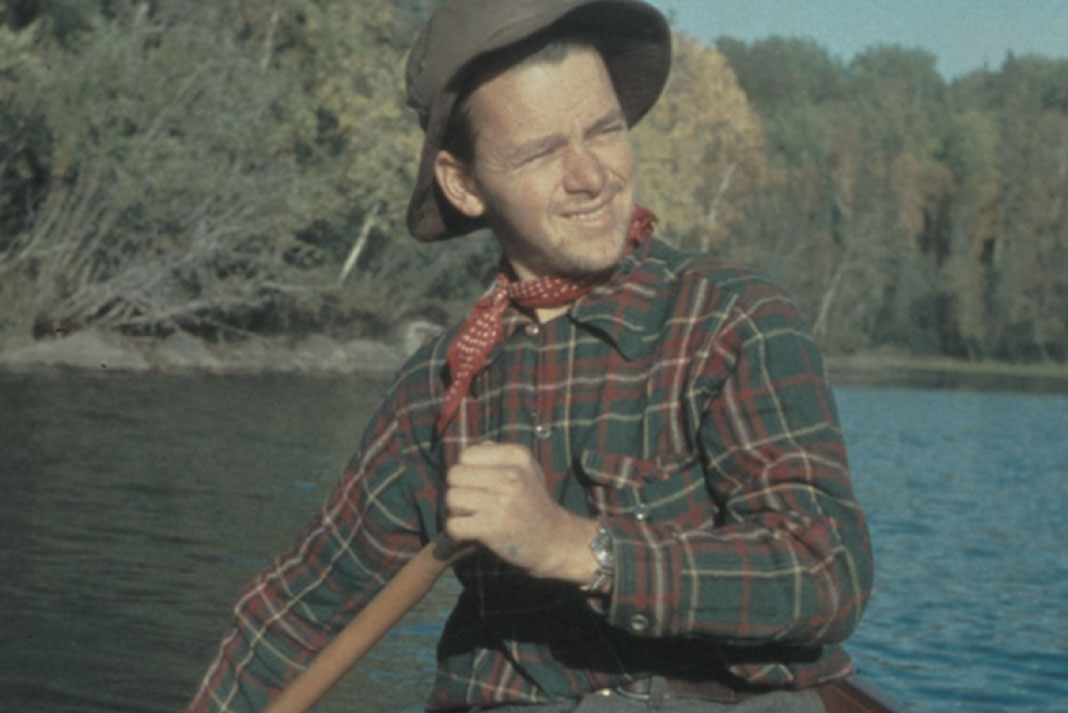
Kirk Wipper is like a firefly—visibly shining, but hard to catch. When I finally caught up with him after weeks of pursuit he had just returned from the annual Fiddlers on the Tobique in New Brunswick. As Honorary Patron, he led the parade of 1,500 canoes and almost as many musicians playing fiddles, mandolins and banjos down the beautiful Tobique River in the central highlands of northern New Brunswick. Before the Tobique he had been a guest speaker at the an- nual Maine Canoe Symposium, and on the interven- ing weekend he had led 60 canoes down Ontario’s Trent River, a new event he had helped to instigate in 2003 to raise money for the World Food Bank.

It’s a busy schedule for an octogenarian to maintain, but Kirk doesn’t seem to tire. Kirk modestly takes advantage of every canoeing opportunity that his status as the world’s greatest canoe col- lector brings him. Though his name is inextricably linked to a museum collection, there’s nothing hushed or sedate about Kirk’s love of canoeing. In the past 10 years he has found enough time away from festivals and events to canoe—or raft—some of North America’s great rivers, including the Thelon, Tatshenshini, Alsek, Nahanni, and, wildest of all, the Naranjo in Costa Rica.

KIRK’S EARLY YEARS

Canoes have been the centrepiece of much of Kirk’s life, but it was not always that way. Growing up on a pioneer farm in the Inter-lake district of central Manitoba, the son and grandson of German immigrants, there was nary a canoe in sight. Living close to nature on a farm carved out of the northern bush, he learned early about hard work, frugal- ity and optimism. Having left Germany to escape the militarism growing out of the rising nationalist fervour, his parents also instilled in him a deep and abiding love of Canada. 

It was not until his arrival in Toronto in 1946, after war-time service in the Canadian Navy, that Kirk really made contact with the canoe. When involvement with the YMCA took him north to be an instructor at Pinecrest summer camp, Kirk discovered the canoe’s true value as a vehicle to connect with the natural world. There he quickly realized that the canoe was a device for leadership training, with its emphasis on self-reliance and resourcefulness.

Early in his career of teaching in the School of Physical Education and Health at the University of Toronto in 1957, Kirk bought Camp Kandalore, a boys’ camp on Haliburton’s Lake Kabakwa. A couple of years later, the head of Kirk’s university department presented him with a basswood dugout canoe from the 1890s which had been found on his farm near Lakefield. The canoe was given pride of place in the dining hall at Kandalore, and the collection began.

KANAWA INTERNATIONAL MUSEUM OF CANOES

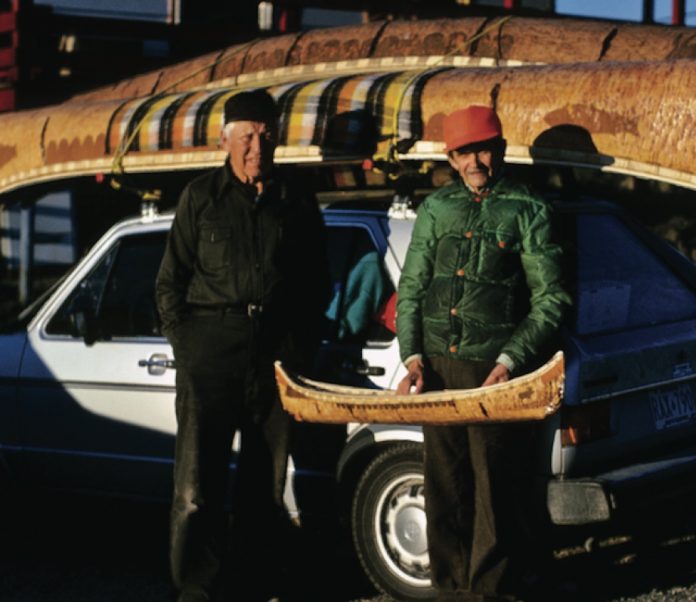
The dugout was soon joined by other unique canoes, including two vintage Peterborough freight canoes which were treasured as much for their historic value as for their usefulness in providing ferry service to Chapel Island, as platforms for stage performances, as diving rafts, or just as large baggage conveyors. Three canoes belonging to the Arctic explorer George Douglas, a birchbark canoe from Maniwaki, Quebec, and several others formed the nucleus of Kandalore’s growing collection, which Kirk had named the Kanawa International Museum of Canoes, Kayaks and Rowing Craft.

Without intentionally starting out as a collector, Kirk had developed a passion for canoes and his collection began to snowball. His many friends in his university, camping and Royal Life-Saving So- ciety circles soon grew into a worldwide network of contacts which included canoe builders and museum curators who kept him informed of any interesting watercraft as they became available.

Opportunities to acquire special canoes often came with a hefty price tag. In Kirk’s words: “It of- ten involved big sacrifices—I was often in debt, but I knew what was being done was right and it had to be done. I felt I had a responsibility to do the best possible job of collecting so I could tell the whole story of the relationship of canoes and kayaks to the environment and to the history of Canada. Once I had started down this path there was no turning back.” 

A LONG NEGOTIATION

His most anxious moments came during the acquisition of 44 canoes from the Heye Foundation’s Museum of the American Indian in New York. He had learned that the museum could no longer afford to look after this valuable collection, and Kirk began negotiations to buy them for Kanawa.

For eight years Kirk negotiated, in competition with several world museums, including the Smithsonian. Kirk remembers: “The time came when the Heye Foundation’s board was meeting to make a decision. There were 63 members on the board, the discussion went on and on, and in the end they agreed by one vote to let them go to Kanawa. I got the message about midnight and immediately phoned my son, David, standing by in New York with two big moving vans, to begin loading. In the meantime, two American congressmen, not wanting the collection to leave the U.S., tried to stop the trucks from crossing the border. I had anticipated this, and already had an import number in place with customs. When David phoned me to say that they were being held up at the border, I phoned the head of customs and the trucks were immediately waved through!” 

Kirk’s problems were not over. He still had to find $150,000 to complete the deal. 

Fortunately, Kirk’s many friends helped out with loans, all of which had to be repaid.

In years of major purchases for the collection, Camp Kandalore sometimes operated at a loss and it became clear it could no longer sustain the museum. To safeguard the camp, the museum was incorporated as a separate entity, with a board of directors to help with the much-needed fundraising. 

Kirk was always on the lookout for canoes which he felt should be in the collection. Never having been able to find a Haida dugout, he commissioned the building of one. Kirk remembers going to the Queen Charlotte Islands in 1971 to take possession of it: “Within living memory, no dugout had been built by the Haida, and Victor Adams undertook the work with some trepidation. The Haida helped us to give the canoe a ceremonial launching. As we prepared to push off the beach, I was struck by the wistful interest many children showed in the canoe. We offered the children a ride, discovering that none had ever before been in a Haida dugout. Despite our best efforts, we found the new canoe sluggish in the water, and responded to Victor Adam’s beckoning to return to the beach. ‘You know,’ he said, ‘Our canoe moves much better the other way around.’ How courageous they are, I thought to myself, to let their children venture out with Eastern amateurs!” 

A NEW HOME FOR THE CANOES

The canoes were beautifully displayed at Kandalore in a handsome log building especially built for the purpose. As the collection grew to 600 boats the building could no longer contain them all and some of the largest had to be stored outside under shelters. In addition to the worries about financing, the danger of fire and theft was ever present, humidity and temperature controls were out of the question, and insurance was impossible. Kirk’s resources were stretched to the limit. The time had come to seek a solution.

When it became known that Kirk was seeking a new location for his collection in the 1980s, a group at Trent University began exploring the possibility of establishing a museum in Peterborough, the home of the famous Peterborough Canoe Company. After negotiations with the newly formed Canadian Canoe Museum were complete, the transfer of canoes took place over several summers in the mid-1990s, whenever trucks and volunteers to drive them were available. Kirk’s collection had found a new home in a safe and controlled environment.

The collection was first put on display to the public in May, 1996. In the words of John Jennings, historian and founding member of the museum’s board of directors, “The collection that Kirk Wipper has amassed over four decades is the foremost collection of canoes and kayaks in the world. It is a national treasure that speaks to Canada’s identity and represents much of her early history.”

To give Kirk the last word: “I always knew that one day the public would take the collection to its heart, pick up the torch and run with it.”

Kirk has been honoured with the Order of Canada and the Order of Ontario for creating this national treasure, but as he says, “It’s not what one has done, but what one might still do that is important—Never rest on your paddle.”

Gwyneth Hoyle is the co-author of Canoeing North into the Unknown and is currently working on a biography of northern surveyor Guy Blanchet. 

This article on Kirk Wipper was published in the Fall 2006 issue of Canoeroots.This article first appeared in the Fall 2006 issue of Canoeroots Magazine. For more great content, subscribe to Canoeroots’ print and digital editions here
A Lynx, a Dog and One Very Long Portage

Photo: Bruce Montagne

When we pulled into the portage on the Steel River and saw an arrow pointing straight up a giant slab of granite, Alana and I immediately started procrastinating. We easily killed 20 minutes discussing the best way (winching? crawling?) to get our gear and canoe up the precipice.

Our dog Bailey, as usual, was less patient. If you’ve ever heard that springer spaniels are hyper, then you didn’t hear it from me. Frenzied is the word I would use. When it comes to portaging, she just wants the ordeal over as quickly as possible. I’ve given up trying to leash her while on the trail, which is why we only take her on remote trips where there’s little chance of meeting up with other people. And most animals rebuff her attempts to be playful.

Her routine is simple—jump out of the canoe as we approach the take-out, wait impatiently as I lash her pack on, and then sprint to the end and take a relaxing swim while we catch up.

While Alana and I dithered, Bailey was climbing the wall—literally. She scrambled up and down the slab looking more and more impatient. Finally we loaded her panniers up with all her dog food and shouldered our packs.

Photo: Bruce Montagne
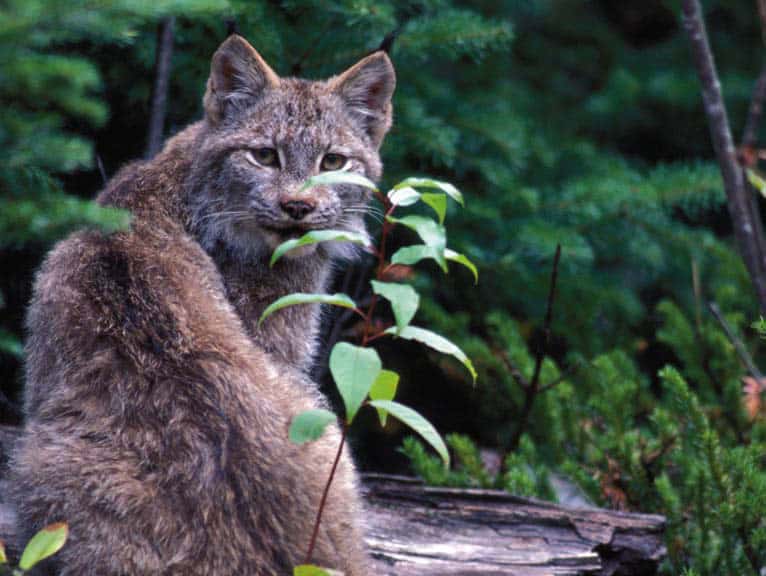
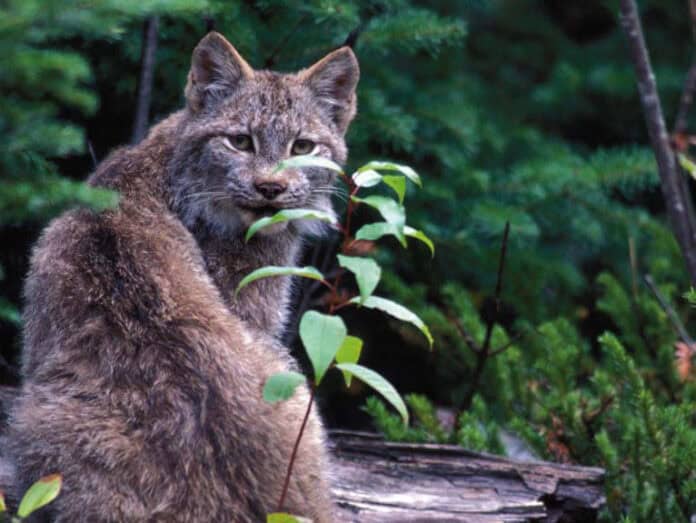
The lynx looked hungry as it approached the whimpering spaniel cowering on the portage trail | Photo: Bruce Montagne

An hour later Alana and I had dragged everything up to the summit and began following a still-eager Bailey along the last kilometre of rough portage.

Sometime after Alana did a face plant and I crunched my crotch while trying to straddle a giant boulder we heard Bailey whimpering ahead of us. This was a new sound. I jogged ahead to see what was up and came across a cowering Bailey trembling uncontrollably while a lynx, just a few metres away, was crouching in a predatory position straight out of Mutual of Omaha and was slowly moving in for the kill.

I had never seen a lynx before, which is my excuse for why my first reaction was to unpack my camera rather than rescue my dog. When Bailey saw me trying to snap a picture of her assailant she gave me a look that made me glad dogs can’t talk. Guilt ridden, I dropped the camera and chased off the lynx with a paddle.

We finished the portage shortly afterward, but I still don’t have a photo of a lynx, and Bailey has been afraid of the neighbour’s cat ever since.

Kevin Callan advises you to keep watch over your pets when in wildcat country in his latest book, The Happy Camper.

This article on cats was published in the Fall 2006 issue of Canoeroots.This article first appeared in the Fall 2006 issue of Canoeroots Magazine. For more great content, subscribe to Canoeroots’ print and digital editions here
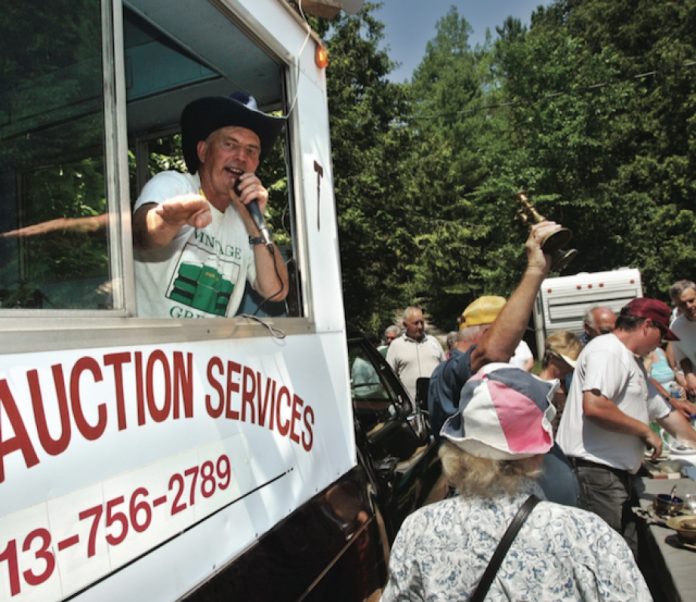
Editorial: New Kids on the Auction Block

Photo: Scott MacGregor
Editorial: New Kids on the Auction Block

“Here we have an Underwood typewriter. Still in the case. Looks in fine shape. She’s a real beauty. We even have some spare ribbons. Let’s start at 10 dollars. How ‘bout five dollars? Four dollars? okay ma’am, we have four dollars. Do I hear five dollars?”

I walked solemnly between the folding tables. Laid out on the tables were a man’s worldly possessions, all his livelihood and his passions. Auction sales happen where I live almost every weekend all summer long. The owners of the stuff are either too old, broke or dead to need them anymore.

Next on the block was a vintage Kodak Brownie and burned into the leather camera case was the name Don MacKay.

In his younger days, judging from the camping gear being carried out, Don was an outdoorsy man. And judging from his old typewriter and cameras he was also a two-way man—what they used to call a journalist who worked as both a writer and photographer. The locals say that in the mid-’60s, he launched an award-winning men’s magazine. He was, in many ways, a guy just like me.

I thought about buying Don’s typewriter and camera for sentimental reasons; I thought they’d be nice to set atop an antique bureau. Imagine the technological differences between this simple brown box camera and my titanium-shelled, eight-megapixel digital SLR, or any of the others used by the pro photographers whose photos appear in this year’s photo annual. I realized that in 45 years, our fancy cameras will be auctioned off, like Don’s Brownie, for less then the price of a cheeseburger.

But the images themselves, the whitewater images between the pages of Rapid, will live on. They are archives of the year’s latest tricks, hottest boats, trendy gear, top dogs and the popular spots to paddle.

Rapid’s photo annual is a time capsule, a snapshot if you will, of whitewater paddling to- day. The photos are historical references for the next generation of paddlers.

Unlike Paul Mason, the fortunate 10-year-old who I watched shooting Little Thompson Rapids on the Petawawa River in his dad’s film, Path of the Paddle, I didn’t start paddling until I was almost 20.

But the new generation is getting an early start. They’re already riding mojo with their parents on wilderness river trips, they’re learning to rip in Jackson Fun kids kayaks and grabbing their own eddies in the new Splash—the first open canoe for kids. Whitewater camps and whitewater high school credit programs are springing up all over the continent. Go tripping and it’s not uncommon to pass babies on remote portages, all swaddled in their little baby carriers.

Never before have parents been more excited about getting their kids out of the mainstream and into the rapids.

I’ve been swimming my son through class II rapids since he was six months old. This summer, at a year-and-a-half, he giggles as we carve into eddies and then points back toward the current for another go. When he and his generation are grown ups, my laptop and camera will be long obsolete and worthless. But these photos will show future generations that whitewater paddling has roots, and it has soul.

I didn’t bid on Don’s camera afterall. I bought a cheeseburger, handed in my auction number and walked out Don’s driveway to my truck.

Instead of going to the office that Saturday morning, I grabbed my camera and took my kids to the river.  

Screen_Shot_2016-01-13_at_12.02.49_PM.pngThis article first appeared in the Fall 2006 issue of Rapid Magazine. For more great content, subscribe to Rapid’s print and digital editions here
Have Instructors Lost Their Mojo?

Photo: Rick Matthews
Have Instructors Lost Their Mojo?

There was a time, not so long ago, when kayak instructors were incredibly cool. Back in the day when the five-day kayak course was the norm, kayak instructors were pioneers of the river lifestyle, living out of the back of their vans, and oozing mojo. Instructors held the secrets to the river, and if you were lucky some of their cool rubbed off on you. Clients adored them. every paddler wanted to become them. They were the top of the paddling food chain. 

Now the mojo has worn off.

Instructors are younger and less experienced, there is more turnover year to year, certification courses have fallen off the radar and kayak schools have trouble finding instructors. Instructing just isn’t cool anymore. 

There are some reasons why the five-day kayak vacation has gone the way of long boats.

The interaction between student and instructor is just not the same in the new shorter time span. Two days is just not long enough for students to realize how cool the instructor is.

Add to this changing demographics. At one time, kayak students were young, athletic free spirits, and were ga-ga over their slightly older, athletic, tanned, free-spirited instructor. Instructors basked in the limelight that allowed their mojo to blossom.

Now the typical student is in his or her mid- 40s. They don’t quite hit it off with the 19-year-old instructor bow stalling in front of them. At 40, bow stalling is not conducive to mojification.

What’s more, modern boats are just plain easier to paddle. Gone are the days of the nervous eddy turn, heroic bow rescues, and long apprenticeships under the all-knowing instructor. Even more subtly, the psychology of danger has changed in kayaking. Instructors were once key to survival, cautiously meting out challenges only when the student proved worthy.

Now, rivers once viewed as a series of dangerous cataracts are seen as play spots. In the a right boat, a newbie can be bouncing in holes t that schools used to walk around. A beginner can now learn in one day what used to take three weeks. The secrets of the river are not so secret anymore. So who’s cool now? Ego-boaters. They paddle for themselves with hedonistic pleasure. They do anything—park and play, jibbing, dropping big ones—as long as it’s big and looks good on film. Websites and video biographies of pro boaters self-proclaim celebrity status. The pittance that boaters used to earn a through instruction has been replaced with the s pittance earned from highly caffeinated energy drink sponsorship. The all-knowing, omnipotent instructor has passed the torch to the brash, a brand-conscious paddling porn star. 

For kayak instruction, this means a paradigm shift. For a young paddler, the instructor role is e merely a stepping stone toward full-time ego- boating. It is no longer the top rung of the ladder, only a way station where they prostitute s themselves on the way to a big break and a video appearance (and a free paddle).

As an upside, this new blood has changed y the way kayaking is taught. shorter boats, play- s boating attitudes, and a new view on dange means the progression is faster. The secrets are all laid out, and newbies are rolling, surfing and running rapids on day one. New instructors (the aspiring ego-boaters) became good paddlers quickly, and this influences how they teach—the 45-year-old office worker learns quickly too. Instructors no longer hold paddlers back, but push them at a rapid pace. The door is open for new paddlers to quickly put some skills together, and dream of attaining full-time ego-boating mojo.

Alas, kayak instructors have been relegated to the status of grade school teachers: vital for the basics, an intrinsic part of the culture, and definitely not sexy.

Instructors, whether they know it or not, are there to open a door and share the understanding that the river is there for everyone to tap into. Fun and play are key—two things egoboaters know better than anyone—and new paddlers quickly grasp that the secrets are not as mysterious as they once believed them to be.

Done well, teaching gets people excited about learning, even if they don’t get the answer right. Paddling instruction, when done well, gets people excited about paddling.

And here lies the irony. If mojo is defined , as cool status and the living of a vaunted lifestyle, then the instructor is passé. If mojo really does have more to do with reproductive prowess—the ability to make more paddlers—then instructors still have it.

Jeff Jackson has been teaching kayaking since boats were long and eddy turns were nervous. And yes, he used to be cool. 

Screen_Shot_2016-01-13_at_12.02.49_PM.pngThis article first appeared in the Fall 2006 issue of Rapid Magazine. For more great content, subscribe to Rapid’s print and digital editions here