Home Blog Page 360

Kirk Wipper: The Passion of the Collector

Photos from the collection of Kirk Wipper
Kirk Wipper: The Passion of the Collector

Kirk Wipper is like a firefly—visibly shining, but hard to catch. When I finally caught up with him after weeks of pursuit he had just returned from the annual Fiddlers on the Tobique in New Brunswick. As Honorary Patron, he led the parade of 1,500 canoes and almost as many musicians playing fiddles, mandolins and banjos down the beautiful Tobique River in the central highlands of northern New Brunswick. Before the Tobique he had been a guest speaker at the an- nual Maine Canoe Symposium, and on the interven- ing weekend he had led 60 canoes down Ontario’s Trent River, a new event he had helped to instigate in 2003 to raise money for the World Food Bank.

It’s a busy schedule for an octogenarian to maintain, but Kirk doesn’t seem to tire. Kirk modestly takes advantage of every canoeing opportunity that his status as the world’s greatest canoe col- lector brings him. Though his name is inextricably linked to a museum collection, there’s nothing hushed or sedate about Kirk’s love of canoeing. In the past 10 years he has found enough time away from festivals and events to canoe—or raft—some of North America’s great rivers, including the Thelon, Tatshenshini, Alsek, Nahanni, and, wildest of all, the Naranjo in Costa Rica.

KIRK’S EARLY YEARS

Canoes have been the centrepiece of much of Kirk’s life, but it was not always that way. Growing up on a pioneer farm in the Inter-lake district of central Manitoba, the son and grandson of German immigrants, there was nary a canoe in sight. Living close to nature on a farm carved out of the northern bush, he learned early about hard work, frugal- ity and optimism. Having left Germany to escape the militarism growing out of the rising nationalist fervour, his parents also instilled in him a deep and abiding love of Canada. 

It was not until his arrival in Toronto in 1946, after war-time service in the Canadian Navy, that Kirk really made contact with the canoe. When involvement with the YMCA took him north to be an instructor at Pinecrest summer camp, Kirk discovered the canoe’s true value as a vehicle to connect with the natural world. There he quickly realized that the canoe was a device for leadership training, with its emphasis on self-reliance and resourcefulness.

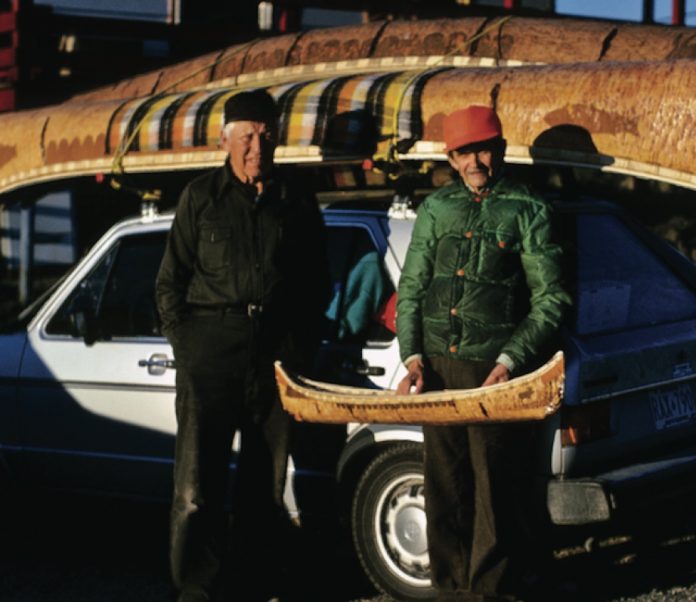
Early in his career of teaching in the School of Physical Education and Health at the University of Toronto in 1957, Kirk bought Camp Kandalore, a boys’ camp on Haliburton’s Lake Kabakwa. A couple of years later, the head of Kirk’s university department presented him with a basswood dugout canoe from the 1890s which had been found on his farm near Lakefield. The canoe was given pride of place in the dining hall at Kandalore, and the collection began.

KANAWA INTERNATIONAL MUSEUM OF CANOES

The dugout was soon joined by other unique canoes, including two vintage Peterborough freight canoes which were treasured as much for their historic value as for their usefulness in providing ferry service to Chapel Island, as platforms for stage performances, as diving rafts, or just as large baggage conveyors. Three canoes belonging to the Arctic explorer George Douglas, a birchbark canoe from Maniwaki, Quebec, and several others formed the nucleus of Kandalore’s growing collection, which Kirk had named the Kanawa International Museum of Canoes, Kayaks and Rowing Craft.

Without intentionally starting out as a collector, Kirk had developed a passion for canoes and his collection began to snowball. His many friends in his university, camping and Royal Life-Saving So- ciety circles soon grew into a worldwide network of contacts which included canoe builders and museum curators who kept him informed of any interesting watercraft as they became available.

Opportunities to acquire special canoes often came with a hefty price tag. In Kirk’s words: “It of- ten involved big sacrifices—I was often in debt, but I knew what was being done was right and it had to be done. I felt I had a responsibility to do the best possible job of collecting so I could tell the whole story of the relationship of canoes and kayaks to the environment and to the history of Canada. Once I had started down this path there was no turning back.” 

A LONG NEGOTIATION

His most anxious moments came during the acquisition of 44 canoes from the Heye Foundation’s Museum of the American Indian in New York. He had learned that the museum could no longer afford to look after this valuable collection, and Kirk began negotiations to buy them for Kanawa.

For eight years Kirk negotiated, in competition with several world museums, including the Smithsonian. Kirk remembers: “The time came when the Heye Foundation’s board was meeting to make a decision. There were 63 members on the board, the discussion went on and on, and in the end they agreed by one vote to let them go to Kanawa. I got the message about midnight and immediately phoned my son, David, standing by in New York with two big moving vans, to begin loading. In the meantime, two American congressmen, not wanting the collection to leave the U.S., tried to stop the trucks from crossing the border. I had anticipated this, and already had an import number in place with customs. When David phoned me to say that they were being held up at the border, I phoned the head of customs and the trucks were immediately waved through!” 

Kirk’s problems were not over. He still had to find $150,000 to complete the deal. 

Fortunately, Kirk’s many friends helped out with loans, all of which had to be repaid.

In years of major purchases for the collection, Camp Kandalore sometimes operated at a loss and it became clear it could no longer sustain the museum. To safeguard the camp, the museum was incorporated as a separate entity, with a board of directors to help with the much-needed fundraising. 

Kirk was always on the lookout for canoes which he felt should be in the collection. Never having been able to find a Haida dugout, he commissioned the building of one. Kirk remembers going to the Queen Charlotte Islands in 1971 to take possession of it: “Within living memory, no dugout had been built by the Haida, and Victor Adams undertook the work with some trepidation. The Haida helped us to give the canoe a ceremonial launching. As we prepared to push off the beach, I was struck by the wistful interest many children showed in the canoe. We offered the children a ride, discovering that none had ever before been in a Haida dugout. Despite our best efforts, we found the new canoe sluggish in the water, and responded to Victor Adam’s beckoning to return to the beach. ‘You know,’ he said, ‘Our canoe moves much better the other way around.’ How courageous they are, I thought to myself, to let their children venture out with Eastern amateurs!” 

A NEW HOME FOR THE CANOES

The canoes were beautifully displayed at Kandalore in a handsome log building especially built for the purpose. As the collection grew to 600 boats the building could no longer contain them all and some of the largest had to be stored outside under shelters. In addition to the worries about financing, the danger of fire and theft was ever present, humidity and temperature controls were out of the question, and insurance was impossible. Kirk’s resources were stretched to the limit. The time had come to seek a solution.

When it became known that Kirk was seeking a new location for his collection in the 1980s, a group at Trent University began exploring the possibility of establishing a museum in Peterborough, the home of the famous Peterborough Canoe Company. After negotiations with the newly formed Canadian Canoe Museum were complete, the transfer of canoes took place over several summers in the mid-1990s, whenever trucks and volunteers to drive them were available. Kirk’s collection had found a new home in a safe and controlled environment.

The collection was first put on display to the public in May, 1996. In the words of John Jennings, historian and founding member of the museum’s board of directors, “The collection that Kirk Wipper has amassed over four decades is the foremost collection of canoes and kayaks in the world. It is a national treasure that speaks to Canada’s identity and represents much of her early history.”

To give Kirk the last word: “I always knew that one day the public would take the collection to its heart, pick up the torch and run with it.”

Kirk has been honoured with the Order of Canada and the Order of Ontario for creating this national treasure, but as he says, “It’s not what one has done, but what one might still do that is important—Never rest on your paddle.”

Gwyneth Hoyle is the co-author of Canoeing North into the Unknown and is currently working on a biography of northern surveyor Guy Blanchet. 
This article on Kirk Wipper was published in the Fall 2006 issue of Canoeroots.This article first appeared in the Fall 2006 issue of Canoeroots Magazine. For more great content, subscribe to Canoeroots’ print and digital editions here

A Lynx, a Dog and One Very Long Portage

Photo: Bruce Montagne

When we pulled into the portage on the Steel River and saw an arrow pointing straight up a giant slab of granite, Alana and I immediately started procrastinating. We easily killed 20 minutes discussing the best way (winching? crawling?) to get our gear and canoe up the precipice.

Our dog Bailey, as usual, was less patient. If you’ve ever heard that springer spaniels are hyper, then you didn’t hear it from me. Frenzied is the word I would use. When it comes to portaging, she just wants the ordeal over as quickly as possible. I’ve given up trying to leash her while on the trail, which is why we only take her on remote trips where there’s little chance of meeting up with other people. And most animals rebuff her attempts to be playful.

Her routine is simple—jump out of the canoe as we approach the take-out, wait impatiently as I lash her pack on, and then sprint to the end and take a relaxing swim while we catch up.

While Alana and I dithered, Bailey was climbing the wall—literally. She scrambled up and down the slab looking more and more impatient. Finally we loaded her panniers up with all her dog food and shouldered our packs.

Photo: Bruce Montagne
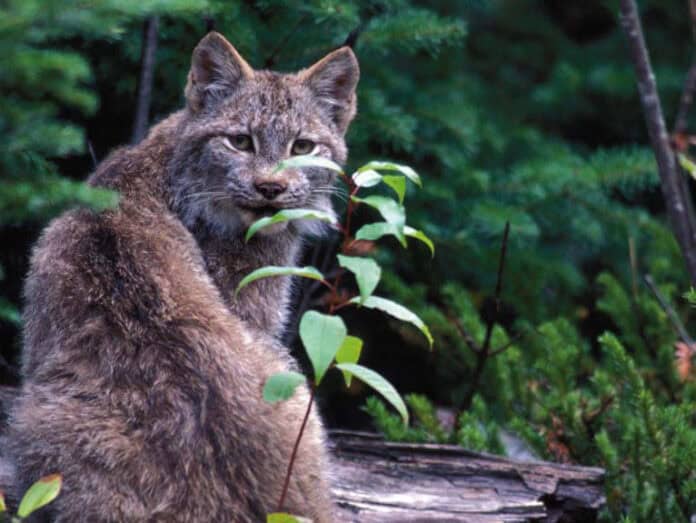
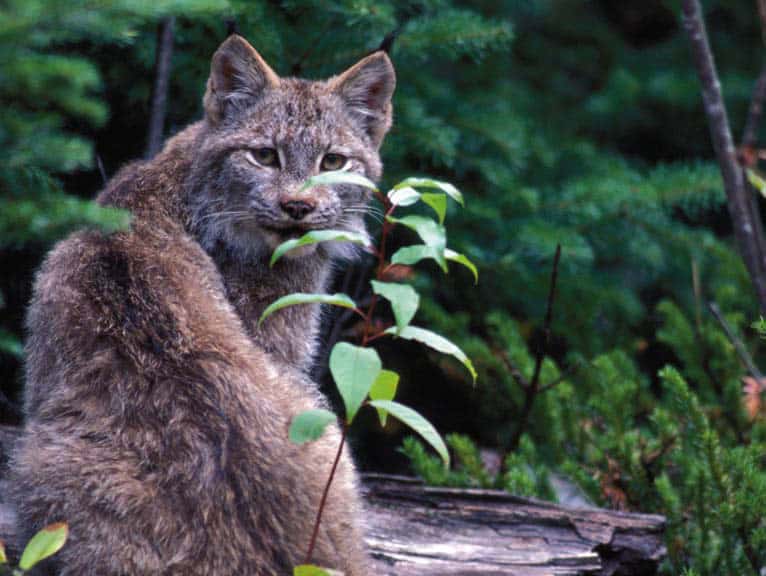
The lynx looked hungry as it approached the whimpering spaniel cowering on the portage trail | Photo: Bruce Montagne

An hour later Alana and I had dragged everything up to the summit and began following a still-eager Bailey along the last kilometre of rough portage.

Sometime after Alana did a face plant and I crunched my crotch while trying to straddle a giant boulder we heard Bailey whimpering ahead of us. This was a new sound. I jogged ahead to see what was up and came across a cowering Bailey trembling uncontrollably while a lynx, just a few metres away, was crouching in a predatory position straight out of Mutual of Omaha and was slowly moving in for the kill.

I had never seen a lynx before, which is my excuse for why my first reaction was to unpack my camera rather than rescue my dog. When Bailey saw me trying to snap a picture of her assailant she gave me a look that made me glad dogs can’t talk. Guilt ridden, I dropped the camera and chased off the lynx with a paddle.

We finished the portage shortly afterward, but I still don’t have a photo of a lynx, and Bailey has been afraid of the neighbour’s cat ever since.

Kevin Callan advises you to keep watch over your pets when in wildcat country in his latest book, The Happy Camper.

This article on cats was published in the Fall 2006 issue of Canoeroots.This article first appeared in the Fall 2006 issue of Canoeroots Magazine. For more great content, subscribe to Canoeroots’ print and digital editions here

Editorial: New Kids on the Auction Block

Photo: Scott MacGregor
Editorial: New Kids on the Auction Block

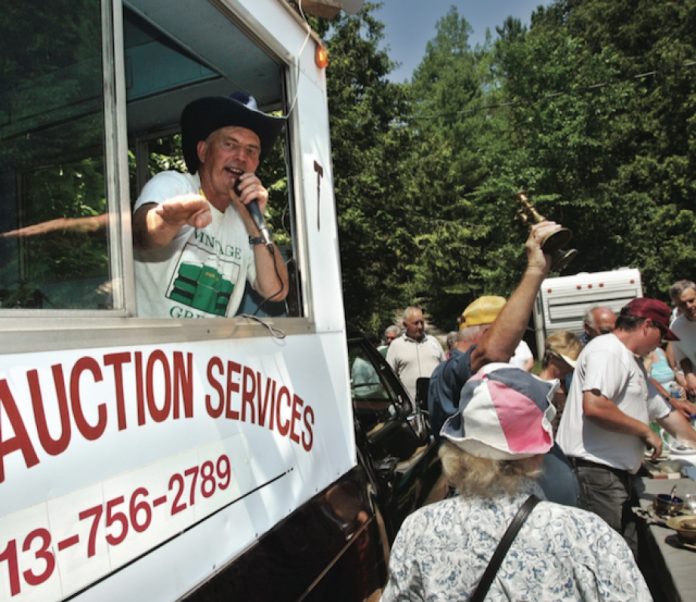
“Here we have an Underwood typewriter. Still in the case. Looks in fine shape. She’s a real beauty. We even have some spare ribbons. Let’s start at 10 dollars. How ‘bout five dollars? Four dollars? okay ma’am, we have four dollars. Do I hear five dollars?”

I walked solemnly between the folding tables. Laid out on the tables were a man’s worldly possessions, all his livelihood and his passions. Auction sales happen where I live almost every weekend all summer long. The owners of the stuff are either too old, broke or dead to need them anymore.

Next on the block was a vintage Kodak Brownie and burned into the leather camera case was the name Don MacKay.

In his younger days, judging from the camping gear being carried out, Don was an outdoorsy man. And judging from his old typewriter and cameras he was also a two-way man—what they used to call a journalist who worked as both a writer and photographer. The locals say that in the mid-’60s, he launched an award-winning men’s magazine. He was, in many ways, a guy just like me.

I thought about buying Don’s typewriter and camera for sentimental reasons; I thought they’d be nice to set atop an antique bureau. Imagine the technological differences between this simple brown box camera and my titanium-shelled, eight-megapixel digital SLR, or any of the others used by the pro photographers whose photos appear in this year’s photo annual. I realized that in 45 years, our fancy cameras will be auctioned off, like Don’s Brownie, for less then the price of a cheeseburger.

But the images themselves, the whitewater images between the pages of Rapid, will live on. They are archives of the year’s latest tricks, hottest boats, trendy gear, top dogs and the popular spots to paddle.

Rapid’s photo annual is a time capsule, a snapshot if you will, of whitewater paddling to- day. The photos are historical references for the next generation of paddlers.

Unlike Paul Mason, the fortunate 10-year-old who I watched shooting Little Thompson Rapids on the Petawawa River in his dad’s film, Path of the Paddle, I didn’t start paddling until I was almost 20.

But the new generation is getting an early start. They’re already riding mojo with their parents on wilderness river trips, they’re learning to rip in Jackson Fun kids kayaks and grabbing their own eddies in the new Splash—the first open canoe for kids. Whitewater camps and whitewater high school credit programs are springing up all over the continent. Go tripping and it’s not uncommon to pass babies on remote portages, all swaddled in their little baby carriers.

Never before have parents been more excited about getting their kids out of the mainstream and into the rapids.

I’ve been swimming my son through class II rapids since he was six months old. This summer, at a year-and-a-half, he giggles as we carve into eddies and then points back toward the current for another go. When he and his generation are grown ups, my laptop and camera will be long obsolete and worthless. But these photos will show future generations that whitewater paddling has roots, and it has soul.

I didn’t bid on Don’s camera afterall. I bought a cheeseburger, handed in my auction number and walked out Don’s driveway to my truck.

Instead of going to the office that Saturday morning, I grabbed my camera and took my kids to the river.  

Screen_Shot_2016-01-13_at_12.02.49_PM.pngThis article first appeared in the Fall 2006 issue of Rapid Magazine. For more great content, subscribe to Rapid’s print and digital editions here
Have Instructors Lost Their Mojo?

Photo: Rick Matthews
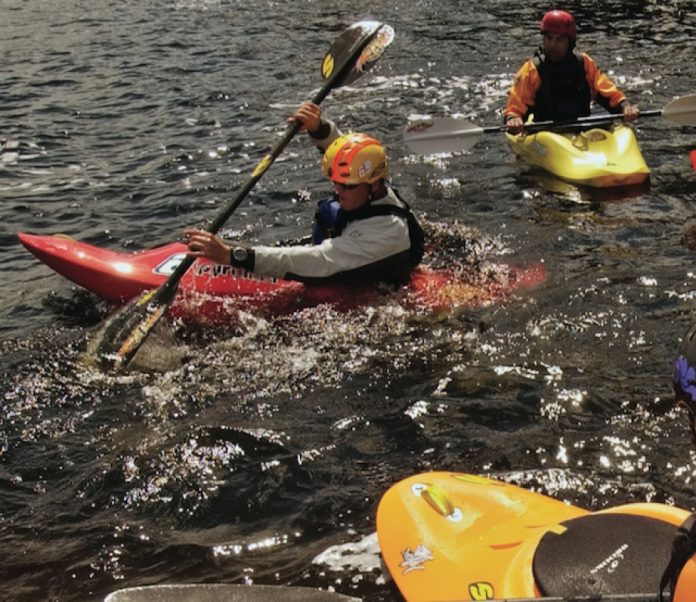
Have Instructors Lost Their Mojo?

There was a time, not so long ago, when kayak instructors were incredibly cool. Back in the day when the five-day kayak course was the norm, kayak instructors were pioneers of the river lifestyle, living out of the back of their vans, and oozing mojo. Instructors held the secrets to the river, and if you were lucky some of their cool rubbed off on you. Clients adored them. every paddler wanted to become them. They were the top of the paddling food chain. 

Now the mojo has worn off.

Instructors are younger and less experienced, there is more turnover year to year, certification courses have fallen off the radar and kayak schools have trouble finding instructors. Instructing just isn’t cool anymore. 

There are some reasons why the five-day kayak vacation has gone the way of long boats.

The interaction between student and instructor is just not the same in the new shorter time span. Two days is just not long enough for students to realize how cool the instructor is.

Add to this changing demographics. At one time, kayak students were young, athletic free spirits, and were ga-ga over their slightly older, athletic, tanned, free-spirited instructor. Instructors basked in the limelight that allowed their mojo to blossom.

Now the typical student is in his or her mid- 40s. They don’t quite hit it off with the 19-year-old instructor bow stalling in front of them. At 40, bow stalling is not conducive to mojification.

What’s more, modern boats are just plain easier to paddle. Gone are the days of the nervous eddy turn, heroic bow rescues, and long apprenticeships under the all-knowing instructor. Even more subtly, the psychology of danger has changed in kayaking. Instructors were once key to survival, cautiously meting out challenges only when the student proved worthy.

Now, rivers once viewed as a series of dangerous cataracts are seen as play spots. In the a right boat, a newbie can be bouncing in holes t that schools used to walk around. A beginner can now learn in one day what used to take three weeks. The secrets of the river are not so secret anymore. So who’s cool now? Ego-boaters. They paddle for themselves with hedonistic pleasure. They do anything—park and play, jibbing, dropping big ones—as long as it’s big and looks good on film. Websites and video biographies of pro boaters self-proclaim celebrity status. The pittance that boaters used to earn a through instruction has been replaced with the s pittance earned from highly caffeinated energy drink sponsorship. The all-knowing, omnipotent instructor has passed the torch to the brash, a brand-conscious paddling porn star. 

For kayak instruction, this means a paradigm shift. For a young paddler, the instructor role is e merely a stepping stone toward full-time ego- boating. It is no longer the top rung of the ladder, only a way station where they prostitute s themselves on the way to a big break and a video appearance (and a free paddle).

As an upside, this new blood has changed y the way kayaking is taught. shorter boats, play- s boating attitudes, and a new view on dange means the progression is faster. The secrets are all laid out, and newbies are rolling, surfing and running rapids on day one. New instructors (the aspiring ego-boaters) became good paddlers quickly, and this influences how they teach—the 45-year-old office worker learns quickly too. Instructors no longer hold paddlers back, but push them at a rapid pace. The door is open for new paddlers to quickly put some skills together, and dream of attaining full-time ego-boating mojo.

Alas, kayak instructors have been relegated to the status of grade school teachers: vital for the basics, an intrinsic part of the culture, and definitely not sexy.

Instructors, whether they know it or not, are there to open a door and share the understanding that the river is there for everyone to tap into. Fun and play are key—two things egoboaters know better than anyone—and new paddlers quickly grasp that the secrets are not as mysterious as they once believed them to be.

Done well, teaching gets people excited about learning, even if they don’t get the answer right. Paddling instruction, when done well, gets people excited about paddling.

And here lies the irony. If mojo is defined , as cool status and the living of a vaunted lifestyle, then the instructor is passé. If mojo really does have more to do with reproductive prowess—the ability to make more paddlers—then instructors still have it.

Jeff Jackson has been teaching kayaking since boats were long and eddy turns were nervous. And yes, he used to be cool. 

Screen_Shot_2016-01-13_at_12.02.49_PM.pngThis article first appeared in the Fall 2006 issue of Rapid Magazine. For more great content, subscribe to Rapid’s print and digital editions here
Sea Kayak Review: Seaward Quantum

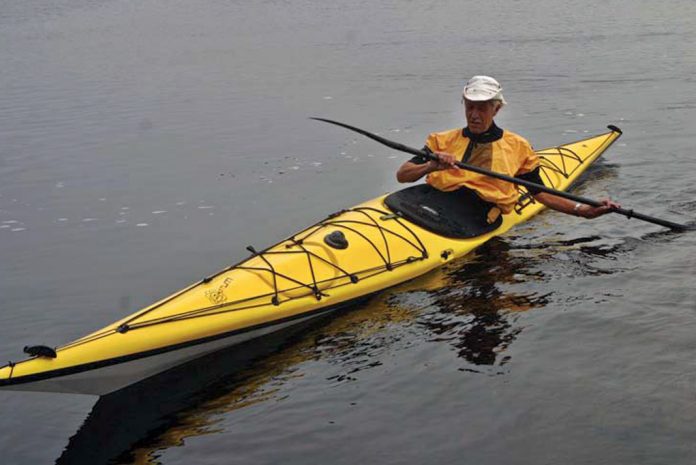
Man paddling yellow sea kayak
Beat that, Brits! | Photo: Tarmo Poldmaa

A couple years ago in the pages of this magazine (read: Long Live the Homegrown Boat), columnist Alex Matthews argued for an end to the black and white separation between British and North American boat designs.

“Let’s keep Brit boats British and take what we learn from them and others, and put it through our own unique filters in order to make something that is truly ours,” writes Alex.

[ Paddling Buyer’s Guide: View all sea and touring kayaks ]

Seaward has answered his call for a mashup. In stealing from the British to create the Quantum they opted to abscond with the skeg but took an “if it ain’t broke” approach to hatches, resisting the temptation to slap on a day hatch and rubber covers just because that’s what they do in Britain.

Seaward Quantum Specs
Length: 17.3′
Width: 21.75″
Depth: 13″
Weight: 54 lbs
Cockpit: 31″ x 16″
Bow hatch: 96 L
Stern hatch: 128 L
Total storage: 224 L
Total volume: 408 L
MSRP: $3,855 CAD fiberglass; $4,445 CAD Kevlar

seawardkayaks.com

Seaward’s design team is clearly a restrained and thoughtful bunch, and it shows in the Quantum’s on-water performance too. Initial and secondary stability are moderate.

The multi-chine, shallow-V hull edges more predictably than a single hard-chine, shallow-arch hull.

Surfing a following sea is fun because you can rock the boat from edge to edge to steer without ever feeling like you’re going to overdo it and capsize.

On the level, the Quantum tracks rail-straight despite having more rocker than Seaward’s other multi-chine offering, the Chilco.

In wind, she gives you just what you want from a skeg boat—weathercocking mildly with the skeg up, trending mildly downwind with the skeg down, tracking across the wind with the skeg deployed halfway.

The Quantum is slim without being cramped, predictable without being dull, responsive without being skittish. Neither completely British nor completely North American, it’s a cultural identity complex waiting to happen.

In other words, it’s Canadian, and who wouldn’t love that?

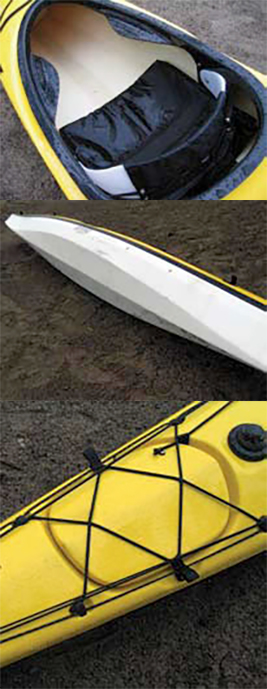
Comfortable, eh? (top)

We’re always struck by the comfort of Seaward’s simple foam seats, er, we mean Seaward’s exclusive SRS™ (Self Rescue System). That’s right, the seat cushion pulls out and doubles as a paddle float. Handy, but did we mention that they’re darned comfortable?

Parts of a yellow sea kayak
Photos by: Tim Shuff

Newer Quantums may features a flashier fiberglass bucket seat and Immersion Research backband, but we hope the good ol’ SRS remains an option

Nice compromise, eh? (middle)

The multi-chine, V-bottom hull edges predictably like a soft-chine hull, yet grabs the water to carve a turn like a hard-chine hull. It makes edging performance accessible to paddlers of all levels.

Hoser proof, eh? (bottom)

One of Seaward’s many proprietary features, the safeHATCH™ system is both functional and foolproof. The fiberglass outer cover and airtight neoprene inner cover—which is labelled with “bow” and “stern” directional arrows—are both tethered to the boat so you can’t lose them. And if you do, the hatch seals with a plastic bag instead. Beat that, Brits!

This article was first published in Adventure Kayak‘s Fall 2006 issue. Subscribe to Paddling Magazine’s print and digital editions here , or browse the archives here.

Sea Kayak Review: Current Designs Rumour

P
Boat Review: The Rumour by Current Designs

Ever noticed that as the population’s girth gets larger, the coolest kayaks get narrower? We thought we’d seen the end of this irony, yet here’s a bold new sub-20-inch-wide offering from Current Designs, a company whose management fortunately missed the movie Super SizeMe.

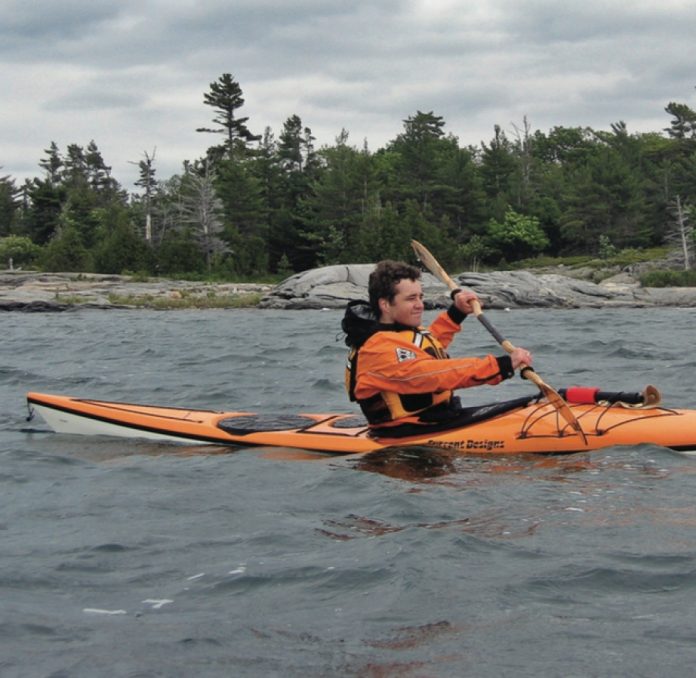
Designer Nigel Foster calls his Rumour a “day-boat/play-boat” for the smaller paddler.

“I wanted to shape a small boat that would serve the small paddler in the same way a larger kayak serves the larger paddler in terms of initial stability, secondary stability and speed,” says Foster.

Not only is the length nearly two feet shorter than Foster’s most popular design, the Legend, the Rumour is also narrower and lower-volume overall—and of course much lighter and easier to schlep.

Current Designs Rumour Specs
Length: 16’5″
Width: 19.75″
Depth: 12″
Weight: 44 lbs
Cockpit: 25″ x 15″
Bow hatch: 9.5″
Stern hatch: 17.5″ x 10.75″
Total volume: 263 L
MSRP: $2,849 USD fibreglass; $3,249 USD Kevlar

cdkayak.com

Foster designed the hard-chine, shallow-arch hull to let bantam-weight paddlers effortlessly dial in an outside-edge turn. The quick transition from edge to edge will intimidate novices, but offers experienced paddlers easy and precise carving that’s especially fun in surf.

Indeed, Foster, who is big for the boat at six feet and 165 pounds, keeps a Rumour in his quiver for short paddles and surf play.

The buoyant bow provides a dry ride and reasonable capacity. Ignoring the 150-pound max recommended paddler weight, we crammed our demo full for a four-day weekend and gave the keys to a 175-pounder.

Low-profile, speedy and easy to steer with the hips, the Rumour was a pleasure to paddle in all conditions, even overloaded, and seemed capable of handling any size paddler it can fit.

Small paddlers with advanced skills should rejoice that there’s a new boat built especially for them, and medium-sized paddlers should not overlook the Rumour for day trips and play trips—not to mention it being a great reason to stay slim.

Different parts of orange sea kayak

Mini-size me (top)

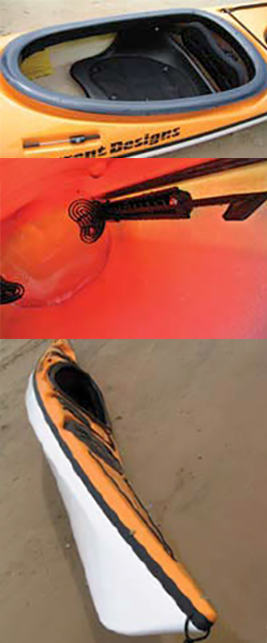
The padded, moulded plastic seat has a slim, low-slung backband for minimalist support, backed by a curved and sloped bulkhead. The cockpit opening is small—a cross between an ocean cockpit and keyhole—but has plenty of legroom inside for six-footers.

Bean there (middle)

Bean-shaped Sea Dog plastic foot braces, instead of the more common aluminum Yakimas, provide on-the-fly adjustment with a release tab that you can reach while sitting in the cockpit. At Nigel Foster’s request, CD installed fibreglass bulkheads.

Left leaning (bottom)

Skeg control and day hatch are on the left. Foster explains, “Take any group out onto choppy water and ask them to brace with one hand and raise their other hand, and almost without exception people raise their left hand.” Who knew all those builders that put day hatches on the right are doing lefties a favour?

This article originally appeared in Adventure Kayak‘s Summer 2006 issue. Subscribe to Paddling Magazine’s print and digital editions here, or browse the archives here.

Boat Review: Esquif’s Zephyr

Photo: Scott MacGregor
Boat Review: Esquif's Zephyr

Looking back on Esquif’s line of solo open boats it’s easy to spot a trend. The Nitro, Detonator, Zoom and Taureau were all successively shorter (we’ll ignore the slalom-oriented Spark for now). Now bucking its way into the current is the full-bodied, 11’ 3” Zephyr.

Why the retreat from increasingly compact canoes? The Zephyr is Esquif’s admission that many open boaters feel more comfortable in a boat like a voluminous Dagger Rival. So Esquif has taken the speed, stability and dryness offered by a larger hull and added advances in areas such as chine and flare developed for the smaller boats to produce their Zephyr.

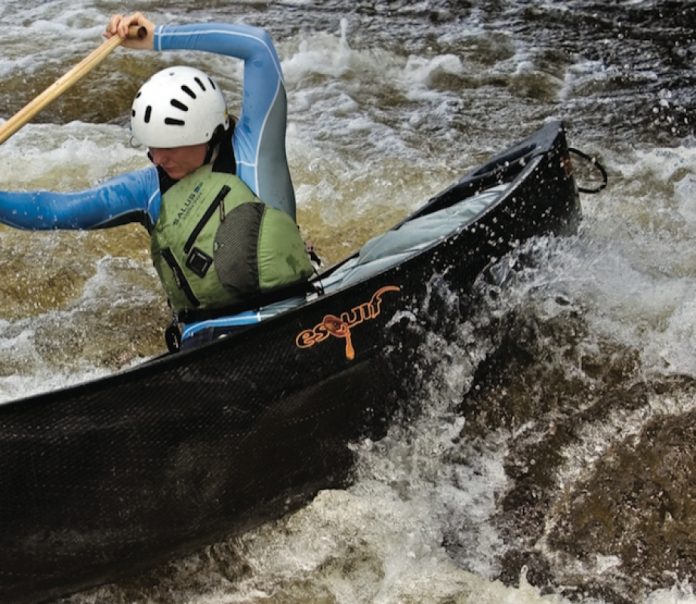
Though it’s a full-bodied canoe it doesn’t feel like you are riding a squishy 10-year-old pig down the river. Esquif owner and designer Jacques Chassé says he wanted to impart the responsiveness of his Zoom into a hull with the stability demanded by intermediate paddlers. The chines, though softer than those on the Zoom, still allow for effective carves and off-side tilts. It’s not a pig to paddle because the narrow bow of the asymmetrical hull and the dramatic tumblehome of the gunwales mean you don’t have to reach out over the boat to get your paddle in the water.

The sharper bow entry point, lighter weight, longer waterline and slightly rounded hull (as opposed to the truly flat hull of the Nitro or Detonator) combine to create a boat that accelerates with only a stroke or two and carries speed deep into eddies.

To achieve a cushy secondary stability that stops the boat dead when the gunwales are about six inches above the waterline, Chassé employed a dramat- ic mix of flare and tumblehome. The mid-ship flare gives you something to rest on while the boat is carv- ing and the tumblehome brings the gunwales safely back from the water to produce a really dry ride.

Look closely at the Zephyr’s matte black hull and you’ll notice a woven material visible in the plastic— the biggest story behind the Zephyr is its new hull material. For years whitewater canoes have been produced in composite (fibreglass or Kevlar) or more commonly plastic (Royalex or polypropylene). Esquif has married the two by devising a process that impregnates fibreglass fabric with melted polypropylene plastic instead of resin.

Chassé says the new material—which he calls Twin-Tex—is lighter than straight plastic but not as brittle or susceptible to abrasion as traditional composites.

“It won’t crack like a resin composite, and it won’t gouge, dent or delaminate like Royalex,” says Chassé.

The big question many canoeists are asking is, how will the Zephyr fare when wrapped around a rock? Chassé insists the plastic bounces back, with just a few cracks that can be smoothed over with a heat gun. But the question may be moot given all the floatation in solo boats. Jeff Johnson, head instructor at Ontario’s Madawaka Kanu Centre, says that they haven’t wrapped a solo open boat in years.

Chassé says another selling point of Twin-Tex is its ability to save weight. The Zephyr comes in at 37 pounds. Chassé claims it would have weighed 48 pounds in Royalex.

Long though it may be, the Zephyr is no evolutionary U-turn. Chassé says with the higher production costs of the Twin-Tex material he had to create a boat that would appeal to a wide spectrum of paddlers. Natural selection on the river will likely provide a return on his investment.

Specs

Price ……….. $1,600 Cdn, not outfitted
……………….. $1,300 US, not outfitted
Material……. Twin-Tex
Length …….. 11’3”
Width ………. 29”
Depth………. 16”
Gunwale ….. wood or vinyl
Weight …….. 37 pounds

rapidv8i4cover.jpgThis article first appeared in the Fall 2006 issue of Rapid Magazine. For more great boat reviews, subscribe to Rapid’s print and digital editions here.
Open Boat Review: Millbrook Boats Prowler

Two people paddling a purple open boat.
A Prowler is always on the hunt. | Photo: Scott MacGregor

To be more accurate, the subtitle should read, “the fastest solo or tandem canoe you’re unlikely to paddle unless you order one or sleep with one of the 35 people who did.” The Prowler is built of fiberglass and Kevlar and there is a two-month wait time to replace it, so they are sweetly cherished and heavily guarded. With only six weeks before the 2008 ACA Open Canoe Slalom Nationals your chances of getting one to take for a spin are slim.

John Kazimierczyk, or just Kaz, chief cook and bottle washer at Millbrook Boats designed and built the first Prowler back in 1993. He was looking for a tandem boat, a boat he says would be comfortable for a variety of different people and knowing Kaz, a boat that would be fast.

“Some people say 15 feet is too long for a tandem. In big waves, all 15 feet of this boat are working. The length adds buoyancy and speed. The rocker and narrowness help make it turn on command.”

Many of those who paddle the Prowler say it handles more like a 13-foot boat.

Millbrook Boats Prowler Specs
Length:15’1”
Width: 27”
Depth: 16”
Weight: 35 lbs, no outfitting
MSRP: $1,350 USD, no outfitting

millbrook-boats.business.site

The Prowler is a serious slalom racing or river-running canoe with a flattish shallow arch like Kaz’s Howler, but it’s a boat he says is faster and has more control.

What’s a Howler? His website says, “One of the most radical whitewater canoes ever designed. Similar characteristics of the Hooter.”

What’s a Hooter? “A wider variation of the Kyote. Stable, dry and fast.” A trip to the Millbrook website is like a trip through the evolution of slalom open canoe design, complete with grainy, washed-out photos and Ace helmets. If you’re not familiar with any of these ancient designs you might say the Prowler has similar lines to the Spark—a joint project between Millbrook and Esquif.

Like the Spark, the Prowler is more stable with speed than it is while strapping yourself in—wobble, wobble, splash. It’s a boat that is paddled from the bow.

[ Paddling Buyer’s Guide: View all whitewater canoes ]

“Almost every bow power stroke has some degree of steering stroke to it,” says Brian Shields, the proud co-owner of the most recent Prowler built. His partner Gail Shields paddles with Kazimierczyk at Nationals and says, “The first time I paddled with him, he put me in the stern and told me to not let my end of the boat touch any gates.” He drives, you’re just the power.

Screaming into eddies faster than ever before it is easy to over-tilt the Prowler. Big mistake. With big tilts you’ll fall over, like we did. The Prowler is best controlled with subtle turning strokes and precise edge control, including off-side tilts to stick and pivot the long carving hull. It is always better to carry speed through eddies, but at only 35 pounds it’s no problem for two paddlers to make the Prowler leap up through gates. If you’ve never experienced a light and lively whitewater composite whitewater canoe, it’s a real treat.

The best place to check out a Prowler will be at the Gull River in Minden, Ontario, August 1 and 2, where the OC Nationals return for the second time in six years. Over the years, the Prowler has won more than 60 national titles and is still unbeatable. You’ll see old ones and new ones, red ones and blue ones; just don’t expect anyone to let you try one… at least until the race is over.

This article originally appeared in Rapid‘s Fall 2008 issue. Subscribe to Paddling Magazine’s print and digital editions here, or browse the archives here.


A Prowler is always on the hunt. | Photo: Scott MacGregor

Editorial: Selling Our Soul to the Company Store

Photo: Rick Snowden
Editorial: Selling Our Soul to the Company Store

Why is the legendary Stihl brand of chainsaws and trimmers not sold in the Home Depot or Canadian Tire stores?

The large bold print on the cover of Stihl’s summer newspaper flyer hooked me. Okay, I thought, I’ll bite. Why not?

The why not is because across Canada there are more than 900 independent dealers, dealers who sell and service all Stihl products.

I own a Stihl saw and grass trimmer, and they are true to their company promise. They walked me through the entire owners manual from mixing the gas to routine maintenance, with an earnest concern for my personal safety—which no doubt was ramped up by my flip flops and Hawaiian shirt.

Chainsaws and kayaks have more in common than you might think. C&J Lemke in Eganville, Ontario, is my local Stihl dealer. It’s a small shop quite similar to my local paddling shop. Both shops offer incredible pre- and post-sale service for their products, both owners are passionate about what they are selling and, lately, both are feeling the pinch of big box stores. When I buy a chainsaw or a kayak I don’t want some pasty-skinned sales associate to greet me at the door with a shopping cart. I want to buy from someone with sawdust on his hat or sporting a lifejacket suntan.
When I wander into a kayak shop I want to chew the fat with someone who shares my excitement and passion for paddling and can shoot me straight about boats and gear. You’re not likely to cut your leg off sea kayaking, but we do require safety equipment and we do need to paddle safely or we’ll get hurt. These are things that Lorna from the garden centre or Billy in sporting goods at the big box store have no idea about.

Just for fun I called three box stores from my cell phone while in their sporting goods departments. I watched as two of the store staff tried to find someone to answer my questions, before telling me that they were sold out of the kayaks—the kayaks I was standing right beside.

The third store told me that “Blue” was the most popular model of kayak.

Big box stores will never really care about paddling. Why? Because kayaks are just another SKU number, one that will be deleted as soon as the market is flooded with poorly designed, potentially unsafe boats at a sales profit margin that cannot sustain all the things kayak shops do best—like on-water demos, events and instruction.

People buy these boats because they don’t know any better. Who is there to tell them? Few are ever exposed to real kayaks or the paddling culture so they get bored and quit. Been there, done that.

In the photos found in our annual photo feature lies the soul of kayak touring—adventure, travel, and exploration and a feeling of friendship and trust among paddlers. Not one boat in these photos was run through the cash register at a box store. Not one.

You can’t buy the soul of paddling in a box, but box stores are selling it. Box stores are selling sea kayaking’s soul right out from underneath us, and tossing in a case of antifreeze, just in case hell freezes over.

akv6i4cover.jpgThis article first appeared in the Fall 2006 issue of Adventure Kayak Magazine. For more great content, subscribe to Adventure Kayak’s print and digital editions here.
Tim Shuff’s 80-Day Paddle Through the Great Bear Rainforest

Photo: Dave Quinn
In Parting: Loaded for Bear

Things were looking promising for bear stories. As the highway took us past Kitwanga and approached the coast, as the mountains closed in and the Skeena river grew wide and flat for its home stretch, no fewer than five black bears, one after another, appeared grazing along the ditch.

Dave and I thought our paddle from Prince Rupert to Victoria would yield plenty of bear tales. It’s the great Bear rainforest after all. We came equipped with bear bangers, pen flares, and enough food-hanging ropes and hardware to climb a mountain.

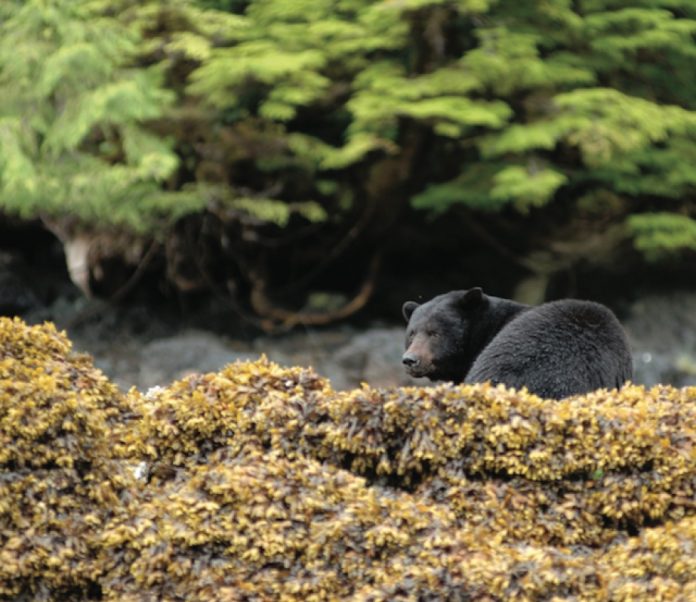
Then the reality set in. Stroking past Princess Royal Island, home of that poster animal of the Central Coast, the Kermode or Spirit Bear—we saw nothing. The few times we set foot on mainland with our reflexes primed for an encounter with the griz—nothing. A gargantuan track here, a fresh mound of berry seeds there, some fearsome tooth marks in an institutional- sized mazola jug found eerily far inland from the shoreline junk pile—that was it.

I did once try to hang our food, the whole hundred-odd deadweight pounds of it, while Dave heartily mocked my efforts. And though our punching bag of produce hung laughably close to the ground, pooh stood us up on the piñata party. Probably the number two question we faced coming home after 80 days out besides Didn’t you get sick of each other? was Did you see a lot of bears?

Fact is, it’s in the margins of human civilization, where wildlife is crammed into the slender geography of wildlife corridors woven between golf courses, back alleys and garbage dumps— where wild omnivores are trapped between the privations of shrinking habitat and the temptations of human refuse—that is where you’re more likely to see bears.

There are 46,000 square kilometres comprising B.C.’s Central Coast, all largely uninhabited, and the wild bears there have better things to do than entertain the few humans who arrive with mace in their pockets and bells on their packs. We learned that more than 99 times out of 100, leaving your food packed away neatly in your kayak hatch is the sensible and practical thing to do while you sleep soundly inside your nylon mesh panic room. And we learned that when you do see a bear in the wild, it’s something truly special.

We did, finally. It was late one drizzly day along a lonely Vancouver Island beach about six weeks in. she was a bumbling black hole in the fabric of the west Coast, flipping over rocks and cruising for something to eat. She never saw us. Or maybe she did. And that was all that happened.

akv6i4cover.jpgThis article first appeared in the Fall 2006 issue of Adventure Kayak Magazine. For more great content, subscribe to Adventure Kayak’s print and digital editions here.