Home Blog Page 368

Skills: Running Big Holes

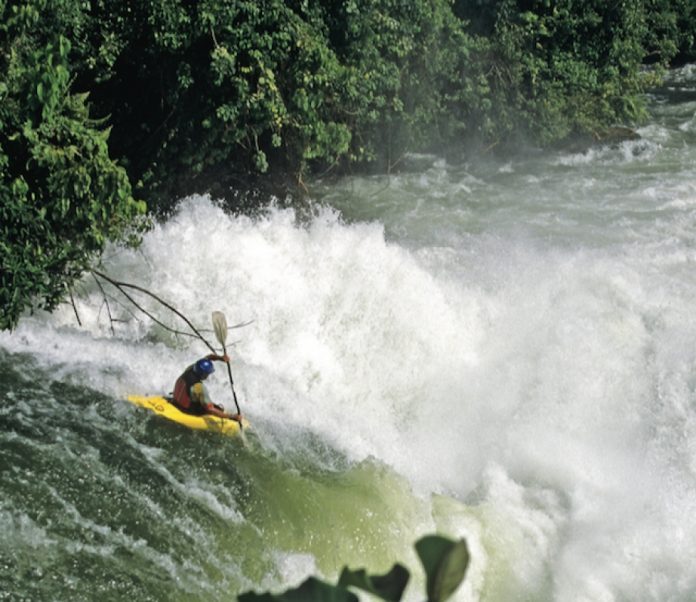
Photo: Dan Armstrong
A whitewater kayaker paddles over the lip of a waterfall.

On large-volume rivers the predictable constants of rock and earth are submerged and replaced with the increasingly chaotic forces of moving water.

Properly assessing one’s mental preparedness and physical fitness, the rapid’s geographic remoteness, and the ability to set up adequate safety are the first steps in deciding to attempt any run. When the run involves extremely large holes, however, there are specific technical variables to consider, including the behavior of the water, your equipment, and your paddling technique.

Being able to see where the current pushes down- stream through a large-volume hole is the greatest challenge when scouting a feature because this flow will often be covered by a large reversal. You can usually tell where the passing current exits the foampile by identifying where the water boils up most significantly on the downstream side of the feature. By connecting the current’s entrance to the exit, you’ll identify a potential passage beneath the whitewater.

{loadposition PTG_RP_Midcontent}

Any path through the feature will almost certainly be deep if you are scouting a truly big hole. Properly aligning your boat with this downstream flow will allow you safe passage by sending you beneath the oncoming speed and power of the recirculating whitewater, not through it or over it.

Your boat is the second variable and the choice you make depends on your ability to read the water. Assessing how deep you will need to go for safe passage through the hole dictates the size and shape of the best boat. The physical properties must provide not just the appropriate buoyancy, but also the tracking ability needed for you to stay online and establish the necessary momentum. Smaller boats are less buoyant and better for subbing out in the deep flow, but lack speed and momentum. Big boats, on the other hand, provide plenty of momentum for punch- ing medium-sized holes, but because of their buoyancy can prevent you from flushing through a hole with the passing current.

The final tactic to employ is proper paddling technique. Aggressive vertical forward strokes and sweeps at the bow will position your boat properly in the current with the correct momentum for entry. A good “tuck and duck,” in which you kiss the skirt and line the paddle up parallel with the prevailing current, will prevent de-limbing. Initiate your exit strokes as a continuation of your tucked paddle position, which will usually be a low brace using the blade behind your hip or a forward stroke using the blade in front of your nose. Placed properly, these strokes will help propel you past the boil point of the hole along with the current continuing downstream.

Above all, remain rational and confident when choosing to lose yourself in a big water giant. The human desire for increasingly larger challenges should be tempered with humility, and knowledge gained from experience. Keep your head by being in the right place with the right people for the right reasons at the right time.

Scott Doherty, who has a master’s degree in education and is an ACA kayak instructor, did the research for this piece on the Stikine and White Nile rivers. 
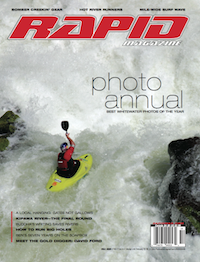
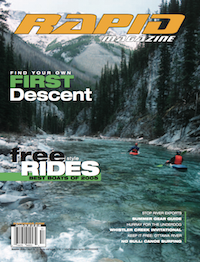
PDF of the Rapid magazine cover showing a kayaker going over a waterfall. This article first appeared in the Fall 2005 issue of Rapid Magazine. For more great content, subscribe to Rapid’s print and digital editions here

Skills: Hanging Gates

Photo: Scott MacGregor
Skills: Hanging Gates

Local hangings were the most popular legal (and extra-legal) form of execution in North America long after its supposed civilization. They were public events with a festive atmosphere—families attended with picnic baskets and vendors sold souvenirs as crowds gathered to watch the spectacle.

In 1949, about the time that lynching was finally coming to its end as an American pop-culture thing-to-do, the first official World Championship canoe and kayak slalom races were held in Switzerland. Swinging from riverside trees were gates instead of nooses. Whitewater slalom was becoming its own form of punishment for crimes such as sloppy technique, lack of boat control and low-water boredom.

Local hangings are still happening, but are now hidden deep in urban river valleys and in smaller forgotten channels of popular rivers. Some courses are the training grounds of the nation’s best slalom athletes, while others transform a class II swift into something to do on hot summer evenings. 

Hanging gates requires only a little wood- working and some trial (not that kind of trial) and error.

Each gate consists of a horizontal wooden crossbar and two five- or six-foot vertical poles. The crossbar should have eyelets installed at either end, top and bottom—an upper set for hanging the bar from the supporting wire and a lower set to suspend the poles.

The book of slalom law states that gates can be as narrow as 47 inches, but a width of 52 to 54 inches is more comfortable, especially for open canoes. For proper presentation you could add gate numbers and sponsors to the crossbars and paint the poles white with green or red bands—red for “upstream gates” and green for “down- stream gates”.

Pre-planning is the key to any successful execution. Whether you’re hanging just a few practice gates or setting a full race course, every gate should lead naturally to the next, using the flow of the river instead of the paddler’s strength. A course should be balanced with a nearly equal number of gates for left- or right-handed paddlers.

Place some gates deeper in eddies so that boats can carve through them. Put others tight on eddylines. Vary the speed of the course so that strong paddlers can muscle through in some places while the careful technicians can whittle their way through oth- ers. Even if you’re hanging gates on a class II river, there always seems to be a tendency to make the course too difficult. Initially, hang your course so that mere mortals can navigate it cleanly; then create a move or two that challenges the desperadoes.

Hanging gates across even a narrow, lazy current can be a fiasco. Your first challenge is establishing a pull line—the line used to move the rest of the lines from one bank to the other. Try tossing a throw bag or even paddling a line across. Popular with Neanderthals is the rock-and-length-of-twine heave toward a cowering partner. Once you have your pull line set, hanging gates can be a simple process of pulling different lines back and forth across the river.

Keeping in mind what finished gates look like helps you understand the process of hanging them. For each gate imagine four lines strung across part or all of the river and anchored to either nearby trees or homemade bipod supports. One line hangs the crossbar, one pulls the crossbar into position and the other two control the height of the poles.

Taut clothesline or fencing wire is best for supporting the crossbar. The second line extends from the crossbar to the far side so it can be pulled into position across the river. The poles hang from the crossbar on two separate lines which are threaded through the lower set of eyelets and then anchored to either side of the river. These allow you to raise and lower the poles if the river level goes up or down once the crossbar is in position.

The teams on either side need their own spools of line, knives, whistles and the know-how to tie a knot or two. To go into greater detail would take pages to explain things that will be obvious after hanging the first gate.

Before long your local gate hanging spot may be a public spectacle, complete with picnic baskets and vendors gathered to watch the mob of vigilant paddlers in pursuit of whatever whitewater witchcraft it takes to paddle through them fast and clean.

Brian Shields and Scott MacGregor are responsible for at least one local hanging in a small Ottawa Valley lumber town. They recently placed 10th at the 2005 North American Open Canoe Slalom Championships in Jonquière, Quebec. 

Screen_Shot_2016-01-15_at_9.16.31_AM.pngThis article first appeared in the Fall 2005 issue of Rapid Magazine. For more great content, subscribe to Rapid’s print and digital editions here

Touring Kayak Review: Current Designs Stratus 18

Photo: Tim Shuff
Boat Review: The Stratus 18 by Current Designs

Say you put on your mad-kayak-designer’s wig and lab coat and head into your workshop with your hacksaw. Then you slice the hull off a flatwater racing kayak and glue it to the deck of an expedition touring boat, complete with rubber hatch covers, deck lines, bungees, rudder and grab handles.

When the glue fumes cleared you would have something like the new Current Designs Stratus 18. This slim speedster fits into a hybrid category of boats that designer Dave Kruger calls “light performance touring.” It’s a crossbred racehorse for the paddler whose main focus is speed—racing and training—but who also wants to be able to go on multi-day tours.

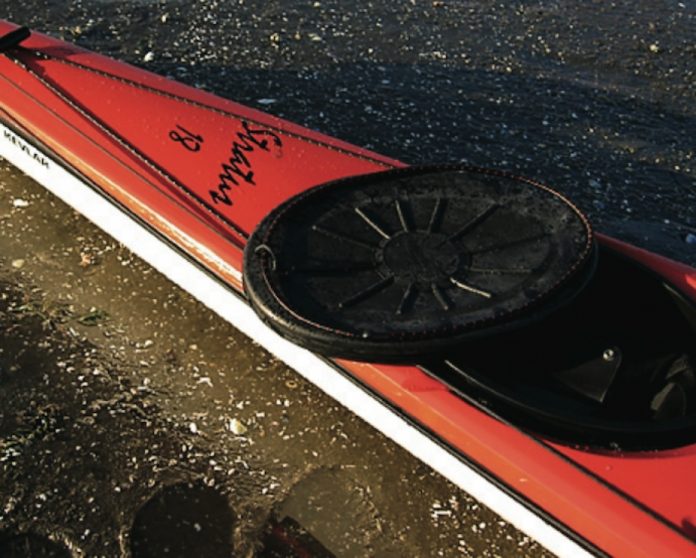
Every element of the Stratus’ design reveals some concession to speed. The hull looks like a large javelin sliced down the middle. It has the smooth rounded cross section of a racing kayak or rowing shell—no v-bottomed keel or chines which would only add surface area and drag. There is virtually no rocker and the waterline extends almost all the way to the nearly plumb bow. Kruger chose a Swede-form shape (widest part of the hull behind the midpoint) for maximum glide.

The dimensions of the Stratus meet most kayak racing specifications, so it will fit into the expedition kayak category at your local adventure race and be one of the fastest hulls in the field. On calm water we were able to sustain a top speed of seven knots.

The Stratus is ideally suited to calm waters. Current Designs calls it a “quietwater” hull design because it stands in stark contrast to seagoing kayaks that have buoyant, upswept bows to ride through waves and rockered and hard-chine hulls for easy turning.

Current Designs Stratus 18 Specs
Length: 18 ft
Width: 21.75 in
Depth: 11.25 in
Weight: 50 lb glass, 46 lb Kevlar
Cockpit: 33 x 17 in
MSRP: $2,699 USD glass, $3,099 USD Kevlar 

cdkayak.com

However, where flatwater racing and training kayaks typically have large, open cockpits and little or no dry storage, the Stratus is a fully decked kayak that can be paddled in rough conditions. Locked into the standard-sized touring cockpit with a sprayskirt on, we were able to easily scull, brace and roll.

The Stratus’ rounded hull cross-section results in a stability profile that is best suited for experienced paddlers. Secondary stability felt consistent and neutral through all degrees of lean; there was no obvious point where the hull resisted efforts to roll it on edge, a feature that can equal good performance in rough seas. The Stratus tracks straight due to its long waterline and minimal rocker, so the rudder comes in handy for turning and also helps prevent weathercocking in cross and quartering winds.

The Stratus 18 comes in two sizes: a standard version that would fit medium to large paddlers well, and a high-volume version suitable for extra-large paddlers or those seeking maximum capacity for long trips.

Rubber’s not just for Brits

The bow hatch is sealed by a 9.5-inch round Kajaksport rubber cover as well as a hard plastic outer cover that straps flush to the deck. The second cover also protects the rubber hatch from UV rays and spray and keeps the Stratus’ racy lines tidy. Front and rear grab handles are kept from flopping by bungees attached to the reflective decklines. Current Designs also includes a painter line for tethering this racehorse.

[ Paddling Buyer’s Guide: View all touring kayaks ]

Sumptuous saddle

Top-quality cockpit features round out the package. A long seat base provides exceptional leg support. The Current Designs rubber-padded backband encourages an aggressive paddling stance. Aluminum foot pegs control the rudder. Instead of thigh supports extending into the cockpit opening there is thigh padding under the coaming. This cockpit design favours spaciousness and ease of entry and exit rather than a tight, controlled fit.

Introducing the superhatch

In a Swede-form hull, the widest part of the boat is behind the paddler, adding extra capacity to the stern hatch. The Stratus has an enormous 21-inch-long hatch cover to match—the largest rubber cover we’ve ever seen. We were able to drop a big duffel bag straight through the opening, and were impressed when it stayed powder dry.

This article originally appeared in Adventure Kayak‘s Fall 2005 issue. Subscribe to Paddling Magazine’s print and digital editions here, or browse the archives here.

Boat Review: Bell Canoe Works’ Nexus

Photo: Rapid Staff
Boat Review: Bell Canoe Works' Nexus

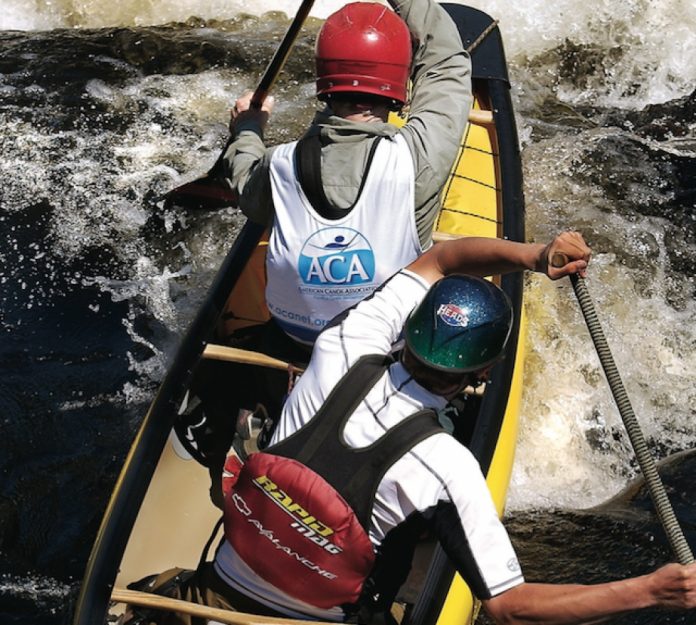
We were just completing our registration forms for the 2005 North American Open Canoe Slalom Championships/U.S. Nationals when our Bell Canoe Works Nexus test boat arrived at the Rapid office. With a new Royalex tandem playboat on the roof racks, we checked one more box on the registration form, entering us in the OC2 REC class. The slalom course of Jonquière, Quebec, would be a perfect testing ground.

Nestled in Zimmerman, Minnesota, Bell Canoe Works has a long history of producing high-quality composite canoes. In 2002, legendary canoe instructor and designer Bob Foote teamed up with in-house Bell designer David Yost to launch their line of Royalex white- water canoes. They first created the shape of the Prodigy and Prodigy X solo boats that provided the basis for their tandem Nexus. Bell is also producing the Ocoee after buying the mould when Dagger bailed from the canoe market.

For the last decade the Dagger Caption has been the standard by which new tandem playboat designs are judged. The Nexus is four inches longer than the 14-foot Caption, has a rounded bottom, moderate rocker and low and balanced sheer. Put plainly, the Nexus wasn’t the boat everyone was dying to try.

However, all of these normal-looking, non-radical design elements come together to produce a non-radical and nice-feeling boat. After two days of training runs on the slalom course in both models, our teams decided to paddle the Nexus instead of the Caption on race day.

Everyone just felt at home in the Nexus. It’s smooth and doesn’t lurch or wobble. It tracked well and we were able to pivot quickly enough to make the most challenging moves on the course. Is it faster than the Caption? There weren’t noticeable time advantages in either boat. Is it wetter than the Caption? It looks like it might be, but on the class II/III course it was difficult to tell.

When the course was closed we snuck out to surf the waves between the gates. The Nexus was a blast to front surf. It had enough of an edge to carve shoulder to shoulder on the wave. We even dropped in for a couple of rompin’ side surfs. These ended with a swamped canoe of course, but one that was stable and fast enough to catch the eddy below for another go.

If we were to nitpick, as racers tend to do, here’s what we’d have our technicians scribble on the clipboards. The bow and stern webbing grab loops were not long enough to carry or effectively rescue the boat. In fact, the ACA boat tech, Bob Stecker, wouldn’t let it pass inspection without the addition of painters.

Bell offers an optional “Mike Yee inspired” factory outfitting package complete with foam pedestals with knee and thigh straps and air bags and cages. We’ll admit that the Bell system functions in the same way as the original Mike Yee Outfitting

brand, but the attention to detail just isn’t the same.

With the Dagger Caption as the standard, all new canoes are either faster or slower, wetter or drier, less or more stable, blah or blah, blah than the Caption. The most distinct advantage over the defunct Caption, the mould for which is locked away in a warehouse somewhere, is that Bell Canoe Works still builds canoes and you can actually buy yourself a shiny new Nexus.

Specs

HULL Royalex
LENGTH 14’4”
WIDTH 29.5”
DEPTH 15.5”
SHAPE asymmetrical
ROCKER bow 5.75”, stern 5”
GUNWALE vinyl or ash
COLOURS yellow, red
WEIGHT 50 lbs w/vinyl
PRICE $ 1550 Cdn, $1150 US, ash gunnels; $375 Cdn, $280 US
OPTIONS Mike Yee-inspired Bell factory outfitting

rapidv7i4cover.jpgThis article first appeared in the Fall 2005 issue of Rapid Magazine. For more great boat reviews, subscribe to Rapid’s print and digital editions here.
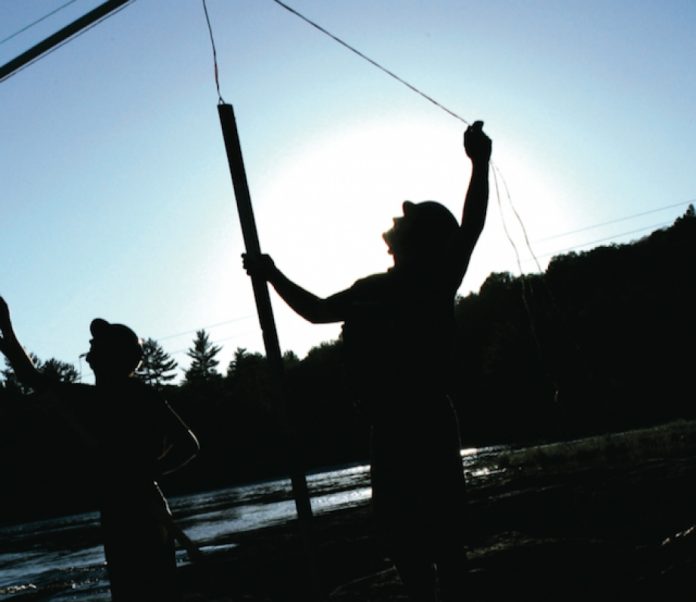
Editorial: Life at Eight Frames per Second

Photo: flickr.com/image-catalog
Editorial: Life at Eight Frames per Second

When I was flat broke and guiding for a living, I lay awake many nights dreaming of a Gore-tex dry suit and a pro SLR camera capable of shooting eight frames a second. One of my life’s great ironies is that now, seven years later, I have both, neither of which are doing me much good here in my office. Sorting through this year’s photo annual submissions I found myself dreaming of the days when I felt rain trickle down the back of my neck—the days before my dry suit and fancy camera. The photos in this issue are taken by people who are not living life at a pace of eight frames a second. I found myself dreaming of days of longer exposures.

When friends and family see the quiver of camera equipment I lug around with me they ask me what camera they should buy. But what they are really asking is, do I need to spend that much to take great photographs?

My camera bag weighs 20 pounds and fills the trunk of most European cars. I have the contents insured for more than $10,000. It’s a marvel of polished glass and Japanese microprocessors that’s about as easy to pack in a sea kayak as the Hubble telescope. They take one look at it and swear they’d never spend that much on camera equipment. Funny thing is, I tell them, they don’t have to. My best photos were taken on an old hand-me-down manual camera from the 1970s.

I tell them to begin their photographic adventures by looking for treasures in pawnshops. Seek out a 35mm body and three lenses: wide-angle, normal and telephoto. Then I tell them to buy a shopping bag full of slide film. With the remaining $9,500 (or whatever their budget allows), I tell them to buy an around-the-world plane ticket and a comfortable pair of sandals and to spend the rest on traveller’s cheques. Then, during every waking hour—no matter if they are on the water, at the beach or riding Mongolian public transit—they should compose, focus and press the shutter button.

Authors of photography books will tell you that any good photograph is just film exposed to the light for some fraction of a second. What they don’t tell you is that the best exposures aren’t measured TTL—through the lens— they’re measured by salty, chapped, sun-burnt lips and callused hands. Good kayaking photographs start with their exposure to the elements, to the waters of our world and to the people and coastlines that surround them. None of the breathtaking kayaking pictures in our annual photo essays could have been taken from a desk, no matter how expensive the camera.

akv5i4cover.jpgThis article first appeared in the Fall 2005 issue of Adventure Kayak Magazine. For more great content, subscribe to Adventure Kayak’s print and digital editions here.

Photography Skills: Shooting the Breeze

Photo: Rick Matthews
Photography Skills: Shooting the Breeze

It’s the sixth day of my Newfoundland search for icebergs. Six days of horizontal rain, two-degree temperatures, 60-kilometre winds and thundering surf. In six days I have yet to unload a boat or camera.

The locals call it capelin weather; I call it hell.

Yet as I drive into the town Twillingate, I realize the spirit and warmth of the people in this small town are seeping bones. I’m absorbing their accepting “see what tomorrow will bring” attitude—something totally out of character for me.

My serenity also stems from the knowledge that my local sanctuary, the Internet café, had opened at 7 a.m. and my apple pie and hot coffee were waiting.

I had come to meet the locals while drying out cameras and body day after day here. They shared their stories with me, stories about depleted fish stocks and how the young people were still leaving, but also about how things were looking better for tourism with the whale watching and birds and so on.

Over various cups of tea I was told the history of the area: about the heyday of the fishery when 100 schooners would crowd the tiny harbour to unload countless tons of cod; about the colourful house on the hill that was towed across the frozen bay by several hundred townsfolk, and of the polar bear who drifted into the harbour on the winter ice and wouldn’t leave.

Unable to paddle, I had to be creative. My routine changed. I’d get up before sunrise and drive around the back bays and fishing villages searching for icebergs and scenic backdrops. I set up boats and cameras and took shots around lobster pots, fishing stages, and boats—images that were not so much about kayaks and paddling but about weather, landscape and life on the Rock. Then I’d retreat to the café to dry out and download and edit images.

I finally abandoned my leaky tent and rented a small cabin on the water’s edge in Little Harbour.

It was one evening at dusk just before the fog rolled in when, through my binoculars, I spotted an iceberg, miles out to sea on the horizon. When seconds later it had evaporated in the fog, I ques- tioned if it really was there or if seven days of eyestrain in the fog was playing tricks on me.

The next morning, after a late evening of sampling the local rum with new friends, I pulled back the curtain and there it was, like a Hollywood prop sitting right there in the harbour. And yet another miracle, the sun was shining. I ran outside barefoot and shirtless with my camera firing away as if a thousand tonnes of ice were going to disappear in minutes.

A sense of urgency set in. I drove quickly into town to look for volunteers to paddle boats. A few local “lads” enlisted and we set out toward the grounded berg.

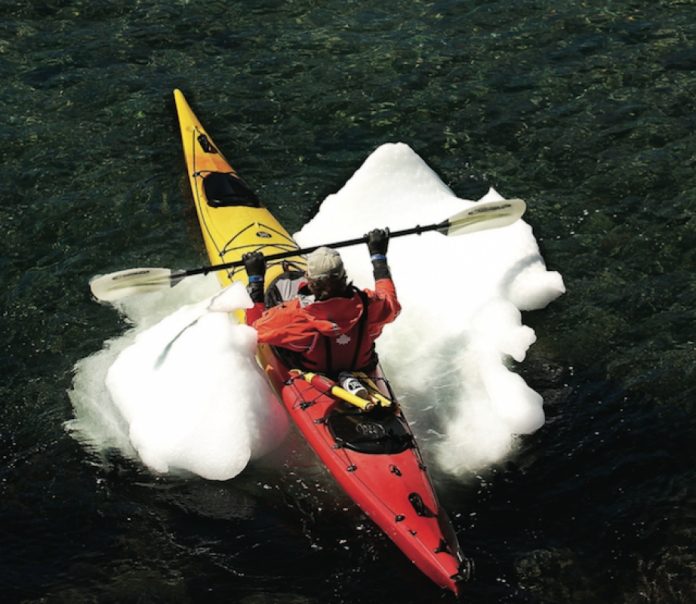
I soon realized that the main berg was still too exposed to the open seas to approach it with inexperi- enced paddlers. However, there were plenty of house-sized chunks of iceberg drifting in the bay.

What quickly became more interesting than the ice was the joy and curiosity on the faces of the paddlers.

Men that had grown up and worked on and around the sea all their lives became excited young children discovering a new toy. I stopped shooting and simply watched as they circled the ice and spontaneously dashed off in mad sprints and chases. Looks of astonishment took hold as they realized how fast they could go under their own power.

When I asked what they thought of the boats the answers came as if in a chorus, “It’s so quiet.”

All their lives on the water had been spent with the constant drone of a labouring motor. They hadn’t experienced the quiet and solitude of kayaking or sensed the power and independence of being self-propelled.

I didn’t take a lot of photos that first day on the water, I spent more of my time soaking up the fun that these guys were having.

I recalled the renowned photographer Freeman Patterson saying good photography is applying the “art of seeing.” But I realized photography is equally a process of learning the “art of connecting” with the landscape, and more importantly, the people within that landscape.

The weather changed, the seas calmed (slightly) and we got out more and more in the boats. The images that I had envisioned, that I had frantically chased for days unfolded before me. My wonder grew daily as these huge ice cas- tles dripped, broke up and changed shape. They had travelled thousands of kilometres from Greenland on the Labrador Current to die a slow death on the shores of Newfoundland. They formed tall pinnacles and small inner ponds, blue and green veins of ice revealing themselves.

As the weeks passed I ended up getting the shots I had hoped for but I don’t need any photographs to remember that first day on the water. I still feel a certain warmth inside knowing that I had given something back to these new friends who had sheltered and adopted me for several weeks while the capelin weather blew.

Rick Matthews is a retired steelworker and photographer with some time to kill. 

akv5i3cover.jpgThis article first appeared in the Summer 2005 issue of Adventure Kayak Magazine. For more great content, subscribe to Adventure Kayak’s print and digital editions here.

Six Inches from Manhood: Kayak Fishing for Muskie

Photos this page: Scott MacGregor
Six Inches from Manhood: Kayak Fishing for Muskie

I stumped upon a photo of Vic Van Wie and his kayak-fishing world-record 256-pound thresher shark while making some final online arrangements for my first kayak-fishing trip.

Here’s a guy in a T-shirt, surf trunks and sandals kneeling beside a 12-foot kayak and an 11-foot fish. Below the photo he recounts the catch: “The thresher shark hit about 20 minutes after I started soaking a live mackerel. He ripped off all 80 yards of mono top-shot and was into the Spectra backing within a few seconds. Even with my bait buck- et in the water [used as a sea anchor] I was still getting pulled at a pretty good clip. After about an hour and a half it turned into a standoff with him about 20–30 feet below the kayak. For another half an hour we played tug of war.”

When he finally landed the shark a kayak-fishing buddy named Rhino grabbed the leader and then “beat it upside the head” until it stopped thrashing.

I don’t even like putting a worm on my hook, let alone dragging a 256- pound shark across my kayak.

I’d committed to this article on kayak fishing and after reading about the monsters being caught off the coast of California I knew I couldn’t just spend a day filling a pail with panfry sunfish if it was going to be a good story.

The biggest, meanest fish I’d be able to find in the freshwater waterways of Ontario—the one closest to Vic’s thresher shark—is the muskellunge, or muskie. If you’re a serious muskie hunter (you apparently hunt, not fish, for muskie) you just call them ‘skies, as in, “Hey, wanna go on a three-day whitewater kayak-fishing trip in November down a class III–IV river hunting for ‘skies?”

It was the perfect combination of all things you never consider doing. So much so that every man I baited with the idea was immediately hooked, and every wife of those men thought we were nuts.

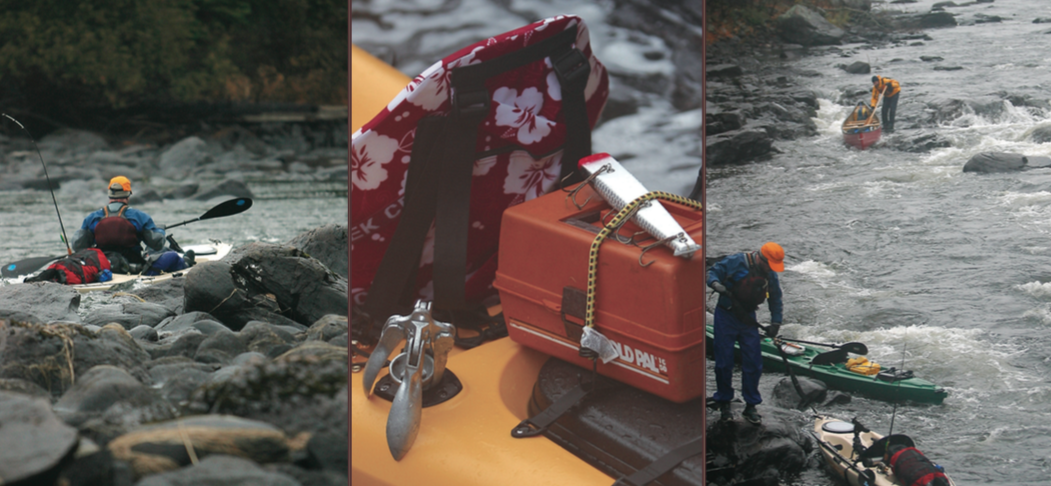
Good kayaking friends who’d never mentioned fishing before came out of their gear closets with Old Pal tackle boxes, dusty bamboo rods and reels spewing nests of 20-year-old line. And real fishermen, guys who’d usually motor not paddle, like my dad who doesn’t kayak and can’t swim, also wanted to go on the trip.

It’s this mass appeal that has the kayak-fishing segment of the paddlesports industry growing faster than a fisherman’s tale after a couple of Coors. And the kayak manufacturers are not letting this one get way.

The ability to draw from the massive pool of fishers and paddlers is the reason fishing kayaks are the current leader of kayak industry sales. Leisure Trends, a market research group in Colorado, states that more than 81 million people in the U.S. fished at least once in the last three years. Toss in the 3.9 million who tried kayaking… and kayak fishing is poised to land some trophy fish and net huge sales revenues. 

The only pictures of kayak fishing I had ever seen were much like the picture of Vic Van Wie—a shining sun and a guy in surf shorts with flip-flopped feet dan- gling over the kayak in clear blue salt water. This wasn’t the fishing I knew. The fishermen looked more worried about heat stroke than hypothermia; they were wearing sun hats, not tuques (woolly Canadian fishing headgear). Kayak fishing above the 46th parallel in November was going to be different.

I’d never heard of anyone running class IV whitewater and fishing the sections between the rapids in sit-on- top fishing kayaks. Nor had anyone I knew considered doing a multi-day trip with sit-on-tops. But that’s what we had to do to fish the Petawawa River, one of Canada’s classic canoe tripping routes (and a famous muskie hunting grounds). Besides, I’ve come to realize things that wives think are crazy are usually what make for a good fishing story.

Screen_Shot_2015-07-22_at_4.38.45_PM.png

The fall is the time to hunt muskie. As the lakes and rivers around the Great Lakes cool, the muskies’ internal alarm goes off and they move from their deep summer hangouts to shallow waters where they start chowing down on whatever they can find in order to store reserves for the long, cold winter ahead. As the water cools and the leaves change colour during the latter part of September and early October the muskie lurk in one to two feet of water amid the lily pads and rushes, along- side logs and stumps. Research indi- cates that 4 to10 degrees is the optimum water temperature (for the feeding muskie, not sit-on-top kayak fisher- men).

Dangling your toes over the edge of your kayak looks very appealing in photographs but doing so in muskie territory is not only chilly, but can be risky.

Muskie are known to grow to almost 70 pounds and up to five feet long and sometimes eat mice, ducklings and muskrats; they’ve been known to order take-out that’s up to 45 per cent of their own length and sometimes die trying— muskie have been found dead with their last meal lodged down their throats. A true case of one’s eyes being bigger than his stomach. 

Dan Droessler was dangling a leg over his canoe in Iowa County, Wisconsin, when a 36- inch muskie decided it looked pretty tasty. When he yanked his foot out of the water the muskie let go and fell into Dan’s canoe. According to Randy Rosslin, a local park war- den, Droessler and the fish both went to the emergency room where he (not the fish)

received 60 stitches. Rosslin took possession of the muskie, explaining, “It’s not a legal size for one thing, and it’s not a legal way to catch fish—with your foot.” Droessler wasn’t charged for illegal fishing but failed to see any humour in the ordeal. “I don’t think it’s funny at all,” he later told the Wisconsin State Journal. 

Muskie experts, both fishermen and biologists, agree that when one consid- ers the amount of time humans and muskies share the same water, such attacks are very rare. One report even points out that being chomped by a muskie is even less common, and cer- tainly less consequential, than being struck by lightning. Maybe so, however, I think dragging an angry 30-pound lightning bolt across my lap might be bringing up the otherwise low chances.

Paddling the Lake Tavers to McManus Lake section of the Petawawa River typically fills the better part of three days paddling and two nights camping. To fish this stretch of river in the same length of time we were constantly on the move, trolling mostly with our rods stuffed in the holders. We were paddling at what we hoped was the speed that would entice lurking muskellunge to ambush our trailing lures.

It was close to freezing during the nights and in the mornings we danced around drinking coffee, trying to avoid crawling back into our drysuits.

Being so late in the fall, dawn didn’t arrive until after seven, so we weren’t on the water until mid-morning. We needed to make time to reach our next campsite before dark.

The Algonquin Park map told me we were just below Little Thompson rapids and my Lowrance X67e sonar indicated that I was in about 15 feet of water but that I had just passed a grassy shoal that rose to only four feet below the surface. The edges of the river were filled with grasses and lily pads that grew out toward the centre. The water was dark and looked cold. It was raining, again.

When my rod bent double and my reel began dumping line I swore out loud for no one to hear. Everyone else was almost out of sight in the misty fog downstream. The kayak spun backward like it had yesterday each time I’d hooked a rocky shoal, reed bed or sunken log. Too lazy to paddle back upriver I tightened my drag, hauled on the 25-pound test line and pulled against the snag, dragging my fully loaded kayak back upriver, against the sleepy current.

When the line was taut directly below me, my colour LCD screen indicated 10 feet of water—I knew my floating blue jointed Rapala must have missed the shoal and hooked a submerged tree instead. I slowly dragged the log to the surface, reeling in the slack I created with each haul. Frustrated by being left behind, I glanced downstream and didn’t notice the log coming to the surface.

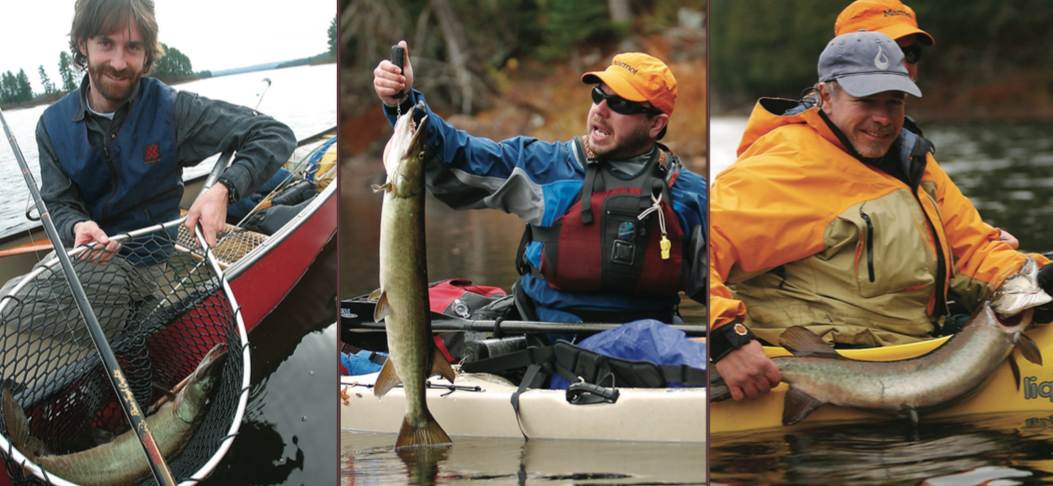
Six inches from my leg was my Rapala, trapped inside a mouth full of daggers, and one dark eye.

“JESUS…”

My startled yell set him off and he was gone deep below the boat. My rod bent completely around under the boat, and the same tension on my reel that I used to drag the kayak upstream was now spooling off line like dental floss in the hands of a savage hygienist.

I kept trying to get my rod on the same side as the fish, but no sooner would I get it around the bow than he’d change direction below me and spin the boat again.

“FISH ON, GET THE NET!” I screamed into the fog.

Now completely spooked, the muskie wasn’t at all interested in getting near the surface or my mango kayak. I finally tightened the drag a few more clicks and was able to put some line back on the reel and slowly bring him to the edge of the boat.

Screen_Shot_2015-07-22_at_4.37.44_PM.png

We had figured out a technique with the three ‘skies we’d landed yesterday that was much the same as the one Vic and Rhino used to land the shark, without beating it upside the head. Landing a muskie in fishing kayaks is a two-person job. The assistant floats up beside the fisher with the net or just a spare set of hands and scoops the fish out of the water.

With my fish now at the surface and my helpers paddling like mad, but still hundreds of metres away, I was faced with landing this monster myself.

I’d read that muskie teeth aren’t like those of sharks or piranhas, the purpose of which is shearing flesh. Muskie teeth are extremely sharp and numerous but used only for holding on to their slippery prey. Knowing this didn’t make me any more enthusiastic about grabbing the leader and dragging the meanest of all freshwater fish onto my lap.

I had him to the surface beside the kayak a couple of times. He was easily the length of my legs, which I figured I’d use to pin him to the deck. Grabbing the leader I lifted his flat ugly head out of the water.

Staring into his dark, evil muskie eyes I considered my options.

Landing the largest fish out of the Petawawa River, maybe even Ontario, would certainly increase my macho angling status in tackle shops around the world and doing so solo in a fishing kayak would certainly add to the lore. I’d be famous. I’d never have to buy drinks in marina bars; I’d have my own TV show and people would read about me online, like I had read about Vic Van Wie and his world-record thresher shark.

On the other hand, I thought of poor Dan Droessler and his leg with 60 stitches. His muskie hangs in the hospital ER reception area in Dodgeville, Wisconsin, with a sign under it that says, “Man-eating fish.” I realized that being admitted to the hospital with a pissed off muskel-lunge latched to my genitals would also make me famous but do nothing for my angling (or manly) reputation.

I gently lowered my muskie back into the water and opened the bail on my reel giving him all the line he wanted. About 30 feet away he hit the surface, shook the hook at me and was gone.

When the guys finally arrived with the net, I was reeling in the last few feet of line and my scarred blue Rapala. They asked what happened.

“Just snagged on a log,” I explained. 

akv5i3cover.jpgThis article first appeared in the Summer 2005 issue of Adventure Kayak Magazine. For more great content, subscribe to Adventure Kayak’s print and digital editions here.

Editorial: The Dam Dumbs

Photo: Trethewey F./Muskoka Falls/Muskoka R./Mediocre/NTS Map Sheet
Editorial: The Dam Dumbs

A friend of mine calls them “The dumbs”. These are the things you do, dumb things, that at the time seem reasonable but eventually go so wrong that you can’t believe you did them in the first place.

It’s a condition that has escaped serious medical research but is most commonly found in males aged 18–35. An example of the dumbs is driving a Hummer into a hood-deep wall of snow, spending two hours digging it out with an avalanche shovel, and then backing up to try it again, getting myself only six feet further and much more stuck.

Another example is reaching over my handlebars to pull leaves out of my front brakes while riding my mountain bike on a rough trail.

Sometimes you get lucky and escape the consequences of the dumbs. Other times the consequences are immediately obvious, like when I reached for that leaf and got my fingers caught in the spokes, stopping the wheels with my weight forward and sending me screaming over the handlebars. But the worst cases of the dumbs happen when you don’t even realize what you’ve done, until later.

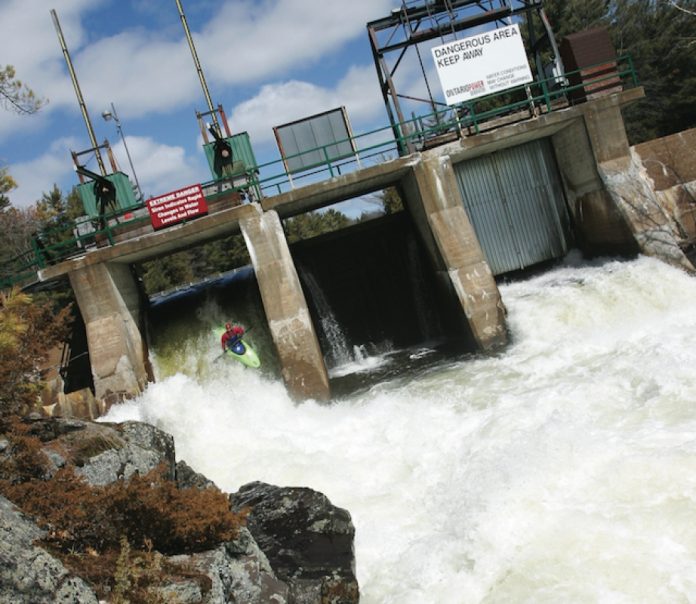
When Linda Halliday called a few weeks ago she explained she was bewildered and very disappointed, but by the tone of her voice I could tell she was actually pissed off. She’d just picked up the early summer issue of Rapid [online V7 I2] which fell open to the feature story, “Code Name Rubber Chicken: A Calculated Assault on Cottage Country Creeks” in which there appeared a photo of a paddler running a hydro control gate at Trethewey Falls.

The photo was taken more than a year ago in perfect spring light just as the boat was dropping through the dam on the curtain of water. It was all framed by the red brick structure and “Extreme Danger” signs. Linda, however, doesn’t think it is such a great shot. She’s a public affairs officer for Ontario Power Generation (OPG), the company that owns the dam and posted the signs.

You need a few more background details here to grasp the depth of this case of the dumbs.

Linda had my phone number handy because that morning I’d emailed her a sponsorship proposal for Palmer Fest, a whitewater canoe and kayak festival I was organizing. I had asked OPG to sponsor the event specifying that their sponsorship money would be used to further their “Stay clear, stay safe” dam safety public education campaign. In fact, I was quite proud of this partnership. I believe it makes perfect sense to work co-operatively with the people who manage the flows of the rivers we paddle. Until Linda’s call, I hadn’t made the connection with the previous year’s photograph.

Being anywhere near (to say nothing of actually running) a dam is exactly what Linda’s dam education campaign is supposed to discourage. The longer Linda and I talked, the more I realized OPG’s commitment to dam safety and the more I realized we should not have printed the photo.

Rapid would never run a photo of a paddler in whitewater without a helmet, nor would we illustrate the combination of alcohol and boating in any way. For the same reasons a photo of a paddler dropping a dam should never have been printed in that article.

Our sport doesn’t have a written code of conduct when it comes to choosing lines or running rapids, however we do have a solid respect for river safety that we’ve built through experience that makes us responsible paddlers.

According to American Whitewater, 10 per cent of all whitewater deaths are a result of victims coming into contact with dams. In this issue we thought we should have a look at why these river “features” are so dangerous—the take-home message being that these obstructions, for the most part, are industrial facilities and not the whitewater playgrounds we are used to scouting.

I’ve learned over the years that the only way to take the edge off a case of the dumbs (besides rest, ice, compression and elevation) is to tell everyone about it. Partly because, like misery, the dumbs love company—it makes you feel better when your friends try to top it, “You think that’s dumb? Well I once…”

But I think we really share stories of the dumbs because doing so can be our own humble public education campaign to stop others from doing the same.

Screen_Shot_2016-01-15_at_10.23.04_AM.pngThis article first appeared in the Summer 2005 issue of Rapid Magazine. For more great content, subscribe to Rapid’s print and digital editions here
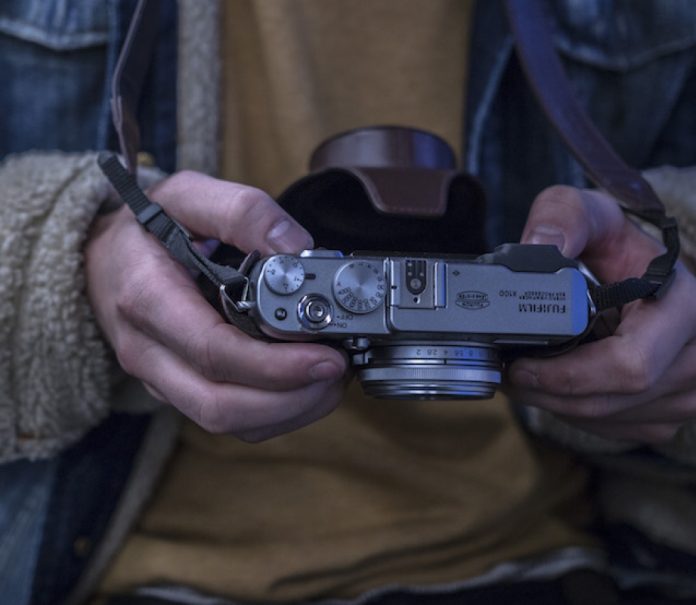
I’m Not a Rower

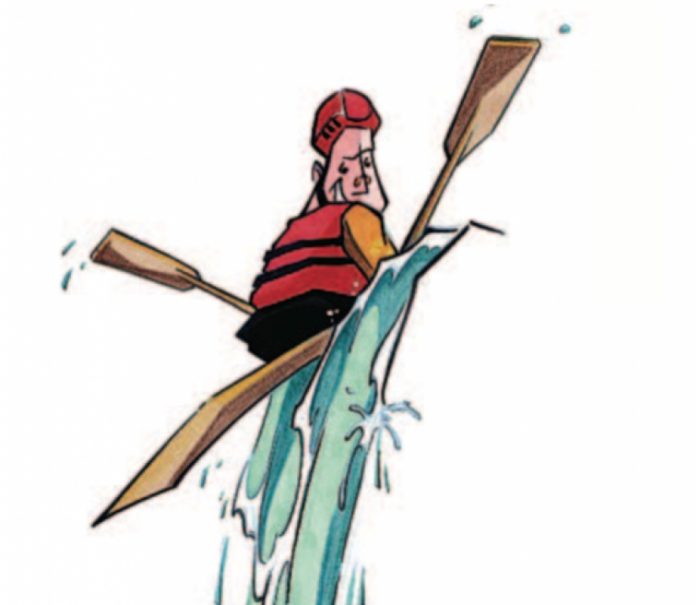
Illustration: Lorenzo Del Bianco
I'm Not a Rower

They will ask, “Whatcha doing this weekend?”

You will answer, “Paddling.”

Inevitably, they will reply, “Oh, I’ve always wanted to go rafting.” It will pain you even though you knew it was coming, even though you’ve heard it a hundred times. There is no polite reply.

Our sport may be growing, but people—family and best friends included—still have no clue what we do. They can’t grasp the difference between a 20-foot blob of black rubber filled with pasty, poorly-dressed punters and a responsive piece of plastic paddled by a party of one. Rafting involves a paddle, a helmet and a lifejacket and is therefore whitewater in their eyes. They don’t see the cunning with which kayakers pick our way down the river. They can’t imagine the freedom of slicing through a roadless landscape or planing down the face of a glassy wave. They’ve never felt their gut lurch at the lip of a drop, the sensation of being airborne and the impact upon landing. They think rafting looks fun.

“I’ve always wanted to do kayaking, but I am so afraid of flipping over and being trapped under the water,” they will continue if you bother impressing upon them the subtle differences between the sports. (You don’t bother explaining that you don’t “do” kayaking.)

It’s hard to reply to people who say they are scared of being trapped underwater because, deep down, kayakers are afraid of being trapped underwater. So you respond, “Don’t worry, when you want to bail, you bail. It’s automatic.”

Then, just to confirm you might as well be talking to a stump, they will blather on about how they heard from a friend’s uncle’s cousin that his neighbour got trapped and almost drowned…but didn’t.

“I would be scared of dying by going over a big waterfall,” they point out.

Of course they’d be scared of dying this way. Most of us would be, but a little perspective please. 

Most of us would also be scared about skiing off huge cliffs we see in ski movies. So why isn’t there the same fear of skiing? Oh right, because you don’t hurtle off cliffs when you go skiing, you ski the blue runs.

The same complex understanding of kayaking is absent.

For some reason the innocent mob thinks if you’re in a kayak you’ve got to run Niagara Falls. I blame Tao Berman.

“Aren’t you scared of drowning?” they ask.

“Yes I am,” I reply. This stumps them and stalls the flow of stupid comments, but only for a moment.

“I went kayaking once out West. It was so amazing,” they gush. “We saw whales and starfish…”

“Whales don’t live in rivers,” I reply.

“What?”

“I paddle rivers. Whitewater rivers.”

“Oh…” Silence. 

Due to the accessibility of lazy-man canoes, sea kayaking has quickly dwarfed our much cooler, bolder sport. Lame sports like rafting and sea kayaking take the same tools we use but apply them to something altogether different. Sea kayaking is not a sport, it’s speed walking on water.

Will people ever understand what we do? Will they understand the passion of putting on frozen gear at 8 a.m. to go paddle recently thawed ice? Will they comprehend that being free is losing yourself on a river? That the river is an equalizer where people from all walks of life are connected by a shared love?

No. As usual the masses will draw conclusions without knowing the full story. They’ll make things up about what scares them and what they don’t understand. They’ll decide paddling whitewater is way too extreme and keep the sport at an arm’s length.

When you’re strapping your kayak to your racks and they say, “Have fun rowing!” just smile and be glad they don’t ask to come along. 

Ben Aylsworth considers himself an ambassador of the sport. 

Screen_Shot_2016-01-15_at_10.23.04_AM.pngThis article first appeared in the Summer 2005 issue of Rapid Magazine. For more great content, subscribe to Rapid’s print and digital editions here
Open Canoe Technique: Side Surfing

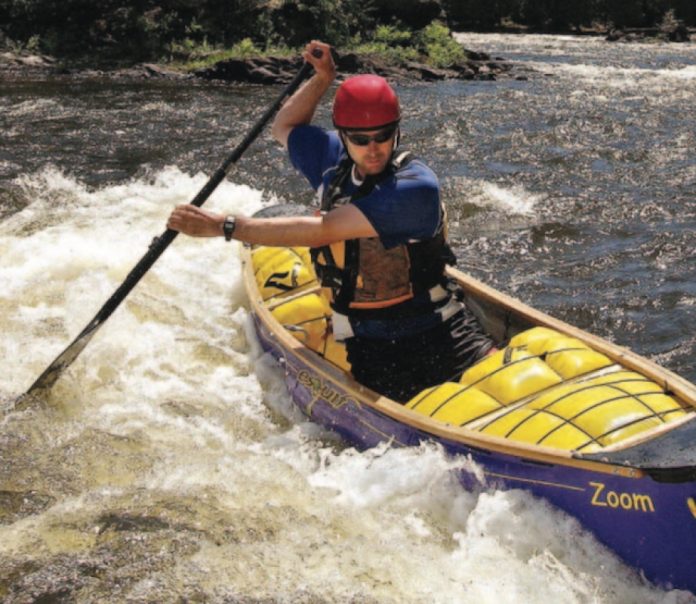
Photo: Rick Matthews
Open Canoe Technique: Side Surfing

Side surfing is to canoeing as bull riding is to rodeo. Both give you a wild ride provided you’re in a kicking hole on a lively bull.

Side surfing occurs (whether you want it to or not) when your canoe is cradled in the trough of a breaking wave or hydraulic. Riding a hole perpendicularly to the current ranges from a smooth see-sawing action to a rough arm-jerkin’ bull ride with lots of splash entering your canoe and the ever-present threat of the upstream edge catching and you being thrown from your boat.

You’re unlikely to begin your bull-riding career on Little Yellow Jacket, a three-time world champion. Similarly, if you are new to side surfing don’t choose a hole that is too threatening—find one that has a short foam pile on the downstream side and a current entering the hole that isn’t too fast. The foam pile should be wide enough to accommodate the entire length of your canoe, with enough water below so that you won’t hit your head when you get bucked off.

A bull ride lasts eight seconds. We may be lucky to have a ride this long while side surfing, but then again if we get thrown from our saddle it’s not likely to hurt as much. Just remember cowboy, keep you upper body quiet, your hips loose, and hang on. 

How to side surf:

  1. Side surfing works when your canoe rests in the seam between the water falling over a rock and the recirculating foam pile on the downstream side.

  2. Hold the canoe as flat as possible with only enough downstream tilt to keep the upstream edge from catching and flipping you.

  3. Let your legs move with the boat and use them to control the tilt. Hold your upper body still and centre your weight over the canoe.

  4. Place your paddle in the foam pile on your downstream side. Use forward and backward strokes for moving forward and back in the hole and braces if the surf gets too rough. 

Andrew Westwood is a frequent contributor to Rapid, an open canoe instructor at the Madawaska Kanu Centre and a member of Team Esquif.

Screen_Shot_2016-01-15_at_10.23.04_AM.pngThis article first appeared in the Summer 2005 issue of Rapid Magazine. For more great content, subscribe to Rapid’s print and digital editions here