Seven years into sea kayaking and I’m wondering, where do I go from here? It was my hope that I’d be able to push my skills ever forward—to move from the intermediate level to expert—along with like-minded club members. But halfway up the learning curve, I find myself alone on the hill.
Last year I attended the West Coast Sea Kayak Symposium in Washington for the third time. If you’re new to the sport the symposium is a wonderful event. There are lots of boats to demo, products to peruse and buy and, of course, fascinating seminars to attend.
During the three-day event I mined through the field of seminars. I found some I hadn’t attended before but, in the end, I left wondering if perhaps I had outgrown the symposium.
Granted, the speakers are world class and intermediate paddlers still have plenty to learn, but how many times can I listen to Reed Waite selling the virtues of the Washington Water Trails Association or Heather Nakamura telling me what I should eat for maximum performance? If I haven’t gotten it by now I never will.
It isn’t surprising that after three visits there would be a sameness to the seminars. What is surprising is how quickly I have begun to feel like I don’t fit an acceptable sea kayaking archetype. It feels like there isn’t a place, in symposiums or clubs, for paddlers of my credentials, or as some might say, lack of.
I didn’t come to this conclusion on my own. Over a beer on the first evening of the symposium an official from my club informed me that there was no support from the club for paddles I had been leading. It was strongly hinted that I should desist until I was “properly trained.”
During the past three years I’ve been organizing paddles for intermediate and advanced club members as well as a few non-members. Once or twice a week we spend the day paddling up to 25 kilometres, often in rough seas, along exposed shores, with few landing places. These paddles have a theme—harder, faster, further.
If we’re not being pushed by the elements, we try to push ourselves. I try to get wet at least once during every paddle. We’ve practiced everything from wrestling with flooded hatches in tidal channels to taking part in rescue operations with the local coast guard auxiliaries.
These paddles weren’t officially sanctioned by the club. I had never thought to ask for them to be included in the club program and now I see that if I had asked, the answer would have been no.
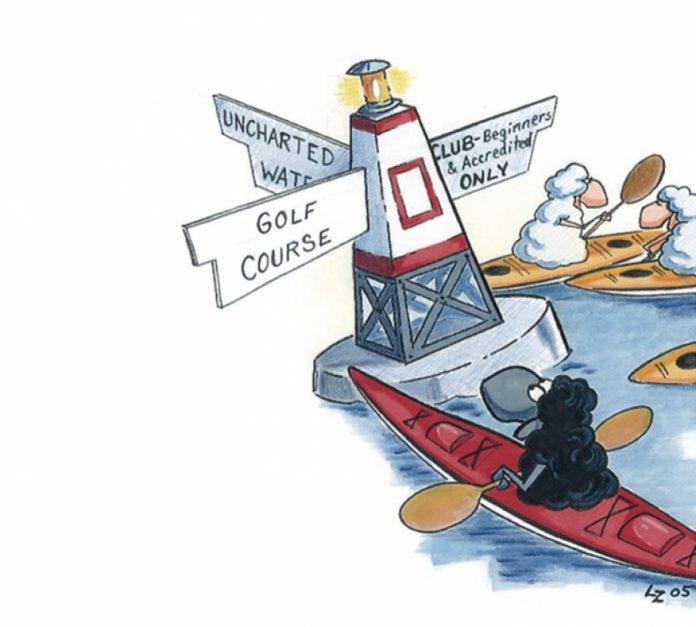
The club official explained that members were not being advised to join me paddling because I have no accredita- tion—and therefore no credibility. You see, I’m a level zero— a zero star—I’m a scout with no badges on my PFD.
This is not to say that I take learning lightly. After all, I had just dropped $400 on the symposium. I’ve also attended lots of seminars, rescue clinics, stroke improvement lessons, towing clinics and so on. I’ve been taught by one of the top instructors on the West Coast. My mentors are some of the most respected members of my club.
I’m going to stop leading the paddles. It had always been my intention and practice to pass on the knowledge and skills I had absorbed from my fellow club members to the next generation of kayakers, but I don’t want to cause any stress for the volunteers who run the club. Perhaps someone in the club with the proper resume will step forward. I’ve asked some to do so, but they seem more concerned with fulfilling the club’s mandate of introducing new paddlers to the sport.
If there is nothing in the club for intermediates, why be a member? Where do those paddlers go? I’m anxious to know because I seem destined to join them. I suspect this malaise affects other clubs. How do they handle the hol- lowing out of intermediates? Maybe that’s just the natural order of things.
That evening at the symposium I was encouraged by club members to take a national certification program, levels I through IV. Presumably these letters and numbers would make me a safer leader.
Seven years into the sport and I’m being prodded toward certification. Going down this channel will set me back about $1,300, more than the price of a breatheable dry suit. Will I take the courses? Maybe. Many of my friends tell me I’ll have no trouble passing them—all I’ll have to do is demonstrate my proficiency. Is the point of education to show off what you know or to learn things you don’t know? Even as an undecorated intermediate, I think I know the answer to that one.
Gordin Warner is also a zero-star golfer.
This article first appeared in the Early Summer 2005 issue of Adventure Kayak Magazine. For more great content, subscribe to Adventure Kayak’s print and digital editions here.
A splashing noise penetrates the tent wall at 5:00 a.m. I ignore it. I want to keep dreaming. With the sky above the thin nylon walls as bright as midday, I know that sleep is impossible so I unzip the fly and poke my head out.
Fifty caribou are crossing the river, heading toward our campsite. A chorus of agitated snorting begins as the lead caribou start pushing their noses further into the stronger current. After some imperceptible signal the herd turns chaotically and heads back to the far side.
Clicking their hooves like tap dancers, they clamber up the cobbled bank and vanish in a thicket of willows where branches mask their antlers and the mats of heather mute the sound of their hooves.
Most people would think this was a pretty exciting wake-up, but today is our 11th day on the Firth River and it’s going to take more than 50 caribou to satisfy me. We have already seen countless caribou milling around in groups this size, but we are after bigger game. Still, my morning mantra per- sists, “Today’s the day,” I say to myself.
Maybe these caribou are the first wave of the much-anticipated migration.
Fetching water for coffee, I’m disappointed to see that the river is still translucent green. In my morning dream thousands upon thousands of hoofed beasts had passed our tents and plunged into the river, crossing in a steady stream that lasted for days, leaving the Firth a soup of hair and dung.
That the coffee will be better without the hair and dung is anemic consolation as I fill the kettle. Time is running out and I’m becoming distressingly obsessed.
We had spent the last 10 days searching— or was it waiting?—for a herd of caribou, though it seems like an understatement to call 123,000 caribou a herd. Every July, the Porcupine herd leaves their calving grounds in Alaska’s Arctic National Wildlife Refuge and crosses the Firth River on its return to its summer range in northeastern Alaska and the Yukon.
We are four kayakers and two rafters on a mission. Our agenda is to paddle right into the middle of the migration. We want waves of caribou to wash over us, choking us with their collec- tive stench and deafening us with their bleating and snorting.
This sounds like a simple plan. But there is a variable involved, or should I say 123,000 variables. Our research told us the best bet for seeing the herd cross the Firth was during the first week of July—even though there was no way to know exactly when or where this might happen. We had given ourselves 160 kilometres of river and 18 days to work with. So far, our trip has involved more waiting, watching and strategizing about our position than paddling.
The Otter’s tundra tires had touched down at the Margaret Lake put-in on June 28th. While we herded our mound of gear from the plane into raft and kayak-sized piles, a welcoming committee buzzed fiercely around us. After ten minutes the bugs had chased us to a breezy ridge above camp. As irritating as the onslaught was, we couldn’t very well begrudge the bugs their role in the nat- ural cycle. They did, after all, play a lead role in the phenomenon we had come to see.
One reason the caribou travel en masse is to lessen the threat from mosquitoes and warble flies. Warble flies lay their eggs on caribou hair, usually the legs. When the maggots hatch, they burrow under the skin and cut breathing holes. A single caribou can host up to 2,000 maggots, all eating away at the poor weakened beast. These pestilential insect hordes drive the caribou into large herds and chase them from one ridge to another in search of bug-dispelling breezes.
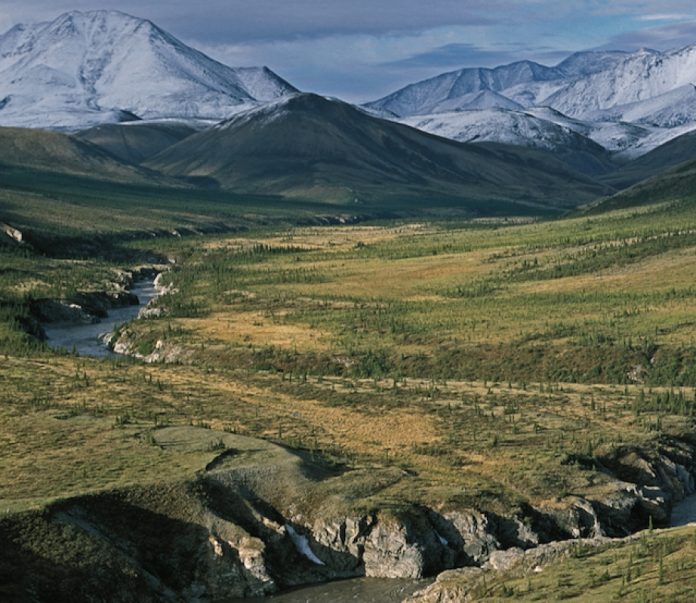
Below us the river, a shiny sliver thread, wove north- ward through the immense open arctic to the Firth Delta. At home in our new surroundings, the rafters, Kevin and Lynn, lounged on the ridge like Zen masters, that is, Zen masters with DEET-soaked veils of netting attached to their hats. Their years of living in Alaska made them comfortable and serene. Being arctic neophytes, Jack and Franz were less serene than excited. Though the grey beards poking through their bug nets suggested rightly that they were both seasoned kayakers, they were awestruck by the vastness of the landscape. Math professor Franz perched on a limestone crag and stared at the panorama in front of us as if he might be able to quantify its vastness.
We launched into a flood of coffee brown water. A recent blizzard had overtaxed the absorbent ability of the spongy tundra. The higher flow and now murky water made it difficult to see submerged rocks and bars so the kayakers paddled ahead of Kevin’s raft to scout.
Cold weather and heavy kayaks made us less playful than usual, but this didn’t translate into more distance covered. Our eyes were more often on the shoreline than the river. We constantly scanned the shore, frequently pulling ashore on cobbled beaches to sleuth for signs of caribou or promising migration valleys. At most we spent three to four hours on the water at a time.
Even though we were unified on our quest, our individual strategies bordered on anarchy. Each of us had his or her own theory about where and when to find the caribou. As soon as we had set up camps at likely caribou crossing points everyone followed his or her own instinct.
Kevin and Lynn would find a likely spot and park there for hours, just watching and waiting. They even spent nights peer- ing like sentries from the shelter of a limestone crag. This placid approach contrasted sharply with that of my husband Jon and myself. We roamed for hours, chased by our own invisible bugs: the need to move. Jon usually dreams up point A to B type expeditions and pursues B like a racehorse with blinders on. It’s a way of travelling that serves him well on his expeditions which have included rowing the Northwest Passage and kayaking around Cape Horn. It’s a little less suited to staying still and waiting for a maddeningly elusive group of animals to stumble upon you. Jon and I spent our days always seeking the next ridge or valley to mark off the next expanse of wild space.
By now, the smell of coffee has woken everyone up and I nestle six steaming cups onto the dryad-covered gravel. It is decision time. Our scheduled pick-up at Nunalik Spit on the delta is a week away. Once we enter the canyon section, five kilometres downstream, we’ll have missed our chance to encounter the herd, the canyon’s steep walls and recirculating rapids make it a place they somehow know to avoid.
All our professed mellowness about seeing the migration has long since vanished like the early morning’s caribou. On our daily forays we had all seen wolves, grizzlies, eagles, Dahl sheep, and moose, not to mention caribou in groups up to a few hundred—but not the surging herd we were seeking. Even though just being in this wild place should be enough, we are dissatisfied and cranky. For all we know, the herd might have crossed the Babbage drainage, hundreds of kilometres from here. During a brief and spirited group meeting, it’s clear that none of us can give up on seeing the migration yet. We agree to wait where we are up to five more days before we race downstream to make our flight.
Now with a definite plan in mind, we worry a little less, and notice a little more. Jon and I paddle across the river the next morning to explore the valley where the previous day’s indecisive caribou had disappeared. We follow a sinuous ridge that affords good views of two valleys.
While Jon snaps photos, I wander down the ridge a little and glass the valley below. Something streaks into view and I focus in on a wolf stalking a nearby cow and calf. The binoculars can’t encompass both the wolf and the caribou, so I stay glued on the wolf. I hear the caribou getting closer. My heart pounds in my ears, but I hold the glasses steady; I know that soon all three players will meet. Half of me wants to jump up and scream, “Watch Out!” But the predator in me whispers, “Keep it cool, wolf, they’re almost close enough.” When the cow and calf finally enter into view, the wolf leaps from his crouch and bolts toward the caribou.
The wolf’s burst of speed puts him within a few dozen metres of his prey, but after 30 seconds the caribou widen the gap. The wolf pulls up and slinks downhill while the caribou rush up the ridge. The wolf has played the surprise card as well as possible, but the caribou hold all the speed cards.
There was no gory finale, but every hair on the back of my neck is standing at attention. Witnessing this predator-prey encounter—one that’s incredibly intense but entirely commonplace—brings my perspective down to tundra level and I realize that experiencing the caribou migration is something that is more complex than blocking a few days off on a calendar.
Below me the tundra in either valley is dotted with small groups of caribou milling around like spiral galaxies. Now, instead of looking for a herd that isn’t there, I see individual animals acting out their individual roles in the age-old drama of survival.
Being so focused on one huge herd had blinded me. The small groups we had been watching for days were the migra- tion. The wet and cold weather that had pinned us down the first week had also kept the insect population low enough for the herd to saunter along in small groups instead of one tight wave.
But the realization that I won’t be paddling through a river choked with caribou isn’t disappointing. Instead, it’s accompanied by an appreciation for the way everything in this austere environment is interconnected.
We were wrong to just focus on the caribou; we should have been looking at the entire arctic ecosystem. The caribou were migrating, as they always do, according to a mix of internal and external forces. Caribou spend their lives eating, avoiding predators, and reproducing. After calving, they group together in response to the insects and instinctively head for areas that offer good foraging and cool, humid conditions. Once together, they have to keep moving or they’ll exhaust the food supply.
It all fits neatly into place, with or without an ultimate explanation. Biologists have theories about why caribou migrate when and where they do, but no one really knows how it is that tens of thousands of animals get together and move as one.
Our group, on the other hand, was driven not by instinct but by curiosity. Psychologists also have theories about human behaviour, but no one can really explain why Jon and I are driv- en, intent on always reaching a destination while Kevin and Lynn are content to sit, and watch, and wait.
On this day above the Firth I see that, with or without expla- nations, our group functioned more like the small groups of caribou that we encountered rather than the tight-knit one we sought—and that we too had reached our destination.
Christine Seashore divides her time between British Columbia and Montana.
This article first appeared in the Early Summer 2005 issue of Adventure Kayak Magazine. For more great content, subscribe to Adventure Kayak’s print and digital editions here.
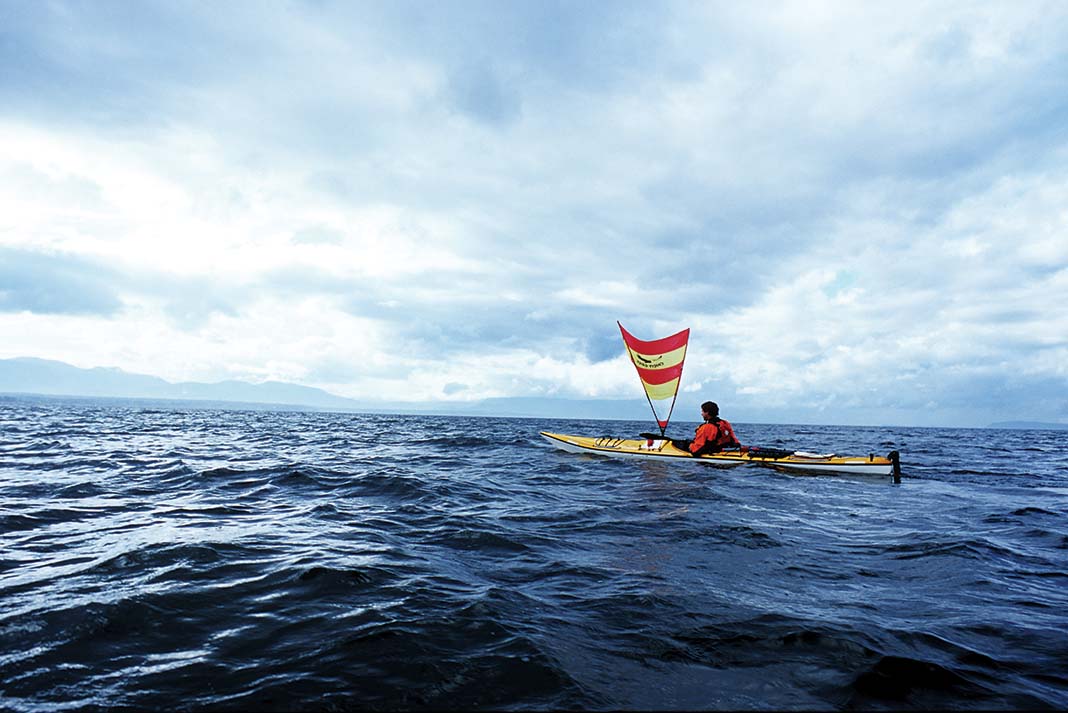
Add a sail and your kayak is pretty much a superyacht now. | Feature photo: Dave Aharoniano: Dave Aharonian
Travelling on the ocean and not using wind power is like driving an electric car in Saudi Arabia. Wind’s such an obvious and available source of power, what paddler with places to go and wind breathing at his back doesn’t dream of lassoing that force with a kite or sail?
I put my sailing aspirations to the test on a weekend trip last October with my photographer friend Dave Aharonian. We planned a crossing of a windswept stretch of the Strait of Georgia from Vancouver Island 19 kilometres to Lasqueti Island. From there we would paddle or sail around Lasqueti’s southern tip to Jedediah Island Marine Park, an idyllic camping spot in a cluster of islands in Sabine Channel between Lasqueti and Texada Islands.
As a skeptical participant in my breezy adventure into new technology, Dave played the role of the curmudgeonly Luddite. Wasn’t sailing more trouble than it was worth? Wouldn’t I spend more time setting up and taking down the sail than I’d gain in speed?
Feature photo: Dave Aharonian
In fact, Dave and I did an 80-day trip down the B.C. coast a few years ago, paddling 1,200 kilometres with prevailing summer north-westerlies at our backs day after day, and it was just this attitude that prevented us from trying sails at all. Dave, like the caveman who didn’t want to experiment with fire, was happy to paddle along at four knots. You could say that when it came to wind, he was content to pass.
Throwing caution to the wind
A few years after the fact, I was determined to find out what we’d been missing. By making the 19-kilometre crossing to Lasqueti, scudding before the infamous Qualicum wind that rips with such force through the mountain pass from Port Alberni that it has earned its own name, I figured we’d make quick time and save a few bucks on the ferry. The ultimate goal, however, was to sail with an irrefutable success that would trounce Dave’s skepticism and prove my elemental experiment was worthwhile.
The sail that I most wanted to try was a full-fledged upwind rig from Balogh Sail Designs. You may have seen pictures of the Balogh Batwing trimaran rig from adventurer Jonathan Waterman’s expedition to the Northwest Passage. The upwind rig enabled him to sail almost half the trip, even though he was going against the prevailing winds. He was even able to lash the whole collapsible rig to the deck of his single Klepper for ordinary paddling.
Sailmaker Mark Balogh started out in windsurfing and regular big boat sailing but was won over by the portability and versatility of kayaks. Although some of his customers are long-time paddlers most true kayak sailors aren’t paddlers. Purebred paddlers aren’t looking to learn new tricks. Balogh has even heard a few complain that sails ruin the sport, which is why you probably haven’t seen the Batwing at kayak symposiums.
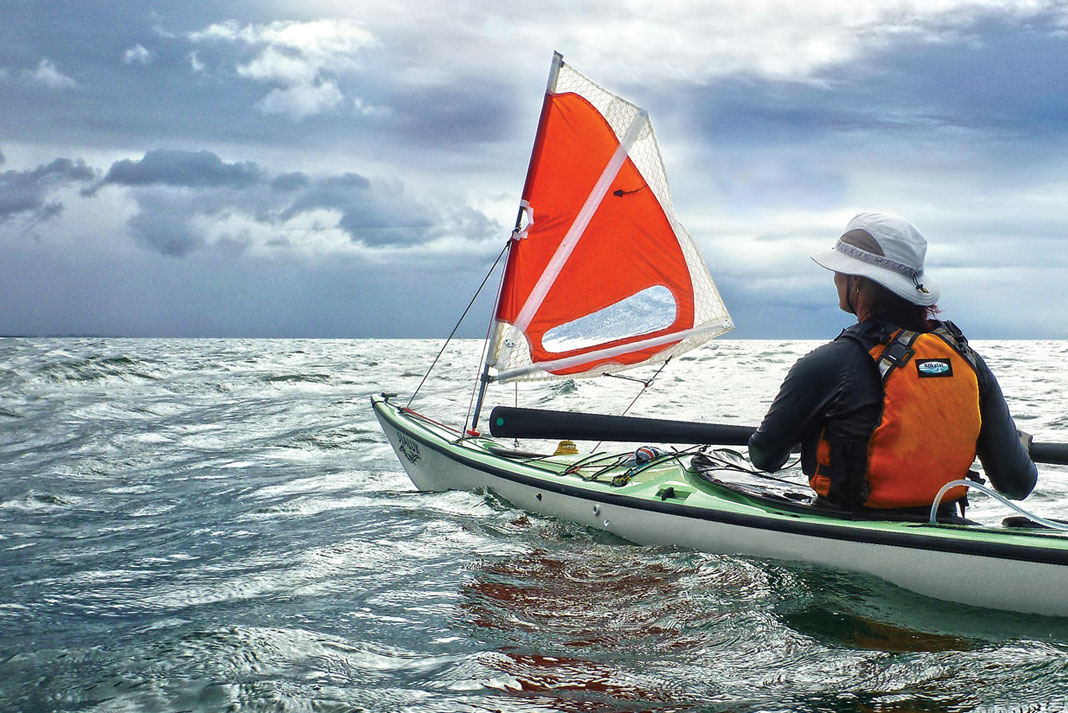
Balogh Sail Designs is a small company by choice, a two-person operation in rural Virginia that doesn’t have the inventory to send out $1,700 loaners to magazine writers. So, we set sail with a couple of more common and affordable downwind rigs: a parafoil kite and classic v-shaped downwind sail from Spirit Sails.
Kayak sails head-to-head
For a long time I’ve dreamed of flying a parafoil from my kayak. But this dream often turned into a horrible nightmare in which I’d be pulled in a rising gale out into seas beyond my ability, I’d flip over and wet exit to find my kayak sailing away from me with kite still attached. So, when Premier Kites of Hyattsville, Maryland, offered to send me a 7.5 or 15-square-foot kayak parafoil, I chose the smaller.
There was nary a breath of wind on our crossing to Lasqueti. To fly a parafoil, six knots of wind is the minimum. Whenever I did manage to launch my parafoil in light breezes, Dave took off ahead of me on paddle power alone.
The dandy rainbow colours flying above the water did have an uplifting effect on the spirit, however. Flying a kite from your kayak is a wonderful novelty. I was so enraptured by the joy of it—combined with the growing urgency of reeling the thing in so I could catch up with Dave—that I fumbled and dropped the whole spool into the ocean. The orange spool bobbed just below the surface as I sailed away from it. I had to reel the parafoil in hand-over-hand and spend the better part of an hour retrieving several hundred feet of tangled string from the Stygian depths of the Georgia Strait. Dave the vindicated Luddite drifted impatiently in the distance.
I understood how Icarus must have felt when the wax melted.
Where the parafoil failed, the paddle pulled through, and we landed and camped on the beautiful sheep-chomped lawn of Jedediah’s Home Bay. We had it all to ourselves for the drizzly October weekend.
Return trip brings stiffer winds
With the rain, the first night brought a true October southeaster, and for the cruise back, we had a steady 15-knot blow on our stern quarter. We put up two Spirit Sails. I flew the full-size while Dave erected the smaller sail on his rudderless kayak. To get back to our launch, we had to point about 45 degrees off of downwind.
Spirit Sails are designed for downwind sailing but they can be angled to a rear quartering wind and were surprisingly useful at this angle, adding about one to two knots to our regular paddling pace.
The hardest thing about sailing for us was the siren song of the downwind run. It was tempting to follow the wind to some arbitrary destination far enough away for a daylong run riding the surf. We teased ourselves with this temptation, zigzagging toward our destination by alternating downwind thrill rides at six knots with crosswind slogs to cover distance toward shore.
Dave and I pulled into French Creek harbour ahead of schedule and broke down our sail rigs. I looked over and caught Dave smiling and eyeing his rig, really seeing it for the first time, “These sure could have come in handy on our trip down the coast.”
This article was first published in the Early Summer 2005 issue of Adventure Kayak Magazine. Subscribe to Paddling Magazine’s print and digital editions, or browse the archives.
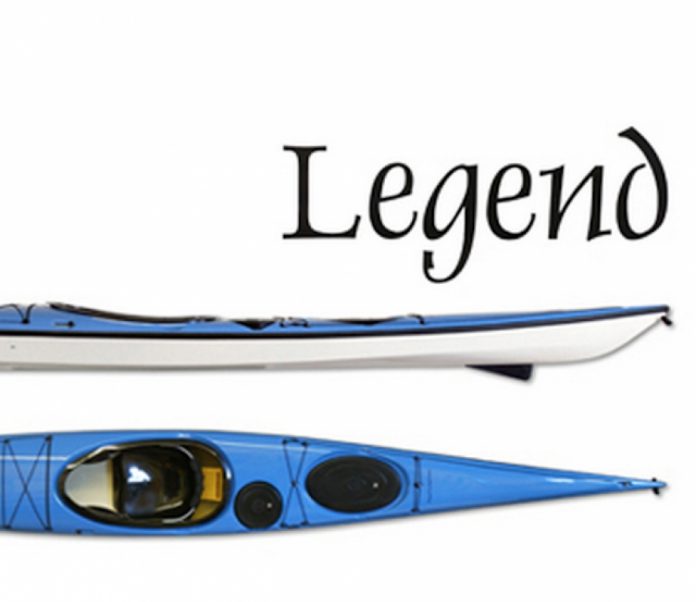
First impressions: The Nigel Foster Legend isn’t the hottest looking Greenland-inspired kayak on the market. It doesn’t have the graceful sharp sheer lines and chines of some of the more ostentatious British designs. But closer inspections reveal a practical advantage behind every missing aesthetic flourish.
Consider those impressive-looking upswept ends we’re so used to seeing on Greenland-style boats: What do they do? They’re like the bombastic tail fins on a ’59 Eldorado. Take them away and you’ve got a little bit less windage and a lot less attitude.
Foster has inflated a skin boat’s sunken cheeks and the result is greater carrying capacity, flotation that keeps the ends from pearl-diving in surf, and an extraordinarily dry ride. It all adds up to practical rough-water performance.
The subtly-arched decks offer similar advantages over the flatter decks of the Legend’s slimmer cousins from across the pond, which suddenly appear a tad anorexic by comparison. The Legend conceals one of the largest carrying capacities in its class—31 litres more than the similarly dimensioned Romany Explorer, that renowned expedition classic by another Nigel.
But don’t think the Legend is in any way bloated or sluggish. Would paring the silly shark fins off that ’59 Caddy rein in the V8? To the contrary, it would probably save gas. The Legend is quick enough. It doesn’t offer lightening- fast acceleration but we found it cruised easily at three to four knots fully loaded and topped out at seven knots in a sprint. On a weekend trip, it held its own alongside other narrow, fast expe- dition touring boats, the CD Expedition and NDK Greenlander Pro, and really took off in following seas. The Legend likes to surf.
Perhaps due to a unique shallow-arch cross-section below its hard chines, the Legend doesn’t flop quickly from edge to edge, but sits comfortably in the water and transitions smoothly and easily into various degrees of tilt for sculling and turning. A low seat position adds to the initial stability.
The arched hull is also likely to hold onto its gel coat through a hard life of coastal touring longer than a V-bottom keel would.
The Legend is the mid-sized version of three Nigel Foster designs hand-built by Seaward Kayaks on Vancouver Island. It’s the size that fits most people best, and is Foster’s personal choice for his expeditions today, replacing his earlier Vyneck, which he paddled on the first circumnavigation of Iceland in 1977.
Conclusion: The Legend impressed us as a renaissance kayak that impeccably balances playful handling with expedition capabilities. A top pick for mid-sized, experienced paddlers who want both capacity and performance.
1. Volvo on the outside
Note the Legend’s softer lines, reduced sheer and more capacious ends than the slender Greenlander Pro, also pictured here. Bow and stern are symmetrical with identically-sized hatches. An optional Brunton Nexus 70P compass ($215 Cdn, $140 US) is nicely recessed into the foredeck. Perimeter lines stop at the front hatch—some would say a safety drawback— Foster says the location of his deck lines is “a more easily identified and secure place to have someone hold your deck line, and because the line doesn’t run all the way through to the bow there is little stretch.” The recessed front and rear oval Kajak Sport hatches have large, easy-to-pack openings, yet are reliably waterproof in rough seas. Seaward’s thorough hand layup includes three fibreglass bulkheads, a Kevlar-reinforced bow and a seam that’s fibreglassed inside and out. Add $590 ($450 US) to get the whole boat in Kevlar or carbon fibre.
2. Caddy on the inside
Padded thigh supports and bucket seat provide a great fit. Excellent support under the thighs. Our 6’2” paddler had ample toe room but maxed out the aluminum foot braces—taller paddlers would have to customize. Reactions to the padded plastic backrest varied—some liked it, others would replace it with a back band. A slider on a cable to the paddler’s left drops the skeg, saving energy in a crosswind by eliminating the Legend’s slight tendency to weathercock.
3. Big backseat
The sloping rear bulkhead maximizes storage capacity in the generously-sized day hatch and makes it easy to empty the cockpit by lifting the bow. Located aft of the seat on the left, leaving the right hand free to brace with the paddle, the day hatch is easy to open and close while on the go and holds an impressive 36 litres. Paddle float rescue rigging is noticeably absent (Brits with bombproof rolls don’t believe in it). However, Seaward kindly offers an optional quick-release self-rescue strap system ($59 Cdn, $45 US) and will also install a Guzzler foot pump for $430 Cdn ($335 US).
This article first appeared in the Winter 2005 issue of Adventure Kayak magazine. For more boat reviews, subscribe to Adventure Kayak’s print and digital editions here.
Beach Combing: Discovering What the Currents Bring
I’m not an ideal kayaking partner. It’s not as though I lack good judgment or conversational skills, but when it comes to helping set up camp, you can forget about it. I’ll be long gone, scanning the beach.
I comb beaches in hopes of finding intriguing items like crab traps, a message in a bottle, a really thick chunk of rope or even (I’m crossing my fingers here) a can of Lucky Lager.
Most of the time I find nothing but junk, like that knotted piece of driftwood that resembled Jean Chrétien.
Above all, I’m obsessed with glass fishing floats that have escaped from fish nets in Asia, hopped aboard an ocean current, caught just the right wind and wave combination and washed up on a beach instead of a rock. They’re hardly worth a cent, but after surviving that ride they’re priceless to me.
Despite the complexity of ocean currents, they’re driven mainly by nothing more than wind. When weather patterns are such that strong winds regularly prevail in one direction, these winds push water along with them and create currents that swirl around the oceans in regular patterns.
The journeys of my glass floats begin off the coast of Asia when, one way or another, they escape from fish nets. They enter the Kuroshio Current which carries them northeast across the Pacific before arcing south along the west coast of North America—all at less than 16 kilometres per day, the maximum speed of an ocean current. A few years later, they skirt the coast of Vancouver Island. If the wind and waves cooperate, they are blown out of the current and wash ashore. If not, it may be years before the right conditions conspire to wash them out of the current and into someone else’s campsite.
I’ve found all my glass floats along a 20-kilometre section of coastline. That’s not surprising, according to Curtis Ebbesmeyer, a Seattle-based oceanographer.
“Beaches are like restaurants. Some serve Thai food, some Indian or Chinese food,” he says. “Each beach interacts with the currents, winds and waves in a unique way.”
The interplay of these forces and the buoyancy of the objects explain how some beaches are well known for their glass or driftwood artifacts, while others trade in more pedestrian goods: running shoes, for instance.
In 1992, the Hansa Carrier freighter encountered a storm in the middle of its run from Korea to the United States. Several containers were washed overboard by massive waves and an estimated 60,000 Nike shoes spilled into the Pacific. The next winter errant sneakers, still in good condition, began washing up on beaches in British Columbia, California and Hawaii. Studying their distribution, Ebbesmeyer was able to further map the Pacific’s currents.
While glass floats and running shoes often wash ashore on B.C. or Washington beaches, other currents might carry cargo to another ocean all together.
A load of bath toys washed off a container ship bound for Seattle in 1992. Ebbesmeyer followed their progress through reports from beachcombers and lighthouse keepers. Instead of a leisurely tour around the Pacific, the rubber duckies ended up bobbing through the Bering Strait between Alaska and Siberia where they were likely frozen in pack ice. The Arctic Ocean’s pack ice drifts eastward and Ebbesmeyer expects the first rubber duckies to thaw, navigate the currents of the Atlantic and wash onto beaches on the east coast of Canada any day now, more than a decade after they first swam free.
Unlike most beach booty, the rubber toys are actually worth something. The first person to find a duck on the east coast will win a $100 reward.
Whether it’s a $100 ducky, some glass artifact, a solo salty sneaker or a driftwood gargoyle, value is truly in the eye of the beachcomber. I’m thrilled with a worthless glass float, and, as Ebbesmeyer says, “Poor people around the world know, if you need a pair of shoes, you go to the beach.”
Ryan Stuart lives on Vancouver Island and still hopes to find a rubber ducky.
This article first appeared in the Spring 2005 issue of Adventure Kayak Magazine. For more great content, subscribe to Adventure Kayak’s print and digital editions here.
I had never thought of the ice as a noisy thing. Then again, I had never paddled at the foot of an actively calving glacier. A set of unfamiliar sounds—icy groans, pops, rumbles and cracks—emanated from Greenland’s Knud Rasmussen Glacier as it fell, piece by piece, into the fjord. As my head spun back and forth following each new percussive effect, my arms were on auto-pilot, bracing against the mish-mash of waves pushing out from wherever the enormous chunks of ice crashed into the water.
Our group of seven had already spent more than a week paddling the Tunu district of eastern Greenland, a barely-populated maze of fjords straddling the Arctic Circle. The east side of Greenland has always been less populated than the west coast due to the huge amounts of drifting polar ice which congest the shoreline, making transportation routes unreliable.
Paddling about 20 kilometers a day in our folding kayaks, we had travelled 180 kilometers through a maze of fjords, working our way north from Kulusuk to Sermiligaq.
Feature photo: Wendy Killoran
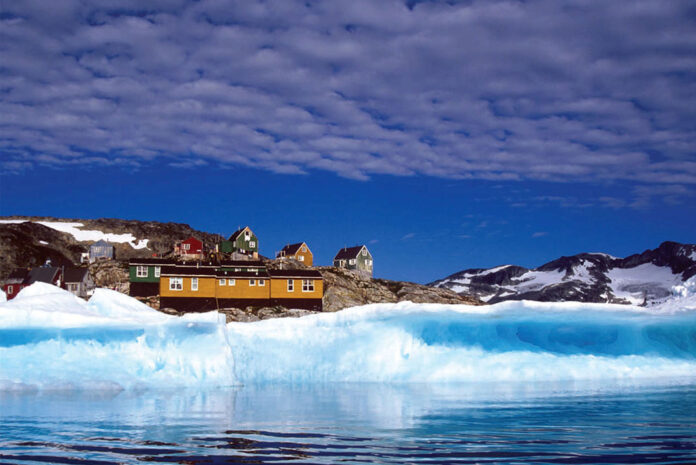
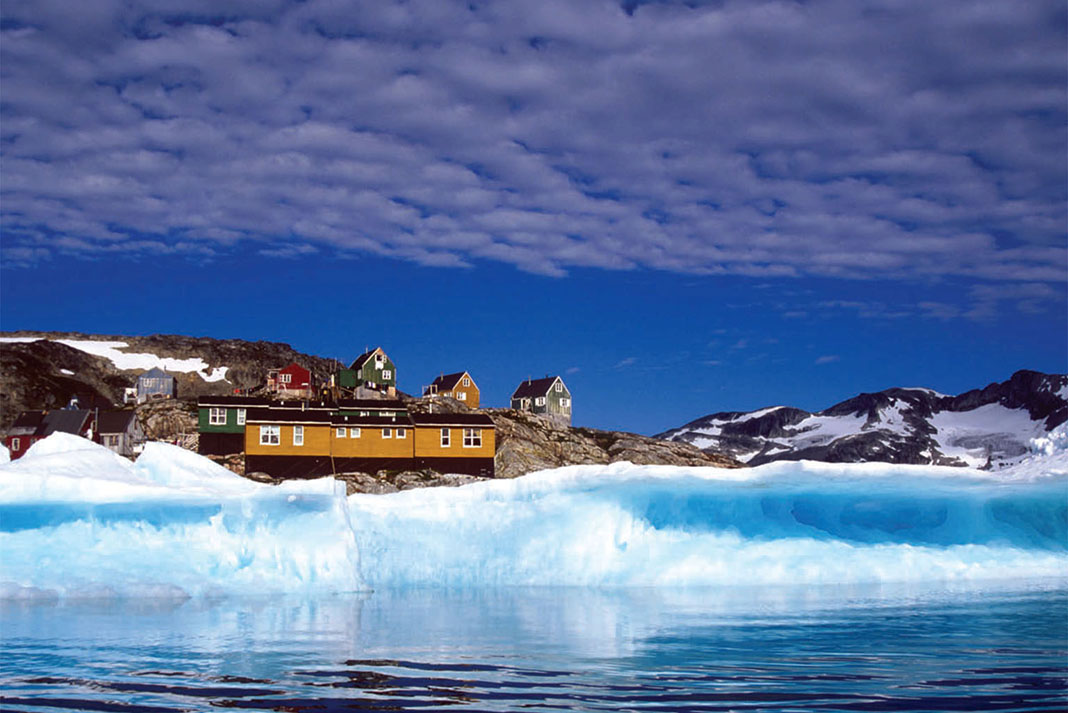
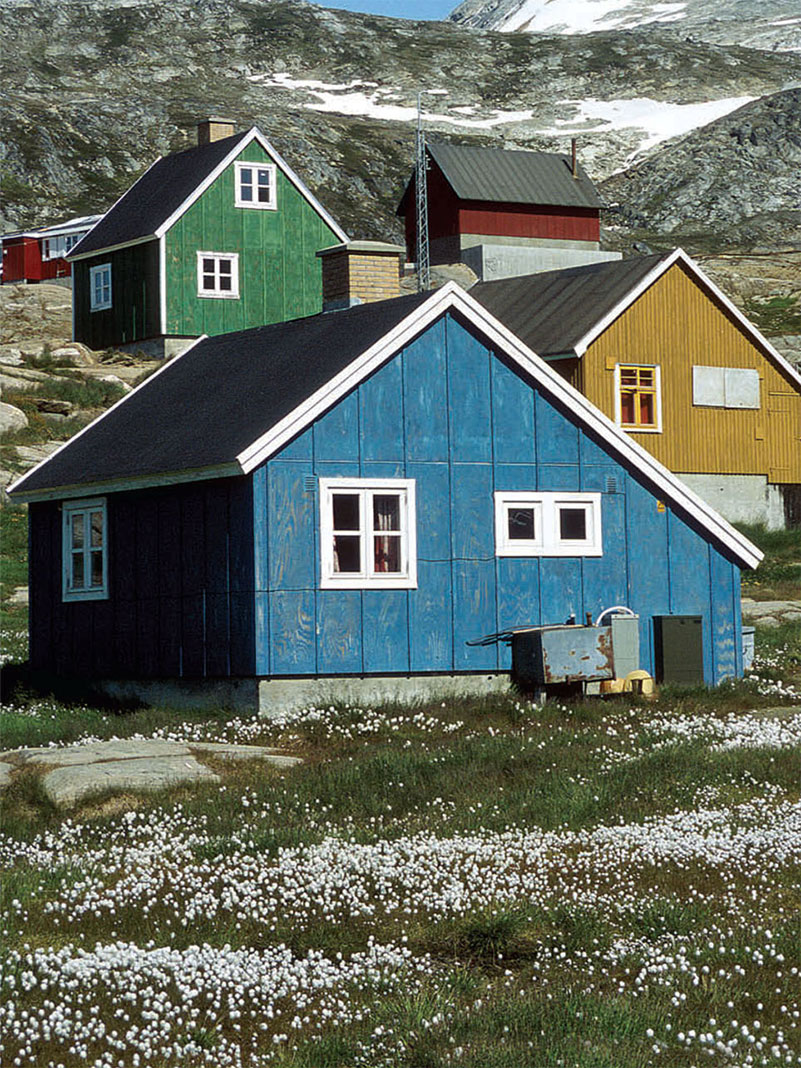
Along the way we had passed a handful of picturesque villages of colourful wood houses, barely clinging to the steep shoreline between the mountains and the water’s edge. It is only the coastal mountains that are habitable; the other 85 per cent of the island is blanketed by the Greenlandic Ice Sheet. At a maximum thickness of three kilometers, it depresses the land beneath and squishes out the mountains that fringe the country. Valley glaciers flow to the sea through these mountains, scouring jagged peaks and creating long, u-shaped valleys and fjords.
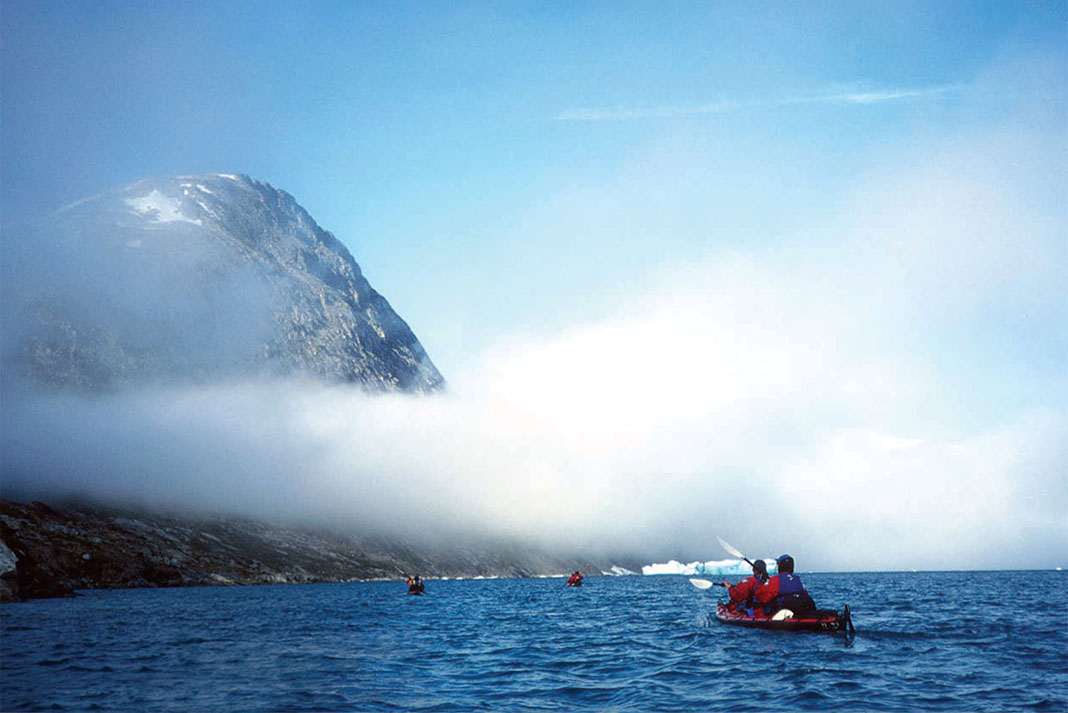
This icy kingdom revealed itself as I paddled beneath snow-capped mountains, beside sculpted icebergs and drift ice, to the base of immense glaciers. Despite the frozen backdrop, we were warmed by sunny, calm conditions for most of these last two weeks of July. Even mosquitoes wilted from the heat, and stayed tucked beneath cool leaves.
[ Plan your next sea kayaking adventure with the Paddling Trip Guide ]
I wasn’t about to dismiss the mosquitoes as wimps. I’ll tip my bug hat to any insect that can survive in the midst of so much ice. Erik the Red was displaying a firm understanding of irony when he gave the misnomer Greenland to the newly-colonized island in AD 985. Perhaps the exiled Viking was trying to entice others to settle on the inhospitable island with him.
Houses in Greenland are squeezed between mountains and ocean. | Photo: Wendy Killoran
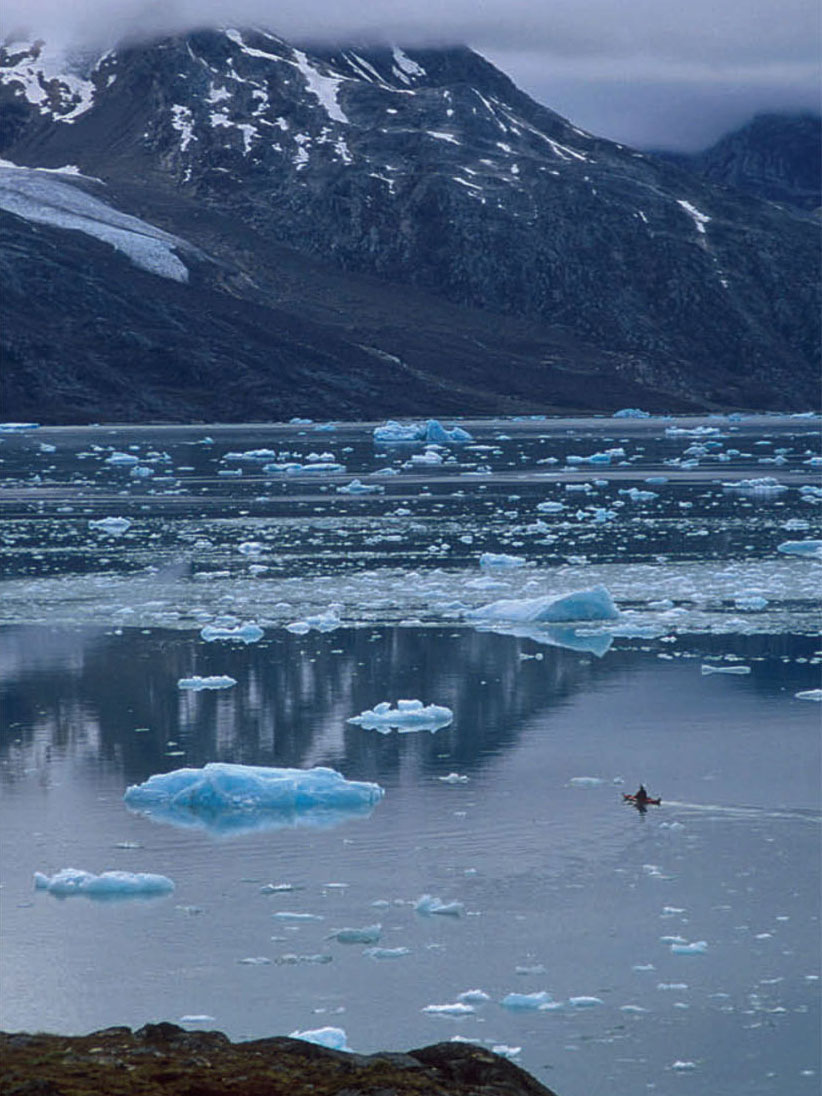
Ice from the Knud Rasmussen chokes Sermiligaq Fjord. | Photo: Wendy Killoran
At home in Greenland, a culture in transition
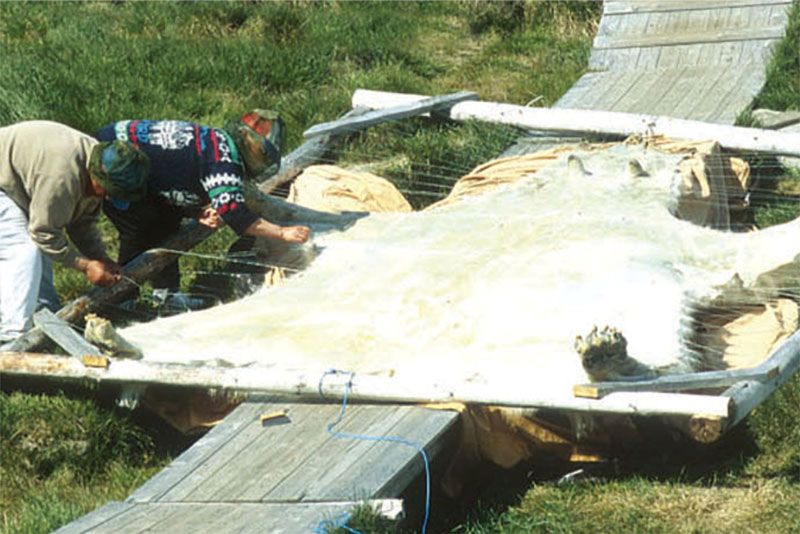
Inhospitable may be a word used only by visitors. Various Inuit cultures have populated eastern Greenland’s shores on and off for 2,000 years. The Thule people arrived in the 14th or 15th century and developed the skills and customs that made survival possible, inventing the kayak, harpoon and dogsled. One of the first things I saw upon arriving in Kulusuk was an Inuit couple stretching a polar bear skin across a driftwood frame. According to Inuit custom, the hunter who first sees the bear has rights to the skin and half the meat.
While watching the enormous white coat stretch out in the sun, it was easy to grasp that the villagers of Kulusuk have only emerged from what we’d call a stone-age existence since 1958 when the United States established an international airport and radar station (truly, a cold-war outpost).
Even today infrastructure is minimal with the majority lacking running water and most using a bucket for a toilet. Chained sledge dogs, fur matted and unkempt, easily outnumber the 350 villagers. I watched my step. The dogs should not be handled, unless one is willing to forfeit a hand.
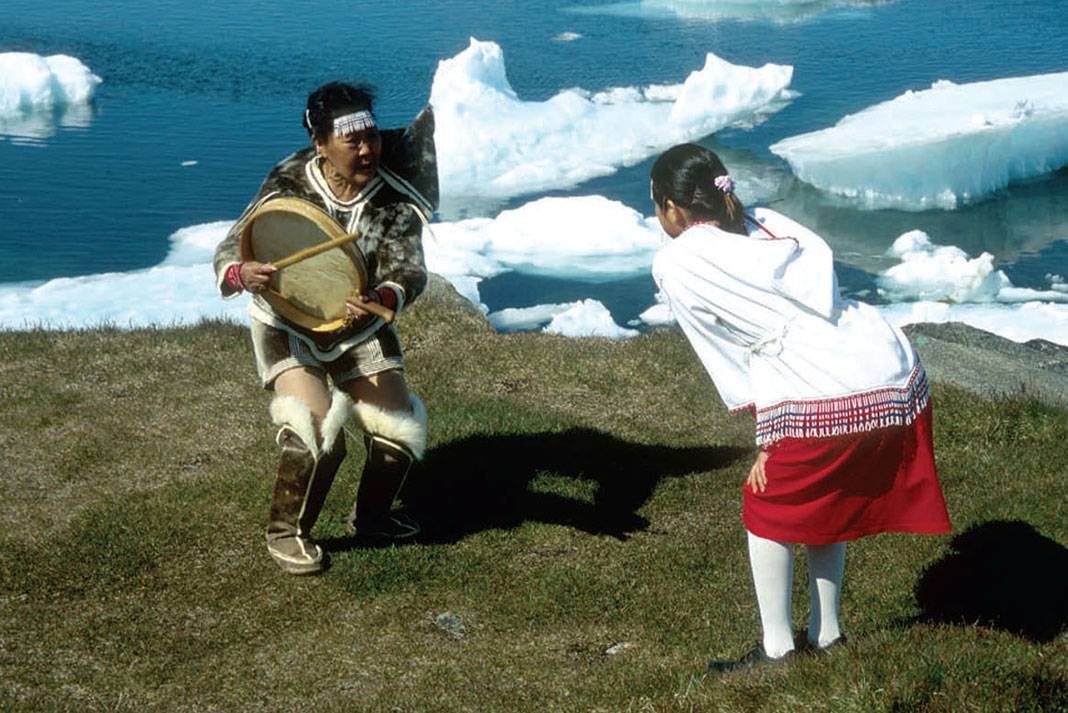
Drum dancing is an increasingly lost art in Greenland. | Photo: Wendy Killoran
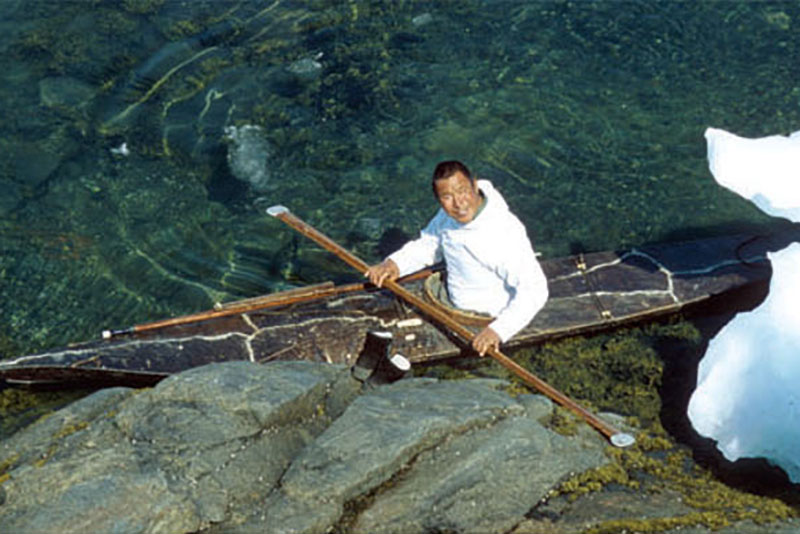
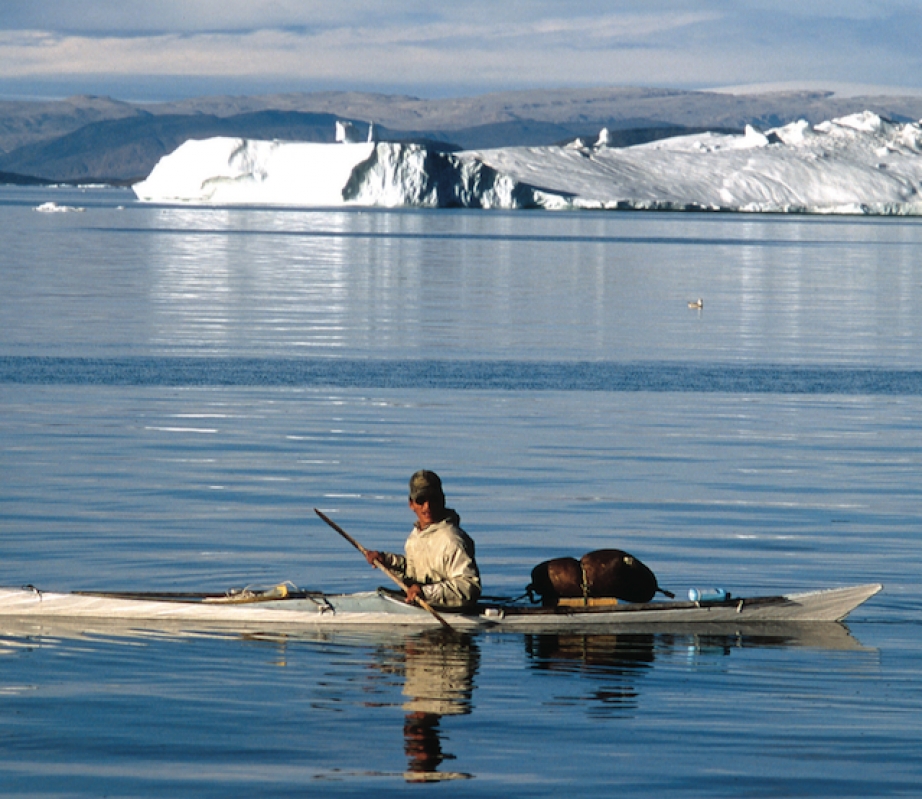
Demonstrating the more utilitarian origins of kayaking in a handmade traditional kayak. | Photo: Wendy Killoran
The hunter who first sees the polar bear has rights to the skin. | Photo: Wendy Killoran
Before we set out on our trip our outfitter arranged for a demonstration of the more utilitarian origins of kayaking. Pili Maratse carried his handmade traditional kayak—sealskin stretched over a driftwood frame—to the rocky shoreline where he removed his shoes and wiggled into his custom-fitting boat.
His boat darted through a puzzle of drift ice as he showed us how to chase and harpoon narwhals and seals. Maratse’s kayak moved nimbly compared to our modern kayaks, heavily laden with highly engineered camping gear that suddenly seemed excessive.
Life here is about more than just survival. Kulusk is fortunate to have Anna Kuitse, who has been teaching village youngsters the ancient Inuit tradition of drum dancing. Dressed in a sealskin anorak and shorts with sealskin kamiks she joined Tinka Mikaelsen, a young adolescent girl with glossy, raven-black hair, clad in a white cotton anorak and an intricately beaded fringe necklace and head piece.
His boat darted through a puzzle of drift ice as he showed us how to chase and harpoon narwhals and seals.
As they danced they provided a glimpse of this art form that has died out in most other regions of Greenland. Though a particular island way of life is still somewhat intact, the ancient culture has undergone incredible changes in the last half-century. With technological and material advance comes a severing of cultural identity. Modern conveniences ease some of the hardships that come with living here, but they have the potential to break the Inuit’s traditional connections with the natural environment, detaching them from their cultural uniqueness. With global trade and communications shrinking the planet, Nike shoes and NBA t-shirts are starting to replace sealskin and polar bear garments. And with global warming making the traditional hunting and fishing lifestyle more difficult, the central pillar of Inuit culture may be facing the same fate a glacier faces when it reaches the sea.
Paddling into the funnel-shaped fjord
As soon as we left the cove in Kulusuk, we entered a fantasyland of ice. We wove our way through corridors barely wide enough for our kayaks. Bergy bits moved about at the whim of the currents, tide and breeze.
Through the process of calving and melting, each iceberg or bergy bit becomes unique. The forces of sun, wind and water combine to sculpt unique creations. Mushrooms, castles, spires, arches, triangulated slabs, ribbed platforms and circular holes bobbed in every direction. Some were clear, others white, fewer were toothpaste blue, and even fewer were translucent sapphire blue. These sapphire bergs are often younger than the white variety and appear blue because of a lack of trapped air bubbles reflecting white light.
Apart from being beautiful, the floating obstacles made travel difficult. Pathways closed in around us, causing us to retrace our path and find new routes through this icy maze. It seemed that the Tunu Fjord was simply too congested to navigate, but while we lunched on a small knoll of rock we watched the ice slowly spread apart as the tide rose. Because the fjords are funnel-shaped, the tides can be significant, often ranging between three and four meters. The increased surface area of the fjord allowed us to make progress through the sprawling gallery of ice sculptures.
I peered inside a burial chamber where a weathered human skull lay encrusted with lichen.
With the tidal currents making the fjords resemble ever-changing rivers, the trip was dictated by tidal cycles. My mindset followed along and I got used to thinking according to these short time frames. But compared to just about anywhere else on earth, Greenland is frozen in time.
We came across the ancient ruins of homes and burial sites on a promontory overlooking the Angmagsallik Fjord. Stopping to investigate, I peered inside a burial chamber where a weathered human skull, believed to be at least six centuries old, lay encrusted by lichen.
As old as this skull seemed to my New World mentality, my temporal perspective received another shock after huffing and puffing my way up a mountain overlooking the y-shaped Sermiligaq Fjord. The fjord is y-shaped with a glacier spilling into each branch, the Karale Glacier from the west and the Knud Rasmussen Glacier from the east.
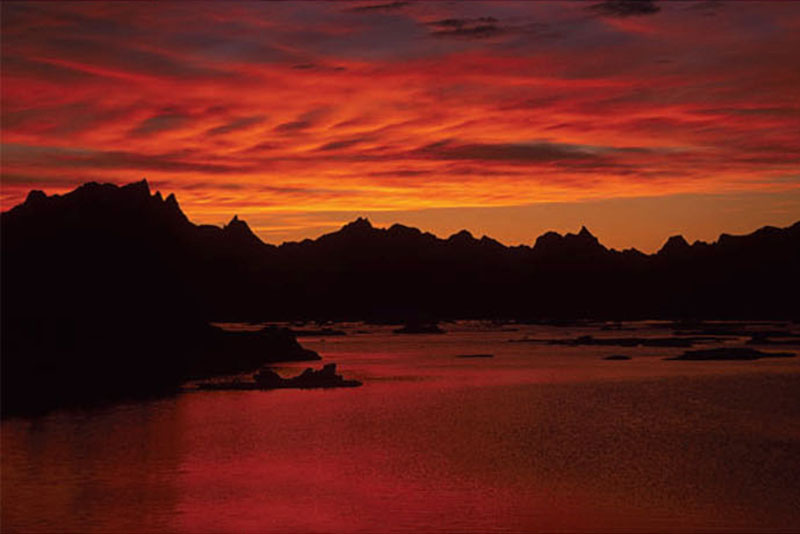
Midnight in the Sermiligaq Fjord. | Photo: Wendy Killoran
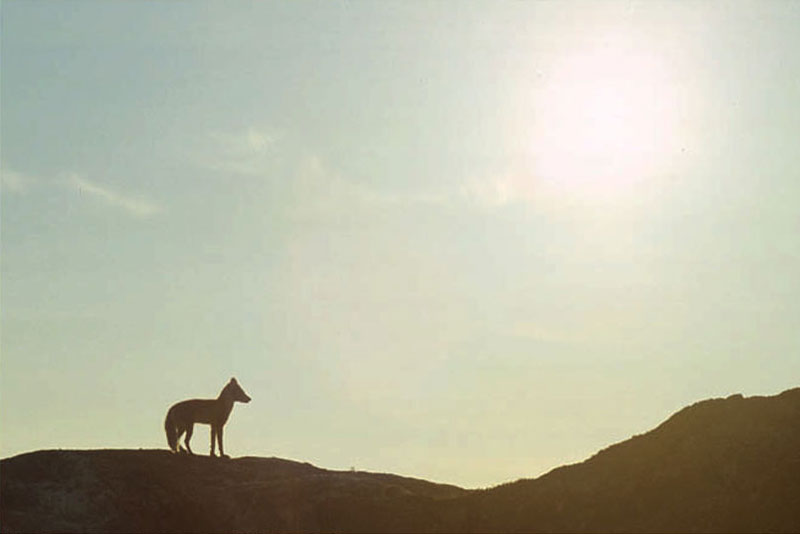
Arctic foxes make curious interlopers. | Photo: Wendy Killoran
Creeping glaciers return to the sea
As a curious Arctic fox hovered nearby, I looked down on the supposedly moving glacier and tried to contemplate the process by which falling snow becomes part of a glacier and gradually returns to the sea. Snow that falls on the ice sheet is compressed into ice when the weight of more snow presses down from above. As the thickness of the ice increases, the compressed snow becomes viscous, flowing through valleys as glaciers, eventually reaching the coast deep in a fjord. The process may take up to 10,000 years.
As eye-opening as the glacial panorama was, it wasn’t until we were paddling at the glacier’s terminus that I truly appreciated that glaciers are moving, active things.
After shoving off from our beach campsite in Sermiligaq Fjord, the four-kilometer-wide, 100-meter-tall face of Knud Rasmussen was an easy target. But first we had to wend our way through a glacial soup of bergy bits, drift ice and cathedral-like icebergs. Diffused sunshine glistened on these sculptures causing meltwater to trickle into the icy, inky water below.
Tendrils of fog obscure the peaks of Ikateq Fjord. | Photo: Wendy Killoran
Nearing the wall we saw ivory gulls feeding at the rambunctious base. Did the glacier’s calving stun the fish and create easy fishing? I wasn’t sure, but it was a good reminder to stay back at least three times the height of the calving wall.
We travelled as a group and listened to growls and rumbles followed by clouds of white spray, captivated by the cacophony of roars and the curiosities of deep crevasses. Huge sections of the glacier wall were a vitreous blue with deep chasms split into this wall, resembling palatial chambers.
The rumbles, growls and roars increased in frequency. Clouds of icy spray burst from the fjord below. Rolling waves spread out as larger chunks of ice spilled into the water. And then a massive, thundering bang released a sapphire chunk of ice the size of a multi-story apartment building that toppled over in slow motion. A three-meter wave spread from the foot of the glacier and rolled towards us. The fjord was alive with sounds and motion. Slurps, sloshes, crackles and slaps drowned out the sound of our rushed paddle strokes as razor sharp shards of ice engorged the fjord. Bergy bits danced all around.
We retreated, grinning foolishly, feeling reverent. The thrill of sitting at the base of a frozen wall, calving enormous chunks of millennium-old ice was pure exhilaration. Greenland was actively sharing its timeless grandeur with us, in both beauty and power.
Wendy Killoran wrote about paddling Iceland’s coast in Adventure Kayak’s Early Summer 2003 issue.
This article was first published in the Spring 2005 issue of Adventure Kayak Magazine. Subscribe to Paddling Magazine’s print and digital editions, or browse the archives.
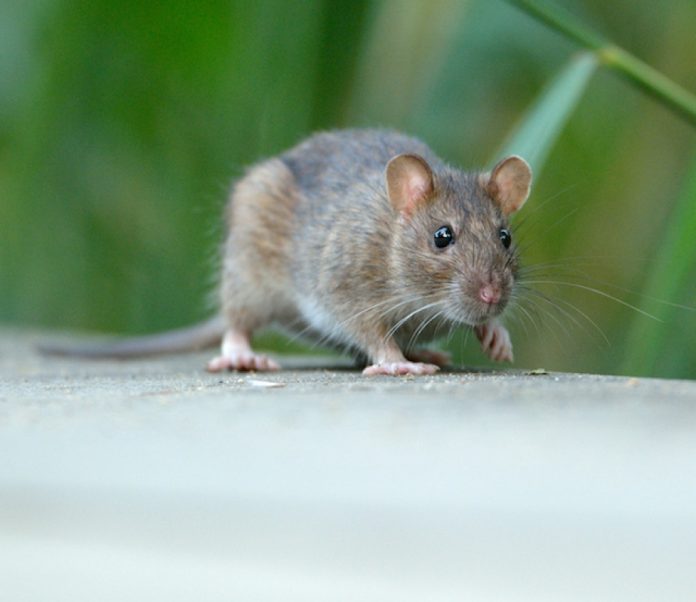
If I were a rat, my paddling gear would be neatly folded and stacked in a plastic bin labeled, Scott’s Paddling Gear. The bin would be in the basement among other gear bins—bike apparel, camping equipment, ski wear—all labeled clearly and arranged according to season. I would probably even have a bar of apple-scented soap inside to keep my paddling gear smelling sweet over the winter.
I’ve tried a couple of times to be all Martha Stewart-like in my basement. It’s just no use. I like to stretch my paddling season as close to winter freeze-up as possible. Just when I think it’s time to put my gear away we get a warm December day and it all gets dug out again. Even after the mercury falls, and paddling seems to be out of the question, I can’t bring myself to admit the season is over. The bag of soggy gear just gets tossed in the garage until spring.
This is where I get back to my point about not being a rat.
If I were a rat, I would have learned my lesson by now. I know this because researchers study rodents in laboratories, testing their capacity to recognize and avoid unpleasant smells. In one study, rats quickly learned to associate a poisonous drink with its particular odour and soon knew enough to leave it alone. (Paddlers haven’t figured this out yet, but this is another story altogether.) In another laboratory test, rodents demonstrated a near-perfect memory when it came to avoiding odours.
Scientists, and the rats, tell us there is a direct connection between our sense of smell and memory, and I believe it. The smell of fresh-cut cedar reminds me of the cottage, pipe smoke evokes my grandfather and black felt-tip markers bring back memories of my grade-two art class with old Mrs. Greener. And every spring, when the sun shines, eaves start to drip and creeks overflow their banks, I load my boat and go in search of my gear. Knowing not to look in the basement, I head for the garage, where I fumble around, looking here and there. Then I smell it.
When I unzip my paddling bag to check that everything is inside, my first memory isn’t of walking through an orchard of green apple blossoms.
Like a hurricane through a Stilton cheese factory, the smell of my gear blows up my nasal passage to the odour receptor cells that pass on the sig- nal to the limbic system in my brain that catalogues my memories. A few neu- rons fire and then I smile. “That was a great day,” I say to myself as I remember that last paddle in December.
Rats learn to avoid putrid odours after one or two exposures. They would learn after their first paddling season. They would wash their gear in little rat washing machines and fold it into little rat plastic gear bins labeled, Rodney and Roxanna Rat’s Paddling Gear.
Rats, I guess, are smarter than me. But rats don’t get to paddle late into the fall.
I’m glad I’m not a rat.
This article first appeared in the Spring 2005 issue of Rapid Magazine. For more great content, subscribe to Rapid’s print and digital editions here.
Everyone knew someone would run it someday. Twisting, steep and ugly, Ragged Falls had festered in the psyche of southern Ontario paddlers. Dropping 85 feet in less than half a kilometre, the falls had repelled any attempt at a complete run, until last November when Billy Harris notched the first full descent.
Just a kilometre off busy Highway 60 as it runs into the southwest corner of Algonquin Provincial Park, Ragged Falls was the most prominent drop in southern Ontario that had yet to feel the caress of plastic.
It is a complex, gnarly, multi-stage drop with plenty to make a sane boater walk away.
“There is lumber, pin spots, rooster tails. When she is crankin’, sphincters are all puckered,” says Harris. “It is a white monster with teeth, scales and attitude.”
Harris had a clean run, only getting into trouble at the bottom when he was drawn toward a lumber yard after starting the celebration too early.
Dale Monkman and Rapid columnist Ben Aylsworth followed shortly after, getting into a few tight spots but escaping unscathed.
In the spring of 2003, Rapid reported on an exploratory attempt by Brent Cooper and Paul Muegge. The pair started at the bottom and progressively ran from higher and higher up the falls before halting their progression still 40 feet below the top.
Gord Baker, a manager at Algonquin Outfitters just down the road from the falls, was watching that day. “If it is in fact runnable top-to-bottom, it would be a dangerous undertaking, one with great risk of injury or death,” said Baker.
While that may well be true, it’s time to take the conditional clause off that quote.
The exploits appear in Ben Aylsworth’s new film H2-HO.
This article first appeared in the Spring 2005 issue of Rapid Magazine. For more great content, subscribe to Rapid’s print and digital editions here.
Though we may often take the vastness of our country for granted, I expect that deep down most of us are proud of our great landscape and the role it has played in shaping the history of our country. This pride shows itself as a fierce love for free flowing rivers, nearendless mountain ranges, and the vast boreal wilderness. And while it may be true that we are better positioned than others to gain a meaningful knowledge of the shape of the earth, it is a knowledge that still has to be actively sought. In Canada, a vague and passive appreciation of the land is easy, too easy.
From the seats of our little boats, we have reduced our rivers to a short section between put-in and take- out, a linked series of playspots and ledges. For us, a river becomes a familiar, sometimes memorized sequence of moves that hints at adventure. It is a snapshot, like a photo of a person that in no way indicates health, happiness or history. This limited knowledge weakens us as paddlers and members of a community. Who are we to speak for a river if we only know eight kilometres of it?
Sliding into the water at a put-in I can’t help but wonder what lies upstream, or where the river goes when it flows around a bend and out of sight at the take- out. Do Ottawa River paddlers know anything of the roaring Culbute Rapids, or the many drops at the Swisha? What about the mountainous waves of Clarke’s Folly in spring flood?
To really understand rivers requires commitment, time and even intimacy. To understand a river is to understand something about all rivers, and to understand rivers is to understand geography.
At one time I pursued an encyclopedic knowledge of rivers — wavelengths, gravel bar formation, erosion, particle capacity. This was an exercise in frustration. I came to see that, without connection to whole rivers, these facts are meaningless.
It was not until I explored my own river — not my local whitewater run, but the stream that runs through the culvert down my road — that I began to understand rivers, and therefore geography, in the broadest sense.
My stream is unremarkable in every way except that it is my own. It shapes the landscape I look onto every morning when I wake up and defines the place where I live. If we don’t really know where we live, then it doesn’t matter where we live.
Understanding local streams matters. We need to know our rivers to care for our rivers. News of dams on the Magpie or the Churchill, or a hundred other rivers, means more than the loss of whitewater runs, mere places to play. Dams portend a drastic alteration of geography, and with it an erosion of the knowledge that is our birthright. In backing up the water, dams dry up our sense of place.
Our predecessors travelled without maps and knew their rivers top to bottom. They understood flow through the seasons, the length, breadth and character of a river. Compare this to playboaters who have a bottomless depth of knowledge for a handful of features on a river, yet are oblivious to what lies 100 metres upstream or down.
It’s an oblivion that has to be recognized. Paddlers are the chosen ones. In a world of bulldozed suburbia we view the world with wet hands and water in our eyes. We feel the connection to the Earth through the grip of the current. We must not ignore the geography that created that current and the geography that the current creates.
Paddle past the take-out.
Jeff Jackson is a professor of the outdoor program at Algonquin College in Pembroke, Ont.
This article first appeared in the Spring 2005 issue of Rapid Magazine. For more great content, subscribe to Rapid’s print and digital editions here.
As long as humans have held whitewater paddles in their hands, they’ve asked the question, “At what angle should I cross an eddy line?” Some have said 45 degrees is the best angle, others argue an approach of 90 degrees is the only way to carve smoothly into an eddy pool. The controversy has spanned several generations of paddlers, yet remains unresolved. Until now.
The solution to this mystery lies in looking closely at the eddy line itself. When you do, you’ll see that the eddy line is not really a line at all. It is actually more like a wedge pointing upstream.
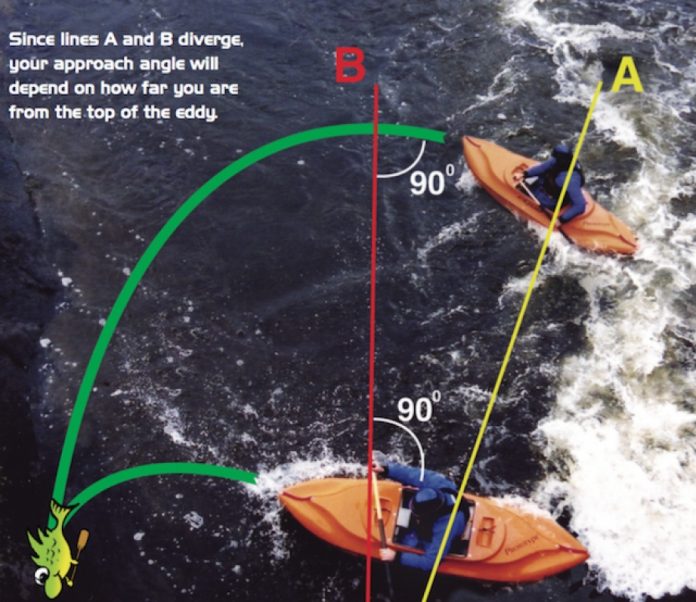
In the photograph, the widening area between line A and B is what we commonly refer to as the eddy line. This eddy line, or wedge, is an area of chaotic water made up of boils and vortices. The upstream end of this wedge, often immediately downstream of a rock, marks the origin of lines A and B. Line A is the current side of the increasingly wide eddy line and line B is the eddy side.
So, how do you decide on an angle to cross the eddy line when it is actually made up of two diverging lines? To answer this, it’s best to work backwards from the eddy pool. At the end of an eddy turn, your canoe should be in the pool pointing upstream. Prior to this, the last point where the canoe was in contact with the eddy line was somewhere along line B. The most efficient entry into the eddy pool is a 90-degree turn off of line B. Any angle larger than 90 degrees results in an unnecessarily wide turn, and any angle less than 90 degrees means front ferrying over the eddy line, which is entirely too much work. The 90-degree crowd is nodding and saying, “I told you so!”
So what about line A? Is it really so important what angle you use to approach this initial eddy line? Anyone who has ever spun out on an eddy line knows it can be very important because of the influence the boils can have on the path of a canoe. As soon as the bow of your canoe touches these boils it will want to turn and face upstream. The risk is that the canoe will face upstream before it makes it to the eddy pool.
The solution is to approach line A with an angle sharp enough to cut a path across the boils so that you can still cross line B at the magic 90 degrees. Since lines A and B diverge, your approach angle will depend on how far you are from the top of the eddy. If you are very close to the top of the eddy (where the lines are close together) you can approach line A at close to 90 degrees. If you are at the bottom of the eddy (where the two lines making up the wedge are further apart) then you should approach the eddy at an angle of 45 degrees. The 45-degree folks are smiling in satisfaction.
So, the whole angle debate boils down to how high or low you hit the eddy. Choosing an approach angle depends on which part of the eddy line you are aiming for. Look carefully at the eddy line and identify both the current side and eddy side of the wedge, break out a protractor and carve a perfect arc into the pool. Mystery solved.
Andrew Westwood is a frequent contributor to Rapid. He’s an open canoe instructor at the Madawaska Kanu Centre and member of Team Esquif.
This article first appeared in the Spring 2005 issue of Rapid Magazine. For more great content, subscribe to Rapid’s print and digital editions here.


 This article first appeared in the Early Summer 2005 issue of Adventure Kayak Magazine. For more great content, subscribe to Adventure Kayak’s print and digital editions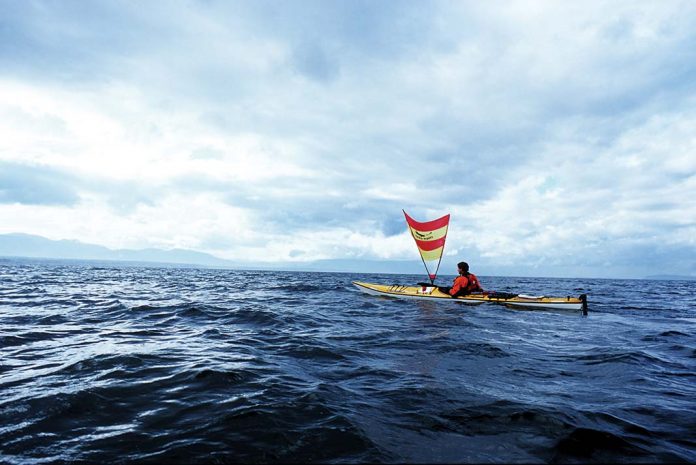
 This article first appeared in the Winter 2005 issue of Adventure Kayak magazine. For more boat reviews, subscribe to Adventure Kayak’s print and digital editions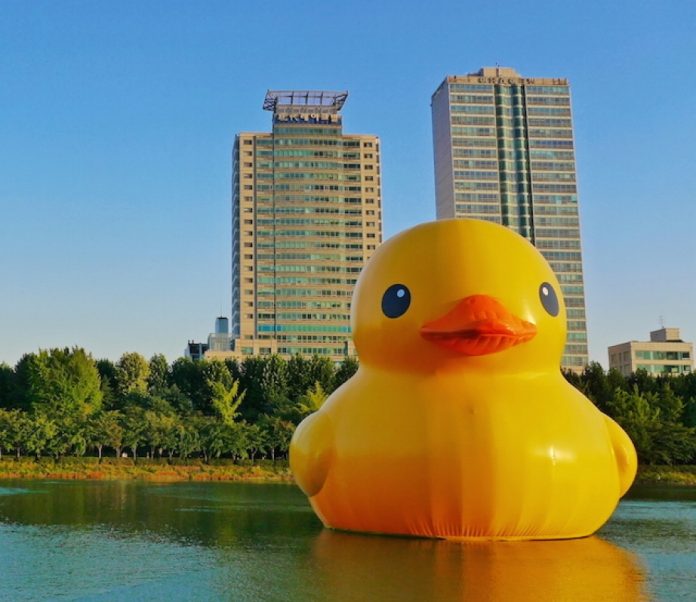
 This article first appeared in the Spring 2005 issue of Rapid Magazine. For more great content, subscribe to Rapid’s print and digital editions