In the corner of my brother Craig’s bedroom there is a pile of outdoor gear growing by one item every year. From across the room it’s easy to spot the paddle propped against the windowsill and the PFD hanging from a nail. Dig a little deeper under the full set of raingear and you’ll find a throw bag, short wave radio, camera and an ice-fishing Tip Up. What bedroom would be complete without this handy spring-loaded device that sig- nals by popping up an orange flag when a fish has taken your minnow. Ideally you notice, put your beer in the snow, and dive across the ice to reel in dinner. I was so excited when he opened it. I had big plans for our annual ice fishing weekends. That was two Christmases ago.
Twelve years ago I left home bound for university and an eventual outdoor recreation, parks and tourism degree. Craig was turning 16 that fall and was busy changing the motor and doing the body work on his first pick-up truck. This spring when I called him on my cell phone he was still working. He was just finishing a brake job on a tractor-trailer, hands covered in grease and two knuckles bleeding because, he told me after, the wrench had slipped. After school, Craig stuck around home and now keeps my dad’s fleet of trucks rolling down the highway. He makes it to all the family functions.
“I’ll have to have a shower and get cleaned up a bit,” he said, “but I’ll be there for six.”
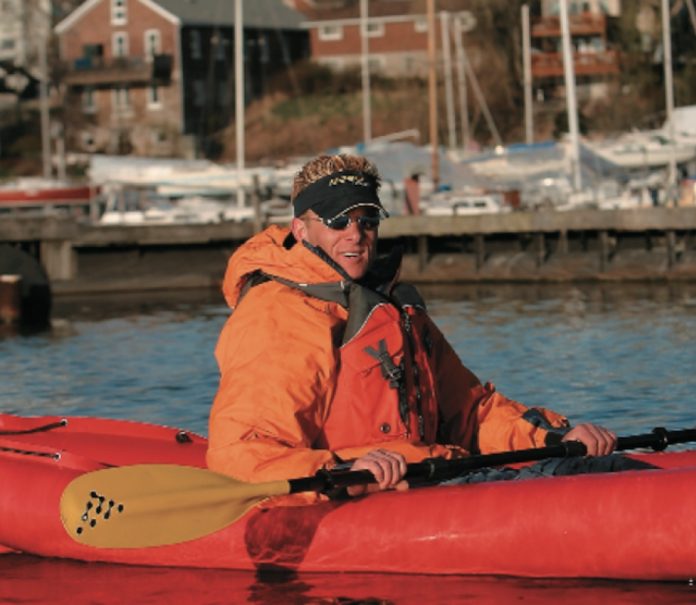
I was tumbleweeding through our hometown on my way to a paddling festival and called to ask if he’d come and paddle with me. I told him I needed to take some photos for the magazine. Part of this was true; I did need to get a couple folding kayaks on the water. But really, I just wanted to share an evening and a bit of my life with my little brother.
After the two of us and some guy in the park named Bicycle Earl assembled and pumped up our boats, I tossed Craig some paddling gear. We packed my camera and paddled into the setting sun. We floated, chatted and laughed. I taught him how to keep his boat straight. He told me about a new rap-metal band that he’d gone to see in Toronto. We even got around to taking the photos.
I often wondered if he knew the significance of the “Scott gifts.” I somehow thought that if he had the gear, our busy lives and 400 kilometres would come together more often. Instead of small talk over turkey, I always hoped we’d catch fish together or perhaps do a coastal paddling trip. He’d use the camera I gave him to record the memories.
Although too dark to stay out any longer, I reluctantly suggested we head in, break down the boats and pack them back in the truck.
Leaning against the tailgate shaking hands, I thanked him for coming out with me.
“These boats are pretty cool,” he said.
Checking one thing off my Christmas list, I thought to myself how nicely one of these folding boats will fit in the corner of his bedroom—right between the paddle and the short wave radio.
This article first appeared in the Summer 2003 issue of Adventure Kayak Magazine. For more great content, subscribe to Adventure Kayak’s print and digital editions here.
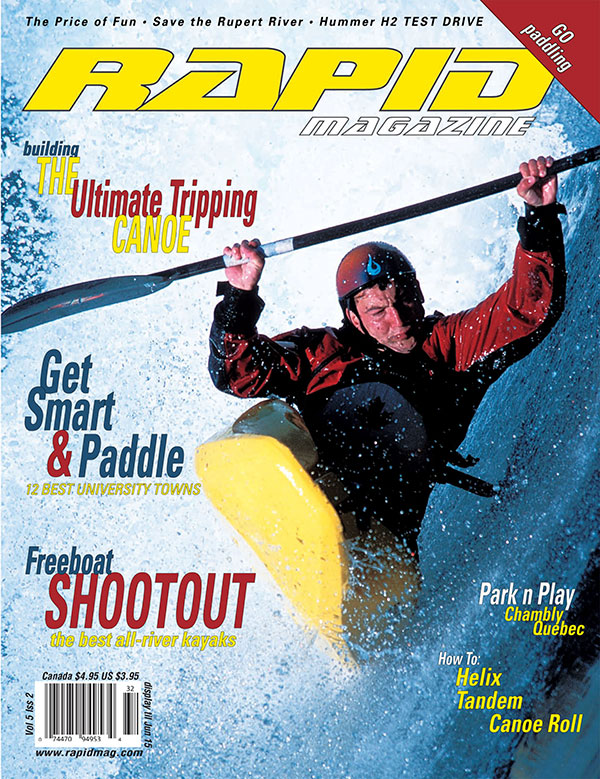
For 15 years and all of my canoe tripping life I’ve been renting, borrowing and using the canoes supplied by the various companies whose summer jobs managed to get me an education. With driver’s licence, degree, real job and wife all checked off my list, buying my own canoe seemed the last rite of passage left for this skinny Canadian man. Seasons spent kneeling on blue foamy sleep pads in boats whose only modifications were Kevlar patches inspired fantasies of one day building my Ultimate Tripping Canoe (UTC). I pitched the idea to wilderness river tripper and meticulous boat outfitter Brian Shields and late last fall the project began.
The basis of the ultimate tripping canoe is a good boat. I chose the Esquif Canyon for its generous rocker and depth, which make it both a big-water tripping boat and also one that likes to play the river. The Canyon will be slower and not track as well in flatwater but we were building our ultimate whitewater tripping canoe and were willing to make some sacrifices for river paddling performance.
The DIY guide to outfitting your canoe for whitewater
1 Where to start…
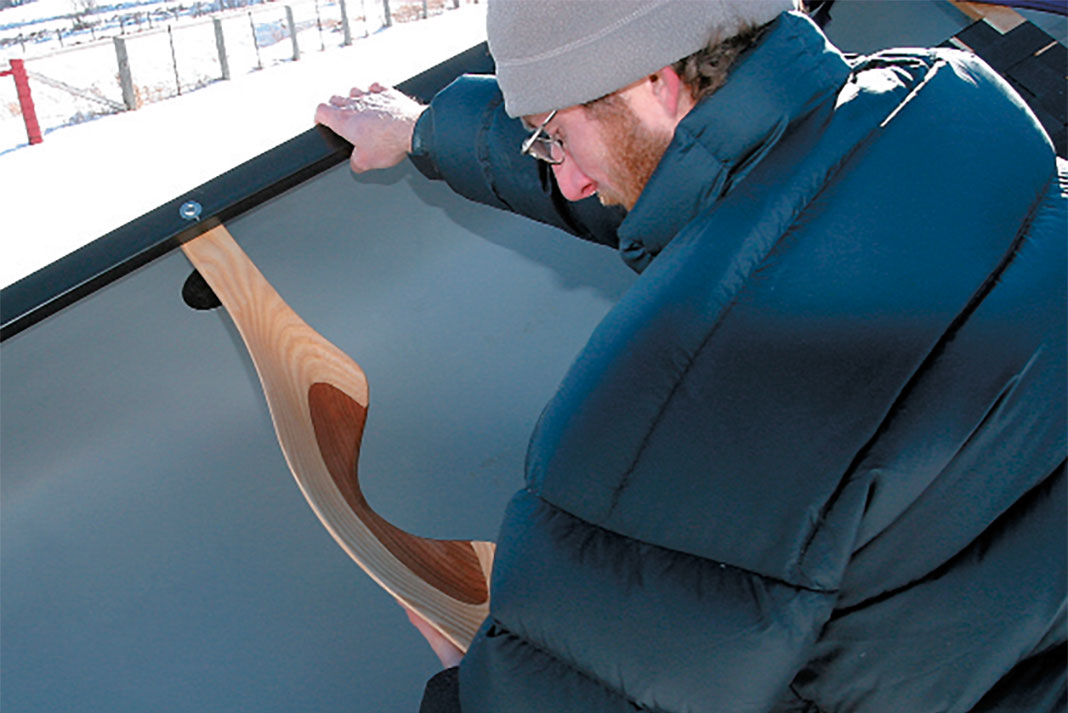
We began at the yoke, replacing the Esquif stock version with a laminated ash and cherry yoke by Madawaska Valley yoke builder SlipStream—an aesthetic touch with the highest benefit-to-cost ratio when it comes to slugging our fully outfitted 77-pound tripping boat.
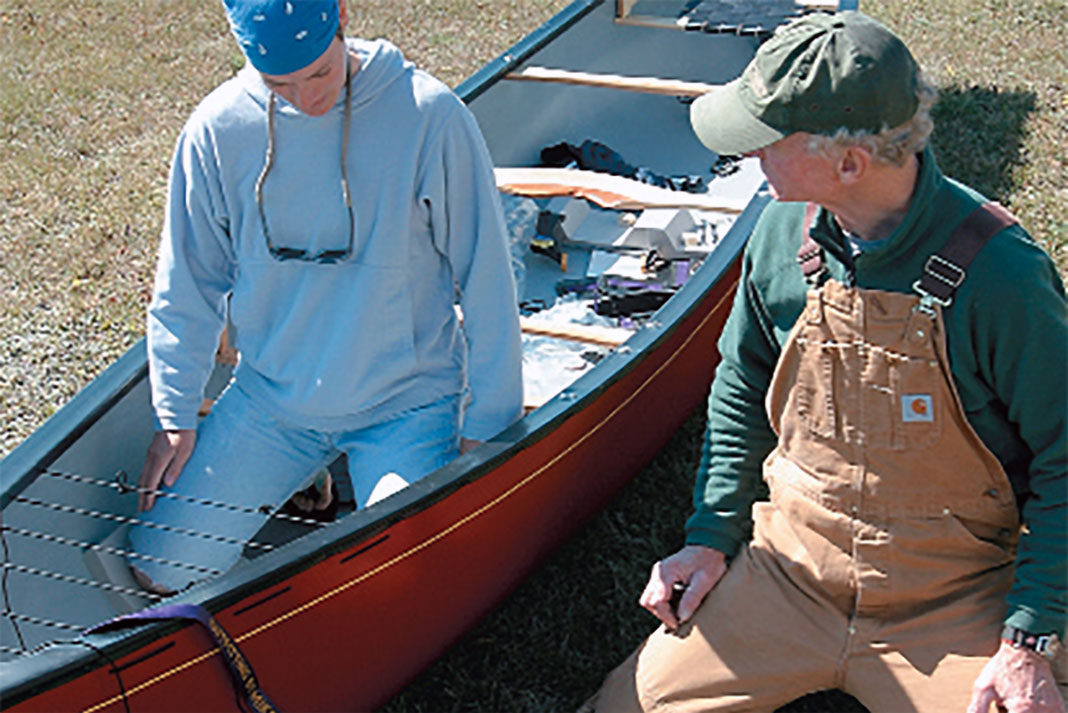
Tanya and I have fallen into the pleasant agreement that I’ll spend my time in the stern and she will enjoy the freedom and view from the bow. Locating our seats and thwart position to accommodate our typical tripping gear was the next and most important step, and one that affects the rest of the outfitting process. Having legs better for walking in deep snow than sitting comfortably on public transit, I made leg room my top priority. The Canyon comes set in a more aggressive and centred playboat-like seating position so we had to move the stern seat rearward to gain my stretching room and leave space ahead of the seat for camera gear. We know we will have to shift gear forward to weight the bow to compensate and trim the boat.
Adjusting seat height and angle are the easiest and cheapest modifications you can do to improve your paddling comfort. Moving my stern seat naturally raised the seat and increased the tilt due to the rise in the gunwales toward the stern. This was perfect for my larger feet and longer legs. The bow seat we lowered and tilted forward slightly so Tanya could reach a comfortable kneeling position without the nagging ache of a level seat bar eating into her legs. Add too much tilt without thigh straps, however, and you slide forward off the seat. Remember to be kneeling on a kneepad or piece of foam to ensure correct seat height and angle.
How to adjust yoke & stern seat
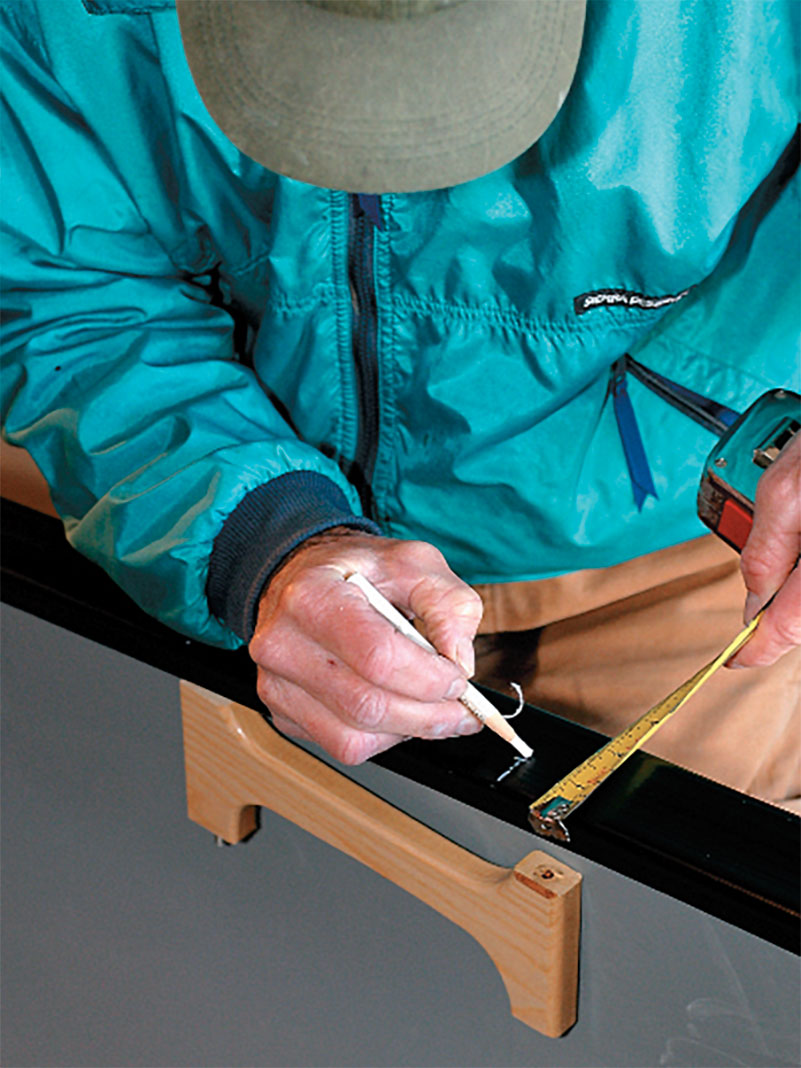
Installing the SlipStream yoke, we used the existing yoke as a guide for cutting to length, centring, marking and drilling the bolt holes. To allow two 60-litre barrels to fit snugly side by side yet still load and unload easily, we redrilled the gunwales and moved the rear thwart back to 24.5 inches from the yoke. Don’t inadvertently add flare or tumblehome to your canoe when moving thwarts—trim them to fit or replace them with longer ones.
Think carefully about the compromises involved in moving the seats from the balanced standard positions. Balance, dryness, maneuverability and gear carrying capacity will be affected. White grease pencils, found at office supply and craft stores, are ideal for marking—measure twice, drill once.
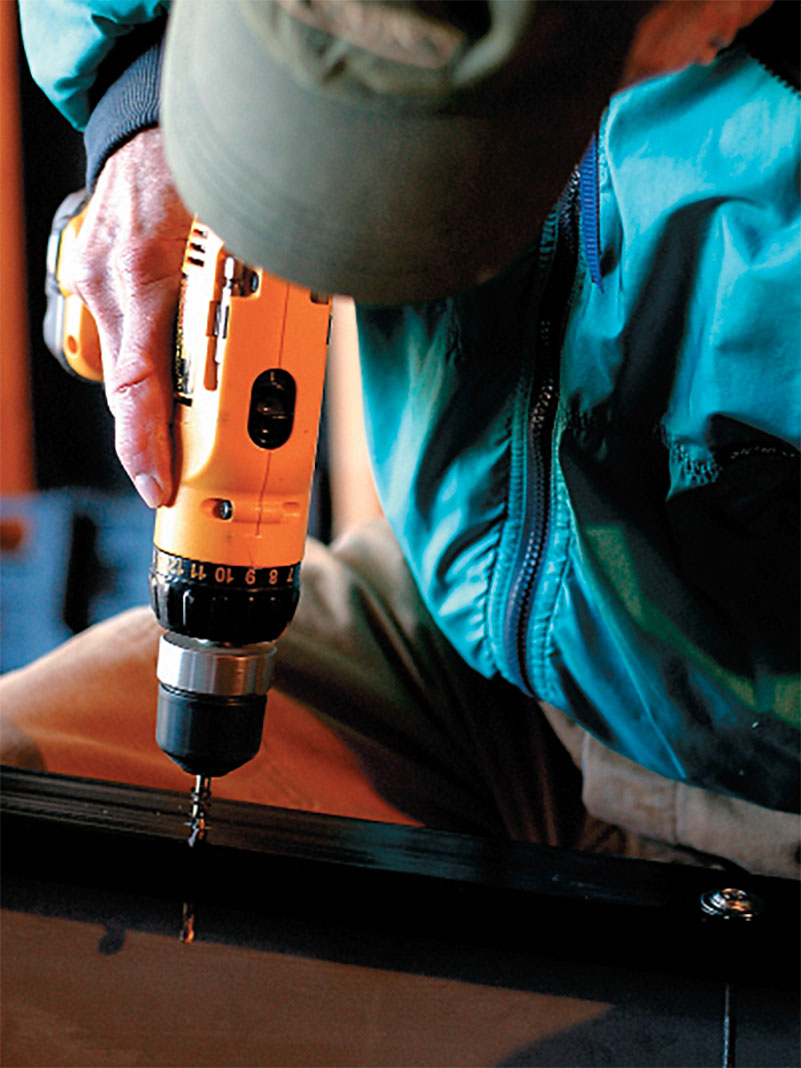
Vinyl-covered aluminum gunwales can easily be drilled without harm. Typically seat and thwart hardware is 3/16-inch diameter and stainless. Use a 3/16-inch drill bit so bolts fit snugly. Recessed washers tuck bolt heads inside and disperse the pressure on a larger surface area of the gunwale. Underneath use washers and nylon locknuts. Pack a Leatherman tool and a metre of farm fencing wire and you can fix anything on trip.
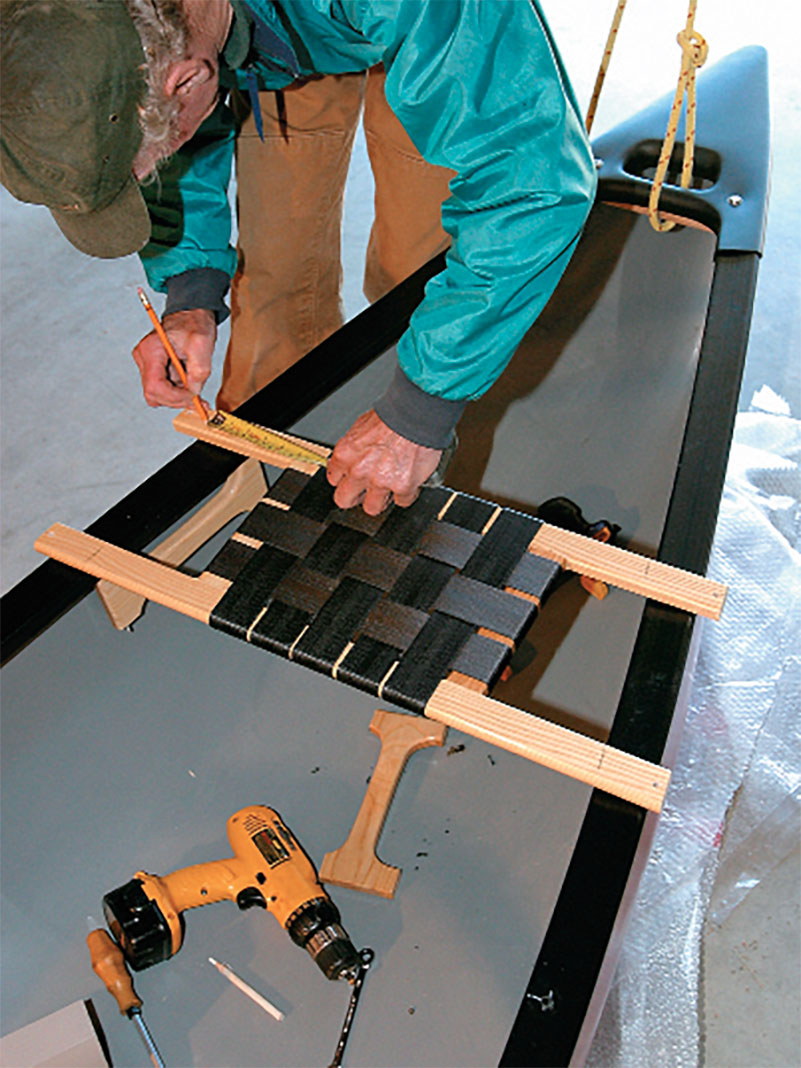
For legroom and working space we ended up moving the Canyon’s seat back a massive eight inches to a more traditional tripping measurement of 24 inches from stern. The seat had to be carefully narrowed to fit farther back in the tapering stern. Be sure to err on the side of too long when you are making your cuts and then trim and angle the seat bars for a perfect fit. A perfect installation has the seat just clear of the inside of the hull. Simply moving a seat forward or back affects the seat height and angle following the shear or gunwale lines of the canoe. Adjust seat height and angle using longer seat bolts and new seat pillars, or cut and drill wooden spacers for between the seat and pillars. We drilled the holes and loosely bolted the seat in place, tweaking height and angle after we installed the outfitting.
2 Float bags
Perhaps the best insurance policy you can buy for your whitewater canoe is a set of float bags and properly installed bag cages. Float bags come in both nylon and vinyl. Vinyl bags are worth the extra money. They are lighter, easier to work with, especially in the cold, and far more durable. Voyageur 36-inch end bags are the perfect length for tandem tripping boats, tucking just ahead of the bow paddler’s knees and behind the stern seat.
[ Paddling Buyer’s Guide: View all floatation and cage materials ]
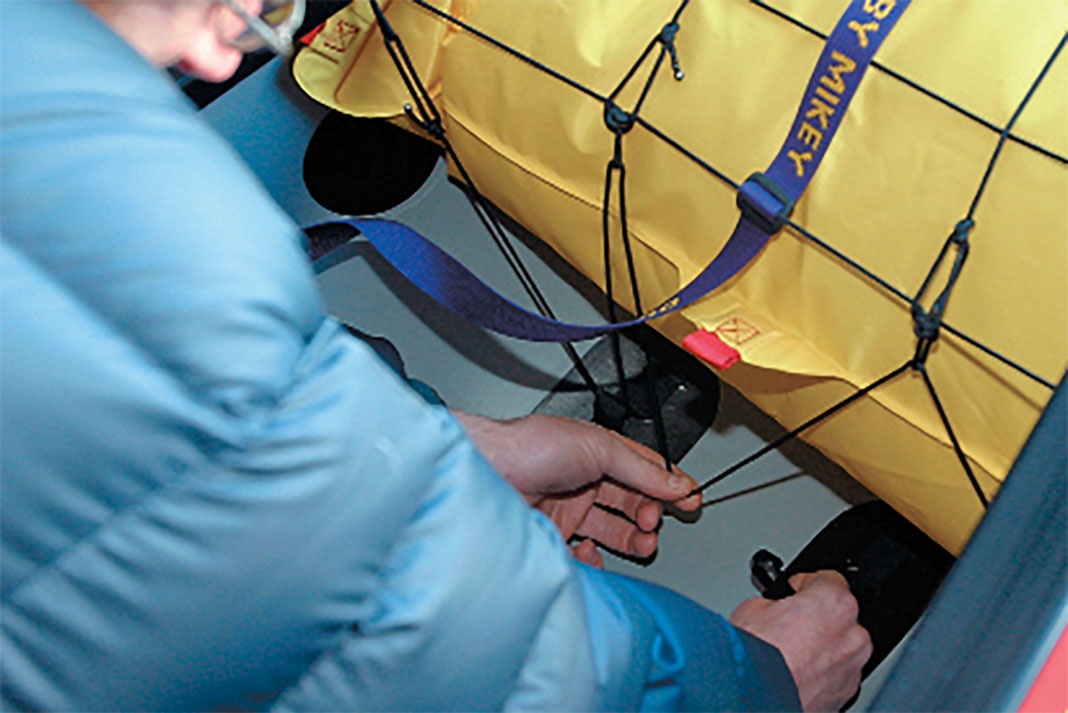
The Mike Yee Outfitting bag cage system is far superior to tying bags into the boat. Although all float bags have sewn tabs, tying bags into your canoe isn’t enough to keep them down. An upright boat full of water floats the bags, focusing all the stress at the sewn tabs. The water will displace the bag above the gunwales, rather than the bag displacing the water in the hull.
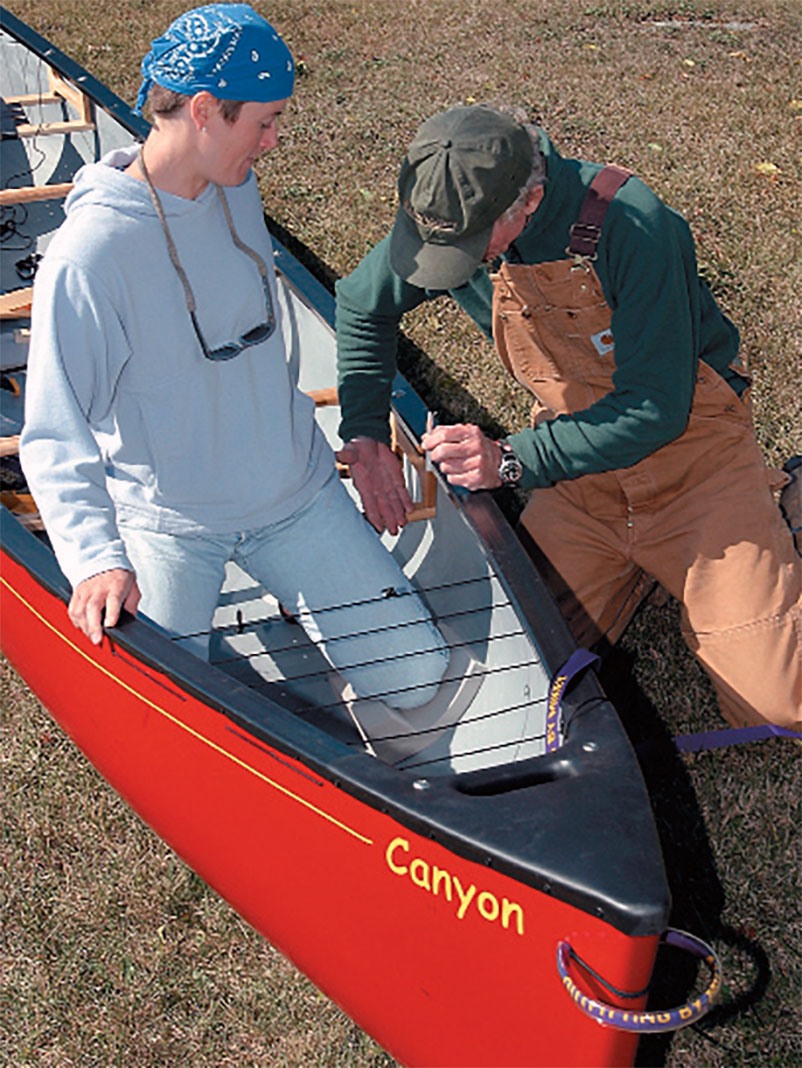
As we installed the stern bag cage, we realized the combination of moving the seat back and me having long legs meant that my feet were going to interfere with the anchors. This was aggravating, and dangerous if my river shoes caught when I needed out of the boat. We simply moved the anchors back, shortening the cage area by a couple of inches.
By necessity, the copious leg room usually enjoyed by the bow paddler gets filled by the face of the bow cage; however, we were sure to lay out our kneepads and eye things up before we drilled the cage holes to set their location. We wanted to ensure there was still enough space in front of the bow seat for Tanya to sit up and stretch a little.
How to install float bags
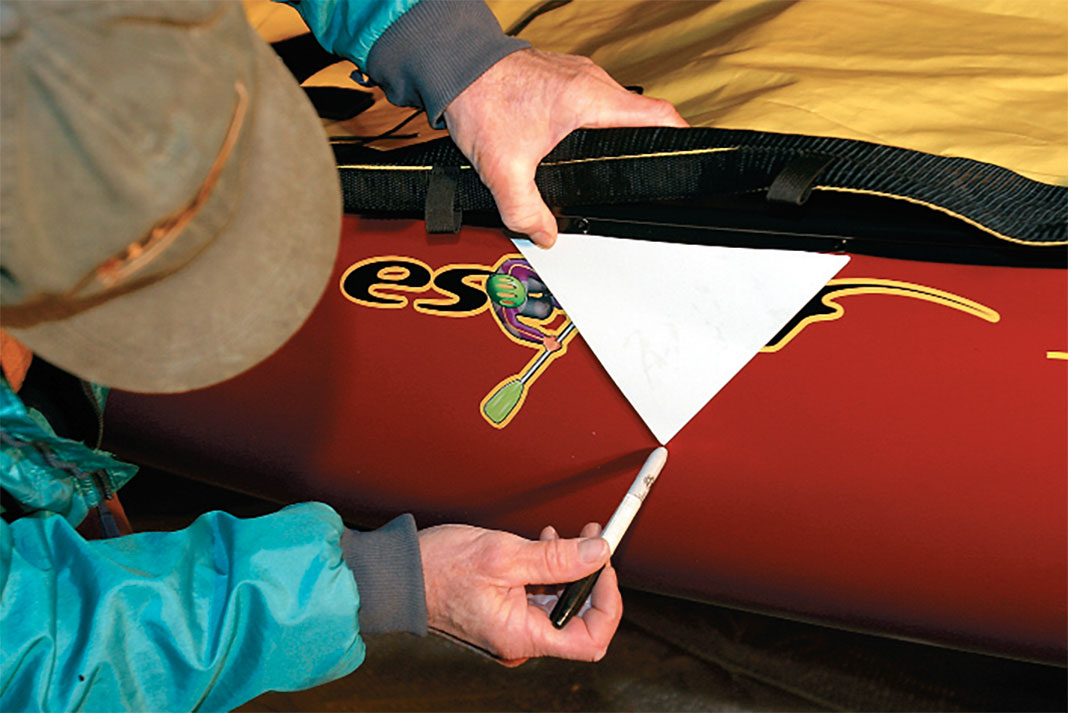
Use a paper, cardboard or plastic jig to mark the float bag cage holes so they are aligned with the holes on the other side of the boat. Mark the 3/16-inch holes every four inches starting at the end of the deck plates and continuing for as far as you want the bags to extend. Drilling holes in a new hull feels wrong, but the holes will be filled when laced with nylon cord. Be gentle with the drill, even the dullest of drill bits can tear through Royalex with ease.
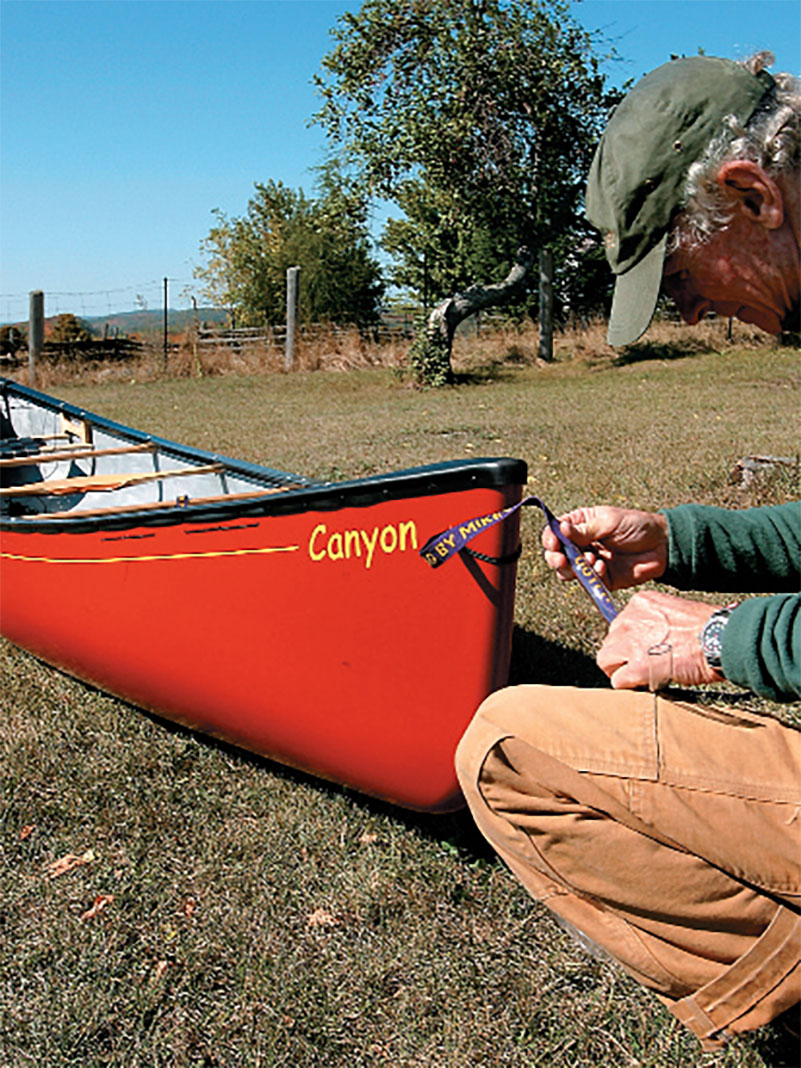
To install a bow or stern grab loop and another anchor point for the cages, drill a larger 7/16-inch hole. We checked first to ensure the holes wouldn’t interfere with the spray deck we will install later. Tie a single loop of 3mm nylon cord through the holes with the ends inside the boat. Pick up some 5/8-inch OC clear vinyl tubing and a metre of webbing at a hardware store. Force the webbing through the tube, into the holes and tie it on the inside of the canoe for a cheap, comfortable and easy-to-use handle.
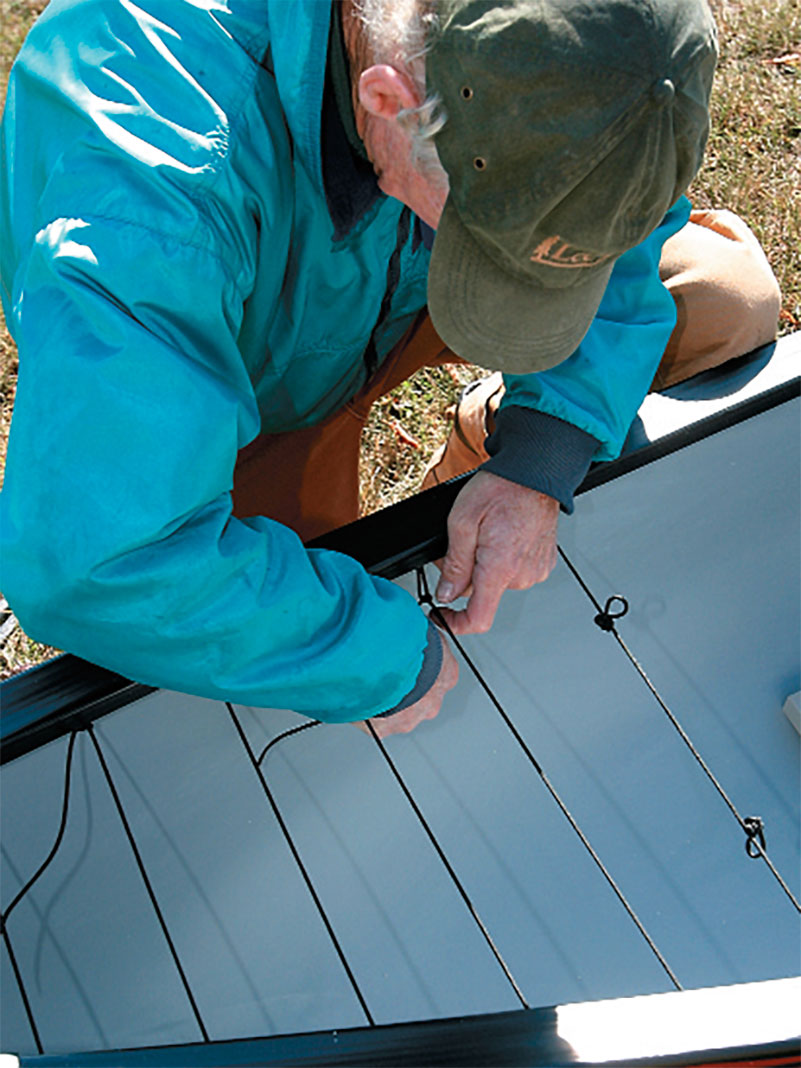
Weave the nylon cord through the 3/16-inch holes starting from the bow or stern. On the last crossing on the inside of the hull tie a loop as a stopper using a figure eight on a bight. Then tension the cord backward through all the holes until you’re back at the first end. Thread the first end back through one of the holes and tie it off with a few half hitches on the inside of the boat. Go back to the last crossing and tie three additional evenly spaced figure-eight loops. Tension this end, threading it back through one hole to tie it off on the inside of the hull with half hitches. The result is a snug cage in which the last strand has two evenly spaced loops in the middle and two stopper knots against sides of the boat so they can’t slide off centre.
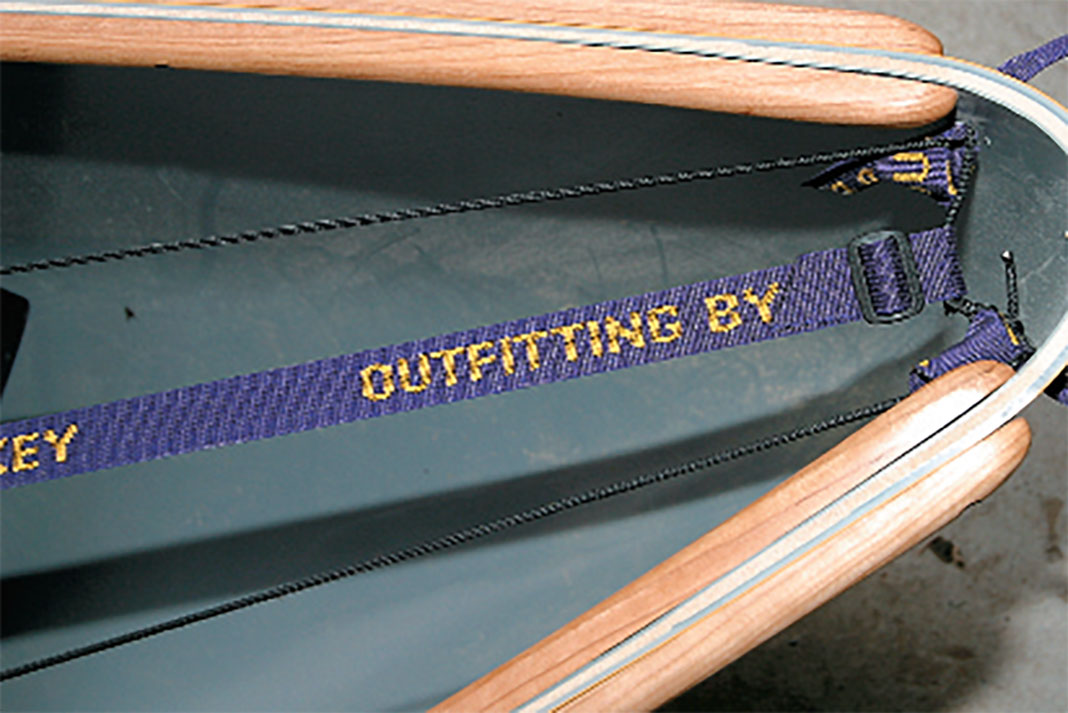
Without the deck plates on this playboat you can see how the webbing grab lop and single loop of nylon cord are attache.d The nylon cord loop is the anchor for a piece of webbing running down the centre of the bag cage. The two nylon cords run from the grab loop holes to the figure-eight loops, underneath the nylon cords that go across the canoe to form a grid with gaps small enough to keep the bag from rising and escaping under water pressure.
Directly below the line below the figure-eight knots, place three evenly spaced vinyl patch anchors. Mark the outlines of the patches with a grease pencil and glue them in place. Let the glue dry for 24 hours, then thread the cord through the figure-eight knots and anchors in a “W” pattern at the end of the cage. Using a centre anchor with a clip allows you to easily unclip the cord and webbing to access the float bag area.
3 Comfort and security
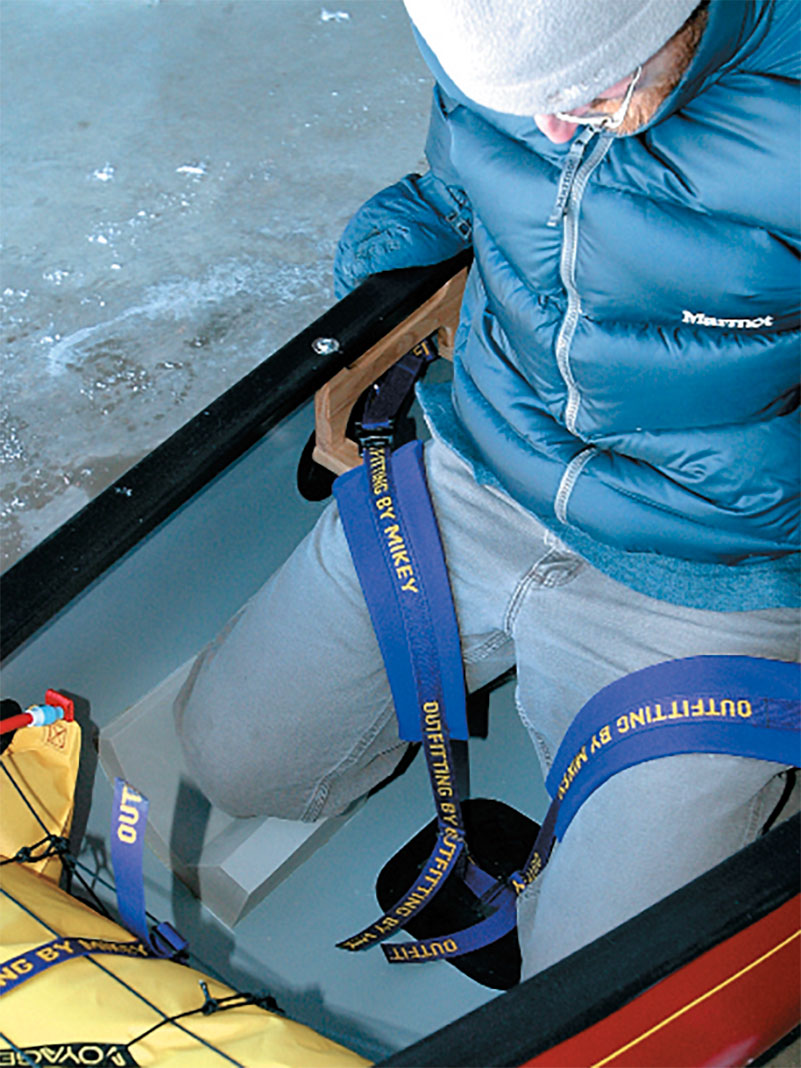
Thin pieces of blue foam offer some comfort to the knees, but proper outfitting has so much more to offer. Contoured knee pads and thigh straps stop your knees and butt from sliding around and connect you to the boat. Coming from a tripping and playboating background, we wanted the comfort and security of quality, well-placed kneepads and outfitting in our ultimate tripping boat. If the bow and stern positions will be shared, the kneepads have to be located to fit both short and tall paddlers. A tip from Brian was to be sure to space the kneepads far enough apart that you can drag a bailer between them. We also wanted this gap between the kneepads for stepping in and out of the boat.
We anchored our thigh straps on the sidewall of the boat, centred between the seat supports. Some canoe tripping outfitting loops around the seat pillar or around the seat itself but the ultra-fine stainless steel bolts used as seat hangers are not suited for the lateral forces exerted by the thigh straps. The bolts bend, work loose and can break under your body weight if the canoe happens to ram and stop on a rock. Having the anchor between the seat support brings the thigh straps into an aggressive, secure position.
How to install kneepads & thigh straps
Position the kneepads widely enough for differential balance of the canoe with pressure on either knee. Get comfortable, you shouldn’t be stretching to reach the kneepads. When you’re sure of their placement, mark the position. Now, run around the yard and get back in to ensure it feels natural. Then, glue them in using contact cement.
With the kneepads held in the correct position, we lowered the seat and tilted it forward slightly so that Tanya’s shorter legs could reach a comfortable kneeling position. Esquif’s solid, one-piece seat hangers allowed us to cut wooden spacers to lower the seat. You might need to buy longer seat bolts. Adjusting seat height and angle are the easiest and cheapest modifications you can do to improve your paddling comfort.
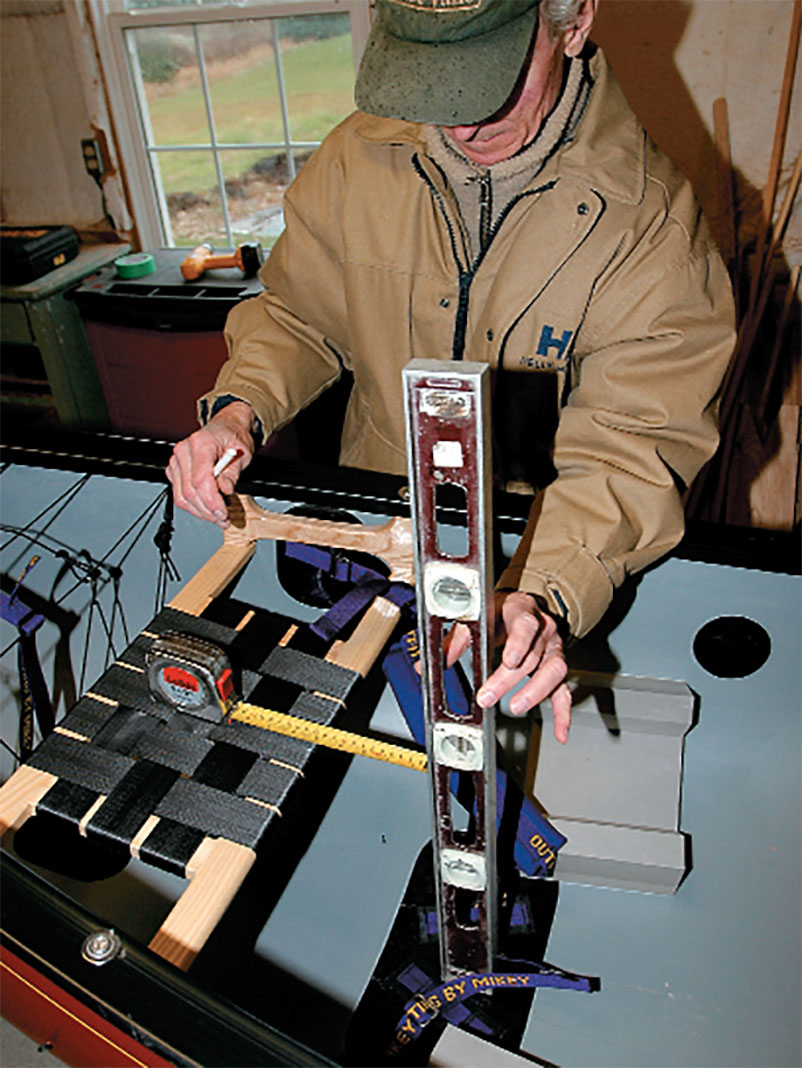
Both bow and stern anchors for the Mike Yee Outfitting thigh straps are centred in the boat five inches forward of the seat bar. Find the centre of the boat with the centre of the seat webbing and use a level to measure up from where the anchor loops leave the floor. Locate the wall anchors centred between the seat supports, with the tops near the gunwales. Mark outlines, location slashes and orientation arrows for the anchors on the hull so you know their placement and which way is forward.
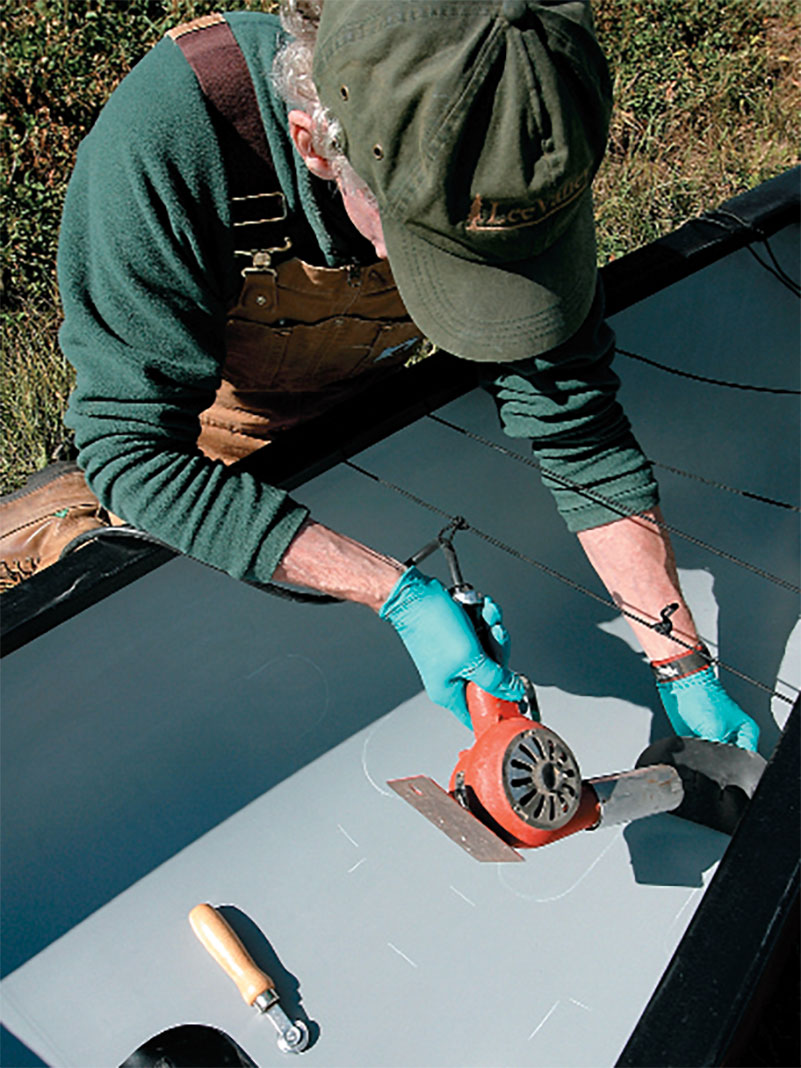
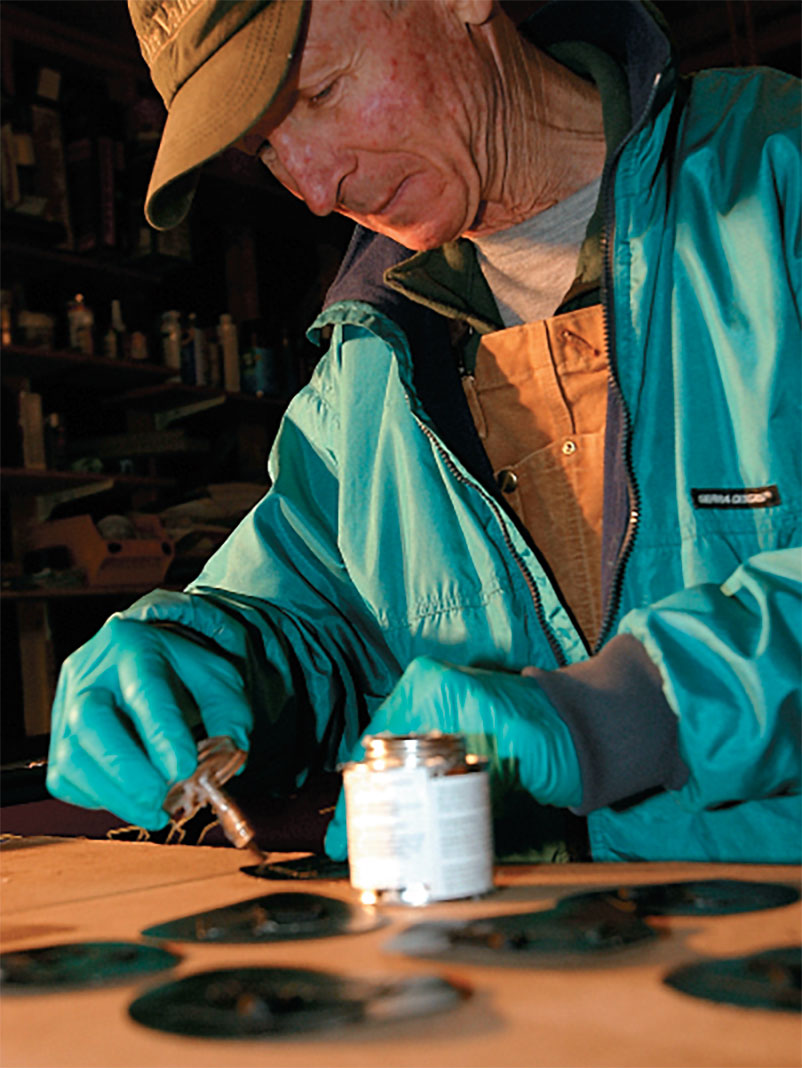
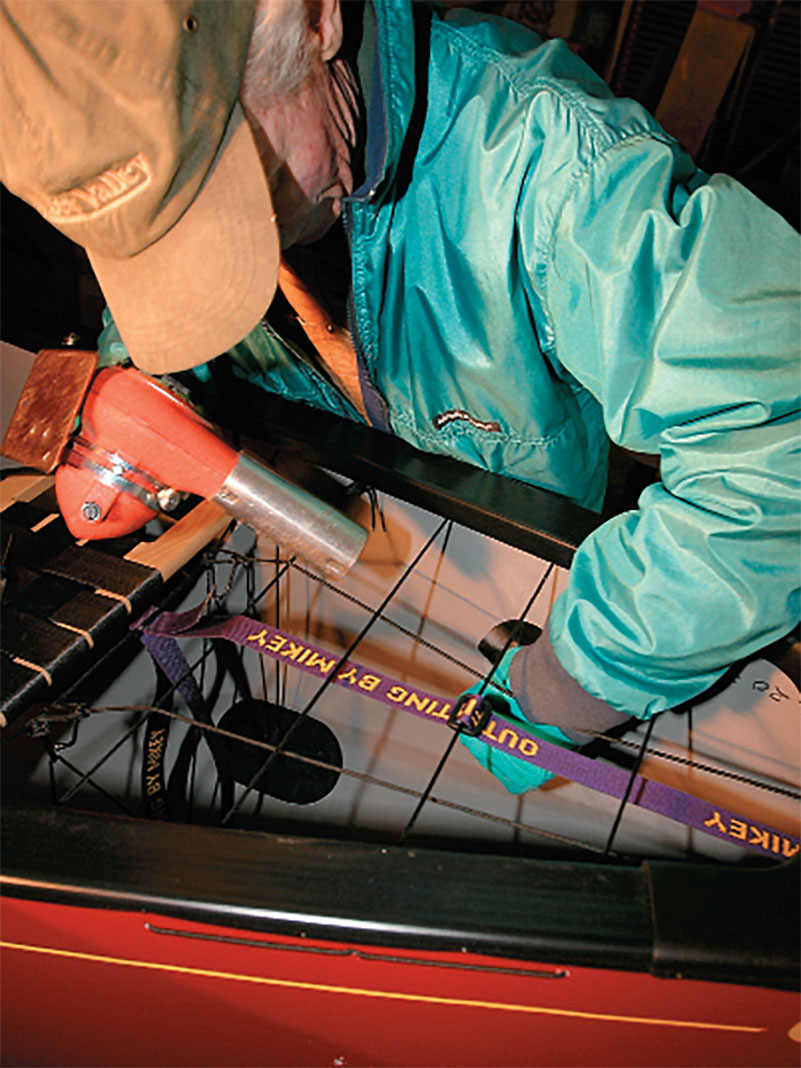
The secret to installing secure vinyl anchors is to keep everything clean. Wipe the hull and anchors sparingly with acetone. Wearing gloves, apply vinyl glue to both surfaces; be sure to go right to the edges. Let dry 15-20 minutes. Reactivate the glue with a heat gun, align and stick. Roll out with lots of pressure using a screen door roller tool.
Be sure to let it dry for 24 hours before you thread your thigh straps and haul on the anchors.
Although some paddlers may say we’ve gone overboard on the outfitting for wilderness river trips, the sporty Canyon with fully rigged outfitting bridges the gap to tandem playboat.
But, we didn’t stop there.
4 Getting northern-river ready
With dreams of traveling north to explore the massive rivers draining the Hudson Bay watershed—the Harricanaw, Rupert and Moose—I placed a call to Morgan Goldie at North Water to order our Expedition Spray Deck. I found myself in the garage with a tape measure and the cordless phone.
I hadn’t thought about it, but all canoe covers are custom-made. Any modification from the canoe builder’s specs affects the cut of the deck. I had moved my stern seat eight inches back, so North Water had to cut my cockpit opening to line up with my seat—it’s imperative to have your seats set before you order your deck.
How to install a spray deck
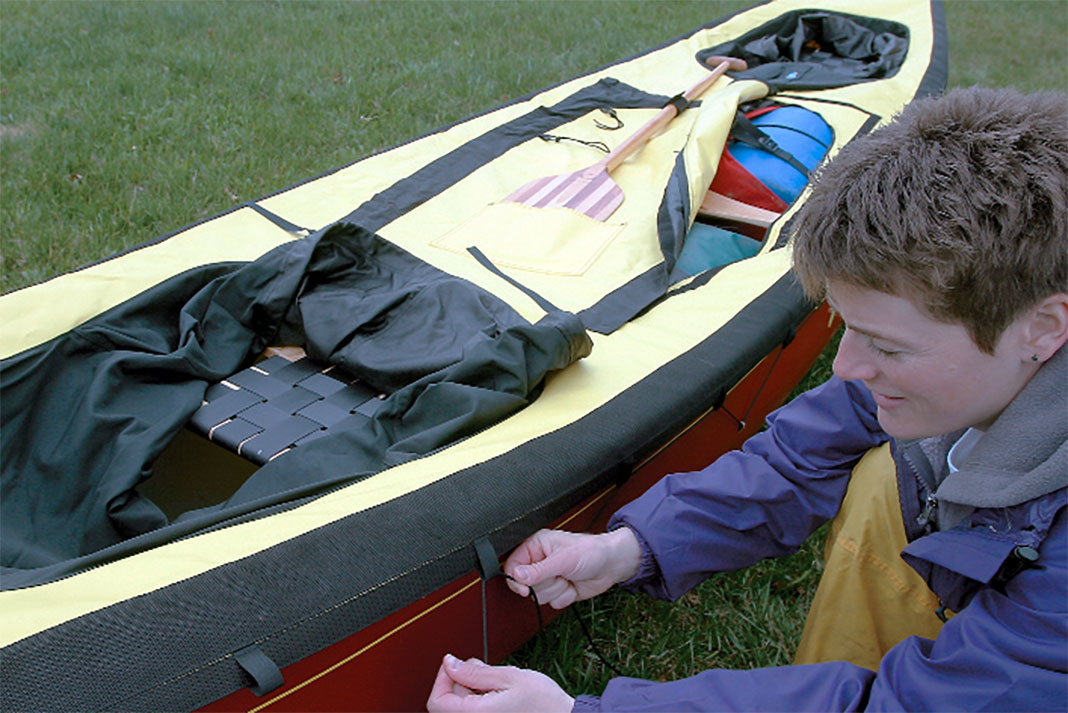
The first step to installing the North Water Expedition Spray Deck is laying it out and using the included jig to mark where you will drill the 12 anchor holes down each side of the canoe. Yes, holes! Some canoe spray covers are attached with Velcro or clasps, and some lash to a strip of webbing riveted from bow to stern. The North Water laces in place with nylon cord weaved through tabs on the deck and tiny loops poking out of the holes. Confused? Read on.
Once we drilled the 3/16-inch holes, we poked the loops through and traced the vinyl patches on the inside of the hull. Apply the supplied vinyl adhesive to both the patch and the hull. The secret is to let it dry, reactivate it with a heat gun and then carefully stick it in place.
Working around our existing bag cages and outfitting was a little awkward but doable. Before beginning the project, we checked that the North Water was compatible with our Mike Yee outfitting. The grab loops and outfitting anchors don’t interfere with the spray cover. Setting the deck anchors in place is a one-shot deal. We installed the first few patches in places hidden by the deck plates or float bags in case they weren’t too pretty. Be sure to rub firmly (especially the edges) with a blunt object such as a screwdriver handle or ideally a screen door roller tool to secure the bond.
See why the North Water system is so clever? The drilled holes are filled with nylon loops and patched on the inside. No sharp edges. The boat is completely watertight. And you only see little black dots on the outside of the hull. The deck laces in place using nylon cord and secures around the bow and stern with webbing and ladderlock buckles. The Expedition Spray Deck covers most of the deck plates, so North Water has sewn on Velcro loops for painter storage. The deck comes with one paddle pocket and we added tabs to hold a map case. The large cargo access option is key for easy access to barrels and packs.
5 Getting ramming-speed ready
There is no doubt in my mind that Captain Kirk had a quality set of Voyageur skid plates protecting the bow and stern of the Enterprise. Low-water weekend trips grinding down the Petawawa, Dumoine, Coulonge and Madawaska take their toll, even on ABS boats. And “ramming speed” is the ABS canoeist’s answer to shallow sections and keeping feet dry at portages. When you wear the skid plates out, simply grind them down and slap on another set. Remember this isn’t a cedar dock decoration. This is our whitewater UTC.
How to install a skid plate
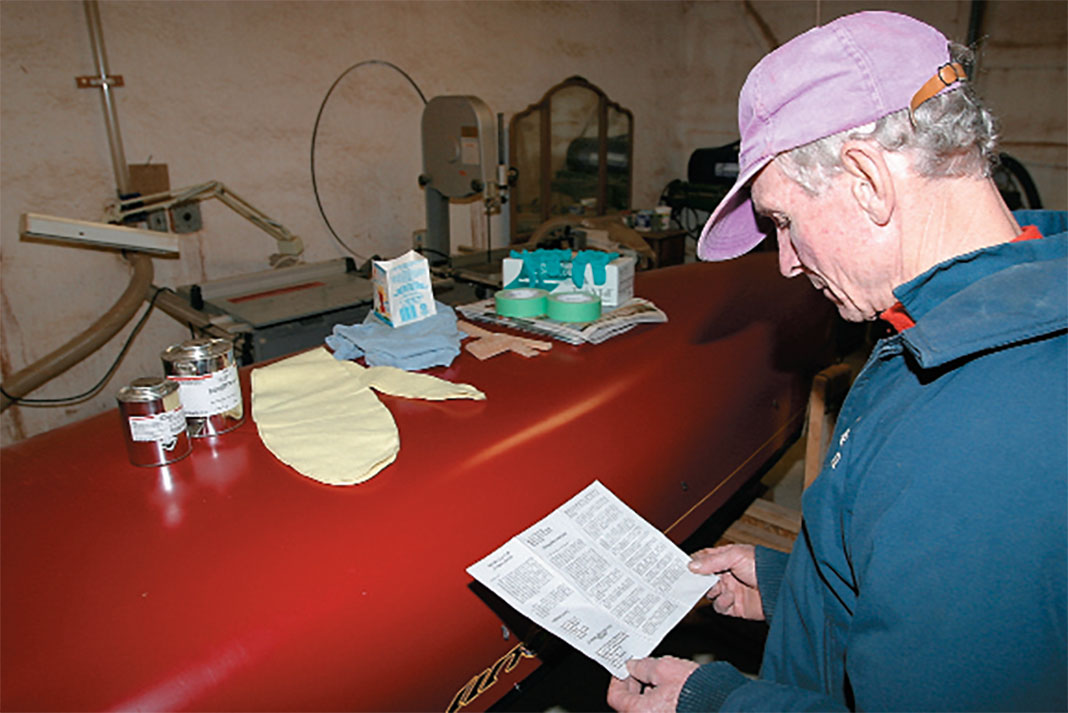
Step one: Collect and organize all necessary items. The Voyageur skid plate kit comes with almost everything you’ll need: Kevlar felts; resins; sandpaper and sanding blocks; gloves and (yes, we read them) instructions. You’ll need to round up a mixing container, masking tape, stir sticks and a disposable surface for apply the resin to the felts.
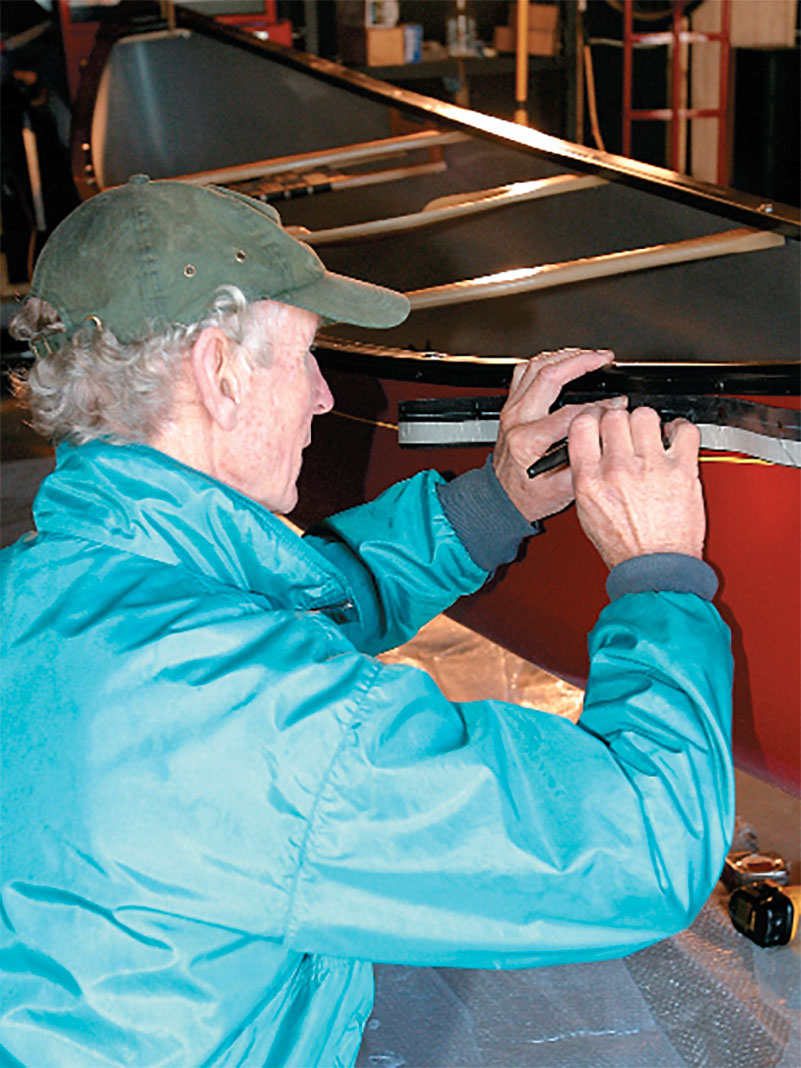
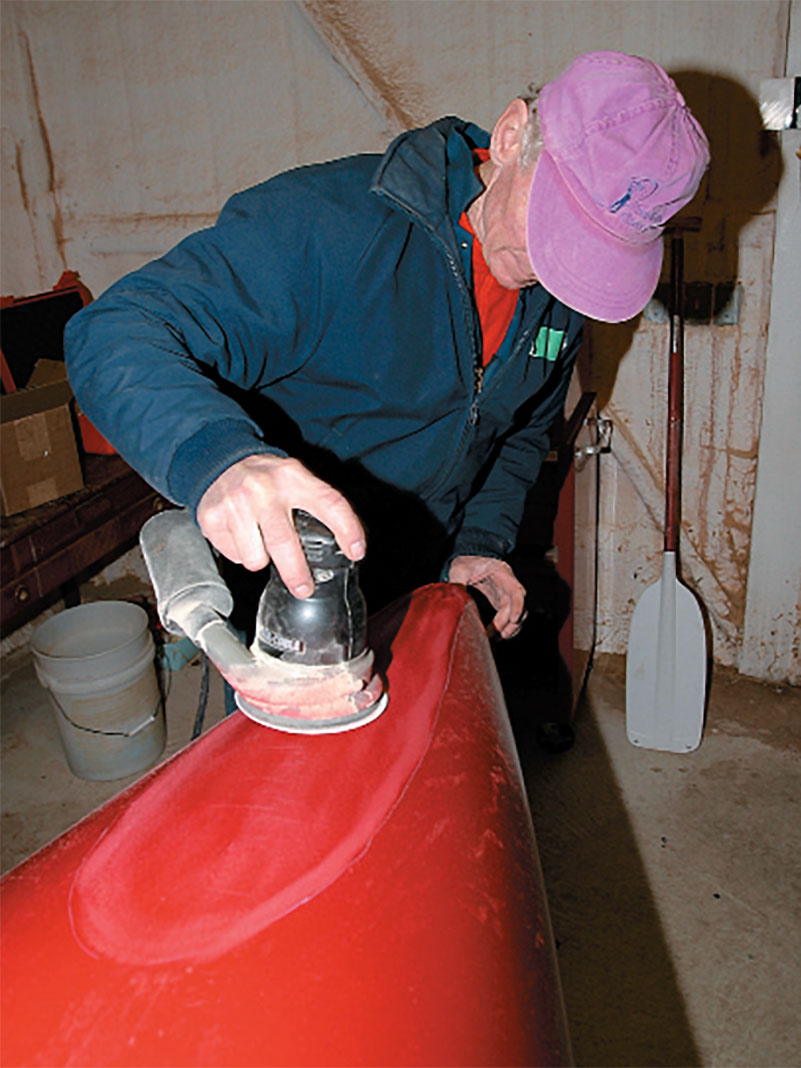
Whether you’re building your UTC from scratch or souping up your existing boat, you’ll need to roughen up (or maybe smooth out) the Royalex. Trace the felts and sand a half-inch or so past your outline—we found the patches tend to expand when wet with resin. Use the included sandpaper or speed up the process with power tools. CAUTION: sand gingerly, just roughing up the surface, not removing it. Brian took over the sanding.
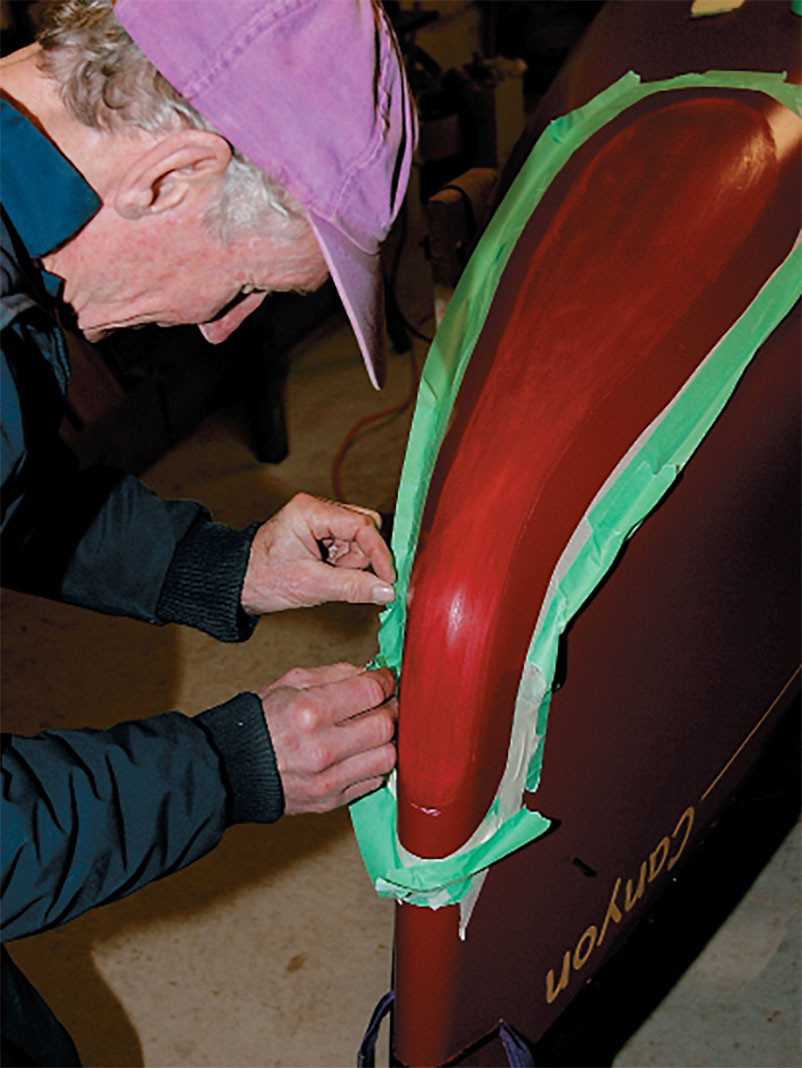
Not only did Brian mask out the area. He created a rain gutter border to channel any excess resin. He masked an inch outside of where we expected the skid plates to be and then painted the entire area with resin for a clean-looking finish.
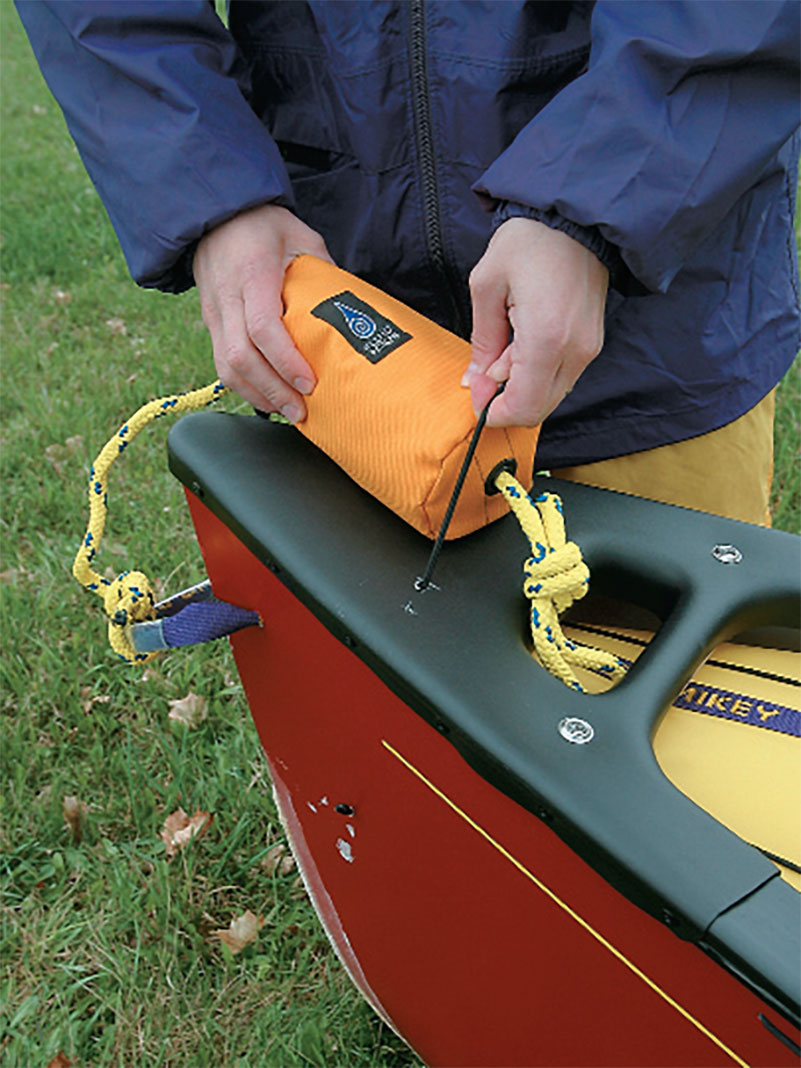
Ropes on your canoe need to be accessible when needed and otherwise out of the way. Brian’s bungee cord on the deck is cheap, easy to install and works like a charm. The secret is to ensure it is perpendicular to the boat. The Fluid Designs painter bags hide the standard 30 feet of bow and stern rope and are easily re-rigged for self-rescue or lining.
6 Finishing touches
“You’ll thank me later,” Brian said as his Black and Decker augered holes in the Canyon’s plastic deck plates. I’d sourced a pair of Fluid Designs’ nacho-coloured Painter Bags. These babies are the bomb for keeping your ropes from looking like bowls of spaghetti. They come with 30 feet of floating 3/8-inch rope stuffed inside. Through his new holes, Brian tied short pieces of 1/8-inch bungie cord and snapped my painter bags in place on the decks—very clever. With age comes wisdom.
How to install a deck bungee
Too cheap to smash the celebratory bottle of Blue Nun on her bow, we slid our UTC quietly into the river—no marching band or confetti. Feeling like we’d just walked into a honky tonk in graduation tuxes we ferried our fully rigged and decked northern river tripper into the crowded eddy of Class II weekend canoeists. My whitewater adolescence paddling in beat-to-a-pulp rental canoes is over.
This two-part article was first published in the Early Summer 2003 and Summer 2003 issues of Rapid Magazine. It was republished in part in the Spring 2008 issue of Canoeroots Magazine. Subscribe to Paddling Magazine’s print and digital editions, or browse the archives.
The helix is the latest move on the pallete of freestyle paddlers. This new move is a 180-degree upside down flat-spin that resembles the rotation of a helicopter rotor. That’s right, it is not a 360 rotation as most people think. The helix is just a bounce and an elaborate roll like the donkey flip, roll-X or the pan am. The boat slides sideways down the face of a wave and when the upstream edge pops up in the air, the stern gets pushed, upside down, toward where the bow just was. The move, when airborne, is really cool to watch and punishing to learn. The first person to actually land and name the move was Steve Fisher, longtime paddler of the Zambezi River. There were variations of the helix before His Holiness published the name helix on the Internet, but he, unlike everyone else, stomped the landing.
Step 1
Find the top of a nice big green wave face with a big foam pile. The foam pile will help catch you when you inevitably land on your head. Slide down the face of the wave sideways and let the upstream edge drop flat with the face of the wave. When the boat picks up speed, pull up the upstream knee and hop the boat sideways. Be sure to lean your head downstream for the hopping. The idea is to get the boat to hop as high as you can without flipping upstream. Practice this for awhile, the more height the better for the helix. You’ll need to lean a little more upstream for better height but you’ll likely crash a bunch learning.
Step 2
Just as the boat leaves the water for the first bounce, punch the downstream hand and its non-power face forward in a reverse sweep while dropping your head back on the same side. Throwing your head leads the move, and begins the spin movement by pushing the stern upstream and sends the bow downstream. If you don’t push the stern hard enough the edge drops and the cockpit rim is going to catch you in the ribs, and it really smarts.
Step 3
As the boat flips over on top of you, the paddle blade you pushed with will become open to the water upstream. Keeping the pad- dle engaged will swing your legs frighteningly fast over your head. You don’t need to pull on it, but some people do. Try both methods to find out what works best at your play spot.
Step 4
Your body needs to tuck under your boat by pulling your legs on top of you. Think of touching your toes while throwing your legs over your head. Once your legs have swung past your face, the stern will engage and the boat will want to flip back upright.
Step 5
You are now on your other edge and on your other paddle blade. On a big wave this is when you want to low brace. The low brace will, with the energy of the water, flip you right side up. On smaller waves this last part of the helix is a very fast roll. Either way, your automatic response will be a hip flick, so let it happen.
Billy Harris will be teaching intermediate and advanced freestyle clinics for Madawaska Kanu Centre.
This article first appeared in the Spring 2003 issue of Rapid Magazine.
Yukon River Quest: the Longest Canoe Race in the World
In the last stretch of the Yukon River Quest, a 742-kilometre paddling race from Whitehorse to Dawson City, many competitors fall asleep between strokes while others hallucinate. Exhausted competitors have recounted such visions as a dangerous waterfall in their path, a canoe with musicians dressed in tuxedos and even a boat full of laughing chipmunks.
The Yukon River Quest is a gruelling event that has drawn paddlers from around the world since 1999—elite marathon pad- dlers, former Olympians and physically honed triathletes as well as novices seeking the adventure of their lives.
There are categories for kayaks and crew boats, but the tandem marathon canoes have always been the first finishers, with the record being just over 52 hours, includ- ing the eight hours of mandatory rest.
An unprecedented 36 boats entered in 2002. One of the most inspirational teams consisted of two 18-year-old Whitehorse ath- letes, Erin Neufeld and Stephen Horton. Embodying the spirit of the race, they entered with the goals of finishing in a respectable time of 70 hours and remaining friends through the ordeal.
Similar to the elite paddlers, Erin and Stephen used a lightweight 49-pound Jensen-design Kevlar canoe and graphite bent-shaft paddles.They kept the boat light by carefully calculating even how much water to carry between stops.
Competitive teams rarely go on shore and many serious racers include “potty training” along with their daily workouts.“During the race, we use a potty and avoid the time that would be lost if we had to go on shore,” Bob Vincent, the top finisher in 2002 explained. “When I coach marathon canoeists, I put a potty under the canoe seat and replace the canoe seat with a toilet seat.”
Erin and Stephen decided against the potty, but did prepare by paddling two to six hours each day as soon as the ice broke and doing one 20-hour non-stop paddle.
Erin spent much of her youth paddling Yukon rivers with her father. She quickly learned to keep up a pace of 60 strokes per minute, approaching the 85-stroke-per-minute rate of top marathoners. Stephen is a member of Yukon’s cross-country ski team.
At noon on Thursday, June 27, Erin and Stephen joined the field of 80 competitors waiting at the start to begin the short sprint from Main Street to their boats on the Yukon riverbank. Ahead was Lake Laberge, the only lake in the course. This 48-kilometre stretch of open water is infamous for its sudden winds and metre-high waves. This year the lake remained calm and by 10 p.m. Erin and Stephen entered the fast current of the “Thirty Mile” section of the Yukon River.
They relaxed and ate their favourite snack—papaya and melon. Food is difficult to digest during a race so the choice is criti- cal. Racers take dextrose, energy gels, drinks and bars—one elite marathoner eats tapioca.
They paddled through the dusky night of subarctic summer, taking turns for a few minutes sleep until the sun beamed down on the river once again.
After 25 hours of paddling, the sleepy pair pulled into the first checkpoint at the small central-Yukon town of Carmacks under a hot noonday sun.They ate lasagna and slept most of the mandatory two hours.
Several hours later and near the end of day two, Erin and Stephen paddled into the second sanctioned stop at Minto for a mandatory six-hour break. They were again met by their families who had warm food and tents ready. All Erin and Stephen had to do was eat and crawl into their sleeping bags.
Now more than halfway through the race, they were in ninth place. The last 325 kilometres has no road access and includes a section of the river where a maze of channels confuses tired paddlers. In 2001, a kayaker took a back channel, became disori- ented and began paddling upstream. He pulled onto an island and was finally rescued after a 14-hour search.
When Erin and Stephen entered this section, the sun dipped briefly below the horizon, marking the second night of the race. This is where Erin’s experience on the Yukon River paid off as she was able to find the correct route despite the fading light.
In the second half of the race they decided to keep paddling until they absolutely had to rest. When Stephen took his break, Erin tried to keep canoeing while he slept, but she soon dozed off too. They drifted for 45 minutes until they woke with a start and picked up the pace, feeling rejuvenated and laughing over their narcolepsy.
As they paddled the final stretch into Dawson City, the rising sun flooded the river valley. First-time racers often quit at the checkpoints or arrive in Dawson City looking like refugees from a war zone. Erin and Stephen arrived in Dawson smiling and healthy after 69 hours on the river. In the last leg they had paddled almost non-stop for 26 hours.
They made their goal of 70 hours and finished ninth out of 21 canoe teams. If they had pushed a bit harder they could have won some of the $15,000 prize money. But Erin and Stephen paced themselves, took the time to enjoy each other’s company and made this a memorable adventure under the midnight sun.
Yvonne Harris writes children’s fiction and lives in Whitehorse, Yukon. She has raced in all four River Quest races, placing fifth overall in 2000. The 2003 Yukon River Quest is planned for Wednesday, June 25.
This article first appeared in the Summer 2003 issue of Canoeroots Magazine. For more great content, subscribe to Canoeroots’ print and digital editions here.
With paddle in hand and journal close by, I began my 1800-kilometre lakewater canoe journey. In the high waters of late June, my partner Eric and I set off from my hometown of South River, Ontario, travelling first into Lake Nipissing. Here we followed the ancient paths of First Nations peo- ples, fur traders and settlers to the northern shore of Lake Superior.
I never imagined when I began my graduate degree in environmental studies that just months later I would be conducting research in a canoe. My aim was to experience living in a Canadian wilderness and to investigate people’s relationships to this land. What better way to do this than to travel along Canada’s largest lake by canoe?
Although the canoe may not be the fastest or the driest way to travel, it was the perfect vehicle for my research. The open canoe denotes an intimate relationship with land and water. Its manoeu- vrability and silence facilitate an encompassing sensual experience—an opportunity to listen as well as hear.
Each section of lake and shoreline that I encountered along this 60-day journey unfolded into several conversations between bodies and landscapes, water and paddles, wind, waves and canoe. All of these I recorded faithfully in a daily journal which became a narrative of my journey through the land and among the people.
Along this journey I saw that the images of forests, lakes and rivers used to represent a “Canadian Identity” are ideas steeped in a certain culture, language and history. Efforts to protect wilderness areas come from particular relationships with land and water, understandings of place that may not necessarily be shared by all Canadians.
Boundaries delineating protected wilderness areas appeared as arbitrary designations put into place with little concern for the his- tory of the land and its people. First Nations people claiming inti- mate spiritual and historical connections to the land within park borders were notably absent from parks we visited, while traditional aspects of their culture were readily used and adapted to provide entertainment for park visitors.
While claiming to protect wilderness, parks assign a cultural significance to specific lands. Park borders, however, are not immune to transgressions as flora and fauna and environmental pollutants penetrate these areas through media such as water, air and precipitation.
As I paddled over long distances through unpredictable waters, I found that the journey itself challenged accepted understandings of wilderness. Our mode of travel surprised many people who saw the canoe as perhaps out of place in modern times and their questions were always the same:What will you eat? Where will you sleep? What if it rains?
People who had paddled some of the places we were travelling told us how to experience Lake Superior, the kind of gear we need- ed, the places we should camp. While we gladly accepted this advice knowing that it came from concerned and experienced pad- dlers, I was conscious of an accepted mentality, a paddling culture promoting appropriate ways to experience the land. Speed and dis- tance seemed very important in this culture and were often discussed within an atmosphere of competition or within a conversa- tion of survival in a hostile or indifferent wilderness.
“[The Lake] defies anticipation,” remarked one woman who was paddling the North Shore of Lake Superior. She leafed through a book of her sketches of the rocky shoreline and spoke about her frustration with Superior’s unpredictable weather. Intended destinations were often not reached, schedules could not be adhered to. She sighed as she admitted to being at the mercy of the weather.
“Weather is everything,” she said. “It can make you hate or love the same place.”
The source of this woman’s frustration—an admission of nature’s power and independence from human control—echoed in many other conversations along the journey. Nowhere is the presence of a nature that is separate from human desires and control more clearly realized than in the bow of a canoe.
In a canoe on Lake Superior change was a constant. Each day of this incredible journey was completely different from the one before. Quiet, comtemplative moments became gale force winds; calm, smooth waters transformed into whitecaps and four-metre swells; slow river current ran into raging rapids and spectacular falls; complex river deltas led into the wide, unprotected expanse of open waters.
In this interactive art gallery where power and beauty are experienced by every sense, I could not have chosen a better vehicle for my research. From the unique perspective of a canoe, I was exposed to a constantly changing, unknowable nature and to many different people living within this land. I became aware of the limitations and inaccuracies of dominant definitions of wilderness. The movement of the canoe and the intense physical effort required to guide it through the natural environment afforded me an intimacy with the land that would otherwise have been unknown. I became conscious of my own culture and history as heavily influencing my ideas of wilderness. I began to question my own understanding of protection and the exclusive, controlling potential of current practices of wilderness preservation.
This journey revealed the limitations of my own and others’ attempts to represent a Canadian “wilderness.” The canoe allowed us to live the unpredictability and power of a changeable, fluid land through our bodies, our minds and our spirits.
Pauline Craig is in the Master of Environmental Studies program at York University. Her research project, entitled “Nature, Identity and the Canadian Landscape,” will continue next summer as she paddles from Lake Superior to the Mackenzie River.
This article first appeared in the Summer 2003 issue of Canoeroots Magazine. For more great content, subscribe to Canoeroots’ print and digital editions here.
Vanessa wanted to go back to the Moisie River… But this time the trip would be different. There would be no camp kids with their battered wooden paddles, no river-weary canoes and definitely no gear wrapped in garbage bags.
While Vanessa remembered all of the Moisie’s rare beauty from 10 years before, the river had also marked her with the darkest of fears. A river-centre hole had claimed her canoe and as she was tossed beyond rescue by the river’s whims, a thousand hands had pulled her down. But in its own time, the water had released her and she crawled away, dripping and in shock, cursing and beaten, swearing that this was her last river. These few moments became the stuff of a decade of sweaty dreams, but the magic of travelling rivers was just too strong to keep her away.
The Moisie begins softly, like all rivers. A tiny dam is the height of land and the Labrador border, and from there it’s 400 kilometres of gathering excitement, southward through Quebec to the St. Lawrence River. We had given ourselves 18 days for the descent, though it’s been done in 11 and more rightly should be done in 23.
The river tripled quickly in width and flow, changing from a channel that seemed to have most of the water missing to continuous busy rapids. Speckled trout rolled in the mid-river rock eddies as we hurried past, wave splash flashing white in the drizzling gloom of this perpetually rainy river. We camped above the river’s gorge with long views upstream and down, water tumbling over ledges below us, where monster crystal eddies whispered the siren song of huge and foolish fish.
In camp we would often hear Vanessa talking about the old days because every campsite triggered a thousand memories of the ones that came before. At 17, she had paddled out of the Mackenzie Mountains and then hiked back along the Canol Road to the mountain put-in where she had started months before, an endless summer of adventure and deprivation. She paddled north out of Yellowknife to reach Wilberforce Falls on the Hood River, and that had devoured another summer. By the time she was 21, she’d tracked her canoe up the George River and over the height of land into Labrador to descend the frothing Notakwanon into the fiords of the Atlantic. She had camped in so many places, places so beautiful that it made you ache. And she was only 31.
Inconceivably, she had already been down the Moisie twice, both times with camp kids stretched to their limit, hyperventilating with excitement and hounded by fear.With male trip leaders as role models, and a girl-boy ratio heavily biased toward the male, she fought to be seen as an equal. She carried more and carried longer, making the torturing wooden beast that was their wanigan her own personal challenge. The teenager became a woman with tempered steel behind her brown eyes, a character seemingly hammered and forged by water.
For this third trip down the Moisie she combined a group of solo playboaters whose very lives revolved around fast rivers. Each paddler was paired with their Significant Other, so there would be lots of women to do the swearing and the distaste- ful heavy work.Vanessa told her partner of the Moisie long before he had ever held a paddle. She told him of the darkness of her long minutes there, of the terrifying glimpse of her own mortality. And then she led him into her passion for wild rivers until they played in moving water with every spare moment of their lives. They tumbled together into the garden of river obsession and he became an inseparable part of her critical armour.
It was on the Moisie that we all began to reflect on how we had changed as people who travel rivers. Vanessa’s mind was now always sifting and sorting the chaos of water, planning her own self-rescue. We paddled the canoes loaded, we searched for the bold centre lines of the playboater and we lived in our moving water world with great comfort and respect.
Playing our way down the Moisie, we watched our world change from the sparse spruce monoculture of the caribou wintering grounds into deciduous forest ready to riot in the frosts of September. Water poured into the deepening canyon in white free-fall at every bend, draining the river’s high plateau in threads and curtains and monster churning draperies.
Sixty-five kilometres from the St. Lawrence, we drifted out of the natural world. Hydro towers stalked over the hills, and the tracks of the QNS&L railroad joined us on the left bank. As we rafted up and drifted toward the “Railway Sets,” the adrenaline-soaked climax of a very challenging river, Vanessa may well have been the only one thinking about what lay ahead.
The first of the Railway Sets had a recirculating hole spanning half the river backed with a wide field of surging boils. A line of standing waves showed vertical faces capped with white below the hole. Vanessa had logged thousands of miles and run hundreds of rapids since she last saw this place. She had even paddled the black and whispering rivers of winter, too impatient for spring. So serene and so certain, so ready for this water that had tried to break her, she didn’t even recognize it. To her, the Railway Sets equalled just another “point and shoot” piece of water.
Vanessa and her partner paddled down to a right-side eddy and sat there for a moment processing the river. Scouting the rapid from the canoe, they spoke briefly of their plans, arms extended, pointing. Vanessa twisted around to touch paddle tips—the final piece of the ritual.
They carved out in an arc, driving hard to hit the precise piece of water to start their line. Their angle turned downriver then, and Vanessa faced the hole that leapt and churned with pure madness. She did a cross-forward stoke that lasted only a heartbeat and they rode their preordained track through a metre-wide window. A grey wall of mixed air and water stretched above her, near enough to touch, and her ears filled with the primal scream of gravity pushing unimaginable weight down the giddy slope. They rode up a wave that rolled the boat under them to 90 degrees. In crazy contortions they wave-blocked for dryness and reached for balance as the wave took them over its peak. Then a well-timed paddle- stroke pulled them beyond the heaving nightmare of the boil-line to safety.
We camped there, our last night on the river, to sleep on arching polished rock like the backs of granite whales. Vanessa sat, staring at the water, drinking tea from a battered mug that had seen almost as many rivers as she had. And then she remembered.
“This is the set. This is where I almost drowned.” She spoke with surprise and wonder, as if she’d discovered her terrible demon with a stake already driven through its heart, and that now she was free to travel without its fearsome company.
Our journey down the Moisie had taken 18 days. But Vanessa’s had taken a decade.
Brian Shields is a sun-mangled river rat, boat outfitter and creator of mean doggerel for friends’ birthdays.
This article first appeared in the Summer 2003 issue of Canoeroots Magazine. For more great content, subscribe to Canoeroots’ print and digital editions here.
Most of what I know about canoeing, I learned from my dad. He is the inspiration behind my passion for solo paddling. As a filmmaker, Dad was always looking for an excuse to make another film involving canoes. In the late ‘70s, he explored the possibility of making a short film on what he called “canoe ballet.” Canoe ballet is a flashy style of solo paddling popularized in the ‘50s by camp instructors like Omer Stringer. In canoe ballet, the canoe is heeled over so the gunwale almost touches the water and the paddler fluidly connects various manoeuvres together with as little splashing as possible.
I was to be the principal paddler in his new film. To prepare for the shoot I had to learn, practice and perfect many different strokes. Perhaps the hardest of these was the dreaded one-hand pry—a showy way to turn 360 degrees on a dime by inserting, with one hand, a pry stroke at the bow. To practice, I would pick up steam, skim the paddle blade along the surface of the water toward the bow and wedge it into place alongside the hull. If I cut the blade in too late I would miss the turn and ram the dock, rattling my teeth in the process. Too early and I’d catapult myself right out of the boat!
After about a year of training, I was ready. Dad shot the pilot with the working title The Magic Paddle, but before the film was brought to final production Dad retired from filmmaking. It seemed a shame after all my training that nobody would see the film. Dad encouraged me to teach a course so I might pass on the skills I’d perfected. Over tea one day in 1987, we came up with the term “classic solo” to describe the style of canoeing that became the basis for my courses.
Classic solo canoeing is a great way to develop basic canoeing skills because it allows you to see an immediate cause and effect of your actions more clearly than in tandem paddling.You end up with a versatile package of flatwater solo skills that allows you to paddle a canoe comfortably, efficiently, with grace and confidence in all conditions. Whether I go for a week-long wilderness adventure, a canoe ballet spin at sunset, or an afternoon exploring a breezy lake, I utilize much of the classic solo stroke repertoire.This versatility is a rare thing for our times when most sporting activity is compartmental- ized and specialized to the extreme.The real plus of going solo, however, is that it allows you to journey at your own pace and it gives you the freedom to follow your whims and your dreams.
When I was 10, my very first solo adventure was inspired by a desire to explore the shoreline near our dock. My dad encouraged me by giving me an 11-foot birch bark canoe. I was thrilled with the idea of my first solo voyage, but I worried about the possibility of not being able to return safely. Dad tied a 100-foot length of yellow floating rope from the dock to the stern of my little canoe. I had a great time that summer revelling in my 100 feet of freedom, happy in the knowledge that I was secure. Even if a gusty wind tried to take me away, I would feel the reassuring tug of the line when I reached the end. Before long, however, the mysteries of the distant shores beckoned and I wanted to explore beyond the safety of my tether. With my Dad’s permission I untied the line and set off with my newfound skills. This childhood memory of freedom is my touchstone and the feeling that I believe classic solo canoeing can instil in everyone.
Becky Mason is a canoeist, visual artist and filmmaker. She keeps busy with teaching, work- shops, demonstrations and slide shows as well as championing environmental issues. Her award winning video, Classic Solo Canoeing, was released in 2000.
This article first appeared in the Summer 2003 issue of Canoeroots Magazine. For more great content, subscribe to Canoeroots’ print and digital editions here.
In honour of our recent engagement, Francine and I decide to celebrate with a canoe trip down the Shikwampkwa River. I tell Francine that I chose this gorgeous Northern Ontario flow because it reflects her purity and beauty. She accepts this explanation but I suspect she knows I chose it more for the deep swirling pools of walleye than for the swift riffles and easy rapids squeezed between its pine-studded rock and gravel shores.We’ve been on several river excursions together and Francine is well aware that my paddling trips are actually thinly veiled fishing trips. But with this being our first trip since becoming formally engaged, compatibility issues are now in sharp focus.
You see we come at angling from different angles. I revel in every aspect: finding fish, selecting the right lure, bait, and presentation. I like photographing fish, admiring fish and I enjoy releasing them unharmed. Francine’s relationship with fishing is a bit more practical. She sees it as a means of procuring flesh for the table. I know from previous experience that any fish unfortunate enough to bite her lure is destined for great things, like floating around in a pan of hot oil.
It’s mid-afternoon by the time we slide our canoe into the Shikwampkwa. We’re prepared for foul weather but the overcast day and the onset of driving rain begin to grate on our spirits as we wend our way down gentle rapids and swifts. Time glides by as swiftly as the current but as the day wears on our perpetual dampness is punctuated by pangs of hunger.
Luckily, we’re within sight of the island where we’ll camp, but the alluring prospect of shelter and food is suddenly diminished by the need to angle.Ahead lies all the warmth and nourishment I need in the form of a deep walleye pool. Here a short riffle eddies out into the slack water sequestered behind a spit of rock. To paddle past such a spot would be like ordering a cold beer and not drinking it. I lower the anchor and we pull our fishing gear from wet packs.
The walleye are holding near bottom where the current and slack water meet. I cast and let my lure sink before deftly bouncing a small jighead and white soft-plas- tic grub along bottom. I have the walleye dialed in and a precise presentation means hooking a fish every few casts. I catch and release the fat green-and-gold river dwellers in quick succession and, with the fish giving such an enthusiastic endorsement of my angling skill, the hours slip by like minutes.
I glance at Francine. Her rod is resting across the gunwales of the canoe—a sure sign of waning interest. Although she is catching her share, rain soaking through her jacket has dampened her angling zeal.
“I’m tired of fishing, let’s just keep a few for supper and head in,” she says.
Rain trickling down my back only lubricates the angling machine within and I’m shocked at the suggestion of quitting. Anything less than four or five hours is a bit of a letdown, especially when the fish are biting. Francine points out that, without fish, our evening meal will consist of a well-travelled package of freeze-dried chili. I tell her I’ll keep a few fish closer to dinner, “they’ll be fresher that way.” Francine knows this is simply an excuse to fish all evening.
“I think you like fishing more than sex,” she sighs. Luckily I am anticipating this statement. It’s the inevitable accusation from the partners of passionate anglers. I laugh and quickly reply, “Of course not my dear, don’t be ridiculous.” Thankfully, fishing from a canoe, I don’t have to look her straight in the eye.
While contemplating the pros and cons of the two activities, I’m jolted from my musings by a double-header. We both have a fish on. Although Francine obviously has the bigger of the two, she is too worried I’m going to let mine go to enjoy the battle waged by her walleye. She twists around to face me.
“Keep it!” she commands as I’m pulling the jig from a 16-inch walleye. As I lower it to the water she makes one last desperate plea as she reels. “Wait, we’ll stuff it with rice and bake it by the fire.” But even in the face of this last fervent appeal, I loosen my grip and the walleye swims away. Francine’s wrath falls squarely on her fish, although she looks directly at me as she snaps the walleye’s neck. “We’re heading in,” she states.
Vivid hallucinations of lines forming on my fiancée, dividing her into shank, ribs and loin convince me of the need to eat. We pull anchor and make for shore. I get to work reconstituting the chili while Francine prepares the walleye. Although I’m quite willing to share my chili, I’m not sure how Francine feels about sharing her fish. But when we sit down to our respective feasts, Francine slides a large fillet onto my plate and garnishes it with a kiss.
Freelance writer/photographer James Smedley lives in Northern Ontario. He has earned nine national writing awards, his most recent from the Outdoor Writers of Canada National Communication Awards for 2002.
This article first appeared in the Summer 2003 issue of Canoeroots Magazine. For more great content, subscribe to Canoeroots’ print and digital editions here.
My dad was fresh off the boat from Germany, arriving in a Canada that was famous back in his birth country for hunting, fishing, logging and most importantly, canoeing. He yearned to seek out the wilderness and carve a little niche for himself and his family in “wild, rugged” Canada. Manfred Wolf intended to carry on his proud Teutonic heritage by blindly throwing himself into nature’s unforgiving clenches with little experience but plenty of determination, efficiency, and an eternally stoic poker face.
Every journey begins with a single crucial step. Dad’s first step took him through the doors of a Canadian Tire in search of a canoe. Browsing the aisles wearing his rainbow-striped polyester pants with flared bottoms and white stitching, Manfred spot- ted it hanging seemingly in midair, suspended by fishing line above a Coleman stove display. It was love at first sight.
The sheet-aluminum hull was painted to look like birch bark and accented with black foam lining held in place by aluminum ribs. A burly outrigger of exterior black foam flotation ran from bow to stern just below the gunwales; the foam seats were removable. It measured a stout 10 feet long and a generous 39 inches at the beam. The clincher was the profile of a proud Indian chief painted in black at the side of the bow. He looks forever unflinchingly ahead with the word ‘Sportspal’ emblazoned behind the flowing feathers of his headdress.
To a 29-year-old father looking for adventure, the Sportspal embodied his romantic ideal of the great Canadian outdoors. After a couple of thoughtful strokes of his muttonchop sideburns, the decision was made. On July 14, 1970, exactly one week before I was born, Sportspal became a member of our family. My sister Christina was the first born but Sportspal was Manfred’s first son. I straggled in as the third child of the clan and spent years trying to measure up to my older brother.
RELIABLE, STABLE, AND LOYAL
My brother Sportspal was an important part of our family’s camping trips in Northern Ontario throughout the ‘70s. Faded airbrushed pictures show me on a day trip with Sportspal in Georgian Bay when I was six weeks old. The Pal may have been slow, but he was stable enough to transport the whole family and was as reliable as coffee in the morning. He didn’t argue, was always ready to play, and taught me to love the lakes and rivers he floated over whenever called upon.
At the cottage, I spent my formative early teen summers with my older brother. Sportspal and I gunwale-bobbed on hot August afternoons and fished for lunker largemouth bass in the calm pink of dusk. I often fell asleep in the cavern of his plush hull as crystal clear water lapped against his faux birch bark and the afternoon sun beat down on my face.
As the years passed, Sportspal established himself as the loyal son, heir to the estate, staying home to watch over the cottage and our parents while I could never quite settle. I ran off here and there to explore and experience the world, while he lounged contentedly in his little piece of freshwater and Canadian Shield granite. I was disciplined for missing curfew or slacking off on my studies—a natural rite of passage for any young person…unless your name happened to be Sportspal. He was always perfect; he was born an adult.
Inevitably, time wore on and we went our separate ways. University, canoe tripping, travelling, and a move out West took me away from Sportspal for several years. Despite my absence, reminders of him were everywhere. On one canoe trip down the Rideau Canal I counted 14 other Sportspals sitting under the decks of cottages along the waterway. Often, I would see Sportspals cruising comfortably on the tops of Winnebagos and loosely tied to wood-paneled station wagons travelling across the country. I missed my family.
On my first visit to the cottage in quite some time, I spot him in his usual spot under the deck. Like me, he’s a little worse for wear. Some of the birch bark on his hull has peeled off, revealing specks of shiny alloy beneath. A couple of the aluminum ribs are missing, allowing the foam lining to bulge out.The Indian chief on the bow has faded slightly from years in the sunshine, though his gaze remains steady.
I’ve spent the better part of a decade travelling the world trying to fulfil my wanderlust and quell youthful angst while he’s remained content in his cottage paradise. During the summer, Sportspal takes my father—in his sixties now—for a paddle every morning. After 32 years, the diminutive canoe still spends more time with my dad than I do. Sportspal is as reliable and stable as ever.
Frank Wolf is an adventurer, freelance writer and retail sales slave based in North Vancouver, B.C. In 1995 he canoed 8,000 km from the Bay of Fundy to Vancouver with his partner to become the first to paddle across Canada in a single season.
This article first appeared in the Summer 2003 issue of Canoeroots Magazine. For more great content, subscribe to Canoeroots’ print and digital editions here.
Hiding behind my truck’s lowered tailgate and pretending to be tying my shoes, I watched in utter amazement as Rich slowly reached into the Thule box above his ’84 Volvo wagon and lifted out a 58-inch, multi-coloured wool stocking. He undid the red ribbon tied neatly in a bow around the woolly sheath and reached inside to draw his cherry ottertail sword. Sir Lancelot ran his finger- tips down the blade, gingerly like he was touching the face of a lover before engaging her in a romantic kiss. He held it above his head looking up his arm and along the shaft. Sun glistened off the tip. What the hell was this guy doing with his paddle?
While he folded his specially knit paddle cozy I thought about my paddle’s trip to the river. Tossed in the back of my pickup like a carpenter’s hammer, it rattled and shook off the last of its varnish. It lay next to the spare gas can covered in 67 kilometres of late-summer logging-road dust. Once they were on the water our paddles would be equal, but Rich clearly held his Excalibur in a higher place.
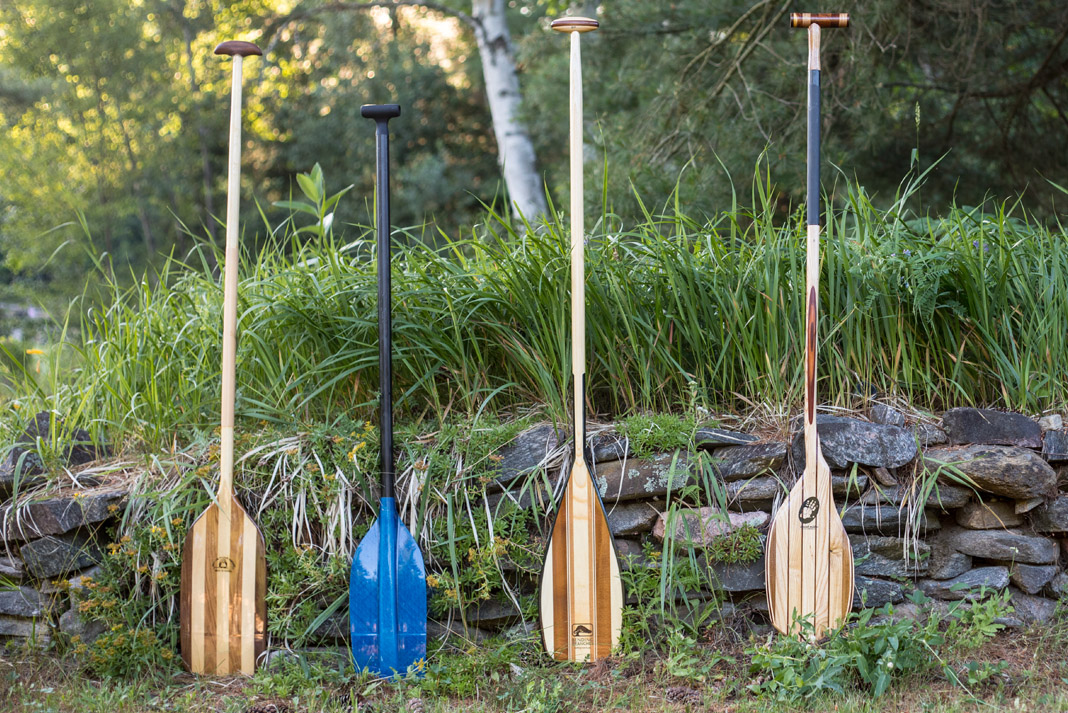
Paddles are hung above mantels in cottages, rested against desks in university dorm rooms and displayed in homes in prominent places once reserved for straight-faced portraits of ancestors. Miniature canoe paddles are crafted into coat racks and I’m sure paddles are the most popular canvas for aspiring wood carvers and painters of snowy chickadee scenes. Putting together the new Paddle Buyer’s Guide for the Summer 2003 of Canoeroots, I wondered how the paddle became a symbol worthy of a spot on the livingroom wall or a knitted carrying case.
NOT JUST TOOLS TO GET DOWN THE RIVER
I called Jeremy Ward at the Canadian Canoe Museum and asked him whether the voyageurs lovingly cherished their paddles. Jeremy said nobody’s entirely sure, but he suspects that the men who opened the country didn’t knit themselves paddle socks. In official documents and journals, references to paddles are conspicuously missing. When a new voyageur signed on with the Northwest Company he was issued blankets, tumpline, sometimes clothing and often an advance on his wages.The equipment inventories contain no mention of paddles. It seems that François, Amable, Joseph and the boys had to supply their own paddles and in those days that meant making their own. Likely, paddles were chopped from a nearby tree, another chore in the daily 15-hour grind of moving furs. Jeremy and I agreed that tracing the origin of paddle nostalgia was worthy of a larger study, a doctoral thesis perhaps.
Canoe paddles are not only tools to propel us across lakes and down rivers. Hanging on walls they float us on memories—summer camp, grandmother’s cottage or a campsite shared with a close friend.
In university a friend of mine designed a simple tattoo with two paddles crossed, like the bats on a little league baseball cap, and under the crossed paddles were three words. I don’t know if he ever got the tattoo, but the words are burned into the hearts of every canoeist who hangs her paddle on the wall or carries his paddle in a sheath:
Swords of Freedom.
This article first appeared in the Summer 2003 issue of Canoeroots Magazine. For more great content, subscribe to Canoeroots’ print and digital editions here.


 This article first appeared in the Summer 2003 issue of Adventure Kayak Magazine. For more great content, subscribe to Adventure Kayak’s print and digital editions here.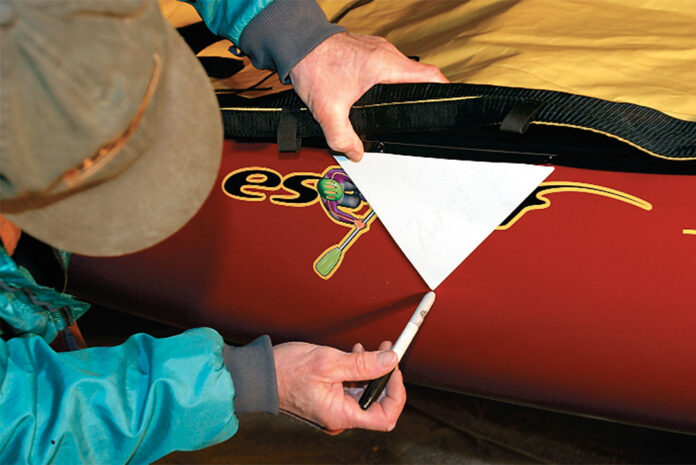
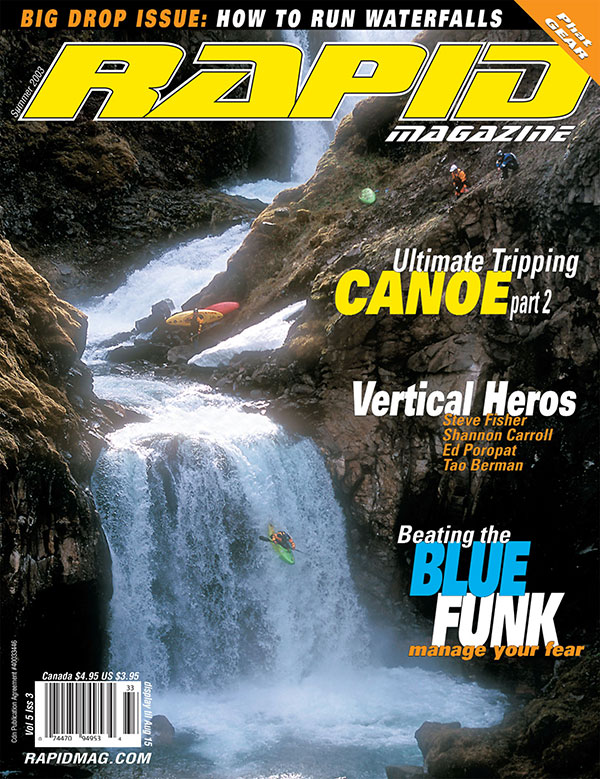 This two-part article was first published in the Early Summer 2003 and Summer 2003 issues of Rapid Magazine. It was republished in part in the Spring 2008 issue of Canoeroots Magazine.
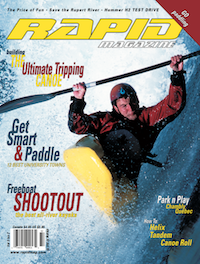 This article first appeared in the Spring 2003 issue of Rapid Magazine.
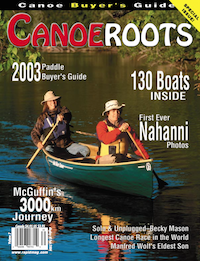 This article first appeared in the Summer 2003 issue of Canoeroots Magazine. For more great content, subscribe to Canoeroots’ print and digital editions






