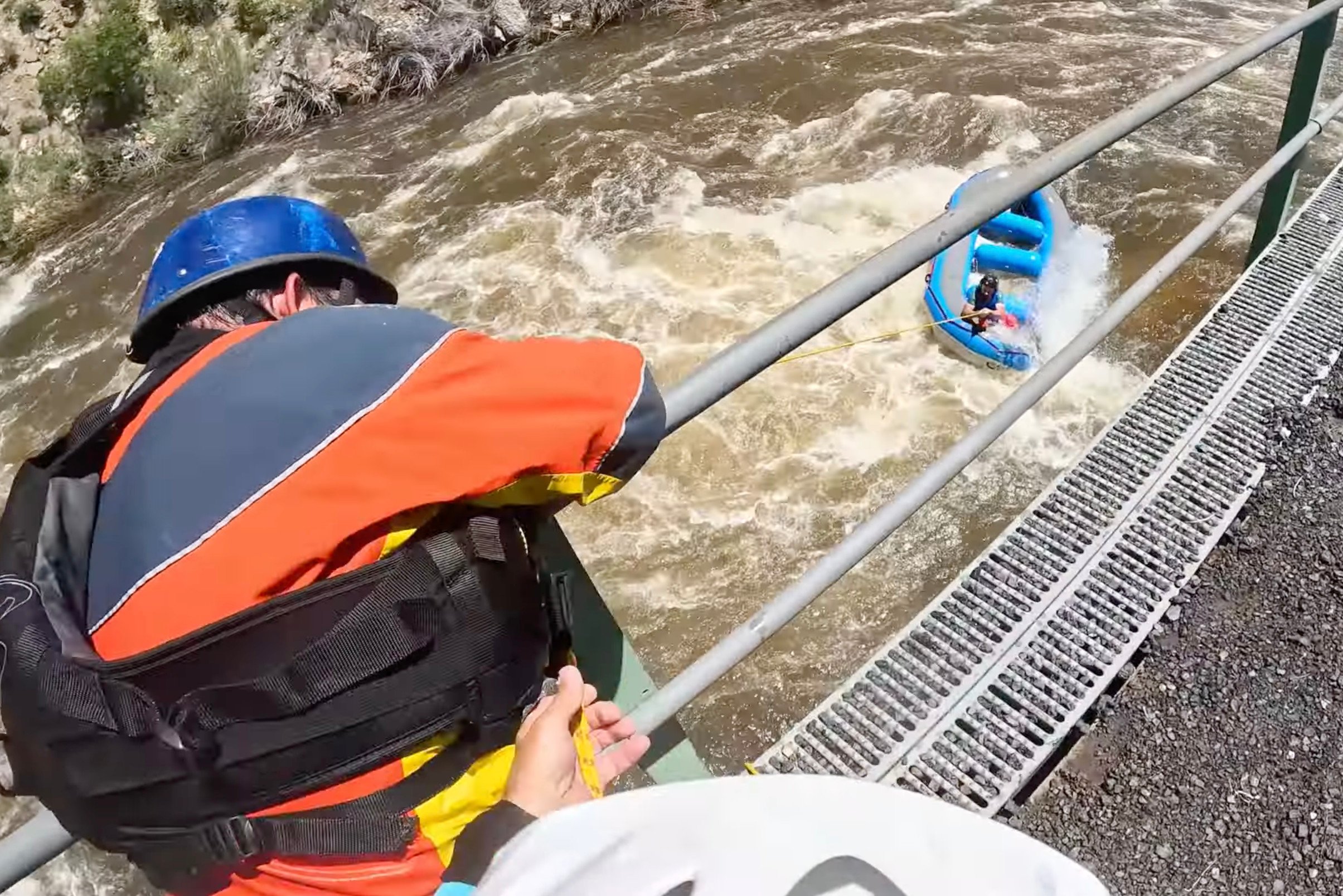
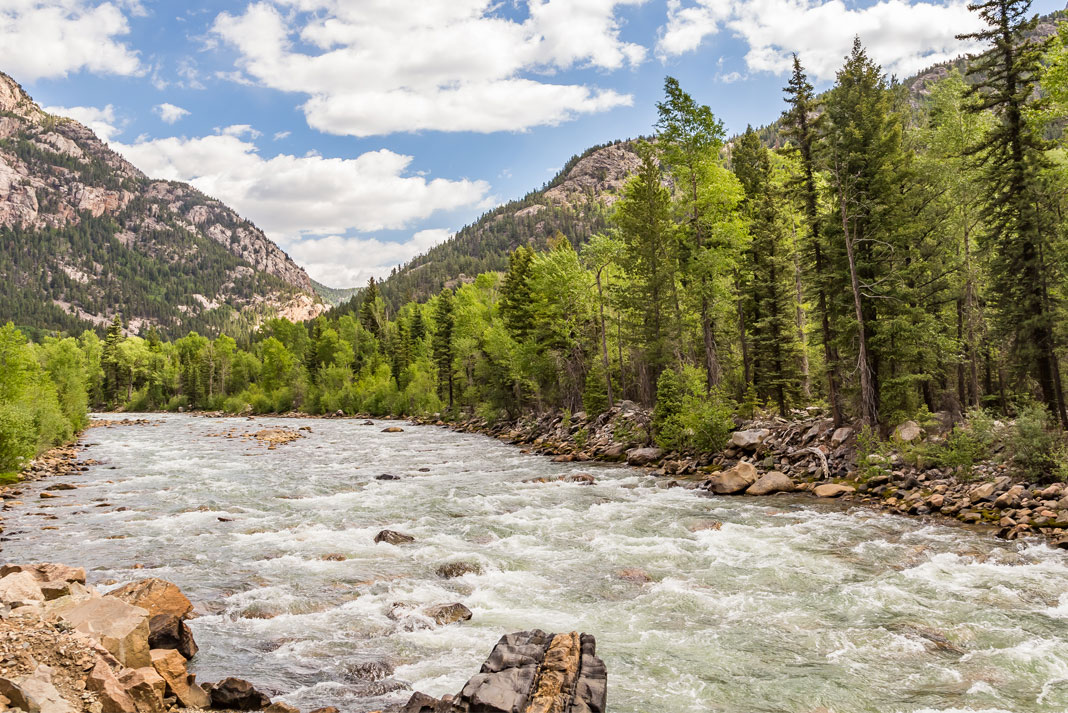
Wade Harrison was cruising down the swollen Eagle River in Colorado when he spotted a raft being surfed in a sticky hole at the top of Trestle Rapid. The raft wasn’t unoccupied though. A lone paddler was clinging to the boat. Harrison called out to the rafter, then quickly jumped into action to rescue the man from the hydraulic.
The lower Eagle River is generally considered a class II-III run. But Colorado’s summer snowmelt can easily turn up the dial. An increased water level can change the character of a stretch. At any level, Trestle is one of the most challenging rapids on the Lower Eagle, marked by the low railroad bridge. With higher flows, a vicious hydraulic hides just off the center bridge pillar.
You have to give the stranded paddler credit. While going for the rodeo ride of his life, he is able to clearly articulate his status to Harrison. The man in the raft states he is the least experienced in his group and doesn’t know what to do.
Image: Wade Harrison | YouTube
How kayakers rescued rafter from hydraulic
Harrison walks out onto the railroad trestle which does not appear to be in active use. There he joins a kayaker who has thrown a rope down to the raft. They attempt to pull the boat from the hole, but the rafter is unable to hang on to the line. A group congregates on the trestle, including paddlers from the raft.
They throw the rope down to the rafter again. This time, Harrison lowers a carabiner on the line and instructs the rafter to clip the loop at the end of the throw bag to the raft. They walk the line across the bridge, moving the raft laterally toward the corner of the hole.
As the boat comes free, Harrison mentions to the others on the bridge that they will try to use the momentum of the taut line to swing the raft to their side of the river. He also acknowledges they may have to let the raft go to run the rapid. The current begins to pull the raft downstream. Being caught between a rope and an object, or wrapping a rope around your hand or a part of your body is extremely dangerous in a water rescue. Harrison yells to the fellow belayers to let go of the line to avoid anyone being injured. All goes well, and the relieved, and likely exhausted, rafter is soon reunited with hard ground.
It’s worth noting the rafters in the video appear to be wearing just shirts and board shorts on the river, which is not the best way to dress for cold water paddling. Although Colorado summer days can be warm, the water temperature of the Eagle River in June fluctuates between just 40 to 50 degrees Fahrenheit. Being submerged in the cold water without a drysuit or wetsuit can easily lead to hypothermia as well as impair your abilities to run a rapid or perform a rescue.
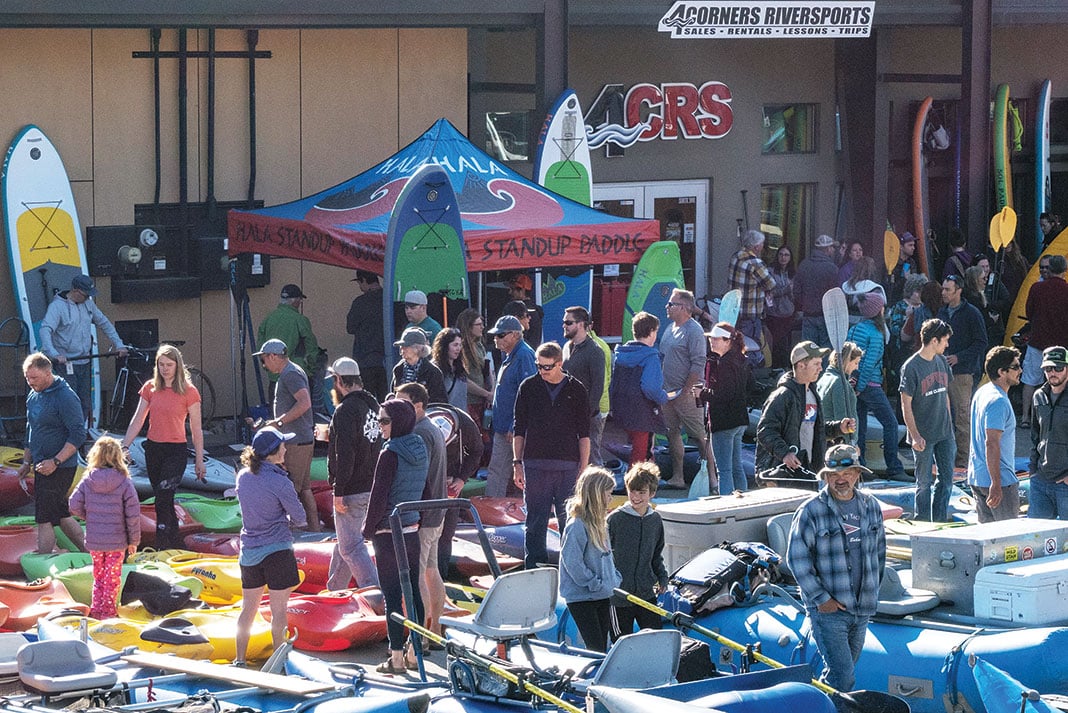
The annual Animas River Days festival brings together a river community spanning four states. | Feature photo: courtesy 4Corners Riversports
Four decades is a long time in any business, let alone paddlesports retail. 4Corners Riversports in Durango, Colorado, hit the milestone this spring and is celebrating 40 years of helping paddlers get on the water. Throughout it all, they’ve learned what’s worked and what hasn’t, all while keeping their focus on making the buying process fun, affordable and informative.
Milt and Nancy Wiley founded the store on the banks of the Animas River in 1983, and sold it to Andy Corra in 1998. Tony Miely came aboard as co-owner in 1999, with Matt Gerhardt joining the ownership team in 2007 and Ashleigh Tucker signing on in 2008.
The foursome has since guided the business through bust, boom and Covid-19. They’re still here and thriving because they’ve been able to roll with the ebb and flow of paddlesports retail, Miely says.
“We’ve seen a lot of changes to the paddlesports market over the years and have tried our best to grow and adapt with them,” he says. “We’ve been pretty good at getting in front of various trends, developing our website early on and growing our online store and presence.”
The annual Animas River Days festival brings together a river community spanning four states. | Feature photo: courtesy 4Corners Riversports
Paddling has changed dramatically over the years, but for 4Corners it all comes back to running rivers. A big key to the company’s enduring success, he adds, is salespeople with real-world experience and a genuine love of rivers. “They’re the ones on the front lines interacting with your customers,” he says.
Outdoor retail is evolving
It’s been fun, but it hasn’t always been easy. Like many in the retail outdoor game, 4Corners has dealt with everything from staffing and supply bottlenecks to poor water years and changing consumer habits. They’ve also chased some trends they’ve since had to curtail.
“We’re seeing a decline in SUP sales as the market has become saturated and the used market has grown,” Miely says. Other segments have held strong. “Fishing craft have been selling well, with manufacturers putting significant effort into new designs, and whitewater has come back a bit with designs that are more approachable to newer paddlers.”
Sun protection is a hot seller in the arid 4Corners region, especially in the rafting market. “We move a lot of our Coyote Raft Biminis since we have so many good desert floats in our area,” Gerhardt says. “Smaller rafts are also popular because they’re more convenient for day trips than big 14- or 16-foot expedition rigs.” His top pick for hottest new product? The Dagger Nova playboat, followed by Alpacka packrafts.
“Packrafts are selling really well for us, and they’re leading to more people taking up paddling and even buying hard-shells,” he says. While some people buying packrafts come from rafting or kayaking backgrounds, a healthy contingent come from sports like climbing and even bikepacking.
All this has allowed 4Corners to maintain steady growth, despite a post-Pandemic slowdown. “It’s become more challenging, but we expanded our store last year and are feeling good about our growth,” says Miely. The expansion included a revitalized paddling school, which has enhanced storefront sales. “We teach hundreds of people every year and try to keep our class prices affordable to bring more people into the sport,” he says. “Sometimes they buy new gear online after their class, but usually they come into the store because we’ve created that relationship with them.”
“In a world full of Backcountry.coms, it makes all the difference to have staff with real-world experience and a passion for the sport.”
– 4Corners Riversports co-owner Matt Gerhardt
The benefits of brick and mortar
Operating a brick-and-mortar storefront isn’t getting any easier, but it remains the core of the business. “Our website drives a good chunk of in-store foot traffic these days,” Miely says. “A lot of people walk through the door who have already pre-shopped our website, but they still want to come and have that tactile retail experience. They want to see, and touch, and try things on, and ask questions. That’s not possible if you’re shopping solely online.”
Online and in-store sales feed off one another, like kayakers in a playboat lineup. “It’s hard to quantify because so many customers use both our website and showroom for a hybrid shopping experience,” Gerhardt says.
Adds Miely: “Our industry is a tough one to be run fully online—people want to sit in a kayak, paddle a SUP and build out their raft frame.”
4Corners Riversports provides that, along with rentals and a kayak school, all staffed by folks who genuinely love rivers. That combination has endeared them to customers spanning their namesake Four Corners region.
The annual Gear Swap weekend brings a flood of business to 4Corners each fall. | Photo: 4Corners Riversports
“They’ve built an amazing paddling community over the past 40 years,” says longtime Durango local and world champion slalom racer Kent Ford. “They embrace every aspect of paddlesport, from helping grow the local whitewater park and creating new access points on the Animas to family rafting, SUP rentals on the local lake and kids’ paddling programs that invest in the future,” he says. “The sign over their door says it all: Attitude-free since 1983.”
4Corners Riversports rang in their 40th season with a gala anniversary celebration during their annual gear swap weekend. The party featured two bands, a cast iron cooking competition, free beer, and hundreds of river runners, old and new. Looking ahead to the next 40 years, Gerhardt says they’ll stick with what got them here: First-rate customer service and an unwavering focus on what they do best. “While we all love other sports, river running is really the core of what we do and know, so focusing solely on paddlesports has helped us thrive for four decades,” he says. “That, and employing people who love and know paddling. In a world full of Backcountry.coms, it makes all the difference to have staff with real-world experience and a passion for the sport.”
This article was first published in the 2024 issue of Paddling Business. Inside you’ll find the year’s hottest gear for canoeing, kayaking, whitewater and paddleboarding. Plus: how to beat the big box, robotic kayak rentals, building the Paddlesports Trade Coalition and more. READ IT NOW »
The annual Animas River Days festival brings together a river community spanning four states. | Feature photo: courtesy 4Corners Riversports
First the forward stroke, then the world. Kayak cross will have its Olympic debut this summer in Paris. | Feature photo: Balint Vekassy
I am a big fan of racing. So, of course, I’m excited kayak cross will be appearing at the Paris 2024 Summer Olympics. It’s the newest addition to the Olympics whitewater events lineup.
The secret key to kayak cross success at the Olympics
If you’ve somehow escaped the most exciting news in the slalom community in the last decade, here’s what you need to know about kayak cross: Four paddlers descend an elevated ramp in identical plastic kayaks and race each other down an artificial course. There are a maximum of six downstream gates and two upstream gates. All athletes are required to complete a roll in a defined area. Collisions ensue. It’s all over in about a minute.
Fast, fun, chaotic and more television-friendly than traditional slalom events, which feature one paddler on course racing the clock. There’s a lot of potential to turn kayak cross’ Olympic debut into a wider phenomenon for recreational paddling worldwide.
First the forward stroke, then the world. Kayak cross will have its Olympic debut this summer in Paris. | Feature photo: Balint Vekassy
The thing with kayak cross, and the more loosely structured boatercross—which is focused simply on getting down the river first, gates be damned—is that the fastest paddler wins. Self-evident, perhaps, and difficult to argue. But watch any of the Pan American Games kayak cross-qualifier runs or the North Fork Championship BoaterX finals, and it is immediately apparent the winning paddlers just plainly have a stronger and more precise forward stroke than the fourth-place paddlers.
Success hinges on a simple technique
Yes, the forward stroke. The very thing most of us spend exactly three minutes learning our first time in a kayak before we move on to the so-called real parts of kayaking whitewater. While the forward stroke is a technique most river runners are lazy about improving, it’s a technique World Cup slalom paddlers spend their lives perfecting.
I predict a convergence between the slalomers’ kayak cross and the downriver boatercross in the near future. And the slalom paddlers will clean up. Easily.
It reminds me of the early days of mountain bike racing when European and North American racing styles collided in the first world championships in Durango, Colorado, in 1990. The two styles had developed independently of one another. The North American mountain biking scene was more focused on the thrill of freeriding, whereas the European scene was more influenced by traditional cycling disciplines and related technical skills. The Euros definitively stomped it in the competition. It was a bit of an outrage at the time that they stole our sport out from under us. Still, it was a defining moment for mountain biking, and it birthed a fusion of the styles evolving the sport.
Mountain biking became an Olympic event in 1996. Since then, a North American man has never won an Olympic medal in mountain bike, and the female list has just a sprinkling of hometown silvers and bronzes. I think the same future awaits North American kayak cross athletes if our competition culture does not rise to support the dedication and precision required of these individual sports.
Beyond the forward stroke
Like I said, I am a fan of racing and see immense value in the pursuit of competition regardless of winning. If kayak cross motivates recreational paddlers to take up training and strive for mastery of the sport, it will be a net gain. If it motivates local clubs to organize races on class III rivers, I’m all in. I have experienced competition as a community builder, a great excuse to travel and a social outlet.
My fear is North Americans will write kayak cross off like we did Olympic whitewater slalom and like we did with mountain bike cross-country racing. These events are seen to belong to someone else and, therefore, only marginally accessible even to those interested in pursuing them. But I hope many others will be inspired to geek out on technique and the forward stroke. By embracing a more competitive and skills-focused mentality here in North America, kayak cross could take us someplace new and grow into something much bigger than just finding out who can go fastest.
Jeff Jackson is a risk management consultant and professor of outdoor adventure at Algonquin College. Alchemy first appeared in the Summer 2000 issue of Rapid.
This article was first published in the Spring 2024 issue of Paddling Magazine. Subscribe to Paddling Magazine’s print and digital editions, or browse the archives.
First the forward stroke, then the world. Kayak cross will have its Olympic debut this summer in Paris. | Feature photo: Balint Vekassy
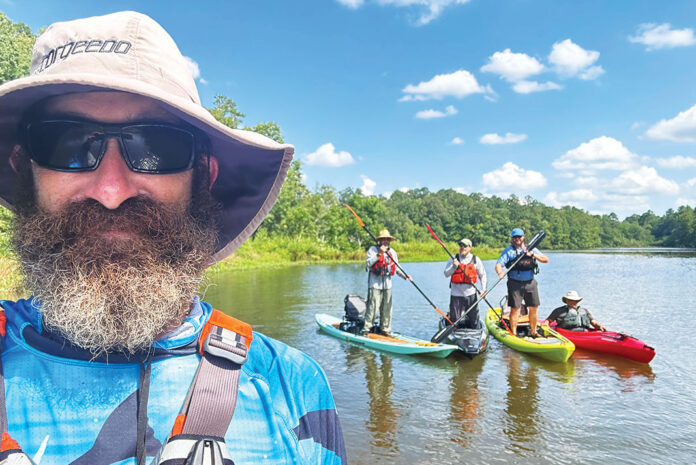
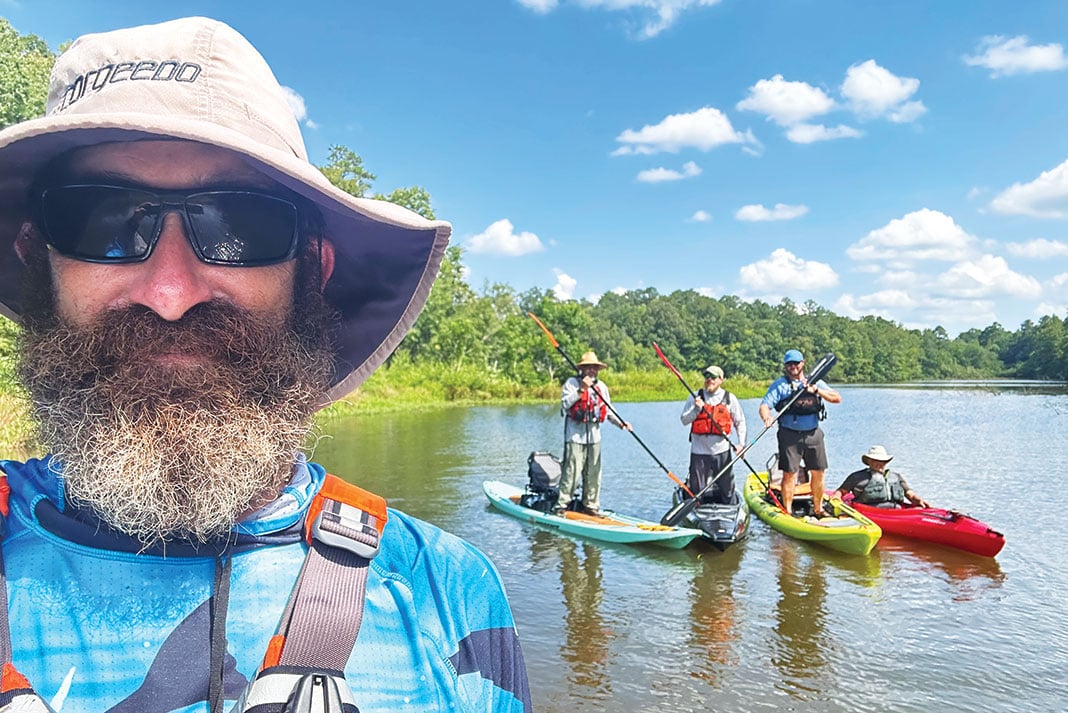
The gang’s all here: Chuck Earls of Lake Erie Kayak Fishing with Geoff Luckett, Fletch Griffin, Jake Vitak and Tony Narcisse. | Feature photo: Chuck Earls
Kayak fishing has been the fastest-growing segment of paddlesports for years, and today there are somewhere between five and 15 million kayak anglers in the United States. By some estimates, that’s more than sea kayaking, whitewater kayaking and canoeing combined. Kayak anglers are everywhere these days, and they also show up disproportionately in the U.S. Coast Guard’s annual boating accident and fatality reports.
Kayak anglers go out year-round, in all conditions, with limited training and information about paddling. They often fish alone and at night, and they paddle straight to the hazards, because that’s where the fish are. Furthermore, everything an angler does, from casting to changing tackle to netting a fish, has the potential to put someone off-balance in a paddlecraft.
Simply put, the odds are stacked against them, yet until the American Canoe Association (ACA) worked with leaders in the kayak fishing community to create a new fishing curriculum, there was no nationwide safety training program tailored to kayak anglers and the unique risks they face. The ACA launched the fishing curriculum in 2022, including a credential that any ACA instructor certified to teach kayak or standup paddleboard can earn to teach courses specifically designed for paddlesports anglers.
Kayak fishing instruction takes off
While the ACA brings more than a century of paddlesports training to the table, the ACA Southeastern regional leaders who spearheaded the new program say it was only possible thanks to expert and enthusiastic input from the kayak fishing community—in short, anglers looking out for other anglers.
“This partnership between ACA and the kayak fishing community to address safety and training is the perfect marriage,” says Tennessee Kayak Anglers founder Geoff Luckett, an ACA river kayaking instructor and coauthor of the new Paddlesports Angler Instructor Endorsement criteria and curriculum. “It brings credibility to the program.”
The gang’s all here: Chuck Earls of Lake Erie Kayak Fishing with Geoff Luckett, Fletch Griffin, Jake Vitak and Tony Narcisse. | Feature photo: Chuck Earls
In August 2023, the program passed a big milestone, certifying leading kayak anglers as ACA kayaking and kayak fishing instructors. Across three instructor classes offered by ACA Tennessee and Georgia River Network, 29 candidates received various ACA instructor credentials, with 11 of those also earning the fishing endorsement.
Mixed in with grassroots instructor candidates, these classes also drew some of the biggest names in kayak fishing. Jameson Redding, host of the popular Road Trip Angler television show, earned his ACA river kayaking instructor certification after more than 13 years in the kayak fishing game. “I got into kayak fishing for the fishing part of it, not necessarily for the kayak part of it,” Redding says. “That meant I had a big learning curve to learn to be a better kayaker so I could be a more successful angler.”
“Everything an angler does, from casting to changing tackle to netting a fish, has the potential to put someone off-balance in a paddlecraft.”
Redding adds, “When I found out about the ACA’s new kayak fishing curriculum it was really important to me to get certified as an ACA kayak fishing instructor. By learning the tried-and-true instructional techniques I will be able to teach other anglers so they can skip a lot of the trials and tribulations I went through.”
Fletch Griffin, owner of Atlanta-based Westbrook Supply Co., says the class wasn’t just an opportunity to brush up his own skills. He also learned how to teach those skills to people coming into the sport. “When you have been doing something for so long it is easy to forget to explain why something is a best practice,” says Griffin, who earned his ACA kayak instructor certification and the fishing endorsement.
“There really is nothing like this curriculum and this instructor training out there for kayak anglers,” Griffin adds. “It’s important to bring together the basic skills and safety techniques that are unique for kayak fishing so we can effectively share them with new kayak anglers.”
Chuck Earls of Lake Erie Kayak Fishing in Ohio came all the way to Georgia to earn his certifications. “Since I am the safety expert in my area, I thought it was very important to get certified as an ACA kayak fishing instructor so I can help out,” he says.
The involvement of influential kayak anglers in the design of the curriculum and now as certified instructors will be the key to its enduring success. After all, says Redding, paddlesports leaders have more in common than folks may initially realize. “Kayak is in the name—we are kayak anglers. And I wanted to learn how to teach people properly so they can have a better, safer experience on the water.”
And that’s something worth working on together.
Andrea White is a member of the ACA board of directors, serves as ACA Southeastern regional chair and as secretary for the ACA Fishing Advisory Board, and works full-time at the Georgia River Network.
Jeff Little was the first kayak fishing guide to earn ACA instructor certification back in 2001. He currently serves on the ACA Fishing Advisory Board and works as sales manager at Torqeedo. He is also the founder of The Little Stuff kayak fishing channel on YouTube.
This article was first published in the 2024 issue of Paddling Business. Inside you’ll find the year’s hottest gear for canoeing, kayaking, whitewater and paddleboarding. Plus: how to beat the big box, robotic kayak rentals, building the Paddlesports Trade Coalition and more. READ IT NOW »
The gang’s all here: Chuck Earls of Lake Erie Kayak Fishing with Geoff Luckett, Fletch Griffin, Jake Vitak and Tony Narcisse. | Feature photo: Chuck Earls
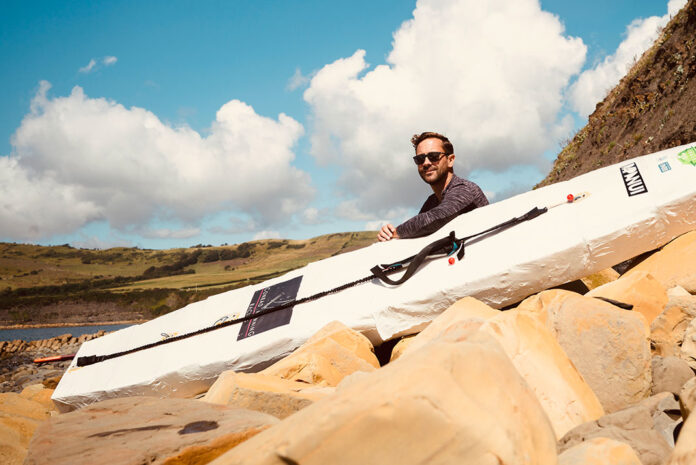
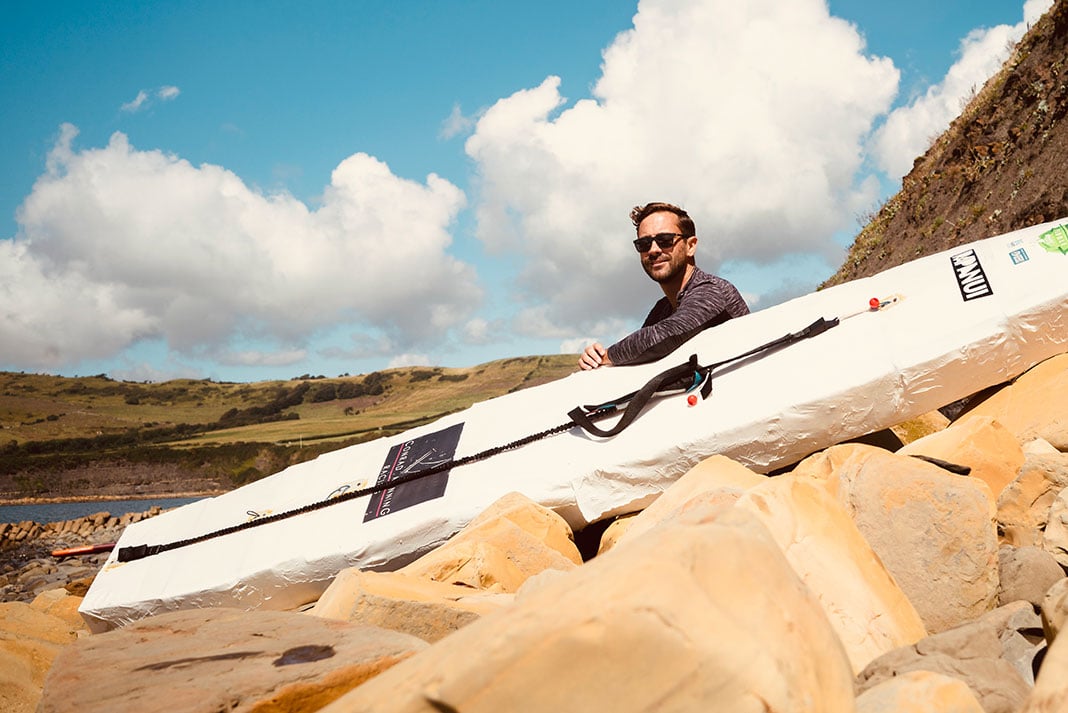
David Haze in Kimmeridge, U.K., with his “horrendous” standup paddleboard made from 100-percent recycled materials. | Feature photo: Courtesy David Haze
It only takes a quick glance at David Haze’s impressive—albeit grueling—schedule to know 2024 might just be his year.
The first six months alone see him paddling the highest lake in England, circumnavigating Fiji’s two biggest islands, tracing the coast of Dorset, tandem paddling across the English Channel, and crossing the Adriatic Sea, which is a feat that will necessitate sleeping on his board. By the year’s end, he’ll have attempted 33 world records in 33 countries over a period of 66 days.
Haze, it seems, is making up for lost time. Less than four years ago he was in prison, serving his second sentence.
“I remember sitting in the cell, just a broken man; a skeleton of who I used to be,” says Haze, who was contemplating suicide at the time. “And I was like, ‘Where did it all go wrong?’”
He found salvation in a stack of standup paddleboarding magazines, which had been sent to him by his mom.
David Haze in Kimmeridge, U.K., with his “horrendous” standup paddleboard made from 100-percent recycled materials. | Feature photo: Courtesy David Haze
Haze had always loved being on the water and by the age of 18, had become a national champion sailor. An addictive personality allowed adventure to drive him—but when he moved to London, it was pushed aside for other addictions, including drugs, gambling and eventually crime.
So, he set an ambitious goal for himself: When he got released, he’d paddleboard the four longest lakes in the U.K., in an attempt to set four world records. Sharing his plans with another inmate who was a personal trainer, he developed an in-house training regime and got to work.
David Haze by the numbers
33: Number of world records Haze will attempt to set in 2024
8: Number of world records Haze has set since his release from prison in 2020
51: Number of months Haze served behind bars
2: Number of world firsts, including first completely carbon-neutral environmental expedition
£15,000: Amount of money Haze has raised for charity
A record-breaking redemption arc
Haze has more than made good on that promise to himself. Since his release in April 2020, he’s set eight records, making him the holder of the most SUP-related records in the world. In 2023, he was named Supconnect’s Man of the Year, as well as Ocean Activist of the Year by Surfers Against Sewage. Haze aims for each of his expeditions to be net-zero, even going so far as to paddle around the Isle of Wight in 2022 on a board made out of rubbish. It didn’t survive the trip and Haze ended up having to wade through the water to finish the last five kilometers. “The board was horrendous,” he says with a laugh.
In addition to advocating for the transformational impact of sport on those who have experienced the criminal justice system, he aligns each of his expeditions to causes he feels deeply connected.
“I owe it to the system to give something back and help other people,” he says.
For example, when he flew to Iceland to paddle the country’s longest lake in 2023, he took an unconventional approach to offsetting the carbon emissions of his trip by having 110 trees planted in a prison yard.
“I wanted to create a green space for the lads,” he says. “Prison can be a toxic place. Now they’ve got a bit of nature to escape.”
Haze’s promise to himself
For Haze, being out on the water has been his own escape. It’s the place he’s been able to reconnect with himself—and remind himself what he’s capable of.
“I’ve learned to deal with my demons when I’m out on that water,” he says. “Every time I undertake one of these massive events, I always want to quit. But it’s persevering and knowing if I come across any difficulties in life off the water, I’ve got the power to deal with that.”
“Prison is my biggest failure in life. But it’s become my biggest success; I remember my lowest point and the promise I made to myself. It’s made me live the life I’ve always wanted to live.”
A film about David Haze’s remarkable life won the best SUP film of the year award at the 2024 Paddling Film Festival. Find a screening near you at paddlingfilmfestival.com.
This article was first published in the Spring 2024 issue of Paddling Magazine. Subscribe to Paddling Magazine’s print and digital editions, or browse the archives.
David Haze in Kimmeridge, U.K., with his “horrendous” standup paddleboard made from 100-percent recycled materials. | Feature photo: Courtesy David Haze
Every right has its responsibilities. | Feature photo: David Jackson
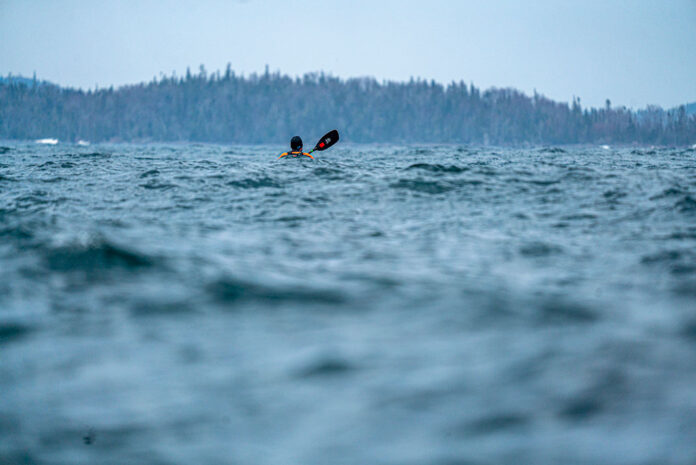
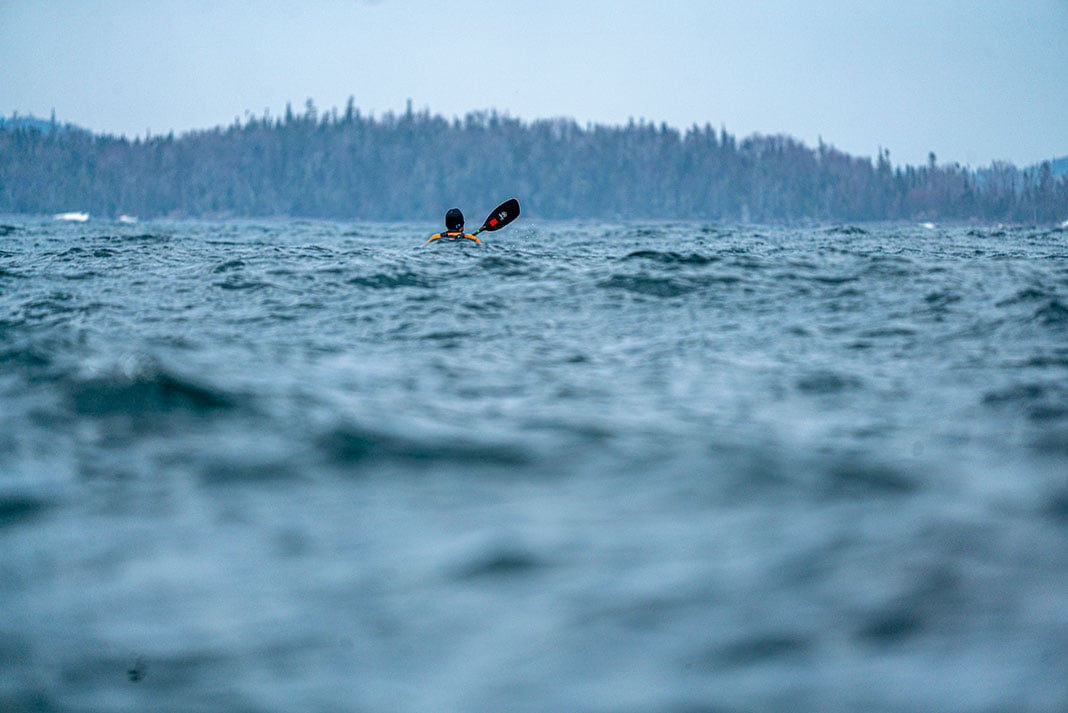
Nearly a quarter of a century has passed since I first apprenticed as a sea kayak instructor with Bruce Lash, a spunky firefighter who was among the first North Americans to earn the British Canoe Union’s vaunted 5-Star Sea award, which is regarded as the most rigorous sea kayak training in the world. Bruce liked to remind paddlers of all skill levels of the harsh, natural consequences of bad decisions on the water. He became especially animated when he launched into war stories of his own close calls, such as the time he ignored his intuition to bail out on an April trip on Lake Superior, then capsized multiple times in a harrowing surf launch from an icy beach and endured a three-hour tow from a fellow kayaker to reach safety through bungalow-sized swells.
Navigating the rising costs of wilderness rescue in an age of quick clicks
Bruce’s tales were always self-deprecating and humble, with the takeaway emphasizing that a paddler’s primary responsibility is sound judgment. Inevitably, as an afterword, Bruce would fetch a beach stick and drop to his knees on a patch of wet sand to draw out the “kayaker’s circles of safety,” which ultimately explained his error. He reinforced that the first line of defense—the outermost ring—was good judgment. From there, concentric circles ranked in order of importance: paddling skills, rescue skills, proper equipment and communication gear, and lastly, the will to survive.
Every right has its responsibilities. | Feature photo: David Jackson
But good judgment doesn’t score views on social media, evidenced by the growing number of hapless adventurers sharing moronic stunts with the world. In one example, New Yorkers Ethan Harold and Ammar Alkassm shocked locals last June by camping on an iceberg in Lobster Cove, near Twillingate, Newfoundland. The pair’s YouTube video depicts the friends’ road trip to The Rock with the goal of doing “something almost unheard of.” They assured the audience that they had “every small measure accounted for” before “rowing” an inflatable swim raft with kayak paddles to an iceberg and “mounting” the football field-sized expanse with ice cleats.
Then, they celebrated their feat with beer and instant noodles and spent the night fretting about polar bears in a pop-up tent that billowed in strong winds. The next morning, the pair’s sense of panic was obvious when the iceberg started breaking up, and they were forced to hastily slide off its surface into the North Atlantic, puncturing their raft with a cleat. Fortunately, they weren’t far from shore. The only upshot of the MTV Jackass-worthy video is that Harold and Alkassm’s channel has attracted fewer than 200 followers.
The dopamine hits of garnering likes on social media aren’t the only way technology is fueling a worrisome trend. Not so long ago, a VHF marine radio was the only option for two-way communication. Sketchy comms placed an immediate priority on solid decision-making and taking the time to hone paddling and rescue skills.
I can still terrify myself by conjuring the image of struggling in cold water, trying to unearth a handheld radio from my kayak’s day hatch, and hoping someone would hear my emergency call through the static of Channel 16. A friend of mine—whom I would describe as a skilled and responsible sea kayaker—perished in this exact scenario on a solo trip on Lake Superior’s Minnesota shore.
New tech brings unintended consequences
VHF marine radios have evolved to become smaller and waterproof, just as satellite messengers like Garmin inReach and SPOT have rendered radios virtually obsolete amongst today’s paddlers. What’s more, reliable cell phone signals now infiltrate once-remote coastlines. In the rare places without cell coverage, the latest iPhone features satellite capability to summon SOS assistance with the push of a button.
Saving your ass in the wilderness is easier than ever, and it seems inevitable that we’re on a fast track to a tragedy of the commons. Across much of North America, emergency rescue by the Coast Guard, military, national parks and volunteer organizations is generally offered free of charge—regardless of the poor decisions and sheer ignorance of paddlers, hikers and backcountry skiers. Emergency professionals would have risked their lives, and taxpayers would have footed the bill had Harold and Alkassm called for rescue.
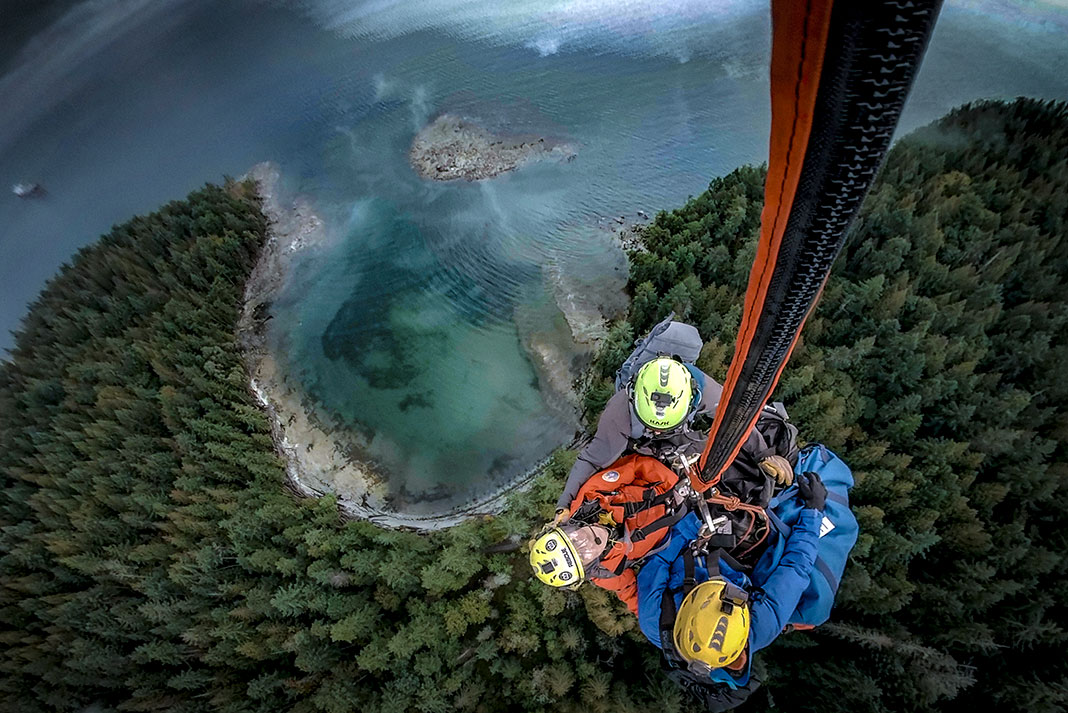
“Having a phone or satellite device increases people’s comfort. It’s the easy button,” says John Blown of North Shore Rescue (NSR), a volunteer search and rescue organization in North Vancouver, B.C. “That never used to exist. It used to be that if you got injured in the backcountry, you were in a lot of trouble.”
“Having a phone or satellite device increases people’s comfort.
It’s the easy button.”
– John Blown
Blown still stands behind the tradition of free rescues because victims may be discouraged from calling for help for fear of incurring costs. Delays can increase the risk to the subject and rescuers, and ultimately cost more, Blown says. Yet, the growing popularity of outdoor recreation and communications technology means NSR is busier than ever, responding to over 200 calls in 2021, compared to less than 40 in 1995. It’s a similar story with search and rescue teams across North America.
Weighing in on the iceberg campers, Canadian professional adventurer Will Gadd took a different tack, arguing the societal costs of risky behavior in the outdoors are still negligible compared to the strain of unhealthy lifestyles on public health care. “It’s like heart disease and depression. All that is very expensive,” Gadd told CBC. “I don’t really buy that argument on a cost basis.”
However, taxes also help compensate for the costs of vices like smoking and drinking. Some experts suggest it’s time for mandatory rescue insurance for backcountry users, the likes of which mountaineers must possess to do an expedition on Mount Everest. This may sound logical to some, but I find the contrast between insurance and the freedom of outdoor adventure deeply jarring. What about simply remembering the fundamental importance of taking responsibility for one’s actions? The best pathway to such an attitude might start with war stories and circles drawn in the sand.
Conor Mihell is a longtime contributor to Paddling Magazine. He kayaks on Lake Superior and paddles wild rivers in wood-canvas canoes.
This article was first published in the Spring 2024 issue of Paddling Magazine. Subscribe to Paddling Magazine’s print and digital editions, or browse the archives.
Every right has its responsibilities. | Feature photo: David Jackson
Don’t miss following along on some of summer’s most exciting expeditions. | Feature photo: Colin Field
Summer is expedition season for paddlers in the Northern Hemisphere, and many of this year’s biggest journeys take advantage of the long daylight hours of the Far North. We’ve got our eyes on several sea kayak, canoe and SUP expeditions in 2024, including a logistically overwhelming west-to-east transit of the Canadian high Arctic and the final days of a Newfoundlander’s incredible year-long mission across eastern Canada. We’re also drawn to more modest yet inspirational sojourns: an attempt at a Mississippi speed record and paddling inquiries into folk music and art.
Expedition AKOR team members Nicolas Roulx and Catherine Chagnon at the beginning of the six-month-long cycling, canoeing and sailing journey. | Photo: Expedition AKOR Facebook
1 Expedition AKOR
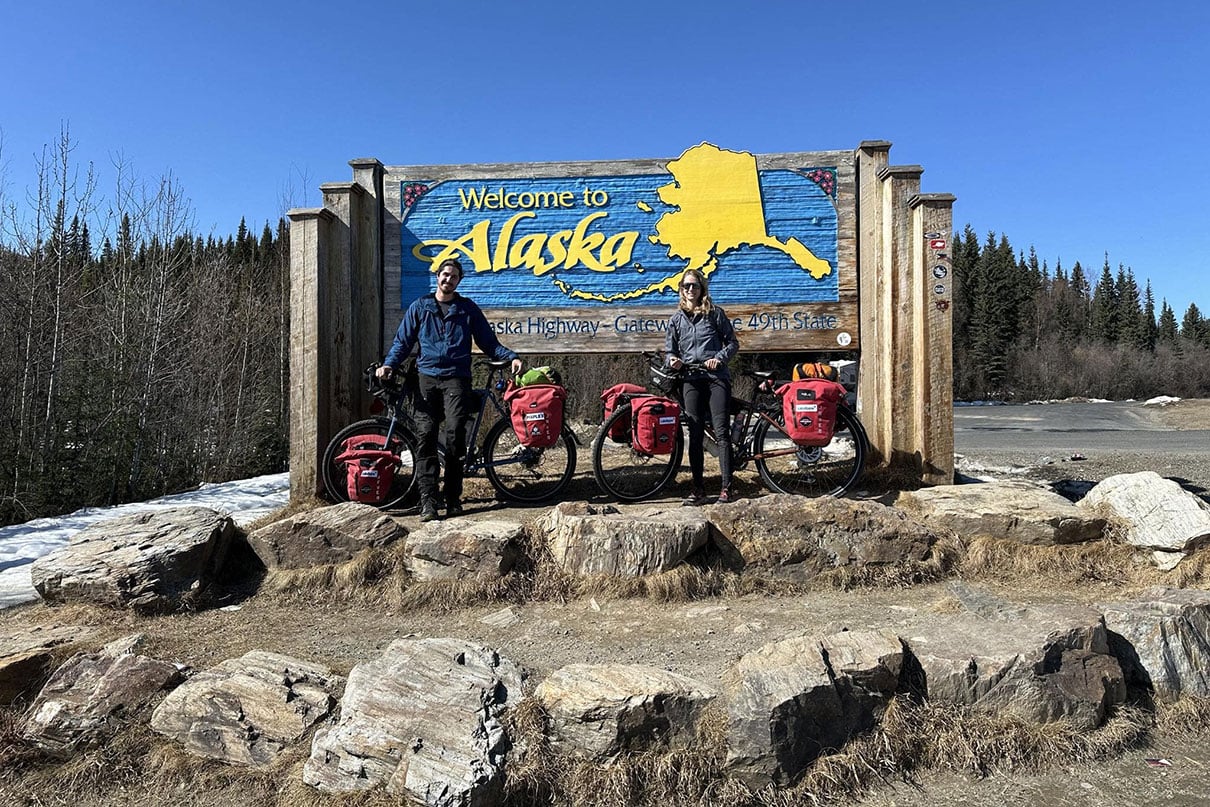
Six friends from Quebec launched the first Expedition AKOR back in 2018, canoeing the George River in northern Quebec and around the Torngat Mountains on the Labrador Sea as part of an impressive 65-day venture. Then, in 2021, the team skied, paddled and cycled from Baffin Island to the southernmost point on Canada’s Lake Erie. Now, the AKOR crew is back in 2024 with a multistage expedition. Earlier this spring, one group started traveling east, cycling and canoeing from the Yukon-Alaska border to Great Slave Lake and across the Barrens of the central Arctic to Baker Lake on Hudson Bay. Meanwhile, as the Arctic pack ice gives way to open water, a sailing crew will set off from the Maritimes, meeting the paddlers and then sailing across the Hudson Strait to Baffin Island. The expedition concludes with a traverse of Auyuittuq National Park by foot. As of late June, the team was well into paddling across the Northwest Territories, headed for Nunavut. Keep tabs on their progress using the Live Tracker on the Expedition AKOR website.
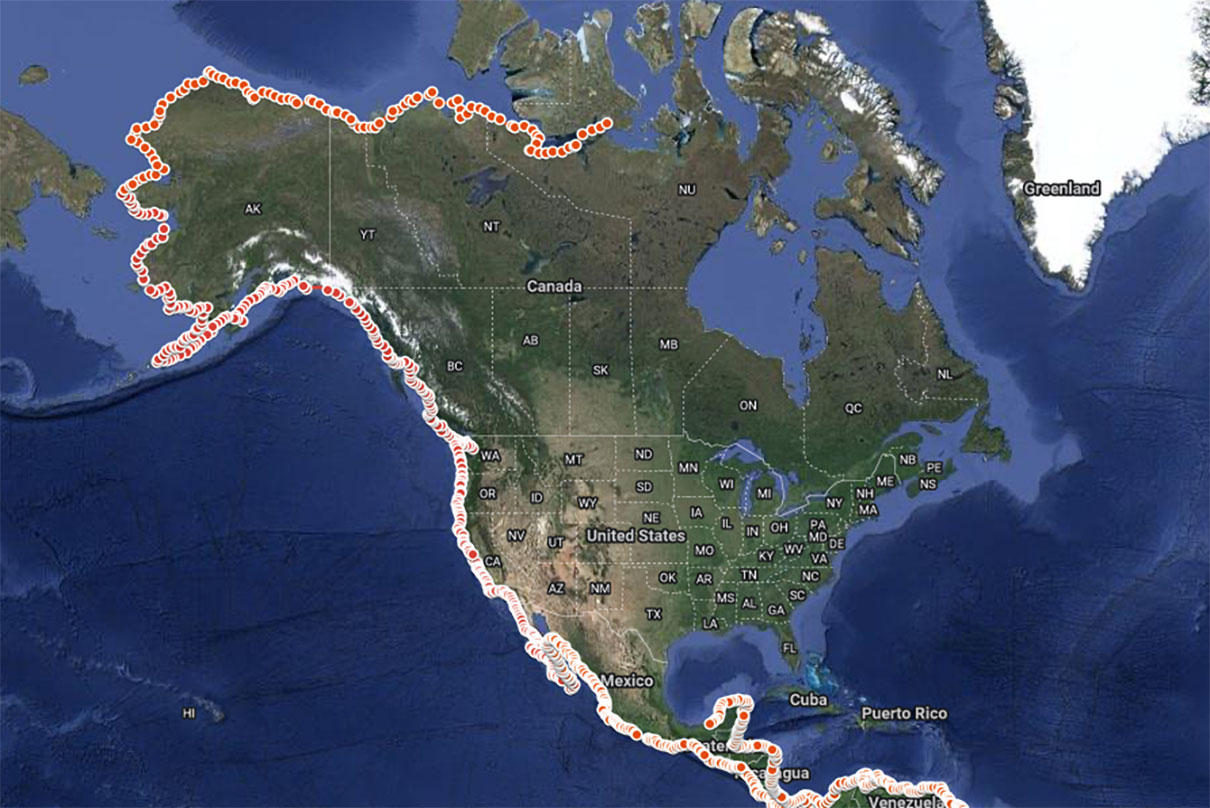
Screencap of Freya Hoffmeister’s map of her progress on her multiyear expedition around North America. | Photo: Freyahoffmeister.com
2 Freya continues
If you’ve spent any time following expedition sea kayaking over the past 20 years, it should come as no surprise that legendary uber paddler Freya Hoffmeister is still paddling around continents. The German is currently chipping away at the monumental goal of circumnavigating North America. She started the expedition in 2017 and has tackled the journey in chunks, alternating between southern coastlines in the winter months and northern areas in the summer, traveling solo and with various partners. She’s back in the Canadian Arctic this summer, tracing the Northwest Passage east from the community of Cambridge Bay. Hoffmeister maintains a detailed expedition log on her website.
3 Expedition Northeast wraps up
Newfoundland adventurer Justin Barbour is poised to complete a year-long, 3,800-km expedition from the community of Puvurnituq on Hudson Bay, across northern Quebec, Labrador and the Strait of Belle Isle, and finally a north-to-south transit of the Rock. The journey has involved canoeing, backpacking, bikepacking and travel by snowshoe and toboggan, as well as a 20-km crossing of the mouth of the Gulf of St. Lawrence by open canoe. You can keep track of Barbour on Facebook and watch for plenty of content to follow on his Youtube channel.
This summer Memorial University outdoor educator TA Loefler will sea kayak “All Around the Circle,” from Fogo to Twillingate and Moreton’s Harbour. | Photo: Marian Wissink
4 Paddling a Newfoundland folk song
Memorial University outdoor educator TA Loefler is dipping her paddle into the classic Newfoundland folk song “I’s the B’y” in a 250-km, three-week sea kayak expedition amidst Newfoundland’s northern islands. The objective of the journey is to take a deeper dive into the cultural significance of this catchy tune, as well as highlighting the Rock’s “vibrant geography, traditions, music and people.” Follow the All Around the Circle expedition on Loeffler’s website. She departs in mid July.
Devin Brown, 38, set out to be the first Black woman on record to paddle what she calls the “Nile of North America,” from Lake Itasca in Minnesota to the Gulf of Mexico. | Photo: Courtesy Devin Brown
In late May, Minneapolis-based sea kayaker and mom Devin Brown launched at Lake Itasca, Minn, and set off on an attempt to break the speed record for paddling the length of the Mississippi River. Brown attempting to complete the 3,770-km journey in less than the current record of 55 days. More importantly, as the first Black person on record to make a complete source-to-sea journey, she’s doing the expedition to inspire other Black, Indigenous and People of Colour to discover the joys of outdoor adventure and the freedom of paddling. Get updates on her progress on Instagram and read more about Devin Brown’s Mississippi River expedition here.
6 Great Slave Lake circumnavigation
This summer, sea kayakers Robert Stair and Shelley Ross will paddle around Great Slave Lake in the Northwest Territories in an expedition supported by the Royal Canadian Geographic Society. The pair’s goal is equal parts inspirational and artistic: to show that “seniors” aged 73 and 68 can tackle big wilderness expeditions and to capture the cliffs, gravel beaches and unique ecology of the planet’s 10th-largest and North America’s deepest freshwater lake through Ross’s watercolour art.
Don’t miss following along on some of summer’s most exciting expeditions. | Feature photo: Colin Field
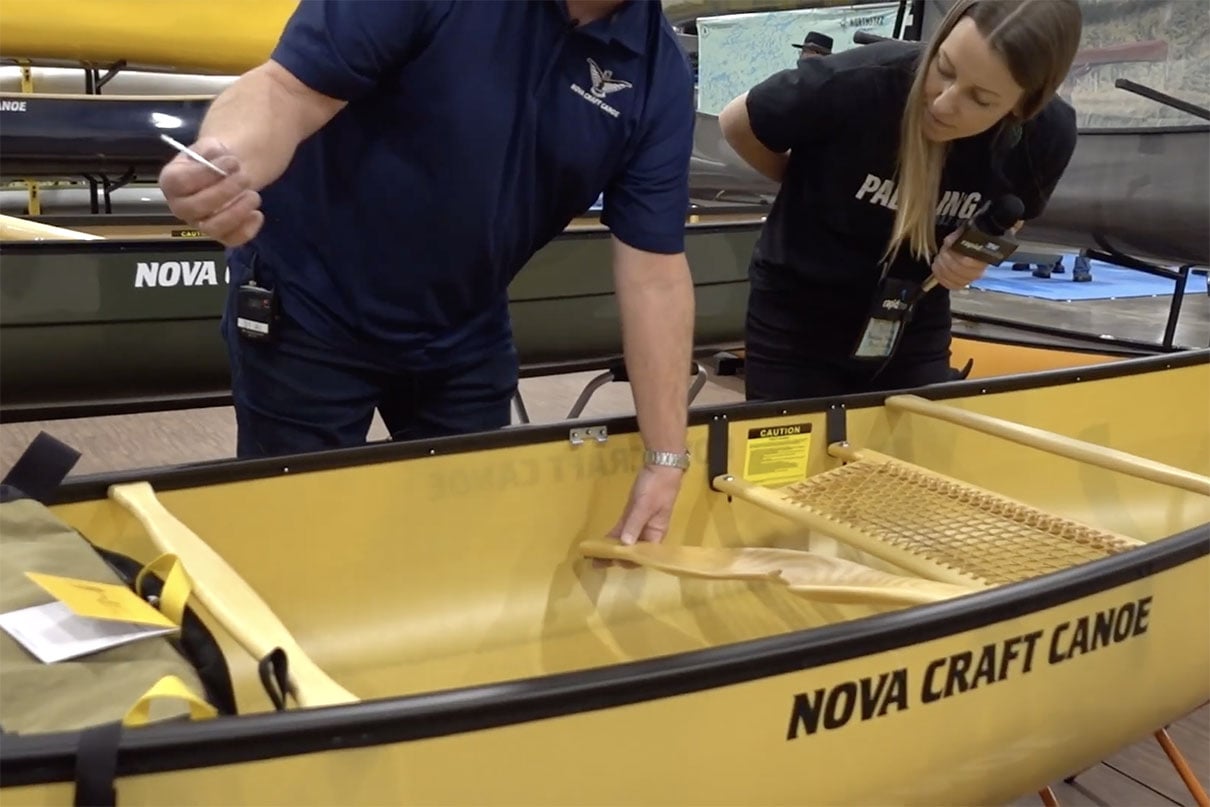
This might be Nova Craft’s most versatile solo canoe yet. The new Prospector 14 is a scaled-down version of Nova Craft’s popular Prospector and is best suited for solo backcountry adventures.
The Paddling Magazine team caught up with Steve Procunier, sales director of Nova Craft Canoe, at Canoecopia 2024 to discuss this new model.
“Prospectors have always been our best series of boats,” said Procunier. “We have them available in 15, 16, 17 and 18 feet. This year, we decided to come out with the 14-foot model.”
The new Nova Craft Prospector 14 comes with a handy removable yoke.
The display model featured at Canoecopia was made of Aramid Lite and weighed 35 pounds.
“We’ve done a removable yoke; just a matter of popping the hinge out; you can take the yoke off when you’re not carrying it and then throw it back in for later on,” Procunier added.
The Prospector 14 promises to be efficient on flatwater while maintaining capacity. It features a symmetrical hull with moderate rocker.
“You can kneel in this canoe if you want; you can sit, whatever you prefer. It’s a very stable canoe, nice and wide with lots of depth. If you want to throw in the back fishing rods, you can put a small dog in here, a large dog. It’s just a beautiful canoe. If you want to get away for the weekend, throw it on the roof of your car, it’s nice and lightweight and easy to throw around on your shoulders,” added Procunier.
Depending on your preference, the wooden bench seat can be ordered hung flat or angled. The Prospector 14 is available in five different materials and weights ranging from 35 to 50 pounds.
Beloved wilderness canoeing community member and custom gear manufacturer Dan Cooke passed away on July 1, 2024. | Feature photo: Bryan Hansel / paddlinglight.com
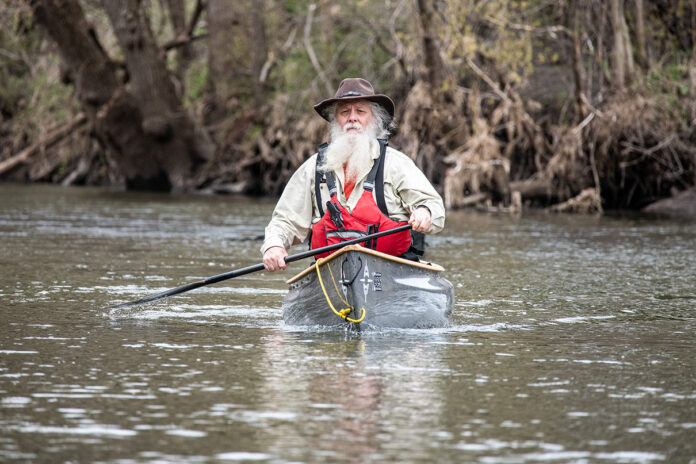
Wilderness canoeing enthusiast and outdoor gear maker Dan Cooke has paddled around his final bend on the river. Cooke was 68 when he passed away from brain cancer on July 1, 2024. Cooke, who founded Cooke Custom Sewing in Lino Lakes, Minnesota, was known as “Minnesota’s gear guy” and inspired countless paddlers with his adventures, custom gear, passion for the outdoors and generosity as a mentor and friend.
Wilderness canoeing legend
As tributes from Cooke’s friends and family poured in last week, many recalled his enthusiasm for wilderness travel. Canoeist Kevin Callan described Cooke as: “A pure joy to hang around with… His passion for wilderness travel was infectious, his knowledge of gear and outdoor skills incredible, his smile unforgettable, and his white beard was absolutely legendary.” Cooke symbolized and preached quality time in the wilderness, Callan added.
In a Facebook post, Cooke’s children shared that: “In the last few years, he was able to enjoy time spent canoeing down rivers in Alaska, kayaking in Antarctica, hiking Mt. Kilimanjaro, exploring Iceland, and visiting family across the U.S.”
Cooke’s daughter, Rebecca Langman, added that he was soft-spoken and had a great sense of humor. She said he loved telling people how things worked due to the engineer in him, but it was his work ethic that really stood out. She reminisced about growing up and helping with the family business: “I remember lacing up mukluks before I could tie my own shoes. We helped with cutting out fabric for tarps on the dining room floor. We attended Canoecopia in Madison, Wisconsin, as his helpers and got paid in Oreos,” Langman said.
“As for his legacy, I think it’s just about staying grounded in nature. That was his happy place,” says Dan Cooke’s daughter Rebecca Langman. | Photo: The Cooke Family
A legacy of adventure and craftsmanship
Sometimes referred to as Santa Claus for his bushy white beard and extremely organized workshop, Cooke’s quality craftsmanship of tarps, packs and canoe spray skirts will remain one of his legacies. Another legacy is the importance of getting outside.
“He liked to go exploring and be out in the middle of nowhere,” said Langman. “One of my favorite stories about him was from a winter trip he took to Yellowstone National Park about 10 years ago during a cold snap (-40 F). He set off on a remote trail to camp and take photographs. After he had set out for the day, conditions got worse, and the rangers told him he had to come back to the ranger cabin for the night. He had planned so long for this winter trip and wanted to test his gear in those conditions that he built a snow hut up against the side of the ranger cabin and spent the night there.”
Cooke’s son, Nate, is preparing to continue Cooke Custom Sewing. As Nate remarked to the Star Tribune, “For me, it’s mighty big shoes to step into.”
Reflecting on Cooke’s impact and his final days, Rutabaga Paddlesports shop owner and Canoecopia organizer Darren Bush wrote in an emailed tribute: “The last time I saw Dan was in March at Canoecopia. He was sitting in his booth, and by this point, he was almost completely nonverbal due to his tumor. I crouched down next to him and said, ‘Hey Dan, do you have any idea how many of these people love you?’ He looked at me with a little bit of mist in his eyes. I put my hand on his shoulder. ‘Damn near all of them, Dan.’”
Wilderness canoeists revered Dan Cooke’s custom production of packs, canoe covers, and more. Feature photo: Bryan Hansel / paddlinglight.com
In his own words
Cooke’s own reflections on wilderness canoeing in a decade-old interview with Morrall River Films reveal a deep connection to nature and a love for its challenges. He described the awe and serenity of the wilderness, from: “Beautiful sunrises with friends, to paddling across lakes at night when there is just the blackness and a few stars poking out, to the appearance of the northern lights, the howling of wolves in the middle of the night… and your innermost thoughts while you’re laying there in your sleeping bag.” He also said that one of his favorite things was the fury of the weather at its worst.
Cooke also shared his joy for wilderness canoe camping: “It’s the anticipation of what’s around each bend in the lake. It happens at a rate I can enjoy: a stroke and a rest, a stroke and a rest. Pushing on to see what’s around the next corner.”
As the canoeing world mourns the loss of a legend, Cooke’s memory and gear will accompany adventurers on their journeys, ensuring his legacy continues.
For those interested in making donations, the family has suggested supporting the BWCA: “Both Karen and Dan Cooke loved and believed in Saving the Boundary Waters. Please consider donating here.”
Beloved wilderness canoeing community member and custom gear manufacturer Dan Cooke passed away on July 1, 2024. | Feature photo: Bryan Hansel / paddlinglight.com
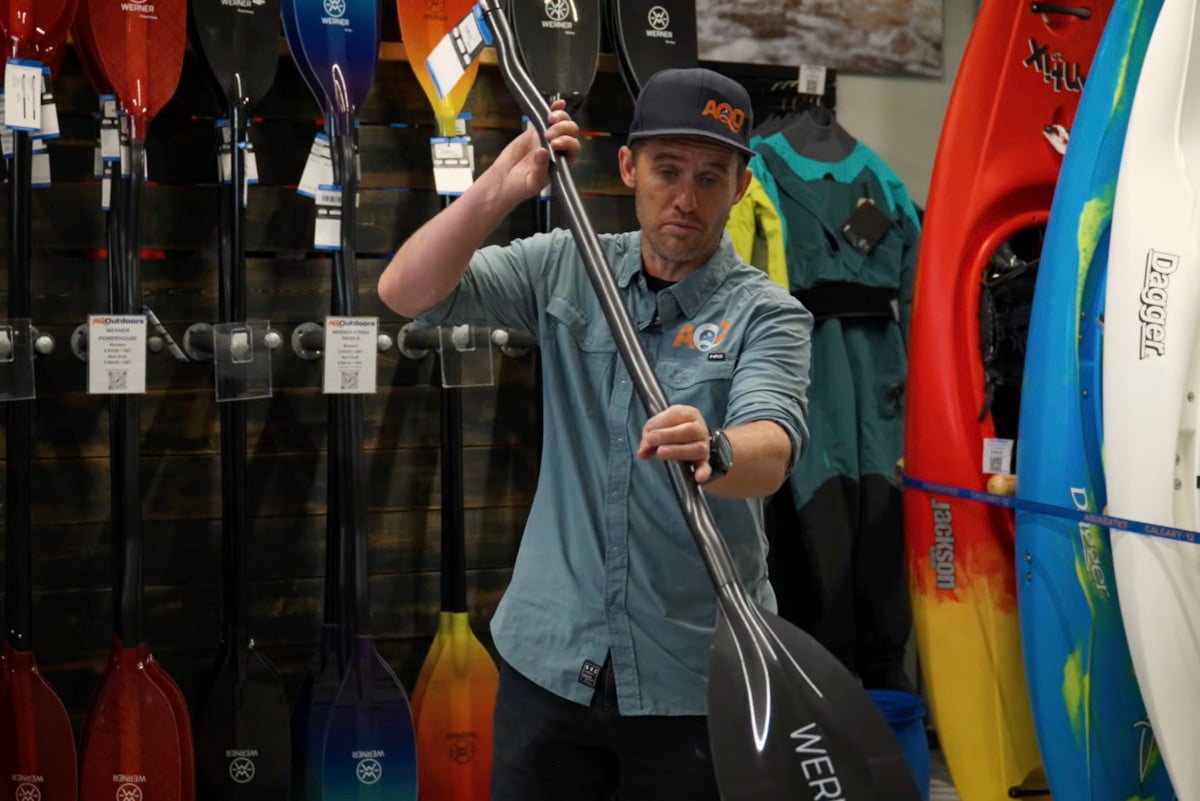
Whitewater paddlers have caught on to the stroke power benefits of blade-forward offset, and with this we are seeing more paddles incorporating the design element. For 2024, Werner has introduced a new blade-forward paddle lineup. Here with an initial reaction is Simon Coward, owner of AQ Outdoors (AQ Outdoors is a paddling shop and school with locations in Calgary and Edmonton). The following is a transcript of Coward’s review.
We’re checking in with a first-thoughts review on the Werner Stealth and Werner Covert paddles. This is the first time I’ve had them in my hands, so please take all this with a grain of salt. We’ll check back in soon once we get them on the water.
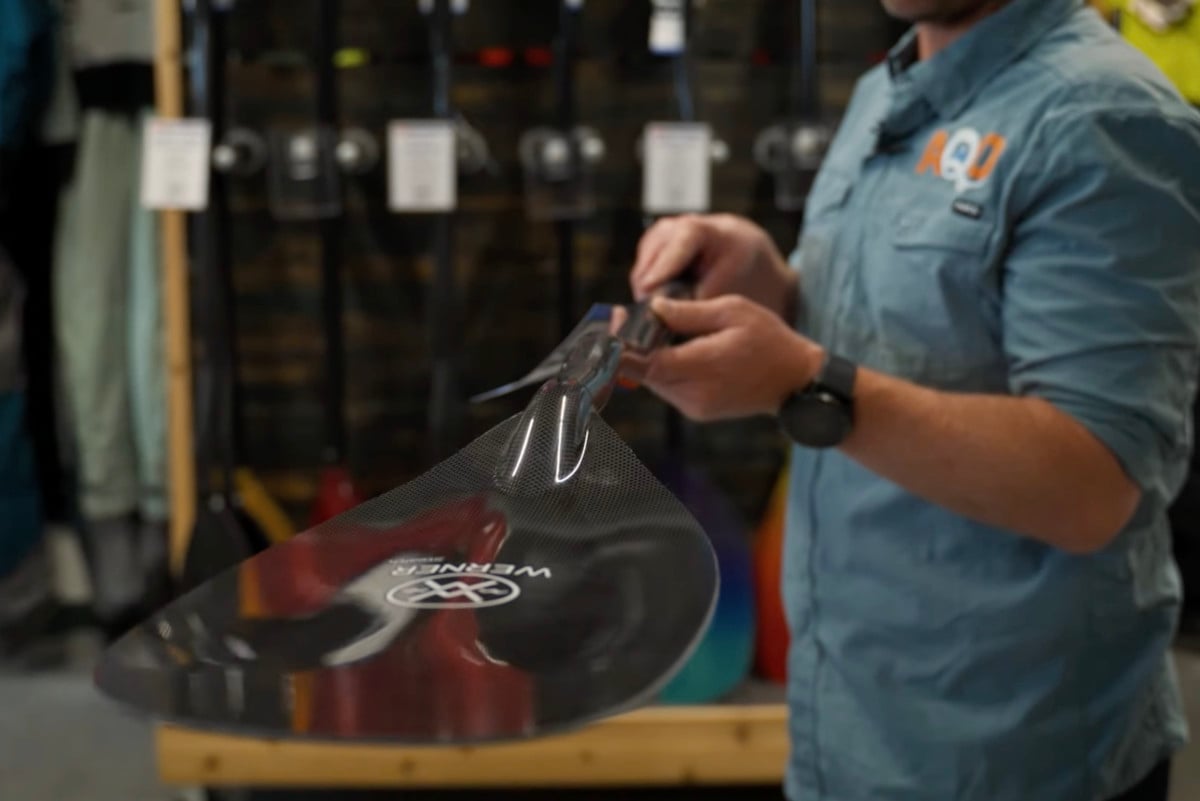
A close look at the blade offset on Werner’s new paddles. | Image: AQ Outdoors
The Stealth is the large blade model and the Covert is the smaller blade version. They’re both the same paddle but designed with different paddler types in mind. Initially, when I look at this paddle, it looks quite different from things that Werner has made in the past. Most notably the combination of materials in the blade.
Paddle construction
You have a combination of foam core in the middle and then you have laminate carbon on the outside. It’s nice and thin through the laminated carbon which is going to make feathering and slicing the blade through the water really smooth and nice. Then you have this foam core built in, which is going to add strength and durability.
You also have that typical ridge that Werner builds into their blades which helps with strength. It’s very narrow where the blade joins the shaft and I think that’s going to be great for nice vertical paddle strokes because you’re not going to have that lower volume there that’s going to bash off the side of your boat.
A blade beneficial to your forward stroke once you have the feel for it. | Image: AQ Outdoors
Blade-forward design
Conversely though, the volume of the blade, especially in the Stealth, is quite big and it carries that volume all the way to the end of the paddle. In shallower water river environments, you’re still going to get power forwards and backwards out of that blade because there’s ample volume all the way through.
It also has the offset forward blade, which gives a more powerful catch and it’s something I’ve become a big fan of over the years. The Surge, Stealth, Odachi, and Galasport paddles, they all incorporate that into the blade design and it does make for a very powerful catch.
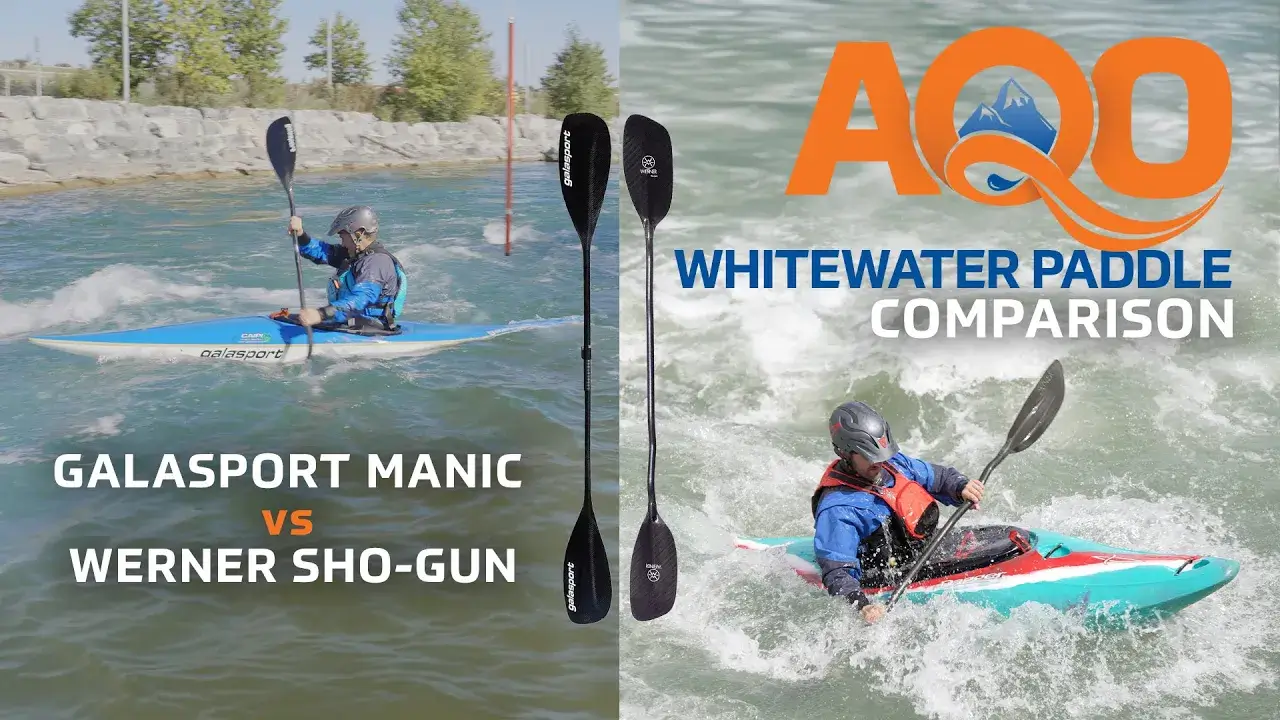
Now it does feel quite different in my hands versus a traditional Werner paddle like a Shogun. I think that might take a little bit of getting used to for some people.
What I would like to see as the paddle gets more use is how durable it’s going to be. It’s not going to be as durable as a composite fiberglass paddle from Werner, but I’m hopeful that it’s going to be as strong as a Shogun or a Double Diamond.
AQ Outdoors offers retail and kayak instruction in Calgary and Edmonton. Learn more about their school and stores at AQOutdoors.com.


 This article was first published in the 2024 issue of Paddling Business. Inside you’ll find the year’s hottest gear for canoeing, kayaking, whitewater and paddleboarding. Plus: how to beat the big box, robotic kayak rentals, building the Paddlesports Trade Coalition and more.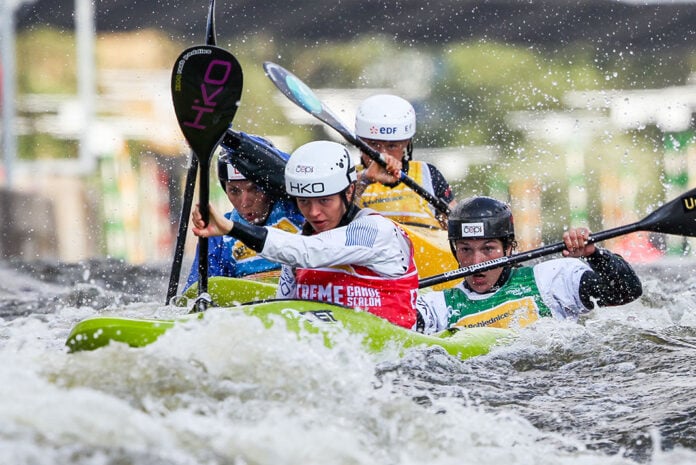
 This article was first published in the Spring 2024 issue of Paddling Magazine.