

My friend Cliff Jacobson and I have a lot in common. We both worked as foresters, taught environmental science and led outdoor skills programs for youth. We’ve both published wilderness canoeing books and spent years presenting at outdoor shows. But let’s be clear: Cliff is one of a kind.
At 84, the renowned outdoor author still prances along a portage trail like a teenager at prom. He’s as small as a leprechaun, but tougher than Paul Bunyan. As saintly as Mother Teresa, but more opinionated than Muhammad Ali. His bestselling book, Canoeing Wild Rivers, remains the go-to resource for wilderness canoe expeditions. This is the guy who got married at Wilberforce Falls on the Hood River. How cool is that?
Cliff Jacobson on what’s changed for better and worse in 70 years of canoeing
Cliff discovered camping and canoeing at the age of 12 in a mouse-ridden Scout camp on amosquito-infested Michigan woodlot. The year was 1952. Tents were made of moldy canvas, not lightweight nylon, clanky aluminum Grumman canoes were the new thing, and camp clothes were trap-door union suits covered over by ratty wool sweaters and pants.
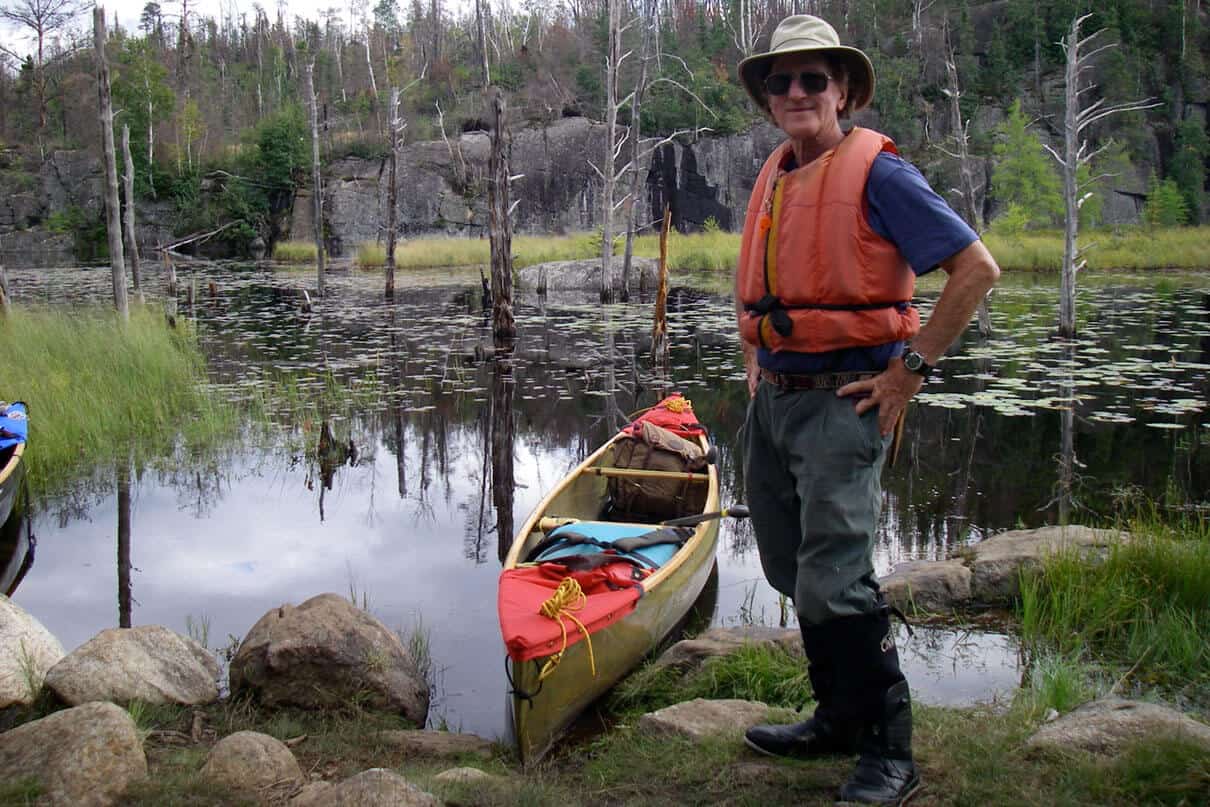
From those humble beginnings, Cliff became a worldwide authority on wilderness paddling. He has sold nearly a million copies of his guidebooks and was crowned a Legend of Paddling by the ACA. Tripping gear has evolved, but Cliff still prefers old-school tubular PFDs, which “moved with your body like the folds of an accordion.” He believes freeze-dried foods taste just as bland as they did 35 years ago. And he uses a tump, carves a classic J-stroke, and remains enamored with vast wilderness.
Cliff’s last presentation was in March at Canoecopia, the world’s largest consumer paddlesports show, where he held the audience rapt one last time with his distinctive camp opinions and tall tales of wilderness wanderings.
His days on stage may be over, but Cliff isn’t going anywhere. He’ll keep paddling and championing the backcountry lifestyle. And yes, he’ll still cruise backroads in his little red roadster, top down, Tilley hat on.
The good, the bad & the grumbly
In his own words, Cliff Jacobson weighs in on what’s changed for better and worse in his 70 years on the water.
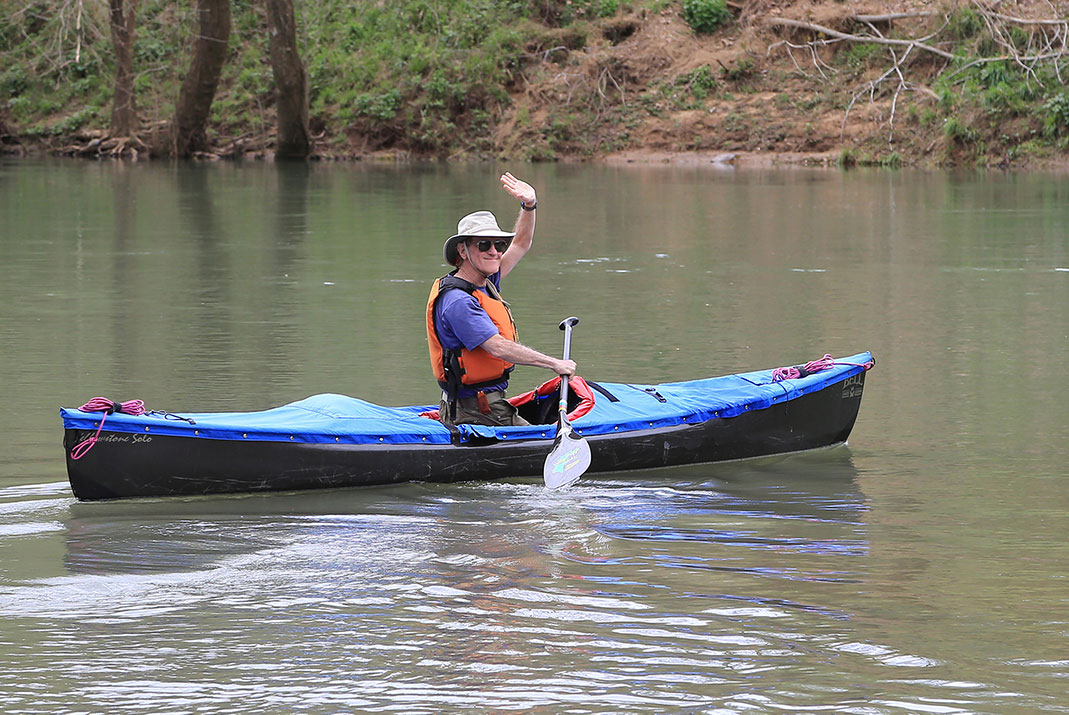
CANOES: “I love lightweight canoes. My lightest solo—a Bell Yellowstone solo—weighs just 28 pounds. My heaviest, a Northstar Phoenix, weighs 41 pounds. I’m 84. Lightweight canoes are marvelous.”
PADDLES: “Better paddles, by a long shot. What I would have given for a 12-degree bent shaft, carbon fiber paddle when I was young.”
DURABILITY: “Overrated. If you wrap the heaviest, most durable canoe, it’s a goner. It may fold back into shape and be ‘paddleable,’
but when you get home, you won’t want it. Better to buy a light canoe and take some lessons. Very good paddlers seldom seriously damage their canoes.”
RULES: “Regulations and permits have exploded. As John Muir would say, freedom of the hills isn’t so free and easy anymore.”
PLANNING: “In the early days, we would write to the Catholic parishes along our intended route for advice. We ordered stereo pairs of aerial photos and, by studying them, could determine the location and path of dicey portages. Planning took months; now it’s all online. And even the most obscure rivers have detailed trip guides. Good or bad? You be the judge.”
COOKWARE: “Remember the old Sigg pots and aluminum fuel bottles? Much better than the goofy little kits they sell today. Paddlers need $50 titanium cups like a hole in their canoe.”
WILDERNESS: “The huge caribou herds on the northern rivers are much smaller now. There was a feeling of deep remoteness when canoeing subarctic and Arctic rivers. This has been shattered with satellite phones, sat communicators and GPS units. Today, we rely more on things than skills.”
 This article was published in Issue 74 of Paddling Magazine.
 The man, the myth, the legend. | Feature photo: Courtesy Cliff Jacobson




Cliff has opinions, as we all do. But I agree with much of what he says and advocates. My go to big expedition boat is Royalex, a 17 foot Prospector by Nova Craft. But like all modern Prospectors, when I bought it, it was not the same dimension of a Chestnut brother’s boat. I stripped it to a bare hull and reshaped it to Chestnut specs and added spruce gunnels and thwarts and decks. This shaved a bunch of weight. As far as durability, a light boat gets thrown around less, and as Cliff says, durability is over rated. And the cook stoves today are a mess. I used them climbing and they are ok, but the “build a stove” concept pioneered by MSR can leave you stoneless for the failure of one simple part. The plastic pumps can break, as happened to one of our party on an expedition. My choice is the Optimus 111C. No stove to build, it comes in a rugged case, and best of all, they will simmer. While I do use some freeze dried food, real food has its advantages. On what is likely the third or fourth descent of the Finlay River, I took lots of grief from my companions for bringing a few cans of mandarins. They were a hit on my first time making dinner. On my second time, a week later, one of the biggest naysayers spoke up, “Hey Erich, are we having mandarin oranges for dessert again?”
I’m also a big fan of Baker tents and camp chairs. If I’m out for a month, I want to be comfortable. In my climbing days, I spent too many days huddled in tiny tents and with no place to sit and relax.