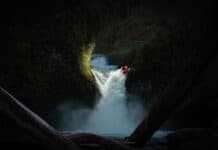
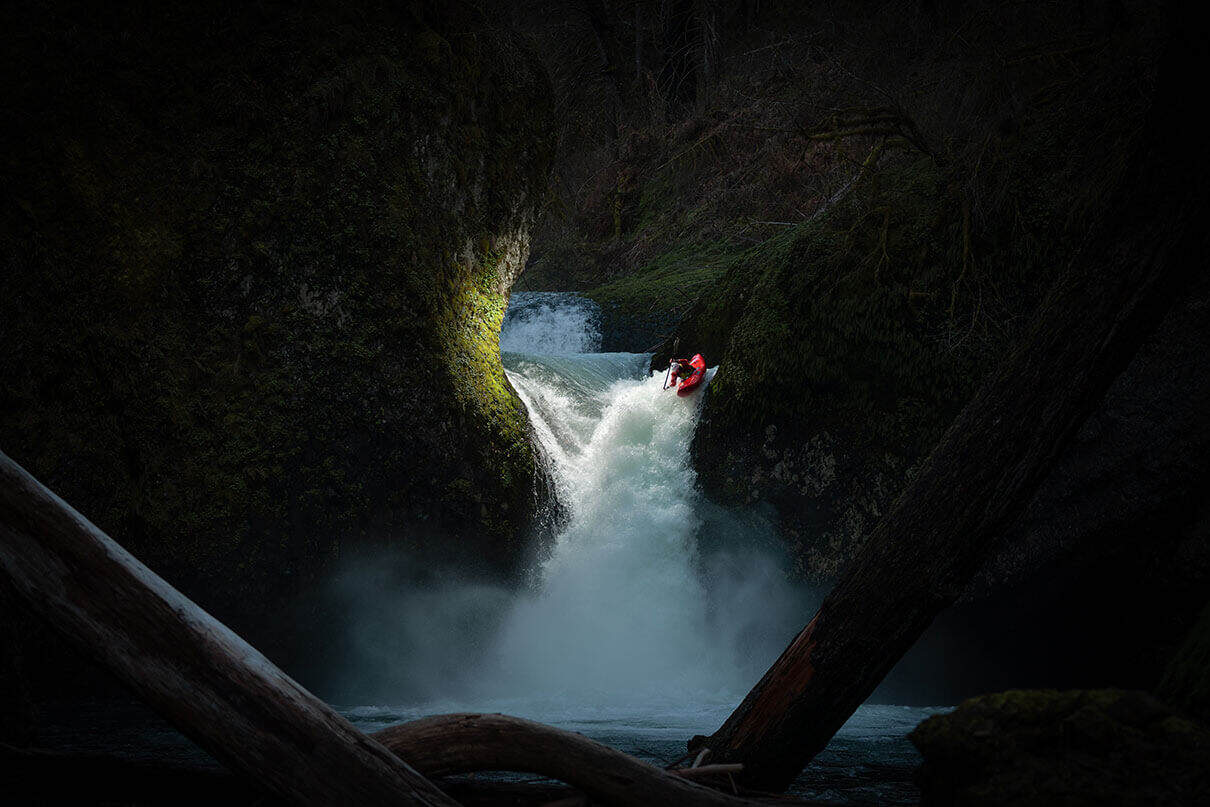
“It was kind of a dream that all fell together,” says photographer Riley Seebeck. Getting this photo was a seven-person, six-hour mission that pushed the limits of technical and paddling skills and it all almost fell apart at the last minute.
Below, Seebeck describes in his own words how he captured this one-shot wonder.
Behind the scenes on the photo of a lifetime
“There’s a handful of photographers in the industry that are starting to play with attaching flashes and lighting to drones to get that type of studio light look you’d get with a hot box. That was always something I thought would look really cool off of a waterfall.
Originally, my idea was to zoom in really, really far to see the water droplets. But once we decided on Punch Bowl Falls, near Hood River, Oregon, I knew it had to be a landscape. It’s too pretty to zoom in. When this idea came up, I started bouncing it around with JT Hartman. He’s the paddler in the shot. He’s just one of those good dudes who’s always like, ‘Sure, man, let’s do it. I don’t know what you’re really talking about, but let’s do it.’
I met JT during COVID. I was living right on the river and thought, ‘Okay, I have $1,500. I could save it or buy a boat.’ I started watching YouTube kayaking videos, and there was JT, making a bunch of videos. I messaged him and said, ‘I want to get into kayaking. Can you show me a couple of things?’ He took me under his wing, taught me to roll and brought me on my first milestone trips. We became really good friends.
We were all gathering for the Little White Salmon Race anyway. I reached out to a buddy who’s a drone pilot because I can’t operate the camera and the drone at the same time. I roped him in, got JT, and pulled together a support team. It turned into a group of good friends coming together.
Punch Bowl was about a two-hour hike in with all our gear. We started in the late afternoon to hit the blue hour light. At the falls, we were in a canyon. I climbed down and swam across a section of the river with my gear in a dry bag to line up the shot. The drone pilot was 10 minutes up a hill and the kayakers were out of sight. Communication was through radio.
I was in single-shot mode. It brought me right back to the art of photography.
We tested the flashes, they were syncing at first, then not. Technical difficulties. With a big flash, you only get one shot, then the flash has to recharge. Timing the flash and kayaker is key. So, we switched transmitters and kept troubleshooting. Each drone battery lasted only 15 minutes.
At this point, we were losing light. It was 6:30 p.m. I thought, I don’t know if we’re gonna get it, guys. Then I saw this little bird bouncing on a log near me. It felt like something saying, ‘You can have this now.’
When the drone flash started syncing again, we were good to go. JT threw the radio down and lined up the lip. He got slightly off-line at the top and my finger almost clicked too early. Then he rolled off the lip perfectly. The flash fired.
Nailed it!
When JT paddled up in the pool, he asked, ‘How’d it go?’ I was yelling back with every swear word in the book. Six hours in for one photo. And we got it. I’ll remember that feeling forever. Mastering this technique and timing was one of the highlights of my career. I was in single-shot mode. It brought me right back to the art of photography.”
—As told to Kaydi Pyette

 This article was published in Issue 74 of Paddling Magazine.
 JT Hartman drops Punch Bowl Falls at dusk. | Feature photo: Riley Seebeck