

Engineering students at University of Tennessee Chattanooga face an unusual challenge as part of their curriculum: make a maneuverable and stable canoe out of concrete. Then, the students pass that concrete canoe to the rowing team and hop into a traditional rowing shell and race the rowers.
On November 16, 2025, the University of Tennessee Chattanooga (UTC) Rowing Team took to the student-built concrete canoe to race it against engineering students, who used a traditional rowing shell, through 500 meters of chop on the Tennessee River in the inaugural “Athletes vs. Engineers” race. The engineering students in the rowing shell won by a significant margin, but the concrete canoe was a success in durability and buoyancy.
University of Tennessee Chattanooga students tackle the unusual task of designing, constructing and racing concrete canoes
In a world where manufacturers are consistently pushing for the next lightweight canoe, the students at UTC are building canoes out of concrete, and for them a 1000-pound canoe is considered a winner.
Abraham Mako from the University of Chattanooga Rowing Team explained that while the concrete canoe was extremely heavy, the weight wasn’t the most challenging part of maneuvering the craft.
“The canoe sat very high in the water, leading to an unusual stroke to keep the blade in the water,” explained Mako.
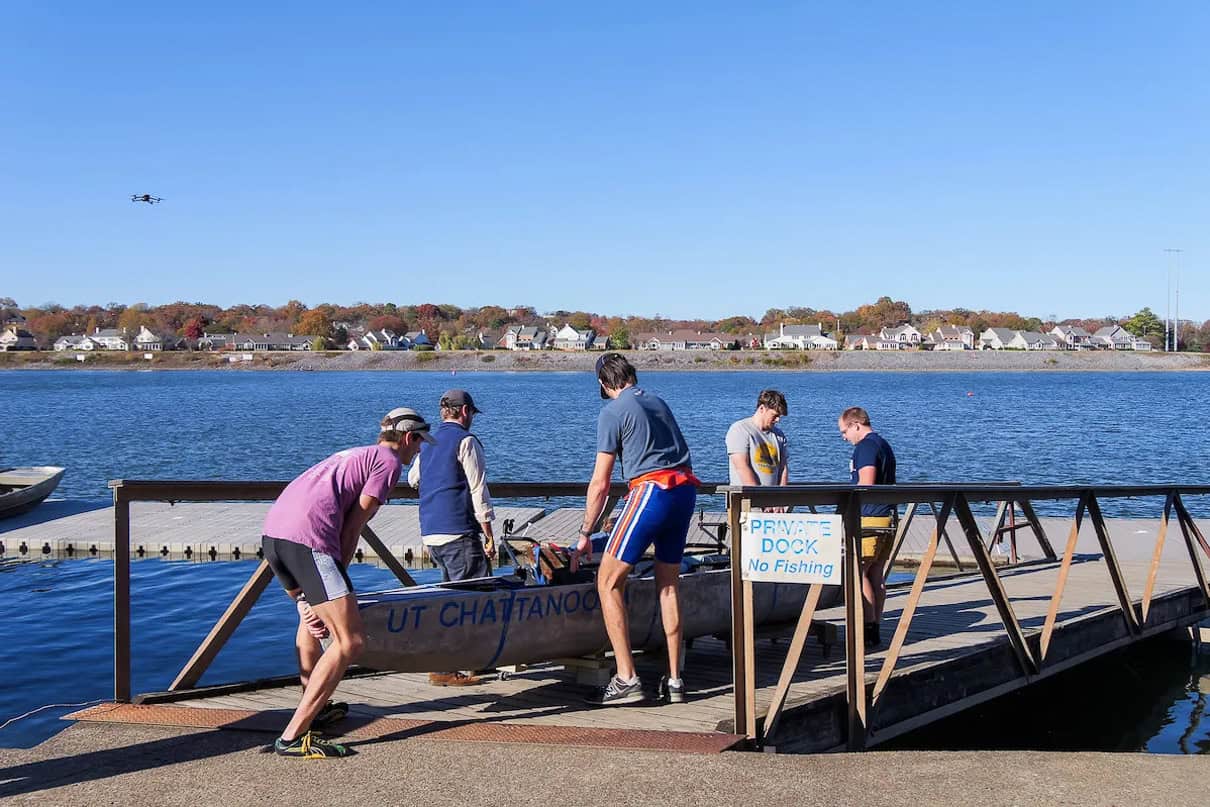
Mako added that the length of the canoe combined with the lack of a skeg and hull shape made the canoe a challenge to paddle in a straight line.
The Athletes vs. Engineers Race on the Tennessee River isn’t the only event these concrete canoes are up to compete in; the American Society of Civil Engineers (ASCE) holds an annual concrete canoe competition that draws students from throughout the United States to race and compete. The first ASCE concrete canoe competition was held in 1988, but intramural concrete canoe races began as early as the 1960s.
“The canoe doesn’t just have to float,” explained Christopher Moreland from UTC’s College of Engineering & Computer Science. “It has to be able to capsize and not fully submerge, not sink to the bottom. They have to go through a maneuverability course.”
Moreland added that this year’s concrete canoe weighed around 1000 pounds.
“If you didn’t know that it was concrete from a distance, you would just be like, that’s a really bulky canoe,” shared Moreland.
From a Chattanooga classroom to the Tennessee River
The lead up to the race begins in a UTC engineering classroom, where students are tasked with designing a canoe, presenting and defending their design and then as a class choosing which of the proposed designs to actually create.
The roles in constructing the canoe are then divided amongst the class and construction begins.
“It’s really about creating an opportunity for them to use the skillset that they’ve developed as part of the civil engineering program, and then apply that in an actual environment where you have to make something real as a team,” said Moreland.
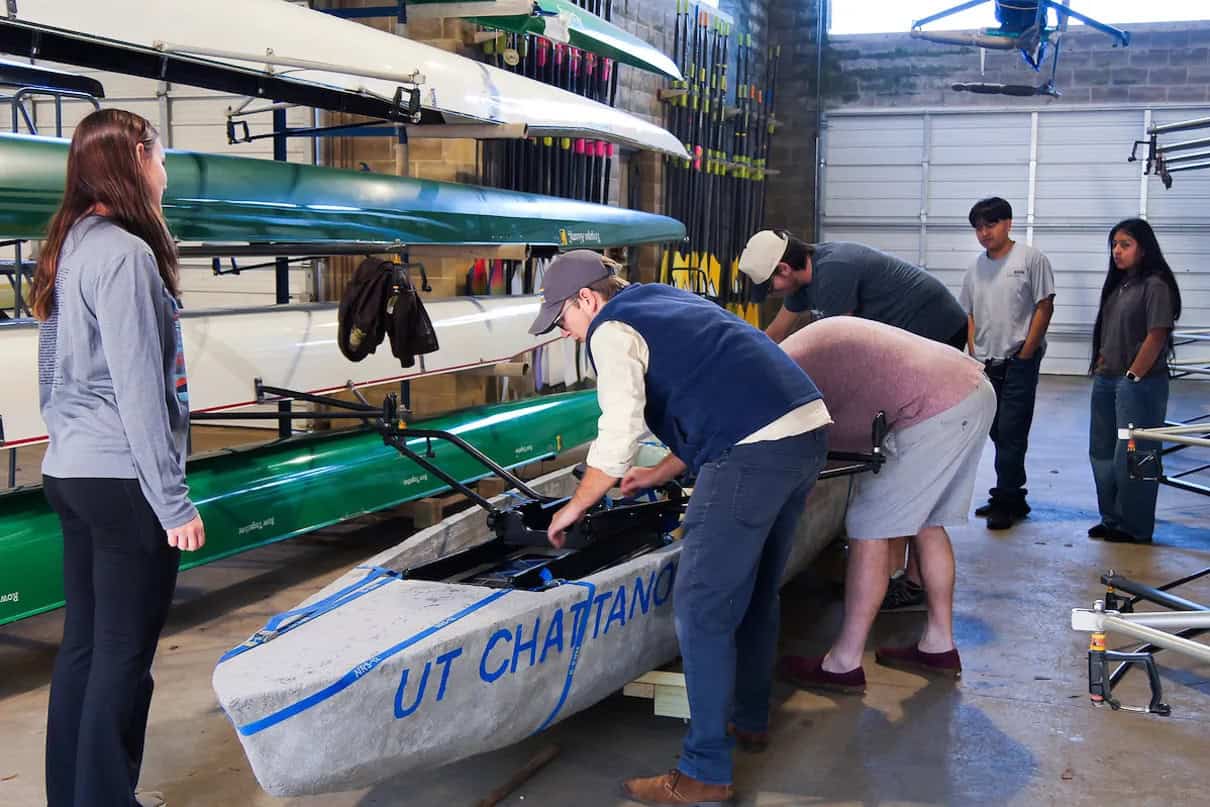
Moreland also shared that the Fall 2025 canoe has been a standout canoe – a number of canoes from previous years have broken apart the first time they were placed in the water.
“Now it’s been in the water four times, and it hasn’t broken,” shared Moreland. “So it’s really impressive. We took it out on the Tennessee River on a little bit of a choppy day and it managed to go, I think a thousand meters undeterred.”
How do you make a canoe made of concrete float?
Whether or not a boat floats comes down to the principles of buoyancy and displacement: a boat, even a boat made of concrete, will float when it displaces enough water that the buoyant force (force of a fluid opposing the weight of an object in the fluid) equals its weight.
Christopher Frishcosy, civil engineering lab director for the UTC College of Engineering and Computer Science and the advisor for the concrete canoe project, shared that the key to making a concrete canoe float is ensuring that the water weighs more than the concrete canoe. A key aspect of creating that lighterweight concrete is replacing the coarse, heavier aggregates like limestone or quartz with lighter volcanic rock.
“We don’t need the strength that you need in a traditional concrete. So we can… be creative on this cementitious portion and cementitious materials portion to make a lighter product that provides the strength we need for that function,” shared Frishcosy.
According to Frishcosy, mix design is the first engineering challenge that the students find themselves in with this competition, but another aspect of engineering the project teaches is code compliance.
Concrete canoes perform well in stability; maneuverability remains a challenge
“ASCE, American Society Civil Engineers, releases the rules and regulations, design proposals for this competition, and they have requirements they have to meet on certain designs,” explained Frishcosy. “Even before you get to the calculations, understanding what your limitations are and what your requirements are for the design is a part of the design process.”
Frishcosy also explained that in some years the ASCE provides requirements for length, width, hull depth, and more but in 2025 there were no specifications and design details of the canoe were completely in the hands of the students.
Generally, the concrete canoes perform well in stability, but maneuverability has often proven a challenge. Frischosy noted that general maneuverability aside, paddler’s time practicing in the boat and learning its mechanics has likely also been a limiting factor in maneuverability tests.
Overall, the concrete canoe project acts both as a fun race and a hands-on learning experience for students.
“Undoubtedly they get more out of this project than, let’s say a homework assignment or just a class project per se,” shared Friscosy. “In the 2023, 2024 [ASCE] competition we were able to get second place. Last year we did not get to race; because of inclement weather in Arkansas, the races were cancelled.”
Nonetheless, the next cohort of UTC Engineering students have the 2026 ASCE concrete canoe competition to look forward to, with the finals to see the return of the three person 600-meter endurance slalom race.











I first saw a concrete canoe built and paddled by four women from the University of Houston in the 2007 Buffalo Bayou Regatta in Houston, Texas. It did not win, but it did finish without any problems. Personally, I prefer my Royalex or Tuf-weave boats because I can carry them by myself and load them on top of my car when I need to travel.