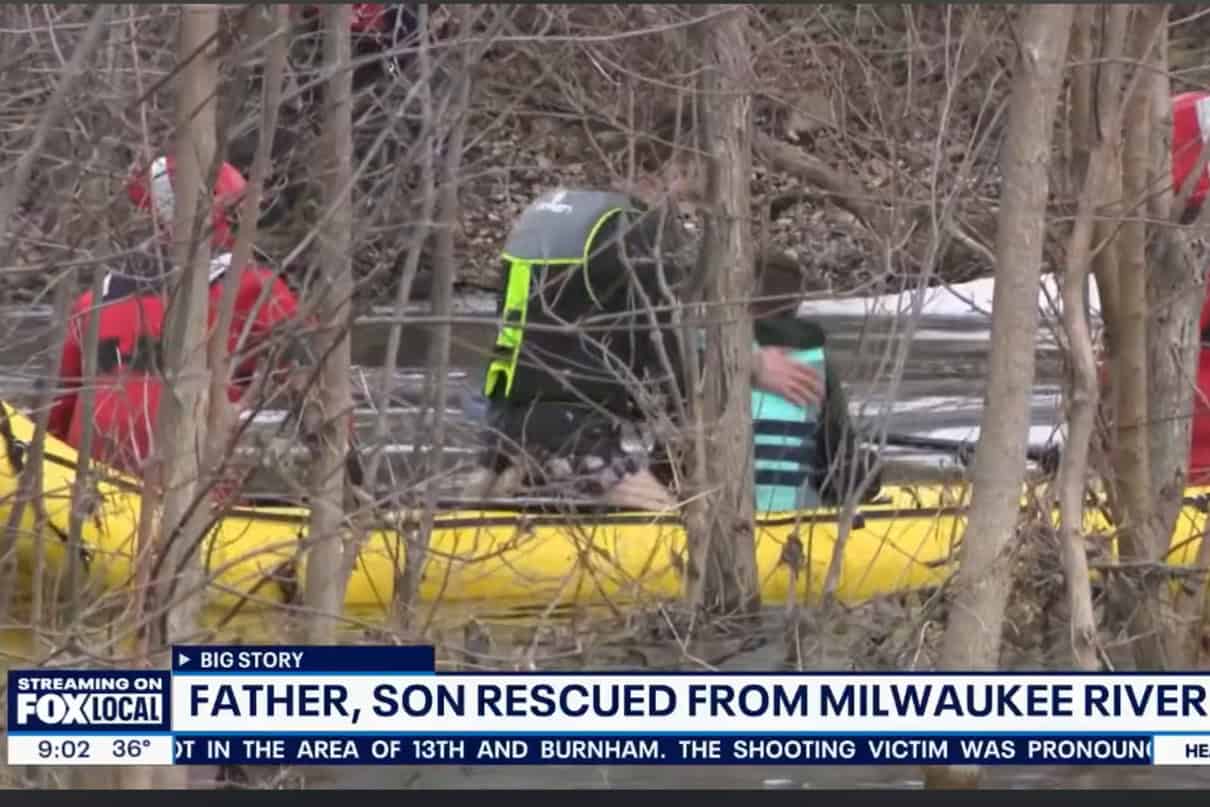
After their kayak overturned on the rain-swollen Milwaukee River, a father and son were rescued on April 19, 2026. A bystander spotted the pair in the water and made the call, triggering the rescue, and North Shore Fire and Rescue was alerted of the situation just after 3 p.m. The duo had made their way out of the current and onto a small, partially-submerged island where they held themselves while the rescue was planned.
Rescue on the Milwaukee River
In the video, first responders can be seen on a raft crossing the swift current of the river to reach the trapped pair before pulling them into the raft and ferrying them back across the river.
Neither father nor son was reported to have sustained injuries, and both can be seen wearing a lifejacket in the video.
The incident occurred near Glendale, on the Milwaukee River. While the river is generally calm in the summer months, spring rainfall increased the volume and speed of the river significantly and led to hazardous conditions.
“As soon as I saw the rafts, I knew it was a kayaking incident,” Dale Gatford, a local who regularly kayaks the area, told TMJ4 News Milwaukee. Gatford also shared that he checks the river’s conditions via its U.S. Geological Survey (USGS) gauge before paddling.
Higher flow rates, measured in cubic feet per second, indicate stronger currents and hazardous conditions on the river. Gatford told TMJ4 News Milwaukee that for him anything over 1,150 cubic feet per second is too much and the week of the accident flow rates were as high as 11,000 cubic feet per second.
Heavy rains lead to hazardous conditions
Even had the pair not capsized, exiting the river in these conditions in a kayak or as a swimmer would have seen additional hazards. With the river flooded, the water was now moving through the trees at the shoreline creating points at which the river rushes through brush and logs and a paddler could easily become pinned.
Following the incident North Shore Fire Rescue issued a warning urging people to use “extreme caution when entering the river due to unsafe, swift-moving water conditions.”