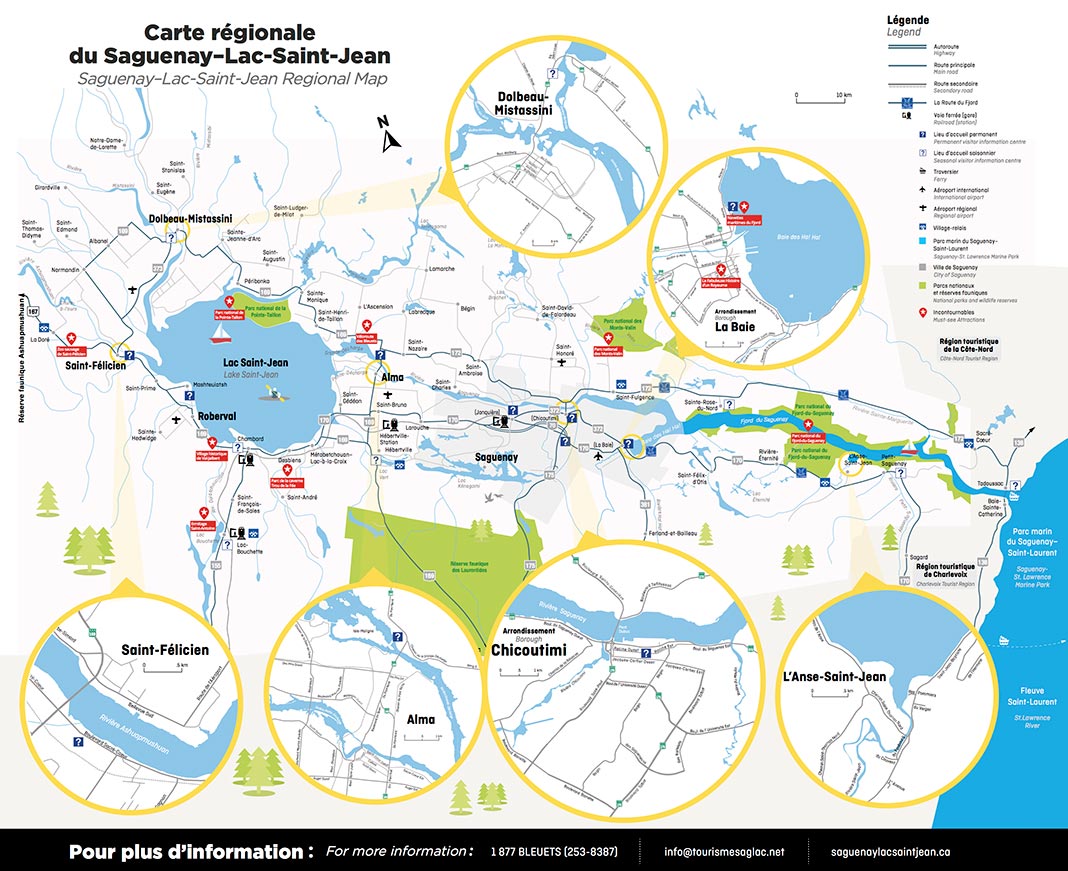
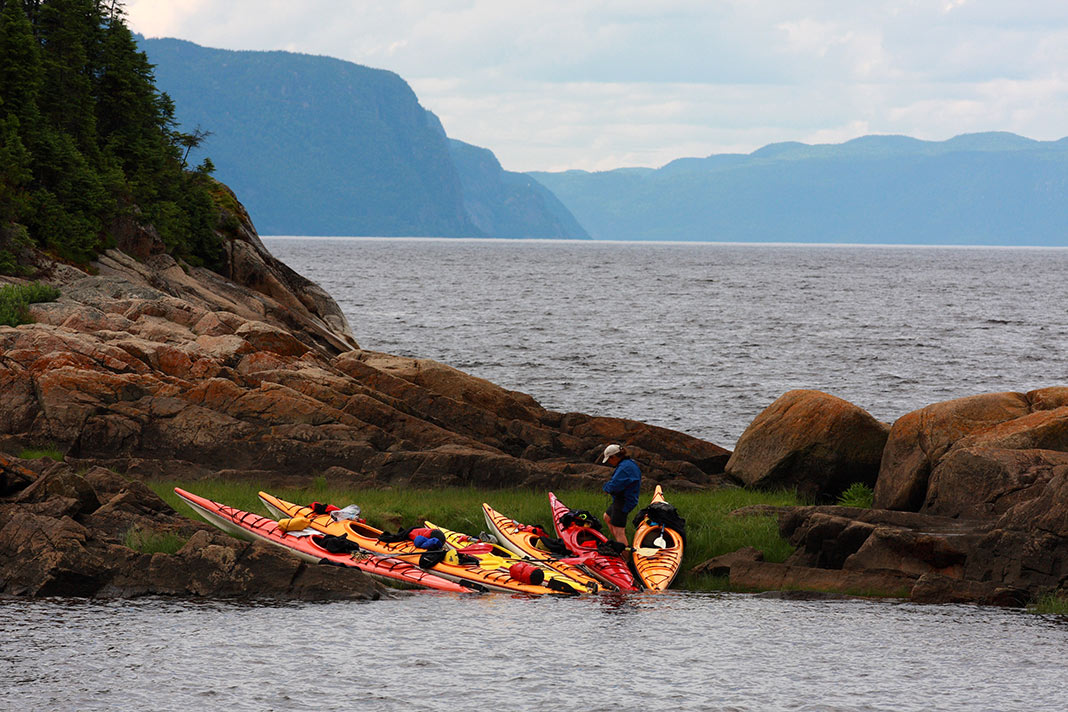
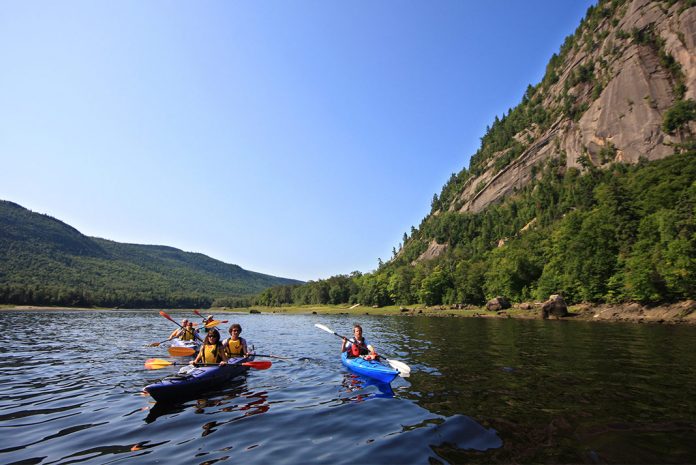
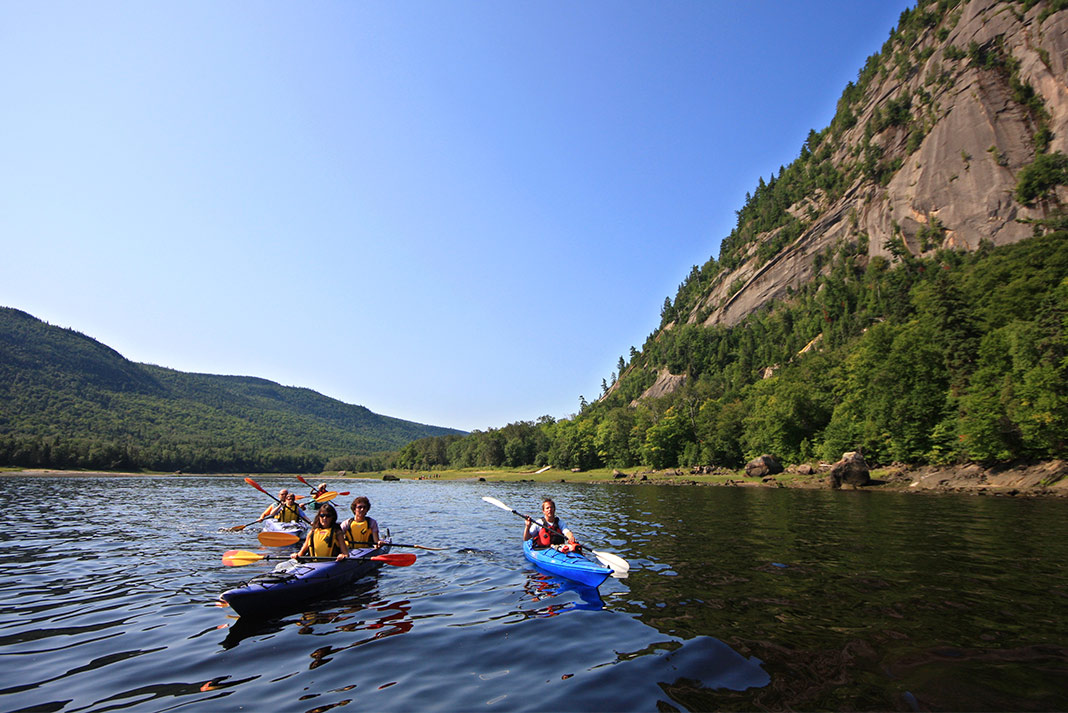
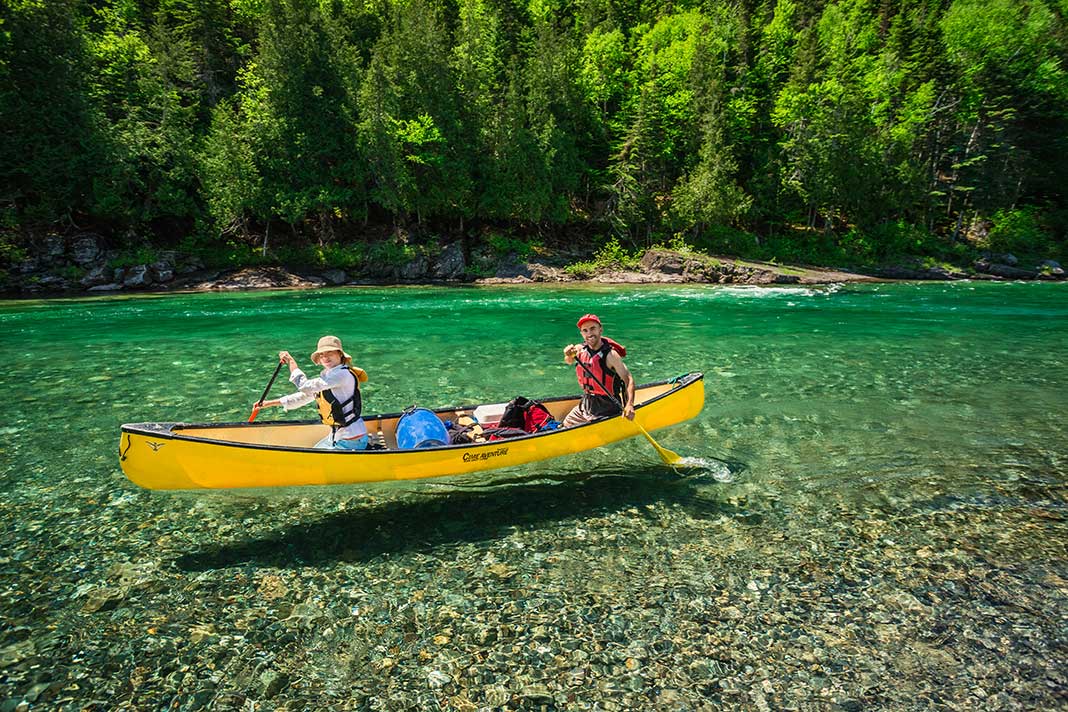
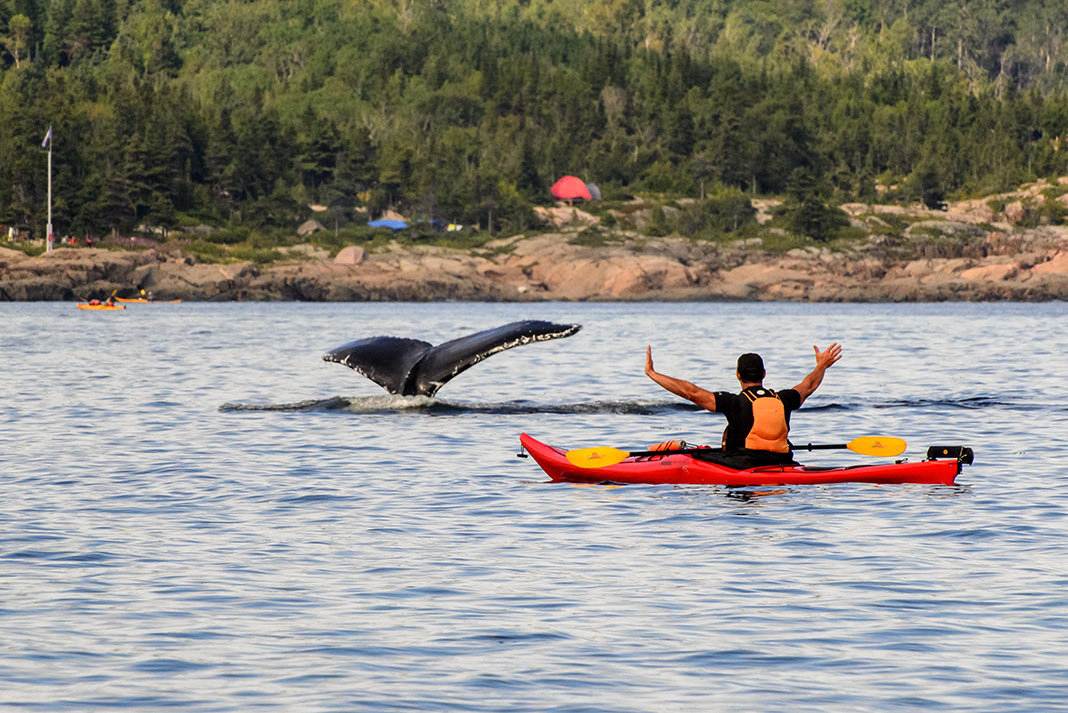
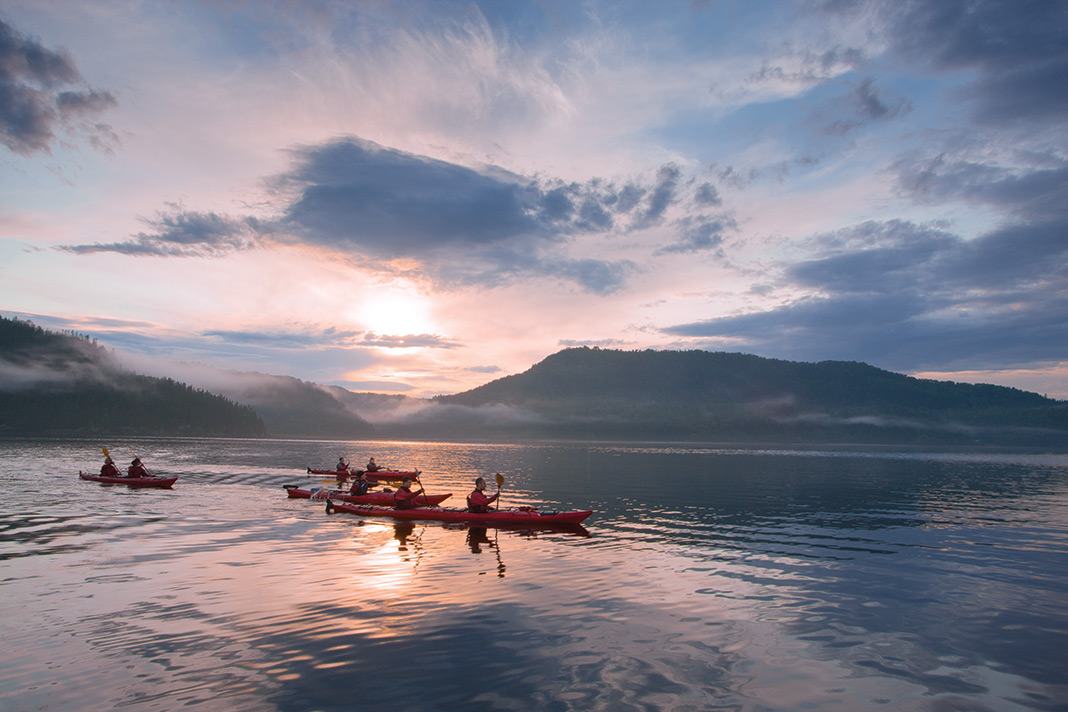
Quebec’s Saguenay–Lac-Saint-Jean region is often referred to as “The Land of Giants.” Paddlers who visit this special place will quickly see why Saguenay is a dream to kayak. The mighty Saguenay River links the wide-open waters of Lac Saint-Jean with the Saguenay Fjord—one of the longest in the world—that cleaves through towering mountain cliffs for more than 100 kilometers. Here, freshwater from the region’s countless cascading rivers merges with the saltwater of the St. Lawrence estuary, creating rich habitat for beluga whales, seals and other marine life.
Sea kayakers can explore this dramatic landscape for a few hours or a few days; two superb national parks ensure over 75 percent of the fjord remains pristine and untouched. Beautiful beaches and gorgeous bays accommodate kayak campers, while whitewater kayakers enjoy some of the best rivers you’ll find anywhere.
[This article is part of our 35 Adventurous Things To Do In Saguenay series. Learn more about where to hike, bike, paddle and sightsee around Quebec’s Land of Giants.]
Places to Kayak
Saguenay Fjord
Excavated by mile-thick glaciers tens of thousands of years ago, the Saguenay Fjord is a mystical landscape of dark waters enclosed within dizzying, 300-meter-high cliffs. Extending 105 kilometers from below Lac Saint-Jean to its mouth at the St. Lawrence estuary, the fjord is at once a sea and a river, as cold saltwater from the St. Lawrence floods its depths while warmer fresh waters from the lake and its tributaries run along the surface. When the tide comes in it carries nutrient-rich saltwater deep into the Saguenay, and whales, seals, porpoises and other marine life follow.
Sea kayaking Saguenay Fjord rewards with sightings of ice-white beluga whales, paddling at the base of skyscraper-sized cliffs and ending the day in a charming village or beautiful campsite. Two parks protect this stunning and ecologically diverse region: the Saguenay-St. Lawrence Marine Park encompasses both the waters of the fjord and the adjoining St. Lawrence estuary, while the shores of the fjord are protected by the Parc National du Fjord-du-Saguenay (Saguenay Fjord National Park).
Three areas of the national park are popular for Saguenay Fjord kayaking day trips.
Baie Éternité
A narrow bay surrounded by the fjord’s highest cliffs, Baie Éternité is one of the most beautiful spots on the Saguenay River and a terrific place to view peregrine falcons—cliff-diving birds of prey that can reach speeds of 200 km/hour! It’s also accessible; you can paddle around the whole bay in just a few hours. The area also offers hiking trails, an excellent visitor’s center and a variety of camping and cabin options.
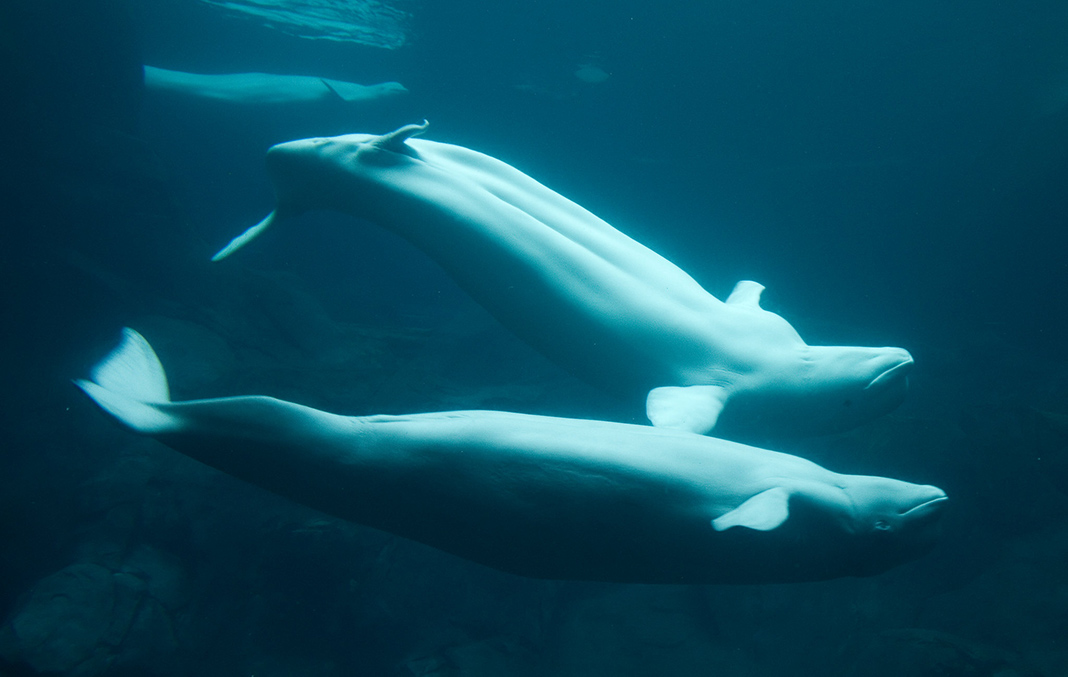
This is a natural nursery for beluga whales, which arrive in Baie Sainte-Marguerite in the summer to give birth and raise their young. The bay provides these small, white whales with plentiful food and quiet, sheltered waters where the calves can grow strong before venturing into the wider waters of the St. Lawrence. Kayakers hoping to glimpse the beluga can launch from nearby L’Anse-de-Roche and paddle across the mouth of the bay in the designated corridor only, being careful to avoid stopping here or entering the restricted zone. Kayaks can attract the whales’ attention and reduce the amount of time they spend looking after their young, feeding and resting—so it’s critical that paddlers follow these whale protection regulations.
Beluga whales swim in their summertime nursery at the Baie Sainte-Marguerite. | Photo courtesy of: Flickr // Brian Gratwicke
Baie de Tadoussac lies at the mouth of the Saguenay River, where the fjord meets the saltwater estuary of the mighty St. Lawrence River. Here, the seafloor rises from a depth of 300 meters to just 20 meters, creating an upwelling of oxygen, zooplankton and other nutrients toward the surface—a veritable buffet for fish, seabirds and marine mammals. Three types of seals and six different whale species frequent these waters from May through October—from the diminutive beluga to the gigantic blue whale and acrobatic humpback. Launch from the kayak-friendly beach at Tadoussac, or from Baie Sainte-Catherine on the south side of the river mouth.
Multi-day Saguenay Fjord kayaking trips are the ultimate way to experience the beauty and exceptional biodiversity of this natural wonder. Parc National du Fjord-du-Saguenay offers 13 kayak camping areas situated on both the north and south shores of the fjord. Campsites are spaced at regular intervals to facilitate backcountry through trips of the 100-kilometer-long gorge. Experienced kayakers should allow at least 5-6 days for an end-to-end journey.
Kayak campsites are available June to September, and multi-day trips must be taken in a downstream direction (heading towards the river mouth). The national park website offers suggestions for kayak camping routes from 2 to 6 days.
Weather and paddling conditions can change quickly in the Saguenay Fjord, and the vertiginous geography means there are few places to get out of the water safely when conditions deteriorate. Tides of four or five meters are common, making tide tables essential for multi-day paddling trips. Tides near the narrow mouth of the fjord reach up to 9 knots, which can create hazardous conditions for kayakers. Unless you’re an expert at rough water paddling and navigating in tidal environments, go with a guide. There are a number of top-rated local outfitters (scroll down for Saguenay Kayak Tours) that can help novice and intermediate kayakers explore the fjord safely.
Kayaking on the Saguenay River centers on the Saguenay Fjord, with numerous park accesses and a handful of historic villages serving as departure points. Kayak launching sites inside the national park include Baie Éternité, L’Anse du Petit-Saguenay and L’Anse de Saint-Étienne on the south side of the river; and L’Anse de Roche and Tadoussac on the north side. The villages of Sainte-Rose-du-Nord and L’Anse-Saint-Jean are also popular for accessing the north and south side of the fjord, respectively.
Overshadowed by the spectacular river and fjord that drains its waters, Lac Saint-Jean is no slouch itself when it comes to size and scenery. The lake is more than 35 kilometers across and is rimmed by mountains, forests, farms and vibrant communities. The unusually shallow depth makes for warm water and large waves—even a modest wind can whip the surface into a frenzy of whitecaps. For these reasons, most kayakers on Lac Saint-Jean enjoy shorter excursions along the lakeshore or exploring the many beautiful rivers that spill into the lake.
Possible half-day and day outings include venturing up the Ashuapmushuan River (the river’s name translates to “the place where one lies in wait for moose”) at Saint-Félicien, or paddling along kilometers of white sand beach at Vauvert on the lake’s north shore. If you’re looking to extend your Lac Saint-Jean kayaking into a weekend adventure, Vauvert and nearby Parc National de la Pointe-Taillon offer lakeside camping, glamping and cabin rentals. From the national park, you can paddle up the Péribonka River or explore a scattering of small islands clustered at the lake’s outlet (the Grand-Décharge).
Located at the great confluence of the Saguenay and St. Lawrence rivers, Tadoussac sea kayaking focuses on the mouth of the Saguenay Fjord and the Upper and Lower Estuary of the St. Lawrence River. The Saguenay-St. Lawrence Marine Park protects these estuaries and the extraordinary biodiversity they are home to. Most kayakers head north from Tadoussac down the St. Lawrence into the Lower Estuary, a crucial summer feeding ground for whales, seals, fish and seabirds. Paddling along the coastline towards Anse à la Cave, you may spot plumes or hear the great misty exhalations of blue, minke, humpback or fin whales feeding just offshore. With locations in Tadoussac and Les Bergeronnes (Anse à la Cave), local specialist Mer et Monde Écotours offers guided kayak trips and spectacular riverfront camping.
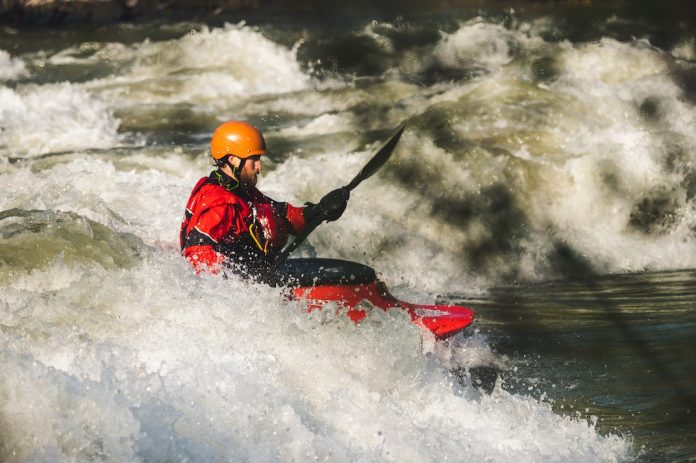
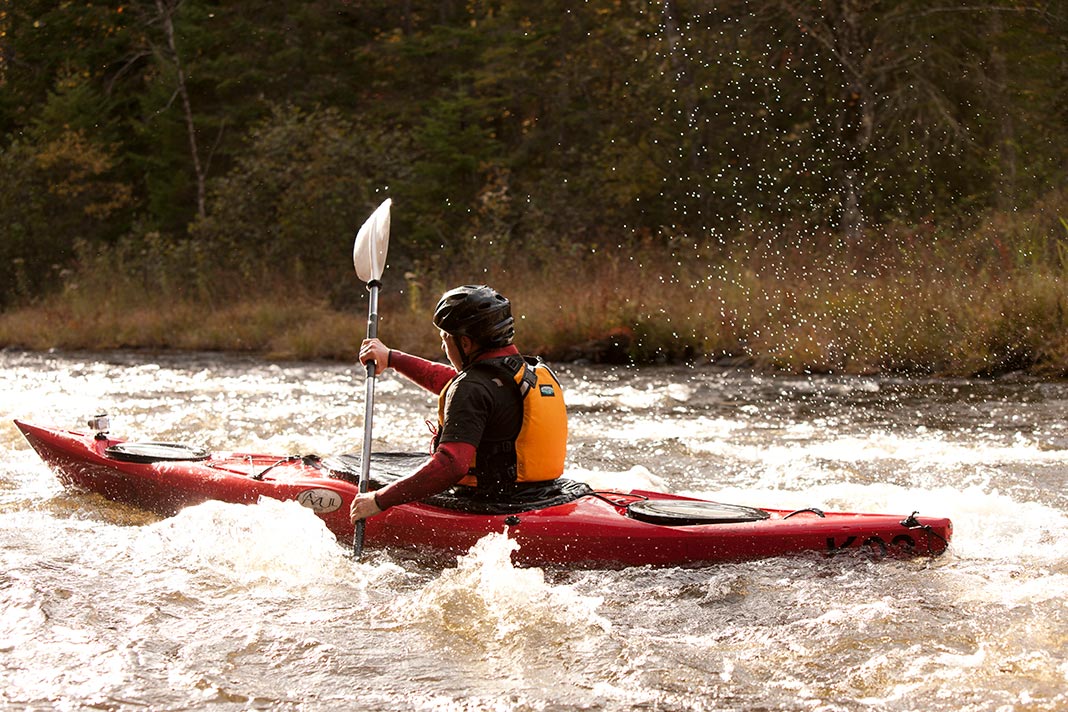
Coursing right through the Saguenay suburb of Jonquière, the Rivière-aux-Sables offers whitewater kayakers a short and sweet river run that’s perfect for practicing laps. The river’s tight and technical class III rapids have hosted national slalom championships. Because it runs right through town, the river is very accessible for laps of varying length.
Just across the Saguenay River from Jonquière, the Shipshaw River charts its own whitewater descent, with two popular sections offering different challenges for kayakers and canoeists. The top section, named Chûte-aux-Galets (9 km), is the preferred section for kayaking and features a fast and furious procession of class III–IV rapids. An agreement with dam managers ensures an ideal flow all summer. The lower section begins east of Saint-Ambroise at the Portage-Lapointe bridge and offers an exciting day trip better suited to whitewater canoeing. Here, long peaceful stretches of river are interspersed with class II and III rapids.
In total, 45 rivers spill into Lac Saint-Jean—all accessible within a 100-kilometer drive on the lake’s encircling network of roads. These rivers drop down to the lake over polished outcrops and boulders of Canadian Shield granite, enticing kayakers with the promise of exhilarating and accessible class III–V rapids. Picture amazing playboating waves and holes, steep chutes, technical water and big-water runs that compare with the world-renowned Ottawa River (minus the crowds).
Traveling clockwise around the lake, one of the first you’ll encounter is the Métabetchouane River at the town of Desbiens. Starting at Parc de la Caverne Trou-de-la-Fée, the Métabetchouane boasts a steep and continuous 7-kilometer run through a beautiful, undeveloped canyon with a dozen major rapids rated up to class IV.
Three massive and powerful northern Quebec rivers—the Mistassini, the Mistassibi and the Ashuapmushuan—pour into the northwest corner of Lac Saint-Jean near the small town of Saint-Félicien.
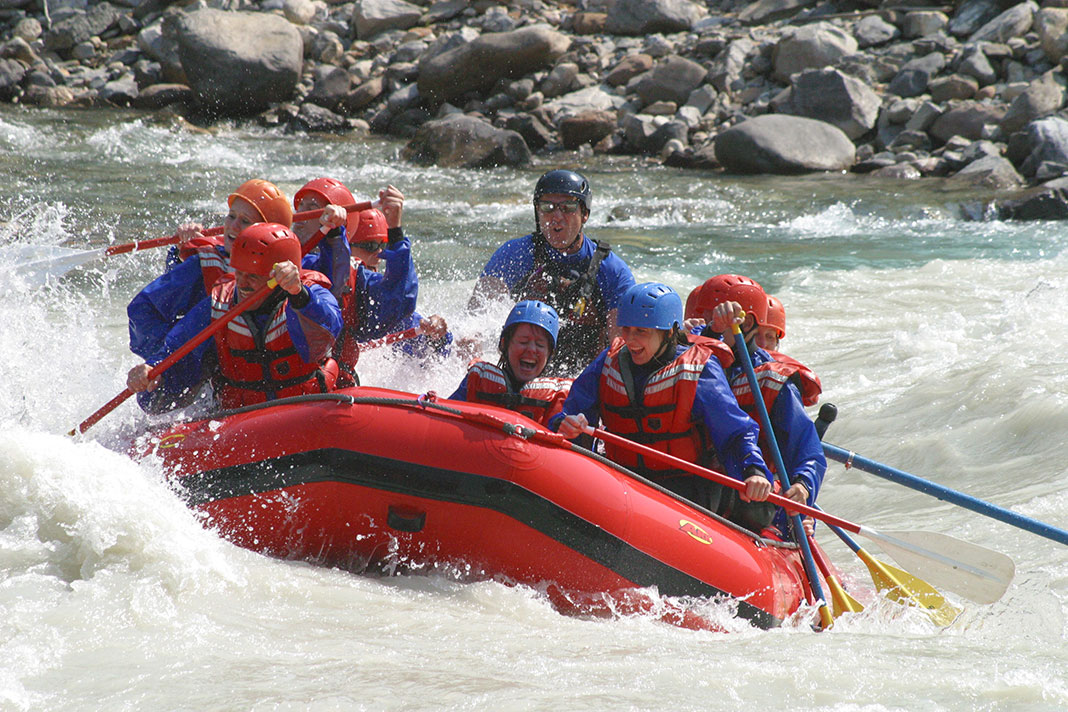
Joining the mighty Mistassini River at the regional hub of Dolbeau-Mistassini, the Mistassibi River rivals its sister to the west for huge rapids and rugged landscapes. High volume, continuous class IV & V rapids are best left to expert kayakers—or join H2O Expédition for an intense half-day whitewater rafting descent of the Mistassibi’s roller coaster rapids.
Perfect for playboaters and making relaxing river laps, the Ashuapmushuan at Saint-Félicien is a treat for whitewater kayakers. Just north of downtown, Chutes à Michel is the put-in for a short playboating run of the lower Ashuapmushuan. Look for a pair of huge hole features below a railroad bridge and don’t miss surfing the impressive Vague Arcand breaking wave near the take-out. Further upstream, expert kayakers can tackle the spectacular rapids and slides at the massive Grand Chute à l’Ours. A well-appointed tourist campground at the chutes makes for a convenient basecamp.
Located in the lovely village of l’Anse-Saint-Jean in the heart of the Parc National du Fjord-du-Saguenay, Fjord en Kayak are renowned for their award-winning service, expert instruction, performance fiberglass kayaks and gourmet dining options available during their multi-day expeditions. If you’re looking for a shorter voyage in the fjord, they offer guided 3-hour and 1-day trips, as well as 2-hour family trips in tandem kayaks for youth ages 3 to 13. Fjord en Kayak’s guided 2-, 3- and 4-day Saguenay kayak trips combine comfortable camping, delicious food and the fjord’s finest scenery and wildlife encounters.
With guided sea kayak tours from 2 hours to 6 days, Organisaction are year-round specialists in Saguenay outdoor adventures. They offer kayak trips from two main bases of operation at Parc national du Fjord-du-Saguenay—Baie-Éternité and Villages-Vacances Petit-Saguenay (L’Anse-Saint-Étienne). Multi-day kayak trip options include a luxury 5-day end-to-end traverse of the entire Saguenay Fjord, combining camping and stays in cozy cottages and inns.
Locations: Baie-Éternité, Saguenay Fjord National Park
L’Anse-Saint-Étienne, Village-Vacances Petit-Saguenay Phone: 418-579-8763 Website: www.organisaction.com/en
Mer et Monde specialize in sea kayaking guided excursions within the Saguenay-St. Lawrence Marine Park along the St. Lawrence estuary. Their award-winning kayak trips are renowned for quality of services, safety of activities, professionalism and integrating marine conservation values into their excursions. Kayak tours include 3-hour and full-day whale-watching trips in the Lower Estuary, and combo paddling and hiking day trips in Saguenay Fjord. Mer et Monde is also the only kayak outfitter offering 3-hour sunrise kayak trips in the estuary and 3-hour night tours to experience bioluminescence and listen to whale sounds with a hydrophone.
Locations: Anse à la Cave, Les Bergeronnes Tadoussac Phone: 866-637-6663 Website: www.meretmonde.ca/en
[ Plan your next paddling adventure with the Paddling Trip Guide ]
Ferme 5 Étoiles
This laidback family vacation resort offers a huge variety of outdoor activities, including guided kayaking tours of the Saguenay Fjord. Choose from 2-hour, 3-hour, full-day and multi-day tours departing from L’Anse-de-Roche.
Situated at the western reach of the Saguenay Fjord, Parc Aventure Cap Jaseux enjoys a beautiful riverside location and provides a unique adventure resort experience. Along with surprising accommodation options—including treehouses and domes perched high in the canopy—the resort offers guided Saguenay kayak tours ranging from standard full-day and half-day trips to paddling excursions at dusk, dawn and during a full moon.
Located beside the fjord in the village of Sainte-Rose-du-Nord, this friendly hostel/café also leads easy 2- and 3-hour guided sea kayak tours and introductory overnight kayak trips. Day tours are suitable for children as young as 3 years.
Paddle the bird- and whale-filled Upper St. Lawrence Estuary portion of the Saguenay-St. Lawrence Marine Park with Katabatik’s expert sea kayak guides. Explore the abundant marine life, remote beaches and amazing geomorphology of the Charlevoix coast on a half-day or full-day kayak tour.
Based on the south shore of Lac Saint-Jean, H2O Expédition offers a variety of guided whitewater experiences on many of the region’s most thrilling rivers. Learn new skills and enjoy wild camping while whitewater kayaking, canoeing, catarafting or rafting the Ashuapmushuan River; guided tours are available from 2 to 7 days. The outfitter also offers guided whitewater raft, river board, canyoning and lake sailing day trips.
Located in the picturesque village of l’Anse-Saint-Jean in the heart of the Parc National du Fjord-du-Saguenay, Fjord en Kayak rents recreational kayaks and SUPs for exploring within the bay at l’Anse-Saint-Jean.
Chicoutimi’s premier outdoors store, Boutique Hors-Circuit rents a huge variety of outdoor equipment including single and tandem sea kayaks, whitewater kayaks, canoes, SUPs, watersports apparel and safety gear, camping equipment and more.
[ See the largest selection of boats and gear in the Paddling Buyer’s Guide ]
Kayak Stores Saguenay
Boutique Hors-Circuit
Chicoutimi’s premier outdoors store, Boutique Hors-Circuit sells a huge variety of outdoor equipment including sea kayaks, whitewater kayaks, canoes, SUPs, watersports apparel and safety gear, camping equipment and more.
Outdoor retail chain SAIL features a spacious Chicoutimi store with the usual diverse selection of kayaks, canoes, SUPs, paddling equipment, camping gear, clothing and more.
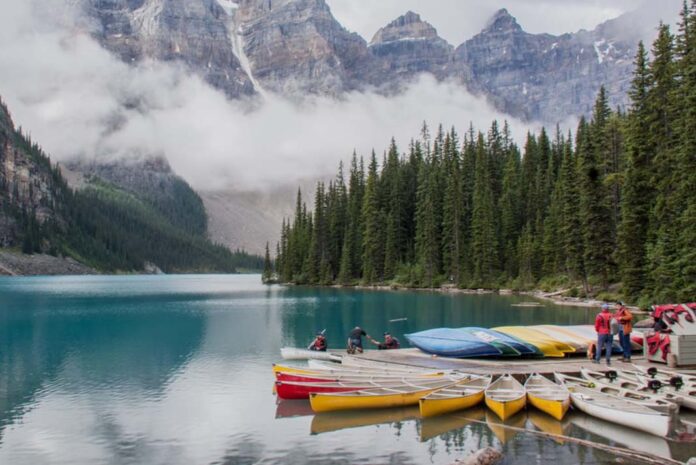
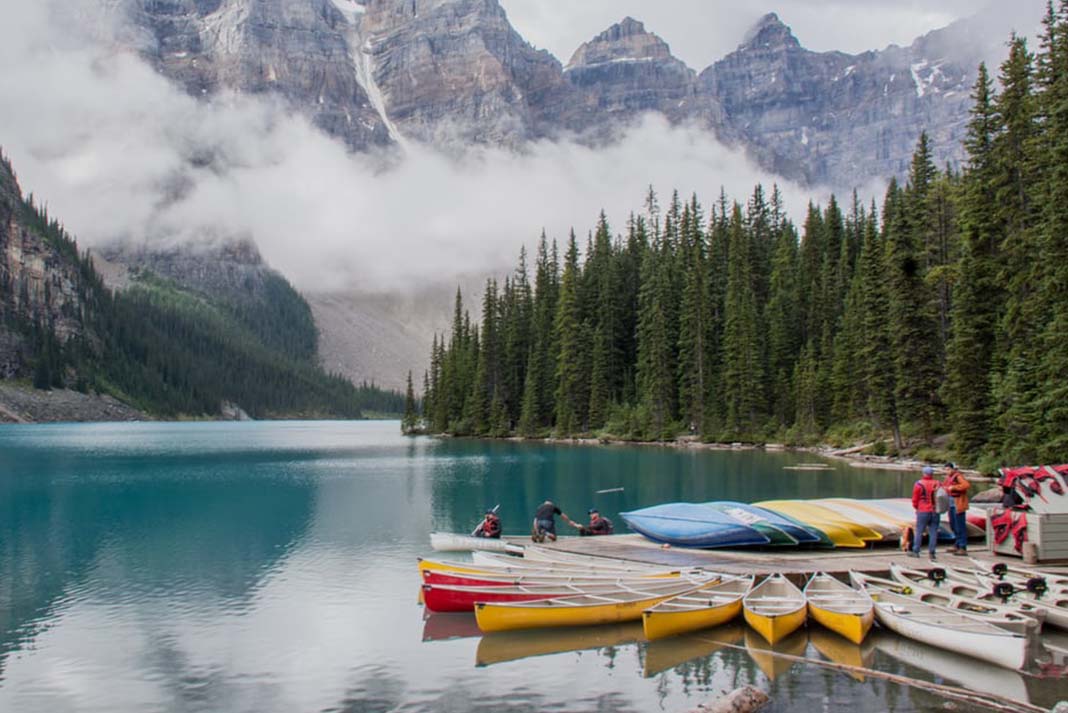
A misty mountain Moraine Lake in Banff National Park. | Photo: David Brooke Martin
Banff National Park is Canada’s most-visited national park for good reason. Canadians have been drawn here since the 1880s, attracted to the park’s glacial lakes, rushing rivers, snow-capped mountains and hot springs.
Known worldwide for its skiing and snowboarding, you can also ice climb, fat bike, skate, snowshoe and cross-country ski here during the winter months.
But we’d argue that summertime is when the region truly comes alive, with even more Banff activities on offer. Campgrounds reopen, making overnight stays a bit more affordable and a lot closer to nature. With the avalanche risk gone, hiking and cycling trails reopen for the season. And, most importantly, lakes start to melt, revealing the turquoise waters beneath and providing some of the most scenic canoeing and kayaking in the country.
If you’re considering taking a Banff vacation, here’s our ultimate Banff travel adventure guide.
Things to do in Banff in summer
Banff hikes
There are dozens of frontcountry and backcountry hikes to tackle in Banff National Park, with a handful of tour companies offering guided excursions, including heli-hikes.
If you prefer to go it alone, you’ll have no problem finding a trail that fits your afternoon, day or weekend plans—whether that means exploring high-alpine meadows or crossing the ridgelines of some of the Rockies’ most awe-inspiring mountains. This is hands-down one of our favorite things to do in Banff.
Parks Canada has a comprehensive guide to walks within the park, organized according to ability level. But if you’re having a hard time narrowing down hikes in Banff worth doing, here are three of the most popular trails for first-time visitors to the area.
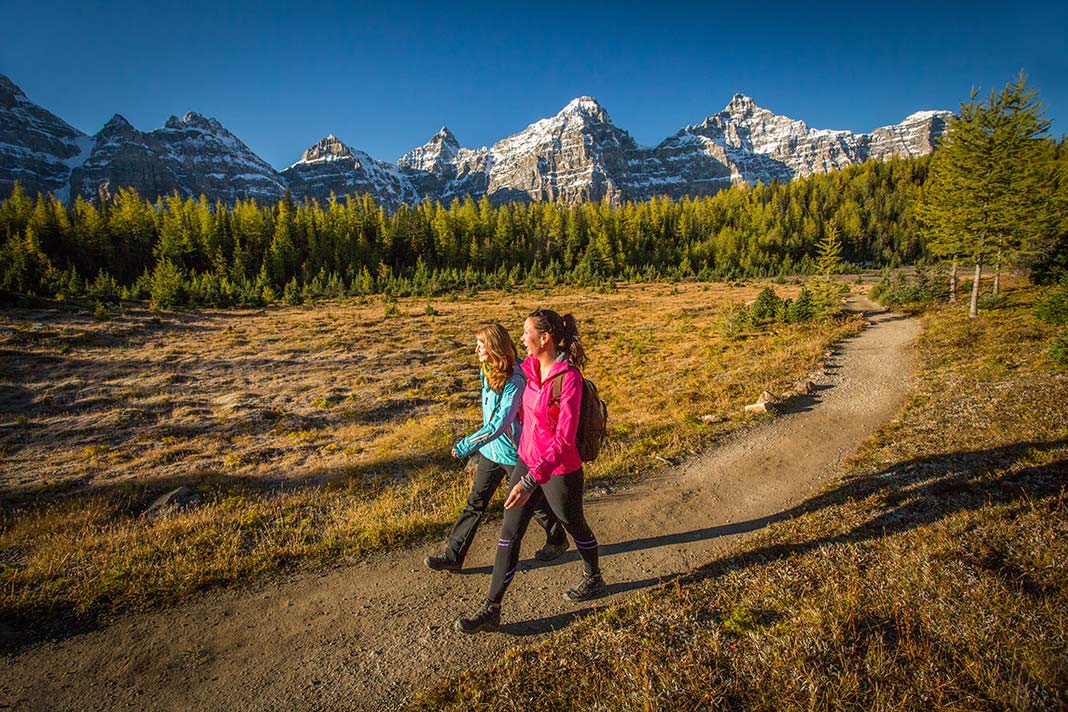
Anywhere you choose to hike in Banff will take you to beautiful views. | Photo courtesy of: Paul Zizka
Lake Agnes Trail & Teahouse
Is the Lake Agnes trail one of Banff’s most popular hikes because of the lure of scones and tea at its end? You only need to see the happy hikers at the top to know the answer to this question. Starting from Lake Louise, this trail winds for 3.4 km uphill past the lake to the European-style teahouse on the edges of a tarn.
The track is easy and wide, but still takes a moderate level of fitness, given its 385 meters of elevation gain. If you really want to earn your morning tea, take the additional 1.6-km trail behind the lake and up to the top of the Big Beehive for epic panoramic views of Lake Louise and the Chateau Fairmont below. The full journey takes between three and five hours.
Johnston Canyon & The Ink Pots
A trail suitable for all skill levels, you can make this one as long or as short as you want. You’ll reach the first set of falls within half an hour, and if you follow the wide path deeper into Johnston Canyon, you’ll arrive at a 30-meter-high waterfall about 30 minutes later. Beyond the falls, there’s an alpine meadow where water bubbles into shallow pools known as the Ink Pots.
For the lower falls, budget an hour round-trip, two hours for the upper falls, and a full four hours to reach the ink pots. The trailhead can be found 25 km from Banff and 33 km from Lake Louise along the Bow Valley Parkway.
Larch Valley
In the autumn, the larch trees of Banff turn a brilliant shade of gold before shedding their needles. Large stands of them can be found along the Larch Valley trail, which is the park’s most popular trail come September and October. Located just beyond Moraine Lake Lodge, you’ll need four hours for this 8.6-km round-trip journey, which has an elevation gain of 535 meters.
Since grizzlies are frequently spotted in this area, hikers should carry bear spray, travel in groups, and make plenty of noise along the way.
Rock climbing & via ferrata
Offering some of the best rock climbing in Canada, Banff has walls suitable for all skill levels of climbers, from beginner faces to multi-pitch routes, and steep sport climbing spots. Never climbed before? Alpine Air Adventures and Yamnuska Mountain Adventures both offer guided excursions.
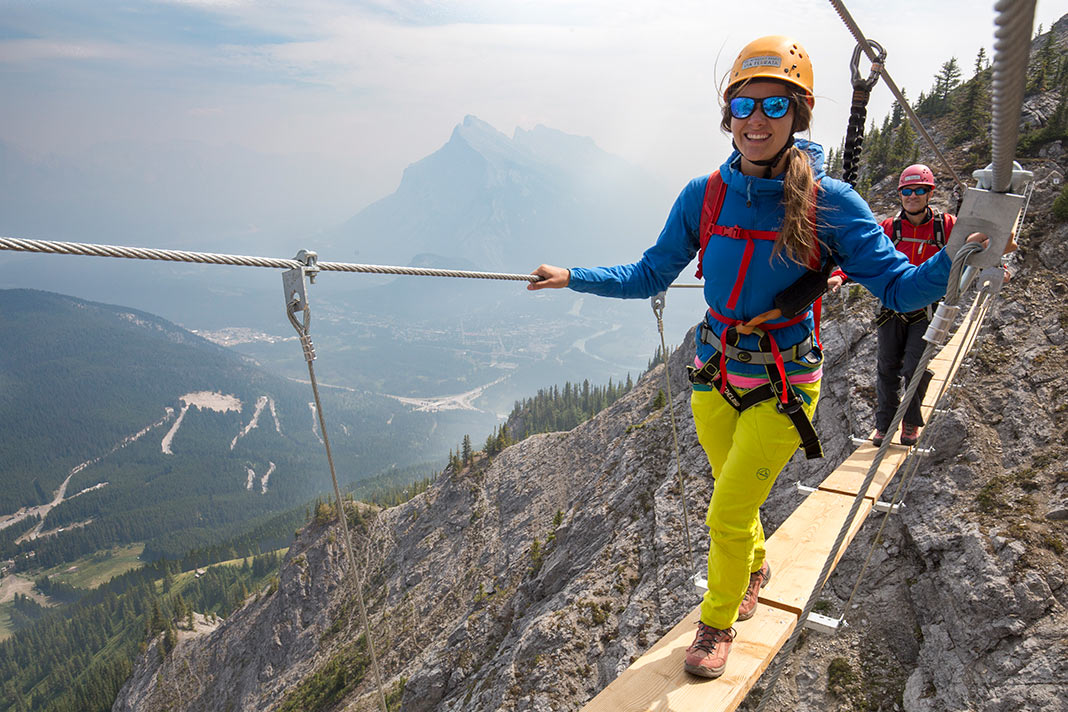
Via ferrata makes climbing mountains a breeze. | Photo courtesy of: Mt. Norquay Via Ferrata
However, you don’t need impressive upper body strength to climb mountains in Banff. Mt. Norquay’s Via Ferrata route is a series of rungs, bridges and ladders that aid climbers in scaling the sides of mountains. There are four routes, ranging in length from 2.5 to six hours. Each experience is guided, with the price starting at $175 CAD.
Banff biking
Banff bike trails
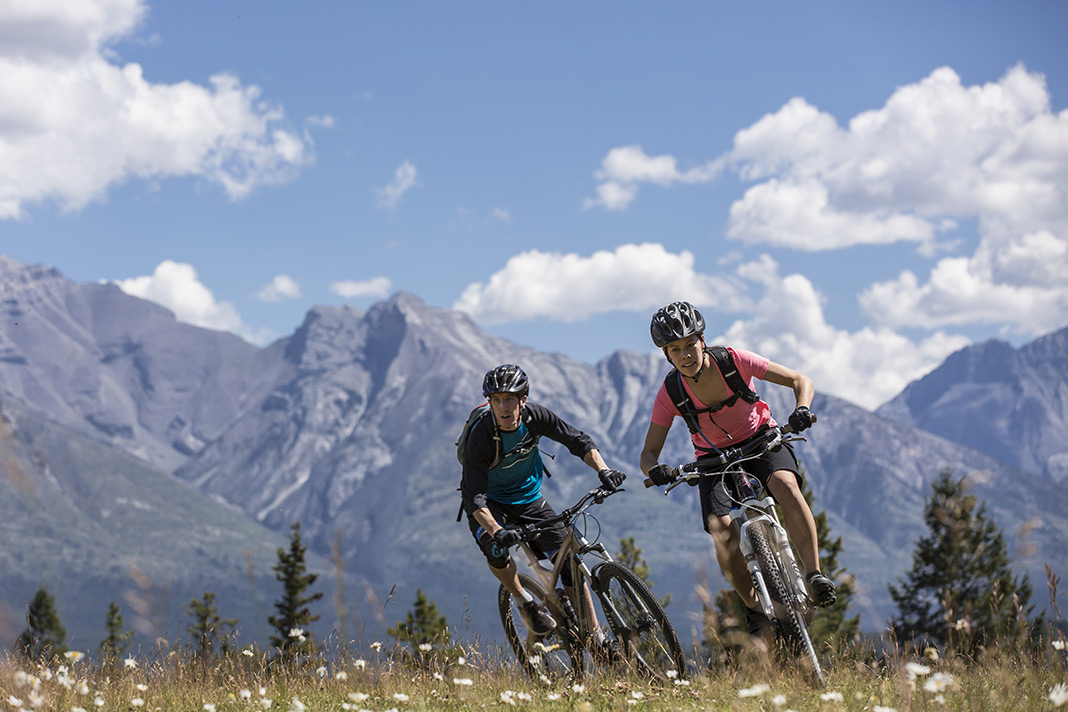
Much like hiking trails, there’s no shortage of mountain biking, road biking and fat biking trails and routes available in Banff National Park. There’s more than 360 km of trails, which are accessible roughly from May until October.
Note that e-bikes aren’t allowed on the trails (with a few exceptions) and if you’re looking for a true downhill mountain biking experience, you’d be better placed to visit nearby Yoho National Park, where there are designated trails for freeriding.
You can visit Parks Canada for a full list of trails, organized by difficulty, but here are just a few routes worth tackling.
Tunnel Mountain Campground Loop
Ideal for beginners and families, this 6.5-km gravel circuit starts at the Tunnel Mountain Campground with plenty of places to stop, rest and gawk at the elk, deer and even coyotes along the way.
Canmore to Banff bike trail
The relatively new and relatively flat Banff Legacy Trail is a 29-km paved path connecting the town of Banff with the town of Canmore just outside the national park. It’s rideable from April to October, with trailheads at Valleyview, Cascade Ponds, Vermilion Lakes and Fireside day-use areas, as well as at the east end of Banff Ave.
Lake Minnewanka
For those looking for more of a challenge, this 29.4-km one-way trail runs from the Lake Minnewanka day-use area to the Warden’s Cabin and beyond. You’ll need to be fit to handle this trail, which takes you along exposed sidehill trails that climb steadily into remote mountain areas.
Banff bike shops
The Tune Shop
A locally owned retailer, The Tune Shop carries Cube, Evo, Thule, Shimano, Yakima and Bern bikes, parts and accessories, as well as e-bikes. It’s located at 16 Eagle Crescent in Banff and open Tuesday through Saturday from 11 a.m. to 7 p.m.
Banff Soul Ski + Bike
Located at 203A Bear Street, Banff Soul Ski + Bike performs bike servicing and repairs by appointment, including professional shock and fork servicing. A range of bike accessories, parts and apparel is also available.
Use two wheels to gain access to seldom-seen places. | Photo courtesy of: Banff & Lake Louise Tourism // Noel Hendrickson
Bike rentals in Banff
Banff Cycle
Offering e-bikes, hybrid and road bikes—as well as cycling tours—this rental shop is located within Banff Soul Ski + Bike at 203A Bear Street. Bike rentals start at $49.95 CAD per day, with weekly discounted rates available. It’s open from 9 a.m. to 5 p.m. daily, and bikes may be reserved online in advance of pick-up.
Bactrax
Name your style of bike and Bactrax has got it. Whether you’re looking for a cruiser, touring bike, BMX or even a bicycle built for two, you’ll find it here. Adult bike rentals start at $25 CAD for a half-day and $35 CAD for a full day. Its storefront, at 225 Bear Street, is open daily from 8 a.m. to 8 p.m.
Ultimate Sports
Along with stocking bike accessories, this outfitter has bicycles for rent, including Scott bikes, full suspension trail bikes, and e-bikes with motor assist for longer journeys. Bikes can be rented per hour (starting at $13 CAD) or by the day (starting at $45 CAD). Ultimate Sports can be found on Banff’s main drag at 206 Banff Ave.
SkiBig3 Adventure Hub
Need an e-bike rental? SkiBig3’s Adventure Hub shop has got you sorted with its extensive fleet. It can be found at 114 Banff Ave and bikes may be reserved online in advance.
Wilson Mountain Sports
For bicycle rentals in the hamlet of Lake Louise, there’s Wilson Mountain Sports. Rentals—which start at $20 CAD per hour or $49 CAD for a day—include hybrid, front suspension and e-bikes. Wilson Mountain Sports is open daily from 8 a.m. to 6 p.m. and can be found at 201 Village Road.
Banff Adventures
In 2021, Banff Adventures (at 211 Bear Street) added Marin hardtail mountain bikes ($32 to $45 CAD) and Urban electric bikes ($45 to $65 CAD) to its offerings. All bicycles are available on a first-come, first-serve basis for half-day and full-day rentals. If you want to extend the adventure, they can also be combined with canoe rentals, chairlift tickets, and gondola rides to create a package.
A misty mountain Moraine Lake in Banff National Park. | Photo: David Brooke Martin
Banff paddling
From exploring the fast-flowing Bow River to turquoise alpine lakes, Banff National Park is considered one of the most iconic paddling destinations in Canada.
Check out our Guide To Paddling In Banff for more information on the best locations, tours, and kayak, canoe and SUP rentals.
[ Paddling Trip Guide: View all paddling adventurers in Alberta ]
Banff rafting
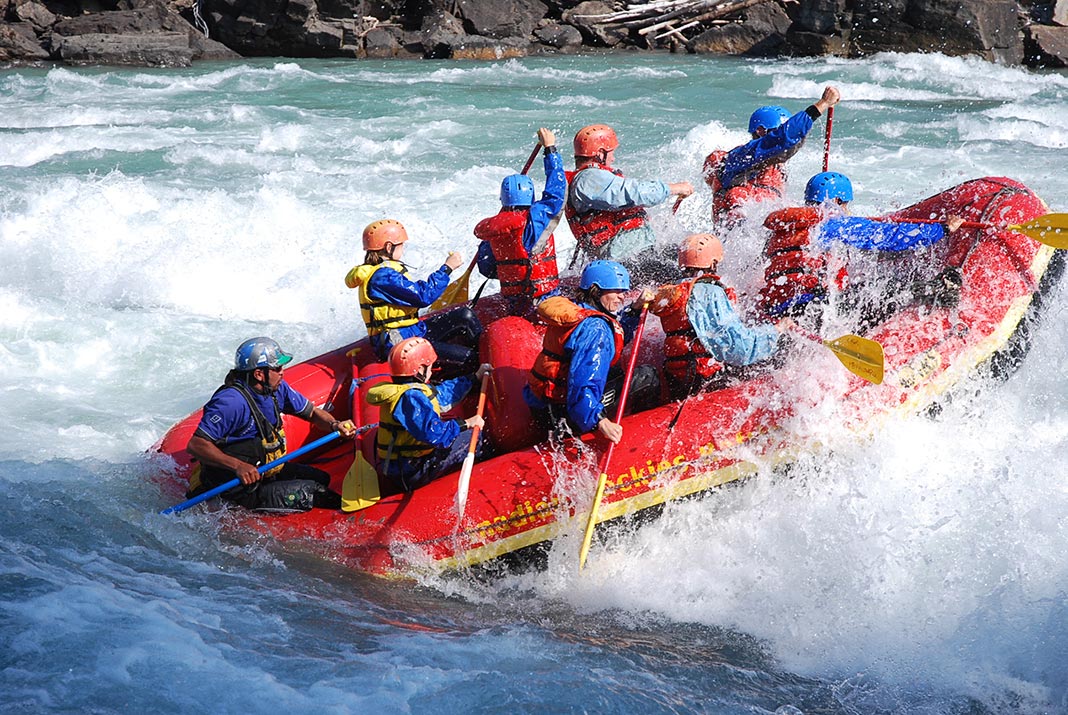
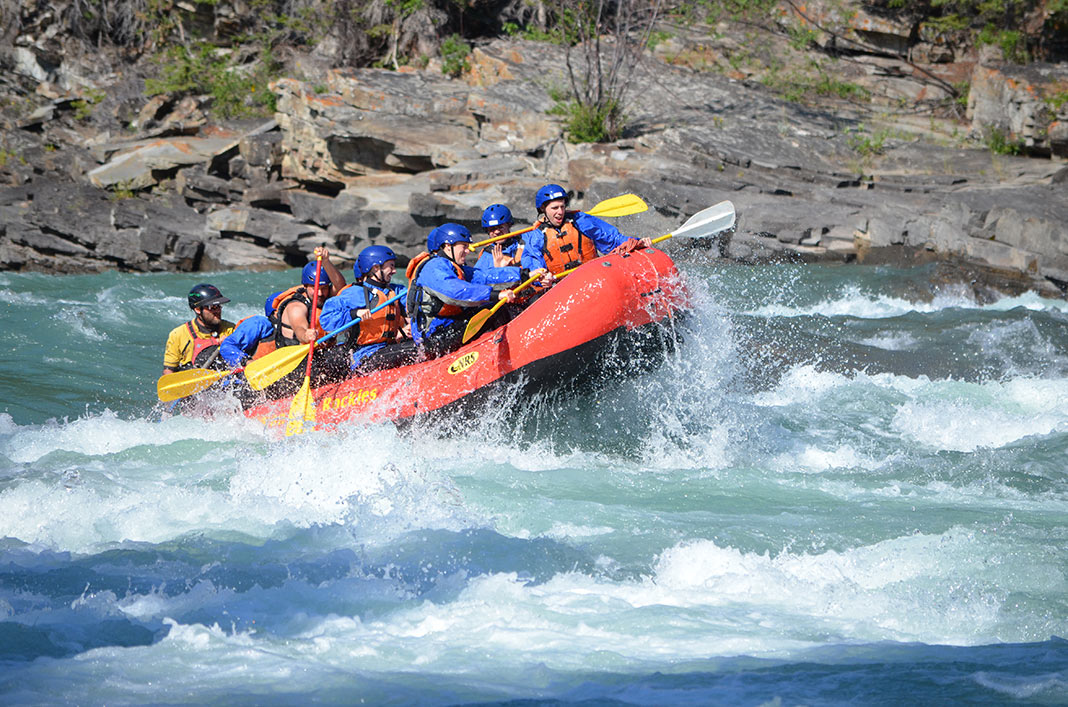
While there is no whitewater rafting available directly within Banff National Park, you don’t have to drive far to access the adrenaline-pumping class II, III and IV rapids of the Bow River’s Horseshoe Canyon, the Kananaskis River or the Kicking Horse River.
If you’re ready to get wet—or even just to go for a scenic flatwater float—read our Guide To Rafting In Banff to learn how.
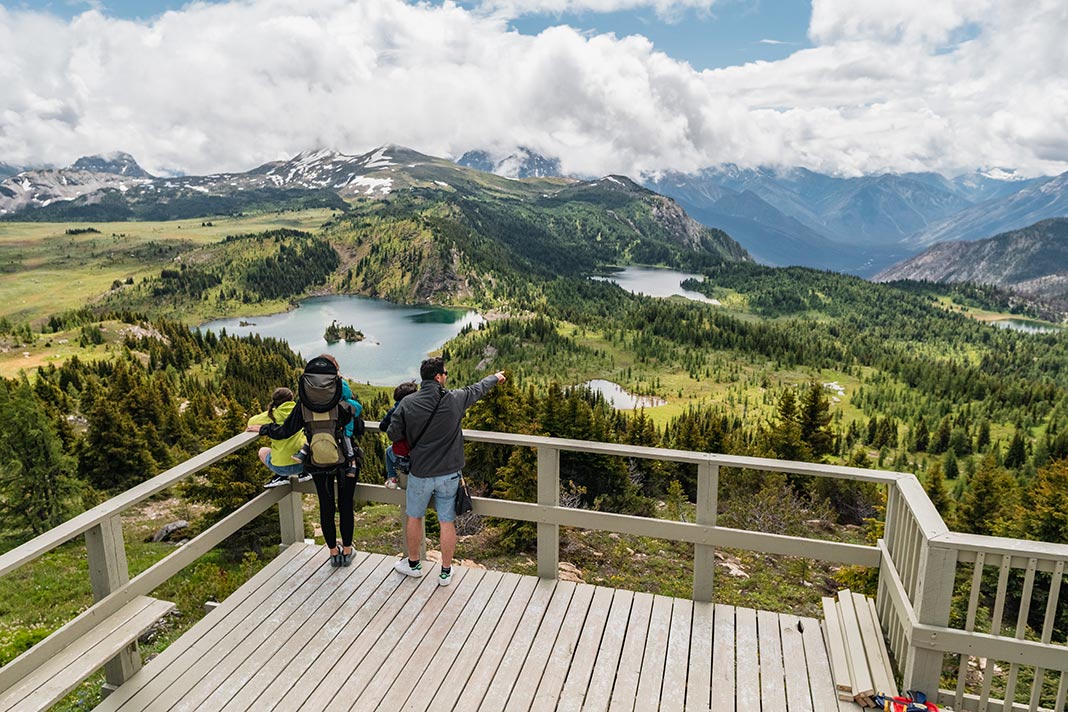
The view from the lookout platform in Sunshine Village. | Photo courtesy of: Banff Sunshine Village
Places to stay in Banff
Banff camping
Finding accommodation in Banff can be challenging, with hotels charging a premium for their prime location.
For those wondering where to stay in Banff on a budget, camping might be the answer. Parks Canada manages and operates 14 frontcountry campgrounds in Banff, with a total of nearly 2,500 sites available for tents, camper vans and motorhomes. That’s not even making mention of the roughly 50 backcountry sites that can only be accessed by foot or canoe.
Our Guide To Camping In Banff provides all the details on Banff’s best campgrounds—from budget sites to luxurious glamping tents—where to find them, how much they cost and how to book them.
Banff cabin rentals
Much like anywhere else in the world, some of the best Banff vacation rentals can be found on Airbnb. In addition to Banff cottage rentals and cabin rentals, this is where you’ll find tiny houses, cute bed and breakfasts, and high-end condos for hire.
However, many traditional accommodation providers also offer cabin rentals, including:
Baker Creek Mountain Resorts
With just 16 cozy cabins and lodge suites set back from the Bow Valley Parkway, Baker Creek’s history dates back to 1949. The self-contained log cabins ooze Rocky Mountain charm, with buffalo plaid textiles and wood-burning fireplaces. Book direct for best rates.
Located off Hwy 93 about 25 minutes from both Banff and Lake Louise, some of this property’s historic log cabins were first built in 1922. Cabins range in price from $365 to $495 CAD, with specials available during the fall and autumn seasons.
Situated below Castle Mountain, these Banff chalet rentals are rustic, yet sophisticated. The property is located midway between Lake Louise and Banff, making all your adventures in the area easy to access. Chalets start from $157 CAD per night.
If you’re going to stay at only one Fairmont in your lifetime, make it the Chateau Lake Louise. As a day visitor to the area, you’ll be subjected to the crowds with selfie-sticks. It’s only as an overnight guest at this hotel that you’ll have one of the most beautiful spots in the park nearly to yourself. The on-site canoe dock is an added bonus, as is the access to trails like the Lake Agnes.
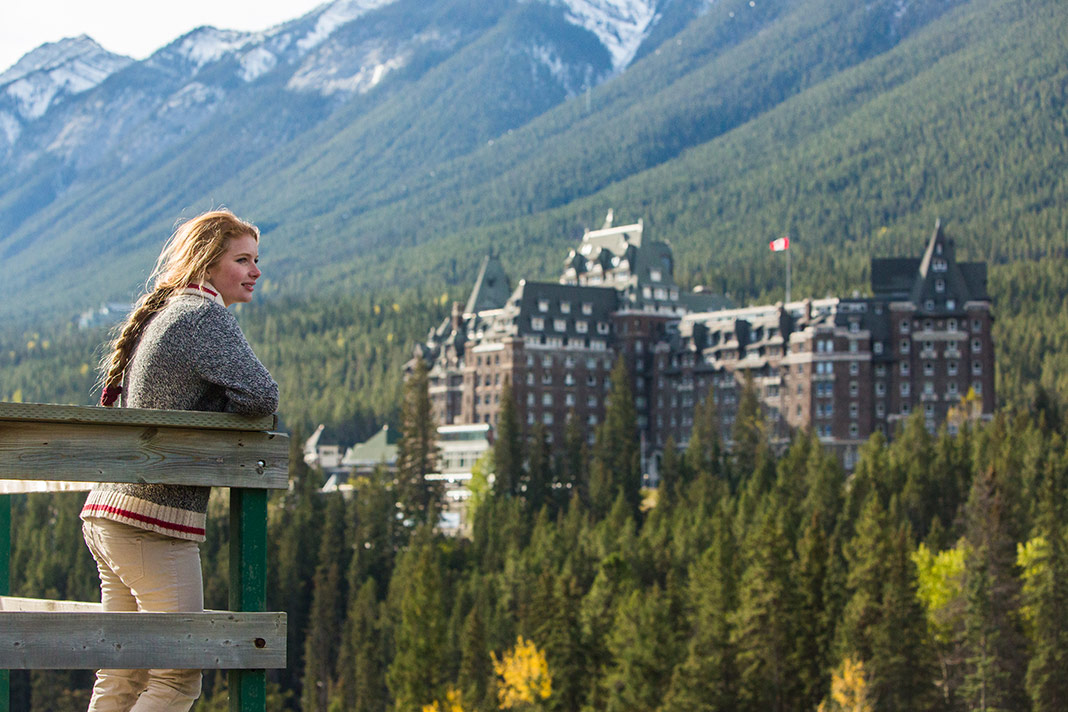
The Fairmont Banff Springs makes for an incredibly glamorous stay. | Photo courtesy of: Travel Alberta
Skoki Lodge
A hotel for true adventurers, Skoki Lodge can only be accessed by hiking or skiing for 11 km. The high-alpine lodge sits at 2,164 meters, somewhere above the Lake Louise ski area. With lodge rooms and log cabins (starting at $200 CAD per night with a two-night minimum), the off-grid property books up months in advance for the summer season, partially thanks to its reputation for great service and filling food.
Visitors to Banff National Park will receive a paper map upon payment of their national park entrance fees at the park gates. A visitor guide, with maps, is also available online at the Parks Canada website.
Banff trail map
For most hiking trails, topographic maps are available from the Banff Visitor Centre (224 Banff Ave) and from select retail outlets in town.
Banff town map
Download the Town of Banff’s map, which includes popular trails near town and sites of interest.
Generally, Banff’s summer season runs from late May until early October, with average highs of up to 22 degrees Celsius. However, being a high-alpine environment means that even during the summer months, the temperatures can be less than balmy—particularly when you’re standing next to a glacier—and in any given month, there’s a chance of snow.
Winters are cold and dry, with the average low being around -15 degrees Celsius. For up-to-date weather forecasts, visit Environment Canada.
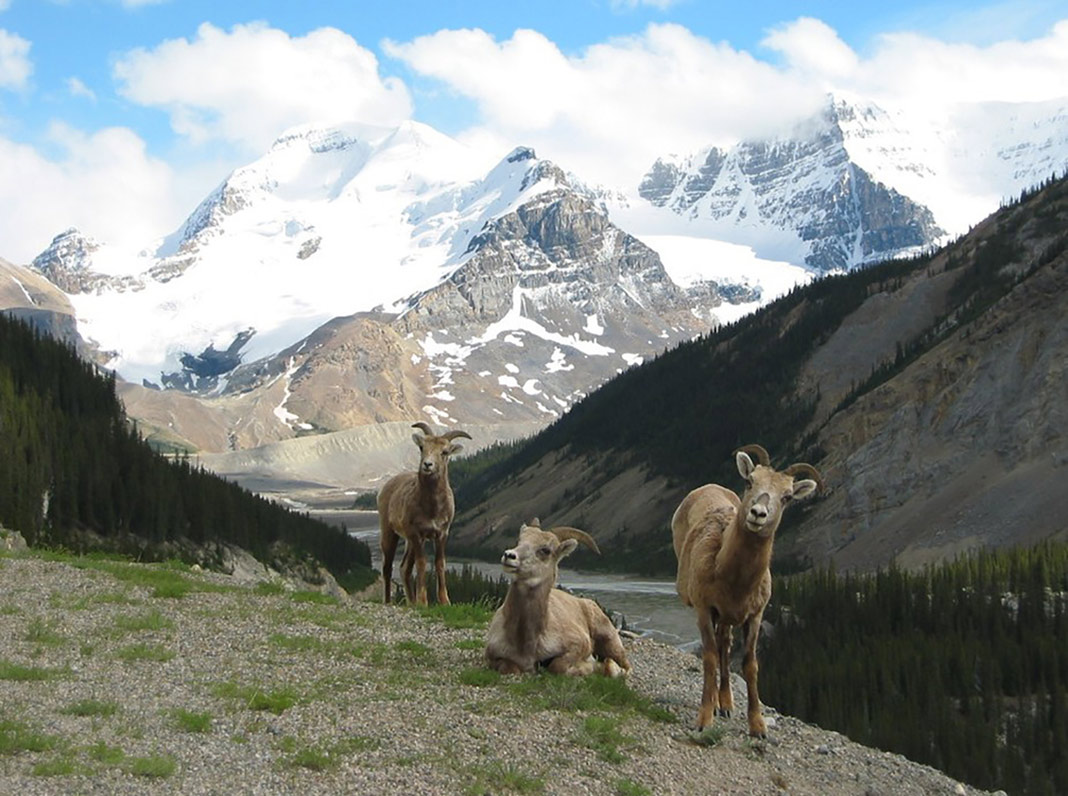
Wildlife viewing is practically guaranteed in Banff. | Photo courtesy of: Travel Alberta
Banff wildlife
Bear sightings near Banff are world renowned, so it pays to be “bear aware” when exploring the area. If you visit the park in the spring, summer or fall months, you have a good chance of seeing bears in Banff, particularly near roadsides where they forage for berries.
While it’s necessary to be particularly conscious of bears, visitors to Banff should be aware of the danger all animals pose—and more importantly, the danger we pose to them. From chipmunks and marmots, to deer and elk, it’s important not to feed the animals, to give them plenty of room, and to do everything we can to ensure they stay wild.
But back to those bears: Carrying bear spray in Banff is a must, particularly if you plan on hiking, camping or paddling in the backcountry. Travel in groups and be sure to make plenty of noise on the trail to warn bears that you’re coming.
A misty mountain Moraine Lake in Banff National Park. | Photo: David Brooke Martin
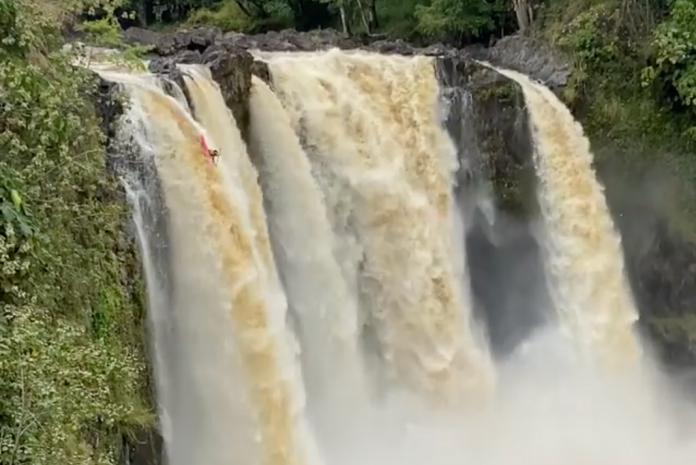
Earlier this month, two seasoned pros—Dane Jackson and Hayden Voorhees—snagged a first descent off the right line of Rainbow Falls on the Wailuku River, Hawaii.
Internationally known for many a great feat in the whitewater world, Dane’s latest first D is just another notch on the belt of his waterfall accomplishments. After watching him secure the first descent of the second-highest waterfall ever run last year, 80 feet seems like it should have been a walk in the park.
Yet, this particular accomplishment wasn’t without its fair share of controversy. According to Hawaii News Now, the pair did not receive a permit to fly a drone in the area. Officials from Hawaii’s Department of Land and Natural Resources and State Film Commission commented that a filming permit would likely not have been granted for this project.
What’s more, for the locals of the Hilo area, Rainbow Falls is associated with a series of fatalities caused by inexperienced swimmers recreating in the dangerous pools below the waterfall.
[ Paddling Buyer’s Guide: View all whitewater boats and accessories ]
For Dane and Hayden, safety is always a huge factor when it comes to making decisions on whether or not to run something. The duo visited the falls at low water and swam in the pools, to ensure the landing was deep enough and hazards could be mitigated. When the time came to run the drop, river levels were just right and safety teams were in place, enabling them a smooth passage down the falls. Watch the video of Hayden’s line off the waterfall here.
Take to the Bow for some of the most beautiful views in the Rockies. | Photo: Banff & Lake Louise Tourism // Paul Zizka
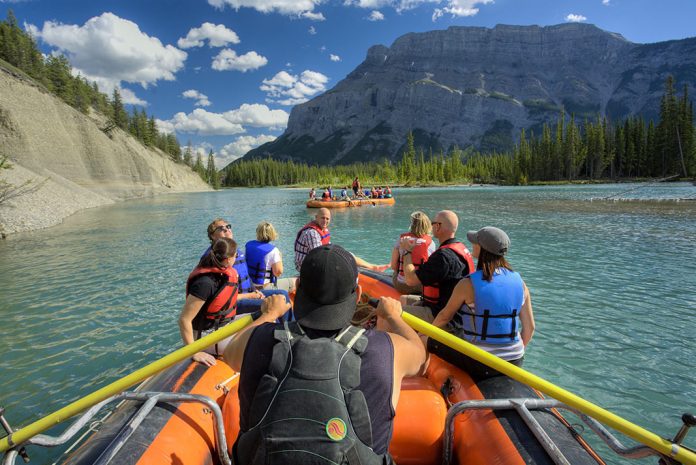
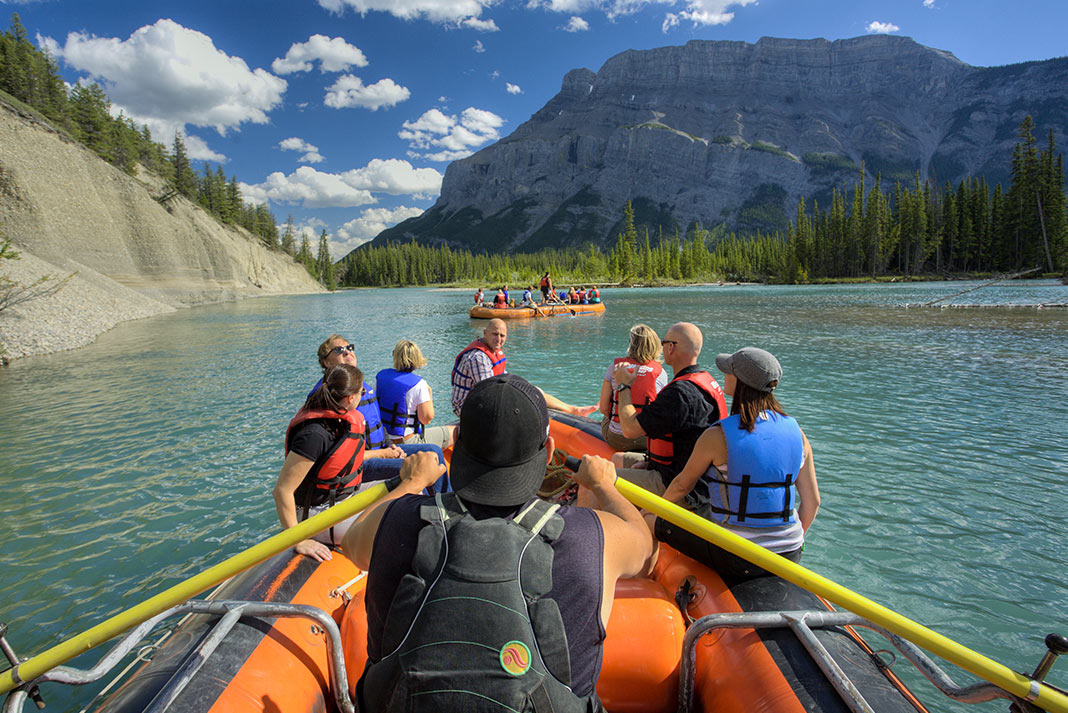
When it comes to rafting in the Calgary area, it doesn’t get much better than the Bow River. Not only does it flow right through the city for easy access, there are a multitude of put-in and take-out spots allowing for easily customized trips, both flatwater and whitewater sections, and a variety of tour companies and outfitters to choose from. When it comes to Bow River rafting, there isn’t much that isn’t on offer.
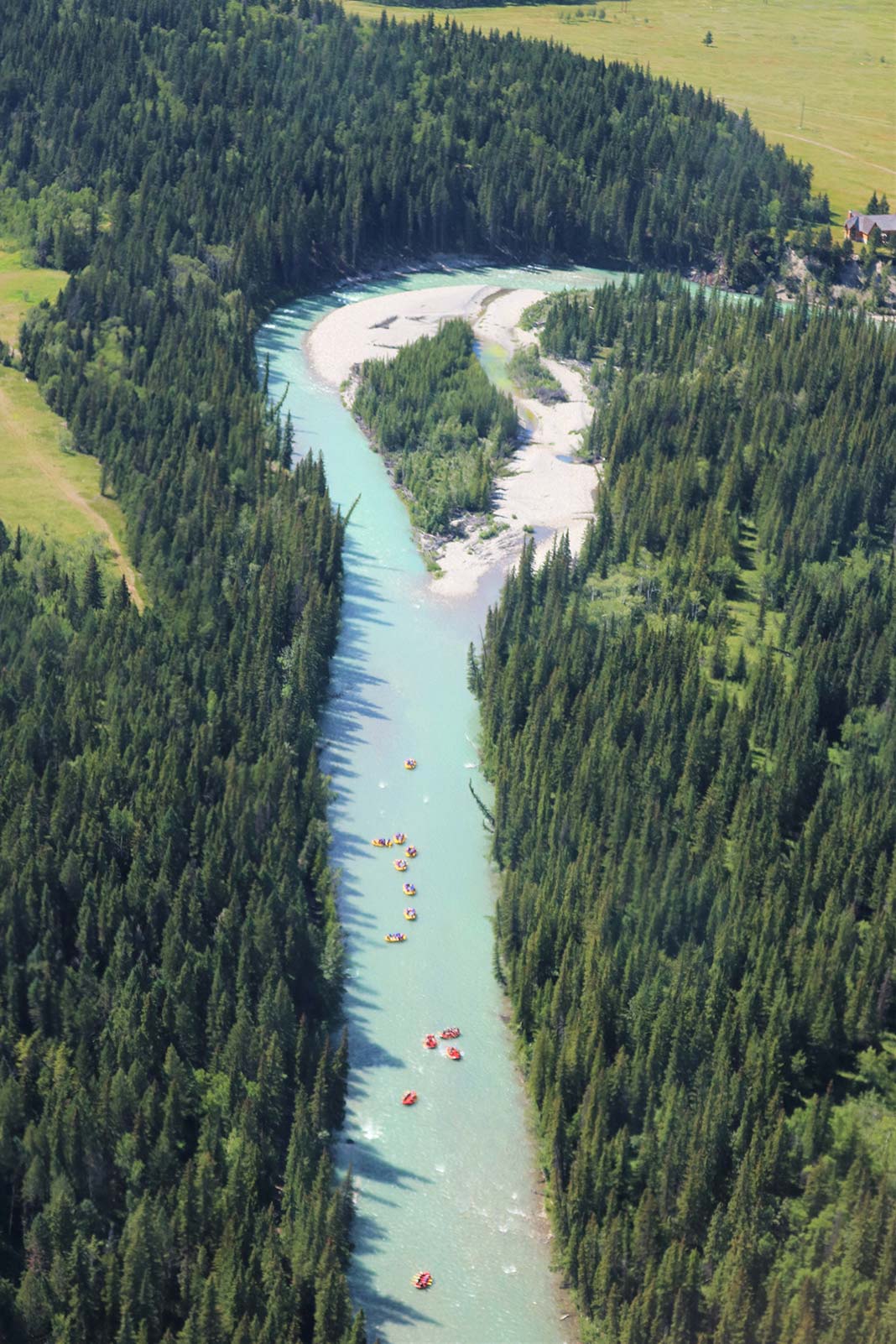
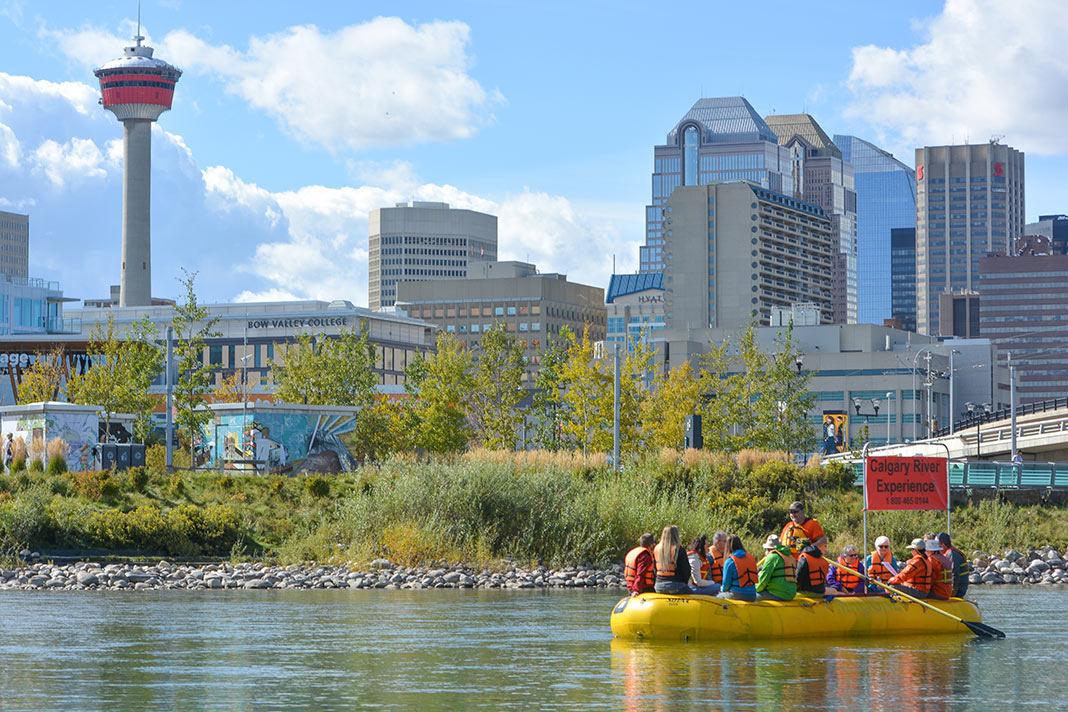
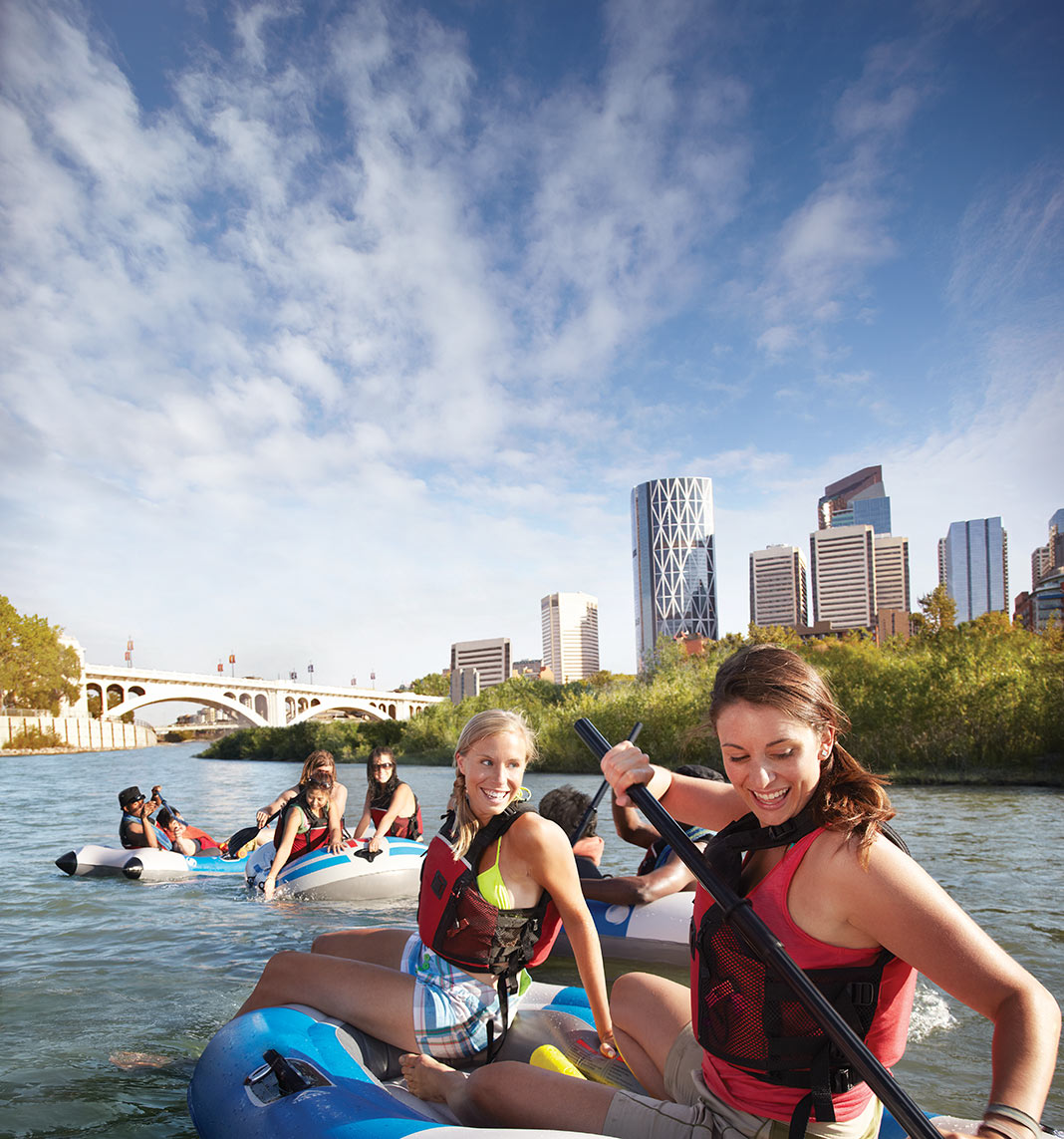
Whitewater rafting opportunities exist upstream of Calgary and are best enjoyed with a guided tour company. You’ll get incredible views of the nearby Rocky Mountain range, see wildlife along the shore and have a wild time in the Bow’s exciting rapids. There are also flatwater paddling sections upstream of Calgary, but by far the most popular flatwater routes are located within the city itself. In this case there are a range of options—choose from guided tours, self-guided trips where all you have to do is show up at the put-in, and self-guided trips where you have to transport the raft yourself and arrange for shuttles.
No matter what your preference, you’ll find out how to plan the perfect Bow River rafting adventure below.
Take to the Bow for some of the most beautiful views in the Rockies. | Photo: Banff & Lake Louise Tourism // Paul Zizka
Planning a self-guided rafting trip
Taking a tour isn’t the only way to experience the Bow River. Rafting the Bow on your own is easy, though it’s recommended you stick to the flatwater sections. Outside the city, you’ll experience a peaceful float in majestic surroundings. Within the city limits, you’ll often be joined by other rafters having a good time and see the city sights from a different perspective.
Bow River rafting routes
Below, we’ll outline some of Bow River rafting routes you can choose from for your self-guided adventure. With so many access points, though, customizing your own route is simple. Note that float times may vary depending on the season.
Ghost Reservoir to Cochrane
Put in at the Ghost Dam and paddle down to Cochrane on this three- to four-hour adventure. You’ll need to negotiate a steep hill to reach the access point, but once at the bottom there is a flat, rocky space for you to launch your raft. This section of river is mostly flatwater, but has a swift current. There are some small class II rapids that are quite manageable (and fun) in a raft.
Gaze up at cliff walls, look back to see mountaintops peaking over the trees, and keep an eye out for birds of prey and other wildlife. Just past the Gas Plant, you’ll come upon Wildcat Island—a natural area that some choose to camp on to split the trip into two days.
Eventually you’ll begin to see houses backing onto the river, indicating that you’re entering Cochrane. Look out for the Hwy 22 bridge—you’ll take out on river left. Always check flow rates before embarking on this trip as the Ghost Dam can greatly influence how much water is flowing through this section of the Bow.
Bowness Park to Prince’s Island Park
For a classic Bow River float trip, set out on this three-hour jaunt from Bowness Park to Prince’s Island Park (sometimes referred to as Sunnyside). You can put in at either Bowness Park on the south shore or West Baker Park on the north shore. You’ll take out on river left, just under the Bow River Pathway Bridge that connects to Prince’s Island Park. You’ll need to use this footbridge to cross over Memorial Drive NW to reach the parking lot.
On this route you’ll see a good chunk of Calgary from the water—and have the opportunity to pass beneath the Peace Bridge, which you’ll probably recognize from many advertisements for rafting on the Bow.
Shouldice Park to St. Patrick’s Island
For another great section of rafting through Calgary, put in at Shouldice Park and take out at St. Patrick’s Island. This two- to three-hour float overlaps with the previous route, starting you a little upriver from Prince’s Island Park. You’ll still pass under the Peace Bridge, around many islands and past beautiful parks.
The access point is a boat ramp located in Shouldice Park where the Trans-Canada Hwy passes over the river. At the end, you’ll get off on river left at the St. Patrick’s Island boat launch, just before the Calgary Zoo. You can also take out farther down on river right at Pearce Estate Park. Just be sure to get off the river before Harvie Passage!
Graves Bridge to Fish Creek Provincial Park
Looking for a less busy route that’s still easy to access from within the city? Put in underneath the Graves Bridge (on Glenmore Trail) on the west side of the Bow. You’ll paddle for about two hours and then take out on river right in Fish Creek Provincial Park, just before the Stoney Trail SE bridge.
There’s far more greenspace along this route, allowing for a more secluded feeling as you float down the river.
Bow River rafting entry points
Don’t fancy any of the suggested routes above? With so many access points on the river, it’s easy to plan your own. Consider the following for the put-in and take-out spots for your adventure.
Ghost Dam
From the Bow Valley Trail, head south on an unnamed road when you see a sign for the Ghost Lake Cottage Club. Follow this road to where it ends at the dam. You’ll have to walk your boat down to the water from here.
Drive south on Range Road 54 from the Bow Valley Trail, toward the Wildcat Gas Plant. Park off to the side before the road turns into the gas plant itself. You’ll have to walk your boat down to the water from here.
The West Baker Park boat ramp is easily accessible from Stoney Trail NW, on the north side of the river. There is a wide boat ramp here and plenty of parking. Washrooms, picnic tables and garbage cans are all located on-site.
Located just downstream of the West Baker Park boat ramp, but on the south side of the river, the Bowness Park boat launch is accessible from 48 Ave NW. There is plenty of parking available and washrooms, picnic sites and a tea house are located on-site.
The boat ramp at Shouldice Park is located beneath the 16 Ave NW bridge on the east side of the river. There are a couple small parking lots nearby and lots of street parking along Monserrat Dr NW. There are portable toilets on-site.
Located on the south side of the river within Edworthy Park, this is a hand-launch site only. There are washrooms, picnic shelters and plenty of parking available on-site.
This is a small hand-launch site on the north side of the river, located at the corner of 37 St NW and Parkdale Blvd NW. There is a small parking lot located on-site.
There are few facilities available at this launch, but you’ll be able to make do if you don’t need to use a vehicle to launch your boat. Only paid street parking is available nearby.
Launch your raft by hand along the rocky shore across from Prince’s Island Park. Parking is available in the lot across Memorial Drive. Use the footbridge to cross Memorial Drive when launching.
Located just across from where the Elbow River enters the Bow, St. Patrick’s Island is home to the Calgary Zoo, a park, walking trails, picnic areas—and a public boat ramp. You’ll find parking and washrooms on-site.
If you’re looking to get off the river right before Harvie Passage or access Harvie Passage itself, you can do so at Pearce Estate Park. There are a number of paths you can take from the parking lot to the shore. There are picnic areas, washrooms and walking trails located within the park.
Find adventure right in Calgary. | Photo: Travel Alberta // Dave Lieske
Ogden Bridge
You’ll find a boat ramp on the east side of the river, accessible from Ogden Road SE. Washrooms, garbage cans and other site enhancements to be added in 2021.
This boat ramp is located on the west side of the Bow, beneath the Graves Bridge (on Glenmore Trail). You’ll find parking, washrooms and picnic tables on-site.
This is a hand-launch location on the east side of the Bow. There is a parking lot with a short walk down to the water, and washrooms and picnic tables on-site. It’s accessible via Riverview Drive SE.
Located by the ball diamonds on the east side of the river, this hand-launch site has stone steps leading down to the water. There are portable toilets and parking on-site.
Make use of the double boat ramp and large parking lot at Fish Creek Provincial Park, on the west side of the Bow. You’ll find washrooms and picnic tables nearby. Day use is free.
Launch from the Johnson Island boat ramp, located within Wyndham-Carseland Provincial Park and accessible off Range Road 260. Washrooms and garbage cans are located on-site.
Need to rent a raft to embark on your self-guided Bow River rafting adventure? See the local rental shops below and get fully outfitted.
Lazy Day Raft Rentals
Whether you want to pick up a raft and head out on a Bow River rafting route of your choosing, or want a hands-off experience with help launching and taking out, Lazy Day Raft Rentals has you covered. Option one is to pick up a deflated raft and equipment at their shop downtown and return it 24 hours later.
The second option is to raft their predetermined and staffed route, starting at the West Baker Park Boat Ramp and ending at their shop downtown. Staff will be on-site at the put-in with your raft already inflated and will help you get on the water. They’ll also be waiting at the take-out to help you get the raft off the water and will look after getting the equipment back to the shop. This is approximately a three-hour float.
The company rents four-, six-, eight- and 10-person rafts from the beginning of June to mid-September.
Phone: (403) 258-0575 Address: 720 3rd Street NW, Calgary
Sports Rent is located three minutes from popular launch sites along the Bow River, including Edworthy Park, Shouldice Park and Bowness Park. However, you’ll be responsible for picking up, transporting and returning the raft and equipment to and from your put-in and take-out locations.
They offer four-, six-, eight- and 10-person rafts which can be rented in one-, two-, three-, four-, five-, six- and seven-day increments.
Paddle right through the heart of Calgary. | Photo: Travel Alberta // Caitlyn Giorgio @caitlyngiorgio
The Paddle Station
Float down the Bow River with ease with the help of The Paddle Station. You’ll receive riverside service at the put-in and take-out, including your raft inflated and ready to go and safety training from their knowledgeable staff members. The raft run is from Shouldice Park to St. Patrick’s Island, which is about a 2.5-hour float.
There’s also a self-serve option, for those who would prefer to raft another section of the Bow. The rental must be picked up at Shouldice Park after 10 a.m. and returned by 6 p.m. the same day.
They offer small (two- to six-person), medium (two- to eight-person), large (six- to 12-person) and round (two- to six-person) rafts, in addition to the Hot Tub Time Machines Raft (four- to eight-person) and The Blue Monster Raft (eight- to 20-person). We’ll let you look up those last two for yourself.
Choose-your-own adventure when you rent from the Rocky Mountain Paddling Centre. Pick up a raft at their store and head out on one of the amazing Bow River rafting routes above. They offer four-, six-, eight- and 10-person rafts with pumps included. You’ll also have the option of purchasing a raft package that includes paddles, throwbag, PFDs, a pump and a bailer.
Note that you will need a truck or SUV to transport their eight- or 10-person rafts. They also rent trailers.
Phone: (403) 202-8490 Address: 1975 26 Street SE, Calgary
The City of Calgary has made it incredibly simple for anyone to enjoy the Bow River. Access points are all listed online and are updated regularly with information on restrictions, hours, parking availability and fees. Find the river access map here.
Many of the featured rental companies listed above will provide maps of the Bow River for your excursion. You can view Bow River route suggestions and trip information on PaddlingMaps. For adventurers that are familiar with map reading, Backroad Mapbooks sells a topographic map of southern Alberta that will provide you with all the information you’ll need for trip planning.
Bow River rafting rules
The City of Calgary has outlined some straightforward rules for rafting the Bow River within city limits. The most important, is that you must always be wearing your PFD while on the river. As well, you may only launch your watercraft in designated areas, to ensure naturally sensitive areas are not damaged.
Safety kits are required on all types of non-powered watercraft—that includes rafts. This kit must contain: a bailing device, paddle or oar, sound-signalling device, heaving rope or towing line that floats, and navigation or safety light. In addition, it’s a good idea to bring the following: water, hats, sunscreen and a cell phone (in a waterproof bag or container).
Common infractions on Calgary’s waterways include public urination, littering, and intoxication. Note that transporting or consuming alcohol on the Bow River—or any of Calgary’s waterways—is not permitted.
Learn about all the City’s waterway safety recommendations here.
Bow River rafting advisories
Before heading out on any on-water excursion, it’s important to check the river conditions. Conditions could be unrunnable because water levels are too high and dangerous, or too low to be any fun (read: you’re going to get stuck, frequently). There may also be hazards on the river or closures to be aware of. Checking the weather is also a necessary precaution to take, to ensure you’re bringing the right supplies or aren’t putting yourself in a dangerous situation.
You can find information on flow rates here and the weather forecast here. As well, check the City of Calgary’s Facebook and Twitter pages for advisories or closures beforehand.
Beauty and thrills on the Bow River. | Photo: Canadian Rockies Rafting & Adventures
Bow River rafting tours near Calgary
Taking a guided rafting trip is a great way to safely experience rapids, glean information about the area, and improve your paddling. You’ll find both whitewater and floating guided trips in the Calgary area. No matter which you choose, you’ll have an enriching experience in one of the most beautiful parts of Canada.
Whitewater rafting tours
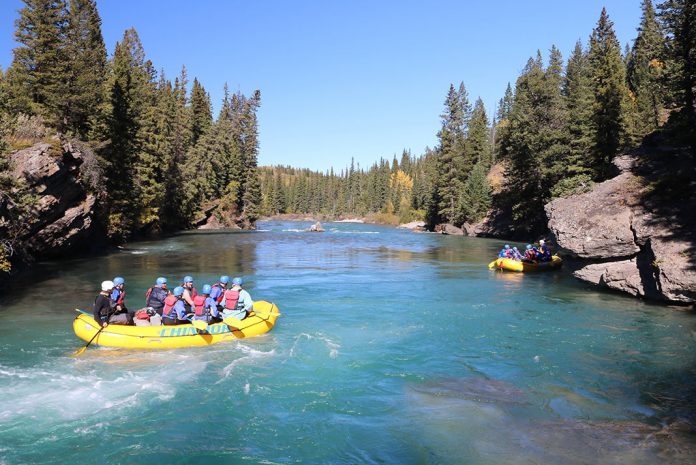
Those looking to experience the thrilling whitewater of the Bow River best head west of Calgary. There are a wealth of companies that run trips through Horseshoe Canyon, a portion of the Bow located just outside the Rocky Mountains that contains up to class IV rapids. You’ll see incredible scenery, take major waves to the face, and even have the opportunity to do some cliff jumping.
Find the companies offering Horseshoe Canyon trips below.
Raft the Horseshoe Canyon with Chinook Rafting, offering daily runs from the middle of May until the beginning of September. You’ll meet at the Nakoda Lakeside Lodge for the 8:15 a.m. departure and return by 12 p.m. Time on the river amounts to 1.5 to two hours.
There’s a float section near the end of the trip, where you’ll have the chance to do a medium or big cliff jump and be able to swim in the river.
The company provides complimentary photos as well as light snacks and refreshments. All gear is included, including wetsuits, PFDs, helmets, rain jackets, booties and gloves.
Canadian Rockies Rafting runs trips through Horseshoe Canyon’s spirited whitewater from the beginning of May to the middle of September. You’ll meet at the Stoney Nakoda Resort at 8:10 a.m. for a three-hour tour with two hours on the river.
Like other tours, you’ll have the option to do a cliff jump during the float section of the trip.
Rafters get a complimentary hot or cold beverage, access to secure storage lockers, and change room facilities. All gear is supplied, including PFDs, helmets, wetsuits, river shoes, splash jackets—and even strings for retaining eyewear.
White Wolf Rafting runs tours through Horseshoe Canyon from June to September. You’ll meet at their base in Canmore at 9 a.m. for a day full of adventure on the Bow. Time on the river is about 2.5 to three hours, though you should expect the entire tour to last four hours including orientation and transportation.
Your tour includes complimentary photos, a snack and drink, a custom White Wolf Rafting drawstring bag, and White Wolf Rafting stickers. All gear is included, such as PFDs, helmets, wetsuits and booties.
Hitting waves in Horseshoe Canyon. | Photo: Canadian Rockies Rafting & Adventures
Float tours
Rapids and cliff jumping not your thing? There are several guided raft tours on flatwater sections of the Bow as well. Your guide will act as interpreter, telling you about the history, wildlife and landscape of the area you’re traveling through. You can choose from natural or urban surrounds, some tours taking place outside city limits and others allowing you to drift right through the heart of Calgary.
Find what you’re looking for from the tour companies below.
Canadian Rockies Rafting and Adventure Centre
One of the draws of the Rockies is the incredible wildlife viewing opportunities. A float down the Bow River is a great way to improve your chances of seeing some of the resident elk, deer, osprey, eagles and beaver, to name a few. Canadian Rockies Rafting’s Bow River Nature Floats take place at dawn and dusk—the prime times of day for seeing wildlife.
The morning tours are at 8:15 a.m. and 10:15 a.m. and are an hour in duration. On these tours, you’ll float through the town of Canmore. The evening tour is at 6:30 p.m. and is an hour and a half. After floating through Canmore on this tour, you’ll continue on to Dead Man’s Flats.
Tours run from the beginning of May until the middle of September. Blankets, PFDs, binoculars, wildlife guidebooks, and photos are all provided. On the evening floats, you’ll be provided with a hot or cold beverage, depending on the weather.
[ Paddling Trip Guide: Find all paddling adventures in Alberta ]
Mukwuh Rafting Tours
Mukwuh Rafting Tours’ Calgary River Experience will take you right through the heart of the city. The route goes from the Pump House Theatre to Pearce Estate Park and lasts 1.5 hours. The whole tour will last about two hours, including shuttle times. They also do custom trips, allowing you to stop at restaurants along the way or get food to go.
Trips run daily at 12:30 p.m from the beginning of April to the end of October.
Canmore Raft Tours offers three scenic floats on the Bow River, west of Calgary. The Townie is a one-hour float through Canmore that will allow you to glimpse some wildlife, see the town from the water, and learn about the area’s history. Tour times are 10 a.m., 12 p.m., 2 p.m., 4 p.m. and 6 p.m.
The Explorer is a 2.5-hour float from Canmore, down the river and through the forests of the Bow Valley. You’ll have plenty of time to relax and enjoy the beautiful views of mountain peaks, not to mention learn about the area’s flora and fauna. Tours depart at 6 p.m.
Rafts & Crafts puts a spin on The Explorer tour, tacking on a Canmore Brewery & Distillery Tour. The float itself is one hour and departs at 4 p.m, for a total length of three hours. You’ll not only be able to take in beautiful views from the river, but try some of Alberta’s best beers and spirits.
Tours run from the middle of June to the middle of September, though opening and closing dates vary year to year. All tours meet at the public boat launch on the Bow River, just a five-minute walk from downtown Canmore.
Take it easy and enjoy the sights. | Photo courtesy of: White Wolf Rafting
White Wolf Rafting Inc.
White Wolf Rafting’s Float Trip will provide you with two hours on the river starting in the beautiful town of Canmore. You’ll have the chance to see elk, beavers, eagles, osprey and more in between staring in awe at the Rocky Mountains.
Tours begin at 6 p.m. and are available from July to August. With the tour you’ll receive a White Wolf Rafting sticker, a snack and drink, and complimentary bug spray.
While not a formal tour, you have the option to add a guide to your raft booking with The Paddle Station. They run floats down the Bow River within Calgary from Shouldice Park to St. Patrick’s Island—a two- to three-hour excursion.
Thanks in part to the COVID-19 pandemic, there have never been so many paddlers on the water. However, communicating safety messaging is a challenge the industry will be reckoning with for years to come.
In his semi annual report, American Whitewater Accident Database manager Charlie Walbridge writes:
“In the second half of 2020 American Whitewater received reports of six kayak, two canoe and six rafting fatalities for a total of 14. There were two commercial rafting deaths and two incidents in “miscellaneous craft”: a small fishing cataraft and a standup paddleboard.
The trends noted in the first six months continue. Recreational kayaks were used in four of the six kayak accidents; 11 of the 19 accidents reported occurred on Class I or II whitewater; eight saw no life vests in use, and seven were solo or one boat trips.
The year as a whole saw 48 deaths overall, which is well above average. Although fatalities among skilled paddlers declined, those involving inexperienced boaters increased sharply. This was almost certainly part of the Covid-19 outdoor recreation growth spurt. Kayak and canoe dealers sold out quickly, and lots of people got on the water for the first time. This is probably the start of a significant growth period for paddlesports generally. It will be a real challenge for the boating community to educate these newcomers so they can paddle rivers safely.”
[ See the best rescue and safety equipment in the online Paddling Buyer’s Guide ]
Many thanks to Charlie Duffy for preparing the graphs below.
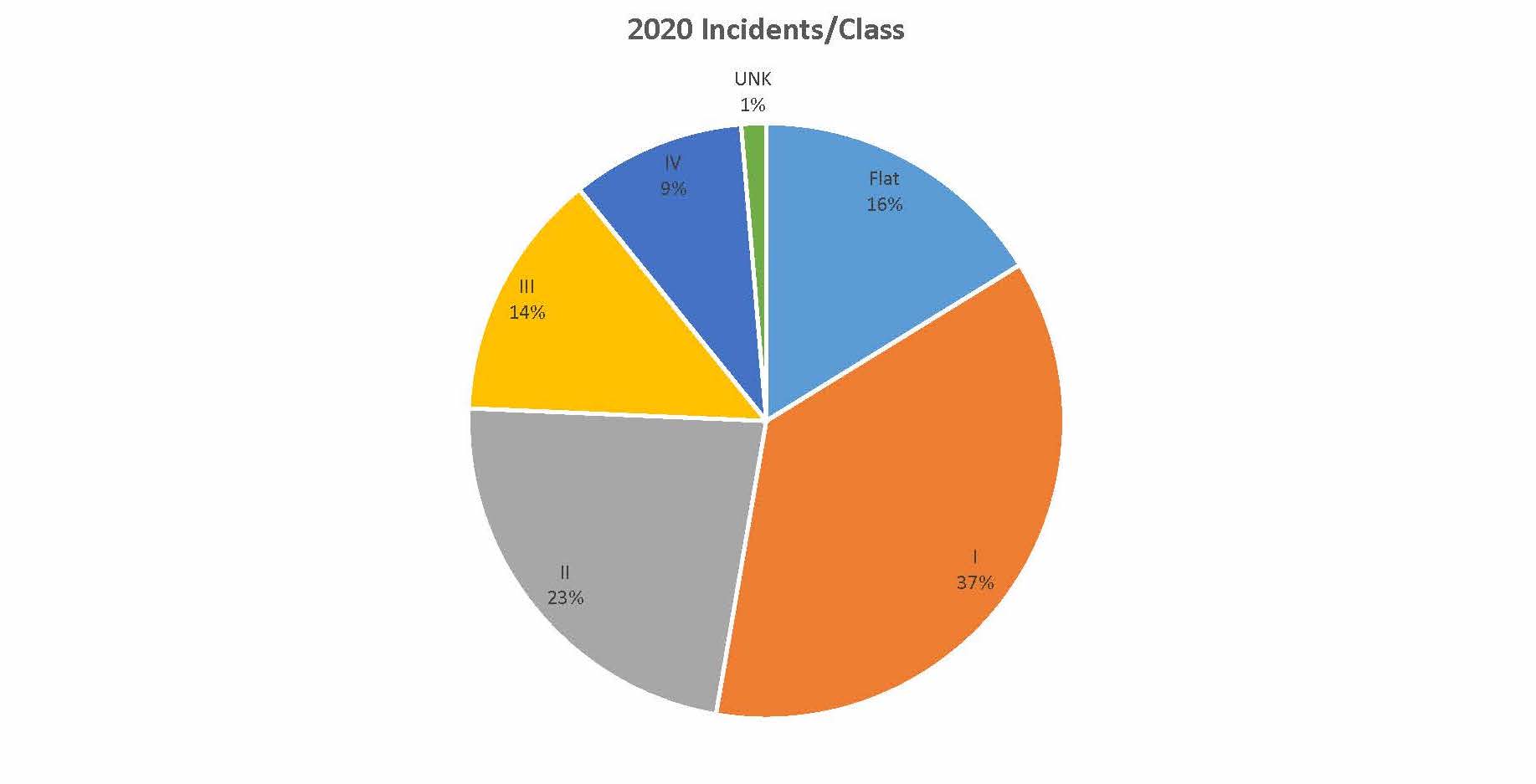
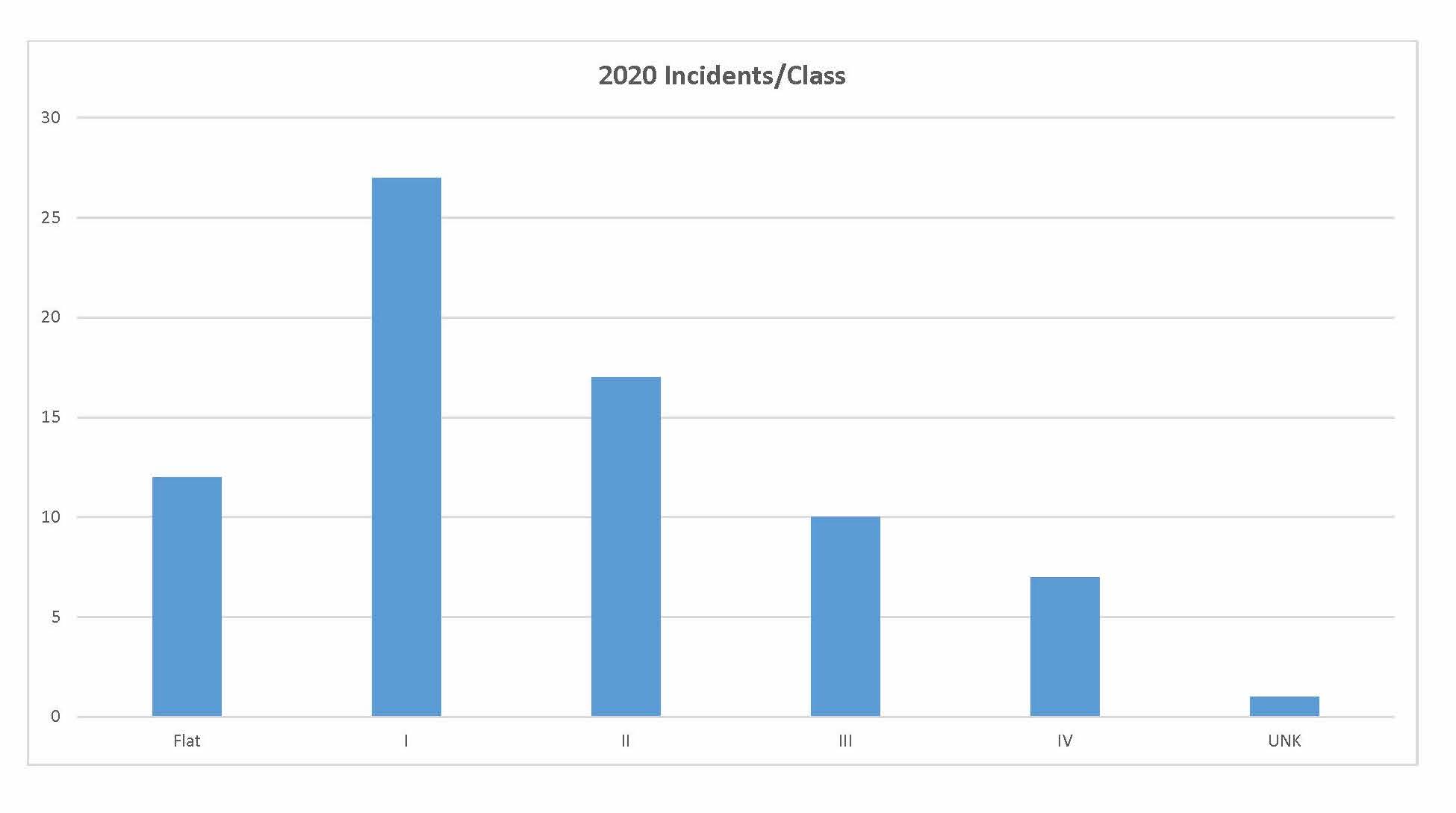
2020 Incidents by River Class
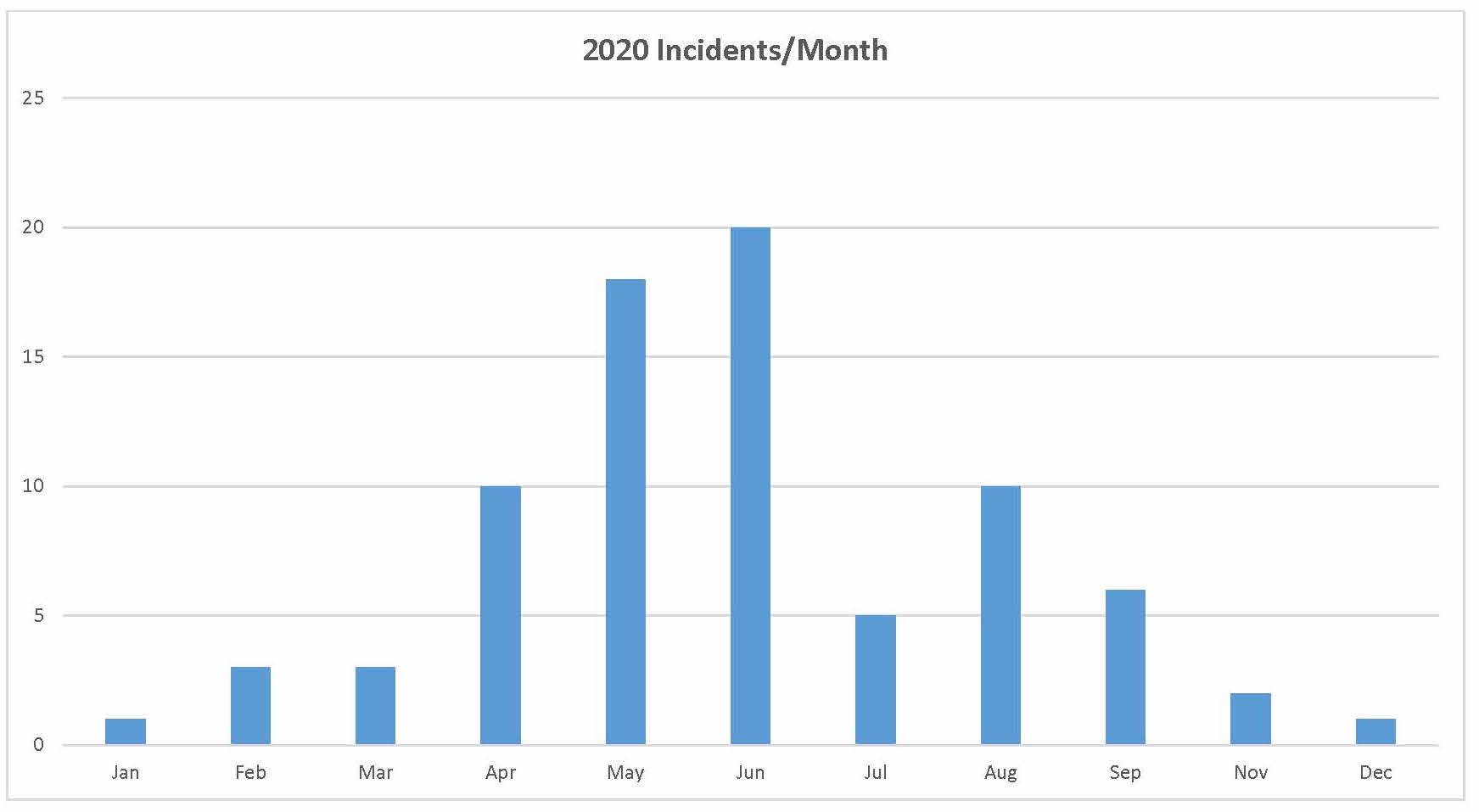
2020 River Incidents by Month
2020 River Incidents by State
2020 River Accident by Top 5 Causes
2020 River Incident by River Classification
History of the American Whitewater Accident Database
The American Whitewater Accident Database catalogs over 1600 fatalities and close calls on whitewater rivers dating back to 1972. The project was initiated over 40 years ago, in 1975 when a fatality occurred due to foot entrapment at a slalom race. Charlie Walbridge was present for the race and described the risks of foot entrapment for the first time in a 1976 issue of the American Whitewater journal. Charlie continued to collect reports and share lessons through the American Whitewater Journal.
In 2001, American Whitewater Safety Chair Tim Kelly led an effort to develop the American Whitewater Safety Database and in 2017 the database was further refined with enhanced search functionality through a website interface. There are three good reasons for writing (or sending in) a whitewater accident report: it provides an opportunity to get the real story out, serves as a learning opportunity that can educate the paddling community, and it facilitates dialogue with river managers and decision makers.
American Whitewater depends on its members to forward the reports and information on accidents on the water. First-hand accounts are best, but information from a newspaper article or social media post often provides the initial information that ultimately leads to more in-depth review and follow up. Go to the database here.
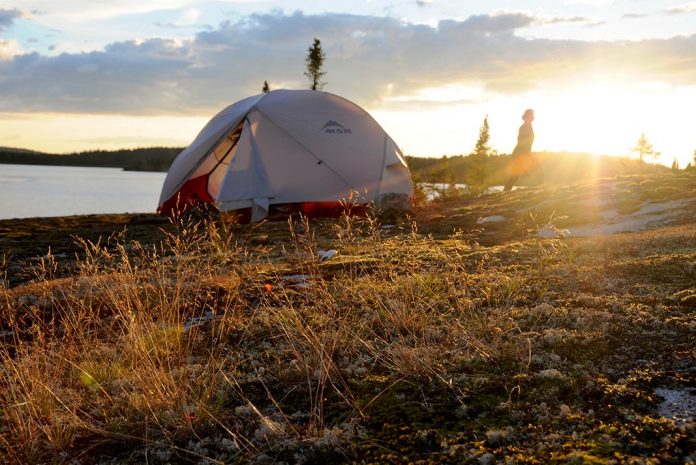
From wilderness camping to luxury glamping, Saguenay has it all. | Photo courtesy of: Virginia Marshall
Quebec’s Saguenay–Lac-Saint-Jean region is an outdoor adventure and paddling paradise. From the wide-open waters and endless sand beaches of Lac Saint-Jean to the towering mountain cliffs and abundant marine life of the stunning Saguenay Fjord, you’ll need to spend at least a few days here just to get a taste of what this remarkable area has to offer. Happily, camping near Saguenay is both plentiful and beautiful with tons of options to suit every taste.
Whether you’re enjoying boutique luxury camping (Saguenay boasts some out-of-this-world glamping accommodations), camping at an all-inclusive adventure resort or seeking the solitude of a backcountry beach, Saguenay camping is sure to be a highlight of your visit. Even better, sleeping under the stars means you can drift off to the rhythm of waves lapping the shores and awake to the unmistakable (and unforgettable) sighs of surfacing whales.
[This article is part of our 35 Adventurous Things To Do In Saguenay series. Learn more about where to hike, bike, paddle and sightsee around Quebec’s Land of Giants.]
Saguenay Campgrounds
Much of the best camping Saguenay has to offer is accessible to visitors traveling by vehicle. Drive-to campgrounds near Saguenay boast an exceptional variety of attractions and amenities with something for every budget and every type of traveller. Plus, many Saguenay camping areas are on or near the water, so they feature great paddling right out your tent door or just minutes away.
[ Plan your next Quebec paddling adventure with the Paddling Trip Guide ]
Beach Camping Saguenay
Pointe-Taillon National Park Campgrounds
Often overshadowed by the spectacular river and fjord that drains its waters, Lac Saint-Jean is no slouch when it comes to size and scenery. The lake is more than 35 kilometers across and is rimmed by mountains, forests, farms and vibrant communities. Its enviable combination of warm, shallow water and sprawling sandy beaches makes Lac Saint-Jean a popular vacation destination with some of the best camping near Saguenay.
Parc National de la Pointe-Taillon occupies a 15-kilometer-long peninsula on the lake’s northern shore and boasts miles of seemingly endless sand beach and 5 campgrounds with a total of 198 sites just steps from the sand. Four of these are designated primitive camping—accessible on foot, by paddle or via a 45-km network of cycling paths (bike rentals and free baggage trailers available). New in 2021, Camp-de-Touage–Les-Îles Campground offers 80 serviced campsites accessible by car and RV. Paddlers can explore an archipelago of 30 rocky islands scattered just offshore. Kayak, canoe and SUP rentals are available at the park’s main swimming beach.
Situated on the east side of Lac Saint-Jean near Alma, Saguenay camping doesn’t get much better for beach lovers than Belley Campground & Beach. A stunning, 3-kilometer-long sandy beach forms the centerpiece of this popular family campground, which offers 321 campsites for tents, trailers and RVs; comfort stations; laundry facilities and camper’s store. Reserve early if you’re hoping to score one of the popular beachfront campsites.
Located on the peaceful north shore of Lac Saint-Jean, the 7-kilometer-long beach at Camping Vauvert is bookended by the mighty Mistassini and Péribonka Rivers, ensuring river-borne sediments are always renewing its sprawling sands. Along with beachside camping and chalets, Vauvert offers a boat launch, kayak and paddleboard rental, hiking trails and dining options.
Nestled on the west side of Lac Saint-Jean, just south of Saint-Félicien and the mouth of the Ashuapmushuan River, Camping Plage Robertson features a fine sand beach and 150 campsites for tents, trailers and RVs. Families appreciate the quiet setting, well-treed campsites with beach views and amenities including comfort station, laundry facilities and on-site restaurant. Bonus: dog-friendly campground and beach.
Camping Baie-Sainte-Marguerite, Saguenay Fjord National Park
Excavated by mile-thick glaciers tens of thousands of years ago, the Saguenay Fjord is a mystical landscape of dark waters enclosed within dizzying, 300-meter-high cliffs. The fjord is at once a sea and a river, as cold saltwater from the St. Lawrence estuary floods its depths while warmer fresh waters from Lac Saint-Jean and its tributaries run along the surface. Two parks protect this ecologically diverse region: the Saguenay-St. Lawrence Marine Park encompasses both the waters of the fjord and the adjoining St. Lawrence estuary, while the shores of the fjord are protected by the Parc National du Fjord-du-Saguenay (Saguenay Fjord National Park).
Photo courtesy of: Flickr // Brian Gratwicke
Known as one of the best places to observe snow-white beluga whales from the shore, Baie-Sainte-Marguerite is regularly visited by schools of female whales with their young in July and August. Located within Parc National du Fjord-du-Saguenay, west of Tadoussac, the Baie-Sainte-Marguerite sector offers 50 tent and RV campsites in Le Bleuvet Campground, as well as hiking trails, an observation deck for beluga watchers, park-led interpretive activities and Le Béluga Discovery and Visitors Centre. Adventurous families enjoy 10 additional walk-in/bike-in rustic campsites with spectacular views of the bay.
Perched on a rugged peninsula overlooking the Lower Estuary of the Saguenay-St. Lawrence Marine Park, the spectacularly situated tent platforms at Mer et Monde Écotours provide campers with front-row seats (and sleeps) to the myriad whales, seals and seabirds that frequent these nutrient-rich waters. Wake to sunrise views of the mighty St. Lawrence River, and then join Mer et Monde’s expert guides for a sea kayaking tour of the estuary. Mer et Monde is the only outfitter offering 3-hour sunrise kayak trips in the estuary and 3-hour night tours to experience bioluminescence and listen to whale sounds with a hydrophone. Located just minutes north of Tadoussac at Anse à la Cave, the camping area offers 33 sites suitable for tents only.
Bordered by a sand beach that stretches for 3 kilometers, the shallow waters of Lac Saint-Jean reach an average temperature in July of 75–85°F at Belley Campground & Beach. Kids and parents can wade to an island 300 feet offshore for more swimming adventures, or linger on the beach building sandcastles and playing on a replica pirate ship marooned in the sands. Add to that daily, staff-led kids’ activities, plus fairy-tale playgrounds and a candy counter, and it’s no wonder this 321-site campground is so popular with vacationing families.
Near the community of Petit-Saguenay, Village-Vacances Petit-Saguenay is a family resort located on a nearly 4-kilometer-long beach directly on the Saguenay Fjord. Picture summer camp for families—the all-inclusive summer packages include accommodation, meals and all-ages adventure activities led by resort staff. Choose from comfortable chalets or 61 Saguenay camping sites set in a forested area and suitable for tents, trailers and RVs (tip: only the rustic tent sites boast magnificent views of the fjord). On-site amenities include swimming pool, hiking trails, children’s park, kayaking tours and more.
Dogs and their puppy parents love exploring the miles of sandy beach and shallow waters at Camping Vauvert. This campground just south of Dolbeau-Mistassini offers shady, pet-friendly campsites and walking trails that welcome four-legged friends.
Camp-de-Touage–Les-Îles, Pointe-Taillon National Park
Beginning summer 2021, the new Camp-de-Touage campground in Parc National de la Pointe-Taillon will offer 27 sites designated for dog-friendly camping. Located near Saint-Gédéon on Lac Saint-Jean, this campground features a beautiful shoreline dotted with small sandy beaches isolated by rocky headlands. Amenities include a comfort station, electrical hook-ups, visitors center and cycling path.
Camping Baie-Éternité, Saguenay Fjord National Park
A center of activities and dramatic scenery in Parc National du Fjord-du-Saguenay, the Baie Éternité sector overlooks a narrow bay surrounded by the fjord’s highest cliffs, reaching heights of 460 meters at Cap Trinité. The Baie Éternité Campground offers 100 sites for tents, trailers and RVs located along the Rivière Éternité, a short distance from the bay itself. Some campsites are dog-friendly and your pup is also permitted on designated trails and picnic areas. The campground is close to the Discovery and Visitors Centre, breathtaking hiking trails and outstanding guided experiences in the fjord, including via ferrata, sea kayak and boat tours.
Multi-day Saguenay Fjord kayak camping and backpacking trips are the ultimate way to experience the beauty and exceptional biodiversity of this natural wonder. Elsewhere in the region, wild and majestic rivers tumble out of northern Quebec before spilling into Lac Saint-Jean—enticing canoe trippers with the promise of rugged scenery, challenging whitewater and remote canoe camping routes.
Parc National du Fjord-du-Saguenay offers more than a dozen wild camping areas for kayak campers and backpackers situated on both the north and south shores of the fjord. The ever-present fjord, with its succession of bays, coves and tidal moods, is the common thread running through all backcountry excursions in the park. Saguenay backcountry campsites are spaced at regular intervals to facilitate through trips of the 100-kilometer-long gorge by paddle or on foot. By day, kayakers will travel the waters of the Saguenay–St. Lawrence Marine Park, while hikers can choose from two long-distance trails on both shores of Saguenay Fjord National Park.
For some of the best camping Saguenay has to offer canoe trippers, experienced whitewater paddlers can choose from nearly a dozen wild and majestic rivers that flow toward Lac Saint-Jean. Chiens et Gîtes du Grand Nord organizes custom, guided canoe camping excursions on the region’s best canoe tripping rivers, suitable for all skill levels. This is true wild camping, with trip options ranging from 2 to 25 days.
Canoe Camping – Lake Circuits, Monts-Valin National Park
Rising to heights of nearly 1,000 meters, Parc National des Monts-Valin protects a stunning high country of ancient mountains and beautiful lakes just north of the Saguenay Fjord. Together with the vast, adjoining game preserve of ZEC Martin-Valin, the two parks offer wild camping enthusiasts a series of interconnected lakes and rivers stretching over 100 kilometers, perfect for canoe camping circuits of 2 to 7 days. Much of the developed canoe routes network is found within the boundaries of the ZEC—five canoe camping circuits are available for trips of 2 to 3 days. The circuits are marked and maintained and are classified as beginner to advanced intermediate. Bring your fishing rod—the ZEC lakes are renowned for superb trout fishing.
The vast size and remote nature of the Saguenay–Lac Saint-Jean region means that beyond the better-known parks and reserves, intrepid wild campers can explore trail-less mountains and undeveloped canoe routes. Wild camping in these areas requires suitable backcountry navigation and travel skills, as you are likely to be far from assistance should anything go wrong. Discover some of the best wild canoe camping rivers in Quebec here.
Luxury camping in Saguenay is de rigueur, making this region perfect for treating yourself to an unforgettable glamping experience. Whether you are looking for convenience, comfort, decadence or all of the above—you’re sure to find it luxury camping in Saguenay.
A popular option throughout the region is the Ready-to-Camp tent—a comfortably appointed canvas tent constructed on a sturdy platform and outfitted with basic furniture. Searching for something more exotic? The sky is the limit—literally! Glamping tree houses, bubble camping in suspended spheres and tree-built geodesic domes take luxury camping to new heights in Saguenay.
Situated near Saint-Fulgence at the western reach of the Saguenay Fjord, Parc Aventure Cap Jaseux enjoys a beautiful riverside location and provides a unique adventure resort experience. Out-of-this-world glamping options include storybook tree houses, bubble camping in hanging spheres and glass-and-canvas stargazing domes perched high in the forest canopy.
Comfortable beds, cozy furnishings and stellar views make it hard to pull yourself away, but when you’re ready the resort also offers exciting treetop ropes courses, hiking trails and guided Saguenay Fjord kayak tours ranging from standard full-day and half-day trips to paddling excursions at dusk, dawn and during a full moon.
Located just 15 mintues west of Tadoussac, Ferme 5 Étoiles offers a laidback family vacation resort with a variety of accommodations ranging from cottages and chalets to cozy camping yurts. The yurts are equipped with comfortable beds, a wood stove and a balcony with an extraordinary view of the majestic Saguenay Fjord. Animal lovers will be delighted by Ferme 5 Étoile’s unique menagerie of four-legged creatures—the resort is both a working farm and a refuge for injured and abandoned wildlife. Resort activities include canoeing the beautiful Sainte-Maguerite River and guided kayaking tours of the fjord departing from L’Anse‑de‑Roche.
Stay in comfort in the heart of Parc National du Fjord-du-Saguenay with the park’s Ready-to-Camp tents, available at the Baie Éternité and Baie-Sainte-Marguerite campgrounds. These spacious canvas tents feature 2 bedrooms with two double beds, plus heating, lighting, a table and chairs and everything you need to cook. Baie Éternité offers 7 Ready-to-Camp tents situated near the Rivière Éternité. Across the fjord, Baie-Sainte-Marguerite’s Le Bleuvet Campground boasts 9 Ready-to-Camp tents with an additional 5 tents available at Pointe-du-Moulin campground, accessible by foot or bike (2.3 km). Lace up your hiking boots—the views of Baie Sainte-Marguerite from your front porch make it well worth the trek.
Perched on a rugged peninsula overlooking the Lower Estuary of the Saguenay-St. Lawrence Marine Park, campers staying in Mer et Monde Écotours‘ three Ready-to-Camp tents can enjoy panoramic views of the St. Lawrence from their large windows and covered, all-weather balconies.
Saguenay/Chicoutimi’s premier outdoors store, Boutique Hors-Circuit rents and sells a huge variety of outdoor equipment including camping equipment and supplies, watersports apparel and safety gear, sea kayaks, whitewater kayaks, canoes, SUPs and more.
[ See the largest selection of boats and gear in the Paddling Buyer’s Guide ]
SAIL
Outdoor retail chain SAIL has a spacious Chicoutimi store with the store’s usual diverse selection of camping gear, paddling equipment, outdoor supplies, kayaks, canoes, SUPs, clothing and more.
Another popular outdoor retail chain, Sports Experts / Atmosphere has two shopping center locations in Alma (Lac Saint-Jean) and Chicoutimi. Purchase camping gear, paddling equipment, outdoor supplies, clothing and more.
Locations: Place du Royaume, Chicoutimi / Le Centre Alma, Alma Phone: 418-545-4945 / 418-662-6513 Website: www.sportsexperts.ca/en-CA/outdoor
From wilderness camping to luxury glamping, Saguenay has it all. | Photo courtesy of: Virginia Marshall
From the towering mountains and abundant marine life of the stunning Saguenay Fjord to the wild rivers of the Lac Saint-Jean basin, Quebec’s Saguenay–Lac-Saint-Jean region is an outdoor adventure and paddling paradise.
Fittingly, outsized adventures are abundant in the “Land of Giants”—you can sea kayak with whales, canoe beautiful mountain lakes, rock climb or hike atop a fjord, cycle hundreds of kilometers of bike routes or raft some of the largest whitewater rapids in eastern Canada.
Three national parks and a national marine park ensure much of the landscape and its waters remain pristine and untouched. Whether you have a few days or a few weeks, you’ll just be scratching the surface of what this remarkable area has to offer.
The marine environments of the Saguenay Fjord and St. Lawrence River estuary entice sea kayakers and paddleboarders with dramatic vistas and the chance to paddle alongside whales. Beautiful beaches and gorgeous bays accommodate kayak campers, while whitewater kayakers and canoe trippers enjoy some of the wildest rivers you’ll find anywhere.
Excavated by mile-thick glaciers tens of thousands of years ago, the Saguenay Fjord is a mystical landscape of dark waters enclosed within dizzying, 300-meter-high cliffs. Extending 105 kilometers from below Lac Saint-Jean to its mouth at the St. Lawrence estuary, the fjord is at once a sea and a river, as cold saltwater from the St. Lawrence floods its depths while warmer freshwater from the lake and its tributaries run along the surface. When the tide comes in it carries nutrient-rich saltwater deep into the Saguenay, and whales, seals, porpoises and other marine life follow.
Sea kayaking Saguenay Fjord rewards with sightings of ice-white beluga whales, paddling at the base of skyscraper-sized cliffs and ending the day in a charming village or beautiful campsite. Two parks protect this stunning and ecologically diverse region: the Saguenay-St. Lawrence Marine Park encompasses both the waters of the fjord and the adjoining St. Lawrence estuary, while the shores of the fjord are protected by the Parc National du Fjord-du-Saguenay (Saguenay Fjord National Park).
Located at the great confluence of the Saguenay and St. Lawrence rivers, Tadoussac sea kayaking focuses on the mouth of the Saguenay Fjord and the Upper and Lower Estuary of the St. Lawrence River. The Saguenay-St. Lawrence Marine Park protects these estuaries and the extraordinary biodiversity they are home to.
Most kayakers head north from Tadoussac down the St. Lawrence into the Lower Estuary, a crucial summer feeding ground for whales, seals, fish and seabirds. Paddling along the coastline towards Anse à la Cave, you may spot plumes or hear the great misty exhalations of blue, minke, humpback or fin whales feeding just offshore.
Lac St Jean
Lac Saint-Jean’s unusually shallow depth makes for warm water and large waves—even a modest wind can whip the surface into a frenzy of whitecaps. But when the wind is light, paddlers can enjoy shorter excursions along the lakeshore or exploring the many beautiful rivers that spill into the lake.
Venture up the Ashuapmushuan River (the river’s name translates to “the place where one lies in wait for moose”) at Saint-Félicien, or paddle and camp along kilometers of white sand beach at Parc National de la Pointe-Taillon. From the national park you can paddle up the Péribonka River, or tour among the more than 30 small, rocky islands scattered around the lake’s outlet.
Rising to heights of nearly 1,000 meters, Parc National des Monts-Valin protects a stunning high country of ancient mountains and beautiful lakes just north of the Saguenay Fjord. Together with the vast, adjoining game preserve of ZEC Martin-Valin, the two parks offer canoe trippers a series of interconnected lakes and rivers stretching over 100 kilometers, perfect for canoe camping circuits of 2 to 7 days. Bring your fishing rod—the ZEC lakes are renowned for superb trout fishing.
Three massive and powerful northern Quebec rivers— the Mistassibi, the Mistassini and the Ashuapmushuan—pour into the northwest corner of Lac St. Jean near the small town of Saint-Félicien. Each of these mighty rivers offers thrilling whitewater day runs for expert kayakers and rafting outfitters, as well as options for superb multi-day (even multi-week) wilderness canoe trips. The wild and remote upper Mistassibi, in particular, rewards experienced river trippers with 80 kilometers of mountainous landscapes, sandy beach campsites, class II–IV rapids and abundant blueberries in season.
Located in the picturesque village of l’Anse-Saint-Jean in the heart of the Parc National du Fjord-du-Saguenay, Fjord en Kayak rents recreational kayaks and SUPs for exploring within the bay at l’Anse-Saint-Jean.
Saguenay’s premier outdoors store, Boutique Hors-Circuit rents a huge variety of outdoor equipment including single and tandem sea kayaks, whitewater kayaks, canoes, SUPs, watersports apparel and safety gear, camping equipment and more.
Based on the south shore of Lac Saint-Jean at the mouth of the Métabetchouane River, H2O Expédition rents canoes, kayaks and SUPs for paddling explorations of the lakeshore and river mouth.
Wanapitei Canoe Expeditions lead wilderness river trips all across Canada, but their 8-day Mistassibi River canoe trip is a northern Quebec classic. Descending 120 kilometers along the river’s spectacular northwest branch, this trip is suitable for first-time whitewater paddlers and includes nearly 80 runnable rapids (mostly class I–II). Beautiful campsites, waterfalls, excellent fishing and guaranteed solitude round out this unforgettable river trip.
Organisaction are year-round specialists in Saguenay outdoor adventures. They offer guided sea kayak trips from 2 hours to 6 days, with two main bases of operation at Parc national du Fjord-du-Saguenay—Baie-Éternité and Villages-Vacances Petit-Saguenay. Multi-day kayak trip options include a luxury 5-day end-to-end traverse of the entire Saguenay Fjord, combining camping and stays in cozy cottages and inns. Organisaction also lead guided, 5-day canoe trips down the wild and remote Mistassibi River, suitable for beginner to intermediate paddlers.
Locations: Baie-Éternité, Saguenay Fjord National Park
L’Anse-Saint-Étienne, Village-Vacances Petit-Saguenay Phone: 418-579-8763 Website: www.organisaction.com/en
Located in the lovely village of l’Anse-Saint-Jean in the heart of the Parc National du Fjord-du-Saguenay, Fjord en Kayak are renowned for their award-winning service, expert instruction, performance fiberglass kayaks and gourmet dining options during their multi-day expeditions. If you’re looking for a shorter voyage in the fjord, they offer guided 3-hour and 1-day trips, as well as 2-hour family trips in tandem kayaks for youth ages 3 to 13.
Mer et Monde specialize in guided sea kayaking and stand-up paddleboarding excursions within the Saguenay-St. Lawrence Marine Park along the St. Lawrence estuary. Kayak tours include 3-hour and full-day whale-watching trips in the Lower Estuary, and combo paddling and hiking day trips in Saguenay Fjord. Mer et Monde is also the only kayak outfitter offering 3-hour sunrise kayak trips in the estuary and 3-hour night tours to experience bioluminescence and listen to whale sounds with a hydrophone.
Locations: Anse à la Cave, Les Bergeronnes Tadoussac Phone: 866-637-6663 Website: www.meretmonde.ca/en
Parc Aventure Cap Jaseux
Situated at the western reach of the Saguenay Fjord, Parc Aventure Cap Jaseux enjoys a beautiful riverside location and provides a unique adventure resort experience. Guided Saguenay kayak tours range from standard full-day and half-day options to paddling excursions at dusk, dawn and during a full moon.
Paddle the bird- and whale-filled Upper St. Lawrence Estuary portion of the Saguenay-St. Lawrence Marine Park with Katabatik’s expert sea kayak guides. Explore the abundant marine life, remote beaches and amazing geomorphology of the Charlevoix coast on a half-day or full-day kayak tour.
Chiens et Gîtes du Grand Nord organizes custom, guided canoe camping excursions on the Saguenay–Lac St Jean region’s best canoe tripping rivers, suitable for all skill levels. This is true wild camping, with trip options ranging from 2 to 25 days. River choices include the Mistassibi, Ashuapmushuan, Du Chef, Métabechouane, Moisie and more.
In total, 45 rivers spill into Lac St Jean—all accessible within a 100-kilometer drive from the lake’s encircling network of roads. These rivers drop down to the lake over polished outcrops and boulders of Canadian Shield granite, enticing whitewater rafters and kayakers with the promise of exhilarating and accessible class III–V rapids. Picture amazing surf waves and holes, steep chutes and big-water runs that compare with the world-renowned Ottawa River (minus the crowds).
Tumbling into the Saguenay River near Jonquière, the Shipshaw River’s Chûte-aux-Galets section features 9 kilometers of fast and furious class III–IV rapids. An agreement between rafting outfitters and dam managers ensures an ideal flow all summer.
Rivière Métabetchouane
When the Métabetchouane reaches Lac St Jean at the town of Desbiens, the river appears wide and placid. But starting upriver at Parc de la Caverne Trou-de-la-Fée, the Métabetchouane boasts a steep and continuous 7-kilometer rafting run through a breathtaking, undeveloped canyon with a dozen major rapids rated up to class IV.
The Mistassibi River is renowned for gigantic, high-volume rapids; legendary, raft-flipping waves and continuous class IV–V whitewater. An intense, half-day rafting descent of the Mistassibi roller coaster includes famous rapids like Hawaii, Black Mass, Moby Dick and H2O. Add a ruggedly beautiful river valley and consistent water levels throughout the season, and the Mistassibi is one of Quebec’s top rafting destinations.
Based on the south shore of Lac St Jean, H2O Expédition offers a variety of guided whitewater experiences on many of the region’s most thrilling rivers. Enjoy rafting day trips on the Mistassibi, Métabetchouane or Shipshaw Rivers. Learn new skills and enjoy wild camping while whitewater kayaking, canoeing, catarafting or rafting the Ashuapmushuan River—guided tours are available from 2 to 7 days. The outfitter also offers guided river boarding and canyoning day trips.
Whether you are a first-time rafter or an experienced whitewater paddler, join Quebec Raft’s skilled guides for an unforgettable rafting day trip down the mighty, class IV–V Mistassibi River. The company also offers guided Mistassibi river boarding (hydroluge) and family rafting for younger participants.
Based in Montreal, Club Raft organizes guided, multi-day whitewater rafting expeditions on many of Quebec’s most spectacular rivers. Experience 4 to 7 days rafting the North-East Mistassibi River, or spend 7 days rafting the Ashuapmushuan River. Trips include transportation to/from Montreal or Quebec City.
[ Plan your next Quebec paddling adventure with the Paddling Trip Guide ]
Hiking Saguenay
From the heights of the Saguenay Fjord to the lofty mountain trails of Monts-Valin National Park, just about everywhere you hike in the Saguenay region rewards with magnificent views of water, sky and rugged landscapes. Choose from short, easy rambles or challenging multi-day treks where you’ll camp out on the trail. Don’t miss these top hiking trails:
Statue Trail, Saguenay Fjord National Park
Departing from Baie-Éternité, the Statue Trail climbs a series of wooden steps and platforms to a breathtaking view of the bay’s 300-meter-high cliffs. This 7.6-km round trip hike takes 3–4 hours and is rated intermediate.
In the park’s Petit-Saguenay sector, the Pinède Trail rambles 8 km through a wonderland of lush, moss-cloaked forest. Allow 3 hours for this intermediate hike.
For a longer hike, the panoramic Le Fjord Trail totals nearly 42 km and boasts spectacular lookouts over the Saguenay Fjord as it traverses from Baie-Sainte-Marguerite to Baie-de-Tadoussac. Most hikers take 4–5 days with nights spent at campsites, huts or lean-to shelters. Vehicle shuttle service available.
Les Sommets Trail, Monts-Valin National Park
Looming to heights of 984 meters, Parc National des Monts-Valin dominates the landscape to the north of the Saguenay Fjord. Fall hiking is especially scenic, when the autumn colors blaze across the rugged hills. Sample the views on the easy Les Sommets loop (5 km), or tackle a 2- to 3-day traverse of the park’s highest peaks on the Des Pics Trail (22 km), staying at mountain huts. Shuttle service and baggage transport available.
Biking Saguenay
The Saguenay–Lac-Saint-Jean region draws cyclists from around the world with its endless beauty and robust cycle-tourism network. Pedal around Lac Saint-Jean on the Véloroute des Bleuets, a 265-km circuit with incredible lake views, dedicated bike paths and cycle-friendly accommodation and services. Take to the easy, gravel trails of Pointe-Taillon National Park and try cycle camping by the beach. Or test your fat tire skills on miles of twisting singletrack at mountain bike centers across the region.
Places to Bike in Saguenay
Véloroute des Bleuets, Lac Saint-Jean
Stretching over 265 kilometers long, this easy bike touring route is accessible to everyone free of charge. The route consists of bike paths, paved shoulders and designated roadways, allowing cyclists to admire the beautiful landscapes and charming towns of the Saguenay region as they pedal around Lac Saint-Jean. Learn more
The cycling network at Parc National de la Pointe-Taillon includes 45 km of cycling paths, many of which link to the Véloroute des Bleuets. Park bike paths run beside Lac Saint-Jean and Rivière Péribonka, connecting miles of stunning sand beach and scenic waterfront campgrounds. The park campgrounds are only accessible by bike (or on foot) and a baggage trailer for your bike is provided free for the entire length of your stay.
Mont Lac-Vert, Hébertville
This downhill ski center in the Laurentian foothills south of Lac Saint-Jean offers more than 30 km of singletrack trail network for riders of all skill levels, including a mountain bike enduro course. Learn more
Novices and experts enjoy the 80-kilometer singletrack network at Saint-Félicien Mountain Bike Centre, which includes a scenic blend of forest, mountain and river landscapes. The center also offers camping on-site. Learn more
Le Panoramique | Vélo Chicoutimi
Vélo Chicoutimi coordinates the development and maintenance of two exceptional urban mountain biking sites—Le Panoramique Mountain Bike Centre in Chicoutimi and Mont-Bélu Bike Park in La Baie. Enjoy 60 km of singletrack, pump tracks and more.
Bike Rental Saguenay
Équinox Aventure
Rents hybrid bikes, cargo trailers, BOB trailer for children and other cycling equipment and accessories for tours on the Véloroute des Bluets and beyond.
This downhill ski center in the Laurentian foothills south of Lac Saint-Jean offers 25 km of groomed fat bike trails and bike rentals for riders of all skill levels. Learn more
Saint-Félicien Mountain Bike Centre offers 20 km of groomed fat bike trails through scenic forest, mountain and river landscapes.
Le Panoramique | Vélo Chicoutimi
Vélo Chicoutimi coordinates the development and maintenance of two exceptional urban fat biking sites—Le Panoramique Mountain Bike Centre in Chicoutimi and Mont-Bélu Bike Park in La Baie. Enjoy 35 km of groomed fat bike trails.
Whale Watching Saguenay
Where the Saguenay Fjord meets the saltwater estuary of the mighty St. Lawrence River the seafloor rises from a depth of 300 meters to just 20 meters, creating an upwelling of oxygen, zooplankton and other nutrients—an irresistible smorgasbord for fish, seabirds and marine mammals. Three types of seals and six different whale species—from the diminutive beluga to the gigantic blue whale and acrobatic humpback whale—frequent these waters from May through October, making this one of the world’s best whale watching sites.
Mer et Monde specialize in guided sea kayaking excursions within the Saguenay-St. Lawrence Marine Park along the St. Lawrence estuary. Kayak tours include 3-hour and full-day whale-watching trips in the Lower Estuary. Mer et Monde is also the only kayak outfitter offering 3-hour night tours to experience bioluminescence and listen to whale sounds with a hydrophone.
Location: Anse à la Cave, Les Bergeronnes Phone: 866-637-6663 Website: www.meretmonde.ca/en
Daily Zodiac excursions accompanied by experienced guides depart from L’Anse Sainte-Étienne and L’Anse Sainte-Jean. Take a scenic trip along the Saguenay Fjord to the St. Lawrence Estuary to see whales and other marine mammals that make this waterway their home.
Get up close to majestic humpback and curious minke whales aboard a 12-passenger Zodiac. Whale watching excursions depart from Tadoussac at the confluence of the Saguenay River and the St. Lawrence Estuary.
Departing from Tadoussac in the heart of the Saguenay–St. Lawrence Marine Park, choose from whale watching cruises aboard 24- and 60-passenger Zodiacs or the ultimate comfort of a spacious observation boat or catamaran. Three-hour, 2.5-hour, 2-hour and 1.5-hour twilight cruises available; whale sightings guaranteed.
Located in the heart of Saguenay Fjord National Park, in the picturesque village of L’Anse-Saint-Jean, this petite inn offers nine comfortable rooms in a historic building with stunning views of the bay. Free parking, beach and restaurant on premises.
Nestled in Petit-Saguenay on the edge of the fjord, this woodsy 12-room inn is surrounded by lovely gardens overlooking the river and national park. Free parking, beach and restaurant on premises.
The spectacular cupola and red roofs of this elegant Belle Époque hotel make it a landmark in historic downtown Tadoussac. Enjoy plush, 4-star accommodations just steps to the Saguenay River and St. Lawrence estuary. Beautiful views of Tadoussac Bay from most rooms, free parking, beach, outdoor swimming pool and restaurant on premises.
Located just 4 km from the urban amenities of downtown Chicoutimi/Saguenay, this comfortable hotel feels worlds apart thanks to its peaceful perch right on the bank of the Saguenay River. Rooms offer river views, free parking, beach, outdoor swimming pool, and are pet-friendly.
Named for a vast sand dune that spills into the St. Lawrence estuary just east of Tadoussac, the unique cottages at Domaine Des Dunes are nestled in a peaceful forest setting. Choose from Instagram-worthy 2-person cottages or cozy chalets that sleep up to six. All cottages have fully equipped kitchen, bathroom, woodstove and access to the site’s treetop trail, bicycle rentals and games area.
Located in the heart of Saguenay Fjord National Park, in the picturesque village of L’Anse-Saint-Jean, the 4-, 6- or 8-person cottages at Chalets Sur La Fjord are situated right by the bay with stunning views of the marine park. Cozy furnishings, fireplaces and full kitchens included.
This cozy and rustic little cottage on the edge of L’Anse-Saint-Jean boasts an unbelievable waterfront location and gorgeous views of the Saguenay Fjord. Paddle right out your door into the marine park. One bedroom, full kitchen, woodstove.
Five new Écho Cabins offer cozy, cottage-style accommodation within the national park at Rivière-Éternité. Each cabin features two rooms (sleeps 4) with a wall of windows, a well-equipped kitchen, bathroom with shower and a woodstove.
Camping options near Saguenay are both plentiful and beautiful with tons of variety to suit every taste. Whether you enjoy boutique luxury camping (Saguenay boasts some out-of-this-world glamping accommodations), camping at an all-inclusive adventure resort or seeking the solitude of a backcountry beach, Saguenay camping is sure to be a highlight of your visit. Plus, many Saguenay camping areas are on or near the water, so they feature great paddling right out your tent door.
Weather in the Saguenay–Lac-Saint-Jean varies greatly depending on which season you are planning to visit. During peak summer season (late June through early September), Saguenay enjoys warm days and pleasant nights with a mixed maritime climate that can include brilliant sunshine, thick fog or rain—sometimes all in the same day! The average daily high is around 25°C in Saguenay and Lac Saint-Jean, with temperatures often a few degrees cooler in Tadoussac and along the St. Lawrence estuary.
Spring (May–June) and fall (mid-September through October) are cooler, with highs of 10–20°C and overnight lows dipping to just above 0°C. The crisp nights of autumn bring spectacular fall colors to forest canopies around the fjord, making for breathtaking vistas. These shoulder seasons can be a great time for Saguenay tourism, as attractions will be less crowded and many places offer discounted rates during these months.
Winter (December–March) can be a magical time for Saguenay travel—for those equipped for frigid weather. In January, the coldest month in the region, the average daily high is just -9°C and overnight temperatures can drop to -20°C. Snowfall in the mountains surrounding Saguenay Fjord often arrives in the form of major winter storms, with locations like Monts-Valin National Park accumulating six meters (20 feet) of annual snowfall!
Winter also brings an equally diverse array of things to do in Saguenay—including downhill and Nordic skiing, snowshoeing, hut-to-hut backcountry touring, ice fishing, snowmobiling and exploring the frozen lakes and bays of the fjord.
Get hourly, weekend, 7-day and 14-day weather forecasts for locations throughout the Saguenay region at The Weather Network.
Environment Canada offers 7-day and hourly forecasts for Saguenay, Tadoussac, Alma, Saint-Félicien and other locations in the Saguenay–Lac-Saint-Jean region.
Rushing out of the Laurentian Mountains north of Mont Tremblant, the Riviere Rouge flows over 200 km south to the Ottawa River at the town of Grenville, Quebec. It’s a river of many different moods, at turns meandering gently through bucolic rural landscapes and dashing violently through thick forest and steep-walled valleys.
Where the current is calm, shallow sandbars and vast shoreline beaches invite leisurely paddle-swim-picnic excursions. The upper valley of the Rouge offers an exciting wilderness experience for skilled whitewater canoeists and kayakers. In its final 10 kilometers, the river enters a canyon and drops precipitously toward its confluence with the Ottawa—a cathartic spill of rapids and falls that have made the Riviere Rouge Quebec’s most popular river for high-adrenaline whitewater rafting.
[This article is part of our Top 10 Best Rivers To Paddle In Quebec series. Learn more about these Quebec waterways that adventurous paddlers won’t want to miss.]
Kayak Riviere Rouge
Classic flatwater kayaking routes depart from the villages of L’Ascension or Labelle, west of Mont-Tremblant, and finish at L’Annonciation (Riviere-Rouge) or La Conception, respectively. Here the Rouge River offers peaceful paddling, warm and shallow water, incredible sand point beaches and cliffs, and even a historic covered bridge. Most kayakers plan a downriver trip of 6 to 30 km, with numerous convenient take-out options to shorten the journey. Plan a half to full day for either section, depending on your distance of choice.
Kayak campers looking for a longer flatwater route can explore up to 130 km of the Rouge from the southern boundary of Rouge-Matawin Wildlife Reserve downriver to the town of Huberdeau. While the gradient is mostly gentle throughout this stretch, a handful of significant rapids (class II–IV) can be bypassed via well-established portage routes. There are campgrounds at L’Annonciation (Riviere-Rouge), Labelle, La Conception and Brébeuf. Wild camping on sandbars is possible at low water along less developed areas of the river.
Whitewater kayakers enjoy park-and-play at the Rapides des Italiens, just downstream from L’Annonciation (Riviere-Rouge). There’s an easy access point upstream from this 1.7-km-long section of rollicking class II-III rapids, and the P’tit Train du Nord cycle path runs alongside the length of the rapid, making it easy to portage back upriver for more runs.
The vast Rouge-Matawin Wildlife Reserve lies just to the north of Mont Tremblant National Park. Bordering the west side of the wildlife reserve, the spectacular upper valley of the Rouge River offers an exciting 50-km wilderness route suitable for experienced kayakers. Setting out from the river’s headwaters at Lac Rouge, kayakers will encounter a short section of class II-IV rapids followed by 20 km of winding flatwater flowing through an unspoiled natural environment. The real draw for many, however, is the continuous class II-IV rapids that follow, delivering the uninterrupted whitewater action of the Rouge River’s famous 21 Milles (21 Miles) section. Numerous campsites allow for multi-day adventures.
Dedicated rental and shuttle service offering single or double recreational kayak, canoe and SUP rental and transport for your Riviere Rouge adventure. Select your paddle craft and then choose from 6 km, 12 km or 24 km route options (2 hours to a full day). This outfitter is located at the take-out, so you’ll begin with a shuttle and can then take as much time as you like meandering back to your car.
Location: 2123 Place des Toulipes, La Conception Phone: 819-686-5880 Website: www.pausepleinair.com/en/
Offers kayak and canoe rental packages including shuttle and optional picnic lunch or post-paddle BBQ or pizza. Choose from 8 km, 12 km, 25 km or 33 km downriver route options. All routes travel a gentle section of the river known for its stunning sand cliffs, beautiful beaches and incredible gooseneck meanders.
Location: 2683 Chemin de la Rivière Nord, Rivière-Rouge Phone: 819-275-1439 Website: www.descentedelarouge.com/
Kayak & Cabana
Offers single or double recreational kayak, canoe and SUP rental and shuttle service for downriver adventures on the Rouge River—enjoy soft sandy beaches and calm waters on an 8 km, 12 km or 23 km route option. Kayak & Cabana also offers unique glamping cabins set in an enchanting riverside location.
Located steps from Lac Tremblant in the Mont-Tremblant Resort village, the Activity Centre offers a huge range of outdoor adventure packages, including kayak, canoe and SUP rentals and shuttles for self-guided explorations of the Riviere Rouge. The center rents recreational single and double kayaks, including sit-on-top options.
Whether you’re looking to enjoy a leisurely day of kayaking or 2 to 5 days of paddle camping, this outfitter can get you set up for an unforgettable Rouge River adventure. Rent sit-on-top kayaks, SUPs or canoes for a 15-km descent of the gentle Rouge River (shuttle included).
Experience the thrill of challenging the Rouge River’s famous rapids by whitewater kayak with beginner to advanced course offerings from this kayak school, located at the powerful rapids of the lower Rouge. One- and two-day packages, equipment rental and riverside camping are available.
Location: 1199 Chemin de la Rivière Rouge, Grenville-sur-la-Rouge Phone: 888-844-5292 Website: www.abvkayak.com/en/
Canoe Riviere Rouge
Combining a beautiful and remote wilderness setting, excellent campsites and more than 30 km of continuous class II-III rapids with the occasional class IV, the upper valley of the Riviere Rouge offers a preeminent canoe tripping experience. The 50-km wilderness route bordering the west side of the vast Rouge-Matawin Wildlife Reserve is best suited to canoe trippers with whitewater paddling experience. Setting out from the river’s headwaters at Lac Rouge, paddlers will encounter a short section of class II-IV rapids followed by 20 km of winding flatwater paddling through an unspoiled natural environment. The Rouge’s famed 21 Milles (21 Miles) section begins below its confluence with the Ruisseau l’Aigle, delivering uninterrupted whitewater excitement.
For a taste of Rouge River whitewater canoeing with easy access and portage options, expert paddlers can put in at the Rapides des Italiens below the village of L’Annonciation (Riviere-Rouge). This 1.7-km section of class II-III rapids kicks off an exciting, 11-km day run featuring four more class I-III rapids. The P’tit Train du Nord cycle path runs alongside the river, making for easy portaging past the most challenging l’eau vive.
Canoe camping Riviere Rouge trips of 2 to 5 days can begin at Lac Rouge or at an access point just south of the wildlife reserve, offering upwards of 100 km of incredible river paddling.
Canoe Riviere Rouge Guided Trips
Aventure Quatre Saisons
Join an expert canoe guide for an exciting day of whitewater paddling on the middle Rouge at the Rapides des Italiens. Learn the skills you need to safely navigate class II-III rapids on an 11-km section of the river. No previous whitewater experience is necessary.
Most Rouge River paddleboarders choose to ply the gentle currents and sandy shorelines between the villages of L’Ascension and L’Annonciation (Riviere-Rouge) or Labelle and La Conception. These stretches of the Rouge offer easy cruising with the current, warm shallows and beautiful scenery, with the added bonus of being well serviced by outfitters offering SUP rentals and shuttles for downriver trips of 6 to 24 km. Huge sandy beaches and a number of riverside parks make it easy to stop for a picnic, swim or simply relax in the shade.
Paddleboard Riviere Rouge Guided Trips
Echo Aloha SUP
Based in Mont-Tremblant, Echo Aloha SUP is a mobile company that provides introductory courses on standup paddleboarding, guided group adventures and rentals. Contact them to organize a guided SUP excursion on the Rouge River.
Experience the thrill of challenging the Rouge River’s famous rapids by paddleboard with beginner to advanced course offerings from this SUP and kayak school located at the powerful rapids of the lower Rouge. Introductory river SUP instruction focuses on developing your paddleboard skills in calm and moving water, progressing to class II rapids and surfing. One- and two-day packages, equipment rental and riverside camping are available.
Location: 1199 Chemin de la Rivière Rouge, Grenville-sur-la-Rouge Phone: 888-844-5292 Website: www.abvkayak.com/en/
Rafting Riviere Rouge
Experience the thrill of whitewater rafting just an hour’s drive from Ottawa or Montreal on the fast and furious Riviere Rouge. Different sections of the river offer moderate class II-III rapids and calm pools, or heart-pounding drops and continuous class III-IV rapids, making Riviere Rouge rafting enjoyable for both families and die-hard whitewater enthusiasts.
The Rouge River rafting season opens in May and runs through September. Rafting trips descend the best stretches of river based on water levels—early in the season, that means braving the high water of Harrington Canyon, while summer offers challenging trips down the rambunctious Seven Sisters. Beautiful scenery, sandy beaches between rapids and places for surfing, swimming and floating in the current make this an unforgettable half-day or full-day trip.
With nearly 40 years of experience rafting the Rouge River, New World Rafting are experts at curating memorable Riviere Rouge rafting experiences. Choose from a half-day of rafting (8 km) or a full day featuring two runs of the best rapids on the Rouge (16 km). New World also offers easy-going family rafting and weekend packages, which include a full day of rafting, camping, meals and access to the spa, pool, beach and bar at their riverfront location.
Launched in 1982, Propulsion Rafting boasts decades of experience and a gorgeous basecamp location nestled in the forest beside the Rouge River, just above the Seven Sisters rapids. Choose from half-day or full day rafting in 6- to 8-person rafts, or get even closer to the wet and wild action in a 2-person cataraft or sportyak. These inflatable kayaks offer an experience in-between rafting and kayaking and can accommodate one or two paddlers. Under the supervision of an experienced kayaker, you will guide your own sportyak or cataraft down the best rapids on the Rouge River. For a full weekend experience, opt for Propulsion Rafting’s riverside camping or cozy cabin stay with access to the on-site spa, pool, beach volleyball and bar.
Location: 619 Chemin de la Rivière-Rouge, Grenville-sur-la-Rouge Phone: 800-461-3300 Website: www.propulsion.ca/en/
Aventure Quatre Saisons
Based on the middle Rouge at L’Annonciation (Riviere-Rouge), this four-seasons outfitter organizes whitewater rafting and inflatable sportyaking on an 11-km stretch of the river that features five class II-III rapids. The huge waves and holes of the 1.7-km-long Rapides des Italiens initiate rafters into this thrilling half-day experience.
Gentle family rafting on the Rouge River is available after mid-May on the Seven Sisters section, once the water level has dropped. This is an unforgettable family summer activity and the perfect occasion to initiate children to whitewater activities. Children must be at least 6 years old and weigh a minimum of 22 kilograms (50 pounds). Accompanied by expert river guides, families will raft rapids up to class III, with stops for swimming, body surfing, cliff jumping and a picnic lunch on a beautiful beach. Both Propulsion Rafting and New World Rafting offer family rafting trips on the lower Rouge River.
Camping Riviere Rouge
Camping opportunities along the Rouge River include backcountry canoe camping at established wilderness sites in the upper valley’s Wildlife Reserve, wild camping on the sandbars of the middle Rouge, and enjoying the amenities of developed riverside campgrounds.
Backcountry Camping
Canoe and kayak campers planning a multi-day descent of the upper Rouge through Rouge-Matawin Wildlife Reserve require permits for backcountry camping along the river. Primitive campsites have a fire ring and pit toilet. Permits are available from SÉPAQ, which manages the wildlife reserve (800-665-6527). Outside the borders of the reserve, wild camping along the upper-middle reaches of the Rouge is possible away from villages and other developed areas. Your best bet for a quiet sandbar campsite is north of L’Annonciation (Riviere-Rouge). Permits are not required for this section, but all campers must practice Leave No Trace minimum impact camping.
Riviere Rouge Campgrounds
Developed campgrounds are located in beautiful riverside locations at well-spaced intervals for multi-day river trips, and also make great basecamps for shorter explorations of the Rouge. Expect a full suite of amenities, including showers, laundry, boat rentals and recreation facilities. For a comfortable camping stay check out these options, listed from north to south:
Paddler-friendly riverside campsites, beach, canoe and kayak rental and shuttle service. Whitewater paddlers take note—Camping de la Plage is situated just 4 km downstream from the challenging Rapides des Italiens and 1 km upstream from a class II rapid that’s ideal for novice paddlers to practice their skills.
Private campsites, cabins, Ready-to-Camp tent sites, tipis and glamping prospector tents. Sand beach, convenient canoe and kayak rental with return shuttle from the Riviere Rouge take-out to your campsite.
Pet-friendly campground with beachfront, lakefront and riverside campsites, Ready-to-Camp tent sites and cabins. Tent campers can stay right on the spacious sand beach. Extras: pizzeria, convenient canoe and kayak rental with return shuttle to your campsite.
Two distinct camping areas at the mouth of the Rouge River. The upper campground offers rustic sites in a quiet forest, while the lower campground is situated on the Ottawa River next to the Rouge River mouth, and provides campers with riverside sites, a large sand beach and more amenities.
Culturally and geographically, Quebec is a landscape shaped by rivers. Canada’s largest province is home to more than 3,000 rivers, including the country’s largest—and most significant, from a historic and economic perspective—the Saint Lawrence River. Even the name Quebec was inspired by an Algonquian word meaning “where the river narrows,” so it should come as no surprise that this province is a fluvial paradise for paddlers.
Beyond the fertile valley and hardwood forests of the mighty St Lawrence the Canadian Shield covers most of Quebec. Glacier-polished rock outcrops have created dozens of beautiful and accessible whitewater pool-and-drop rivers from the Ottawa Valley to the Côte-Nord. South of the St Lawrence, the Appalachian mountain chain extends in Quebec from the Montreal area east to the Gaspé Peninsula, where deep valleys hide emerald-green canoe camping rivers.
Canoeing, kayaking and whitewater rafting in Quebec’s many glorious rivers could fill a lifetime worth of summer adventures, so we’ve narrowed your options down to this list of 10 that everyone should visit.
Flowing south out of remote Lac Bonaventure high in Gaspé’s Chic-Choc Mountains to the sea at Baie des Chaleurs, the Bonaventure River offers you the chance to canoe or kayak camp along dazzling emerald green waters surrounded by gorgeous mountain scenery. The clear, cold water is also perfect habitat for salmon—during angling season, bring a fly rod to sample the excellent Atlantic salmon fishing for which the Bonaventure is known.
Bonaventure River Canoe Camping
For some of the very best canoe camping Quebec has to offer, don’t miss the 3- to 6-day Bonaventure River canoe trip. This is one of most pristine wilderness whitewater rivers east of the Rockies, with a steady gradient, virtually continuous class I-II rapids, no portages and only a handful of class III ledges and rocky drops where you may need to line your canoe. The Bonaventure starts out as a swift-moving mountain stream with many sharp bends, and grows in size as you descend through a deep valley and stunning gorge. Along the way you’ll be mesmerized by the transparency of the green water and the pebble bottom sliding beneath your canoe. Magnificent mountain vistas, beautiful wilderness campsites, waterfall hikes and wild forests add to the magic, with the salmon pools of the wide lower river enticing anglers.
Allow 5 to 6 days to paddle the entire 127-km length of the river so you can savor the amazing scenery and paddling. Free wilderness campsites are abundant along most of the route, with the exception of the final 40 km of river where managed sites with basic amenities can be reserved for a small fee. The upper Bonaventure is best paddled at medium to high water, typically from late May through mid-to-late June. This trip is recommended for experienced river canoeists, as logjams and sweepers are common along the upper river.
Less experienced paddlers should opt for a shorter trip with 3 to 4 days of Bonaventure River camping on the easier lower river, below its confluence with the Bonaventure Ouest. This section is suitable for novices and can be run from early June through to the end of September.
Bonaventure River Kayaking
Kayaking is the perfect way to experience a scenic day trip on the beautiful Bonaventure River. Enjoy continuous class I-II boogie water on the river’s 16-km “Intrepid” day trip (starts at KM 45), or float the broad bends, crystal clear swimming holes and easy rapids of the 20-km lower river (put in at KM 29). Local outfitter Cime Aventures (see below) runs shuttles for the best day trips on the Bonaventure and rents single and double kayaks, as well as canoes, SUPs and mini-rafts.
Bonaventure River Map
If you’re planning a day trip anywhere along the lower Bonaventure River, check out this detailed day-tripper’s river map from Cime Aventures. The outfitter has also put together comprehensive topographic map sheets for the entire river. Download this indispensable Bonaventure River guide for canoe campers, or purchase a print copy from their store.
Bonaventure River Outfitters and Guided Trips
Wanapitei Canoe Expeditions
With more than five decades leading canoe trips, Wanapitei Canoe Expeditions guides rivers across Canada and as far afield as Central America and Europe. Available in June, their 7-day Bonaventure River canoe trip includes all meals and group equipment, professional guides, camping permits and shuttle. This trip is recommended for paddlers with previous whitewater experience.
Founded in 1989, family-owned Cime Aventures are the local experts for Bonaventure River canoe and kayak trips. Their award-winning riverside base is located 10 km upstream from the river mouth, serving as a convenient departure point for shuttles to Lac Bonaventure or day trips on the lower river. The outfitter offers canoe, kayak, SUP and mini-raft rentals; canoe camping equipment packages; trip planning assistance; and shuttle services for self-guided paddlers. You can also start and finish your Bonaventure River canoe trip here—Cime Aventures’ beautiful basecamp features tent camping, trailer and RV sites, glamping, cozy cabins and lovely eco-lodges.
Bringing more than 25 years of experience to their guided trips, MHO Adventures offers river and lake trips across Canada. Their 7-day Bonaventure River canoe camping trip is rated intermediate and includes all meals and group equipment, professional guides to ensure your safety and enjoyment, camping permits, shuttle and accommodation with Cime Aventures.
From its upper reaches west of Montreal to its vast estuary at the Gulf of St Lawrence, Canada’s largest river holds endless potential for paddlers. Whitewater rafting and kayaking are a must at Montreal’s Lachine Rapids. Just a few miles downstream, canoeists ply the peaceful marshes and canals of the Boucherville Islands. A day’s drive to the east, freshwater merges with the salty seawater of the St Lawrence estuary, creating rich habitat for marine life—and unbelievable whale encounters from your sea kayak.
The best locations for sea kayakers looking to paddle with whales, seals and seabirds are found in Quebec’s Saguenay region on the north bank of the river, and in Bas-Saint-Laurent on river’s south shore. Here, you’ll find two national parks managed by SEPAQ—Saguenay–Saint-Laurent Marine Park and Parc National du Bic—that offer kayakers a taste of the St Lawrence River’s extraordinary biodiversity.
Located at the confluence of the Saguenay River and the St Lawrence, Saguenay-St. Lawrence Marine Park protects the Upper and Lower Estuaries of the St. Lawrence. Most sea kayakers head north from the village of Tadoussac down the St. Lawrence into the Lower Estuary, a crucial summer feeding ground for whales, seals, fish and seabirds. Paddling along the coastline towards Anse à la Cave, you may spot plumes or hear the great misty exhalations of blue, minke, humpback or fin whales feeding just offshore. With locations in Tadoussac and Les Bergeronnes (Anse à la Cave), local specialist Mer et Monde Écotours offers guided kayak trips and spectacular riverfront camping.
Located in the St. Lawrence Estuary on the south bank of the river, Parc National du Bic showcases the spectacular capes, bays, coves, islands and mountains of this unique coastal environment. Sea kayak among the scattered forested islands and you’ll spot nesting seabirds, seals basking in the sun and rare plants blooming on rocky headlands. Recommended day trips include exploring Havre-du-Bic and the delightfully named Baie du Ha! Ha! For total tranquility and out-of-this-world sunsets over the river, book one of the nine rustic kayak campsites at La Coulée campground. Aventures Archipel is based right in the park and offers guided half-day, full day and sunset kayak tours in the Bic Archipelago.
St Lawrence River Rafting
Montreal is situated at the convergence of two mighty rivers—the Ottawa and the St. Lawrence—which means outstanding rafting opportunities are just as plentiful in this vibrant city as smoked meat and 17th-century architecture. You can enjoy thrilling St Lawrence whitewater rafting on Montreal’s world-famous Lachine Rapids just minutes from downtown. Beginners and families can enjoy a calmer introduction to whitewater while splashing down class I-II rapids and marvelling at the clear green water and urban skyline. Feeling even more adventurous? Book a high-adrenaline rafting tour, which will have you facing down class III-IV rapids, raft-swallowing whirlpools and intense, meters-tall waves. Rafting Montréal and Club Raft offer Lachine Rapids St Lawrence whitewater rafting.
The sheer size of the St Lawrence River means it would be impossible to list all of the camping opportunities on the river’s shores and islands, but there are definitely a few choice camping spots for paddlers.
Parc National du Bic offers 185 campsites for tents, trailers and RVs in three different camping areas, as well as a handful of rustic riverside sites only accessible by kayak, on foot or by bike. Across the Saint Lawrence near Tadoussac, Mer et Monde Écotours specialize in guided kayak trips and offer spectacular riverfront tent sites and Ready-to-Camp glamping sites at their basecamp. Where else can you watch whales surface and tip their enormous tails skyward right from your tent door?
When you think of canoe camping in Quebec, the country’s second-largest metropolis probably doesn’t immediately come to mind. Yet Montreal boasts wonderful camping less than 10 km from the city’s Old Port. Situated smack in the middle of the St Lawrence River, the five closely-knit, vehicle-free islands that make up Parc National des Îles-de-Boucherville offer a peaceful escape from the noise of the city. Leafy channels teem with birds and aquatic life and two marked water trails are navigable by canoe, kayak or SUP (rentals available). The park has 50 tent campsites and 25 Ready-to-Camp sites accessible by paddling, cycling, hiking or hopping aboard a pedestrian ferry from Montreal.
Conveniently located right at Parc National du Bic, Aventures Archipel offers guided half-day, full day and sunset sea kayak tours in the Bic Archipelago. Trips are beginner-friendly and available from late May through mid-October.
Mer et Monde specialize in sea kayaking guided excursions within the Saguenay–St. Lawrence Marine Park along the St. Lawrence estuary. Their award-winning kayak trips are renowned for quality of service, safety of activities, professionalism and integrating marine conservation values into their excursions. Kayak tours include 3-hour and full-day whale-watching trips in the Lower Estuary. Mer et Monde is also the only kayak outfitter offering 3-hour sunrise kayak trips in the estuary and 3-hour night tours to experience bioluminescence and listen to whale sounds with a hydrophone.
Paddle the bird- and whale-filled Upper St. Lawrence Estuary portion of the Saguenay-St. Lawrence Marine Park with Katabatik’s expert sea kayak guides. Explore the abundant marine life, remote beaches and amazing geomorphology of the Charlevoix coast on a half-day or full-day kayak tour.
Located near Montreal, Excursions Kayakalo offers guided sea kayak tours of the Boucherville Islands and Sorel Islands. The Sorel Islands–Lac Saint-Pierre Biosphere is one of the most ecologically diverse places to kayak near Montreal. Less than an hour downriver from the city, this dense archipelago of 103 islands shelters 50 percent of the river’s wetlands, making it an internationally important birding area. Navigate kayak-sized passages through this vast mosaic of hidden channels, maple swamps and bird-filled marshes.
Based just east of Montreal, Nerrivik Aventures is a sea kayaking outfitter specializing in day trips and multi-day tours on the St Lawrence from the Boucherville Islands to the Sorel–Lac Saint-Pierre archipelago. Develop your kayaking technique and learn about the river and region’s natural and cultural history on a custom excursion with Nerrivik’s experienced guides.
For an urban paddling tour of Montreal, NAVI offers beginner-friendly sea kayaking trips and kayak/SUP rentals on the St Lawrence River below the Lachine Rapids. Choose from an easy tour to Rock Island; a more challenging descent to the southern tip of Île-des-Soeurs, including a few small rapids; or a full moon night paddle to enjoy the magic of Montreal after dark.
Montreal’s oldest and best-known paddling school, KSF offers SUP and whitewater kayak lessons to take you from flatwater to the advanced level surf waves of the Lachine Rapids. They also rent surfboards, paddleboards, touring kayaks and whitewater kayaks from their location near Rapids Park.
Rushing out of the Laurentian Mountains north of Mont Tremblant, the Riviere Rouge flows over 200 km south to the Ottawa River at the town of Grenville, Quebec. It’s a river of many different moods, at turns meandering gently through bucolic rural landscapes and then dashing violently through thick forest and steep-walled valleys.
Where the current is calm, shallow sandbars and vast shoreline beaches invite leisurely paddle-swim-picnic excursions. The upper valley of the Rouge offers an exciting wilderness experience for skilled whitewater canoeists and kayakers. In its final 10 kilometers, the river enters a canyon and drops precipitously toward its confluence with the Ottawa—a cathartic spill of rapids and falls that have made the Rouge one of Quebec’s most popular and accessible rivers for high-adrenaline whitewater rafting.
Regarded by many as having the prettiest scenery and best whitewater of the “Three Sisters” in western Quebec—a trio of parallel rivers that flow south to the Ottawa River Valley—the Dumoine River is also the only tributary of the Ottawa to remain gloriously wild and free flowing. Plunging some 500 feet down the rocky granite of the Laurentian Highlands, the Dumoine boasts 90 kilometers of spectacular whitewater paddling from Lac Dumoine to its mouth at the Ottawa River.
Dumoine River Canoe Trip
Self-guided paddlers should have intermediate whitewater skills to safely canoe the Dumoine. The river is interspersed with picturesque lakes and flanked by steep-sided hills. Majestic old-growth white pine forests shelter five-star campsites, and the magnificent canyon at La Grande Chute will take your breath away. For much of its length the Dumoine River traces a pattern of beautiful falls and exciting class I-III rapids—many of which can be run in spring conditions, with water levels remaining good throughout the summer. There are optional portages around most of the tricky rapids, making this Canadian Shield classic an ideal river for developing your whitewater canoeing skills.
Most canoe trippers plan 5 to 9 days for Dumoine River expeditions. Five- or six-day trips travel the lower two-thirds of the river—60 km from Lac Benoit to the Ottawa River. This section includes over 30 sets of class I to III rapids, including such descriptively named classics as Canoe Eater and Thread the Needle. Allow 7 to 9 days to navigate the entire river—100 km from Lac-Dix-Mille (Ten-Mile Lake) to the Ottawa River. Shorter trips from 2 to 4 days are also possible. You’ll find plenty of gorgeous campsites to choose from, some of them nestled beside spectacular falls or fun rapids where you can swim, fish and practice whitewater maneuvers in empty boats.
The Dumoine runs through crown land and controlled hunting and fishing zones called ZECs. All river travellers must register their trip at the ZEC Dumoine office in the village of Rapides des Joachim, where you’ll pay a modest camping and access road fee. Most self-guided paddlers use a local shuttle service (scroll down for more info) to drop them at Lac Dumoine, Ten-Mile Lake or Benoit Bridge. The headwaters are also accessible through Kipawa Reserve or La Vérendrye Wildlife Reserve for a trip of 10+ days.
Dumoine River Map
The waterproof Paddler’s Guide Map to the Riviere Dumoine has been helping paddlers navigate the river for nearly 20 years. This detailed map indicates put-ins, portages, rapids, campsites and historic highlights. Alternatively, you can find a compilation of river section topographical maps online for free at Carte Plein Air. This PDF also includes helpful river beta and resources (in French). Print and laminate the map sheets and bring them with you on the river.
Another terrific resource for paddlers planning a Dumoine River trip is Rivers of the Upper Ottawa Valley by Hap Wilson (Boston Mills Press, revised ed. 2004), a superb guidebook with hand-drawn maps, descriptions of rapids, points of interest and historical background.
For a detailed and compelling human history of the Dumoine that brings to life the many historic remnants you’ll encounter when travelling downriver, The Last of the Wild Rivers (Burnstown Publishing House, 2016) by lifelong Dumoine paddler and conservation advocate Wally Schaber makes for fascinating campfire reading.
Dumoine River Water Levels
Yet another reason for the Dumoine River’s popularity for whitewater canoe tripping is that the river enjoys reliable water levels throughout the entire season—from May to early November. The Center d’Expertise Hydrique du Québec (CEHQ) operates a flow measurement station on the Dumoine River where you can check current and historical water level information.
Dumoine River Outfitters and Guided Trips
Black Feather
Black Feather runs award-winning guided canoeing, sea kayaking and hiking trips all across Canada. They lead Dumoine River canoe trips in June, July and August, with 3 options to suit paddlers with some previous whitewater experience. Choose from a 5-day getaway, 6-day Dumoine River for families, or the classic 9-day Dumoine River expedition.
Wanapitei Canoe Expeditions guides 4-day, 6-day and 9-day canoe trips on the Dumoine River with dates in May, July, August and September. Trips include all meals and group equipment, professional guides, camping permits and shuttle.
MHO’s 6-day Dumoine River canoe camping trip is rated intermediate and includes all meals and group equipment, professional guides, camping permits, shuttle and cabin accommodation the night before your trip start. Available in June.
Experienced local outfitter offering canoe rental and shuttle packages, pre- and post-trip camping and planning assistance. Services available for the Dumoine, Coulonge and Noire Rivers.
Esprit is ideally situated on the Ottawa River between the confluences of the Rivière Noire and the Rivière Coulonge and is ready to help with any rental or logistical needs for your journey. They rent whitewater-outfitted canoes and canoe tripping, camping and safety equipment; assist with detailed trip planning; and provide shuttle service for all major rivers in this region of Quebec, including the Dumoine.
Another experienced local outfitter in Quebec’s Pontiac region offering canoe rentals, shuttles, trip planning assistance and complete camping equipment packages. Services available for the Dumoine, Coulonge and Noire Rivers.
Local inn and outfitter offering canoe rental, canoe camping equipment rental, shuttle service and on-site camping and cabin accommodations. Services available for the Dumoine, Coulonge and Noire Rivers.
Compared to its sister rivers—the Dumoine and the Noire—the Coulonge River has the most diverse geography, making for a fascinating and ever-changing landscape. From Canadian Shield bedrock to sandy esker meanders, it offers a great combination of lake and river paddling along with an abundance of picturesque sand beach campsites perfect for swimming. Coulonge River whitewater boasts rock-studded runnable rapids, ledge-type descents and deep channel runs with numerous scenic chutes and falls.
Coulonge River Canoe Trip
From its headwaters high in the Laurentian Highlands of La Vérendrye Wildlife Reserve, the Coulonge drops a total of 700 feet over nearly 250 km. The upper river passes through a number of large lakes before narrowing down after Lac Pomponne. Beginning at Lac Pomponne, the river runs some 180 km through wild crown land on its descent to the Ottawa River at Fort-Coulonge. Miles of swifts and a few magnificent waterfalls punctuate sections of calm water, with the majority of the river’s runnable class I-III rapids concentrated in the 40 km immediately south of Lac Pomponne. There are up to 19 portages on the river—most of them are relatively short carries around waterfalls.
Self-guided paddlers should have intermediate whitewater skills to safely canoe the Coulonge, while strong flatwater skills are adequate for a guided trip. Plan 8 to 10 days to run the river from Lac Pomponne down to Chutes Coulonge or Fort-Coulonge. Starting at the headwaters at Lac Ward will add 3 days to your trip, while running a shorter section is also possible with put-ins at Lac Bryson (140 km, 6-7 days), Lac Wright (125 km, 5-6 days) and Lac Jim (100 km, 4-5 days).
Camping on the Coulonge is straightforward—there are plenty of sites to choose from and paddlers from Canada don’t require permits for camping on crown land. Most self-guided paddlers use a local shuttle service (scroll down for more info) to drop them at their put-in of choice.
Coulonge River Map
You can find a compilation of Coulonge River topographical maps online for free at Carte Plein Air. This PDF also includes helpful river beta and resources (in French). Print and laminate the map sheets and bring them with you on the river.
Another terrific resource for paddlers planning a Coulonge River trip is Rivers of the Upper Ottawa Valley by Hap Wilson (Boston Mills Press, revised ed. 2004), a superb guidebook with hand-drawn maps, descriptions of rapids, points of interest and historical background.
Coulonge River Water Levels
The Coulonge River is an enjoyable and interesting paddle in both high and low water levels, with a tripping season that extends from May to October.
Coulonge River Outfitters and Guided Trips
Black Feather
Black Feather leads a 9-day Coulonge River canoe trip in August, when the water is warm and the swimming fine. This trip paddles the river south from Lac Pomponne and is suitable for beginner to advanced paddlers.
Founded in 1992 by whitewater leader and eco-advocate Jim Coffey, Esprit has been ranked by National Geographic as one of the Best Adventure Travel Companies on Earth. For paddlers short on time but keen on whitewater adventure, they offer a 2-day Coulonge River canoe trip exploring the section of river between Rapids Enrage and Chutes Coulonge. Fun class I-II rapids make this a great trip for gaining confidence in easy whitewater. Trip dates available from June to October.
Experienced local outfitter offering canoe rental and shuttle packages, pre- and post-trip camping and planning assistance. Services available for the Dumoine, Coulonge and Noire Rivers.
Esprit is ideally situated on the Ottawa River between the confluences of the Rivière Noire and the Rivière Coulonge and is ready to help with any rental or logistical needs for your journey. They rent whitewater-outfitted canoes and canoe tripping, camping and safety equipment; assist with detailed trip planning; and provide shuttle service for all major rivers in this region of Quebec.
Another experienced local outfitter in Quebec’s Pontiac region offering canoe rentals, shuttles, trip planning assistance and complete camping equipment packages. Services available for the Dumoine, Coulonge and Noire Rivers.
Local inn and outfitter offering canoe rental, canoe camping equipment rental, shuttle service and on-site camping and cabin accommodations. Services available for the Dumoine, Coulonge and Noire Rivers.
Rounding out western Quebec’s canoe tripping “Triple Play”, the less travelled Noire River distinguishes itself from its big sisters, the Dumoine and the Coulonge, with a handful of enticing superlatives. Of the three, the Noire offers the longest distance of runnable whitewater, the shortest distance to be portaged, the best chance of seeing wildlife, and the least likelihood of encountering other paddlers. Throw in huge sandy beach campsites at nearly every river bend, the clarity of the water and the easiness of its portages—and the Noire is one of the finest wilderness rivers in Quebec for adventurous novices and families. Plus, an abundance of access points make it easy to plan trips of varying lengths.
Noire River Canoe Trip
From its source in the small lakes and high creeks of the Laurentian Highlands—the worn remains of the world’s oldest mountains—the Noire meanders slowly through almost 100 km of lazy current and shallow swifts. From here, the river wanders another 100 km past sandy banks, races through 25 different class I-III rapids and flows over several falls and ledges. A number of short portages skirt the harder rapids, unnavigable ledges and outright waterfalls.
Most canoe trippers plan a Noire River canoe route of 5 to 7 days to enjoy the river’s best campsites, scenery and whitewater paddling, but shorter trips and day trips are also possible. Suggested put-in points include Lac St Patrice/Forant Bridge (110 km, 7 days) and Lac Raymond (75 km, 5 days). The Noire River flows through ZEC St Patrice, so you’ll need to pay a small daily user fee to access and camp along the river. Permits are available for purchase at the ZEC gate on the access road.
Noire River Map
You can find a compilation of Noire River topographical maps online for free at Carte Plein Air. Download the map set for the upper river, and the map set for the lower river. This PDF also includes helpful river beta and resources (in French). Print and laminate the Noire River canoe route map sheets and bring them with you on the river.
Another terrific resource for paddlers planning a Noire River trip is Rivers of the Upper Ottawa Valley by Hap Wilson (Boston Mills Press, revised ed. 2004), a superb guidebook with hand-drawn maps, descriptions of rapids, points of interest and historical background.
Noire River Outfitters and Guided Trips
Black Feather
Black Feather leads Noire River canoe trips in July and August, with 3 options to suit paddlers with some previous canoeing experience. Basic whitewater skills are advisable, but adventurous novices can do these trips. Choose from a 5-day getaway, 6-day Noire River for families, or the classic 7-day Noire River expedition.
Available in July, MHO’s 5-day Noire River Family Adventure canoe trip is rated intermediate and includes all meals and group equipment, professional guides, camping permits, shuttle and accommodations on your first and last nights—plus an awesome half-day of whitewater rafting on the Ottawa River to wrap up your vacation!
Esprit is ideally situated on the Ottawa River between the confluences of the Rivière Noire and the Rivière Coulonge and is ready to help with any rental or logistical needs for your journey. They rent whitewater-outfitted canoes and canoe tripping, camping and safety equipment; assist with detailed trip planning; and provide shuttle service for all major rivers in this region of Quebec.
Perched on the banks of the Noire River in a beautiful riverside location, this inn and outfitter offers canoe rental, canoe camping equipment rental, shuttle service and on-site camping and cabin accommodations. Services available for the Dumoine, Coulonge and Noire Rivers.
Another experienced local outfitter with a basecamp right on the Noire River, they offer canoe rentals, shuttles, trip planning assistance and complete camping equipment packages. Services available for the Dumoine, Coulonge and Noire Rivers.
Flowing north to south through much of the western portion of spectacular Mont Tremblant National Park, the Diable River is the park’s most popular route for kayaking and canoeing. It’s easy to see why—the river offers a scenic course of calm meanders, peaceful lakes and fun class I-II rapids framed by the forested summits and sheer rock faces of the Laurentian Mountains. Loads of beautiful campsites invite a relaxed descent spread over 2 or 3 days.
Canot camping Riviere du Diable trips begin at Lac-aux-Herbes in Mont Tremblant National Park. This upper section of the Diable River offers 26 km of rapids, river and lake kayaking with more than 80 campsites scattered along its course. Experienced paddlers can run all 14 rapids at most water levels, or take the short portages to bypass the whitewater.
Those wishing to extend their Diable River trip beyond the upper section take-out at Lac Laplante can shuttle around a 7-km section of unrunnable rapids and falls and put-in below Chutes Croches. From here, the route continues an additional 21 km through Lac Monroe, Lac Chat and a selection of class I-III rapids, with an option to camp a final night before reaching the take-out at Mont Tremblant Park’s Diable Sector entrance.
Mont Tremblant National Park’s Lac Monroe Visitors Centre offers canoe rentals, camping permits and a shuttle service for downriver trips.
Rivière du Diable Kayaking
While some kayakers do undertake overnight trips on the Diable River, day trips are also very popular. Within Mont Tremblant National Park, the 12-km run below Lac Chat to Mont de la Vache Noir is a rewarding half-day trip with only a few easy rapids. This route can be done self-guided or as a guided experience, with kayak rentals and shuttle service available at the park.
Beyond the national park, the Rivière du Diable flows more placidly through a rural landscape near Mont-Tremblant village, offering easy kayak journeys for beginners and families. This gentle section is bordered by inviting sandy beaches and offers 12- or 23-km route options (3-7 hours).
Rivière du Diable Camping
Within Mont Tremblant National Park, more than 80 canoe campsites are distributed all along the Diable River, allowing you to set the pace of your trip as leisurely as you like. Outside the park, Camping de la Diable serves as a comfortable and convenient basecamp for Diable River day trips. The campground is tucked in a peaceful meander just steps to the amenities of Mont-Tremblant village, and offers 360 riverside sites for tents, trailers and RVs, as well as rentals of canoes and kayaks.
Rivière du Diable Outfitters and Guided Trips
Parc National du Mont-Tremblant
Rent single or tandem touring kayaks, canoes and SUPs at rental center locations within Mont Tremblant National Park. The park also offers a 4-hour, self-guided Diable River package that includes kayak rental and shuttle between Lac Chat and Mont de la Vache Noir (12 km).
This popular Mont Tremblant outfitter offers kayak, canoe and SUP rentals as well as a shuttle service for self-guided adventures on the Rivière du Diable. This gentle, 12-km section of the river boasts beautiful sand beaches and begins with a stretch of fun and splashy class I rapids suitable for beginner kayakers. Available June to September, reservations strongly recommended.
Located steps from Lac Tremblant in the Mont-Tremblant Resort village, the Activity Centre offers a huge range of outdoor adventure packages, including kayak rentals and shuttles for self-guided and guided explorations of the Diable River.
The Magpie River in the Côte-Nord region of eastern Quebec is ranked among the world’s top 10 multi-day rafting rivers by National Geographic. Despite the heavy presence of hydroelectric dams in the region, the Magpie is one of the few mighty rivers in this part of Quebec to be left virtually untouched—only a single dam interrupts its nearly 300-km length. It’s also the first river in Canada to be granted legal personhood, a landmark status awarded in early 2021 that aims to protect the Magpie from any future development. The sense of remoteness and pristine mountainous landscape make for a humbling and spectacular wilderness experience as you descend world-class whitewater from the austere heights of the Labrador Plateau through boreal forest to the salty seawater of the Gulf of St Lawrence.
Magpie River Rafting
Spilling out of a remote corner of the Labrador Plateau, the Magpie River is way off the beaten track, necessitating fly-in access to the whitewater rafting trip’s departure point. The added expense and logistics of a helicopter or floatplane shuttle to the put-in means only a handful of parties run the river each year. The season runs from July to September and most trips start at Lac Magpie and descend the river’s spectacular class III-IV rapids over the course of 8-10 days. Highlights include jaw-dropping wilderness campsites beside stunning rapids and falls, feasting on fresh-caught trout and—if you’re really lucky—watching the Northern Lights dancing above your campfire. Guided trips will also include a helicopter-assisted portage of rafting gear around thundering Magpie Falls and its breathtaking gorge.
Rafting Magpie River Outfitters and Guided Trips
Black Feather
Join legendary guiding outfit Black Feather, in partnership with whitewater experts Boreal River Adventures, for this 9-day, once-in-a-lifetime Magpie River cultural rafting expedition. Aside from the world-class whitewater and scenery, guests enjoy incredible speckled trout fishing, gorgeous hikes enhanced by the trip’s ecologist, and fascinating Indigenous cultural experiences with an Innu interpretive guide. Previous paddling and camping experience are not required, but those with prior experience will be able to challenge themselves using the solo-paddling equipment available—choose between SUP boards or kayarafts, stable one-person inflatable kayaks. Trip dates available in August.
In addition to Magpie River rafting trips and custom Magpie canoe & kayak trips, Boreal River Adventures offers a totally unique, 8-day Magpie Packraft Expedition. This challenging trip combines backpacking your ultralight, solo packraft across the remote upper reaches of the Magpie watershed, with an unforgettable whitewater descent all the way from source to sea. If you are a physically fit adventurer and want to push yourself, this trip is a rewarding combination of paddling an incredible river and exploring majestic terrain where few other people have been.
Best known for high-adrenaline whitewater rafting, the Gatineau River also hosts the rollicking Festival d’Eau Vive de la Haute-Gatineu (Upper Gatineau Whitewater Festival) every August. What makes the Gatineau so unique is the volume and intensity of the rapids concentrated in just an 8-km section south of Maniwaki. Here, you will encounter eight major rapids rated class III-IV or higher, including four rapids rated class V—all of them runnable on a guided rafting day trip.
Gatineau River Kayaking
Expert whitewater kayakers can descend the day run between Maniwaki and Bonnet Rouge Rafting’s riverside basecamp. Most of the rapids through here are class IV and IV-V, but there is usually an easier line, generally class III, that makes this section also accessible to well-supervised intermediate paddlers. Additionally, there’s an option for park-and-play beneath the covered bridge at Grand Remous—this is the infamous Guelle du Lion rapid, best left to advanced paddlers. Less experienced kayakers can enjoy a short section of mellow class I-II rapids south of Bonnet Rouge.
Enthusiasts of any skill level should mark the Upper Gatineau Whitewater Festival on their calendars. Held in late August when the water is warm, this 3-day Quebec whitewater festival dedicated to the preservation of rivers is celebrating its 24th anniversary in 2021. The all-ages, family-friendly event brings together hundreds of kayakers, open boaters, rafters and first-timers to partake in an awesome long weekend of exciting paddling, camping, fun and festivities.
The Upper Gatineau River rapids draw whitewater enthusiasts from across Ontario, Quebec, the northeastern United States and as far away as Europe. Experienced outfitters and guides (scroll down for listings) make it possible for anyone from beginners to experts to enjoy a half-day of rafting Gatineau River whitewater.
Water levels on the Gatineau are reliable throughout the season, with suitable flow for rafting and kayaking from late May through October. The Center d’Expertise Hydrique du Québec (CEHQ) operates a flow measurement station on the Gatineau River where you can check current and historical water level information.
Gatineau River Outfitters and Guided Trips
Boreal River Adventures
Get your friends and family together for a unique, custom expedition rafting experience on the Upper Gatineau River. Available for groups of 12-25, Boreal River Adventures will work with you to create an unforgettable 3- to 5-day whitewater rafting trip complete with beautiful wild camping on the river. On this leadership and educational expedition you can expect to learn whitewater navigation and safety and develop wilderness camping skills while experiencing the magic of a river journey.
Located right at the take-out for the Upper Gatineau whitewater day run, Bonnet Rouge Rafting offers guided half-day high adventure rafting, gentle family rafting and camping packages at their beautiful riverside basecamp. They also offer everything you need for a self-guided descent of the river, including shuttle service, launching and take-out access and whitewater kayak, canoe and paddling equipment rental.
The Mistassibi River is a powerful northern Quebec classic offering wild and beautiful Canadian Shield and boreal forest scenery and paddling. Flowing into Lac Saint-Jean in central Quebec’s Saguenay region, the river is actually composed of two distinct branches—the Riviere Mistassibi Nord-Est (Northeast) and the Riviere Mistassibi Nord-Ouest (Northwest)—each spilling more than 100 km from their highland headwaters before converging for the final 100-km descent to the lake. Both trips begin amid stunted black spruce forest and boast steep-walled valleys, swift mile-eating current, scores of runnable rapids and lovely campsites.
Mistassibi River Canoe Trip
Superb wilderness canoe trips with straightforward access are possible on both branches of the Mistassibi River. Expect to encounter few other paddlers, and be sure to bring your fishing rod on either trip. Water levels on the Mistassibi Northeast are more variable than those on the Northwest branch, which enjoys reliable flows throughout the summer.
Choose the Mistassibi Northwest for a more varied trip that begins with 40 km of scenic paddling on a calm and meandering river bordered by sandy beaches, followed by a long, narrow and spectacularly cliff-lined lake that leads into the final 60 km where most of the whitewater is concentrated. You’ll run nearly 80 rapids in this second half of the trip, most of them fun class I-II with only two short portages. Beautiful waterfalls all along the route cascade into the river valley from the hills above. The Mistassibi Northwest is suitable for novice–intermediate canoe trippers; self-guided paddlers should have some previous whitewater experience.
[ Plan your next Quebec paddling adventure with the Paddling Trip Guide ]
More experienced whitewater canoe trippers enjoy the many runnable class III rapids of the exciting Mistassibi Northeast, including two days of nearly continuous class II-III whitewater. Toss in loads of easy class I-II boogie water and only one 30-meter portage on the entire 110-km route, and this is a popular river trip for paddlers of intermediate to advanced skill.
You can find a compilation of Mistassibi River topographical maps online for free at Carte Plein Air. Download the map set for the Mistassibi Northwest, and the map set for the Mistassibi Northeast. These PDFs also includes helpful river beta and resources (in French). Print and laminate the map sheets and bring them with you on the river.
Mistassibi River Outfitters and Guided Trips
Wanapitei Canoe Expeditions
Join Wanapitei Canoe Expeditions for an 8-day guided trip down the Mistassibi Northwest in late July. The relaxed pace of this trip and the fun, easy rapids make it suitable for canoe trippers who are new to whitewater.
Joining the mighty Mistassini River at the regional hub of Dolbeau-Mistassini, the Mistassibi River rivals its sister to the west for huge rapids and rugged landscapes. High volume, continuous class IV & V rapids are best left to expert kayakers—or join H2O Expédition for an intense half-day whitewater rafting descent of the Mistassibi’s roller coaster rapids.
H2O Expédition
Want a one-day taste of the Mistassibi’s whitewater excitement? Based on the south shore of Lac Saint-Jean, H2O Expédition offers a variety of guided whitewater experiences on some of the most thrilling rivers in Quebec, including white-knuckle rafting on the lower Mistassibi River. Here, the combined flow of the Mistassibi and its mighty sister to the west—the Mistassini—makes for high-volume, continuous class IV and V rapids and an insane half-day of rollercoaster rafting.
The beauty of the float sections rival the fun of the whitewater on the Kananaskis River. | Photo: Chinook Rafting
With both the Bow and Elbow rivers running right through the city and still others close at hand, Calgary is the perfect destination for those who want to experience both nature and city life in one trip. One of the best ways to enjoy the area’s waterways is by raft.
There are many different types of rafting trips on offer in the Calgary area—it all depends what you’re looking for! Choose between thrilling whitewater adventures and leisurely floats down the river. Go with a knowledgeable guide or rent a raft to independently explore at your own pace. Paddle through the heart of the city, or drive a little farther afield for a wilderness experience.
To find the best rafting rivers, tour companies, routes and outfitters read on—you’ll find all this information and more to help you take advantage of rafting in Calgary.
Go for a float on the Bow River. | Photo: Travel Alberta // George Simnoni
Where to go rafting in Calgary
Bow River rafting
The Bow River is undoubtedly the most accessible waterway for those looking to experience rafting in Calgary. With a multitude of access points within city limits, a gentle current, and an abundance of outfitters, getting out on the water for an afternoon of easy paddling is simple.
Popular launches within the city include Bowness Park, Shouldice Park and Edworthy Park. It’s best to take out no later than St. Patrick’s Island, as Harvie Passage is just around the next bend. The section of river from the Ghost Dam to the western edge of Calgary is also flatwater—you’ll just need to transport the raft there yourself and arrange for shuttles.
Those wanting a little more action on their Bow River rafting trip should look farther upstream. Whitewater trips run through Horseshoe Canyon, the section of river just exiting the Rocky Mountain range.
Dora the corgi enjoying a float down the Elbow River. | Photo: Justin Kleinsasser // @corgiincalgary
Elbow River rafting in Calgary
Slow and steady is the name of the game on the Elbow River. Floating the Elbow River as it passes through Calgary is a popular activity in the summer months. Many choose to make the trip on pool floats or inflatable inner tubes. Be aware that this river can get very shallow later in the summer—you can check flow rates here.
There are currently no rafting companies that run tours on the river—instead, you’ll need to rent a raft from one of the reputable companies below, transport the raft to the put-in, and then arrange for a shuttle at the take-out.
Elbow River rafting routes in Calgary
Flatwater paddling on the Elbow River extends from the Glenmore Reservoir to the confluence with the Bow River. There are many access points along this route, allowing you to customize your trip to the length of time that suits you.
For reference, the stretch from Sandy Beach to Stanley Park alone requires about three hours.
Elbow River rafting maps
View a map of the Elbow River and access point locations on The City of Calgary website. You can also view paddling route suggestions on PaddlingMaps. Lastly, you can load the Calgary River Access Map on your Google Maps on your phone to take with you on your trip.
Never a dull moment on the Kananaskis River. | Photo: Chinook Rafting
Whitewater rafting Calgary
Those looking for a little excitement will find it just outside Calgary. The best way to experience the class II to IV rapids on nearby sections of the Bow and Kananaskis rivers is by going on a guided trip offered by a reputable tour company. For information about whitewater rafting on the Bow River, see the article linked above.
Kananaskis River
The Kananaskis River provides thrilling whitewater rafting opportunities west of Calgary. You’ll experience class II to III whitewater, incredible scenery and other optional exciting activities such as cliff jumping and swimming. Find the best tour companies below.
Chinook Rafting
Chinook Rafting offers a fun, two-hour whitewater rafting run on the Kananaskis River. There are plenty of ways to get wet on this route, from the class II to III rapids, to the optional swim during the scenic float near the end of the trip.
Trips run from May to September. You’ll meet at the Nakoda Lakeside Lodge at 1:15 p.m. for the 1:30 p.m. departure and finish your trip by 5:30 p.m. (this timeframe includes everything from orientation to running the river to transportation). All rafting tours include complimentary photos, wetsuits, PFDs, helmets, rain jackets, booties and gloves.
[ Paddling Trip Guide: Find all rafting trips in Alberta ]
Canadian Rockies Rafting and Adventure Centre
Enjoy rolling class II to III rapids on the Kananaskis River with Canadian Rockies Rafting. You’ll spend two hours on the river, playing in rapids, viewing wildlife and taking in the beautiful surrounds. There’s an optional swim at the end of the trip, allowing you to soak in the pristine water of the Kananaskis. And why not? You’ll already be soaking wet!
They also offer a Kan Plus Whitewater trip, putting a bit of a twist on the traditional Kananaskis River adventure. On this tour, you’ll have the opportunity to surf on the biggest rapids on the river.
Tours depart from the Stoney Nakoda Resort at 1:30 p.m and run from May to September.
Take White Wolf Rafting’s Kananaskis River Adventure tour for a family-friendly, super fun experience on the Kananaskis. You’ll spend two hours on the river, for a total time of four hours including transportation and orientation. Surf, splash and relax on this incredibly beautiful and exciting river.
The tour includes a USB stick of professionally taken photos, a snack and drink at the end, a custom White Wolf Rafting drawstring bag and White Wolf Rafting stickers.
Tour groups meet at the White Wolf Rafting office in downtown Canmore at 1 p.m. Tours run from June to September.
Cliff jumping is a fun and thrilling option on many whitewater rafting trips. | Photo: Canadian Rockies Rafting & Adventures
Learn how to raft
There are plenty of easy flatwater sections of river in the Calgary area you can safely raft independent of a guiding company and with little paddling experience. However, if you’re looking to step things up a notch and experience some faster moving water with perhaps low-level rapids mixed in, without having to rely on a guided trip every time you want to get out, there are courses you can take.
University of Calgary Outdoor Centre
Contact the Outdoor Centre at the University of Calgary to customize a rafting lesson with their knowledgeable instructor. Your group will learn the basics, and then will have the choice between a float down the river or more instruction on rescues, obstacle avoidance and picking the safest river channels. All gear is provided.
Chinook Rafting offers extensive Guide Courses—meant for both those who are interested in making a career out of being a river guide and those who simply want to learn about rafting for recreational purposes. This 10-day course includes all the necessary equipment and training manuals, and will allow paddlers to earn their Rescue 3 International Swiftwater Rescue Technician Level 1 Certification and Professional River Outfitters Association of Alberta Guiding Certification.
If you’re looking to do a self-guided rafting excursion in the Calgary area, there are various outfitters to choose from. Find the best options below.
Lazy Day Raft Rentals
Whether you want to pick up a raft and head out on a self-planned adventure or want a hands-off experience with help launching and taking out, Lazy Day Raft Rentals has you covered. Option one is to pick up a deflated raft and equipment at their shop downtown and return it 24 hours later (though note that the rafts are not recommended for whitewater).
The second option is to raft right on the Bow River, starting at the West Baker Park Boat Ramp and ending at their shop downtown. Staff will be on-site at the put-in with your raft already inflated and will help you get on the water. They’ll also be waiting at the take-out to help you get the raft off the water and will look after getting the equipment back to the shop. This is approximately a three-hour float.
The company rents four-, six-, eight- and 10-person rafts from the beginning of June to mid-September.
Phone: (403) 258-0575 Address: 720 3rd Street NW, Calgary
Sports Rent is located three minutes from popular launch sites along the Bow River, including Edworthy Park, Shouldice Park and Bowness Park. However, you’ll be responsible for picking up, transporting and returning the raft and equipment to and from your put-in and take-out locations.
They offer four-, six-, eight- and 10-person rafts which can be rented in one-, two-, three-, four-, five-, six- and seven-day increments.
Float down the Bow River with ease with the help of The Paddle Station. You’ll receive riverside service at the put-in and take-out, including your raft inflated and ready to go and safety training from their knowledgeable staff members. The raft run is from Shouldice Park to St. Patrick’s Island, which is about a 2.5-hour float.
There’s also a self-serve option, for those who would prefer to raft at another location. The rental must be picked up at Shouldice Park after 10 a.m. and returned by 6 p.m. the same day.
They offer small (two- to six-person), medium (two- to eight-person), large (six- to 12-person) and round (two- to six-person) rafts, in addition to the Hot Tub Time Machines Raft (four- to eight-person) and The Blue Monster Raft (eight- to 20-person). We’ll let you look up those last two for yourself.
Choose-your-own adventure when you rent from the Rocky Mountain Paddling Centre. Pick up a raft at their store and head out to one of the many amazing rafting rivers in the area. They offer four-, six-, eight- and 10-person rafts with pumps included. You’ll also have the option of purchasing a raft package that includes paddles, throwbag, PFDs, a pump and a bailer.
Note that you will need a truck or SUV to transport their eight- or 10-person rafts. They also rent trailers.
Phone: (403) 202-8490 Address: 1975 26 Street SE, Calgary
If you decide it’s time to invest in a raft of your own, there are a few different stores in the Calgary area that sell new and used rafts. Consider checking out the following when searching for your vessel:
Aquabatics Calgary
Aquabatics‘ Calgary location has a wide range of rafting gear for you to choose from. You’ll find rafts, outfitting, safety equipment, PFDs, pumps, repair kits, apparel—and just about anything else you’d need on a rafting adventure.
While they don’t have a ton of selection when it comes to rafts, you’ll find plenty of other outdoor gear at Cabela‘s. Choose between a few raft models and browse their boating section, including PFDs, oars, safety kits, accessories and more.
Look to the Rocky Mountain Paddling Centre for used equipment sales. They often sell off their older rafts, which come in multiple sizes.
Phone: (403) 202-8490 Address: 1975 26 Street SE, Calgary
A thrilling run on the Bow River. | Photo: Canadian Rockies Rafting
Calgary rafting rules
Before you head out on the river, there are some Calgary river rafting rules to be aware of. The City of Calgary encourages everyone to be aware of river conditions before setting out. You can find information on flow rates here and the weather forecast here. As well, check their Facebook and Twitter pages for advisories or closures beforehand.
It’s important to know that it’s mandatory to wear a PFD when on any of Calgary’s waterways. You’ll face a court appearance and $500 fine if you’re caught without your life jacket on.
As well, safety kits are required on all types of non-powered watercraft—that includes rafts. This kit must contain: a bailing device, paddle or oar, sound-signalling device, heaving rope or towing line that floats, and navigation or safety light. In addition, it’s a good idea to bring the following: water, hats, sunscreen and a cell phone (in a waterproof bag or container).
Lastly, note that intoxication on the water is not only dangerous, but also illegal. You could receive a fine for consumption or transportation of alcohol and drugs on Calgary’s waterways.
For more safety information, visit the City of Calgary’s website.
Most raft rental and tour companies are open from the middle of May to the middle of September. The best time to raft within this timeframe depends on what type of trip you’re looking for. For wilder rides, head out in the spring as this is when flow rates will be higher. For more leisurely runs, the summer months are best as the weather and water will be warmest and the river at a lower level.
While the shoulder seasons are colder, rafting companies do provide the appropriate attire such as wetsuits and booties, ensuring you’ll still have an enjoyable time.
The beauty of the float sections rival the fun of the whitewater on the Kananaskis River. | Photo: Chinook Rafting