Home Blog Page 17

Kayaking With Kids

kid poses in a kayak with map
Family planning. | Feature photo: Bruce Kirkby
At the end of a school year, I was surrounded by parents and their kids—my children’s cohorts in grade one and preschool. We were all talking about summer plans and what everyone was excited about. When I told them about plans to enter a kayak race, go on an overnight paddling trip, and scope out a new kayak festival seven hours away, they all seemed to be looking at me like I had two heads. As if in coordination, some followed up with the question, “But what are you doing with your kids?”Their reaction caused me to reflect on the summer of kayaking I had dreamed up with my young children. These were all experiences my kids and I were going to take part in together. Were my plans more ambitious than the other families? Was I going to burn myself out this summer trying to share my passion for paddlesports?

I thought intensely about what the other parents felt would make these plans challenging, and in my mind, none of those challenges outweighed the monumental, life-altering experiences my children were about to have. So my answer was yes to the adventure.

Kayaking with kids is not something that should scare people, no matter the age of their child. It’s easier than we build it up to be if… IF… you set zero expectations for yourself to begin with and keep in mind a few considerations.

Wear A Life Jacket
  • Everyone, even strong swimmers, needs to wear a life jacket at all times when on the water. It is extremely difficult to put a life jacket on once you fall into the water. Even a light wind can blow any paddlecraft away from you, faster than you can swim.
  • Always wear a USCG-approved Level 70 or Type III life jacket designed for paddling.
kid poses in a kayak with map
Family planning. | Feature photo: Bruce Kirkby

A Guide To Kayaking With Kids

Planning your trip

Plan a trip that you will actually do. We can all dream of something spectacular that will hook our kids on kayaking forever, but the reality is that it’s not the one time that you went kayaking that hooked you, it was the accumulation of experiences. If you don’t have the energy or bandwidth to plan a “trip” then just load your boats to the roof and go to the nearest beach for a two-hour scoot. Keep it simple. I assure you, it will still be more fun for your kids than watching four back-to-back episodes of whatever show is recommended by the Netflix algorithm that day.

If you do want to do something that is longer than a couple of hours and you do have some time to plan, figure out what you have the time to plan for. A multi-day self-supported kayak trip seems a bit daunting with kids, even for me, but possible. Or a multi-day cottage-base with daily outing is another option—hey, no one’s judging. We aren’t here to set records or score bragging rights. We are aiming to get our kids on the water in kayaks as much as possible. If that means visiting your local paddle club and renting boats anytime you want to go out, do it. If that means you visit your parents’ cottage more than you ever used to, do it. The goal is simple, butts in boats.

Kayaking gear for kids

Gear checklist

This is the checklist for a minor outing, assuming the child is very young and inexperienced. Don’t overwhelm them with gear and instructions; keep it simple. The items listed below are all a child needs for a bit of fun paddling whether they are sitting in a boat with you or their own kayak:

  • Kayak
  • Paddle
  • Appropriate-size life jacket and whistle
  • Bathing suit, sunshirt, and hat (wetsuit for colder water)
  • Bowline (if they need a tow on flatwater)
  • Super Water Blaster 5000 (also works well as a bailer)

Additional gear parents should consider having:

  • Water
  • Drybag with…
    • Communication device (cell phone, radio, other)
    • Snacks
    • extra layers
    • splash jacket
    • Sunscreen
    • Basic first aid kit
  • Buoyant rope
  • Bailing system (like a bilge pump or waterscoop)
  • Float bags (for enclosed kayaks that do not have sealed bulkheads)

Things you may want to bring along to make the experience more fun include things like:

  • Binoculars
  • Mini paddles
  • Waterguns
  • Nature Identification Activity Sheets

Again, we don’t want to overcomplicate things, so if the outing is simple, keep your packing list simple.

On the water

When you are on the water with your child who is still getting into kayaking just remember what it’s truly about. It’s not something we are doing so we can be the best. It’s something we are doing to help us enjoy nature and each other. My tips for ensuring your kids have fun on the water are:

  • Don’t be in a rush, give yourself lots of time.
  • Take breaks
  • Play simple games like you would on a road trip
  • Learn skills through games
  • Tell jokes
  • Stop and look at cool things
Parent with kids kayaking on a stretch of river.
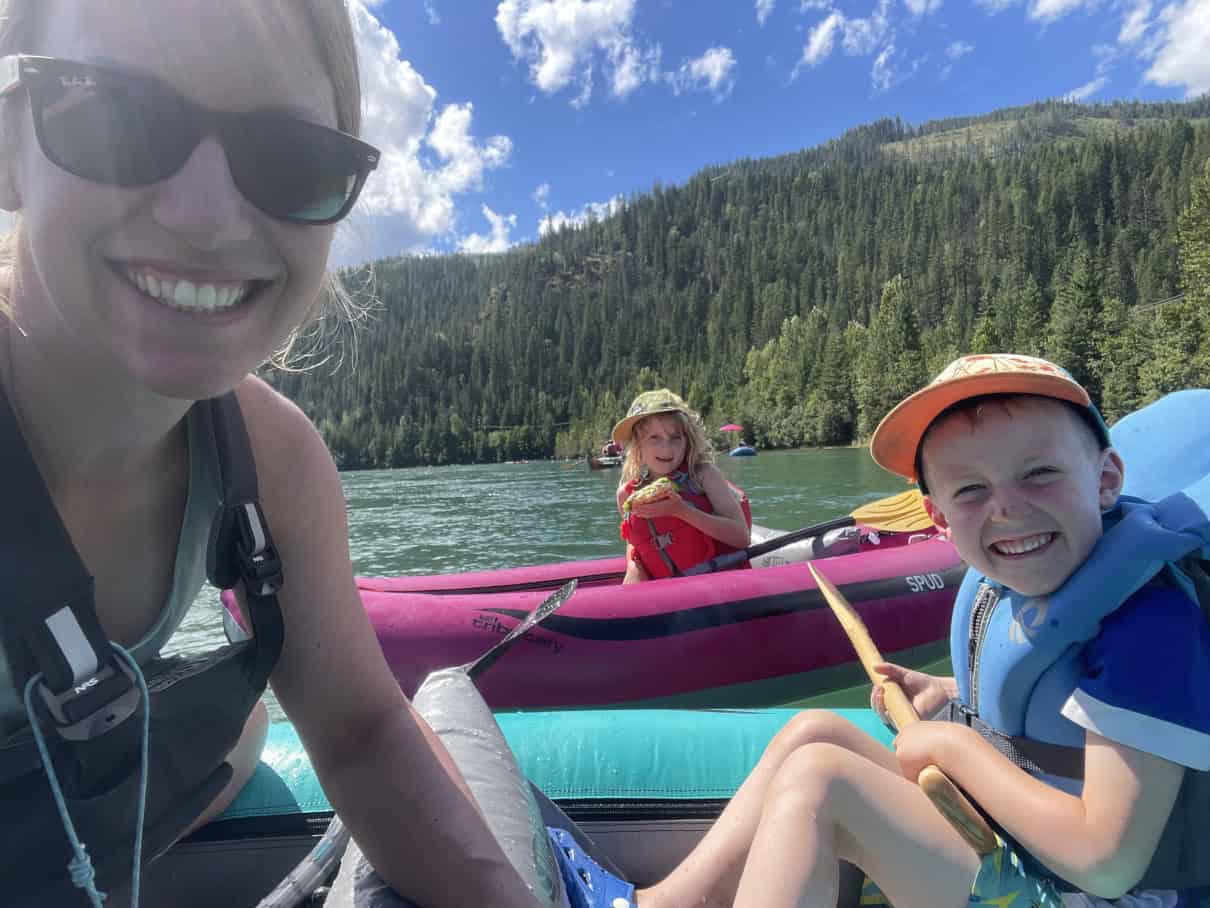
The author and kids out for a paddling adventure. | Image: Brenna Kelly

The psychology of kayaking with kids

The key here is knowing your child really well, which I am sure most of us do. We want to avoid them associating the activity we love with a negative feeling, and a helpful way to do that is by approaching kayaking with your kids using the following acronym.

You need to S.E.L it to them:

  • Safety—if they ever feel scared, it’s not going to last
  • Enjoyment—make sure it’s fun
  • Learning—becoming a paddler involves a life-long progression; take every challenge as an opportunity to teach your child something new.

Safety

First things first, whoever is organizing the outing needs to be very confident with the adventure you are taking them on. You are taking a risk on behalf of the child you are with, so you need to feel confident you could get them out of any danger that may come your way while on the water. Don’t let this turn you away from taking your children out at all. We do the exact same thing while driving them to daycare and school each day. We are weighing risk vs. reward here.

A good exercise would be to take mental notes on the potential risks and the potential rewards.

One more note on safety: we need to be able to let them make their own mistakes. You design the trip with the question in mind, “What’s the worst that could happen?” If you are comfortable with “the worst” your child will likely encounter, move ahead. For example, I have a four year old. He doesn’t like getting splashed or wet very much. At the end of the day, when he is tired and taking a bath, trying to wash his hair makes me feel like I am temporarily employed as a torturer. No matter how enjoyable I try to make it for him, he will scream, yell, cry and look at me like “how could you.”

All that to say, when I am taking an inventory of the possible risks for him, I try to ensure the worst possible risk is that he will get splashed. Eventually, I am hoping he becomes okay with more than just being splashed, so we can move up a level in risk for him. What next you ask? Maybe a full dunking!

If you ever get to the point where you are not confident that you are skilled or experienced enough to get your child out of the potential dangers, but you don’t want to hold them back either, find someone who is and pair your child with them. If you don’t know anyone, put them in a paddling camp or a paddling school. There are lots! This step seems so obvious when we talk about things like hockey or ballet, but it is the same for paddlesports.

Enjoyment

If we are not having fun, why are we doing it? For kids, this question is amplified a hundredfold. We need to make every day on the water fun. Ask yourself how you are going to do that, because telling a child to sit down and paddle until you say they can stop may not be their definition of fun. I’ll share four of the most available and best methods to make a kayaking trip enjoyable: snacks, laughter, the company of other kids, and seeing the opportunity to make it a game.

Snacks

Bring all the snacks.

Isn’t it weird when you are camping how much better food tastes? I am sure it’s because we are actually experiencing hunger. I remember a friend giving me some of his bagel with cream cheese and cucumber sandwich while on a paddling trip. It was the most incredible meal I had ever eaten. Of course, I made it when I got home, but it didn’t hit the same. I mean, a bagel? Not toasted? How did I even swallow that? Anyway, snacks, meals, candies, whatever you think will make someone smile.

Laughter

See the humor in everything.

Hearing laughter and seeing smiling faces forces positive memories, even if the experience is difficult. With my kids, I make sure to come equipped with a couple of new knock, knock jokes. That invites them to start joking around and although their jokes sometimes make no sense at all, the fact that they think they themselves are so funny, is funny in itself.

I also laugh at situations that most people would choose not to laugh at—while also keeping in consideration whether someone was seriously hurt. For example, let’s say my son—who doesn’t like getting splashed—accidentally walked under a downspout, got soaked, and started to cry. Ask yourself, what is it that he hurt? If his ego is the answer, then laugh away, just make sure you include them in the joke and convince them to laugh too. If I decide to leap off a jumping rock and land flat on my back and even bruising myself, that’s laughable too! Lead by example here, put your ego aside, and laugh at yourself when you do something that didn’t work out the way you had planned. It invites everyone else to laugh along with you. Cut yourself while whittling your kid’s marshmallow stick? Laugh it off. Having trouble setting up the family tent? Laugh it off. Lost a boot in the mud? Laugh it off.

Bringing other kids

Bringing more kids really speeds up the learning process and kids’ willingness to paddle.

It’s difficult to do when children are young unless you know other dedicated paddling parents, but when kids reach five and older, having other kids around is great. It helps with the preplanning and packing stage because your children will be motivated to help, knowing that their friends will be there too. Sure, the items they pack may be questionable, but that’s besides the point. And when you are on the water it is incredible to see how much more enthusiastic they become around another kid. Imagine yourself paddling with a superhero. It would be easy to give up knowing that the superhero would forever outlast you, but put another adult in your boat, and all of a sudden, your stamina and confidence in yourself will not be skewed.

Make it a game

Use what your kids are already doing to transform the experience.

One example: if you are in the boat with your child and they are lily-dipping and saying how bored they are, ask them to count how many drips come off their paddle into the water before there are no more drips left. Then, tell them to try to beat the high score; the most drips wins. Another fun game for when you are on shore is stick juggling. Grab three fairly straight sticks, put two in your hands like drumsticks, and try to juggle the third, just like a set of devil sticks. Eventually, your kids will start to get creative and make their own games, and this is where the real magic happens. Creating games also translates back into everyday life, and you’ll likely have less requests to watch TV, go on the iPad, or play video games because they’ll know how to make their own fun and engage others around them.

Learning

This one is easy because if you are doing the first two things well, the learning will happen naturally. If you and your kids are excelling at the first two things and they come easy to you now, here are some ways to facilitate the learning that is taking place already.

Highlight something that you noticed as a learned skill

Kids aren’t able to reflect too far back in their younger years, so it is difficult for them to notice that they are getting better at something. You need to highlight these accomplishments for them. Saying things like, “Wow! Did you just bring your own backpack all the way to the boats for me? That’s a huge help! Thank you!” or something like “How did you get here in your kayak? I saw you paddling in that direction. Did you turn the kayak on your own? I thought you only knew how to go straight! That’s amazing!” These types of questions require affirmation from your child and, in turn, ignite their self-confidence and feeling of achievement.

Success is addictive but sometimes it’s hard to notice in ourselves, especially if we are comparing ourselves to others. So, help them see their progress.

Mindfully consider challenges

As a parent it is really easy to say, “Don’t do that!” or “Be careful!” or flat out, “No.” But in spending a lot of time with kids and parents in an outdoor setting with inherent risks all around, I have found that many parents use these phrases as a reflex without actually considering what their child is trying to do

It also has crossed my mind that parents are saying no because they don’t want to deal with the aftermath of what could happen, and aren’t actually considering the child in the equation at all. I get it because I do it too. I just try to catch myself now.

For example, you’re on a paddling trip with friends and other children. It is the end of a long day, and you are exhausted, but you still need to set up camp, make dinner, and do it all again tomorrow. (I am already laughing in my head as I type this because it is a familiar story.) While you are wrapping your head around the monstrous list of things you need to do, your child is goofing off by standing up in a kayak t in the middle of the lake. You think to yourself, “I have done this and got the biggest bruise on my shin bone and it was sore for weeks.” You think, “When this happens to her, she is going to come crying to you and you just can’t deal with it.”

Let’s restructure this thinking for the sake of your child’s learning. Ask yourself, “What’s the worst possible outcome?” Or, “What else could happen?” And even, “What could they learn?” If you decide the reward is worth the risk, then let them do it. The beauty of being outside with no distractions is that there is ample time to reflect on our stupidity or genius and how we may do things differently next time. It is learning in its most complete form. And you will have just gifted this experience to your child. So when they come back crying from a bruised shin bone, you can say, “You’re welcome.”

Teaching your kid to kayak

It’s important to understand that kids are essentially beginners with few life experiences to draw from. The progression may first involve getting kids comfortable around water, trusting the people they are with and understanding why we are doing this (reasons you will need to provide them with at first). Here are some things that I remind my kids about:

  • It’s fun
  • More time playing with mom and dad
  • Offer to bring friends if you are up for it (this one works like a charm)
  • Excuse to eat special snacks reserved for adventures

When you are on the water, make sure to highlight the awesome and downplay the not-so-awesome…

  • Wasn’t that snail the coolest!
  • Wow you really paddled fast there!
  • You didn’t like that splash in the face? On the bright side, we won’t need a bath tonight
  • Always laugh

Comfort in and around water is sometimes a big hurdle. Think back to what you didn’t like about any watersport and consider a solution for your child before it has the opportunity to become a negative memory. Some common hurdles with paddling and possible solutions are:

  • Water up the nose: nose plugs
  • Splash in the eyes: goggles
  • Getting cold:
    • Opt for warm days for very young children
    • Bring dry fleece layers for backup
    • Bring splash tops and pants for backup
    • Bring a thermos of hot chocolate
    • Try to keep butts off the hull in cold water environments with a sleeping pad or something insulating
  • Getting tired quickly:
    • Snacks! Snacks! Snacks!
    • Short paddle outings at first
    • Adult paddle power as backup
    • Towing as a backup plan
    • Shuttle options, even on a lake, where you could get blown somewhere you couldn’t get back from. Having arrangements with a friend on standby to call for a pickup could work in this case.

Thinking about these risks is the first step to a successful day. Your children will also learn from it and start to understand how to do it themselves. With solutions to predictable challenges in place, we can move onto the actual teaching part.

It’s crazy to think that as a parent you become so many things to your children. One of them is a teacher. With anything, the more you do it, the easier it becomes, but if you don’t have much experience with teaching yet, here is a simple understanding of a learner’s progression and how you can tailor your teaching role to each stage.
A group of kids in paddling gear standing on a bridge overlooking a rapid.
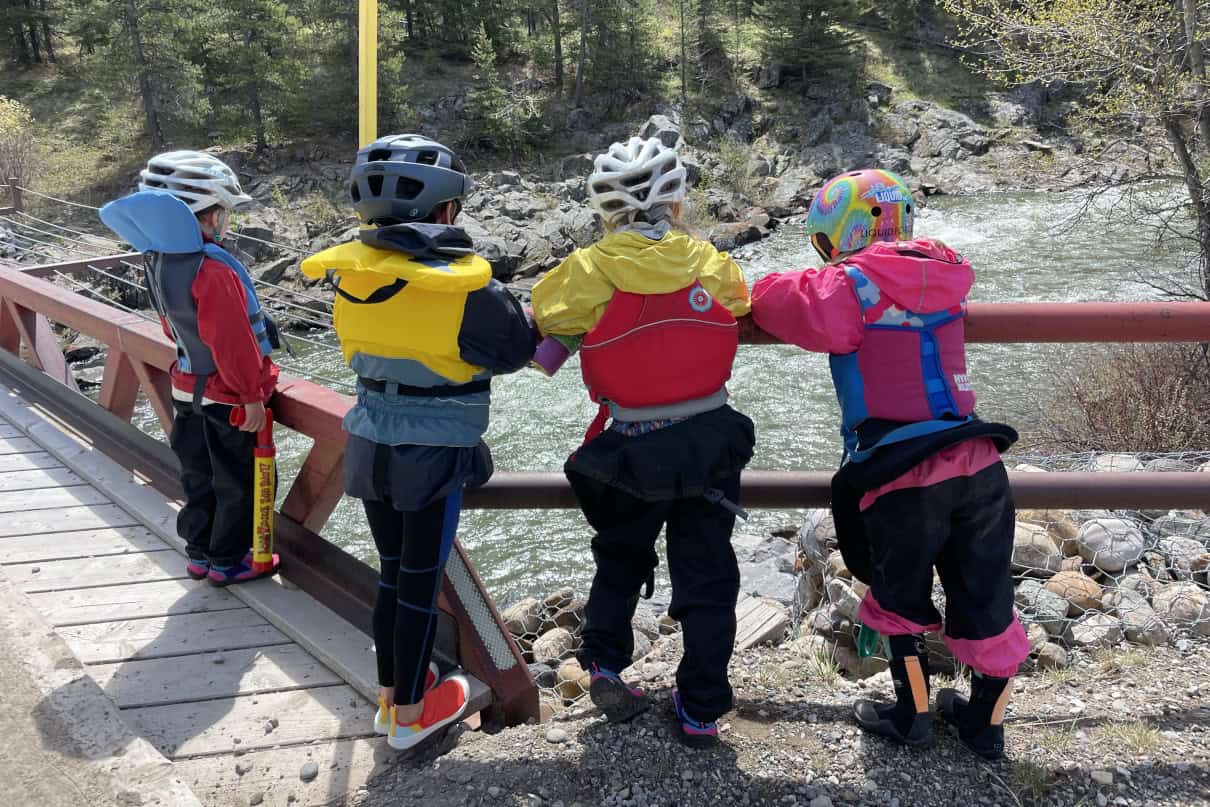
Scouting rapids and taking side quests are both fun and entertaining parts of a paddling trip. | Image: Brenna Kelly

Stages of learning

Stage 1: unconscious incompetence

This refers to the saying, “you don’t know what you don’t know.” For example, even if you are an adult going on a river trip for the first time, you may not even consider that you will have to set up a shuttle. In my raft guiding days, it astonished me to hear the number of people who would think the river ended at the same place we started, yet these people were typically way more educated than me around other subjects, where I am likely the “unconscious incompetent” one. Your role as a teacher here involves lots of patience, explanations, demonstrations and celebrations when your child tries and or succeeds with the skill. Yes, even trying should be celebrated.

Stage 2: conscious incompetence

This is where the learner knows what they need to do but can’t do it yet. When playing the teacher role at this step, be careful not to remind your child what they are doing wrong too many times. They know. This is likely the most frustrating stage in the learning process. As a teacher, try to camouflage the skill they are learning by getting your child to do a drill or a game that requires it. For example, if I am learning the sweep stroke in my kayak, it may be fun to play sharks and minnows where I will need to dodge people using a sweep stroke. The goal is now having fun, and the skill is a byproduct. It’s kind of like feeding your dog medicine with a spoonful of peanut butter.

Stage 3: conscious competence

This is where the learner is able to perform the skill, but still needs to be consciously thinking about it. This is a fun stage because it is less frustrating and there is a sense of accomplishment every time they complete the skill. As a teacher, take note of the child’s energy levels because this can play a big factor in their success and personal confidence. A learner can start to believe that they have regressed back to being unable to achieve the skill, when in fact they are just tired because they have to consciously think about it every time. Reminding kids to take breaks and not be hard on themselves at this stage is a good idea.

Stage 4: unconscious competence

This is what we all aim to achieve in our learning. Once the learner get to this point, they can take on much more. Think about every skill you have learned in your life. If we still had to think about how to walk every time we wanted to walk, I think our brains would start cramping up. If someone is lucky enough to get to this stage with an entire skill set, magic starts to happen. There will be times they will be faced with a challenge that seems impossible, but all of the skills that they have mastered will unconsciously line up, leaving them the victor, without even knowing how they did it. Most people call this the “flow state”. These have become some of my most coveted memories since I can count on one hand the times I experienced my own flow state.

If you understand these stages and where your child is at with a certain skill, you will be able to decide how much direction is needed from you. Stages one to two require lots of explanation, encouragement and involvement. You will be more of an instructor whose role is to keep things fun and engaging, and reduce frustration and disappointment. Stages three and four are where mileage and creativity come in. All you need to do is continue to seek out and set up the opportunities to keep them involved.

Don’t forget to use your paddling community for support because you can burn yourself out here if you make everything your kids learn about kayaking your personal responsibility. Also consider signing your kids up for paddling camps, schools, competitions and clubs to keep them engaged and learning.

Dress For Immersion, Not Air Temperature
  • Your body loses heat much faster when immersed in cold water than it does when dry.
  • Avoid cotton clothing like t-shirts and jeans; they retain water and accelerate cooling when wet. Synthetic fabrics, or wool, are generally a better choice. If the water is very cold (60° fahrenheit or less), you should wear a wetsuit or drysuit.

What if they just aren’t into it?

If your child isn’t into kayaking, I would recommend trading them for one that does…kidding. Don’t force it. It is fun watching little humans make their own decisions and find their own path. Kayaking is our passion and your child will know that. Their passion may be elsewhere and that’s okay, and will bring you the opportunity to try something new too. But I believe that if you continue to have experiences with your children while kayaking, it is something that will shape them for the better, and they will always value sharing adventures with you.

So while I’ve got my work cut out for me trying to convince my son that water splashes aren’t going to kill him in hopes that he someday loves kayaking too, I am going to keep signing them both up for kayaking trips. If there is a complementary passion starting to spark in your little ones, even better. Use that to keep them going. Luckily for me, my daughter loves nature, so anytime we can rescue a drowning moth or wonder what those two dragonflies are doing, it’s a good day. I don’t even need to “S.E.L.” the adventure to her anymore, because she knows that kayaking means she gets to be one with nature’s little creatures.

If you’re looking for inspiration, have your child submit a story to the Paddling Kids Story Contest!


Family planning. | Feature photo: Bruce Kirkby
 

Best Coleman Canoes For 2026

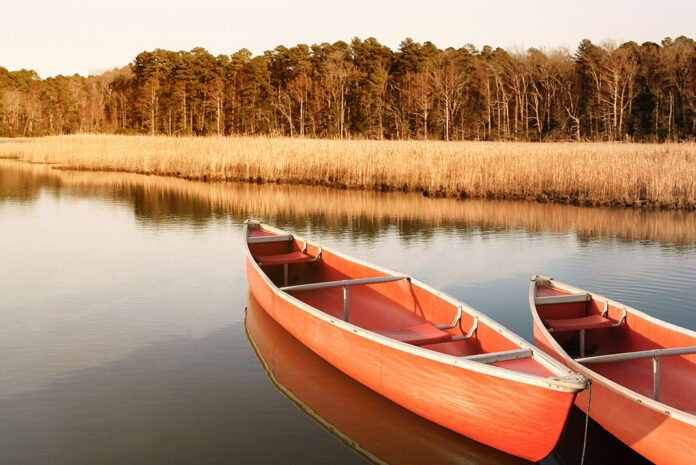
Two red plastic canoes
Photo: Design Stock

A 1982 article in the Washington Post describes Coleman canoes as “good starter boats.” Thanks to their durability, it’s a description that still rings true today, even if the company has stopped stamping its name on new canoes.

Coleman canoes were some of the first polyethylene canoes to reach the masses. Sold through department stores and outfitters, these canoes were more affordable than the aluminum and wood-canvas canoes that were popular at the time.

At a low cost, these maintenance-free boats provided the opportunity for many families to get outdoors. They were available in different lengths ranging from 13 to 17 feet. With wide, flat hulls, these canoes didn’t win many races. Instead, they were loved by beginner canoeists, families with children and anglers who wanted a stable, reliable canoe.

Wear A Life Jacket
  • Everyone, even strong swimmers, needs to wear a life jacket at all times when on the water. It is extremely difficult to put a life jacket on once you fall into the water. Even a light wind can blow any paddlecraft away from you, faster than you can swim.
  • Always wear a USCG-approved Level 70 or Type III life jacket designed for paddling.

Coleman no longer makes canoes under their name, but you may still be able to find used ones for a great deal. These canoes are ideal for anyone looking to start canoeing or who may want a cheap one for paddling around the cottage or local pond. Although the brand has been discontinued, their models live on in Pelican canoes, which acquired the line at the start of the century.

Other companies also continue making canoes that are reminiscent of Coleman’s designs. You’ve come to the right place if you are looking to buy a Coleman canoe or a similar polyethylene starter boat. We’ve outlined the models that were made, touching on the Coleman canoe’s history while providing links to reviews and tips for finding used canoes.

Top picks: Best Coleman canoes

Coleman RAM-X 15 Canoe

Coleman RAM-X 15 canoe

Easy for the beginner to handle, yet satisfying for the more experienced canoeist. The sloping keel reduces sideslip for good tracking on lakes and streams, while allowing maneuverability for whitewater.

  • Length: 15’0″
  • Weight: 78 lbs
  • Capacity: 650 lbs
  • Maximum Width: 36″

Coleman RAM-X Scanoe

Coleman RAM-X Scanoe

Paddle it… pole it… troll it… and add up to 5 hp motor. Wide aft provides more stability for more passengers and cargo. Narrow bow lets it move out on a stretch of fast water or sneak into a cove.

  • Length: 15’8″
  • Weight: 94 lbs
  • Capacity: 740 lbs
  • Maximum Width: 40″

Coleman RAM-X 17 Canoe

Coleman RAM-X 17 canoe

Stow in the gear, and go tripping. Tough, quiet, resilient. And lightweight enough to ride on most cartops. (No trailer to buy!)

  • Length: 17’0″
  • Weight: 85 lbs
  • Capacity: 740 lbs
  • Maximum Width: 36″

Coleman RAM-X 13 Canoe

Coleman RAM-X 13 canoe

Accommodates one or two people. Stable design for all types of water. Recessed bulkhead for storage, and carry-handles both fore and aft for easy portage. Rides on a cartop.

  • Length: 13’0″
  • Weight: 67 lbs
  • Capacity: 475 lbs
  • Maximum Width: 36″

Shopping for a used Coleman canoe?

Coleman canoes frequently turn up on classified pages and are often sold for fairly cheap. As they are nearly indestructible, a 25-year-old canoe in decent condition is still an excellent option for going out fishing or poking around calm waters. Canoes hold their value well, but you will likely be paying less than $500 for these boats.

Coleman made different styles of canoes through the years that they were in production. The Coleman 13, 15 and 17 models were most popular, with the model number indicating each canoe’s length in feet. They built all of these canoes to be durable and inexpensive.

In the early 2000s, Pelican Sport, the Quebec-based recreational kayak manufacturer, began producing Coleman canoes. They started using their own proprietary RAM-X high-density polyethylene, selling the canoes as the Coleman Ram-X series in 13, 15 and 17 feet. These are probably the used Coleman canoes you’ll find today.

Eventually, Pelican swapped out the Coleman branding for their own, and they made minor changes, like adding cup holders and a third bench seat in the middle of some models. If you’re looking for new canoes similar to the old Coleman models, look at Pelican. They only build two models, but the Pelican 15.5 is a direct descendant of the Coleman 15 canoe.

One of Coleman’s innovative and beloved models was the “Scanoe.” This wide, square-sterned boat was designed as a cross between a skiff and a canoe. It was wider than other square-stern canoes at the time and could be paddled or else mounted with a small motor. It’s sometimes called a “Scout Canoe,” and you can find similar new models made by Old Town.

In addition to finding them online, you might find old Coleman canoes that have been sitting under cottages or in backyards. Try posting a “wanted” ad on a community board. Some people may have one sitting around that they are happy to clear out.

Know The Local Hazards
  • Check navigation charts before you launch.
  • Check with those who have local knowledge of man-made and natural hazards, e.g. low-head dams; sweepers, strainers and undercuts; tides and currents; and rocks and shoals.

Although we’ve touted the durability and toughness of these canoes, you still should thoroughly check the boat for any damage. If you’re planning on mounting a motor on the square-stern Scanoe models, make sure that the transom board on the back is solid enough to support the mount. If not, you may need to reinforce it with ½-inch plywood.

Coleman canoes are made of polyethylene plastic on an aluminum frame. Major damage worth worrying about would be cracked gunwales or hull damage. At a glance, any damage to the gunwales is easily noticeable. Pay special attention to the thwarts running across the canoe. These pieces are essential for maintaining the canoe’s structural integrity and overall shape. They are pretty easy to replace with another aluminum or wooden bar if they are broken.

Polyethylene is a solid material and resistant to abrasions and collisions with unexpected rocks. Dents and dings will appear along the hull, but these are superficial and not cause for concern. If you are worried, you can retroactively add keel strips to the bow and stern for an extra layer of protection. This is an easy, fun project that anyone can do in a day.

For more tips on what to look for when selecting any used canoe, read our article How To Buy A Used Canoe.

Want to know more about Coleman canoes? Read on to get answers to common questions.

  • Does Coleman make good canoes?

    When they were being produced, Coleman canoes had a reputation for being durable and inexpensive. Better options exist if you are looking for a lightweight canoe to carry and portage, but as a “beater” boat that requires no maintenance, Colemans are great.

  • Do they still make Coleman canoes?

    The Coleman brand was discontinued, but the spirit of inexpensive polyethylene canoes lives on with their successor, Pelican. Pelican still makes select models, and other canoe builders like Nova Craft and Old Town also make inexpensive polyethylene canoes.

  • Who makes Coleman canoes?

    For a while, Pelican Sport was making Coleman-branded canoes. Later, they assumed the Coleman designs under the Pelican brand.

  • Coleman canoe models

    Beginning in the 1980s, Coleman made recreational canoes in lengths of 13, 15 and 17 feet. In the mid-80s, they introduced the “Scanoe” which was designed as a canoe/skiff hybrid. In the late 1990s, Coleman rebranded their canoe models, with Coleman 13 becoming the Vantage, Coleman 15 becoming the Journey, and Coleman 17 renamed the Odyssey.

    When Pelican took over production, these canoes were renamed RAM-X 13, 15 and 17, since they used the new material.

  • Coleman canoe weight

    When Coleman canoes were first introduced to the market, their main competitors were aluminum and wood-canvas canoes. Plastic canoes are lighter than wood-canvas canoes and don’t require nearly as much care on or off the water. The main selling point of polyethylene was the cost and durability.

    Aluminum is similarly indestructible but often lighter than plastic. Both materials are heavy compared to modern composite boats that come in at a fraction of the weight. Colemans are therefore heavier than most other canoes of similar lengths, with 15-foot canoes weighing more than 80 pounds.

  • Coleman canoe weight capacity

    The weight capacity of a Coleman canoe depends on the canoe’s dimensions, and some canoe manufacturers caution against strictly looking at the capacity numbers. Instead, consider the water conditions, weight distribution and overall feeling of the canoe when determining if it is overloaded or not.

    You want to pack the canoe in a manner that keeps the weight as low as possible, rather than stacking gear high in the center.

  • Coleman canoe dealers

    As Coleman no longer builds boats, you’ll want to find a Pelican dealer for the modern-day version of Coleman models. Many outfitters stock polyethylene options if you’re looking for a reliable, low-cost starter canoe.

  • Coleman canoe material

    Coleman canoes were made with polyethylene sheets bent around aluminum frames.

  • What type of plastic is a Coleman canoe?

    Coleman canoes were originally made with polyethylene plastic. When Pelican took over the canoe production, they introduced the Coleman RAM-X, which uses their proprietary polyethylene. RAM-X is lighter than traditional polyethylene and equally as strong.

  • Are Coleman canoes made of fiberglass?

    Coleman canoes are made of polyethylene plastic. Models made by Pelican, the “RAM-X” models, use Pelican’s RAM-X polyethylene material.

  • Coleman canoe price

    Even when they were new, Coleman canoes were marketed as inexpensive, entry-level canoes. A fair price for a used one in perfect condition is still less than $500.

Education: Get Some!
  • Take a paddling safety course from the American Canoe Association (ACA), your local paddling shop or outfitter, or other reputable source.
  • Take a boating safety course from the U.S. Coast Guard Auxiliary, U.S. Power Squadrons® or your own state’s boating agency.
  • Take on-the-water skills training.

Compare Coleman canoes

  • Coleman canoe vs Pelican

    If you can’t find a Coleman canoe, look to the popular big-box brand Pelican Sport. Pelican Sport took over Coleman’s canoe designs, although some have been phased out in recent years. They still build three models of heavy-duty plastic canoes at reasonable prices. Pelican now uses RAM-X material for their canoes, which is slightly lighter than polyethylene.

    They make two models currently, a 14’9’’ two-seater and 15’6’’ three-seat canoe. If you come across older Pelican canoes, they will be the same polyethylene construction as Colemans used to be. The square-sterned Pelican Bayou 160 is their take on the original Scanoe.

  • Old Town vs Coleman canoe

    One of the oldest canoe builders in America, Maine-based Old Town still makes some polyethylene canoes that are very similar to Coleman models. There are options of single-layer polyethylene on the Saranac models, or the heavier, more durable three-layer on the Discovery Series.

    Select Old Town canoes also have yokes for easier portaging. Check out the Old Town Discovery Sport for a square-stern model from Old Town.


How To Line Rapids In A Canoe

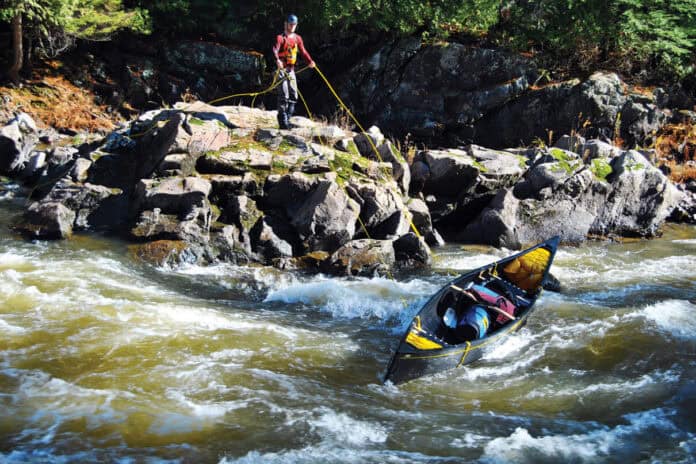
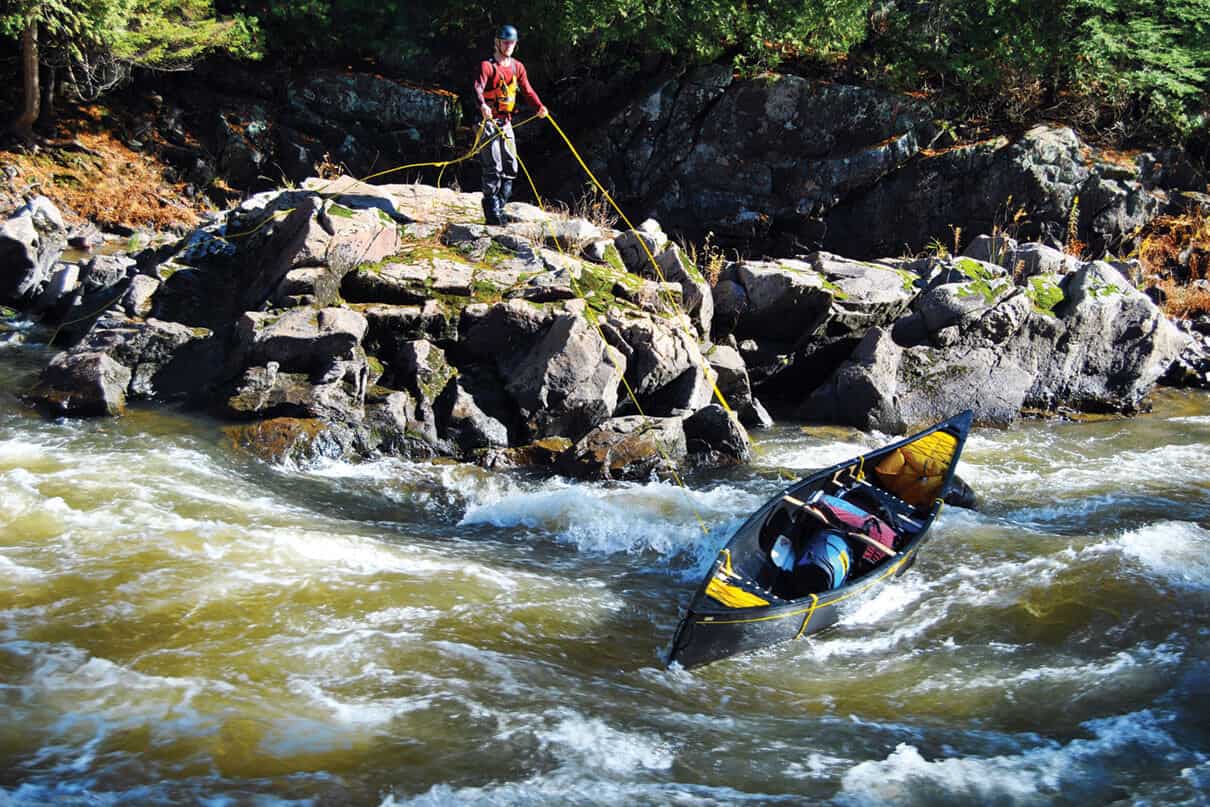
man standing on a rocky shelf above rapids lines a canoe without having to portage it
Leading lines. | Feature photo: Johno Foster

After you line a canoe the first time around that usual portage, your watch and back will thank you for the discovery. Using guide lines to control the descent of a canoe through moving water is an age-old art that can provide a welcome alternative to portaging.

Think of lining rapids as the great compromise. Lining lets you avoid a rapid that is too shallow or tight and technical to paddle, without having to shoulder your load and hit the trail. When lining properly, you use ropes and the force of the current to steer your canoe safely down sets.

Once you’ve come to recognize its potential, you may find yourself lining rapids that you would normally have carried around.

How to line rapids in a canoe

Set up

The simple way to tie a bridle
  1. Fold back eight feet of rope on the end of your line.
  2. Tie a double overhand knot halfway up the folded section of rope so that you have a big ‘Y’.
  3. Tie each of the short ends of the ‘Y’ to either side of the canoe’s seat, positioning the center knot under the canoe at the keel line.

With a bridle at both the bow and stern, and the load slightly rearranged so that the downstream end of your canoe is heavier, you will have a very stable setup.

The ideal rigging requires two 20-metre throw bags and a bridle consisting of a three-metre length of rope with a loop tied at the halfway point. Using a bowline, tie one end of a throw rope to the loop in bridle, slide the bridle under the hull and tie each end off inside the gunwales at a thwart or seat. The loop should be near the keel line and at least a metre from the stern of the canoe.

With this bridle set-up you can control the canoe from below the waterline. Though lining a canoe with the stern line attached to a grab loop near the deck is possible (not to mention common) a strong pull on the grab loop from an angle can flip the canoe (many readers are nodding knowingly right now). The bow rope can be attached to the grab loop of the canoe since it will only be used to control the canoe angle.

If you don’t trust yourself to re-pack throw bags after each use then use a fixed painter on the bow. It should be of large diameter (so it is easy to grip) and both buoyant and free of knots (to reduce the chances of it getting jammed between rocks). 1/4- to 1/2-inch braided floating rope works well.

The length of the lines is dependent on the river and personal preference. Shorter lines are easier to manage but may leave you grasping for a runaway canoe. Longer lines allow you to move the canoe further into the current but may result in tangles if you only use a fraction of their length. Thirty-to forty-foot lines are a good compromise.

man standing on a rocky shelf above rapids lines a canoe without having to portage it
Leading lines. | Feature photo: Johno Foster

Safety

Whenever rope and currents mix you need to be prepared. Both paddlers should have a knife handy in case the rope gets tangled. Leave any excess rope in the bag or in loose coils in your hand. You should be wearing a PFD and if you trip with a helmet there is no sense having it in the canoe and not on your head while you scramble over wet rocks.

Starting line

Push the canoe out into the current and let it float downstream until the stern rope becomes taut. Try not to let all the rope out. By pulling on the downstream rope while the upstream rope is taut, you will set an angle just as you would in a back ferry and the boat will ferry away from shore. To move the boat toward shore release the downstream rope and pull in on the upstream rope. The canoe’s angle will change and the current will push the canoe toward you.

By keeping pressure on the downstream end you can have the canoe ferrying as much as 45 degrees out into the current below you.

Adjust the angle until the canoe is lined up, then slowly walk downstream while keeping the ropes taut to control the angle and the canoe’s position.

Too many people risk broken ankles and capsized canoes by relying on luck and quick feet when lining. With this under-the-hull bridle set-up, lining can be less about speed and recovery and more about control and finesse.

Practice makes perfect

Much like paddling rapids, lining is a mental game. Practising in light current with only a few obstacles present, you can learn with how the canoe interacts with the lines and the water. You need to work with the river rather than against it. The same can be said of lining with a partner—effective communication is essential.

To read more on the subtleties of this technique, check out Garrett Conover’s comprehensive book Beyond the Paddle and Bill Mason’s classic Path of the Paddle.

Mark Scriver is a Black Feather guide and the author of Canoe Camping, An Essential Guide. Johno Foster is a seasoned Black Feather guide who would rather paddle through most rapids but knows when to toe the party line.

Cover of Issue 73 of Paddling MagazineThis article was published in Issue 73 of Paddling Magazine. Subscribe to Paddling Magazine’s print and digital editions, or browse the archives.
Leading lines. | Feature photo: Johno Foster


Best Waterproof Fanny Packs For 2026

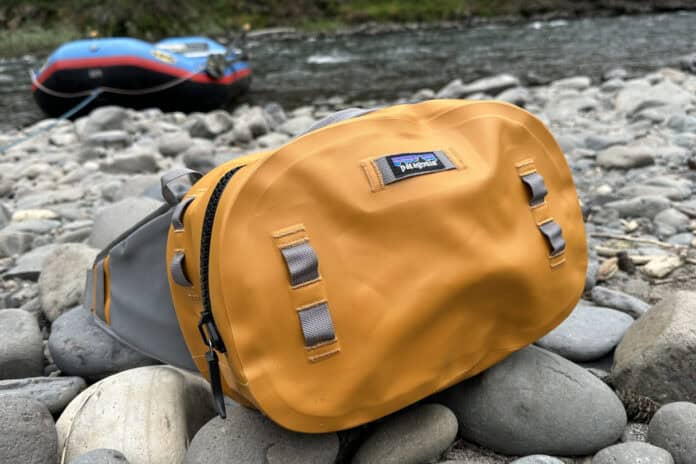
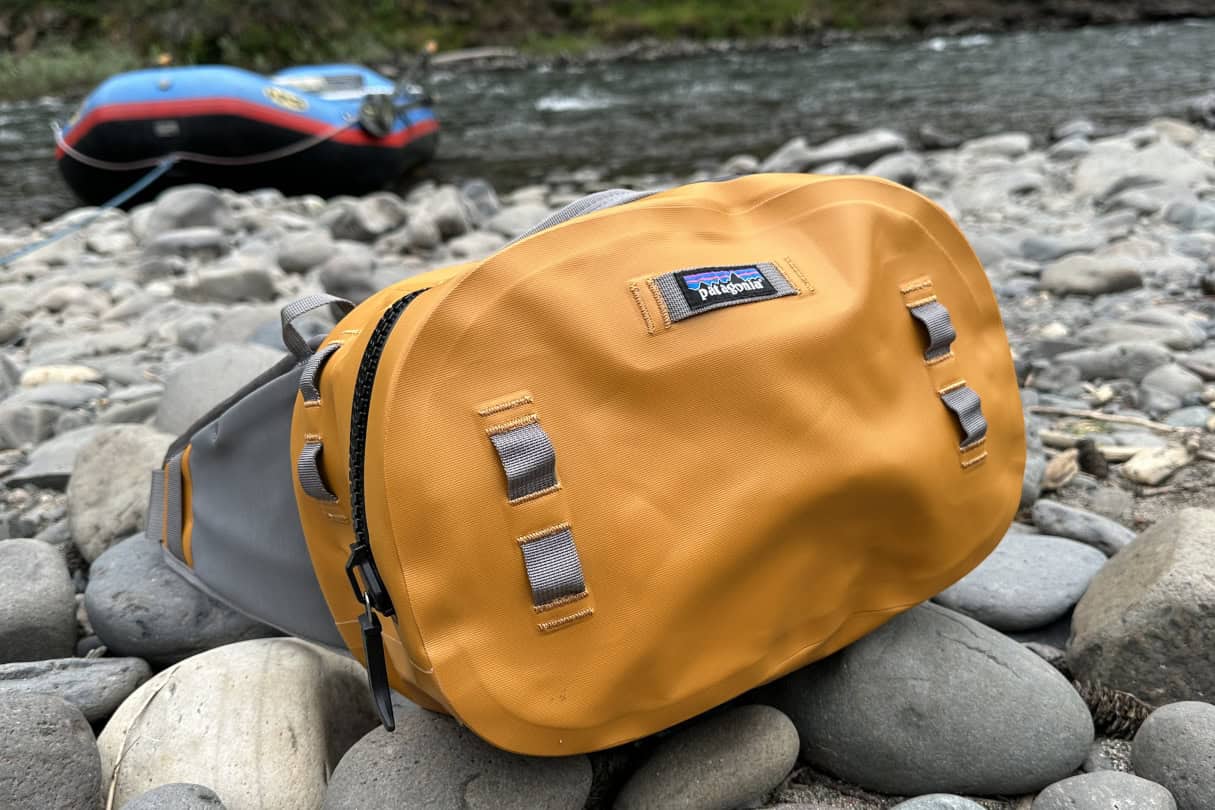
The Patagonia Guidewater waterproof hip pack sitting on rocks near the edge of a river with a raft in the background.
Image: K.M. Collins

Whether you’re Inflatable paddleboarding, canoeing, kayaking, rafting or drift fishing, you need a place to keep some gear close and dry. It’s critical that, whether you are on an afternoon float or a weeklong trip certain items on your packing list, such as phones, key fobs, snacks, cash, or a box of flies, not only remain tucked away in a waterproof place but are always accessible when you need them.

There are plenty of options when it comes to dry bags, including roll top backpacks, duffels, and hard cases, however, when considering versatility, this article asserts there may be none more helpful than our old friend from the 80s, the fanny pack. Also known in its recent renaissance as the hip or waist pack, and initially a comeback kid in the modern festival scene, the fanny pack has infiltrated paddling, not to mention travel and leisure. On a board, it can be clipped below your life jacket for ever-present accessibility. For a short side hike, it can be slung over a shoulder. And with any watercraft, it can be tucked away under a bungee or in a hatch just like a small dry bag.

In this article, I’ve compiled a list of the top waterproof fanny packs in the industry and crash tested them in the gnarliest, wettest water sport of all—rafting. Read on to discover how each performed while field tested by a professional guide, what unique features stood out on each waist pack, and which specific water sport each pairs best with.

Best waterproof fanny packs: Our top picks

Wear A Life Jacket
  • Everyone, even strong swimmers, needs to wear a life jacket at all times when on the water. It is extremely difficult to put a life jacket on once you fall into the water. Even a light wind can blow any paddlecraft away from you, faster than you can swim.
  • Always wear a USCG-approved Level 70 or Type III life jacket designed for paddling.

Best fanny pack overall

Patagonia Guidewater Hip Pack

The Patagonia Guidewater waterproof hip pack sitting on rocks near the edge of a river with a raft in the background.
Image: K.M. Collins
Patagonia Guidewater Specs
Capacity: 9 Liters
Rating: Submersible
Construction: Recycled nylon plain weave with a PU face coating and a TPU back coating
Price: $239.00

Buy from:

PATAGONIA BACKCOUNTRY

Why I love it

Waterproof, dustproof, and fully submersible—the Guidewater was intended for angling, but this hip pack’s ability to cross over into other water sports and everyday use is uncanny. Its zipper is identical to those manufactured for industry-leading dry suits as well as its seam seals and fabric.

The Guidewater is ergonomic by design, sitting comfortably on the hip. It offers an optional shoulder strap to distribute weight and two external, adjustable loops at the bottom of the pack designed to hold a breakdown fishing rod. These loops double as external storage for your rain jacket or outerwear as you swap layers throughout the day.

In testing, I used this pack as my day bag on the Grand Ronde in eastern Oregon. Just what is a guide such as myself carrying in a day bag? A map, chapstick, emergency toilet paper, wag-bag, mobile phone, Garmin InReach, speaker, electronic cables, backup battery and more. In addition, I am opening and closing my pack innumerable times while on the water each day. The ease of a zipper, such as on the Guidewater versus a snap closure wass a universe apart. And for good measure, I routinely submerged this waist pack throughout each day.

Reasons to buy
  •  Just about everything proof
  •  Made from recycled materials
  •  The company’s well-known “Ironclad Guarantee” on repairs and replacements
Consider another if
  •  Cost is factor
  •  You’re seeking a more compact storage size

Bottom Line

The Guidewater submersible hip pack has the backing of a trusted legacy outdoor brand and can keep all your goodies dry for days on end.


Best fanny pack for standup paddleboarding

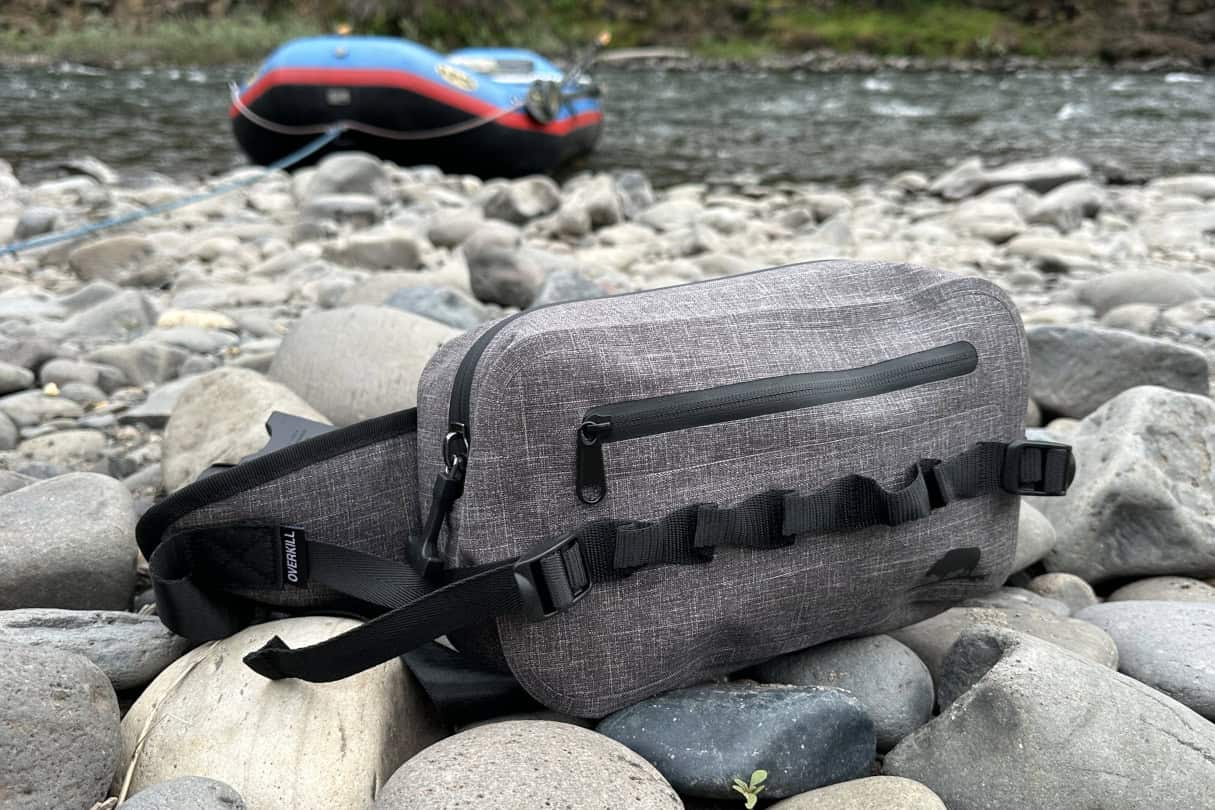
Atoll Overkill

The Atoll Overkill is a submersible fanny pack especially useful for paddleboarding.
Image: K.M. Collins
Atoll Overkill Specs
Capacity: 4 Liters
Rating: Submersible (except small outer pocket)
Construction: TPU material
Price: $49.99

Buy from:

AMAZON ATOLL

Why I love it

Considered a lightweight waist pack, the Overkill by Atoll was created with a blend of durability, style and thoughtful design. You can even choose from five colors: army green, black, heather grey, navy or safety orange.

Atoll’s intent of this pack is for use on an inflatable paddleboard. It stows under deck bungees without taking up too much room among the rest of your strapped-down gear. You can clip it around your waist when carrying your board to avoid extra trips or awkward juggling. And, if it fits below your style life jacket, you can keep it on your person for your entire outing.

I also found the Overkill to be the perfect auxiliary first aid kit. For many commercial whitewater companies, a major medical kit stays on the sweep boat at all times, and a secondary med kit is created in a fanny pack, which can accompany guides and guests on a hike or travel with the boats taking off ahead of the group to secure camp. I stashed gauze, bandages, and other items which would be rendered useless if damp or soggy in the pack, and left it in the footwell of my boat for three days while intermittently pulling out supplies every now and then. At take-out everything was just as dry as at the put-in. Part of the reason this pack is so dry is that it also utilizes the same zipper used for dry suits

My only regret with the Overkill was not snagging it in the safety orange.

Reasons to buy
  •  Low cost compared to similarly designed packs
  •  Balances storage capacity and compactness
  •  Resistant to oil and grease as well as abrasions, scuffs and scratches
  •  TPU construction means no PVC smell
Consider another if
  •  A brand’s time established in the outdoor market is a major factor in your decision

Bottom line

Atoll is a paddleboard company and they’ve built a paddleboarding-specific waterproof waist pack that fits the bill and is also capable for other users.

Carry A Waterproof VHF Radio, Use Your Phone Only As A Backup
  • A handheld VHF marine band radio allows you to communicate with the Coast Guard and other boat traffic. Use Channel 16 only for hailing and emergencies. The radio should be waterproof, because it is virtually certain to get wet.
  • A cell phone, even if in a waterproof case or sealable bag, might not work, so don’t rely on it as the primary means of emergency communication.

Easiest to access waist pack

Yeti Sidekick Dry

The Yeti Sidekick Dry can be used as a waist pack with the addition of a belt or strap.
Image: Joe Potoczak
Yeti Sidekick Dry Specs
Capacity: 1 Liter
Rating: Submersible
Construction: Dryhide shell
Price: $45.00 (Sideclick waistband sold separately)

Buy from:

AMAZON REI YETI

Why I love it

Yeti’s Sidekick case is a Transformer, and I’m obsessed with its multiple uses. Not only can this fully waterproof storage compartment be used during any water-based activity, it can be attached to a cooler or fixed to a raft by the velcro bits on the back. In addition, the Sideclick strap is available separately, which turns it into a proper waist pack. In fact, because of the webbing slots on the back of the Sidekick, you can use any strap you prefer or have at your disposal attach it to.

This is a truly multi-use gear case like no other. The Sidekick is just at home on a paddleboard or raft as it is strapped to a bike or on a cooler at a concert.

Best of all, the magnetic waterproof closure makes access to contents easier than any other product on this list.

Reasons to buy
  •  Slim design
  •  Magnet closures for handy ease of access
  •  A “Transformer” that combines with other outdoor gear and Yeti products
Consider another if
  •  You foresee issues using the magnetic seal instead of a zipper closure

Bottom Line

The Yeti Sidekick is made to handle class V, though it also seamlessly integrates into the everyday river life.


Best pack on a tight budget

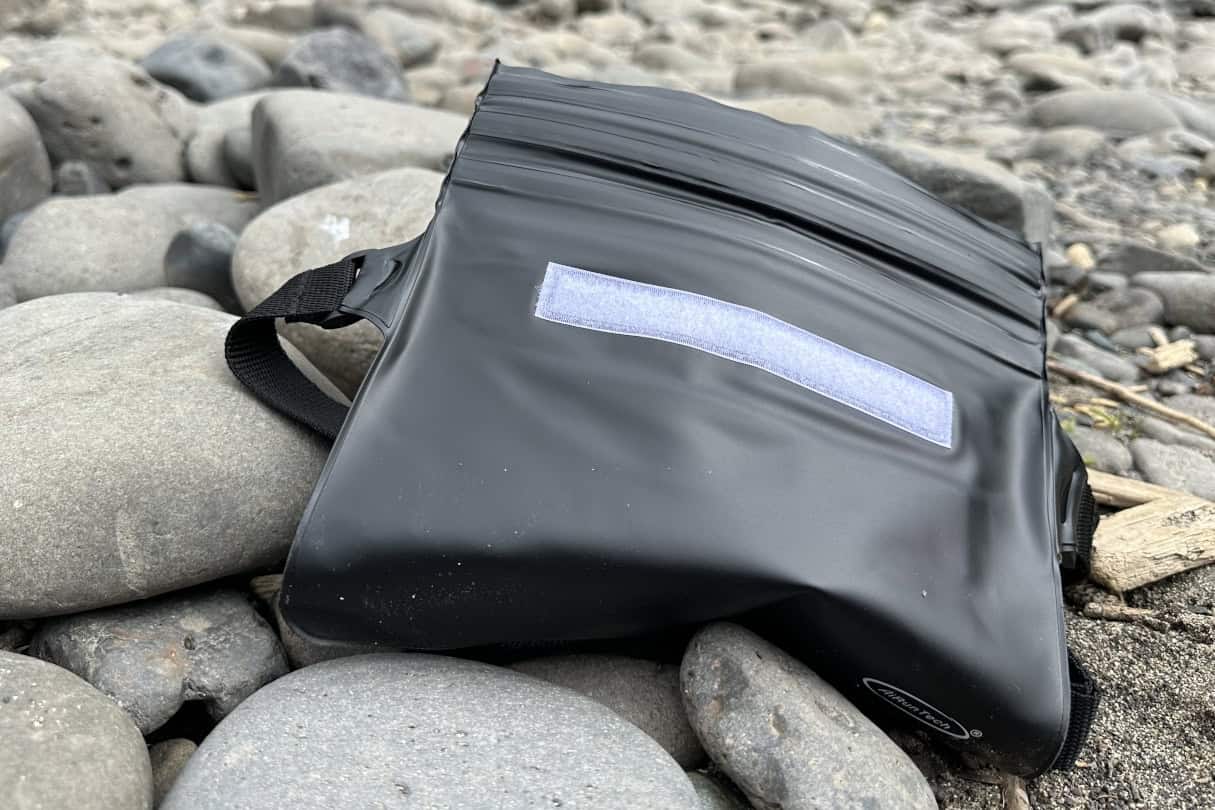
AiRunTech Waterproof Pouch

The AiRunTech is a budget-friendly waterproof pouch to store belongings.
Image: K.M. Collins
AiRunTech Waterproof Pouch Specs
Capacity: Less than 1 liter
Rating: Submersible
Price: $16.99

Buy from:

AMAZON AIRUNTECH

Why I love it

The best reason to purchase the waterproof fanny pack by AiRunTech is the price point. If you have a tight budget and you need a waterproof case for limited items to get you through one or two trips, this product will get the job done.

One consideration is that the AiRunTech is a hybrid between a fanny pack and a phone pouch, though it doesn’t have a clear window for phone photography. It has three Ziploc-like, press closures to access anything inside. To secure your valuables, paddlers will need to be sure all three closures are sealed, and you should test-submerge the pouch before use.

Reasons to buy
  •  It is incredibly affordable for limited use or a last-minute solution
Consider another if
  •  You want a durable waist pack for many uses or multiple seasons
  •  You have the means to upgrade to another option
  •  You want to ensure you have enough storage capacity for your size phone and other items

Bottom Line

The AiRunTech Waterproof fanny pack will get the job done for a few bucks in a pinch.

Wear The Appropriate Leash When Stand Up Paddleboarding
  • Always wear a leash on open bodies of water like lakes, bays, and oceans. Due to the risk of snags and entrapment, leashes should only be worn on rivers if they include a quick release attached to your life jacket.

Waterproof fanny pack buying advice

The number one priority paddlers are looking for in a waterproof pack is that it is in fact going to keep your gear dry. The last thing you want is to spend money on a bag, for it to fall of your paddleboard or raft and later open it up to find a stew of your belongings. Waterproof is a tricky word to throw around when it comes to interior dryness, and what you are often looking for that is submersible. This usually translates to a dry bag or pack with a rating of IP67 or IP68. This means the pack can be submerged under a meter of water for 30 minutes or more.

Beyond this, you probably want a waist pack that is not only submersible but fits and is comfortable to wear. If you can try packs on before buying this is the best way to find out.

You also want a pack that will not only fit your waist, but store well on your boat or board. I larger capacity pack will hold more gear but is both bulky on you and under the bungees of a paddleboard. While a slim pack will be low profile but be more scarce on space when trying to cram it with snacks, phone and safety gear. Take stock of what you plan to carry and what this looks like with the capacity of various packs.

Lastly, waterproof fanny packs come with multiple types of closures. Specialty zippers are the most commonly used because they offer a low profile and closure that is considered submersible. Zippers can be tough to open and close however, and need to be maintained with a lubricant over time. Yeti’s magnetic closure is unique and enjoyed by many users. Budget packs may have a press-to-seal zipper like many may be familiar with from sandwich bags.

How we tested

The fanny packs in this article were first selected through researching what products were widely available on the market. Next, the waterproof fanny packs selected were tested, on-the-job, by the author, a professional guide, while on a four-day trip down the Grand Ronde River for Little Creek Outfitters. Packs were filled with critical gear like first aid supplies, maps, phones and satellite messengers, then put to work. All packs kept these items dry for up to three hours of intermittent submersion in the chaotic currents of the Grand Ronde. The author found that because all waterproof fanny packs were indeed waterproof as advertised, evaluation came down to unique product features and versatility in multiple sports and leisure activities.

Why trust us

K.M. Collins has been writing about rivers for over a decade and paddling them for longer. She has guided on the Lower Wild and Scenic Rogue, Owyhee, Deschutes and Grand Ronde with some of the most well-respected companies on the West Coast, and has assisted in teaching river courses. Collins is meticulous about rigging her paddling crafts with the best possible gear for her kit, because as a guide, she’s learned the last thing you want is for your gear to fail you when you need it most.


Inside India’s First All-Female Kayaking Revolution

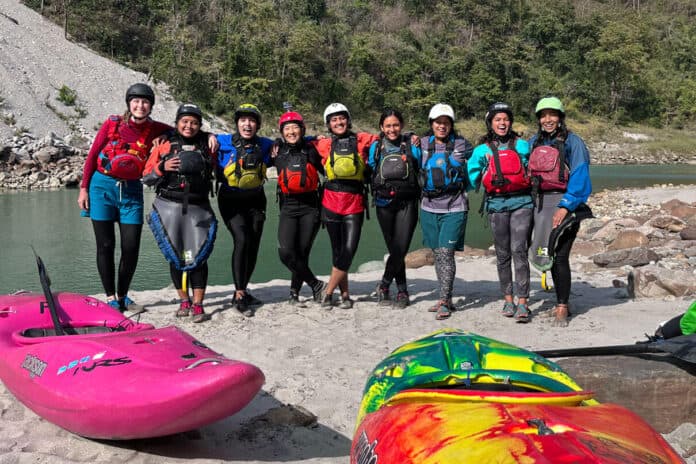
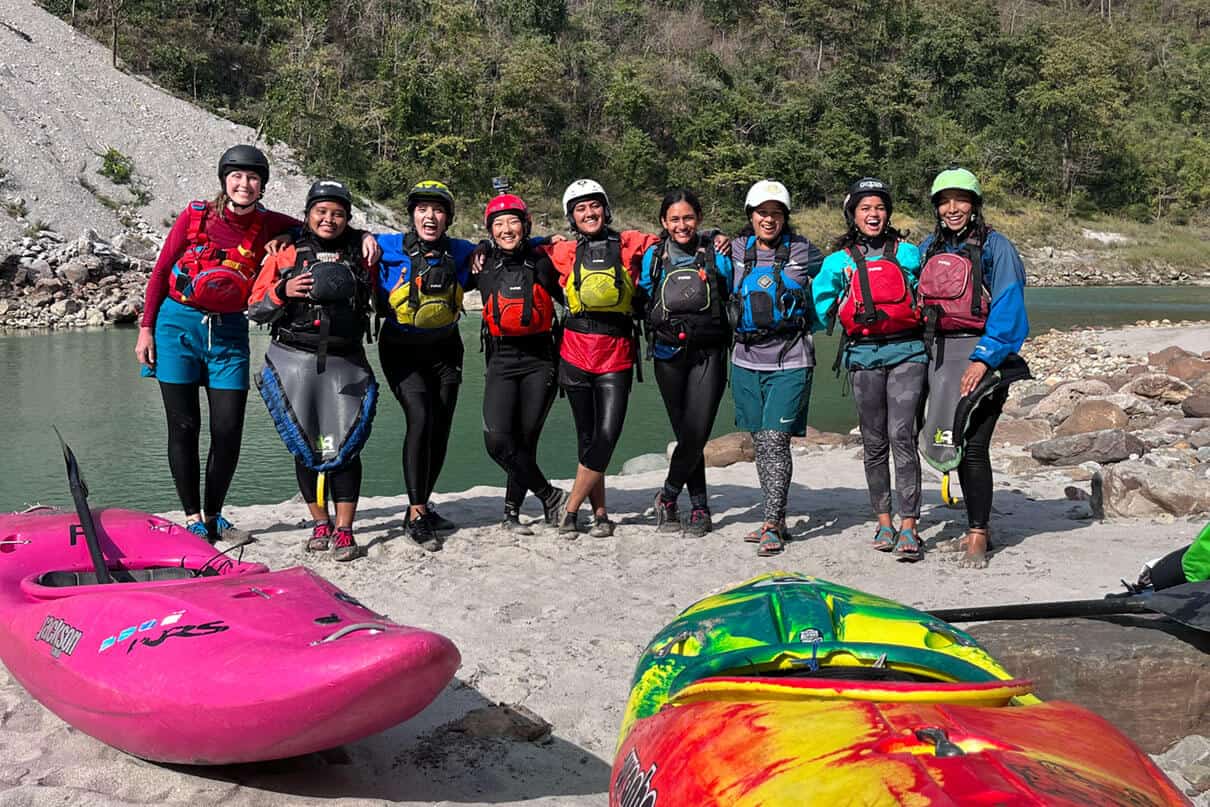
a group of woman kayakers pose for a group photo in their whitewater gear by a riverside in India
“It’s about giving somebody the same experience that I get to experience on the river,” says Naina Adhikari (fourth from right). | Feature photo: Harendra S. Rawat

In April 2023, eight women launched their kayaks into the icy waters of the Himalayan Ganga River. Led by India’s top female kayaker, Naina Adhikari, it was the first all-female kayaking expedition of the river. Over three nights and countless rapids, a movement was born: Ganga Girls.

Inside India’s first all-female kayaking revolution

Three years prior, I received an Instagram message from Adhikari. I knew of her as “that kayaker girl from India,” but we had never met. She had responded to a post I made about sexism in the whitewater industry, saying it resonated deeply.

While I’d faced inequality—being paid half as much as male champions at freestyle competitions—Adhikari’s experiences were far more harrowing. “In India, if I’m on an expedition, I have to worry if anybody is going to misbehave with me because they’re drunk… I have to worry if there is a man who is trying to hit me because he’s frustrated from a raft trip.”

Until speaking with Adhikari, I didn’t realize how privileged I was to have a full women’s class to compete with. Or how lucky I was to kayak with women and to feel safe with my male kayaking partners. I decided I wanted to meet her and learn her story.

a group of woman kayakers pose for a group photo in their whitewater gear by a riverside in India
“It’s about giving somebody the same experience that I get to experience on the river,” says Naina Adhikari (fourth from right). | Feature photo: Harendra S. Rawat

In 2022, NRS sponsored Adhikari to go kayaking in Chile, making her the first female Indian whitewater kayaker to go on an international kayaking trip. I remember looking behind me after the last rapid of our first run on the Futaleufú River. Adhikari followed my friend, Hailey, and me down the rapids with tears streaming down her face. When I asked what was wrong, she erupted with a giant grin: “I’ve never followed women down a river before.”

Adhikari learned to kayak at 13 but was one of the only female kayakers in all of India, so she paddled with men. With a smaller frame, she questioned her abilities and strength on the water. But given the chance to paddle with women—to watch bodies like hers move through rapids—Adhikari thrived.

“When there is female representation, then we think if she can, I can too,” Adhikari says.

While in Chile, we volunteered with Chicas al Agua, an organization providing free kayak instruction and environmental education to local girls, with an all-female coaching staff. In a culture that typically celebrates machismo, learning from women is a big deal.

With the chance to not only paddle with other women for the first time, but also mentor them, Adhikari’s world expanded.

“When I was in Chile, I was not worried about anything else, I was just enjoying kayaking every day. I got this sense of belongingness that, wow, this is home. Being around your kind of people who understand you and who understand the challenges,” she says.

Back in India, Adhikari couldn’t shake that feeling. She wanted a crew—so she built one. She gathered a group of women, helped some of them learn how to kayak, and inspired others to do the same. In April of 2023, they launched the very first all-female expedition of the Ganga River.

“What I’m trying to create is a healthy environment,” said Adhikari. By organizing an all-female trip in a country where it is almost unheard of for women to participate in or lead expeditions, Adhikari is trying to break free from the cultural norms.

“In our society, it’s already very hard being out there and doing what you want as a woman,” she explains.

For most of the women, the two Ganga Girls expeditions were their first multi-day kayaking trips. Adhikari said the expeditions gave the women the confidence to go beyond traditional gender roles. Some of them now hold jobs, some are river guides, and all have continued kayaking.

Adhikari’s vision for the future of Ganga Girls goes far beyond simply teaching women to kayak. Her ultimate goal is to form an NGO that introduces survivors of human trafficking to the river.

“This is something that gives you so much self-confidence because if you can control your boat in the river, then you can also control your life outside. You can do what you want to do,” says Adhikari.

A film about Naina Adhikari and the Ganga Girls is touring in the 2025 Paddling Film Festival. Find a screening near you at paddlingfilmfestival.com.

Cover of Issue 73 of Paddling MagazineThis article was published in Issue 73 of Paddling Magazine. Subscribe to Paddling Magazine’s print and digital editions, or browse the archives.
“It’s about giving somebody the same experience that I get to experience on the river,” says Naina Adhikari (fourth from right). | Feature photo: Harendra S. Rawat


Kayakers’ Camp Washed Out By Tsunami In Alaska

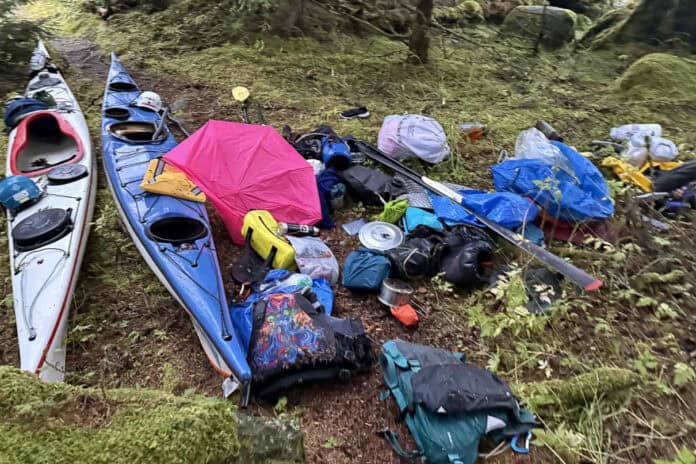
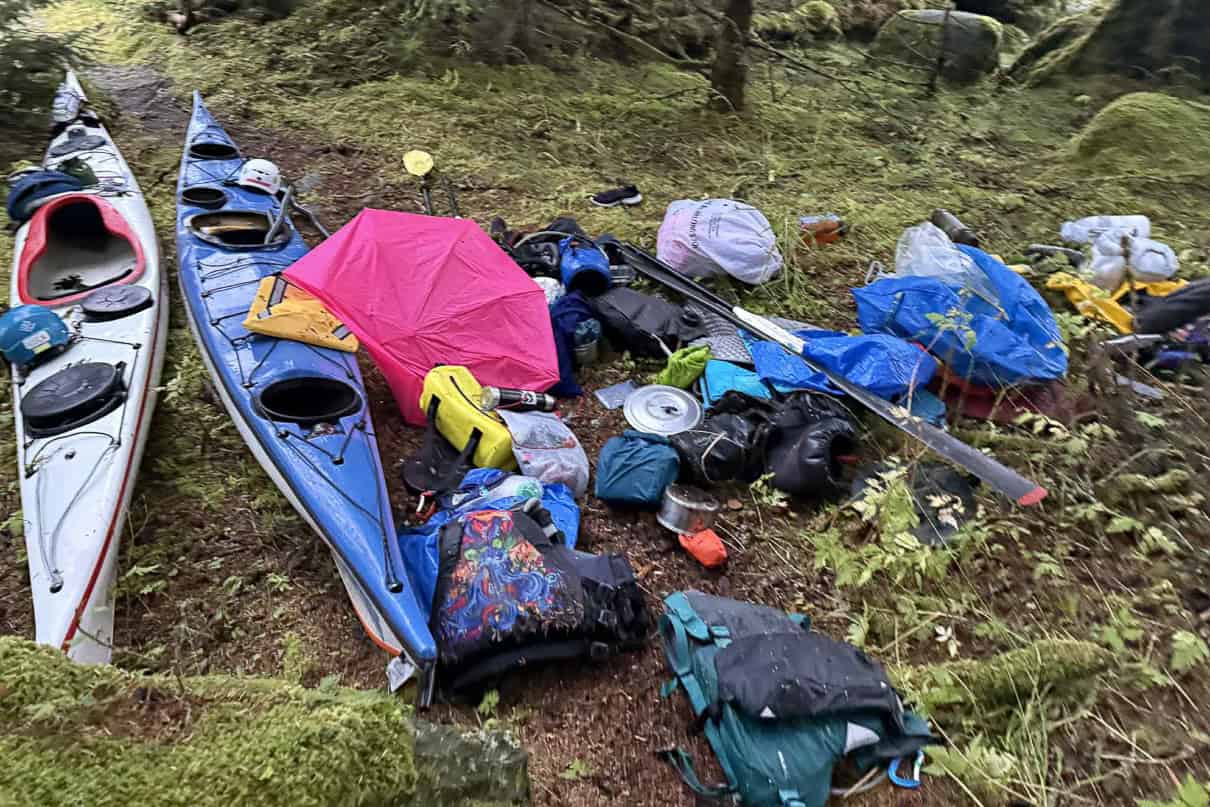
Gear salvaged in the aftermath of the Tracy Arm tsunami. Image courtesy Billy White.

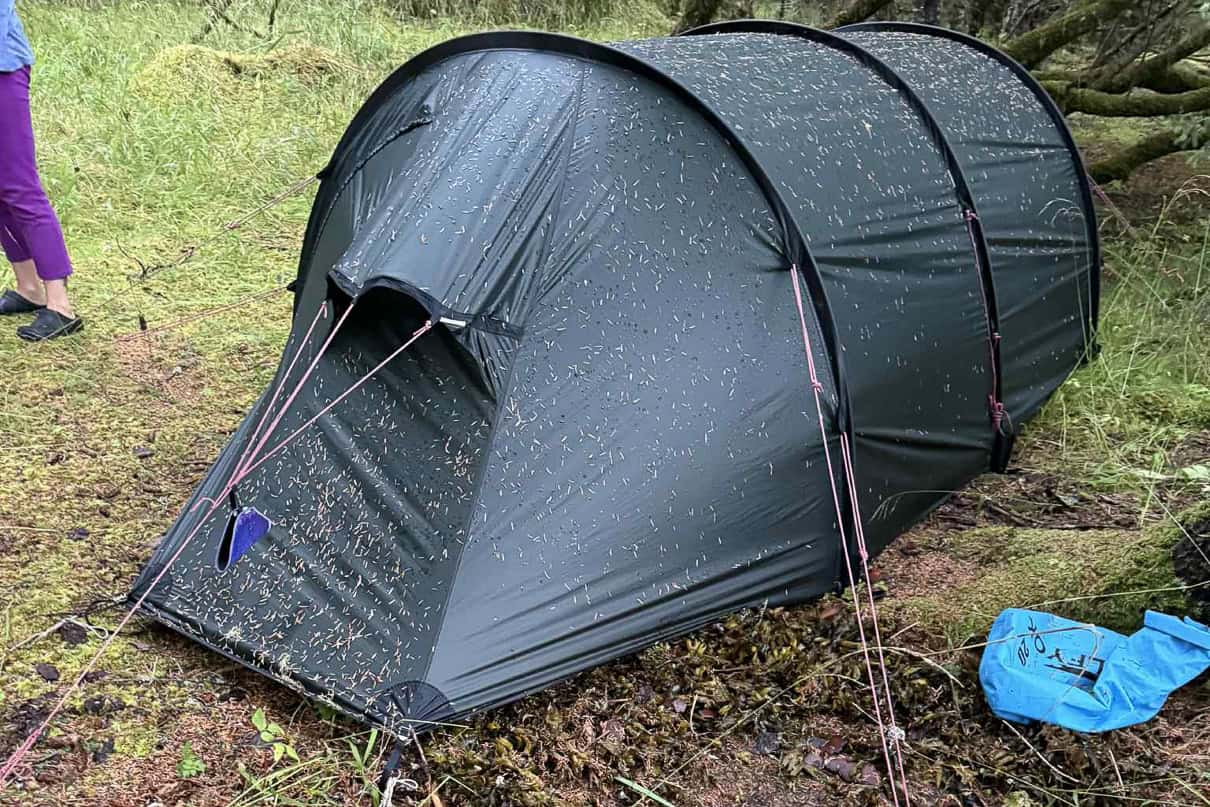
On day 78 of kayaking the Inside Passage, a trio of sea kayak guides and instructors woke at 5:45 in the morning to a rush of water that missed their tent by inches.

“I think when a lot of people think of a tsunami they think of a rogue wave,” explained Billy White, sea kayak guide and expedition member. “But this was almost like a flash flood, as if the ocean just moved up several feet and then came at you all at once.”

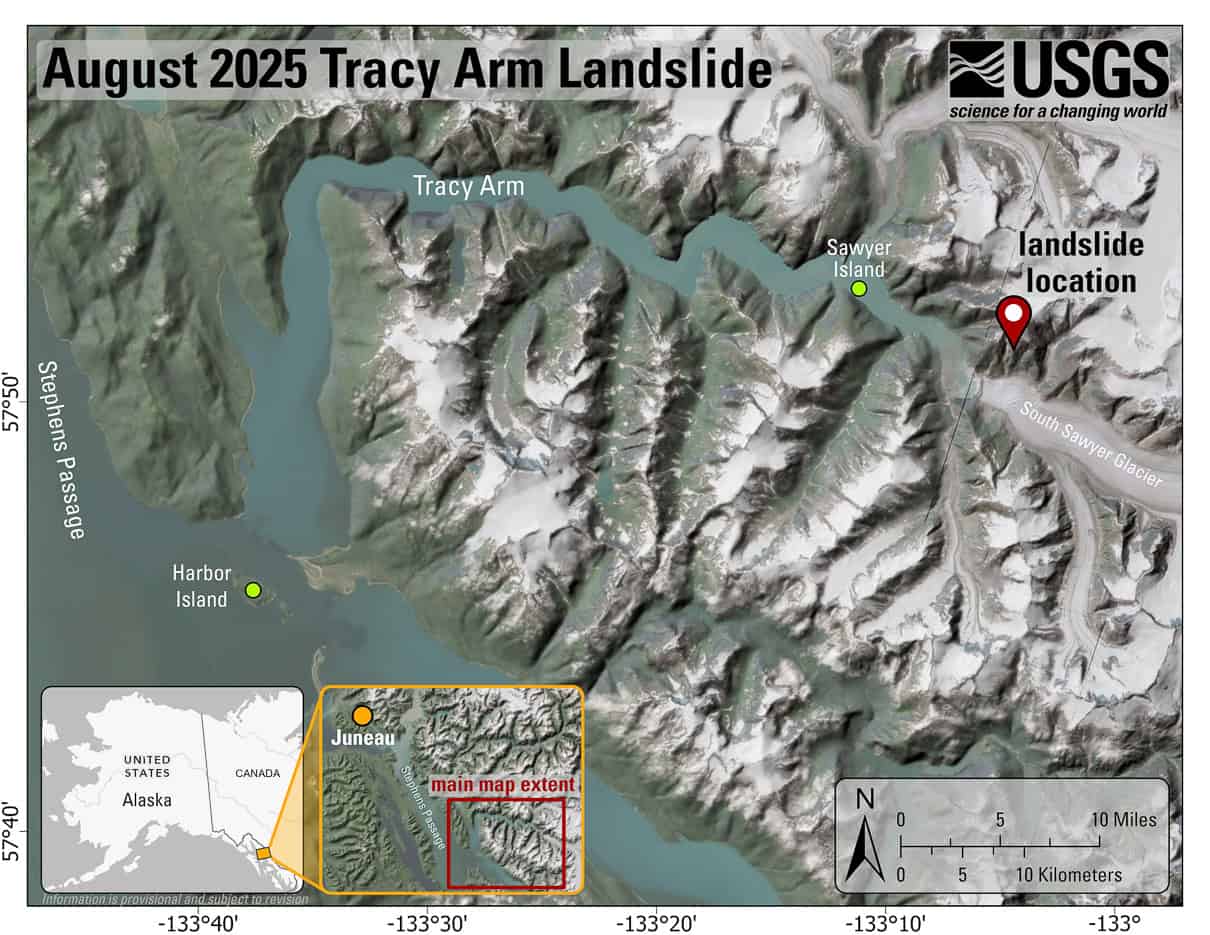
Diagram of the Tracy Arm landslide
Diagram of the Tracy Arm landslide depicting both the origin of the tsunami at the South Sawyer Glacier and Harbor Island where the kayakers were camped. Image: USGS | Landslide Hazards Program

White along with friends Sasha Calvey and Nick Heilgeist began their journey up the Inside Passage, a classic sea kayaking route that runs roughly from Seattle, Washington to Skagway, Alaska, on May 24, 2025 from Washington’s San Juan Islands. On the morning of August 10, the team was camped on Harbor Island in Holkham Bay at the mouth of Tracy Arm, a long fjord with an entrance about 74 kilometres (46 miles) from Juneau, when a tsunami triggered by a landslide at the end of Tracy Arm swept through their camp.

Tracy Arm Tsunami sweeps through expedition kayakers’ camp

“I got woken up by my friend Sasha saying ‘get out of the tent’. And I’m half asleep. I stumble out of the tent and there’s a wall of water that’s rushing by,” shared White. “[The wave] had washed away all of our boats, our gear and our tarp.”

A landslide above the South Sawyer Glacier had raced down the steep mountain slopes into Tracy Arm on Sunday August 10 at 5:26 in the morning. The Landslide Hazards Program reported that preliminary interpretations of photos kayakers took indicate that the resulting tsunami reached heights of nearly 30 metres (100 feet) at Sawyer Island, a small island deep in the fjord, and the resulting tsunami was recorded on a coastal tide gauge in Juneau at 36 centimetres (14 inches).

Landslides that trigger tsunamis in Alaska’s fjords are relatively common, according to the Landslide Hazards Program, with the especially notable Lituya Bay landslide in 1958 creating a tsunami with a maximum height above sea level on shore of 530 metres (approximately 1740 feet).

Surviving a backcountry tsunami

White estimated that the group had camped in the woods 20-25 vertical feet (approximately six to eight metres) above the high tide line and their gear was stored 10-15 vertical feet (approximately 3-4.5 metres) above the high tide line at the mouth of the forest. The kayaker’s account and photos indicate that the wave missed their tent by inches, and White expressed relief that the group chose to camp in the woods rather than on the beach near their gear.

Seaweed left just outside the kayakers tent by the wave.
Seaweed left just outside the kayakers’ tent by the wave. Image courtesy Billy White.

“I’m really glad we went back in the woods,” said White. “We definitely would’ve died if we hadn’t.”

Luckily, Heilgeist’s kayak was used as an anchor for their tarp and some of the group’s gear got caught in the kayak, including White’s marine radio. The team found Heilgeist’s boat about four feet up in a tree and balancing on a rock. White also shared that had the team not recovered the radio, they always keep the Garmin with them in the tent, so they could’ve gotten out a text for assistance if needed.

“My boat was down on the cliffs by the beach so we were able to run and grab it,” said White. “Unfortunately Sasha’s was out in a giant whirlpool.”

After collecting their scattered gear, the team brought it all to the forest to take stock of what had happened. At this point, they didn’t know they’d experienced a tsunami, and didn’t know if another wave could be coming.

After the Tracy Arm tsunami

“We placed a pan pan call out into the void on a marine radio and we were really lucky that there was a boat about three nautical miles away and they were able to come pick us up,” said White.

The team was rescued by The Blackwood, a yacht that does trips around Alaska.

“It was a very surreal experience because we’d just been camping for 78 days and then we get picked up by this gorgeous charter yacht with a chef…it was very disorienting,” White shared. “It was very impressive, the rescue, because at that point the water was still quite turbulent… I would say six to seven knots of current forming these giant whirlpools and so they sent their chase boat through those whirlpools to come grab us.”

Gear salvaged in the aftermath of the Tracy Arm tsunami. Image courtesy Billy White.
Gear salvaged in the aftermath of the Tracy Arm tsunami. Feature image courtesy Billy White.

While White and Heilgeist’s boats were damaged but recovered, Calvey wasn’t so lucky – the team saw her boat circulating in a whirlpool shortly before it vanished.

“We lost Sasha’s boat and then all of us… I lost a bunch of gear and a lot of our group gear is gone, so that’s definitely the hardest thing.” White explained. “All being guides, we use our gear for our livelihood.”

Overall, White reflected that the incident emphasized the importance of training for the worst case scenario, practicing rescues, and knowing radio protocols.

“Make sure you know how to operate your radio and how to place an emergency call,” said White, adding that they would consider sleeping with their radio in the future. “That would probably be my biggest takeaway. Know what to do when disaster strikes. That’s why we practice our rescues… make sure you have that drilled into your head because when it actually happens it might be 5:45 in the morning stumbling out of your sleeping bag.”

Despite an unfortunate early end to their Inside Passage expedition, the team hopes to return and complete the final leg of their journey beginning at Tracy Arm and heading to Glacier Bay in the future. Find their GoFundMe to offset the cost of new gear here.

A Paddler’s Guide To Predicting The Weather

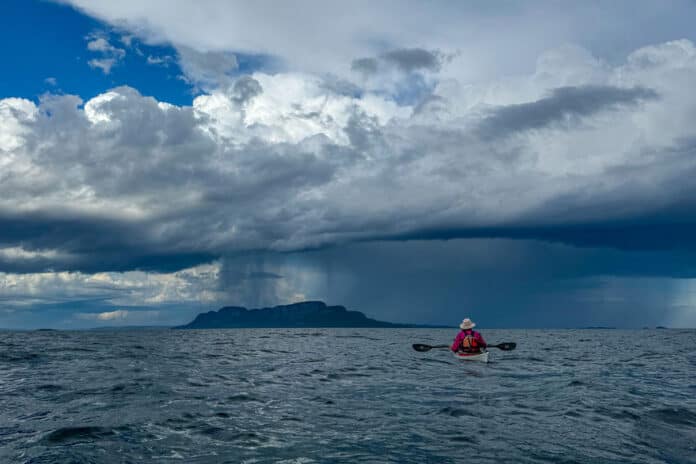
A sea kayaker sits on the water looking at a storm on the horizon
Just passing through. | Feature photo: Kaydi Pyette

As dozens of folksy sayings attest, you can make your own weather forecast from easy atmospheric and environmental observations. You don’t need a weatherman to know which way the wind blows.

A paddler’s guide to predicting the weather

“Wind from the east, weather a beast, wind from the west, weather is best.”

Changes in wind direction hint at coming weather. A counter-clockwise shift in wind direction (“backing” in mariner parlance) predicts approaching low pressure with its attendant low clouds, strong winds and miserable weather. A clockwise shift in wind direction (known as “veering”) is a sure sign of approaching high pressure, with fewer clouds, lighter winds and pleasant weather. Wind typically backs from west to east and veers from east to west.

A sea kayaker sits on the water looking at a storm on the horizon
Just passing through. | Feature photo: Kaydi Pyette

“Mackerel sky and mares’ tails make tall ships carry low sails.”

Mottled, fish-scale altocumulus clouds and cirrus streamers indicate moisture and unstable air—and rain within 24 hours.

“When sounds travel far and wide, a stormy day will betide.”

Humid air is better at transmitting sound waves.

“If the moon has a halo around, we’ll soon tread on deluged ground.”

A halo around the moon or sun is caused by ice crystals in high cirrus clouds, which form as a cirrus cloud flattens ahead of a warm front. A halo is often the first sign a low-pressure system is approaching, and that rain is 18 to 36 hours away.

“Red sky at night, sailor’s delight. Red sky at morning, sailors take warning.”

In the evening, red clouds above and to the east mean the sun is shining through clear skies in the west—the direction of approaching weather. Conversely, red sky at sunrise means clearing in the east but unsettled weather approaching in the west—often a sign storms will linger.

“When smoke descends, good weather ends.”

Your campfire provides a reasonable forecaster for the next 24 hours. A low-pressure system approaching makes smoke absorb moisture in the air and sink, enveloping your campsite. Smoke rises in a high-pressure system.

“When leaves show their undersides, be very sure rain betides.”

Rising humidity and shifting winds can cause tree leaves to flip before a storm, revealing their paler undersides. Some flowers may close to protect their pollen, a subtle sign of nature preparing for rough weather.

“If birds fly low, expect rain and a blow.”

Birds fly lower before storms because the insects they feed on stay close to the ground in low-pressure, humid air. High-flying birds usually signal good weather.

“If your muscles all ache and itch, the weather fair will make a switch.”

Aches and pains can worsen as barometric pressure drops—a subtle but common sign of a coming weather change.

Cover of Issue 73 of Paddling MagazineThis article was published in Issue 73 of Paddling Magazine. Subscribe to Paddling Magazine’s print and digital editions, or browse the archives.
Just passing through. | Feature photo: Kaydi Pyette


Best Delta Kayaks For 2026

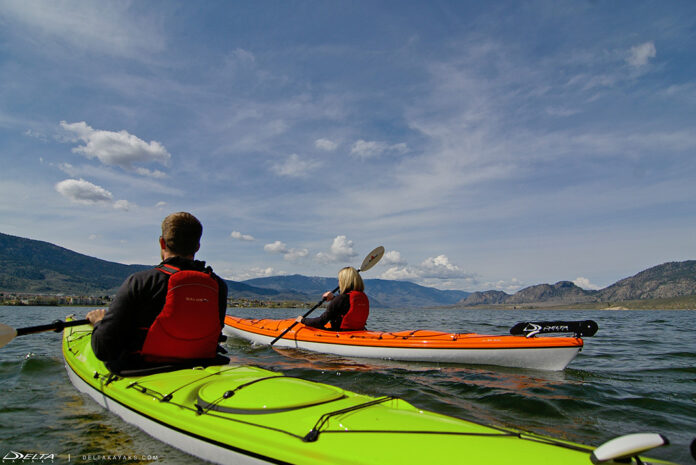
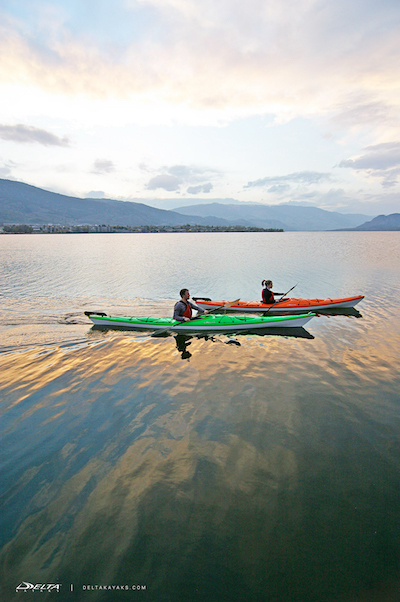
Two people paddling green and orange touring kayaks
Photo: Courtesy Delta Kayaks

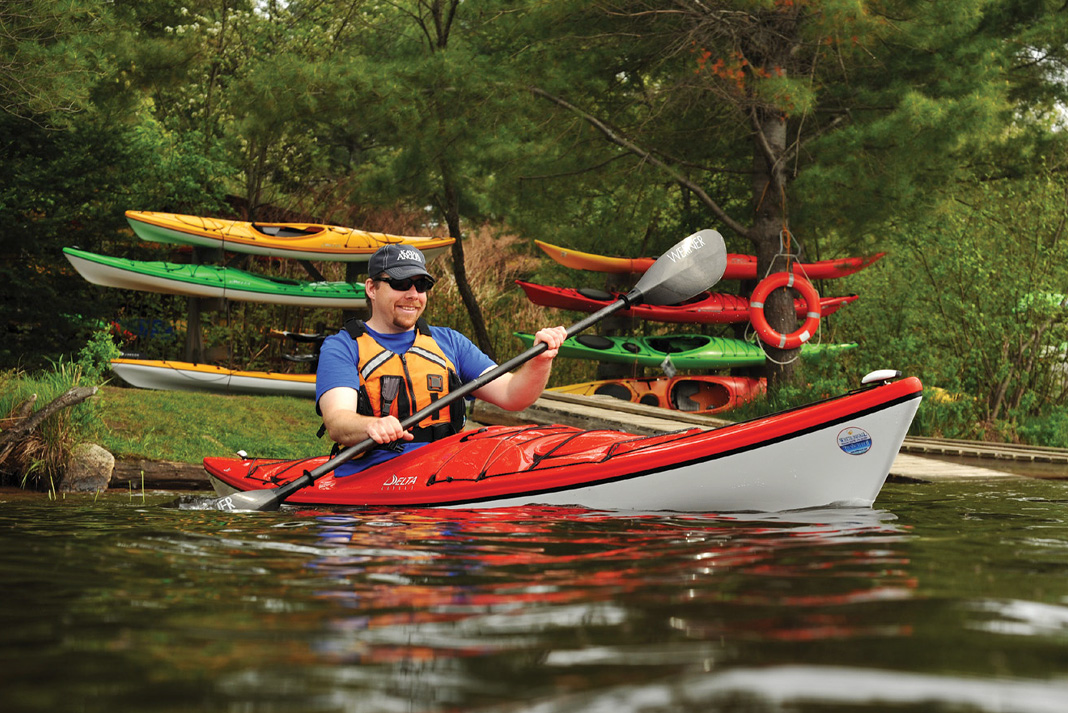
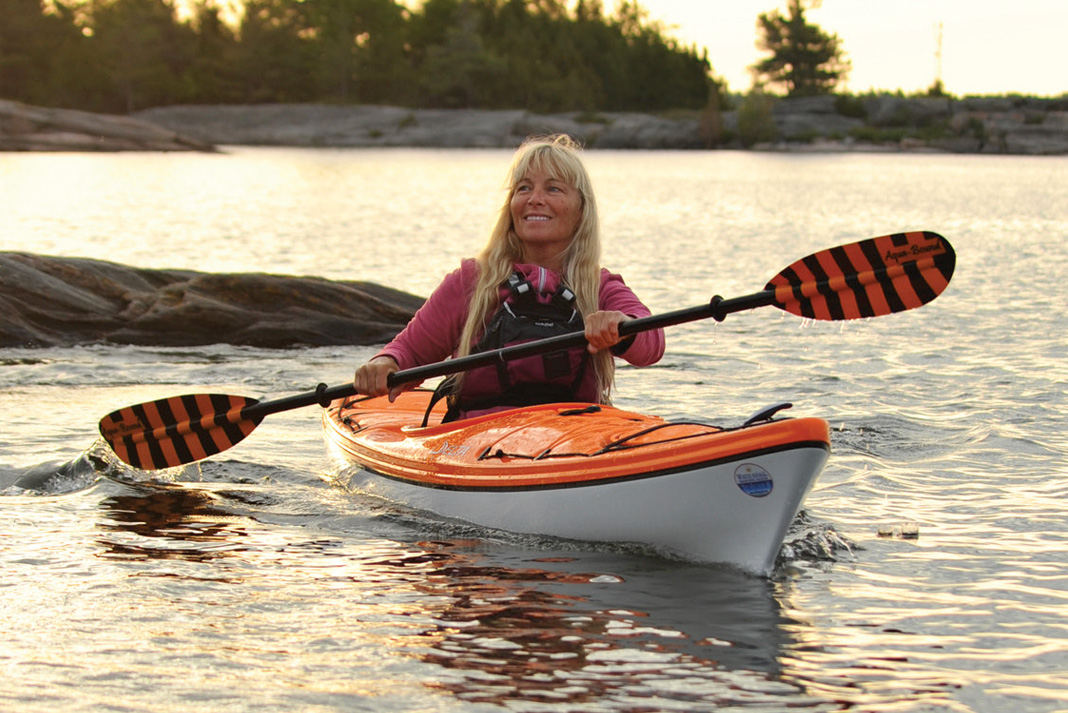
As a sea kayak guide, I rarely see a group out for a day or multi-day trip without at least one Delta kayak in the mix. Why? They’re darn good boats. Delta is a Canadian, paddler-owned company that sets out to do one thing well: create quality touring kayaks. They were early adopters of thermoforming, and chose to focus exclusively on this novel process rather than dabbling in composites or rotomolding. Delta has been building recreational and touring kayaks in Maple Ridge, British Columbia, since 2006.

Thermoformed kayaks balance durability and weight at a reasonable cost. Delta’s mastery of the thermoforming process—which involves heating sheets of durable ABS/acrylic laminate and vacuum-forming them into the kayak molds—shows in their beautifully finished and lightweight kayaks. Delta’s proprietary SolarKote acrylic outer layer gives their kayaks a gleaming, glossy finish and superb UV resistance, while the robust ABS inner layer is nearly indestructible.

Inside the hull, Delta kayaks are renowned for their high storage capacity and exceptionally comfortable seating systems. These systems allow paddlers to adjust themselves up, down, forward, backward and nearly every other configuration you can think of. Cushiony foam is thoughtfully laid out to drain and ventilate well, great for long days in the cockpit. With high volumes and large openings, storage space is never an issue in Delta hatches.

Delta’s lineup includes everything in the touring range, from 10-foot day tourers to 17-foot expedition kayaks. If you’re looking for a lightweight single or tandem touring kayak, there’s likely a Delta that’s a great match for you.

This article will run through a few of our favorite Delta models and help you find your next kayak with buying advice and field-tested reviews.

Top picks: Best Delta kayaks

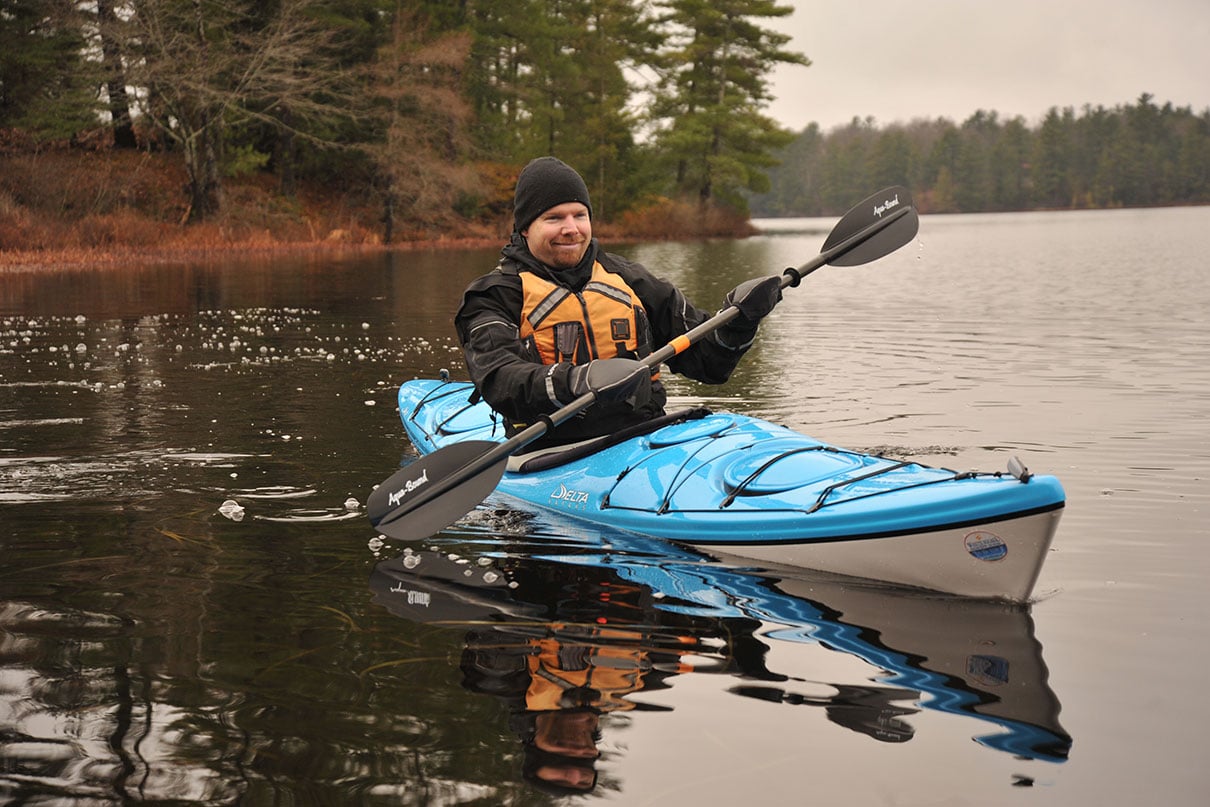
Delta Kayaks 14

man paddles the Delta 14 touring kayak in chilly fall weather while wearing hat and gloves
Out for a day trip in the Delta 14. | Photo: Virginia Marshall
Delta 14 Specs
Length: 14′
Width: 23.5”
Weight: 45 lbs
Capacity: 340 lbs
MSRP: $2,395 CAD

Buy from:

DELTA

From our review:

“The shortest and lightest of Delta’s touring kayaks at 14 feet and just 45 pounds, it’s positioned as the easiest to own for paddlers balancing space, weight and cost. If you are looking for a compact touring kayak that can handle diverse waters and won’t break the bank, the Delta 14 is a superb solution at an exceptional value.” [ Read full review ]


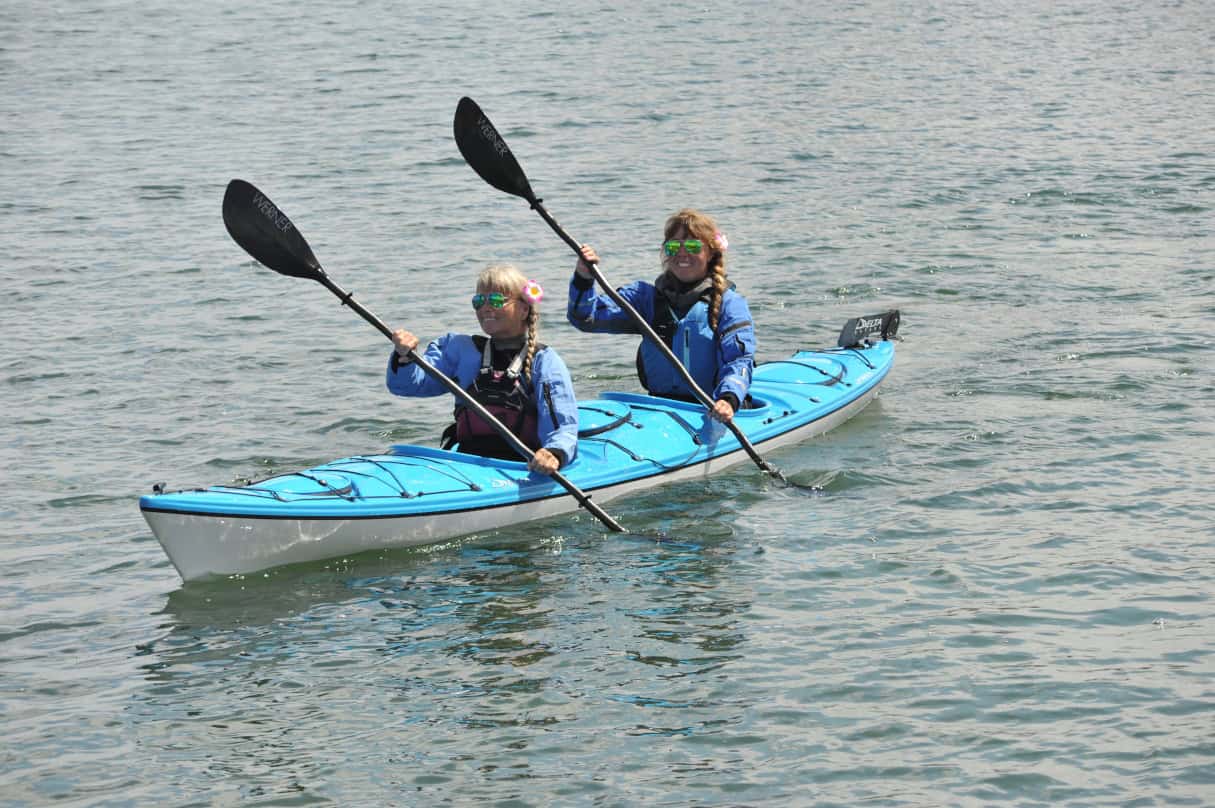
Delta Kayaks Traverse 17.5T

Two women paddling a tandem touring kayak.
Seeing double in the Delta Traverse 17.5 T. | Image: Owen Marshall
Delta Traverse 17T Specs
Length: 17’6”
Width: 27.25″
Weight: 70 lbs
Capacity: 560 lbs
MSRP: $3,250 CAD

Buy from:

DELTA

From our review:

“Delta’s designers finessed two cockpits into the Traverse’s 17-and-a-half feet—a length more typical of solo sea kayaks than tandems. As veterans of tandem bicycles and boats know (and the uninitiated soon discover), cockpit proximity is one of the finer points of double design. Too close together and unsynchronized paddle strokes amount to a jousting match. The 17.5 T, we are relieved to report, gets paddler positioning just right.” [ Read full review ]


Delta Kayaks 17

THE 17 By Delta Kayaks | Photo: Virginia Marshall
The 17 By Delta Kayaks. | Photo: Virginia Marshall
Delta 17 Specs
Length: 17′
Width: 22.5”
Weight: 40 lbs
Capacity: 410 lbs
MSRP: $2,795 CAD

Buy from:

DELTA

From our review:

“Whether you’re starting out on your journey or you’re a seasoned paddler, larger folks looking for a lightweight touring kayak will appreciate Delta’s commitment to bending plastics. With its sophisticated looks, affordable price tag and hardwearing construction, the thermoformed 17 is built for the long haul. From the top down, the 17’s deck illustrates Delta’s expertise when it comes to shaping plastic sheets. Molded-in bungee clasps help secure the new press-lock hatch covers—even easier to use than previous iterations thanks to their single gasket seal—and recessed grooves for bungees keep the deck super sleek and snag-free…” [ Read full review ]


Delta Kayaks 12S

Delta Kayaks 12S. | Photo: Virginia Marshall
Delta Kayaks 12S Specs
Length: 12′
Width: 24”
Weight: 38 lbs
MSRP: $1,595 CAD

Buy from:

DELTA

From our review:

“Stable and well behaved, the 12S embodies Delta’s West Coast touring design ethos—beginner-friendly, efficient and capable of hauling all your gear—scaled down in a compact package. The multi-chine, V-shaped hull and full, flared bow confidently handle bumpy conditions, while offering satisfying—if not speedy—cruising capabilities on calmer waters.” [ Read full review ]


Shopping for a used Delta kayak?

Buying a used kayak is an excellent way to get the most out of your budget. Delta’s timeless touring designs and robust construction make shopping for a used Delta a great option. Look for secondhand Delta kayaks on used marketplaces like Craigslist, Kijiji or Facebook Marketplace, but be aware that these popular boats often sell quickly. Setting up an email alert for the keywords “Delta Kayak” notifies you as soon as one becomes available.

Searching for retired demos or rentals is another way to get your hands on a used Delta. If an outfitter near you rents Delta kayaks, chances are they will be replenishing their fleet as the kayaks get older—ask if they are planning to do so at the end of the season. Renting a boat is also a great way to test how it fits and performs. If the fit is almost there, Delta sells padding kits that are compatible with all of their seating systems.

Delta’s thermoform plastic construction is UV-, abrasion- and impact-resistant, and nearly maintenance-free, but be sure to thoroughly inspect any used boat before buying. Superficial scratches are not an issue, but repairs may be needed for deeper gouges into the inner material. Check the deck (top) and hull (bottom) for cracks and deformities (which will make the kayak paddle less efficiently). Also inspect the bulkheads, hatches, skeg or rudder (if applicable) and outfitting for signs of excessive wear or damage.

For more tips on what to look for when selecting a used kayak, read our article How To Buy A Used Kayak.

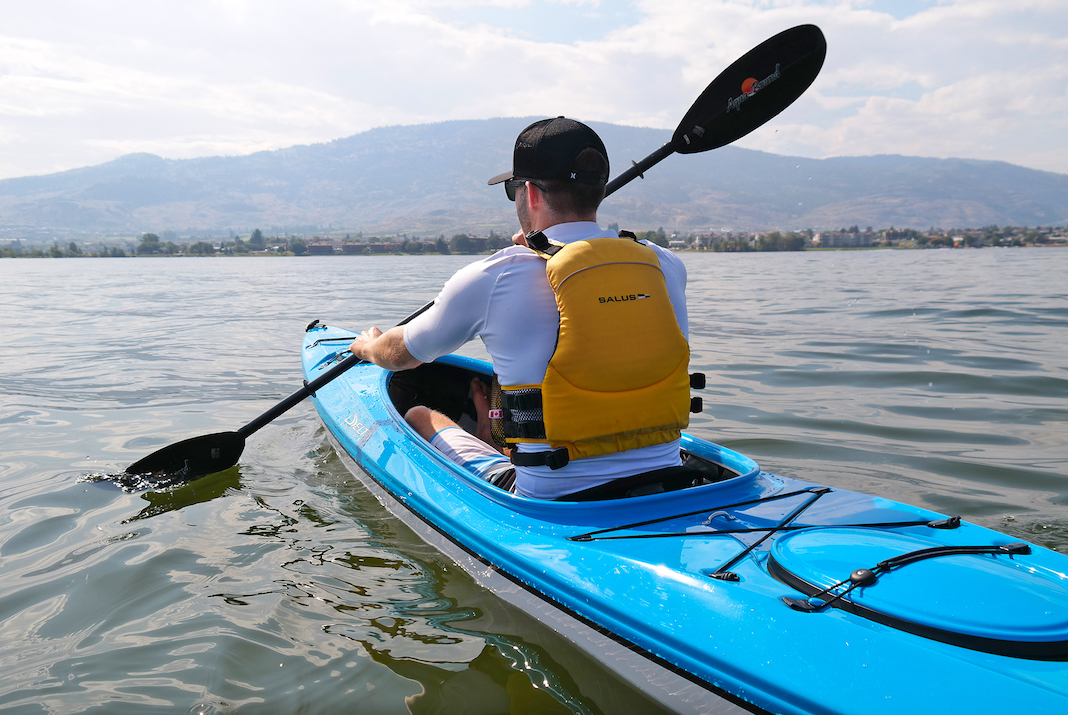
Man paddling blue day touring kayak
Photo: Courtesy Delta Kayaks

Delta Kayaks buying advice

Delta’s construction method sets these kayaks apart from many other touring kayaks. The thermoforming process involves heating sheets of ABS plastic laminate and vacuum-forming them into the kayak mold. The deck and hull are molded separately, then joined together to form the finished kayak.

The outer layer of Delta’s proprietary plastic laminate is protective “Solarkote” acrylic, which provides resistance to abrasions and harmful UV rays. A key advantage of thermoform construction is that it creates a lighter and sleeker kayak than traditional rotomolded plastic, but more resilient to scratches and impacts than a fiberglass layup.

Recessed deck fittings and flush-mounted hatches add to Delta kayaks’ sleek aesthetic. In addition to looking sharp, these features reduce the chances of damaging the kayak during transport and make it easier to re-enter the kayak from the water. Subtle details like this also indicate that the company has put lots of thought and feedback from paddlers into their designs.

Although Delta focuses exclusively on touring kayaks, there are many options within their lineup to suit a wide variety of paddlers. Delta kayaks are divided into four categories: Adventure Rec, Light Touring, Touring and Performance Touring.

Adventure rec

Adventure Rec are the shortest kayaks, aimed at beginner and casual kayakers. With 10-foot and 12-foot options available, the Delta AR is the company’s recreational touring model. These boats have a roomy cockpit for easy entry and exit and a wide, catamaran-style hull at the stern for lots of stability.

Premium outfitting, bulkheads for safety and sealed hatches for watertight storage make the Delta AR a solid step up from other entry-level recreational kayaks. Read a full review of the Delta AR here.

Light touring

Light Touring kayaks are the next step in Delta’s progression. These include the Delta 12S and Delta 12.10. Light touring kayaks are perfect for paddlers who want a boat that is the size of a recreational kayak, but performs more like a sea kayak. These boats balance nimble handling and good glide with no more length than is necessary.

This makes the kayak easier to turn on the water and saves space wherever it is stored. Light Touring kayaks have features found on longer sea kayaks, like decklines and thigh braces, delivered in a space-efficient package.

Touring

Delta’s Touring category moves into traditional sea kayak territory. The Delta 14, 15.5 GT and 17.5 (Tandem) kayaks fall under this category. The longer length and higher volume of these boats makes them best suited for coastal paddling or touring on large lakes. They feature a smaller cockpit, where the paddler’s thighs engage with the hull for superior boat control.

The watertight bulkheads and hatches have ample space for all the gear needed on overnight trips. There are options for rudders or skegs in the Touring category.

Performance touring

Two people paddling orange and green touring kayaks on glassy waters.
Photo: Courtesy Delta Kayaks

Performance Touring kayaks get a little longer and are equipped to handle whatever conditions you may encounter on the open coast. These sea kayaks—which include the Delta 15S, 16 and 17—offer top of the line performance and ample storage capacity for intermediate and advanced paddlers planning extended trips. Like all Delta kayaks, they use thermoform construction for a great blend of durability and light weight.

Just like any kayak you are considering, it is crucial to “try before you buy.” Head to your local paddling shop and chat with one of the staff there—they know boats. Describe your paddling goals, and take the kayak out for a spin to make sure it fits and performs as expected.

Still wondering if Delta kayaks are right for you? Here are answers to some of the most common online questions about Delta kayaks.

  • Are Delta kayaks good?

    For someone looking for a durable yet lightweight touring kayak, Delta kayaks are a good option. At mid-range prices, they won’t break the bank. Delta also has a reputation for comfortable kayaks with customizable seating options. The best way to know if a Delta kayak is a good fit for you is to try it out. For further comfort, additional padding can be purchased specifically for Delta’s seating system to really make it your own.

  • Where are Delta kayaks made?

    They’re available across North America, so where are Delta kayaks manufactured? Delta kayaks are made in British Columbia, at Delta’s Maple Ridge headquarters just outside of Vancouver.

  • Delta kayaks warranty

    All new Delta kayaks come with a 3-year limited warranty; be sure to register your kayak when you buy it. This warranty covers any defects from faulty materials or workmanship.

  • Delta kayak dealers

    Delta kayak dealers can be found in nearly every province and state. Use Delta’s dealer locator to find one near you.

  • Does REI sell Delta kayaks?

    REI sells Delta Kayaks and is an authorized dealer. Each store will have a different inventory. Delta notes on their website that although the products may not appear on the REI site inventory, they are carrying Delta kayaks and accessories.

  • Delta kayaks cost

    How much are Delta kayaks? Delta kayak prices vary depending on the model, but range from $995 USD / $1,095 CAD to $2,750 USD / $3,000 CAD. Prices can also vary based on shipping costs and location.

    How much is a Delta kayak in comparison to other similar boats? Delta kayaks are priced mid-range: less expensive than fiberglass or composite kayaks, but more pricey than most polyethylene boats.

  • Delta kayak material

    What is a Delta kayak made of? At first glance, the glossy coat and two-tone colorway looks like fiberglass, but Delta kayaks are made with a patented blend of ABS and acrylic plastics. Sheets of this laminate material are heated and vacuum-formed into molds made with computer-assisted design (CAD) programs.

    The result is a durable, attractive and lightweight kayak designed with the assistance of cutting-edge tech for machine precision.

Compare Delta Kayaks

  • Eddyline vs Delta kayaks

    Like Delta, Eddyline kayaks are made exclusively from thermoformed plastic. Eddyline calls their material Carbonlite, which produces kayaks with a similar balance of durability and light weight to Delta kayaks. Where Delta kayaks are manufactured near Vancouver, British Columbia, Eddyline builds their boats in Burlington, Washington.

    Delta produces an extensive range of rec touring and touring-specific boats, while Eddyline offers a line of angler-dedicated sit-on-top kayaks along with their touring and recreational options. Both companies produce top-of-the-line thermoform kayaks; if you’re seeking a good variety of sit-on-top and sit-inside recreational kayaks, or a thermoform fishing kayak, look to Eddyline.

    If you want a wider selection of full-size touring kayaks, choose Delta.

  • Boreal vs Delta kayaks

    Boreal Design kayaks are ubiquitous among rental fleets across North America. They have a boat for everybody, with recreational, touring and expedition kayaks. Boreal Design produces their kayaks overseas, with polyethylene and thermoformed plastic kayaks made in Shanghai and composite kayaks built in Estonia.

    They offer a massive catalogue of kayaks ranging from 12-foot recreational kayaks to 21-foot tandems. Comparing Delta Kayaks to Boreal Design, Delta offers a smaller range of touring-focused models, exclusively made with thermoformed ABS. Choose Boreal Design if you want a wider variety of touring designs and materials.

    If you prefer the lightweight, affordable durability of thermoform construction, you can’t beat Delta kayaks.

  • Delta vs Seaward kayaks

    Both Delta kayaks and Seaward kayaks are designed and manufactured in British Columbia. Seaward has been building quality touring and expedition kayaks since 1986, the early days of recreational sea kayaking. They specialize in fiberglass and Kevlar composite kayaks.

    Seaward’s lightweight, high-capacity composite kayaks land at a higher price point than Delta’s thermoformed plastic kayaks. In terms of design, Seaward offers a more extensive touring and tandem lineup, while Delta makes many more boats less than 16 feet, suitable for day touring and recreational paddling.

    If you are an avid paddling enthusiast ready to make the investment in a quality composite kayak, Seaward offers many fine choices. Choose Delta kayaks if your paddling budget is a bit tighter, or if you are a more casual recreational paddler.

Two people paddling touring kayaks with mountains in background
Photo: Courtesy Delta Kayaks

Delta kayak reviews

Remember, the first step in choosing a kayak is considering the type of paddling you aspire to do. Reading expert reviews will allow you to evaluate how each kayak handles and how it performs for the intended paddler and conditions.

The Pacific Northwest’s Once-Thriving Paddlesports Manufacturing Industry Is Vanishing

person paddles a kayak in cliffside surf on the Pacific Northwest coast
Don’t it always seem to go that you don’t know what you’ve got till it’s gone. | Feature photo: Kiliii Yuyan

In the spring of 1994, a friend wanted a ride to buy a used pickup. We left the remote camp where we ran outdoor education programs and drove to a remote warehouse near the Molalla River. Three guys came out. One was selling the truck. Then he introduced his co-workers, saying, “We are Lightning Paddles.”

I’d been using one of their paddles since I started kayaking six years before. I hadn’t realized the “Colton, OR” printed on the blade was just a few miles from where I worked.

The Pacific Northwest’s once-thriving paddlesports manufacturing industry is vanishing

Lightning Paddles, of course, is gone. So is Necky, which made sea and whitewater kayaks on Vancouver Island before being bought out by Johnson Outdoors. Pygmy Kayaks in Port Townsend, a legendary maker of stitch-and-glue kayaks, shut down during the pandemic. Saltwood Paddles—once five miles from my front door—is no more. Current Designs, started in the ‘70s on Vancouver Island by Brian Henry, was sold in 1999 to Wenonah Canoes, which moved the operation to Wisconsin. It was recently sold again. Pacific Water Sports closed in 2003.

The latest disappearance is Seaward Kayaks, the last manufacturer of touring kayaks on Vancouver Island, which shut down its Chemainus operation in the summer of 2024 after almost 40 years in business.

person paddles a kayak in cliffside surf on the Pacific Northwest coast
Don’t it always seem to go that you don’t know what you’ve got till it’s gone. | Feature photo: Kiliii Yuyan

Even the ones that survive have moved. Werner Paddles merged with Jackson Kayak and is moving operations from Sultan, Washington, to Tennessee. Eddyline Kayaks left Anacortes, Washington, for Siloam Springs, Arkansas. What’s left of Pacific Northwest paddlesports manufacturing is slim: Kokatat in Arcata, Sterling Kayaks in Bellingham, Delta Kayaks in British Columbia, and Immersion Research in Hood River.

There is much to both lament and celebrate about the flight of paddling manufacturing from the Northwest. I certainly don’t begrudge Pygmy’s John Lockwood, Eddyline’s Tom Derrer, or Current Designs’ Brian Henry their well-earned retirements. And one community’s loss is another’s gain. I’m sure locals were excited in Siloam Springs and Sparta, Tennessee, when Eddyline and Werner started production there.

Of course, companies close, move and merge all the time, from the mergers of Mercedes-Benz-Chrysler to Facebook-WhatsApp and Burlington Northern-Santa Fe. Mergers aren’t just for railroads, car companies or Mark Zuckerberg.

Still, I want my local paddling industry to thrive.

Knowing your gear was made nearby, by hands you’ve shaken, creates connections that tie you to a place.

The loss of local manufacturing is about three overlapping trends: demographics, culture and how we make and buy things. Time waits for nobody. Many shutdowns, mergers and moves happen when a founder retires. Lockwood, Henry, Derrer, Pacific Water Sports’ Lee Moyer, and Bob Collmer of Lightning are all baby boomers. They started their companies in the first golden age of sea kayaking in the 1970s and ‘80s, making handcrafted products during the rapid expansion of kayaking and the outdoor adventure business. With new leadership, ties to place and business models evolve.

And paddling has changed. Seaward made glass touring boats. Pygmy’s kits were for builders. Both require combinations of money, space to store and build, and a hankering for trips that take days or weeks. Much ink, including my own, has been spilled analyzing the evolution of how we paddle (paddlingmag.com/0180). While overall participation in paddling is up, more paddlers today are day trippers. The number of outdoor enthusiasts getting outside for long trips is dropping, according to the Outdoor Industry Association, and with it, so goes the number of paddlers shopping for an expedition kayak.

Manufacturing has also shifted toward thermoform and plastic, which cost less but also yield smaller margins. Shared manufacturing—like at Confluence, which owns six paddlesports brands—helps cut costs. The “play the sea” trend—whitewater moves in surf and rock gardens—favors plastic boats. Packrafts are surging. Evolution requires a lot of resources for R&D, which is expensive and risky since you might spend a lot of time developing something new and innovative that might not sell (remember the Perception Mr. Clean?).

The third trend is one we’ve known about since the 1970s: manufacturing in North America has declined since the end of the post-WW2 boom in the late 1970s. Then came offshoring and the decline of high-paying manufacturing jobs in the U.S. and Canada. These days, it’s hard to tell what country a company is from when American Fords are made in Mexico, Canada and the U.S., and Japanese Toyotas are made in 26 countries, including 10 places in the U.S.

It’s the same story for many paddlesports brands.

Globalization has plenty of discontents, and I’m often one of them. It’s lowered prices and created scale—but it’s also stripped away some of what makes paddling culture rich and rooted. Knowing your gear was made nearby, by hands you’ve shaken, creates connections that tie you to a place.

And there’s more at stake than community. There’s power. Jobs that go elsewhere reduce our clout. As I wrote years ago in this magazine, the outdoor industry is an economic behemoth that should have a lot more influence than it does. In 2024, the U.S. outdoor industry was responsible for $1.2 trillion in economic output and five million jobs.

But many of those jobs are seasonal or low-paying. Think of your seasonal, itinerant paddling instructors, river shuttle drivers, ski lift operators and the various services we use on our adventures: food, gas and the motel on the way to the river. To build an outdoor economy that sustains us and gives us the clout to protect rivers and seas where we paddle, we need to design and make things. The good-paying jobs often aren’t in the service industry; they’re in designing and making stuff.

Good-paying manufacturing jobs are only part of the story. The other piece of the puzzle is keeping business HQs local. Product design, engineering, marketing, accounting and all the things that go into making a business work are also high-paying outdoor jobs. They’re lost when a company like Seaward shuts down, or they shrink or leave town when a small business becomes part of a larger one. Even if manufacturing has gone elsewhere, keeping a company’s headquarters in North America matters for our economic and political pull.

It’s easier to advocate for clean water when you have a trillion-dollar industry and good-paying jobs that depend on it.

Of course, it’s not all economics. Knowing the people who make the stuff you paddle with has a huge intangible value. At a local event, someone once asked about my paddle. I laughed and pointed to Richard, the designer, sitting right beside me. Those connections make paddling a community, not just a sport.

My next kayak is another story. Three of us need new kayak polo boats, which are handmade by two retired guys in Edmonton, Alberta, with no website. In addition to the kayaks came an invitation to a kayak polo tournament and the puzzle of how to get the kayaks back down to Portland.

Feels a lot like Lightning Paddles, circa 1994. Maybe they’ll also sell us a truck.

Neil Schulman’s first paddle was a Lightning, made in Colton, OR. His last purchase was a Saltwood Reggie, one of the last made in Portland.

Cover of Issue 73 of Paddling MagazineThis article was published in Issue 73 of Paddling Magazine. Subscribe to Paddling Magazine’s print and digital editions, or browse the archives.
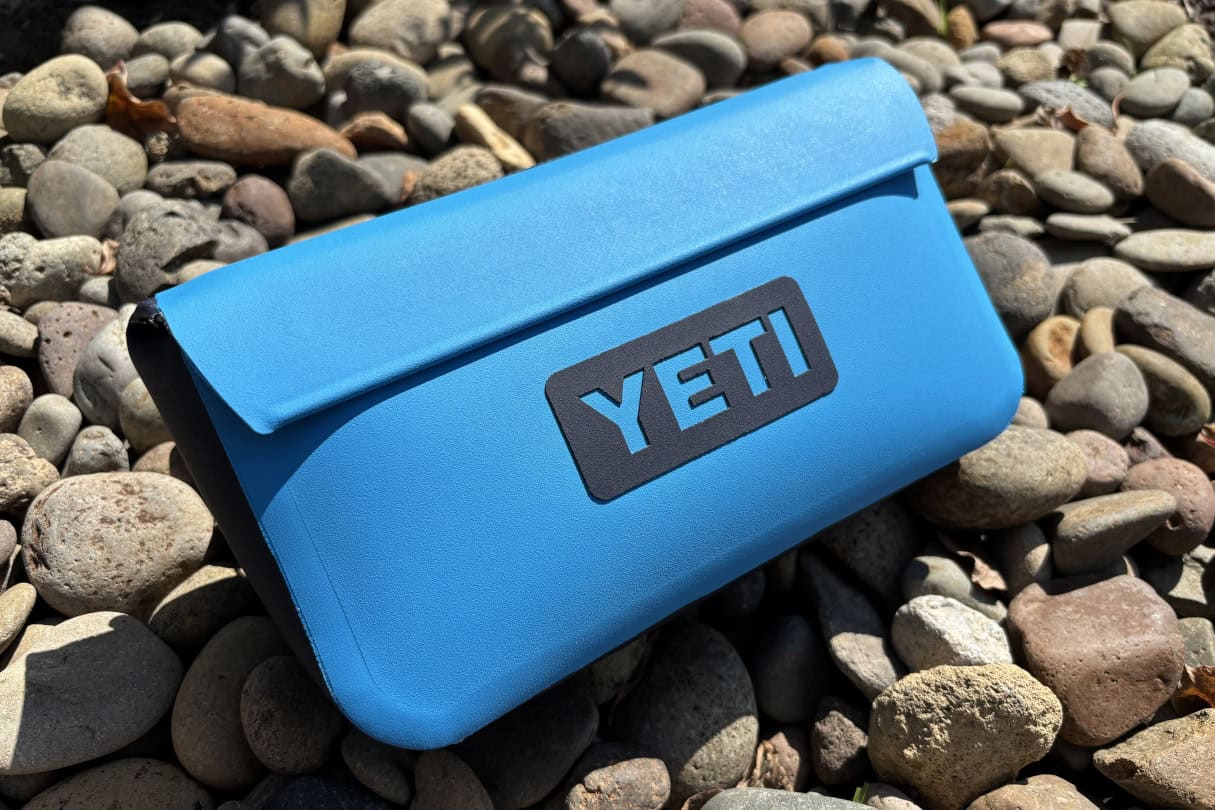
Don’t it always seem to go that you don’t know what you’ve got till it’s gone. | Feature photo: Kiliii Yuyan


Watch A Dramatic Kayak Rescue Caught On Body Cam Footage (Video)

Body cam footage from a Florida Fish and Wildlife Conservation Commission (FWC) Officer shows a dramatic rescue of a kayaker clinging to his overturned and waterlogged kayak near Marathon in the Florida Keys.

The kayaker, Micheal Krevat, was spotted struggling in the water near the Spanish Harbor Bridge. Officer Shawn Turner quickly reached the scene in his patrol boat and initiated the rescue.

Kayaker rescue caught on body cam footage near Marathon, Florida

“Here, give me your hand. Give me your hand,” said Turner as he approached Krevat, who appeared to be struggling to keep his head above the water.

When reaching with his hand didn’t work, Turner was able to get a rope to Krevat and pull him and the swamped kayak to the patrol boat. With Krevat too exhausted to haul himself aboard, Turner moved Krevat to the back of the boat.

“I’ve been out here for like 20 minutes,” said Krevat.

FWC officer pulls struggling kayaker from the water in dramatic rescue caught on bodycam footage.
FWC officer pulls struggling kayaker from the water in dramatic rescue caught on bodycam footage. Feature Image: CBS 12 News – WPEC | YouTube

Krevat asked if they could save the kayak and Turner assured him that he was more worried about Krevat himself than the kayak. Throughout the rescue, Turner remained calm and assuring and operated quickly in actions that likely saved Krevat’s life.

Turner helped to haul the struggling kayaker from the water and removed the rope wrapped around Krevat’s arm before securing his sinking kayak to the FWC boat. Turner also called to let authorities know Krevat was out of the water, then secured Krevat in a life jacket as he had not been wearing one. After, he emptied the sinking kayak and pulled it aboard.

“I was paddling water for 20, 30 minutes then I started praying to God, and then this guy shows up,” Krevat said.

Turner shared that as Krevat had drifted underneath the bridge, a bystander driving past saw him floating and called for help on his behalf, leading to Krevat’s swift rescue.

Rescued kayaker ultimately uninjured

While shaken and exhausted, Krevat was ultimately uninjured, but the near miss highlights the importance of wearing a life jacket when paddling, even when conditions appear calm.

Additionally, paddlers can come to the water prepared by carrying multiple ways to call for help in an emergency such as a marine radio, cell phone in a drybag, signalling mirror, flares, and/or a whistle. Carrying multiple ways to signal for help can both allow a paddler to make an initial call for help should disaster strike and later help first responders locate the scene of the incident more quickly. Equipping a kayak with float bags or choosing to paddle a kayak with bulkheads can also prevent a kayak from sinking upon capsize, leading to an overall safer ride.