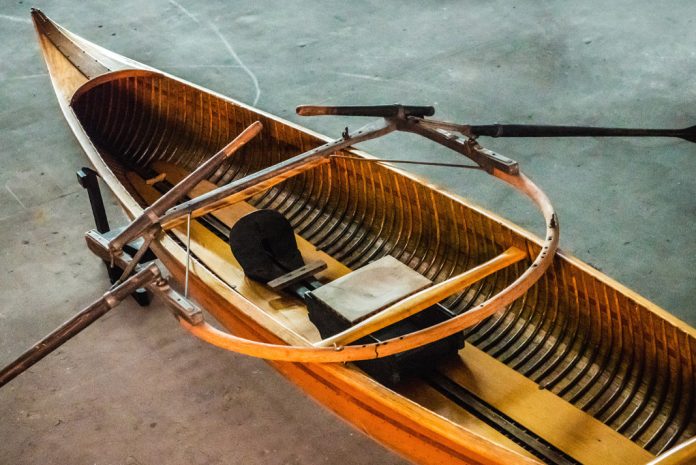
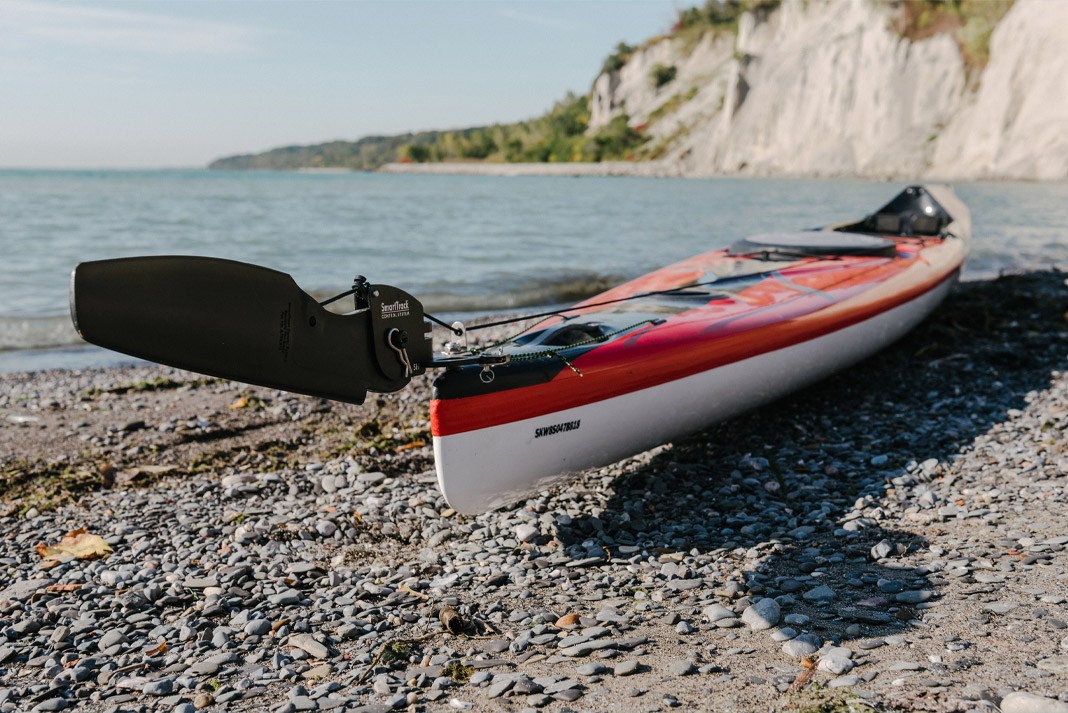
You’ve got mail. Now delivered to you with patented FORWARD-FACING EFFICIENCY. | Photo: Samantha Moss
Of all the thingsin the Canadian Canoe Museum, I’m often asked about my favorite item. It’s not a boat, strange as it may sound—although there are some very fine craft with stories yet to be discovered and some really crappy boats with amazing tales attached to them, and vice versa.
One of my absolute favorite artifacts is actually an aftermarket doodad. Specifically, it’s an item described in Letters Patent No. 169,277 and confirmed on October 26, 1875, at the United States Patent Office. It’s called: Improvement in Oars.
What is it about this gawky little spider of an invention that tickles me so? Let me explain with a brief story.
“[I’m] firmly committed to rowing,” she writes, “which does not allow any part of my body to ride for free.” By contrast, her husband, Doug, is a sea kayaker. “[He is] oddly committed to seeing where he is going,” Fredston writes.
Lest you think this difference trivial, here’s a brief description of the situation from Fredston’s book: “Doug asserts rowing has made me dyslexic. I call the bow of the boat the back because it is behind me. Along the same lines, the stern is the front. I steer off of a terrain feature ‘ahead’ of me, like a notch on a ridge or a snow patch, despite the fact it recedes as I row.”
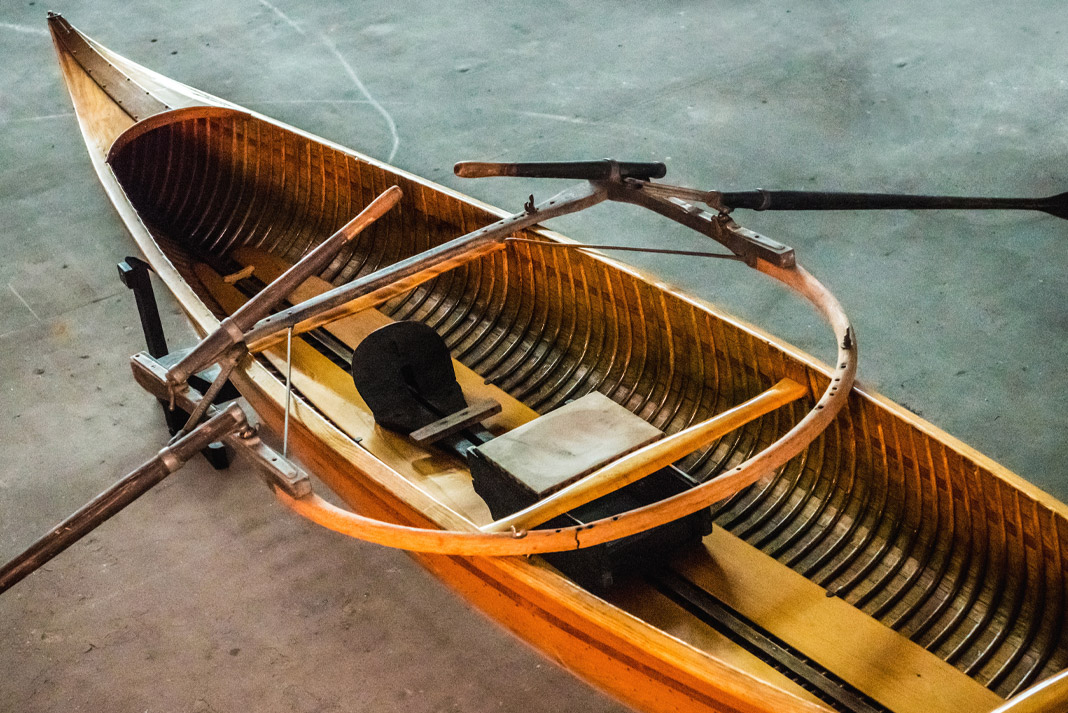
You’ve got mail. Now delivered to you with patented FORWARD-FACING EFFICIENCY. | Photo: Samantha Moss
After something like 8,700 miles of sea travel in different boats, Doug eventually traded his sea kayak for an ocean-going shell and “reluctantly acknowledged the greater efficiency and speed afforded by a sliding seat and long oars. Doug and I skirmished a few times when he instructed me to go left or right, causing me to turn toward the obstacle we were trying to avoid. Seeking harmony, we adopted a color-coded system based on the red and green plastic collars on the oars. Now it is go green or go red.”
Among the other excellent tales Fredston writes is an occasion when they nearly come to blows over a disagreement on the water. Eventually, they realize the main difference in their perspective on what nearly killed them was that Jill, the rower, was facing one way and Doug, the kayaker, was observing from a position 180 degrees different than his wife.
The Improvement on Oars could have prevented this near field divorce.
It’s an assemblage of wood and metal affixing to the gunwales of a canoe to allow the occupant to row on a sliding seat and to do so facing in the direction of travel.
Ingenious.
Records at the Museum indicate the Peterborough Canoe Company built this little mechanical gem with Mr. William Lyman of Middlefield, Connecticut’s patented design. It came to the Museum through its first executive director Jack Matthews.
Matthews detailed in his description of the device, submitted at the time of the donation, that he purchased it with the understanding it had been used by the postmaster in the w—ee burg of Bobcaygeon, Ontario, between Sturgeon and Pigeon Lakes on the Trent-Severn Waterway, to deliver mail to cottagers around 1900.
History does not record if the postmaster’s mistress was a paddler but, had she been, they would have delivered the mail in perfect matrimonial harmony on account of Mr. Lyman’s cool little invention.
Some things never die, especially when they find a forever home in a museum.
James Raffan is an author, explorer and former executive director of the Canadian Canoe Museum.
You’ve got mail. Now delivered to you with patented FORWARD-FACING EFFICIENCY. | Photo: Samantha Moss
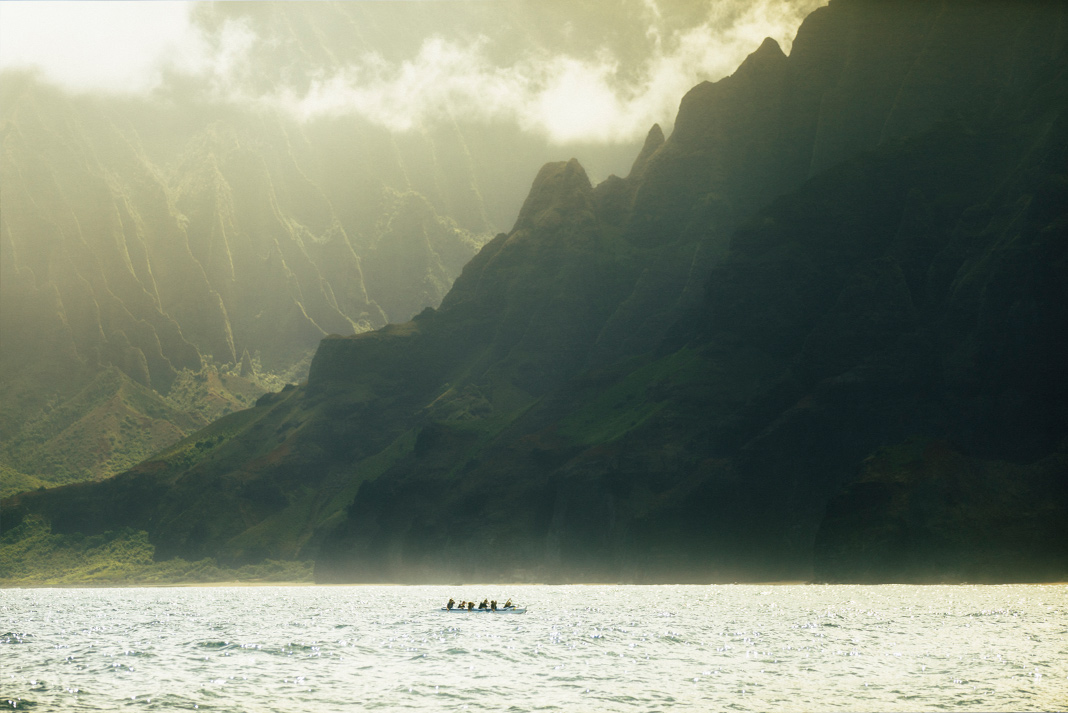
Mystical (adj): Inspiring a sense of spiritual mystery, awe and fascination. | Photo: Courtesy Gnarly Bay
Spoiler alert. Filmmaker Forest Woodward’s favorite scene in his new film about the tradition of outrigger canoeing in Hawaii is the documentary’s final moment. (people) of water, a part of the 2020 Paddling Film Festival, ends with Hawaiian canoe-builder Bobby Puakea issuing a waterman’s blessing to Robbie Prechtl, an American whitewater rafter who serves as the film’s star. Then the Hawaiian elder stares into the lens of Woodward’s camera and implores the filmmaker, with a haunting intensity, “Now it’s your turn.”
“I still get goosebumps thinking about it,” says Woodward, who produced the film with Rhode Island-based studio Gnarly Bay. “The camera shut off exactly when he finished the sentence. It’s just a hard cut, and it all ends there—and all begins there in a way, too. We ended up building the whole film around that scene.”
Woodward first met Prechtl and the U.S. men’s raft team in 2017, when the athletes scored a near-miss in a speed record attempt on the Grand Canyon on the Colorado River. Like the rafters, Woodward is drawn to water-based adventures. He was particularly intrigued when the national raft team decided to try outrigger canoeing—a discipline of paddling relying on teamwork which originated for fishing and inter-island voyaging on the open waters of Polynesia.
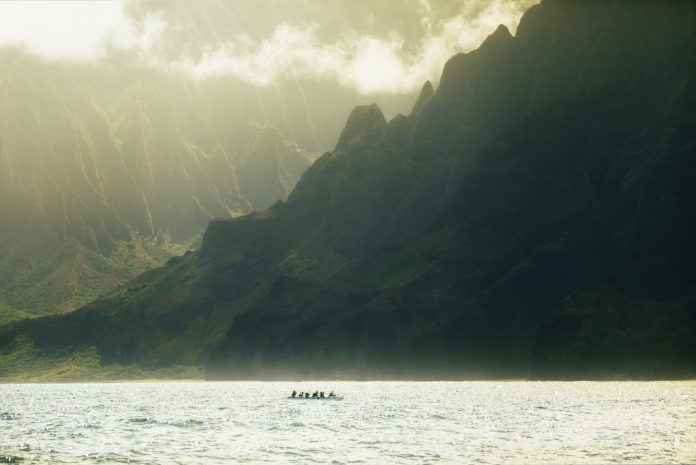
Mystical (adj): Inspiring a sense of spiritual mystery, awe and fascination. | Photo: Courtesy Gnarly Bay
After the six-man team got some practice on lakes in Colorado, inevitably “the water took us where we needed to go,” recalls Prechtl. They connected with Hawaiian cultural guru Puakea and participated in the famous 40-mile Na Pali Challenge on the island of Kauai. The experience provided an excellent opportunity for team building.
“The power of the ocean is apparent in each swell as it pushes and pulls the canoe until the crew finds a way to work together to move the canoe with the water,” notes Prechtl. “It’s all about finding that underlying rhythm that allows you to generate the power and grace needed to move the canoe efficiently. The best feeling is catching a swell to surf the canoe. Finding that first surf will leave you searching for the next thrilling ride.”
But (people) of water is more about the immense significance of outrigger canoes in Hawaiian culture than the raft team’s Na Pali race. The film profiles Puakea’s craft of carving big canoes from hand-selected logs and shaping an elegant, practical vessel by eye and touch. The canoe is “a living thing,” Puakea insists. “It has feelings…[and] a life of its own.”
Adds Prechtl, “It is hard not to walk away changed from an experience of testing your limits and learning about traditions that have survived generations—from the people who are most connected to them. You can see and feel how important these cultural customs are to the people who paddle canoes or work with them. I think we all felt lucky to be welcomed into that part of canoe culture.”
[ Paddling Buyer’s Guide: View all big canoes ]
Prechtl says the experience was important in his own development as a “water person.” Perhaps owing to stunning scenes of the otherworldly Hawaiian islands and Puakea’s mystique, the film has a magical quality. In a repeating scene in the film, Prechtl describes an overwhelming sense of deja vu.
“It was a visceral experience for me in Hawaii,” he recalls. “Throughout my time in the islands, deja vu seemed to be a continual theme, somehow linking underlying connections to my experience in unexplainable ways.”
The film was successful because everyone involved “was in it for the ride,” says Woodward. “We were willing to explore whatever currents pulled us, trusted the process and tried to be good listeners.” For Prechtl, the experience in Hawaii reinforced his connection to watery places. “There are so many moments of bliss and terror, and trying to find some comfort within that spectrum is what I continue to work toward,” he says. “I am unsure if that will ever be achieved, but I will keep working at being a ‘water person.’”
Find (People) Of Water in a screening of the Paddling Film Festival’s Culture Program.
Culture—it is what brings us together. We are rafters, creekers, kayak fishermen and big-wave surfers. We are paddleboarders, whitewater canoeists, and canoe trippers. From all around the world and all walks of life, we share our special love for moving across lakes, rivers, and oceans under our own power. These nine films tell the stories of paddlers and all that paddling can mean to us.
Serious sea kayaking credibility, now in a smaller package. | Photo: Scott MacGregor
My history with 14-foot sea kayaks was inauspicious. Typically, there would be some new iteration to test out for the recreational market. A budget- and beginner-friendly spud with some sea kayak features slapped on: deck lines or a rudder, a rear hatch, a single bulkhead.
As if by some universal formula ruling the length of a kayak must be directly proportional to the anticipated girth and skill of the paddler, the shorter the kayak, the wider and flatter-bottomed it would be. The outfitting would be reliably sloppy, the volume more than ample, the construction suspect. But what else did you really need for picnicking or fishing at the local slough? I’ve paddled and reviewed countless of these short kayaks and tried to temper my expectations and be fair in my appraisals.
So, you can imagine my sentiments when presented with the new Virgo, knowing nothing except that it was a new fourteener. But a few minutes into my first paddle, my first impressions matched what I would have already read in P&H Kayak’s descriptions if I’d done my homework. The Virgo is every bit a serious and bona fide sea kayak, just in a smaller package.
P&H’s intention with the Virgo is to provide “a confidence-inspiring platform that is a real sea kayak and therefore can deal with anything the ocean can throw at you,” sales director Chris Hipgrave told me.
In a blog post about the design, the company loosely relates the Virgo to an updated and souped-up version of the Easky, a recreational 15-footer popular in Europe for many years, or a scaled-down sea kayak offering the performance of the 17-foot P&H Scorpio in a package that’s better sized for weekend trips and easier to get on and off the car. Because “it’s hard to bring the boat weight lower or make transport and storage any easier without losing some length,” according to Hipgrave.
[ Paddling Buyer’s Guide: View all P&H kayaks ]
While the Easky was sold at a lower price point under the recreational brand name Venture, the Virgo is under the P&H banner. It has the stiff and light three-layer sandwich CoreLite X plastic and the same outfitting as other P&H plastic sea kayaks. And it’s designed with the same watertight bulkheads, bow and stern waterproof KajakSport hatches, hull strength and full deck lines for rough ocean paddling, rolling and rescues.
Slipping into the cockpit reminded me of whitewater kayaks and play-oriented sea kayaks, like P&H’s 15-foot Delphin. At 23 inches wide, the Virgo retains high-performance sea kayak dimensions—no extra-wide or oversized cockpit here, and a nice low back deck suited for ease of entry, exit and rolling.
P&H’s Connect outfitting provides an instantly comfortable performance fit. There’s enough room for a medium-sized paddler—my 175-pound frame with 34- by 34-inch pant size maxed out the length of the foot braces and fit snugly between the hip pads. Eventually, P&H plans to make the Virgo in three sizes, like its other models. This flagship Virgo will one day become the medium, but at the time of writing, it’s the only option.
The Virgo tracks well for such a short kayak and cruises at a reasonable three or four knots. A moderately steep bow and stern keep the waterline long for speed and tracking, but the line of the hard chine rises up from the waterline to the ends of the boat to give it a sleek and playful look, a mischievous side profile like the Joker’s smile. In calm conditions, I didn’t bother putting the skeg down, just throwing in some correction strokes from time to time to stay on course. For long distances or windy conditions, the skeg would save energy.
Photo: Courtesy P&H Kayaks
Happily, when P&H considered scaling down the sea kayak, they also made it sportier, since speed probably isn’t your primary concern if you’re paddling a 14-footer. You’re more likely to want to have some fun wherever you already are—like at the small beach break I found during my test paddle.
Some hot dogs from the P&H team must’ve got their hands onto the CAD file at some point, predicting they’d be asked to surf it at Skookumchuck for a photoshoot some day. The Virgo has just enough rocker to spin around when you want it to, turning 90 degrees with a couple of strokes on one side. Unlike the Scorpio, which has rounded chines, the Virgo has aggressive rails so you can put it on edge and carve it like a parabolic ski.
The Virgo felt adept when I caught a wave, giving a boost to my confidence and making me feel coordinated on the wave even though I hardly ever surf. The buoyant and flared bow stayed above the wave and kept me dry. Inspired, on the way back to shore, I slipped into the steep wake of a passing tugboat, accelerated and caught a long ride most of the way back to my car.
My only quibbles with the design are minor. I found the forward placement of the skeg control and paddle park—well in front of the paddler’s knees—to be slightly awkward, and the deck bungees overlap the skeg control and the optional mini hatch unless you find a way to reroute them. Used to the speed, tracking and glide of the longer sea kayaks I usually paddle, I felt like if the Virgo were 12 to 18 inches longer it would be the ideal all-rounder. But of course, with that extra length would come the weight and storage challenges the Virgo is intended to avoid—and likely a higher price tag too.
For its size and intended purpose, the Virgo could hardly be more perfect. In the market niche for what P&H calls “a compact, but uncompromising sea kayak for weekend warriors,” the Virgo will surely dominate for years to come.
Serious sea kayaking credibility, now in a smaller package. | Photo: Scott MacGregor
“If everything seems under control, you’re not going fast enough.” ―Mario Andretti, race car driver. | Photo: Ashley Sherwood
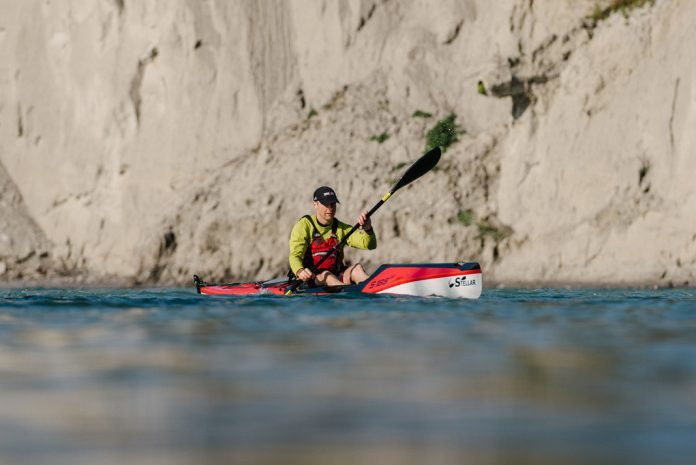
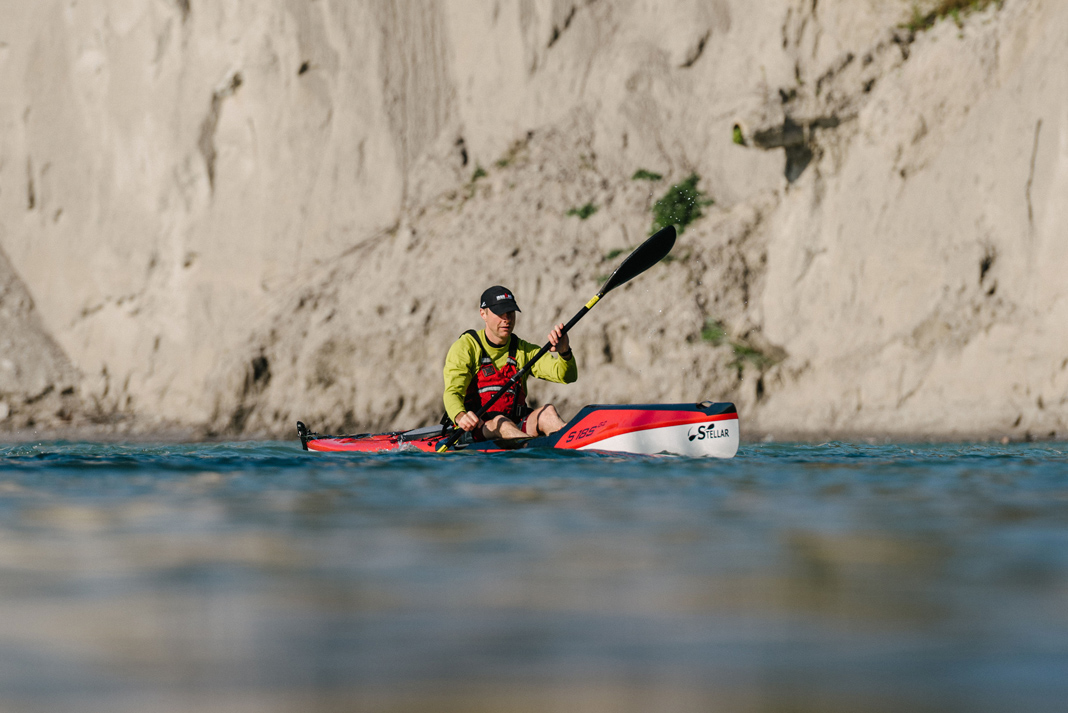
Consider this question before you read further: Do you think the boat in this picture is a surf ski or a kayak?Either way, you’re right.
For the fence-sitters, the Stellar 18 (also known as the S18S G2, for generation two) might be the perfect all-around fast paddling craft. Because while in name and appearance it’s unmistakably a surf ski—it comes with an open cockpit with drain holes, a skinny surf ski bow, and a surf ski foot brace—for racing classification, it is considered a sea kayak almost everywhere.
As an article in Surf Ski News explained when considering the popular Chattajack 31 race in the Tennessee River Gorge, “by and large, boat category is determined by hull dimensions. The topside of your craft is generally irrelevant.”
Designed intentionally to fit the United States Canoe Association’s 18-foot sea kayak regulations, for most races, the S18S qualifies as a sea kayak or a “fast sea kayak” because it’s not more than 18 feet long or narrower than 20 inches. Also, its length-to-width ratio—the measurement used by some races, including the Blackburn Challenge—is just low enough to still make it a kayak.
Stellar makes eight single surf skis categorized on a spectrum from recreational to intermediate to racing. The S18S is closer to the recreational side of things, being the shortest intermediate ski on offer. Move up one and you’re into 100-percent surf ski territory: the Stellar Racer, at over 19 feet long, 18.9 inches narrow, and with zero hatches. The S18S is the longest, fastest craft in the Stellar lineup to include storage hatches, two of them with a total capacity of 34 gallons, which is just enough for minimalist camping.
“If everything seems under control, you’re not going fast enough.” ―Mario Andretti, race car driver. | Photo: Ashley Sherwood
Design
Compared to the original, Stellar gave this second generation of the S18S a sleeker hull shape to make it a little faster for the racing market, a sharper, more cutaway bow for a tighter catch, and a more forward center of gravity and rocker profile to make catching waves easier. Coming from a sea kayaking background, I somewhat naively thought the S18S was a full-on surf ski. It fools you from the perspective of the cockpit, where all you see is the needle-sharp bow knifing through the waves. The ample rear, with its generous hatch, is hidden behind the paddler.
[ Paddling Buyer’s Guide: View all sea kayaks ]
Speed
Compared to sea kayaks I’m used to, the S18S is also blazing fast, cruising at six miles per hour, sprinting at just over seven—practically my running speed on land. I got the feeling this ski likes to be paddled fast and will operate most efficiently for a strong and fit paddler. This is more hunch rather than anything measured, but there’s little reason to paddle a speed demon if you’re interested in a leisurely tour.
Stability
The S18S’s shallow-arch hull contributes to its fleetness. It also makes for wobbly initial stability, but when you adjust to it—and note, the S18S is stable by surf ski standards—this hull shape helps you stay upright through waves and cross chop. If you do start to tip over, this ski becomes very stable on edge, with secondary stability stopping you before you end up in the drink even without a strong brace. I didn’t have the privilege to test this ski in big waves, but even in small wind waves I caught a ride with ease. The bow is designed to be sharp for slicing through small waves but with high volume above the waterline and closer to the paddler for a dry ride in the big stuff.
Tracking & maneuverability
With either an under-stern or over-stern rudder (yes, you can attach either), the S18S tracks very straight and turns with control. Without the rudder deployed, the hull felt very maneuverable and apt to blow around—more inclined to smear or skid quickly through a turn than carve due to its chineless, rounded hull shape. Overall the response felt high-performance, without the twitchiness and top-end speed I remember from elite surf skis. More like the kayak version of one of those road bikes with all the high-end components and materials of a racing bike but with a more relaxed riding position for the Boomer generation.
The S18S can be ordered with either an under-stern rudder for deep water or this more versatile flip-up, over-stern rudder for shallow water and rivers. The rudder post and steering line tubes are installed to accommodate both. | Photo: Ashley Sherwood
Materials
Stellar offers fantastic freedom of choice when it comes to materials. My 36-pound demo was so easy to carry I portaged it a half-mile on my head. So, I was amazed to discover there are three lighter options than this basic Advantage layup (fiberglass and Soric foam core), bottoming out at the 27.6-pound Alpha (carbon fiber) for an additional $2,100. That’s weight savings at $253 a pound!
Stellar says these lighter-weight versions have more “pop” at the catch, which translates to slightly faster acceleration and overall responsiveness. However, it’s hard to imagine it would be worth the price unless you’re sprint racing or carrying it a lot. If purchasing my own, I’d probably opt for the Multi-Sport layup, which for just $300 more than the Advantage, blends carbon and Kevlar into the hull. This adds flex and durability to tackle shallow rivers and class I and II whitewater, ideal for the rigors of multi-day adventure paddling races like the Missouri River 340, the Watertribe Everglades Challenge, Timmins’ Great Canadian Kayak Challenge, or the 260-mile Texas Water Safari. All places you’d likely spot the S18S on the start line.
The Stellar comes with many premium features including carbon fiber carrying handles with deck recesses for your hands, carbon foot braces, sturdy aluminum handles on the side double as secure points to attach a lock.
The hatches proved to be very dry. The front hatch is easy to access while adrift with your legs over the side of the ski. It includes a drain plug for easily emptying any water that happens to get in while you’re retrieving your lunch on a rough and rainy day.
The sum up
The S18S is ideal for fitness paddling; it’s a fast boat that can be used for more than just racing. It takes a lot of athleticism and seat time to be able to paddle a 20-foot, 18-inch-wide surf ski comfortably. The S18S is far more approachable for the weekend warrior or the master’s athlete, while still being fast enough to compete. It also has the width and stability to engender confidence in rough water, for an experienced paddler who might paddle a sleeker boat on flats but wants a more stable craft to push their comfort level and chase rides in the big stuff.
All this speaks to crossover appeal. Call it what you will—fast sea kayak or touring surf ski—it’s clear the S18S’s greatest strength is its versatility.
“If everything seems under control, you’re not going fast enough.” ―Mario Andretti, race car driver. | Photo: Ashley Sherwood
Canoeists, kayakers and stand up paddle boarders may soon see a red safety sign posted at launch ramps and other water access areas across the country. The new safety sign is part of an ongoing effort to reduce the number of paddle sport fatalities. USCG Recreational Boating Statistics show that, between 2013 and 2018, an average of 133 paddlers died each year – nearly a quarter of all boating deaths. The vast majority of these paddlers were not wearing a lifejacket and drowned.
The sign resembles a stop sign and carries a simple message – Stop. Always Wear Your Life Jacket. “The purpose of this program is to remind paddlers that the single most important factor in preventing drowning is to wear an appropriate life jacket,” said Robert E. Kumpf, of the Coast Guard Auxiliary.
The Coast Guard Auxiliary, the National Safe Boating Council, the Water Sports Foundation, and regional paddling organizations have worked together to promote paddlecraft safety. For more information about the Coast Guard Auxiliary’s paddlecraft safety programs please visit the Recreational Boating Safety Outreach Directorate’s website by clicking the link.
The Coast Guard Auxiliary is the uniformed civilian component of the U.S. Coast Guard and supports the Coast Guard in nearly all mission areas. The Auxiliary was created by Congress in 1939. For more information, please visit www.cgaux.org
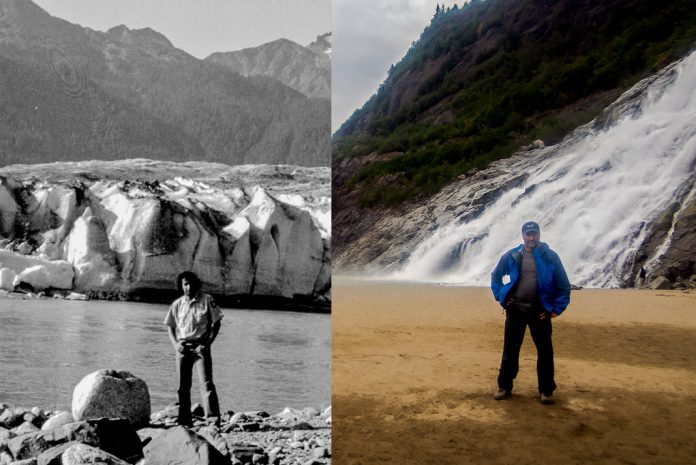
Engaging the flux capacitator. Neil Schulman pictured in 1990 and 2019. | Photo: Neil Schulman
I’m looking for my lunch rock from 30 years ago. The summer Germany reunified after the Berlin Wall came down, I worked at an Alaskan visitor center at a two-mile-wide glacier that rolls into suburban Juneau. On sunny days I’d eat lunch on a flat rock on the lakeshore and see if the glacier would calve an iceberg or two. Back for the first time three decades later, I’m thinking less about glaciology than Greek philosophy.
As Heraclitus said, “No man ever steps in the same river twice, for it’s not the same river and he’s not the same man.” The same could be said of glaciers. And paddlers.
Back in 1990, the Mendenhall Glacier was retreating 30 feet a year. That’s obviously accelerated—30 years times 30 feet would be less than a fifth of a mile, and the Mendenhall is more than a mile back from where it was. My lunch spot has been overgrown by willows. A trail takes us to Nugget Falls, which used to be unreachable, wedged in a hollow in the glacier back in the day.
Nobody is shocked glaciers change and melt. Glaciers are frozen rivers, and they behave like rivers, just more slowly. I knew about the Mendenhall’s retreat from Google Earth and news about climate change. But when change is so stark, it’s a wake-up to all the time passed. It’s also a visit to my birth as a sea kayaker.
I’m not the same man I was in 1990. Mostly for the better, except for some missing knee cartilage and a hairline that, like the glacier, has receded. I did feel old when the young ranger with my old job congratulated me, scruffy after two weeks in the backcountry, for “still being on the right side of the ground.”
Mendenhall Lake is where I first scooted my butt into a sea kayak. I’d grown up canoeing in the Eastern U.S. and Canada and learned whitewater in Oregon and Scotland. When I came to the Alaska Panhandle, the endless inlets and the lake filled with icebergs at work every day made me feel like the kid with his nose against the candy store window.
[ Paddling Trip Guide: View all kayaking trips in Alaska ]
Eventually, one of my co-workers took pity on me and let me borrow his old kayak, and his old truck to transport it. We’d paddle across the lake to an island that was partly underneath the ice—now a massive peninsula—and we’d hike across to the glacial face. When we could manage the logistics, we’d borrow or rent kayaks and paddle in the glacial fjords. It was a minor diversion from spending my time hiking, since I didn’t have a kayak or a car, and Juneau’s trails were accessible by bus and bike. But it stuck with me.
In the decades since, glaciers were absent from my paddling experience. This was my first return to Alaska to paddle among the tidewater glaciers and icebergs. The shape of icebergs became instantly familiar and entrancing, even after a long melting period. I remembered watching ping-pong ball-sized arctic terns chase off bald eagles perched on the bergs to feed on salmon runs. I was absurdly thrilled my favorite pizza joint is still in business, even though a tram now carries cruise ship tourists up my favorite mountain.
We easily miss gradual changes, like tides rising inch by inch or glaciers receding a few feet a year. It’s when we see the sudden change—in this case, a 30-year time-lapse—we take stock. In the past three decades, I’ve gone from occasional to dedicated paddler, from young man to middle age, from grasping for my place in the world to a settled rhythm of enjoying and protecting the outdoors.
Glaciers, of course, are sending us signals all the time. The morning we flew back to Portland, the Mendenhall let loose a jökulhlaup, a sudden, unpredictable outburst of water from inside the glacier that flooded forests and trails. It’s a not-so-subtle reminder we’re not really in charge, and there are more things in heaven and earth than are dreamt of in our philosophy. Rivers rise, fall, and change their course, even when made of solid ice.
Neil Schulman lives, writes and paddles in Portland, Oregon.
Engaging the flux capacitator. Neil Schulman pictured in 1990 and 2019. | Photo: Neil Schulman
Ready, set, let go. | Photo: Destination BC/Michael Bednar
I recently had a chance to relive part of the three-month kayak expedition of my youth. After not being away from home or my kids for more than five days in the past 10 years, I received a one-week getaway as a birthday gift from my wife.
“Mom bought me a plane ticket to British Columbia!” I announced to my kids.
“But she has to buy you a ticket to come back,” my 8-year-old son complained.
“Don’t worry, it’s not a one-way ticket,” I explained with a laugh.
Yet, my son was correct in thinking there was some uncertainty concerning my return. After kayaking the B.C. coast for 80 days in 2002, returning to conventional life was not easy. At the time, I’d seriously considered carrying on where I’d left off, southward along the U.S. to Baja and beyond, to circumnavigate the continents like Verlen Kruger or Freya Hoffmeister. Instead, I’d married, acquired a house and a dog, had two kids and spent too much time pining for waters not traveled.
“Thinking about our trip makes me melancholy,” my expedition partner Dave lamented recently. “It was such an amazing time. I had this feeling like, ‘This is what’s real, this is what matters.’ And I look around at my life now, and the world that we live in, and I miss those days.”
Over the years, I’ve struggled with similar feelings. So, it was with some trepidation my wife handed over the ticket to the one thing that most competes with her for my attention. It was as if she was giving me a pill that would either kill me or cure me, hoping I’d come home with the piece of myself I’d left back there 17 years ago.
Friends joked about her “master plan,” noting it was no accident she’d booked the flight in November, one of the bleakest months to visit Vancouver Island. The weather could at least be counted on to blot out any rosy romanticization of the West Coast.
The trip begins
I arrived in Victoria with a come-hell-or-high-water determination to revisit part of the coast we’d traveled. I borrowed a kayak and, when Dave’s SUV threatened to throw a wheel bearing in Nanaimo, we borrowed a pickup truck to get us the rest of the way to Tofino, two sea kayaks teetering on the roof of the tiny cab. The raincloud shrouding the mountain passes matched the fogginess of my memory. It was like I’d traveled back in time to a past called B.C.—Before Children.
Along the way, I kept saying things like, “This is probably going to be miserable, but I just want to do it anyway,” justifying why we were going camping on the ocean in the cold November rain.
It was with almost comic nonchalance we launched our middle-aged selves into the frigid waters. Years of experience had yielded complacency. Dave eschewed the wetsuit he wore for the entire balmy summer of 2002 for a pair of nylon pants and thrift store running shoes. With dusk approaching and visibility at near zero, we dead-reckoned our way to an offshore island, tracking the swell direction and the sound of surf until the trees of our destination loomed out of the fog.
Ready, set, let go. | Photo: Destination BC/Michael Bednar
It was almost dark when we scanned the beach for a sheltered spot. A wolf loped along the sand and scrambled up a rocky bluff. A low surf peeled along the shore.
We pitched tents in a steady drizzle, boiled tortellini, washed dishes with sand and seawater by headlamp and settled in for a long, dark evening of cribbage under the tarp.
I went to bed early and slept for 12 hours. The next day we hiked a string of desolate surf-swept beaches, spotted a humpback whale feeding offshore, and impassively observed the majesty of the rainforest, with Sitka spruce the circumference of my Toronto living room.
There was nothing sensational about a damp West Coast beach in winter weather. No oracles speaking from the trees, no sunbeams shining Godlike through the clouds. Nothing much was happening out here besides the boom of surf, the drip of rain, the chatter of birds, a slight ache in my back. Some might have called it miserable and more than a little boring.
“Two nights is definitely enough,” I remarked to Dave. “I mean, this is great and all, but I’m good.”
“Me too,” he said.
The return to civilization
When we returned to Tofino, lining up in the rain at the taco truck with the surfers and tourists for sloppy gringa sandwiches and fish tacos was pure bliss. I couldn’t imagine anything better than trading my wet clothes for a cotton hoodie and climbing into a warm truck with a steaming coffee and a fresh Nanaimo bar. It felt like the whole point of suffering the cold and wet for a couple of nights was to enjoy the return to civilization properly. In this case, the joy I was looking for through kayaking came not from the paddling itself, but—unexpectedly—in the non-kayaking that followed.
There’s a meditation exercise I sometimes do that instructs you to push aside all thoughts and focus on your breathing. It’s almost impossible. Then at the very end, you’re told to let all those thoughts back in—and suddenly they’re gone. Your awareness is as blank as a blue sky at noon.
To benefit from meditation, you’re supposed to not try to benefit. You succeed through a deliberate, focused effort of not aiming where you want to go. This is the Buddhist concept of non-doing, the idea there is power in letting go.
For me, it’s the same with writing. I won’t get anywhere until I step away from the computer. Then I’m scrambling to scribble down the ideas flooding in while I’m going for a run or having a shower.
There’s a lesson in all this. It’s not my kayaking skills needing perfecting; it’s my non-kayaking skills. My particular lousiness at the non-kayaking aspect of kayaking is a huge blind spot since it’s how I spend 99 percent of my life.
I can relate to Mark Twight, the former professional alpinist who just published a book, Refuge, inspired by his quest to adapt to life on the ground and “see beauty in the mundane” since quitting climbing way back in 2000.
“When the trivia I once mocked from the highest mountains became my daily life, I realized I need to assimilate, I need to integrate down here, or I’m going to be the guy who goes out with drugs and alcohol or goes back to climbing again and doesn’t come back,” he said in an interview. “It can be really good down here if you accept it. If you open your eyes and see it. It can be really fucking good.”
Much of the meaning I’ve mistakenly ascribed to my paddling experiences has instead come from the intersection of kayaking and non-kayaking.
A change in perspective
What I took to be the wilderness experience was actually the experience of regarding the wilderness from my perch in the city, wanting to get back there without realizing the experience I sought was essentially one of not wanting to be anywhere else. When I went out to find it, it was not there, until I stopped looking.
The defining moment of my trip came not on a Pacific island beach but the return flight, peering out the window as the mountains of the West were replaced by the blandness of the city’s industrial suburbs. I felt a flood of angst and regret. Then I made a different choice and let go—the lesson I should have taken from the wilderness in the first place.
The West Coast was beautiful beyond words, but not a place I needed or wanted to stay in forever. And, it turns out, not all that difficult to visit.
And it’s really fucking good to be home.
Tim Shuff is a former editor of Adventure Kayak magazine.
Ready, set, let go. | Photo: Destination BC/Michael Bednar
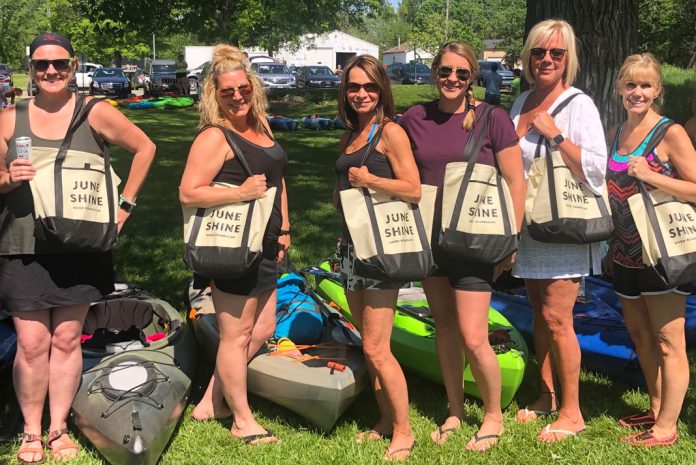
Event participants were given a tote bag full of products and snacks to sample. | Photo: Shelby K
Team Talent, an outdoor marketing agency located in Northern Illinois, was proud to host an all women’s kayaking event by the name of Sip & Paddle 2020. The event was a major success with a full attendance, captivating educational discussions regarding the paddling trails in the area, environmental etiquette as well as mindfulness practices in the Great Outdoors.
Our event began with introductions to one another including many laughs and an abundance of excitement to start our journey on the Nippersink Canoe River Trail in Richmond, Illinois. The sun was out, it was warm with a slight breeze and everyone was immersed in nature. It was the perfect day for a paddle! Shelby Koutas, a founder of Team Talent, began with our first led discussion on mindfulness and wellness in the outdoors. Shelby educated individuals on the basics of mindfulness, outdoor mindful therapy, and the importance of this practice for your mental state especially during these difficult times that many have been experiencing.
The mindfulness discussion was appreciated by everyone and next all gift bags were distributed including all of the sponsored goods. A short and sweet introduction on each sponsor involved in the event was provided. The Official Media Sponsor for the event was Paddling Magazine with a free digital subscription to each participant involved. JuneShine, a hard organic kombucha beverage company out of Oregon, donated cute tote bags to give to all paddlers and hold all of their sponsored goods. We loved connecting with JuneShine as they were an honest company we hope you would support too! Oatmeal bites from Bobo’s Baked Goods out of Boulder, Colorado were included and loved by all paddlers. Dot’s Pretzels from North Dakota were a hit as everyone loved the flavor in the recipe and stated they would be purchasing these tasty pretzels from now on as they never had them previously.
Then there were the natural energy drinks donated from BUBBL’R out of Wisconsin. Everyone enjoyed their BUBBL’R beverage thoroughly with hopes to purchase more at their local stores. Paddlers noted they have not discovered a healthy and fruitful energy drink until we introduced them to BUBBL’R. L’il Suckers donated drink holders to hold our drinks on our kayaks—everyone was impressed with the innovative and creative design. Wet ‘n Wild Outfitters out of Richmond, IL provided kayak rentals and included a shuttle back to our vehicles with our kayaks and enough room for all 10 paddlers. Team Talent is extremely grateful for all of our sponsors and their generosity for the Sip & Paddle 2020 event. The participants truly loved each and every item donated and have formed new ties with each company including now being lifelong customers.
JuneShine donated tote bags to the event. | Photo: Shelby K
As we consumed these snacks and beverages during our paddle journey there were several pit stops for breaks. At one of the stops an environmental etiquette speech was conducted. Krystal Lee, a co-founder of Team Talent, hosted an educational talk regarding Leave No Trace, which is a non-profit organization creating a standard for outdoor ethics. The speech conveyed the seven Leave No Trace Principles in hopes all individuals can prepare and enjoy the outdoors safely and responsibly for present and future events.
As the Leave No Trace speech wrapped up, the paddle continued. The overall paddle was just short of 7 miles, a beginners route as paddlers went with the current and through some exciting small rapids and tree canopies. The event was intimate and allowed women to be immersed in nature as well as form friendships with other women in the outdoors. Each individual had an amazing time and they were grateful for the opportunity to enjoy nature with other like-minded individuals. All attendees would love to participate in another Sip & Paddle hosted by Team Talent and expressed excitement to learn about any other future outdoor events!
Team Talent, an outdoor marketing agency, promotes their passions by supporting outdoor brands, products and services that we believe in. We strive to create a community in the outdoors by creating attainable outdoor events for all levels such as the Sip & Paddle, to educate others and create a welcoming environment!
A round of applause to the Great Outdoors, all sponsors, paddlers and those involved. We cannot wait to get back on the water with future kayaking events so stay tuned and cheers until next time!
Team Talent LLC
Shelby & Krystal
Co-Founders
The Paddling Magazine Event Network is our exclusive media sponsorship program that provides kayaking, canoeing, SUP and whitewater events national exposure to help promote paddling events to paddlers across the country.
If you would like your paddling event to be part of our Paddling Magazine Event Network please click here to submit your event.
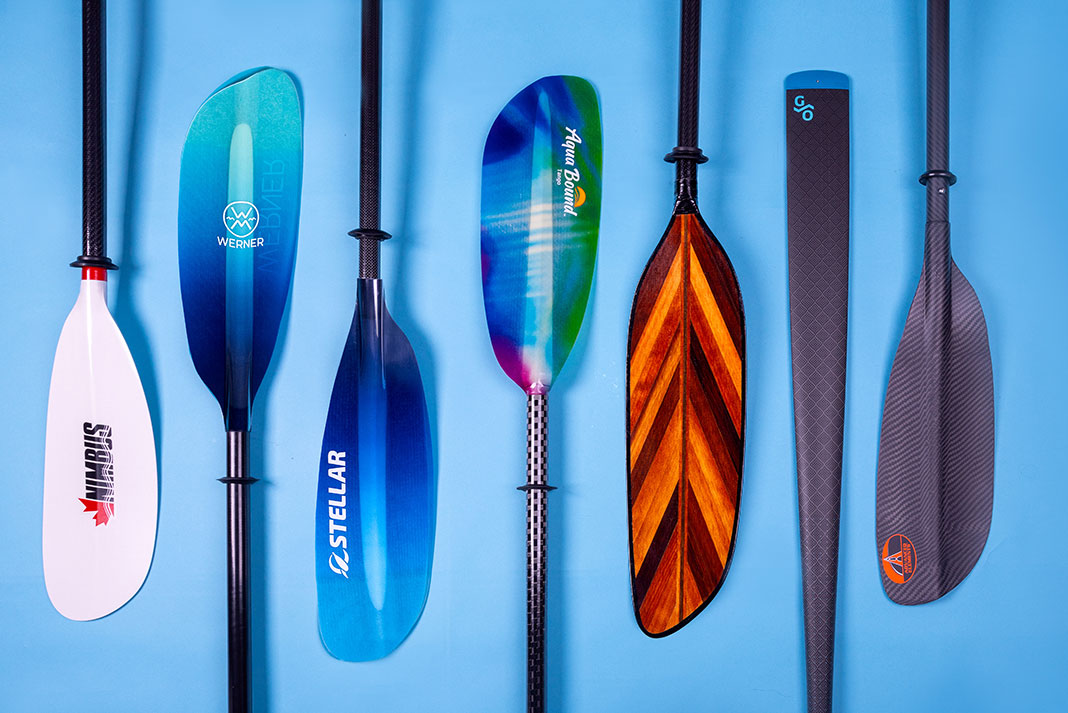
Paddles may feel shorter than they appear. It’s time for paddle manufacturers to create a universal sizing tool to better fit kayakers, says writer Brian Day. | Photo: Kevin Light
Years ago, when I was working at a prominent paddlesports retailer in Madison, Wisconsin, I had a chance to try some new sea kayak paddles. They were carbon fiber with wide, compact blades and intended to be used with an upright, high-angle forward stroke. I grabbed a couple of the new kayak paddles in 215-centimeter lengths and, for comparison, I brought a 215-centimeter paddle from a different manufacturer I had used for the past several seasons.
On the water, the new paddles were light and buoyant. They braced well and transitioned from stroke-to-stroke better than the paddle I had been using. Despite this, something felt a little strange. The catch felt different. Slower maybe. Not as assertive.
At first, I assumed this was due to the shape or size of the blade. Later, on the beach, I realized it didn’t have to do with the blades at all. It was the shaft length.
The compact blades of the new paddles were shorter than the blades of my old paddle. When I set the three paddles side-by-side on the grass, it was obvious the new paddles’ shafts were five to 10 centimeters longer than the paddle I was used to. With longer shafts, the paddles felt longer in the water. In my hand, the 215-centimeter paddle felt like a 220 or 225.
I went back inside and pulled shorter versions of the new paddles off the shelf to try, this time taking care to ensure the shaft length matched my old paddle. Back on the water, the results were dramatically different. The new paddles had a quick, assertive catch. A small change in shaft length had a significant impact on performance.
Charged-up by my discovery, I headed to the sales floor and started comparing the shaft lengths of all the paddles we had on the wall. High-angle, low-angle, and by all manufacturers. The results were illuminating.
Shaft length varied widely across models and brands at any given overall paddle length. Some paddles, with long slender blades intended for low-angle paddling, had surprisingly short shafts. Short enough to make it difficult to use them with hands held low. Others had compact blades and long shafts. The overall length of the paddle seemed to have little relationship to the shaft length, regardless of which paddle I picked up.
Why shaft length matters
This is a problem because shaft length sets the angle of the paddle during the forward stroke. In the forward stroke, you want the blade of the paddle fully immersed without burying the shaft underwater. This means a paddle with a longer shaft requires the blades placed farther from the centerline of the boat. If you’re trying to keep your hands low, you need a long shaft to allow you to get the blade fully immersed at a low angle. If you’re trying to keep the blade close to the boat for a powerful forward stroke, you need a shorter paddle shaft.
You might expect longer paddle shafts would lead to longer paddles, and vice versa, but this isn’t always the case. Kayak paddle blades optimized for low-angle paddling are typically longer and narrower than those more suited to an upright stroke. This difference can result in some confusing paddle length recommendations. The other day I worked my way through an online paddle fitting exercise to see what size the manufacturer recommended for my height and boat width. When I compared the paddles recommended, I discovered the shaft of the low-angle paddle was actually shorter than the shaft of the high-angle model.
Paddle shaft length determines how a paddle feels in use and whether it is best suited to use with a low hand position or an upright forward stroke. If all paddle blades were the same length, it would make sense to size paddles by overall length. They aren’t. Some blades are long; some are short. This means the current industry approach of sizing kayak paddles by overall length is wrong. It’s time for a better approach.
Changing the way we shop for paddles
Through trial and error, I learned what length paddle shaft works best for me. When I’m choosing a kayak paddle, I compare the length of the shaft to what I’m already using. I don’t pay much attention to the overall length. My paddle quiver contains paddles varying in total length, but they feel similar in the water, regardless of whether they are 205 or 215 centimeters long.
Once you know what length paddle you prefer, it’s easy to compare shaft lengths and pick a new paddle with a similar feel. But what about people who are just getting into the sport?
A new way to size customers for paddles
It’s time for paddle manufacturers to take a page out of the footwear playbook and create a paddle shaft sizing tool similar to the metal Brannock device ubiquitous in shoe shops and used to measure feet to determine shoe size. It wouldn’t be hard to do. All you need is an adjustable length paddle shaft with no blades on it. In the kayak shop, a customer could sit on the floor or on a low stool to simulate the paddling position in her kayak. She would then hold the kayak paddle sizer and shorten or extend the length until the lower end of the sizer touched the floor and her hands were in the appropriate position for forward paddling.
For an upright stroke, the sizer would be shortened until the top hand was at shoulder level and the paddle was at a high angle. For a lower stroke, the sizer would be lengthened until the hands could be held comfortably low.
Once the fitting tool has been adjusted, walk over to the paddle wall and compare the length of the sizer to the available paddles. Pick a model with blades appropriate for your preferred forward stroke and then select the size most closely matching the shaft fitter. Don’t worry about the overall length; it doesn’t matter much.
Creating a paddle shaft sizing tool seems like a straightforward way around the wide variation in paddle shaft length found in the marketplace. If such a tool were to be commonly used, I suspect we would discover many of the paddles sold over the past couple of decades have been the wrong size.
Influencing paddle manufacturing for the better
The kayak industry is in the midst of synthesizing the best influences from the Pacific Northwest and British sea kayaking traditions. Historically, paddles used in the West Coast style have been longer and more suited to a lower angle forward stroke. Those from the British style have tended to be somewhat shorter, likely because of the influence of training in whitewater kayaks before transitioning to sea touring in the UK. Whatever the reasons, the collision of these two schools of kayaking over the past 30 years has resulted in a squeezing of paddle sizes a bit toward the middle, mostly resulting in low-angle paddles getting shorter. And this doesn’t work.
If your paddle gets too short, you can’t use it with your hands held low. You’ll bang your knuckles on the boat. After you do this a few times you’ll naturally drift toward a more upright stroke that is appropriate for the shaft length of your paddle and you won’t be using the relaxed, low-angle stroke you had intended to use.
What we’ll discover with widespread use of a paddle shaft sizing tool is low-angle paddle lengths will begin to trend longer again. I expect we’ll also see paddle lengths get shorter for high-angle forward paddling, as people discover the blades of some paddles call for much shorter shaft lengths than they had expected. And as some paddles get longer and others get shorter, kayakers will get a better fit.
Contrarian Brian Day has been paddling sea kayaks, teaching kayak skills and sharing unsolicited opinions about outdoor gear since the early ‘90s. He blogs at www.kitchi-gami.com. Please direct your rebuttals to editor@paddlingmag.com.
Paddles may feel shorter than they appear. It’s time for paddle manufacturers to create a universal sizing tool to better fit kayakers, says writer Brian Day. | Photo: Kevin Light
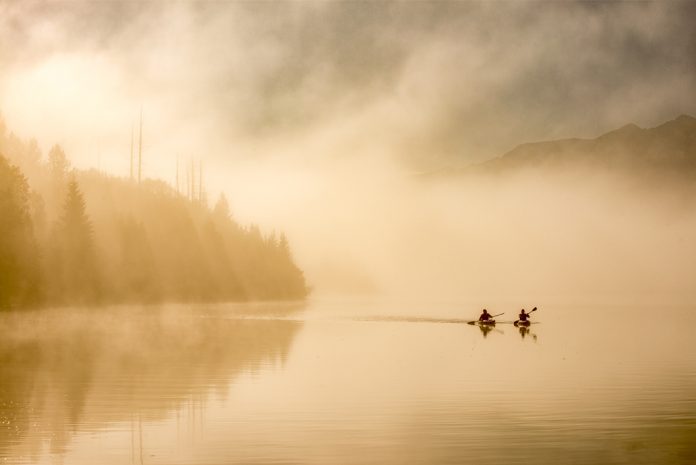
Despite its rainy image, portland gets less annual rainfall than New York and Houston. However, it does have many cloudy days with light precipitation, especially in winter. | Photo: Neil Schulman
If you wanted to design the perfect paddling town, here’s what you might do. Place it at the junction of two broad rivers, one threading all the way from the Canadian Rockies to the Pacific, the other draining most of western Oregon. Pepper the rivers with islands. Then dig one of them into a dramatic cliff-lined gorge. Now build a mountain range with massive, glaciated stratovolcanos pumping out meltwater all summer long. Send some of those streams flowing into that gorge, where waterfalls plunge off the cliffs.
Weather
Summer is spectacular; expect afternoon northwest winds. Spring is less predictable and boasts massive wildflower blooms. Fall is a roll of the dice; winter is wet.
Re-use your water
Portlanders use water four times: first to ski on Mt. Hood, second as whitewater in the steep rivers, third in the Columbia and Willamette Rivers in sea kayaks, and then in the ocean for surfing and rock gardening.
Other liquids
Portland has 84 craft breweries, one per every 7,621 residents. Seek out Gigantic Brewing in southeast Portland and Breakside Brewing near the Columbia. There are 34 independent coffee roasteries if you’re moving slowly the next morning.
For variety, add another mountain range to the west, and lace it with more rivers. Add a rugged coast and fill it with dramatic cliffs, arches, sea caves and surf beaches. Scoop out some protected bays for easier paddling. For good measure, toss in some mountain lakes. Put all that within a two-hour drive of the city center. Now add the final ingredient—rain and moderate temperatures in the winter, and sunny, warm summers.
If you did all this, you’d create Portland, Oregon. Here the kayaking season is year-round and kayak routes are everywhere. In The Paradox of Choice, psychologist Barry Swartz describes how people can easily decide between three or four options, but struggle when confronted by a vast number of choices. Welcome to the dilemma Portland kayakers face every weekend.
If you have half a day
Plop your boat in the water in the heart of Portland for a spin around Ross Island, a five-mile loop around a forested island in the Willamette River with a bald eagle nest and a great blue heron rookery. You’ll share the water with rowing shells, canoes, outrigger race teams, standup paddleboards, and just about every type of human-powered craft you can imagine.
If you have a full day
Circumnavigate Bachelor Island on the Columbia River, a nine-mile loop through nearby Ridgefield National Wildlife Refuge. You’ll start in quiet sloughs with lots of waterfowl, herons and birds of prey. Then you’ll enter the wide Columbia. Dodge big ships as you cross to Warrior Rock lighthouse. To extend your paddle, explore the Lewis River, Sand Island or Scappoose Bay before re-crossing the Columbia and paddling back up the Lake River to Ridgefield.
[ Paddling Trip Guide: View all paddling trips in the United States ]
If you have a weekend
Go coastal. If you have ocean skills and good conditions, paddle out the Salmon River mouth to Cascade Head. Explore the gorgeous headland’s sea caves, and look for whales and sea lions. On the way back, stop on the spit to sprawl on the sand. If the sea is big, paddle the protected wildlife-rich salt marsh. On day two, head north to Pacific City. If Poseidon is friendly, paddle to Cape Kiwanda and around Haystack Rock and add some surf play. Or explore protected Nestucca Bay.
Paddle the Lower Columbia River Water Trail, 144 miles from Bonneville Dam to the sea at Astoria. Pass through the massive cliffs of the Columbia Gorge, the metropolis of Portland, mazes of islands, and the lower river, with tidal influence and sea-like expanses. Camp on uninhabited islands. Trace the route of Lewis and Clark’s Corps of Discovery in 1805-06. Best in spring, when high flow whisks you along, and before summer’s upriver winds.
Despite its rainy image, portland gets less annual rainfall than New York and Houston. However, it does have many cloudy days with light precipitation, especially in winter. | Photo: Neil Schulman