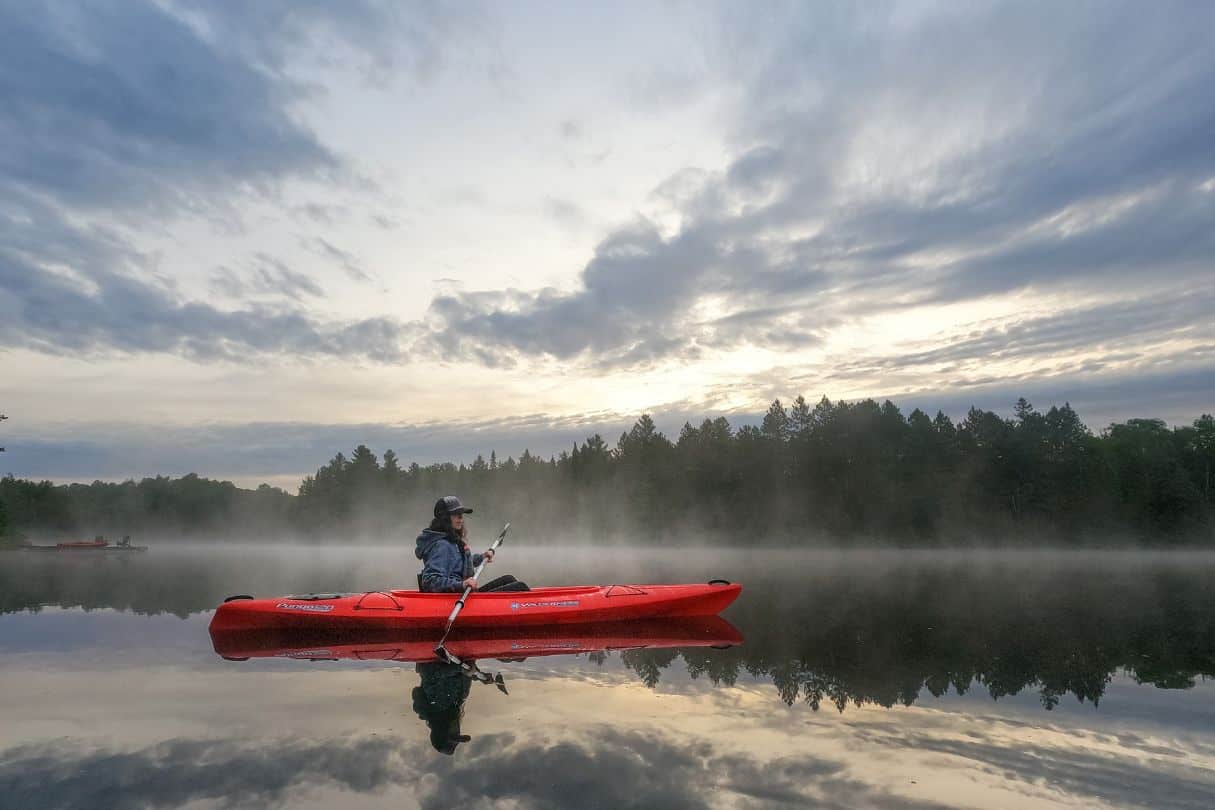
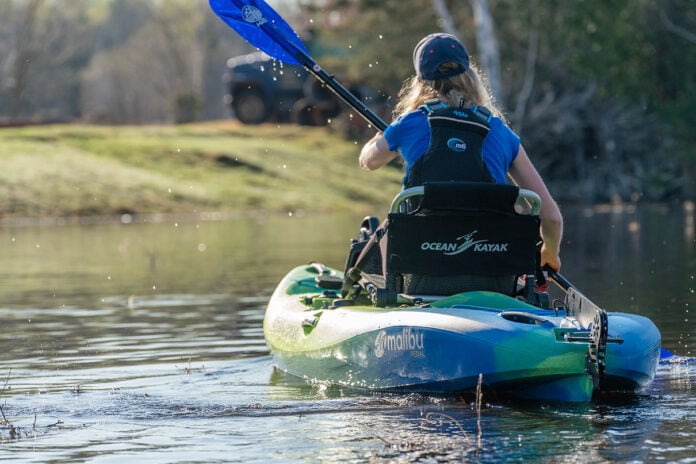
Warning: Creek boating is addictive. Paddlers may experience emotional highs after exposure. | Feature photo: Nick Gottlieb
Creek boats have come a long way since 1973, when Tom and Jamie McEwan attempted the first descent of North Carolina’s Linville Gorge in fiberglass slalom boats. Plastic kayaks first hit the market around the same time. But it wasn’t until 1986 that the Perception Dancer really kicked off the revolution and changed the course of kayaking.
Since then, whitewater boats have gone through all sorts of permutations. The modern creek boat emerged in the mid-1990s. Creek boats got short for a time; now they’re getting longer again. They went from round displacement hulls to flat-bottomed planing hulls and then got rounder again. And what they’re used for has changed, too. Creek boats aren’t just for hair boaters anymore. Now they are paddled by boaters of all skill levels on all types of rivers. So, what is a creek boat these days? And is a creek boat right for you? Probably, yes. Read on to find out for sure.
Shopping for a used creek boat?
Kayaks can last decades, so there’s no reason not to consider buying used. That said, used kayaks come in all sorts of conditions. Of course, you want to be sure you’re paying a reasonable price for the number of days you’re likely to get out of the boat.
Try to ascertain how much the person selling the boat has paddled it and on what kind of whitewater. If you’re buying a pro paddler’s year-old creek boat, the odds are good they’ve used and abused it and even if it isn’t cracked, it might be close. When I lived on the East Coast, paddling 150 to 200 days a year, I would break about one boat a year, regardless of brand. If a boat has been paddled consistently on hard, lower volume whitewater, odds are it’s near its breaking point.
You can also assess this by looking at the boat. Is there oil canning, an indentation under the seat? Is the hull heavily worn? Is the outfitting torn, worn and falling apart? Are there any major dents in the boat or any other evidence of a catastrophic piton? Look closely at any areas around dents that might harbor a small crack.
Old boats lose strength over time, especially if stored in the sun. Even if a boat hasn’t paddled extensively, its age could be an issue, so ask when it was originally purchased and where it’s been stored. A popular design could have been in production for 10 years. A well-used boat isn’t necessarily a “don’t buy”—it’s just a question of price and value.
Lastly, when you buy one, make sure to check that all the grab loops are securely attached. In the event of a pin, it could be a lifesaver. And while you’re at it, as you’re setting up your outfitting, be sure to tighten all your seat bolts.
For more tips on what to look for when selecting a used kayak, read our article How To Buy A Used Kayak.
Each creek boat model will perform slightly differently on different types of whitewater. | Photo: Daniel Stewart
Creek boat buyer’s guide
Creek boats generally make challenging whitewater more manageable, and that’s true whether you’re crushing class V or a beginner looking to step up to class III.
The term creek boat is an allusion to creeking—paddling steep, low-volume whitewater. Modern creek boats typically have high-volume designs, displacement hulls and rounded ends to charge downriver and not get hung up in or on river features on the way. The stability and predictability of this category also make creek boats a top choice for some paddlers on difficult, high-volume whitewater. Those same attributes are also valuable for helping beginner and intermediate paddlers feel confident and step up their game. Finally, a creek boat’s higher volume and relatively larger size also make it an ideal kayak for carrying gear on multiday river trips.
Creekboats defined
One of the most common questions new paddlers ask is, “What’s the difference between a playboat, river runner and creek boat?” Playboats are short, low volume and designed for surfing, freestyle moves and play in place.
River runners form an increasingly blurry category situated between playboats and creek boats. Some river runners, like Jackson’s Antix, are more similar to playboats but have more rocker and length for better capability on downriver runs. Others, like the LiquidLogic Braaap, share a lot in common with creek boats but have a specific design element, like a slicey stern, encouraging play on river features. Speed and playability are two features prioritized in current river runner design trends.
Thanks to design improvements in comfort and safety, it’s a great time to be a boater. | Photo: Daniel Stewart
Most major whitewater kayak brands manufacture one or more creek boat models. There are differences in boat design when comparing models, but the basics of the modern creek boat are consistent enough to be lumped together. They’re typically eight to nine feet long, high volume with lots of rocker, and designed for downriver efficiency.
The primary design elements differentiating creek boat models from each another are rocker profile, amount and distribution of volume, and hull shape.
You might be familiar with the concept of rocker profile. If you are looking at a boat from the side, its rocker profile defines where and how much the stern and bow rise. A boat with a large, continuous rocker profile would be shaped like a banana. In practice, rocker is distributed unevenly throughout a boat’s profile. The distribution and amount of rocker are important characteristics helping determine the speed, maneuverability and other performance aspects of the kayak.
Many of today’s creek boats have embraced an aggressive amount of bow rocker. According to long-time Liquidlogic Kayaks designer Shane Benedict, “The trend right now is rocker. All the new boats have lots of rocker.” More bow rocker makes boofing easier and keeps the paddler drier and moving faster through waves. But more bow rocker shortens the waterline reducing the boat’s overall speed.
The cross-sectional side-to-side shape of the hull also affects performance. Most modern creek boats feature displacement hulls. The round bottom of displacement hulls slide off rocks more easily and are usually more forgiving.
Hybridization with a flat bottom planing hull is becoming more common. Planing hulls are relatively flat laterally and have more defined edges. Planing hulls can turn more sharply but are also more susceptible to catching an edge, whether on an unexpected current or a rock.
Many of today’s creek boats feature a high-rocker displacement-style bow paired with a planing-style stern with hard chines and an abrupt change in stern rocker that Benedict calls “stern kick rocker.” Each manufacturer’s rendition of this style varies and paddles differently.
Photo: Nick Gottlieb
Volume is the third characteristic feature of creek boats. A high-volume kayak will quickly resurface. The high-volume bow and stern typical of creek boats reduce the chances of either end submerging. Creek boats will be more forgiving when the paddler is in the lower end of the weight range. When looking at the manufacturer’s optimal weight range, don’t forget to account for the added weight of gear, especially if using the kayak for multiday missions.
What’s inside
Most creek boats, like the rest of whitewater kayaks, are made from rotomolded high-density polyethylene. Polyethylene is a resilient plastic suited for the abuse creek boats suffer on river rocks. To make the kayak, plastic pellets are poured into a hollow metal mold and then heated and rotated in a massive oven to distribute the now-molten plastic throughout the mold. The trick is to get the right amount of plastic to be crazy durable but not stupid heavy. After it has cooled, the mold is removed to reveal a perfectly cast kayak requiring only light hand-finishing for outfitting and accessories.
Speaking of accessories, comfort matters. Creek boating is not like playboating at a local surf spot where you’re typically taking a few rides and then getting out for a break. If you’re paddling a creek boat, you’ll likely be in it a decent amount of time, especially on longer trips or multiday expeditions. Today’s boaters are lucky. Outfitting has never been better for comfort and safety, or more adjustable to fit as many people as quickly as possible.
If you’re considering multiday trips, it’s important to be able to pack gear into the boat easily. The boat’s outfitting contributes to this in a few ways. First, some creek boats allow you to remove the bulkhead easily and pack gear in front of it. This is a great feature, but it’s not a dealbreaker—many people self-support without packing gear in front.
Access behind the seat varies from boat to boat, too. While it’s good enough in virtually all creek boats, some models and designs will be easier to work with. Ultimately, it depends on the hardware at the back of the seat, and the space between the seat and the top of the hull behind the cockpit. Either test your gear to see if it will fit or be prepared to change your packing list and system to suit your new boat.
No kayak outfitting is more robust than creek boat outfitting. Things we’ve learned about durability and safety have been filtering down into river runners.
In terms of safety, modern creek boats from reputable brands come with two bow and three stern grab handles. Most are metal, reinforced, angled and shaped to clip into easily. Safety step-out pillars are a reasonably new idea replacing minicell foam pillars in the bow. Two things here: The boat is less likely to crush and trap your legs; and, if pinned, you can step on them and step out of the boat.
Creek boats have bulkheads, not foot pegs. It’s a good practice to cover the bulkhead with minicell foam to cushion your ankles from impact and prevent your feet from slipping past the edges of the bulkhead and getting trapped. Some kayaks ship with this pre-installed foam, other manufacturers provide adjustable foam blocks to glue to your bulkhead. Dagger’s bulkheads, for example, can be adjusted to fit the hull’s shape and come with pre-marked foam pads. If your boat doesn’t come with foam on the bulkhead, consider buying some and adding it yourself.
Warning: Creek boating is addictive. Paddlers may experience emotional highs after exposure. | Feature photo: Nick Gottlieb
Top creeker buying mistakes
You can do all the research about rocker profile, volume and hull shape. You can read the reviews in this magazine. You can watch all the trending videos on YouTube. But each creek boat model will perform slightly differently on different types of whitewater. For example: Sharp edges can be less forgiving in rocky whitewater; aggressive rocker can make it harder to hold a line but much easier to boof; and a longer, bigger boat might be faster and more stable but may feel less maneuverable in low-volume, tight, technical whitewater.
The best way to tell what boat is right for you is to paddle it. The biggest mistake is buying a creek boat without paddling it. “Figure out how you can get into a boat, ideally on the section of whitewater you run most often,” says Canadian pro paddler Ben Marr. He adds that it’s all about the feel of the boat and finding something suitable and fun for you on the whitewater you want to paddle.
Not all paddlers have a quiver of kayaks to choose from, so whatever you purchase, make sure it’s a kayak that makes you want to paddle more.
This article was first published in the Early Summer 2022 issue of Paddling Magazine. Subscribe to Paddling Magazine’s print and digital editions, or browse the archives.
Warning: Creek boating is addictive. Paddlers may experience emotional highs after exposure. | Feature photo: Nick Gottlieb
Have the blade exit when it reaches your feet to get the most out of your stroke. Image: Scott MacGregor
Just like paddleboards themselves, paddle technology continues to evolve to the point that it’s nearly impossible to only have one paddle in your arsenal. If you’re anything like me, you’ve got a quiver of boards to choose from depending on the conditions or type of paddling experience you’re looking for.
Using a lightweight carbon race paddle for whitewater SUP would be a recipe for disaster. Likewise, trying to check a one-piece paddle on a flight alongside your folding inflatable SUP would likely end up with you making a trip to an outdoors store on your vacation for a replacement.
Below are some of the best options across a wide range of paddling disciplines and scenarios.
Wear The Appropriate Leash When Stand Up Paddleboarding
Always wear a leash on open bodies of water like lakes, bays, and oceans. Due to the risk of snags and entrapment, leashes should only be worn on rivers if they include a quick release attached to your life jacket.
Starting this feature off with a $400 paddle may raise some questions, but when it comes to paddles, that old saying, “you get what you pay for” couldn’t be more true. If you’re going to own one single paddle to do it all, a lightweight carbon paddle is the way to go. Werner is one of the biggest multisport paddle companies in the world and they’ve proven over decades that they know what they’re doing.
The light weight of this paddle, combined with a smaller blade size and the option of a small or standard fit shaft and grip, means you can tailor the Trance 85 to your needs. The two-piece with a LeverLock adjustable system allows a variety of settings, and for others to try your gear.
Reasons to buy
Lightweight
Customizable sizing options
Small blade size
Plenty of versatility
Consider another if
You want something more budget-friendly
You’re a bigger or very strong paddler who needs more blade surface
You spend most of your time paddling in rocky or shallow areas
Bottom Line
If you’re going to own a quiver of boards but one single paddle, this is it.
We’re going from one of the most expensive to the most affordable on the list. One of the things that makes paddleboarding so inclusive is that just about anybody can do it. But you don’t need an expensive paddle to get on the water or introduce a friend to the paddleboarding. Keeping a couple of entry-level paddles on hand for days when there’s a high likelihood of a paddle getting lost or damaged is also just plain smart.
Boardworks makes a wide variety of paddles, but their entry-level aluminum option is beefy, durable and has a very low entry price. This no-frills paddle will handle plenty of abuse.
Reasons to buy
Very low price
Adjustability will fit many users
Durability
Consider another if
You are an experienced paddleboarder
You are spending a significant amount of time on the water
You have the budget to invest in something better
Bottom Line
If you need a cheap first paddle or a backup, this is a good option.
Traveling with your paddling gear to new destinations is one of life’s great pleasures. There’s nothing more enjoyable than discovering new waterways on your own equipment. For that reason, keeping a high-quality, three-piece paddle in your equipment closet is a must for frequent flyers or road trippers. Red Paddle Co. has been making some of the most reliable inflatable paddleboards since 2008, and the UK-based brand’s paddle lineup is just as good.
The Prime Adjustable is a lightweight, high-performance do-it-all paddle that splits into three pieces to easily fit into your inflatable SUP bag. It features a full carbon shaft and blade, as well as a deep scoop blade design and profiled edge, features that you’ll feel on the water.
Reasons to buy
Good value for the money
Easily packs into inflatable paddleboard bags
Won’t leave you with paddle envy on vacation
Consider another if
You want the best-of-the-best paddle no matter where you are
Storage space isn’t a concern when traveling
Bottom Line
If you’re going on vacation with your inflatable paddleboard, or just prefer a reliable multi-piece, bring along the Red Equipment Prime Adjustable.
Quickblade has made a science out of standup paddleboard paddle research and design. It’s why they’re the only brand you’ll find in two categories on this list. Truthfully, we could have slotted them into a number of additional spots.
When it comes to adjustable paddles, you have two options for the ‘adjustable’ part: some sort of a lever that closes to tighten the extension in place at any interval, or a push-pin style that locks the paddle at set lengths.
Both have their advantages and disadvantages. Quickblade uses a push-pin closure for set lengths with a set it and forget it design. There’s no slippage to worry about. Aside from that, the Quickblade Kanaha is a very lightweight paddle—especially for a two-piece—and offers an excellent blade design for a variety of paddling disciplines.
Reasons to buy
An adjustable paddle that feels like a one-piece
Years of R&D went into this paddle
Great value for a high-end paddle
Consider another if
You want infinite adjustability
You’re a very strong paddler who prefers a bigger blade
You need an unusually short paddle length
Bottom Line
Quickblade is the paddle of choice for most professional paddlers for a reason.
Black Project is as close to a boutique brand as you can find when it comes to SUP paddles. These are the ultimate in customizable paddles, where you can select your shaft length, blade size, number of pieces and more. When it comes to SUP surfing, not all paddles are created equal.
You’ll likely need a slightly shorter paddle than you would typically use for long-distance paddling, and paddle weight and durability is important. The shape of the blade also matters because you need quick power to get you up onto the waves.
The Surge offers all of this and more. It comes at a premium price, but with a surf-specific handle, shaft and blade design, this is the best money can buy.
Reasons to buy
You’ll be the envy of your SUP surf buddies
Reinforced carbon blade edges protect your investment
Available in a ridiculous number of length/blade combinations
Consider another if
You only SUP surf occasionally
Price matters
Bottom Line
When it comes to SUP surf paddles, this is the best of the best.
Standup paddleboards are, by definition, meant to be used while standing up. However, many people enjoy using paddleboards while kneeling or even seated. Trying to paddle with a traditional SUP paddle while in either of these positions is awkward and incredibly inefficient. That’s why the Hala Butterknife paddle is so handy.
Unlike some convertible paddles that require you to switch between SUP mode and kayak mode by swapping out the SUP grip for a second kayak paddle, the Butterknife has the second paddle already in place behind the SUP grip. It may look a little odd when you’re using it standing up, but swapping back and forth between SUP and kayak modes requires zero effort.
Reasons to buy
Quick switch from SUP to kayak-style paddling without extra hardware
Travel-ready paddle that splits into three pieces
Adjustable carbon shaft cuts weight and adds stiffness
Consider another if
You don’t frequently switch between standing and sitting during paddles
You’re looking for something a bit more budget-friendly
Bottom Line
If switching between standing and sitting is something you often do while paddling, you won’t find an easier-to-use option than the Hala Butterknife.
The start line of any serious SUP race around the world is filled with the familiar orange noses of Starboard’s carbon fibre race paddleboards. Their attention to detail and years of R&D have led to countless world championships in many disciplines. Not surprisingly, the company making the most popular race boards also makes some fantastic race paddles.
The Velocity paddle is solely designed with racing in mind—from its aggressive 14-degree blade angle to its winglet design on the blade, to the ultra-lightweight carbon construction.
The Velocity comes in four different shaft lengths from S-XL, three shaft flex options, five different shaft diameters and shape options, and size-specific blade sizes.
Reasons to buy
You want to win races and don’t mind spending to do so
Ultimate customization
It’s backed by the top pros in the world
Incredibly lightweight
Consider another if
You need a paddle for more than just racing
You prefer sprint races over longer distance events
Bottom Line
Starboard makes the winningest race boards on the planet. Here’s the paddle to match.
If you really want to raise eyebrows on the starting line or in your next group paddle, show up with a Quickblade Stingray. The odd, bulbous look of the carbon blade is half the length of most traditional blades, reducing the catch and exit time.
The result is an efficient paddle with a winged foil effect that is said to increase speeds by up to two percent. If you’re going to buy one, Quickblade recommends ordering it two inches shorter than your typical SUP paddle length.
Reasons to buy
You need a paddle capable of high-speed power (think SUP foil)
You like to be on the cutting edge of technology
Consider another if
You prefer endurance over sprints
You don’t want to be asked repeatedly to try your paddle
Bottom Line
Give the Stingray a try. You’ll either love it or hate it.
Whitewater paddleboarding requires a completely different set of skills—and equipment—from almost every other discipline. As much as a stable, bomb-proof board can be the difference between success and failure, a reliable and purpose-built paddle is nearly as important.
The long-proven Rip Stick lineup from Werner is built specifically for surf and whitewater. While it’s available in a travel-friendly three-piece setup, going with a one-piece cut to the length you need means a light paddle without any risk of slipping locking mechanisms.
The Rip Stick’s 79 square inch carbon blade has a double concave shape to maximize power for quick acceleration.
Reasons to buy
Tough fiberglass reinforced nylon blades
The fiberglass shaft is warmer and lighter than aluminum
Great for beginners and handy to have around as a loaner or spare
Consider another if
You are looking for a high-angle stroke option
The basic, push-button ferrule offers limited options for feathering
Reasons to buy
Seven-degree blade offset is exactly what you want for whitewater and surf
Purpose-built whitewater paddles are designed to handle the abuse of rocky rivers
Many length/blade combinations mean you can get the perfect fit
Consider another if
You travel frequently for whitewater adventures (get the three-piece)
You tend to break paddles often because of shallow rivers or rocks
Bottom Line
If you plan to be a whitewater paddler, you need the board, body protection and paddle designed specifically for that discipline.
Kids love to paddleboard, but not so much when they’re forced to use an oversized paddle meant for adults. The iRocker Kids Fiberglass Paddle is a kid-sized and durable entry-level paddle that comes in bright colors the young paddlers will love.
The three-piece design makes it easy to transport, and iRocker’s Hexa adjustable paddle feature will allow for the ideal paddle length for anyone under about 5’1” tall.
Reasons to buy
Perfect paddle for kids
Bright colors will put a smile on their face
Durability is great for kids who may not be gentle on gear
Consider another if
You want the best money can buy for junior
Your kids spend hours on the board (go for a lighter option)
Bottom Line
If you’ve got a kid and you want them to enjoy paddling, get them a kids paddle like the Hexa.
SUP Paddle Buying Advice
Buying standup paddleboard paddles is a lot like buying the boards themselves: many companies make them, and hardcore paddlers think the brand they support is the absolute best. But here’s the truth: lots of companies today are making lots of fantastic paddles covering every type of paddling discipline you can imagine, from whitewater to long-distance racing to foiling.
The good news is that there is most certainly the perfect paddle out there for you. The bad news is that it’s really difficult to know if a paddle is the right fit until you try it out yourself, and ideally, have it cut or adjusted to your preferred length.
If you have the opportunity to try out a number of paddles at a demo event, do so—even if you think you’re not in the market for a particular type of paddle in the near future. The more time you can spend with a variety of paddles, the more you’ll discover what you like and don’t like. Similar to the boards, you get what you pay for. A material such as carbon costs more for a reason—it’s lightweight, offers a range of stiffness options, and can be shaped into unlimited design variations.
If you can swing it, buy a paddle better than you think you need today, because otherwise you’ll end up spending more when you combine the paddle you settle for now, and then the upgraded paddle you move to in the future.
Wear A Life Jacket
Everyone, even strong swimmers, needs to wear a life jacket at all times when on the water. It is extremely difficult to put a life jacket on once you fall into the water. Even a light wind can blow any paddlecraft away from you, faster than you can swim.
Always wear a USCG-approved Level 70 or Type III life jacket designed for paddling.
These paddles were hand-picked based on expert knowledge and first-hand experience from more than a decade of paddling in many types of SUP disciplines, including touring, racing, whitewater and surf.
Why trust us
Freelance writer Dan Dakin has been a paddleboard racer and adventurer since the early 2010s. He was the first person to paddle on all five Great Lakes in a single day, and has paddled or raced down rivers as long as 225 kilometers. These days, he gets as much enjoyment spending hours on lakes and rivers with his kids as he does crossing a finish line.
Bubble wrap not required. | Feature photo: Mike Last
Pardon me in advance for yelling.
On morning radio the other day, a 20-something municipal recreation administrator was interviewed about a new protocol to make flooding the neighborhood skating rinks safer. In his city, self-organized and well-intentioned volunteers had done what they needed to do for years, working early in the morning and late into cold nights to make 18 local rinks for their children and grandchildren to stretch their legs on winter days.
Sinking Outdoor Ed
“Is there reason to think flooding rinks is a dangerous activity?” asked the interviewer.
“No,” said the rec administrator, “I don’t know of any examples of people getting hurt making these rinks. We just want them to be safe. So, we’ve created a course for the volunteers to take so they will be able to continue making this contribution to the community without any incidents.”
With no reason to rinky-tinker with a system that has been working fine for decades, but with growing unease about the city’s liability exposure, this municipality decreed anyone involved in the rink-making would need to take a course.
“How is your training program going?” the interviewer followed up. The answer? Many volunteers declined the training and stopped offering their services. The result? Fewer neighborhood rinks were made.
Bubble wrap not required. | Feature photo: Mike Last
This same over-cautiousness isn’t just affecting community volunteers—it’s threatening the future of outdoor education for school kids. This depressing radio interview coincided with hearing from a former student of mine who said the award-winning secondary school outdoor program she’d been running for the last 25 years—a program that had transformed the lives of thousands of students through ambitious activities, like community volunteering, hiking, canoeing and winter camping, all with a flawless safety record—was on the cusp of being closed.
She’d learned to live with the school board-mandated two-night maximum rule for excursions and with the imposed funding limitations. But now, despite a total paucity of data or evidence that these activities are dangerous, an ever-increasing number of administrators are no longer comfortable supporting such offerings.
Son of a perch!
In today’s risk-averse culture, well-intentioned efforts to ensure safety are dismantling valuable community traditions and educational experiences.
“We need to stand up for paddling and its minimal yet inherent risks,” wrote outdoor educator Bob Henderson in this magazine back in 2018 in an article titled: How Risk Management is Sucking the Life From Kids’ Paddling Trips (paddlingmag.com/0182). “If meeting safety standards is the sole mark of success for a paddling trip [then] the bar is set very low. Should safety be a given? Yes. All trips must be safe. Safety first, but not safety only.”
Studies consistently show getting outside boosts kids’ test scores, reduces stress, and improves behavior and fitness.
I’m sorry to say, Bob, it’s only gotten worse.
While the frequency and length of outdoor excursions steadily shortened over the last three decades, the research on the benefits of outdoor and experiential education as part of any school curriculum has only grown. Studies consistently show getting outside boosts kids’ test scores, reduces stress, and improves behavior and fitness.
Lawyers may caution against risk, but in outdoor education, well-managed challenges lead to almost certain positive outcomes. The gains in capacity, courage, humility, resilience, and confidence that come with chafing against the vagaries of weather, being away from home, and enduring the pain of physical and mental exertion in the woods somehow get eclipsed by the pronouncements of risk-averse administrators with little firsthand experience.
There’s a real conundrum in shutting down outdoor education programs by people who ignore the fact that roads, inactivity, food toxins, gymnasiums, and many team sports—just to name a few—have injury and death rates higher than the actuarial data about the risks of paddling and other demonstrably nourishing outdoor activities.
Excising risk from our children’s lives is not the answer to keeping them safe. More importantly, purposeful inclusion of risk in education sets the stage for meaningful conversations about what those risks might be and how they can be managed to ensure safety.
As any elite climber, pilot, or seasoned outdoor educator will tell you, a key part of the risk equation is acknowledging it fully as part of preparation. Maybe we, as canoeing instructors and wilderness guides, haven’t said enough about this over the years.
Purposefully engaging with the myriad of ways one could get hurt or die shapes what we do, encourages prudent behavior, and sets the stage for dealing with unexpected risks in other contexts. Care is taken. Reward is there for the risk.
The danger isn’t in paddling—it’s bubble-wrapping a generation so tightly they’re too afraid to get their feet wet.
James Raffan is an author, explorer, occasional Zodiac driver, and the former executive director of the Canadian Canoe Museum. Tumblehome appears in every issue of Paddling Magazine.
This article was published in Issue 73 of Paddling Magazine. Subscribe to Paddling Magazine’s print and digital editions, or browse the archives.
Bubble wrap not required. | Feature photo: Mike Last
Only once in nearly 30 years of paddling have I found myself facing a familiar adage in real life. I couldn’t help but chuckle when I realized my mistake while unloading my kayak at the put-in: I’d forgotten my paddle at home.
No one wants to be caught up a creek without a paddle. But nearly worse—in my opinion—is to make-do with inferior blades. A high-quality, lightweight paddle that fits my body, style and kayaking mission is at the top of my gear list—just as important as a sleek and seaworthy sea kayak, a burly whitewater kayak or go-anywhere fishing kayak. That’s why even when I’ve traveled and plan to take a rental kayak, I’ve always paid extra to check my beloved carbon touring blades when I’ve flown for sea kayak trips everywhere from California to Newfoundland.
When it comes to buying a paddle, my top piece of advice is to make sure it’s the best kayak paddle you can afford.
No matter how great of a kayak you own, the paddle ultimately defines who we are as paddlers. Simple math reveals modest paddling pace equates to around 1,800 strokes per hour, and this article breaks down my favorite picks in all kayaking disciplines and styles to make each of those strokes a pleasure, especially in the challenging conditions like headwinds, expeditions and big water when quality, fit and design pays off the most.
Everyone, even strong swimmers, needs to wear a life jacket at all times when on the water. It is extremely difficult to put a life jacket on once you fall into the water. Even a light wind can blow any paddlecraft away from you, faster than you can swim.
Always wear a USCG-approved Level 70 or Type III life jacket designed for paddling.
Best budget-friendly recreational kayak paddle
Aqua Bound Sting Ray
The Aqua Bound Sting Ray is a long-running favorite low-angle paddle for touring and recreational kayaking on a budget. | Image: Maddy Marquardt
The Aqua Bound Sting Ray is the workhorse of kayak outfitters and rental fleets. Sting Rays were standard issue for the clients I guided on multi-day tours on Lake Superior. They’re tough and well-designed, with dihedral blades that feel smooth in the water and work best with a low-angle stroke. This is a great, reasonably-priced option for beginners, recreational kayakers and touring kayakers looking for a serviceable spare paddle.
Reasons to buy
Tough fiberglass reinforced nylon blades
The fiberglass shaft is warmer and lighter than aluminum
Great for beginners and handy to have around as a loaner or spare
Consider another if
You are looking for a high-angle stroke option
The basic, push-button ferrule offers limited options for feathering
Bottom Line
A decent paddle for a good price.
Best High-Angle Touring Paddle
Werner Ikelos
The author’s two-piece carbon Werner Ikelos. | Image: Conor Mihell
The Werner Ikelos has been my go-to paddle for sea kayak touring since it was released in 2005. It matches my fast and narrow expedition sea kayak and penchant for long-distance days perfectly. The high-angle blade feels buttery smooth, disguising its powerful bite. Foam core carbon construction makes its blades feel light as air, offering superior performance for bracing and rolling in rough water. Werner’s attention to detail yields fit and finish that’s second to none and built to last.
Reasons to buy
Powerful, high-torque blades are ideal for strong paddlers
The incredibly buoyant, foam-core blades lend a reassuring feeling of stability in rough water
Consider another if
Smaller paddlers usually prefer the scaled-down, high-angle blades of the Werner Cyprus
Seeking a lower budget option
Bottom Line
A smooth and light, premium paddle for big water touring.
There’s something special about wooden paddles. The Sawyer Sea Feather captures the craft in a beautiful and functional work of art, blending the warm look and western red cedar blades with a high-tech carbon shaft. The long, narrow, gently spooned blades allow for effortless long-distance touring, while the ferrule supports unlimited feather angles and modest adjustments of overall paddle length.
Reasons to buy
Gorgeous and functional aesthetics
Adjustable feather and length
Consider another if
You’re looking for a featherweight paddle
Wooden blade upkeep isn’t for you
Bottom Line
A functional piece of paddle art.
Best all-around whitewater kayak paddle
Werner Sherpa
You’re likely to retire from paddling before you whittle the Werner Sherpa paddle blade to replacement. | Image: Conor Mihell
You can’t go wrong with the Werner Sherpa as an all-around whitewater kayak paddle that checks a lot of boxes. For starters, it’s impressively light with all the durability you’d expect in a mid-range paddle. The Sherpa blade shape works for just about everything: river running, creeking, a little bit of freestyle…even ocean play in rock gardens and surf. It’s the type of paddle you will never grow out of. I recommend upgrading to the bent-shaft version for ultimate ergonomics.
Reasons to buy
The Sherpa is a true Jack-of-all-trades on the river, ocean, rock gardens and surf
Fiberglass blades are light and tough
Great price for a long-term investment in a paddle that grows with your skills
Consider another if
You are dedicated to a single discipline, such as creekboating or freestyle
Bottom Line
The Werner Sherpa is a one-and-done paddle choice for all-around whitewater boaters.
Best high-end whitewater kayak paddle
Galasport Manic MCQ
Simon Coward shows off the Galasport Manic. | Image: AQ Outdoors / Matt Allen
Czech-based Galasport has a well-earned reputation for making some of the best whitewater paddles. The Manic features lessons learned from the brand’s decades of putting world-class whitewater athletes on Olympic podiums, with premium carbon blades and shaft in a stiff and durable, monocoque (seamless) construction. The Manic is ideal for serious whitewater boaters who know exactly what they want in a paddle: length, blade reinforcements, offset and shaft configuration (straight or bent) are available made to spec.
Reasons to buy
Fully customizable and built to order
Slalom-inspired blade forward design
Monocoque construction is super stiff and efficient
Consider another if
Your budget is tight
You prefer durability over finesse paddling
Bottom Line
European precision in a whitewater paddle.
Know The Local Hazards
Check navigation charts before you launch.
Check with those who have local knowledge of man-made and natural hazards, e.g. low-head dams; sweepers, strainers and undercuts; tides and currents; and rocks and shoals.
Low-cost paddle for beginners
NRS PTK
Kailin Dent on the Lehigh River with an NRS PTK paddle. | Image: Justine Albright
The NRS PTK is a beginner-friendly paddle from a reputable manufacturer, at an unbeatable price. It forms the basis of outfitter rental fleets in paddling destinations across North America. A range of lengths and a versatile blade shape make the PTK suitable for easy whitewater boating as well as recreational touring.
Reasons to buy
Mid-sized blades are suitable for just about anyone
An indexed shaft gives you good control of the paddle
Consider another if
Only available in 1-piece, with a 45-degree feather
Bottom Line
Durability and versatility at a great price, perfect for recreational use on rivers and sheltered water.
The Wilderness Systems Alpha Angler leans heavily on high-end touring paddle design, with powerful high-angle blades that work well in wider fishing kayaks. I always recommend fiberglass blades as a high-performance yet reasonable cost option. You can’t beat the Alpha’s angler-specific features, including line hooks on the blades and a built-in measuring tape.
Reasons to buy
Adjustable shaft accommodates a wide range of kayak shapes and paddling styles
Fiberglass blades are stiff, strong and smooth in the water
The Alpha’s overall weight is a fraction of cheaper paddles
Consider another if
Consider a low-angle blade design if you’re looking for a lower impact or more relaxed paddling cadence
Bottom Line
A top-tier, touring-inspired paddle for kayak anglers.
Though I prefer the torque of a high-angle paddle these days, I was once smitten by the elegance and simplicity of Greenland-style paddling. The Gearlab Outdoors Akiak lures me back with a traditional profile and modern touch. The hybrid carbon composite construction is stiff and light, and the replaceable tips mean the Akiak will last a lifetime.
Reasons to buy
Low-impact, efficient touring blade for those without the time or skills to craft their own Greenland paddle
Take-apart option makes it possible to stow the Akiak
You won’t find a better price for a carbon touring paddle
Consider another if
You paddle a wide or high-decked sea kayak
Bottom Line
Arctic tradition means modern construction at a great price.
Introducing your kids to paddling with good equipment is a good way to foster a lifelong passion. The Accent Wahoo is a quality kids kayaking paddle that won’t break the bank. It features smaller kid-sized blades that move through the water smoothly, and its carbon shaft offers adjustable length in a range that will work for most youngsters through their early teens. This is a great kids paddle for moving water or touring.
Reasons to buy
Versatile for different paddling styles
Adjustable length to grow with your young boater
Durable and reasonably light
Consider another if
You’re on a tight budget
Bottom Line
A perfect junior kayak paddle to develop lifelong paddlers.
The 4-piece Quadra is a fantastic travel-ready collaboration between TRAK Kayaks and Nimbus Paddles, two great West Coast paddlesports manufacturers. Nimbus has been building paddles in British Columbia since 1973, and their long history of expertise shines through with the Quadra. The mid-sized blades are great for all-around use and allow you to mix it up between high and low angle strokes. Full fiberglass construction is durable and reasonably light, and tried and true push-button ferrules allow the paddle to pack down small in four pieces—ideal for pairing a TRAK folding kayak and touring the world.
Reasons to buy
All-around performance in a wide variety of sea conditions, with all-around light and tough construction
You want to travel to paddle
Consider another if
You’re looking for a featherlight touring paddle
Stiffness and paddling power are top priorities
Bottom Line
An outstanding price for a travel-ready paddle from a legendary West Coast manufacturer.
Education: Get Some!
Take a paddling safety course from the American Canoe Association (ACA), your local paddling shop or outfitter, or other reputable source.
Take a boating safety course from the U.S. Coast Guard Auxiliary, U.S. Power Squadrons® or your own state’s boating agency.
Take on-the-water skills training.
Kayak paddle buying advice
A paddle is a big investment, both in terms of cost, performance and the overall enjoyment you get out of time on the water. Try before you buy is familiar boat-buying advice, and it’s just as relevant when it comes to choosing a kayak paddle. Visit your local paddling shop, talk to outfitters and guides, and get out on the water with friends to test paddle as many styles as possible before you make a purchase.
Type of paddling
Whether you’re buying a sea kayak, PFD or a paddle, it’s a good idea to ask yourself some key questions first: What kind of paddling will you do? How serious are you about the sport? How much do you have to spend? From there, make a point of trying out all the different options; you may be surprised to discover you like a low-angle touring paddle best, or perhaps you find a mid-range whitewater paddle is light enough.
Length
Also, beware of old-school methods of sizing a kayak paddle. You should select a paddle length based on your preferred style of paddling and boat. For example, freestyle whitewater kayakers often choose a shorter paddle; similarly, high-angle touring paddles are usually shorter than low-angle blades. There’s no need to use a longer, heavier paddle with a narrow sea kayak. I’m nearly 6-foot-4, my preferred touring boat measures 21 inches wide, and I use a 215-cm high-angle paddle.
Extra features
Adjustable length paddles are handy if you own several different kayaks or wish to mix up your stroke style. Try a bent shaft paddle if you have a history of carpal tunnel, wrist or elbow issues—or if you simply want to maximize the efficiency of your stroke. There’s a lot more to know about choosing the best paddle size, shape and material for your paddling goals.
This article was assembled through a mix of informal field testing and expert knowledge, shared from Paddling Magazine’s diverse team of editors. We drew on our personal experience testing and using a variety of whitewater, touring and kayak angling paddles, as well as our connections with guides, outfitters and paddlesports professionals. Several paddles on the list reflect our personal choices of go-to blades, selected and still cherished after years of experience.
Why trust us
I came to kayaking in the paddling industry’s halcyon days of the late 90s and early 2000s, when thousands of people were just discovering sea kayaking, dozens of new whitewater boats with much fanfare were released every year, and professional paddlers were setting new standards on big water around the world. Boats, paddles and gear have come a long way since then, and I feel fortunate to have seen (and tested) it all in my 25 years of guiding sea kayak tours on the Great Lakes and beyond, whitewater boating, and working in paddlesports media.
Decisions, decisions… | Feature photo: Joe Potoczak
Rather than looking for a “women’s kayak,” look for a kayak with particular features better fitting the physical characteristics more common among females. | Feature photo: Ron Watts
Female paddlers shopping for their first, or next, kayak can be forgiven for wondering where all the women’s models are. Nearly every outdoor pursuit—think biking, backpacking, skiing and even snowshoeing—now has gear made exclusively for women. Is the kayaking industry trailing behind, or are we simply onto a different approach?
The answer lies in understanding the subtle distinction between “best kayaks for women” and “best women’s kayaks.” Search for the latter and you’re likely to come up empty-handed. But ask for the former, and a knowledgeable dealer can guide you toward a range of superb options focusing more on finding a perfect fit than a pretty color palette.
Rather than focusing on gender-specific marketing, or designing one or two boats just for women, the kayaking industry has adopted the approach of different-sized kayaks for different-sized people. Most manufacturers now offer multiple size options across a wide variety of models, from expedition and fitness kayaks to those built for recreational use, fishing and light touring.
Go shopping for a kayak today and you’ll discover thoughtful designs fitting both sexes and all sizes. There’s truly a kayak for everyone—here’s how to find yours.
Shopping for a Used Women’s Kayak?
With patience, attentiveness and a little bit of research, you can find a used women’s kayak that will outperform many new kayaks for a fraction of the price. Used kayaks designed for women are sold both privately and through dealers or outfitters.
Used women’s kayaks will mostly be found in online classifieds like Craigslist, Facebook Marketplace or Kijiji. If there are particular makes, models or sizes you know you would prefer, setting an email alert is a handy way to be notified as soon as they become available.
One now-discontinued model of particular note is the Necky Eliza. Fifteen or so years ago, the Necky Eliza pioneered women’s specific design. Since Necky ceased production in 2017, the only Elizas you’re likely to find now will be on the used market.
Another avenue for scoring a great deal on a used women’s kayak is through an outfitter. Outfitters often have end-of-season sales of their rental fleets, and some may even take offers on any boats they have. Renting the boat for a day or an overnight trip is a great way to test-paddle the kayak before buying it. The guides and staff at the shop will be familiar with the boat’s best uses and can help you decide if it will suit your personal needs. If your used kayak needs any new parts, they may also be able to order them.
For more tips on what to look for when selecting a used kayak, read our article How To Buy A Used Kayak.
Buying Advice
The first question that needs to be answered when shopping for a women’s kayak is: what is a women’s kayak?
What is a women’s kayak?
The short answer is, it depends who you ask. In the past, sizing a kayak for an average-sized woman or smaller man meant keeping the same hull and simply lowering the deck and fitting a smaller cockpit.
That isn’t to say there’s never been a kayak aimed squarely at women. As mentioned above, 15 or so years ago, the Necky Eliza pioneered women’s specific design with scaled down proportions to suit smaller, lighter paddlers with narrower shoulders and a lower center of gravity. The designers even consulted a female physician paddler to dial in cockpit ergonomics. With their lighter weight and playful handling, both plastic and composite versions of the boat were hugely successful. So what happened?
Perhaps the Eliza was simply ahead of her time. Necky’s notion of “fitting the boat to the paddler” flew in the face of popular wisdom that longer equals faster, period. The Eliza demonstrated the fastest boat for you is one that a) fits properly and b) has the least possible drag at the speed you normally paddle.
Fast-forward to today’s market. Rather than focus on gender-specific marketing and design, the kayaking industry has adopted the approach of different-sized kayaks for different-sized people. The tremendous range of kayak sizes means there’s no need to brand some models as women’s specific, argues Graham Ketcheson, marketing director for Kayak Distribution, which produces Boréal Design kayaks.
“Smaller people regardless of gender tend to choose a kayak that is smaller, fits them better, and is made of lighter weight material so they can carry and lift it on and off their vehicles,” Ketcheson says. “Larger people choose more voluminous kayaks… I think it can be that simple.”
Dale Williams, a longtime U.S. distributor for Sea Kayaking UK (Nigel Dennis Kayaks) and internationally recognized sea kayaking coach, puts it another way.
“There is such a thing as a kayak designed to optimize certain physical characteristics that are more common among women,” Williams says. “That doesn’t mean these designs would not also work for many men, or that kayaks designed without these objectives in mind might not still work for many women.”
Johnson Outdoors, which ceased production of Necky Kayaks in 2017, still produces a pair of women’s recreational kayaks under its Ocean Kayak brand. The Venus 10 and Venus 11 are sit-on-top kayaks with female-friendly features like a higher seat position, narrower width, lighter weight, and added carry handles for easier lifting and cartopping.
Getting started
Women becoming more involved in the design process means more boats will be made that better suit women. | Photo: Virginia Marshall
Everyone’s adventures look different. Understanding the type of paddling you want to do is the first step to finding the best women’s kayak for your needs.
The touring kayak market includes everything from 17-foot expedition sea kayaks for those looking to take long wilderness trips, to a wide range of shorter 13- to 15-foot boats for weekend trips on all types of waterways. Known as light touring or day touring kayaks, these smaller boats offer paddlers a lighter, more compact option that is easier to store and transport, and maybe take out on an overnight trip. Recreational women’s kayaks in the 10- to 12-foot range are ideal for casual users and grab-and-go day trips on calmer waters.
Enthusiasts can also find more specialized women’s kayaks for fitness paddling, ocean play, whitewater, fishing, rolling and more.
How well a kayak fits is the single most important factor in how much you will enjoy paddling it. This is especially true for smaller paddlers who fall outside the traditional kayak sizing paradigm.
Most manufacturers now offer a rough size guide with suggested weight ranges for each model. If you’re starting your search online, Mike Patterson, U.S. director of operations for Pyranha and P&H Kayaks, suggests, “Narrow down the hull type you prefer, then look at weight ranges, widths and outfitting adjustability, in that order.”
In the store, put your feet on the foot pegs and your legs under the thigh braces. You should feel comfortable, yet engaged. If the kayak is too tight, you risk being cramped or unstable. If it’s too loose, you will have a hard time engaging your lower body and controlling the boat. Rock back and forth using your hips and determine which size kayak feels the most comfortable. If you’re on the smaller side, look for sizes marked with “LV” for low volume.
The best kayak for women is the one that fits. If none of the sizes feel right, try a different model. A kayak that fits you well will give you more stability and control than a boat that is too tight or too loose.
Ultimately, experts agree, the only way to know for sure whether a kayak is right for you, is to get in it and go for a paddle. Buy from dealers that offer this opportunity (or a great return policy), and try as many styles as you can before committing to a purchase.
Types
There are as many types of kayaks suited to women as there are styles of kayaking. Before you zero in on important factors like size, fit, features and color preference, you’ll need to identify why and where you’ll kayak most often.
These are the most popular types of kayaks for women, and the environments to which they’re best suited:
Recreational Kayaks
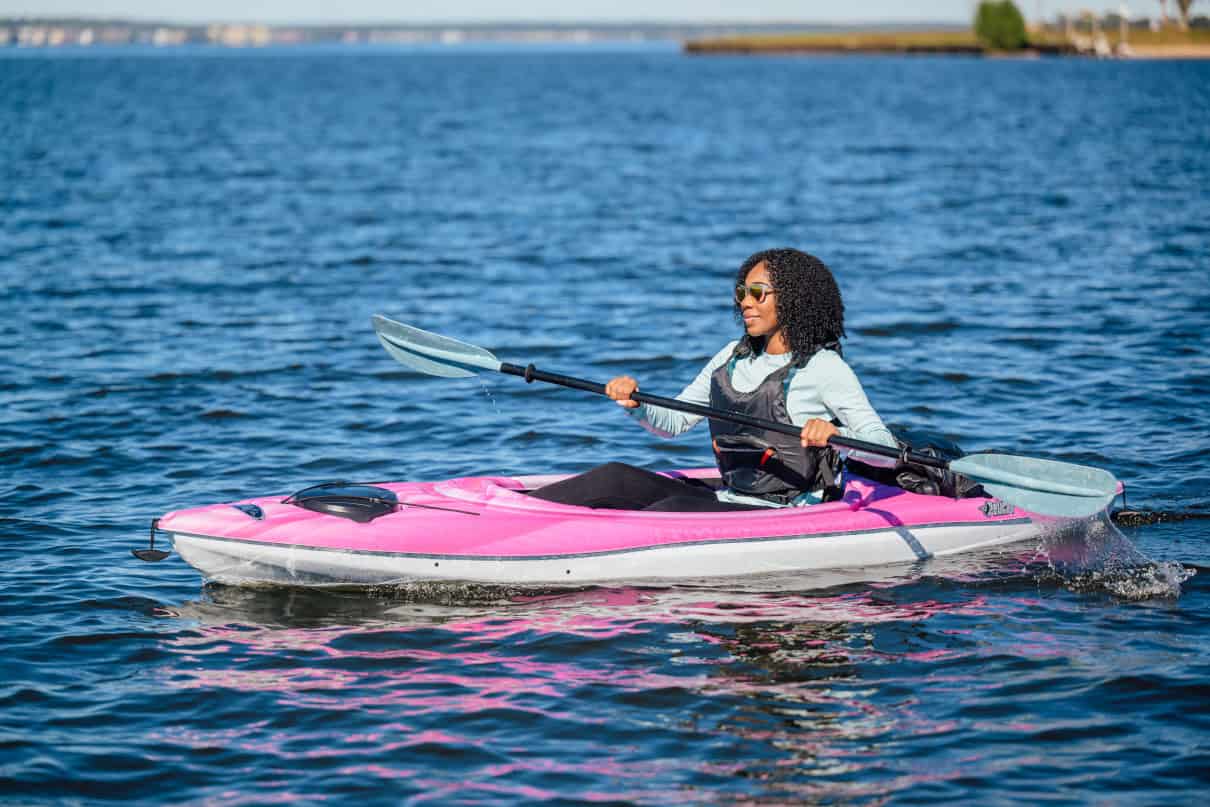
Recreational kayaks for women are all about ease of use and value. Whether they are sit-inside or sit-on-top designs, recreational kayaks put a premium on stability. They aren’t as fast as touring kayaks, but they feel more secure on the calm, sheltered waters for which they are designed.
Recreational kayaks often offer very basic features and come at an affordable price. In some cases they are just a simple kayak hull with a seat and little else. Better designs incorporate some touring kayak features, like hatches and bulkheads for dry storage and deck bungees for stashing a water bottle. If you plan on paddling farther from shore, choose a sit-on-top recreational kayak that can be easily reentered if you fall out. Most sit-inside recreational kayaks should only be used close to a shoreline with easy landings and minimal exposure to wind and waves, since they lack adequate flotation when swamped and can be difficult to reenter from deep water.
Recreational kayaks come in a wide range of lengths and designs. Few are shorter than nine feet and most are no longer than 13 feet. All are wider than touring designs of similar length.
Women considering a recreational kayak should take a look at designs around 10 to 12 feet long and less than 25 inches wide for a sit-inside, or less than 30 inches wide for a sit-on-top. Boats shorter than this may be lighter and less expensive, but noticeably slower. Those that are wider will be heavier and smaller paddlers will find they feel sluggish and slow to respond.
Carry A Whistle (And A Light For Night Use)
Every paddler should have a whistle attached to his/her life jacket.
Carry a light at night. Consider carrying a distress signal device.
Ocean Kayak produces a pair of recreational kayaks for small women and mid-sized paddlers. The Venus 10 and Venus 11 are women’s sit-on-top kayaks with female-friendly features like a higher seat position, narrower width, lighter weight and added carry handles for easier lifting and cartopping.
Touring Kayaks
Touring kayaks for women are sleek and fast sit-inside kayaks designed for long-distance travel and camping. Common styles of touring kayaks include day touring (or light touring) kayaks and sea kayaks, which range in length from around 13 to 15 feet and 16 to 17 feet, respectively.
Most touring kayaks are fitted with bulkheads and hatches front and rear for dry storage and flotation, making them suitable for trips on more exposed and challenging waters. Many have rudders or retractable skegs to help control direction in wind. Safety features like a continuous deckline running around the perimeter of the kayak are common.
While the average width of a touring kayak is around 22 to 24 inches, touring kayaks designed for women are typically narrower. The wider the boat, the more stable, but also slower, it will be. Since women, on average, have a lower center of gravity, they have less need for speed-sucking stability and can feel comfortable in a sleeker women’s sea kayak.
Day touring kayaks are excellent for aspiring paddlers who want to develop their skills but have no intentions of taking overnight and multiday trips. Day touring kayaks are lighter, more compact and easier to secure on a car’s roof rack than full-sized sea kayaks.
Sea kayaks are often expertly designed for specific applications, such as overnight kayak camping trips or rough water paddling. Take a close look at a women’s sea kayak if you want to develop your skills, explore exposed coastlines and undertake multiday camping trips.
Because women have a lower center of gravity, they don’t need as wide a boat as a man would to feel stable. Taking advantage of a narrower boat will provide women with greater speed and cause less fatigue. | Photo: Nicholas Spooner
Fishing Kayaks
Fishing kayaks are specialized recreational designs suited to avid kayak anglers. In fact, many of the most popular fishing kayaks are simply recreational kayaks with certain upgrades to on-board accessories and outfitting—like rod holders, livewells and convenient places to store tackle, fish finders and other gear. Most women’s fishing kayaks are sit-on-top designs, which allows for good mobility, ease of landing fish and safety when far from shore.
Some fishing kayaks are wide enough for standing. These designs are typically slower, but their wider beams provide ample stability for sight casting and fighting fish. An added benefit of wider designs is that seats can be mounted higher for more effective sighting and casting.
Pedal drive fishing kayaks are another popular option, allowing a kayak angler to keep her hands free for managing tackle, casting and handling fish. There are a variety of pedal kayak propulsion systems, including those with fins and others with propellers. Since there are no dedicated women’s fishing kayak pedal drives yet, it is especially important for women to try out these kayaks before buying. Ocean Kayak and Old Town brand manager, Julia Winske, urges women to visit their local shop and try using the pedal drive to make sure the ergonomics work for them.
In colder climates, some kayak anglers prefer closed cockpit fishing kayak designs. These kayaks offer less flexibility for fish wrangling, but provide more protection from cold water and air temperatures.
Dress For Immersion, Not Air Temperature
Your body loses heat much faster when immersed in cold water than it does when dry.
Avoid cotton clothing like t-shirts and jeans; they retain water and accelerate cooling when wet. Synthetic fabrics, or wool, are generally a better choice. If the water is very cold (60° fahrenheit or less), you should wear a wetsuit or drysuit.
Whitewater Kayaks
Whitewater kayaks are specialized designs for running river rapids. Most whitewater kayaks are sit-inside designs with smaller cockpits that can be sealed tightly with a neoprene sprayskirt. They are the most maneuverable kayaks with hulls that are short and rockered (shaped like a banana) to turn on a dime. Some models also feature a flat surface on the hull that planes on a wave like a surfboard, allowing the paddler to perform tricks on river features like recirculating holes and standing waves.
Whitewater kayaks come in a variety of styles, depending on their intended use. River runners are whitewater kayaks intended for covering miles and playing on river features along the way. River runners are usually longer than playboats and creek boats and faster than either on the water.
Playboats are about fun on the water—surfing waves and performing tricks like cartwheels and squirts. They’ll almost always have a planing hull for precise surfing. If you decide to choose a playboat instead of a river runner, remember you’ll be trading plush comfort for play in most cases. Freestyle kayaks are a more specialized version of playboats. Like playboats, freestyle kayaks won’t offer the most comfort for a long day on the water, but they will unlock the potential of any play spot on the river.
Creek boats are designed to make running very steep whitewater safer and easier. You probably already know if you need a creek boat. Women who are comfortable on class III and are interested in challenging themselves on harder water often choose a creek boat to make class IV more accessible and fun.
For women looking to develop the skills to paddle whitewater rivers, the right kayak choice is critical. “User-friendliness is key,” says Emily Jackson, freestyle kayak champion, designer and whitewater brand manager for Jackson Kayak. “Look for comfort, durability and light weight—those three things can make a big difference in your paddling growth.”
Materials
Kayaks are constructed from various materials, including plastic, fiberglass, carbon, wood and vinyl or other materials for a folding or inflatable kayak. Each material has benefits and drawbacks, relating to price, performance and durability.
Plastic kayaks dominate the recreational, day touring, fishing and whitewater markets, with rotomolded polyethylene being the most common material. Rotomolded kayaks are durable and particularly impact-resistant, which is why nearly all whitewater boats are rotomolded. Rotomolding can be used to create an almost infinite range of kayak designs. The toughness of the material makes it a good choice for many paddlers, as does its modest cost.
The biggest downside of rotomolded kayaks is they tend to be heavier than boats made from other materials. If you are looking for light kayaks for women, there are better material options. Rotomolded boats are also a little more flexible than composite designs, so the material isn’t quite as good for high-performance designs like racing kayaks and sea kayaks.
Rather than looking for a “women’s kayak,” look for a kayak with particular features better fitting the physical characteristics more common among females. | Feature photo: Ron Watts
Composite kayaks are made from layers of fiberglass or aramid cloth laminated together with resin. In general, composite kayaks are lighter and stiffer than rotomolded designs. This makes composite a good choice for longer touring kayaks or high-performance racing and fitness designs.
If you are searching for ultralight touring kayaks for senior women to ease the transition from roof rack to put-in, carbon kayaks offer the absolute lightest (and most expensive) option. However, unless they are reinforced with additional layers of gelcoat or a keel-strip, they are not as durable as fiberglass. This is fine if you are paddling in calm conditions, but if you plan on dragging the kayak up a pebble beach it won’t last long.
Thermoformed kayaks fill a middle ground between rotomolded designs and composites. They cost more than rotomolded boats but less than composites, and they’re roughly in between the two materials in terms of stiffness and impact resistance. Many light touring and touring designs are built in this material and offer excellent value. Thermoformed kayaks are a great option if you’re seeking out light kayaks for women at a budget-friendly price.
Wooden kayaks are not as common, but their owners love their classic look and warm aesthetic. They can be designed with high-performance shapes, and the characteristics of wood give them a unique feel in the water. Many of these touring and recreational designs are made with do-it-yourself kits, and half the fun is the project of building the boat. Wooden kayaks are lightweight and beautiful, making them a wonderful option for women who have the time, tools and desire to build their own boat.
Folding kayaks or inflatable vinyl designs prioritize portability. These kayaks store into duffels and are assembled at the put-in. They’re ideal for women who are tight on space, like those living in condos, or for airline travel to exotic destinations. Generally, these kayaks have the advantage of portability at the expense of performance. Look to established companies for folding and inflatable kayaks with better quality and performance.
Design Features
Building the best kayaks for women means getting more women involved in kayak development and design. Happily, the number of female product developers, team paddlers and design influencers is growing.
At Johnson Outdoors, makers of Old Town and Ocean Kayak, women hold key positions across all aspects of the design process, “from consumer insights and industrial design, to production and everything in between,” says Julia Winske.
Sea Kayaking UK (Nigel Dennis Kayaks) made great leaps forward in designs suiting women when advanced-level sea kayak coach and expedition leader, Eila Wilkinson, became involved in their design process. Wilkinson wanted narrower, faster boats that were rough water capable and more responsive to smaller paddlers. Her input led to the design of NDK’s Pilgrim, Pilgrim Expedition and Echo kayaks, which are favorites of diminutive women—and men—around the world.
Progress isn’t limited to touring and recreational kayaking. At Jackson Kayak, women are integral to the design teams for both whitewater and fishing kayaks—two segments traditionally dominated by men.
“We have a wide variety of influences and team paddlers including women, men, kids, teens and individuals with disabilities,” says Emily Jackson. “By casting this wide net, we look for common threads and get as close as we can to the needs of every style and shape of kayaker.”
When it comes to feedback from women paddlers, concerns around weight, comfort and speed are top of the list. So too, is frustration at kayaks that feel heavy and sluggish.
“You could be doing all the right things, but not have the boat respond because it’s too big for you,” says Jackson.
Kayak weight is important for two reasons: a heavy kayak feels less nimble on the water and is slower to accelerate and harder to keep moving at a steady pace; and a heavy kayak is harder to lift and carry. This can make a big difference in how easy it is to get to and from the launch. Women who want the independence of lifting their kayak on and off a roof rack or trailer by themselves can seek out lighter composite and thermoformed materials to save on weight.
The size of a kayak also plays into its weight. But internationally recognized sea kayaking coach and NDK distributor, Dale Williams, says there’s another reason women should seek out narrower and shorter kayaks: speed.
Paddle Sober And Smart
Never mix alcohol and paddling. Coast Guard and state BUI (boating under the influence) laws apply to all vessels. This includes canoes, kayaks, SUPs and rafts.
“The wider the boat, the more stable,” he starts. “But why suffer a wider, slower boat when you’re plenty stable with a narrower, faster one?”
Unlike their typically more top-heavy counterparts, women, on average, have a lower center of gravity and less need for speed-sucking stability. Furthermore, wider boats create more surface area for wind and waves to push them around. All else being equal, says Williams, “The kayak the average man would find stable and controllable, the average woman will find slow and cumbersome.”
A narrower boat is also better suited to most women’s shoulder widths, allowing for an efficient, comfortable forward stroke and easier rolling.
The average woman also has less upper body strength than the average male paddler. It’s for this reason Williams recommends a correspondingly shorter kayak for many women.
Popular wisdom holds that longer equals faster, period. The best kayaks for women acknowledge that this is an oversimplification. The fastest boat for you is one that, a) fits properly, and b) has the least possible drag at the speed you normally paddle.
“Longer boats are only faster when you add more power,” Williams explains. “It’s why ‘getting her a longer boat’ has rarely been the answer for helping mixed sex couples paddle together at the same speed.”
If maximum speed is your objective, a paddler with lower center of gravity and less power can afford to go longer by also going narrower. Williams says this is the design rationale behind NDK’s Echo, at 16 feet, 10 inches long and a trim 19 inches wide.
Ultimately, choosing the best kayak for your needs still means identifying where you paddle most often, then getting on the water in as many models as you can to dial in the perfect fit. Be wary of sales pitches claiming one boat can do it all. No design excels in all types of water, just as there’s no such thing as “one size fits all.”
A smaller cockpit opening will enable women to more easily secure and pull their sprayskirts—and actually be able to reach items on their decks. | Feature photo: Andy Zeltkalns
Outfitting
Outfitting describes the parts of the kayak that directly connect paddler to boat: the seat, back support, hip pads, thigh braces and foot pegs or pedals. Not surprisingly, outfitting plays a critical role in ensuring a good fit and enhancing on-water comfort and control.
Emily Jackson says conscientious outfitting can solve the most common feedback she hears from other women paddlers. “They want to feel more connected to their boat,” she explains. Whether you are looking at kayaks for small women or kayaks for heavy women, the best outfitting can be easily adjusted or customized to improve fit for every size and shape.
Starting with the seat, a woman’s lower center of gravity and often shorter reach calls for a higher seat position. “If you want to make a bigger boat feel more manageable, lift your seat,” says Jackson. Boosting the seat enables the paddler to transfer more power to their strokes and provides an easier reach over the cockpit rim and sidewalls.
While some kayaks may offer an adjustable height seat, you can also customize most kayak seats by adding a cushion or placing foam under the seat pan or liner. Kayaks with a seat that can be moved fore and aft also allow paddlers to trim the boat so it is optimally balanced for their height and weight.
In sit-inside kayaks, the hip pads and thigh grips work with the seat and backband to provide a snug yet comfortable fit. For many women, particularly those with curvier figures, this is a spot requiring special attention. Removable or adjustable hip pads and thigh braces allow paddlers to strike a balance between comfortable seating and a narrower performance fit. DIY types can also shape custom pads from blocks of closed cell foam.
The shape and size of the cockpit will also affect how a kayak fits, and how easy it is to get in and out of the boat. While large, open cockpits are standard on recreational kayaks intended for use in sheltered waters, paddlers touring on more exposed waters are better matched to a smaller oval or keyhole cockpit.
Oval-shaped cockpits vary in size, with some feeling too large for petite paddlers. Keyhole cockpits narrow toward the bow, allowing shorter legs to extend comfortably beneath the deck for a snugger fit. A shorter keyhole cockpit also makes it easier for smaller paddlers to secure or pull their spraydeck. Working with NDK to design their Pilgrim and Echo kayaks, Eila Wilkinson insisted on a shorter cockpit opening for another reason: so she could reach her chart on her front deck.
In addition to kayak ergonomics, a properly fitted PFD and lightweight paddle is key, says Julia Winske. Most life jacket manufacturers offer women’s specific paddling PFDs that are designed to fit a woman’s body by eliminating bulk around the bust. Paddles are sized based on your height and the width of your kayak, meaning women who go with a narrower boat should also choose a shorter paddle.
Wear A Life Jacket
Everyone, even strong swimmers, needs to wear a life jacket at all times when on the water. It is extremely difficult to put a life jacket on once you fall into the water. Even a light wind can blow any paddlecraft away from you, faster than you can swim.
Always wear a USCG-approved Level 70 or Type III life jacket designed for paddling.
Price
Ask five people, “How much is a women’s kayak?” and you will get five different answers. Recreational kayaks are the cheapest option, starting from around $300 for a box store kayak, to around $800 to $1,500 for a recreational kayak from a well-known manufacturer. Generally speaking, you get what you pay for in terms of quality, comfort and performance.
Whitewater kayaks average $1,200 to $2,000. Fishing kayaks can vary tremendously in price, from sub-$1,000 recreational models to $5,000-plus pedal kayaks with all the bells and whistles.
Depending on the material, model and condition, a touring kayak will cost anywhere from $1,000 to $4,500. With an increase in price, there will often be an increase in quality, but that does not mean the most expensive kayak is the best for you. Consider your desired use and overall kayaking equipment needs. A good paddle and comfortable PFD will make a huge difference when using your kayak, so consider splurging in those areas instead of blowing your whole budget on a boat.
Where To Buy
Touring, recreational, whitewater and fishing kayaks are available at most local paddlesports retailers and national outdoor chains such as MEC or REI. Outfitters often have used kayaks for sale at the end of the season. Scouring online classifieds such as Kijiji or Facebook Marketplace can yield great deals on used women’s kayaks for those with time and patience.
This article was first published in the 2023 Paddling Buyer’s Guide. Subscribe to Paddling Magazine’s print and digital editions, or browse the archives.
Rather than looking for a “women’s kayak,” look for a kayak with particular features better fitting the physical characteristics more common among females. | Feature photo: Ron Watts
Recreational kayaks easily make up the largest segment of the paddlesports industry. What exactly is a recreational kayak? They are generally shorter, wider kayaks that focus on stability and comfort for a day on the lake, bay, slow rivers and other sheltered waters. You can buy a rec kayak just about anywhere, from box stores to huge online retailers, sporting goods outlets and niche paddling shops. Regardless of your age, size, budget, fitness level and paddling destination and overall aspirations, there’s truly a kayak for everyone; but you must take the time to do your homework and research the right boat for your situation to make the right selection. A recreational kayak may be a good fit, but making a selection is no easy task when there are hundreds to choose from.
We’re here to help! This article narrows down your options with some of my favorite recreational kayaks in a variety of categories, with an overview of key design, construction and safety features that will keep you happy on the water no matter where you paddle.
Everyone, even strong swimmers, needs to wear a life jacket at all times when on the water. It is extremely difficult to put a life jacket on once you fall into the water. Even a light wind can blow any paddlecraft away from you, faster than you can swim.
Always wear a USCG-approved Level 70 or Type III life jacket designed for paddling.
The Pungo is a true classic, an OG recreational kayak that helped define what’s become the most popular segment of paddlesports. I especially admire how Wilderness Systems has kept its timeless design modern, with seat upgrades for comfort and refinements to its hatch system for convenience and safety. Meanwhile, Wildy has remained steadfast to the Pungo’s tried and true hull design, which is versatile and capable for day paddling excursions on rivers, lakes and sheltered coastlines.
The Wilderness Systems Pungo 120 was my top recommendation when my brother-in-law was looking for a beginner-friendly kayak to use at his new waterfront home on Lake Superior. It offers reassuring stability and a spacious cockpit that’s easy to enter and exit. The Phase 3 AirPro seating system provides all-day comfort and plenty of adjustability. As a 2022 Paddling Magazinereview noted of the Pungo 120 it “sits right in the Goldilocks zone for a wide variety of paddlers.”
Reasons to buy
A watertight rear bulkhead keeps the Pungo 120 floating even if the cockpit is swamped
Time-proven and refined outfitting, including a paddled, ergonomic seat and easy to adjust foot braces
Large cockpit strikes a fine balance between airiness for hot weather paddling and protection from the elements on cooler days
Consider another if
You are on a tight budget
Lightweight is a priority
Bottom Line
A classic sit-inside recreational kayak with widespread appeal.
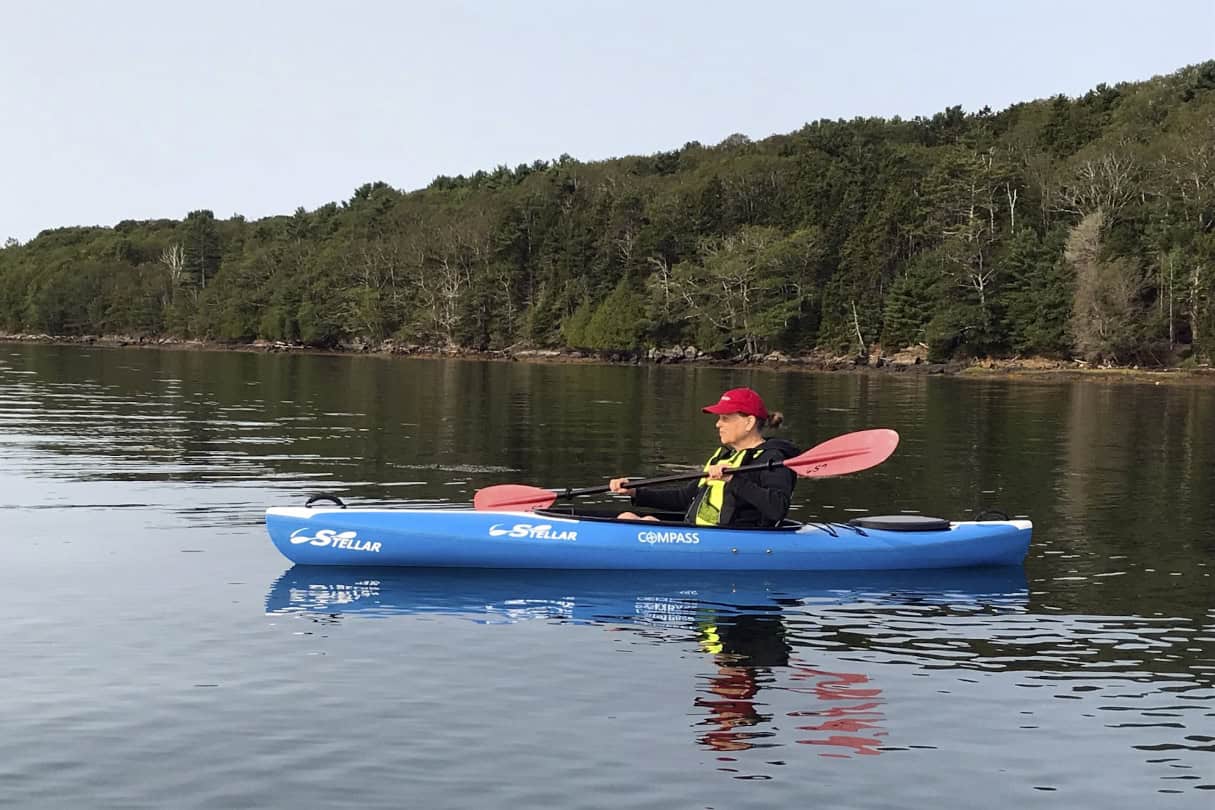
I’ve always admired the easy paddling efficiency of Stellar kayaks and the Compass 11 takes cues from the brand’s missile-fast touring models. The Compass 11 features the distinct swede form shape (that is, the widest part of the hull is behind the cockpit) of super fast surf skis, combined with the reassuring stability you expect in a rec kayak. This affords incredible glide and tracking in a compact, 11-foot, six-inch boat. Outfitting is what you’d expect in a touring kayak, with easy-to-adjust Smart Track foot braces and a comfortable seat.
The Stellar Compass 11 is a stark contrast to a rec market loaded with heavy plastic boats and sluggish inflatables. The light and stiff fiberglass layup makes it easy to cartop and launch in the water. Most of all, I love how this kayak takes all the features of a high-end touring boat and shrinks them down to a recreational package, perfect for discerning day paddlers who want to find the abundant rewards of investing in the sport.
Reasons to buy
Unmatched tracking, glide and paddling efficiency for a short recreational kayak
Premium outfitting and lightweight construction
Hatch and bulkhead for dry storage and safety
Consider another if
You’re on a budget
Durability is a top priority
You’re looking for a kayak for overnight trips
Bottom Line
A recreational kayak with all the bells and whistles of a premium touring boat.
Sponsored
Pakayak Bluefin
This 14′ packable hard-shell touring kayak is the ultimate kayak that packs down to just 42 inches in the included rolling bag and assembles in three minutes! The patented design has been trusted by paddlers in more than 25 countries for over a decade. Explore waterways others can’t reach, skip the roof rack, and get out on the water more often. MSRP: $2,195
You notice the stark difference between the Caribbean 100 and rugged yet heavy plastic sit-on top kayaks on both land and water. Tipping the scales at a light 40 pounds, the Caribbean 10 is easier to carry as well as faster to respond to paddle strokes due to its sleek and shiny thermoform construction. Its compact, 10-foot length makes it easy to maneuver for beginners, yet a straight keel line with minimal rocker keeps the Caribbean 10 moving straight on the water with impressive efficiency for such a short boat.
Eddyline is best known for its touring kayaks and some key features have trickled down to the Caribbean, the smallest offering in the brand’s kayak lineup. These include two watertight hatches for day gear, a clever “paddle park” (holder) built into the side carry handles, and easy-to-adjust foot braces. Overall, the Caribbean is a winner for lighter-weight adults and kids. The boat’s premium features make it far more enjoyable to paddle than cheaper boats.
Reasons to buy
Premium build quality, outfitting details and finish make for better paddling performance, comfort and lightweight
Fits smaller paddlers well
Consider another if
You’re looking for a cheap sit-on top for more casual use
You weigh more than 200 pounds (larger paddlers should consider the larger Eddyline Caribbean 120FS or Caribbean 140FS models)
Bottom Line
A can’t miss sit-on top for recreational paddlers: Compact, light and fun.
Dress For Immersion, Not Air Temperature
Your body loses heat much faster when immersed in cold water than it does when dry.
Avoid cotton clothing like t-shirts and jeans; they retain water and accelerate cooling when wet. Synthetic fabrics, or wool, are generally a better choice. If the water is very cold (60° fahrenheit or less), you should wear a wetsuit or drysuit.
The Pelican Argo 100X is a cheap yet serviceable sit-inside rec kayak that’s available at many box stores. Price and availability are the primary reasons for its widespread popularity, but its paddling performance exceeds its sub-$350 price tag. A vee-shaped keel line and hard “rails” on the edges of the hull contribute to tracking and maneuverability alike. The Argo 100X is a step above the many mass-produced, ill-conceived recreational kayaks that could best be described as pieces of junk.
Outfitting is barebones yet adequate, especially for a kayak that’s only expected to perform light duty. Don’t ask this kayak for too much. Be cognizant of how its basic design and short length impose limits on seaworthiness and speed, and it will deliver paddling fun on sheltered water for years. Its robust rotomolded plastic construction means you can crash into rocks and leave it on the beach all summer long.
Reasons to buy
Cheap and widely available
Fits a wide range of paddlers
Reasonable weight of 36 lbs
Consider another if
Performance is a priority
You’re a smaller person (the Pelican Argo 80X is a better choice for lighter-weight paddlers and kids)
Bottom Line
The best box store sit-inside kayak you can buy.
Best for overnight trips
Delta 12.10
Editor Joe Potoczak enjoying the Delta 12.10. | Image: Marcel Bieg
The Delta 12.10 bridges the gap between recreational and light-touring kayaks with a sweet blend of beginner-friendly stability, dry storage and safety features necessary for casual day paddling and embarking on weekend kayak camping trips. Delta was an early pioneer of thermoform construction, and the 12.10’s light, sleek build makes huge contributions to its paddling performance and overall appeal. Thermoform plastic is stiffer and more efficient than comparable rotomolded kayaks, as well as being easier to transport and more responsive to paddle strokes due to its lighter weight.
Besides its top-notch construction, the 12.10 borrows heavily from Delta’s longer touring kayaks. Front and rear hatches and bulkheads offer a lot of dry storage for such a short boat, as well as enabling the kayak to be emptied of water in an assisted rescue offshore. The sea kayak-inspired cockpit size seals well with a sprayskirt to keep you dry, with ergonomic thigh supports for the boat control I expect in an advanced touring kayak. Overall, this is a stable, easily paddling crossover kayak that you won’t grow out of too soon.
Reasons to buy
Fits just about anyone
Light, reasonably tough, easy paddling
Touring-ready features, including front, rear and day hatches
Consider another if
You aspire to go on longer multi-day trips
Your friends paddle longer, faster touring kayaks
Bottom Line
Recreational kayak meets touring kayak in this versatile crossover.
The Old Town Ocean Kayak Breeze is a kayak clearly designed for kids, with a slim yet stable profile that makes it easier for smaller-sized bodies to balance and reach the water. There’s no better way to share the joy of paddlesports with youngsters than with a simple, open-deck boat – that’s built by a sit-on top kayak pioneer. There’s nothing to break on the rotomolded plastic hull, no moving parts or sharp edges. It is maneuverable and easy to handle, with good glide to allow kids to keep up. Multiple moulded footrests fit a variety of sizes, from kids to youth and smaller adults. What’s more, it also makes for a fantastic swim platform.
Reasons to buy
Kid-specific sizing
Simple and durable construction
Built in Tag Along system makes it easy for adults to tow tired young paddlers
Convenient carry handles in all the right places
Consider another if
You paddle in cold water or exposed conditions
You want a kids kayak that’s suitable for overnight trips
Bottom Line
Start them right with a playful sit-on top kayak that promises years of fun.
Best rec kayak for travel
Oru Kayak Lake
Author Conor Mihell testing the Oru Kayak Lake. | Image: Conor Mihell
My skepticism of a 9-foot, origami folding kayak vanished the moment I took my first stroke in the ORU Lake. It’s a fun, comfy, stable and easy to paddle rec boat that’s impossible not to love. The Lake has so many great attributes. For starters, it weighs next to nothing at 17 pounds; it sets up in barely a minute and folds into a manageable backpack size that’s easy to take on a trek, trip or public transit; and the gel seat and adjustable foot bar make for a comfortable ride and fit for those up to 6’4″ and 250 pounds. You can even bring along a medium-sized dog in the large cockpit.
Reasons to buy
Light and compact, appeals to globetrotters and apartment dwellers
Great price for an innovative, beginner-friendly recreational kayak
Agile and fun to paddle
Consider another if
You’re looking for more speed and glide
You wish to paddle in more exposed water conditions
You’re a larger paddler
Bottom Line
A packable rec kayak that’s fun to paddle, convenient and unique.
Education: Get Some!
Take a paddling safety course from the American Canoe Association (ACA), your local paddling shop or outfitter, or other reputable source.
Take a boating safety course from the U.S. Coast Guard Auxiliary, U.S. Power Squadrons® or your own state’s boating agency.
Take on-the-water skills training.
Recreational Kayak Buying Advice
Choosing the best recreational kayak for your paddling dreams takes time and effort. You’re cutting yourself seriously short if you simply make a trip to a box store and grab what’s on sale. Of course, budget is a determining factor in any purchase. But when it comes to kayaks, just like any product, you get what you pay for.
Research and test drive
Take your time, read online reviews, including the trove on Paddling Mag, and shop around. I always recommend buying from a dedicated paddling shop or outdoor store to get the best advice. Many paddling shops also offer the option to try before you buy, which is another top tip to invest in the best recreational kayak for your needs. You can also sign up for a kayak lesson and ask your instructor for their top kayak recommendations. Certified paddling instructors can offer trained expertise in key safety features, such as hatches and waterproof bulkheads, as well as design and construction nuances, which may be glossed over by sales staff.
Choosing for your local waterways
To narrow your selection, think about where you will do most of your paddling (river, lake or coastal waters); be honest about how serious you are about paddlesports (occasional use or a passionate pursuit); and think about what paddling activities you’re most interested in and likely to pursue (kayak angling, downriver paddling, touring or travel). Then, choose between a sit-on top (open deck, ideal for warm weather paddling and kayak fishing) or sit-inside (partial or full deck, best for cooler conditions, day paddling and touring).
Proper fit
Boat fit and comfort are personal parameters that are key to optimizing your paddling experience. At the very least, insist that you sit in a prospective kayak to “try it on for size.” Better yet, put it through the paces on the water at a paddling center or by borrowing a friend’s kayak.
Full disclosure: I’m a sea kayaker from way back. Years ago, when recreational kayaks first appeared on the market, I thumbed my nose at their short and squat dimensions. But just as rec kayaks have exploded in popularity, I’ve come to appreciate their appeal to paddlers who don’t kayak as demanding of circumstances as I do.
The pivotal moment came about a decade ago, when I (reluctantly) did some research and coached my mom on her first rec boat purchase. Since then, I watched her embrace casual outings at the cottage and amidst the mangroves of her winter home in Florida. It makes me smile to hear her describe the joys of exploring new waters by kayak. I drew on that experience and more in compiling this article, with the hopes that you too can discover paddling at whatever pace you choose.
Why trust us
Don’t ask me how I’ve come to make a career in paddlesports as an adventure travel writer, canoe and sea kayak guide, and outdoor educator. Youthful enthusiasm made me a sea kayak guide in the early 2000s. The trade put me through journalism grad school and kept me afloat as an editorial intern at Rapid Media in 2005, where I wrote my first boat and gear reviews and kickstarted my freelance career. Paddlesports have evolved over the past 25 years, and I feel fortunate to have seen (and tested) it all—and made a living to boot.
Standup paddleboards continue to be one of the fastest-growing activities on the water, and for good reason. They’re easy to transport, they’re not particularly expensive to purchase, and they give you an elevated view of the water unlike that of a kayak or canoe. Take a paddleboard out to a clear lake or river on a calm, sunny day and the views below the surface can be spectacular. In over a decade of paddleboarding, my single-most treasured experience remains paddling with manatees in Florida, where I had amazing views of these gentle giants gracefully moving around me.
However, for those with balance issues or who just find spending long paddles standing up on a board too taxing, simply adding a paddleboard seat and switching to a kayak paddle can be a game-changer, and creates one of the most versatile human-powered watercrafts imaginable. Here are a few options that will transform your standup paddleboard into a kayak-style watercraft with versatility and stability.
Wear The Appropriate Leash When Stand Up Paddleboarding
Always wear a leash on open bodies of water like lakes, bays, and oceans. Due to the risk of snags and entrapment, leashes should only be worn on rivers if they include a quick release attached to your life jacket.
Stability is everything when it comes to paddleboard seats. The Thurso Surf SUP Kayak Seat is designed top to bottom to make you feel secure and stable on the board.
I love the four-inch thick cushion which gives you the flexibility of going as rigid or soft as you’d like depending on how much air you pump into it. The back has a wraparound-style design that provides good ergonomic support while paddling. And just like a quality inflatable SUP itself, the inflatable seat is made from a high-quality PVC and drop-stick material, meaning that it can handle the abuse paddleboards sometimes go through.
The four adjustable D-ring straps will make securing the Thurso Surf seat to your inflatable board easy, as long as your board comes with D-rings installed. There’s also a rear mesh storage pocket with enough room for snacks, water bottles or even a small jacket.
Reasons to buy
Uses the same standard inflator valve size as your SUP
Easy to install
4” of seat cushion gets you off the board
Consider another if
The 4” seat doesn’t elevate you off the board enough
You don’t have an inflatable SUP, and don’t want to carry a pump just for your seat
You want to quickly add a seat to your board without the hassle of pumping
Bottom Line
The Thurso Surf combines the best of inflatable seats with the best of kayak seats, giving you the versatility to keep you on the paddleboard longer.
If you simply want to add a seat to your paddleboard with no fuss and little setup time, a clip-on foam-padded seat is the way to go. You won’t get the added cushion of an inflatable, but the back stability is key.
If you’ve spent any time in a kayak, you will understand the importance of getting the angle of the seat pack just right. Similarly, if you’re adding a seat to a paddleboard, you’re going to want to get the angle exactly where you prefer. With four adjustable upper straps and two down low, the Atoll Board Universal SUP-Kayak Seat gives you the customization you want.
Adjustability is the keyword on this seat, with plenty of straps and four marine-grade brass D-ring clips to secure it in place on your board.
The seatback itself—while looking like a king cobra—gives you a wide surface to lean against while paddling, which is exactly what you need. The back features reinforced nylon backing for lumbar support and an extra layer of durable mesh on the front to allow for quicker drying. The base of the seat is minimalistic, which makes it convenient and light when not in use.
Reasons to buy
Customizable seat back
Fantastic lumbar support
Easy to install and remove
Lots of straps to attach backpacks or waterproof bags to
Consider another if
Extra thick cushion is important to you
You want built-in storage without having to add your own
Bottom Line
The Atoll gives you the back support needed for long days on the board.
Many people think that overnight paddling trips require a canoe and large kayak with water-tight storage. However, standup paddleboards with lots of tie-downs, combined with waterproof storage bags, can make for an epic paddling adventure option. Space on the board comes at a premium however, so adding a seat that can double as a sleeping pad is a no-brainer.
Rather than a seat specifically, the Trekker Chair is more of a tool to turn your Therm-a-Rest sleeping pad into a seat. The idea here is that you can use this super lightweight sleeve to fold your inflatable sleeping pad into a comfortable seat for on or off the paddleboard.
It has adjustable straps to change the angle of the seat back. The soft-cushioning features that make the Therm-a-Rest sleeping pads so comfortable at night also make this an extremely comfortable paddling seat.
Reasons to buy
You’re a camper who already owns a Therm-a-Rest sleeping pad
You want a minimalistic seat option
Cushion for your backside is more important than lumbar support for your back
Consider another if
You’re not a paddling camper
You want a seat you secure to your board’s D-rings
You’ve got a bad back and need lumbar support
Bottom Line
The Therm-a-Rest Trekker Chair is the perfect solution for a particular segment for the multi-day paddleboarding crowd.
Sometimes the simplest solution is also the most versatile and useful. If back support is not particularly important to you, but having a cold seltzer and food on hand for the day is, then using a hardshell cooler as a seat is a simple and useful option. Yeti has long established itself as the best in the cooler business, and the Yeti Roadie 15 hard cooler is the best option for sitting on a paddleboard.
At 14” tall, the Roadie is the easiest option on the knees of any paddling seat because it allows your legs to be in a natural seated position. Although it doesn’t have buckles to attach the cooler to your paddleboard, it does have slots for cam straps, and strapping the cooler to your SUP will do the trick. When you need to transport the seat/cooler when not on the board, the Roadie 15 has a padded shoulder strap.
Reasons to buy
The most natural seating position of any option
Enough cold storage for lots of drinks and snacks
Useful for much more than just paddling
Consider another if
You want any sort of back support
You’re looking for a cheap option
You want something designed specifically as a seat that clips to the board
Bottom Line
This is a surprisingly simple solution many paddleboarders turn to for sitting down and simply packing lunch.
Wear A Life Jacket
Everyone, even strong swimmers, needs to wear a life jacket at all times when on the water. It is extremely difficult to put a life jacket on once you fall into the water. Even a light wind can blow any paddlecraft away from you, faster than you can swim.
Always wear a USCG-approved Level 70 or Type III life jacket designed for paddling.
Standup Paddleboard Seat Buying Advice
Buying a paddleboard seat really comes down to a personal choice on what’s important to you. The first question to ask yourself is what is the biggest issue you’re trying to solve by sitting down, instead of standing, on a paddleboard? For some, it’s back pain. For others, it’s leg or foot discomfort. Some find sitting to be more stable than standing. For each of these priorities, there is a best option.
Those with bad backs should be looking first and foremost at a paddleboard seat that offers lumbar support and lots of adjustability in the seat back angle. You may need to compromise some seat cushion support or storage, but if your back is the biggest hindrance to being able to stay on the paddleboard for any length of time, then something like the Atoll seat or others like it will solve your problem.
For those who need more support for their backside than their back, an inflatable seat or another with robust back support may be the best option.
And from the creative category comes the idea of sitting atop a hardshell cooler while paddling. Plenty of people who like to SUP fish love this option because it gives them a secure place to stow their catch while also having a place to sit down. For others, the idea of lunch on the board or at a remote spot on the river is incredibly appealing. This is where the cooler concept shines.
The products included in this article were hand-picked through more than a decade of both paddling and product review experience.
Why trust us
Writer Dan Dakin has been a paddleboard racer and adventurer for more than a decade. He was the first person to paddle on all five Great Lakes in a single day, and has paddled or raced down rivers as long as 225 kilometers. These days, he gets as much enjoyment spending hours on lakes and rivers with his kids as he does crossing a finish line.
It’s a familiar pattern: paddler shares a rescue video on the internet. Others leap to the comment section to share their thoughts. Controversy ensues.
When Dimirtri Vandepoele posted a video of a rough water sea kayak rescue while paddling Pointe du Ra, an exposed headland in Brittany, he did so with the phrase “rescue training pays off”. Like many of Vandepoele’s North Sea Kayak videos, the rescue was shared as an educational moment. While playing in a tide rip together, Hugo Germonpre capsized and swam and Vandepoele went in for the rescue. Upon making contact with Germonpre, Vandepoele himself capsized as Germonpre tugged on Vandepoele’s decklines at the same time as a wave broke on the opposite side of the kayak.
Vandepoele quickly rolled and continued the rescue, retrieving Germonpre’s kayak while leaving Germonpre with a paddle in the air, then aided Germonpre in reentering the cockpit. From here, the pair continued paddling and playing in the tide race.
“You shouldn’t be out there without a bomb-proof roll”
Vandepoele’s video repeatedly incited a very specific comment: you shouldn’t be out there without a bomb-proof roll.
“Genuine question, what are you guys doing in this situation without a combat roll?” wrote a commenter on Instagram under the video.
Vandepoele replied, pointing out that a roll was seen in the video if you watch beyond the initial capsize, and that North Sea Kayak trains more often on self rescues. “We have seen people with a combat roll bailing out, and not knowing what to do next,” wrote Vandepoele.
“Have you guys considered learning how to roll?” wrote another commenter.
In Vandepoele’s reply, in addition to pointing out that there is in fact a roll in the video, he explained that he believes there’s no such thing as a “bomb-proof” roll.
“There comes a moment, where you are injured, or when the situation is dire and you have to bail out,” wrote Vandepoele. “I have seen paddler[s] with a ‘bomb-proof roll’ bail out and not be able to perform a rescue. That is why we find self-rescue more important than rolling.”
Meanwhile, Gulf Kayak Academy wrote ”train in the conditions that you are likely to face trouble in,” agreeing with Vandepoele that rescue practice beyond rolling is key.
Does a bomb-proof roll exist?
Germonpre isn’t the only experienced paddler to take a highly publicized swim recently. Even world-renowned kayaker Dane Jackson had his first swim in over five years on the Misstassinni in early Summer 2025, a swim that led to a torn MCL, calf muscle, and impact fractures on his Femur + Tibia.
In his YouTube video, Jackson took care to acknowledge the incident as a wet exit and swim.
“I wrecked my knee as I got ripped out of the boat. Well, I swam,” Jackson corrected.”And then as I swam I got ripped out of the boat.”
Later in the video, Jackson went on to drink a “bootie beer” through a slipper and laugh about the swim with his friends.
Paddling accidents and rescue shaming
Ultimately, rescue videos like Vandepoele’s can be a learning tool. Videos and case studies can allow us to learn more about the sport even when not on the water, but often these case studies are met with judgement.
As former editor of Adventure Kayak Magazine Tim Shuff writes:
“The paddling community judges accidents harshly. We are so determined to figure it out and ascribe a cause to the incident we often rush to conclusions before all the facts are available and blame the victims in the process. Instead, we ought to humbly reflect on what lessons the incident can teach us and give thanks for surviving our own near misses.”
If you began paddling before the rise of plastics, chances are you’ve sat in an aluminum Grumman canoe. These iconic canoes have led many adventurous families, scout troops and Burt Reynolds wannabes on their first canoe trip.
In 1944, Grumman Aircraft Engineering’s Vice President, William Hoffman, conceived the idea to build an aluminum canoe with the same technology Grumman had been using for their aircraft. Presumably, this idea emerged after slogging a waterlogged wood-canvas canoe through the Adirondacks, as aluminum construction lightened the load significantly.
With shaped aluminum panels riveted together, these canoes could be mass-produced and sold at a reasonable price. Without the care and maintenance that wood-canvas canoes demanded, recreational canoeing was suddenly available to the masses.
Wear A Life Jacket
Everyone, even strong swimmers, needs to wear a life jacket at all times when on the water. It is extremely difficult to put a life jacket on once you fall into the water. Even a light wind can blow any paddlecraft away from you, faster than you can swim.
Always wear a USCG-approved Level 70 or Type III life jacket designed for paddling.
Grumman canoes are stable and fairly lightweight, considering how durable they are. The riveted aluminum construction resists warping, scraping, and most punctures. These are ideal canoes for anglers and hunters, or anyone who wants a boat that they don’t need to worry about. The metal construction will last generations. They are a bit noisy and frigid to the touch on cold days but consider a Grumman if that doesn’t bother you.
This article will provide you with everything you need to know about buying a Grumman canoe, whether it’s new or used. You will also find links to view specific models and compare the specifications with other popular canoes. Read on to learn more.
Grumman’s 17-foot square-stern model is designed to be equipped with a motor for additional power. The reinforced transom at the back can support a five-horsepower outboard. At 85 pounds, this canoe is 10 pounds heavier than the 17-foot Double-Ender.
Users can paddle it with canoe paddles in areas where motors don’t work as well, like creeping into the weeds or marshy areas. These are good options for hunters, anglers or anyone who wants the extra power boost from a motor.
To dabble in a bit of everything, consider Grumman’s 3-in-1 Sportboat. This 15’3” boat can be paddled like a canoe, equipped with a motor or rowed with oars. At 40 inches, it’s wider than any of Grumman’s other canoes. It will not paddle as efficiently as the Double-Ender, but it is much more stable. This is a good option for families who want to get on the water safely but don’t care how quickly they’ll move.
The transom and extra width account for the additional weight in this 122-pound craft. This is more of a boat than a canoe, but if you aren’t planning to portage it (don’t plan to portage it), the Sportboat might be a good choice.
Grumman’s aluminum Double-Ender canoes are the ones most people are familiar with. These take the traditional canoe shape. They are the best option for prospective buyers who plan on exclusively paddling with single-bladed canoe paddles rather than attaching outboard motors or using oars. These are the lightest canoes Grumman makes as well. You can find a Grumman Double-Ender at 13, 15, or 17 feet long.
The length you choose depends on a few factors, and there are often tradeoffs when deciding which length to buy. Longer canoes get heavier, but they also increase the cargo capacity. You’ll track much better in a 17-foot canoe, but a 13-foot Double-Ender turns more readily.
For this reason, solo paddlers will have an easier time controlling a 13- or 15-foot canoe, while a 17-foot canoe provides ample space for overnight trips for two or outings with a dog. Choose the 17-footer if you’ll always have a paddling partner, the 13-footer if you’ll be solo more often, and the 15-footer for a bit of both.
Shopping for a used Grumman canoe?
Used Grumman or other aluminum canoes are good low-risk purchases. If you are looking for a basic canoe to get from A to B or to leave at the hunt camp, you’ll find Grummans for low prices. As they are so durable, unless they’ve suffered catastrophic damage, it will still probably be fine to paddle even if they’ve been neglected for a while.
When you’re buying a used Grumman, consider where to look, what to look for and how much to pay when you find it.
Where to look
Since they’ve been in production so long and last almost forever, your chances of finding a used Grumman canoe are pretty high. They are especially popular among the hunting and fishing crowd, so you may have good luck searching in smaller towns. You can start shopping for a used Grumman right now by opening up your favorite online classifieds site. On Kijiji or Craigslist, Grumman canoes might be simply listed as “aluminum canoes” or another general term.
Cast a wide net to make sure that you don’t miss these postings. Another strategy might be to post a “wanted” ad on a community page. People may have aluminum canoes sitting in their backyards that they just haven’t gotten around to selling, and in these cases, they would be happy for you to take the boat off their hands.
What to look for
Since these canoes are so tough, most used ones will probably still be seaworthy. You’ll still want to inspect the boat and test it if you can. Flip the canoe over and look for weak points along the hull where it may have been repeatedly scraped and dragged. Two areas to check are the stems, the narrow aluminum plates that cover the seams at the bow and stern of the canoe.
Dress For Immersion, Not Air Temperature
Your body loses heat much faster when immersed in cold water than it does when dry.
Avoid cotton clothing like t-shirts and jeans; they retain water and accelerate cooling when wet. Synthetic fabrics, or wool, are generally a better choice. If the water is very cold (60° fahrenheit or less), you should wear a wetsuit or drysuit.
If they’ve been bashed enough times they may have cracked, which could mean a leaky canoe. Best to get the canoe into some water and look for any water seeping in. Small holes are easy enough to repair with a bit of solder. Lift the canoe and listen for any water sloshing around in the bow and stern float tanks.
How much to pay
Used Grumman canoe prices will vary significantly depending on their condition and reason for the sale. You might find them for less than $500 if a seller is keen to clear it out. A newer canoe may sell for more, between $800–$1,000.
For more tips on what to look for when selecting a used canoe, read our article How To Buy A Used Canoe.
Grumman canoe buying advice
If you’ve decided that Grumman canoes are the way to go, check out their offerings below. We’ll touch on the three types of canoes they offer and who would enjoy them. Aluminum canoes are rare, and plastic has overtaken metal as the go-to for inexpensive, durable boats, but they still have their uses. While plastic canoes are susceptible to UV damage from the sun, you can leave an aluminum canoe exposed to sun, snow, heat and sleet; it will paddle the same as ever.
Grummans are stable, long-lasting canoes, ideal for recreational paddling, angling or hunting. Your preferred means of propulsion and how many people will be paddling the canoe will determine the best model and length to choose.
Is a Grumman a good canoe?
Grumman makes good aluminum canoes. These canoes are ideal for recreational paddling or paddlers who want a canoe that requires virtually no maintenance.
When did Grumman start making canoes?
Grumman started to make canoes in 1944, as World War II brought an industrial surge through the United States. The company originally made aluminum fighter planes in the war, and took the expertise for bending and riveting aluminum sheets and applied it to canoe building. The result was the first commercially viable recreational canoes.
Does Grumman still make canoes?
Marathon Boat Group owns the Grumman brand now, and they’re still churning out canoes, although with fewer options compared to their peak in the 1970s and 80s. Today, you can find three canoe models in different lengths.
Grumman canoe models
There are three different Grumman canoe models available this year. The Double-Ender is a classic canoe shape. The Square-Stern and 3-in-1 Sportboat are both flat at the stern for mounting outboard motors. Any of the models have optional paint in five colors.
Stay Clear Of All Other Vessels
Know the “Rules of the Road” Navigation Rules that govern all boat traffic and stay out of the way of all other vessels.
Never assume that power boaters can see you. Avoid high-traffic areas whenever possible. Proceed with caution when you can’t avoid paddling near boats. Dress for visibility.
Grumman canoe sizes
Grumman’s “Double-Ender” is available at 13, 15, and 17 feet long and 35-36 inches at the widest point. The Square-stern canoe is 17 feet with a 36 ⅝” beam. The 3-in-1 Sportboat is just longer than 15 feet and 40 inches wide.
Grumman canoe dimensions
Grumman canoe specs vary depending on the model. The dimensions of discontinued Grumman canoes may be found online or by contacting Grumman directly.
Weight of Grumman canoes
Grumman canoe weights range from 58 pounds for the 13-foot Double-Ender to 122 for the 3-in-1 Sportboat.
The weight of Grumman Double-ender canoes is comparable to some polyethylene and fiberglass canoes of equal lengths.
Grumman canoe prices
New Grumman canoes start at $1,500. Prices vary depending on the model and length.
Grumman canoe value
Used Grumman canoes hold their value well because of their long life. Unless it suffers catastrophic damage, the canoe will perform the same as it did when it was brand new. Used Grumman canoe prices will vary. Some may just want to clear the canoe out, while others will list it close to the sticker price. From 50–80% of the original price is fair for a used aluminum canoe.
Grumman canoe dealers
If you’re wondering where to buy a Grumman canoe, use the dealer locator tool. Grumman canoes are sold at independent outfitters, who may also be able to order a canoe in for you.
Compare Grumman canoes
Alumacraft vs Grumman canoe
Minnesota-based boat manufacturer Alumacraft began producing canoes shortly after Grumman. They no longer make canoes, instead focusing on aluminum boats, but you can still find used ones for sale periodically.
An Alumacraft canoe that’s in good shape will still provide the same durability of a Grumman canoe. If you know you want an aluminum canoe, either will meet your expectations. Grumman is a good choice if you’re set on a new aluminum canoe rather than a used one.
Whether paddling a sit-on-top kayak or a sit-inside kayak, the general guidelines on what to wear while on the water remain the same. | Photo: Scott MacGregor
The well-worn saying, “It’s like riding a bike,” has a second meaning when it comes to kayaking. Like the saddle of our two-wheeled counterpart, the seating area in a kayak is not always the most comfortable. Like a bike, stretching and putting in time could improve the situation, but at the end of the day, if your kayak isn’t comfortable, you aren’t going to want to spend time paddling it.
One of the tough parts about kayak seats, especially for sit-insides, is that the seats are generally factory-produced to fit inside of the kayak they were designed for. This doesn’t mean you are out of luck. Depending on whether you have a sit-on-top or sit-inside kayak, there are aftermarket options. To bring some relief and make your kayaking experience an enjoyable one, here are some of the best solutions available.
Best seat cushion for fishing kayaks and raised sit-on-top seats: Kayak Kushion
Wear A Life Jacket
Everyone, even strong swimmers, needs to wear a life jacket at all times when on the water. It is extremely difficult to put a life jacket on once you fall into the water. Even a light wind can blow any paddlecraft away from you, faster than you can swim.
Always wear a USCG-approved Level 70 or Type III life jacket designed for paddling.
Sit-inside kayaks are rather limited in the manufactured upgrades you can make to the seat. Custom building your own additional padding is an option using closed-cell foam or other items like pool noodles, but that is time-consuming. The Yakpads Paddle Saddle from Cascade Creek is a more convenient and pretty affordable choice for comfort in your recreational or touring kayak.
The pad will fit just about any bucket seat. It isn’t extremely thick, however, it is filled with silicone elastomer gel—the same stuff that is in those squishy, comfy bike seats. The Paddle Saddle also has a non-skid bottom to keep it in place, and two small loops so you can connect it to the rest of your outfitting. It is just a bottom, so it isn’t providing back support, but the small footprint makes it a convenient upgrade for most kayakers who just need a little extra cushion.
Reasons to buy
Low cost
Small footprint compatible for most sit-inside kayak seats
Cushy gel seat
Consider another if
You need additional back support
You need thicker padding
Bottom line
The Cascade Creek Yakpads Paddle Saddle is a quick solution to make your sit-inside kayak more comfortable.
Sit-on-top kayaks often come without a seat or include a very cheap one, instead relying on paddlers to spend hours sitting on the molded in shape of the rotomolded plastic. If there is a kayak seat out there that turns bare plastic into an executive’s chair, it is the Skwoosh Expedition Kayak Seat.
Sit-on-tops are easier to accommodate with aftermarket chairs because they generally follow a similar shaped scoop and have multiple eyelets around the cockpit to clip a seat into. The Skwoosh has liquid gel padding under your tush. It also provides a backrest for support. The Expedition seat doesn’t stop there however, it also has an adjustable lumbar pad and fiberglass rods to provide structure to the seat system overall. With the name expedition in mind, it also doesn’t overlook the need for gear storage, and includes water bottle holders and a bungee pocket on the back.
Reasons to buy
Gel seat cushion
Bolstered back support with adjustable lumbar padding
Small storage area
A kayak seat upgrade to most sit-ons
Consider another if
You are looking for a cheap option
Bottom line
The Skwoosh Expedition is the closest you’ll find to a luxury kayak seat for a low seat position sit-on-top kayak.
If your sit-on-top kayak didn’t come with a seat, or you need a replacement, the Harmony Gear Standard Sit-On-Top Seat is a well-constructed, to-the-point seat that will fit just about any sit-on-top kayak.
Sit-on-tops often have a scooped-out bucket seat molded into the plastic design. They also generally have four eyelets around the cockpit of the paddler. One of the reasons these are here is to attach a seat. The seat from Harmony features corrosion-resistant clips and webbing straps to attach to these points. It has 14 inches of back support and adjusts to help you sit forward or lean back. It’s nothing fancy, but it provides what you need: padding, support and trusty hardware.
Reasons to buy
Cost-effective seat
Compatible with most sit-on-top kayaks
Consider another if
You want thicker padding
You want more elaborate adjustments and support
Bottom line
The Harmony Gear Standard Sit-On-Top Seat is all you need to outfit a sit-on-top kayak with a seat.
Best cushion for fishing kayaks and raised sit-on-top kayak seats
The high-position, frame seats that come standard on many of the most popular fishing kayaks and some sit-on-tops have brought comfort a long way for casual paddling and angling. Even with the raised position though, these seats are just fabric stretched over a metal frame. The square Kayak Kushion provides up to two inches of padding to provide the comfort needed for a long day of fishing or sightseeing
The Kayak Kushion is a breathable pad, with ventilation to help avoid perspiration on the seat. The cover is also removable so you can wash it. And the Kayak Kushion’s Tactical Straps and cam buckles secure it to your raised kayak seat. The Kushion is stitched together to handle the rigors of fishing, but anyone with a high-seated sit-on-top will enjoy adding this plush little kayak pillow underneath them.
Reasons to buy
Up to two inches thick
Breathable material
Removable cover
Constructed for heavy use
Consider another if
You have a molded-in sit-on-top kayak seat
Need a one-piece bottom and back
Bottom line
Whether you are spending the day fishing or paddling around the pond, the Kayak Kushion provides padding to spend the day in your raised sit-on-top seat.
Education: Get Some!
Take a paddling safety course from the American Canoe Association (ACA), your local paddling shop or outfitter, or other reputable source.
Take a boating safety course from the U.S. Coast Guard Auxiliary, U.S. Power Squadrons® or your own state’s boating agency.
Take on-the-water skills training.
Kayak seat buying advice
The number one aspect to consider when shopping for a kayak seat is whether it will fit in your boat. Most sit-inside kayak seats are built by the manufacturers specifically for the dimensions of the kayak, so in that case, adding padding is the best bet. You can make your own with foam or pool noodles, but you can also find manufactured options with gel or foam padding that have a small footprint to slide under your bottom.
Sit-on-tops tend to fall into two categories: low, molded-in seats or raised, frame seats. Molded-in seats will take an aftermarket clip-in kayak seat pretty universally. The trick here, when you see a long list of seats on Amazon, read the reviews from others or, better yet, trust a brand that also manufactures kayaks or is carried by kayak shops. People have low-seated sit-on-tops with a raised from seat, but I generally wouldn’t recommend this unless the manufacturer has approved it because it significantly raises the center of balance of the paddler on a kayak that wasn’t designed for that position.
Stadium seats are interesting. There are some aftermarket options, but since these are designed for the kayak lineup, I would generally recommend sticking with the seat that is there and adding cushioning to it.
You want your kayak to be comfortable, and what I can’t stress enough is to sit inside a kayak before you even buy it. Even if you are putting it down in a store aisle. Climb in and sit in it for a few minutes. If you are aching right away, that isn’t a good sign, and you aren’t going to enjoy it. First, check the outfitting either yourself or with knowledgeable staff. If that doesn’t fix it, a kayak seat may help, but if it doesn’t, then that kayak may not be a good fit for you.
To decide on the best kayak seats, we used experience with various products and researched the options currently available as well as listened to the opinions of our fellow paddlers.
Why trust us
My early early days of kayaking included cramming myself into small whitewater kayaks with painfully tight outfitting. Once I figured out the sport is actually much more fun, and safe, when you are comfortable I’ve become much more picky about ensuring my seat and outfitting are right. I’d like for everyone who kayaks to be comfortable so they too can enjoy the experience of being on the water.







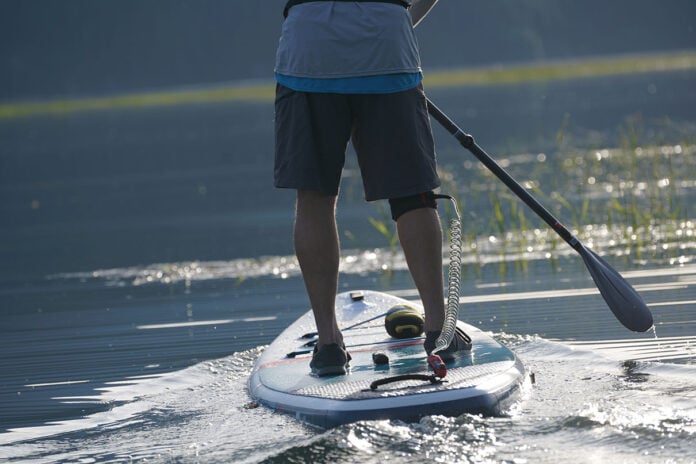
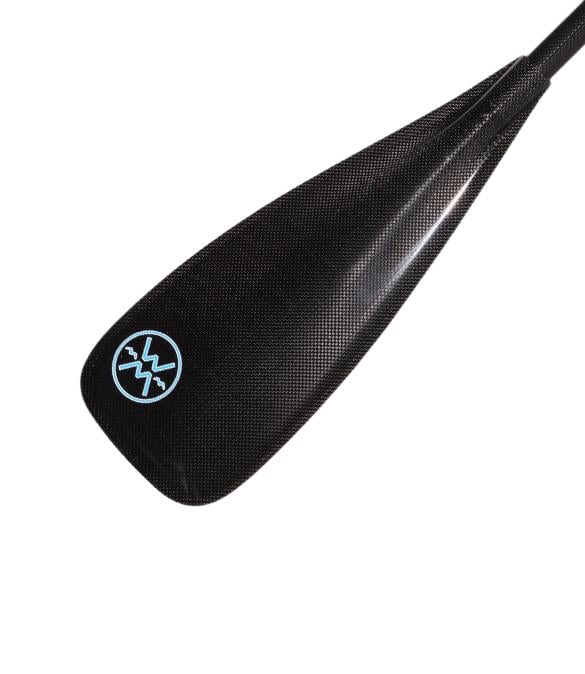
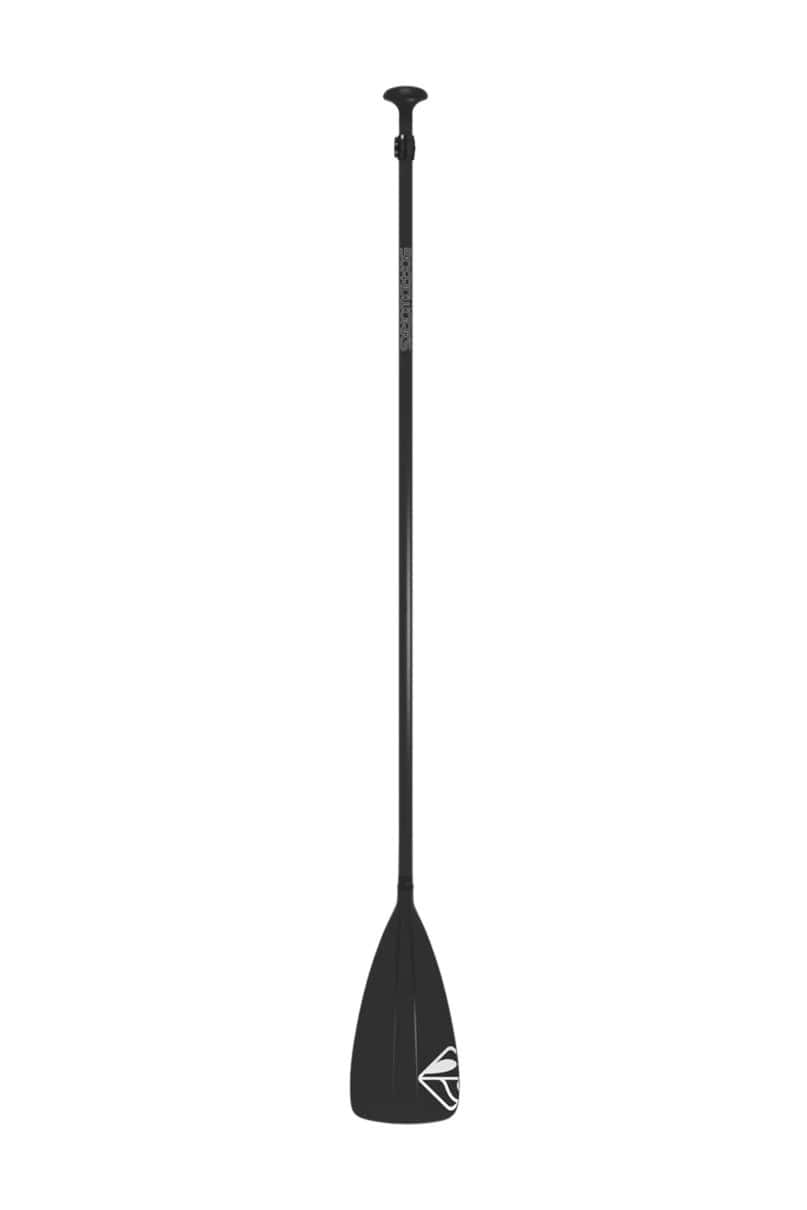

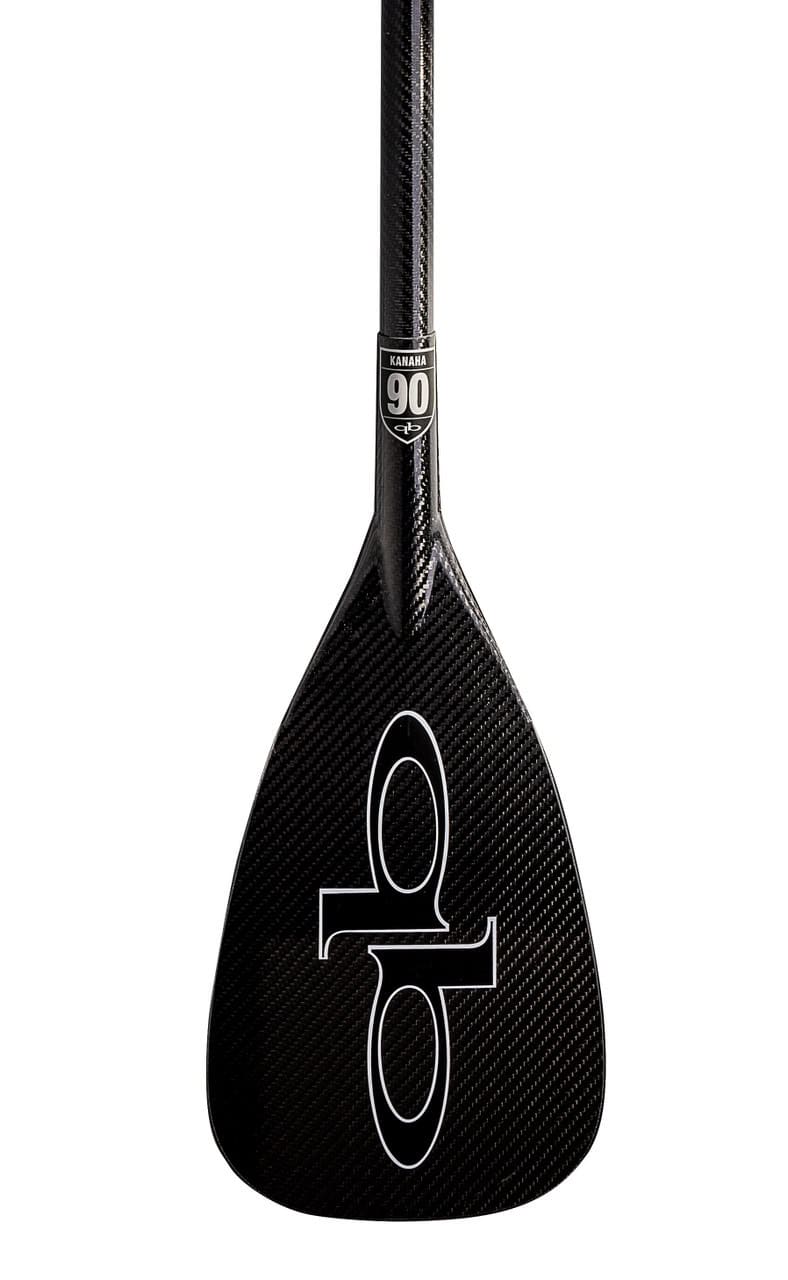
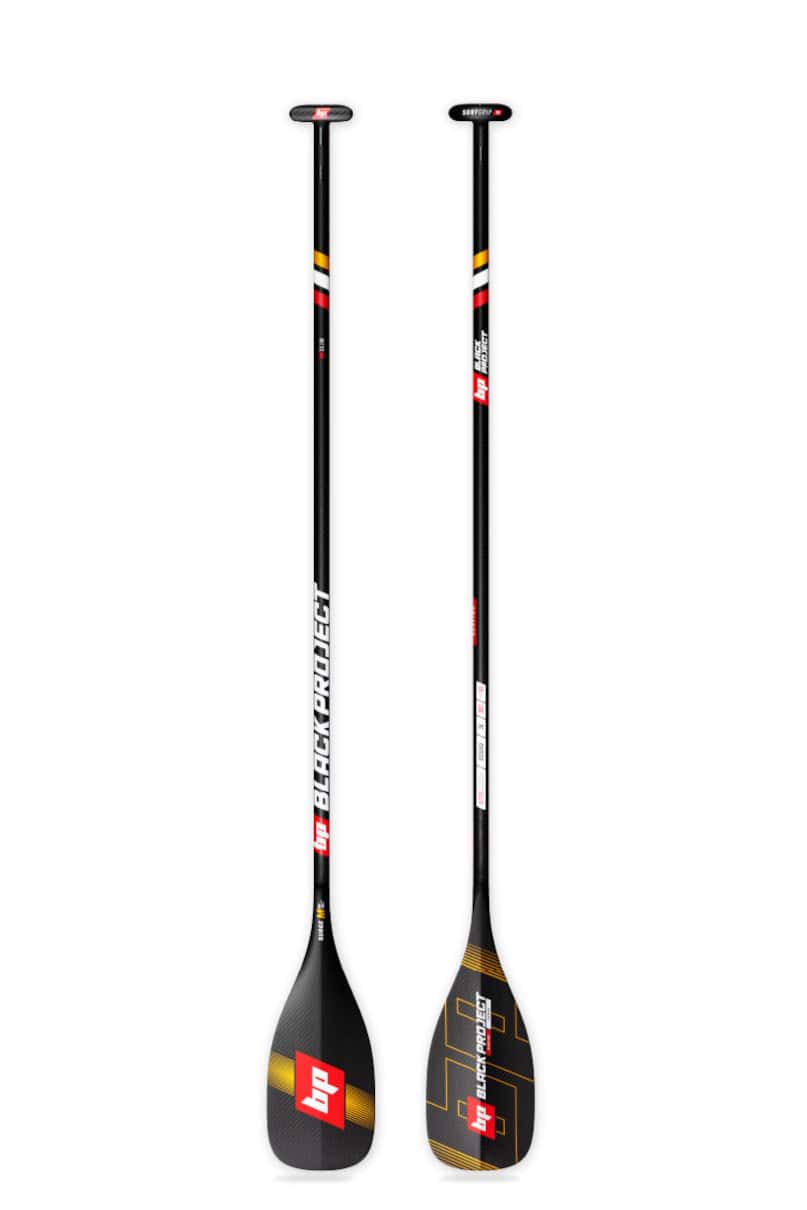
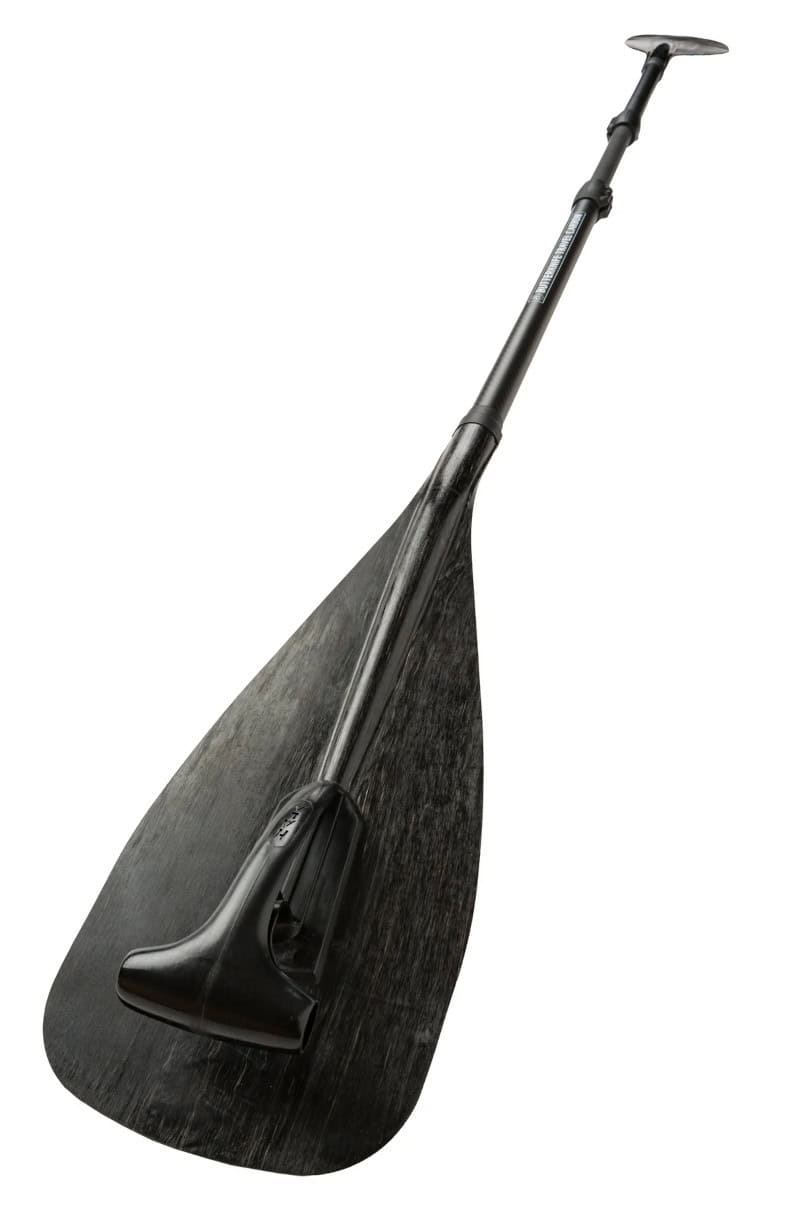
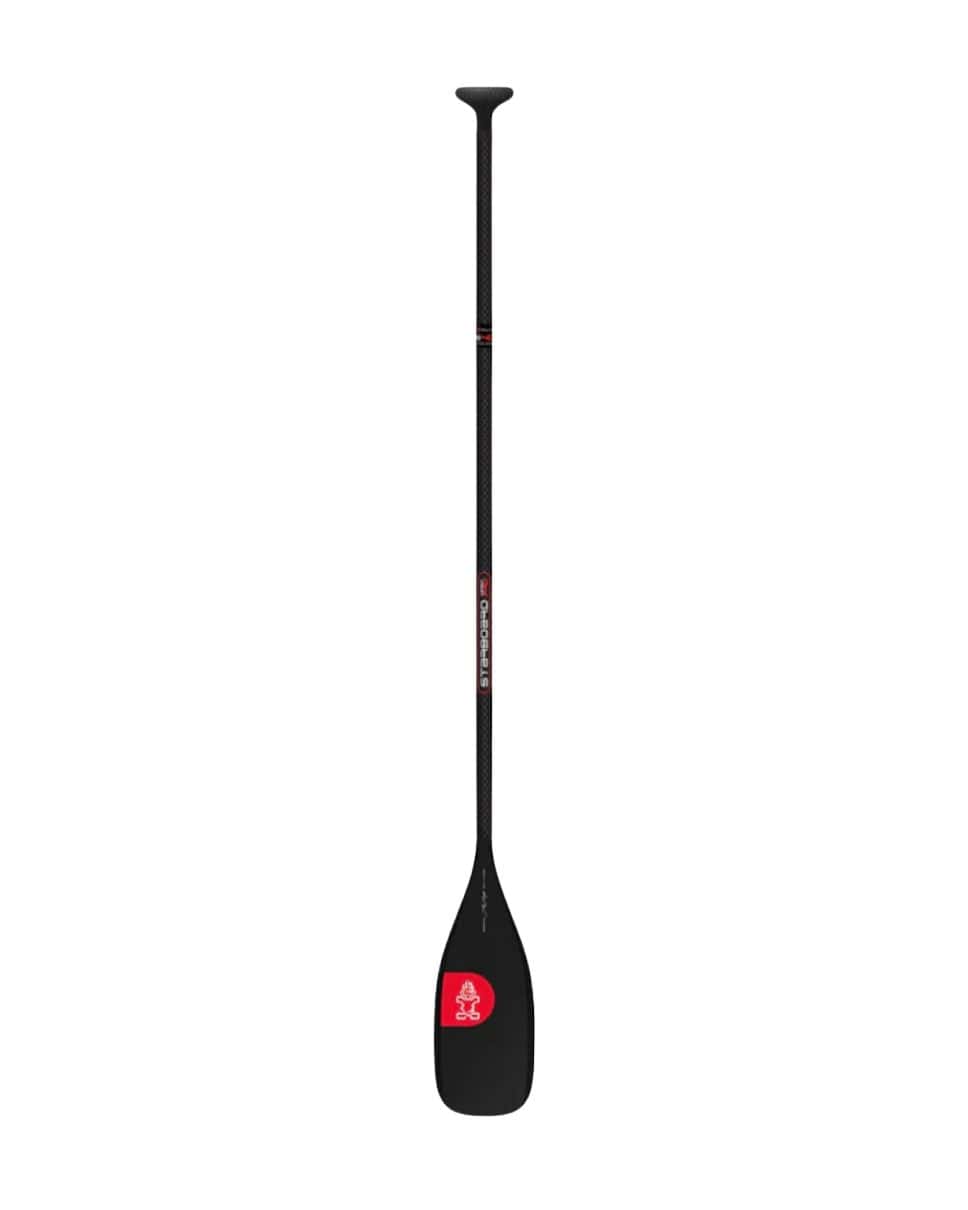
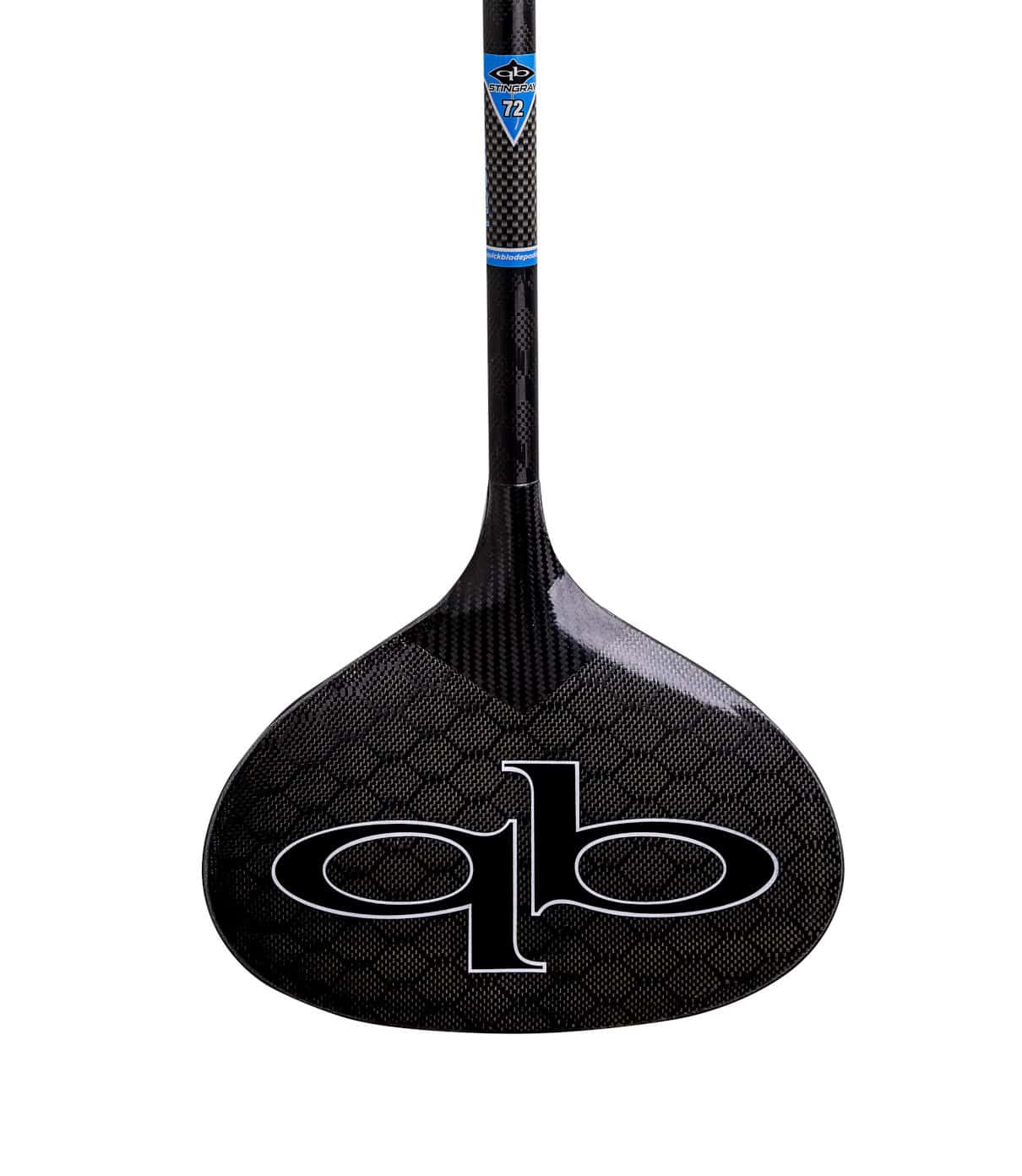
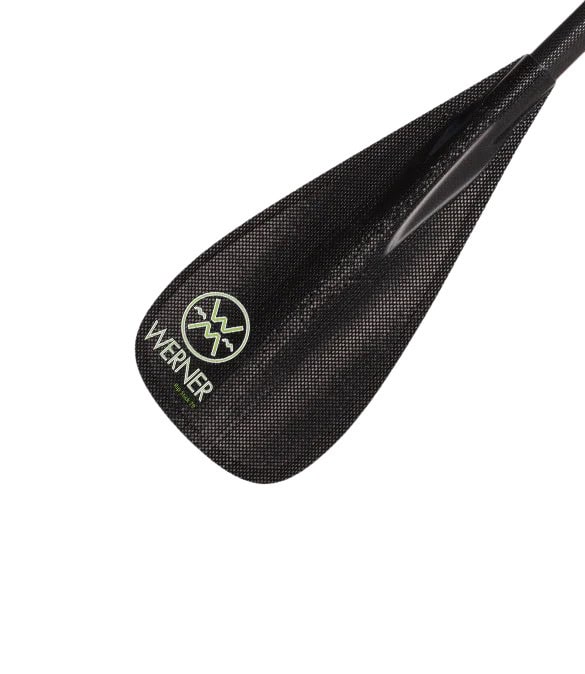
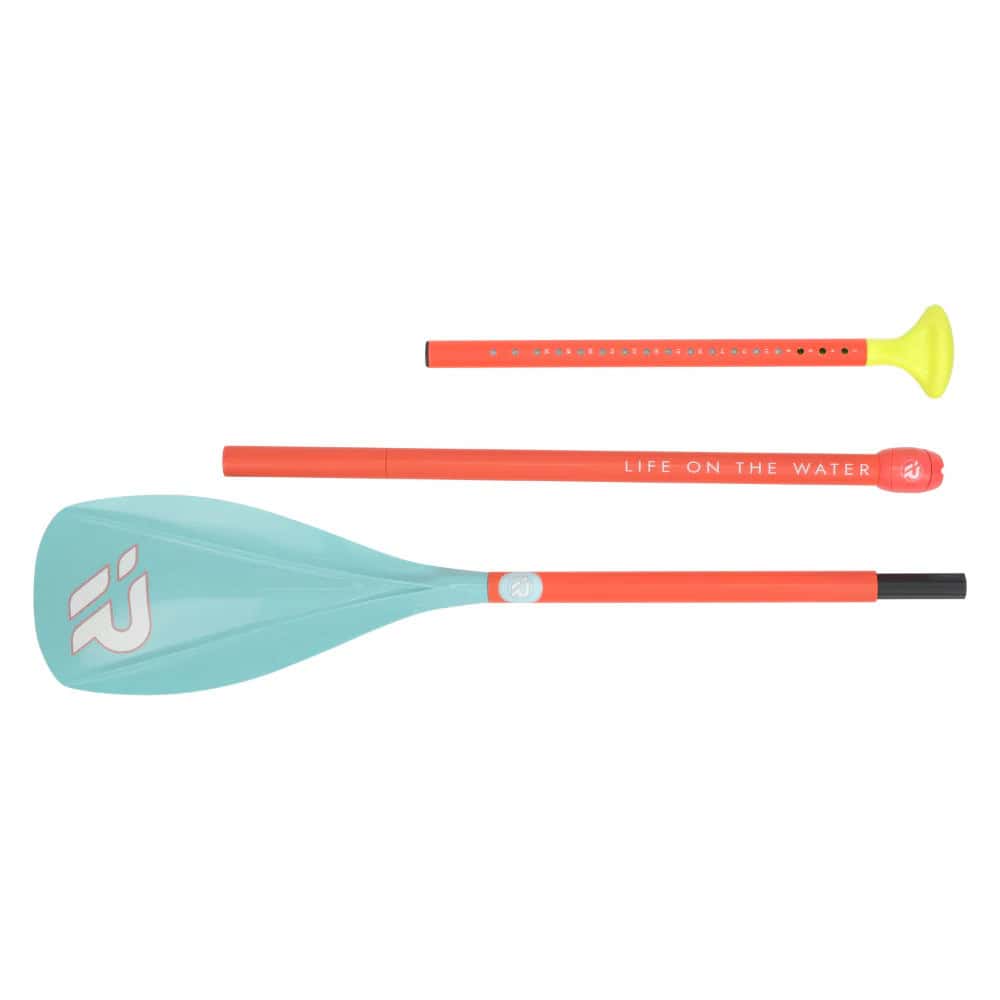



 This article was published in Issue 73 of Paddling Magazine.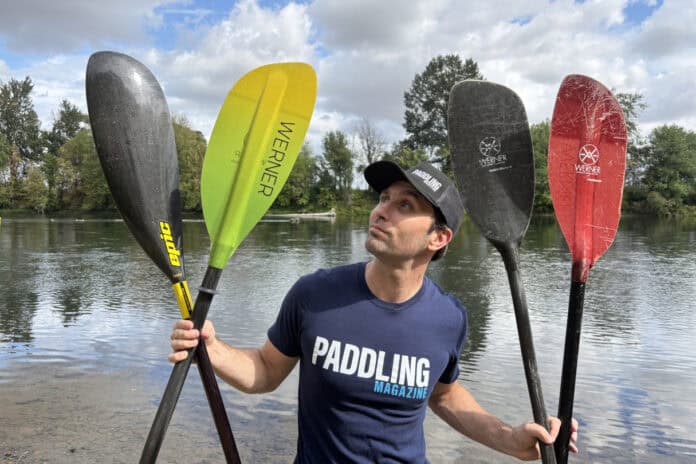
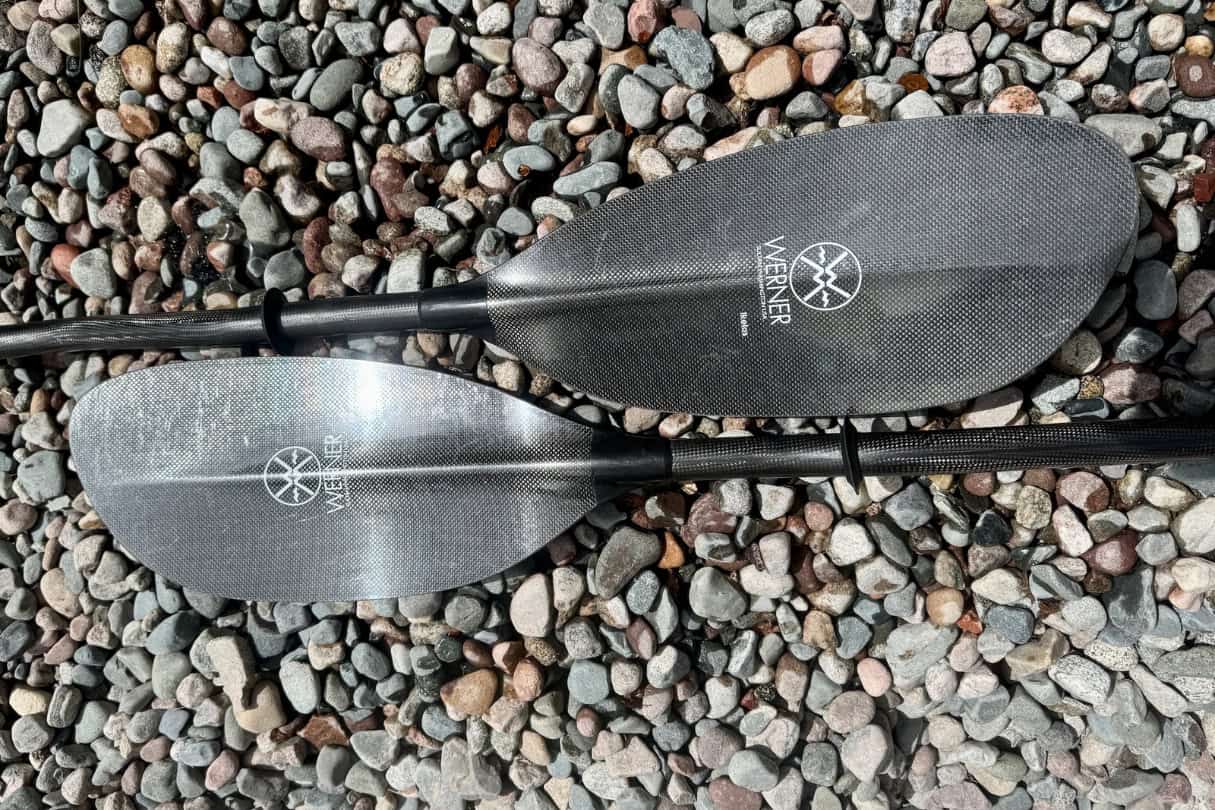
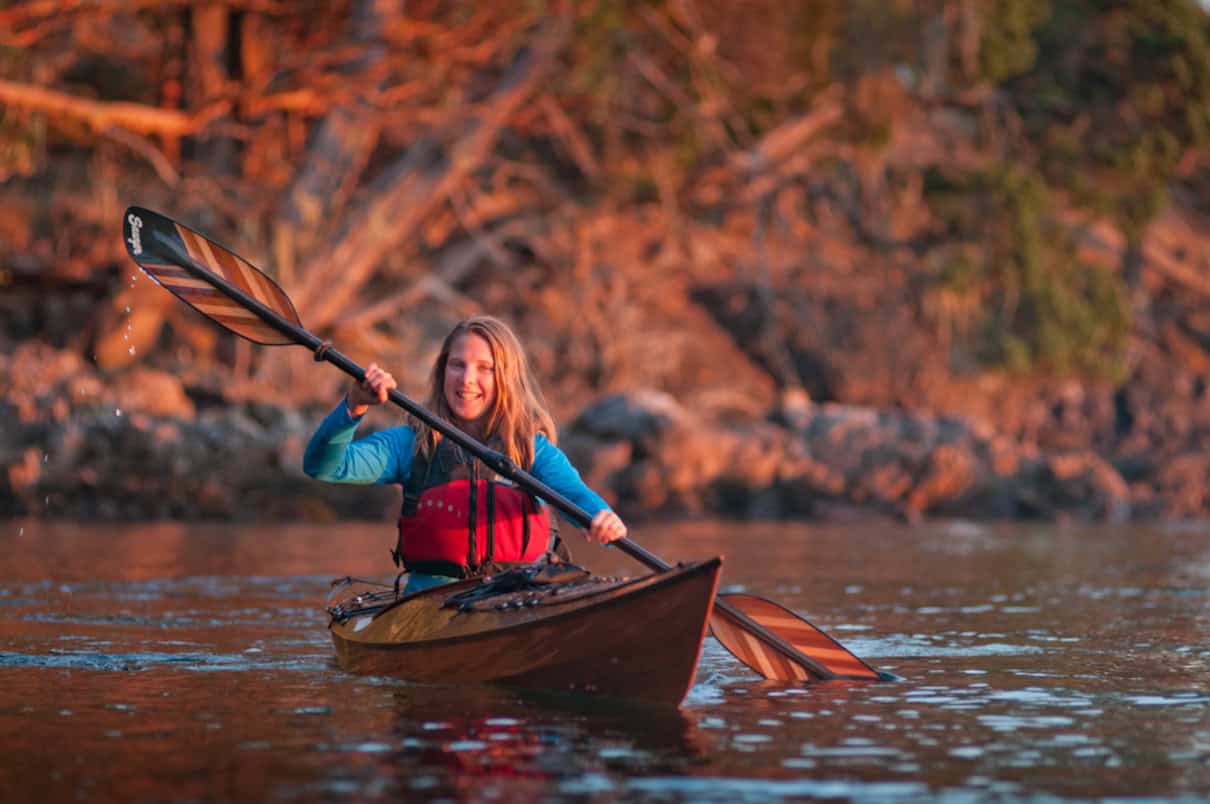
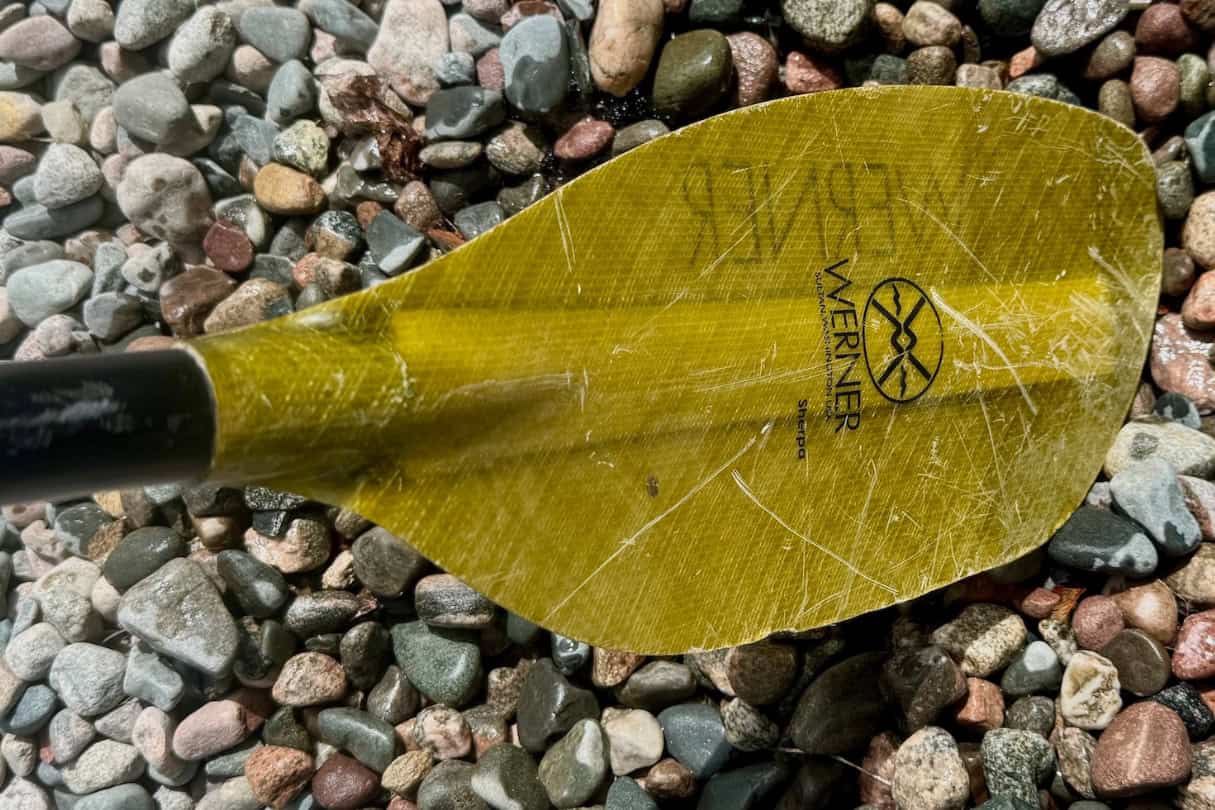
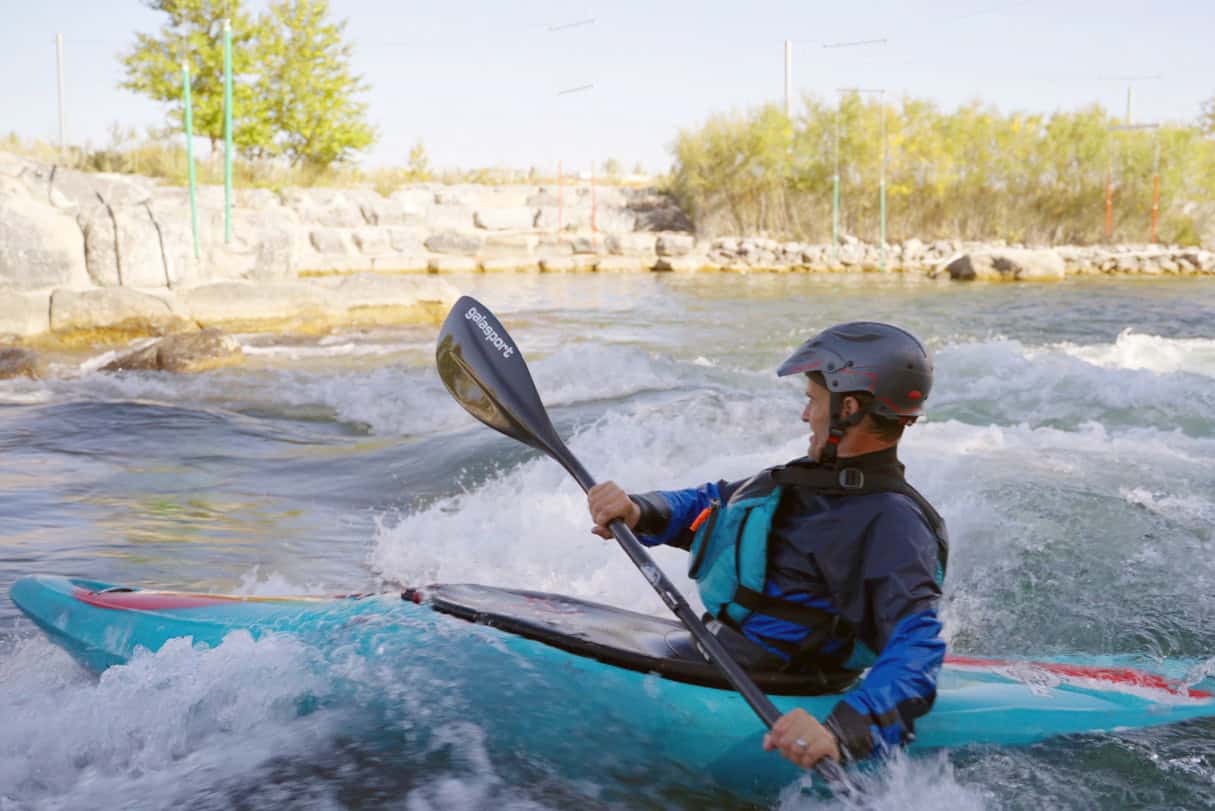
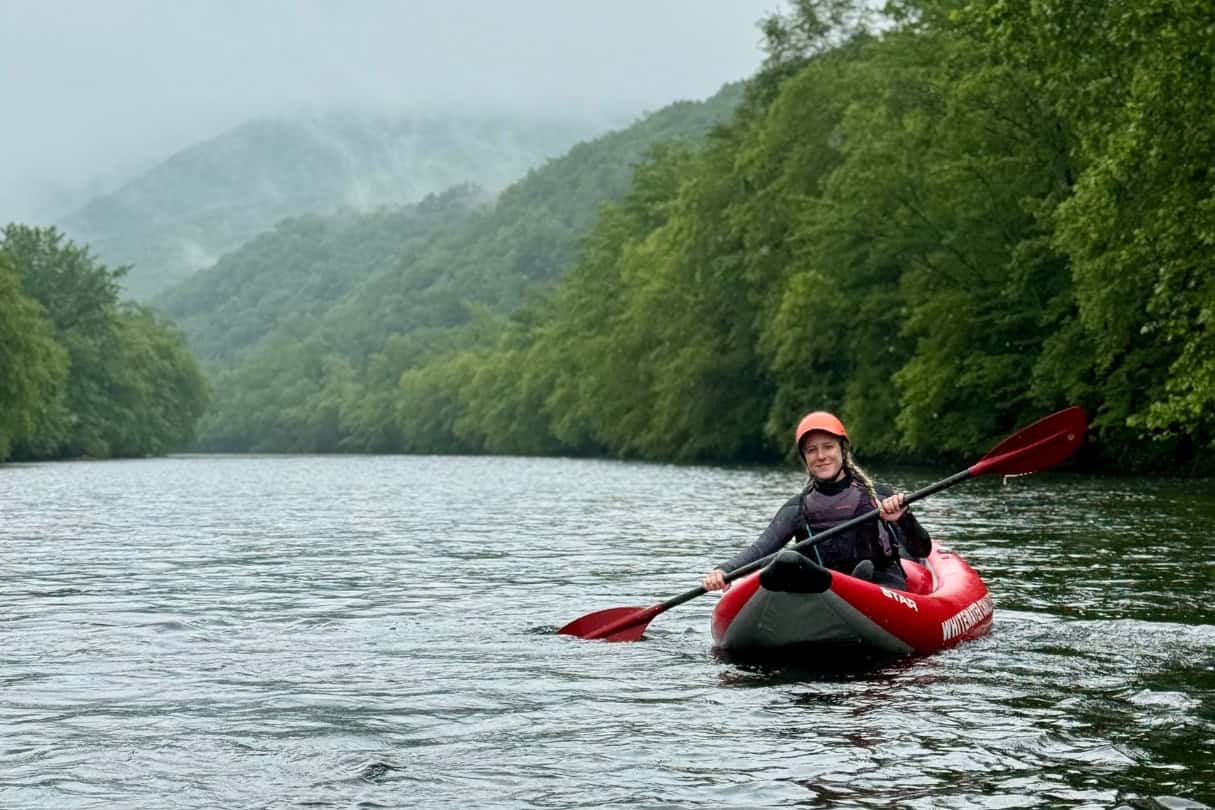
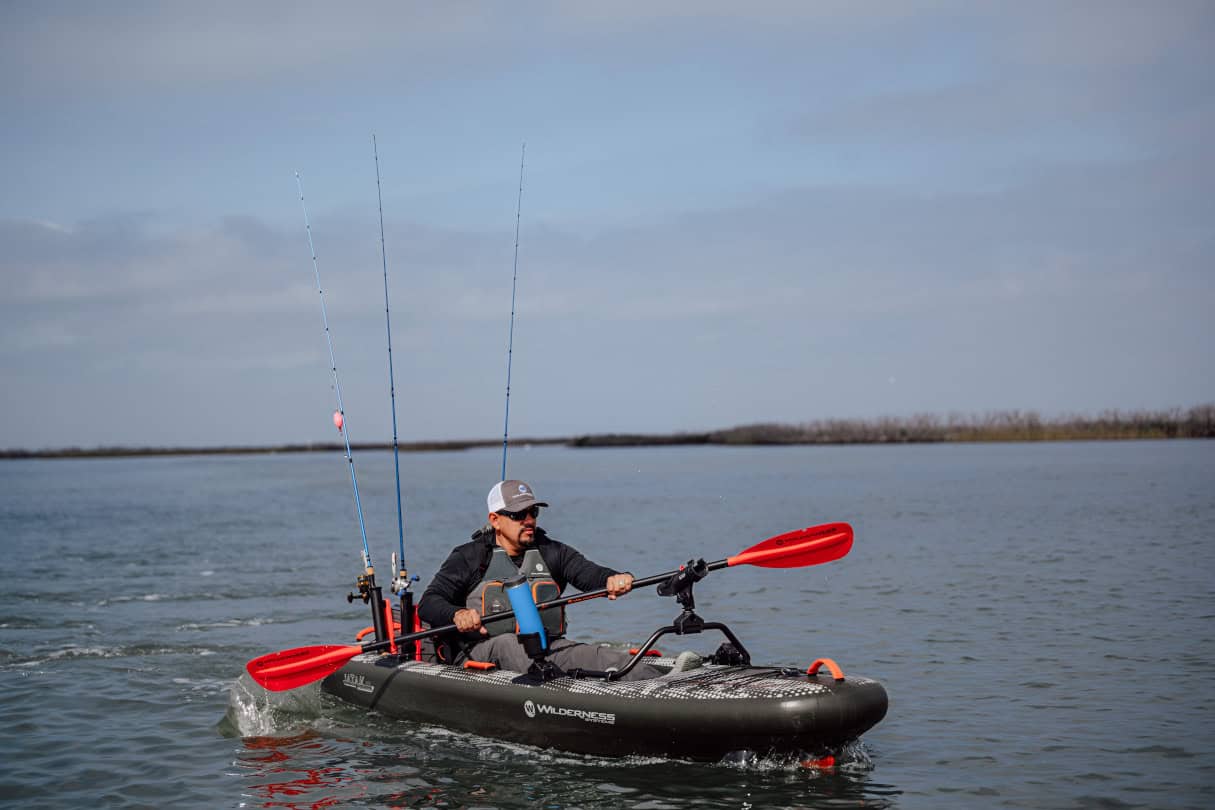
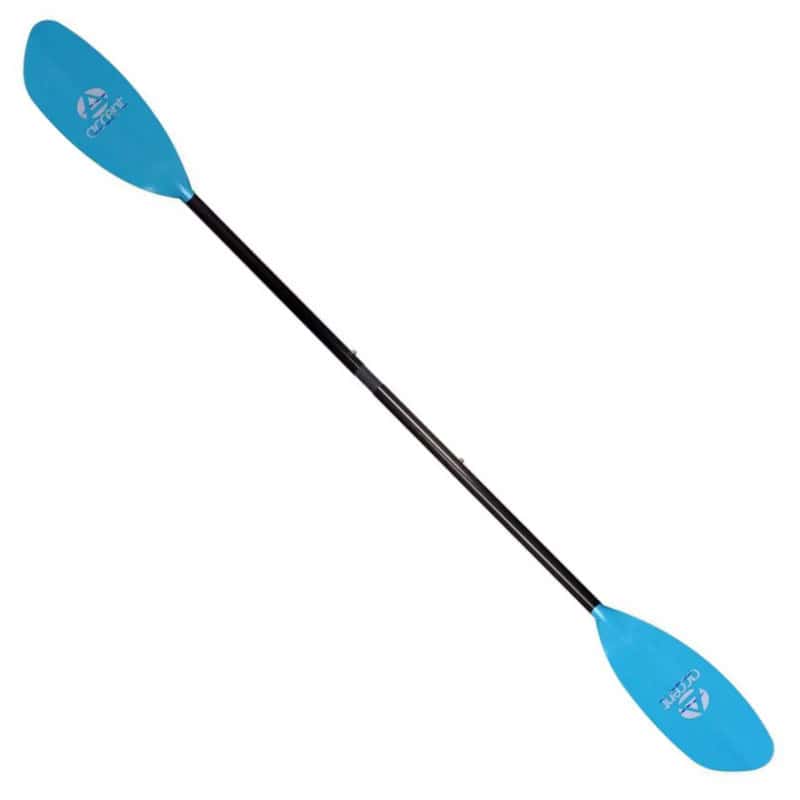
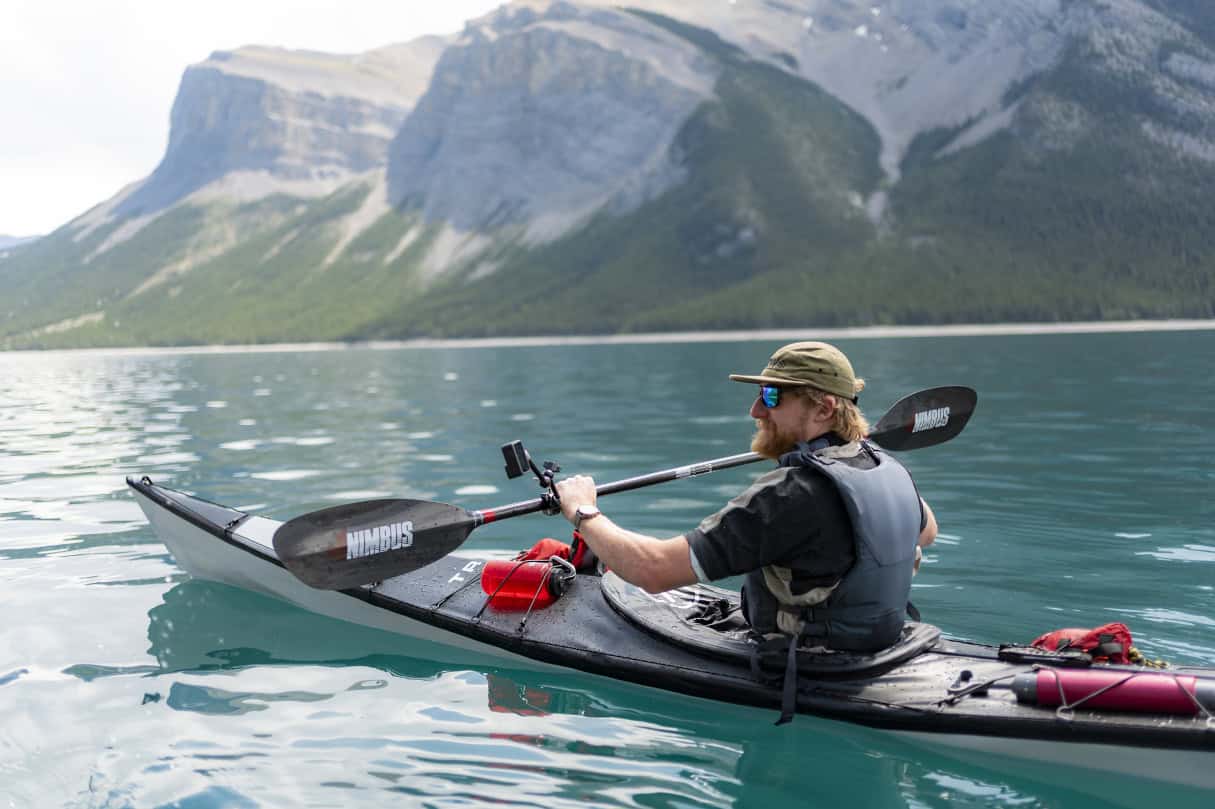
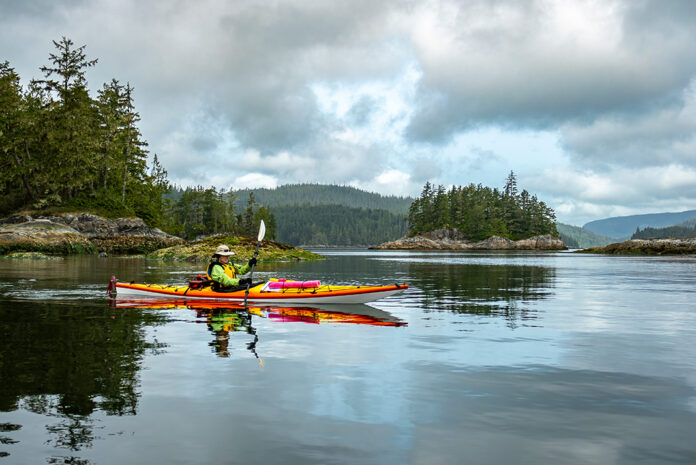
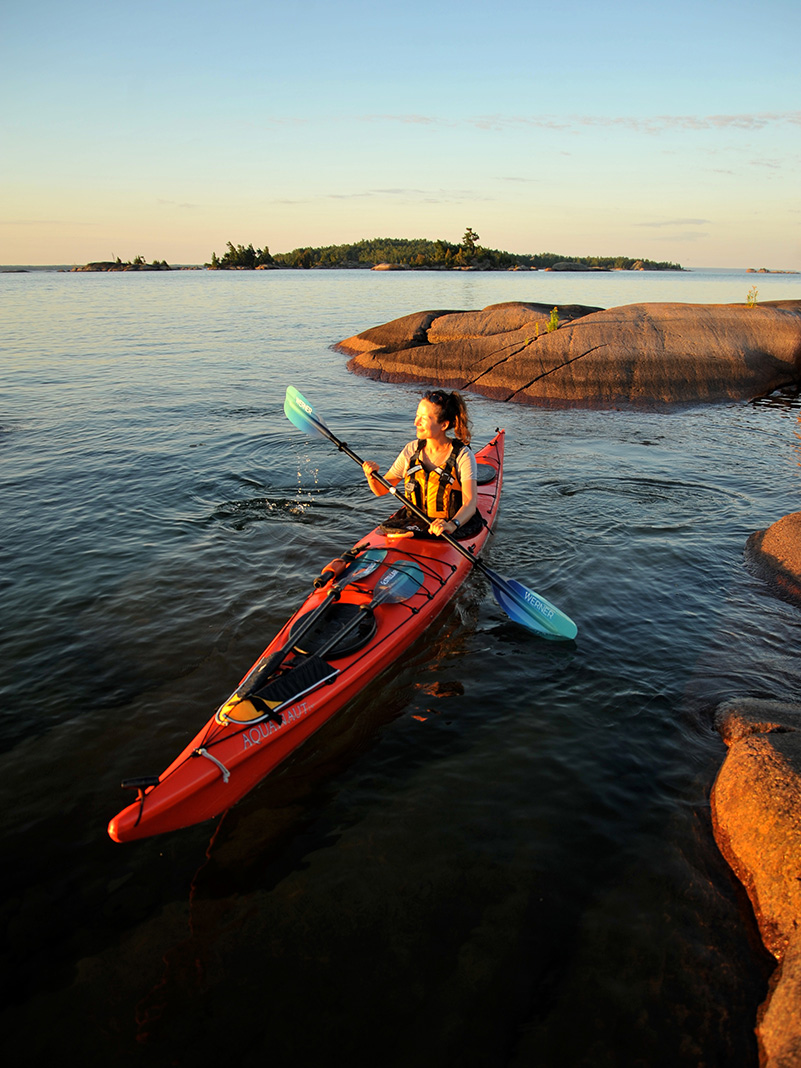
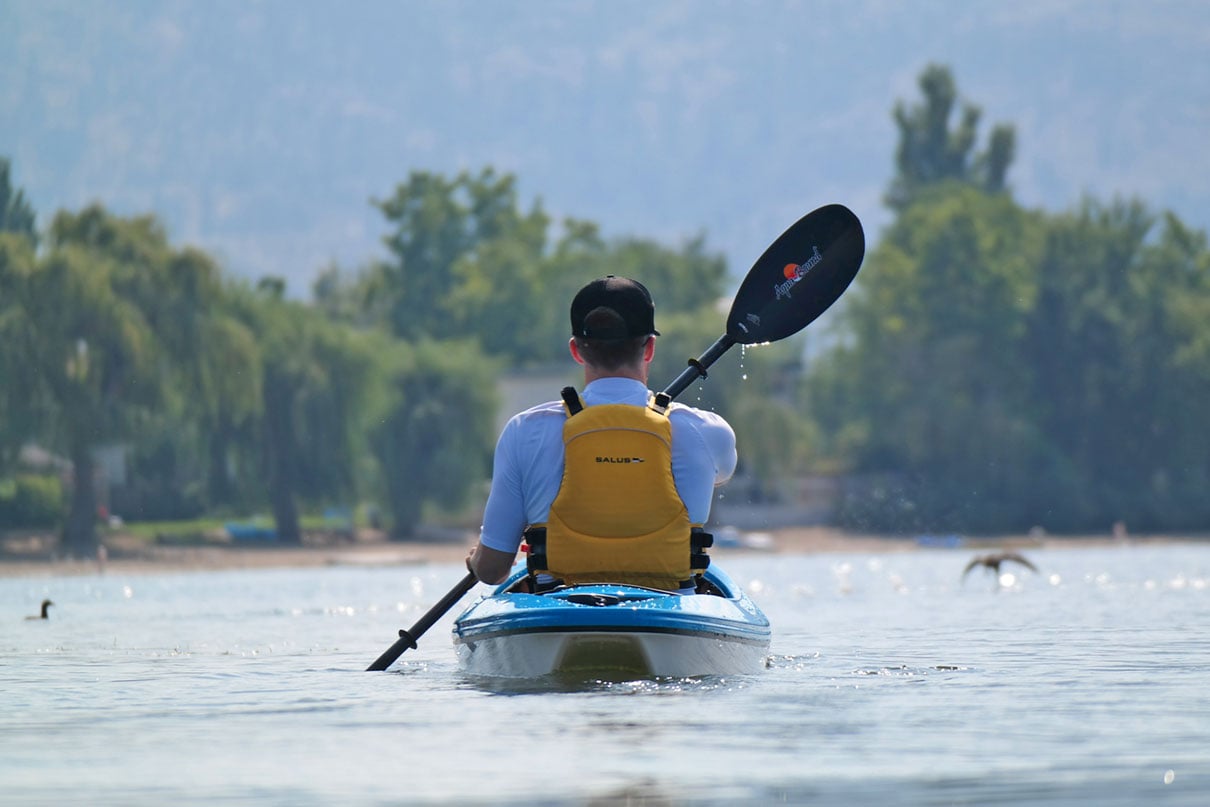

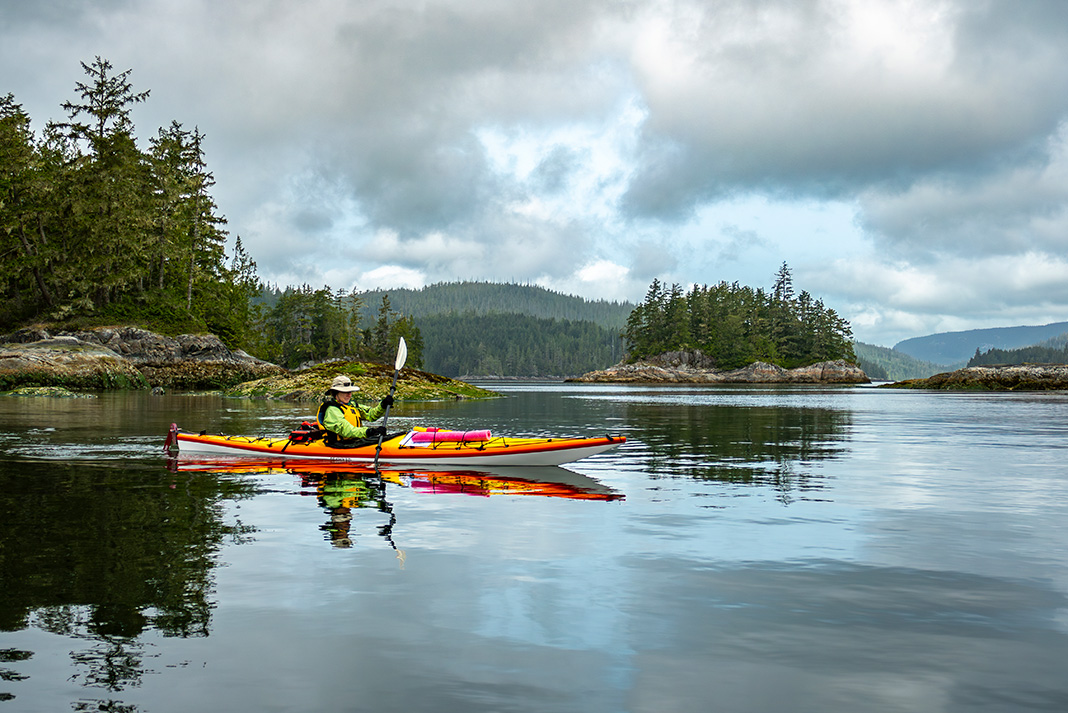
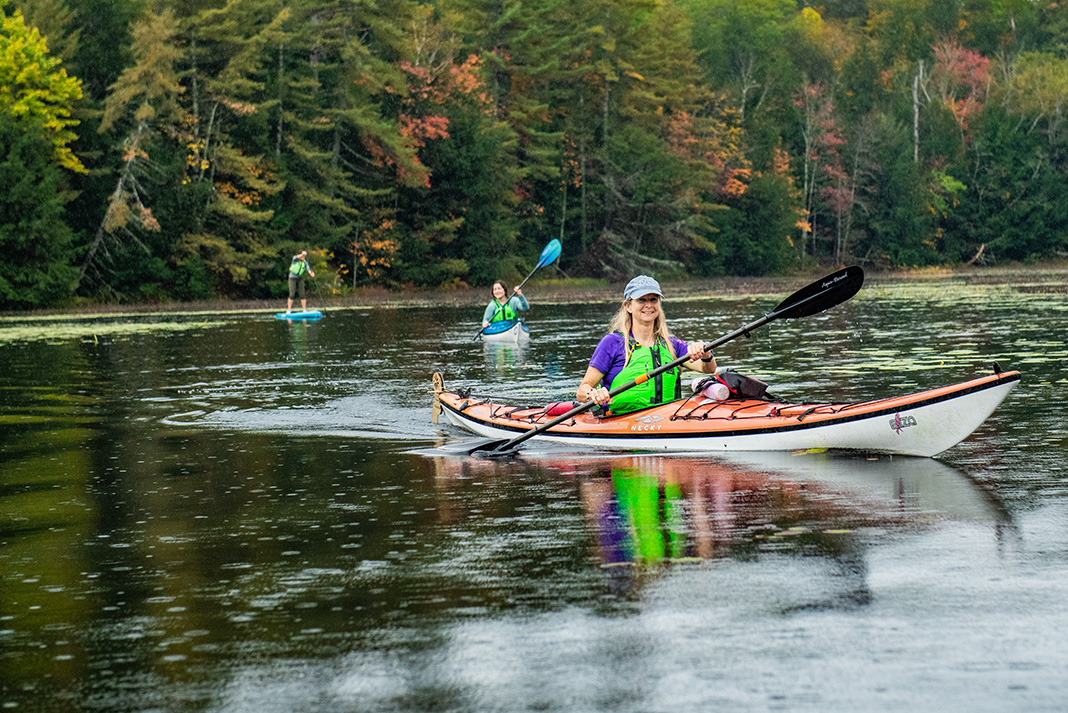
 This article was first published in the 2023 Paddling Buyer’s Guide.