Home Blog Page 203

Chris Vermeulen Builds DIY Paddleboard Jet Drive

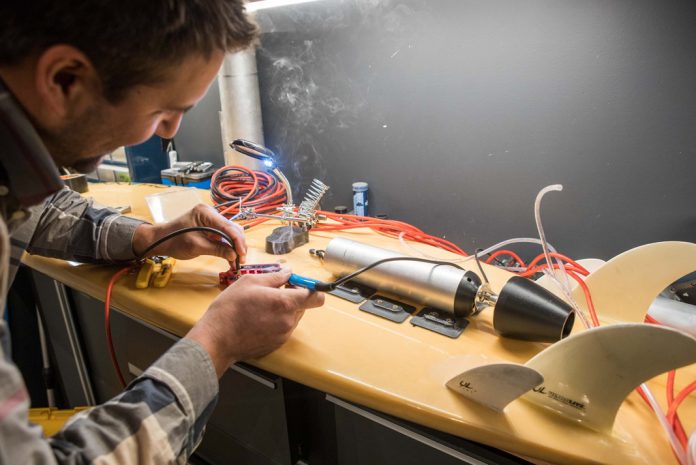
man putting a motor on a paddleboard

Turn Your Next Paddleboarding Excursion Into A High-Speed Adventure. This is the promise Collingwood, Ontario, local Chris Vermeulen is making to his customers with his new invention VeFoil, a bolt-on jet propulsion system for surf and paddleboards.

Vermeulen has always been a tinkerer. As a kid he built a dirt bike, a go-cart and remote-controlled airplanes. Now 37 years old, his latest creation is set to take the e-surf world by storm. His successful Kickstarter campaign raised more than $2,000 in the first 36 hours. And now, with 100 backers, he’s raised more than $7,000. One look at his project and it’s easy to see why he’s succeeding;

Chris Vermeulen’s paddleboard jet drive

Vermeulen Is Creating Something Anyone Who Has Ever Stood On A Surf Or Paddleboard Has Only Dreamed Of. I want to create a propulsion system, which will attach to the bottom of any SUP and any surfboard, with a bracket system so you can bolt it on to any hydrofoil,” says Vermeulen. “It’s a remote control jet drive.

His prototype features a 12-horsepower motor powered by LiPo batteries, though the production model uses lithium ion batteries. Among the numerous hurdles while bringing his dream to fruition has been the controller—no company was manufacturing a decent waterproof remote control to throttle up or down engine speed.

Working alongside an ever-growing team of local tinkerers and paddlers, including Ian Brown, Simon Fischer, Pedro Monsalve and Miles Hammond, they solved this problem by designing and beginning to manufacture the first commercial, floating, waterproof trigger-style remote. It’s a piece of kit the e-surf world is excited about and may turn out to be the most successful part of Vermeulen’s venture.

Since the entire kit can mount to just about anything, top speeds of the finished product will differ. Vermeulen believes the top speed of a paddleboard with the VeFoil will be about 30 miles an hour and the battery will last 30 to 60 minutes, depending on what it’s mounted to.

Vermeulen created his jet drive to catch the surf

One Of Vermeulen’s Big Gripes With E-Surf Boards Is You Can Never Truly Catch A Wave With Them.

“When you catch a wave with an electric board, unless you throttle the board perfectly, you’re either falling back off the wave from the propeller resistance, or you’re shooting in front of the wave,” he says. So he designed a system when the throttle is off, the nozzle will close. Allowing you to catch a wave with the motor, shut the motor down, surf the wave, then power up to get out of the wave.

As a DIY kind of guy, Vermeulen’s final product will be a bolt-on kit retailing for about a tenth of what a full production model, like competitor Lift eFoil, is going for.

The whole plan we’re working on is to try to build it with stock parts,” he says. “We order bulk motors, bulk computer systems, get everything pre-programmed with all our settings, we’ll put on special plugs, so it’s plug and play. It’s a DIY kit. I’ll put the kits together and say, here they all are, here’s the instructions, here’s the video clip. Bolt it together, plug in the battery and you can transform any of your rides.

“We’re hoping it’ll retail for about $1,750 USD,” says Vermeulen. “That’s the goal, but we won’t know until we’re totally done.” Final testing is ongoing, with the entire kit available for shipping late this summer.
A Paddleboarding Mission Down The Grand River

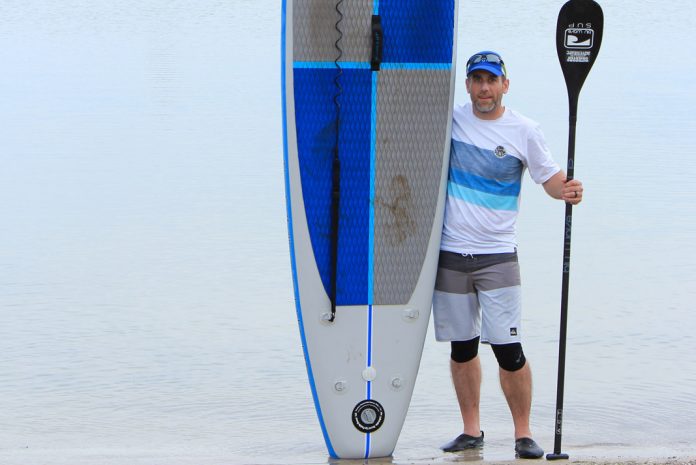
Dan Dakin holding up a paddleboard and paddle

It’s a riddle. What do you call a treasured waterway with no defined beginning, a very distinct end and many personalities along the way?

It’s a source of food for many, recreation for others, and untold tragedy for some. It’s within an hour’s drive of millions of people, yet few ever dip their toes into its ever-changing waters.

The answer to this riddle is the Grand River – A scenic and varied estuary flowing nearly 280 kilometers southeast, from rural Grey County to its outlet at Port Maitland on Lake Erie. Also known as O:se Kenhionhata:tie to the Indigenous Iroquois communities living along its shores—named for the watershed’s many willows—the Grand is the longest river entirely within Ontario’s boundaries.

Because its headwaters start with shallow ditches around Dundalk, the section worth paddling runs from Belwood Conservation area more than 220 kilometers to Lake Erie. At that distance, and with a fairly brisk flow, the Grand River can be paddled over a long weekend if you’re ambitious.

My introduction to the river came as a teenager when I attended a summer camp in the quiet town of Paris. The campground was located across the street from the river, and a quick hike down an embankment brought us to an isolated, shallow section, where we could walk across to the opposite shore during the dry summer months. In my twenties, I kayaked sections of it.

In my late 30s, I took up standup paddleboarding and started racing on it. After a few long-distance races, I knew covering 50 or more kilometers a day was a realistic goal. With 2018 being the year I turn 40, I decided this would be the time to solo paddle one of Ontario’s hidden-in-plain-sight treasures. I circled the May long weekend on the calendar, booked a vacation day to make it a four-day weekend and crossed my fingers for good weather.

An end-to-end paddle of the Grand relies heavily on high water levels, which are rare except in spring and fall. There’s also a risk of the water being too high, which can lead to dangerously fast flows and flooding.

The Grand showed its might in a horrific way last February when a three-year-old boy was swept from his mother’s arms as they tried to escape a vehicle in the river. The boy’s body was found 13 kilometers downriver more than two months later.

Although the flooding had long since subsided, the tragedy weighed heavily on my mind leading up to my chosen weekend. A dry start to May meant traversing the beautiful, but boney Elora Gorge on the upper reaches of the river wouldn’t be safe on a paddleboard. Instead, I planned a 212-kilometer journey, starting at the south end of the gorge.

Of my four boards, I opted to paddle my 12-foot-six inflatable Blu Wave Catalina, which offers excellent balance and quick handling, as well as straight-line efficiency for covering distance. I used both a 4.5-inch and an 8-inch flexible fin, switching between the two depending on the depth and flow of the section of river I was in.

The rest of my kit included an older carbon paddle I was willing to risk damaging in exchange for its weight savings, as well as a PFD, helmet, two-liter Camelbak hydration pack and quick-release leash.

While it was a solo endeavor on the water, my wife volunteered to be my one-person support crew, supplying me with lunches, water refills and encouragement. Her support extended to driving me to camping locations each night, removing the need to paddle with days of food and camping gear. With my four-day plan requiring an average of more than 50 kilometers per day of paddling, I knew it needed to be a supported journey or nothing.

[ See the largest selection of paddleboards in the Paddling Buyer’s Guide ]

On the first morning, I pushed off on the Grand just after 10:30 A.M, and I was quickly reminded of what makes this river so special. I went from paddling easy rapids to calm, flat water passing a group of artists painting the lush green landscape from shore. Soon after, I passed under the oldest wooden covered bridge in the country, found in the quiet hamlet of West Montrose, population 267.

There are nearly a dozen dams and weirs along the length of the Grand, but only six had to be portaged. Leading into the town of Paris on the second day, an unseen rock in shallow water tossed me off the board and I was swept through shallow rapids.

On my third day on the river, the fast-flowing waters of the Grand slowed and my arms and shoulders started to feel the distance behind me. The river turned east toward the quiet First Nations lands around Ohsweken and Caledonia. I encountered motorboats for the first time, changing the dynamic and feel of the river.

[ Plan your next paddling adventure with the Paddling Trip Guide ]

With just 43 kilometers to complete on the fourth and final day of my journey, I was paddling under beautiful sunny skies when I spotted a pair of bald eagles soaring overhead. They were just one of many bird species I witnessed along the route, but certainly the most majestic.

Plenty of motorboat traffic greeted me as I neared the river’s outlet at Lake Erie. As I paddled past dozens of fishermen along the pier and rounded the lighthouse that guides ships in Lake Erie, I felt a sense of euphoria knowing that the journey was complete. After more than 28 hours of paddling and 212 kilometers covered, I arrived at the end of my journey.

I was tired, sore and ready to be done, but my love of the Grand River had only grown. It’s a river steeped in history, and one that can flex its muscle with sometimes tragic consequences. And yet, its many personalities means that anyone with a board, canoe or kayak will find a section to enjoy.

Paddling addicted journalist Dan Dakin worked as a sports reporter for 12 years before becoming a freelance writer. He races on his paddleboard whenever he can.

8 Essentials For SUP Expedition Racing

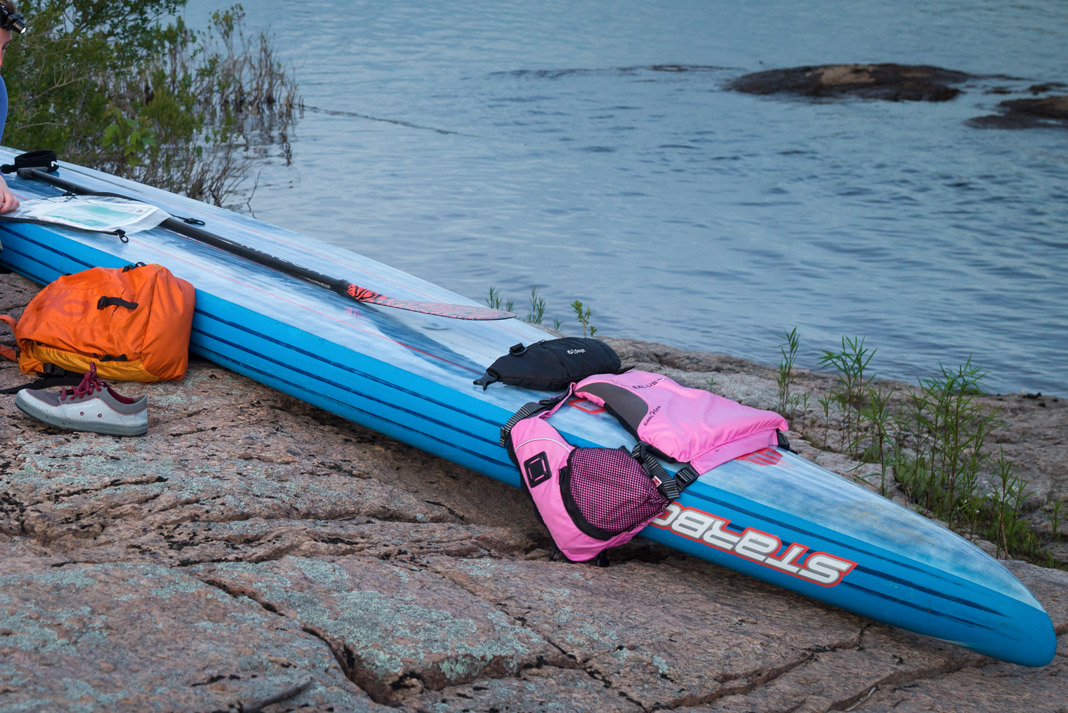
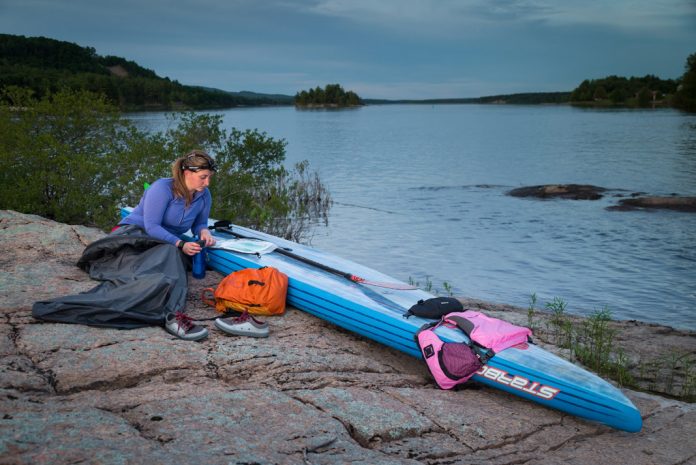
woman surrounded by paddlboarding gear

Relying On The Right Gear Allowed Me To Race A Total Of 367 Kilometers In Expedition Paddleboarding Races Last Summer.

Successful expedition racing requires technique, endurance, navigation skills, strategy and sometimes a bit of luck. In most races—which range in length from the Muskoka River X’s 58-kilometer Sprint class to the sprawling 715 kilometers of the Yukon River Quest—most paddlers are set first and foremost on just getting to the finish line, rather than reaching the podium. Take a peek inside my kit to discover what to look for in the eight essentials every expedition racer needs.

1. PFD

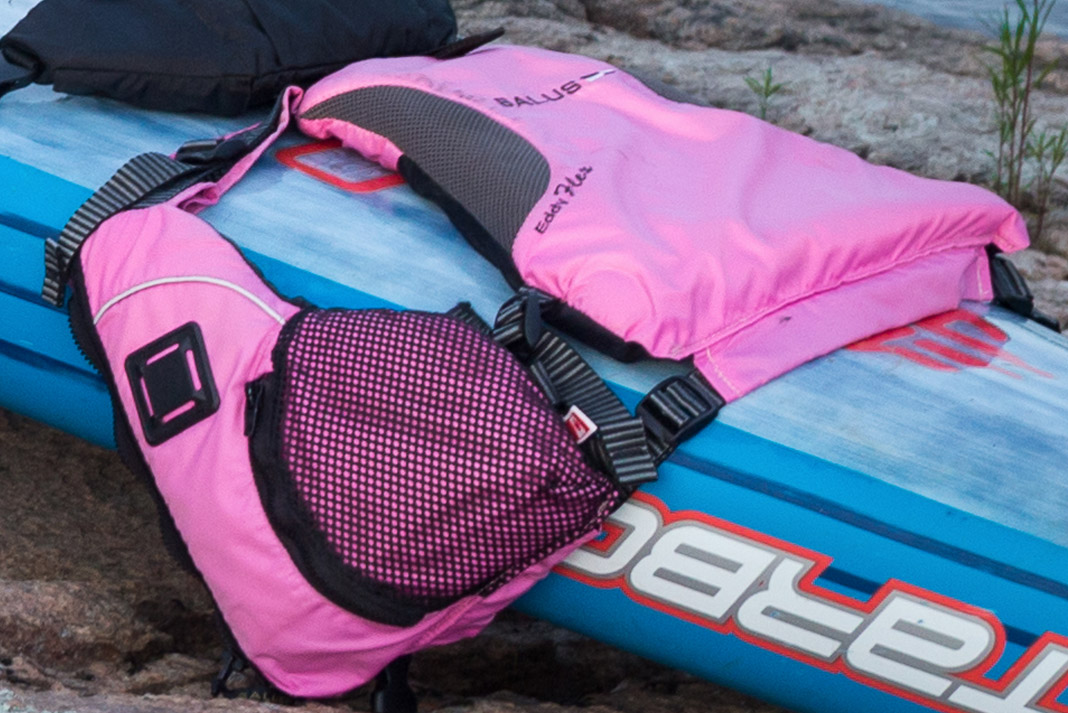
pink pfd
PFD. | Photo: Philip Quade

An inherently buoyant PFD is usually mandatory in expedition races and often better suited as many courses include swift current. Look for a low-profile vest to ensure your life jacket isn’t restricting freedom of movement. In my opinion, the more storage the better—a front zippered pocket can stash all sorts of goodies, including a whistle, water purification tabs, snacks or energy gels. Opt for bright colors—pink, red, orange, yellow—for optimal visibility on the water.

Eddy Flex PFD | 119.00 | www.salusmarine.com

2. Paddleboard

paddleboard covered in gear
Paddleboard. | Photo: Philip Quade

A great SUP expedition race paddleboard marries speed and stability. It’s typically 14 feet in length and has enough volume to support the added weight of your mandatory gear. “Many people convert their race boards to touring race boards,” says expedition racer and SUP instructor Norm Hann.

“Most of those race boards do not have gear attachments points, so you have to add them on and figure out for yourself where the weighting is best for gear.” One size never quite fits all, but Hann recommends a narrow racing board to maximize speed, between 25 to 27 inches depending on the paddler’s stability and comfort.

Starboard All Star | $3,799 | www.star-board-sup.com

3. Bivy

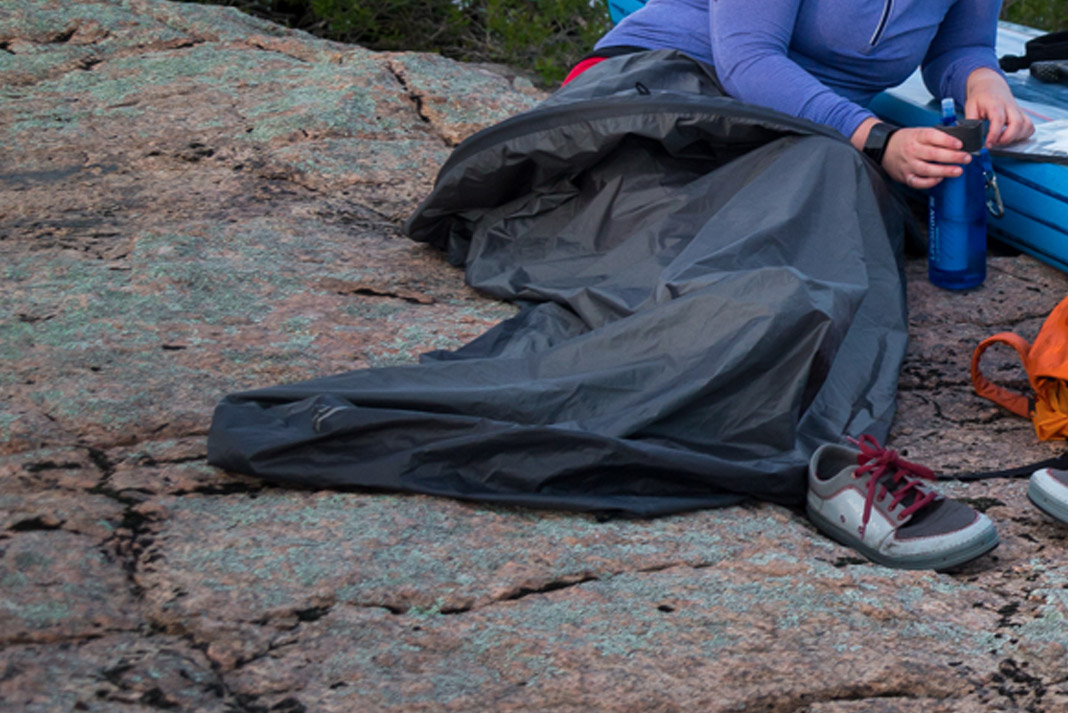
black ivy
Bivy. | Photo: Philip Quade

An emergency shelter is gear you must bring, yet hope never to use. It’s mandatory equipment for most expedition races over 24 hours. In an emergency or if the weather takes a turn for the worse, you may need to seek shelter. Packing a lightweight, compact, waterproof and durable bivy is key to being self-sufficient and protected from the elements. Choose breathable and ultra-lightweight fabrics featuring fully taped seams.

Helium Bivy | 18 grams | $179 | www.outdoorresearch.com

4. Footwear

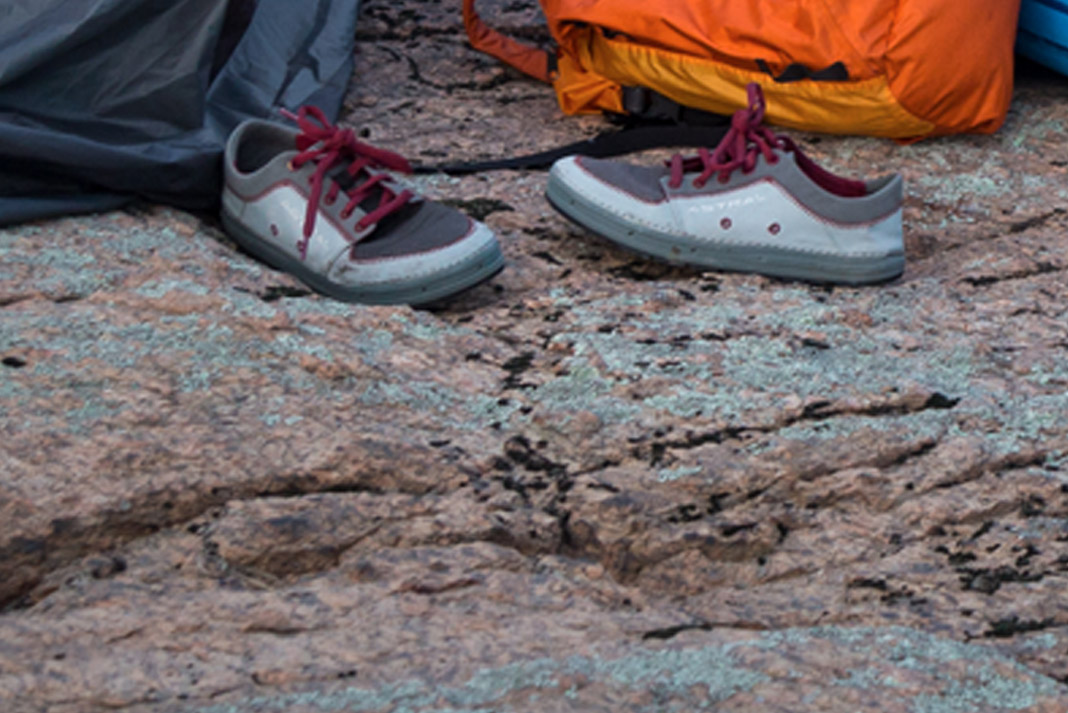
grey shoes with red laces
Footwear. | Photo: Philip Quade

“Don’t your feet get tired from standing all day?” Give your dogs a break with racing footwear maintaining comfort, warmth and a good connection to the board. Expect to be walking through water and over rocks during portages, and select a closed toe shoe with a grippy rubber outsole. Depending on the season, opt for materials that will dry quickly and keep you warm, such as hydrophobic canvas or neoprene.

Astral Brewer | $99.95 | www.astraldesigns.com

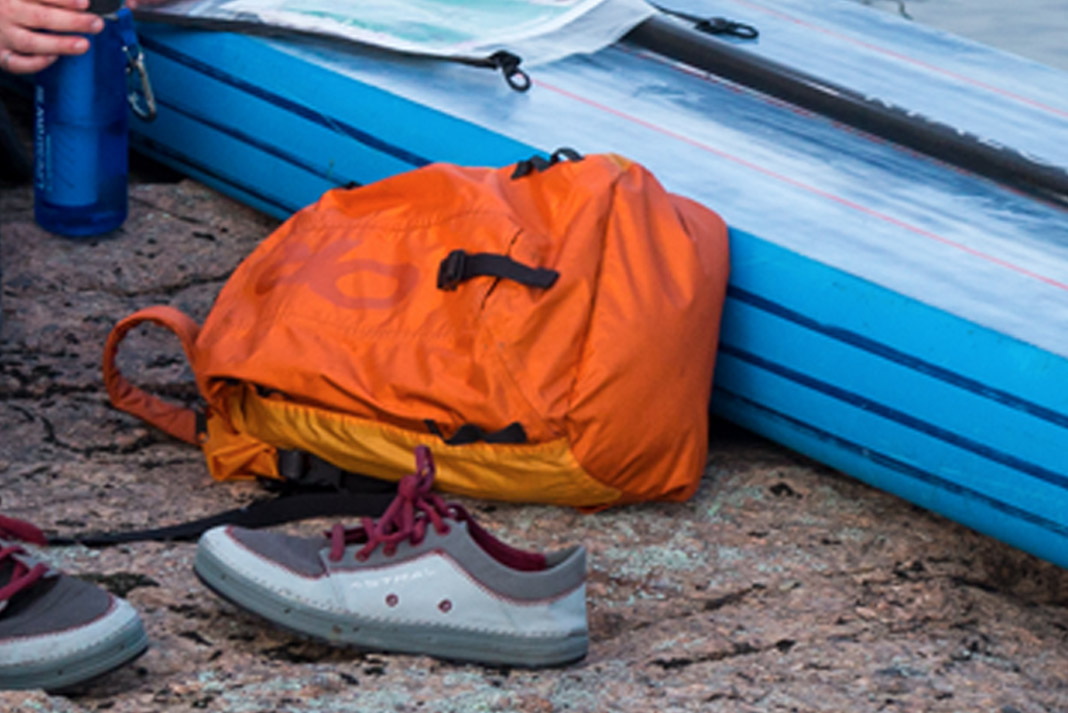
5. Drybags

orange dry bag
Drybags. | Photo: Philip Quade

Keep your kit organized and protected with a drybag. Look for one with 30 to 40 liters of volume—enough room to store your gear during the race, without the opportunity to overpack and weigh down the board. You’ll appreciate backpack straps on portages. An external pocket will help optimize efficiency, allowing for quick access to gear you want to keep close at hand, like Snickers bars.

Dry Payload Pack | 32 liters | $149 | www.outdoorresearch.com

6. Timing

A watch for expedition SUP racing must do more than tell time. Look for a timing device with distance tracking in order to follow your route and locate portages. A watch displaying calories burned is useful for monitoring nutritional intake requirements and managing energy levels. A pace function is a critical feedback to know if you must speed up to make a checkpoint timing and to understand the effects of current and wind on performance. Ensure your watch is water resistant and has sufficient battery life.

Garmin Vivoactive HR | $200 | www.garmin.com

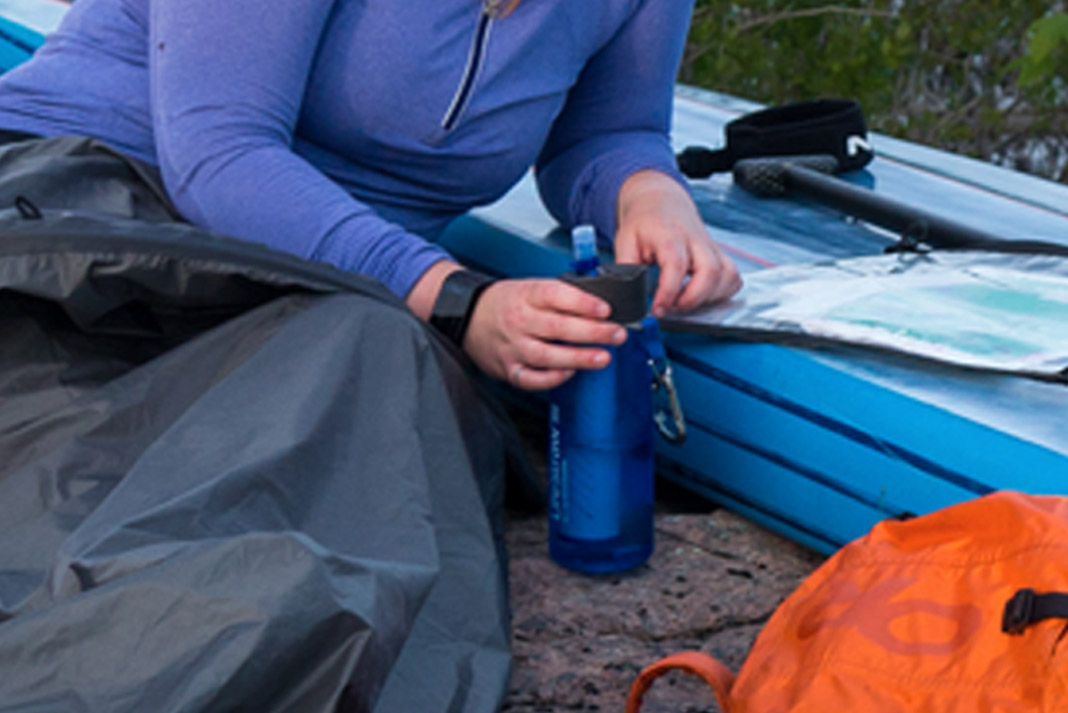
7. Hydration

woman wearing watch holding blue water bottle
Timing and hydration. | Photo: Philip Quade

Staying hydrated for the long haul requires a few key pieces of kit to work together as a system. A hydration backpack allows for easy access to drinking water without breaking stroke, while water purification tabs paired with a Nalgene keep carrying weight at a minimum and cover resupply. Though less conventional, I prefer a LifeStraw filtration bottle because I can reach over the side of my board and fill up at anytime and then drink without having to wait for a chemical treatment to take effect.

LifeStraw Go | $55 | www.lifestraw.com

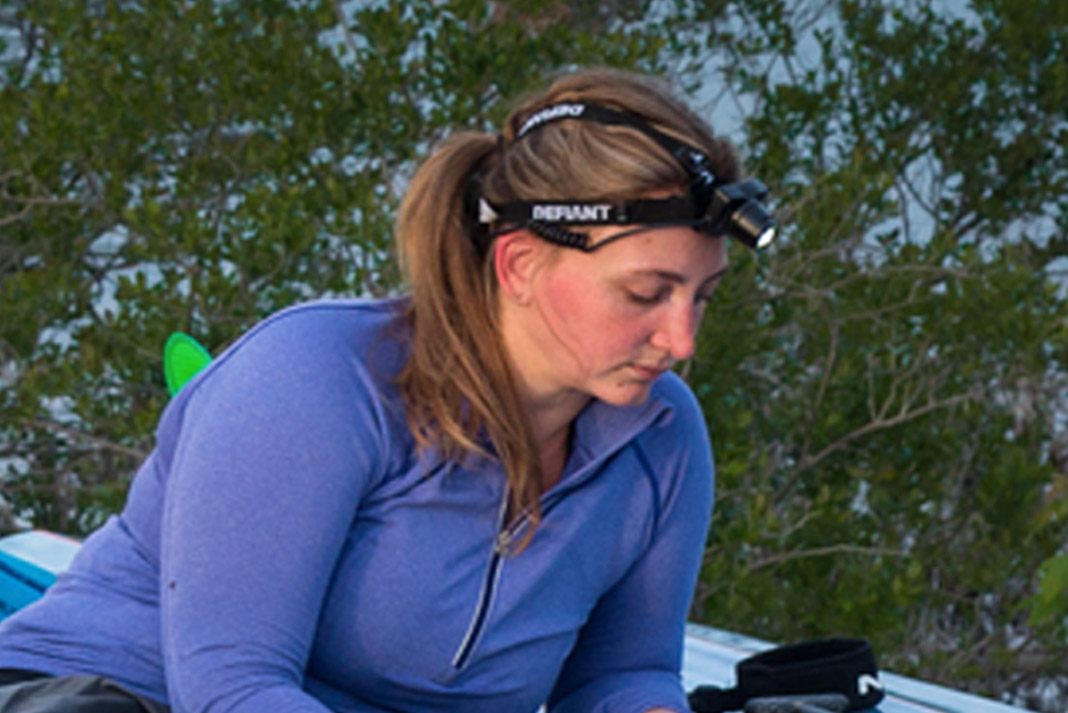
8. Lighting

woman wearing headlamp
Lighting. | Photo: Philip Quade

Navigation on the water and along portages is challenging in the dark. Overnight races will require a bow navigation light, stern signal light, and a headlamp. Choose lighting systems that are lightweight, durable and use LEDs.

Consider the lumens—a measure of how bright the light is—in combination with run time and illumination range. A 150-lumen headlamp works well for camp chores, but you’ll want something brighter for finding portages in the dark. Outfit a red flashing light on the stern of the board for vessel visibility. And remember waterproof lights are essential.

Lupine Piko Headlamp System | $335 | www.lupinenorthamerica.com

Courtney Sinclair is an Ontario-based SUP instructor who competes in ultramarathon paddleboarding races. In 2017 she won the Ontario Ultra Paddling Points Series. She loves cruising waterways of all types, while her dog, Sully, rides shotgun. You can find out more at Court Outdoors.

Do Sea Kayakers Have Bad Judgement?

cartoon of man buying a lot of paddling safety gear

“Which one do you do? With the sling, or without? Are you on your back, or lying on your belly? Do you inflate it first or after?”

Initially, it sounds like this might be interesting kinky talk. But no, it’s sea kayak rescues again.

Sea Kayakers Lust After Safety

Rescues are the hottest topic of sea kayaking conversation by a nautical mile. The number of different techniques is astounding.

Despite all the safety talk, sea kayakers often have surprisingly modest skills, eschewing an emphasis on judgment, conditioning and strong technique in favor of amassing safety gear and studying a near endless litany of rescue maneuvers.

Safety, Apparently, Has Nothing To Do With Good Judgment Or Paddling Skills

It’s all about rescues and rescue gear. From the sounds of it, the best way for me to be safe is to cover every inch of my kayak deck with a sea of international orange rescue equipment. Is it me, or does this seem like slamming the aquarium door after the sea horse has already escaped?

I’d rather invest my time practicing the avoidance of calamities rather than perfecting 20 different rescues to deal with disaster after it has occurred. After all, an ounce of prevention is worth 40 pounds of paddle floats.

Flares, floats, slings, signals, radar reflectors, radios, compasses and GPS units don’t, themselves, actually keep us safe.


Rescue Gear Doesn’t Save People—People Armed With Knowledge And Forethought Save People—Often Themselves. Deep down, sea kayakers know this. After all, we are typically intelligent, older, post-secondary-educated professionals, not 20-year-old, wet-behind-the-ears whitewater punks—who, despite their cockiness, can actually brace and roll in rough conditions.

No, sea kayakers are mature. They live well and reside in desirable neighbourhoods. They drive Volvos and drink mocha-frappuccinos produced by environmentally conscious coffee roasting companies. Sea kayakers have dinner reservations at Le Jardin and opera tickets. Their lives are good. They should be highly motivated not to die.

But Most Sea Kayakers Don’t Find The Time In Their Cosmopolitan Lives To Learn To Paddle Well. Instead, they try to buy safety. And they are abetted in believing they can do this. There’s a veritable raft of rescue gear out there promising to keep them safe, even if they know nothing about kayaks or the movements of the ocean.

So where did this blind faith in equipment and the false sense of security it instills come from?

Perhaps it’s just part of a wider trend in a society bent on effortless accomplishment: find the most corrosive bathtub cleaner on the market so you won’t have to scrub, start a diet starving your body of fuel so you won’t have to be active to burn it off, buy a Volvo (there’s that word again) and be safer on the road without having to slow down or change your driving habits.

Then again, it might have something to do with the fact the vast majority of paddling instruction is offered by kayak retail businesses. This presents a conflict. It’s great a store can offer instruction but don’t expect there won’t be a mandate to sell gear via the instructional programs.

After All, It’s A Lot Easier To Sell A Bit Of Kit Rather Than The Concept Of Conservative Good Judgment. You can’t buy good judgment, you can’t really teach it, and you definitely can’t bottle it for sale. If you could, I’d buy a two-four of it every weekend.

Alex Matthews is the co-producer of the instructional video, The Ultimate Guide to Sea Kayaking.

A Paddling Photographer’s Nightmare

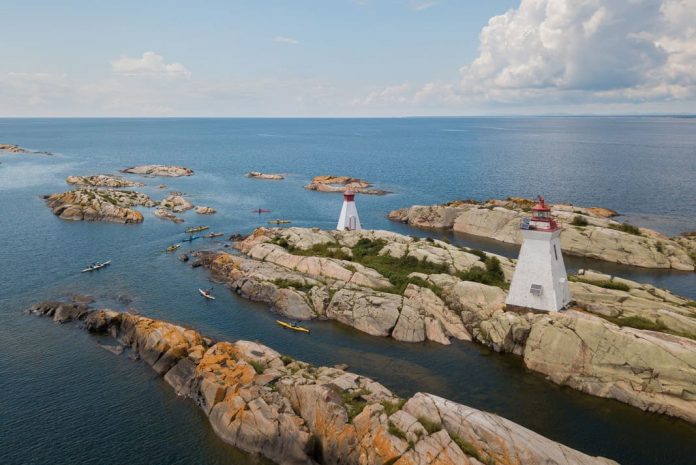
lighthouses on an island surrounded by sea kayaks
Photo: Colin Field

Seconds after taking this shot, I panicked. The screen displaying my drone’s camera view went black. Completely. No battery levels. No GPS. No map. Nothing. I couldn’t see what the camera on the quadcopter saw. In fact, from where I was standing, I couldn’t even see the tiny black speck of the drone in the sky.

While I’ve resigned myself to the possibility of someday losing a drone—it hasn’t happened yet, knock on wood—it was the memory card I was most concerned about. It had on it nearly five days and 10 flights worth of photos on it. Rookie move. Suddenly the $40 memory card seemed more valuable than the camera and rig itself.

[ View all boats and gear in the Paddling Buyer’s Guide ]

This was a trip I’d wanted to take for years. Over several days we’d paddled up the eastern shoreline of Georgian Bay, from Key River to the tiny town of Killarney. I knew this route would be a photographer’s dream.

Every few kilometers of travel rewarded us with new vistas. Islands of grey and pink Shield granite peaked out from the azure blue water, contrasting with the bright orange lichen growing onshore. Under warm August sunshine, I felt I was paddling in a Caribbean island chain—it was paradise in a freshwater sea, complete with warm water for endless swimming.

With no idea where the drone was, I pressed the panic button and waited

I wanted to paddle here to take pictures. The idea of a drone shot near the Chicken Islands, lighthouses in view, had me excited. While flying a drone is pretty easy these days and anyone could take an amazing shot from 300 feet up in this area, getting your gear to work in a spot like this is difficult. Spending seven days in the wilderness while maintaining enough power to make multiple flights per day isn’t easy. My secret? A behemoth battery weighing 28 pounds, which just barely fits in the rear hatch of my kayak. Combine the battery with a foldable solar panel and I can keep all my drone batteries charged for days. So long as it’s sunny.

Of course, my massive power source was also worthless if my drone ended up in the drink. As I scanned the bright sky for a tiny speck of airborne black plastic, I remembered the button on the controller I had never pressed before, marked simply with the letters RTH.

With no idea where the drone was, I pressed the panic button and waited. I was just less than a kilometer from the Chicken Island lighthouses and my drone was somewhere over that-a-way.

After a few minutes, I heard the familiar swarm-of-bees heralding its arrival and spotted a black smudge in the sky headed my way. I retook control and landed it easily on the rocks beside me. After a few celebratory cuss words, I mentally thanked whoever designed this RTH button.

You know what I did next? I switched out my memory cards. Because in my humble opinion, the tiny 16 gigabyte SD card containing this photo was as valuable as newfound treasure.

Feature photo: Colin Field

Embracing Change In Glacier Bay By Sea Kayak

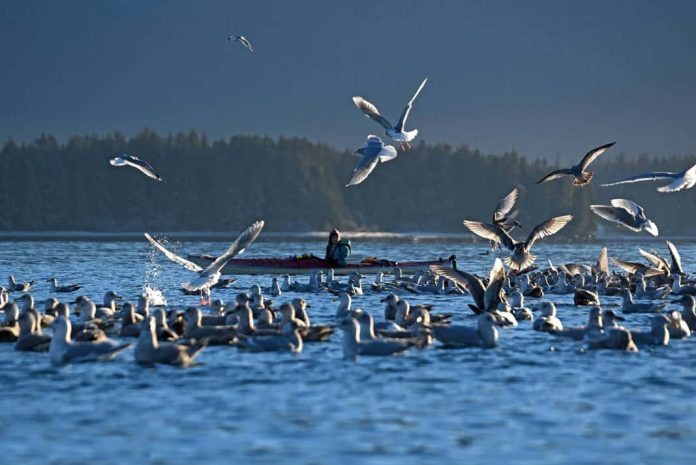
woman sea kayaking surrounded by seagulls

My corridor is where cold, silty freshwater meets the salty, slender sea. My vessel is a kayak, and my direction is north.

As the ice of Alaska’s Glacier Bay National Park shrinks, new land is revealed and seawater habitat enlarges. New niches emerge, a diversity of organisms move in, and a beautiful fjord ecosystem is born. Like a living laboratory, it’s here biologists observe how life returns in the wake of retreating ice.

Like me, most of the migrants to this new land use the air or the sea as their migratory corridors.

Along the edge of the glacier’s ice, bullseye lichen circulates and spots the bare rock as the earliest colonizer. Its spores were passed here through the air, spread by wind and wing.

A dozen types of seabirds have flown here to feed from the glacier’s nutrients, now melting into the sea.

I set up camp on a small, hideaway beach, serenaded by a cacophony of oystercatchers’ shrieks and shrills.

Seagulls are hard to speciate, and even harder to appreciate, as they cackle and squeal and poop. A gaggle of unseen sea ducks rolls in a sea of purple. And three loons coo and croon a wilderness song reverberating through the valley, bouncing off lichen-laden granite, then dissipating toward the ocean, and into the night.

Just 150 years ago this beach campsite and bird-nesting island habitat was occupied by ice. Today it’s a world reborn, a lesson in resilience.

In the morning I pack up camp and fill the bulkhead of my sea kayak with a propane stove and bear cans.

I’m ready to continue my slow and steady migration north. The ocean is so still, the continuous sounds of birds smoothly slide atop the water, sound waves entering my eardrums, which vibrate in rhythym. The memory fixes in my mind.

When I depart, my paddle gently pulls the water. My own liquid corridor, moving toward glacier ice.

While I float atop it, other mammals swim this cold sea.

A moose’s brown ears are all that extend from the surface of the ocean as she makes her way to an island of cottonwood trees, then eventually back to mainland again. And a brown bear swimmer uses the water as its path throughout the islands of southeast Alaska on what I imagine is a hunt to find a mate.

The sky and sea are corridors to this young land where lichen spores propagate, cottonwood trees extend, oystercatchers nest, brown bears fish. We are all travelers here, temporary and ephemeral. I pull the nose of my kayak onto the sand, start a fire under a moon sliced in half, encircled by golden rose—the ring reaches toward the ocean and reflects a glittering ripple of light.

Theresa Soley is a guide, writer and journalist who lives in Juneau, Alaska.

GLACIER BAY NATIONAL PARK IS A HIGHLIGHT OF ALASKA’S INSIDE PASSAGE AND PART OF A 25-MILLION ACRE WORLD HERITAGE SITE—ONE OF THE WORLD’S LARGEST INTERNATIONAL PROTECTED AREAS.

How Building Plastic Kayaks Saved Indonesia’s Longest River

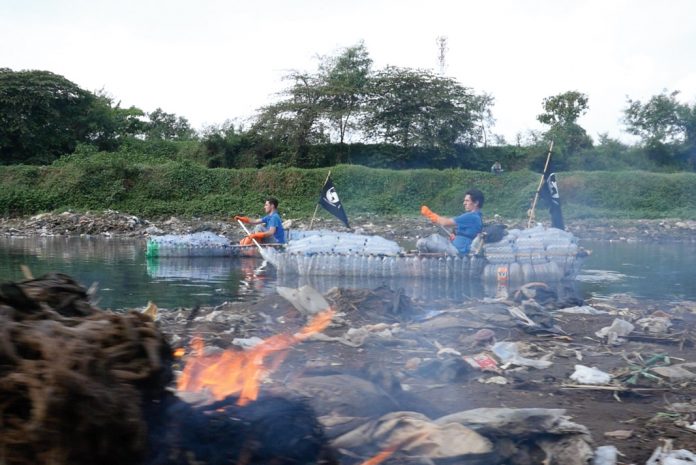
two men in kayaks made out of trash
Each kayak was built with 300 water bottles, was nine feet long, weighed 70 pounds and took four days to build | Photo: Gary Bencheghib

When Bali-raised brother Gary and Sam Bencheghibs decided to paddle one of Indonesia’s longest rivers, they weren’t trying to break a record.

Instead, they were setting out to better understand how millions of people live alongside one of the world’s most polluted waterways. In July 2017, the Bencheghibs launched their homemade kayaks—constructed from used water bottles—onto Java’s 270-kilometer-long Citarum River.

Neither were experienced kayakers, but this wasn’t their first unusual expedition. Only a year earlier, they’d floated down the Mississippi on a raft made of trash, recording their experiences for their media company, Make a Change World. As 23-year-old Gary explains, nothing could have prepared them for what they were about to encounter.

What was the biggest challenge?

About 15 million people live around the Citraum River and depend on it. We started from Majalaya, which is the Indonesian capital of textile manufacturing. A lot of industries dump their waste directly into the river and don’t have water filtration, so there’s a lot of toxic waste.

We didn’t expect to see so much plastic concentrated in one river. We were breathing in sulphur. There were dead animals—dogs, cats, pigs, rats, birds, fish—and open fires every 100 meters from burning trash. Early on, there was so much trash, we’d get stuck. We’d have to physically pull ourselves through and over trash. We wore protective clothing, boots and gloves and avoided contact with the toxic water.

Why build your own kayaks?

We liked the idea anybody can build a plastic bottle kayak. Trash can have a second life and what is polluting the river can be transformed into a resource.

My first design failed so we collaborated with expert bamboo crafters from Bali who helped with the design of the structure. Our kayaks were built from bamboo and 300 bottles, collected by students and volunteers from waste banks. We used recycled motorbike tires to tie the bamboo, and recycled fishnets to hold the kayaks together.

[ View all plastic kayaks in the Paddling Buyer’s Guide ]

Where are your kayaks now?

People along the river were fascinated by the idea of floating on trash. We started working with some villagers along the way to show them how to make their own kayaks. Now, one of the villages is using our kayaks and has made three more to clean up the river. It’s really cool to see our kayaks having a second life after the expedition.

When did you realize your trip was a success?

For Indonesia, it was shaming to see two expats going down the river. Instead of shaming and blaming, we wanted to focus on the positive—how do we solve problems and get individuals working towards the same goal of making the world green. We wanted to show locals initiatives fighting day and night to preserve the environment.

Some of our content went viral—with over 3.5 million views—and two weeks after we finished our expedition, the Indonesian government wanted to see us to deliver a response. The Indonesian president has since announced a seven-year rehabilitation program for the river.

Who inspires you?

A river is so interesting because from upstream to downstream, you’re meeting all these people connected by one body of water. Getting their perspectives is always fascinating. Really engaging with the communities is so powerful.

It’s incredible there’s life in the Citarum; people use the water for drinking, fishing and bathing. For my brother and me, it’s astonishing how polluted the river is, yet at the same time, life still manages to find a way.

Each kayak was built with 300 water bottles, was nine feet long, weighed 70 pounds and took four days to build. | Feature photo: Gary Bencheghib

Certification killed paddling adventures

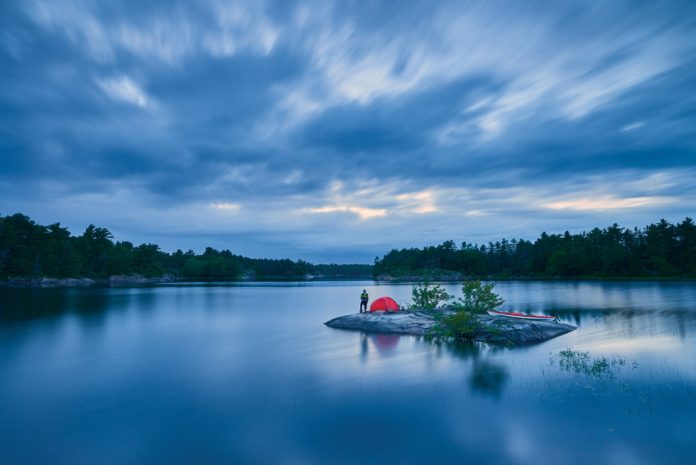
man on a small island with a tent and sea kayak on a lake
"Our bravest and best lessons are not learned through success, but through misadventure" according to American philosopher Amos Bronson Allott | Photo: Henry Liu

One morning this past July, my co-guide and I watched as a young couple paddled up to our beautiful little coastal campsite.

It was not yet even 10 a.m., but the pair had the sleep-deprived, puffy-eyed saltiness I associate with early morning starts. As our clients got organized for the last day of paddling on our 10-day trip, we raised our highly certified eyebrows and exchanged skeptical looks.

We analyzed the couple’s gear and paddling techniques, noting the way they landed and unpacked their boats. We welcomed them to the beach with the customary questions. How long have you been out? Where did you come from today? Where are you headed?

They told us they had just made the onerous six-mile open water crossing of Hakai Pass. It’s an option not unheard of among knowledgeable and experienced paddlers, but a committing decision, and one we had decided against with our commercial group of clients.

Now on day 51 of 80, the couple told us they started their trip in Telegraph Cove, 300 miles south. Their goal was to make it as far up the coast as they could in the month remaining.

Both were seasoned recreational mountaineers, but this was their first journey of any length on the sea. A winter knee injury resulted in a change of plans. Within a month of their planned departure, their three-month mountain traverse turned into 80 days on the ocean by sea kayak. How much different could it be?

[ View all sea kayaks in the Paddling Buyer’s Guide ]

One of their kayaks had been borrowed from the garage of a senior relative, and the other from a retired day paddler’s Craiglist ad. Their knowledge of weather and ocean navigation was gleaned from books, websites and simple observation. Much of their basic kayaking knowledge was acquired along the way by chatting up paddlers with whom they crossed paths. By the time they reached us, they could read a chart, understand the weather forecast and knew how far to pull up their boats each night.

What impressed me most was their seemingly flawless adherence to the most conservative of decision-making metrics. When in doubt for any reason, they waited.

During the rest of the day with our clients there was much discussion and derision about the wisdom of taking on an ocean trip of this length and exposure with so little experience. My co-guide even went so far as to say, “They shouldn’t be out here.”

It’s not an uncommon sentiment in our increasingly certification-focused and rule-based industry. These days, there is an approved training and industry standard meted out for even the most innocuous of recreational adventures, so by this measure, he is certainly not wrong.

I have enough laminated high-level guide and instructor cards to sink a small rowboat

I admit when hearing of the 80 days of food and fuel the pair had packed in and on their boats on day one, in addition to water rations, I shuddered inwardly. I imagined the pair launching wildly overloaded kayaks, two self-proclaimed tight-hipped novices wobbling their way into Johnstone Strait with no tide and current table or weather forecast between them, let alone the knowledge to interpret them.

One might say I have earned the right to look askance at such folk. I have logged thousands of days leading groups on rivers and coastlines and have earned the title of expert in a few outdoor adventure disciplines. I have enough laminated high-level guide and instructor cards to sink a small rowboat. I have also witnessed more than a few adventurers who don’t know what they don’t know about the requirements of the terrain or the judgement and decision-making skills to negotiate it. I’ve seen leaders suffer the consequences of their own unconscious incompetence, and endanger the lives of others at the same time.

I had to remind myself I’ve also had more than a few epics of my own. On my own time, I have been out in conditions above my skill level, and tried my luck on river, ocean and mountain. I’ve made bad and good decisions and learned from both. And I know I’m certainly not the only one. Paddlers have always tested themselves, and usually come away better for it in skill, growth and self-knowledge. 

As I have moved through my career, I have become a devotee of certification. In part out of necessity, but also because I see the undeniable value of standardized training in a growing and diversifying adventure industry. Today, certification is an expectation—not just for professional guides and instructors, but increasingly for the lay person. If you aren’t certified yourself, you damn well better hire someone who is. We have become slaves to certification and expertise in a pastime and passion prized for its sheer simplicity.

As slaves to certification, I feel we’ve created such a level of risk-aversion and elitism, we’re squashing the heart of authentic adventure. You know the type I mean—the adventures demanding self-sufficiency, which can’t be purchased from a travel catalog. Embarking on something new and getting in over our heads is a lost art practised by few. On these types of trips, not everything will go as planned. Sometimes there are tears and conflict. Yet, these difficult situations are often how we grow and how we learn the most about ourselves. Real adventure isn’t always comfortable—and that’s a good thing.

I was impressed by the young couple who joined us on the beach. They had equipped themselves with a healthy dose of conservatism, practiced good principles-based decision-making skills, and had the humility and curiosity to learn from both the people they met along the way and the environmental conditions they faced. Above all, they gave themselves the luxury of time and space. Doing the best they could with the considerable skills and resources available to them, they had done pretty damn well so far. This empowering experience is impossible to laminate and won’t fit in a wallet.

According to American Philosopher Amos Bronson Allott; Our bravest and best lessons are not learned through success, but through misadventure,”

Fiona Hough has worked as a paddlesports guide, instructor and trainer for more than 25 years. Her most ill-advised personal adventure was when she decided to ski 24 kilometers in a whiteout and in the dark carrying only stirfry veggies and Baileys in a day pack. Feature photo: Henry Liu

What Paddling Teaches Us About Life And Death

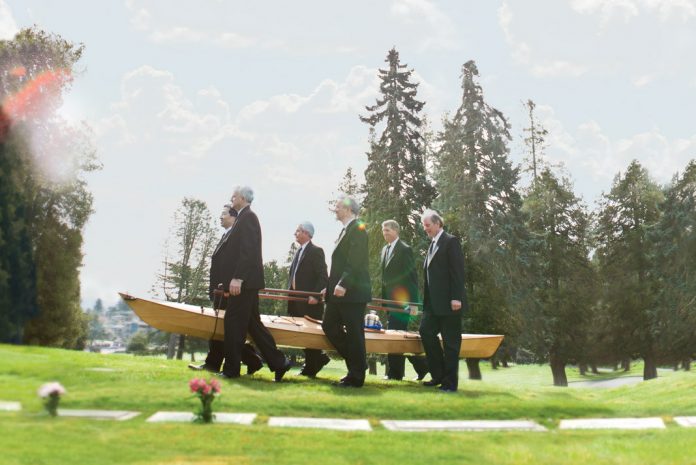
6 men in tuxedos carrying a wooden kayak with an urn

Lately, I’ve Been Thinking About My Own Death

Sorry, I know it’s weird. Maybe it’s a middle age thing. I feel superstitious writing this, lest I drop dead in the next instant and it becomes prophetic, but I’m going to go ahead and do it anyway.

This all started one day last September when I was out paddling on my home waters. Here there’s a spit of land entirely human-made from construction and demolition waste. A vast peninsula created over decades by a daily procession of dump trucks moving like leafcutter ants between the city and the lake.

The Spit, as we call it, is literally a massive urban graveyard, built out of what’s destroyed and long past. Amidst the timeless lap of waves on the bleached out bones of old buildings and twisted rebar I can feel the complementary forces of urban decay and natural reclamation at work to erase the human signature on this landscape.

I Was Paddling Out On The Open Lake Near The End Of The Spit. The night was breezy, but oddly quiet. Waves were rolling in but there seemed to be no sound. The far off motorboats and Jet Skis were muffled like the ocean noises in the foam pile outside a line of pounding surf.

All I could hear were the nearby, focused sounds of my bow cutting through the water, the splashes of my paddle. Everything washed in the hazy yellow glow of the setting sun. There was a feeling of desolation, privacy and comfort.

For a moment time stopped. The waves in front of me absorbed all thought. I felt utterly at peace.

Maybe Death Would Feel Like This, I Thought

Like being on the lake at sunset when everything’s quiet and you forget the separation between yourself, the water and everything else.

I was struck suddenly by the vision of being buried somewhere quiet, in a pine or cedar box, with my paddle at my side. Like the Egyptian mummy I’d just visited the week before at the museum, wrapped up and buried with the provisions required for the afterlife journey. Oddly, this was not a disturbing vision, but rather comforting. I made a mental note to tell someone I’d like to be buried with my paddle, as a symbol of something I love and a preferred way to get around in the afterlife, if there happens to be one.

This is not an entirely unusual train of thought. Many wilderness travelers have written about similar feelings. I recently listened to an interview on the Dirtbag Diaries podcast with Karl Kruger about his incredible 750-mile journey in the Race to Alaska on a paddleboard last summer. Although he didn’t explicitly mention thought of death, he did fall into a similar kind of meditative state during his grueling two weeks of all-day paddling. Instead of lasting for a few minutes, he was in this altered mental state for days on end.

It starts sounding a little trite to say connectivity to the universe, but it’s precisely what it is,” Kruger described. “I’d so perfectly let go of the self, I was able to exist in a state of pure connectivity to everything around me…. I would go to sleep in that space and I would wake up in that space. It was absolute comfort. It’s the only way I can think of to describe it…. I was so thoroughly in a meditative space and so in the flow.

If Being On The Water Can Make A Person Feel So Connected To The Universe, It’s A Short Leap To Relate It To The Subject Of Death

Perhaps this is why water is woven into the beliefs about immortality and burial in so many cultures.

I recently saw an ad in my local newspaper for a funeral home depicting six pallbearers carrying a stitch-and-glue kayak with an urn in the cockpit. It was a tongue-in-cheek way to hawk ultra-personalized funeral services, but harkens to many ancient burial traditions, making using kayaks to sell funerals not so far-fetched.

The Vikings are famous for their death ships. The resting places for their most honored nobles and heroes are carefully provisioned watercraft. And there is the well-known sacredness of the Ganges River to the Hindu religion, which flows from heaven to earth and is thus seen as a purifying force and the connection point between the living and the dead.

Wild Waters Provide An Immediate Connection To Worlds Beyond Our Own

I was starkly reminded of this when it came time to write this death-themed essay I’d hastily pitched to my editor. I was starting to feel kind of sheepish and stupid. It was the deep freeze of early winter and I’d been on a one-month hiatus from the ice-locked lake which inspired me in September. It suddenly seemed like a dumb, irrelevant and depressing subject for a magazine column.

Then, in January, I took advantage of a break in the cold to head back out on the lake.

As Soon As I Was Sealed Up In My Drysuit And Paddling Away From Shore The Idea Came Right Back Into Focus. Leaving the harbor was like crossing over into another universe. What had appeared like a calm windless day was actually in the middle of a wind shift. There was a stiff breeze coming at me off the Spit and a big rolling swell pitching from the opposite direction, plus some smaller chop added to the general confusion.

Staying calm and balanced required such an immediate shift in focus, and was such a definitive upset in the power balance. From me at the center of everything to being slapped in the face by some higher power with a belly laugh like the sound of rolling water. To paraphrase the book title by Galen Rowell, I felt like I’d crossed over from the human realm into the throne room of the water gods.

Water Has Its Own Completely Unfathomable And Untameable Agenda

We interact with it on its terms, not our own. It made sense in an instant. The big lake I paddle on is so otherworldly, of course it would remind me of the flip-side of life. The death vision came rushing back in an instant.

The change in perspective, from when I set out on the water full of my own agenda, to returning completely turned inside out, was both comforting and productive. It cleaned my slate of worries and distractions and gave me a renewed focus on what I value. Like the kayaker in this oft-cited anonymous Inuit poem, who faces fear and danger and comes back with the realization:

There is only
One great thing,
The only thing:
To live and see in huts and on journeys
The great day that dawns,
And the light that fills the world.


Tim Shuff is a writer and firefighter in Toronto. He made a New Year resolution to stop daydreaming, and write his next column about something more practical than dying.

The First-Ever Sea Kayak Film Series

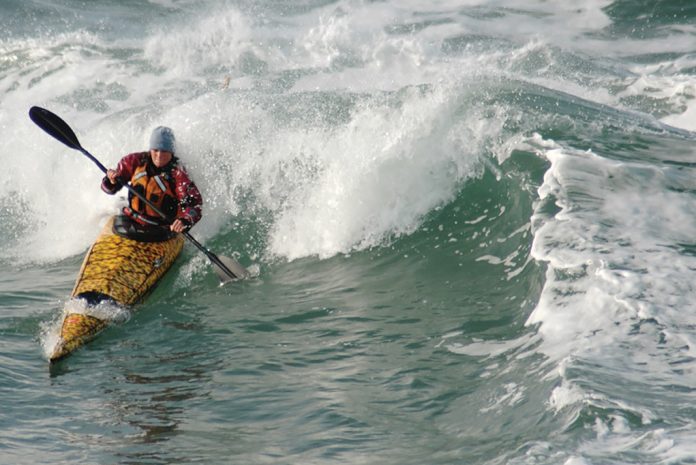
woman in sea kayak surfing a wave

“Sea kayaking. Isn’t that men with beards enjoying nature?” asks the voiceover

Then Justine Curgenven, Trys Burke and Gemma Rawlings peel off their fake beards, strip down to bikini tops, paddle into the tidal race of Penryhn Mawr and surf up a storm. The voiceover continues: “I wanted to make a sea kayaking film to show that sea kayaking is exciting and dynamic.”

It’s Been 14 Years Since Justine Curgenven Released This Is The Sea, Which Was Heralded As The First-Ever Sea Kayaking Action Film. It’s a short time span for a retrospective, but the film could also have been titled This Is The Sea Change in Sea Kayaking.

When the first feature-length film in the five-part series was released, I gathered my paddling pals to watch it. During the screening our excitement bubbled over like a wave surging through a rock garden. Someone had finally captured the paddling we did on the Oregon coast and the Columbia Gorge.

In hindsight, I see how much influence it had,” Curgenven recently told me from her new home on Vancouver Island’s west coast. “At the time I didn’t see it, but people who were already doing exciting paddling suddenly had a vessel to communicate what they do. And other people said, ‘Wow you can do that in a sea kayak? That’s really cool!’

A rock had been thrown into the paddling pond—following This Is The Sea’s big splash waves rippled in all directions. Over the next few years advertisements in kayak magazines morphed from depicting mostly peaceful flatwater scenes to action-oriented photos. Instruction shifted as surf expanded its turf. Manufacturers began designing and marketing specialty ocean-play kayaks. This Is The Sea inspired the creation of more rough water films, most notably Pacific Horizonsand Eastern Horizonsby Bryan Smith, before he went off to work for some obscure outfit called National Geographic.

This Is The Sea Also Put Women At The Forefront Of Sea Kayaking

“I didn’t do it for women’s rights; I did it because I love doing it. I just happen to be a woman,” says Curgenven. But her adventures and the women she featured in her nine films inspired others. “It made women say, ‘Damn, if she can do it, then I can do it as well.’”

This Is The Sea wasn’t the first foray into rough water sea kayaking. Remember the Tsunami Rangers, who wore hockey-style body armor while paddling the northern California and Southern Oregon coast back in the 1980s? However, This Is The Sea struck a chord. Curgenven’s wide-eyed enthusiasm, disarming and distinctive cackle, and masterful strokes gained a following. Her films weren’t only dedicated to surfing the gnar, the series had compelling characters and narratives.

“The Films All Have A Mixture Of Different Stories,” Curgenven Told Me

“The first concentrated on rough water because it was important to show that aspect. The others had destinations and characters, as well as rough water.”

Segments focused on traditional Greenland kayaking, and less dramatic destinations like Florida, the Mediterranean and the Great Lakes, as well as rock gardens, tide races, surf play and expeditions.

And, like surfing a wave, timing and take-off point mattered. In 2004, Internet video was just coming into to its own. Curgenven filmed with a video camera mounted on an arm custom-made by Lendal, and wired to a heavy box holding the camera’s processing unit inside the hatch. Spare batteries filled up more hatch space. Clunky and low-res by today’s standards, it was groundbreaking for the early millennium.

“In hindsight, it was really good timing, a bit ahead of its time. I had a crappy website and a one-minute cut, but if people wanted to see exciting sea kayaking stories they bought my videos,” Curgenven says. Now, with the Internet awash in free videos and GoPros on every helmet, she’s turning away from filmmaking. “I haven’t made a film for two years. I don’t know if I am going to,” she says. “Right now, I’d rather go kayaking.”

Even If We Never See A New Film Featuring Curgenven’s Signature Cackling Laugh, The Influence Of This Is The Sea Is Undeniable

“We were trying to shake it up a bit,” she admits. “But the old guys with beards are still okay by me, too.”

Neil Schulman writes about sea kayaking’s past and future in Reflections.