Home Blog Page 204

Do Sea Kayakers Have Bad Judgement?

cartoon of man buying a lot of paddling safety gear

“Which one do you do? With the sling, or without? Are you on your back, or lying on your belly? Do you inflate it first or after?”

Initially, it sounds like this might be interesting kinky talk. But no, it’s sea kayak rescues again.

Sea Kayakers Lust After Safety

Rescues are the hottest topic of sea kayaking conversation by a nautical mile. The number of different techniques is astounding.

Despite all the safety talk, sea kayakers often have surprisingly modest skills, eschewing an emphasis on judgment, conditioning and strong technique in favor of amassing safety gear and studying a near endless litany of rescue maneuvers.

Safety, Apparently, Has Nothing To Do With Good Judgment Or Paddling Skills

It’s all about rescues and rescue gear. From the sounds of it, the best way for me to be safe is to cover every inch of my kayak deck with a sea of international orange rescue equipment. Is it me, or does this seem like slamming the aquarium door after the sea horse has already escaped?

I’d rather invest my time practicing the avoidance of calamities rather than perfecting 20 different rescues to deal with disaster after it has occurred. After all, an ounce of prevention is worth 40 pounds of paddle floats.

Flares, floats, slings, signals, radar reflectors, radios, compasses and GPS units don’t, themselves, actually keep us safe.


Rescue Gear Doesn’t Save People—People Armed With Knowledge And Forethought Save People—Often Themselves. Deep down, sea kayakers know this. After all, we are typically intelligent, older, post-secondary-educated professionals, not 20-year-old, wet-behind-the-ears whitewater punks—who, despite their cockiness, can actually brace and roll in rough conditions.

No, sea kayakers are mature. They live well and reside in desirable neighbourhoods. They drive Volvos and drink mocha-frappuccinos produced by environmentally conscious coffee roasting companies. Sea kayakers have dinner reservations at Le Jardin and opera tickets. Their lives are good. They should be highly motivated not to die.

But Most Sea Kayakers Don’t Find The Time In Their Cosmopolitan Lives To Learn To Paddle Well. Instead, they try to buy safety. And they are abetted in believing they can do this. There’s a veritable raft of rescue gear out there promising to keep them safe, even if they know nothing about kayaks or the movements of the ocean.

So where did this blind faith in equipment and the false sense of security it instills come from?

Perhaps it’s just part of a wider trend in a society bent on effortless accomplishment: find the most corrosive bathtub cleaner on the market so you won’t have to scrub, start a diet starving your body of fuel so you won’t have to be active to burn it off, buy a Volvo (there’s that word again) and be safer on the road without having to slow down or change your driving habits.

Then again, it might have something to do with the fact the vast majority of paddling instruction is offered by kayak retail businesses. This presents a conflict. It’s great a store can offer instruction but don’t expect there won’t be a mandate to sell gear via the instructional programs.

After All, It’s A Lot Easier To Sell A Bit Of Kit Rather Than The Concept Of Conservative Good Judgment. You can’t buy good judgment, you can’t really teach it, and you definitely can’t bottle it for sale. If you could, I’d buy a two-four of it every weekend.

Alex Matthews is the co-producer of the instructional video, The Ultimate Guide to Sea Kayaking.
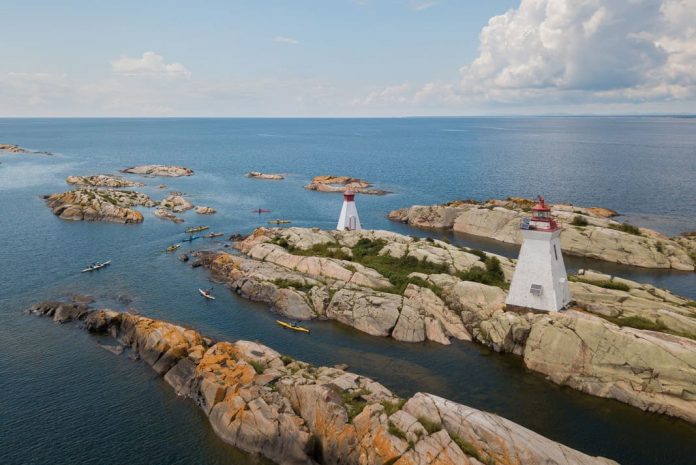
A Paddling Photographer’s Nightmare

lighthouses on an island surrounded by sea kayaks
Photo: Colin Field

Seconds after taking this shot, I panicked. The screen displaying my drone’s camera view went black. Completely. No battery levels. No GPS. No map. Nothing. I couldn’t see what the camera on the quadcopter saw. In fact, from where I was standing, I couldn’t even see the tiny black speck of the drone in the sky.

While I’ve resigned myself to the possibility of someday losing a drone—it hasn’t happened yet, knock on wood—it was the memory card I was most concerned about. It had on it nearly five days and 10 flights worth of photos on it. Rookie move. Suddenly the $40 memory card seemed more valuable than the camera and rig itself.

[ View all boats and gear in the Paddling Buyer’s Guide ]

This was a trip I’d wanted to take for years. Over several days we’d paddled up the eastern shoreline of Georgian Bay, from Key River to the tiny town of Killarney. I knew this route would be a photographer’s dream.

Every few kilometers of travel rewarded us with new vistas. Islands of grey and pink Shield granite peaked out from the azure blue water, contrasting with the bright orange lichen growing onshore. Under warm August sunshine, I felt I was paddling in a Caribbean island chain—it was paradise in a freshwater sea, complete with warm water for endless swimming.

With no idea where the drone was, I pressed the panic button and waited

I wanted to paddle here to take pictures. The idea of a drone shot near the Chicken Islands, lighthouses in view, had me excited. While flying a drone is pretty easy these days and anyone could take an amazing shot from 300 feet up in this area, getting your gear to work in a spot like this is difficult. Spending seven days in the wilderness while maintaining enough power to make multiple flights per day isn’t easy. My secret? A behemoth battery weighing 28 pounds, which just barely fits in the rear hatch of my kayak. Combine the battery with a foldable solar panel and I can keep all my drone batteries charged for days. So long as it’s sunny.

Of course, my massive power source was also worthless if my drone ended up in the drink. As I scanned the bright sky for a tiny speck of airborne black plastic, I remembered the button on the controller I had never pressed before, marked simply with the letters RTH.

With no idea where the drone was, I pressed the panic button and waited. I was just less than a kilometer from the Chicken Island lighthouses and my drone was somewhere over that-a-way.

After a few minutes, I heard the familiar swarm-of-bees heralding its arrival and spotted a black smudge in the sky headed my way. I retook control and landed it easily on the rocks beside me. After a few celebratory cuss words, I mentally thanked whoever designed this RTH button.

You know what I did next? I switched out my memory cards. Because in my humble opinion, the tiny 16 gigabyte SD card containing this photo was as valuable as newfound treasure.

Feature photo: Colin Field

Embracing Change In Glacier Bay By Sea Kayak

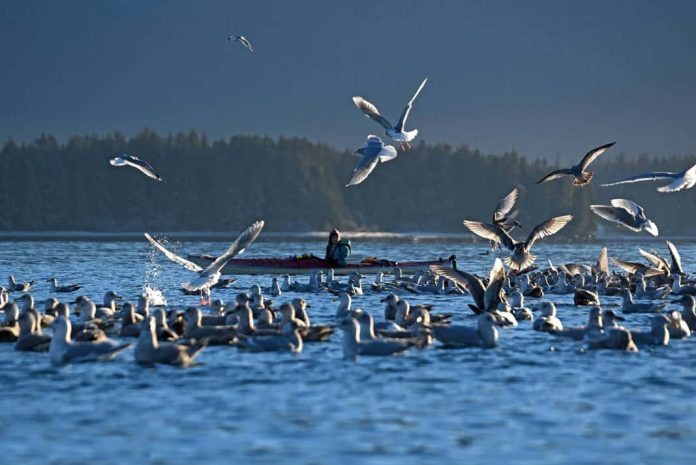
woman sea kayaking surrounded by seagulls

My corridor is where cold, silty freshwater meets the salty, slender sea. My vessel is a kayak, and my direction is north.

As the ice of Alaska’s Glacier Bay National Park shrinks, new land is revealed and seawater habitat enlarges. New niches emerge, a diversity of organisms move in, and a beautiful fjord ecosystem is born. Like a living laboratory, it’s here biologists observe how life returns in the wake of retreating ice.

Like me, most of the migrants to this new land use the air or the sea as their migratory corridors.

Along the edge of the glacier’s ice, bullseye lichen circulates and spots the bare rock as the earliest colonizer. Its spores were passed here through the air, spread by wind and wing.

A dozen types of seabirds have flown here to feed from the glacier’s nutrients, now melting into the sea.

I set up camp on a small, hideaway beach, serenaded by a cacophony of oystercatchers’ shrieks and shrills.

Seagulls are hard to speciate, and even harder to appreciate, as they cackle and squeal and poop. A gaggle of unseen sea ducks rolls in a sea of purple. And three loons coo and croon a wilderness song reverberating through the valley, bouncing off lichen-laden granite, then dissipating toward the ocean, and into the night.

Just 150 years ago this beach campsite and bird-nesting island habitat was occupied by ice. Today it’s a world reborn, a lesson in resilience.

In the morning I pack up camp and fill the bulkhead of my sea kayak with a propane stove and bear cans.

I’m ready to continue my slow and steady migration north. The ocean is so still, the continuous sounds of birds smoothly slide atop the water, sound waves entering my eardrums, which vibrate in rhythym. The memory fixes in my mind.

When I depart, my paddle gently pulls the water. My own liquid corridor, moving toward glacier ice.

While I float atop it, other mammals swim this cold sea.

A moose’s brown ears are all that extend from the surface of the ocean as she makes her way to an island of cottonwood trees, then eventually back to mainland again. And a brown bear swimmer uses the water as its path throughout the islands of southeast Alaska on what I imagine is a hunt to find a mate.

The sky and sea are corridors to this young land where lichen spores propagate, cottonwood trees extend, oystercatchers nest, brown bears fish. We are all travelers here, temporary and ephemeral. I pull the nose of my kayak onto the sand, start a fire under a moon sliced in half, encircled by golden rose—the ring reaches toward the ocean and reflects a glittering ripple of light.

Theresa Soley is a guide, writer and journalist who lives in Juneau, Alaska.

GLACIER BAY NATIONAL PARK IS A HIGHLIGHT OF ALASKA’S INSIDE PASSAGE AND PART OF A 25-MILLION ACRE WORLD HERITAGE SITE—ONE OF THE WORLD’S LARGEST INTERNATIONAL PROTECTED AREAS.

How Building Plastic Kayaks Saved Indonesia’s Longest River

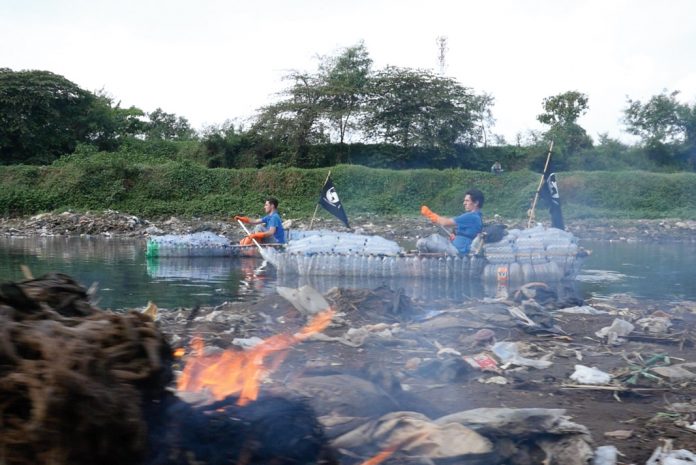
two men in kayaks made out of trash
Each kayak was built with 300 water bottles, was nine feet long, weighed 70 pounds and took four days to build | Photo: Gary Bencheghib

When Bali-raised brother Gary and Sam Bencheghibs decided to paddle one of Indonesia’s longest rivers, they weren’t trying to break a record.

Instead, they were setting out to better understand how millions of people live alongside one of the world’s most polluted waterways. In July 2017, the Bencheghibs launched their homemade kayaks—constructed from used water bottles—onto Java’s 270-kilometer-long Citarum River.

Neither were experienced kayakers, but this wasn’t their first unusual expedition. Only a year earlier, they’d floated down the Mississippi on a raft made of trash, recording their experiences for their media company, Make a Change World. As 23-year-old Gary explains, nothing could have prepared them for what they were about to encounter.

What was the biggest challenge?

About 15 million people live around the Citraum River and depend on it. We started from Majalaya, which is the Indonesian capital of textile manufacturing. A lot of industries dump their waste directly into the river and don’t have water filtration, so there’s a lot of toxic waste.

We didn’t expect to see so much plastic concentrated in one river. We were breathing in sulphur. There were dead animals—dogs, cats, pigs, rats, birds, fish—and open fires every 100 meters from burning trash. Early on, there was so much trash, we’d get stuck. We’d have to physically pull ourselves through and over trash. We wore protective clothing, boots and gloves and avoided contact with the toxic water.

Why build your own kayaks?

We liked the idea anybody can build a plastic bottle kayak. Trash can have a second life and what is polluting the river can be transformed into a resource.

My first design failed so we collaborated with expert bamboo crafters from Bali who helped with the design of the structure. Our kayaks were built from bamboo and 300 bottles, collected by students and volunteers from waste banks. We used recycled motorbike tires to tie the bamboo, and recycled fishnets to hold the kayaks together.

[ View all plastic kayaks in the Paddling Buyer’s Guide ]

Where are your kayaks now?

People along the river were fascinated by the idea of floating on trash. We started working with some villagers along the way to show them how to make their own kayaks. Now, one of the villages is using our kayaks and has made three more to clean up the river. It’s really cool to see our kayaks having a second life after the expedition.

When did you realize your trip was a success?

For Indonesia, it was shaming to see two expats going down the river. Instead of shaming and blaming, we wanted to focus on the positive—how do we solve problems and get individuals working towards the same goal of making the world green. We wanted to show locals initiatives fighting day and night to preserve the environment.

Some of our content went viral—with over 3.5 million views—and two weeks after we finished our expedition, the Indonesian government wanted to see us to deliver a response. The Indonesian president has since announced a seven-year rehabilitation program for the river.

Who inspires you?

A river is so interesting because from upstream to downstream, you’re meeting all these people connected by one body of water. Getting their perspectives is always fascinating. Really engaging with the communities is so powerful.

It’s incredible there’s life in the Citarum; people use the water for drinking, fishing and bathing. For my brother and me, it’s astonishing how polluted the river is, yet at the same time, life still manages to find a way.

Each kayak was built with 300 water bottles, was nine feet long, weighed 70 pounds and took four days to build. | Feature photo: Gary Bencheghib

Certification killed paddling adventures

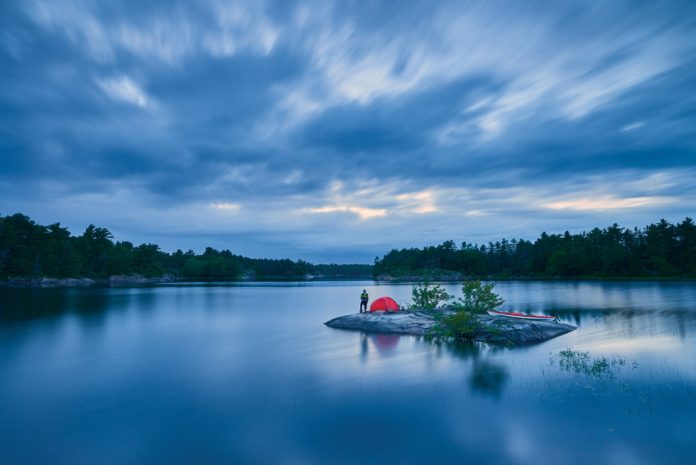
man on a small island with a tent and sea kayak on a lake
"Our bravest and best lessons are not learned through success, but through misadventure" according to American philosopher Amos Bronson Allott | Photo: Henry Liu

One morning this past July, my co-guide and I watched as a young couple paddled up to our beautiful little coastal campsite.

It was not yet even 10 a.m., but the pair had the sleep-deprived, puffy-eyed saltiness I associate with early morning starts. As our clients got organized for the last day of paddling on our 10-day trip, we raised our highly certified eyebrows and exchanged skeptical looks.

We analyzed the couple’s gear and paddling techniques, noting the way they landed and unpacked their boats. We welcomed them to the beach with the customary questions. How long have you been out? Where did you come from today? Where are you headed?

They told us they had just made the onerous six-mile open water crossing of Hakai Pass. It’s an option not unheard of among knowledgeable and experienced paddlers, but a committing decision, and one we had decided against with our commercial group of clients.

Now on day 51 of 80, the couple told us they started their trip in Telegraph Cove, 300 miles south. Their goal was to make it as far up the coast as they could in the month remaining.

Both were seasoned recreational mountaineers, but this was their first journey of any length on the sea. A winter knee injury resulted in a change of plans. Within a month of their planned departure, their three-month mountain traverse turned into 80 days on the ocean by sea kayak. How much different could it be?

[ View all sea kayaks in the Paddling Buyer’s Guide ]

One of their kayaks had been borrowed from the garage of a senior relative, and the other from a retired day paddler’s Craiglist ad. Their knowledge of weather and ocean navigation was gleaned from books, websites and simple observation. Much of their basic kayaking knowledge was acquired along the way by chatting up paddlers with whom they crossed paths. By the time they reached us, they could read a chart, understand the weather forecast and knew how far to pull up their boats each night.

What impressed me most was their seemingly flawless adherence to the most conservative of decision-making metrics. When in doubt for any reason, they waited.

During the rest of the day with our clients there was much discussion and derision about the wisdom of taking on an ocean trip of this length and exposure with so little experience. My co-guide even went so far as to say, “They shouldn’t be out here.”

It’s not an uncommon sentiment in our increasingly certification-focused and rule-based industry. These days, there is an approved training and industry standard meted out for even the most innocuous of recreational adventures, so by this measure, he is certainly not wrong.

I have enough laminated high-level guide and instructor cards to sink a small rowboat

I admit when hearing of the 80 days of food and fuel the pair had packed in and on their boats on day one, in addition to water rations, I shuddered inwardly. I imagined the pair launching wildly overloaded kayaks, two self-proclaimed tight-hipped novices wobbling their way into Johnstone Strait with no tide and current table or weather forecast between them, let alone the knowledge to interpret them.

One might say I have earned the right to look askance at such folk. I have logged thousands of days leading groups on rivers and coastlines and have earned the title of expert in a few outdoor adventure disciplines. I have enough laminated high-level guide and instructor cards to sink a small rowboat. I have also witnessed more than a few adventurers who don’t know what they don’t know about the requirements of the terrain or the judgement and decision-making skills to negotiate it. I’ve seen leaders suffer the consequences of their own unconscious incompetence, and endanger the lives of others at the same time.

I had to remind myself I’ve also had more than a few epics of my own. On my own time, I have been out in conditions above my skill level, and tried my luck on river, ocean and mountain. I’ve made bad and good decisions and learned from both. And I know I’m certainly not the only one. Paddlers have always tested themselves, and usually come away better for it in skill, growth and self-knowledge. 

As I have moved through my career, I have become a devotee of certification. In part out of necessity, but also because I see the undeniable value of standardized training in a growing and diversifying adventure industry. Today, certification is an expectation—not just for professional guides and instructors, but increasingly for the lay person. If you aren’t certified yourself, you damn well better hire someone who is. We have become slaves to certification and expertise in a pastime and passion prized for its sheer simplicity.

As slaves to certification, I feel we’ve created such a level of risk-aversion and elitism, we’re squashing the heart of authentic adventure. You know the type I mean—the adventures demanding self-sufficiency, which can’t be purchased from a travel catalog. Embarking on something new and getting in over our heads is a lost art practised by few. On these types of trips, not everything will go as planned. Sometimes there are tears and conflict. Yet, these difficult situations are often how we grow and how we learn the most about ourselves. Real adventure isn’t always comfortable—and that’s a good thing.

I was impressed by the young couple who joined us on the beach. They had equipped themselves with a healthy dose of conservatism, practiced good principles-based decision-making skills, and had the humility and curiosity to learn from both the people they met along the way and the environmental conditions they faced. Above all, they gave themselves the luxury of time and space. Doing the best they could with the considerable skills and resources available to them, they had done pretty damn well so far. This empowering experience is impossible to laminate and won’t fit in a wallet.

According to American Philosopher Amos Bronson Allott; Our bravest and best lessons are not learned through success, but through misadventure,”

Fiona Hough has worked as a paddlesports guide, instructor and trainer for more than 25 years. Her most ill-advised personal adventure was when she decided to ski 24 kilometers in a whiteout and in the dark carrying only stirfry veggies and Baileys in a day pack. Feature photo: Henry Liu

What Paddling Teaches Us About Life And Death

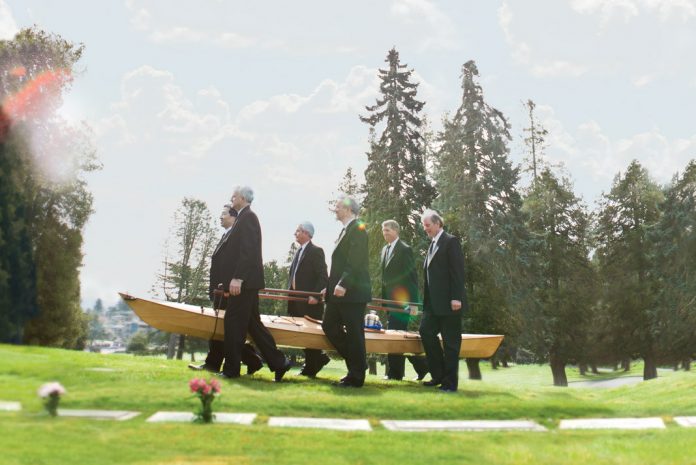
6 men in tuxedos carrying a wooden kayak with an urn

Lately, I’ve Been Thinking About My Own Death

Sorry, I know it’s weird. Maybe it’s a middle age thing. I feel superstitious writing this, lest I drop dead in the next instant and it becomes prophetic, but I’m going to go ahead and do it anyway.

This all started one day last September when I was out paddling on my home waters. Here there’s a spit of land entirely human-made from construction and demolition waste. A vast peninsula created over decades by a daily procession of dump trucks moving like leafcutter ants between the city and the lake.

The Spit, as we call it, is literally a massive urban graveyard, built out of what’s destroyed and long past. Amidst the timeless lap of waves on the bleached out bones of old buildings and twisted rebar I can feel the complementary forces of urban decay and natural reclamation at work to erase the human signature on this landscape.

I Was Paddling Out On The Open Lake Near The End Of The Spit. The night was breezy, but oddly quiet. Waves were rolling in but there seemed to be no sound. The far off motorboats and Jet Skis were muffled like the ocean noises in the foam pile outside a line of pounding surf.

All I could hear were the nearby, focused sounds of my bow cutting through the water, the splashes of my paddle. Everything washed in the hazy yellow glow of the setting sun. There was a feeling of desolation, privacy and comfort.

For a moment time stopped. The waves in front of me absorbed all thought. I felt utterly at peace.

Maybe Death Would Feel Like This, I Thought

Like being on the lake at sunset when everything’s quiet and you forget the separation between yourself, the water and everything else.

I was struck suddenly by the vision of being buried somewhere quiet, in a pine or cedar box, with my paddle at my side. Like the Egyptian mummy I’d just visited the week before at the museum, wrapped up and buried with the provisions required for the afterlife journey. Oddly, this was not a disturbing vision, but rather comforting. I made a mental note to tell someone I’d like to be buried with my paddle, as a symbol of something I love and a preferred way to get around in the afterlife, if there happens to be one.

This is not an entirely unusual train of thought. Many wilderness travelers have written about similar feelings. I recently listened to an interview on the Dirtbag Diaries podcast with Karl Kruger about his incredible 750-mile journey in the Race to Alaska on a paddleboard last summer. Although he didn’t explicitly mention thought of death, he did fall into a similar kind of meditative state during his grueling two weeks of all-day paddling. Instead of lasting for a few minutes, he was in this altered mental state for days on end.

It starts sounding a little trite to say connectivity to the universe, but it’s precisely what it is,” Kruger described. “I’d so perfectly let go of the self, I was able to exist in a state of pure connectivity to everything around me…. I would go to sleep in that space and I would wake up in that space. It was absolute comfort. It’s the only way I can think of to describe it…. I was so thoroughly in a meditative space and so in the flow.

If Being On The Water Can Make A Person Feel So Connected To The Universe, It’s A Short Leap To Relate It To The Subject Of Death

Perhaps this is why water is woven into the beliefs about immortality and burial in so many cultures.

I recently saw an ad in my local newspaper for a funeral home depicting six pallbearers carrying a stitch-and-glue kayak with an urn in the cockpit. It was a tongue-in-cheek way to hawk ultra-personalized funeral services, but harkens to many ancient burial traditions, making using kayaks to sell funerals not so far-fetched.

The Vikings are famous for their death ships. The resting places for their most honored nobles and heroes are carefully provisioned watercraft. And there is the well-known sacredness of the Ganges River to the Hindu religion, which flows from heaven to earth and is thus seen as a purifying force and the connection point between the living and the dead.

Wild Waters Provide An Immediate Connection To Worlds Beyond Our Own

I was starkly reminded of this when it came time to write this death-themed essay I’d hastily pitched to my editor. I was starting to feel kind of sheepish and stupid. It was the deep freeze of early winter and I’d been on a one-month hiatus from the ice-locked lake which inspired me in September. It suddenly seemed like a dumb, irrelevant and depressing subject for a magazine column.

Then, in January, I took advantage of a break in the cold to head back out on the lake.

As Soon As I Was Sealed Up In My Drysuit And Paddling Away From Shore The Idea Came Right Back Into Focus. Leaving the harbor was like crossing over into another universe. What had appeared like a calm windless day was actually in the middle of a wind shift. There was a stiff breeze coming at me off the Spit and a big rolling swell pitching from the opposite direction, plus some smaller chop added to the general confusion.

Staying calm and balanced required such an immediate shift in focus, and was such a definitive upset in the power balance. From me at the center of everything to being slapped in the face by some higher power with a belly laugh like the sound of rolling water. To paraphrase the book title by Galen Rowell, I felt like I’d crossed over from the human realm into the throne room of the water gods.

Water Has Its Own Completely Unfathomable And Untameable Agenda

We interact with it on its terms, not our own. It made sense in an instant. The big lake I paddle on is so otherworldly, of course it would remind me of the flip-side of life. The death vision came rushing back in an instant.

The change in perspective, from when I set out on the water full of my own agenda, to returning completely turned inside out, was both comforting and productive. It cleaned my slate of worries and distractions and gave me a renewed focus on what I value. Like the kayaker in this oft-cited anonymous Inuit poem, who faces fear and danger and comes back with the realization:

There is only
One great thing,
The only thing:
To live and see in huts and on journeys
The great day that dawns,
And the light that fills the world.


Tim Shuff is a writer and firefighter in Toronto. He made a New Year resolution to stop daydreaming, and write his next column about something more practical than dying.

The First-Ever Sea Kayak Film Series

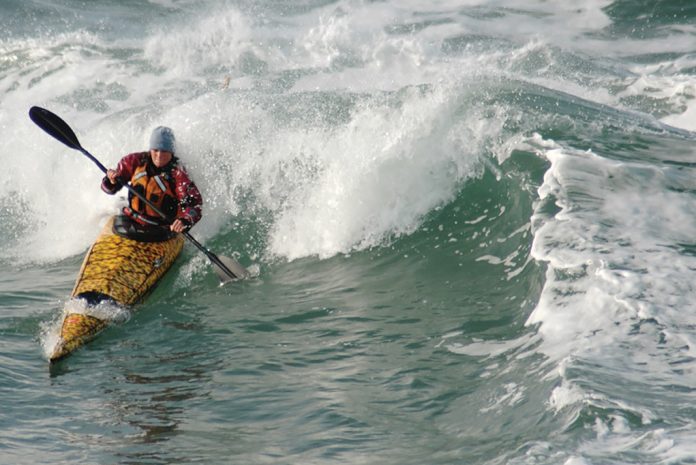
woman in sea kayak surfing a wave

“Sea kayaking. Isn’t that men with beards enjoying nature?” asks the voiceover

Then Justine Curgenven, Trys Burke and Gemma Rawlings peel off their fake beards, strip down to bikini tops, paddle into the tidal race of Penryhn Mawr and surf up a storm. The voiceover continues: “I wanted to make a sea kayaking film to show that sea kayaking is exciting and dynamic.”

It’s Been 14 Years Since Justine Curgenven Released This Is The Sea, Which Was Heralded As The First-Ever Sea Kayaking Action Film. It’s a short time span for a retrospective, but the film could also have been titled This Is The Sea Change in Sea Kayaking.

When the first feature-length film in the five-part series was released, I gathered my paddling pals to watch it. During the screening our excitement bubbled over like a wave surging through a rock garden. Someone had finally captured the paddling we did on the Oregon coast and the Columbia Gorge.

In hindsight, I see how much influence it had,” Curgenven recently told me from her new home on Vancouver Island’s west coast. “At the time I didn’t see it, but people who were already doing exciting paddling suddenly had a vessel to communicate what they do. And other people said, ‘Wow you can do that in a sea kayak? That’s really cool!’

A rock had been thrown into the paddling pond—following This Is The Sea’s big splash waves rippled in all directions. Over the next few years advertisements in kayak magazines morphed from depicting mostly peaceful flatwater scenes to action-oriented photos. Instruction shifted as surf expanded its turf. Manufacturers began designing and marketing specialty ocean-play kayaks. This Is The Sea inspired the creation of more rough water films, most notably Pacific Horizonsand Eastern Horizonsby Bryan Smith, before he went off to work for some obscure outfit called National Geographic.

This Is The Sea Also Put Women At The Forefront Of Sea Kayaking

“I didn’t do it for women’s rights; I did it because I love doing it. I just happen to be a woman,” says Curgenven. But her adventures and the women she featured in her nine films inspired others. “It made women say, ‘Damn, if she can do it, then I can do it as well.’”

This Is The Sea wasn’t the first foray into rough water sea kayaking. Remember the Tsunami Rangers, who wore hockey-style body armor while paddling the northern California and Southern Oregon coast back in the 1980s? However, This Is The Sea struck a chord. Curgenven’s wide-eyed enthusiasm, disarming and distinctive cackle, and masterful strokes gained a following. Her films weren’t only dedicated to surfing the gnar, the series had compelling characters and narratives.

“The Films All Have A Mixture Of Different Stories,” Curgenven Told Me

“The first concentrated on rough water because it was important to show that aspect. The others had destinations and characters, as well as rough water.”

Segments focused on traditional Greenland kayaking, and less dramatic destinations like Florida, the Mediterranean and the Great Lakes, as well as rock gardens, tide races, surf play and expeditions.

And, like surfing a wave, timing and take-off point mattered. In 2004, Internet video was just coming into to its own. Curgenven filmed with a video camera mounted on an arm custom-made by Lendal, and wired to a heavy box holding the camera’s processing unit inside the hatch. Spare batteries filled up more hatch space. Clunky and low-res by today’s standards, it was groundbreaking for the early millennium.

“In hindsight, it was really good timing, a bit ahead of its time. I had a crappy website and a one-minute cut, but if people wanted to see exciting sea kayaking stories they bought my videos,” Curgenven says. Now, with the Internet awash in free videos and GoPros on every helmet, she’s turning away from filmmaking. “I haven’t made a film for two years. I don’t know if I am going to,” she says. “Right now, I’d rather go kayaking.”

Even If We Never See A New Film Featuring Curgenven’s Signature Cackling Laugh, The Influence Of This Is The Sea Is Undeniable

“We were trying to shake it up a bit,” she admits. “But the old guys with beards are still okay by me, too.”

Neil Schulman writes about sea kayaking’s past and future in Reflections.

Sea Kayak Review: Nigel Dennis Explorer

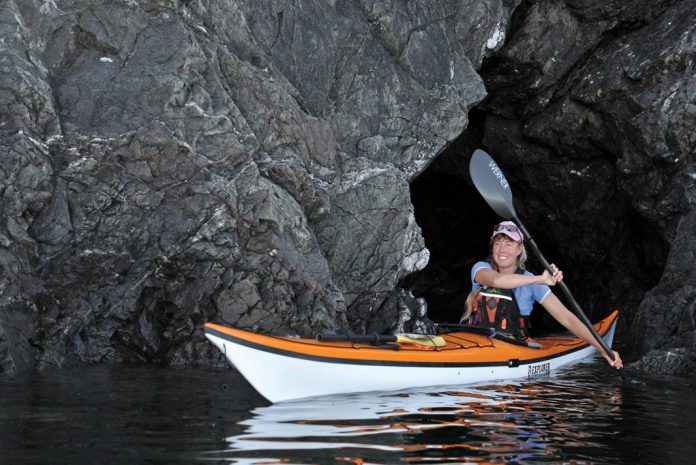
woman paddling an explorer sea kayak

If modern expedition kayaks have a phenotype—that is, a distinctive appearance and characteristics based on a combination of genetic traits and environmental factors—the Explorer may exemplify it best. No wonder it’s a perennial contender for best kayak.

Nigel Dennis Explorer Specs
Length 17 ft 6 in
Width 21 in
Weight 58lbs
Price $4,200 USD

The fine lines of the upswept bow and stern, the narrow beam and the clean, functional deck layout are informed by the classic British interpretation of traditional Greenlandic kayaks. From this base DNA, designer and renowned expedition paddler, Nigel Dennis, refined the shape and layup to address the unique challenges of extended journeys on remote, exposed coastlines.

History of the Explorer sea kayak

Few other sea kayak designs can boast the expedition pedigree of the Explorer. It has been the kayak of choice for circumnavigations in some of the roughest and least accessible waters in the world: Britain, Ireland, Iceland, New Zealand, Antarctica, South Georgia Island and the Aleutian islands. Twenty-five years after it was first introduced, the Explorer is still handmade in Anglesey, North Wales, and is now sold under the label Sea Kayaking UK (SKUK), formerly Nigel Dennis Kayaks.

I borrowed a shiny new, persimmons-orange-and-white Explorer last summer to better understand the sustained popularity of this mid-sized touring kayak. Along with its devoted following in expedition circles, the Explorer is a staple among elite coaches and at symposia from Illinois to Israel. My testing regimen included a week of teaching intermediate paddling skills, four weeks of self-supported kayak-camping journeys on open waters, and as many surf sessions as the water gods saw fit to deliver.

How did Nigel Dennis’ Explorer kayak perform?

After a summer on the water, if I had to sum up the Explorer in one word, it would be consistent.

Now, in 600 words, let me explain.

Explorer stability

First up, directional stability. The Explorer is designed for covering distance and, as such, it tracks well and is very neutral in wind and confused seas. Weathercocking is minimal, making it easy to hold course with slight edging. When deployed, the skeg works exactly as it should to enhance tracking in high winds. The skeg slider feels sturdy and is well balanced to set-it-and-forget-it on long crossings.

Speed

I found it easy to maintain a relatively quick touring speed in a wide variety of conditions, however the Explorer is exceptionally fast with a following sea. Even heavily laden with camping equipment and fresh food for 10 days—including a secret watermelon (more on that later)—I rode effortlessly ahead on the swell while my companions’ boats mired in the troughs.

Handling

A useful measure of performance for any touring kayak is a comparison of handling with paddled with empty hatches and with hatches loaded. This is where the Explorer’s versatility and consistency really shine. Whether I was out for an hour or a week, the boat felt responsive to my inputs, carving graceful turns and remaining stable and predictable in sloppy conditions.

Hard chines and a boxy hull profile lend the Explorer more initial stability than you’d expect from its 21-inch beam, making it a surprisingly forgiving companion for novice paddlers. Secondary stability is also very solid, especially with hatches full of cargo. I could roll smoothly into a deep edge to coax tighter turns out of the kayak’s 17.5-foot waterline.

The Explorer may lack the turn-on-a-dime maneuverability of its shorter, more highly rockered sister, the Romany, but it’s no slouch in the surf. The high-volume bow doesn’t dive or deflect easily, which makes for wonderfully controllable rides. The responsive handling meant I was able catch long surfs on three-foot-high faces, even where the wave pattern splintered unpredictably above shallow sandbars. When my concentration faltered and I found myself upside-down, the low back deck and excellent cockpit fit made rolling up easy and uneventful.

The seat

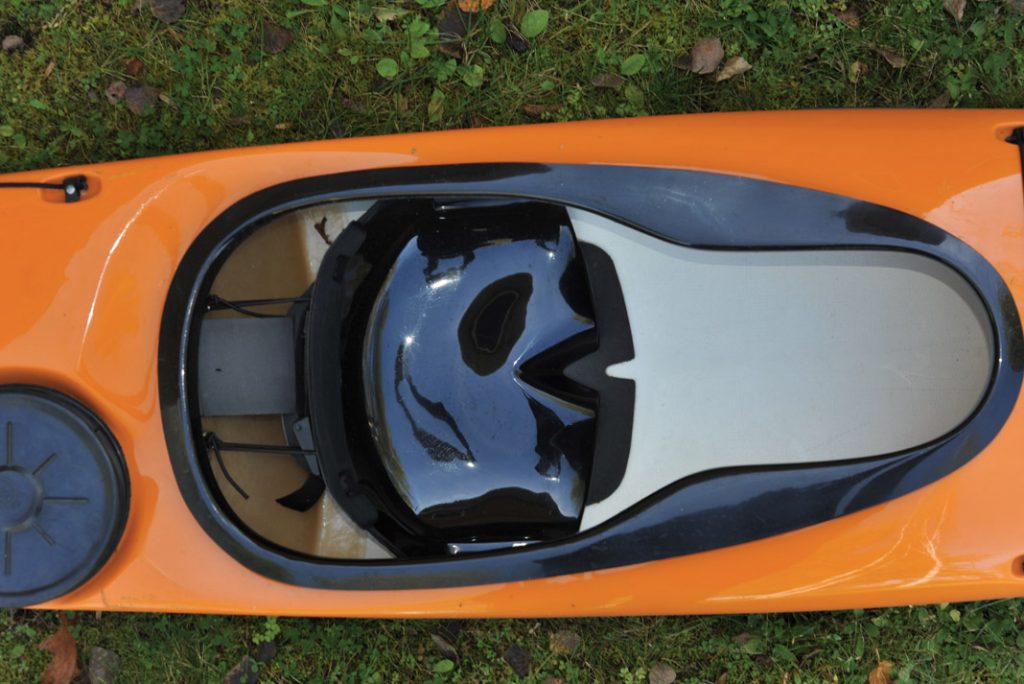
The seat is a small, fiberglass dish that suits me just fine for all-day tours. Those accustomed to the sophisticated seat systems found in many of today’s kayaks might find SKUK’s minimalist interpretation offers less leg support.

The Explorer’s cockpit

The Explorer accommodates medium-sized paddlers, with plenty of room under the foredeck for larger shoe sizes.

Or a cleverly concealed watermelon. Surprise!

Storage volume

With 166 liters of storage volume distributed across bow, stern and day hatches, there’s ample space for carefully packed extended trips. More challenging is squeezing bulky items through SKUK’s small, round hatches—I had to leave the Outback Oven and my three-ring binder of kayak lesson plans at the put-in. The upside of these smaller openings is that all three hatches remained bone-dry even after repeated rolling and playing in surf, and the soft rubber lids are very easy to peel off and press on.

Our standard fiberglass layup Explorer employs a relatively heavy, resin-rich construction built to withstand the abuse of expedition paddling. This laminate is also straightforward to repair, as damage tends to be localized around the site of impact. For weight-conscious paddlers, SKUK offers lighter Elite, carbon/Kevlar and hybrid glass-carbon/Kevlar layups.

Whether you’re planning an expedition of your own, or just looking to cover some miles and play along the way, the Explorer is an outstanding performer as you paddle into rougher waters. Its intuitive handling and composure in any conditions ensures all paddlers feel like great explorers.


A Paddling Adventure In Uncharted Territory

three people setting up a tent in vast territory
Photo: Francois Leger-Savard

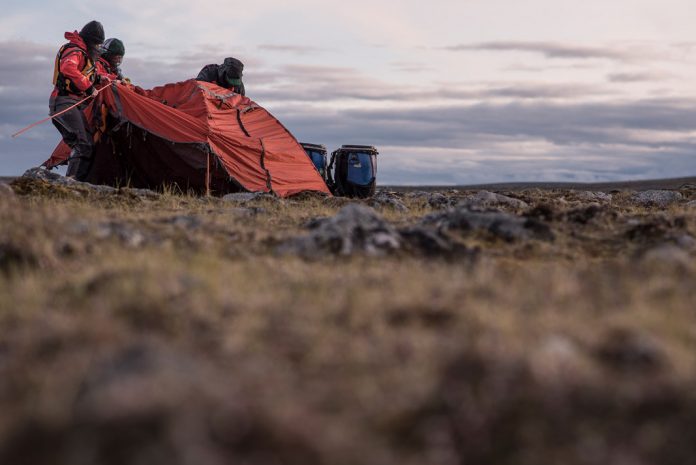
Last July, six paddlers took a small plane to the vast Pingualuit Crater on the Ungava Peninsula in northern Quebec. We intended to paddle down the Lestage River, for which there is no written record of exploration.

A winter with low snowfall, combined with a warm spring had lowered water levels, making our plans immensely difficult. Rather than running rapids, we hauled our canoes over rocks while standing in a few freezing inches of water.

The slow and arduous progress was grueling. We were forced to accept the fact we would not reach the village of Kangirsuk in our time frame. The North is a land of splendor, but also a land of power—even after two years of planning this expedition the appropriate response was to be humble enough to modify our course.

The Lestage River will keep its mysteries. Our new path took us down the Arpalirtuq and the Lepellé, two more unmapped rivers accessible from our remote location.

Over the next four hundred kilometers and 26 days, we were graced with the company of seals, wolves and snowy owls. Most impressive were the thousands of caribou keeping pace with us.

Steady rain and occasional hail and snow accompanied the first 10 days of the trip. Constant high winds blew through the region, testing the mettle of our team of three men and three women, as well as our equipment.

[ See the largest selection of boats and gear in the Paddling Buyer’s Guide ]

Day after day, the environment changed, from stone landscape to comfortable moss. The only certainty was our daily routine of erecting camp. It was the place to recharge, heal our wounds, share and laugh. Our tents were more than shelters to us; they became the place to talk and listen, binding six individuals into a team.

No social facade or bravado can withstand the seclusion and challenges of a northern adventure like this. We each discovered the true essence of our traveling companions and were richer for it.

We wanted our adventure to be more than a friends’ trip and contribute to something more than our personal benefit. To achieve this we documented thousands of years of human life in the region, making notes on the presence of archaeological sites on our journey.

The discovery of tent circles, stone houses and cairns was a concrete reminder of the ancestral Inuit presence on these lands. These marks of the past bore witness to the strength, intelligence and resilience of the men and women who set these stones in place and lived in this difficult environment.

We were privileged to paddle those waves, walk those hills, admire that sky and be in communion with the fauna. This incredible opportunity comes with the responsibility of sharing the beauty of this fragile ecosystem and promoting its protection.

Featured Photo: Francois Leger-Savard

The Science Behind Why Paddling Makes Us Happier & Healthier

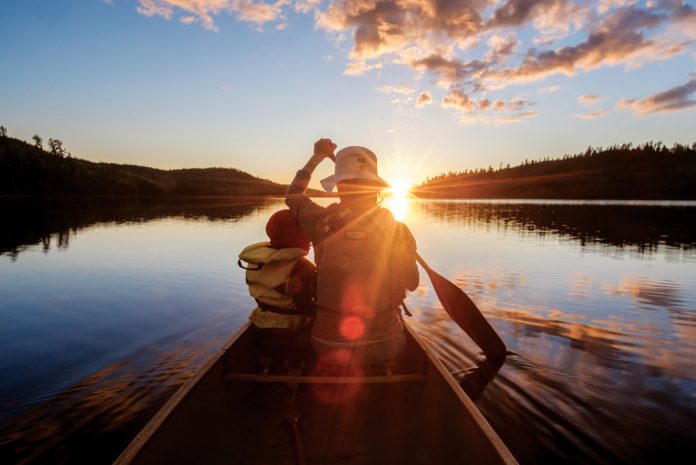
woman and child paddling into sunset stress free
"Imagine a therapy having no known side effects, was readily available, and could improve your cognitive functioning at zero cost." —Berman, Jonides, and Kaplan, 2008 | Photo: Ariel Estulin

In Apple’s App Store, I recently came across Wildfulness: Unwind in Nature. For $2.99, the app will pair “beautiful on-screen animations reflecting natural scenes, such as winter mountains and spring mornings, with forest sounds.” Wildfulness promises to help its users “relax from your busy day.” No need to ever step outside.

Wildfulness isn’t unique. A quick search reveals dozens of apps designed to mimic a natural outdoor experience, while promising to provide the same mood-boosting and stress-relieving benefits as the real deal.

The reason we need natural stress relief

Enter this as one more piece of evidence in the case-closed debate arguing North Americans are lacking time outdoors. A recent study by the Environmental Protection Agency claims the average American spends 93 percent of his or her life inside—87 percent indoors and six percent in automobiles. That results in the measly equivalent of just half a day outside a week—probably accumulated while taking out the garbage and walking around the block for a carton of milk.

Rather than prescribe themselves a walk in the park, today’s technophiles are increasingly turning to high-tech solutions to self-soothe. Surprisingly, there’s evidence to suggest these nature-infused apps do impart at least some of the benefits of actual time under a leafy canopy.

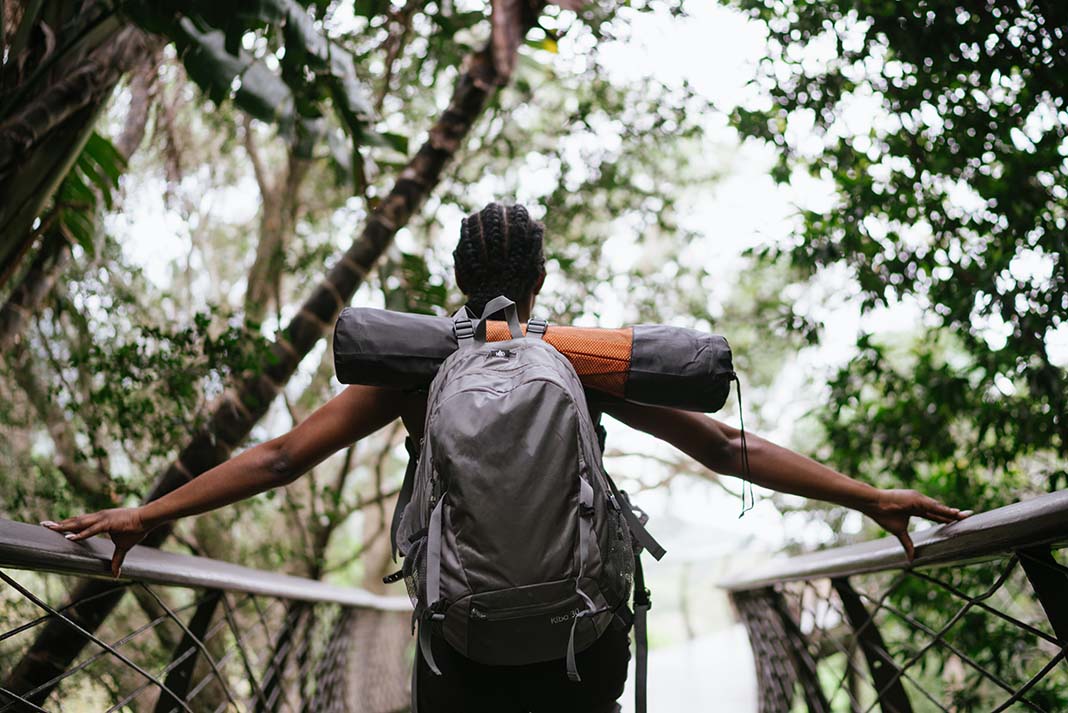
Photo by Rachel Claire from Pexels

Research shows forest scenes in a virtual reality atmosphere can lower blood pressure. Guided visualization exercises designed to mimic walking down a forest path can lower stress hormones. Listening to birdsong on earbuds can boost creativity. To me, these hacks seem like high-tech fixes to a low-tech problem.

An extreme example is in South Korea, where 90 percent of the nation’s youth experience myopia due to vitamin D deficiency from lack of sun exposure. Full-spectrum lights may be installed in classrooms nationally to stem the tide of short-sightedness.

“Thanks to a confluence of demographics and technology, we’ve pivoted further away from nature than any generation before us,” journalist Florence Williams writes in her 2017 book, The Nature Fix. “At the same time, we’re chronically burdened by ailments made worse by spending time indoors; from myopia and vitamin D deficiency, to obesity, depression, loneliness and anxiety.”

Stress relief activities and stress management

I know I’m preaching to the choir when I write nature is good for the body and mind. Last fall, I picked up The Nature Fix to find out why. I believe nature makes us happier, healthier and more creative, but what is happening on a physiological level?

Williams tracked down the top nature neuroscientists around the globe to explore why our brains are hardwired for nature. She travels to Japan to study the practice of shinrin yoku, or forest bathing—a fancy term for a walk in the woods. There she meets with Yuma University researcher Yoshifumi Miyazaki, who hypothesizes our bodies relax in pleasant, natural surroundings because they evolved there. For 99 percent of Homo sapiens’ history, we’ve been a species living outdoors.

Miyazaki’s work begins to quantify the almost mystical benefits the natural world can offer up. On average, his findings show a 15-minute walk in the woods offers a 16 percent decrease in stress hormone cortisol, a two percent drop in blood pressure, and a four percent drop in heart rate. It was enough for the Japanese government to take note and create 48 forest bathing therapy trails maintained by the national forest service.

Photo by RF._.studio from Pexels

Over two years, Williams traveled to three continents to meet with experts. Among some of the findings she uncovers: Just 15 minutes outside increases short term memory. When listening to birdsong or looking at fractal patterns—like a leaf or droplet on water—the prefrontal cortex quiets down and our brains produce more alpha waves, associated with calmness, flow and meditation. Phytoncides—a technical term for nice tree smells—boost white blood cell production.

Spend 45 minutes outside and most subjects will experience a boost in cognitive performance. Spend five hours a month in the woods to stave off depression, at least according to Finland’s public health officials. Spend three days outside and, in the words of one researcher, “that’s when things start to get profound.”

In the end, Williams comes up with this ultra-simple mantra: go outside, often, sometimes in wild places. To get maximum benefit, she recommends a pyramid approach. Take walks in tree-filled spaces in your neighbourhood daily, explore accessible and wilder areas weekly or monthly, and make time for transformative multi-day trips once or twice a year. The perfect recipe for a dose of natural stress relief and anxiety relief.

[ Find your stress-relieving boat in the Paddling Buyer’s Guide ]

A fact-based answer to the woolly question of why nature soothes us so effectively may always be elusive—perhaps, it’s a question best left to philosophers. What is becoming clearer is precisely how nature benefits us. The connection between humans and the natural world is so strong, viewing a digital representation of a beautiful landscape—or even the photo accompanying this column—may be calming.

The notion nature is essential to humanity seems romantically poetic. Increasingly, it’s also delightfully factual. The data is starting to catch up with what so many of us already intuitively know: We belong outside.

This article was first published in Paddling Magazine Issue 53. Subscribe to Paddling Magazine’s print and digital editions here, or browse the digital archives here.


Kaydi Pyette is the editor of Paddling Magazine. While creating this issue at her desk, she sat under a full-spectrum light, beside a humidifier infused with pine oil, while listening to a looped 11-hour track of tranquil birdsong on YouTube.

“Imagine a therapy having no known side effects, was readily available, and could improve your cognitive functioning at zero cost.”— Berman, Jonides, and Kaplan, 2008. | Photo: Ariel Estulin