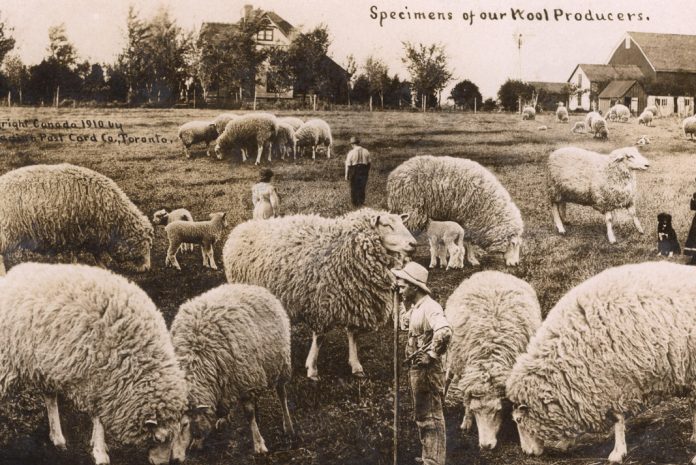
Many Associate Wool With Sheep, But Alpacas, Camels And Goats Also Produce Fibers Commonly Twisted Into Yarn And Made Into Textiles. More unusually, cat and dog hair can also be spun into yarn.
1. Clothing and other items made of wool date back millenia, from 3,400-year-old Egyptian yarn to fragmentary textiles unearthed in Siberian graves dating from the first century B.C.
2. Wool Has Always Been A Favorite Of Paddlers
—from fur-trade-era voyageurs to modern lumbersexuals. Wool is naturally antibacterial, helping to prevent odor, and it provides natural insulation thanks to its hollow construction. Wool retains its insulating properties even when wet, making it especially popular with off-season paddlers and campers.
3. Thanks to a high ignition point, wool is naturally fire-resistant. Unlike nylon and polyester, wool does not drip or melt when it catches fire, and it often self-extinguishes. These qualities have made wool attractive to the U.S. Army, firefighters, stunt men and women, and campers alike.
4. The fastest recorded time to shear a mature sheep is 37.9 seconds and held by Ivan Scott, 33, of Ireland. In 2017, Scott shaved 1.41 seconds off the previous six-year-old Guinness World Record, held by Australian shearer Hilton Barrett. Scott previously set the world record in 2012 for the number of sheep sheared in eight hours, shearing 744 lambs.
5. When purchasing a $80 merino wool shirt you might feel fleeced—is merino wool truly the wonder fiber it’s touted to be? Most common in New Zealand, the Merino is a type of sheep prized for its long and fine wool. Generally, the finer the wool, the softer-feeling the garment. As far as we can tell, this is the biggest, objective difference between Merino and other types of wool.
6. The Woolly Bugger Is An Artificial Fly
Widely used for both freshwater and saltwater game fish and considered one of the top patterns to have in any fly box. Conversely, being called a wooly bugger is almost always an insult.
7. Wool is woven into many common idioms, including “a wolf in sheep’s clothing” and “pulling the wool over someone’s eyes.” The phrase “dyed in the wool” refers to an unchanging belief or opinion. Its origin comes from the fact wool dyed before it was woven kept its color better than a wool garment dyed after weaving.
8. Isolated populations of wooly mammoths survived on Alaska’s Wrangell Island until just 4,000 years ago. A team of Harvard scientists is currently working on a de-extiction effort to resurrect the furry beasts through a feat of genetic engineering. They call the mammoth-elephant hybrid they hope to create in 2019 a mammophant.
9. Q: Where did the sheep go to get his wool cut?
A: The baa-baa shop.
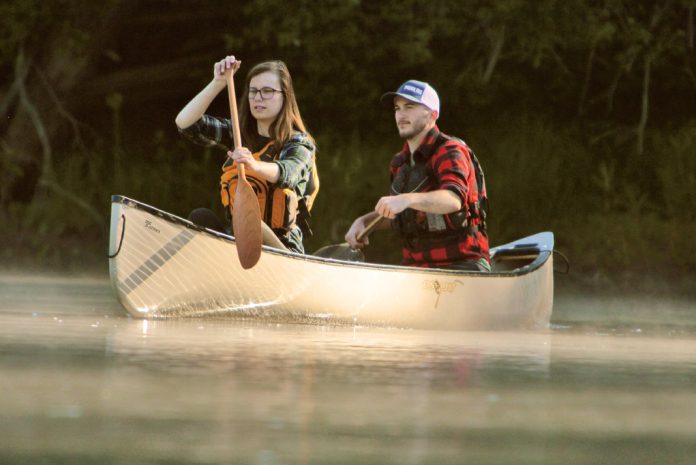
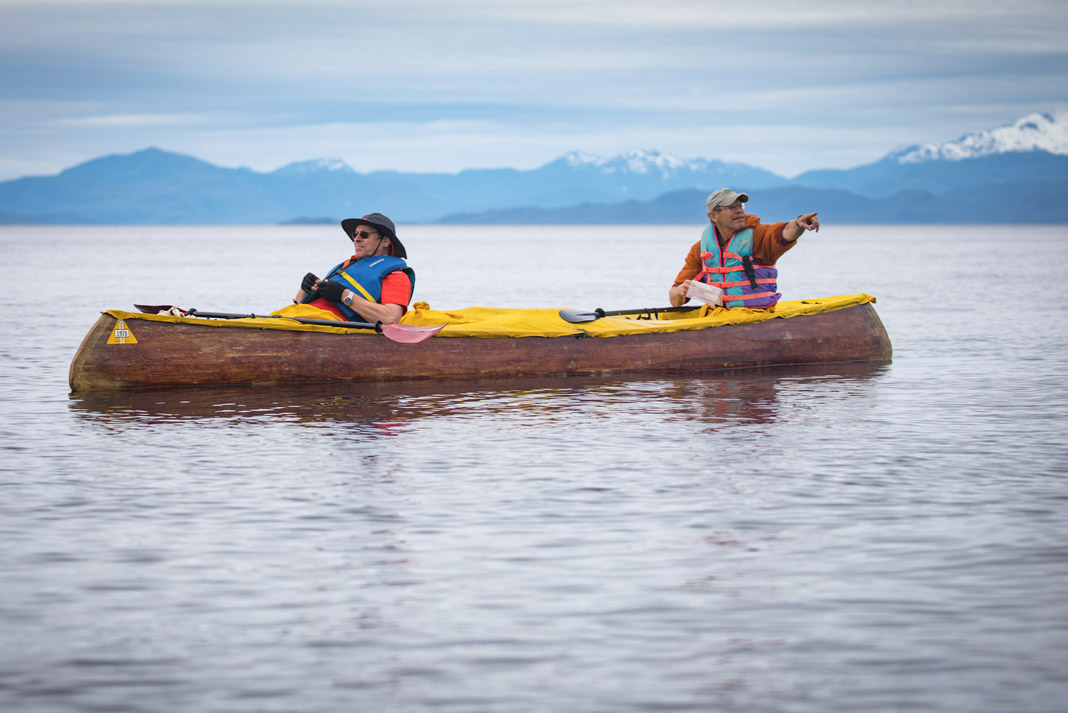
Pick your paddle partner for your latte on the lake. | Photo: Kaydi Pyette
It’s hard to focus with the Hurons nestled up against the shore outside my office window. The new series from Esquif Canoes features a 15-and 16-foot duo ideal for the sheltered waters beside Paddling Magazine’s cottage-turned-office headquarters.
Esquif Canoe’s Huron Canoe Specs
Length: 15 ft/ 16 ft Width: 35 in/ 35 in Depth: 12.5 in/ 12.5 in Weight: 55 lbs/ 60 lbs Price: $1,900 USD–$2,115 CAD/ $2,005 USD–$2,230 CAD esquif.com
Esquif has been making canoes for more than two decades, building their reputation largely on whitewater and expedition designs for paddling remote rivers in Ontario, Quebec and Canada’s territories. Esquif’s core market is a niche in the canoeing world.
“We’re selling a dream. The big adventure, once-in-a-lifetime, three-weeks-with-all-your-gear dream,” says founder and owner Jacques Chasse. “But we also understand lots of people paddle with a friend on a local lake to watch the sunset.”
Or, how about at lunch with your colleagues to blow off some deadline steam?
Enter the Huron. It’s more of a sit-and-sip-your-coffee and watch-the-birds kind of boat. “It’s a different approach,” agrees Chasse. Side-by-side with Esquif’s best-selling Prospecteur lineup you might not think the hulls look too different. And you’d be right—in fact, they’re identical.
The Huron 15 and Huron 16 are taken from the same molds as the Prospecteur 15 and Prospector 16, then trimmed down to a depth of 12.5 inches. Further up the family canoe tree, both the Prospecteurs and the Hurons descend from a 17-foot Chestnut Canoe Company Prospector.
Esquif Canoe’s friendly 2-person canoe
Who is the Huron perfect for? Well, unless your go-to destination is a whitewater river or one of the Great Lakes, the Huron is probably ideal for you. The Huron series is a compromise for those who want the Prospecteur’s predictable and friendly handling, but don’t paddle much in the way of rough water.
It’s Corny to Say, But The Huron does have this nice balance between tracking and maneuverability.
Shaving the gunwale height from the Prospecteur’s 14.5 inches to the Huron’s 12.5 inches saves five to eight pounds. It also lowers the windage on the Hurons, making them easier to control in breezy conditions.
The Huron series is ideal for recreational canoeists who want rugged canoes for paddling on calm bodies of water and small rivers, but who don’t need the depth and capacity of the Prospecteurs,” says Chasse.
While the Prospecteur 15 and 16 are capable wilderness canoes for solo or tandem tripping canoes, without the depth of its cousins the Hurons lack the confidence to handle wind waves and wave trains they’re better suited to cottagers and relaxed day tours.
Esquif’s mid-sized recreational canoe
Think less canoe tripping and more of the finer things in life—on-water picnics, fishing, wildlife photography, sunset birding and toodling around without a care in the world.
“We didn’t really have a small to mid-size recreational flatwater canoe in the lineup,” says sales rep Johno Foster. “It’s corny to say, but the Huron does have this nice balance between tracking and maneuverability.”
The solo handling of the Hurons is easy and enjoyable. The only solo flatwater canoe Esquif is currently manufacturing is the 14-foot Echo—the Hurons are a good alternative for prospective paddlers looking for a bit more depth and length for more capacity and capability, according to Foster.
Between the two Hurons themselves, there’s not much difference—the Huron 15 is simply the 16-footer scaled down with reconfigured rocker, says Chasse. The 15-footer offers a little less carrying capacity and speed.
After 20 years being known first and foremost for innovative whitewater designs created for a very niche market, Esquif’s new Huron series is the kind of boat with appeal to the mass flatwater paddling public. | Photo: Kaydi Pyette
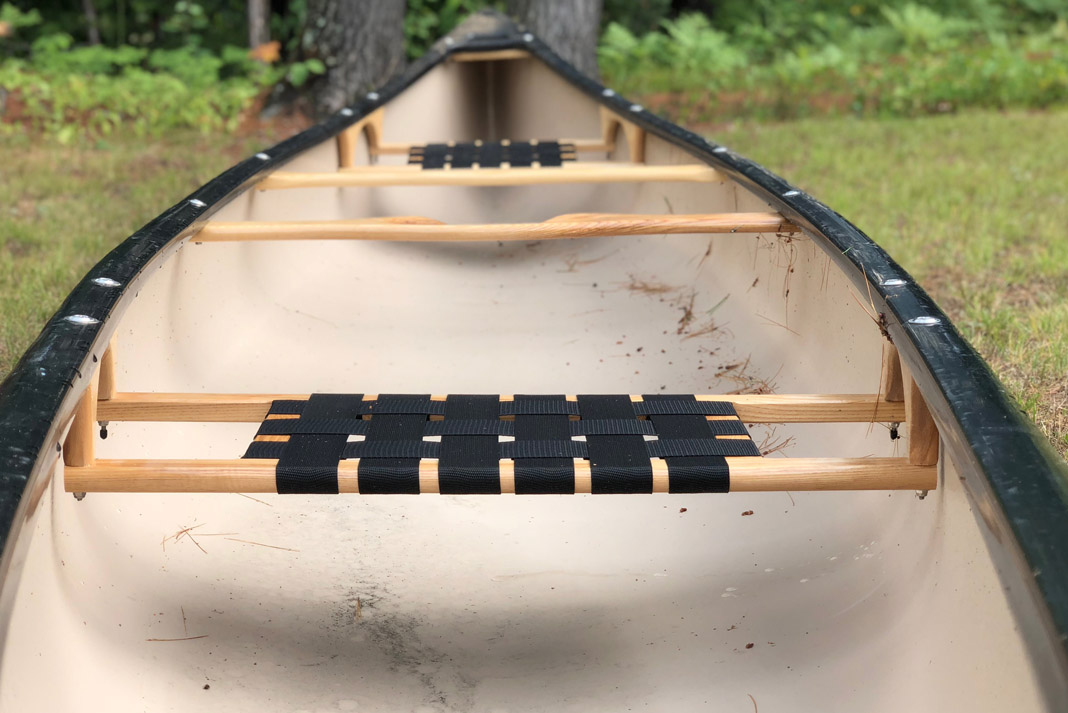
Webbed seats, with vinyl trim and a contoured ask yoke and thwart come standard with the Huron. The Huron is available in red and tan. | Photo: Kaydi Pyette
Esquif Canoe’s heavy-duty T-formex canoe
The Huron Canoes are available in T-formex. It’s a glossier, slippier and more abrasion resistant material than defunct hull material Royalex. It’s manufactured the same way though—a layer of foam core sandwiched between ABS plastic and a proprietary material Chasse won’t divulge.
This heavy-duty layup is favored by whitewater paddlers but it also appeals to anyone desiring a maintenance-free boat. The Huron’s T-Formex hull will continue to shine even after it has been dragged down to the water’s edge, banged up in shallow and rocky creeks and left to bake and freeze outside through the seasons.
Not that we’d recommend this sort of treatment, of course. What I can say is T-Formex is a pretty worry-free material—the handful of T-Formex canoes resting year-round outside the Paddling Magazine office are a testament to it.
“The durability is a big part of the appeal. With many layups there’s a feeling of wanting to baby the boat,” says Foster. “I love this about T-Formex—I never feel that way. I don’t have to worry about it.”
[ View our selection of T-formex canoe’s in our Paddling Buyer’s Guide ]
Both the Huron 15 and 16 canoe come in around the $2,000. Our pair of Hurons are trimmed with standard webbed seats, ash yokes and vinyl gunwales and deck plates. For an elegant design like this, I’d be tempted to trim it in wood.
Esquif also offers a solo outfitting package if that’s more your style. Now, if you’ll excuse me, the Hurons are awaiting my lunchtime liberation from the editor’s desk, and I don’t want to disappoint.
Pick your paddle partner for your latte on the lake. Feature Photo: Kaydi Pyette
I Was Raised In Southwestern Ontario And I Spent My Teens Paddling Local Rivers There. However, for the last 30 years, I’ve become acclimatized to canoeing rivers in the far north where it’s rare to see other paddlers, let alone signs of development along the banks. My recent 300 kilometers down the length of southwestern Ontario’s Thames River was a totally different type of canoe trip.
Campsites along the way were a mixed bag. I pitched my tent on farm fields and backyards. I even spent a night in a king-size bed of a fancy hotel. I packed a bike lock to secure my canoe and carried my own drinking water for the entire eight days.
With the river water said to be undrinkable due to agriculture runoff, I was reminded of how comparatively safe and comfortable I am traveling in wild, remote places in the far north.
Bears and bad weather can be menacing
People, however, can be down right freaky. On my sixth day the river was constantly twisting and turning and a heat wave made paddling farther unbearable. I’d been on the river for nine hours, making my way through a section the voyageurs referred to in their journals as a “respectable ditch” due to the high, clay banks.
I would have preferred to set my tent up in a farmer’s back woodlot amongst the cow patties and stinging nettle. Instead I obtained permission to stay the night along a Highway 2 park just upstream from the small town of Thamesville. It’s an historic spot with a plaque commemorating the War of 1812 and the death of the great Chief Tecumseh.
I locked my canoe to an old willow and clambered up the muddy bank with my packs to pitch my tent on the freshly mowed lawn. There were picnic tables, charcoal BBQs and a portable plastic toilet. And there were people. Lots of people.
I had a week-old beard, smelled of wood smoke and bug dope. Still, I was a popular attraction. Everyone wanted to know where I was going. While I cooked dinner on my butane stove I visited with a Mennonite family on their way home from market. Closer to dusk I met a teenage couple who came to make out. I met some guy looking to hook up. They all shared stories of life along a southern river.
Darkness came late and eventually the crowd dispersed. Except for one. A tall husky man in a black leather jacket, torn Wranglers and snakeskin cowboy boots jumped out of his lifted Ram pickup and limped over to the picnic table directly beside my tent.
When He Started Rambling About The Ku Klux Klan And His Firearm Collection I Started To Get Nervous. During my travels in the remote north I’ve dealt with my share of misadventures. I’ve been stormbound on the north shore of Lake Superior.
I’ve been stalked by a predacious black bear on a portage in Woodland Caribou Park. And I’ve been unsure of my whereabouts along the shore of James Bay. There were some anxious moments. But I’ve never once felt more concerned about my welfare than with this card-carrying member of the NRA.
For the first time after thousands of miles on hundreds on routes and months under the stars, I felt vulnerable. The more I ignored him and went about my business packing up for the night, the more he ranted about the rise of “white power” and the stupidity of “Goddamn communist gun control”.
When darkness finally set in, I caught him reaching into his jacket pocket. Dreams of rivers never paddled flashed before my eyes. I was holding a plastic spatula as he was reaching for a pistol. I was going to die right here at the memorial for the Battle of the Thames.
Instead he drew from his pocket a king can of Budweiser. Before he had a chance to pop the top he swatted at his neck. Then again. And again.
The Very Bloodsucking Insects I’ve Cursed In The Wilderness My Entire Adult Life Were Coming Out To Feed.They were coming to my rescue.
A few minutes of cursing and swatting at mosquitos the man retreated to his truck and sped off in a cloud of gravel dust taking his unopened can of Bud with him.
I spent the rest of the night curled in a fetal position inside my nylon shelter, grasping my camp knife. Lying there waiting for the sun to come up I wished I was camped on a nice piece of northern granite surrounded by Boreal wilderness—safe and sound.
Kevin Callan is the author of 17 paddling and camping guidebooks.
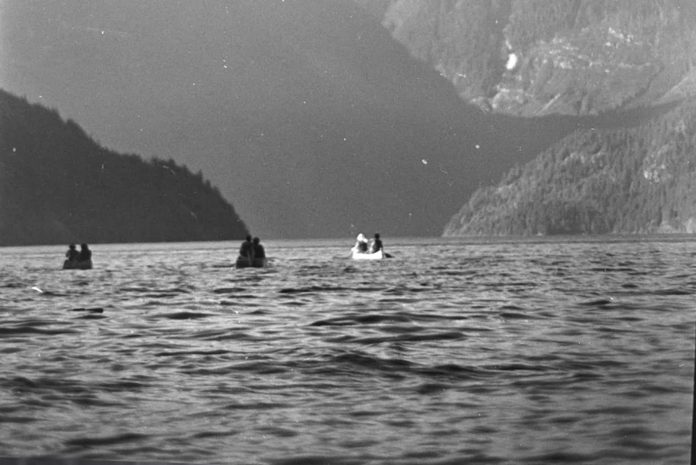
On June 14, 1974, my grandma Glady dropped her two sons off at a marina in the Puget Sound. They loaded gear into homemade woodstrip canoes and pushed off into the cold, black water. Decades later, Grandma told me as she watched them disappear into the fog, she wondered if she would ever see her boys again.
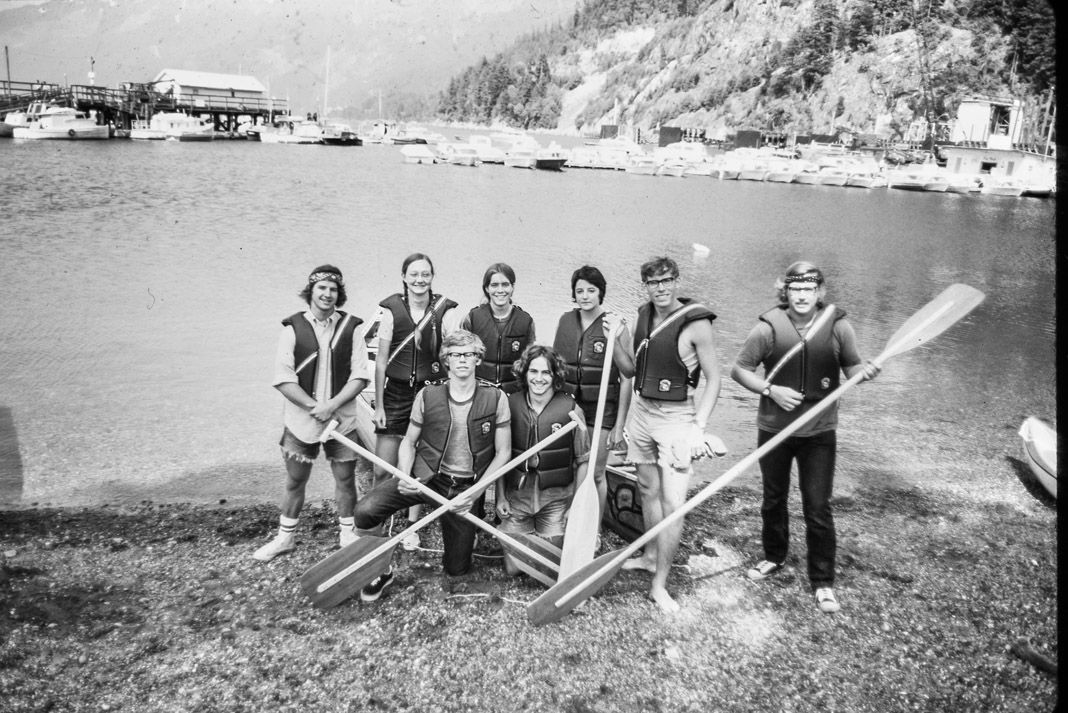
My dad, Alan, and his best friend and younger brother, Andy, had been planning this trip for years. They were climbers, mountaineers and fishermen. Before leaving college and entering what they remember calling “the real world,” they wanted one last adventure—an experience truly unknown and challenging; something beautiful they could share as brothers, and with my dad’s girlfriend, Sara, who would later become his wife and my mother, and a small band of college friends.
After my dad finished college, he and my uncle built their own canoes in a college basement, launched them into the Pacific, and became some of the first people in recent history to canoe the Inland Passage from Vancouver to Alaska.
Their story became a legend in my family. One of the original boats still hangs in my parent’s garage. My brother, Ben, and I grew up paddling the old canoe—fishing from it in the Pacific Northwest and beating it up in eastern rivers, like the Shenandoah. As we reeled in fish and cut through waterways, we couldn’t help but marvel at the craft our dad built and wonder what the 1974 adventure was actually like.
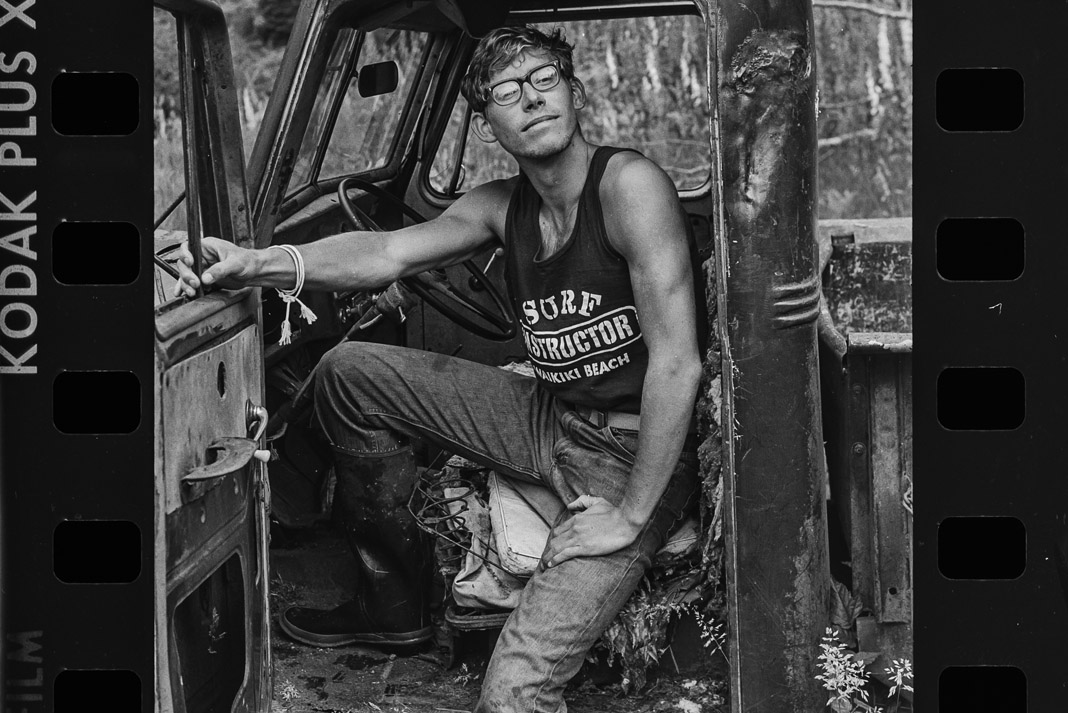
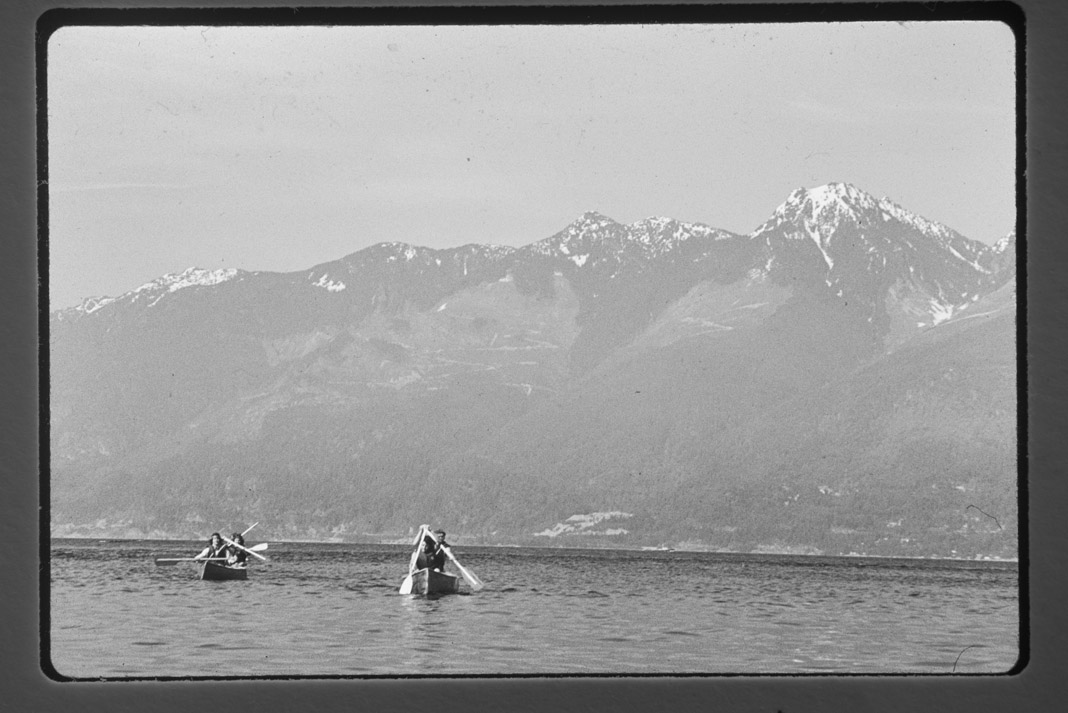
When I was 16, I unearthed a dusty cardboard box behind my dad’s CDs and cassette tapes. Carelessly written on the top of the box were the words, Canoe Trip. The images and film negatives I found inside painted vivid pictures of the 1974 legend—a story of risk, naysayers and adventure. I studied the photographs countless times, mesmerized by images of my 20-year-old parents on the adventure of a lifetime.
Looking back now, almost two decades after finding the images, I’m certain the story of my parents’ journey on the Inside Passage shaped my life choices. How could a journey I never directly experienced have had such a profound impact on me?
Before I could answer this question, I needed to understand what really happened in 1974. And so, for nearly a year, I worked on a documentary about their legendary canoe trip. In the process, I learned volumes about the real journey, my parents and myself.
“The good thing when you’re young and you come up with an idea that everyone thinks is crazy is that you’re too young to understand they perspective, you just think they’re crazy and they don’t understand.” -Alan Dappen, pictured in 1974. | Photo: Courtesy of Nate & Alan Dappen
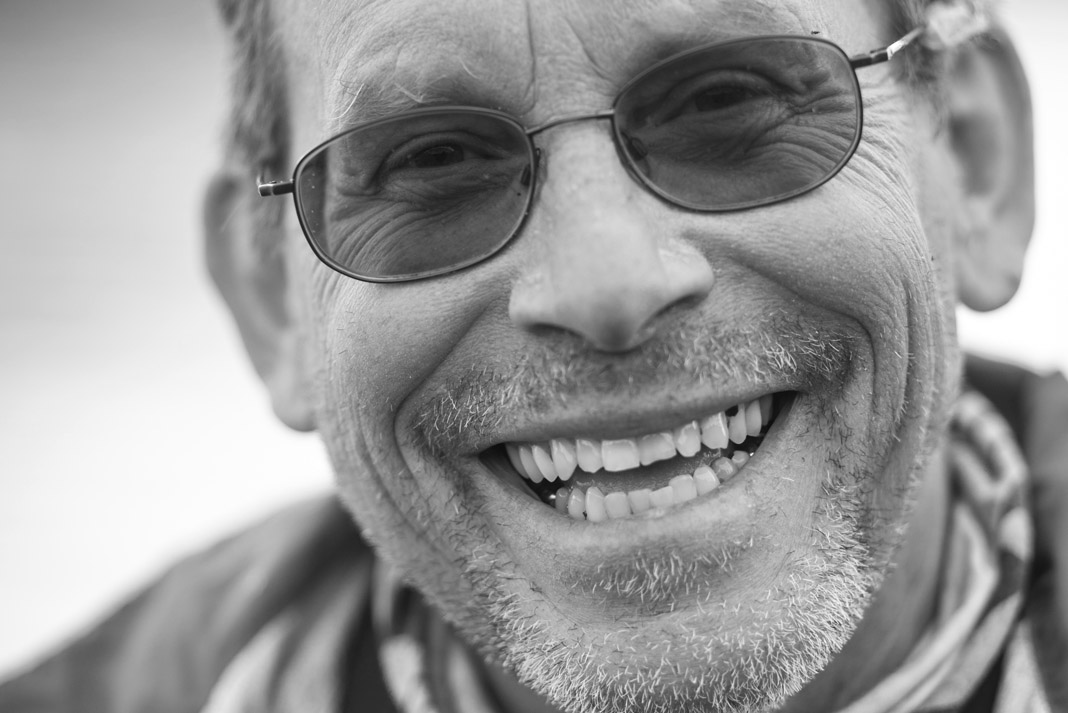
Alan Dappen pictured in 2017. | Photo: Courtesy of Nate & Alan Dappen
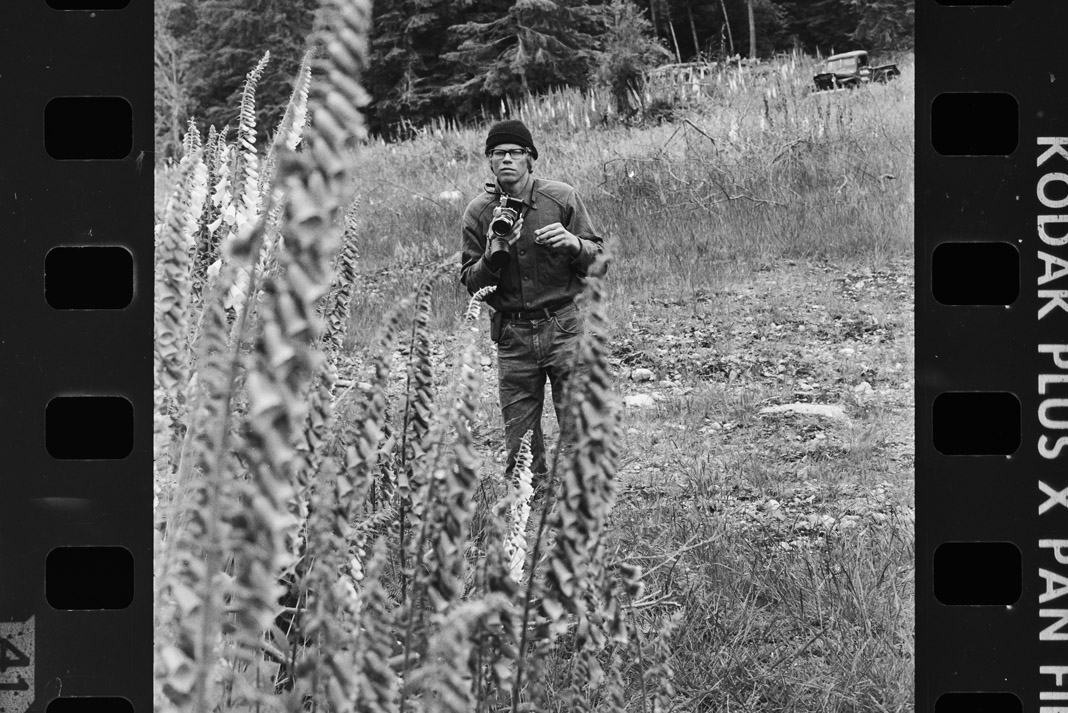
Brother Andy in 1974. | Photo: Courtesy of Nate & Alan Dappen
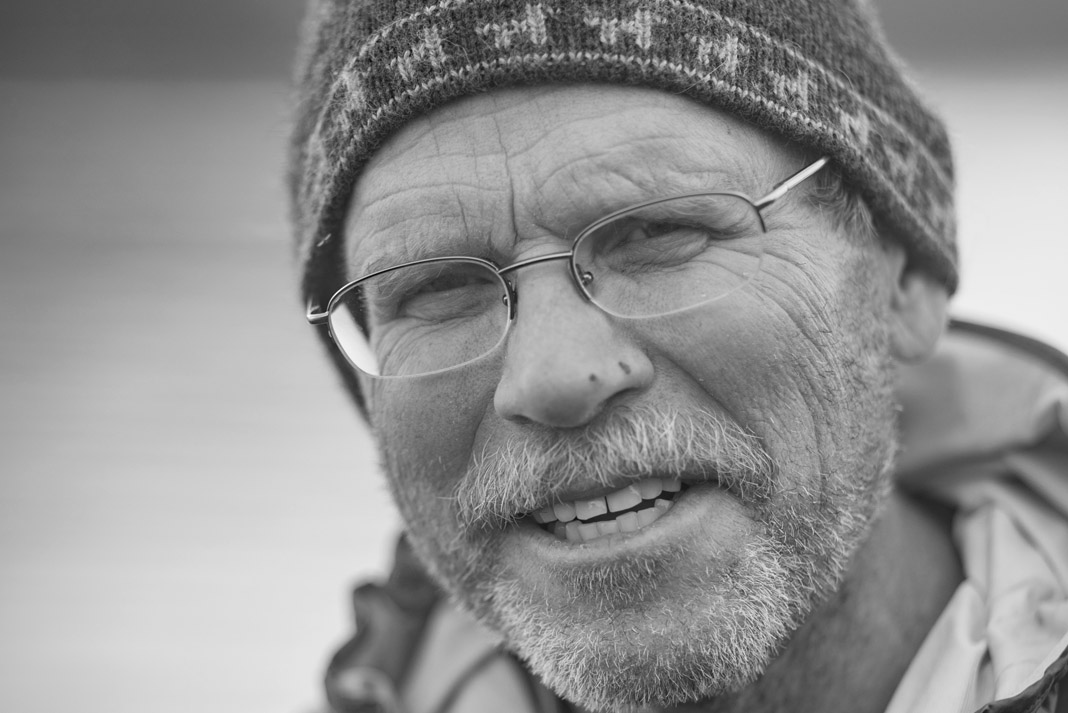
Brother Andy in 2017. | Photo: Courtesy of Nate & Alan Dappen
The story started in 1970. After my dad finished high school, he got a job as a deckhand on a yacht called the Thea Foss, taking guests up and down the Inside Passage, a labyrinth of straits and islands extending from Washington State up the coast of British Columbia and well into Alaska. Stuck on the boat, he watched the coastline pass by and dreamed of fishing and camping along its banks.
His summer experience sowed the seed of a grand idea to canoe the entire coastal waterway. He rushed home from his summer job to share this dream with his younger brother, Andy.My Dad and Andy had a unique relationship as brothers. Close in age, they were best friends throughout childhood and when they went off to university at Whitman College they roomed together.
As early adopters of outdoor adventure, they spent their weekends climbing, camping, fishing and ski-mountaineering in the wilderness of the Pacific Northwest. Together, they set a goal of embarking on a journey along the Inside Passage just after my dad graduated from college and before medical school consumed him. The only obstacles standing in their way were a lack of canoes and empty pockets.
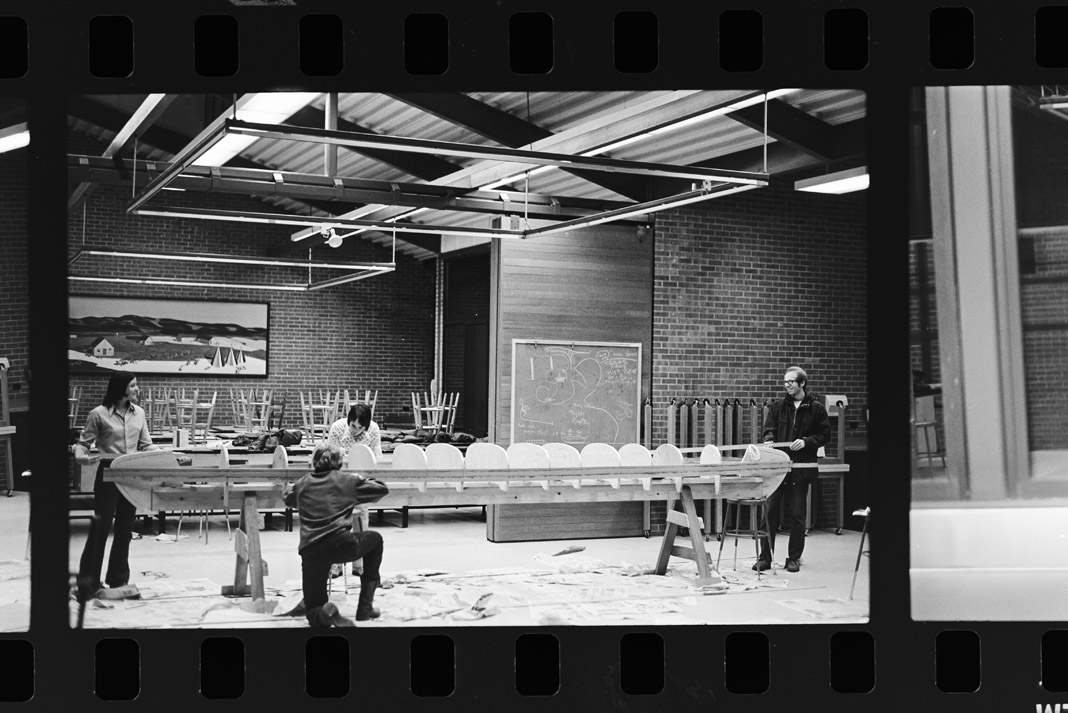
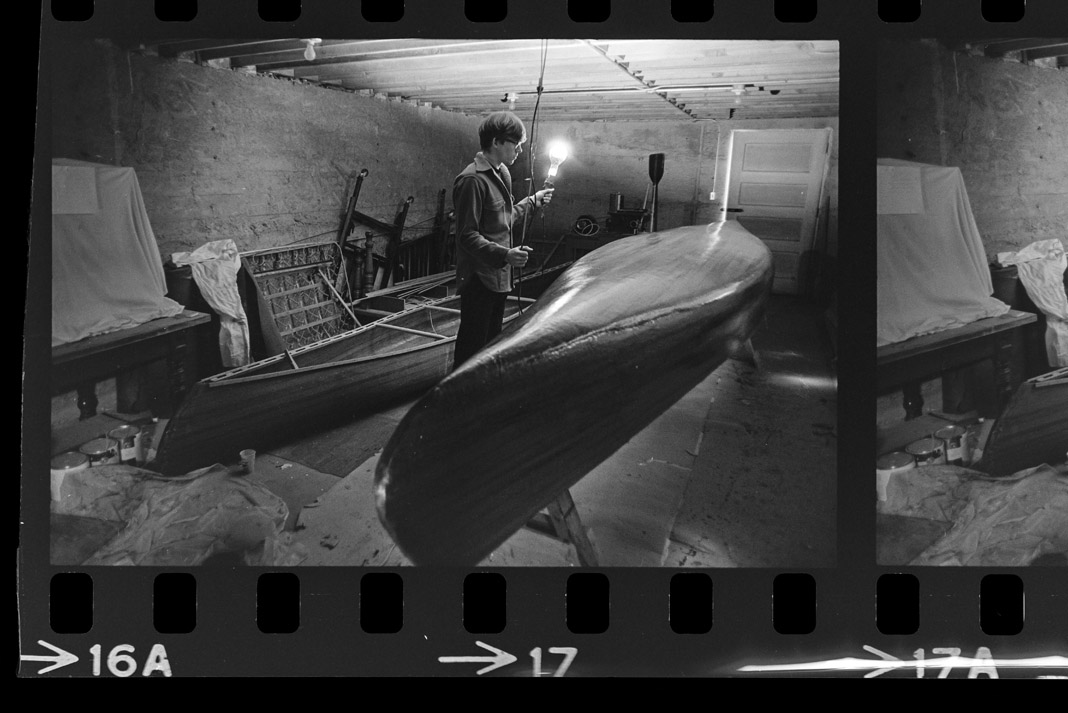
Determined to make this trip a reality, they found a man in Bellingham, Washington who shared building plans. For the last six months of university, the duo worked every night in the college art building, sawing, sanding, bending and varnishing. With $500 and a lot of elbow grease, they built three gleaming cedarstrip canoes before graduating.
Hard at work building boats after class. | Photo: Courtesy of Nate & Alan Dappen
“If you were to buy these boats they would cost $3,000, $4,000, maybe $5,000. But we could make these woodstrip canoes for $150 at the time. We made these pieces of art because it was the cheapest option.”-Andy Dappen | Photo: Courtesy of Nate & Alan Dappen
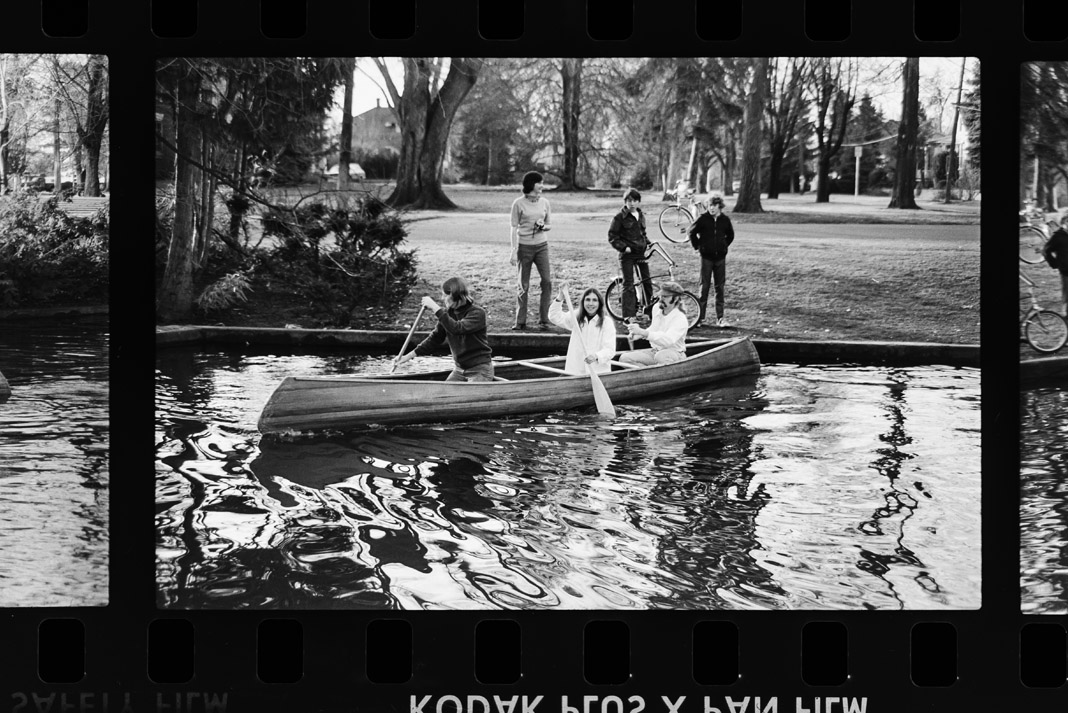
Testing the homemade works of art. | Photo: Courtesy of Nate & Alan Dappen
At the time, only a few people had ever canoed the entire coastline, and there was virtually no information available. During the building process, my dad and Andy sent letters to fishermen, loggers, writers, homesteaders and the Forest Service—anyone and everyone they could think of who lived along the coast and could give them advice about canoeing the Passage.
The letters returned were almost unanimously apocalyptic. “Go home and sell your canoes,” they read. “You’re going to kill yourselves,” wrote another. “People go down in big boats on those waterways. Why are you going in a canoe?” Letter after letter returned, urging them not to do it. Finally, just a few weeks before they were planning to leave, one letter returned with the response they were waiting for. It began, “Do it. It’ll be the best trip of your life.”
At the time, my dad was dating a Wellesley college girl named Sara, who would eventually become my mother. They had been together for about a year, and he decided this canoe trip would be a good opportunity to get to know each other better. As an invitation, he sent her a survival kit filled with trinkets and tools he said would sustain her during the voyage. She accepted without hesitation. Soon after her parents sent her to a psychiatrist to attempt to talk her out of going.
As the story goes, by the time their sessions were over, the psychiatrist wanted to join the expedition.
One member of the 1974 paddling crew dropped out a couple weeks into the journey. | Photo: Courtesy of Nate & Alan Dappen
The rest continued onto Ketchikan. | Photo: Courtesy of Nate & Alan Dappen
On June 14, 1974, my 20-year-old father, mother and uncle, along with a small crew of their friends, launched their three homemade canoes into the Pacific and began an eight-week journey along the Inside Passage.
For the next two months, they paddled, fished and camped in one of North America’s wildest landscapes. After their adventures along the coast, they returned home as different people. The canoe trip had changed them, and the story of the grand adventure lived on long after summer faded. Over the next 40 years, tales from their trip were told, and retold. Through a game of telephone and the metamorphosis of aging memories, the story of their adventure became morphed, exaggerated, forgotten and remembered. By the time I became an adult, it was hard for me to separate fact from legend. In my mind, and even in the minds of my parents, they had returned home upon the completion of their intended journey. But as a kid you never really get the full story.
Some of the group needed to go back to college and had enough, while others wanted to continue on to Juneau, their intended destination. They had never completed the original trip as intended.
In September 2015, as we prepared centerpieces for the guest tables at my wedding, my uncle Andy told me by the time the group reached Ketchikan, about 800 miles from their starting point, the crew was divided. Some of the group needed to go back to college and had enough, while others wanted to continue on to Juneau, their intended destination. They had never completed the original trip as intended.
When my dad and Andy started this trip, they were young men with endless possibilities in their lives. Now, 43 years later, they are both nearing the ends of their careers, with more time behind them than ahead. But they still had at least one big adventure left in them. On my wedding day, my brother, Andy, my dad and I made a plan. We decided to refurbish the canoes, return to the Inside Passage and complete the journey through the Pacific Northwest that had shaped them so profoundly as young men.
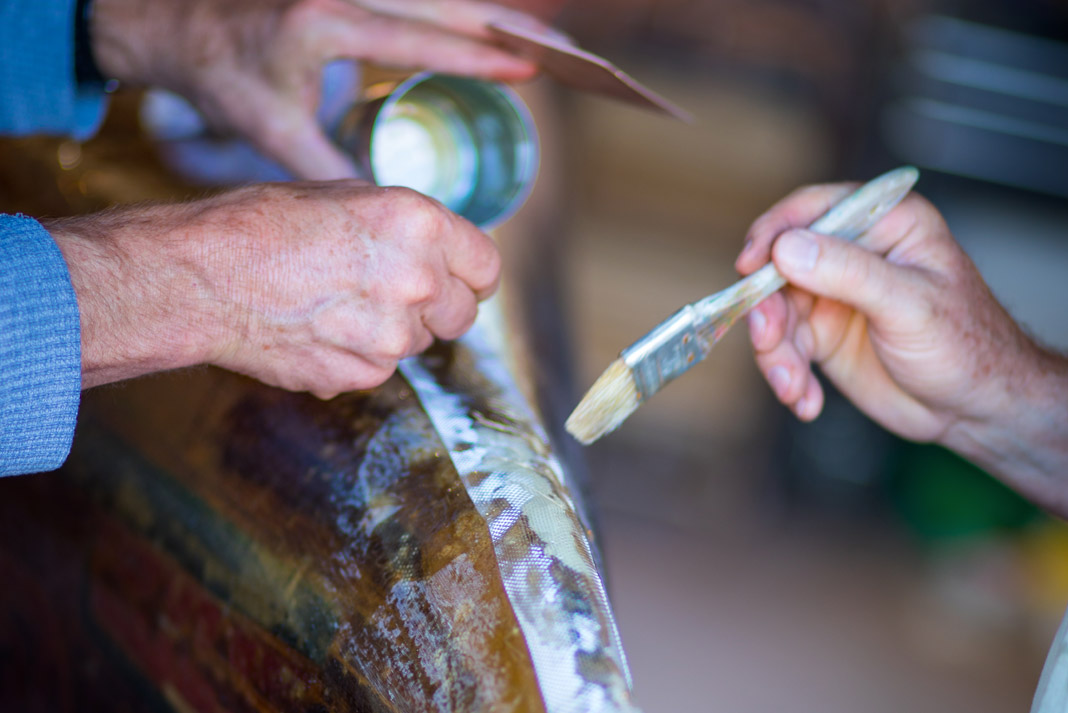
The 2017 crew stripped down the boats and re-glassed the hulls. | Photo: Courtesy of Nate & Alan Dappen
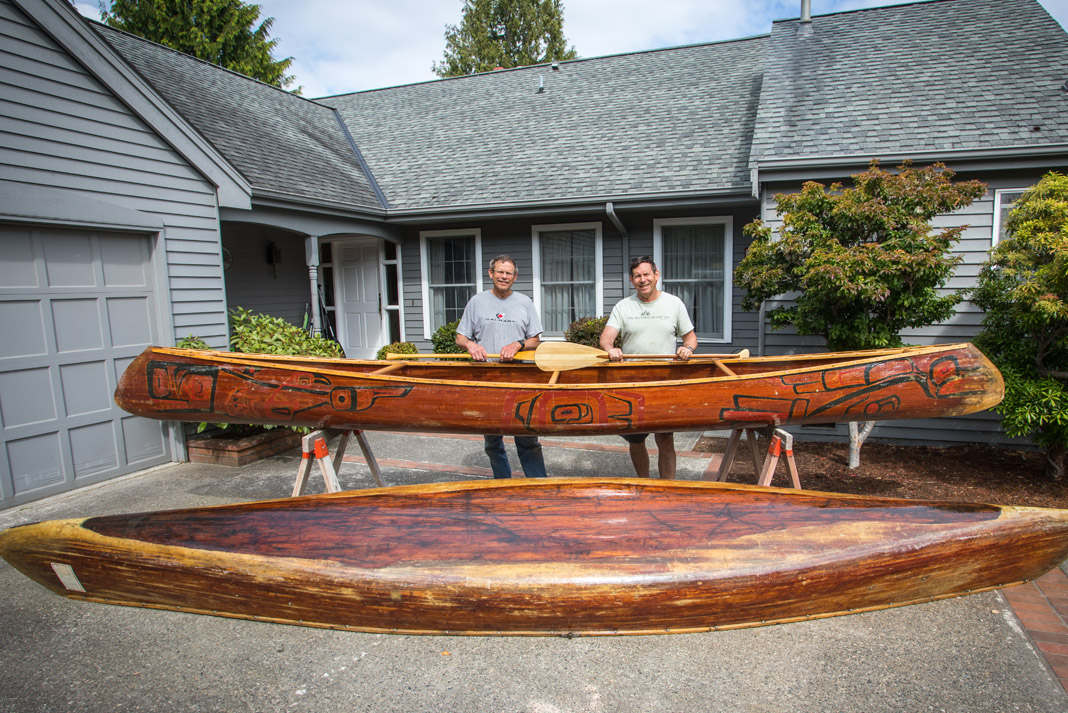
“It’s incredibly cool, you can see its old battle scars and history,” says Alan. | Photo: Courtesy of Nate & Alan Dappen
Our first challenge was getting the four-decade-old canoes ready. When the crew returned home from Alaska in 1974, one canoe went with my parents, one with Andy, and the third was left at my grandparents’ house. Each canoe took on a life of its own. Andy became a professional adventure journalist, taking his canoe on even more epic journeys in places like the Yukon and on the Peace River. The canoe in my grandparents’ house became the Puget Sound fishing vessel on family visits. And the canoe my parents kept became a cornerstone of our childhood adventures. These boats were old, and needed work before they could complete the journey they were intended for.
It took a week to repair two of the canoes. When ready, the four of us ferried for two days from Bellingham, Washington to Ketchikan, Alaska. Our aim was to fulfill the original 1974 goal of reaching Juneau, a 300-mile paddle from Ketchikan.
The day we arrived in Ketchikan the rain poured and the wind howled. After just a few hours of paddling up the Tongass Narrows, everything and everyone was soaked. We were in the water for less than five hours before the weather turned and forced us to land on Gravian Island. We stayed there for two days, stranded by wind and high seas. Finally, the sun came out and we continued north.
I was moved by the beauty and richness of the landscape. Every day, humpback whales breached around us. Pods of harbor porpoises rounded our canoes. Sea lions appeared suddenly around our boats, only to disappear a moment later and bark in the distance. Mink ate the many fish carcasses we disposed of after dining on the spoils of our outrageously productive fishing efforts. Evidence of bears was common and once, a young brown bear paraded through our camp, inspecting our canoes before entering the channel and swimming a half-mile to the other side. Even as a wildlife filmmaker, I have rarely seen such abundance.
As the days and nights melted into one another, and time disappeared, we shared stories, catching up on years of our busy, distant lives.
A few days into the trip, as we paddled steadily through this remarkable landscape, Ben and I realized this was the longest time we had spent together since he left home for college 18 years earlier. For my dad and Andy, this was the longest they had spent together since the 1974 canoe trip, 43 years earlier. As the days and nights melted into one another, and time disappeared, we shared stories, catching up on years of our busy, distant lives.
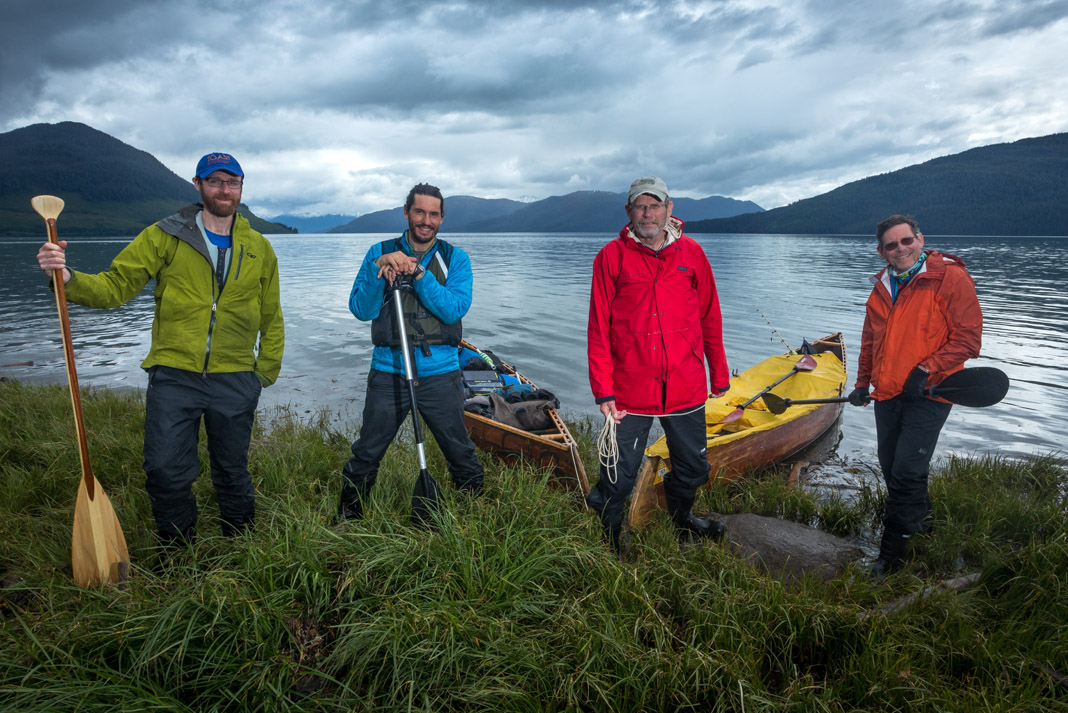
Ben Dappen, writer Nate Dappen, Uncle Andy Dappen, and father Alan Dappen. | Photo: Courtesy of Alan and Andy Dappen
“Not everyone can do the hardest route, not everyone can be the fastest, but everyone can do their own epic journey. And I think that’s more important. Follow the voice in you that says ‘I want to give it a shot,'” says Andy. | Photo: Courtesy of Alan and Andy Dappen
After almost two weeks on the water, we entered the Zimovia Strait, camping on Etlin Island for several days before arriving in Wrangell, where my brother and I would dock our canoe and take the ferry south, leaving our father and Andy to complete the last stretch on their own.
As I watched my dad and Andy paddle off into the distance to finish a journey they started 43 years earlier, I reflected on how the story of their original 1974 canoe trip, an expedition I never experienced, had impacted me so profoundly. How the stories we tell and the stories we remember are reflections of who we see ourselves to be.
As children, we don’t have our own stories yet, so maybe we adopt the ones we’re told that most resonate with who we want to be. My parent’s 1974 canoe adventure had been one of those stories.
From an early age, it was infused into my identity, shaping who I thought my parents were, and who I wanted to become. Now, as a father myself, I have many of my own stories to tell. And at the top of the list is an adventure along the Inside Passage that started in 1974 and ended in 2017.
Nate Dappen is an award-winning photographer and filmmaker based in New Jersey. His images, films, books and other projects have been featured by National Geographic, Vogue, The Washington Post, Scientific American, The Guardian and World Wildlife Fund. Watch his film inspired by this adventure below.
Four years ago, Brenna Kelly left the security of her job as a whitewater kayak instructor on the Ottawa River to do what countless adventurers and entrepreneurs before her have done—to go west.
Brenna Kelly’s Adventure Paddle School
The Smiths Falls, Ontario Native Was Drawn To The East Kootenays As The Perfect Place To Start Her Business, Adventure Paddle School. No stranger to a good paddling pun, the competitive kayaker—Kelly was a member of the 2012 Canadian National Freestyle team—says the experience has been full of “ebbs and flows.”
Earlier this year, she sold the school to Columbia River Paddle. However, she remains the head instructor at Adventure Paddle School, where every summer 250 students “rapidly” learn to standup paddleboard and kayak.
We spoke with Kelly about what it was like to navigate new waters, some 3,400 kilometers from home.
Why did you choose Invermere, B.C. as your location?
I was the manager and kayak instructor at the Ottawa Kayak School and in the winter, I would go west to be a ski instructor. After a while, it was getting tiring moving every six months. I wanted to make my life in British Columbia and I want people to like kayaking as much as I do.
Out here, the rivers are shallower, faster and they don’t necessarily end in a calm pool of water. Most of the lakes in B.C. are also glacier-fed, which makes it really difficult to start as a kayaker, because the first thing you learn is wet exits and trying your roll.
That’s why Invermere was the perfect spot to start a paddle school: The lake is warm, it’s cottage country for Calgarians and Edmontonians, and there’s a small class I to II river up the road.
What were your biggest challenges as a young entrepreneur?
It was very difficult to access financing to start the school. There are a lot of specific requirements for each grant, and we didn’t meet a lot of them. It forced me to develop my business plan fully and gave me a great understanding of where I was and where I wanted to go. To anyone starting a paddling business from scratch: Start small and make organic growth. Once you have proven your business is growing, you can apply for grants or put more of your own money into it. But the grand vision will take time. Let it.
When should someone take a lesson?
It’s funny because people are like, “I can standup paddleboard.” Then you see them go out in only the calmest conditions and kind of sunbathe. It’s not something where if the wind picked up, they’d be able to paddle back. We do standup paddleboard whitewater classes, which is cool because kayaking isn’t for everybody. Standup paddleboarding is another way to get down a river and still get to see all the beautiful sights.
Where do you think there’s room for growth?
There doesn’t seem to be as big of a culture of wanting to learn the proper strokes and skills. It’s all too easy to try something and assume you have mastered it and go onto the next thing without even challenging yourself. By taking lessons, you learn new skills and challenge yourself. Sometimes you fail—but ultimately, you succeed because you’re taking on new skills, allowing you to paddle in cooler places and meet more passionate people.
Who are you most excited to teach?
I just had my first child three months ago, so that’s the new adventure at the moment. Eventually, Piper will get big enough we’ll have her out on the water. We’ve already been doing swimming lessons, just getting her comfortable splashing and interested in water stuff. She’s on the trajectory to be a paddler herself.
If a paddler sends it but no onesees, did it really happen? Not a concern these days. | Photo: Tegan Owens
The convergence of rapidly improving camera technology and the dramatic rise in social media use over the past decade has changed the way we paddle.
For many paddlers, packing a camera to capture the action is almost as important as packing a paddle. A decade ago, adventure photography remained the domain of a few skilled individuals, carting heavy equipment and protective, waterproof housing. Today, adventure photography is accessible to anyone with a few hundred dollars to spare.
The company largely responsible for changing how outdoor sports are recorded is GoPro. Launched in 2002 by American Nick Woodman, he wanted to create a camera for consumers to capture professional quality action photos. The turning point for the company came in 2006, when GoPro launched the groundbreaking Digital Hero, a tiny, but durable digital camera capable of shooting 640×460 photos and 10-second 320×240 video clips.
While the quality couldn’t match even the early digital SLR cameras, the size and video capabilities changed the game of capturing outdoor adventures. In the 12 years since, GoPro has released nearly two dozen variations of its Hero line of cameras. The latest is a top-of-the-line Hero6 Black—a waterproof, image-stabilized camera capable of 12-megapixel photos and 4k, 60fps video.
GoPro obviously isn’t the only action camera on the market. But competitors such as JVC, Sony, Nikon and Garmin, along with many knockoffs, haven’t overcome the original action camera’s reputation for simplicity, quality and remarkable durability.
One company providing remarkable competition is DJI, a Chinese drone manufacturer launched in 2006. Like GoPro with action cameras, DJI has been the leader in groundbreaking unmanned aerial vehicle (UAV) technology for both commercial and consumer use. And also like GoPro, it’s hardly the only drone brand, but it holds a massive market share, said to be close to 85 percent for the consumer market.
Aerial photography has come a long way since Gaspar Félix Tournachon took the first successful aerial photograph in 1858 from a hot air balloon tethered 262 feet above Paris.
While DJI’s commercial drones are now being used to film blockbuster movies, the company’s inexpensive entry-level drones can be flown by just about anyone and have onboard, gimbal-stabilized cameras capable of 4K video and 12-megapixel images.
We have always been trying to make the best flying cameras we possibly can and keep the price point as accessible as possible,” said Michael Oldenburg, senior communication manager for DJI North America. “It’s all an effort to help people capture life’s moments from a new perspective.
Sure, paddlers use them for getting incredible shots and rarely-before-seen angles, but you could argue it’s just progression in aerial photography. What is innovative is how drones are being used to scout rapids and by search and rescue organizations across North America.
The company’s latest drone is the Mavic Air, an $800 consumer UAV folding small enough to fit in a jacket pocket. It’s packed with the latest camera and drone features such as Smart Capture mode, allowing users to take photos using gestures, and Active Track, so the drone will follow you as you paddle away.
You don’t need someone on shore filming you anymore,” said Oldenburg. “That’s one of the great uses for drone technology. We’ve tried to make it easy, even if you don’t have a lot of flying experience.
What’s the next investment when your paddling kit already includes a GoPro Hero6 and a DJI Spark or Mavic Air? Go full 360. Many believe virtual reality is the next big technological shift. While its adoption has been slow, the camera technology to capture 360-degree images and video is rapidly improving.
A handful of brands such as Ricoh, GoPro, Garmin, Samsung and even Kodak—yes, that Kodak—now make palm-sized 360-degree cameras capable of shooting incredibly high-quality images. Postproduction software allows you to grab single, traditionally-cropped images from literally any angle. It’s like having dozens of high-quality cameras mounted to the front of your kayak and pointed in every direction.
For better or worse, armchair adventurers will soon be able to enjoy the most extreme river experiences without ever getting wet.
Paddling addicted journalist Dan Dakin worked as a sports reporter for 12 years before becoming a full-time freelance writer. | Feature Photo: Tegan Owens
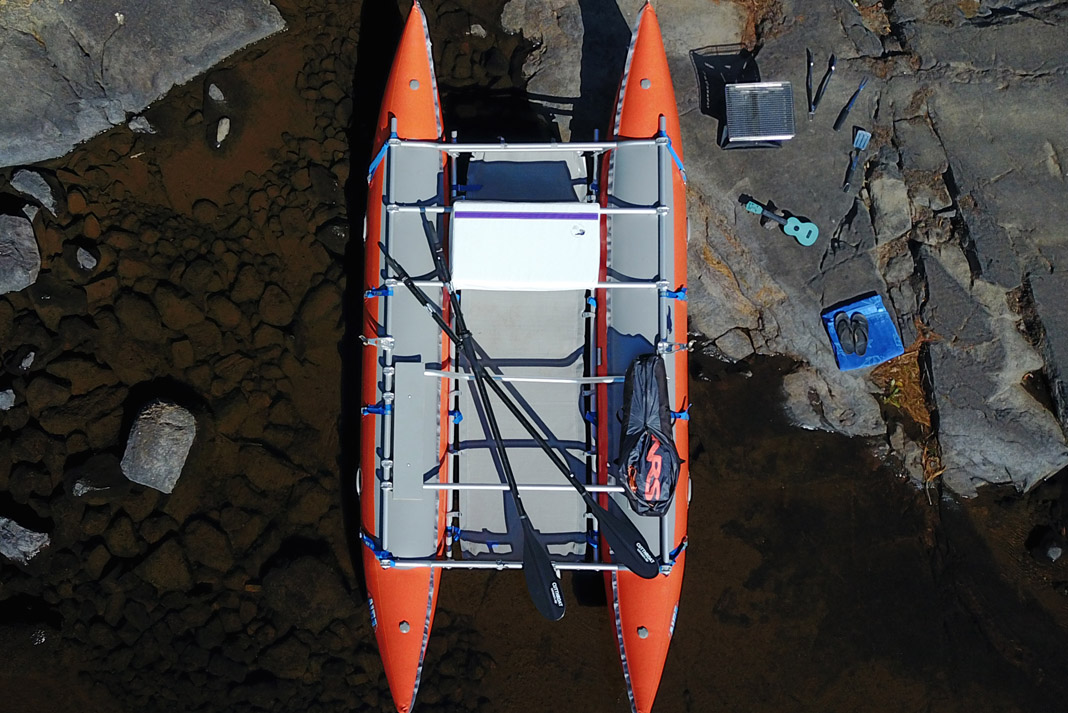
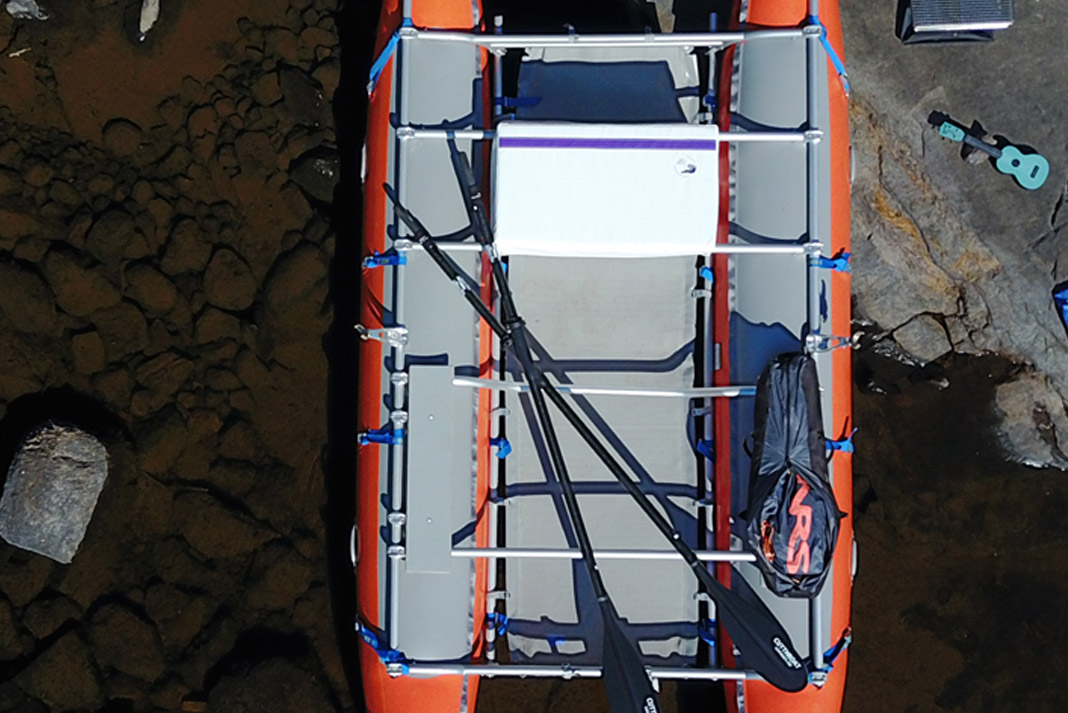
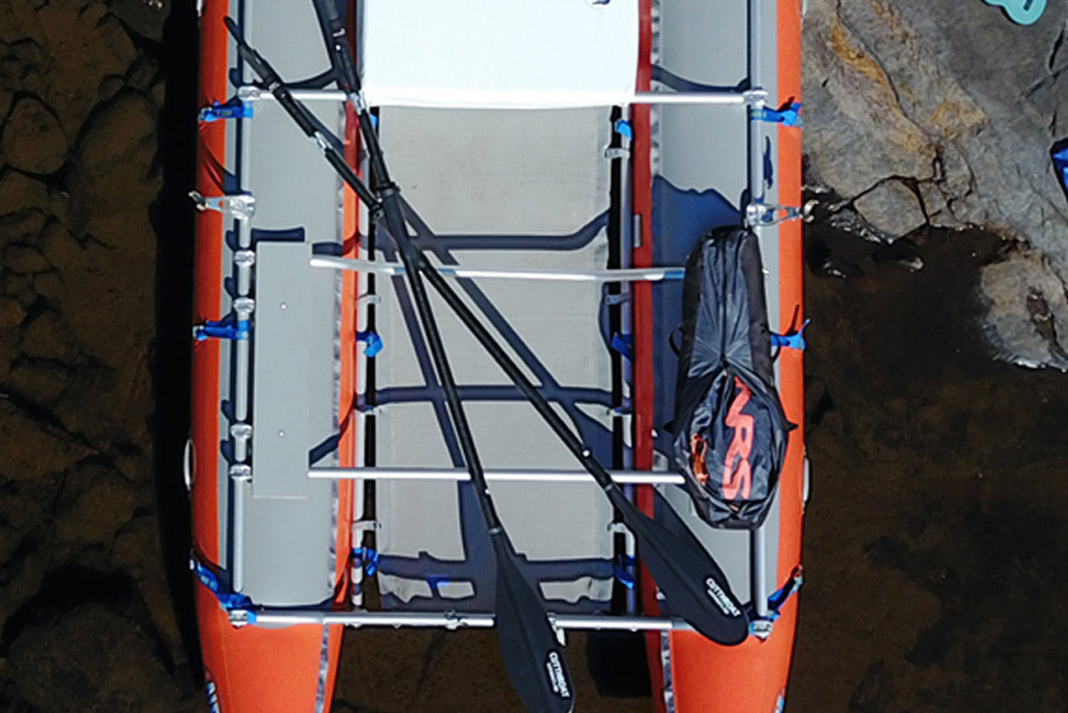
We wanted a family gear-hauling cat raft that would play on day trips and fish spring trout rivers. We settled on AIRE’s performance series 16-foot Jaguarundi with 24-inch tubes—not just because Jaguarundi is so fun to say. The Jag sits in the sweet spot between AIRE’s expedition Lions and their sportier Wave Destroyers. We added AIRE’s cat floor and one of their welded aluminum dry boxes for a bench seat and to hold our food, kitchen items and camping gear. See you in the Canyon, or wherever.
www.aire.com | $2,699 USD
2. NRS Top Cat Frame
Cat Frame. | Photo: Scott MacGregor.
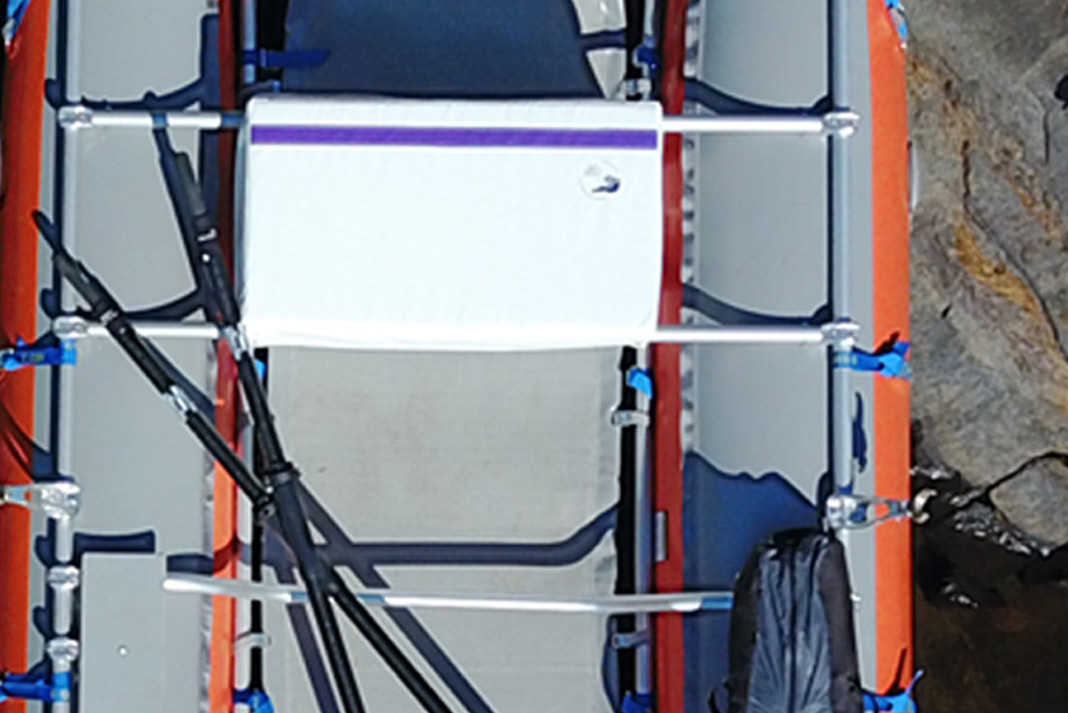
The Top Cat is a perfect fit on the Jaguarundi. For expeditions we replaced the high-back, drain-hole seat and rigged it with cooler, dry box and still had room for another box or a gear sling compartment. Seventy-two inches wide is enough to make our Jag cat plenty stable and is wide enough to drop in 37-inch wide coolers and dry boxes. A few years ago NRS retooled all their LoPro fittings and oar mounts to a hot-forged aluminum alloy making the most adaptable frame system way more polished. Shop NRS.com for frame parts and accessories like the NRS Frame Side Rail Racks or to convert the Top Cat for fishing.
www.nrs.com | $1,495 USD
3. Cataract Oars SGG & SGX Shafts and Cutthroat Blades
Cataract oars SGG & SGX shafts and cutthroat blades. |Photo: Scott MacGregor.
We’ve been using Cataract’s SGG and SGX fiberglass and carbon fiber blended shafts for years. The SGGs are spun flexier to feel like wooden oars while the premium SGXs are 33 percent stiffer. Take your pick balancing performance to ibuprofen. This time we upgraded to Cataracts’ clever H2O Counter Balance system of interchangeable weighted or unweighted handles.
Even more clever is Cataracts’ new thumb indexer so you can feel your blade angle at the grip. So simple. With fishing in mind, we ordered Cataract’s Cutthroat blades designed for shallow gravel bar trout rivers. Not getting a descent blade catch is almost as frustrating as the fish not biting. The greater submerged oar blade surface area allows for maximum propulsion on any low-water summer river.
www.cataractoars.com | SGGs with H20 counterbalance handles | $168.95-$202.50 USD each; cutthroat $84.95 USD each
4. Canyon Cooler Prospector 103
What we love most about Canyon Cooler’s Prospector 103 is the built-in lip so the cooler sits on the raft frame instead of hanging from straps. The other clever touch is the second drain plug on the front—you know what I’m talking about, no more pulling a loaded cooler from the frame to drain water.
The Prospector will hold two sliding organizer baskets on two interior levels so you can get to the meat quickly while keeping the lid open as little as possible… yes, I’m looking at you, Margaret.
www.canyoncoolers.com | $369.99 USD
5. Wet Dreams River Supply Cooler Cover
Canyon cooler prospector 103 and Wet dreams river supply cooler cover. |Photo: Scott MacGregor.
When Jason at Wet Dreams heard we ordered a Canyon Cooler Prospector he sent us one of their custom cooler covers. The 22-ounce vinyl coated polyester and a vinyl-coated mesh base create a sleeve for the 1- or 1.5-inches foam to be inserted adding insulation and cushion for extended trips.
The corner flaps have slits so it hinges when you open the cooler lid and so you can access the cooler latches. Options include stainless steel snaps, sewn-in straps, additional foam and a mini-cell foam upgrade. Choose one of the available 12 Canyon or Yeti sizes or custom order a cover for almost any cooler size.
www.wetdreamsriversupply.com | $54-$120 USD
6. Primus Kamoto OpenFire Pit
Primus Kamoto Openfire Pit. |Photo: Scott MacGregor.
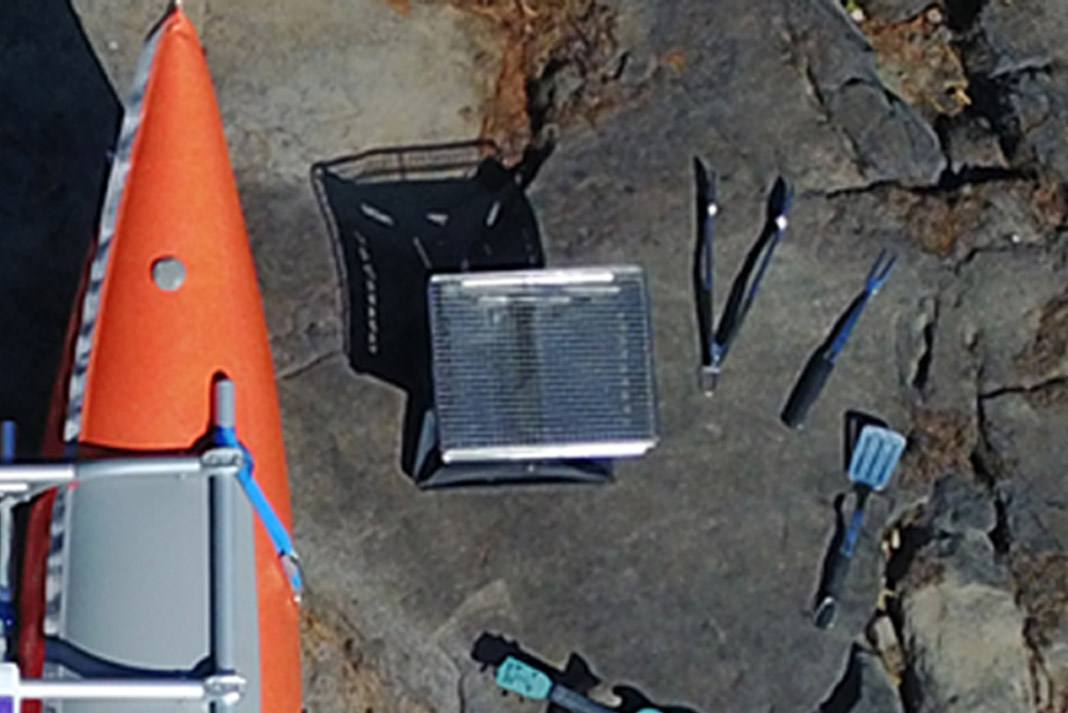
The Primus Kamoto OpenFire Pit is a new solution to no trace fires on rafting rivers. This clever scissor folding unit collapses flat and easily fits in the smallest of dry boxes. Burn wood or charcoal and roast on the open flame or drop the grill in place to cook steaks or as a base for pots. The bottom is an ash pan and protects the ground from fire scares. For big groups, Primus makes a larger size accommodating 16-inch logs.
www.primus.com | $129.95
7. Kala Brand Music Waterman Ukelele
Kala Brand music Waterman ukelele. |Photo: Scott MacGregor.
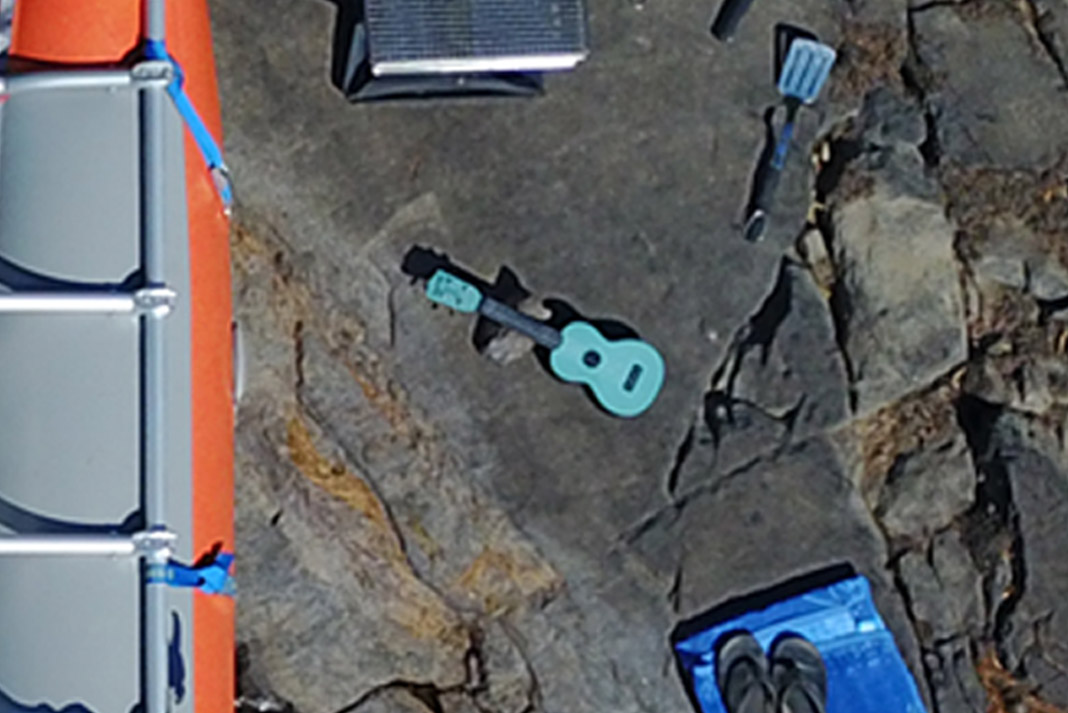
Why is the ukulele the top-selling instrument in America? Four strings, baby. Even I can hammer out a campfire version of Brown Eyed Girl on the Kala Brand Waterman series of waterproof soprano and concert ukes. Sure, it’s ABS plastic but it has nickel-plated tuners and sounds way better than you’d think. No need to pack it away for Lava Falls, one person rows the other strums C-F-C-F-C-F-D-C-F because in the Grand Canyon, “You can’t always get what you want, You can’t always get what you want, You can’t always get what you want, But if you try sometimes, you just might find, you get what you need.”
www.kalabrand.com | $69.99 USD
8. NRS River Wing
NRS River wing. |Photo: Scott MacGregor.
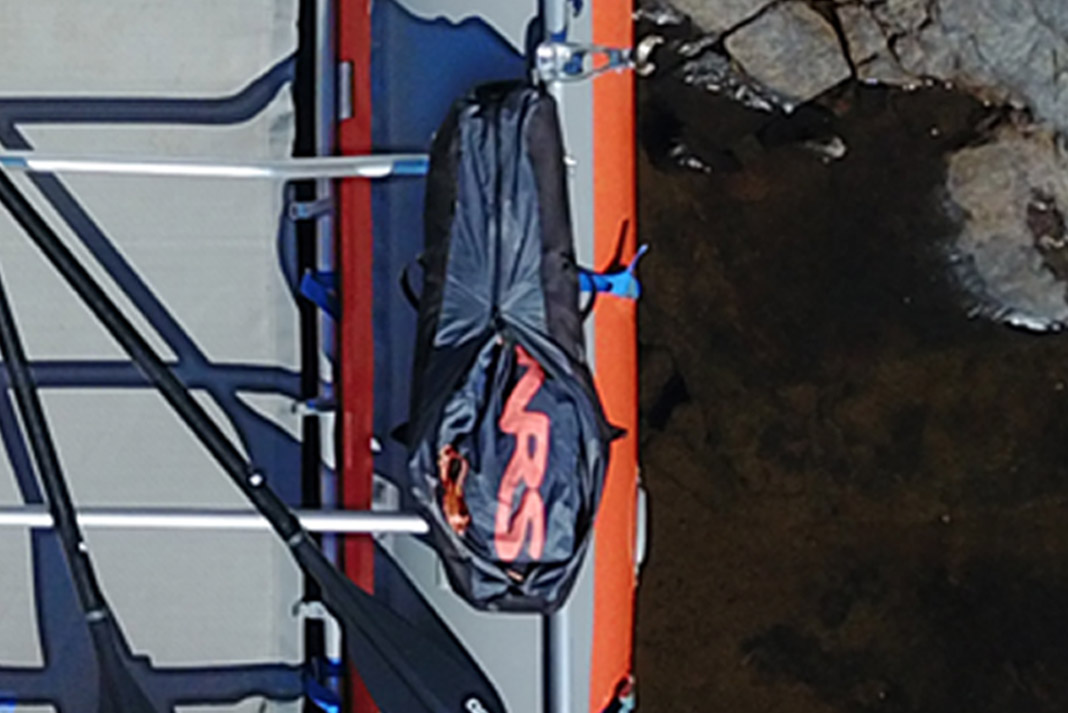
Where I live we have trees for shade and anchors for tarps of any shape, but on the beaches and in canyons of western rivers you need the 40-denier ripstop nylon NRS River Wing self-supporting canopy. At 17 feet long and 16 feet wide you can hunker beneath for dinner prep shade or to wait out the storm. Reflective strings and burly stakes are provided for each corner. Pack along the provided three-piece aluminum poles or do as we do and just use your oars.
Who wouldn’t run a boat named Phantom down a line called Dragon’s Tongue. Graham Kent big water testing on the Middle Channel of the Ottawa River. | Photo: Kaden McLaughlin
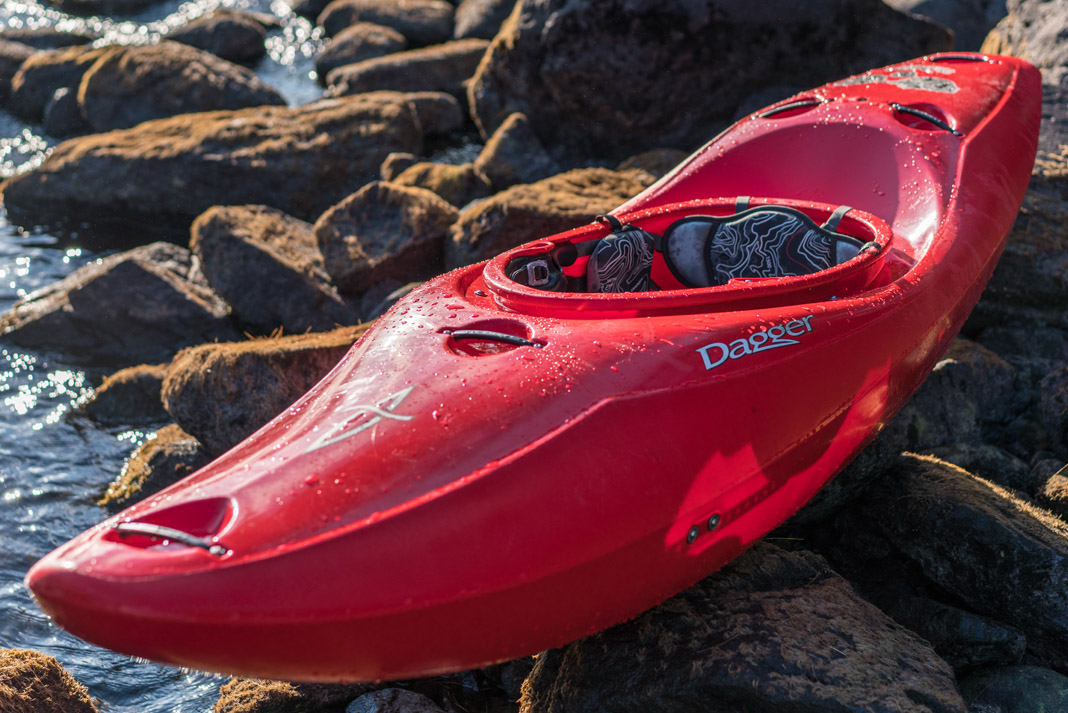
Dagger Kayaks’ latest whitewater kayak design and the newest contender in the popular nine-foot creek race category almost didn’t make it to the starting line.
Dagger Kayak’s Phantom Kayak Specs
Length: 8 ft 11 in Width: 26.75 in Weight: 49.5 lbs Volume: 89 gal Paddler Weight: 145-255 lbs Price: $1,249 USD/$1,589 CAD dagger.com
During the reveal of the Phantom kayak, Dagger’s pro team manager Chris Gragtmans told Paddling Magazine publisher Scott MacGregor the behind the scenes story.
Beginning as a secret passion project by Gragtmans, Dagger Kayaks’ designer Mark Robertson and some team athletes, an early Phantom prototype caught fire in the mold. The little episode caused an evacuation of the entire factory. When management pushed to know if anything was damaged in the fire, the boys had to come clean about their covert project. Once the smoke settled, the Phantom was allowed to become more than just a factory team pipe dream.
Dagger Kayak’s nine-foot creek boat
So the Dagger Phantom shares the nine-foot creek race boat category with the Jackson Nirvana and the Pyranha 9R. All three of these kayaks share similar key ingredients but in different portions.
None are over nine feet long, all have a planing hull, they are sort of narrowish, aggressively rockered in the bow with more relaxed stern rocker, and all have a squared off stern—keeping the waterline longish but truncating overall length to play within the race rules. But stir these up with different spoons and they all come out quite a bit different.
I am a proud owner of a Pyranha 9R. I’m completely sold on the #fastisfun mantra of the creek race category of boats. Kayaks like the Phantom are not just for pro paddlers, or kayakers on the hard core creek race circuit.
I enter all six categories in just one race a year. The race is on my home river, basically in my backyard. I bang off at least one training lap almost every night of the week from when the ice goes out to race day.
These boats are just plain fun to paddle. Anyone looking to increase the fun factor of their local creeks, or looking for challenge without stepping up to more consequential runs, needs to try one of these boats.
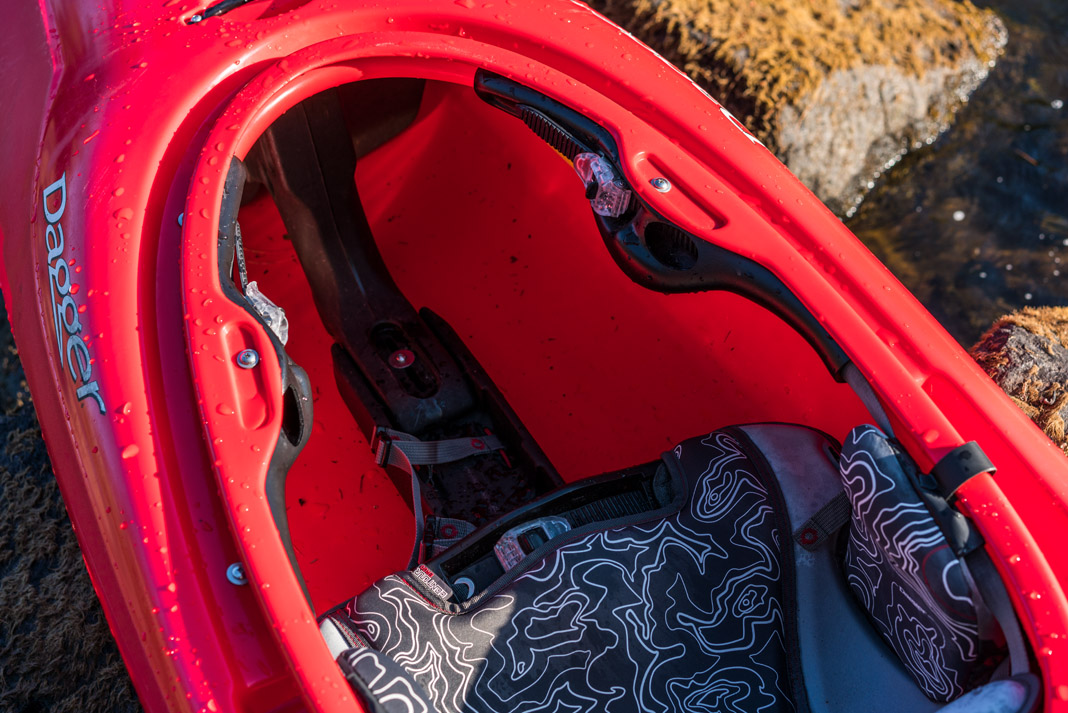
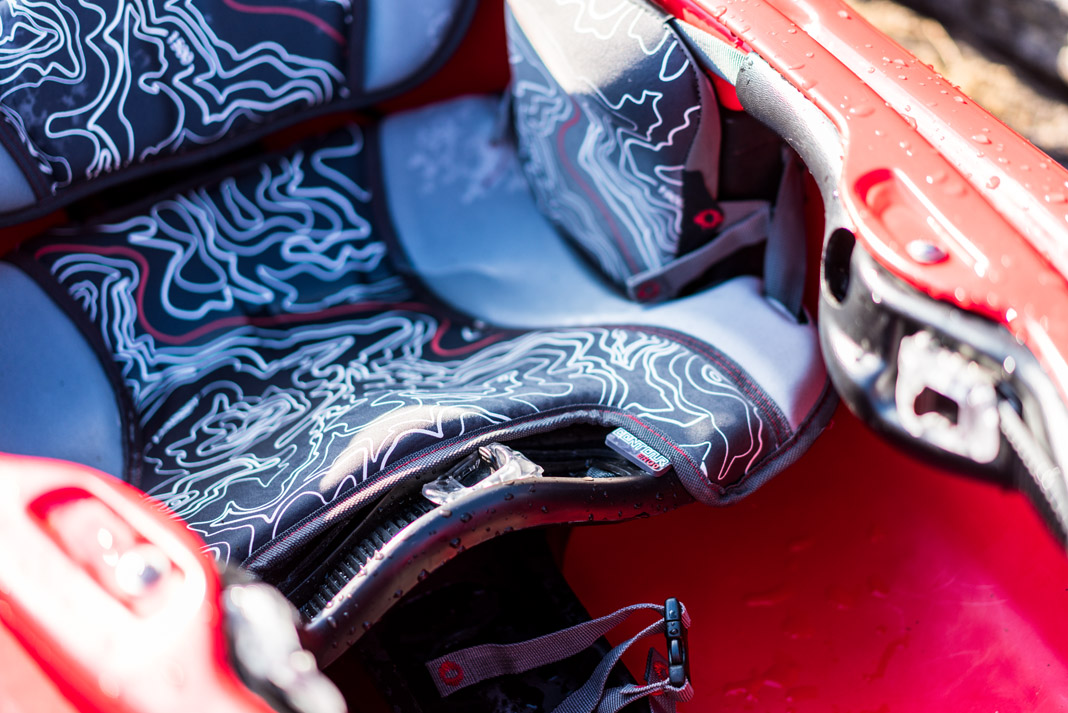
As you’d expect in today’s creek boats, the Phantom comes with Dagger’s adjustable bulkhead foot brace, plastic step-out pillar, gear loops, water bottle clips and multi-way adjustable thigh braces with backhand ratchets tucked inside. | Photo: Scott MacGregor
How do you dramatically improve your paddling in just 30 minutes? Take the time to dial in Dagger’s contour hip pads and ratchet-adjust leg lifter seat. Do it. | Photo: Scott MacGregor
Dagger Kayak’s racing kayak outfitting
Let’s get talking about the Phantom, specifically. I’m a complete fanboy of Dagger’s outfitting. In my opinion, none of the other brands come anywhere close to the adjustability, quality and comfort Dagger is bolting into their whitewater kayaks.
There are those paddlers who will complain Dagger’s outfitting is too complicated with too many nuts and bolts and moving parts. Adjusting a Dagger boat for the first time can be a daunting task.
Being a planing-hull style kayak, the Phantom has defined edges like a modern river runner.
For me, I know if I spend 30 to 45 minutes setting up the rotomolded seat with Leg Lifter, adjustable thigh braces, comfy hip pads, and ratcheting backband, I can have a kayak fitting me like a glove, truly becoming an extension of my body. If I could, I’d retrofit Dagger outfitting into every boat I own.
For me, at 5’11” and 190 pounds, the Phantom still felt big, but not so large it was unwieldy. Compared to my 9R, the Phantom is an inch-and-a-half wider, and has 11 more gallons of volume. With a paddler weight range of 145 to 255 pounds, I’m very close to the middle of the range, which should be ideal.
Paddling Dagger’s Phantom creek boat
Initially paddling on flatwater and trying a few ferries and easy eddy moves, the Phantom didn’t feel as fast as what I was expecting. Being a planing-hull style kayak, the Phantom has defined edges like a modern river runner.
Just enough edge to be able to carve a turn, and control a surf, and yet these edges are very forgiving. While I could get the boat to carve a turn, it generally wasn’t a crisp, sharp turn; and when peeling into an eddy, dropping an edge alone often wasn’t enough to fully bring me around to facing upstream.
The softness of the edge keeps this boat feeling closer to the stability of a creek boat. Or like a chubby river runner, like a sportier Dagger Mamba. I can’t recall any occurrence of the current catching an edge and setting me off balance.
Faster boats often have a learning curve. You can find yourself crashing down a rapid out of control; this is especially noticeable in the 12-foot boat category, when you get moving downstream too quickly to make the moves required to style a line.
Race boats can also feel locked-in on course and difficult to turn. The Phantom did not seem to lock-in on a line, and making course corrections mid-rapid or maintaining the bow upstream while peeling out of an eddy was natural feeling. Again, more like a river runner than a race boat.
Same race length as the large Dagger Nomad; just a smidge wider than the medium Nomad; same volume as the Dagger Mamba 8.6. Cool to know. | Photo: Scott MacGregor
A big racing kayak for expedition kayaking too
While I love the 9R, and have been paddling it as my dedicated class IV to V creek boat for the last two years, I have started looking for something new. When I run remote class V runs in the 9R and start loading it down with gear, including large throw bag, pin kit, lunch, sat phone, first aid and survival kit and breakdown paddle, it’s just not big enough.
At 89 gallons, the Dagger Phantom was more than large enough, especially with plenty of volume up front. It rides over features and surfaces very quickly.
The Dagger Phantom is more like a nine-foot creek boat I can burn down my river on race day and pack it for an expedition the next weekend.
I couldn’t get over how much bow rocker the boat feels like it has. It’s like the bow is waiting for me to give it something to climb over. Even on photo shoot day with two pro DSLR cameras, lens and my girlfriend’s lunch in my boat, the extra load was hardly noticeable.
I find race boats are typically best paddled aggressively—leaning forward and utilizing bow control strokes. The game is to use the boat’s speed to your advantage to skip over holes and boils, and the edges to carve your way between features.
Typically designers pull back on the stability cushion provided by today’s creek boats in exchange for the downstream performance of race boats. If you try to float your way through rapids, cross currents will play havoc with the long sterns, tugging on your edges—these boats are meant to be driven hard down the river.
The Dagger Phantom on the other hand is more like a nine-foot creek boat I can burn down my river on race day and pack it for an expedition the next weekend.
Working under the cloak of corporate darkness the Dagger design team created a vision for a kayak they themselves wanted to race and paddle. While the cause of the fire may remain a mystery, the Phantom is real. For more top picks and expert reviews, check out Paddling Magazine’s guide to the best whitewater kayaks here.
Who wouldn’t run a boat named Phantom down a line called Dragon’s Tongue. Graham Kent big water testing on the Middle Channel of the Ottawa River. Feature Photo: Kaden McLaughlin
Over The Past Four Years, I’ve Had The Privilege To Work As An Expedition Paddling Guide Year-Round By Working On Board Expedition Cruise Ships In Polar Regions.
Working with Quark Expeditions last winter on board the Ocean Endeavor, I spent three months sailing multiple times between the end of the earth—fin del mund—in Ushuaia, Argentina and the Antarctic Peninsula.
Once the group makes the two-day, 550-mile crossing of the notoriously rough Drake Passage, we spend our days sailing along the coast of the frozen continent nearby the penguin and seal colonies of the Gerlache Strait. When not sailing, we take excursions on land, where we walk amongst thousands of penguins, or on water, where we cruise with icebergs and marine life.
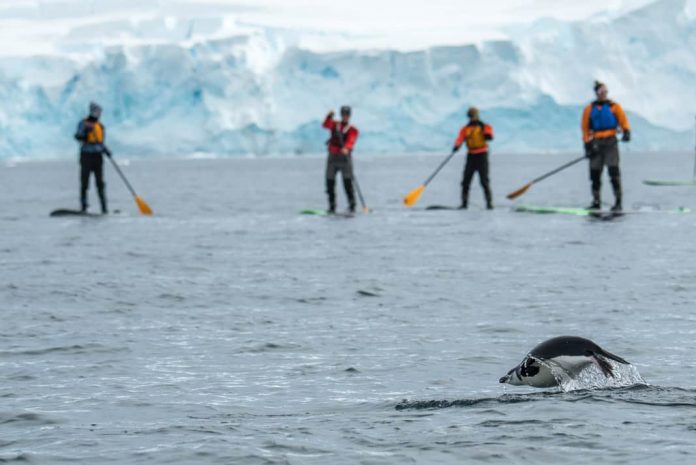
I Was Initially A Bit Skeptical Of Paddleboarding In Antarctica. It was introduced as a new activity last year, and I knew more than half the guests I took out would be trying SUP for the very first time. What I could never have predicted was how tranquil the experience could be. In comparison to kayaking, the paddleboard’s higher vantage point allows for a superb view of the marine life cruising just below.
In Addition To Seals And Whales, Penguins Are One Of The Animals We Encounter Most Often In Antarctica. They’re curious and often interact, darting underneath boards or porpoising alongside. They swim behind the paddleboards—the board’s disturbance in the water stirs up plankton which attracts krill which the penguins feed on.
Majestic is the only way to describe the underwater glide of these flightless birds. The chinstrap penguin, seen here, is a surprisingly speedy creature, able to swim 20 miles an hour. For comparison, American Olympian Michael Phelps can swim six miles an hour on a good day.
This Photo Was Captured During A Paddling Excursion At The Mouth Of Mikkelsen Harbor. I was working as a support guide in a Zodiac inflatable, acting as the paddleboarders’ personal paparazzi. While on the lookout for curious wildlife and monitoring shifting ice conditions from wind and tide, I had the opportunity to position myself for taking fun photos away from the hustle and bustle of the other passengers.
To Get Low For This Shot, I Hung Off The Side Tubes Of The Zodiac And Had The Lens Just Above The Water Level To Get A View Of Penguins Cruising Around The Paddleboarders. I took this with a Nikon D500. Having a 80-400mm zoom lens allowed me to capture the action while keeping out of the way. While no photo can truly do justice to Antarctica’s grandiosity and beauty, capturing this moment offers a glimpse.
Jimmy MacDonald is a canoe and kayak guide, as well as a swiftwater and ice rescue instructor. Find more of his photos at www.pawistik.ca.
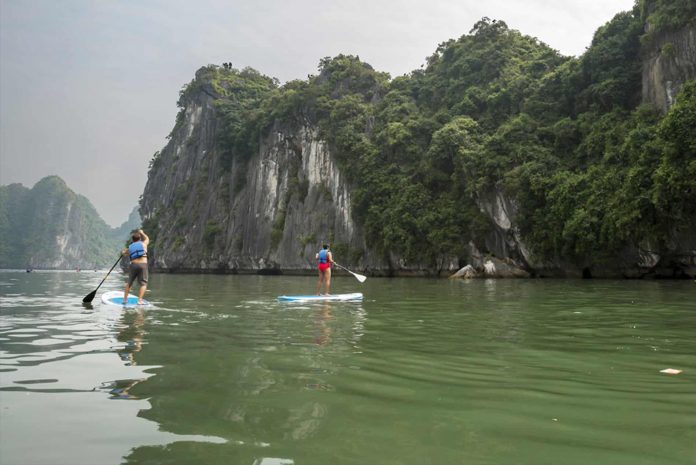
As I Stood On My Board Paddling Through The Massive Green Limestone Karsts Jutting Into The Red-Sunned Sky Of Northern Vietnam, I Couldn’t Help But Think, “Here Be Dragons”.
Ha Long Bay and Lan Ha Bay are known for the towering karsts dotting the bays, creating a surreal experience for paddlers. Vietnamese legend suggests thousands of years ago the people of the Vietnam region were fighting invaders from the north and called upon dragons to help them fight the enemy’s navy.
[ Plan your next paddling adventure with the Paddling Trip Guide ]
When the dragons destroyed the attacking ships, emeralds are said to have fallen from their mouths and these created the 2,000 karsts which make Ha Long Bay and Lan Ha Bay famous.
I Was Lucky Enough To Explore Lan Ha Bay-The less touristy of the two bays, paddling amongst floating homes from which locals catch fish. I also kept an eye on shore hoping to spot one of the 60 remaining Cát Bà langurs—one of the world’s most endangered primates.
Ha Long Bay is protected and beautiful for paddleboard tours. When Ha Long Bay became a protected area several years ago, all of the floating homes of the bay were forced to pack up and move or give up their way of life.
This exodus led to a massive influx of floating homes in neighboring Lan Ha Bay.
Wildlife
While most jellyfish in the bay are harmless, the fire jellyfish will give a good sting. They’re most common in the summer months, so consider swimming with a rashguard. If you’re lucky, you might spot a Cát Bà langur.
Exposure
Because of the many karsts surrounding the area, the bay is usually calm. And no matter where you are in the bay, you are always close to some type of shore. The Vietnamese sun is not so forgiving. Pack plenty of sunscreen and drinking water.
Outfitters
Asia Outdoors (www.asiaoutdoors.com.vn) runs half day and full day paddling tours of Lan Ha Bay. They are environmentally conscious and work with local fisherman to help clean up the area and create sustainable tourism.
Accommodation
Cát Bà Island is the place to stay. With hotels for every budget, prices range from $5 to $150 a night. Just be sure to choose a place with air conditioning.
The bay has had issues with garbage over several years as currents bring trash from China in the north and from southern Vietnam, and now the higher numbers of floating homes have added to the problem.
Several tour companies now work with the locals to clean the area. I tried to do my part as I paddled along picking up the odd plastic bottle or soda can.
After Returning To The Transport Boat After A Glorious Day Of Paddling Amongst The Dragons’ Emeralds, I Headed Back To My Hotel On Cát Bà Island.
Cát Bà Island is one of the largest karsts in the bays and has a town with several hotels, a national park and fantastic beaches.
This is the place to relax and enjoy the beautiful sunsets over the harbor.
What To Do In Ha Long Bay
Half Day:
Take a short boat trip from Cát Bà Island into the heart of Lan Ha Bay.
Spend your morning or afternoon paddling through the maze of karst islands dotting the area, and explore hidden lagoons, limestone caves and floating villages.
Full Day:
Take another boat trip in the heart of Lan Ha Bay. A full day trip offers time to land on shore to relax on the many small, deserted sandy beaches in the bay.
Enjoy lunch on your support boat before heading to another area of the bay to experience more of the impressive karst archipelago.