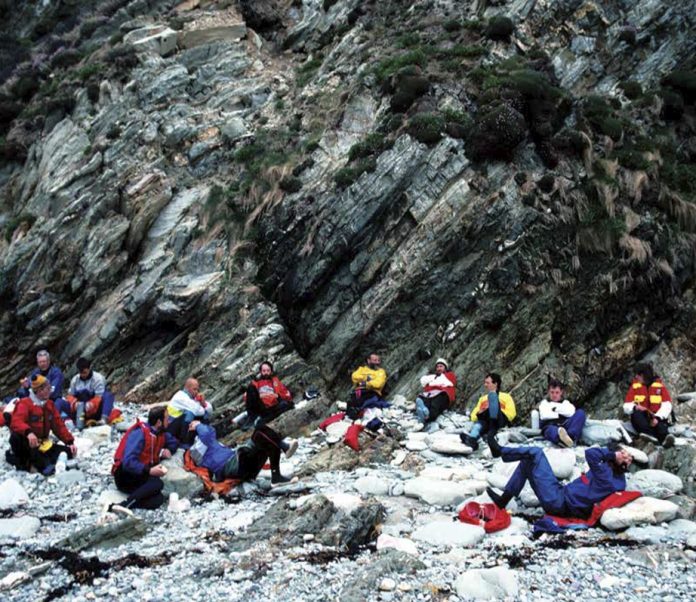
THE LATE FRANK GOODMAN
AND A GROUP OF FRIENDS,
BREAK FOR LUNCH ON
A GRAVEL BEACH ON
ANGLESEY ISLAND, WALES.| Photo by: Stan Chladek
“Frank Goodman is dead.” I paused for a second, phone pressed to my ear.
“Hi there, can I ask who is calling, please?” I said.
Bruce Winterbon paddled the Noire River with Frank Goodman in the early ‘90s and felt compelled to call Adventure Kayak and let us know the news. This telephone call kicked off a flood of calls and emails carrying the news that sea kayaking adventurer and Valley Canoe Products founder Frank Goodman had passed away at 86-years-old.
I didn’t know Frank Goodman, not really. I had certainly never met him. Anecdotally, I was aware of his presence as a pivotal figure in the sea kayaking community. He had dabbled in music, art and the British whitewater slalom scene. He flew powrachute aircraft and was part of a team who sea kayaked around Cape Horn, Chile in 1975. His most famous sea “canoe” design, the Nordkapp, is on display at the British National Maritime Museum. The list of accomplishments and accolades grows on page 39, as former Adventure Kayak editor Tim Shuff delves further into the father, friend and explorer that the world knew as the insatiably curious Frank Goodman.
I am not a dyed-in-the-wool sea kayaker. I was not born and raised in a kayak. Until I was three-and-half years old, I lived in a 10-foot wide trailer on the southeast side of Vancouver Island—you are free to make whatever inferences about my parents you choose. My dad sea kayaked around parts of the island a decade earlier. Back then it wasn’t considered hard-core to spend days paddling with just fishing line, a fillet knife and lemons as the sole source of nourishment. They were just fun-loving hippies having their ‘fros tossed around by the ocean. Berries and trickling streams were their Clif bars and Nalgene bottles. But sea kayaks were not in my dad’s life when I arrived in his.
Reading Shuff ’s chronicle, I instantly found affinity to Frank Goodman’s life. He wasn’t a dyed-in-the-wool sea kayaker either. Curiosity pushed Goodman to build a homemade sea kayak and take it out in tidal surf—his life changing in an afternoon. Great moments in sea kayaking history followed because he was curious. I came to Adventure Kayak in a roundabout way. I’m curious too. My affinity for pushing boundaries parallels Goodman’s.
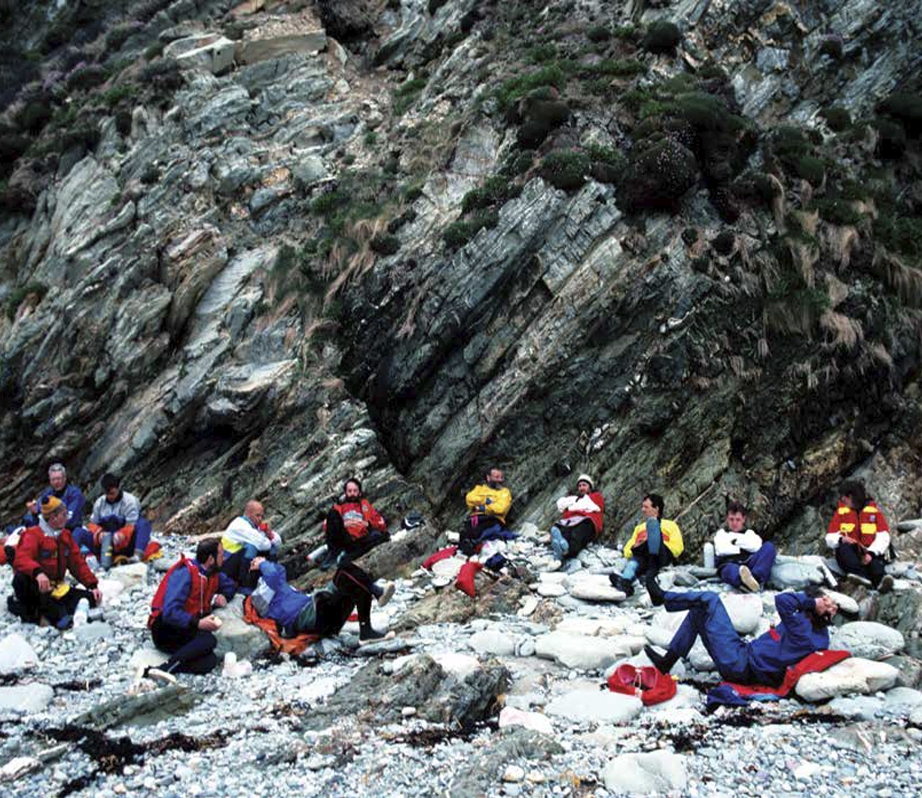
THE LATE FRANK GOODMAN AND A GROUP OF FRIENDS, BREAK FOR LUNCH ON A GRAVEL BEACH ON ANGLESEY ISLAND, WALES.| Photo by: Stan Chladek
My moment took root at 28. I was on a six-and-a-half-year walkabout through Europe—oscillating between an undergrad degree in philosophy and time spent as a volunteer in the former Yugoslav Republic—you are also free to make whatever inferences you choose about my parents’ son. I found myself sea kayaking on the coast of Croatia and in that moment decided my life needed a course-correction. That decision to visit the famous Blue Cave off the island of Biševo by kayak had lasting impacts beyond what I could have ever imagined. It took three years and dropping out of a Masters in Philosophical Anthropology before I applied to an adventure guide training program. Sea kayaking on the coast of Croatia has become present day moments on the rocky shorelines of Lake Huron’s Georgian Bay. It has turned into solo sessions in the current by our office for low braces and re-entry practice. On the surface these are just the periphery of a life that has changed.
It takes vulnerability and courage to be curious. When you allow it to grow, life-changing moments can come unexpectedly—occurring in an instant, afternoon or years. Goodman’s moment of curiosity bore fruit in an afternoon playing in the surf. His legacy is not grounded solely in the design of our hatch covers and waterlines. He was ravenously driven to discover how things could be done better; how sea kayakers could experience the water differently. The beauty of his curiosity is that it changed his life for the better and probably yours and mine as well.
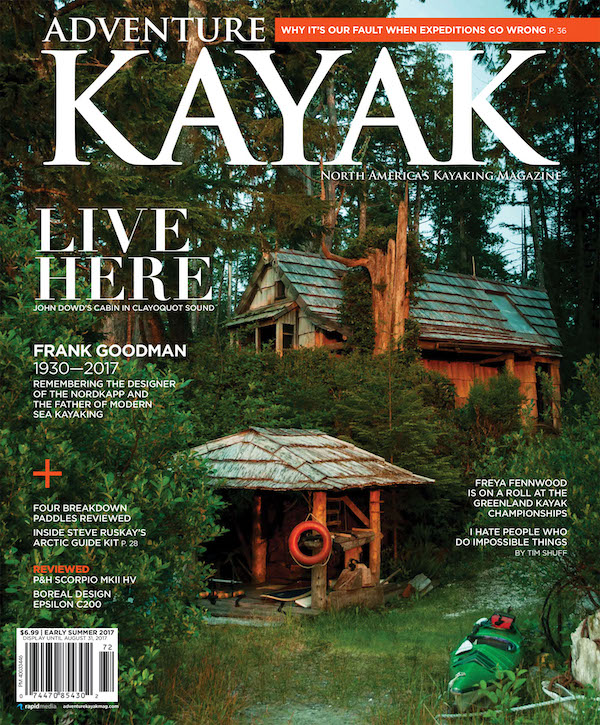
This article originally appeared in Adventure Kayak Early Summer 2017 issue.
Subscribe to Paddling Magazine and get 25 years of digital magazine archives including our legacy titles: Rapid, Adventure Kayak and Canoeroots.
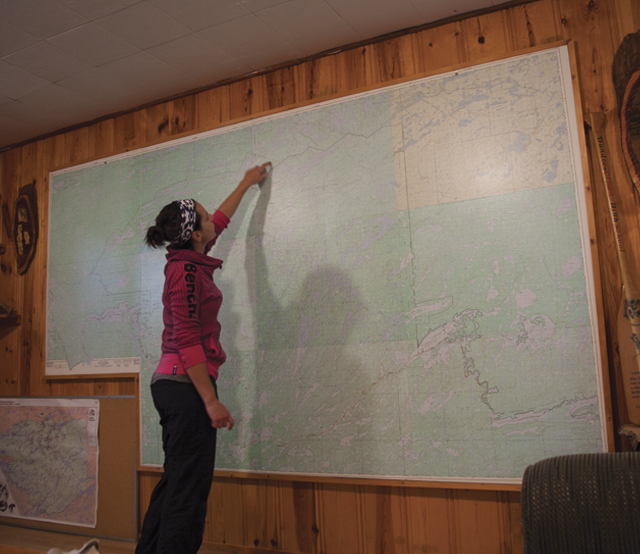
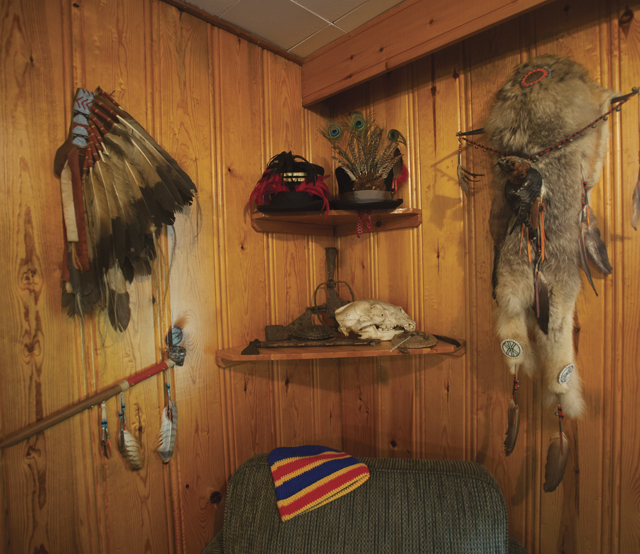
Tucked between the dining room and the pantry, I’m sitting in the Voyageur Wilderness Programme map room with my feet on the coffee table enjoying a cup of blueberry tea. On the shelf behind me sits a Métis ceremonial headdress along with two beaver pelt bourgeois hats. Madeleine Savoie is tracing the many lakes and rivers of her favorite Quetico canoe routes on the 11 topographic maps cut and pasted together. To scale the map room wall would be 90 kilometers wide and the ceiling would be 60 kilometers high.
Venturing into Quetico with the Voyageur Wilderness Programme
The map room wall is 90 kilometers wide and 60 kilometers high. | Photo: Scott MacGregor
At the bottom of the collage, at about her knees, Madeleine points to the dotted line that is the 150-mile Canada-United States border joining Quetico Provincial Park to the Boundary Waters Canoe Area Wilderness. The Boundary Waters Canoe Area is not as big as Quetico yet is said to be the most visited wilderness area in America. Some 2,000 marked campsites stretch over 1,200 miles of canoe routes and 12 hiking trails see 250,000 visitors every year. Quetico is wilder by comparison with no marked camping sites or portages and it sees only 11,000 visitors per year.
Voyageur Wilderness Outfitting was one of the first companies to provide outfitting services for backcountry canoeists entering Quetico. Fifty-seven years later it is still one of only a handful of companies serving just 21 entry points to the 1.1 million acres of protected wilderness. Madeleine points to the spot of the map where we are sitting on Voyageur Island. It is only a short paddle to where we’ll be lifting over into the park.
Metis ceremonial headdress and beaver pelt borgeoois hats line the native pine walls. | Photo: Scott MacGregor
My twelve-year-old son Doug and I fly into Northwestern Ontario where we meet Paul Anthony Pepe, manager of tourism for the City of Thunder Bay. Pepe knows the reason paddlers come to the North is wilderness areas like Wabakimi, Woodland Caribou and Quetico. He’s positioning Thunder Bay as “the urban gateway and basecamp for the region’s outdoor adventures”.
We arrive a day early like Pepe hopes all wilderness travellers will do. We stay the night at the historic downtown Prince Arthur Hotel overlooking Lake Superior and Thunder Bay’s newly rejuvenated waterfront marina park.
This is not my first rodeo in the North. I spent five years in Thunder Bay getting three degrees in outdoor recreation, geography and school teaching. Doug and I tour the Lakehead University cam. Includes pancakes, saunas, good coffee and the hotels where I used to find the cheapest pitchers of draft beer.
The Nym Lake access to Quetico Provincial Park is two left turns leaving the airport and then a lonely two-hour drive west on the Trans-Canada Highway. Before we get to the old mining and lumber town of Atikokan, that now calls itself the Canoeing Capital of Canada, we make our final left turn onto a gravel road which dead ends in a parking lot at the waters edge. Doug and I meet up with documentary filmmakers Goh Iromoto and Courtney Boyd along with Ontario Tourism’s adventure partnership coordinator Steve Bruno, who put together this trip to Voyageur Island.
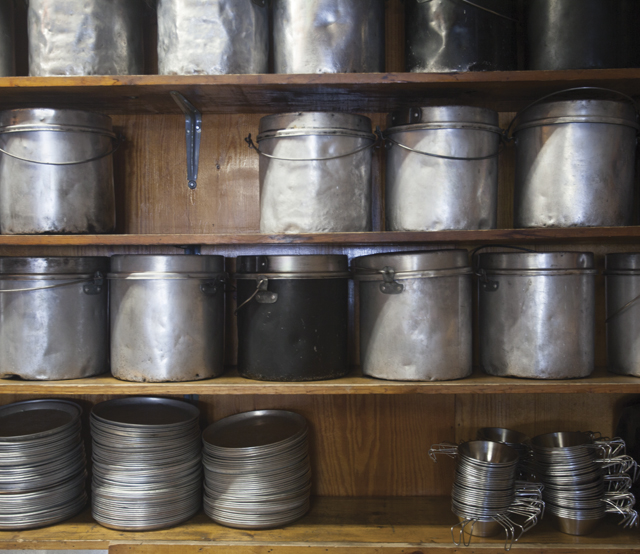
Inside the Voyageur Wilderness Programme pack house. | Photo: Scott MacGregor
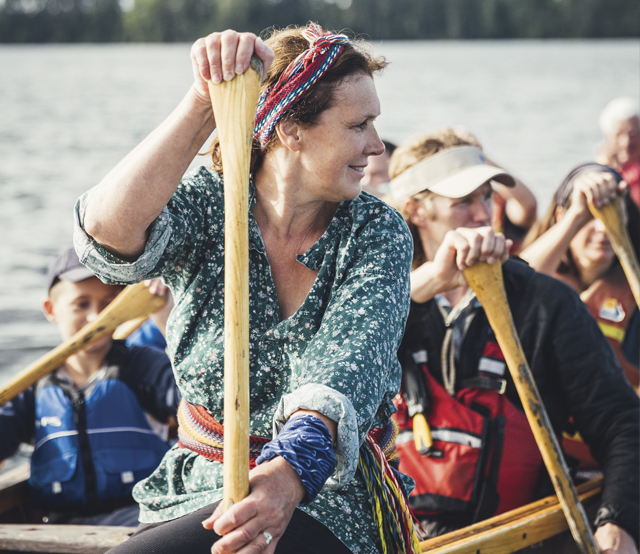
Michelle Savoie greets us at the dock on Voyageur Island. She is dressed in her flowery voyageur chemise, corde du roi, sash and moccasins. I offer a handshake which she knocks aside to give me great big hug. Michelle has been advertising her outfitting business in Canoeroots magazine for the past 16 years—nearly as long as she’s been inviting me and my family to visit.
We are shown to our Simon McTavish lodge room. All the buildings are named after famous figures from the fur trade. Inside hangs a historic Quetico canoe route map, a Hudson’s Bay Company point blanket and of course, a paddle. The room is rustic and cozy—a perfect place to spend a night before or after a wilderness trip. But we spend very little time here except to sleep.
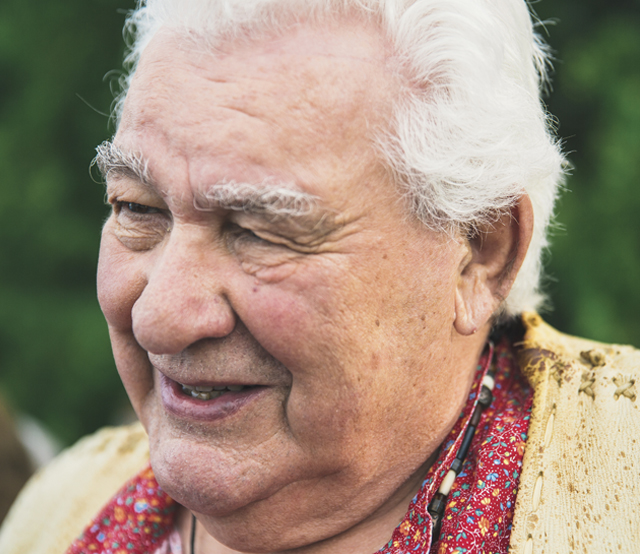
The main lodge has been the meeting place for thousands of groups for almost six decades. The coffee is fresh, pewter mugs line the shelf above and the fruit bowl is overflowing. In the great room an old guitar rests in the corner against a bookshelf stuffed tightly with adventure stories, volumes of poetry and dog-eared interpretive guides. These pine walls have heard stories of grand adventures and the tables have held three generations of cribbage, Scrabble, and Monopoly. While Doug is learning the rules of Settlers of Catan, I sit down with 82-year-old Guy Savoie to learn the history of this place.
Voyageur Wilderness Outfitters was started in 1958 by Charlie Ericksen and Jean Goff, he tells me. The couple had met in Duluth, Minnesota where Goff was an executive with Sears, Roebuck & Company. She had lost a son and wanted to develop a youth program or camp in the Duluth area. Ericksen was a conservation officer with the forest service. How the two ended up in Atikokan in Northwestern Ontario, Guy isn’t sure.
82-year-old Guy Savoie, Metis elder, genius story teller. | Photo: Courtney Boyd/Ontario Tourism
At a forest service conference in the early 1960s, Ericksen learned of the new environmental concern, acid rain. When he took up the fight against acid rain Ericksen’s colleagues thought he had a screw loose. He figured if he couldn’t convince his peers and his generation of the dangers of acid rain, maybe he could teach young people about it. And so Voyageur Wilderness Outfitters became Voyageur Wilderness Programme—an educational program focusing on ecology and the importance of the environment and the dangers it faces.
“He was at the right time. There was all that hippy movement. Things were very volatile and impressive. They came in droves,” says Guy. Ericksen and Goff were teaching 1,200 to 1,400 young students through their 10-day program every summer. The children arrived by bus, usually spending the first night at the lodge, like we did. They were given instructions on how to canoe. Many had never seen a canoe or touched a paddle.
“We taught them to roll their sleeping bags from the head first in case the roll gets wet,” Guy laughs. “It’s okay to have it damp at your feet and better to have it dry at your head. They’d learn things like that and then they would head out for a seven-day wilderness trip.”
Photo: Courtney Boyd/Ontario Tourism
Because the canoe was the only way to travel into the park—the only way anybody has ever travelled in the park—it was an obvious vehicle to use to teach ecology. But Ericksen and Goff needed a theme to interest the youth.
“The lure of the voyageur grabs young people. It’s adventurous. It had lots of pizzazz. It still does,” says Guy. “The voyageurs were He-Men, they had to be. The Grand Portage on the Pigeon River was nearly nine miles long. The voyageurs carried two 90-pound bales on their shoulders. They’d get an extra Spanish dollar if they carried a third.”
Guy and his wife Leá were good friends with Ericksen and Goff and had spent the Thanksgiving weekend of 1977 at the lodge putting away canoes and closing up for the winter. Ericksen was a severe diabetic and not feeling well. Guy remembers telling him to slow down and relax and write more. Ericksen replied, “If I’m going to go, I’d sooner be doing what I’m doing.”
Goff called early that Monday morning to say that Ericksen died in the night of a massive heart attack.
For seven years Goff tried to keep the business going until finally she called Guy and Leá, “You’re the only ones who know the program. You would be perfect.”
Guy is an aboriginal Métis elder. He was at the time president of Winnipeg’s Festival du Voyageur. In 1804, his direct ancestor, Francois Savoie, signed a voyageur contract at Fort William to travel between Fort William and the Red River Settlement. Running an outfitting business called Voyageur Wilderness is in his blood. The Savoie family bought the shares of the company and ran their first school programs the summer of ‘86.
The charm of Voyageur Island is that it feels like nothing has changed since the ‘60s. However, Guy tells me that his business, like most, needed to evolve to change with the times.
The summer after the September 11 attacks, five long-time schools cancelled their trips to Voyageur Island. American schools at the time were cancelling all international trips.
“After the plane crashed into the towers, we lost one-third of our business in one swoop,” says Guy. And just when Voyageur Wilderness Programme was almost back to pre-9/11 numbers, along came the economic crisis of 2008.
At the age of 67, Guy officially retired and passed the bourgeois hat to his second eldest of six children, Michelle. As it turns out, running a successful outfitting business in the north requires the wearing of many different hats.
We stay our first night on one of the rabbit ears campsites on Batchewanng Lake just inside Quetico Provincial Park. | Photo: Scott MacGregor
While Voyageur Wilderness Programme still runs their 10-day school group program, Michelle is focusing more on outfitting private groups as part of their complete business model.
“I’m fortunate to have an incredible elder like my dad,” say Michelle. “He empowered me to try new things with the business and not be afraid to make some mistakes. He always says, ‘If you don’t try, you won’t know—so what do you have to lose?’”
Canoeists heading into Quetico would call Voyageur Wilderness Programme and ask Michelle if she rented canoes. They asked if they could stay a night before or after their trips. Adventurers wanted her to help them with route planning, meals and equipment rentals. It seems when you are located 500 meters from 1.1 million acres of protected Canadian wilderness and say yes to all sorts of customer requests, soon enough you will find yourself in the full service canoe outfitting business.
“We’ve simply expanded our emphasis of our eco-practices to the outfitting of individuals, smaller groups and families,” says Michelle. “In them we try to install good values and educate them about the environment. I believe that with knowledge comes respect.”
Before we venture into Quetico Provincial Park, Michelle walks us through a passionate backcountry best practices presentation that I’m sure she’s done one thousand times before. At the end she tells us that she believes our time together creating memories and experiences will inspire us to preserve and protect the wilderness for future generations.
Doug and I paddle off toward the park in silence.
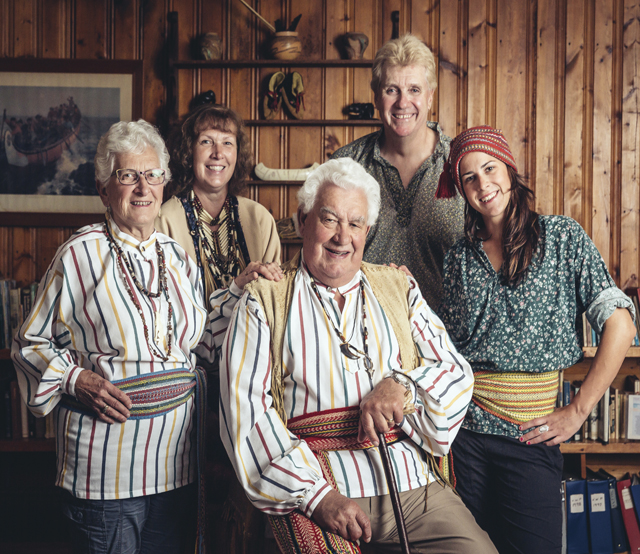
Three generations of the Savoie family known for their perseverance, tenacity and joie de vie. | Photo: Courtney Boyd/Ontario Tourism
What happens to the third generation of children with Métis and voyageur blood who spent their summers on a small island just outside a wilderness canoe tripping paradise?
Michelle’s children had only one rule: They could go anywhere on the fiveacre island so long as they were wearing their lifejackets. As they got older they were assigned chores like sweeping cabins, working in the pack house, stacking wood and teaching guests how to paddle. At 18 they ventured into the park as wilderness guides and continued to do so throughout university.
Madeleine, now 27, tells me that she and her older brother Joseph have plans to someday return to Voyageur Island and run the business together. For now however, she is happy as a paramedic in a rural area south of Winnipeg. Joseph is a wildlife biologist and conservation officer in the tiny hamlet of Qikiqtarjuaq, Nunavut. He couldn’t be part of the filming week because he was even further north in Pond Inlet tagging narwhals.
Madeleine thinks when her parents decide to retire she and Joseph have lots of things that they will keep exactly the same but there are a few things this new generation would like to change.
“There will be two of us, so we’d like to run programs on the island all year long,” she says. They also have plans to reorganize the pack house to make outfitting groups more efficient. These are small but important changes you might end up thinking about rolling tents and nesting pots as teenagers or now on slow nights in an ambulance or on ice floes when the narwhals don’t show up.
It is about connecting to each other and to the land. | Photo: Courtney Boyd/Ontario Tourism
Like every Voyageur Wilderness school program since the 1960s we return to Voyageur Island from our canoe trip in Quetico to the welcoming sound of bagpipes. Now we are relaxing in the main lodge, the adults reading and editing photos while the kids are back at the board games. The fire in the sauna by the lake is heating the rocks above.
When the cook rings the iron triangle dinner bell Doug and I sit at a large round table for a traditional banquet with three generations of French Canadian voyageurs—Guy, Michelle and Madeleine, the direct descendants of Francois Savoie.
After the sit down supper we meet outside at a teepee for closing ceremonies— to appreciate our connection to the Earth and be symbolically welcomed into the family of the voyageurs.
Doug and I were mangeurs de lard when we arrived. And we were still pork eaters when we came out of the park. But now we are real voyageurs.
Michelle closes the evening with a reading from First Nations’ leader Chief Seattle, “This we know: All things are connected. Whatever befalls the earth befalls the sons of the earth. Man did not weave the web of life; he is merely a strand in it. We are all connected.”
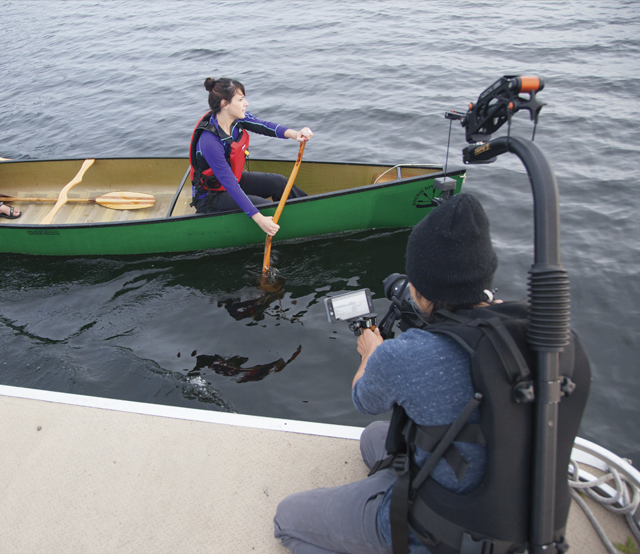
Behind the scenes with Goh Iromoto filming The Canoe. | Photo: Scott MacGregor
The segment of Goh Iromoto’s film The Canoe filmed during our visit to Voyageur Island is entitled, “The Connector.”
The canoe and the voyageurs connected Fort William to settlements further west and northwest, essentially opening and connecting a nation at a time when there was no other possible way to do so. And now, protected areas like Quetico Provincial Park provide a place canoeists can go to connect with nature and to escape a world that today is far too connected all of the time.
“In today’s time it is so great for school children and families to get back to communicating, to really connecting and interacting with each other,” says Michelle in The Canoe. “These interactions weave communities and families tighter. Connection is what makes the experience in the wilderness so strong. Wilderness really is part of who we are, it is part of life, it is part of the true raw emotion that connects us all.”
Scott MacGregor is the founder and publisher of Canoeroots. Goh Iromoto’s film featuring Voyageur Wilderness Programme won the Reel Paddling Film Festival Best Canoeing Film award and has been entered in another 55 film festivals around the world. It has been featured in National Geographic’s Short Film Showcase. Watch The Canoe, the story of Canada’s connection to water and how paddling in Ontario is enriching the lives of those who paddle there.
This article was first published in the Early Summer 2017 issue of Canoeroots Magazine. Subscribe to Paddling Magazine’s print and digital editions, or browse the archives.
A glorified, albeit patriotic, trash bag with a hood. | Feature photo: Adobe Stock
A child on a beach, looking at a washed-up starfish.
A boat load of toys and electronics is not the picture of family canoe tripping that outdoor enthusiast parents envision. We want our kids actively engaged in their surroundings, having fun while busily discovering the natural world that compels us to get out canoeing in the first place.
After 6,000 kilometers of canoe tripping as a family, we have discovered a few tricks to help the kids settle into their wilderness playground. In our 500 plus nights of camping as a family, we’ve rarely had complaints. When we pause from paddling, the kids naturally drift off to play, figuring out the lay of the land in each new spot. If there is a definition of parenting bliss, this is it.
Photo by Dan Clark
PART OF THE PLANNING
Building a sense of anticipation is a great way to get kids involved in the trip. Start talking about it as a family weeks before you head out on your trip, look at some pictures of the area you intend to paddle and get kids to imagine what it might be like. Provide kids with a stuff sack that they can fill with a few favorite toys and encourage them to bring some books for time in the tent at the end of the day.
TOSS IN SOME TOOLS
If you want your kids to play with the elements surrounding them, some basics will enable them to get started with creative outdoor play. Reducing the toys that we pack may be one of the greatest challenges for parents planning canoe trips. We always pack things like a shovel, bucket, sponge, some plastic containers with lids, static cord and yarn. For older kids, a small knife can be an excellent addition.
SET SOME GROUND RULES
It is important to find a happy medium between helicopter parenting and letting your kids disappear into the rough. Young kids need close attention as they are less rational and may inadvertently wander away. However, once our kids are over four years old we developed a general rule: the kids should be able to see camp from wherever they are so that we are able to
see them. We also suggest the buddy system so that they look after on another. There are a few other considerations to keep everyone safe, such as making noise in bear country, and not picking and eating anything without parent approval.
Photo by Dan Clark
WATER, ROCK AND ICE
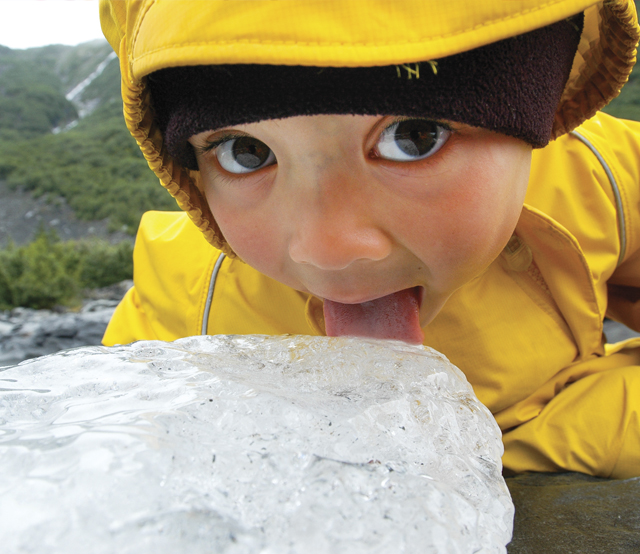
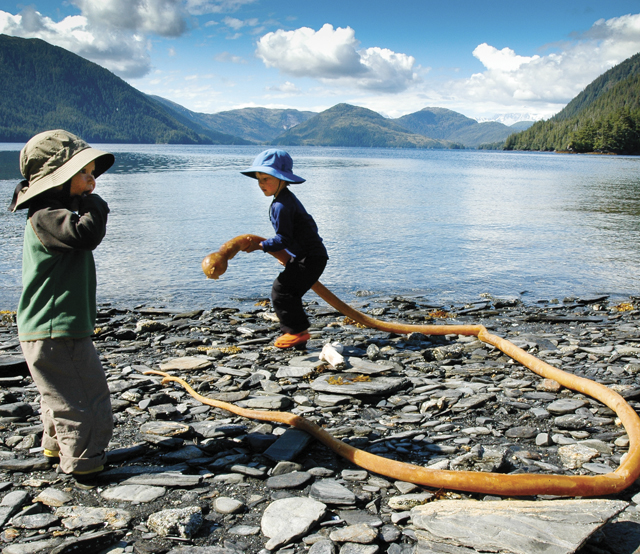
The inorganic that can be found in even the most barren Arctic landscapes is a veritable sandbox for kids to play in. With a few tools, they will soon be building dams and creating miniature rivers. Picture gumboots filled with sand and butterfly motifs etched in mud with a stick and you’re on the right track. Canoeing really is one big beach vacation, except that there is a new beach to explore around each bend.
Rock collecting is a great way to inspire treasure hunting. One way to inspire kids to focus on the small details is by reading, “Everyone Needs a Rock” by Byrd Baylor. This book shares some highly individualistic rules for finding the perfect rock. You can extend the learning by looking for crystals in rocks, seeking that perfect heart-shaped stone, or the ideal skipping stone. When we are outside of National and Provincial Parks (where you are not allowed to remove anything), our family usually returns with a weighty stuff sack full of special rocks that grace our nature table in our kitchen. These keepsakes help connect kids to nature and provide lasting memories for the entire family.
PLANTS
You don’t need a degree in botany to help your kids learn about the plants that surround your family. You may start by bringing a plant guide, and laminated boat. When our kids are playing in areas with plants that are new to us, we use the plant guide to identify any potentially dangerous plants and provide frequent reminders to check with us before they pick or eat anything. But do let them sample some wild foods. The most immediate reward for local exploration may be a berry patch hiding right behind your camp. Kids will spend hours filling a ziploc and themselves, with blueberries.
Beyond the edibles, we’ve packed loads of sticks, tumbleweed, ferns and even a birch bark crown on many a day of canoeing. We invite the kids to create magic potions out of combinations of plants, bouquets for the fairies, or forts out of sticks. To extend the learning, you may teach your kids to look at leaf patterns, branch structure, or the details of wild flowers.
Most recently, our son started carefully cutting the hollow stems of wildflowers and switching them onto different plants. We suddenly had an interesting puzzle to notice which Valerian flowers had mismatched Arnica leaves. This was a game completely of our son’s invention and he had fun stumping his parents.
CREATIVE VENTURES
Finding treasures in the natural world is a great start, but using these as resources for further creative play is the next step. Our kids have built countless fairy houses out of sticks, sand, shells and leaves. They sometimes trace lines in the sand that become roads or rooms in a house. Whittling a stick is a calming and focused activity for older kids and allows them to create magic wands or intricately etched swords. Younger kids can learn this process by removing the bark from a green branch with an old vegetable peeler.
ANIMALS
Think animals and your first thoughts needs to be safety and respect. We keep a healthy distance from the birds and animals that we discover and our explorations are usually with field manual in hand to figure out the coloration on the wings of a bird, or if the stripes make it a chipmunk or a squirrel. We never feed any of the animals or birds we see.
Aquatic animals are often overlooked, but infinitely interesting to kids. Bring a tupper-ware with a lid and start by rolling rocks at the waterline to discover stoneflies and other bugs. Keep your eyes open for fish just under the surface and consider bringing a fishing rod if time allows. Consider taking your canoe out on a protected stretch of saltwater and your whole family will be transfixed by discoveries of starfish, jellyfish and crabs legging it for shelter in the shallows.
Further animal treasure hunting involves finding the signs of their passing. Tracks in the mud, a lost feather, dropped antlers, or shells on the beach are likely to have your kids rushing back to camp to share their discoveries. These moments are a great opportunity to learn more about the animals whose home we are sharing. We take lots of pictures of these types of finds and then encourage the kids to leave them for someone else to discover.
Photo by Dan Clark
WILDERNESS HISTORY
There have been people living in the Canadian wilderness for millennia and stumbling on the signs of past peoples is something kids will long remember. We are careful to not disturb these sights and have taught our kids to use only their eyes. In many remote areas, the land is slowly reclaiming these bits of human history. Keep your eyes out for old cabins, food cans from a bygone era, or ancient blazes in the trunks of trees.
IN THE TENT
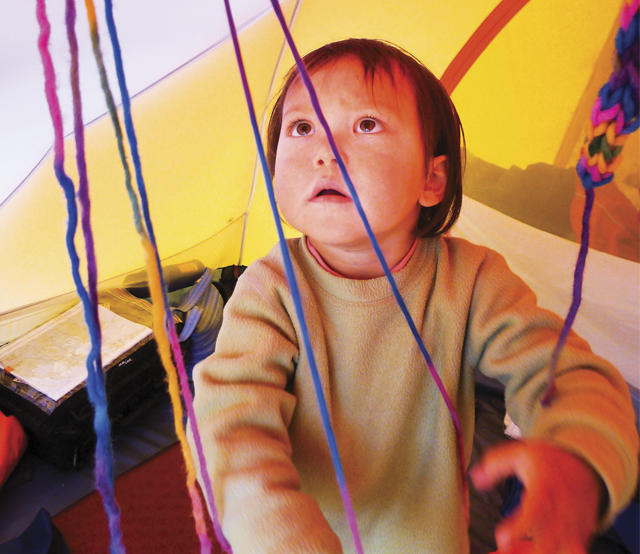
There is going to come a day that is wet and rainy on most every trip. Our family rule is to avoid packing up in the rain. A day in camp is a good excuse to eat pancakes and later relax in the tent. The cord and yarn can be used for weaving, finger knitting, or imaginative pulley systems that criss-cross the tent. Finishing a rainy day with a game of Go Fish is the ultimate in tent-bound treasure hunting.
TREASURE HUNTING TAKE-AWAY
The innate curiosity of kids makes them excellent naturalists and enthusiastic treasure hunters. Reducing the toys you take on trips may be difficult at first, but this first step will help your kids discover the wonders of the natural world. Give your kids some guidance, think up a few games, and steer them in the right direction.
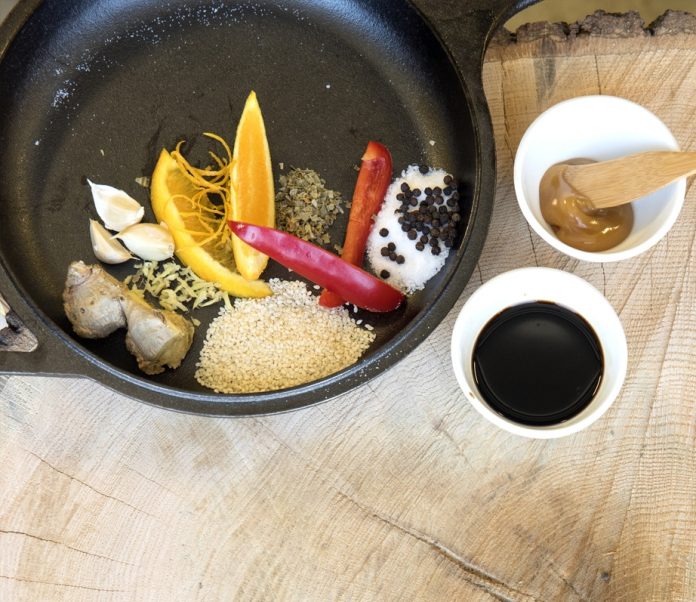
Vegetables in a skillet next to the ingredients to make sauce.
Dehydrating your own food will give you a variety of nutritious but also flavorful choices while reducing pack weight and food costs. Not to mention respecting bans on bottles and cans in backcountry parks.
If you are under the impression dried food is no tastier than chunks of driftwood, I implore you to think again. You can dehydrate everything from single ingredients, like fruits, to complete meals, such as chilli. You can pack for multiple people without weighing yourself down, and become a camp cook rockstar.
If you’re still not convinced, the fact that you can enjoy homemade sauces on the shoreline that didn’t break your back on the last portage should help waver your prejudice.
For all the pasta lovers out there, here’s an Alfredo recipe that’s about as easy as it gets. For those looking for a sweet and savory sauce over a bed of rice and vegetables, this sesame ginger teriyaki recipe should get your appetite rumbling.
If you don’t own a dehydrator, don’t be discouraged, you can also dehydrate food using a convection oven.
SESAME GINGER TERIYAKI SAUCE
(Makes 1 cup)
INGREDIENTS:
1 tablespoon canola oil
2 garlic cloves, finely chopped
1 tablespoon fresh ginger, finely chopped
1/2 cup soy sauce
3 tablespoons honey
2 tablespoons brown rice vinegar
2 tablespoons sesame seeds
1 tablespoon sesame oil
2 tablespoons red pepper, chopped finely
1 tablespoon chives, chopped finely
1 tablespoon orange juice
1 tablespoon cornstarch
. cup water
DIRECTIONS:
1. In a saucepan, heat oil at medium heat
2. Sauté garlic for 1 minute
3. Add remaining ingredients, except for cornstarch and water
4. Add cornstarch to water, stirring until it is dissolved
5. Add cornstarch water mix to saucepan
6. Simmer until thickened.
DEHYDRATING THE SAUCE:
1. Measure out the amount of sauce needed for the meal
2. Make note of this quantity (i.e. 1 cup)
3. Dehydrate the sauce following the directions of your dehydrator, spread thinly on drying sheets. It may take 6 hours or more depending on the sauce, your dehydrator, and humidity
4. Once it has dried completely, let it cool, then put the dried sauce into a plastic sandwich bag, seal it, and write the original quantity on
the bag (i.e. 1 cup)
5. Pack it with the rest of the ingredients for the meal, such as pasta, or dehydrated veggies.
RE-HYDRATING THE SAUCE AT CAMP:
1. Being careful, boil water, adding just enough to the sauce in the bag to make the quantity you started with (i.e. 1 cup)
2. Zip up the bag, and let it sit for approximately 10 minutes
3. Instead of a bag, use a bowl or a cup, with a lid to rehydrate faster
4. Add sauce to your meal
TIPS + TRICKS:
• When making sauces to dehydrate, lower fat content is best. Fat doesn’t dehydrate and will go rancid over time
• Freeze dehydrated foods until just before the trip to make them last even longer
• When rehydrating foods, less is more as you can always add water if you find the sauce is too thick
Speed up the rehydration process by massaging the sauce in the bag, being careful not to burn your fingers or pop the bag
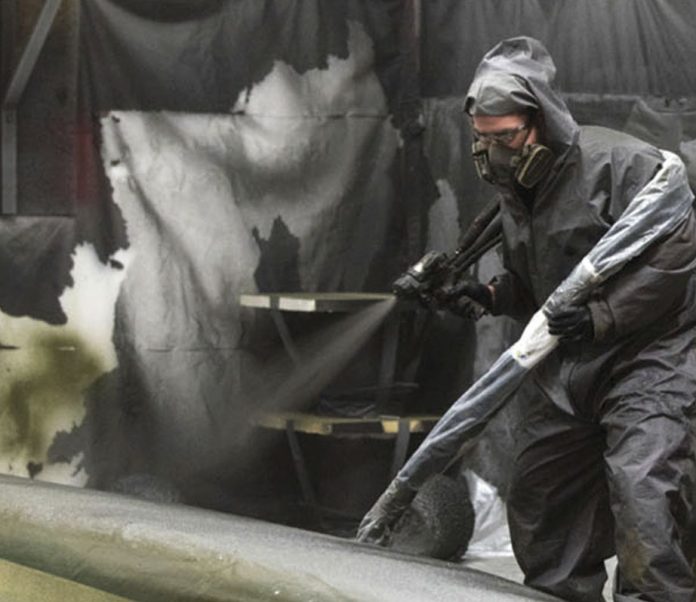
A person spraying the bottom of a canoe with truck bedliner spray.
Although canoes can’t be made out of Line-X— or can they— this two-part polyurethane elastomer system combines two ingredients, hardener, and resin, directly before application to create the perfect mix of a durable, protective shield.
Outfitters such as The Boundless School across the river from the Canoeroots office, and Algonquin Canoe Company in Rapides-des-Joachims, Quebec, have applied it directly as skid plates and entire bottoms of some canoes in an effort to cover, seal and protect from further damage.
Just how tough is it? If you’re going to add eight to 15 pounds to your boat, you should know if it’s going to make a reliable difference.
Given that canoes spend so much time in the water, will the durability hold up the same as it does as truck bedliners?
Between $250 to $350 to apply, it certainly beats buying an entirely new fleet of boats from an outfitter’s perspective. Would individuals feel the need to line their boats with this shield when the standard skid plate repair costs roughly $130?
“Our price was comparable to Kevlar skid plates by the time we buy material and pay someone labor to install them.” says Adrian Meissener of Boundless School.
Line-X will dry in three to five seconds once it’s applied to a surface. A canoe could be done in a matter of minutes, if it weren’t for all of the sanding and buffing of imperfections.
“The prep and the masking is the most time consuming part of the job, and the most important,” says Cameron Symington at Valley Line-X in Petawawa, Ontario.
Symington has covered a variety of different consumers needs with Line-X including garden boxes, interiors of vans and Jeeps, bomb masks for the military, RVs, tool boxes, snow plows for the City of Ottawa and 1000s of pickup truck beds.
“I have done nearly 40 canoes now compared to zero last year at this time” Symington says.
With all of the whitewater canoeing outfitters in the Ottawa Valley, Symington hopes to see more canoes come his way.
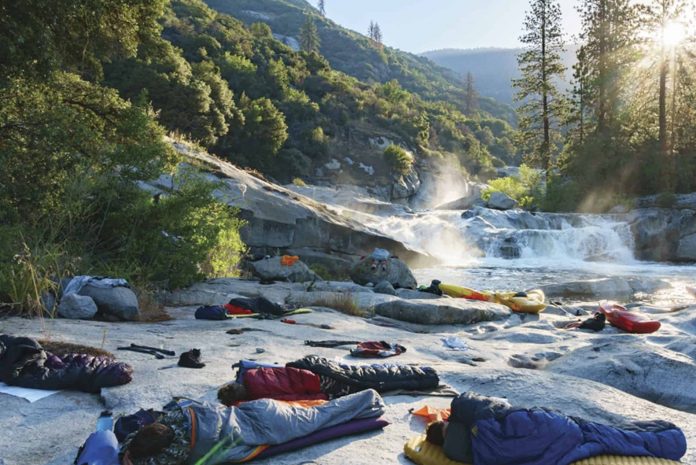
A group of paddlers sleeping on a rock bank, next to a river.
Photo by: Darin McQuod
The term dirtbag carries decidedly negative connotations of unshaven, good-for-nothing drifters and vagrants, contributing little to society. Whitewater paddlers however, know that being a dirtbag is a mark of pride. Spending as much time as possible at the river’s edge, prioritizing paddling above all else and doing it all on a shoestring makes for an afternoon, weekend, summer or life well-spent. Whether you already are a soggy, bonafide dirtbag or a new paddler looking to embrace our unique culture, here is your guide to getting the most for the least out of the river life—on and off the water.
A is for Al Fresco.
Italian for “in the open air,” al fresco is the umbrella term for most activities a dirtbag paddler undertakes. From spending all day eddy-hopping on rivers to communal parking lot dinners at the take-out to sleeping outside, dirtbags are at home in the great and wild outdoors.
B is for bootie beer.
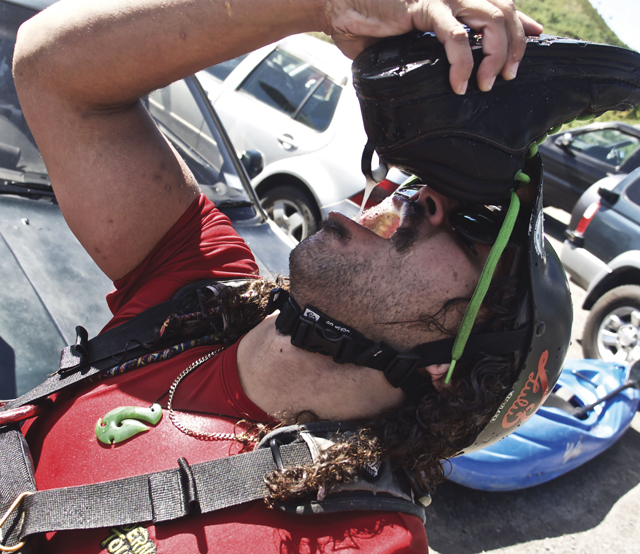
The beer consumed from a sodden, manky booty at the take-out is the ritual friends never forget about when you swim. It may be unhygienic and a less-than ideal way to enjoy your hard-earned cold one, but for all the protesting and grimaces, everyone loves how it makes them feel like they are part of the paddling community.
Nasty and amazing. | Photo by Caleb Roberts.
B
is also for broke.
Related: see Q
c
is for creativity, the indisputable cornerstone of the dirtbag paddler’s life. From figuring out how to carefully engineer a schedule that allows maximum river time to problem solving ingenious quick fixes for busted gear, the ability to approach obstacles creatively is the requisite attitude.
c
is also for couch.
Specifically someone else’s couch, someone who you may not have known yesterday, someone who may wish they didn’t know you in four days, someone who would appreciate you mowing the lawn while they are at work or making dinner for them when they arrive home or replacing the beer in the fridge that you drank before you went to sleep—on their couch.
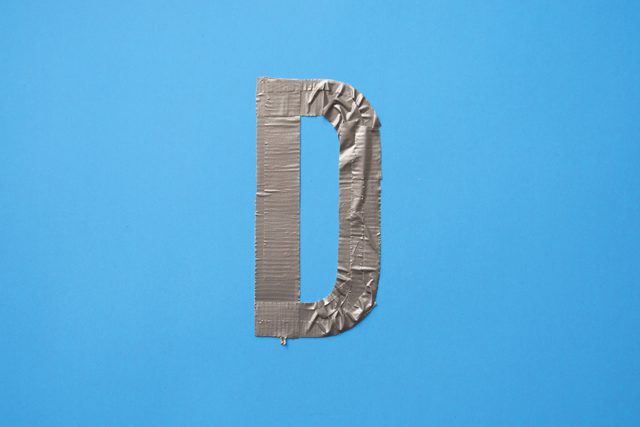
Ductape fixes everything. | Photo by Hannah Griffin.
D
is for Duct Tape.
Invented during World War II, American soldiers used the tape for all kinds of tasks, including fixing broken windows and as makeshift bandages. Post-war, it was used to hold ventilation ducts together, hence the moniker duct tape. Today it is cloth or scrim-backed pressure-sensitive tape that is an indispensable life tool for the paddler.
Duct tape can be used to:
Cover a puffy jacket hole
Patch jeans
Latch a car door that won’t close
Patch a torn tent
Catch flies in the tent or car
Waterproof socks
Wax backs on a tight budget
Hold your pants up as a makeshift belt
Repair sunglass arms
Create a bowl or mug
Make a hat
Start a fire
Write your buddy’s name on the forehead of his Pro-Tec
If that’s not enough to satiate your duct tape passion, you can always road trip to the annual Duck Tape Festival in Avon, Ohio, while blasting 1998 hip-hop album Duck Tape’n by Michael “Prime Time” Williams.
E
is for employment insurance.
Known in some jurisdictions as unemployment insurance, this social assistance program provides benefits to those who have lost their jobs through no fault of their own, like work shortages and seasonal layoffs (see R for raft guiding). Employment insurance is most commonly used by paddlers and their distant cousin the ski bum while in their mid-twenties as a safety net between education and a real job. Tolerate the minimum amount of gainful employment required to qualify, paying into the system and then enjoy blissful weeks of paddling at a percentage of your previous income. Rapid Media would like to be clear that we do not condone defrauding the government. Dishonestly using employment insurance is illegal and has serious consequences. However, it may also be your only chance to paddle for the national kayaking team. Think of it as a sponsorship.
E
is also for empties.
Some skeptics see empty beer bottles when taken individually as almost worthless in today’s economy. Not so fast, dear dirtbag. Imagine you spend a week camping at the river with six friends, who each consume only four bottles of beer per day. At the end of the week, returning those 168 bottles in a state like Oregon will net you $16.80, a sum that can treat you to the following:
10 buffalo cheese Taquitos at 7-Eleven
A pack of double ply (read: fancy) toilet paper
2 jars of Nutella and one loaf of Wonder bread
Brand new wool socks
Three visits to the laundromat
A bag of coffee beans and a carton of milk
A basket of fries and a pint at your favorite post-paddling pub
Photo by Tegan Owens
F is for funemployment.
While funemployment is a perfect fit for the kayaker who wants as much time on the river as possible, it’s not all endless days boofing and letting your feathery mullet blow in the wind. It requires hard work and cubicle monkey-like tasks.
13% Managing budget—Deciding whether the week will bring PBRs or cheese.
22% Communications—Posting photos and videos of epic adventures to social media.
32% Maintenance—Duct taping tent, washing spork and monitoring the grime factor of booties.
26% Meetings and networking— Bonfires, scouting with new friends, forest parties and road trips.
7% IT—Tracking list of gas stations, grocery stores and fast food joints within a 30-mile radius that offer free Wi-Fi.
Keep well groomed by any means possible. | Photo by Caleb Roberts.
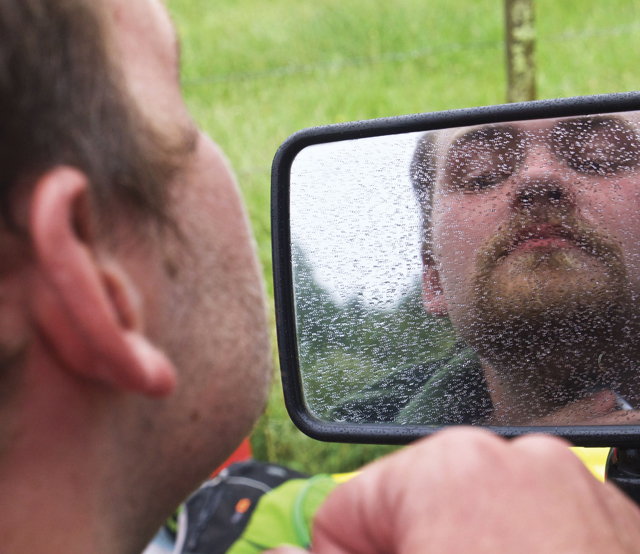
Gis for good grooming.
Because river bums need to find love, too.
H is for hoods of cars.
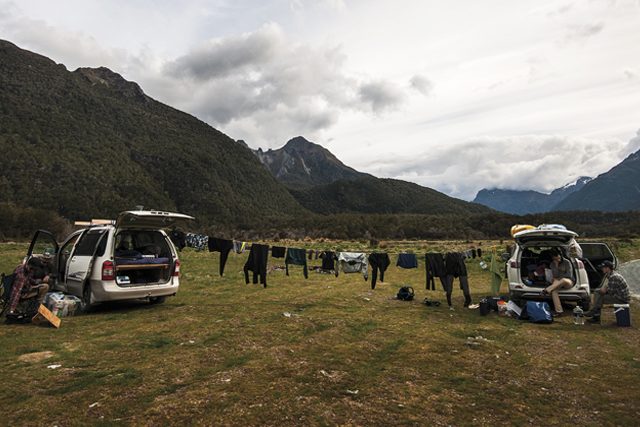
The sturdy hinged cover for the engine is like a multipurpose piece of furniture for paddlers’ outdoor living rooms. Dinner table? Yes. Place to spread wrinkled maps and chart the next day’s route? Check. Drying rack? But of course. And don’t forget, the hood of a car is the classic place to view the nighttime light show playing at whatever river you’re calling home.
H is also for hitchhiking.
The green and social way to get to and from anywhere. Increase your potential for getting picked up by packing a dry bag of semi-respectable clothes in your kayak and smiling big. Going further than the put-in? Never take a ride that isn’t going to at least the next town, never walk away from a town and hide your boat in a ditch.
I is for inside-out underwear.
You know you do it, too.
J is for jamming.
As in playing guitar around a toasty campfire clad in down booties or on the back of a raft floating through a steep-walled canyon at sunset.
Our favorite songs to jam to include:
Wagon Wheel by Old Crow Medicine Show
Teenage Dirtbag by Wheatus
Hotel California by The Eagles
Red Wine by Bob Marley
Burn One Down by Ben Harper
Folsom Prison Blues by Johnny Cash
Are you lovin’ it? | Photo by Hannah Griffin.
K IS FOR KETCHUP SOUP.
(Serves one)
RECIPE:
4 packets of ketchup
1 cup water
Salt and pepper
Instructions:
Subtly remove packets from McDonald’s condiment counter.
Speed away.
Open packets and squeeze into pot over campfire.
Add water and stir, allowing soup to thicken as it heats to a boil.
Simmer for five minutes.
Season with salt and pepper to taste.
L is for leaving your shit everywhere.
Literally everywhere. As in all over, like a bomb went off in the van. What is it with paddlers?
Business in the front, party in the back. | Photo by Caleb Roberts.
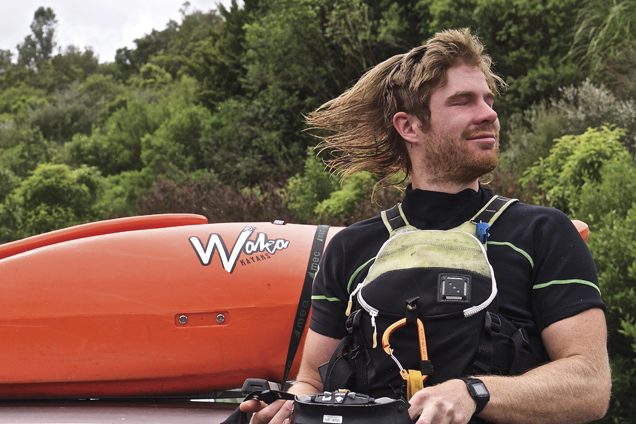
m is for mullet.
“You want to know what’s a mullet? Well I got a little story to tell about a hair style, that’s a way of life.” -From “Mullet Head” by the Beastie Boys
This versatile haircut featuring a close-cropped crown and luxurious locks trailing down the neck is the true dirtbag hairstyle, largely because it’s difficult to find meaningful employment once you grow one.
While the mullet is found on hungover raft guides and waterlogged river bums coast to coast, the haircut that makes you look like an NHL third round draft pick or 70s lounge lizard goes way back. In Mullet Madness!: The Haircut That’s Business Up Front and a Party in the Back, Alan Henderson explains that archaeological evidence in fact confirms the mullet’s existence in ancient Mesopotamia, Syria and Asia Minor. Hittite warriors in the 16th century BCE sported haircuts similar to the mullet, as did Assyrians and Egyptians.
When famous figures like Paul Mc- Cartney, Ziggy Stardust and Chuck Norris have all rocked the mullet, we think it’s clear what your next hairstyle choice for the river should be—as long as those rivers aren’t in Iran. The Iranian Ministry of Culture and Islamic Guidance banned the hairstyle in 2010 in an attempt to rid the country of “decadent Western haircuts.”
n is for nudity.
It’s hard to avoid nudity when you have to get into a new outfit at each end of the river. Be careful and keep your dangly bits out of view of the general public. Of all the amazing stories you could have about getting arrested for being naked, getting changed into a Gore-Tex suit is not the one you want to tell.
o is for “Officer.
I was just getting changed to go kayaking, I swear.” See N, above.
Photo by Hannah Griffin.
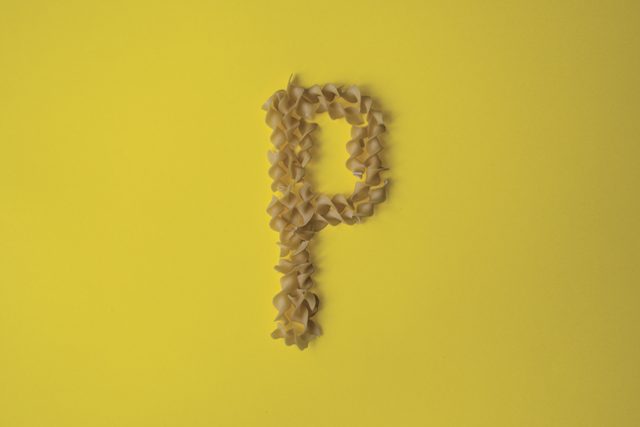
p IS FOR PASTA.
In the 1300s, dried pasta became a popular choice for those embarking on lengthy ship journeys because of its long shelf life. More than 700 years later, whitewater paddlers are still on board with the filling, delicious and cheap river staple that can feed a crew of hungry paddlers for less than $8.
q is for quit your job
…and go to the river.
R is for raft guiding.
If there is one job to keep you living the river lifestyle, this is it. Guide excited clients down rapids by day, party with like-minded paddlers by night and explore new rivers on your days off. To avoid having to go on employment insurance (see E), explore southern places you can raft guide during the northern hemisphere’s winter
s is for showering anywhere.
It seems dirtbag paddlers may be onto something. While mainstream society sees regular showering and the frequent use of soap as a requirement for successful adulting, too much cleanliness can in fact be a very real health risk. Over-cleaning of your skin can cause cracking, increasing exposure to germs and infection. Too much shower time can also reduce the amount of oil on the surface of your skin, decreasing important immune-supporting bacteria.
While this is great news for the under-showered, for aesthetic reasons and to increase your odds of finding the dirtbag of your dreams, sneak in the occasional shower, even if it means going to the local campground, public pool or truck stop.
t is for tent.
Noun. A portable shelter made of cloth and supported by one or more poles. Synonyms: living room, changing room, office, reading room, master bedroom and logistics control center. If you are going to spend most of your time at rivers, it pays to get a good one. T could also be for truck. Most of the above still apply.
u is for unidread.
Urban Dictionary defines the unidread as “hair that is matted together to form a single dreadlock consisting of all of a person’s hair.” It is most commonly seen on paddlers who wear a helmet all day during kayaking season and seem to have forgotten to pack their comb and detangler. If you need to deal with a unidread at the end of paddling season, follow these steps.
STEP 1: Find a buddy to help.
STEP 2: Assemble a metal comb, shampoo and conditioner.
STEP 3: Cut a ó inch off the dreadlock.
STEP 4: Shampoo hair in warm water and saturated with conditioner. Don’t rinse.
STEP 5: Pick apart dreadlock and comb smooth section by section.
STEP 6: Repeat next season.
There’s no place like home. | Photo by Caleb Roberts.
V is for van.
It can be a tricked-out VW with bed, eating and seating areas, or just your mom’s hand-me-down Caravan. The important part is it fits you, your friends and all your precious gear.
W is for “where is my skirt/paddle/keys/helmet?”
Best said at the put-in, while all your friends stare at you in disbelief, paddles in their hands and boats on their shoulders. W is also for WTF dumbass? Are we going out boating?
X is for x-girlfriend / boyfriend / wife / husband.
The former partner who stunned you when they announced they were done after “quick paddles” consistently took 12 hours, you forgot their birthday because you were hunting stouts and who spent their weekends driving shuttle for your soaking wet, thankless kayaker friends.
Y is for “you don’t want to eat that.”
Seriously. If it’s fallen on the ground, is covered in dirt, has an expiry date from a year you don’t remember or is dripping, you shouldn’t eat it. Get a good cooler, leave it in the shade and clean often.
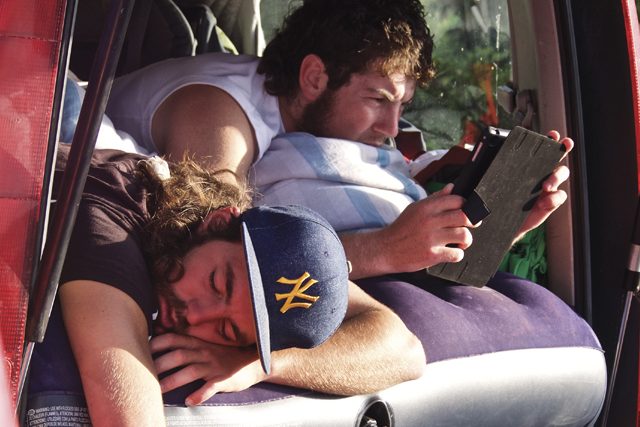
Where is your bed? Everywhere. | Photo by Caleb Roberts.
Zis for zzzzz’s
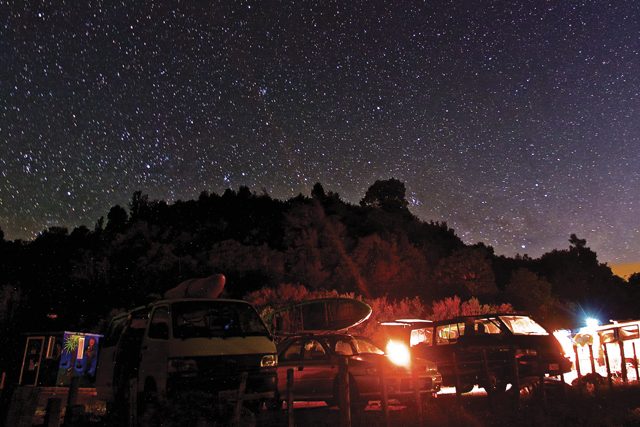
Catching them anywhere and everywhere. When you spend your days chasing drops and surfing waves, you need to nap wherever and whenever you can find the time. Accepting that any flat surface is an appropriate place to slip into the REM cycle is your first step to being a well-rested dirtbag.
No, really—we mean anywhere. A wooden pallet, a cliff, the trunk of a car or the overturned hull of a creekboat are all great and economical choices. Sweet dreams and see you on the river.
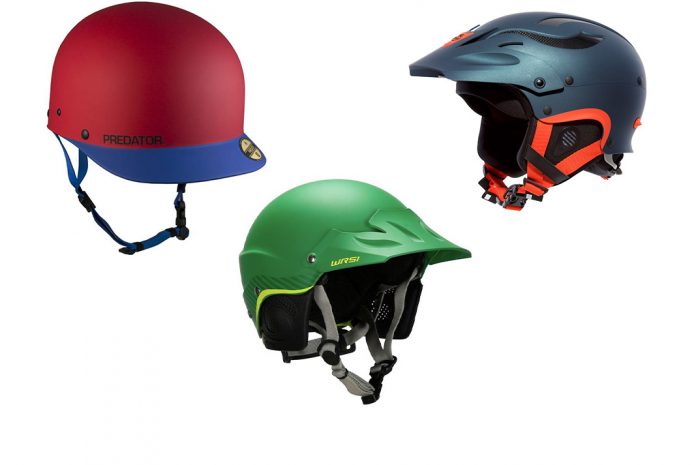
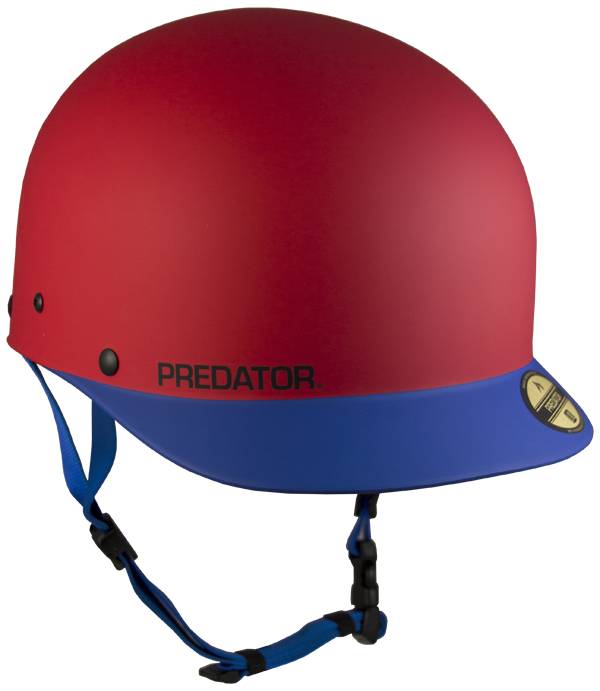
This smooth and stylish matte-textured lid will make you look like you rolled up to the riverbank straight from hitting rails at the local skate park. Predator’s Shiznit has a four-centimeter blue brim that keeps the sun out of your eyes while its gently curving shape sits at just the right level so it doesn’t obstruct your vision. Predator owner and designer Matt Kelly explains the brim is also designed to reduce bucketing and roll back.
This means when you roll up your helmet won’t fill with water and then roll backward on your noggin, something that can happen with longer visors that lack a design allowing water to flow through. This is definitely one of the more comfortable whitewater helmets we’ve tried—cushy removable interior padding on the sides and top are supportive and just the right amount of soft. It also stayed in place beautifully with a Croc-Lok adjustment dial and smoothly tightening chinstrap.
$79.95 | WWW.PREDATORHELMETS.COM
2. SWEET PROTECTION: ROCKER
2. SWEET PROTECTION: ROCKER
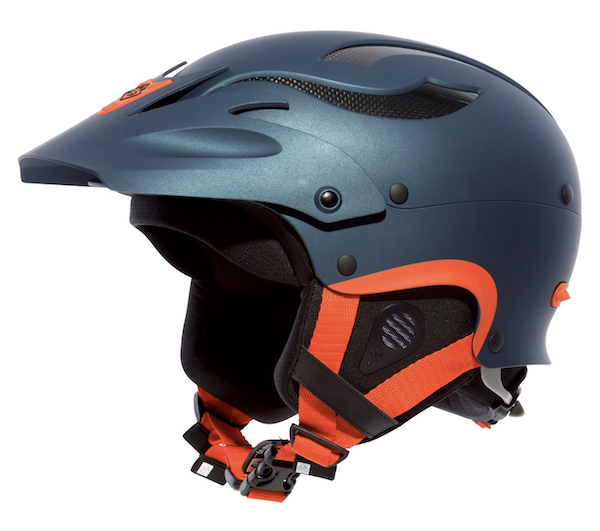
The popular Rocker from Sweet Protection came on the whitewater helmet scene in 2009 and is being re-released this year with some sick new colors, including navy blue metallic and orange. Designed by Sweet as their high-performance helmet for rough conditions, this carbon fiber reinforced lid combines two shell technologies, meaning your brain is well protected on rocky creeks and rivers. At $249, the Rocker is on the high end of the price spectrum but we think its worth it for the high-quality carbon fiber construction and great fit.
When tested on frigid spring runs, the Rocker scored major bonus points from us with its super warm and comfortable interior. The inside liner extends down just below the low profile brim for a warm forehead and the cozy flaps have adequate room and don’t squish your ears. It comes with an optional two-and-a-half inch long visor and universal padding so you can adjust for a perfect fit. We especially liked the vented earflaps which we found didn’t inhibit your hearing the way some do. The clear swirls at the top that allow you to see the carbon fiber reinforcements keeping your brain safe are pretty cool too.
$249 | WWW.SWEETPROTECTION.COM
WRSI: CURRENT PRO
WRSI: CURRENT PRO
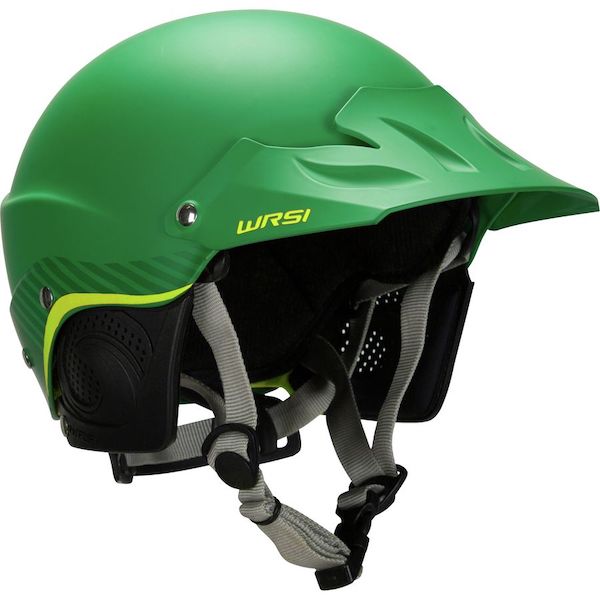
The new Current Pro from WRSI is the supersleek head protection you’ve been looking for. It has three-layer impact absorption, interconnected straps that hold the helmet snug on your melon and an adjustable O-brace harness for a perfect fit. We’re big fans of the comfy and breathable liner, which can be quickly removed, washed and dried after hot summer days. The hinged visor keeps your peepers protected from sun and rain and we loved the inch of visor adjustment which allows you to choose how low or high it sits based on the weather. Strategically placed cut-outs in the Current Pro’s brim are designed to reduce the impact of water by allowing it to flow through the helmet.
$109.95 | WWW.WRSISAFETY.COM
This article originally appeared in Rapid Early Summer 2017 issue.
Subscribe to Paddling Magazine and get 25 years of digital magazine archives including our legacy titles: Rapid, Adventure Kayak and Canoeroots.
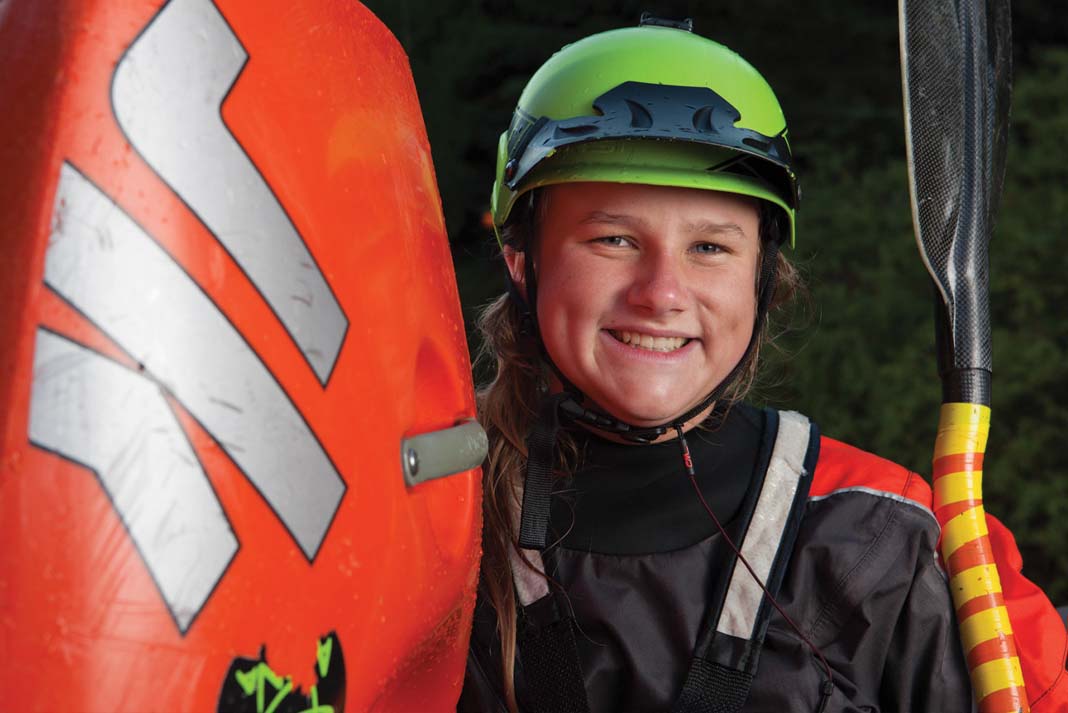
Nevada native Sage Donnelly sounds like a normal teenage girl. She is bubbly, positive, laughs a lot and is stoked on getting her driver’s license. But Donnelly is a little different: she’s also a whitewater kayaking phenomenon. She began kayaking at three in a Eskimo ToPo Duo, at five had her own kayak, rolled at seven and at fifteen won the 2015 Junior Women’s Freestyle World Championship—and nabbed a finals score higher than any senior woman in the event. The 16-year-old homeschooler also races slalom and downriver—and does it all while managing Type 1 Diabetes.
WHAT’S YOUR LIFE LIKE?
In the U.S. or Canada I am in a massive orange van. We have two beds in there so we can bring the dogs and the whole family. We’re in that around five months out of the year. But now that I’m doing a lot of slalom and travelling overseas quite a bit, we’re doing a lot of Airbnb. For training my usual routine is to wake up pretty early in the morning, eat breakfast quickly, go out and usually do a whitewater or flatwater workout. I’ll come back, do school, eat lunch and then go back out again paddling two or three times.
Top of her class.| PHOTO: PETER HOLCOMBE
WHAT’S THE SCARIEST THING THAT HAS HAPPENED TO YOU KAYAKING?
I was on the Tellico River in Tennessee. We had a massive crew with a lot of kids and most of us hadn’t done the river before. We got to the last drop and one guy was in a playboat and he didn’t boof it very well and got pinned upside down. One of the guys put his boat below his head so at least he could pull himself up and breathe. I was paddling up and didn’t realize anything was wrong because no one had whistled or signaled. When I got to the drop I could tell something was wrong, so I turned back upstream to catch an eddy, but it wasn’t a very good eddy. I fell in backwards and got pinned vertically upstream. I was under for about a minute and then my dad pretty much ran on water and pulled me out. I was mainly upset my boat was dented.
DO YOU EVER GET ANXIOUS OR STRESSED OUT WITH KAYAKING?
There’s always that little thing in the back of my mind thinking about if I’m off on a move or touching gates. The biggest thing I worry about is that I’m not improving fast enough. I actually go back to look at old videos quite a bit to realize how much I have improved. I just always try to be positive in my sessions.
DOES BEING A TYPE 1 DIABETIC MEAN YOU APPROACH KAYAKING A BIT DIFFERENTLY?
It definitely makes things a lot different. I have to plan things out a lot more. I can’t just go paddle whenever I want. I have to go, ‘My blood sugar is this, I have to bring this kind of food, I need to make sure I can always have snacks. It’s a lot of planning which can be a major pain, but I think it’s made me a lot more in tune with my body which has helped me a lot with kayaking.
WHAT WAS THE BEST PART OF 2016?
2016 was a pretty rough year for me. My Junior Slalom Worlds results were nowhere near as good as I wanted them to be and I took that hit pretty hard. But after that I had three Junior races in Europe and probably the best thing was how I bounced back from that and came back much more mentally strong and positive. I did a lot better in those races instead of just giving up and going home.
This article originally appeared in Rapid Early Summer 2017 issue.
Subscribe to Paddling Magazine and get 25 years of digital magazine archives including our legacy titles: Rapid, Adventure Kayak and Canoeroots.
Hot water, hot slalom skills. | Photo Courtesy: THE FREDERICK NEWS-POST
Entering the Dickerson Whitewater Course, located smack in the middle of a massive generating station on the Potomac River in Maryland, is a lot like getting into a posh country club. Paddlers must first show appropriate identification and membership cards and find their names on a pre-authorized list
supplied by the local paddling club. Then the security guard has to escort them through the premises, passing a series of flashing lights and sirens— not to mention the four massive stacks rising from the facility.
Checking in is a hassle but it’s worth it when you consider the local paddling center gets to access this Class IV whitewater course free of charge. Not a bad arrangement when you’re training Team USA and hosting national championships on a course that’s—get this—heated.
When sub-zero temperatures descend on Maryland and the Potomac River freezes over, athletes like canoe slalom Olympian Ashley Nee can check into the only heated whitewater course in the country. Access to the course has become more restricted in recent years because of NRG Energy’s increased security concerns. Currently about 100 members of the Potomac Whitewater Racing Center are on the access list for the course. Regular use of the course is limited to U.S. National Team members.
First, you should know there aren’t heating elements in the course. The generating station, currently run by NRG Energy, diverts Potomac River freshwater through their system to cool the machinery that powers more than 400,000 homes. The warmed outflow is then returned to the river. This arrangement has been in place since the course was built in 1991 in preparation for the Olympic Games in Spain. NRG Energy says they occasionally run the pumps for the paddlers even when the plant isn’t running, as a courtesy.
Hot water, hot slalom skills. | Photo Courtesy: THE FREDERICK NEWS-POST
When Nee, a Maryland native, first started paddling the course at 14, there were just two steam-billowing stacks. She took one look at the boiling rapids and a daunting hole at the bottom of the course and declared with confidence there was no way she was getting in her boat. Six months later with newfound confidence she was back and hasn’t missed a year on the course since. She recalls a day last year when the temperature dropped to 17 degrees Fahrenheit and despite a comical ice build-up on her helmet she carried on her training as usual while her coach snapped pictures of her icy costume.
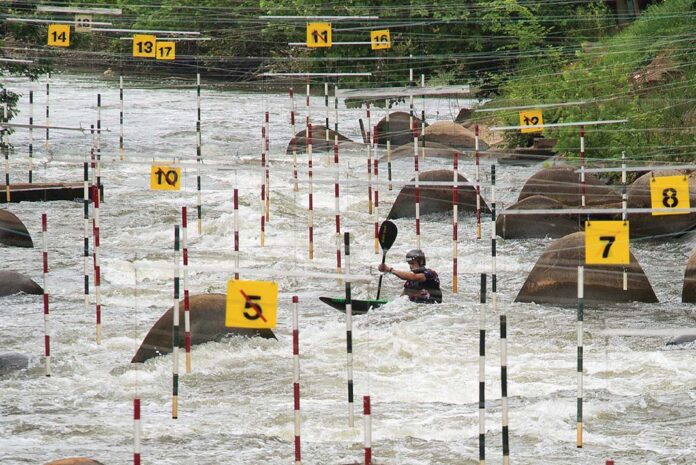
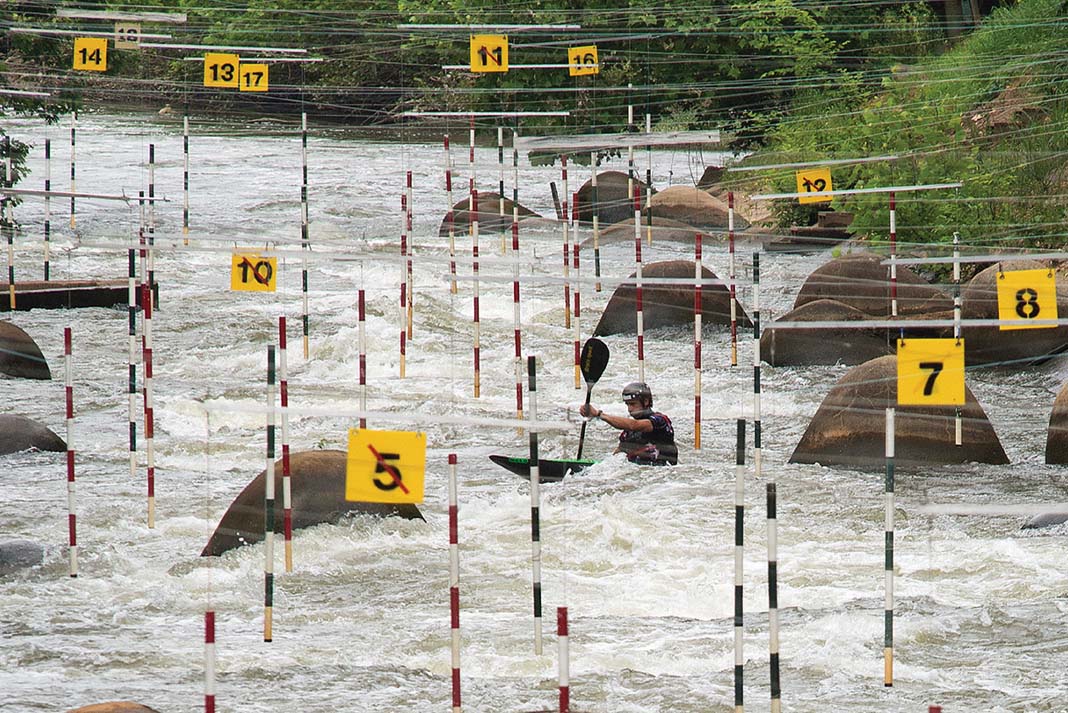
Nee, who is now on a first name basis with most of the security team, has learned to live her life by the sometimes unpredictable pumping schedule of the Dickerson course. Her training begins when she gets an email that says, ‘Dickerson is confirmed.’ This means the plant is generating and soon water will be pumping through the course at nearly 660 cfs, creating dynamic eddies, drops and hydraulics as the frothy gush passes over underwater concrete gumdrops and squeezes between the wing dams.
The 900-foot-long concrete chute, complete with hanging gates is uniquely designed to simulate competitive canoe slalom, perfect for training athletes, while coaches and onlookers can follow along the course on the grass from one of the protruding water level platforms.
The course only ever let down once. It was at the 2004 National Championships and Adam Van Grack, chair of USA Canoe/Kayak and long-time Dickerson paddler, remembers that day well. Due to a passing storm the Potomac River had risen to twice its normal height, flattening the whitewater features, leaving the rapids Class I at best.
“At that point all the racers had already shown up that morning,” says Van Grack with a laugh. “So the head of the U.S. National Team adjusted all the gates and we had the canoe slalom Whitewater National Championships on what is essentially flatwater.”
That day aside, the Dickerson Whitewater Course has stood the test of time. Since it was built, every whitewater slalom athlete that has represented the U.S. in the World Championships or Olympic Games has trained and competed on the course.
This article originally appeared in Rapid Early Summer 2017 issue.
Subscribe to Paddling Magazine and get 25 years of digital magazine archives including our legacy titles: Rapid, Adventure Kayak and Canoeroots.
After a month of non-stop paddling in southern Siberia, my friends Don, Darcy and I decided to head back to the Chuya River for our last three days. It was a river that had humbled us just weeks before and we knew it would be an exciting way to finish our adventure in this sparsely populated corner of northern Asia.
On our last evening, Darcy and I were sitting by the river at camp, reflecting on a remarkable trip that we both agreed was a highlight of our paddling careers. Nevertheless, after a month of non-stop Class V Siberian whitewater, my nerves were shot and I was looking forward to returning home.
Triumph and tragedy in Russia’s Altai Mountains
As we sat there in the last light of day just downstream of Mazhoy Gorge where our trip began with wide eyes at the incredibly deceptively-named Baby Rapid, Darcy spotted something floating in the river. “Looks like a helmet,” she said with concern. As the object came nearer, it suddenly hit us what we were witnessing. “A body! There is a body floating in the river!” Darcy yelled to get the attention of anyone in proximity. And there, in the last moments of our trip we watched as a drowned catarafter—one of two, we later learned—floated slowly past us.
It was a sight that shook Darcy, Don and I to the core and one all too familiar to the local Russian paddlers, cementing what we had come to learn during our time in the Altai; the whitewater community in Siberia is a world away from the one we know.
Early one spring morning I opened an email from my good friend Darcy Gaechter. She wrote asking if I was interested in joining her and her partner Don Beveridge on a paddling trip to Russia’s Altai Mountains.
“Darn, this is a tough call,” I typed back. The Altai had long been at the top of the list of places I wanted to kayak, but I wasn’t sure if I was fit enough. I had met Darcy and Don years earlier in Ecuador, where they run Small World Adventures, a kayak guiding firm on the Quijos River. The pair are no strangers to big adventures, having previously paddled the Amazon from source to sea.
After much back and forth I realized that this was too good an opportunity to pass up—to journey with experienced and trustworthy paddling partners to the Siberian wilderness. I just couldn’t say no.
To make the trip possible we joined Two Blades Adventures, a company run by Egor Voskoboynikov of Russia, Alona Buslaieva of Ukraine and Tomass Marnics of Latvia. They offer logistics and guiding to some of Russia and Central Asia’s finest paddling destinations, including the Altai, the heart of Siberian whitewater. Without them, there was no hope in overcoming the language barrier and navigating the complex logistics including remote put-ins and takeouts, bad roads and corrupt officials.
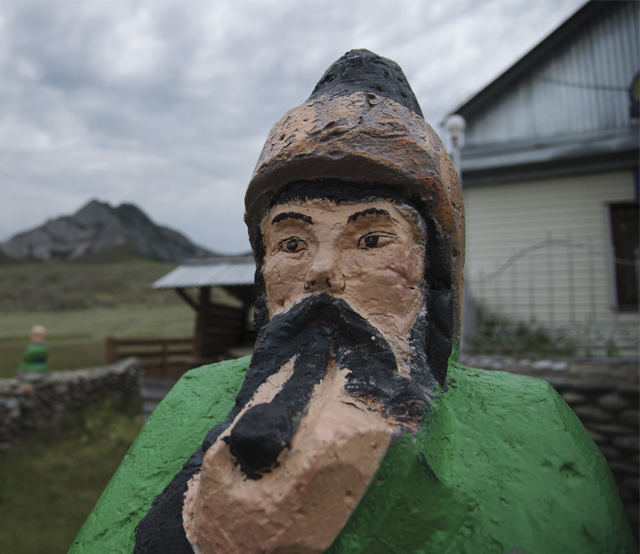
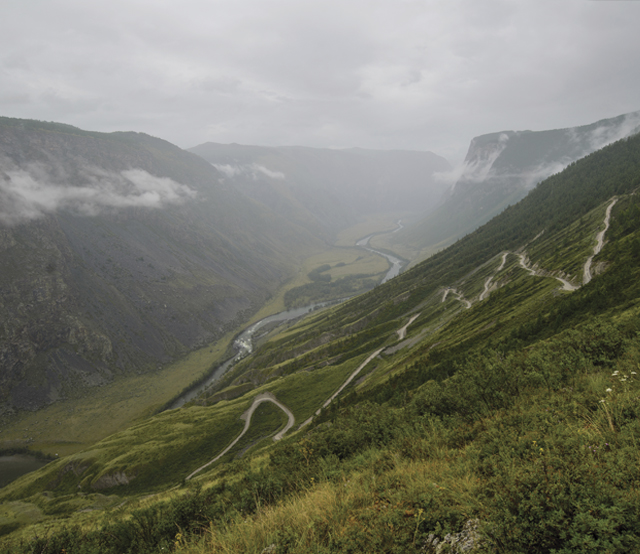
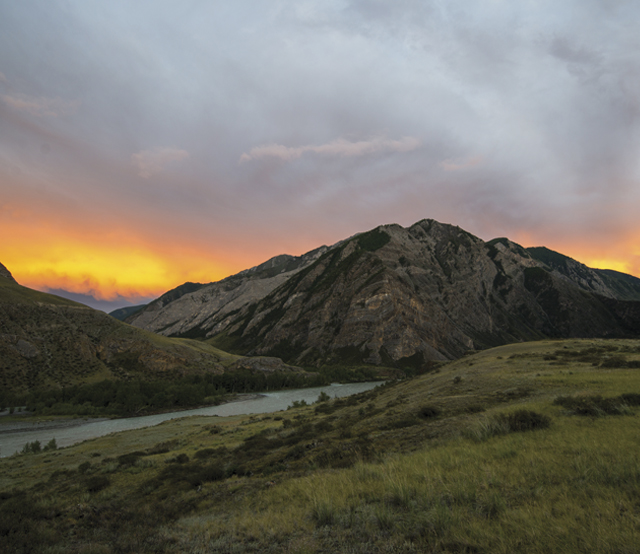
The Altai Mountains are located in southern Siberia, where Russia, Mongolia, China and Kazakhstan converge. Here the thick pine forest of Siberia meets the high altitude Mongolian steppe and the steep mountains of the ‘Stans. This unique geography makes for a rich culture and history. Statues of Genghis Khan are scattered throughout the region highlighting the Mongol influence. Ruins of failed industrial projects are a reminder of the Soviet planned economy and tough, shirtless and outdoor-loving Russian men perfectly symbolize the country’s newfound ambition in the world today.
Arriving in Novosibirsk, located in southern Siberia and the closest major airport to the Altai, it was another two-day drive to the mountains. The drive on neglected highways followed the Ob River—the main watershed draining the Altai and one of the world’s longest rivers.
Meeting Egor at the airport was my first glimpse of what Russian paddlers look like. If there were a comic book kayak character, he would look like Egor. He is six-foot-two, with a slim waist, barrel chest and shoulders like a bear. My first question after my much-practiced “privet”—hello in Russian—was what the water levels were like.
“We had lots of snow and it’s been raining every day for a month,” was Egor’s terse response. This was a Russian of few words.
Siberia is known for huge water in normal years, so I wasn’t hoping for high water. I didn’t relax much during the drive.
Getting humbled on the Chuya
After warming up on a few easier rivers on the two-day drive to the mountains, the first real stop was the Chuya River. The Chuya is the focal point of the Altai paddling scene, in part because it is a main transit corridor for trade with bordering countries, which makes access and logistics easy, but mostly because it offers incredible whitewater. There are several different sections to paddle on the Chuya River, but the Mazhoy Gorge is the undisputed king.
After hearing many tales of fast and continuous whitewater interspersed with steep and technical big-water rapids, the Mazhoy Gorge seemed like too big a first test to Darcy, Don and I, especially at high water. Instead of running the section from the top, Egor suggested we hike into the end of the canyon to run the last few easier rapids of the gorge, from Baby down to the Class IV rafting section below.
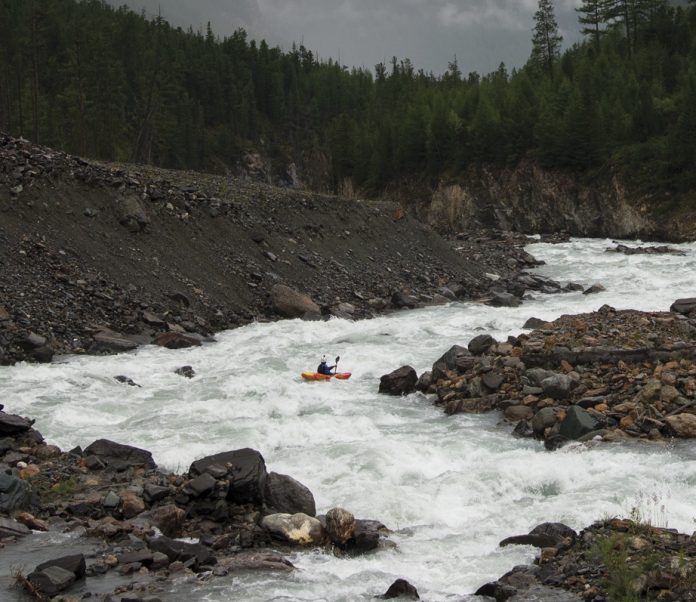
After that first introduction to the raw power of Russian whitewater, we decided to go for a full run of the Mazhoy the following day. The Mazhoy started off with an hour of continuous Class IV-V wave-trains, interspersed with big crashing holes and sharp corners. We scouted a few times, but mostly followed Egor’s concise and very accurate descriptions and stayed closed on his stern. As the run progressed, the canyon tightened and the rapids grew steeper and more defined. The last eight kilometers offered back-to-back Class V rapids that had tight lines past giant holes and essentially flowed one into the next. The Mazhoy’s continuous glacial water reminds me of British Columbia’s Soo River, but the size of the rapids approach those of the mighty Stikine.
This last section in the Mazhoy Canyon is also the location of the annual King of Asia Extreme Race. We were there during the event, but none of us had the courage to race down a section we were simply relieved to reach the bottom of. We happily used the excuse that we had many of the Altai’s other great rivers to explore and left Egor and Alona to try and defend their King and Queen of Asia crowns.
The King of Asia race has two distinct events. The first is a half-mile head-to-head race with a seal launch start off an old wooden bridge right into a big hole. The main event is a downriver race on the Mazhoy where racers sprint for 10 minutes before charging into the final and biggest rapid, Russian Hills, which starts with a must-make boof over a huge hole and then drops 40 feet through several more large hydraulics. The mostly Russian competitors celebrate survival with a wild vodka-fueled party.
Being able to hold a race on a run as difficult and remote as the Mazhoy is a testament to the vibrancy of the Russian paddling community. Not only is there a large and tight-knit group of passionate river people in Russia, they are also incredible paddlers. In comparison to us recreationists in the West, Russian paddlers are real athletes—they train with Olympic discipline and possess steadfast mental strength, no doubt linked to the important role that sports play in Russian society. Combine this with a strong slalom background for many of the local paddlers— a legacy from the Soviet Union—and you get paddlers the caliber of our guide, Egor.
The Bashkaus—Paddling through Russian river running history
Equally telling of the Russian dedication to river running is the country’s rich history of exploring Siberia’s rivers dating back to the Soviet days. In the 1960s and 70s, adventurous Russianswould request permits for accessing remote rivers with the official purpose of helping map the vast Siberian hinterland, but which in reality was for nothing more than the personal enjoyment of river running.
Lacking proper equipment, these adventurous Russians would build makeshift rafts, often constructed at the put in by cutting down trees and tying them to truck innertubes or old germ warfare suits for flotation. The rafts typically came in two styles: the classic Russian cataraft and the infamous Bublick—in which two innertubes are tied together with trees so that the tubes stand vertical with paddlers strapping themselves inside.
Having assembled their makeshift crafts, brave young men and women would then attempt Siberia’s most remote and challenging rivers. Many river runners paid the ultimate price, a fact that only increases the mystique around paddling in Russia. On many of Siberia’s rivers, commemorative plaques are erected remembering friends who never made it back on dry land.
This adventurous spirit lives on today in the local catarafting community. These craft look modern enough. But the catarafters’ equipment, including old hockey helmets, empty plastic water bottles taped to metal paddles for floatation, and giant full-body lifejackets make the rafters look like cosmonauts. Yet this outdated equipment doesn’t stop large numbers of Russians from braving the country’s most dangerous rivers.
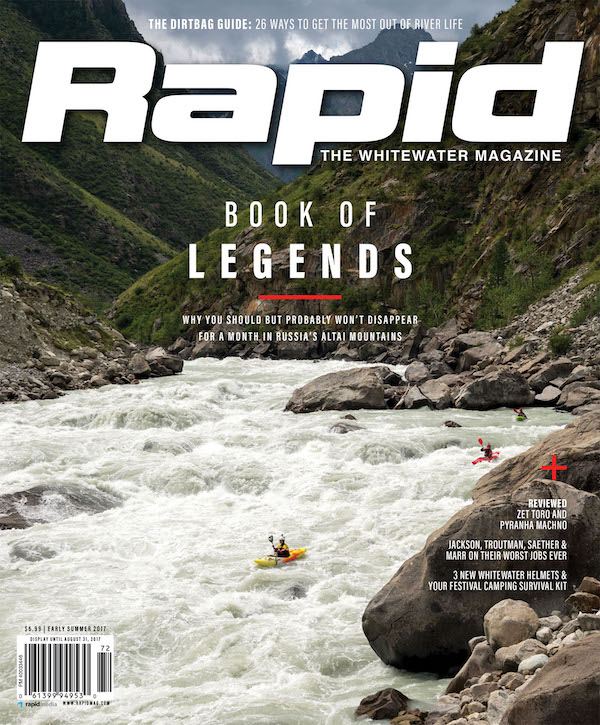
No river has a richer and more dramatic history than the Book of Legends section of the Bashkaus. Widely considered the most challenging multi-day run in the Altai, this stretch of river is revered as much as feared in Russian river running lore.
During the first descent attempt in the mid-70s, multiple people, including expedition leader Igor Bazilevsky, drowned in one of the first major rapids, bringing the expedition to a tragic end. Today, a commemorative plaque marks the spot, accompanied by a rusty metal box. Inside this box lives a logbook called the Book of Legends, whose pages have been signed by all groups attempting the run since 1978.
I was nervous paddling into this section, having only heard rumors and tales of 212 named rapids amidst a remote and at times inescapable canyon that has seen more than 30 fatalities since the first descent. I felt confident knowing that I had trained hard for this trip, yet I knew even British Columbia’s notoriously steep and powerful rivers couldn’t have prepared me. Day one was mostly a warm-up. At camp I slept poorly, with vivid dreams of what lay downstream.
The next morning we packed camp and slid into the water just as the fog from the previous night’s rain was lifting. The first rapids were dangerous with sticky holes in the main flow and siphons on the side, causing us to portage several times. A little further downstream we arrived at the run’s namesake rapid and the site that ended the first descent attempt in disaster. Only Egor was brave enough to attempt this maelstrom. He fought to make the line and made it to the end without flipping.
Once safely at the bottom of this rapid, we climbed up the canyon wall and found the memorial and below it, the Book of Legends. We spent half an hour carefully turning the pages, captivated by epic narratives from earlier expeditions and then humbly scrawled our own names in the historic book.
My energy soared after this and I began to appreciate the murky green water, polished white boulders and near vertical canyon of the Bashkaus. After eight hours we finally arrived at the take-out, high-fived and hugged each other, ecstatic that we had just safely run one of the most challenging and dangerous rivers we would ever attempt.
Travelling through vast landscapes on the Argut
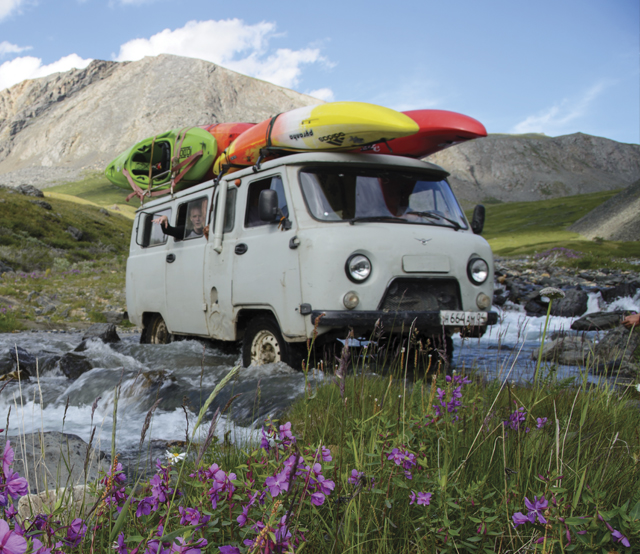
Next we headed to explore the Karagem and Argut Rivers. The journey to the put-in required an all day off-roading mission along the Mongollike steppe, through creeks and over mountain passes often without any semblance of a road or track. This would have been impossible were it not for our trusted UAZ 452, a Soviet era off-road van. The inside of the van had nothing more than sheet metal and a hard bench, a bare bone set-up that proved advantageous when water would rush into the cabin in one of several river crossings.
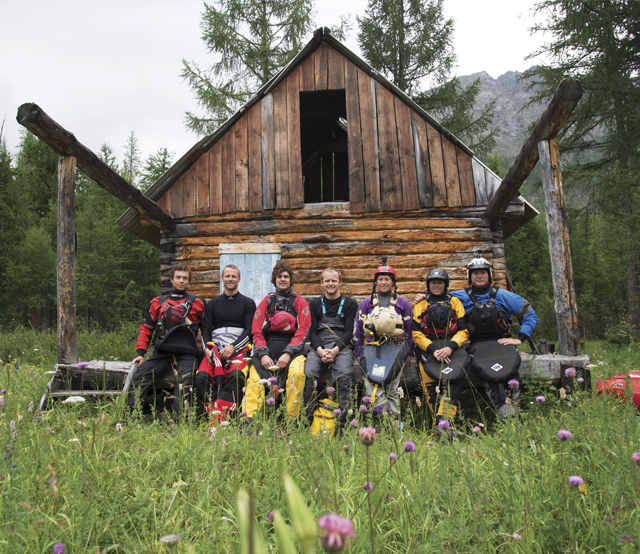
Once we could drive no further, we shouldered our boats, laden with gear and food for four days and started walking down an overgrown track. After three hours we arrived at the bottom of the valley. We were greeted by two glacial creeks merging and a sub-alpine meadow filled with purple wildflowers in full bloom. Glaciers hung off jagged peaks above an abandoned hunting cabin. Home for the night.
The next morning we started on the Karagem, a fast and steep glacial creek. After 40 kilometers and dropping more than 1,000 meters in elevation we joined the much bigger Argut. On the Argut we rode 100 kilometers of Class IV-V wave trains that left the Mongol Highlands behind and quickly approached the jagged mountains of the Siberia-Kazakh border.
After our last three days on the Chuya it was time to start the long journey home. Driving away from the river on our last morning, my mind wandered back to how our trip had started with wide eyes at Baby Rapid. “If that was Baby, what does the rest of the trip hold in store?” I had nervously asked Darcy at the bottom of that rapid, trying to catch my breath after being swallowed in the surging hydraulic. A month later I had the answer.
We had paddled eight new rivers—including three multi-day runs—descending hundreds of kilometers of whitewater. We had seen rare animals and slept at beautiful campsites. But it hadn’t all been easy. I was intimidated for much of the trip, which slowly wore me down mentally. We had gone hungry, endured bad weather and witnessed stark tragedy. Driving away from the Chuya, I couldn’t help but smile. All the apprehension and hardship had been worth it. I had forever etched my name into the Book of Legends.
Maxi Kniewasser is a conflicted individual. As a result, you can sometimes find him in exotic locations, but much more often on local Whistler runs like the Cheakamus, Callaghan and Ashlu.
This article originally appeared in Rapid’s Early Summer 2017 issue.
Subscribe to Paddling Magazine and get 25 years of digital magazine archives including our legacy titles: Rapid, Adventure Kayak and Canoeroots.


 This article originally appeared in Adventure Kayak Early Summer 2017 issue.
 This article was first published in the Early Summer 2017 issue of Canoeroots Magazine.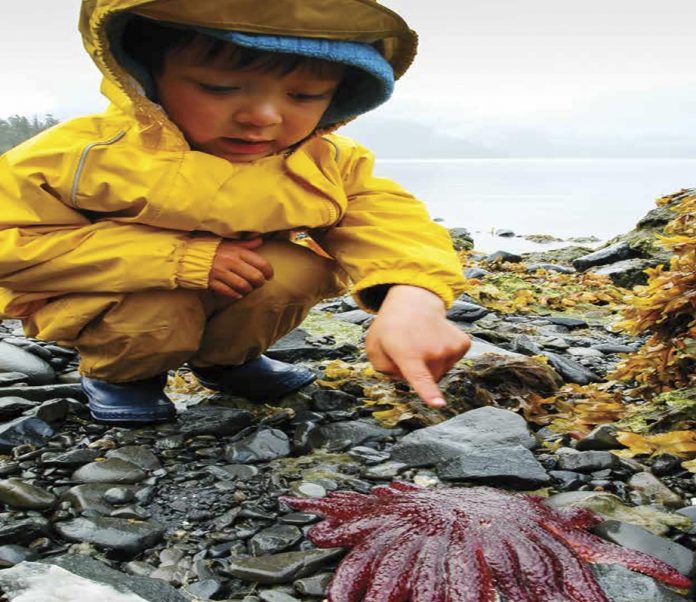

 This article originally appeared in Rapid Early Summer 2017 issue.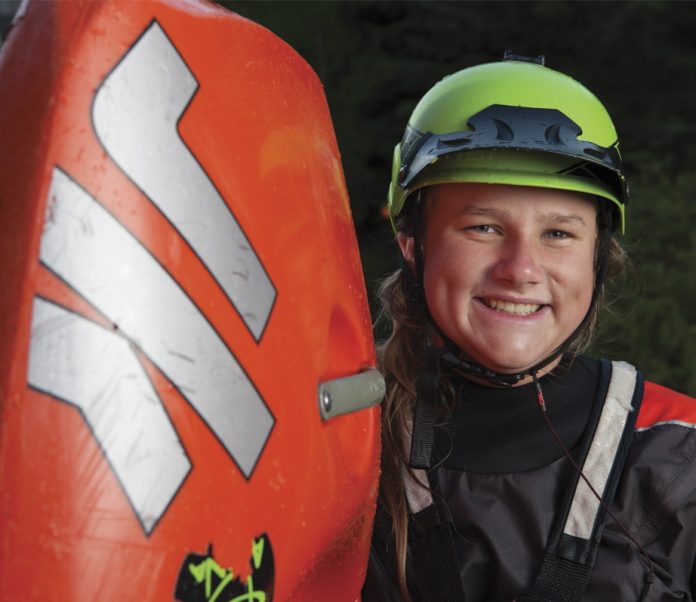
 This article originally appeared in Rapid’s Early Summer 2017 issue.



