Home Blog Page 247

Child’s Play: Meet California’s 14 Year Old Wave Wizard

Photo: Jason Self

The quaint seaside village of Trinidad in northern California, population 367, has been described as a drinking town with a fishing problem. Situated at the gateway to California’s Coastal National Monument, 14 miles south of Redwood National Park, tourists visiting this hidden North Coast jewel can expect to see whales, porpoise, surfers and the largest commercial crab fleet on the U.S. West Coast.

Now there is another increasingly familiar sight at the numerous surf breaks and pocket beaches surrounding the area: kids shredding the waves in whitewater boats and surf kayaks. In the past, the nearly empty breaks behind the redwood curtain have hosted only small bands of hearty surf kayakers, including five-time U.S. surf kayak champion and wave ski/surf kayak designer Dick Wold of Wold Ski Custom. But in recent years, surf kayakers became a rare sight in the area. Now there seems to be a kind of surf kayak renaissance gaining momentum among local youth, and 14-year-old Cory Soll is leading the charge.

Like a lot of kids in his neighborhood, Cory is growing up playing in the ocean. Spending several years board surfing, boogie boarding, diving and spearfishing nearly every day, Cory developed an understanding of ocean dynamics and comfort on and in the water, before taking up kayaking in October 2015. His original goal when he picked up a kayak paddle was to find an easier way to get to and from spearfishing grounds than the boogie board he had been using.

It wasn’t until a serendipitous kayak fishing trip with Pacific Outfitters’ coach Jason Self that Cory realized the potential for kayak as surf craft. A north wind blew in and the decision was made to cancel offshore fishing for the day. Having time to kill and a mindset for playing in waves, Cory and his friends began trying to surf their sit-on-tops.

“I started out catching a few waves after kayak fishing and loved it,” Cory enthuses. “Then I tried a whitewater kayak in better surf and couldn’t get enough.”

A neighbor gave Cory a 20-year-old Perception Whiplash kayak and the focus of his coaching sessions with Self shifted from kayak fishing to kayak surfing.

“I’ve never seen someone take to kayaking as quickly as Cory,” marvels Self. “He rolled on his first attempt and then repeated it 10 times. In the few months that he’s been at it, I’ve seen his skill increase to levels that take most people a year or two or more to refine.” Cory so impressed his mentor that he is now training with Self for his first competition, the 30th annual Santa Cruz Paddlefest, in mid-March at California’s Steamer Lane. “We’ve got a high performance surf kayak coming for him before the comp,” says Self, “I can’t wait to see what he can do with it.”

Others have noticed Cory’s inherent abilities as well. Pacific Outfitters, Werner Paddles and Stohlquist Waterware have brought on Cory as an athlete ambassador, and paddlesports media have taken notice, too. When asked how he feels about being in the limelight, Cory says, “The attention is a fun bonus to the main attraction, which is learning, having fun and finding new ways to enjoy the ocean.” 

Jason Self leads kayak instruction and guiding programs on California’s Redwood Coast.

Screen_Shot_2016-03-23_at_2.38.21_PM.pngThis article first appeared in the March issue of Paddling Magazine. To read the entire issue, click here.

Video: Tips For An Effective Sea Kayak Brace

Learn this recovery stroke to brace your kayak. With these fast and helpful tips and progressions from Dympna Hayes and James Roberts of the Ontario Sea Kayak Centre (ontarioseakayakcentre.com) in Parry Sound, Ontario, you’ll be bracing like a pro in no time.

canadian canoe culture logo for Ontario Travel

Watch THE CANOE  an award-winning film that tells the story of Canada’s connection to water and how paddling in Ontario is enriching the lives of those who paddle there. #PaddleON.

Author: Paddling Magazine Staff

Wanting What We Have

Photo: Virginia Marshall

The future is now. As October 21, 2015, appeared on our calendars last fall, I considered how the future Marty McFly visited in Back to the Future II compares with our own present.

Like McFly, we can wear auto-lace Nikes and ride hoverboards (although they’re not as slick as his). Even flying cars are now available for our air- and roadways. More mind-blowing than drinking Pepsi Perfect, however, are a new wave of virtual reality arenas that use omnidirectional treadmills to allow physical movement within a simulated world—not so far removed from the holodeck technology of Star Trek.

More and more, our imaginary is becoming our reality. And it worries me. Am I a neo-Luddite curmudgeon, balking at the glorious, golden future? Or is it simply the urge to escape the senseless embellishment of an already rich world?

I don’t consider myself anti-technology, unless we insist on staging every discussion and decision as Nature vs. Technology. Then, for me, nature wins.

After all, as Minnesota wilderness author Calvin Rutstrum wrote in 1975, “We are not aliens contemplating nature; we are nature. We might assume the urban role and remain there…but nature will walk through walls of concrete, glass and steel without opening a single door and still control our every function and our destiny.”

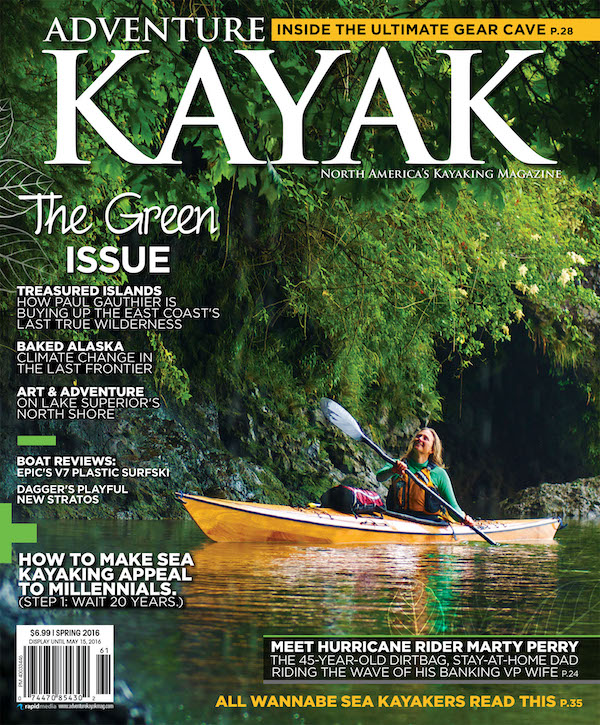
Outdoor equipment and apparel companies are particularly sensitive to this delicate balance. In Adventure Kayak‘s spring issue, we looked at some of the ways gear companies are making more eco-friendly, sustainable and socially responsible products. The R&D departments of these companies focus on reducing waste and environmental footprints, rather than boosting production at any cost. Now that’s something worth buying into.

It’s also worth remembering that the greenest gear is the gear you already own. My closet is full of patched pants, repaired tents, re-waterproofed jackets and threadbare fleeces (great for summer evenings). Aside from trail-proofed dependability, “old gear is full of memories—it’s comforting,” says Ontario Sea Kayak Centre’s Dympna Hayes.

Already far from the course set by a time-traveling DeLorean, my mind wanders from the wilds of Minnesota to the dustbowl of Oklahoma. In John Steinbeck’s seminal The Grapes of Wrath, he explored the disturbing transition from multi-gener- ation families working the land with their hands and horses, to diesel-guzzling tractors helmed by anonymous drivers in sealed wheelhouses. With such efficiency, “the wonder goes out of the land and the working of it, and with the wonder the deep understanding and the relation.”

A motor on a boat lets the boater cover more ground, but the powerboater who buzzes from point to point sees far less than a paddler moving at a tenth the speed, poking her bow into cracks and crannies. Like the Joad family in Steinbeck’s novel, I can’t escape the march of progress and technology. But I can question it.

If our virtual worlds are made more fantastic— think Avatar or Oculus Rift—than our real, blue- and-green, soil-and-water home, what reason will future generations raised in these virtual playgrounds have to explore our original playground? To care about it, or for it?

Dam the rivers, mine the mountains, fell the forests—just, for the love of latinum, keep the power on to the holodeck.

Editor Virginia Marshall is not a secret member of the Dark Mountain Project. Adventure Kayak is her manifesto. 


This article originally appeared in Adventure Kayak
Spring 2016 issue.

Subscribe to Paddling Magazine and get 25 years of digital magazine archives including our legacy titles: Rapid, Adventure Kayak and Canoeroots.
Popularity Contested: Welcoming Beginners to Whitewater

DOUBLE FIST PUMPS COME LATER. | PHOTO: ROB FAUBERT

When you ask whitewater kayakers what they love about the sport, you get hundreds of answers. It’s wild and fun, challenging, great exercise and a way to see hidden beautiful places. You feel more focused, alive, intense, happy. You make great friendships, and come back with an endless smile. The list goes on and on.

It sounds like kayaking should be the most popular sport in the world.

Except, it isn’t.

In fact, it’s a niche sport seen by most people as risky and dangerous.

Somehow, the love we have for it isn’t the message most non-paddlers receive. Why is that?

Consider my hometown, Missoula, Montana. The town enthusiastically embraces the outdoors: climbing, paragliding, skiing, hiking, backpacking, fishing, mountain biking and, well, you name it. There are 13,000 university students, five wilderness areas and two national parks, multiple rivers and lakes, and an artsy, literary, open city with six craft breweries, restaurants and a dozen different festivals.

It’s a kayaking town too, with whitewater runs close by, an artificial play wave in the middle of the city, and another due to be completed next year. It would seem to be a place where kayaking could hold its own. But it doesn’t.

There used to be four shops that sold whitewater kayaks. Two of them went out of business. One of them shifted to river surfboarding and standup paddleboarding. One stopped selling kayaking gear and put in a fly-fishing department. At present, there is only one small specialty whitewater shop left.

DOUBLE FIST PUMPS COME LATER. | PHOTO: ROB FAUBERT

WHAT IS WHITEWATER MISSING?

In contrast, other sports are growing rapidly.

Take the Missoula Marathon, for example. In six years, it has grown from 200 entries to over 7,000. There are one-mile runs, half and full marathons. Participants are young and old, male and female, professional and recreational, people who started on a bet and everybody else under the sun. Four thousand participants are local, and the rest come from all 50 states and foreign countries. Everybody has a blast.

Take paddleboarding: It started a couple of years ago as a curiosity.

Now there are hundreds of people knocking around on the river. People working out, yoga classes in the eddy, boarding border collies, grandmothers sitting and dabbing paddles in the water, and kids playing in the shallows.

What do these sports have that whitewater kayaking doesn’t?

For one, these communities roll out the red carpet for beginners. Paddleboarders could be shown out in the open ocean, struggling in windswept waves with great white sharks circling them. Blood, sweat and tears could dominate marathon photos.

Instead, those sports are presented as welcoming, encouraging people at all levels. Beginners aren’t made to feel like loser newbies because status comes only by doing what is difficult.

People don’t fear running or paddleboards. In contrast, the fears beginners have about whitewater are wildly exaggerated, appropriate for class V but not for class I or II. They’re worried about being stuck inside a kayak, unable to breathe, slamming their heads on rocks. And instead of showing paddling in safe, fun ways on easy rivers, their fears are fanned by tough-guy attitudes, adrenaline rush chatter, and incessant photos of dangerous rapids.

Seven thousand people in Missoula find inspiration running on asphalt, in large part because they’re met with humility, family fun and open, encouraging attitudes. If we’re going to entice more people to kayak, we might start by showing them how fun, safe and accessible it can be, instead of how gnarly we are.

Otherwise, we’ll leave it to SUPs and surfboards, sit-on-tops, pack rafts, inflatables, touring boats, inner tubes and running shoes to take up the slack for thousands of people who might well love whitewater.

If we do this right, the list of what we love about the sport will grow longer with every new beginner.

Doug Ammons has kayaked for nearly 50 years. He is married with five children, has a PhD, and was named by Outside magazine as “one of the top 10 game changers in adventure since 1900” for his 1992 solo of the Grand Canyon of the Stikine. 


This article originally appeared in Rapid
Spring 2016 issue.

Subscribe to Paddling Magazine and get 25 years of digital magazine archives including our legacy titles: Rapid, Adventure Kayak and Canoeroots.
Backcountry Booze: The Best New Ways to Imbibe in the Wilderness

Photo: Graeme Owsianski

You’ve spent the day paddling, portaging and pondering life from the seat of a canoe. You have earned a refreshment or two. However, adult drinks don’t come easy in the backcountry. Even if you’re willing to schlep some extra weight, backcountry bans will force you to think outside the bottle. Next time you’re looking to relax in the wilderness, consider these innovative drinks that pair well with outdoor adventure.

WINE SNOB

Don’t sacrifice your refined tastes for canoe tripping convenience. Clif Family Winery, associated with the popular power-food Clif Bars, knows that outdoor enthusiasts appreciate good food and drink. Clif’s resealable Climber Pouch is filled with 1.5 liters of high-quality California wine. Available in chardonnay and cabernet sauvignon, they are portable, resilient and use less packaging than bottles. Alternatively, pour your favorite vintage into a Platypreserve Wine Preservation System. These reusable, lightweight, food-grade polyethylene-lined bladders hold 800ml of liquid. By limiting exposure to oxygen, they protect flavor and extend pack life for weeks. Plus, the wine chills in just minutes in the fridge—or in your case, the lake.

MICROBREW FANATIC

Leave fragile glass bottles at home and take Klean Kanteen’s Hydro Flask Growler instead. Made with the craft beer connoisseur in mind, this vacuum-insulated growler keeps brews cold while holding carbonation for up to 24 hours. Shatterproof and leak resistant this work of art is available in 32-, 40- and 64-ounce sizes.

Fill your growler with local beer that respects and protects wild places. Brews like New Belgium’s Portage Porter, Kern River’s Class V Stout and Odell’s Cutthroat Ale are location appropriate, and these breweries take the environment into consideration with initiatives like using green power, recycling water and reusing spent grain as fertilizer, compost or livestock feed.

ULTRALIGHT WARRIOR

Paddlers dehydrate meat and vegetables, sauces and desserts to save space and weight. It was only a matter of time before some parrothead took the weighty H2O out of alcohol. Powder Palcohol saves adventurers from having to lug liquid-heavy containers of spirits through the backcountry. One package of powder weighs about an ounce and, when mixed with six ounces of liquid, is equivalent to one standard drink.

Choose from premium vodka or Puerto Rican rum. Available in Cosmopolitan, Margarita and Lemon Drop flavors, these just-add-water cocktails are about as instant as it gets. Shaken or stirred?

GADGET GEEK

Love a good brew but can’t bare the weight? Pat’s Backcountry Microbrew System allows you to put the fizz back in your beer. Their BPA-free, shatter-proof Carbonator Bottle holds 20 ounces of foamy goodness. Pat’s tiny activator packs use food-grade citric acid and potassium bicarbonate to make CO2. Add water and a concentrate beer gel pack to the mix, shake for a minute and watch the reaction occur before your eyes. The carbonator and ingredients to make a six-pack weigh just over a pound, water not included. The bottom of the bottle unscrews to become a cup, if you feel like sharing. These all-natural bubbles turn flatwater beer into whitewater fizz.


This article originally appeared in Canoeroots
Spring 2016 issue.

Subscribe to Paddling Magazine and get 25 years of digital magazine archives including our legacy titles: Rapid, Adventure Kayak and Canoeroots.
Inspiration Nation: One Man’s Transcontinental Kayak Journey

Photo: courtesy Rich Brand

Rich Brand knows there’s no time like the present. That’s why the 39-year-old graphic designer set aside his successful Denver business in 2013 to follow the call of adventure on a solo descent of the Mississippi River from Minnesota to the Gulf of Mexico. Somewhere along the way, Brand says he realized the value of his journey went beyond his personal experience. He established a channel to share his photos and stories, CapturedHeartbeats.com, in the hopes of inspiring others to embrace their own inner explorers.

Last summer, Brand completed an even more ambitious journey, kayaking 1,500 miles down the Pacific coast from Seattle to San Diego. The isolation and exposure of that trip, he says, were both beautiful and intimidating. With no training and just a couple miles of previous ocean paddling under his belt, Brand learned what he needed to survive the transit by listening to those he met along the way, and navigating by the seat of his pants. “That’s real adventure,” he explains, “real exploration.”

His next expedition, a 7,500-mile adaptation of power and sail mariners’ Great Loop, will find him departing January 1st from New Orleans and paddling around Florida, up the East Coast to the St. Lawrence River in Canada’s Atlantic provinces, and then inland on that river to the Great Lakes before returning south down the Mississippi to New Orleans. Brand expects the trip to take a full year. He’s had just three months to prepare since returning home from San Diego, but he isn’t worried. Like a true explorer, it’s the unknowns, he says, that’s he’s most looking forward to. 

I had paddled eight miles in my life before I took on the Mississippi. After that trip, I knew I wanted to do the Great Loop, but first I decided to paddle the Pacific coast to check it off and prepare for the loop.

Going solo was both a personal decision and logistical necessity. Trips like this aren’t the place to test someone else’s fortitude and grit. I knew I had what it took.

In the Pacific, I didn’t quite grasp the gravity and the beauty of it at the time. There’s lots of isolation up around Washington and Oregon—it was lonely as all get out. It was a true wild. If you disappear out there, you may never be found. But when I look back on it: I had an ocean to myself.

I learned a lot of patience—for timing and for waves and wind.

The wildlife was unreal. A humpback whale came up within arm’s length of my boat.

I decided to expand the Great Loop because I have friends I wanted to see all along those waterways. And I wanted to explore. There aren’t many people who just go out and explore any more. 

I ask my friends: when was the last time you did something for the first time? On my trips, everything is the first time. Every person I meet, every view, every wildlife encounter, every experience. It’s a drug—I’m living in the moment to the fullest extent.

If it’s not an imminent threat to my life, it doesn’t trickle past my radar too much. Going upstream on the St Lawrence, I have no idea what to expect. I gravitate towards the mystery. I look at it as an opportunity to adapt, to learn. You can Google every detail before you leave, but where’s the fun in that?

I don’t believe there are enough explorers and role models in our society. I showed kids on the Lower Mississippi what the clear waters of the river up in Minnesota are like; it was a whole other world to them. I want to show them what’s out there, what’s possible. Inspire them to do something passionate and important with their lives.

Get inspired at capturedheartbeats.com, instagram.com/nevermissamoment and follow the journey on Facebook. 

Screen_Shot_2016-03-23_at_1.11.41_PM.pngThis article first appeared in the January issue of Paddling Magazine. To read the entire issue, click here.

Share the Love of the River

WORDS WITHOUT A SOUND. | PHOTO: PAUL ZIZKA

One of the most influential essays ever written on outdoor education came to me as a grey and blurry photocopy, perhaps 30 times removed from its original copy. It lived in my ammo box for nearly a decade, folded in half and softened from handling to an almost cloth-like texture. I too photocopied it and handed it along many times over. It was formative in my understanding of my leadership and guiding role on the river.

This essay, written in 1980 by Outward Bound mountain instructor Thomas James, is philosophically titled, “Can the mountains speak for themselves?”

The paper is less esoteric than it sounds— it specifically debates what role instructors have in verbalizing for their students what it is that they are learning, in this case, from their time in the mountains. The parallels to the river world are immediate.

On one side of the debate is the position that we, as leaders facilitating these experiences, need to say very little, as time on the river or in the mountains presents life lessons well beyond the concrete experience at hand that are available for anyone who cares to learn them. Challenge, perseverance, confronting fear, pride in learn- ing new skills—the list goes on and on. Paddling works well as a vehicle for learning, and the solo nature of kayaking in particular, brings up important questions.

On the other side are the interpreters, who believe that making these lessons obvious—explaining the deeper meaning of experience and encouraging reflection—is required in order for participants to take home the learning. As James points out in his essay, both sides are right, and both have a place. The question then becomes, when and where is each appropriate?

Having made my living taking people down rivers, either for their vacation, to learn to paddle, to see wild places or to get a glimpse of what is inside of themselves, I can say I’ve seen and tried all variations on the ‘who speaks for what’ debate.

Typically, we paddlers are less philosophical than our mountain-going cousins, which I believe is due to the immensely immersive nature of running whitewater.

The river speaks loudly and forcefully to even the most temporary of visitors on just a half-day raft trip. Spend two or three weeks on a northern river or in a canyon and its language becomes not only forceful, but crystal clear.

The clarity of the rivers’ message is the point worth examining for us river people, and it is here where I decide on my role as interpreter or none.

WORDS WITHOUT A SOUND. | PHOTO: PAUL ZIZKA

The half-day rafters often get blasted with the greatest hits of what whitewater has to offer, but it is written in a foreign language. It is loud, fun, but not understood in any way. I don’t even try to inter- pret what the river says for these folks; it would come across as stilted and unintelligible. I believe my obligation in this case is to make a plug for clean, free-flowing rivers, but that’s about it.

As for the expedition paddlers, on the other hand, I don’t need to interpret for them. They have all the time they need to figure out what the river is saying, or not saying, to them.

It is the in-between group that is more challenging. Spend more than a couple of days around whitewater—become more than a visitor—and one senses that there is more going on than waves and thrills.

I saw this in the five-day kayak school world where I spent several summers. By the end of the week, introspective individ- uals sense that their experience is deeper than learning to roll and running class II. There was current, continuity, and a forum to ask themselves questions about what is important to them. Even here I do not see it as my job to tell the whole story. Rather than interpreter, I see my role as more of a coach—helping people discover for themselves what the river experience means to them.

As enthusiasts, we have either con- sciously or unconsciously figured this out. It is what keeps us coming back to feel the pull of the current. For those on the verge of understanding, sensing there is more out there, I open my ammo box and hand them a photocopy.

Jeff Jackson is a professor with Algonquin College’s Outdoor Adventure guide training diploma and is the co-author of Managing Risk: Systems Planning for Outdoor Adventure Programs.


This article originally appeared in Rapid
Spring 2016 issue.

Subscribe to Paddling Magazine and get 25 years of digital magazine archives including our legacy titles: Rapid, Adventure Kayak and Canoeroots.
How To Choose Between An Inflatable And Hard Paddleboard

Three people crossing road with paddleboards under their arm.
Giddy up. | Photo: Mickey Bernal

Choosing your first standup paddleboard can be a surprisingly difficult purchase. Options seem endless and many boards cost about the same as your first vehicle. There are now dozens and dozens of brands manufacturing boards, each with various models for different styles of paddling.

Perhaps the biggest decision to make—and the one question retailers get asked the most—is whether to opt for an inflatable or a hard board. Many manufacturers now make both, and unless you’re looking at a high-end, specialized hard board, the price difference between the two types can be negligible. Depending on the type of paddling you want to do, both types have their advantages.

Read on for our overview of inflatable paddleboards vs hard, so you can figure out which kind is best for the type of paddling you intend to do.

Advantages of inflatable paddleboards

The most obvious advantages of inflatables are portability and the ability to store them small. Fold one up into your luggage while flying, throw it on the back of your motorcycle, or hike it up a mountain to access remote lakes. There are few limits to where you can paddle with an inflatable. And if your downtown condo doesn’t have much space, just roll it up and store it in the closet.

Durability is also an advantage—inflatables are surprisingly rugged. “Drop them, kick them, dropkick them, throw them, crash them, bash them—they’re tough,” confirms C4 Waterman global ambassador, Todd Lawson.

Typically made with ultra-tough PVC or similar rubbers and plastics, these boards practically require a shark bite to get punctures. It is this durability that makes inflatables great for kids, who won’t have to worry about bashing their inflatable against rocks, or bashing themselves on their boards.

Cons of inflatable paddleboards

The lack of rigidity inherent in some inflatables means many are not as efficient as a hard board. Inflatables don’t glide as well on the water, or as fast. Though inflatable board technology has come a long way, elite paddlers still usually prefer hard boards for performance.

Three people crossing road with paddleboards under their arm.
Giddy up. | Photo: Mickey Bernal

However, “you can’t judge a board by its material,” argues Boardworks rep Gretchen Gamble. “Shape, rocker and fins are just as big a factor as material when it comes to performance. Just like hard boards, there are a wide variety of inflatables available. Some inflatables are more responsive than others, and some are much better for touring and long distances.”

The only tangible downside to inflatables might be pumping up the board, which usually takes between five and 10 minutes.

Advantages of hard boards

When it comes to choosing between an inflatable or hard paddleboard, racing is the one area where the decision is definitive. If you’re looking to get competitive about paddleboarding, you likely need a hard board. Most racers, surfers and touring paddlers use hard boards. The exception to the rule is whitewater paddling, which is solely the domain of inflatables.

“A well-designed hard board will perform better in the surf, generally has more glide than an inflatable, and no pumping is required,” advises Gamble.

Some paddlers also argue that hard boards just look sexier.

While durability has dramatically improved in recent years—a bowling ball was repeatedly smashed into a hard board without leaving a mark at the Pau Hana booth at Outdoor Retailer in 2016—scraping, scratching and bouncing off rocks still sounds absolutely terrible on a composite board. Fortunately, any small dents and cracks are easily fixed with epoxy and some sandpaper.


BG_2016_0.jpgThis article originally appeared in the 2016 Paddling Buyer’s Guide issue.

Subscribe to Paddling Magazine and get 25 years of digital magazine archives including our legacy titles: Rapid, Adventure Kayak and Canoeroots.
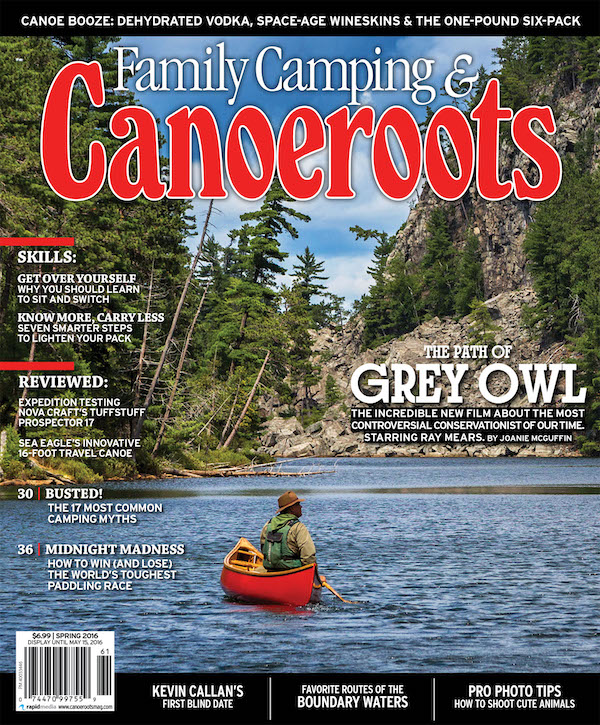
17 Of The Most Common Camping Myths Busted

Camp councillor telling scary stories and camping myths to two boy scouts around the fire
Camping myth #18: Scary stories are best told before bed. | Feature photo: Brian Kaldorf

The wilderness has always been a place where myth and legend run rampant. Nowadays, instead of encountering tales like Little Red Riding Hood, you’re far more likely to encounter fictions supported by pseudo-science and misinformation. Can you really catch a cold from getting chilled? Should you actually suck the venom from snakebites? Does moss only grow on the north sides of trees? Have two adults ever comfortably fit inside a two-man tent? We shall see whether these camping myths hold water.

17 of the most common camping myths busted

A mosquito bites a person
Photo: Ravi Kant/Pexels

1 Bananas attract/repel mosquitos

The world’s most dangerous animal is ambivalent to your intake of the delicious Musa acuminate fruit. The most universally recognized attractant to mosquitos is carbon dioxide—mosquitos can detect it from 90 feet away. Body odor and heat are also factors.

According to the American Mosquito Control Association: “Ingestion of garlic, vitamin B12 and other systemics has been proven in controlled laboratory studies to have no impact on mosquito biting. Conversely, eating bananas did not attract mosquitoes as the myth suggests, but wearing perfume does.”

[ Find your next outdoor adventure in the Paddling Trip Guide]

2 Daddy longlegs are the most poisonous spiders but their fangs are too tiny to bite you

First of all, they’re not even spiders. These arachnids, also known as harvestmen, don’t produce silk and have only one pair of eyes. More importantly: The entomology department at the University of California confirms that daddy longlegs have neither fangs nor venom sacs. Bonus bust: Killing them has never been proven to cause it to rain. It is mean, though.

Bigfoot crossing sign along a highway, a good example of a camping myth
Photo: Gabe/Pexels

3 Sasquatch, Nessie and the Yeti

Despite being delightful fodder for the spooky campfire stories, there has yet to be a single credible, peer-reviewed piece of evidence proving the existence of any of these creatures—and this in an age where almost everyone over the age of 10 carries a high-resolution camera in their pocket. That said, if you’re interested in a hair-raising humanoid encounter, check out the following link.

Diamondback Rattlesnake
Diamondback rattlesnake. | Photo: Pixabay

4 Suck the venom from snakebites

Forget everything you learned from cowboy movies. Cutting and sucking snakebites will do more harm to the tissue, according to the NOLS Wilderness Medicine Institute. The best course of action is to immobilize the affected limb, keep the victim calm and get medical help ASAP. The good news is that despite about 8,000 venomous snakebites in the U.S. each year, the Florida Department of Wildlife Ecology and Conservation reports just five to six result in fatalities.

5 Moss only grows on the north side of trees

Moss likes to grow in damp and shaded spots best. While it’s true that the north sides of trees get less sunlight in the northern hemisphere, there are lots of other factors that can create shade, including other trees, big rocks and sloped ground, which can lead to moss growing on the east, west and even south sides of trunks. A compass is a far better bet to be directionally astute.

6 Junior is too young to go camping

Anecdotally, it’s never too early to hit the trail. We’ve been enchanted with stories of 3-month-olds on hiking adventures north of the Arctic Circle, toddlers on canoe trips across the continent and 5-year-olds who completed the entire 2,180 miles of the Appalachian Trail—with their parents, of course.

7 40 to 45 percent of body heat is lost through your head

Rubbish according to a 2008 study published in the British Medical Journal. Heat is lost more or less evenly across the skin. If someone were wearing only a swimsuit, no more than 10 percent of body heat would be lost through his or her noggin, according to the researchers.

8 Campfires are an effective way to dry gear

Unless you’re an unusually patient person, drying gear around a campfire is a recipe for melted synthetics, and warmer but still damp clothing. Direct sunlight on a breezy day is a safer and more effective option if conditions allow—we’ve got the holey socks to prove it.

poison ivy
When it comes to poison ivy, you need to heed the weed. | Photo: iStock

9 Poison ivy is contagious

The itch can’t be spread through contact with the blisters, however, this devil plant’s rash-inducing oil, urushiol, can remain on clothes, equipment and pet fur for days. It’s this second exposure that has led to the belief that the rash itself is infectious, according to the Mayo Clinic. If you’ve been exposed, the best defense is to wash anything that might have the oil on it in hot and soapy water.

10 Two can fit comfortably in a two-person tent

Lies. Unless one is a small child or dog, and no gear is brought into the tent. We’ll tolerate the sardined quarters for ultralight adventures, but for optimal comfort, a good rule of thumb is purchasing a tent for one more “man” than needed.

[ Find everything you need to go camping in the Paddling Buyer’s Guide]

11 Biodegradable soap is okay to use in waterways

Even biodegradable soaps can increase nitrogen levels and harm the local inhabitants of lakes and streams. Read the fine print on your bottle of Campsuds and you’ll discover recommendations for washing dishes, bodies and everything else at least 200 feet away from water sources, and burying the grey water in a cat hole.

how to take a bearing in the field with a compass
Transfer the bearing to your map to identify your mystery landmark. | Photo: Virginia Marshall

12 You don’t have to carry a map and compass if you have a GPS

While dropping or immersing your GPS can be an electronic catastrophe, we hear far more stories of devices simply running out of batteries at inopportune moments, leaving adventurers holding nothing more than a paperweight sans sense of direction. Not a good situation in the wilderness. Always bring a backup. A waterproofed map and compass are impervious to pretty much everything but fire and wild dogs.

13 Aluminum cans burn in a campfire

Unlikely, and better for your lungs and the environment not to try. Aluminum melts at about 1,200 degrees Fahrenheit. Wood fires can get that hot, but it’d have to be one heck of a blaze. Not only would that violate Leave No Trace ethics, you’re more likely to burn off (and inhale) the ink on the can first, and still have to fish a sooty carcass from the ashes come morning. Just crush it and pack it out instead.

14 “You’ll catch a cold out there!”

Ignore this cautionary cry of grandmothers everywhere, it was debunked by The New England Journal of Medicine back in the ‘70s. While prolonged exposure to cold temperatures may inhibit the body’s immune system, ultimately you need to come into contact with a virus to catch the common cold. Viruses don’t grow on trees; they spread from person to person.

15 Reciting incantations

We’ve all heard some version of “white rabbit, white rabbit” to try and change wind direction and avoid getting smoked out by a campfire. Come on, everyone knows this doesn’t work.

person cooking eggs on a portable camp burner with a salad nearby
Photo: Thirdman/Pexels

16 Delicious backcountry meals are actually delicious

Hunger is the best sauce of all—even better than Sriracha. Use caution when bringing tasty wilderness creations into your home kitchen. Previous disappointments around the Canoeroots office include: Gado-gado (noodles and peanut butter do not create a convincing Pad Thai in urban environments), pre-packaged dehydrated meals as dinner party fare, and the realization that drinking the starchy water from boiled noodles is actually a bit gross.

17 Everything you learned at camp about marshmallows

They’re not made from horse hooves (they’re actually made from sugar, water and 100-percent pig-derived gelatin), they’re not good for you just because they’re fat-free, and eating a single burnt one won’t give you cancer.

Camp councillor telling scary stories and camping myths to two boy scouts around the fire
Camping myth #18: Scary stories are best told before bed. | Feature photo: Brian Kaldorf

Cover of Spring 2016 issue of Adventure Kayak MagazineThis article was first published in the Spring 2016 issue of Canoeroots Magazine. Subscribe to Paddling Magazine’s print and digital editions, or browse the archives.


Camping myth #18: Scary stories are best told before bed. | Feature photo: Brian Kaldorf


Diamonds and Gold

Photo: Seth Ashworth

As time crept closer to Claire O’Hara’s final squirt boat run at the 2015 Freestyle World Championships, Jez started getting jitters.

“What if she doesn’t win?” he asked himself.

As an announcer at the event, he’d been peppering athletes with questions all day, but was saving his biggest question—the question—for O’Hara, world champion paddler and his girlfriend of three years.

“I was fairly certain she would win, but I couldn’t steal the limelight if another athlete won,” says Jez. “Then I thought, ‘stuff it—if someone else wins, I’ll just propose to them instead,’” he jokes.

Photographer Seth Ashworth was sitting on the Ottawa River’s edge with his camera in his lap as O’Hara floated up the eddy following her final run.

There was a break before the men’s finals, but Ashworth decided to stay put and save his spot to shoot the next event. He snapped a few photos of O’Hara celebrating with the crowd, as she made her way over to Jez and his microphone.

“I watched as Jez ran through the typical list of questions, like, ‘How does it feel to be a world champ again?’ and I could hear something a little off in his voice,” says Ashworth. Then he remembers hearing, “Well, Claire, I just have one more question for you.”

“He pulled out a ring, and I quickly grabbed my camera and started snapping away,” says Ashworth. “The crowd went wild. It was an emotional moment for everyone.” Looking downstream, Ashworth saw Jez’s family holding up a big sign that said, “Claire, will you marry me?”

“I had been planning this for about a year,” says Jez. “I’m glad she did win, or things might be quite different right now.”


This article originally appeared in Rapid
Spring 2016 issue.
Subscribe to Paddling Magazine and get 25 years of digital magazine archives including our legacy titles: Rapid, Adventure Kayak and Canoeroots.