Home Blog Page 251

Why Scientists Say A Canoe Is The Secret To True Happiness

CANOES TAKE YOU SOFA AWAY FROM IT ALL. | PHOTO: GOH IROMOTO/ONTARIO TOURISM

There’s an old, grey three-seater couch in my living room that needs replacing. My cat has lovingly tortured it for eight years, and it’s long since sagged under the weight of sleeping friends and winter evenings spent binging on adventure flicks.

Every couple months my partner and I talk about replacing it. Many friends our age have moved onto leather La-Z-Boys and chic sectionals. The three-seater is a bit of an eyesore and far too cramped for movie nights, requiring a game of Tetris for us both to lie down. Yet $1,500 seems like a lot for a couch—where’s the return on investment?

SPENDING MONEY ON EXPERIENCES, NOT THINGS

Fortunately, science is backing up my frugality. A recent study from Cornell University found that people are happier when they spend money on experiences, not things.

According to lead researcher Dr. Thomas Gilovich, experiences, rather than material goods, make us happier in the long run. This is contrary to what some people feel is true, since material goods last longer than individual experiences. Yet, the happy memories associated with a concert or ski trip last longer, creating more of a positive impact than the short-term happiness from a single purchase.

What’s really interesting is researchers found that even relatively bad experiences create happy memories—not a characteristic unique to canoeists. A camping trip of nothing but rain becomes a great opportunity for bonding, and an excellent story to tell. Stressful, uncomfortable and scary experiences can be turned into funny stories and later be seen as valuable learning experiences.
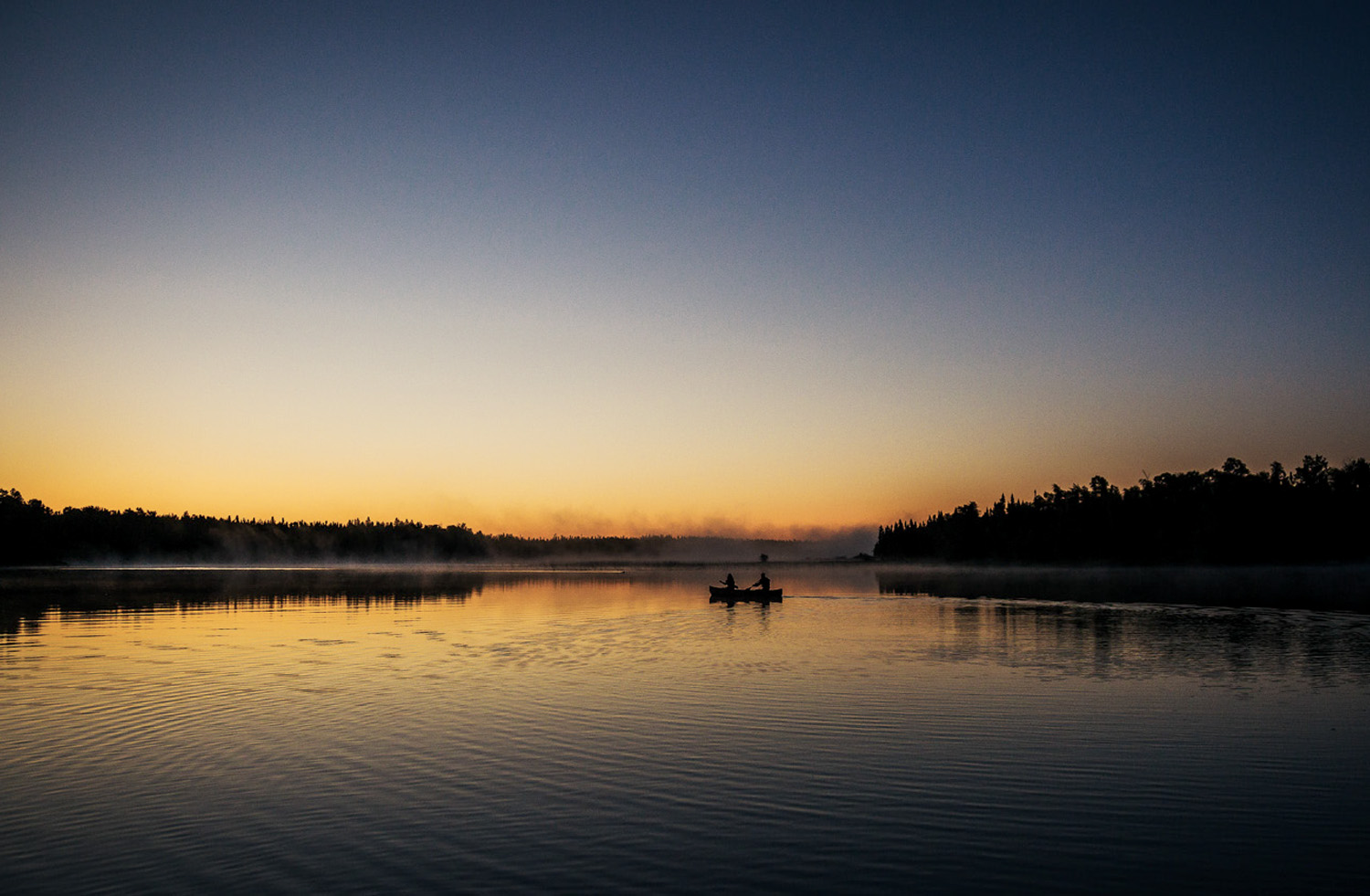
CANOES TAKE YOU SOFA AWAY FROM IT ALL. | PHOTO: GOH IROMOTO/ONTARIO TOURISM

Not only does remembering past trips make us happy, so too does anticipating future experiences. Conversely, waiting for material possessions is fraught with impatience and frustration, according to Dr. Gilovich. Boxing Day sale riots at Wal-Mart anyone?

Maybe none of this is a surprise to paddlers, and perhaps the study only proves what we each intrinsically already know.

Maybe, like me, your favorite vehicle for experiencing the world isn’t upholstered, it’s buoyant, about 17 feet long, and available in a wide variety of materials and colors. Whether day-tripper or expedition boat, plastic banana or svelte racer, a canoe promises the same: Adventure. Exploration. Experience. Even relaxation.

My family and I still tell stories about camping vacations we spent together two decades ago. Ten years from now we’ll be telling some of the same stories, and many new ones. There’s not a single material possession that will withstand that test of time. No new couch, no matter how comfortable, will ever be talked about around the campfire.

You can’t buy happiness, but you can buy a boat—and isn’t that the same thing?
10 Tips for a Successful River Cleanup Day

Photos: Charles Ruechel

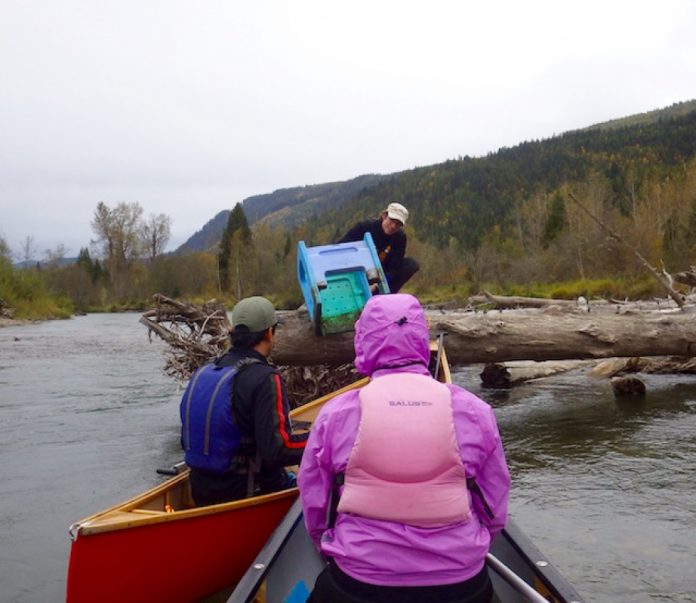
Over the years, when Vernon, British Columbia-based Elements Adventure Co. owner/operator Charles Ruechel ran paddling river cleanups, he began to collect more than just trash. He collected a shortlist of invaluable tips that anyone can implement to easily execute their own river clean-up initiative. “A cleanup event can be so much more than just picking up garbage,” says Ruechel. “From the people you meet, to the gorgeous fall paddling, a cleanup event builds connections and relationships that are becoming so vital to protecting our waterways.” Use these tips to plan your own cleanup on your local waterway.

1. Let the locals know about it

Most people who own river-front property will be delighted to hear about your initiative. We even had one property owner offer to host a BBQ lunch for the participants. Building relationships between the various river users is always a good idea—you never know when you might need to use a nearby phone in a hurry, or want easy access to that sweet play-wave.

2. Schedule your clean-up event for the fall, or low-water season

The lower water will not only expose more garbage, it’s also safer to retrieve the trash that is hung up in log jams or on rocks.

3. Bring along at least one canoe

Having a tandem canoe in your team acting as the garbage barge makes picking trash fast and easy. Just toss the garbage in like a big dumpster. Alternatively, kayakers can act like the scouts that bring back the smaller bits back to the mother ship.

4. Arrange for the local municipality to get involved. 

They will likely arrange for someone to meet you at the take-out to pick up the bags you’ve collected and pay for proper disposal.  Make it easy on them and sort the recycling from the garbage.

Screen_Shot_2016-02-18_at_10.07.02_AM.png

5. Set time aside the week before to invite people

A personal phone call is the best way to enlist helpers. Let people know in advance then followup. Some paddlers seem to be reluctant to commit to anything too far in advance, so give your friends a call or personal email two days before. That way they won’t assume that, someone else is already helping.

6. Contact related local businesses for support

A local paddling shop or outdoor store may be happy to donate some prizes to give away at the end of the day for ‘most unusual item found’, or, ‘most heroic garbage retrieval’, etc.  Don’t be shy to ask.

7. Make it a social, fun event that people won’t want to miss

This can be as simple as a riverside picnic at the end of the cleanup. This way even non-paddlers or families can take part.

8. Invite your Mayor, local MP, or other political figure to participate

This can be an amazing Public Relations opportunity for them and an opportunity for you to get our decision-makers to connect with the land.  Chances are they’ll decline your invitation, but at least they’ll get the message that people care about having clean waterways.

9. Safety First

When hosting a public event, you’ll want to make it clear what kind of paddling skill is required, and chose an appropriate stretch of river.   Make it mandatory that everyone wear a PFD at all times on the water. Having a lawyer draw-up a simple waiver of liability can be a good idea. Don’t be afraid to ask to have the waiver created for free. After all, you’re doing everyone a favor whether they know it or not.

10. Tally up at the end of the day

At the end of the day tally up the garbage weight, the number of bags, and make note of what you find.  From three years of hosting a cleanup, our most unusual items collected from the river include an office chair and a climbing harness. This kind of information can be useful when writing a press release about the cleanup. Letting the public know about how much and what you collected can help bring awareness to our rivers how we use them.

As paddlers, we have the unique ability to clean up long stretches of shoreline from the comfort of our canoe or kayak seats, all within a matter of hours.  So after a long season of paddling your favorite home-river, why not consider giving thanks for safe passage by cleaning up its shores before putting it to bed for the winter? 

In addition to teaching river-canoeing in the Okanagan Valley, Elements Adventure Company specializes in guided whitewater canoe trips on the Upper Stikine River in Northern British Columbia: elementsadventures.com.

Video: How to Do Live Bait Rescue

Photo: courtesy NRS
[iframe width=”560″ height=”315″ src=”https://www.youtube.com/embed/LPW6a5DPPCY” frameborder=”0″ allowfullscreen ]

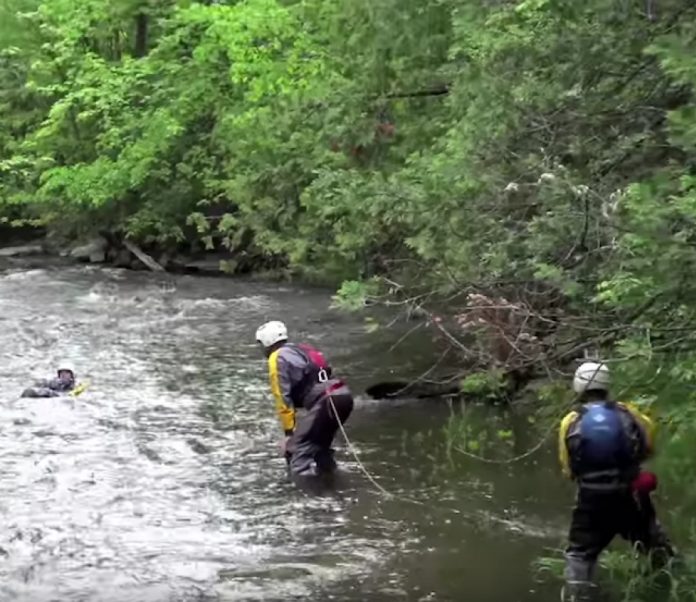
Entering the water to grab a swimmer, while tethered to shore by a rope attached to your quick-release rescue belt, is a very effective technique. In this video, rescue instructor Jim Coffey shows how to set up and execute a live bait rescue safely. Remember, a video is a supplement to, not a substitute for, hands-on training classes.

Video: Rescue a Runaway Kayak in Whitewater

Learn to rescue a runaway boat with Thea Froehlich from the Madawaska Kanu Centre (owl-mkc.ca/mkc). This is an essential skill for anyone paddling continuous rivers where a swim could lead to loss of gear or a long and difficult hike out.

Photo: Under the Midnight Sun in Iceland

Photo: Frank Orsi
Photo: Under the Midnight Sun in Iceland

Hot springs, volcanoes, moonlike landscapes and a surprisingly common belief in elves are just some of the unique features that bring close to a million tourists to Iceland each year. For professional photographer and paddleboarder, Franz Orsi, it was the endless summer days and opportunity to shoot surf, river and lake paddling all in one location that brought him to the land of ice and fire.

On a road trip around the small island nation, the globetrotting Starboard athlete experienced some of the warmest days Iceland offers (a sweltering 60 degrees Fahrenheit), as well as days that bottomed out at just 41 degrees Fahrenheit, with water temperatures hovering around the same.

“Everything about the trip was extreme—extreme weather, extreme landscape, and everything changes super quickly.” says Orsi.

Orsi got in touch with Iceland’s very small community of surfers (“Not more than 20 or 25,” he says) and contacted its four windsurfers to get beta on the best spot to catch surf. “None of them had tried standup before. One of the guys was very interested and started paddling afterwards—he’s probably the first standup paddler in Iceland,” jokes Orsi.

Photo: Frank Orsi
Photo: Under the Midnight Sun in Iceland

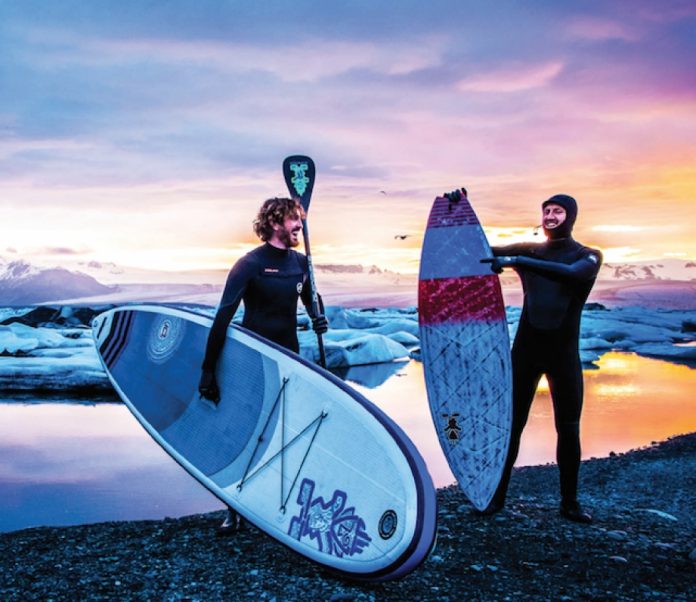
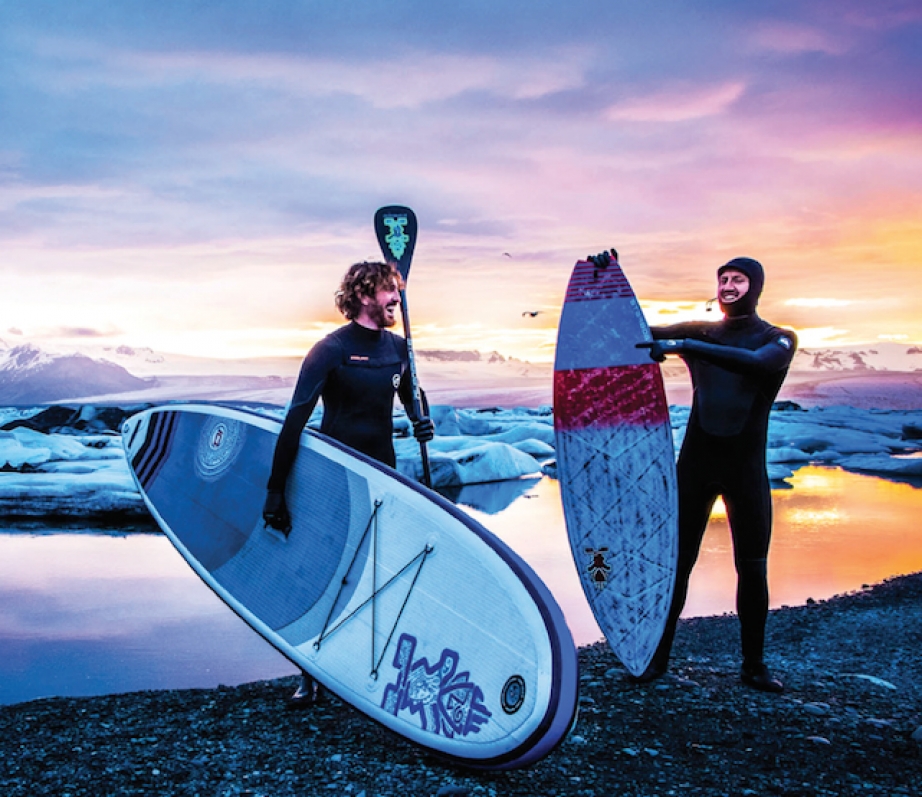
This photo was taken shortly after midnight near the shore of a glacial lagoon. Though there had been perfect surf and light for photos, the water was full of ice. “It was so close to the glaciers that little bits of ice were floating in the water and extremely sharp,” says Orsi.

In this photo, Orsi and road trip partner and pro surfer, Filippo Orso, are seen just after their surf session. “He’s making fun because of the size of my board of course,” says Orsi. It was a spontaneous moment—“two people sharing passion for the water, but divided by their passion for their own sports.”

While Orsi loves capturing on-water action, it’s off the water where the magic happens. “What’s been really interesting to me about standup is documenting the lifestyle. It’s related to the crazy action sports, but there’s also another side of the sport, of exploration and enjoyment.”

Standup paddling offers new perspectives of looking at the world, says Orsi. “It enables me to get to places and into situations that I would never go. It’s such a simple way of travel—even rudimentary—that it breaks down barriers with people I’d otherwise never meet.”

In his minimalist travel kit, Orsi packs two Nikon digital SLRs, a waterproof-housing unit, and two lenses, including a telephoto.

“There’s no way to shoot a standup trip with a lot of gear,” he says. “There’s a saying I always have in mind before a trip: pack light and you’ll go farther.” See more of Orsi’s work on Instagram at @supnomad.


BG_2016_0.jpgThis article originally appeared in the 2016 Paddling Buyer’s Guide issue.
Subscribe to Paddling Magazine and get 25 years of digital magazine archives including our legacy titles: Rapid, Adventure Kayak and Canoeroots.

Kayaks Should Come With Warning Labels. Here’s Why

Mind-altering, life-changing stuff. Photo: Virginia Marshall

Kayaks should come with warning labels.

I don’t mean the standard sort of cautionary risk disclaimer (the sort you’ll find in the masthead of Paddling Magazine):

Paddling and other activities described and illustrated herein are inherently dangerous and could result in serious bodily injury, including disability and death. Do not attempt without proper supervision, training and safety equipment…yada, yada, yada…

While it’s the head’s-up our litigious society demands, it doesn’t do much to sell the sport and, more than that, it seems kinda obvious in the way that “don’t stick a fork in an electrical outlet” and “look both ways” are by the time you’re old enough to read mouseprint.

No, I only wish someone had warned me that kayaking would take over my life. Consume my daydreams, holidays, basement, bookshelves and career. I would have started paddling sooner.

We’re used to negative advisories on things we might want to avoid: violent movies and video games, cigarettes, alcohol, profanity-strewn records, bear-plagued campgrounds. But here’s a thought—how about slapping portentous labels on good things?

Sleeping bags and pads—who needs a bed and sheets? Kayaks and canoes—I am being productive, I’m going paddling. This Buyer’s Guide—Honey, I’ve found the perfect, high-return investment for our nest egg!

Mind-altering, life-changing stuff. Photo: Virginia Marshall

Warning labels work by getting our attention and triggering psychological and emotional responses. In the case of labels on controlled substances like tobacco, a recent study by Cancer Council Victoria, in which researchers surveyed smokers in the U.S., Canada, Australia and the United Kingdom, found that larger labels that included images were most effective at capturing smokers’ attention. Simply trying not to look doesn’t help, says the study’s author, “This just goes to prove the idea that the more one tries not to think of something, the more one tends to focus on it.”

Adventure Kayak and Paddling Buyer’s Guide readers, of course, already know this. Photos of happy, adventurous kayakers plying scenic coasts trigger overwhelming urges to drop everything and go paddling.

Paddling will make you a crusader for this watery planet. Will make you care deeply about aquatic and oceanic ecology and every other environment on our bluish-greenish-brownish globe. May shift the way you think, shop, drive, dress, work and vote.

There’s another advisory we could put on boats, but maybe we should keep it under our hats for now. Paddling will make you a crusader for this watery planet. Will make you care deeply about aquatic and oceanic ecology and every other environment on our bluish-greenish-brownish globe. May shift the way you think, shop, drive, dress, work and vote. Mind-altering, life-changing stuff.

It’s no coincidence our long-time columnists and contributors often share their concern for our society’s shift out of nature and into cubicles, and the estrangement of the next generation from wild places.

So turn the pages and dive in, but don’t say I didn’t warn you. If kayaks and paddling magazines came with this “lifestyle advisory,” it might read something like this:

Attention: Kayaking is addictive and is a leading cause of good health, mental wellbeing, and meaningful relationships with friends, family and nature. Paddlers may experience cravings and emotional highs after brief exposure. Prolonged use can result in enlightenment, heightened fitness, and environmental awareness and appreciation. Enjoy!

Recirc is a column celebrating our favorite stories from 20 years of Adventure Kayak, Rapid and Canoeroots. This article first appeared in the 2016 Paddling Buyer’s Guide.


BG_2016_0.jpgThis article originally appeared in the 2016 Paddling Buyer’s Guide issue.
Subscribe to Paddling Magazine and get 25 years of digital magazine archives including our legacy titles: Rapid, Adventure Kayak and Canoeroots.

5 Questions With The Rediscover North America Expedition

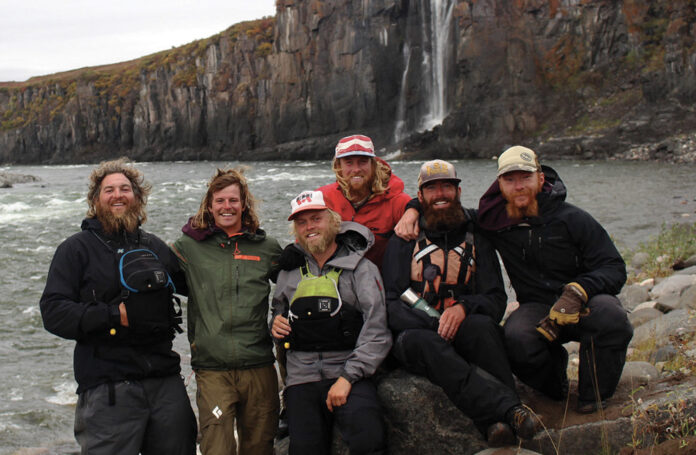
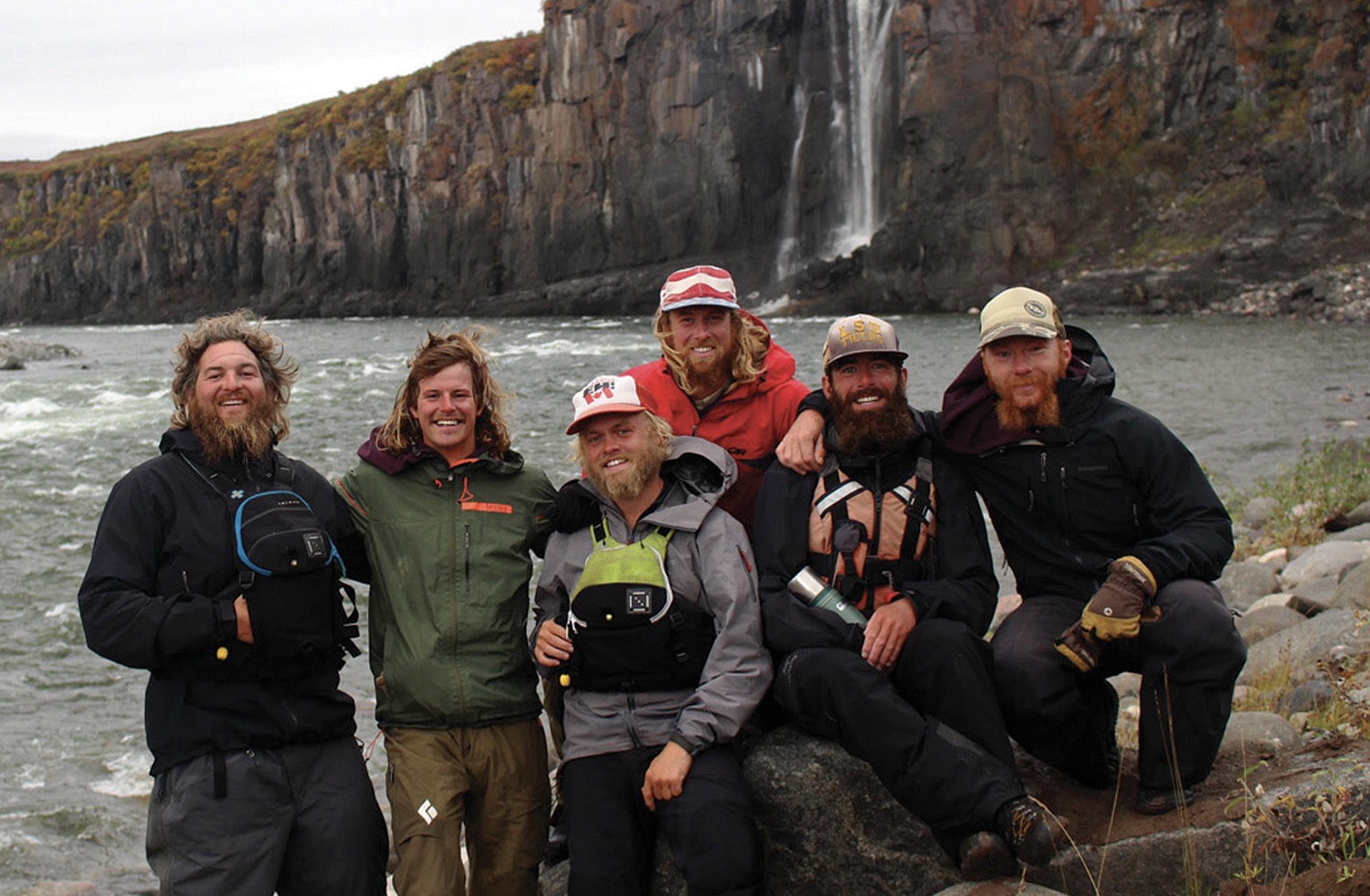
Mission impossible? Mission accomplished. | Photo: Rediscover North America Expedition

Just months after completing the first-ever west to east canoe journey across Canada’s Yukon, Northwest and Nunavut territories in 2012, Minnesota-based adventurer Winchell Delano, 30, felt an itch. He scratched it by planning a 5,200-mile south to north expedition from the Gulf of Mexico to the Arctic Ocean.

To complete the journey in a single season meant starting in January—and traveling against the current for most of the route. But the six-man team lucked out: Low water meant easier upstream paddling, and their route avoided the hotspots of an active wildfire season in northern Canada.

Delano and his friends, Adam Trigg, Luke Kimmes, John Keaveny, Dan Flynn and Jarad Moore, touched down at the mouth of the Coppermine River in Kugluktuk, Nunavut, in September 2015.

The documentary of their trip is available to rent or buy here.

[ Paddling Trip Guide: View all canoeing trips in North America ]

What was Rediscover NA like compared to your last trip?

Trans-Territorial was an anxious sprint. This was an interpersonal marathon. We knew it was possible to paddle from the Gulf of Mexico to the Arctic Ocean because several people have done versions of it. The question was, could we come together and do it as a group of six. I’d rather have longer, harder workdays than have to discuss every decision ad nauseam.

Mission impossible? Mission accomplished. | Photo: Rediscover North America Expedition

Why call it Rediscover North America?

I was out in Utah working in wilderness therapy. I was trying to get a rapport with a kid, describing this upcoming trip, asking him if he had any ideas for a good name. I could tell he didn’t give a shit about it, yet one thing he said stuck: He called it a rediscovery. That’s exactly what we did, stitching together all these existing routes into one big journey.

Where did you meet the most interesting people?

We thought there’d be a juxtaposition between the heavily populated south and the empty north. However, kindness transcends geography and encounters with people were the greatest highlight of our trip. It didn’t matter where, people who had no reason to welcome us would call us in to shore, feed us a meal and give us a place to sleep.

Who made the biggest sacrifice to join this journey?

You could make a compelling argument for anyone. A year and a half ago, I gave everyone the same prospectus. It outlined the trip, how long it would take and what type of conditions. When you do a 245-day trip you give a lot up. But you gain a lot, too.

That’s a good question. It’s been three weeks since we finished and I still have a trip hangover. It’s weird to be home and not have my day revolve around eight hours of paddling. I’m still waking up at four in the morning, thinking we need to get up and move.

Watch the Rediscover North America Trailer:


BG_2016_0.jpgThis article originally appeared in the 2016 Paddling Buyer’s Guide issue.
Subscribe to Paddling Magazine and get 25 years of digital magazine archives including our legacy titles: Rapid, Adventure Kayak and Canoeroots.

Find The Perfect Whitewater Boat In Just 10 Minutes

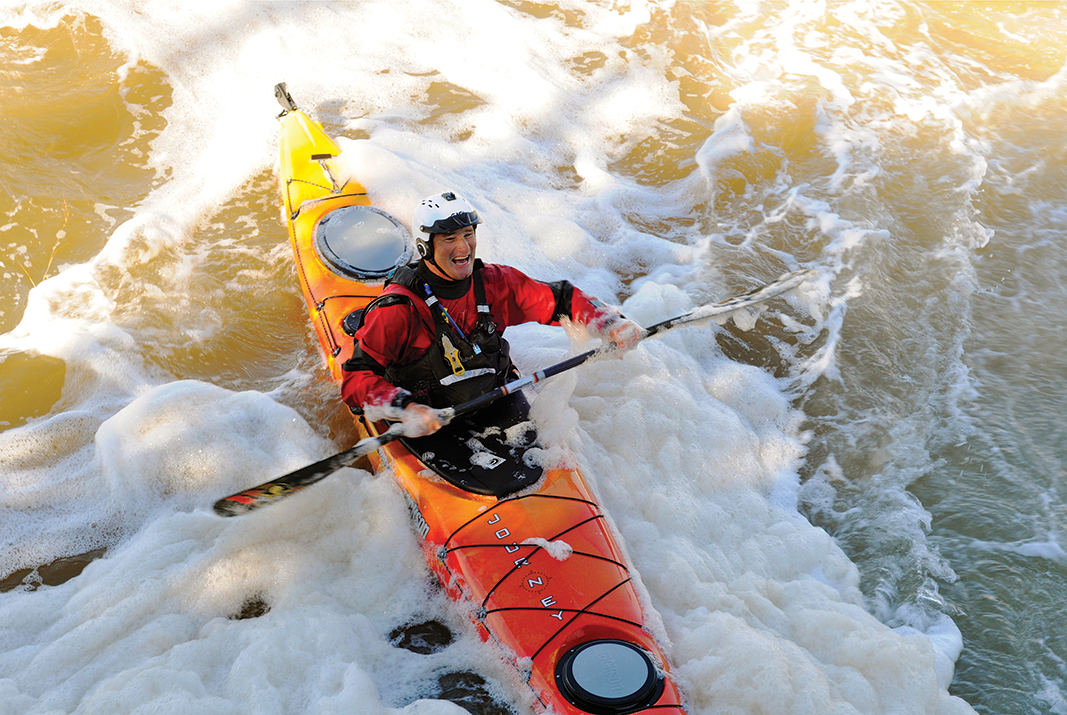
kayaker upside doing a kayak roll
Speed dating. | Feature photo: Jordan Manley

It’s demo day at your local outfitters, a chance to get on the water and try out different boats. The catch: the only water nearby is flatwater. How do you translate what this boat is doing on flatwater to what it will do in whitewater?

Simon Coward, whitewater kayak instructor and owner of Aquabatics kayak shop in Calgary, Alberta, offers these tips for making sure your flatwater demo converts into to the purchase of the perfect whitewater companion.

5 steps to find the perfect whitewater boat on flatwater

1 Fit it

Proper outfitting is a key component to feeling comfortable, safe and secure in a kayak. When you are hopping in and out of demo boats, it’s important to take the time to adjust the outfitting so you can get a real feel for the boat.

“With most modern boats the outfitting is pretty turn-key; bulkheads are easily adjustable, back bands are simple to move forward and backward,” says Coward. Bring a footblock for trying out playboats and extra foam shims to help adjust hip pads in creek boats. As long as you can get snug and comfortable in the hips you are good to go, adds Coward.

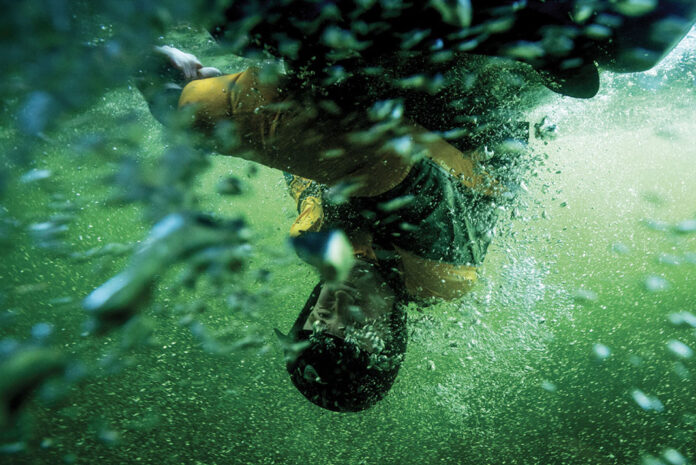
kayaker upside doing a kayak roll
Speed dating. | Feature photo: Jordan Manley

Beware of red flags. This is not the boat for you if you feel uncomfortable, even with a minimal amount of outfitting; if you continually bash your knuckles on the hull; or if the boat feels too big or too small—trust your gut on this one.

2 Paddle it

These flatwater drills will give you a feel for how the boat will handle in moving water.

3 Forward paddle

Take two-dozen forward strokes. Does the boat track nicely? Is the trim balanced, and are the bow and stern even on the water? How quickly does the boat accelerate? It’s important to note that the boats that accelerate quickly may be less maneuverable, adds Coward.

4 Go for a roll

“Many beginner and intermediate paddlers talk about certain boats being easier to roll than others. To some degree this is the case,” says Coward, “though with a really solid rolling technique, it doesn’t make much difference. However, from a confidence standpoint, you want to know you are comfortable rolling the boat.”

5 Put it on edge

Practice edging the boat. See how the kayak transitions from sitting flat (primary stability) to on edge (secondary stability). Is it a smooth transition? Is it balanced on edge? Get a feel for the tipping point of the boat by putting it on edge while paddling and practicing a low brace. This will help in finding where the secondary stability fails. Consider this: boats with very defined edges offer more primary stability, however have less secondary stability than boats with less defined edges. “Carve some circles and get the boat on edge with some speed,” says Coward. “The boat should feel balanced on edge and should accelerate easily.”

Carmen Kuntz is a freelance writer and kayak instructor at the Muskoka Kayak School.


Speed dating. | Feature photo: Jordan Manley


Video: Canoe-Over-Canoe Rescue Technique

Learn the Canoe-Over-Canoe Rescue Technique to right an overturned canoe on your next camping trip—an essential skill for any paddler.

Erik Fenkell from Temagami Outfitters show you how to perform a T-rescue with this simple step-by-step approach.

Find more great paddling skills and technique instruction from Canoeroots magazine here.

Discover great paddling adventures at ontariotravel.net/wateradventures.

Editorial: Full Circle

PROMISE OF ADVENTURE AND A HOT MEAL. | PHOTO: RAPID STAFF

The evolving crossover kayak category is whitewater’s newest boat category for whitewater’s oldest category. We’ve seen half-a-dozen new models emerge over the last few years—from Dagger’s Katana, Pyranha’s Fusion sit-on-top to Jackson’s Traverse. This growing breed of kayaks is our rotomolded polyethylene DeLorean time machine back to the future.

Last spring we took a handful of our favorite crossovers and headed downriver. To compare this burgeoning category we gathered a motley crew of paddlers that ranged in experience level from a never-successfully-rolled fisherman to a former pro freestyle athlete. Why such a range of paddlers? Because that’s who we think should be buying.

All the boats were about nine or 10 feet long with some configuration of deck rigging, skeg and stern compartment with bulkhead and hatch. The similarities ended there. One could pass for a creek boat, another charged across lakewater sections like nobody’s business. Another did a little of both, like a crossover of crossovers.

Over the years we’ve tried shorter, flatter, rounder, slicier and bouncier, and lately bouncy with a little more slice. It seems there are no limits to the mash-ups blending what have become traditional categories. Essentially, we’ve been giving whitewater paddlers newer and better options.

In 2008, the Liquidlogic Remix XP invited thousands more to the party. Originally crossover meant crossing over from recreational kayaking to whitewater. You may be surprised by how many people take department store kayaks on class II-III river trips. Now they too have newer and better options.

While I’m excited to see whitewater growing in new ways (or again in old ways), not everyone has jumped on the bandwagon. A few Rapid readers have commented disparagingly something along the lines of: “The kind of boat I want my buddy to paddle so he can carry my beer.” Read: Not a kayak for real boaters. Think: They don’t get it.

Attending the Gull River Festival a number of years ago I watched as a crew of young athletes—sent by their sponsors—arrived late Saturday morning to teach the clinics that were already on the water. There were hundreds of weekend paddlers working the different sections and dozens more in the lake below working on skills, drills and rolls. I overheard one of the pros ask the rest, “Who are all these losers? I don’t recognize anybody.” They didn’t get it either.

PROMISE OF ADVENTURE AND A HOT MEAL. | PHOTO: RAPID STAFF

These losers watch live streaming freestyle events on their lunch hours. These losers get together every weekend at different put-ins. These losers are real boaters. And someday they may just want to do self-supported, class III-IV, multi-day river trips. Why? Because around a blazing campfire at a takeout on Sunday afternoon one of them will pull out a map, and on that map will be an unknown thin blue line longer than they can paddle in one day.

With so much innovation, marketing and hype surrounding hucking downright frighteningly high waterfalls and the leading edge of freestyle, crossovers offer something a little different. Newbie to expert, creeker to freestyle phenom—we can all get behind crossovers, can’t we?

Crossovers are our ticket back to before double fist pumps below 80-footers and before waiting in line for 45-second rides. Crossovers take us down rivers to a simpler time, a time when paddling was about exploration and freedom and adventure. And who couldn’t use a little more exploration, freedom and adventure? Not to mention a waterproof compartment for food and a sleeping bag.

Scott MacGregor is the founder and publisher of Rapid Media.


BG_2016_0.jpgThis article originally appeared in the 2016 Paddling Buyer’s Guide issue.
Subscribe to Paddling Magazine and get 25 years of digital magazine archives including our legacy titles: Rapid, Adventure Kayak and Canoeroots.