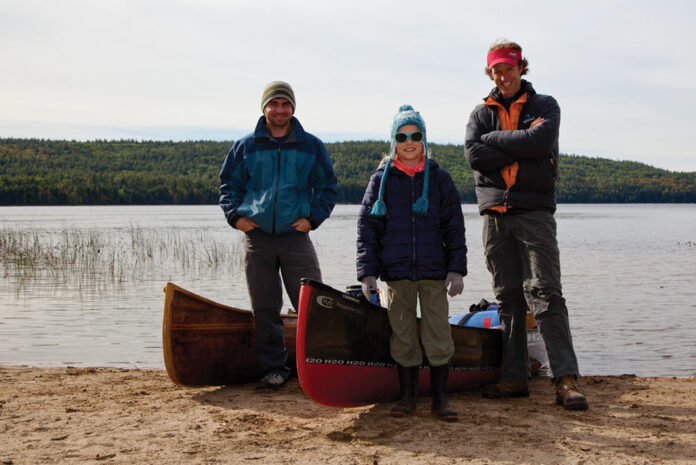
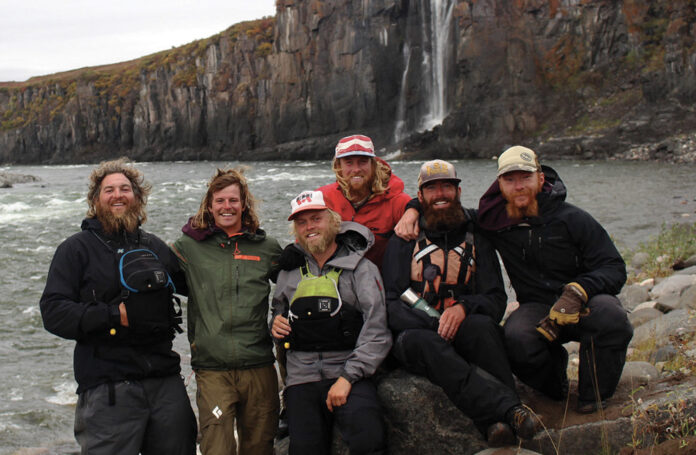
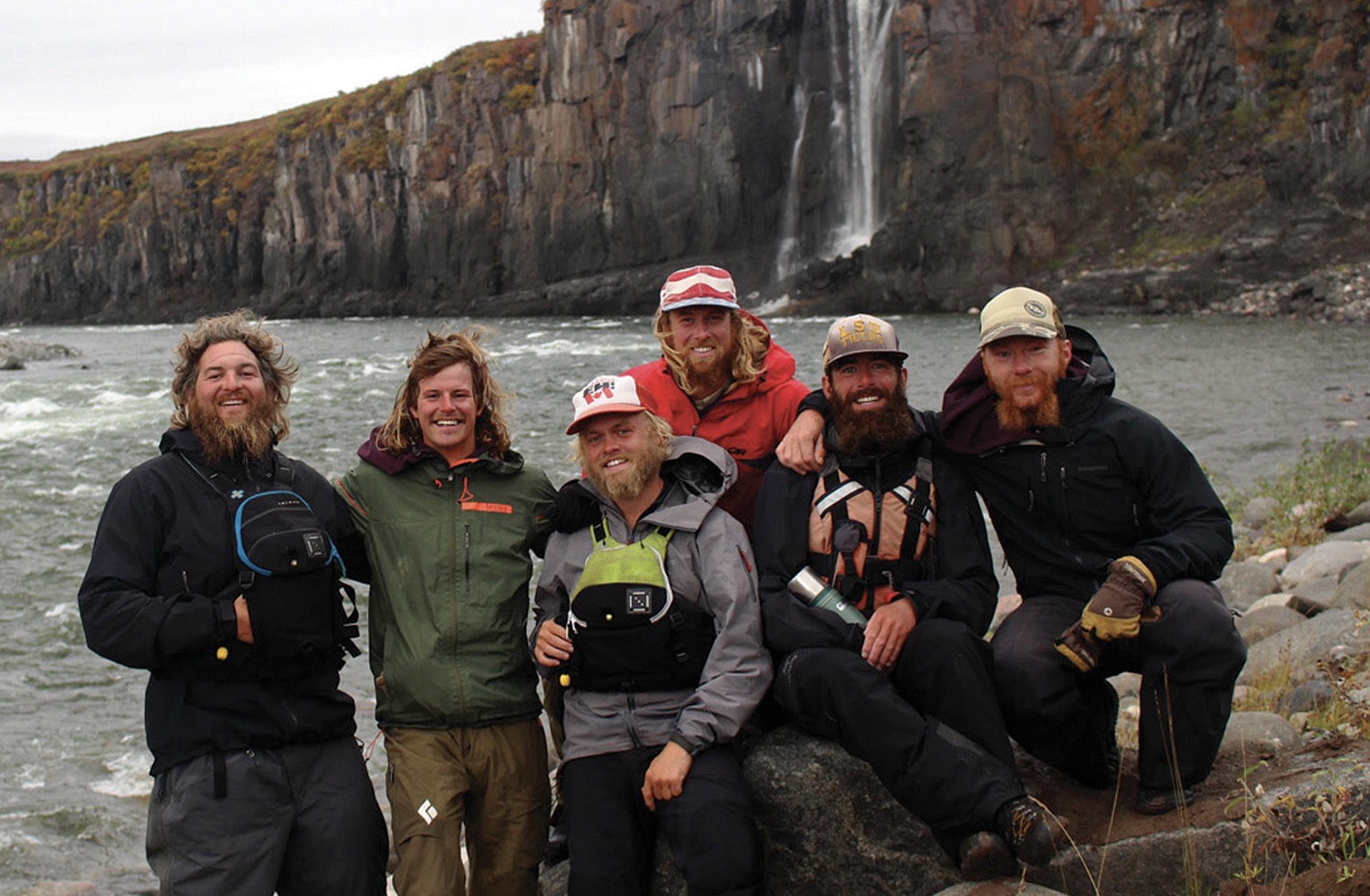
Mission impossible? Mission accomplished. | Photo: Rediscover North America Expedition
Just months after completing the first-ever west to east canoe journey across Canada’s Yukon, Northwest and Nunavut territories in 2012, Minnesota-based adventurer Winchell Delano, 30, felt an itch. He scratched it by planning a 5,200-mile south to north expedition from the Gulf of Mexico to the Arctic Ocean.
To complete the journey in a single season meant starting in January—and traveling against the current for most of the route. But the six-man team lucked out: Low water meant easier upstream paddling, and their route avoided the hotspots of an active wildfire season in northern Canada.
Delano and his friends, Adam Trigg, Luke Kimmes, John Keaveny, Dan Flynn and Jarad Moore, touched down at the mouth of the Coppermine River in Kugluktuk, Nunavut, in September 2015.
The documentary of their trip is available to rent or buy here.
[ Paddling Trip Guide: View all canoeing trips in North America ]
What was Rediscover NA like compared to your last trip?
Trans-Territorial was an anxious sprint. This was an interpersonal marathon. We knew it was possible to paddle from the Gulf of Mexico to the Arctic Ocean because several people have done versions of it. The question was, could we come together and do it as a group of six. I’d rather have longer, harder workdays than have to discuss every decision ad nauseam.
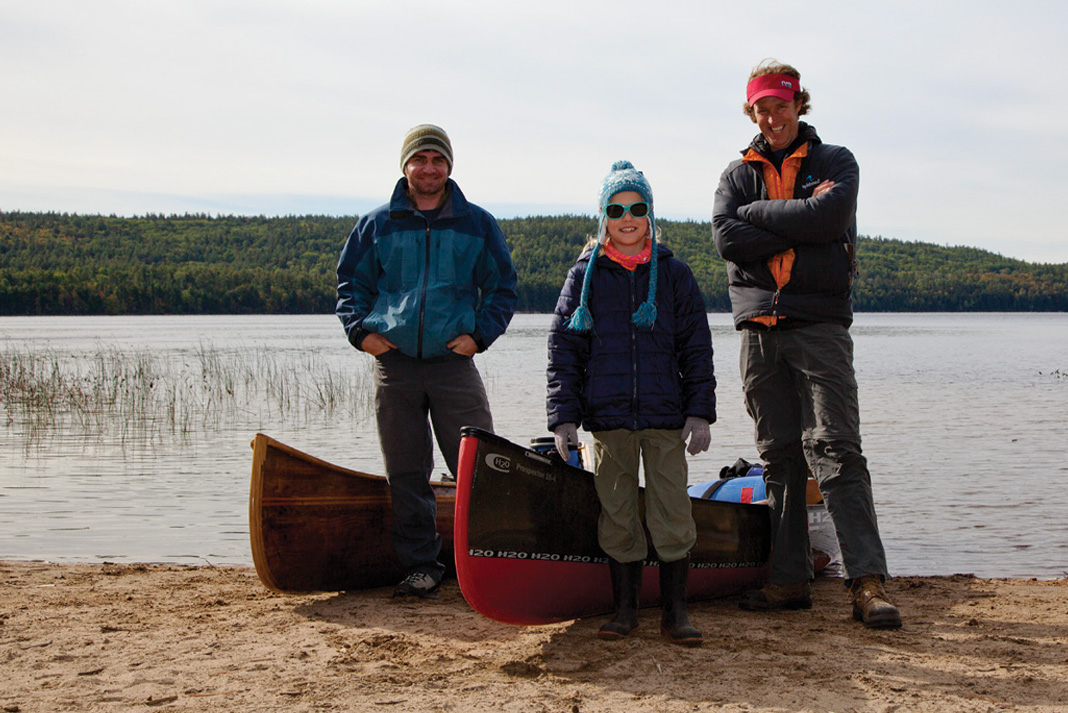
Mission impossible? Mission accomplished. | Photo: Rediscover North America Expedition
Why call it Rediscover North America?
I was out in Utah working in wilderness therapy. I was trying to get a rapport with a kid, describing this upcoming trip, asking him if he had any ideas for a good name. I could tell he didn’t give a shit about it, yet one thing he said stuck: He called it a rediscovery. That’s exactly what we did, stitching together all these existing routes into one big journey.
Where did you meet the most interesting people?
We thought there’d be a juxtaposition between the heavily populated south and the empty north. However, kindness transcends geography and encounters with people were the greatest highlight of our trip. It didn’t matter where, people who had no reason to welcome us would call us in to shore, feed us a meal and give us a place to sleep.
Who made the biggest sacrifice to join this journey?
You could make a compelling argument for anyone. A year and a half ago, I gave everyone the same prospectus. It outlined the trip, how long it would take and what type of conditions. When you do a 245-day trip you give a lot up. But you gain a lot, too.
That’s a good question. It’s been three weeks since we finished and I still have a trip hangover. It’s weird to be home and not have my day revolve around eight hours of paddling. I’m still waking up at four in the morning, thinking we need to get up and move.
Watch the Rediscover North America Trailer:
This article originally appeared in the 2016 Paddling Buyer’s Guide issue.
Subscribe to Paddling Magazine and get 25 years of digital magazine archives including our legacy titles: Rapid, Adventure Kayak and Canoeroots.
It’s demo day at your local outfitters, a chance to get on the water and try out different boats. The catch: the only water nearby is flatwater. How do you translate what this boat is doing on flatwater to what it will do in whitewater?
Simon Coward, whitewater kayak instructor and owner of Aquabatics kayak shop in Calgary, Alberta, offers these tips for making sure your flatwater demo converts into to the purchase of the perfect whitewater companion.
5 steps to find the perfect whitewater boat on flatwater
1 Fit it
Proper outfitting is a key component to feeling comfortable, safe and secure in a kayak. When you are hopping in and out of demo boats, it’s important to take the time to adjust the outfitting so you can get a real feel for the boat.
“With most modern boats the outfitting is pretty turn-key; bulkheads are easily adjustable, back bands are simple to move forward and backward,” says Coward. Bring a footblock for trying out playboats and extra foam shims to help adjust hip pads in creek boats. As long as you can get snug and comfortable in the hips you are good to go, adds Coward.
Speed dating. | Feature photo: Jordan Manley
Beware of red flags. This is not the boat for you if you feel uncomfortable, even with a minimal amount of outfitting; if you continually bash your knuckles on the hull; or if the boat feels too big or too small—trust your gut on this one.
2 Paddle it
These flatwater drills will give you a feel for how the boat will handle in moving water.
3 Forward paddle
Take two-dozen forward strokes. Does the boat track nicely? Is the trim balanced, and are the bow and stern even on the water? How quickly does the boat accelerate? It’s important to note that the boats that accelerate quickly may be less maneuverable, adds Coward.
4 Go for a roll
“Many beginner and intermediate paddlers talk about certain boats being easier to roll than others. To some degree this is the case,” says Coward, “though with a really solid rolling technique, it doesn’t make much difference. However, from a confidence standpoint, you want to know you are comfortable rolling the boat.”
Practice edging the boat. See how the kayak transitions from sitting flat (primary stability) to on edge (secondary stability). Is it a smooth transition? Is it balanced on edge? Get a feel for the tipping point of the boat by putting it on edge while paddling and practicing a low brace. This will help in finding where the secondary stability fails. Consider this: boats with very defined edges offer more primary stability, however have less secondary stability than boats with less defined edges. “Carve some circles and get the boat on edge with some speed,” says Coward. “The boat should feel balanced on edge and should accelerate easily.”
Carmen Kuntz is a freelance writer and kayak instructor at the Muskoka Kayak School.
PROMISE OF ADVENTURE
AND A HOT MEAL. | PHOTO: RAPID STAFF
The evolving crossover kayak category is whitewater’s newest boat category for whitewater’s oldest category. We’ve seen half-a-dozen new models emerge over the last few years—from Dagger’s Katana, Pyranha’s Fusion sit-on-top to Jackson’s Traverse. This growing breed of kayaks is our rotomolded polyethylene DeLorean time machine back to the future.
Last spring we took a handful of our favorite crossovers and headed downriver. To compare this burgeoning category we gathered a motley crew of paddlers that ranged in experience level from a never-successfully-rolled fisherman to a former pro freestyle athlete. Why such a range of paddlers? Because that’s who we think should be buying.
All the boats were about nine or 10 feet long with some configuration of deck rigging, skeg and stern compartment with bulkhead and hatch. The similarities ended there. One could pass for a creek boat, another charged across lakewater sections like nobody’s business. Another did a little of both, like a crossover of crossovers.
Over the years we’ve tried shorter, flatter, rounder, slicier and bouncier, and lately bouncy with a little more slice. It seems there are no limits to the mash-ups blending what have become traditional categories. Essentially, we’ve been giving whitewater paddlers newer and better options.
In 2008, the Liquidlogic Remix XP invited thousands more to the party. Originally crossover meant crossing over from recreational kayaking to whitewater. You may be surprised by how many people take department store kayaks on class II-III river trips. Now they too have newer and better options.
While I’m excited to see whitewater growing in new ways (or again in old ways), not everyone has jumped on the bandwagon. A few Rapid readers have commented disparagingly something along the lines of: “The kind of boat I want my buddy to paddle so he can carry my beer.” Read: Not a kayak for real boaters. Think: They don’t get it.
Attending the Gull River Festival a number of years ago I watched as a crew of young athletes—sent by their sponsors—arrived late Saturday morning to teach the clinics that were already on the water. There were hundreds of weekend paddlers working the different sections and dozens more in the lake below working on skills, drills and rolls. I overheard one of the pros ask the rest, “Who are all these losers? I don’t recognize anybody.” They didn’t get it either.
PROMISE OF ADVENTURE AND A HOT MEAL. | PHOTO: RAPID STAFF
These losers watch live streaming freestyle events on their lunch hours. These losers get together every weekend at different put-ins. These losers are real boaters. And someday they may just want to do self-supported, class III-IV, multi-day river trips. Why? Because around a blazing campfire at a takeout on Sunday afternoon one of them will pull out a map, and on that map will be an unknown thin blue line longer than they can paddle in one day.
With so much innovation, marketing and hype surrounding hucking downright frighteningly high waterfalls and the leading edge of freestyle, crossovers offer something a little different. Newbie to expert, creeker to freestyle phenom—we can all get behind crossovers, can’t we?
Crossovers are our ticket back to before double fist pumps below 80-footers and before waiting in line for 45-second rides. Crossovers take us down rivers to a simpler time, a time when paddling was about exploration and freedom and adventure. And who couldn’t use a little more exploration, freedom and adventure? Not to mention a waterproof compartment for food and a sleeping bag.
Scott MacGregor is the founder and publisher of Rapid Media.
This article originally appeared in the 2016 Paddling Buyer’s Guide issue.
Subscribe to Paddling Magazine and get 25 years of digital magazine archives including our legacy titles: Rapid, Adventure Kayak and Canoeroots.
Plan ahead to minimize these mistakes when canoeing far from civilization. | Feature photo: Courtesy of Old Town Watercraft & Accessories
After canoeing North America’s lakes and rivers for more than 60 years, author and adventurer Cliff Jacobson has unfortunately seen all the mistakes you can imagine. In his own words, America’s renowned canoeing authority shares seven of the most common—and dangerous—errors he sees on the water.
[ Paddling Buyer’s Guide: See all expedition canoes ]
Most Common Canoeing Mistakes
1 Not scouting ahead
Round the bend of your local river, you might see the dancing horsetails of a rapid you’ve paddled a dozen times before. Don’t be tempted to dismiss scouting and plunge confidently ahead. I’ve done this myself, only to see a sapling blocking the way. We capsized and wrapped the canoe. View the route you’re paddling with fresh, clear eyes, each and every time.
Plan ahead to minimize these mistakes when canoeing far from civilization. | Feature photo: Courtesy of Old Town Watercraft & Accessories
2 Leaving an unsecured canoe
Spend enough time tripping and you’ll be sure to spot an unlucky paddler’s previously beached canoe drift by. In wind or current, and especially in remote areas, a runaway boat is a serious problem. Always secure your canoe overnight and during breaks by tying off the bowline to a tree or other immovable object. If you stop briefly where a tie-up is difficult, string out your bow and stern lines along the ground. If the canoe drifts away while you’re watching, you can make a dash to grab a line.
Stop when you must and run when you can. If you’re being beaten by a headwind, put ashore to wait it out. Too much focus on keeping to a schedule can lead to bad decision making, exhausting the group—or worse. Paddlers can often make up lost time by paddling longer on nice days, or by paddling in the quiet hours of dawn and dusk.
4 Paddling with an unzipped PFD
Drowning deaths where PFDs are worn properly account for between only two and 13 percent of incidents, according to the Red Cross Society. In the event of of capsizing, swamping or collision with another boat, wearing a PFD properly is your best assurance of returning home.
[ Paddling Buyer’s Guide: See all PFDs ]
5 Overloading the canoe
Whether its enthusiastic weekend warriors stacking beer, guitar cases and duffel bags high above the gunwales, cottagers stuffing in too many passengers or experienced paddlers taking home an awkwardly sized trophy, overloading leads to instability and is one of the most common causes of serious river accidents. I’ve had the unfortunate experience of having a found caribou rack caught in a low hanging sapling above a class II rapid. Escape meant cutting the cord that held the rack—and hoping a tine wouldn’t spear me as it rolled out.
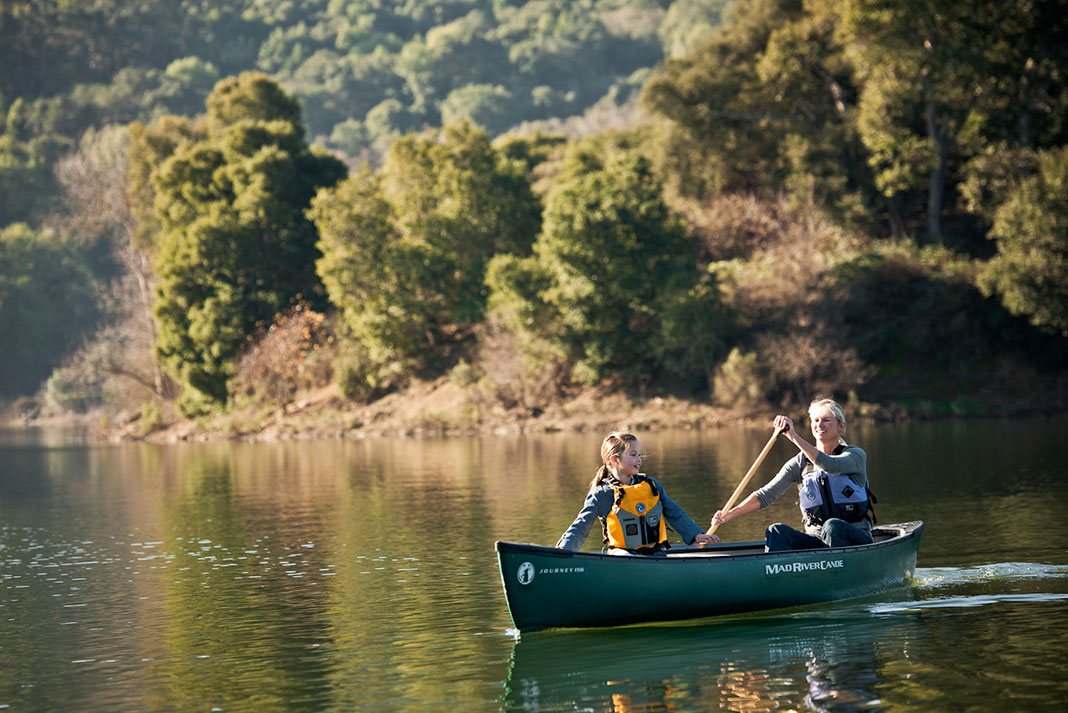
Avoid overloading your canoe to ensure a pleasant wilderness trip. | Photo: Courtesy of Mad River Canoe
6 Incompetent back ferry
Anyone who plans to travel on a wilderness river with a loaded canoe should learn to back ferry effectively. A back ferry allows for moving from one side of the river to the other, and slows the canoe, buying time to evaluate the next obstacle and position the canoe. Boat control is a problem for many paddlers when learning this maneuver, so practice this technique before you need to execute it.
Loose items must be minimized and secured. Not only does this make portages much more efficient, if your canoe capsizes the cleanup is much quicker. Your friends will thank you.
Plan ahead to minimize these mistakes when canoeing far from civilization. | Feature photo: Courtesy of Old Town Watercraft & Accessories
Story Behind the Shot: Wuthering Heights | Photo: Steve Rogers
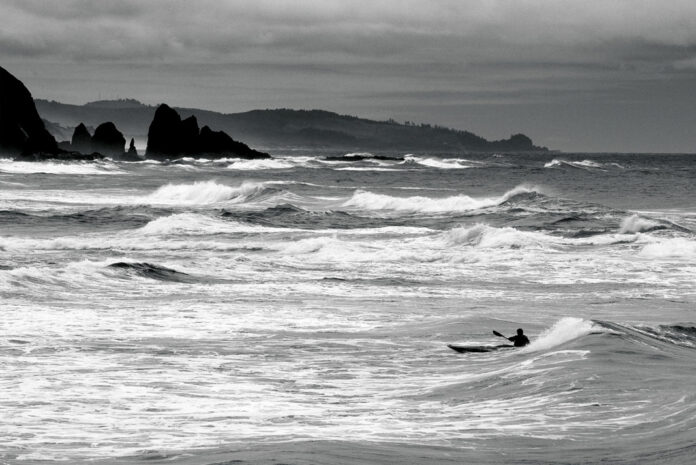
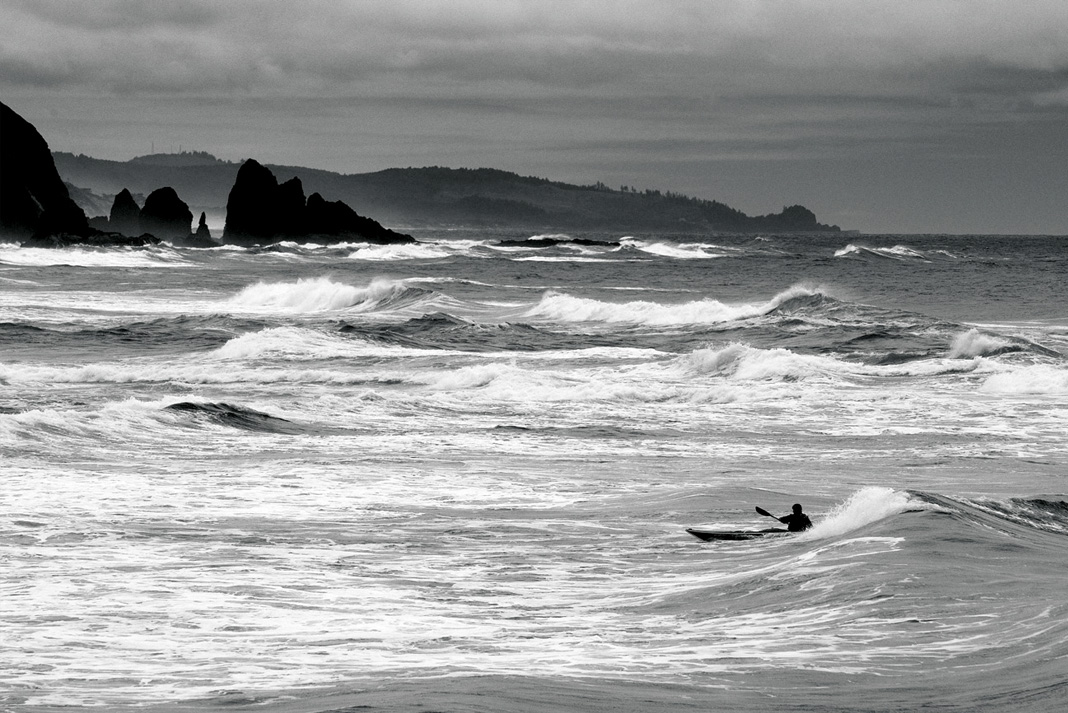
Cascade Head is a secluded beach break on the central Oregon coast, accessible via a short paddle down the Salmon River system, making it difficult to reach other than by kayak. This gives the area a remote feel despite being relatively close to several small towns.
I had traveled south from my home to shoot surf photos at the break with talented Oregon locals Dave White and Paul Kuthe.
When we reached the coast, I managed to paddle my own kayak over to the north side of the break, where I noticed the sweeping view to the south encompassed crumbling sea stacks and chaotically spilling waves beneath a bank of moody clouds drifting off the ocean. I wanted to layer all of these elements into the shot to try and capture the charged atmosphere that makes this area feel so special.
Story Behind the Shot: Wuthering Heights | Photo: Steve Rogers
While Dave and Paul contended with sets of overhead breakers, my own challenge came when I decided I needed a little elevation to bring all the elements in line. What looked from below like an easy 100-foot scramble up the cliffs turned into a leg-shaking mini epic when I managed to get myself into a position of no retreat 80 feet up, surrounded by horribly crumbling shale and mud.
After 10 minutes of desperately searching for a way to down-climb—with the roar of the Pacific and my own elevated pulse pounding in my ears—I was forced to accept a risky six-foot, upward scrabble, clinging to nothing but tufts of grass anchored tenuously in the mud. As I lay in the meadow atop the cliff, breathing heavily and thanking my lucky stars, White caught this set and I managed to grab my camera and rattle off a few frames with my shaking hands.
This article first appeared in the Fall 2015 issue of Adventure Kayak magazine.
Subscribe to Paddling Magazine and get 25 years of digital magazine archives including our legacy titles: Rapid, Adventure Kayak and Canoeroots.
Efficiency is key when packing your kayak for a wilderness trip. Let Aria Kooy from Parry Sound, Ontario’s White Squall Paddling Centre share her expert advice.
Learn how to protect your clothing and gear from moisture, make best use of space and how to ensure you remain balanced and buoyant.
Discover more great skills and techniques on Adventure Kayak’s Techniques page.
TWO DAYS. TWO CANOES.
NOT TOO FUSSY.| PHOTO: SCOTT MACGREGOR
We set out with two very different canoes.
Kate and I were test paddling a brand new carbon fiber epoxy-infused H2O Canoe Co. Prospector. With integrated composite gunwales it barely tipped the scales at 37 pounds. Despite it being a classic Chestnut Canoe Co. shape the construction is all state-of-the-art stealth fighter jet.
Dean, on the other hand, found his cedar strip at a yard sale. It was in need of much repair, some of which had been started and abandoned by the woman’s husband, who she admitted wasn’t such a handy fellow. This was Dean’s first canoe restoration and first foray into woodworking. Using Ted Moore’s book Canoecraft and the encouraging advice on wooden boat forums, over the course of three winters, Dean brought his stripper back to life.
Without really doing the math we chose a route down the Barron River on the east side of Algonquin Park. The river was low and the route leapfrogged over the dry rapid sections from flatwater pool to flatwater pool until we reached the deep and majestic Barron Canyon. Around the campfire we calculated we would paddle 23 kilometers, walk nine kilometers and drive 300 kilometers over the daylight-short weekend.
Growing up a truck driver’s son, I learned the value of having the right tools for the right job. Now I have a barn full of tools. I have whitewater tripping canoes, solo playboats, tandem whitewater slalom racing canoes, whitewater squirt C1, freestyle kayaks converted to C1s, and on the dock at the office I have a training shell for misty morning workouts.
Dean had invested a few hundred dollars into materials and wood working tools and too many hours of sweat equity. He built a steamer box and learned to bend new ash stems. He now knows just the right
amount of resin to apply with each sheet of fiberglass and he knows what three extra layers of varnish feels like after two trips over three back-to-back 600-meter carries.
TWO DAYS. TWO CANOES. NOT TOO FUSSY.| PHOTO: SCOTT MACGREGOR
There is a 29-pound weight difference between my stealth black Prospector and Dean’s cedar reno. By the end of the second day, I was teepeeing the canoe for Dean. I could still one-arm shoulder carry mine out of the water. On the steep rocky portage trails, Dean admitted to fantasizing about sexier composite canoes. On the water I appreciated the quiet natural beauty of his wooden labor of love.
This Paddling Buyer’s Guide is a 292-page tool catalog of dreams. On any given page you can complete the following sentence, “Now that would be perfect for…” Add in proper nouns, like the names of trips, rivers, waves or races, or substitute verbs, such as flying, lifting and carving.
We’ve UV coated the cover of this issue because readers tell me how their copies get ragged, dog eared and ringed from sweaty beer bottles and coffee cup stains. We like that. We know that shopping for gear is often the catalyst for grand adventures. We know you circle items and think to yourselves, if we had this we could go do that.
Don’t let worrying about the perfect purchase stop you from going. What Dean, Kate and I learned this fall is it didn’t matter much which boat we paddled. Our canoes were completely different yet both got the job done. I know that I probably had the perfect tool. But I also know that in a pinch you can fix many things with an old, rusty pair of Vise-Grip locking pliers. Sure, Dean’s shoulders were a little more tender but his stories in the office on Monday morning sounded just as good as mine.
Scott MacGregor is the founder and publisher of Rapid Media. He lives with his family in the Ottawa Valley.
This article originally appeared in the 2016 Paddling Buyer’s Guide issue.
Subscribe to Paddling Magazine and get 25 years of digital magazine archives including our legacy titles: Rapid, Adventure Kayak and Canoeroots.
Visionary Design Announced for Canadian Canoe Museum
— The following is a press release from the Canadian Canoe Museum —
Members of the Architect Selection Committee and the Board of Directors of the Canadian Canoe Museum are proud, honoured and excited to announce that visionary architects heneghan peng Architects (Dublin, Ireland) and Kearns Mancini Architects (Toronto, Ontario) have won the international competition for the new $45-million Canadian Canoe Museum to be located at the majestic site of the 1904 Peterborough Lift Lock National Historic Site.
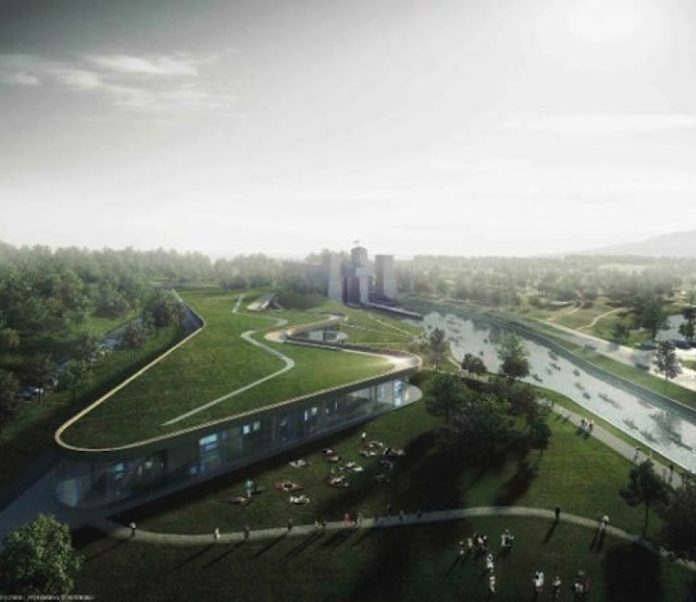
An elegant, serpentine glass pavilion graced by a two-acre rooftop garden has been selected as the winning design in the two-stage international competition. The design to house the world’s largest collection of canoes and kayaks presents a Canadian game changer that organically and boldly curves out from the drumlins beside the Trent-Severn waterway. Envisioned with and for the community, the museum embraces aboriginal wisdom to live and build lightly on the land.
The Irish-Canadian design team brings to the Canadian Canoe Museum its rich experience in the design of high-profile museums and visitor centers in Toronto and around the world. Heneghan peng’s competition-winning Grand Egyptian Museum is currently being constructed in Giza, Egypt at the foot of the Pyramids. Their stunning Giant’s Causeway Visitors’ Center in Northern Ireland folds its dramatic geometry into the hill above unique basalt stone cliffs at a World Heritage Site. Kearns Mancini Architects work includes dynamic university buildings in Canada as well as the award-winning Fort York Visitor Centre that inserts a powerful Cor-ten steel and glass volume below the Gardiner Expressway in Toronto.
The heneghan peng/ Kearns Mancini submission stood apart from the other submissions as the design works organically with the land rather than overwhelming it. In an era of climate change, its intelligence on sustainability impressed the design jury in many ways, not only for its geothermal heating/cooling and reduced energy costs. The embedded design has inherently lower operating costs with only the east and south glass walls exposed to the elements. Inside, the 80,000-square-foot single floor design offers a flexible floor plate, allowing the Museum to adapt to changing expectations and technology over time through the ability to reconfigure the Museum experience and offerings by changing internal partitions.
The organically-shaped volume banded on its top edge with local hardwood is embedded within the site’s drumlins, allowing the museum’s light-sensitive collections of historic birch bark canoes that date back to the 1780s and aboriginal artefacts to enjoy energy-passive, naturally dark spaces. The museum’s stunning two-acre green roof will provide the community with the possibility of creating edible gardens, native flower pollinators and aboriginal three sister plantings while facilitating efficient management of storm water and fantastic views to the Lift Lock.
“The design looks forward to the importance of sustainability, respect and responsibility as we move forward as a Nation to the Sesquicentennial in 2017, and beyond,” says Richard Tucker, executive director of the Canadian Canoe Museum. “The design speaks to the importance of the contents, programming and messages conveyed by the Canadian Canoe Museum and its craft to all Canadians.”
The Architect Selection Committee is chaired by Lisa Rochon, Senior Fellow, Global Cities Institute, University of Toronto and formerly the award-winning architecture critic for
The Globe & Mail. The Selection Committee included Chief Williams of Curve Lake First Nation, representatives from Parks Canada, the City of Peterborough, business leaders and museum staff. Members met over several months to hear presentations from the five short-listed teams, and to give serious consideration to all of the exceptional designs during meetings at the Canadian Canoe Museum and at Curve Lake’s Business Centre.
During the spring of 2015, the Canadian Canoe Museum was honoured to receive over 97 high-quality Stage 1 submissions from leading firms located all over the world. From that elite group of submissions, five leading firms were selected to submit designs for consideration by the Canadian Canoe Museum based on a 300-page design brief that laid out in detail the requirements of the Canadian Canoe Museum, Parks Canada and the City of Peterborough including First Nations, environmental, operational, functional, heritage, programming and planning considerations. Short-listed teams submitted their schemes mid-August, 2015.
As an enhancement to the rigorous review by the Architect Selection Committee, the submissions underwent a dynamic and instructive community engagement which included a popular public presentation by the competing architects in September at the existing Canadian Canoe Museum, as well as on-line media polls, emails, and letters.
The Canadian Canoe Museum is deeply impressed by the detailed thought, scope, creativity and quality of the submissions and the team’s commitment to the process. All five teams are to be recognized, commended and lauded for their achievements in this competition.
There will be a public presentation of the award of the contract to heneghan peng Kearns Mancini team held at the Canadian Canoe Museum at a date to be announced. We encourage the public, volunteers, members and staff to come out and meet the design team and share their aspirations for new programming at the Museum.
In accordance with the Memorandum of Agreement signed in 2015 between Parks Canada and the Canadian Canoe Museum, the design team will immediately move ahead with preparing a planning submission to the City of Peterborough and Parks Canada as the first step towards the construction of the new Canadian Canoe Museum. The Canadian Canoe Museum will continue to ramp up the capital investment campaign that will be necessary to fund construction of the new museum building on the contributions from the City of Peterborough and Founders that have supported our success to date.
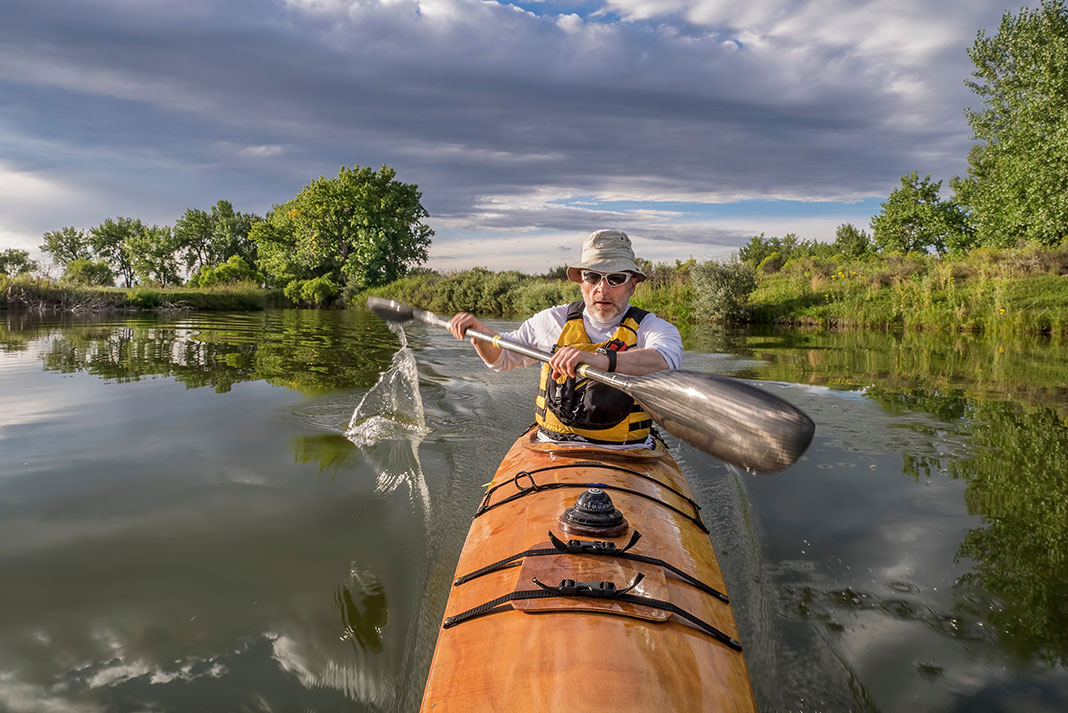
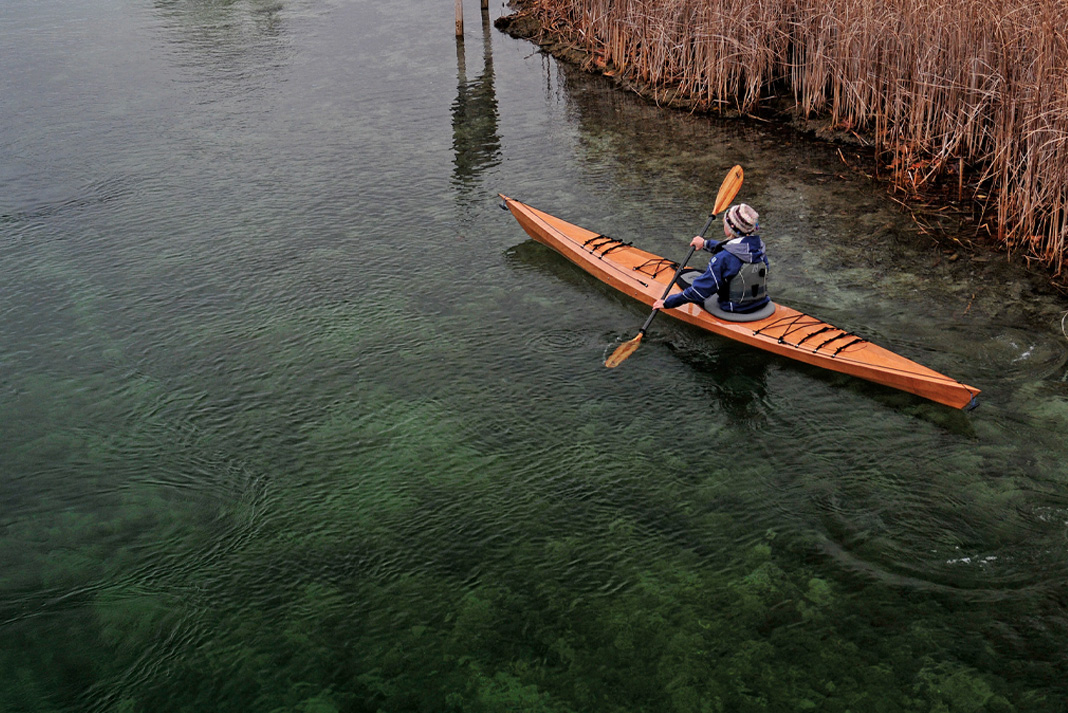
The author’s Pygmy kayak begins to take shape. | Feature photo: Virginia Marshall
Surviving self-doubt, limited skills and a busy schedule Adventure Kayak’s intrepid editor and rookie boat builder, Virginia Marshall, learns that bringing a wood kayak into the world takes passion, persistence and above all, patience. Which, as it turns out, is not her strongest suit.
“I really believe John Lockwood is the best kayak designer in the world,” boat-building instructor Dan Jones proclaims on the first day of the Pygmy kayak workshop I’ve traveled to southeastern Ohio to attend. “His boats just work.”
Jones’ praise for Pygmy Boats’ 73-year-old founder and designer is a sentiment I’ll hear him repeat to the stream of appreciative visitors who drop into the workshop throughout our six-day course. Jones, 71, should know—he’s assembled 14 of Pygmy’s wood kayak kits himself and assisted friends and students with a dozen more.
So I’m surprised to learn he’d never paddled a kayak before building his first Pygmy—the Queen Charlotte, a higher volume tripper with the lines of a traditional Greenlandic skin-on-frame kayak—in 1989 while living near the Maine coast. After slipping it into the frigid Atlantic to quietly explore among fog-shrouded archipelagos, Jones was hooked.
The Queen Charlotte stayed behind with a friend when Jones moved west to Marietta, Ohio, but more Pygmys soon followed.
Heading south beyond the sprawling congestion of Cleveland and Columbus, I climb into the verdant hills and secreted valleys of Appalachia and roll off the I-77 into historic Marietta, a town of around 12,000 founded in 1788 by veterans of the Revolutionary War.
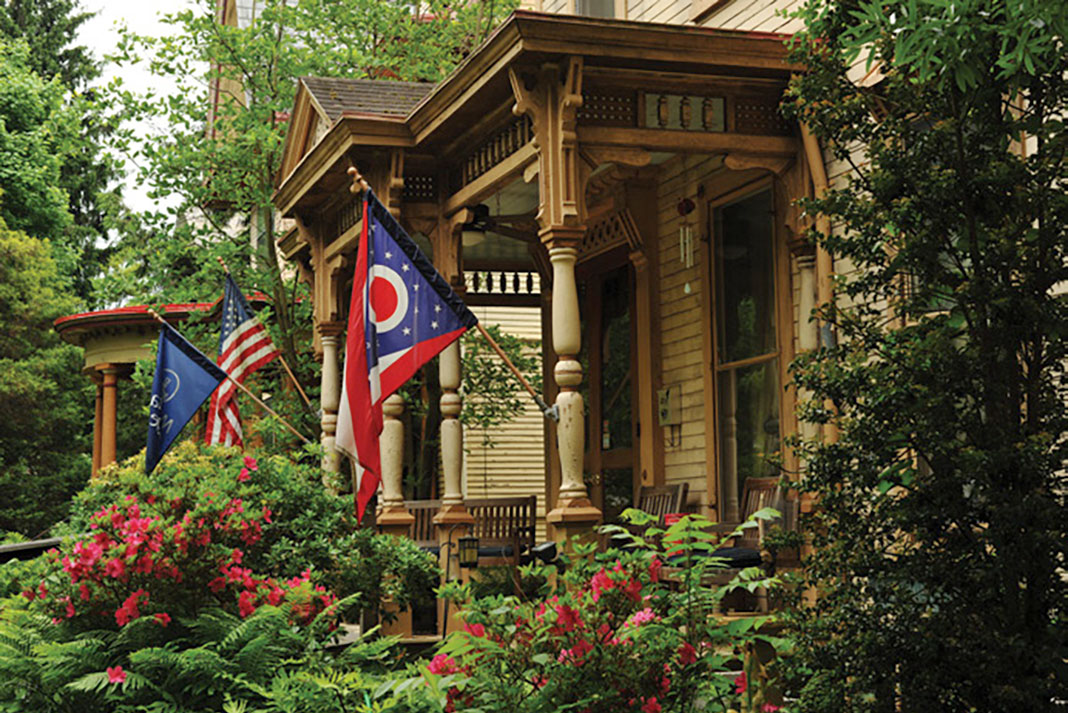
I meet up with Jones and his partner and co-instructor, Teresa Griffith, 59, out front of our unconventional workshop—a former J.C. Penny downtown department store. Just down the block, the Muskingum River slides lazily past leafy, redbrick streets lined with immaculate Victorian homes. In the dusty, disused accounting offices on the second floor, tall windows stream sunlight into a long room containing twin worktables and the piles of plywood sticks that I and one other student will transform into kayaks.
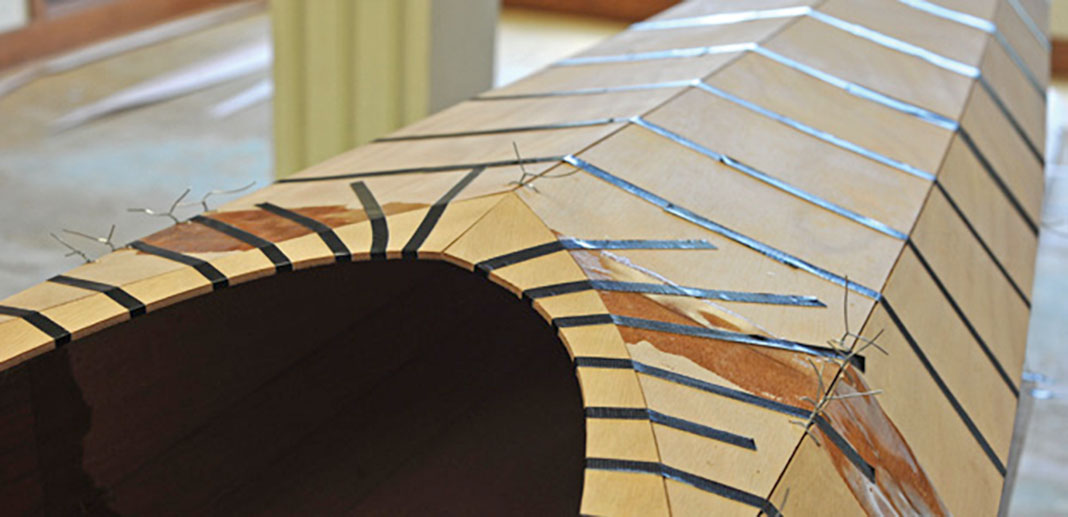
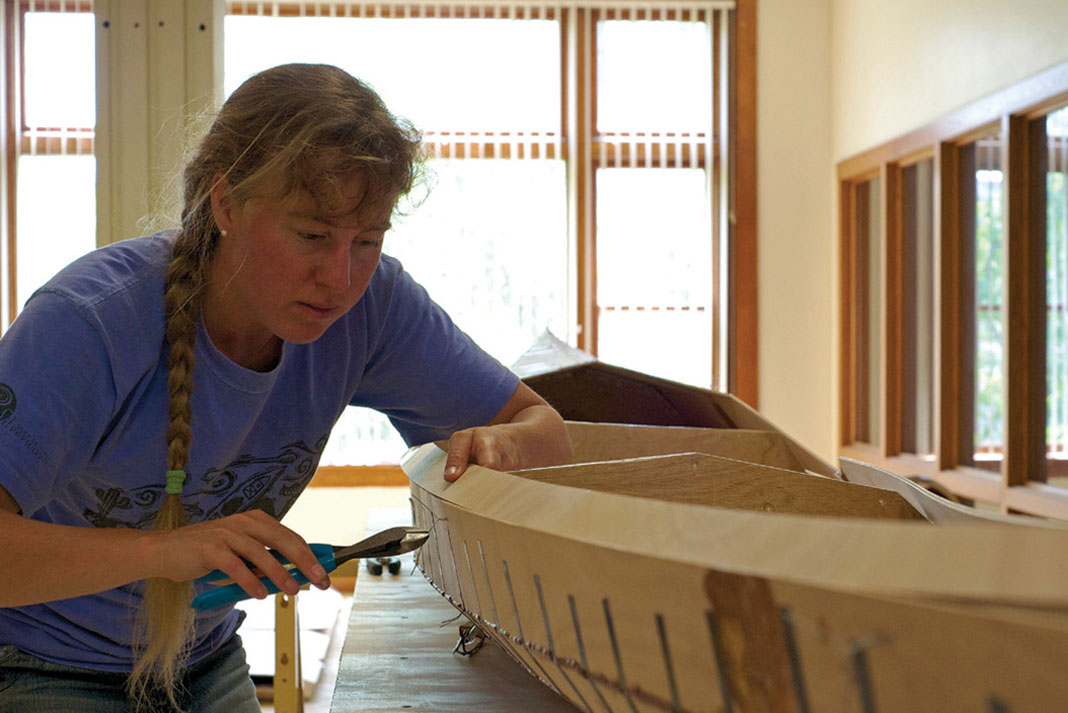
Gorilla Tape replaces many of the wires typically used in stitch- and-glue construction. | Photo: Virginia Marshall
Build a boat on your own, or with a workshop
For about half the price of a premium plastic kayak—or a quarter the cost of a comparably lightweight, high-performance composite boat—Pygmy kayak kits include pre-cut, plantation-grown African mahogany plywood panels, swaths of silky fiberglass cloth, coils of wire, jugs of epoxy, bags of wood flour, latex gloves, syringes and a 46-page instruction manual.
The only other tools Pygmy’s comprehensive builder’s guide promises I’ll need for the job—drill, file, wire snippers, pliers, hot glue gun, clamps, sandpaper, masking tape, utility knife, paint rollers and foam brushes—I assemble from neglected corners of my basement, closets and kitchen drawers.
Most Pygmy paddlers are reasonably enterprising individuals with the gumption—builders need not have any woodworking experience, everyone I talk to is quick to point out—to tackle the 80- to 100-hour commitment of building a stitch-and-glue kayak on their own. Many folks diligently cobble together months of evenings and weekends to complete these masterpieces. Helpful staff at Pygmy’s oceanfront headquarters in Port Townsend are only a phone call away should builders run into difficulty as their kayaks take shape in basements, garages and home workshops.
For perennial procrastinators, however, or those who are nervous about building a kayak on their own, Pygmy began offering weeklong workshops at Port Townsend’s Northwest Maritime Center in 2010. The classes, which are limited to six participants, have sold out for the last five years.
Laura Prendergast, marketing director at Pygmy, says students come from many different backgrounds, from teachers and truck drivers, to doctors and do-it-yourselfers who love the idea of a rewarding vacation where they come home with a kayak.
“For a lot of people, joining a class removes their fear,” she explains. “We’ve found the typical incubation period from when people learn about our kits to when they actually build a boat is about four years. But with the classes, we’ve had people learn about us for the first time and say ‘sign me up’ that day.”
When I heard that Pygmy had expanded the workshops for 2015 to include venues in Maine, Florida, Oregon and Ohio—and that Jones, who loaned Adventure Kayak the lovingly crafted Pygmy Murrelet to review, would be teaching the Marietta class—I called Prendergast and registered without hesitation.
“You don’t need any skill to build these boats, just patience,” Jones told me on our first fateful meeting. “If I can do it, anyone can.”
Since Lockwood launched Pygmy Boats from his garage in Port Townsend, Washington, in 1987, his designs have multiplied and diversified to include a fleet of 22 different kayaks, a wood canoe and a wherry rowing boat. Each promises the resourceful self-sufficiency of its creator. Lockwood, a nomad turned anthropologist-computer programmer turned boat designer, built his first stitch-and-glue kayak in 1971 after a five-month stint living off the land in a homemade teepee on the wild shores of British Columbia’s Queen Charlotte Islands.
History… | Photo: Virginia Marshall
Beauty… | Photo: Virginia Marshall
And a storied past. | Photo: Virginia Marshall
The story behind Pygmy Boats
It may be the more-fantastic-than-fiction trajectory of Lockwood’s life, as much as the allure of wooden boats, that captured Jones’ imagination, and mine. After several years of wandering the world’s wild places, first as a young itinerant and then serving in the military, Lockwood’s peregrinations ended abruptly in 1967 with a fall at a construction site, resulting in a shattered hip and a long-term dependence on crutches.
Four years later, armed with a Harvard education and a Klepper folding kayak—and seeking escape from academia, increasingly crowded wilderness and the limitations of his injury—Lockwood landed in the remote Queen Charlotte archipelago. The wood kayak that he built was light and tough to enable dragging over the islands’ barnacle-encrusted shores while hopping on his good leg.
The story might have ended there were it not for a decade-and-a-half journey that lead Lockwood south to Seattle, into the offices of IBM and Boeing as a computer programmer, and finally back to the water when he developed cutting-edge software for naval architecture. With this powerful tool, he could also design precision-cut plywood hulls on his personal computer. Lockwood sold three Queen Charlotte kits in 1986; a year later Pygmy was born and he shipped 45 kits to the company’s first crop of would-be builders.
Building a Pygmy boat
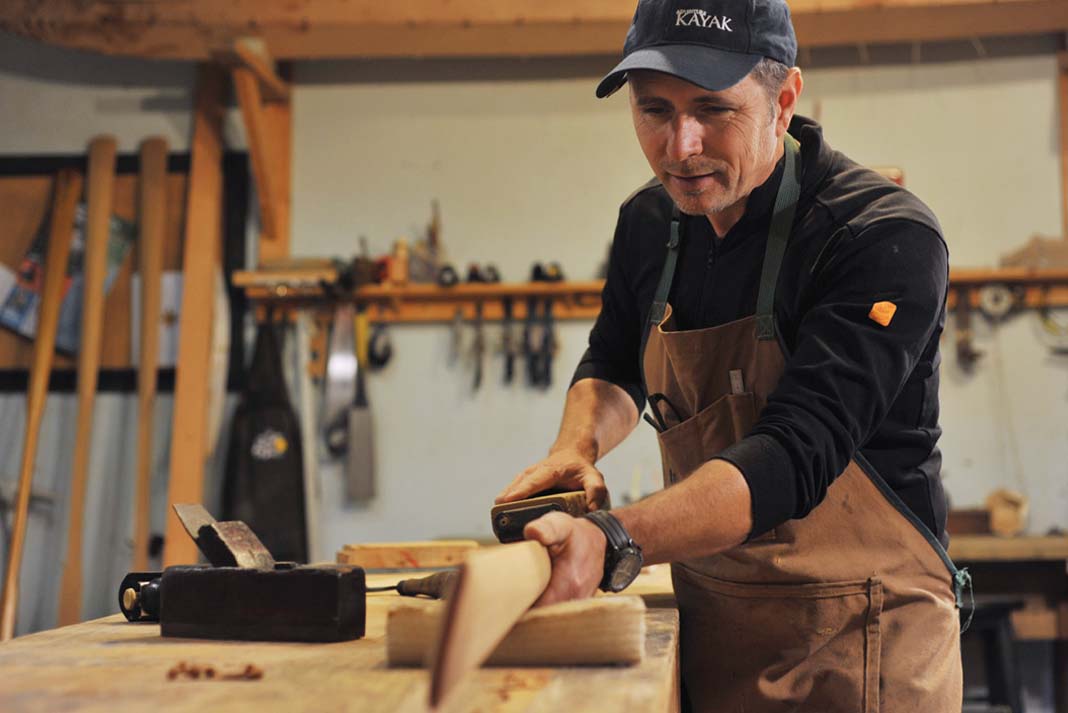
My first day in the workshop, I discover that I’m not quite as handy with a carpenter’s square, or as hopeless with a block planer, as I’d imagined. I’ve misused the former with some frequency, but I’ve never used a planer before beveling the edges on five of the kayak’s 15 delicate, plywood panels. Wood shavings fall in curlicues to the floor as the deck and hull panels are prepped to fit neatly together at the sheer line.
The 17-foot-long panels flop off either end of the table and must be carefully supported at this stage. “It’s the wood that gives a boat its shape and beauty,” says Jones, but four-millimeter plywood on its own is not particularly robust. “The fiberglass gives a boat strength and the epoxy binds everything together and makes the shell waterproof.”
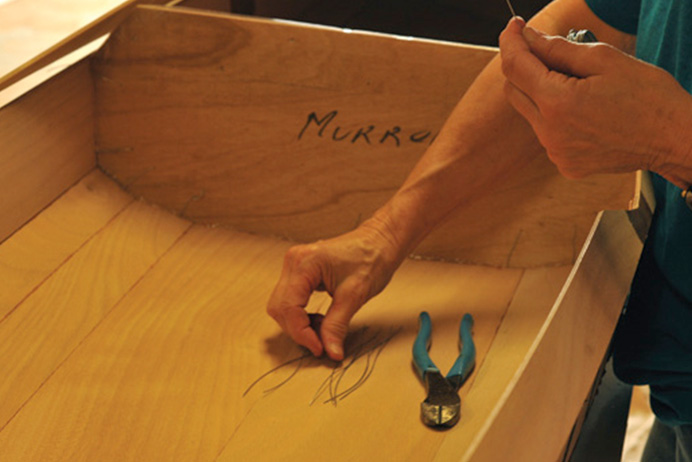
Wires are used to join key areas of the deck and hull. | Photo: Virginia Marshall
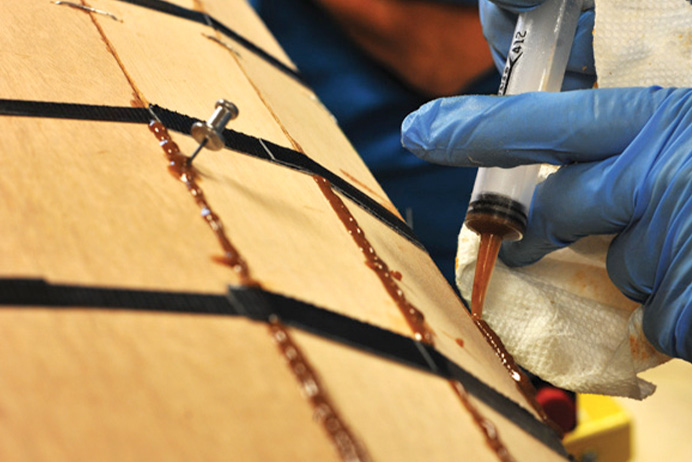
Shooting seams with epoxy bonds the panels permanently. | Photo: Virginia Marshall
We’re using Pygmy’s pioneering new Gorilla Tape method rather than the classic stitch-and-glue assembly. Instead of the hundreds of painstakingly twisted pieces of wire used in the stitch method, strips of super-sticky tape placed every few inches hold the panels together before the seams are joined with epoxy. It’s faster, less fiddly and works well for the rapid build of a weeklong workshop.
After putting in a full day in the workshop, I join Jones and Griffith for a tour of Marietta from the water—down to the confluence of the Muskingum and mighty Ohio rivers, and upstream to view the town’s historic paddlewheelers. I paddle Jones’ beloved Osprey HP, his second Pygmy build and still his favorite. The HP is “straight and fast, and doesn’t turn worth a damn,” he tells me, “but I’ve been in the shit in that boat and it performed beautifully.”
The class’s only other student, Richard Webber, is a quiet, fit, 67-year-old who has driven three days cross-country from Boulder, Colorado to build his kayak under Jones and Griffith’s watchful tutelage. He looks surprisingly refreshed.
Webber unpacks his old tools from new Tupperware containers. He builds Greenland and Aleutian paddles in his spare time, he tells us, which he uses for rolling and other traditional tricks. Like me, he’s never built a boat before. Also like me, he’s building the Murrelet 4PD—a performance touring and rolling design that he paddled only briefly at Pygmy’s Port Townsend showroom. He’s unhurried and efficient. He says “darn,” not “damn it,” even when he breaks a wire or snaps his third 1/16th bit. My concerns that the class will feel like a race melt away. Even with only two students, the workshop has a collaborative feel rather than a competitive one.
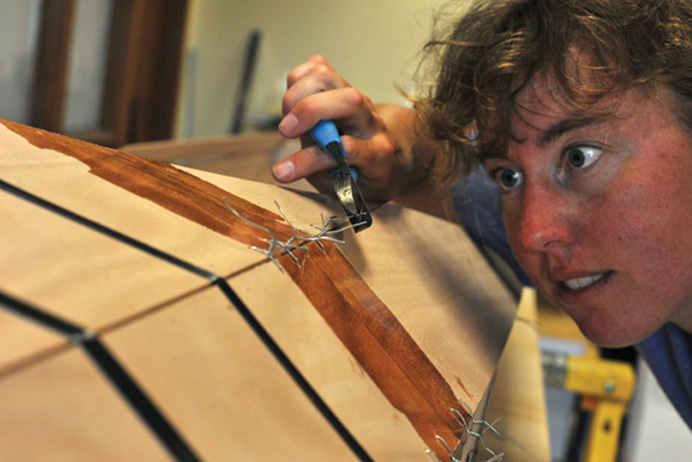
Day two brings the new challenge of working with epoxy. With eight long strips forming the multiple chines and shallow V, my hull actually resembles a boat now—an overturned half-boat, but a vessel nonetheless. We mix epoxy thickened and fortified with wood flour and shoot the seams using dental syringes.
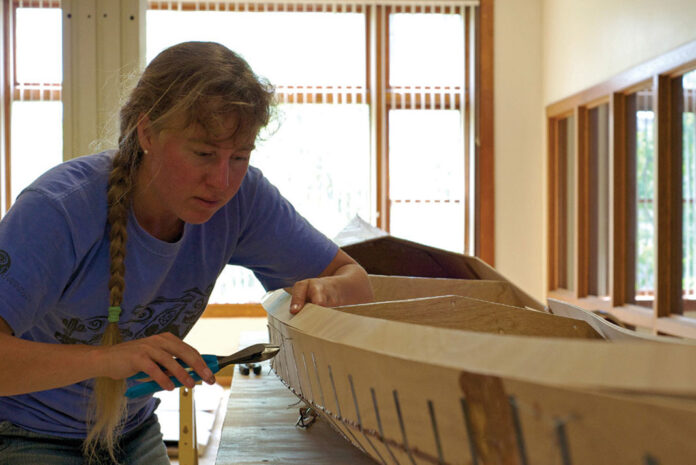
Absolute concentration, half-hearted confidence.| Photo: Virginia Marshall
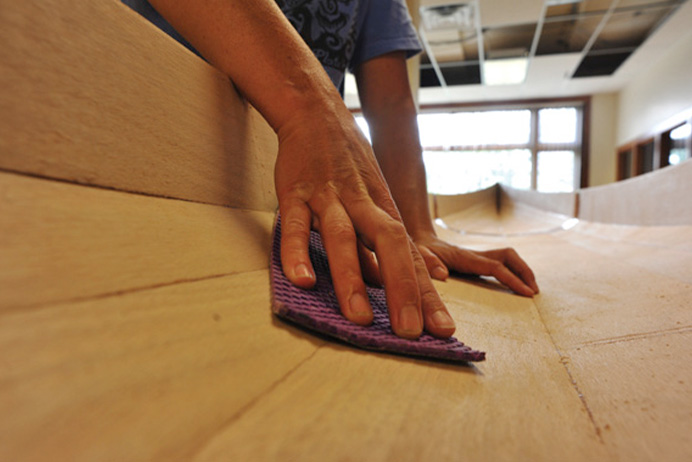
How smooth is smooth? | Photo: Virginia Marshall
At day’s end, I’m cross-eyed and head sore from nine hours of focusing on seams six inches from my face. My feet hurt. But nobody complains. We’ve joined what Griffith calls the Pygmy cult—building these boats feels like a privilege, no matter how painstaking.
I’ve been in love with the Murrelet’s lines since I first laid eyes on Jones’ boat two-and-a-half years ago: the sweeping bow, the cutaway front deck, the way the rear deck scoops gracefully down behind the cockpit for effortless rolling.
Jones describes assembling the Murrelet’s intricate cockpit area as a “wrestling match,” but it flows together nearly seamlessly. Pygmy kits don’t require the wood to be tortured—bent or manipulated into form—but instead fit perfectly together like puzzle pieces. And like Lockwood’s designs, the panels are almost miraculously well engineered.
By day three I have a full boat, but the accomplishment is temporary. Tomorrow we’ll remove the deck to complete interior work, then put it back on (then take it off again). Each step is logical, methodical, necessary. I’m learning boat building involves nearly as much tearing down as building up. I’m learning patience.
The days begin to blur. Our concentration is so absolute, an hour can pass without a word being exchanged aside from brief instructions—or more often, Jones’ Socratic questioning, “What’s the next step?”
On day four, we roll epoxy over the inside of the deck. The resin brings out the manuka honey-hued beauty of the Okoume mahogany’s grain—what Pygmy calls a “bright finish.” Webber mentions maybe painting his hull later for an alternative finish. Sacrilege.
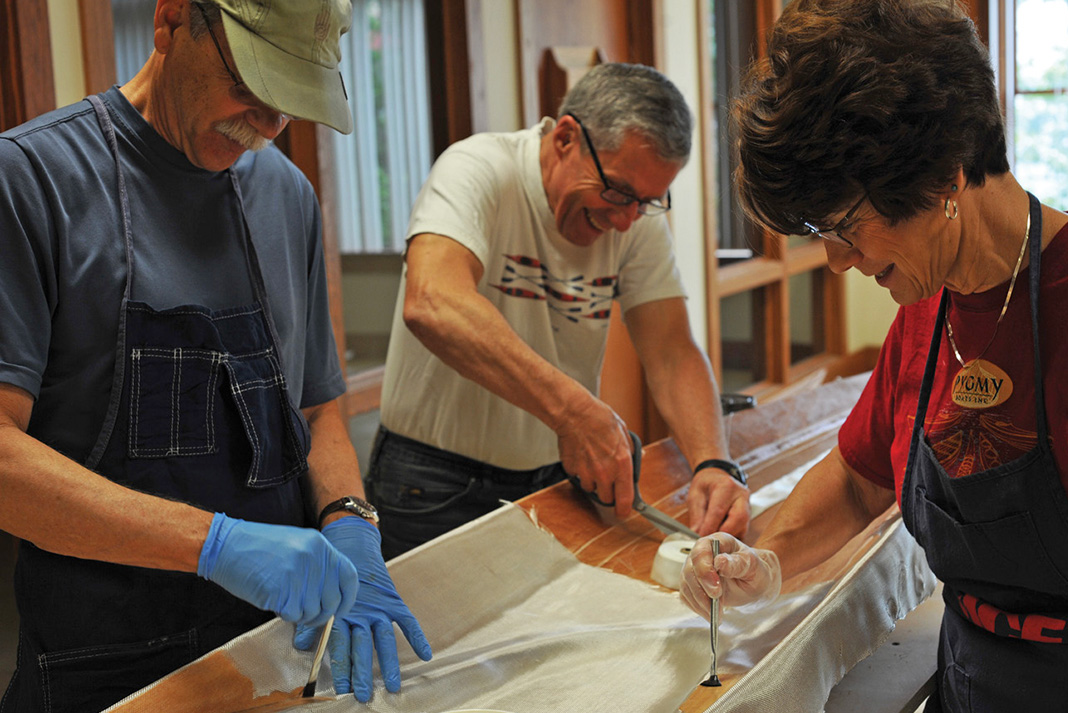
Webber, Jones and Griffith apply fiberglass and epoxy to the inside of Webber’s kayak deck.| Photo: Virginia Marshall
Day five’s main event is glassing the inside of the hull. First, however, the interior must be sanded to remove all bumps, divots and ridges. When it’s as perfectly smooth as a still pond, Jones calls in a friend and fellow builder from the Marietta Rowing and Cycling Club to assist with glassing. The fiberglass is a 24-foot-long by several feet wide roll, and it’s slippery as an eel. We drape it over the boat, coaxing it into the keel and chines.
“When you do your outside deck and hull at home, get some friends to help. Make it a glassing party,” advises Jones. “It just makes it so much easier. You want five people: two to roll on the epoxy, two to follow with squeegees and brushes to work out any air pockets, and one to mix epoxy.”
It’s a wonderful vision: the glue saturating the fiberglass and turning the cloth translucent to reveal the golden mahogany. Rollers fly, elbows bump, heads bow and the hull glows. My latex-clad fingers stick to the roller handle. When I try to pass it to someone, I find it’s glued to my hand.
“This is the most perfect inside hull glassing I’ve ever seen,” Jones says when we’ve finished with my kayak. Webber’s face crinkles into a smile. “I thought this was the practice boat,” he teases.
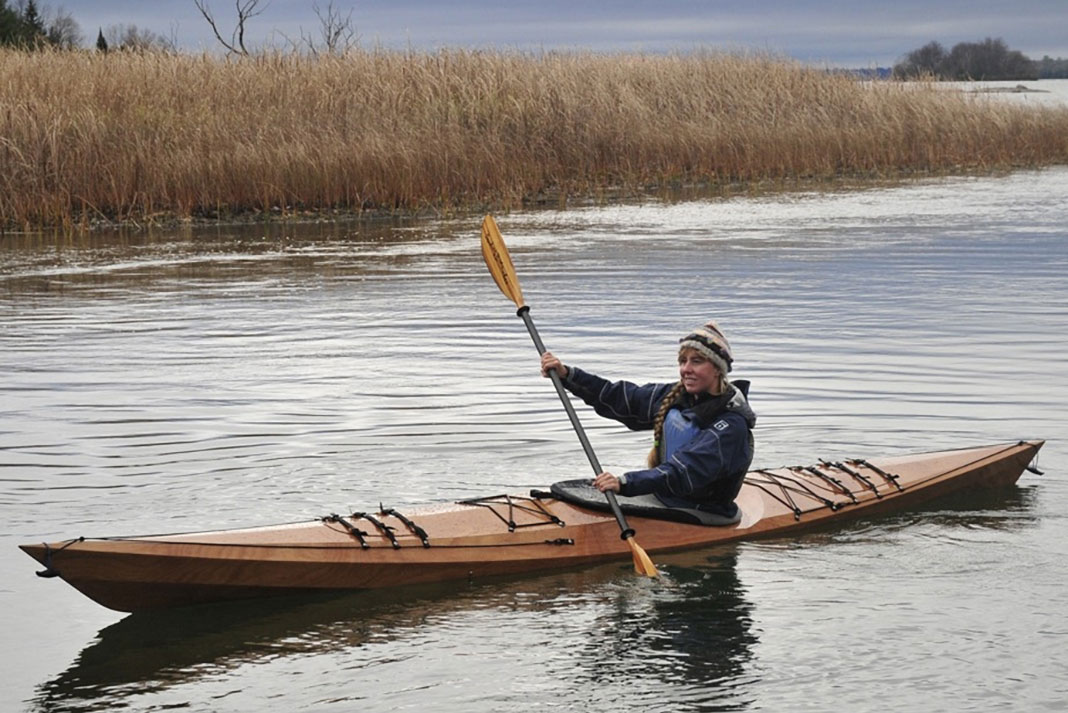
Who wouldn’t want to build (and paddle) this boat? | Photo: Virginia Marshall
Taking it home
One week is just enough time to assemble the kayak’s basic structure. Major finishing steps like sanding and glassing the exterior, cutting hatches and installing the coaming and outfitting must still be completed in students’ basements and garages. Theoretically.
“We should offer follow-up classes for all the folks who take them home and never finish them,” muses Griffith. She cites students and friends who are still tinkering—or procrastinating— six months, a year and two years later.
Inwardly, I worry this will be me. “Well, life gets in the way,” Griffith concedes.
“Then you’ve got your priorities wrong,” Jones retorts, only half kidding.
Webber tells me that he plans to finish his boat as soon as he gets back to Colorado. “I want to paddle it this summer,” he enthuses. I think of all my other obligations when I return home— my priorities will be a juggling act. I hope I don’t drop the ball.
On the last night, Jones and Griffith invite both of us for dinner— delicious New Mexican cuisine, a throwback to Jones’ boyhood in Albuquerque, and Sangria with home-brewed Moscato wine. Over green chili sauce-drenched enchiladas, Jones reviews the steps we’ll follow to complete our boats, adding his own tips and tricks to the Pygmy manual.
Two weeks later, when I hit hour 16 of a marathon sanding session to prepare the kayak for final glassing, I’m wondering—as Webber did in class so many days ago—‘how smooth is smooth?’ This time, I don’t have Jones’ knowledgeable hands to caress the sanded seams and give a pleased nod or shake his head and join me with his own rasp.
Finally, I do the sensible thing. I call Jones for reassurance, then Webber.
Jones is sympathetic but firm. “Scraping the seams is a pain in the ass, it really is,” he admits, before coaching me on tools and technique. I’m starting to feel better.
Webber shares the highs and lows of his own sanding trials—from hours of fruitless hand sanding and resigning himself to hiding the imperfections with paint, to embracing the power sander and finally getting the hull fiberglass- and varnish-ready. “I’m anxious to get it in the water,” he concedes, but like me, he’s learning patience.
The author’s Pygmy kayak begins to take shape. | Feature photo: Virginia Marshall
Before the course, Webber says he was intimidated by the idea of building a kayak on his own. Empowered by our time in the workshop, he’s pushed past those fears. “But I’m still feeling nervous about this next step,” he confesses.
I now feel much better. We promise to exchange photos of our finished kayaks at the end of the summer.
Joining this workshop, I realize, has brought more than just another kayak into my life—it’s also connected me with a wonderful community of builder-paddlers who, like my nascent Murrelet, I’ll cherish for years to come.
This article was first published in the Fall 2015 issue of Adventure Kayak Magazine. Subscribe to Paddling Magazine’s print and digital editions, or browse the archives.
The author’s Pygmy kayak begins to take shape. | Feature photo: Virginia Marshall


 This article originally appeared in the 2016 Paddling Buyer’s Guide issue.

 This article first appeared in the Fall 2015 issue of Adventure Kayak magazine.