TAKING LIFE WITH A GRAIN OF SALT,
A SLICE OF LIMITED LIME, AND A
SHOT OF ADRENALINE. | PHOTO: ROB FAUBERT
After a five-day trip on the Gates of Lodore section of the Green River, Utah, I flew home determined to return the following summer with my family and friends. I was so taken with canyon rafting, I built the ultimate canyon rig for a feature in Rapid—a two-part series in which we outfitted an AIRE 156R with an frame, boxes, coolers, dry bags and pretty much everything we’d need for 21 days in the Grand Canyon. I had big dreams.
My dreams and my Ultimate Canyon Rig were a little too big for our local rivers. On western rivers, you drive your raft right to the river’s edge. A fully rigged 16-footer is too much for my wife and I and two little kids to carry down the remote access and portage trails of our local rivers. And the ginormous 22-inch tubes were overkill for our lower volume runs.
I should have ordered the AIRE 143D.
AIRE released the 143D way back in ’99, the same year we released the first issue of Rapid. After 17 years it’s still one of AIRE’s best-selling shapes and sizes, with only a few improvements along the way. In 2008, AIRE added the frame chafe strip—the gray patch where you’d anchor the frame or rest your butt. In 2012 they created more durable and replaceable handles. This year, the 143D is available in vivid Limited Lime.
The 143D name says it all. It measures 14 feet, three inches long and the D stands for diminished tubes, meaning at the bow and stern the tubes diminish in size from 20 inches to 17.25 inches. Diminished tubes mean more rocker, a shorter waterline, less weight, more maneuverability and a more exciting ride.
TAKING LIFE WITH A GRAIN OF SALT, A SLICE OF LIMITED LIME, AND A SHOT OF ADRENALINE. | PHOTO: ROB FAUBERT
The 143D, like all AIRE rafts, is constructed with a PVC outer skin with zippered compartments and four AIREcell urethane bladders inside the collar, and another bladder in the floor. AIRE offers two different self-draining floor options. We opted for the standard floor with drains. Water enters these drain holes and acts as a ballast. The sealed floor pocket option is better for silty rivers, rivers that require portages and trips when you’re carrying enough gear to act as ballast.
While my original raft, the 156R, may be great for long vacations, the 143D is the perfect all-rounder. For the last three years Rapid has raced a 143D at our local Hell or High Water raft race. It’s been on family day runs and this past fall it joined a five-day technical river trip rigged with NRS’s Compact Outfitter Frame, one big cooler and more gear than we truly needed.
If your backyard is full of steep, low volume technical creeks, AIRE offers their Puma series of very narrow, super rockered, highly maneuverable inflatables. For big rivers, maximum stability and rowing tons of gear, we’re not getting rid of our 156R—no way. But for paddle guiding most of our rivers, most of the time, the 143D is just right. And when our ticket for the Canyon finally gets pulled, the frame will go back on and we’ll take it there too.
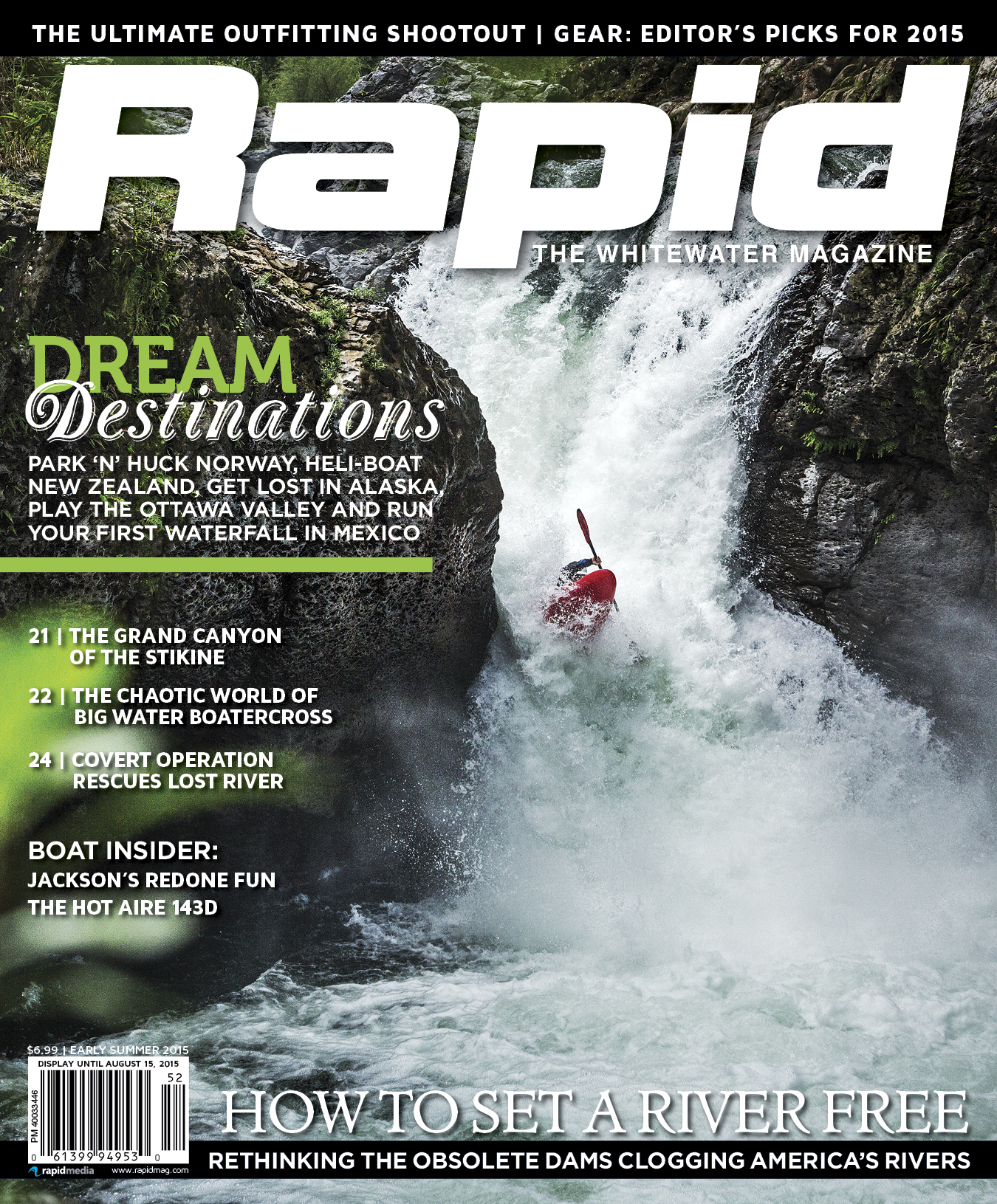
This article first appeared in the Early Summer 2015 issue of Rapid Magazine.
Subscribe to Paddling Magazine and get 25 years of digital magazine archives including our legacy titles: Rapid, Adventure Kayak and Canoeroots.
Leave your fears behind when you enter the wilderness. | Feature photo: Jen Gardiner
One of the scariest movies I ever watched as a young teenager was horror flick The Blair Witch Project. It scared the crap out of me.
For those unfamiliar with this indie-flick phenomenon, let me fill you in. One of the first in the found-footage genre, the mock documentary follows three filmmakers on a remote hike as they’re terrorized by a ghost.
After becoming hopelessly lost, the threesome find spooky stick figures hanging from trees, are awoken by shrieking in the night, and one morning they find teeth outside their tent. Sound silly? Trust me, it’s creepy. An online marketing campaign created even more buzz, making it appear as if the film was non-fiction.
Fast-forward three months. I’m on a solo overnight as part of a month-long outdoor education course. I don’t know whether to feel safe or terrified by the isolation of my little island paradise.
As the sun set, the same question kept racing through my mind: Do Blair witches swim?
Leave your fears behind when you enter the wilderness. | Feature photo: Jen Gardiner
How to banish your biggest wilderness fears
Hollywood movies would have us believing that bears, boogeymen and banjo-playing locals lurk around every corner of the portage trail. With just a little imagination, it can be easy to stir up latent fears of the unknown wilderness and all things that go bump in the night. An ill-timed snap of a twig can turn the forest’s enveloping darkness from a cozy comforter into a suffocating shroud.
Few outdoorsy types talk about it, but we all experience fear in the wilderness at one time or another. Due to our own vulnerability while alone in the dark, fear can be described as a perfect evolutionary survival trait, but in the embrace of the morning sun, we still feel a little foolish.
In truth, there are more scary specters in the wilderness than Blair witches and creatures from the Black Lagoon. Spinal injuries, animal attacks, and being hit by lightning are some of the most common fears I’ve heard outdoor enthusiasts discuss. Those are more rational concerns, for sure, but almost equally as unlikely to befall a recreational paddler.
In the Early Summer issue of Canoeroots, we look at some of these widespread wilderness fears and explore whether they’re legit or bogus. It didn’t surprise us to discover that many of the dangers we spend the most time worrying about are the ones least likely to affect us. We spend so much time shielding ourselves against mega-disaster, we neglect to realize that we’re in far greater danger of spraining an ankle than ever encountering a bear—let alone an aggressive mama bruin.
The fact is, with the right equipment and attitude, the wilderness is one of the safest places to be.
Kaydi Pyette is the editor of Canoeroots. She requests that you keep your ghost stories to yourself, thank you very much.
This article was first published in the Early Summer 2015 issue of Canoeroots Magazine. Subscribe to Paddling Magazine’s print and digital editions, or browse the archives.
Leave your fears behind when you enter the wilderness. | Feature photo: Jen Gardiner
When Australian adventurer Mark Kalch completed an epic, 153-day source-to-sea descent of the Amazon River in 2008, he had no idea the expedition would become the springboard for 7 Rivers, 7 Continents—a bid to paddle the longest rivers on each continent. Now based in Buenos Aires, Argentina, with his girlfriend and three young children, Kalch has turned adventure into a full-time vocation.
In 2012, he paddled the Missouri-Mississippi Rivers, and in 2014 he made a first solo descent of Russia’s 2,300-mile Volga River. Off the river, he stays busy researching and planning the next leg, and sharing trip stories and images.
[ Plan your next kayak or canoe adventure with the Paddling Trip Guide ]
Adventure Kayak: Tell me a bit about what you’re up to right now?
Mark Kalch: Right now (and for the last two years) I have been living in Buenos Aires, Argentina. We (myself, my girlfriend and our three children under the age of 5) find ourselves here by virtue of my partner’s job as a diplomat. It is a real mega-city and not exactly helpful in connecting easily with the outdoors.
However, where there is a will there is a way and I paddle at least a few times a week on the enormous Rio de la Plata. Of course the country as a whole offers world-class paddling and outdoor experiences. We spent a month camping and paddling in Patagonia earlier this year which was fantastic. To be able to share this experience with the children was beautiful.
I am kept busy here by trying to constantly hone my paddling skills, be that kayaking or more recently SUP, attempting to write my first book about my Volga River descent, staying in touch with sponsors, developing my own paddling apparel brand, Paddlers First, and planning for my next big river descent as part of my 7 Rivers, 7 Continents project.
AK: Where did the idea for 7 Rivers, 7 Continents come from? Why paddling expeditions?
MK: It was an idea which kind of just grew out of a desire to continue undertaking long and sometimes difficult journeys after the completion of our source to sea descent of the Amazon River in 2008. In 2010, I walked alone across the entire Islamic Republic of Iran from the Caspian Sea in the north to the Persian Gulf in the south. A really amazing journey in a beautiful country. I was somewhat stumped in deciding what to do next.
After tossing around ideas for climbing mountains in Afghanistan and Pakistan, my girlfriend suggested a longer term project whose successive expeditions were linked. Why not the longest river on each continent, she thought? I was immediately hooked. With the Amazon River, South America’s longest river, already completed it was a great springboard from which to launch. Now the project is such a huge part of my life, I am not sure how there could have been any other option.
Why paddling expeditions? The greatest civilizations in history and indeed modern times have sprung and flourished alongside them. Cities, towns, villages and communities exist where they do in large part down to rivers. They provided a means of transport, trade, power, food and water. Even now the impact they have on our planet is immense. To paddle down huge rivers like the Amazon, the Volga, the Missouri and the Yangtze is an opportunity to experience and understand this impact first-hand. Oh, and mostly I just really like paddling!
AK: What were the most surprising aspects of your Volga trip? How did your preconceptions of Russia and its people compare with the reality?
MK: I think the number one most surprising thing was the absolute beauty of the river. I had expected to come across a much higher level of pollution and degradation of the river. At least, on a visual scale, it appeared for the most part pristine. Unfortunately, environmental studies have shown that the strains on the river due to agricultural, household and industrial pollutants are massive and ever increasing.
I grew up in Australia throughout the end of the Cold War. As in most Western countries, I was fed a media biased view of a menacing and cold Soviet Union, grey industrial cities and a population to match. Despite being fully conscious of this narrow view and completing extensive research, it is still hard to know what to expect. I really had no clear idea what I would encounter.
Fortunately, the Russia I experienced was in its beauty and hospitality far greater than anything I could have imagined. In all my journeys and travel I do not think I have been cared for and welcomed in such a way. It really became quite surreal as each day afforded me ever more amazing paddling and the opportunity to meet such friendly people of the Volga. Whenever I talk about my Volga descent I get the feeling that people must think I am exaggerating. Happily I am not.
AK: Tell me about what’s going on in this photo. Why are you grinning so widely!?
MK: Ha, ha! What a photo! It really does kind of sum up my Volga descent. I had spent the last five or six days really battling the weather on the river. Constant rain, massive headwinds, powerful storms and this huge waterway to paddle. The day previous I had been forced to make camp early just due to the incessant wind. I am not one to capitulate easily to the elements and rather enjoy the challenge but the sheer effort had really become counter-productive. I found a good camp and rested up.
The following morning, in order to get an early start I skipped my usual power breakfast of oats, raisins and strong coffee, instead grabbed some extra chocolate bars for sustenance. Rookie error. A few hours into the day I bonked (massive fatigue set in). I was angry at myself for the mistake but had not much option but to paddle on. I had hoped to make it past the city of Ulyanovsk that day, but realized I would have to settle for being happy to actually reach it.
In late afternoon, I approached its outskirts and began scouting for a place to camp. With few options presenting themselves, a night beside an old factory looked promising enough. As I floated closer, between the trees a man appeared. He waved and shouted a greeting, motioning for me to come ashore. Utilizing my faltering Russian language skills, I understood that Dmitri wished for me to take out right there. I did so gladly. Within a few minutes Dmitri had introduced himself, his brother and various friends. Dmitri and his brother, who spoke very good English, were working on their dacha situated on the banks of the Volga River. They were renovating some of the buildings within the compound, as well as cultivating a burgeoning and impressive organic vegetable garden.
It was quickly established that I would be staying in their dacha. But first Dmitri insisted on taking me on a driving tour of Ulyanovsk, most famous as the birthplace of Lenin. Upon our return, Dmitri informed me that evening we would be having dinner at the dacha with a group of their friends. Before eating, however, I needed to be introduced to the ubiquitous Russian banya, or sauna.
My new friends prepared the stone-walled and rather authentic looking banya by stoking a fire to unbelievably high temperatures. Then it was time to strip naked and see how long we could bear the intense heat. On Dmitri’s order, we filed naked down to the Volga and dived into its cold water. In winter, they must cut a hole in the fully frozen river to attempt the same. We repeated this once more before Dmitri asked his brother to translate something for me: “Mark, now there will be some pain.” What the…? The boys produced branches from a birch tree and proceeded to whip the living daylights out of me in the banya—front, back and sides. He was right, there was some bloody pain! Once more into the Volga and done.
A huge dinner, friends, laughing, beer and vodka followed. We talked endlessly about my journey, Russia, the West, everything. It was an experience that I continue to treasure. In the space of a few minutes I had gone from the prospect of camping beside a dismal old factory to one of the best nights on my entire journey. Hence the big smile!
AK: Why do you do these trips? What keeps you motivated to leave family and friends behind for months at a stretch?
MK: It is always difficult to pin down exactly why I do these trips. I would say that, from a personal perspective, I really enjoy the simplicity of life on a big river. After that initial period of transition from the “comfortable” life of the real world, the attraction of having to focus on only a very small number of needs is wonderful. Stay dry, stay watered, stay fed, paddle and explore. I like that.
I also very much enjoy sharing images and stories from my trips. I have made, since the Amazon, effort to deflect some of the focus of my journeys from me, the “hero,” to the river, its people and surrounds. The dashing adventurer narrative is just one tiny and often very much overused part of these expeditions.
I repeat over and over in interviews, articles and updates that by far the most difficult thing for me in all of my journeys is leaving my family. It really is. I enjoy battling and sometimes working with the river to follow its course. That is the easy part. It is more or less a holiday for me. But not seeing the kids is tough. So why keep leaving them? My passion for experiencing this planet was instilled in me by my father who was awed by the Earth’s wonders, natural and man-made. I hope that the kids, seeing me explore such amazing places and bringing back stories, will also share this wonderment.
AK: Why make adventure your full-time job?
MK: I think primarily for me the advantage is the amount of time I can spend researching, planning and undertaking my journeys. I spend a lot of time learning about not just the river I am to paddle, but the regions or countries through which it will pass, and also the people and cultures I will be fortunate to meet and experience.
It also means that I can develop good relationships with my sponsors who see me as a full-time paddler that can represent their brand in a credible light. Their support over the years has allowed me to keep the costs for my descents down as much as possible.
Perhaps less wisely from an exposure perspective, I attach little fanfare or media chasing to my 7 Rivers project. I paddle my rivers, share interesting stories and images, then if people get in touch with me I am more than happy to oblige. To me, a meaningful interview with Adventure Kayak is worth 100 times in value a time filler TV slot or a few inches in a national newspaper. This attitude does hurt me financially, but I feel more comfortable with it. I have too many paddling friends around the world who are doing amazing journeys and don’t feel compelled to let everyone know how awesome they are.
Five W’s with Mark Kalch
AK: You mentioned in an interview with Alastair Humphreys that you could have—maybe should have—paddled the second or seventh longest rivers, and the experience would have been quite similar. Do the stresses of this project becoming a race detract from your enjoyment when you’re out there?
MK: The stress of a potential race does not detract from my enjoyment when I am on-river. I remain blissfully and purposefully unaware of the “real world” back home when I am paddling. However, yes, I do not enjoy the prospect of a race. I have nothing against fast descents; for some people that is their thing, they are paddling machines. I am often in awe of them. I feel like a bit of a monster paddler myself and love going hard out, but it is not my interest.
It was during our Amazon River descent in 2007, which began as a purely river focused and adrenalin-packed adventure that I realized there can be so much more to these journeys than just paddling. Having to complete these rivers from source to sea within the time dictated to me by my visa length pains me no end. I want my descents to take longer. I want to be able to stay with new friends, I want to be able to explore farther beyond the river bank, get lost walking through towns and cities, understand my surroundings and how these mighty rivers have impacted it all.
Can you imagine blasting down the Yangtze River, or any big river, to the ocean and all but ignoring the thousands of years of history and culture to be found?
AK: What’s next? Which river will you tackle in 2016?
MK: It really is dependent on so many things. Family, finance, preparation, and water levels or season are most pertinent. I am really excited by the Yangtze River in China. It is a touch under 4,000 miles in length. The Upper Yangtze has some really very difficult sections, to say the least. The lower is stifled by dams and becomes huge in width and volume. The impact that this river has had on the development of China is overwhelming. I really look forward to paddling it.
Another option, at just under 3,000 miles, is the Murray-Darling River in Australia. I have probably been a little dismissive of my own country’s longest river, but recently I have taken a step back and really appreciated the waterway a lot more. It passes through some of Australia’s most spectacular wilderness areas and takes a paddler past towns and regions made famous by European exploration of the continent. Throw in some of the world’s most deadly snakes and spiders and it now sounds pretty exciting to me.
This article first appeared in the Fall 2015 issue of Adventure Kayak magazine.
Subscribe to Paddling Magazine and get 25 years of digital magazine archives including our legacy titles: Rapid, Adventure Kayak and Canoeroots.
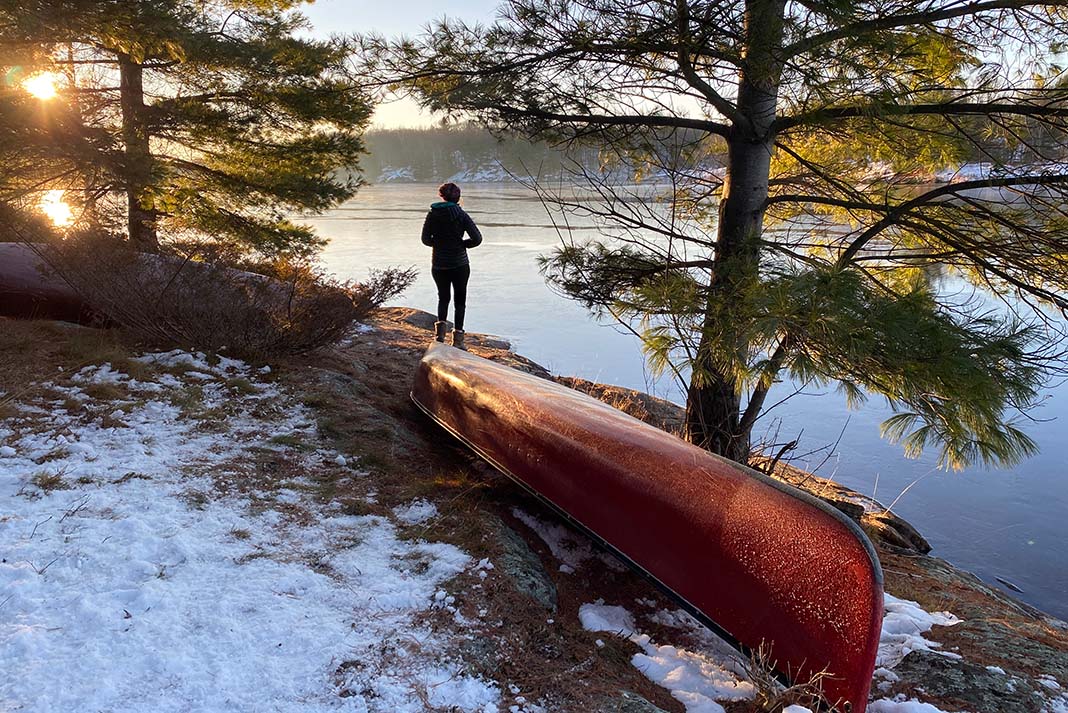
Current Designs Equinox GT | Photo: Virginia Marshall
My least favorite memory of a Current Designs Solstice GT is an image of a lime green boat rested against my own, both rising and falling in a stomach-churning morning swell, its occupant spewing eggs Benedict across my lap. My fondest memory is of that same boat and paddler three days later, charging skilfully through a sea of whitecaps.
[ Paddling Buyer’s Guide: View all sea and touring kayaks ]
I’ve met perhaps more paddlers in Solstices than any other kayak. From the quiet passages of the Discovery Islands, to the inland shores of the Great Lakes and beyond to the rugged Maine Coast, the Solstice GT is ubiquitous wherever touring kayakers are found.
First launched in 1984, its classic blend of stability, speed, reasonable maneuverability and gear-swallowing storage has made it one of the best-selling boats of all time.
For the growing numbers of paddlers who venture out for only a week or less, however, those ample hatches are often largely empty. Enter the Equinox GT.
Noticing the trend to shorter trips—and shorter boats—Current Designs recognized an opportunity. “We knew we had a winning hull and a winning design,” says vice president Bill Kueper, “so we just scaled it down.”
At nearly two feet shorter, the 16-foot Equinox GT has the same roomy 24-inch beam (a lower volume, 22-inch-wide GTS version offers a sportier fit), shallow-V hull and soft chines for rock-solid initial stability and smooth edging.
In a family hailed for superb acceleration and glide, the Equinox’s shorter waterline actually makes for even greater efficiency at a comfortably sustained touring pace of three to four knots. Tracking with or without the rudder is excellent, adding to the effortless feel of open-water cruising.
Above the water, the sleek and practical deck layout will also look familiar to Solstice paddlers. Color-matched, flush-mount hatch covers, recessed deck fittings and reflective decklines round out Current Designs’ flawless composite layup. Our Kevlar Equinox felt lighter than its listed 47 pounds and its impeccable regatta blue finish attracted admiring glances from gas station attendants and fellow paddlers.
Current Designs Equinox GT | PHOTO: VIRGINIA MARSHALL
Larger boaters will find plenty of room in the keyhole cockpit for all-day comfort. Outfitting is classic West Coast influence, with a cushy padded seat, supportive backrest and high knee position. The rudder control lines are easy to reach and route below the back deck to prevent snags during rescues and transport.
Efficiently sized for today’s shorter trips, the Equinox GT rewards touring kayakers with the same user-friendly features that Solstice paddlers have been enjoying for three decades. In fact, the only real surprise is that it took Current Designs this long to build it.
The SEA-LECT Designs foot braces can be easily adjusted while seated, and use a pivoting pedal to control the rudder without compromising strong leg drive.
Photos: Virginia Marshall
Trip equipped
Although the Equinox GT is marketed for shorter trips, folks who’ve packed low-volume Brit or Greenland boats will find ample room in the voluminous bow and stern hatches for a week’s or more worth of supplies. Current Designs’ triple cam strap system takes a bit more time to secure, but our hatches were bone-dry.
Creature comforts
Integrated thigh braces, plenty of hip room and a slightly scooped seat are designed to optimize fit for a wide range of paddlers, and keep bottoms happy after a full day in the saddle.
This article first appeared in the Spring 2015 issue of Adventure Kayak magazine. Subscribe to Paddling Magazine and get 25 years of digital magazine archives including our legacy titles: Rapid, Adventure Kayak and Canoeroots.
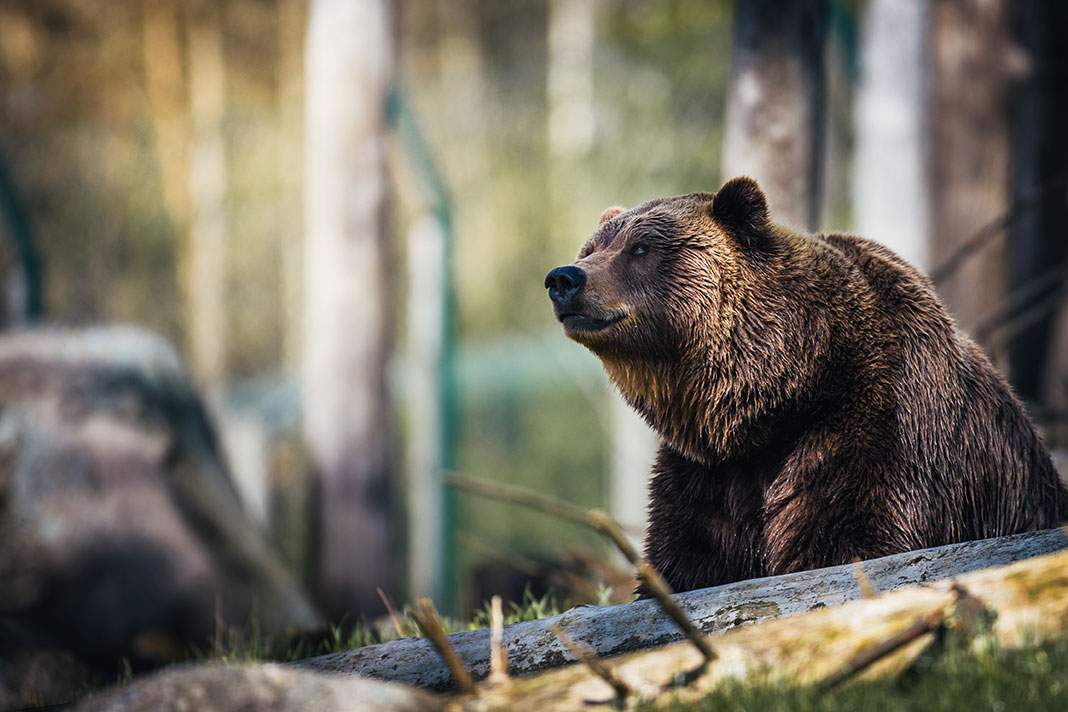
“HEY BEAR!!!” we hollered, lifting our boats to look bigger and banging pots together. The bear stopped. We sighed with relief. Then he stood on his hind legs for a better view, revealing his true, monstrous size. I swallowed hard. He dropped down and continued inching towards us, now less than 50 feet away.
Protected by a cluster of national parks that make up one of the largest UNESCO World Heritage Sites on Earth, the Alsek River is home to one of the highest densities of grizzly bears anywhere. And the scenery is second to none.
From its source on the eastern part of Kluane National Park, the Alsek flows west and south, straight through the heart of the St. Elias Mountains, draining the largest non-polar ice fields and flowing through some of the biggest mountains—measured in relief and size of the massif—in the world.
A fast flowing glacial river, the Alsek’s class IV whitewater is interrupted by a six-mile chasm where the massive Tweedsmuir Glacier pushed bedrock into Blackadar Mountain resulting in the frothing and pulsing class V+ Turnback Canyon—first descended in 1971 in a daring high water solo by iconic paddler Walt Blackadar.
In his memoires of the trip Blackadar writes that Turnback should never be attempted again. Subsequent descents have taken place at much lower water but most parties opt to helicopter around it.
Labyrinths of icebergs and rugged, barren canyons appear to be of another planet altogether.
Locked in a staring match with the griz that was lasting far too long, we were all too aware of our remoteness.
Apparently deciding we weren’t worth the trouble, the bear finally dropped down, turned around and lumbered across the Alsek’s otherworldly terrain. We decided we didn’t need coffee with our breakfast that morning.
If you’re curious…
Take a guided raft trip on the Upper Alsek or on the Tatshenshini, a tributary that joins the Alsek 40 kilometers below Turnback Canyon (www.nahanni.com).
If you’re serious…
For self-supported kayak trips, you need a permit for Wrangell-St. Elias Park (search “Alsek Permit,” at www.nps.gov). Then get permits for Kluane National Park and B.C.’s Tatshenshini-Alsek Provincial Park.
The river crosses an international boarder—you have to go through customs beforehand. From the take-out at Dry Bay, the only way back to civilization is by plane (www.flydrake.com).
PHOTOS: MAXI KNIEWASSER
What To Bring
Bear spray. There are a lot of big, hungry grizzlies on the Alsek!
A good tent. Weather can be extremely harsh; be prepared for multi-day rain and snow.
Whisky and hot chocolate. See above re: extremely harsh weather.
Map of the Alsek and Tatshenshini Rivers. Hand-drawn to scale maps by Cloudburst Productions.
Never Turn Back by Walt Blackadar. The best book to read on this trip.
This article first appeared in the Early Summer 2015 issue of Rapid Magazine.
Subscribe to Paddling Magazine and get 25 years of digital magazine archives including our legacy titles: Rapid, Adventure Kayak and Canoeroots.
Shipwright Louis Sauzedde shows us a few ways to tie a bowline as well as the many different uses of this famous knot. Fast and versatile, the bowline could be the most useful knot you will ever learn for camping and paddling. It will not slip, and easily comes undone even after being tightened under load.
Soaring over azure water flowing through granite gorges from the Southern Alps to the Pacific Ocean, it’s hard to argue with the locals who claim this is the best place on earth.
The west coast of New Zealand’s strikingly scenic South Island is, in a word, pure.
Unsullied rivers of drinkable water cut through a region characterized by rainfall, lush forest and sparse population. With much of the landscape unaltered by human touch, roads are often not an option for access. Instead, helicopters are a standard shuttle service.
It’s an experience Barny Young will never tire of. A North Island native who transplanted south to West Coast kayaking hub Hokitika, Young says heli shuttles are part of what makes the area bucket-list material.
After a drop off at the put-in, a pilot flies gear and food—cheeses, avocado, steak; no need to pack light—to the spot downstream where paddlers will end their day at a comfortable backcountry hut.
If you have 2 weeks…
Fly into Christchurch and drive three hours to Hokitika. Warm up on one-day walk-in trips like the Lower Kakapotahi (Class IV) before starting into a series of class IV and V, two-day-long adventures—the typical length of a river trip in a small country where it’s only a 40-kilometer trip from the Alps to the ocean.
If you have a month…
Fly into Nelson, rent a car and drive to Murchison, where class II and III whitewater serves as a warm up en route to the West Coast’s more difficult backcountry trips.
If you have 6 weeks or more…
Fly into Auckland to experience the North Island’s whitewater highlights before driving to Welland to catch a ferry to the South Island. From there, hit Murchison before heading to more committing class IV-V West Coast whitewater.
PHOTO: TEGAN OWENS
Transport
Rent a car on arrival. Insurance in NZ is easy and affordable—don’t risk it. For a the full New Zealand experience of a month or more, buy a van or station wagon to accommodate friends, kayaks and equipment. www.trademe.co.nz.
Shuttles
A pilot shuttles you and your kayaks to the put-in then drops gear at your evening’s destination. The average cost of a shuttle is between $150 and $250 NZD. Kokatahi Helicopters (03 755-7912); Alpine Adventures (www.scenic-flights.co.nz).
Backcountry huts
New Zealand’s Department of Conservation maintains backcountry huts scattered on the banks of West Coast rivers. They have a stove and four to six bunk beds, and cost $5 a night. Visit www.doc.govt.nz to browse huts by region.
Gear
If you’re travelling from the USA, Young recommends bringing your own equipment. For Canadian travellers, he’s seen the cost of flying with boats add up to more than the cost to buy used gear in NZ. Check with your airline before making the call. To buy, sell and swap, check www.rivers.org.nz.
Read Up
For stories and descriptions of over 180 kayaking runs, and to plan your route, shuttles, accommodations and more, pick up the bible of kiwi river trips, New Zealand Whitewater by Graham Charles.
PHOTO: TEGAN OWENS
Hit List Of West Coast Rivers:
“I know a lot of people are biased and like to act like where they’re from is the best,” says Young. In this case, he swears it’s true. Don’t argue before running his list of must-hit West Coast rivers:
1. Kokatahi River.
Steep one-day run with spectacular gorges and classic moves from top to bottom.
2. Upper Whitcombe River.
Two days of continuous whitewater and awesome huts.
3. Upper Perth River.
Two days with a glacier backdrop and less committing whitewater. Challenging whitewater for those who want to step it up. Day one can be short, so have plenty of food and wine waiting at Scone Hut.
4. Kakapotahi.
A half-day trip with drive-in access—best bang for your buck run on the West Coast. Quick and easy.
5. Mungo River and Hokitika.
Two days of committing and scary whitewater with beautiful gorges. The view from Serpentine hut is a highlight.
Beluga whales have a protrusion on their heads called a melon. | Feature photo: Daniel Raiti
Churchill, Manitoba has been known as the Polar Bear Capital of the World since the 1980s. Each fall more than 12,000 tourists flock to the small frontier town (population: 899) to witness polar bears gathering, awaiting sea ice to form on Hudson Bay.
These ursine kings of the Arctic aren’t the only charismatic mega-fauna to inhabit the area. An estimated 10,0000 beluga whales migrate into Hudson Bay each summer, with approximately 3,000 congregating in the estuary where the Churchill River meets the Bay. The belugas make much friendlier paddling companions than the bears.
Paddleboard with beluga whales at the edge of Hudson Bay
Kayak trips have been popular for tourists hoping to get on the water with the beautiful 1,000-pound cetaceans, however, standup paddleboarding is a new option for getting close to the playful belugas of Churchill.
Beluga whales have a protrusion on their heads called a melon. | Feature photo: Daniel Raiti
The melon aids in communication and changes size and shape during sound production. | Photo: Dustin Silvey
Belugas are attracted to disturbances in the water, including those created by a paddle. Incredibly curious, the whales often follow the boards, eyeing up at them from just under the surface. They’ve even been known to knock paddlers off their boards with boisterous flicks of their massive white tails. Don’t worry—the gentle beluga prefers a diet of crab and cod to stinky neoprene-wrapped paddlers.
Day trip
Paddleboard tours typically last two hours on the water. With gearing up and a safety briefing, the whole trip totals about three hours. The trips are run at low tide to give paddlers the best view of the belugas in the mouth of the warmer Churchill River, rather than out in cold Hudson Bay.
Whales, bears, bald eagles, moose and wolves are plentiful. Book a separate tour to visit the tundra hotspots where polar bears frequent.
Exposure
July and August are best for beluga watching. Visit in August for the best chance of seeing both belugas and polar bears. The weather is typically cool in summer—about 60°F—and it can change quickly. Dress accordingly.
Diversion
Tundra buggies are massive all-terrain vehicles hopped up on extra large tires. Frontiers North Adventures’ buggies take tourists and photographers out to the bears for closer viewing, while keeping them safe from becoming dinner.
Belugas aren’t the only breathtaking attraction in the area. | Photo: Dustin Silvey
Access
The town of Churchill is accessible only by rail and air. Or you could paddle there.
Snacks
The Tundra Inn Dining Room and Pub has the best food in town. Don’t miss trivia night and open mic night.
This article was first published in the 2015 Paddling Buyer’s Guide. Subscribe to Paddling Magazine’s print and digital editions, or browse the archives.
Beluga whales have a protrusion on their heads called a melon. | Feature photo: Daniel Raiti
Battle Island lighthouse looks out over the misty waters of Lake Superior. | Feature photo: Susan Miller/Wikimedia Commons
Craig jiggles the handle and elbows the rickety, wood-paneled door. From my paddling buddy’s devious glance I know in a few moments we’ll be inside the cupola of the tallest, most remote lighthouse on the Great Lakes. I dig out a Swiss Army knife from my PFD pocket and with a few turns of a flat-head screwdriver, the hinges release from the rotten jamb and we step into the dark and musty Caribou Island tower.
Red-enameled stairs switchback to a trapdoor; inside the glass room at the top it’s unbearably hot. Through windows caked with desiccated insects, the watery horizon of Lake Superior stretches in all directions, our sea kayaks yellow and white slivers on the rocks below.
[ Plan your next Great Lakes kayaking tour with the Paddling Trip Guide ]
I justify forced entry by a sense of entitlement: My great-great-grandfather worked here for 11 years in the late 1800s. This is the climax to a six-hour open-water crossing—a nerve-wracking affair Craig and I will repeat tomorrow as we begin our 150-kilometer journey back to civilization. But I’m disappointed to realize the signs of lightkeeper C.J. Pim’s Caribou Island tenure have long crumbled away, erased by time and technology. The only tangible evidence of my ancestor’s career is the photocopy of his life insurance policy—valued at $2,000 and dated 1896—stored at home in a desk drawer.
Photo: Virginia Marshall
The 100-foot-tall cement structure we’ve broken into replaced Pim’s stone tower in 1911. Impressive Gothic-style flying buttresses, designed to anchor the tower in hurricane winds, symbolize the halcyon days of lightkeeping, when hardscrabble men and women and their families were integral to maritime safety—responsible for tending whale oil and kerosene lamps, operating foghorns, recording weather observations and bravely assisting mariners in distress.
A century ago, the Caribou Island lightkeeper was paid $1,260, from which he pulled a salary for an assistant. Since then, the occupation faded into obsolescence. With the advent of accurate charts, improved navigational tools and, finally, solar-electric power, the Canadian Coast Guard de-staffed the last light on Lake Superior in 1991.
Final abandonment came in 2010, when the government listed 986 lighthouses in Canada, including 12 on Lake Superior, as “surplus”—meaning they “could be replaced with simpler structures whose operation and maintenance would be more cost-effective.” Coast Guard lightkeepers still maintain beacons in a few isolated spots in the Pacific Northwest, but as the lights of Lake Superior wink toward an uncertain future, a handful of hopelessly anachronistic individuals have found their own creative approaches to reinventing this long-lost way of life.
It could be argued that once you’ve seen one lighthouse, you’ve seen them all. But the more you visit, the more you appreciate these marvels of engineering. Towers cling to the craggy bedrock of some of the most rugged headlands on Lake Superior. Tons of concrete, rebar, two-by-fours, aluminum roofing, oil drums, asbestos insulation, lead paint and more were hauled to the middle of nowhere where the buildings were erected largely by hand. So it makes sense the government favored cookie-cutter architecture. Structures were often duplicated from place to place—the keepers’ houses at Île Parisienne, at Lake Superior’s south end, mirror those at Michipicoten Harbour on the east shore; and the light towers at Battle and Davieaux islands are twins, as are those at Otter and Slate islands.
More importantly, though, the simple argument of design ignores the human aspect of the lights. Regrettably, I don’t know much about how Pim occupied his lightkeeping days. But many stories documented from other lights tell of an unpredictable existence—from uplifting tales of quaint family life to accounts of tragedy and suffering that make your blood run cold.
The assistant keeper’s house at Otter Island is located in Old Dave’s Harbour, a crescent-shaped nook three kilometers off the Pukaskwa mainland, midway along a 200-kilometer-long stretch of wilderness. It’s a haunting place: Native Ojibwa made mysterious, prehistoric stone structures here, believed by some to align with the setting sun on the June solstice. Trees grow to the water’s edge, muffling the sound of the swell on the outer coast and creating quietude that’s unsettling after days of wind and waves. Fog flows like gauze through the narrow channels, and a few remnant woodland caribou ghost into thick bush. The atmosphere is made spookier still by the decrepit two-storey Victorian, with its peeling paint, sagging eaves and creaking floors.
“I don’t want to stay here,” says Anne, a client I’m guiding on a sea kayak trip along the Pukaskwa coast. Relaxing on the cement pier in front of the eerie house, I’ve just told the story of assistant keeper John Moore, who slipped, cracked his head and died here on a cold night in November 1930. Main keeper Gilbert MacLachlan tended his colleague’s body for two weeks, until a Coast Guard vessel arrived to transport man and corpse home at the end of the shipping season.
Spectacular skies, remarkable geology, sheltered waters and dainty Arctic plants enchant visitors to the Slates archipelago. | Photo: theplanetd.com
I assure my guest we’re safe and show her the lighthouse logbook revealing the numerous times I’ve camped here before: Windbound again… Played lightkeeper for a few days… Nice here but hoping for calm… I’ve lost count how many times I’ve made the long walk to the lighthouse on Otter’s rocky tip, desperate to pull in fragments of the weather forecast through static on the marine radio. “So you’re saying we’re going to be stuck here awhile?” she asks. I don’t bother mentioning that even in good conditions, it’s a white-knuckle paddle to the north or south along a cliff-bound shore with few landings. Heebie-jeebies aside, Otter Island is a welcome refuge on a treacherous coast.
Oftentimes, the journey to and from beacons comprised the greatest risk of the lightkeeping profession. In the 1910s, the Coast Guard issued sailboats to lightkeepers for their commute to work—a short-lived policy that proved deadly for some unlucky workers.
In December 1919, Caribou Island keeper George Johnston survived an epic eight-day escape, piloting a tiny, open-decked boat through massive waves, ice chunks and freezing spray back to the mainland. A couple of years later, when the government decided to assign a Coast Guard boat for the job, the CGS Lambton disappeared in a winter storm without a trace. Twenty-two men died, including new Caribou lightkeeper George Penefold.
Lightkeepers suffered heart attacks, starved to death, fell through the ice, and drowned in various boating accidents. Lake Superior’s first Canadian light was built on Talbot Island, a knife-edge escarpment 100 kilometers east of Thunder Bay, in 1867. It was abandoned after three Talbot keepers perished on the job in just six seasons. One drowned and another died of exposure in separate end-of-season boating mishaps. Keeper Thomas Lamphier died suddenly while overwintering. After guarding his frozen corpse for months, Lamphier’s wife was discovered the following spring in a state of madness, her once-black hair turned pure white. The site, long since overgrown, became known as the “lighthouse of doom.”
Photo: Paul Steyn
Woodland caribou ply the calm channels of the Slate Islands. | Photo: Brendan Kowtecky
Keeping the lightkeeper spirit alive
Viewed from the mainland on a calm day, the Slate Islands interrupt the southern horizon with a series of smooth hills. This doughnut-shaped, 10-kilometer-wide archipelago was created when the earth’s crust rebounded from a meteorite impact about 450 million years ago. Eons later, Mortimer and Patterson islands cradle an inner harbor and a cluster of smaller islands like a set of misshapen parentheses. It’s an exposed, 11-kilometer paddle from the mainland—risky enough that most kayakers employ a boat shuttle from the town of Terrace Bay.
Few places better capture the split personality of Lake Superior: On the outside, wave-washed cobble beaches, jagged, slate-blue volcanic rock formations and hardy Arctic plant communities; inside the harbor, verdant black spruce forests and a healthy population of woodland caribou, which are often seen swimming the glass-calm channels.
The Slate Islands lighthouse is perched on a 250-foot cliff on the south side of Patterson Island, where its flashing light once guided coal ships to the railway town of Jackfish. For three decades starting in 1948, the islands captivated late lightkeeper Jack Bryson. While Jack tended the light, the rocky shoreline with its protected wharf in Sunday Harbour, and the deep forests draped in wispy old man’s beard, were a playground for the four Bryson boys. When Jack retired in 1978, the Coast Guard let him continue to use the main keeper’s residence on the outer coast as a cottage; a tradition his wife—now in her nineties—and sons keep up to this day, sharing the experience with their own families.
For Rod Bryson and his brothers, maintaining the Coast Guard buildings on their own dime and time is a rewarding trade-off for the privilege of spending summers on the islands. After traveling the world with the Canadian Armed Forces, Rod was happy to return to Superior, explaining that the Slates feel like home—he sees no reason to be any other place.
Canadian Lighthouses of Lake Superior chair Paul Capon wings over the restored Porphyry Point light station. | Photo: courtesy Rob Patterson/CLLS
Amongst last-generation lightkeepers, the Brysons weren’t alone in their Peter Pan-like quest to stay in Neverland. Further west, in the group of islands offshore from the village of Rossport, Bert Saasto continued a lightkeeper’s life after the Coast Guard terminated his contract on Battle Island in 1991. For years, the diminutive Saasto—invariably clad in paint-stained dungarees—welcomed sea kayakers as a break from his self-imposed task of slapping red and white paint on structures around the property. Strolling across a golf green lawn from his immaculate farmhouse, a yellow lab at his heels, Saasto was at first taciturn, but quickly warmed up to visitors.
“The waves coming from the southwest were 50 feet high,” was Saasto’s familiar refrain, describing a wicked storm in 1977, his first year on the job. “When they hit the rocks, the spray shattered the glass in the lantern”—which stands 120 feet above the water.
More colorful still was Thunder Bay resident Maureen Robertson, who was compelled to rent lights at Porphyry Island and Trowbridge Island for 17 summers, despite declaring, “I never had a romantic interest in lighthouses.” On vacation from her job at a health clinic, Robertson made annual solo retreats to northern Ontario lakes, hiring a floatplane to access remote fishing and hunting camps. On one such vacation in 1993, the pilot took the scenic route home, buzzing the red and white keepers’ residences on Porphyry. “When I saw the lighthouse I thought, ‘Oh my gosh, would I ever love to have that,’” says Robertson. “It was like something out of Hansel and Gretel.”
Robertson sweet-talked the Coast Guard into giving her the keys to a place that lacked electricity, running water and indoor plumbing. “At first they said I could never live out there alone,” she says. “They said, ‘What’s an old woman like you going to do out at a lighthouse?’ Well, what’s so dangerous about an island with a nice house on it?”
She spent four years at Porphyry before moving to tiny, rockbound Trowbridge. There, she decorated each room of the lightkeepers’ two-story duplex with unique themes, including a recreated post office and a fur- and snowshoe-decked bedroom dedicated to the Royal Canadian Mounted Police. Nearly every room in the house had an old rotary telephone, despite a lack of phone service. All of her furniture and decorations were purchased at yard sales and thrift shops and hauled to the island by helicopter.
“If people are going to think I’m eccentric,” she says, “then I’m going to live up to it.”
Robertson was 76 years old when she left Trowbridge for good in 2010, the year the Coast Guard divested nearly a thousand lights. I felt fortunate to have encountered a woman whose simple lifestyle was likely analogous to my great-great grandfather C.J. Pim’s. Then, a few years later, I learned about a group of Lake Superior enthusiasts working just as hard to keep the lightkeeper spirit alive.
Retired keeper Bert Saasto surveys his beloved Battle Island from the light tower. | Photo: Virginia Marshall
Protecting Lake Superior’s heritage
Darrell Makin fell in love with lighthouses 20 years ago, when he kayaked from the Sibley Peninsula across the gaping mouth of Black Bay and landed in a grassy cove on the west side of Porphyry Island. After hiking a kilometer from the landing to the lighthouse grounds on the island’s tip, Makin had his first introduction to Maureen Robertson—two 1950s-vintage automobiles, sporting fresh pink and purple paint. The Coast Guard had issued the cars to the lightkeepers, ostensibly to make it easier for them to get around. Now, they were central to Robertson’s landscaping.
“The place was in great shape,” recalls Makin, an outdoor educator and author of a guidebook to paddling the Lake Superior National Marine Conservation Area. “Maureen made people welcome out there. It was an eye-opening encounter with a part of maritime history.”
The historic Island No. 10 light tower before its restoration by CLLS volunteers. | Photo: Virginia Marshall
After Robertson moved to Trowbridge, Makin witnessed the slow demise of the Porphyry Island lighthouse with sadness. Unkempt grasses overtook the grounds and vandals damaged both the main keeper’s two-story house and assistant keeper’s bungalow. “As a kayaker, I felt I had an additional responsibility to protect Lake Superior’s heritage,” says Makin. “Lighthouses are icons.”
The silver lining of the Coast Guard divestment is the Heritage Lighthouses Protection Act, which enables citizens like Makin and a handful of like-minded cottagers from the Thunder Bay area—who collectively formed a non-profit known as the Canadian Lighthouses of Lake Superior (CLLS)—to acquire lighthouse properties from the government. The organization received ownership of Porphyry and Island Number 10, a tiny outpost midway along the paddling route from Sibley to Rossport. In 2014, hundreds of volunteer hours were committed to drywalling, painting, replacing windows and tending the grounds at Porphyry, and sprucing up the light tower and installing a pit privy at Island Number 10, a popular campsite.
The overall goal, says Makin, is to keep Lake Superior lighthouses accessible to the public. Similar grassroots initiatives on the Great Lakes have saved lighthouses on Manitoulin Island and at Lake Erie’s Point Dover. This year, Makin anticipates operating Porphyry’s two-story residence as a bed-and-breakfast, with administration space and possibly hostel-style accommodations in the assistant keeper’s house. Meantime, the organization is pitching similar plans to the government for other lighthouses along the Sibley to Rossport corridor—ultimately creating a “lighthouse trail” for sea kayakers.
The original lightkeepers would, I think, approve of the resourceful characters who have stepped in as stewards for their lights. Relicts of an increasingly distant era, the lake’s historic sentinels may well have succumbed to senescence were it not for the efforts of these mariners, misfits, enthusiasts and adventurers—a motley band whose members I count myself among.
That evening at Caribou Island, I consider how sea kayak wanderlust is my own connection to C.J. Pim and the lightkeeper tribe. A 1914 obituary to my progenitor reveals the parallels between his life and mine: Pim “was very familiar with the coast for many miles on either side of the Sault,” reported the Sault Star. “Michipicoten Island, Gargantua, Dog River and other spots along the shore of Lake Superior saw him frequently.” These are some of my favorite haunts a century later.
As the sun pulses on the horizon, the feeling of timelessness sparks a kinship with my great-great grandfather. The gulls become silent and the lake laps rhythmically on the gravel shore; the beacon stirs to life, casting its first beams into the twilight; and somewhere in the distance, the sound of a freighter’s engine drones across the water.
Plan your Lake Superior lighthouse tour
The Slate Islands were designated an Ontario provincial park in 1985, recognizing the archipelago’s unique geology, rare Arctic plants and woodland caribou. Though protected, it’s free to visit and registration isn’t required for overnight stays. The islands are the perfect destination for a base camp sea kayak trip. When the wind is blowing, stay inside the harbor and check out the abandoned mine shaft in Copper Harbour, troll for lake trout off of McColl Island and explore the century-old logging camp in Lawrence Bay, a caribou hotspot. In calm conditions, circumnavigate Patterson Island, visiting the lightstation, camping at Horace Cove and keeping your eyes peeled for shattercones—flaky, fractured rock formations created by meteorite impact.
The Slates mark the eastern boundary of the Lake Superior National Marine Conservation Area, the world’s first freshwater preserve, which stretches over 150 kilometers west to the mouth of Thunder Bay. Porphyry Island and tiny Island No. 10 are just two of the hundreds of isles in this sprawling archipelago. Contact the Canadian Lighthouses of Lake Superior on Facebook to learn more about the area’s paddling opportunities and staying at the restored lightkeeper’s residence on Porphyry.
Photo: theplanetd.com
Best season
Cold water, strong winds and fog are Lake Superior staples. Mid-summer offers the best chance of fair, sunny weather and moderate winds.
Access
The crossing to the Slate Islands is long and exposed to the brunt of Lake Superior’s wind and waves; paddlers without open water experience should contact Bluebird Charters for a boat shuttle. Journeying in the Lake Superior National Marine Conservation Area requires numerous open water crossings—including the seven-kilometer vault from the Sibley Peninsula to Porphyry Island—and is recommended for experienced paddlers only.
This article was first published in the Spring 2015 issue of Adventure Kayak Magazine. Subscribe to Paddling Magazine’s print and digital editions, or browse the archives.
Battle Island lighthouse looks out over the misty waters of Lake Superior. | Feature photo: Susan Miller/Wikimedia Commons
Offshore rocks are magnets for paddlers, but one mishap can mean a damaged kayak. If you are paddling where there are no suitable landings, the ability to repair your kayak on-water can be the difference between an epic and just a good story.
In this video, Leon Sommé and Shawna Franklin of Body Boat Blade show you some top tips for managing and repairing a kayak on-water, as well as some of the simple tools they use to fix a boat on the water. Practice on flatwater first, but realize these repairs can also be done in a good-sized sea state.
Being able to fix your kayak on the water is the must-have skill. | Photo Credit: Body Boat Blade