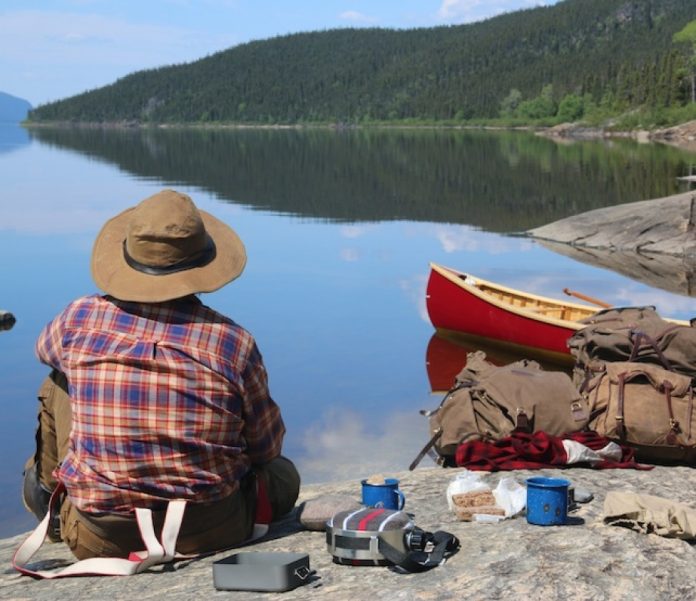
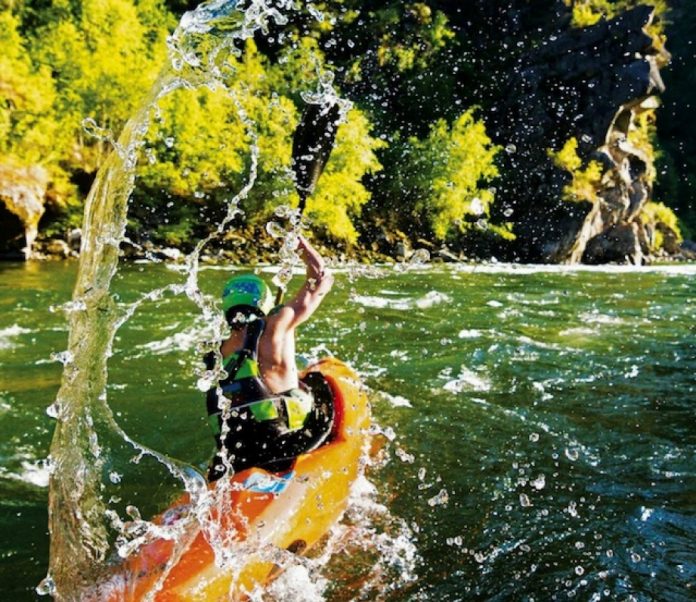
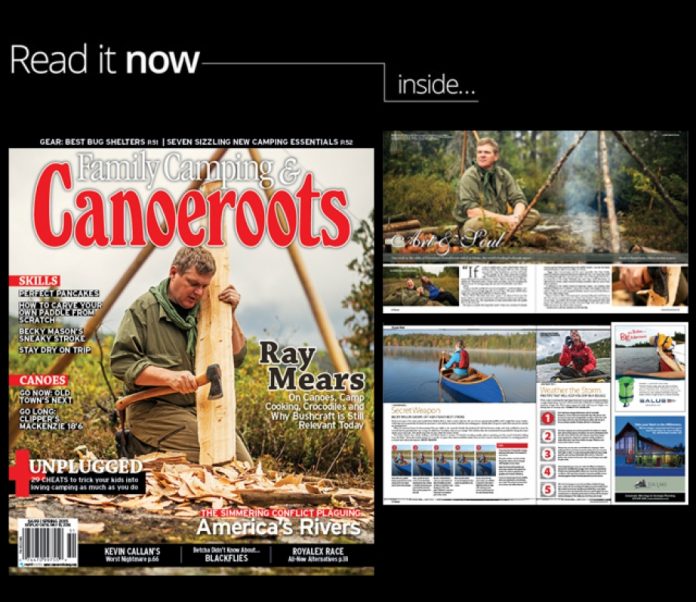
This Spring 2015 digital issue of CANOEROOTS magazine has all of the canoeing content you crave from the print newsstand edition, including trips, techniques, tips, gear reviews and profiles of your favorite adventurers, as well as additional exclusive content, like extra photos, video and links, so you can get more from your issue.
Also available on:
What’s Inside?
Features:
Art and Soul: One week in the wilds of Wabakimi with bushcraft expert, Ray Mears
Who Owns the River? The simmering conflict plaguing America’s rivers.
Camping Cheats: 29 ways to make your kids love camping as much as you do
Departments:
Butt End: Kevin Callan worst wilderness nightmare
Campcraft: Carve your own beautiful blades
Gear: Best bug shelters for spring camping
Expert Tip: Stay dry in a deluge
Camp Kit: Best new gear this spring
Technique: Becky Mason’s sneaky stroke
Food: Perfect pancakes
Canoe Reviews: Old Town’s NEXT and Clipper Canoe’s MacKenzie 18’6
Canvas: Recipe for photographing a tundra wolf
Canoes: All-new Royalex alternatives
Tumblehome: James Raffan on why it’s the portage trail, not the river, that connects us to our past
Editorial: Editor Kaydi Pyette’s escape from the carnival of unnecessary inventions
Base Camp: Getting your kids into higher learning
Betcha Didn’t Know About … Blackflies
Bubble Street by the bearded and funny Paul Mason
Canoescapes: Gorgeous photos that will make you want to grab your paddle and hit the water
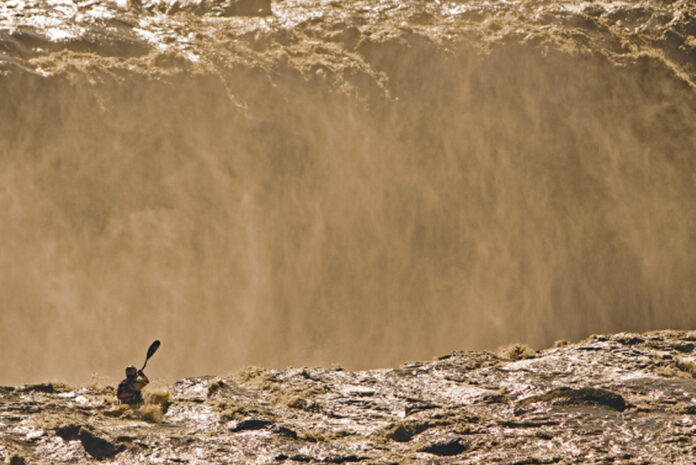
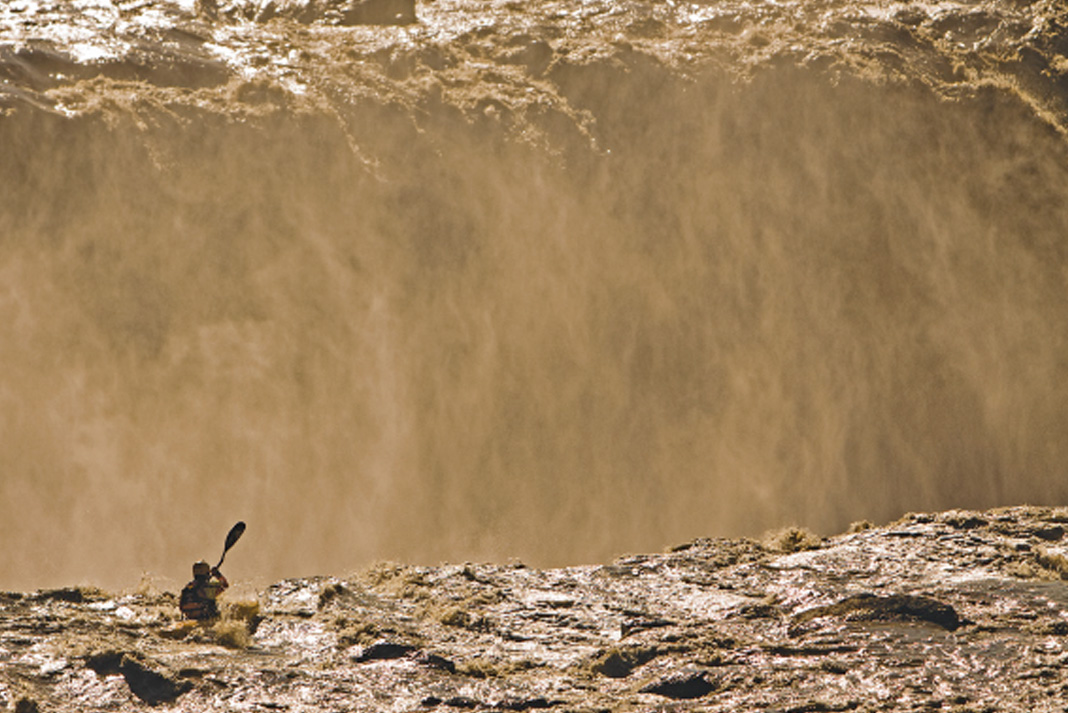
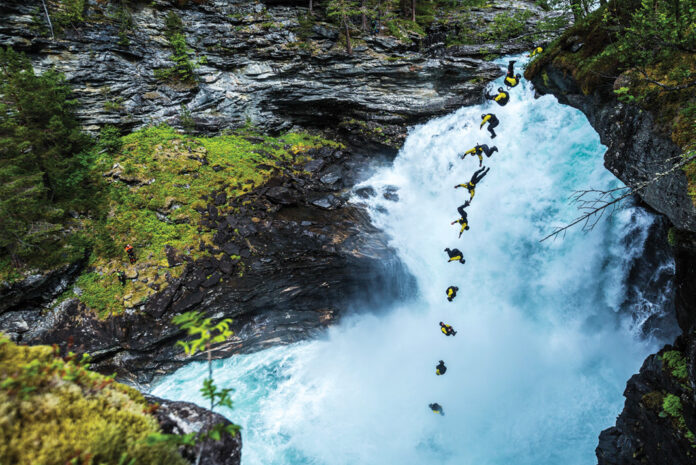
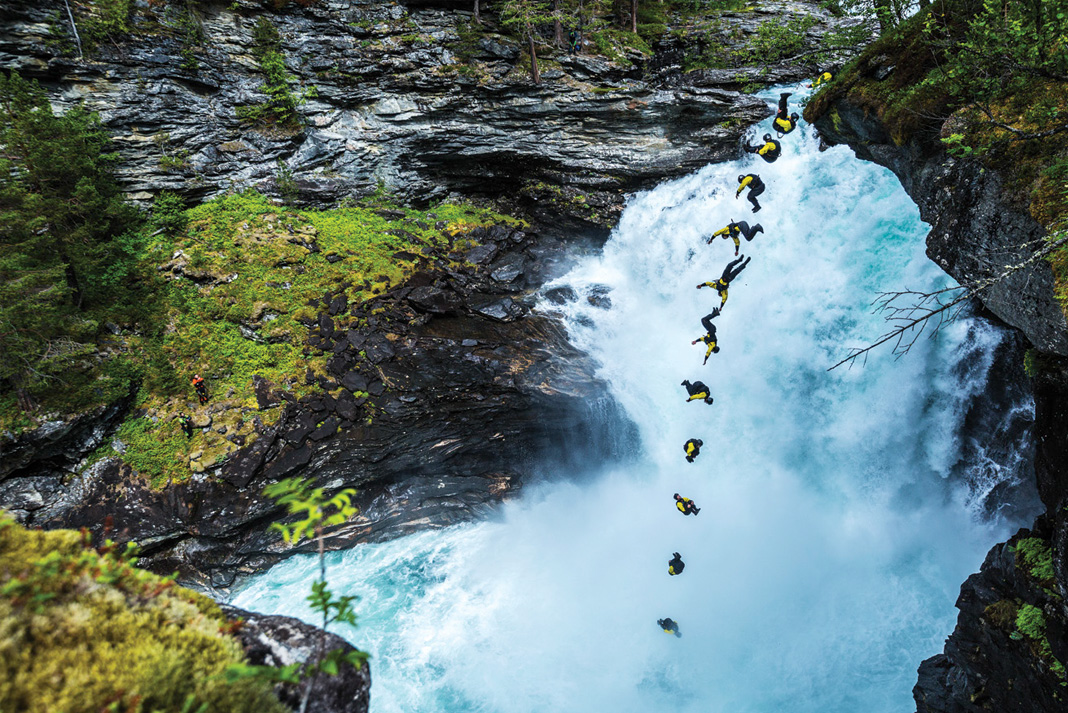
If you’ve seen another photo of Norway’s famous Flemming’s Drop, there’s a good chance it was taken from the river right shore.
The left is an inhospitable, moss-covered bank and since the take-out is on the right, there’s little reason to ever ferry across.
But with the frightening determination we’ve come to expect from some kayaker-photographers, Ciarán Heurteau imagined a new angle and knew he needed to get the shot.
A French and Irish slalom paddler, Heurteau turned to creeking in 2009. A year later while nursing a shoulder injury, he spent more time with a camera than a kayak.
“I started reading books about photography, studying photo composition,” says Heurteau. He analyzed the works of Ansel Adams and decided he wanted to start shooting with more of a vision in mind. “I don’t want to take a photo for the sake of taking a photo,” he says, “but look at what is around, what I want and what I don’t want in the shot.”
Free Falling | Photo: Ciarán Heurteau
When he saw a little ledge two meters down from the mossy left bank, he knew it would be perfect the perfect vantage point to shoot paddler and diver Sven Lämmler, along with the full scale of Flemming’s Falls.
“The only problem was accessing it,” says Heurteau. “It was just an overhanging rock with a lot of unstable moss on top of it.”
Praying the ledge would hold, he jumped down and found his footing to set up for the perfectly composed photo he’d imagined.
The result is this composite image, in which Lämmler, 15 minutes after running the falls by kayak, pulls off a front pike to branny to back tuck, for a total of three rotations before landing in the Rauma River.
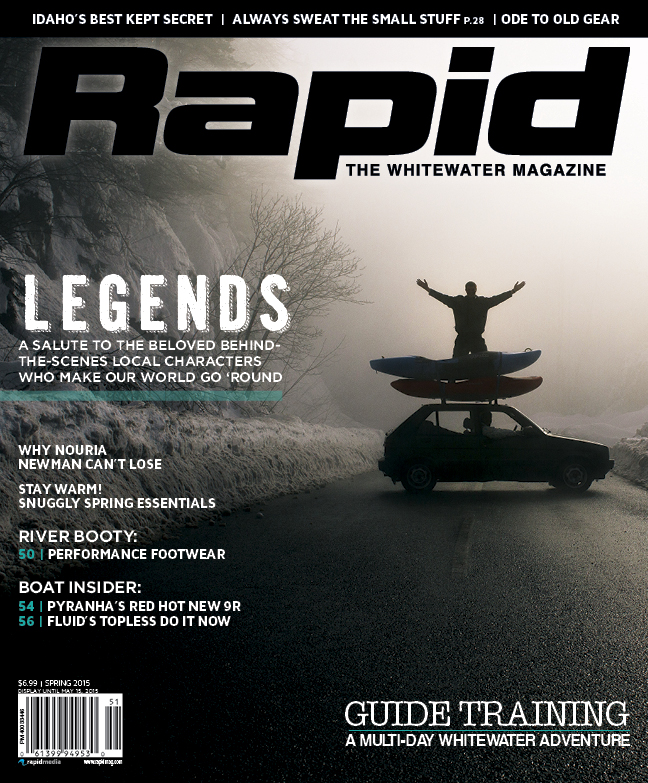
This article first appeared in the Spring 2015 issue of Rapid magazine.
Subscribe to Paddling Magazine and get 25 years of digital magazine archives including our legacy titles: Rapid, Adventure Kayak and Canoeroots.
Choose your own kayak adventure. | Feature photo: Gary Luhm
While I write these words, Sarah Outen and Justine Curgenven are wending their way through the Aleutian Islands as part of Outen’s multiyear London2London Via The World enterprise. Russell Henry is somewhere off Vancouver Island, attempting a new speed record. Lee Sessions and Jenny Johnson are dragging canoes upstream from Hudson Bay to Ungava Bay, portaging 21 waterfalls. Jon and Kirti Walpole are forging along 900 kilometers of Nunavut rivers.
Meanwhile, I’m struggling to squeeze in a week’s tour of the comparatively local and placid Discovery Islands.
Stop obsessing over other kayakers’ adventures and get your own
With hectic lives and little time to plan our own trips, paddling is becoming a spectator sport. We live vicariously through the blogs and SPOT reports of those with the disposable income, gumption and skill to spend months braving foggy Alaskan crossings or dodging mosquitos and polar bears across the Arctic. But I don’t envy them.
Besides being long, arduous, expensive and logistically complex, these trips share another characteristic: they don’t sound remotely fun.
Choose your own kayak adventure. | Feature photo: Gary Luhm
They’re feats of athletic prowess and dedication, and I’m sure if I did trips like that I’d be a better person in some abstract way. But I’m not likely to. Mega-trips are impressive but not necessarily inspiring—the gulf between these journeys and my paddling is as wide as the Pacific Ocean that Outen spent 150 days rowing across.
At a recent sold-out lecture I attended by another mega-tripper, the audience left shaking their heads with both awe and a sense of irrelevance. The average paddler is fully aware they’re unlikely to ever embark on a trip with grueling 40-mile days, considerable danger and weeks of separation from their families.
To inspire, journeys must be possible for people without type triple-A personalities. Seduced by the extreme, even active paddlers can feel like slouches on their local routes instead of enjoying themselves.
That’s not the fault of the ambitious adventurers who are just following their muse. However, the voyeuristic Internet tracking of mega-expeditions is the paddlesports equivalent of trashy celebrity magazines that line grocery checkout lanes.
Just as following the glitz of the rich and famous can leave us dissatisfied with our otherwise fulfilling lives—why aren’t I driving a Ferrari and dating Taylor Swift?—the mega-expedition obsession robs more realistic trips of their own considerable grandeur.
Whatever their length, kayak trips work in the ways that matter to us as human beings. | Photo: Courtesy Delta Kayaks
From mundane to momentous, the right trip fits you
Though my paddling résumé lacks epics and even frequent overnighters, I’m not an armchair kayaker. I’ve been out for a paddle six times in the past week. They were all short jaunts near my front door, squeezed between deadlines, meetings and social gatherings.
The value of these so-called mundane trips isn’t that they’re the longest, fastest or most daring. It’s that they work: They renew our spirit, strengthen friendships and rekindle our love of nights spent under the stars and in wild places.
When I do manage longer trips, I’d rather camp on a wilderness surf beach for three days than chart an expedition that can be measured on a globe. I cover short distances, take layover days and tell jokes around the campfire. Friends stop following my SPOT updates when they realize I’m not moving much. I may have fewer stories, but I like to think I have more fun.
I’m not the only one to feel this way. A countercurrent to our romanticizing of the mega-trip is gaining steam. Shawna Franklin and Leon Somme of Body Boat Blade International are promoting the Jellyfish Award for the slowest circumnavigation of Vancouver Island. If I ever compete for it, I’ll seek sponsorship from a hammock company, Penguin Books and Clear Creek Distillery instead of a racing kayak manufacturer.
Regular Adventure Kayak contributor Neil Schulman is currently seeking sponsorship for a solo, unsupported circumnavigation of Ross Island—a four-mile expedition in downtown Portland, Oregon. He won’t be tracking his progress online.
This article was first published in the 2015 Paddling Buyer’s Guide. Subscribe to Paddling Magazine’s print and digital editions, or browse the archives.
Choose your own kayak adventure. | Feature photo: Gary Luhm
Using only turn-of-the-century equipment, Peter Marshall and Andrew Morris set out to retrace a 600-kilometer route through the rugged Canadian province of Labrador last summer. Their proposed path followed the 1905 route of Mina Hubbard, a young widow who set out to complete an exploratory route along the then-unmapped Naskapi River, which had claimed the life of her husband. In what was one of the most anticipated expeditions of the summer, and with a camp kit that featured throwbacks like a waxed canvas tent, tin cloth rain gear and a cedar canvas canoe, the twosome struggled forward for 130 kilometers before turning back—here Marshall shares what went wrong.
WHO INSPIRED THIS EXPEDITION?
Labrador is wild and remote—it’s always been enchanting to me. After reading about the tragic expedition and death by starvation of explorer Leonidas Hubbard, I was even more interested. To my knowledge, no one has paddled this specific route since his widow, Mina Hubbard, who completed it in his honor in 1905. So there was the big historical element.
WHY USE TRADITIONAL EQUIPMENT?
I had paddled more than 10,000 kilometers in Canada’s North on several expeditions and I was looking for a new kind of trip. I had always been equipped with Royalex canoes, GoreTex, the most lightweight materials and top-of-the-line gear. When I read about historical expeditions, I sometimes felt like I was cheating.
WHEN DID YOUR APPRECIATION FOR EARLY EXPLORERS CHANGE?
It was Leonidas’ trip mate, Dillon Wallace, who chron-icled the tragedy of the expedition in Lure of the Labrador Wild. It’s written in classic man-versus-na-ture style. In comparison, Mina’s published expedi-tion journal is full of joy and wonder for the wild. I had always liked Mina’s perspective more, but we definitely had several of what we called “Dillon Wallace days”—hard and tough.
WHERE DID YOU TURN BACK?
After bushcrashing for three days we’d gone a mile and a half. I had developed micro fractures in one foot, and Andrew had obvious tendon dam-age. At that pace of travel, we would have had 10 days of food left for 400 miles after the portage. We had to separate our emotions from the facts. Labrador has a history of expeditions not turning back when they should—we didn’t want to make that mistake.
WHAT EFFECT DID THE TRADITIONAL GEAR HAVE ON THE TRIP?
It was wonderful traveling with non-synthetic equipment, even though it was bulky and heavy—us- ing modern equipment would not have affected the outcome of the expedition. Prior to the trip I had romantic notions that our traditional gear would bring us closer to nature, but, ultimately, it was just gear. The satisfaction of wilderness travel comes from being out there, not from the equipment we use.
This article first appeared in the 2015 Paddling Buyer’s Guide. Subscribe to Paddling Magazine and get 25 years of digital magazine archives including our legacy titles: Rapid, Adventure Kayak and Canoeroots.
“There’s a period in the early evening when the light on this stretch seems magical,” says Idaho photographer John Webster. “We paddled to the most secluded area to capture it.”
See this photo in our 2015 Paddling Buyer’s Guide here.
On an unusual Monday last March, in the hamlet of San Luis Río Colorado, in the Mexican state of Sonora, hundreds of people gathered below a bridge that spans the dry channel of the Colorado River. The polka-beat of Ranchero music mixed with the sound of laughter across the sandy basin. It was a party of all ages and everyone waited for the guest of honor: agua.
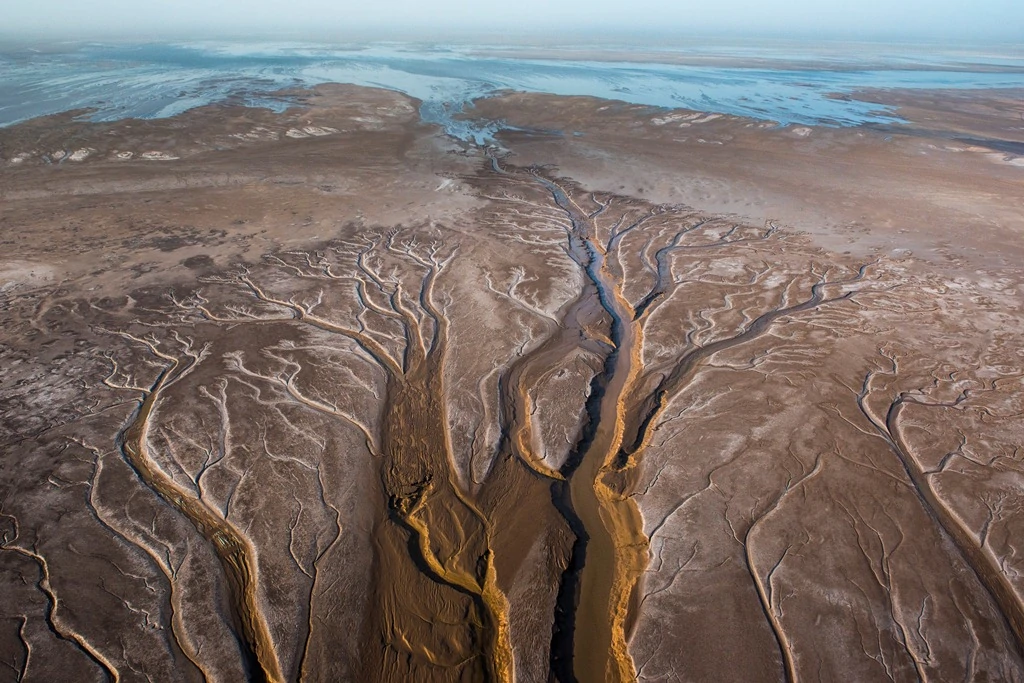
Located 23 miles downstream of Morelos Dam—the last dam on the Colorado—San Luis is where the river finally leaves the border behind and journeys into Mexico. From here, the riverbed winds 80 miles to the Sea of Cortez. But for nearly two decades, water has rarely escaped the sealed downstream gates of the dam.
Instead, Mexico’s entire Colorado River allocation turns west—diverted into the giant, concrete irrigation Reforma Canal. What is left below is a river of sand.
But at 8 a.m. on Sunday, March 23, the red steel gates glided open, releasing the beginning of a 105,392-acre-foot “pulse flow”—roughly the amount it would take to cover a football field in one foot of water. This blast of moisture, de-signed by hydrologists to mimic a natural flood, represents what many thought to be the unfathomable—an international partnership to bring a river back to life.
By Tuesday, the party by the bridge had significantly swelled. The river was late, but no one seemed deterred. I asked two men in business suits why they braved the heat here on this sunny afternoon.
“We are here to see the water, of course. Do you know where it is?”
“We are here to see the water, of course. Do you know where it is?” they asked in Spanish.
As a boy growing up on a cattle ranch near the headwaters of the Colorado, I often pondered that. How long would it take that water—snowmelt originating in the 14,000-foot peaks shrouding the valley—to cross our fields, gurgle down creeks, merge with the mighty Colorado, and make the 1,450-mile march across seven states and northern Mexico before it terminated in the Sea of Cortez?
Although neither the longest nor largest river in the United States (it is the seventh), the Colorado is one of the most loved. The economies and lifestyles of over 36 million people rely on it, as does America’s entire commercial winter salad bowl crop. Yet as a growing population collectively moans for more water, the Colorado River groans from another dehydrating straw. The river’s delta in Mexico is alarming proof of such thirst—not a single drop of the Colorado River had reached the sea since 1998.
The pulse flow experiment in March changed everything—temporarily. By Wednesday, March 27, the San Luis fiesta had quadrupled. Like everyone else, I was stopped in my tracks when agua finally made its debut. Inch by patient inch, the river moved down its old dusty path toward the San Luis bridge. A sense of giddiness grew with every foot the water advanced. Fireworks popped, kids splashed in the shallows, cowboys danced horses, and ATVs and dune buggies roared, rooster-tailing sand into the afternoon light.
PHOTO: PETE MCBRIDE
To see the results of the pulse flow, I joined a few friends and did what any river lover would do. We took canoes and SUPs downstream. We experienced breathtaking beauty bustling with wildlife, but also desperate hours of belly crawling through mesquite thorn thickets, 107-degree heat, swarms of infuriated mosquitoes and were forced to do nighttime stealth maneuvers to dodge drug traffickers.
In 1922 the American conservationist Aldo Leopold took a canoe down the delta and wrote, “The river was nowhere and everywhere, for he could not decide which of a hundred green lagoons to take to the sea.” Before that, steam ships navigated the delta carrying passengers from Arizona to California.
“The river was nowhere and everywhere, for he could not decide which of a hundred green lagoons to take to the sea.”
We did find moments of a river nowhere and everywhere. After eight days spent paddling 92 miles through coiling green waters and shallow mucky salt flats, we reached the high tide line of the Sea of Cortez. It was the first SUP expedition across the new delta—hopefully not the last.
Was it an absurd mission? Sure, but our journey symbolized the power of people working together—that it is possible to revive one of the world’s great rivers, starting with a trickle.
As the sun set across the delta, we opened a special bottle of wine for the occasion, celebrating fresh water kissing the sea. With skin covered in salt, clay and black mud, we toasted skyward to a living delta, nowhere and everywhere before us.
Watch award-winning photographer and writer Pete McBride’s short film about this journey at www.petemcbride.com.
This article first appeared in the 2015 Paddling Buyer’s Guide. Subscribe to Paddling Magazine and get 25 years of digital magazine archives including our legacy titles: Rapid, Adventure Kayak and Canoeroots.
There’s a river that crosses beneath the freeway on my drive to work. On its journey through the city it appears from place to place, in parks and major road crossings, but then vanishes for a long stretch into a deep ravine behind tracts of monster suburban homes and the closeted greens of an exclusive golf club before emerging under my commute.
I pass over this waterway almost daily, giving me the notion that I might like to paddle it someday, but I didn’t approach the idea with sufficient determination to actually make it happen for several years.
Overlooked urban waters give an unexpected dose of joy
Going outside means overcoming the inertia of being inside; attending to the dirty dishes in the kitchen, the dog that needs walking, the dust bunnies colonizing the stairs. There was never anything quite exciting enough about that muddy channel as seen from the highway—probably too polluted and boring, I told myself—to motivate me over the hurdle of actually getting there, to provide the inertia to cross the eddyline, as it were, out of the grind and into the unknown, where the water might be cold, or too shallow, or too swift, where something might waylay me and make me late for picking up the kids from daycare.
Strangely, more far-off wildernesses are easier to get to. They loom larger in the imagination, distant targets that you can build momentum towards by booking vacation, making lists and dehydrating food.
Then, one day, I finally did it. It was this article assignment that finally got me out the door. Sometimes all you need is an excuse. I set off alone on my usual traffic-clogged route to work, but this time with a kayak and a bike on board. I dropped off the car and took just 20 minutes to pedal back to where I’d conspicuously locked my kayak to a picnic table in a children’s playground.
Turn the city upside down and find a place where everything is curved, dynamic, and easier on the mind. | Feature photo: Takuya Sakamoto/Pexels
Setting off on urban waterways
My heart surprises me by doing a little leap when I see the water, at the thought of the adventure the river has in store for me. What had seemed like a lot of work to get going really wasn’t, and now here I am, accelerating down a chute past three men casting fishing lines into the current, under a busy roadway, and around a bend where the river carves into a steep shale bank. I’m all on my own, surrounded by trees, not a house in sight. I could be anywhere.
How easy and crucial it is to claim a little bit of happiness, just by going outside for whatever reason at all. This is something I discovered early in life but am not always good at remembering. Society screams at us that there are always more important things to do. But as I get older, I’m getting better at building these kinds of experiences into my routine. They keep me on an even keel. I’ve got greater happiness and peace of mind to show for it.
While designed for the ocean, my 15-foot touring kayak turns out to be the ideal river craft, fast enough paddling upwind on the flats, yet nimble enough for eddy turns and ferries in the class I rapids, its plastic hull bumping and sliding gamely over the shallows.
There’s inexorability to water, how rivers flow from A to B. Once you launch, you’ve entered a story, part of the order of things. Everything that occupied my mind before drops away, and I feel like I’m truly awake for the first time in weeks.
It’s like I’ve turned the city upside down and found a place where everything is curved, dynamic, and easier on the mind. The river is a place out of time, forgotten-feeling. Like many urban waterways it’s cleaner, quieter, wilder than any time in recent history. This river was once the center of a native civilization, and later an engine of 19th century industry. Today the many mills are shut down and dismantled, and roads have rendered it obsolete as a travel route. For most of us locals, whose lives revolve around the Starbucks and Walmarts tied together by asphalt, this feels as hidden as the creeks that flow through concrete tunnels under the city, a blank spot on our mental maps.
New perspective on a familiar place
The river is a new dimension, a time warp that turns my 20-minute bike shuttle into a two-hour adventure of wild sights, sounds and sensations. Shale riverbanks as high as buildings. Water sliding like molten glass over green-hued, slick rock-smooth shelves. Wildflower bursts of color. Kingfishers, hawks, geese, swans. Minnows. Great blue herons lifting off around every corner—or perhaps it’s the same one I’m lazily chasing.
Last comes the highway bridge that I usually drive, appearing completely different from below, its arcing underbelly the perfect contrast to its business-flat topside and the roaring beeline of commuter traffic that I will soon rejoin—a different kind of flow.
The river eases me back into civilization, but not before transforming my perspective. Now every time I drive to work, I feel different crossing that bridge, reminded of all that lies beneath and around the bend. That pleasant little jolt is better than the hot coffee in my travel mug, a joy I earned simply by committing myself to one tiny adventure.
Former Adventure Kayak editor Tim Shuff lives in Toronto, where he spends his time working as a firefighter and making up excuses to go paddling.
This article was first published in the 2015 Paddling Buyer’s Guide. Subscribe to Paddling Magazine’s print and digital editions, or browse the archives.
Turn the city upside down and find a place where everything is curved, dynamic, and easier on the mind. | Feature photo: Takuya Sakamoto/Pexels
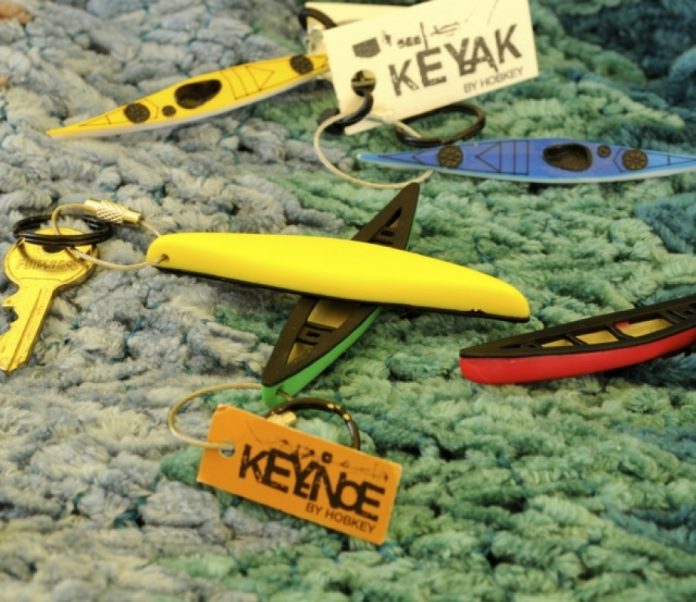
For the paddler who has all the coolest gear, why not let your key ring make a statement, too? Check out these fun-key (pun intended) Keyaks and new Keynoes—realistic toy kayak and canoe key chains for paddlers.
Keyak’s and Keynoes are available in 5 color options. And, of course, they float, so you can play in puddles when you’re not driving.
James Roberts from Ontario Sea Kayak Centre shows you how to do controlled, graceful sculling braces in your kayak. Sculling for support is a key sea kayak foundational skill. Sculling with your paddle gives you terrific blade awareness and is especially useful for gaining stability in rough water, recovering from a less-than-perfect roll, or preventing a capsize.
Stay tuned for more great paddling skill videos, including canoeing, kayaking and whitewater techniques, brought to you in partnership with Rapid Media and Ontario Tourism.
I’m sitting in an eddy with a pang of anxiety swimming around the bottom of my chest. My brain is working at hyper speed, playing over every possible scenario that could happen once I peel out. I know this feeling well. I know the moves, and I know the longer I sit here, the louder the noise clouding my mind and body will become.
No matter how much I’ve improved in my 15 years of kayaking, sometimes it feels the same as the first day I sat my butt down in a boat.
A lot of what we challenge ourselves to do on the river is the exact opposite of what millions of years of programming has taught us. The result is this feeling of fear, something all whitewater paddlers can relate to. The good news is there are things we can do to make sure it doesn’t impact our paddling performance.
There’s a little part of our brain called the amygdala, nicknamed the “lizard brain.” It’s the automated command center for our body, using chemical and electrical signals to tell our bodies what to do when presented with a fight or flight scenario, such as unexpectedly flipping over in a kayak. It also stores all of our emotional memories, or fears for future use.
Picture the difference between a skilled paddler, taking calm, well-placed strokes, and a panicked boater with fear in his eyes, pad- dling frantically without getting where he wants to go. The panicked boater is controlled by the lizard brain, reacting automatically to his surroundings.
The unconscious and subconscious part of the brain that deals with programmed survival response is incredibly powerful, firing off around 60,000 neural impulses a second. The conscious part, or ability
to reason, however, fires off only about 60 impulses each second.
To fight this uphill battle and tame the lizard brain, we need to break things down so we have more time to process what is happening. A rapid that seems intimidating at first is much more approachable once picked apart into individual moves. A major difference between the panicked boater and the pro is the mental shift from undertaking an entire rapid at once to stringing together a series of attainable maneu- vers. Going from eddy to eddy gives us pause, or the ability to process each move individually.
The Mental Game | Photo: Jens Klatt
This alone is only part of the equation since there can be consequences downstream when we fail to execute moves as planned. I account for this by thinking through potential outcomes. If, before entering a rapid, I imagine the good, the bad and the ugly, those outcomes are less frightening because they don’t catch me off guard. This willingness to accept less than desirable outcomes is another key difference between staying focused and reverting to survival mode.
By acknowledging our fear, naming it and discussing it, we can reflect on whether or not our fears are reasonable to maintain. This lays the foundation for our inevitable swims and screw-ups to be positive learning experiences instead of memories that instill anxiety. I liken learning as a kayaker to a baby learning to walk—it won’t come without its stumbles and falls.
Chris Wing is the founder and president of H2o Dreams, and has been teaching all levels of kayakers for more than a decade.
This article first appeared in the 2015 Paddling Buyer’s Guide. Subscribe to Paddling Magazine and get 25 years of digital magazine archives including our legacy titles: Rapid, Adventure Kayak and Canoeroots.




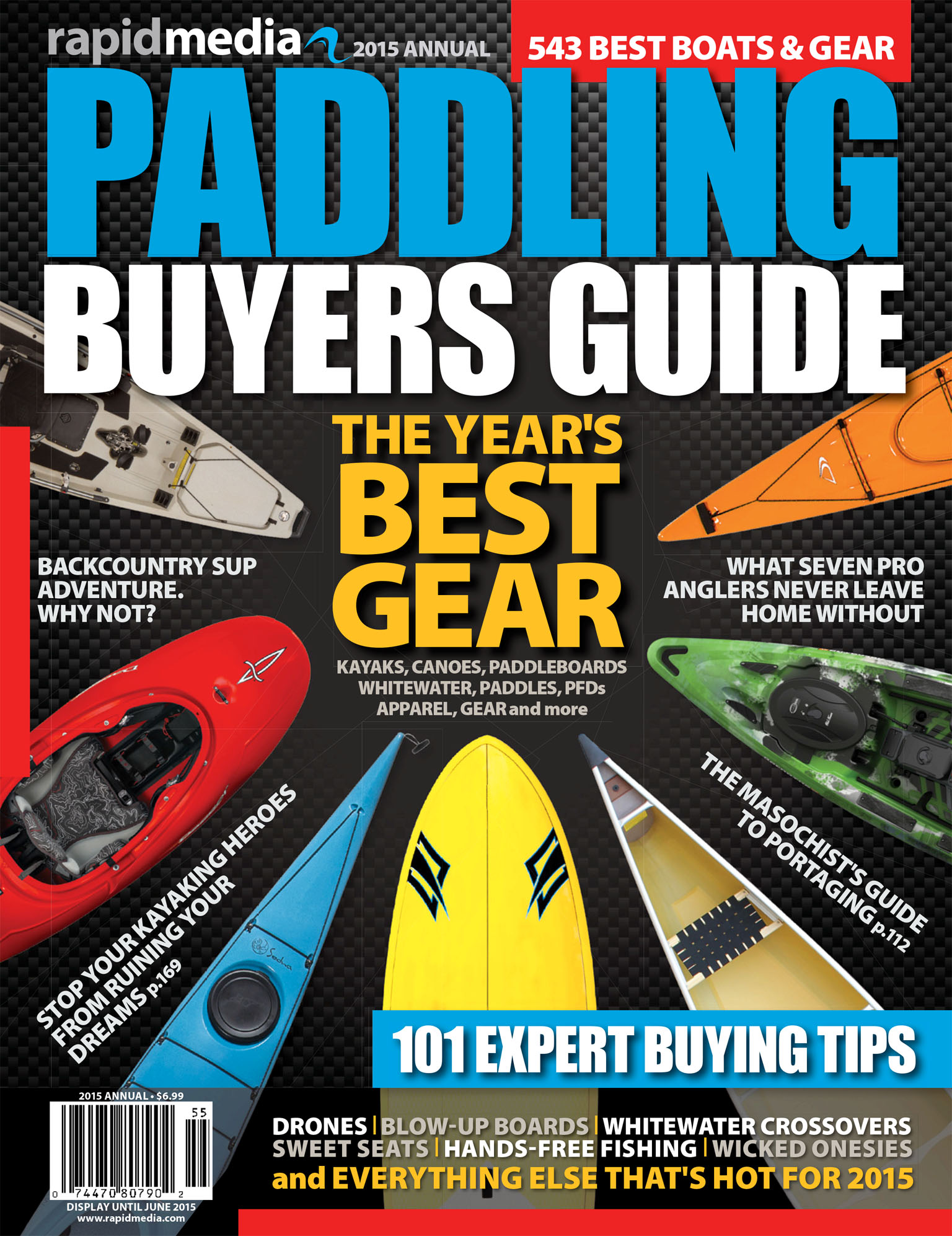 This article was first published in the 2015 Paddling Buyer’s Guide.