Want to know the fastest, easiest way to get back in your boat after a capsize? BCU kayak coach Gordon Brown demonstrates the heel hook re-entry “The heel hook takes advantage of the strength in your larger leg muscles” explains Brown. “It’s a fundamental rescue move, worth practicing until it’s second nature.” Watch the video to learn how it’s done.
Get more kayak instruction films at Sea Kayak with Gordon Brown. DVDs and downloads here.
This short film from canoeist Bill Mason presented by the National Film Board of Canada illustrates the joy and poetry of paddling solo. All basic strokes used to control the canoe are rendered with perfect clarity through animated lines.
Sit back and enjoy this 5-minute salute to the pioneers of rock garden surfing, the Tsunami Rangers. This short film is excerpted from the Tsunami Rangers Greatest Hits DVD. Copyright Tsunami Rangers 2011.
“Because it’s there,” has been one of the most famous phrases in adventure sports since George Mallory’s 1923 justification for attempting the as-yet unclimbed Mount Everest.
Unfortunately for us outdoor types, this explanation is much more shallow than it is profound. Paddlers and climbers alike deal with a public perception that we are reckless risk takers. Mallory’s words contribute to us being written off as irresponsible and totally lacking in reflection.
I am dog paddling my way through a PhD—something I don’t recommend for a middle-aged person hoping to maintain a life—and my field of study is the psychology of motivation. One consistent belief in this area of research is that people cannot be trusted to explain why they do the things they do. Motivation is complex and there is no one reason for anything we do, let alone the highly biased reasons we provide to validate our actions.
In October,74-year-old French mountaineer Bernard Amy gave a speech at the Italian Academic Alpine Club that articulated what many before him have attempted and failed. He included all mountain sports, to which we paddlers belong, when he spoke of the social contract that allows each of us the freedom to do what we want as long as our actions are acceptable to society.
A social contract is guided by nebulous standards of what is, and what is not, socially acceptable. So long as we live up to those standards, we have permission to do what we choose.
Adventure activities live on the border of such acceptance because people who don’t do them have a hard time understanding why we’d want to explore a remote river or throw ourselves off a waterfall.
“We must explain what the mountains give us,” he said. “We must not try to explain why we go to the mountains but what we find there.”
Amy is helping to change the conversation. He proposed that in order for risky activities to be accepted we should stop trying to explain why we do them, and instead focus on what we learn from them.
“We must explain what the mountains give us,” he said. “We must not try to explain why we go to the mountains but what we find there.” In other words, our own personal reasons for paddling may not justify the risk, but its outcomes may.
Worth The Risk | Photo: Steve Shannon
Amy said adventure sports build courage through reasoned risk-taking and grow responsibility and initiative in its participants. They require us to be both independent and able to work cooperatively in teams. They build confidence and character.
When you look at it this way, whitewater paddling is not only acceptable but important. It’s a vehicle to provide skills and abilities widely recognized as lacking in today’s society.
Despite our untrustworthy understanding of our own motivations, Amy is helping to renew the social contract by pushing us to recognize the valuable outcomes of our sport. Whitewater paddling is slowly moving in from the fringes of social acceptance. You now see whitewater boats on the roof racks of cars in mainstream advertising, and more people than ever are giving it a try, according to the Outdoor Industry Association’s 2013 Participation Report.
Even if we can’t always explain it, we know there’s a whole lot more to running a river than because it’s there.
This article first appeared in the Early Summer 2014 issue of Rapid Magazine. Subscribe to Paddling Magazine’s print and digital editions, or browse the archives.
This canoeing expert tip column was first published in the Early Summer 2014 issue of Canoeroots.
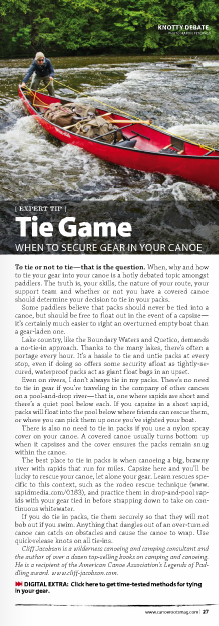
To tie or not tie—that is the question. When, why and how to tie your gear into your canoe is a hotly debated topic amongst paddlers. The truth is, your skills, the nature of your route, your support team and whether or not you have a covered canoe should determine your decision to tie in your packs.
Some paddlers believe that packs should never be tied into a canoe, but should be free to float out in the event of a capsize—it’s certainly much easier to right an overturned empty boat rather than a gear-laden one.
Lake country, like the Boundary Waters and Quetico, demands a no-tie-in approach. Thanks to the many relatively small lakes, there’s often a portage every hour. It’s a hassle to tie and untie packs at every stop, even if doing so offers some security afloat as tightly-secured, waterproof packs act as giant float bags in an upset.
Continue reading this article in the digital edition of Canoeroots and Family Camping, Early Summer 2014, on our free iPad/iPhone/iPod Touch App or Android App or read it on your desktop here.
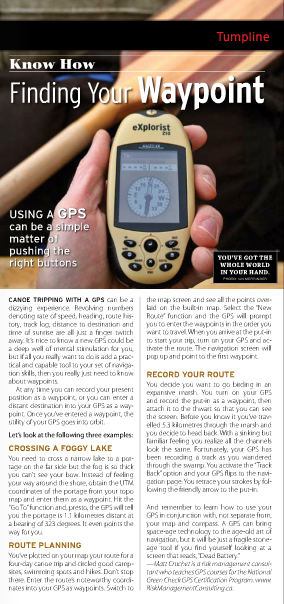
Canoe tripping with a GPS can be a dizzying experience. Revolving numbers denoting rate of speed, heading, route history, track log, distance to destinations and time of sunrise are all just a finger twitch away. It’s nice to know a new GPS could be a deep well of mental stimulation for you, but if all you really want to do is add a practical and capable tool to your set of navigation skills, then you really just need to know about waypoints.
At any time you can record your preset position as a waypoint, or you can enter a distant destination into your GPS as a way-point. Once you’ve entered a waypoint, the utility of your GPS goes into orbit.
Continue reading this article in the digital edition of Canoeroots and Family Camping, Spring 2007, on our free iPad/iPhone/iPod Touch App or Android App or read it on your desktop here.
This photo essay by Peter Mather was first published in the 2014 Early Summer issue of Canoeroots.
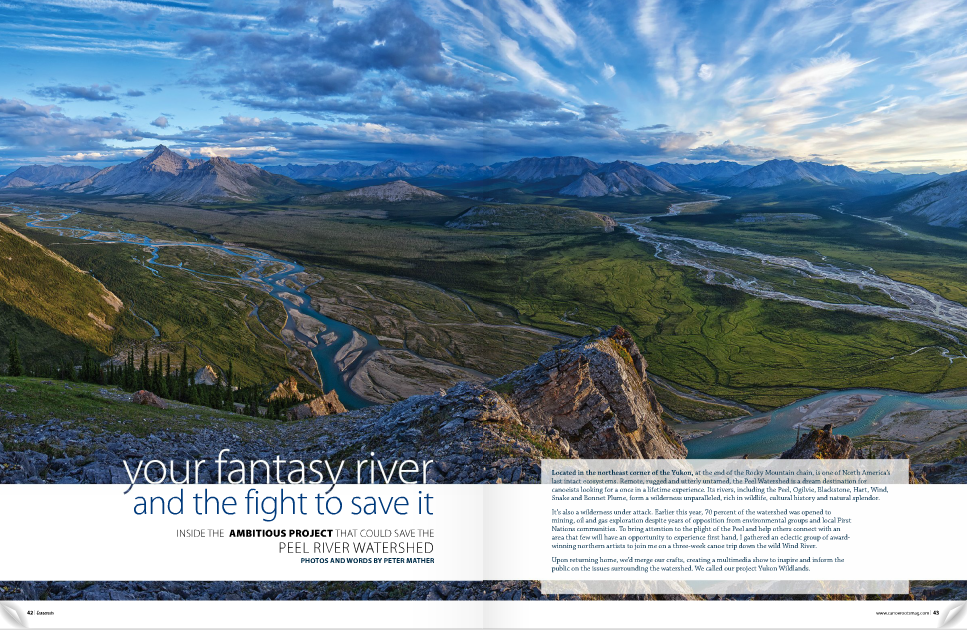
Located in the northeast corner of the Yukon, at the end of the Rocky Mountain chain, is one of North America’s last intact ecosystems. Remote, rugged and utterly untamed, the Peel Watershed is a dream destination for canoeists looking for a once in a lifetime experience. Its rivers, including the Peel, Ogilvie, Blackstone, Hart, Wind, Snake and Bonnet Plume, form a wilderness unparalleled, rich in wildlife, cultural history and natural splendor.
It’s also a wilderness under attack. Earlier this year, 70 percent of the watershed was opened to mining, oil and gas exploration despite years of opposition from environmental groups and local First Nations communities. To bring attention to the plight of the Peel and help others connect with an area that few will have an opportunity to experience first hand, I gathered an eclectic group of award-winning Northern artists to join me on a three-week canoe trip down the wild Wind River.
Upon returning home, we’d merge our crafts, creating a multimedia show to inspire and inform the public on the issues surrounding the watershed. We called our project Yukon Wildlands…
Continue reading this article in the digital edition of Canoeroots and Family Camping, Early Summer 2014, on our free iPad/iPhone/iPod Touch App or Android App or read it on your desktop here.
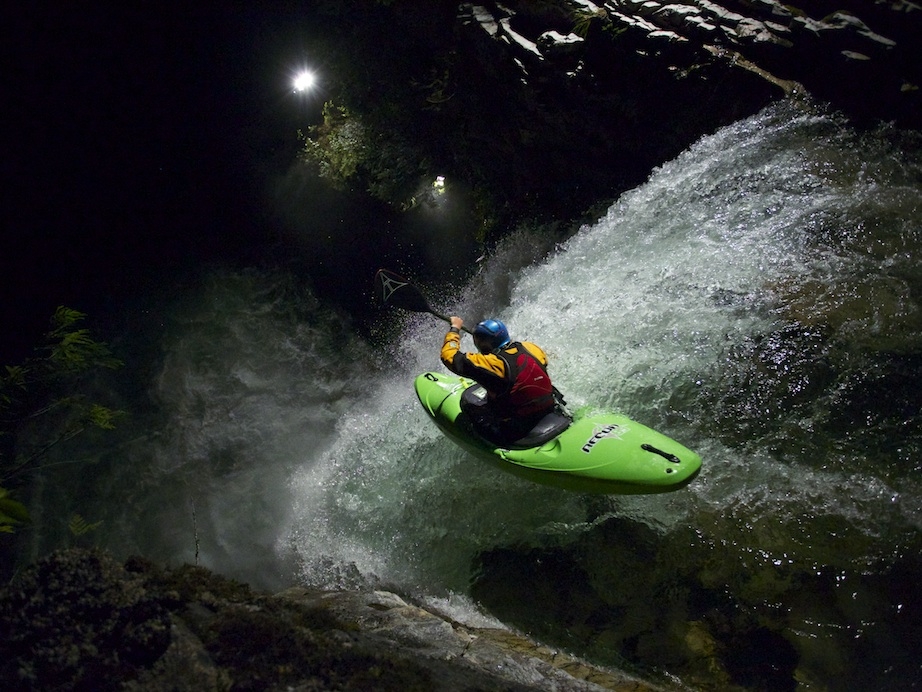
“The closer you live to the put-in, the later you put on,” says fulltime photographer Darin McQuoid.
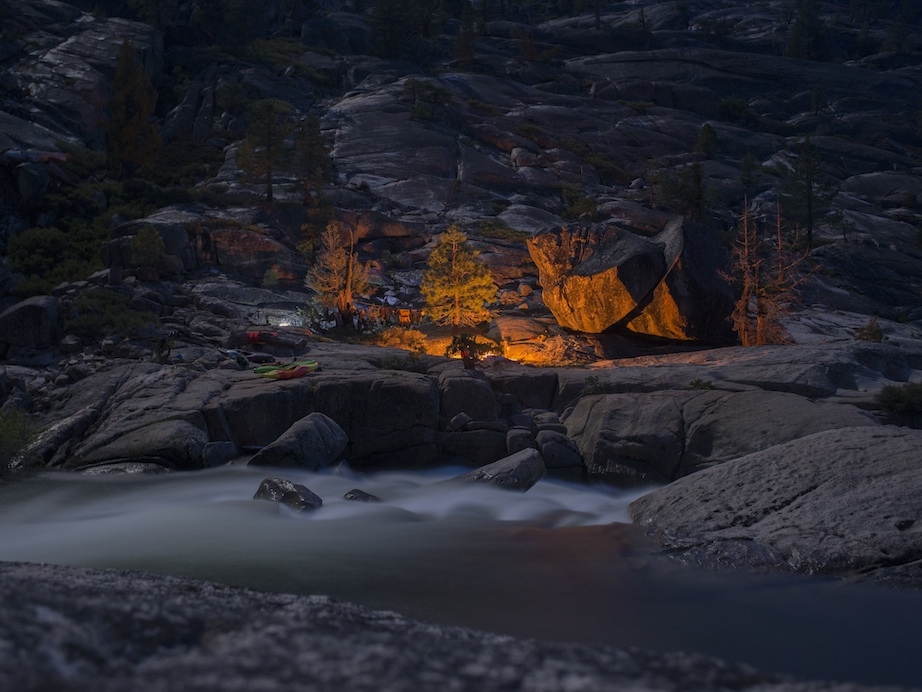
He calls it “the inverse law of location relative to start time,” and has it to thank for this shot, which he snapped on a run of Fantasy Falls of the North Fork Mokelumne River in California last May.
An all-local crew of paddlers—Rok Sribar, Chris Zawacki and Scott Ligare—joined McQuoid on the three-day run, making them particularly vulnerable to the late start-time law but comfortable enough to cruise downstream quickly. Still, they landed at their first campsite after another group had already claimed a spot across the river.
A Shot In The Dark | Photo: Darin McQuoid
“It worked out perfectly for the shot,” says McQuoid, since the site is nestled between two class V rapids, and he often walks the one just downstream. “Ferrying across is no joke,” he says, so he likely wouldn’t have geared up to cross and point the lens back at his own group after nightfall.
“It’s tough to motivate once you’re relaxing around a campfire.”
Since he didn’t have space to stuff a tripod into his Jackson Kayak Villain with the rest of his multi-day gear, McQuoid had to get creative to find a stable spot. Throwing a fleece on the ground, he molded a spot for the camera in the folds of the base layer’s fabric and pushed his shutter speed to its maximum length.
Shooting with a 1977 Nikon 28-45mm f/4.5 lens, he cranked the ISO to 800, “something you can only get clean results from on a full frame camera,” and hunkered on the ground, capturing this shot.
This article first appeared in the Early Summer 2014 issue of Rapid Magazine. Subscribe to Paddling Magazine’s print and digital editions, or browse the archives.
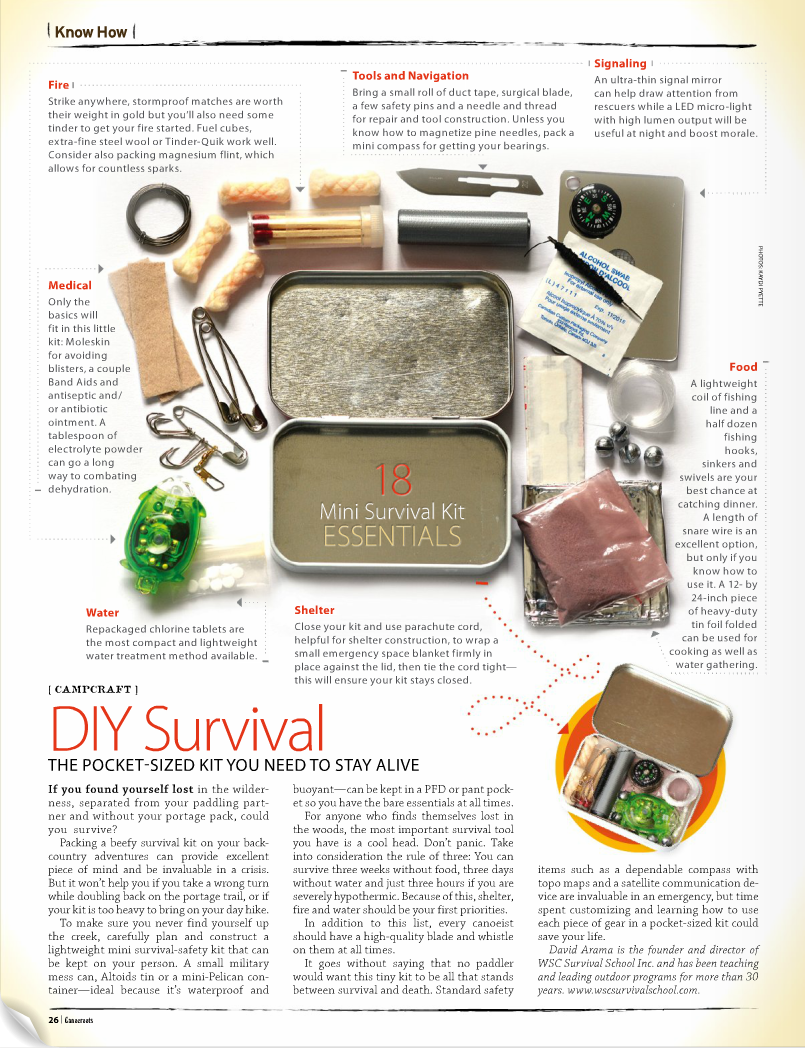
An overview shot of a small survival kit featuring fishing line, waterproof matches and a compass.
Survival skills for canoe trips may seem like overkill to most weekend warriors or occasional enthusiasts, but dont be fooled – weather can be at best fickle and at its worst deadly. With a little common sense and a few small safety items, even the worse-case scenarios can be mitigated to increase the chances of positive outcomes.
Packing a beefy survival kit on your backcountry adventures can provide excellent piece of mind and be invaluable in a crisis, but it won’t help you if you take a wrong turn while doubling back on the portage trail, or if your kit is too heavy to bring on your day hike.
To make sure you never find yourself up the creek, carefully plan and construct a lightweight mini survival-safety kit that can be kept on your person so it’s within reach at all times. A small military mess can, Altoids tin or a mini-Pelican container—ideal because it’s waterproof and buoyant—can be kept in a PFD or pant pocket so you have the bare bone essentials at all times.
For any one who finds themselves lost in the woods, the most important survival tool you have is keeping a cool head—don’t panic. Take into consideration the rule of three: You can survive three weeks without food, three days without water and just three hours if you are severely hypothermic. Because of this, shelter, fire and water should be your first priorities…
Continue reading this article in the digital edition of Canoeroots and Family Camping, Early Summer 2014, on our free iPad/iPhone/iPod Touch App or Android App or read it on your desktop here.




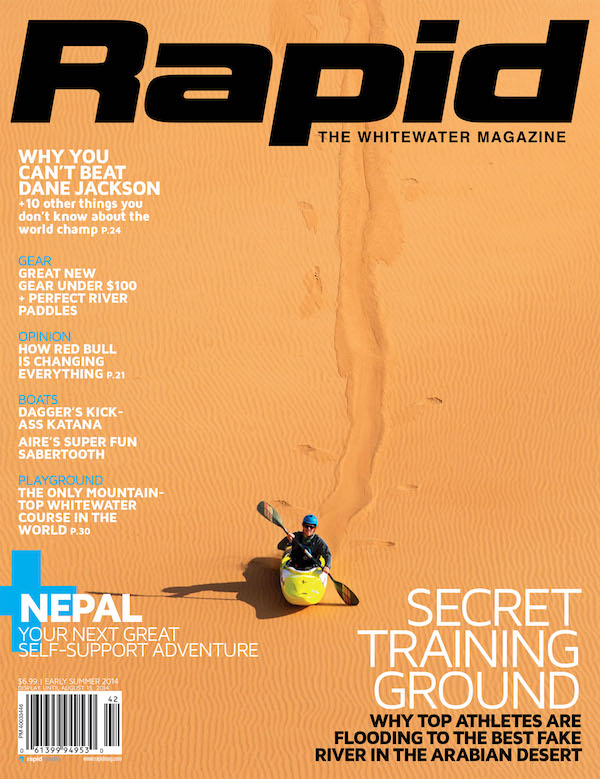 This article first appeared in the Early Summer 2014 issue of Rapid Magazine.
 Continue reading this article in the digital edition of Canoeroots and Family Camping, Early Summer 2014, on our free
 Continue reading this article in the digital edition of Canoeroots and Family Camping, Spring 2007, on our free
 Continue reading this article in the digital edition of Canoeroots and Family Camping, Early Summer 2014, on our free

 Continue reading this article in the digital edition of Canoeroots and Family Camping, Early Summer 2014, on our free



