Home Blog Page 289

Assisted Surf Ski Rescues

Image: Alex Matthews
Assisted Surf Ski Rescues

“As a longtime sea kayaker, but new and ridiculously stoked convert to surf ski paddling, I seem to have a special interest in making sure that someone around me can haul my sodden carcass out of the water after a swim!” says Alex Matthews. Here, Victoria, B.C.-based Matthews and Bob Putnam of Deep Cove Canoe & Kayak (Canada’s largest surf ski dealer) practice a few strategies for aiding a swimmer who’s having a hard time with a solo remount. Watch the video to see how it’s done.


See more kayak techniques on Alex Matthews’ Vimeo channel.


New Greenland Championships Documentary

Screen Capture: James Manke
New Greenland Championships Documentary
{Vimeo}119495279{/Vimeo}

Kayaka / James Manke

In July, two Canadians—skinny stick aficionados and mentors James Roberts and James Manke—will set out for Greenland to compete in the 2014 National Greenland Kayaking Championships, making them the first team from Canada to do so. Inspired by the remarkable culture and history that drives their passion, they will navigate the challenges and logistics of getting to Greenland and participating in the event, experiencing the excitement and sharing their learning through a documentary film. “By working through this ourselves and creating a resource that will make it easier for others to do the same, we want to inspire paddlers to go visit this amazing, intact culture,” says Roberts.

{loadposition PTG_AK_Midcontent}

The film will be released to the public for free at http://greenland.qajaq.ca/ later this summer. Roberts and Manke are presently seeking community support to help complete the funding necessary to make Greenland Bound a reality. Visit http://greenland.qajaq.ca/ to learn more and make a donation. Follow along on Facebook for updates.


Skill Video: Freestyle Fundamentals

Photo: Screen capture Kayak How-to: Freestyle Fundamentals
Skill Video: Freestyle Fundamentals

Balance, power and vision are imperative to strong, controlled boating.

This video demonstrates and explains a list of warm-ups for freestyle paddlers’ quiver of strength exercises, but they will be beneficial to every other facet of kayaking as well.

Every paddler, in any kind of kayak, can practice these warm-ups any time they hop on the water.


Chris Wing has been an instructor for as long as he has been a kayaker. He started H2o Dreams out of a desire to spur growth and reverence for paddle sports education all while providing a different spin to the presentation of familiar topics. Visit www.whitewaterdreams.com for more info or follow H2o Dreams on Facebook and Twitter 

 Click for more pro tips on whitewater skills. 


Well-Worn Memories

Never truly hung out to dry. Photo: Ryan Creary
Off the Tongue: Well-Worn Memories

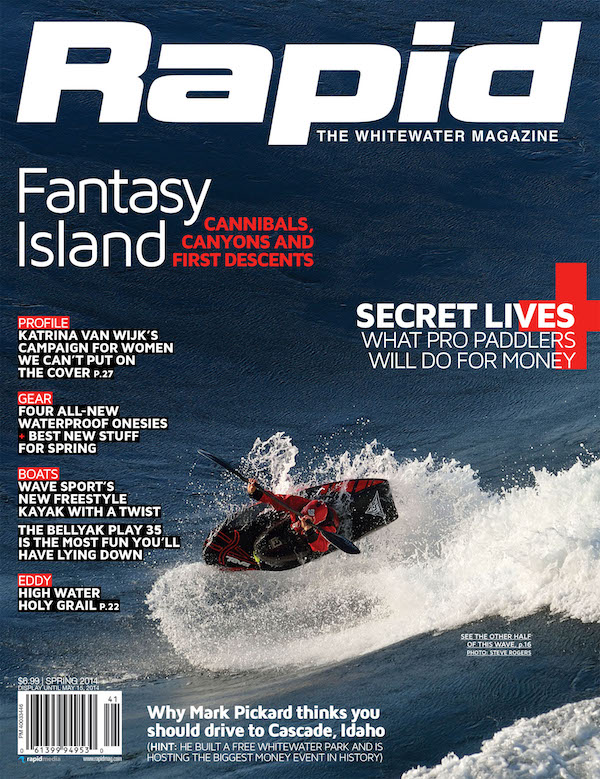
One of the best parts of our job at Rapid is testing new boats and gear. Courier trucks deliver boxes of the year’s latest and greatest apparel and gadgets. For our Spring 2014 issue, we jumped into the Wave Sport Mobius and game-changing Bellyak Play. We tried out a wack of new products we really liked. We lined up and tested four new breathable drysuits.

It’s one thing to have access to the latest models, fabrics and colors, but it’s another thing entirely for new gear to find a permanent home in my gear bag.

In 20 years on rivers I’m only on my second drysuit. Six years ago I reluctantly upgraded to a new Kokatat Meridian, not because my original Gore-Tex suit was worn or leaked, but because I was logging more river days in my suit than without it and I wanted sewn-in feet and a pee zipper. Underneath, I’m still loving my original threadbare-in-the-elbows-and-knees Stohlqiust fuzzy fleece onesie, originally reviewed in the very first issue of Rapid, 16 years ago.

When the water warms I switch to a retro Patagonia short sleeved rip-stop nylon training shell. It was used when I traded it for my Kenwood car audio cassette deck. Patagonia stopped making their own brand of paddling gear in ’99, cassettes are now defunct, but I’ve yet to replace my favorite shell. Through winter, spring and fall I wear a holey pair of original Five Ten Water Tennies on my feet and come summer I switch to a pair of resoled Teva Alps.

For more than 10 years I’ve been racing open canoe slalom. If it weren’t for longer hair, shorter hair and facial hair there would be no way of sorting photos taken from 2003 to present—I’m even using the same boat and paddle.

Never truly hung out to dry. Photo: Ryan Creary
Off the Tongue: Well-Worn Memories

The Rapid gear review closet is full of newer and snazzier versions of these items. The technology today is dryer, stickier, warmer, smarter and more protective. But the undeniable truth is, good gear lasts. And because it lasts we wear it a lot. Because we wear it a lot we get attached to it. We develop systems. We know what pieces layer well together at what temperature and in what boats. But we know layered deeper in our brains or maybe our souls, there is more to it than that.

This past Black Friday, Patagonia threw parties at 15 of their retail stories across the country, parties they said to, “Celebrate what you already own.” They screened the new short film, Worn Wear. Billed as the antidote to the Black Friday and Cyber Monday shopping frenzy, Worn Wear tells the stories of eight people—people just like you me—and their well-loved, well-used pieces of clothing that have become part of their lives.

As a couple seasons turn to ten and then to twenty, I feel the same way about paddling gear as I do about paddling friends. The more new rivers paddled together, more finish lines crossed together, and more great memories created together, the more good gear and good friends become part of our lives and who we are.


Scott MacGregor is the founder and publisher of Rapid magazine. 

This article was first published in the Spring 2014 issue of Rapid Magazine. Subscribe to Paddling Magazine’s print and digital editions, or browse the archives.

Headwaters: Turning Tides

Photo: Courtesy Sault Ste Marie Museum Archives
St Marys River canoeing

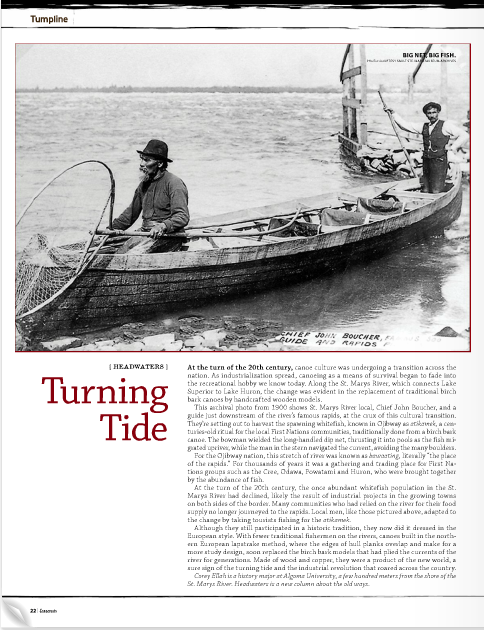
At the turn of the 20th century, canoe culture was undergoing a transition across the nation. As industrialization spread, canoeing as a means of survival began to fade into the recreational hobby we know today. Along the St. Marys River, which connects Lake Superior to Lake Huron, the change was evident in the replacement of traditional birch bark canoes by handcrafted wooden models.

This archival photo from 1900 shows St. Marys River local, Chief John Boucher, and a guide just downstream of the river’s famous rapids, at the crux of this cultural transition. They’re setting out to harvest the spawning whitefish, known in Ojibway as atikamek, a centuries-old ritual for the local First Nations communities, traditionally done from a birch bark canoe. The bowman wielded the long-handled dip net, thrusting it into pools as the fish migrated upriver, while the man in the stern navigated the current, avoiding the many boulders.

For the Ojibway nation, this stretch of river was known as bawaating, literally “the place of the rapids.” For thousands of years it was a gathering and trading place for First Nations groups such as the Cree, Odawa, Powatami and Huron, who were brought together by the abundance of fish.

At the turn of the 20th century, the once abundant whitefish population in the St. Marys River had declined, likely the result of industrial projects in the growing towns on both sides of the border. Many communities who had relied on the river for their food supply no longer journeyed to the rapids. Local men, like those pictured above, adapted to the change by taking tourists fishing for the atikamek.

Although they still participated in a historic tradition, they now did it dressed in the European style. With fewer traditional fishermen on the rivers, canoes built in the northern European lapstrake method, where the edges of hull planks overlap and make for a more study design, soon replaced the birch bark models that had plied the currents of the river for generations. Made of wood and copper, they were a product of the new world, a sure sign of the turning tide and the industrial revolution that roared across the country.

Corey Ellah is a history major at Algoma University, a few hundred meters from the shore of the St. Marys River. Headwaters is a new column about the old ways.


Screen_Shot_2014-05-05_at_9.25.12_AM.pngThis article originally appeared in Canoeroots and Family Camping, Spring 2014.

Betcha Didn’t Know About…The Night

Photo: IStock/Kathy Dewar
Betcha Didn't Know About...The Night
  • Nocturnal animals, which are only active from dusk until dawn, usually have spe- cially adapted senses. For example, owls have extra keen vision for hunting in the dark and a rabbit’s extra large ears help it avoid becoming a midnight snack.

  • The night is not truly black. A complete lack of light is interpreted by the brain as eigengrau, a German word meaning intrinsic gray. Contrast is important to the human eye, which is why this color appears lighter than a black-colored object under normal lighting conditions.

  • The night got a lot brighter after Homo erectus, the earliest human species known to have controlled fire, first lit up the dark between 125,000 and 400,000 years ago.

  • Today the phrase fly-by-night refers to a shady operation or fraudulent business but it was originally an ac- cusation of witchcraft, referencing flying on a broomstick at night.

  • To achieve optimal night vision, eat lots of dark leafy greens, sweet potatoes and carrots, which are all high in vitamin A—a deficiency can lead to night blindness. Expect to spend 20 to 30 minutes in the dark to allow your eyes to fully adjust.
  • In the northern hemisphere, the longest night of the year is around December 21 and the shortest night of the year around June 21. The difference in duration is due to a 23.5-degree wobble in the Earth’s axis as it rotates around the sun.
  • Nights on the planet Venus are the lon- gest of any planet’s in the solar system; there it takes 224 Earth days to com- plete one day-night cycle. Night falls ev- ery 9 hours and 56 minutes on Jupiter.
  • “Wimoweh, wimoweh,” is the beginning of the pop hit “The Lion Sleeps Tonight,” made famous by The Lion King movie. Wimoweh is the phonetic spelling of a Zulu word that means lion.  

This article on the nighttime was published in the Early Summer 2014 issue of Canoeroots magazine.This article first appeared in the Early Summer 2014 issue of Canoeroots Magazine. For more great content, subscribe to Canoeroots’ print and digital editions here.

Family Camping: Sticks and Stones

Photo: courtesy Scott MacGregor
Family Camping: Sticks and Stones

“Mr. MacGregor?” A short, stern-looking woman wearing a lab coat and holding a clipboard motioned me into a small room. She closed the door behind her.

Half an hour earlier I’d carried my six-year-old daughter, Kate, into the emergency department of the hospital. After a few words with the doctor on duty Kate had been wheeled off to the X-ray room.

Kate, the stern-looking woman told me, had a spiral fracture of her tibia, the large bone between her knee and her ankle. This type of injury is common in cases of child abuse, she said. It happens, she continued, when children are forcefully dragged in directions they don’t want to go. The stern look and clipboard were beginning to make sense.

It gets worse.

I’d told the receptionist that Kate had fallen down. In the X-ray room the radiologist asked Kate where she was when it happened. Kate said, “Whitewater canoeing.” Our stories where not matching up.

Later I learned that when Kate was asked about her mommy she replied, “She left early this morning with my brother.” It was a Thursday and both kids should have been in school.

For the past two years, my son, Doug, and I have been racing in the junior-senior division at the Gull River Open Canoe Slalom Race. My wife, Tanya, and Doug did leave early that morning to set up our campsite. Kate and I had stopped at a river on the way for a few hours of training. This was to be her first race.

We’d grabbed every eddy in the 300-meter, class II lower set of rapids and even back surfed the wave at the bottom. We’d carried up to the upper chute and shadowed a solo boat test course in our 14-foot tandem. An instructor high-fived Kate and told her she’d just passed her level two. She smiled and asked me if the snacks were in the truck.

I was dumping the water out of the canoe when Kate ran back to the beach in a sundress, juice box in one hand and a granola bar in the other. One moment Kate was hopping on top of a rock shouting that she had a sliver in her foot, the next she was laying on the beach screaming her little heart out. Her sandy foot must have slipped into a crack in the rock and her body fell the other way creating the spiral fracture.

It took phone calls to my wife and the public school before I was downgraded from abusive parent to irresponsible parent. In this woman’s eyes it was pretty much the same thing. Children anywhere near whitewater rivers were a big mistake, she said. I was just asking for trouble.

All the while Kate’s leg was being casted I argued the report not read that it was a whitewater canoeing injury. She hadn’t even gotten wet, I pleaded. “If she’d been in school this wouldn’t have happened would it, Mr. MacGregor?”

As I carried Kate out of the hospital she asked, “You didn’t like that lady, did you?” I said I didn’t. I told her that the nurse thought I was a bad father. She hugged me and asked if I would like to sign her cast.

Scott MacGregor is the founder and publisher of Canoeroots. At the next Gull River Open Canoe Slalom Race, Kate and Scott placed second. Kate can’t remember which leg was broken. 

This article on adventuring with your kids was published in the Early Summer 2014 issue of Canoeroots magazine.This article first appeared in the Early Summer 2014 issue of Canoeroots Magazine. For more great content, subscribe to Canoeroots’ print and digital editions here.

Skills: Understanding River Features

Photo: James Smedley
Skills: Understanding River Features

Identfying river features and knowing how to manage them is the key to paddling safe lines and having fun. If your next tripping route has sections of swift flowing water or rapids, these are some of the most common features and obstacles you need to be aware of before taking the plunge.

TONGUE

When considering where to enter a rapid look for the tongue—clear and fast moving dark water that forms a V-shape pointing downstream. Usually it marks the channel of deepest water and can indicate a safe place to enter. Tongues sometimes end in wave trains, three or more similarly sized and evenly spaced waves, often dark in color with crashing white tops.

ROCKS

Moving water wouldn’t be much fun without rocks to create river features, but sometimes they get in the way. If you hit a rock, control the collision by keeping your paddle in the water for stability and redirect your bow back into current. If you find yourself broad side to a rock, lean and tilt your canoe towards it and slide around. Don’t lean upstream, this will swamp your boat and could cause it to wrap. Beware of lone waves in the river as they can indicate a rock is hiding below the surface. 

HYDRAULICS

Also known as holes, these river features recirculate water downstream of ledges. Hydraulics can be fun play spots, but larger ones can be nasty sticking points for boats or, worse, paddlers. If you miss your intend- ed route and have to paddle through one, point your boat downstream and keep pad- dling. The key to avoiding a capsize or get- ting stuck is to pierce the hydraulic with the bow of your boat and maintain momentum.

EDDIES

Downstream of exposed rocks and river bends, calm pools called eddies form where the water recirculates back behind the obstacle. They can give canoeists a chance to pull out of the current to rest or scout the next section of river. To enter or exit you’ll need to cross the eddyline—where the main flow meets the calm pool—with momentum.

STRAINERS

Created by trees that have fallen into current, the hazard is caused by water rushing amongst branches and through unyielding limbs. The force of water can trap paddlers and their gear and make rescue and recovery very difficult and extremely dangerous.

The first step to avoiding them is ensuring you have a clear view downstream before running a rapid. If you spot a strainer, choose a line that matches a deep-water current that directs well away. Take no chances, if there’s not a line that gives you a wide berth, get out and portage.

Paddling whitewater is a specialized skill and there are plenty of other hazards to be aware of if you’re taking on big rapids, including undercuts, recirculating eddies and sieves. There’s no substitute for on-water instruction by a trained paddler to ensure your river journey is a fun and safe one.

Andrew Westwood is an open canoe instructor at the Madawaska Kanu Centre, member of Team Esquif and author of The Essential Guide to Canoeing. Find him at www.westwoodoutdoors.ca.

This article on understanding river features was published in the Early Summer 2014 issue of Canoeroots magazine.This article first appeared in the Early Summer 2014 issue of Canoeroots Magazine. For more great content, subscribe to Canoeroots’ print and digital editions here.

Muddy Waters

photo: Larry Rice
Muddy Waters

“One has only matured in the sport of paddling when you can discover as much adventure in exploring a local swamp or marsh by canoe as running rapids or traveling to far-off lands.” —Ralph Frese (1926–2012), prominent canoe maker, conservationist and canoe culture icon.

To the average paddler, swamps conjure up visions of oppressive heat, treacherous mud, tangled vegetation, fetid water and creatures that creep, crawl, sting and bite. It’s a menacing, mysterious place with the power to suck an unwary traveler into its bowels. 

At least that’s what horror movies like Curse of the Swamp Creature, Terror in the Swamp and Swamp Zombies, just to name a few, would have you believe. Maybe it’s Hollywood’s creepy and inaccurate stereotyping that causes many canoeists to shy away. But I believe swamps are fascinating treasure troves. 

North America’s swamps vary in size from oasis-like bogs surrounded by steel and concrete to vast tracts of wilderness wetlands, the largest of which in the U.S. is Okefenokee Swamp’s 700 square miles. Tiny or immense, these oft-misunderstood liquid lands offer some of the most enchanting backdrops paddlers can hope for.

Swamps are a dream for wildlife lovers and botanists alike—lining the serpentine channels and tea-colored ponds are curtains of towering cypress, magnolia and water tupelo trees, their ranks broken only by patchy marshes and grassy prairies. If you’re lucky, you may spot a bald eagle snatching a fish out of the water and river otters at play. There’s a cacophony of unfamiliar insects, repetitive croaking of frogs and clamorous hooting of birds. 

I’ve been smitten by swamps since buying my first canoe nearly 40 years ago. Whether on an overnight trip or weeklong journey into the labyrinth of brackish creeks and backwaters, I always feel like an explorer embarking into the unknown. Lakes and rivers don’t offer the same feeling of primordial exploration, the chance to paddle slowly and come face-to-face with wild growth around each bend and in every nook.

Henry David Thoreau, one of America’s most beloved and influential writers of the 19th century, was the patron saint of swamps. In an essay called Walking, he wrote, “hope and the future for me are not in lawns and cultivated fields, not in towns and cities, but in the impervious and quaking swamps…that was the jewel which dazzled me.”

Venture with Thoreau into the wildest and richest gardens and expect to be dazzled.

Larry Rice's article Muddy Waters was originally published in the Early Summer 2014 issue of CanoerootsThis article first appeared in the Early Summer 2014 issue of Canoeroots Magazine.


Hull Revolution

Photo: Francis Vachon
Hull Revolution

If you’ve been living under a rock rather than scraping over them, you may not know that Royalex canoes are in short supply. 

Manufacturer PolyOne announced last summer that it was calling it quits on the long-time favored hull material of whitewater and recreational canoes. Production of Royalex sheets ceased in March. The announcement sent the paddling community into a Royalex-boat-buying frenzy. Outfitters are bulking up their fleets while enthusiasts are buying backups of favorite models. Everyone is wondering about the future of the sport. 

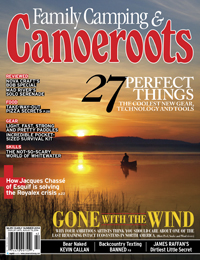
Jacques Chassé, owner of Esquif Canoes, thinks he has the magic bullet. 

Beginning this fall, Esquif will begin replacing Royalex in its canoe line with a brand-new, in-house-made material they are calling T-Formex. 

According to Chassé, paddlers can expect the same indestructability and performance of Royalex for approximately the same price. And he claims T-Formex will be 10 percent lighter and 20 times more abrasion resistant than Royalex.

“Seventy-five to 80 percent of our boats are now made from Royalex. We had no choice but to innovate,” says Chassé. “It’s not a secret I had been asking the manufacturer to improve their material but they weren’t interested. They’d been making Royalex for the last 35 years and there’s a lot of new plastic and new technology.” 

Chassé is building a 6,000-square-foot T-Formex factory within Esquif’s existing 15,000-square-foot warehouse in southern Quebec. 

“Because so many of our canoes were made from Royalex, we needed to find a material that could be used in the same molding stations in which the Royalex boats are shaped,” says Chassé. Switching to T-Formex will not require any re-tooling of this boat building operation. The same workshop will be able to produce the usual 20 to 25 canoes per day.

Like Royalex, T-Formex is manufactured into sheets using foam core, ABS plastic and another outer material Chassé won’t disclose. These are layered together to create a reinforced, multi-laminate sandwich that can withstand years of abuse. 

At the time of publication, Chassé had just recently approached other canoe manufacturers. Before going public he wanted to let them know he had a new material coming and is hoping that T-Formex will replace Royalex in their canoe lines as well. No commitments had been made at the time of printing this issue of Canoeroots. In the meantime, Chassé is completing his factory-within-a-factory and setting up his operation to manufacture the T-Formex sheets needed to supply Esquif’s fleet. 

“T-Formex is the only alternative to Royalex I know about,” says Chassé, adding that his first T-Formex prototype canoe hit the water mid-April. “I have very modest forecasts, but I’m pretty sure once the manufacturers and public see the properties of the material, everyone will step up and want to work with it. It’s the much improved material we’ve been waiting for.”
This article on T-Formex was originally published in the 2014 Early Summer issue of CanoerootsThis article first appeared in the Early Summer 2014 issue of Canoeroots Magazine.