Home Blog Page 305

Stroke Style for Short Canoes

Photo: Jens Klatt
Canoe technique

 In the past decade short solo canoes have bobbed into the whitewater scene. Now, short and long solo boats share the river in about equal numbers, and we expect to see four new sub-10- foot canoes hitting the rivers this year. Paddlers are attracted to these canoes because they are responsive, lightweight and well suited for technical rapids and popular low-volume creeks. They offer canoeists something different and are simply fun to paddle, once you figure them out.

Short canoes require adjustments in paddling style to maximize the performance of their unique hull features. Sure, these tricks work in long boats too, but the response time of a short canoe is almost instantaneous, and the effort required to accelerate and pivot is so much less than in longer and heavier boats.

Short canoes tend to be slower and have less glide, so you will want to reduce the use of speed-sapping friction strokes like the stern pry and J-stroke. Instead, paddle by carving an inside circle and use bow control strokes to adjust your direction while maintaining forward momentum. This will allow you to focus on dodging rocks and driving your canoe through converging currents.

Use the slower hull speed of the short canoe to your advantage. Cruise through a rapid at a relaxed pace, then when you need to manoeuvre, accelerate using on- or off-side forward strokes. These canoes are so responsive that simply adding one efficient correction stroke will completely change your direction. Anticipate this using the opposing forward or cross forward stroke to finish the move.

Playing with stroke length can help too.

A long stroke tends to turn short canoes. Why? Think about your traditional stroke with lots of torso rotation and reach. In many of these short boats you’d be engaging your paddle literally at the bow of the canoe—a long way from its sensitive pivot point at your hips.

Short strokes produce straighter paths and allow a quicker stroke rate. Typically most people paddle a Rival something like this: Long forward stroke—glide—stern correction—recovery—long forward stroke—glide—stern correction. However, an Esquif Spanish Fly is more like: Stroke— stroke—stroke—off-side forward stroke—stroke— stroke. With so little glide, if you need to get somewhere, you need to be always driving these little boats forward.

Some view short canoes as less stable than comfortable-feeling traditional solo canoes, when in fact, they are just more responsive to tilt.

The ease of tilting can actually keep you more stable because you can engage the boat’s edge by using leg and hip movement within your outfitting, and avoid risky body leans more commonly used in large canoes.

In short canoes you can easily use outside edge control for lightning fast pivot turns. By gently pressing down the outside leg to engage the outside edge, you can hold spectacular and dynamic draws to manoeuvre the tightest turns and mid-stream changes in direction. With your body held vertically throughout a turn you are less likely to capsize as the smaller and lighter boat can be securely gripped through good outfitting.

Low volume rapids filled with rocks, waves and slot moves are the playgrounds for which short canoes are made. Adapting paddling skills to short canoes is new and different and will expand your horizons of fun and excitement on the river.

Andrew Westwood is an open canoe instructor at the Madawaska Kanu Centre, member of Team Esquif and author of The Essential Guide to Canoeing. www.westwoodoutdoors.ca

This article originally appeared in Rapid, Early Summer 2010. Download our free iPad/iPhone/iPod Touch App or Android App or read it here.
Kayak Repair: How To Fix a Cracked Kayak

Repairing a cracked kayak is what nightmares are made of, but there is no reason you can’t fix your trusted plastic boat and turn that nightmare into more pleasant memories.

Kayak repair guru Jamie Dors of Paddle Sports Repairs walks us through this straightforward, but sometimes sticky, fix. Sorry, but you’ll need to find a new excuse to buy a new boat.

Icy temperatures and craggy runs make spring paddling a recipe for cracked boats, but this is possible all-year round from collisions with rocky shorelines, pins or other random events. However it happened, these are the kayak repair tips you need to know to get back on the water.


Repairing a plastic kayak

Not all polyethylene is created equal. Most manufacturers use layered high-density polyethylene (HDPE). Alternatively, a few boats out there, including Jackson Kayak’s Elite lineup, are made of a variation called high-density crosslinked polyethylene (HDXLPE).

[ Paddling Buyer’s Guide: View all polyethylene kayaks ]

Both types of poly are weldable, but HDXLPE is a lot trickier. “Its melting point is very close to its burning point,” Dors warns. This makes not scorching HDXLPE more difficult for most people without professional experience and highly specialized equipment. If you’re not sure what type of plastic you’re working with, contact the manufacturer.


Kayak repair kit

You can weld plastic with either a heat gun or plastic welding iron. Learning how to fix a cracked kayak can take time. “The key is providing direct and constant heat,” Dors says. Hot air can pool material so it’s important to use a high-quality heat gun with the proper focusing tip nozzle.

A plastic welding iron may work better since it provides a more focused, consistent heat. If your boat’s manufacturer doesn’t sell poly welding sticks, they can be found at some auto or motorcycle body shops or online.

For a professional look, try matching colours, or go with whatever you can get your hands on—chicks dig scars. If you’re working on a particularly large crack, you’ll want reinforcement that will help the repair to hold. Use mesh for cracks in flatter surfaces like the hull or decks, and rods to support cracks in awkward areas such as around cockpit combing.

Stainless steel or aluminum works best because they won’t rust. Aluminum is lighter. Lastly, get your hands on a good scraper, some sandpaper, a file and a surform for prepping and finishing.


Prep the kayak

Your boat has to be clean before you begin work. Hose it down and then sand or scrape the surface around the repair area. Opening up the crack a little with a scraper will help with the binding process. Finally, clean the area inside and out with mineral spirits as dirt and grease can interfere with welding.


Repair the cracked kayak

Whether you’re working on a deep gouge or a crack, the process of heating and mixing is more or less the same. Dors says holes are rare, “but if you’re this unlucky, you’ll have to find a scrap piece of poly, cut it to size and follow the same process as welding a crack.”

Begin by preheating the material

If your hull didn’t crack on its first run down the river, then its surface is probably fuzzy and whitened. “You’ll know the surface is hot enough when it starts to get shiny and the fuzziness disappears,” Dors says. If you’re using a heat gun, you’ll also need to preheat the welding rod. When welding with a heat gun, lead with the gun and follow with the heated rod. Keep the gun 1 to 2 inches away from the work surface.

Mix the welding rod with the boat material using a stirring motion so as not to let the melted plastic pool. A steady, methodical hand will do the trick if you’re using a welding iron. Just take your time, ensuring the material mixes well, and leave the rest up to the iron.

If you’re using reinforcement, support the hull and realign the crack, then press the mesh or rod into the plastic as you heat. Allow the plastic to mix around the reinforcement for strength. “If it doesn’t mix well, the weld will pop open when it cools or is under stress,” Dors cautions.

[ Paddling Buyer’s Guide: View all maintenance and repair tools ] 

Take your time repairing the kayak

This will ensure the heat penetrates the material completely. “Don’t rush,” suggests Dors, “plastic does not conduct heat well.” Continue the weld at least a half-inch beyond the length of the damage. This will prevent cracks from continuing to form after welding.

“The weld should be just as thick or thicker than the original surface of the boat,” says Dors. Reheating the area until it’s pliable and gently pressing it back into shape with a flat, metal object can smooth out lumps.


Recovery

Continue to support the weld while it cools to restore the boat’s original shape. Let the plastic cool naturally. Adding water or anything else to cool it will weaken the weld. Once the weld cools, use a scraper, file or surform to smooth out the surface.

Bruised egos will pass, scarring should be minimal and your boat will live to see another day on the river. Next up—perfecting your river-reading skills to avoid the carnage in the first place.

The Dizzying Healing Powers Of Canoeing In The Great Outdoors

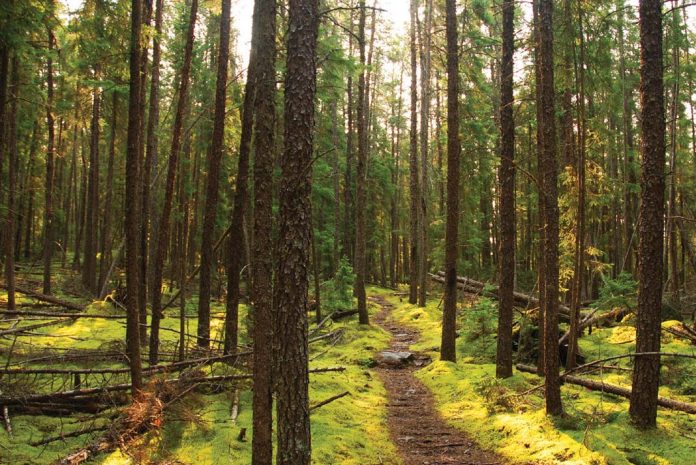
Narrow path between trees in the woods.
A portage a day keeps the doctor away. | Photo: Kevin Callan

A couple of years ago, I was diagnosed with benign positional vertigo. Its effect is a sudden spinning sensation similar to walking off the Tilt-a-Whirl after drinking a bottle of Jack Daniels. It’s caused by a disturbance within my inner ear.

The specialists administered drugs, told me to stop drinking coffee and sent me to physiotherapy, where they performed a fancy maneuver that involved shaking my head back and forth. I was also told that the illness lasts forever and that my hearing will gradually get worse, my balance will depreciate and wilderness canoeing, especially alone for extended periods, will have to stop.

[ Paddling Trip Guide: View all canoeing adventures ]

Being diagnosed with an odd affliction was a shock, losing my hearing was upsetting and walking around as if I were drunk most of the time would pose some serious challenges. The end of my solo canoe-tripping career was absolutely unacceptable.

So I did what any wilderness-loving paddler would do—I stocked up on the drugs I needed, taught myself how to do the head-shaking maneuver and packed enough decaffeinated coffee for an extended solo canoe trip. Most doctors advised against it, but my physiotherapist promoted it—and even helped me prepare for it.

The result was one of the best trips I’ve ever had—one that included awesome rapids, phenomenal fishing, incredible scenery, utter solitude and zero spinning episodes.

Maybe wilderness travel is the cure for all; maybe a stress-free environment should be put into a bottle and sold at a pharmacy; maybe the trip was more like taking a dash of placebo. The time spent paddling was proof that there’s magic in the woods—a drug like no other—and a reminder that wilderness is a necessity of the human spirit, not a luxury.

It’s no wonder we just smirk at people who don’t understand the importance of paddling.

My daughter, now 8, has understood the passion for wilderness paddling from the age of 6 months, when she completed her first canoe trip. My wife, Alana, understands. She insists our marriage has flourished because of our canoe trips together, but also never questions the times I head out alone. My friends understand as well. That’s how we became lifelong friends—we paddle together.

All of us, every culture on this planet, are born from wilderness. When we return to the familiarity of the outdoors, our senses peak and all the ills of society fade away. The dizziness disappears.

This article was first published in Canoeroots & Family Camping‘s Early Summer 2013 issue. Subscribe to Paddling Magazine’s print and digital editions here , or browse the archives here.


This is an adaptation of the title story from Kevin Callan’s newest book, Dazed But Not Confused.

A portage a day keeps the doctor away. | Photo: Kevin Callan

PakBoats PakCanoe 160 Review

Photo: Kaydi Pyette
PakBoats PakCanoe 160

A canoe that can comfortably take you from big lake waves to remote rivers and only takes up half the trunk sounds impossible. But Pakboats’ PakCanoe 160 makes it happen. This hand-assembled canoe is an ideal wilderness boat that also functions well as a general-purpose day-tripper.

Formed of heavy-duty synthetic canvas coated with high-abrasion-resistance PVC, PakCanoes are held under tension by an interlocking skeleton of tubular aluminum. Inflatable air pockets help make them rigid.

While it took a little sweat and some skinned knuckles to get the 160 put together the first time, we shaved down the straightforward assembly to a lean 45 minutes on our second try. Taking it apart takes less than half that and, disassembled, the 160 stores in a 35- by 17- by 13-inch bag—our publisher thought it was a new cooler sent for review. Don’t worry about having to put it together every time you want to paddle, PakCanoes can ride on the roof while assembled, just like their hard-shelled cousins.

On the water, the 160 is stable, easy to maneuver and gets up to top-speed quickly. There’s plenty of space for several weeks worth of gear if you’re smart about your packing. The seats’ location and height are easy to adjust and the simple foam kneepads are surprisingly comfortable.

Alv Elvestad, who founded Pakboats in 1995, steers those interested in a dedicated tripping boat to the larger 165 or 170 models, but says the 160 is a popular option for those who take shorter wilderness trips as well as longer ones.

“It’s a very seaworthy boat and people feel very comfortable in it because of its stability— it’s designed to deal with the rough conditions that come with long trips.” The flexibility of the fabric hull keeps the boat drier in rough weather and on the river, as the boat flexes and runs over waves instead of through them.

The most common reason people buy PakCanoes is because their packable nature makes them easier—and cheaper—to take to remote regions. “The cost of float plane flights nudges people into using Pakboats on the really remote trips,” says Elvestad.

While he’s used to fielding questions about the durability and reliability of the hand-assembled boats, he says their exploits speak for themselves. PakCanoes have been the boat of choice for decorated explorers on first descents on everything from northern Canadian rivers to tropical Bolivian ones.

“The kinds of trips people do with these boats, you would not take a boat on this type of trip if you couldn’t rely on it,” he says.

Pakboat Pakcanoe 160 Specs

Length: 16’
Width: 37”
Depth: 14”
Weight: 53 lbs
Capacity: 760 lbs
MSRP: $2,060
This article originally appeared in Canoeroots & Family Camping, Early Summer 2012. Download our free iPad/iPhone/iPod Touch App or Android App or read it here.
Get Better in the Bow

Photo: Marilyn Scriver
Bow paddling technique

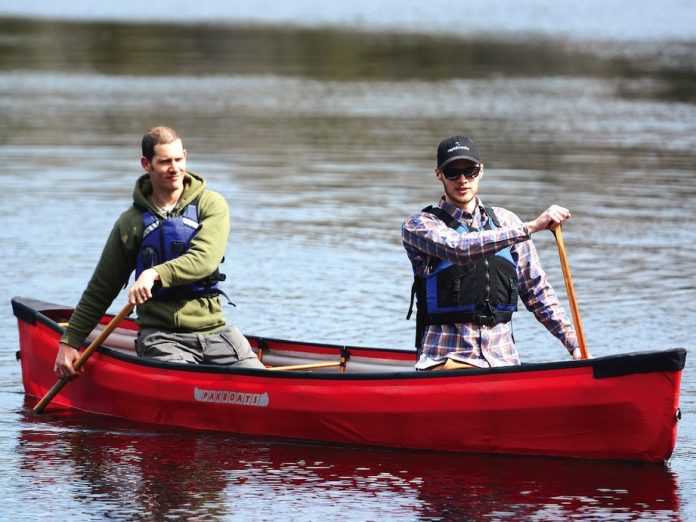
Having someone ask if you would paddle in his or her bow is a great compliment and there’s much anticipation of greatness in your first run together. To have fluidity and make the moves, the bow paddler needs to be more than just a mindless power machine. An active bow paddler controls momentum, assists with eddy turns and aids in boat tilt and pitch.


Controlling Forward Momentum

Knowing when to supply power and when to back off or stop paddling altogether—without being told from the stern—is the first step to mastering the bow.

A good sense of timing is part of the momentum equation. When starting a wide cross-current manoeuvre, bow and stern paddlers build momentum together. However, as the new eddy approaches, the bow paddler may need to pour it on to reach the eddy, or back off or even pause his stroke in order to avoid overshooting the eddy. Practice timing on easy water, carving wide arcs across moderate current and giving the bow paddler time to use his eyes and plan the speed of approach.

Power from the bow is generally necessary when entering eddies as well as when starting from a standstill in difficult eddies. However, when surfing or using transport waves to cross currents, the bow paddler will probably need to supply less power and can help with fine-tuning the angle of the canoe. Too much power can result in the bow being buried in the on-coming downstream water, making it difficult for the stern person to control the angle and the boat being blown off the wave.


Turning Strokes

The bow paddler’s turning strokes are nearly always assistive. Once the stern paddler initiates a turn, the bow paddler determines its radius or sharpness. Radius is affected by the stroke you use and how much tilt you give the boat. For example, an onside sweep in place of a cross-bow rudder (the stroke formerly known as cross-draw) is a useful stroke when forward momentum and wider turning radius are desired.

Timing is key in all turning strokes. When heading into eddies, a bow rudder should be done in the eddy pool, where the water is moving upstream, not on the eddyline where the current is too undefined. Prematurely supplying turning strokes instead of forward power does two negative things: one, there is less or no momentum to cross the eddyline and two, the boat may be turned to face upstream before arriving in the eddy, waffling on the eddyline or stuck in the downstream flow of the current.

When leaving an eddy, the bow paddler should again wait on the turning stroke until her end of the boat is fully in the current.


Tilt and Body Position

Sitting up straight and tall allows you to separate your upper and lower body movement and therefore tilt more effectively. For the most part, keep your shoulders over your hips for maximum use of your body weight and control of the boat. If your weight is forward over your knees, this often makes the boat (and you) feel tippy. The bow is the area where the canoe starts to narrow—keep your weight back over your seat where the boat is wider. Leaning forward also transfers your weight toward the bow, often pinning it and making it more difficult for the stern paddler to initiate turns.

Varying your posture in the bow also plays a role in how well a canoe punches through holes, surfs and turns. Leaning forward when surfing will drop the boat down into a trough. Leaning back keeps the bow light and dry when travelling through large standing waves or once the canoe is settled in a surf.

It’s way more fun in the bow when you are a thinking paddler and able to mind your end of the boat independently. The next step in double-domination is working on communication and coordination with your stern paddler.


This article originally appeared in Rapid, Spring 2010. Download our free iPad/iPhone/iPod Touch App or Android App or read it here.
Sjoa Valley Trip Guide: Norway’s Whitewater Paddling Paradise

Photo: Graham Genge
Sjoa Valley Whitewater

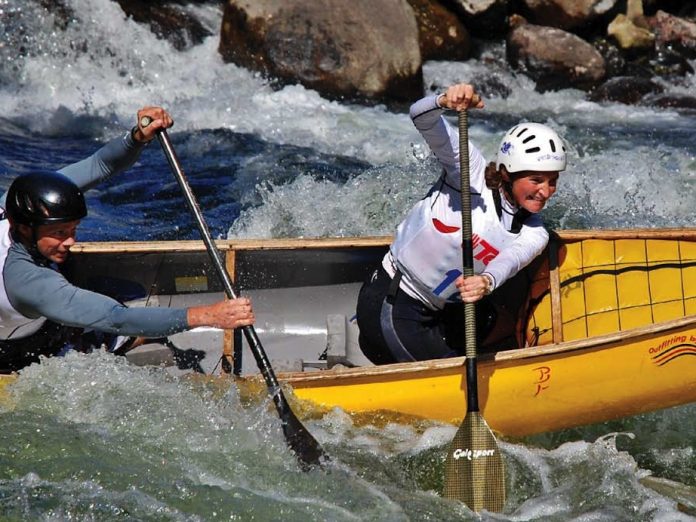
The world’s best paddlers migrate to the Sjoa Valley in the spring and summer to seek out the towering falls, endless slides and amazing Fresca-colored rivers that have made Norway a premier international paddling destination.

Situated 1.5 hours north of Lillehammer and 4.5 hours north of the capital, Oslo, Sjoa is central to nearly all of the country’s most outstanding whitewater. The valley itself is home to centuries-old wooden churches, bridge trolls and historic farms, as well as Norway’s largest commercial rafting operations and a seemingly inexhaustible supply of rivers, waves and steep creeks.

[ Paddling Trip Guide: View all paddling trips in Norway ]

Whitewater lowdown

Warm up on the middle Sjoa, a 6-km, mid- to high-volume Class II-III+ play section with safe, eddy-serviced holes and a world-class wave that boasts epic playboating status in flood. Upstream, the Aseng Juvet canyon is 14 km of read-and-run Class III-IV that makes for a thrilling backyard run. Downstream, Amot Gorge provides 2 km of big-volume Class IV+ falls that can be run in a playboat or creeker.

Over a dozen more runs—including the renowned Ulla Falls, Lower Otta and Lagan— are accessible within an hour’s drive from Sjoa.

Factoids
Population: 311
Average rent: $685
Number of gear shops/guide outfitters: 6+
Number of rafting companies: 4+
McDonalds: No

Cross-training

Mountain biking

Get dirty on Lilehammer’s world-class, lift-accessed bike parks and cross-country trails.

Hiking

Reach treeline in a matter of minutes on 400 km of marked trails in the adjacent Jotunheimen National Park. Tackle the classic, six-hour Besseggen circle route, which includes a stunning ferry ride on glacial Lake Gjende, and top out under the midnight sun among Norway’s highest mountains.

Grub, pub and hubbub

Sjoa Kayak Camp is the place to meet other boaters and settle in for cheap camping. Gear up and get river beta at Strie Strømmer—Norway’s largest kayak shop. Sjoa itself doesn’t offer much in the way of food or drink, but with the high price of grub in Norway, the local Statoil gas station’s sausage and endless free coffee (with the purchase of a mug) start to look pretty good.

Fifteen minutes down the road, Otta is the regional service center and the place to stock up on supplies. Don’t miss the annual Sjoa Kayak Festival, held in July when the water levels and weather are perfect, and there’s no shortage of paddling partners.

This article originally appeared in Rapid‘s Spring 2010 issue. Subscribe to Paddling Magazine’s print and digital editions here, or browse the archives here.


That’s brisk, baby: Sjoa’s glacial whitewater. | Photo: Graham Genge

Paramount H2O Canoe Review

Photo: Dan Caldwell
Paramount 16-6 by H20 Canoe Company

This review of H2O Canoe Company’s Paramount 16-6 was originally published in Canoeroots and Family Camping magazine.

When looking at sleek lakewater boats like the Paramount 16-6 from H2O Canoe Company, speed comes to mind. This is a fast canoe, but when was the last time you were in a rush in the back country? Marathon paddling aside, canoeing is rarely about speed at all. It’s about efficiency and the Paramount’s lay-up and hull design offer exactly that.

The H2O line of canoes consists of resin-infused composite boats. This molding process uses minimal liquid resin, producing boats that are both stiff and ultra-lightweight. The Paramount we tested is at the premium end of the line-up, in H2O’s carbon-Kevlar lay-up. Ours came in at a svelte 42 pounds—impressive, considering the use of gelcoat. H2O has managed to shave off pounds by using a clear-coat epoxy from the gunwales down to the waterline. While lightweight, hulls finished entirely in clear coat are less abrasion resistant so H2O applied gelcoat where durability is most important—the underside. The result is a signature eye-catching two-toned look.

As another means of weight savings, designers reduced the Paramount’s surface area. There is little volume at its extremities and sheer lines are low, requiring less build material.

“We started the company concentrating on classic canoes,” says H2O founder and designer, Jeff Hill. “We wanted to make sure the modern boats we do make perform well across all fronts.”

By modern, Hill means asymmetrical. Unlike the Prospector or Bob’s Special found in H2O’s Heritage Series canoes, the Paramount’s widest point is aft of center, a design attribute that improves acceleration and glide.

The first thing I noticed about the Paramount was how effortlessly it travels across the water, exceeding expectations based on its weight and hull shape.

At 16 feet six inches and with little rocker, it has a long waterline eliminating any need for a keel. Few stern finesse strokes are needed, leaving both paddlers free to maintain momentum and take full advantage of the boat’s top speed and glide. Despite the straight-tracking nature of the canoe, the two and a half inches of bow rocker left me pleasantly surprised by the boat’s maneuverability.

Confident paddlers will appreciate the secondary stability afforded by the Paramount’s gently rounded hull. Limited initial stability could leave novice paddlers a little wary when paddling it empty.

With the refined hull, low freeboard and trim placement, this canoe is better suited to weeklong trips than expeditions.

All H2O canoes come with classy cherry seats, yoke, aft kneeling thwart and carry handles complete with finger grooves. Rounding out the beautiful trim package and true to clever weight-saving design principles, the carbon-Kevlar lay-up comes with H2O’s Integral Composite Gunwales—inwales integrated into the canoe during the molding process. On the outside, aluminum outwales are bonded to the hull to maintain strength.

Paddlers looking for a premium canoe can expect to pay a higher price for H2O boats, especially the carbon-Kevlar lay-up. Given that the Paramount’s hull shape is designed for intermediate to advanced paddlers, cost should be less of an issue. These are canoeists who are never in a rush but always have a discerning taste for efficiency.

H2O Canoe Company Paramount 16-6 specs

  • Length: 16’6”
  • Width at waterline: 32.5”
  • Width at gunwales: 35.5”
  • Depth at bow: 22”
  • Depth at center: 14”
  • Depth at stern: 20”
  • Weight: 42 lbs (in carbon-Kevlar)
  • MSRP: $3,295 CAD
  • www.h2ocanoe.com

This article originally appeared in Canoeroots & Family Camping, Spring 2013. Download our free iPad/iPhone/iPod Touch App or Android App or read it here.
Freestyle Move: Loop Lunar Orbit

Photos: Emily Jackson
Nick Troutman freestyle tips

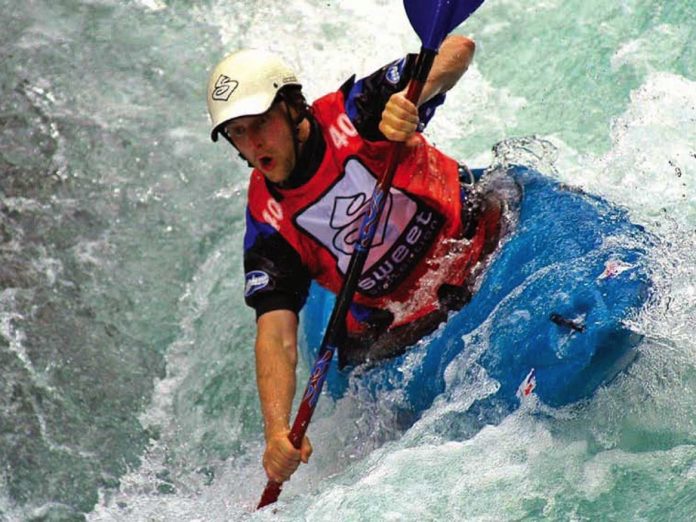
The loop lunar orbit is an awesome aerial hole combo that is sure to get you more chicks than a Nickelback concert. The beauty of it is that once you have it dialed, you can cartwheel into a mcnasty, and then keep adding more moves to infinity.

1. Start by plugging your bow for the loop.

2. Stand up tall and jump forward. The higher you go and farther upstream you jump, the better because the lunar orbit will pull you downstream.

3. Throw your body forward and pull back on your paddle blade. This launches your bow around over your head. Using only one blade to pull the loop stroke is key; this will set you up for the combo.

4. From here, you actually want to land on your stern, rather than finishing all the way flat on your hull.

5. When you are vertical on your stern with your paddle behind you from pulling the loop stroke, quickly use that same paddle blade for a reverse stroke. This is the stern pry that initiates the lunar orbit.

6. The farther back your paddle blade when you push, the more vertical your boat will go. Keep your paddle blade in the water the entire time or you will fall over on your head.

7. Finish the reverse stroke and turn it into a forward draw to pull yourself around vertically.

8. Lean forward as you turn your forward draw back into a reverse stroke for your bow smash.


This article originally appeared in Rapid, Early Summer 2011. Download our free iPad/iPhone/iPod Touch App or Android App or read it here.
Base Camp: Algonquin’s Logging Museum

Courtesy of Scott MacGregor
Algonquin alligator

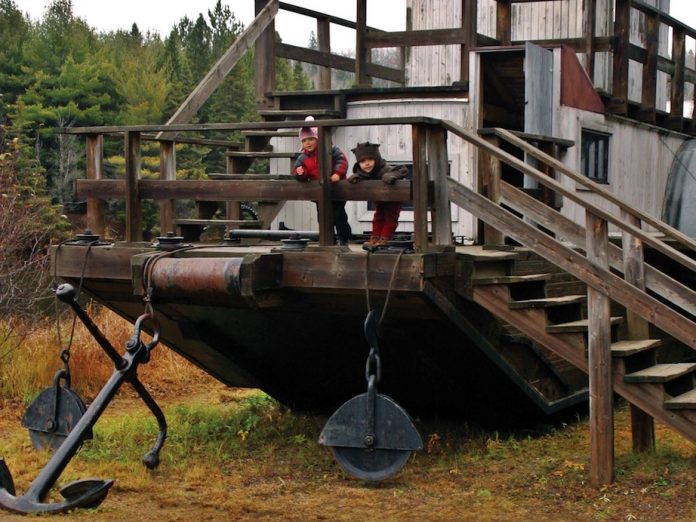
The amphibious tugboat pictured here was invented in 1889. Called an “alligator,” it is a wood-fed paddlewheel steamer capable of warping 60,000 boom logs in a day, then winching itself on a temporary railway of logs overland to the next lake. Built in 1905 and taken out of service in 1946, the William M. is one of only three alligators remaining in existence. For the last 49 years, it has rested on the shore of a small creek 600 metres down a wheelchair accessible, stone dust path at the Algonquin Logging Museum.

Located on Highway 60 just inside Algonquin Park’s east gate, the Logging Museum has a bookstore, theatre and souvenir shop, but it’s outside—in the bush, above a log chute, behind the wheel of the William M. and aboard a locomotive—where Algonquin’s logging history really comes alive. The Logging Museum, like hundreds of others across the country, didn’t make this issue’s list of North America’s top six interpretive centres. Nevertheless, it is outdoors, interesting for kids and within an hour’s drive of my house, putting it at the top of my family’s favorites list.

By comparison, a 10-minute drive deeper into Algonquin Park is the Visitors Centre—a state-of-the-art interpretive facility opened in 1993 and heralded as a must-visit on any trip through the park. We do visit. However, all of the exhibits are indoors—like a museum, complete with a cafeteria. My four-year-old son refers to the Visitors Centre as, “you know Dad, that place where we eat pie.”

Stuffed wolves hide safely behind Plexiglas well protected from curious little fingers. The French lumberjack’s story of the log drive is interesting to small children for all of 10 seconds. After an hour inside the Visitors Centre, both kids and parents go crazy like moose with brainworm (see the exhibit if you have time). Quick kids, back outside to the wheelhouse of the William M.

In a hurried, blackberry-driven, concrete world so focused on higher marks and organized sports, it’s alluring to blow into these visitor centres for a canned, one-hour educational tour. However, study after study from education and health organizations like the American Academy of Pediatrics says free and unstructured child-centred play is healthy and even essential to the development of children. Free play is even more beneficial when it’s outdoors in nature. This means that if we want our children to learn more, be more active and be socially and emotionally well balanced, we need to turn off our ringers, get them outside and let their imaginations lead the way.

Dan Strickland, author of the Logging Museum’s interpretive guidebook, writes that the twice-rebuilt alligator will never again belch out smoke and sparks as it struggles across Algonquin’s lakes. Perhaps, but in the imaginations of my children, the log drive has just begun and there are plenty of trees to be floated downstream. “Stoke up that fire Katie, we need more steam.”

—Scott MacGregor

This article appeared in Canoeroots & Family Camping, Early Summer 2009. Download our free iPad/iPhone/iPod Touch App or Android App or read it here.
Flushed: Doin’ It Duckie Style

Photo: Steve Thomsen
Duckie style

My partner Steve Thomsen and I work together on field projects as a photojournalist team. Our gigs are often crossover affairs: mountain biking and fly-fishing on rafting trips, disc golf on a sea kayak expedition. Invariably, our diverse pursuits require a lot of gear.

For our latest trip—a scenic downriver journey with fly-fishing, fowl hunting and some canyoneering on the side—we pack all the typical necessities plus such eclectic luxuries as a Dutch oven, camp chairs, cooler, fly-fishing gear, SLR camera setup, espresso brewer, shotgun and shells, fresh veggies and down pillows. We are set up in the tradition of a classic safari and that’s how we like it.

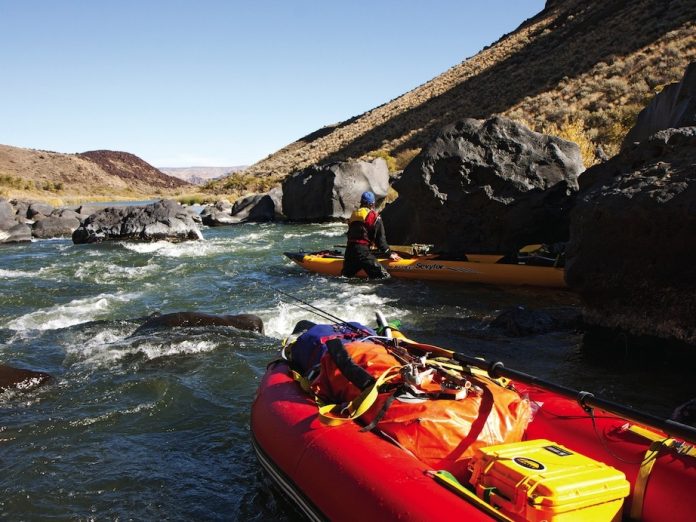
Our cargo, stuffed into Rubbermaids stacked three deep, fills the bed of Steve’s Tundra truck as we roll past Boise toward the put-in for the Owyhee. Most groups run southeast Oregon’s mighty O during spring runoff, when 7,000–10,000 cfs create a three-day, class III run from Rome to Birch Creek and raft support, or a lean tripping style, is de rigueur.

We’ve chosen to run this 45-mile stretch of river in early October at a niggling 100 cfs, taking a leisurely week to do it. Because our payload is lean only in comparison to a fully loaded 18-foot Aire Cat, we’re paddling inflatable kayaks (IKs)—no raft support required, or possible given the extreme low water.

Canoes are out of the question. The first time we took open boats down the late season Owyhee, the canoes emerged so thrashed that the rental guy refused to take them back. We paid for that mistake in no small amount of change.

Without all our planned side ventures we’d probably be paddling the new crop of crossover kayaks: Liquidlogic XP10s or Pyranha Fusions, hard shell kayaks with hatches and space for a little extra—but just a little.

Steve and I know we’ll be leaving cool at the corner running the Owyhee in duckies, but so what? We’re the only ones on the river and we stopped worrying about cool a couple decades ago. Our goal is to get our butts and our swag through the canyon, and if IKs are the ticket, so be it.

Putting on the river in stellar weather, we bump inelegantly down the rapids dodging as many rocks as possible and bouncing off or sliding over the rest. Sometimes we get hung up—the beamy IK hulls refuse to go over—and have to wade out to haul the damned things free.

We drag ass in the riffles, line the boats down the messiest stuff and struggle over one truly miserable portage. We nail every lava nugget that more nimble river runners would easily slip past. More than a few times I think how fun it would be to slalom gracefully down a rapid that we’ve just pinballed through.

Still, we have no regrets. We are a different breed of boater.

We dig what meager performance we can squeeze from our rubber ducks, but our sights are set on the bigger picture: Eating Cajun-blackened quail from the Dutchie. Catching smallies on flies from stacked pools. Hiking up the canyon flanks to photograph the grandeur of the Little Grand. Exploring crumbling rock wall wind breaks built by Basque shepherds on the dry grass plateaus. Hunting for petroglyphs, partridge and bighorns. Playing a game of call-shot disc golf up the arroyo behind camp with a cold beer in hand.

When we roll up the IKs at week’s end, Steve and I agree we’ve found the perfect match to our tripping ethos. Next time we run the Owyhee, you can bet it will be duckie-style. Sure, the cool crowd would probably heckle us, but they won’t be there.