Home Blog Page 312

Autumn Solitude

Photo: Brad Badelt

Long after you’ve paddled through the summer, as the warmest of seasons fades into your wake, the fall – perhaps anxious not to be forgotten – begins a visual celebration. Slowly at first, the earliest trees begin to yellow, eventually joined by those around them. Maples turn a vibrant red, reminding Canadians just where their national colours come from.

Though the waterways may be quiet, they are just as welcoming. For canoeists like Brad Badelt, a paddle along part of the Magnetawan Loop in Ontario is one of the many pleasures of the fall season.

Labrador Plateau Canoe Trip

Photo: Frank Wolf
Labrador Plateau Canoe Trip

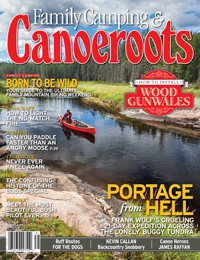
It’s July 22, 2012. I’m only halfway there, carrying the canoe up a three-kilometer-long, 1,500-foot-high portage. A storm of black flies keeps me company and have bludgeoned me to the point where the protective shirt wrapped around my head is soaked in blood. The temperature in the windless Poungasse Valley has crept to 30 degrees Celcius and sweat mixes with blood, running in a pink stream down my chest. We’re trying to crawl out of this chasm to reach the expansive Labrador Plateau. “Shoot when it’s hard,” they say. It’s showtime.

I drop the canoe on the tundra, pull the camera out of the case strapped to my chest and go to work. First, a close-up zoom and comment on my beaten face and the general situation. Next, run ahead 20 meters to set up the camera on a tripod for a third-person perspective of the carry. Finally, flip the canoe back on my head, grab my little point-of-view (POV) camera and turn the lens to my face before continuing to march uphill past the tripod. Drop the canoe again, pack up the camera gear, pop the canoe up and carry on with the journey.

Doubling back down the mountainside I meet up with Todd. He’s been seized with heatstroke and is on the verge of puking. Of course the camera comes out. I interview him about how he feels, then set up the tent so he can escape the black flies, hydrate and sleep off his condition. He drops into the shelter and immediately conks out for three hours. I tell the camera what’s happening and then film his passed-out body from an aesthetic angle shot through the tent screen that initially focuses on him before fading to a foreground of no-see-um mesh. I put away the electronics, grab a couple of bags and start back up to the canoe. So goes day three of a 620-kilometer, 21-day expedition and film production through Nunatsiavut and Nunavik with my friend Todd McGowan.

As an adventure filmmaker, this is just a typical day juggling the duties of director, videographer, editor, producer, expedition leader, camp cook and sherpa. Working within this creative box, I try to create intimate portraits of the landscapes I pass through. With national broadcasts of my past three productions, I’ve managed to scrape along from one project to the next.

To avoid burnout, I take an occasional break from filming. In 2010, I completed a canoe trip to Hudson Bay without my cameras and it was bliss (read an account of this trip in Canoeroots, spring 2012, www.canoerootsmag.com/0040). I basked in the experiential simplicity of that adventure—just a friend, a canoe and the boreal forest. Then I struggled with committing to film my next adventure. 

I knew that I wanted to use film to show the interconnectedness of life in Labrador, but the all-consuming process of shooting a layered, broadcast-worthy movie about a tough expedition is like adding the logistical complexity of a third person to the canoe. In terms of energy and effort, it’s like bringing a toddler along. On the other hand, films I’ve made in the past have always been deeply rewarding. The tug of war in my mind didn’t end until the morning we left Vancouver for Goose Bay. The third person was coming. 

Labrador is a vast region, the most eastern part of Canada’s mainland, and home to more caribou than people. North of its southern towns there are no connecting roads and the only way up is by plane or ferry. 

With our canoe on board, we take the MV Northern Ranger on a two-day voyage along the coast to its terminus at the Inuit village of Nain. This community is my only chance to get the Inuit perspective of the land. Nain is the capital of Nunatsiavut, the Inuit region that comprises northern Labrador.

Filmmaking is a journey that parallels the canoe trip—you have an idea of where you want to go but never know exactly what, or who, is around the next corner. Unknown twists and turns are where adventure and inspiration arise. Likewise, the camera and the canoe are powerful tools if you have a purpose and mission. Both invite local populations to share ideas and stories they otherwise wouldn’t tell. I immediately begin hunting for relevant interview subjects.

Sarah Leo is the recently elected President of Nunatsiavut. I ask her about the area we’re to canoe through. She laughs heartily and says, “That’s not an area people go in the summertime—partly because of the difficult access…but mostly because of the flies.” I’ll use this quote in the narration of our buggy portage up the Poungasse a few days later. One interview down.

From Nain, it’s 238 thick kilometers to the George River in Nunavik and after speaking with Leo, I want to know if the rest of the locals think what we’re doing is rational, mad or somewhere in between. In a grassy field along the shoreline, I interview Johannes Lamp, an experienced hunter and local politician. He encourages and discourages me at the same time. “It will be difficult…but if you are determined, I think you can make it.” A nice bit of narration to lay over the portage footage, I think. In just a few hours I’ve managed to grab the local commentary I need to give context to the first leg of the film. 

Though the Inuit and Innu have been roaming these lands for millennia, British explorer Hesketh Prichard is the only known person to have crossed over the Labrador Plateau from Nain by canoe. He paddled—then abandoned his canoe and hiked—a route north of ours over a hundred years ago. Back in Vancouver, I’d looked at the maps and crafted a route that I thought made more sense than Prichard’s. Here’s hoping. 

On July 29th, Todd and I huddle behind a monolith on the shore of a large, unnamed lake while we wait for a heavy head wind to ease off. That’s the thing with the Labrador Plateau, it’s either windy or it’s buggy. Though it’s pleasantly bug-free behind this hunk of rock, we’re just sitting. 

Progress has been slow since we crested the Poungasse and gazed across the Plateau’s moonscape of rock and heather. Many of the rivers and lakes shown on our maps are severely shallow, boulder-choked and unnavigable. As a result, we’ve had to be content with dragging slowly over the tundra with short spurts of paddling across small lakes. Averaging only 12 kilometers or so per day, it’s been a grind. 

The wind across the Plateau doesn’t make it practical to carry the canoe so I’ve had to drag it overland with a line harnessed to my PFD. In the past week I’ve shot every conceivable dragging angle possible, to the point where the leading candidate for the film’s title is Dragging my Canoe across Nunatsiavut: A Fool’s Journey.

Groping for a fresh perspective, I pull out the rubber mosquito mask I’ve made for this trip. I slip it over my head and strip down to my briefs. Having recently filmed super close-ups of mosquitoes and their natural movements as they crawl over various parts of my body, I begin filming a sequence where I crawl, mosquito-like, around the tundra that will fade into a shot of a mosquito doing the same in the film.

On a deeper level, I want this film to illustrate the interconnectedness of all living things in the region—this scene will bridge the gap between man, mosquito and everything in between. The Inuit spoke of this connection during my interviews in Nain—though it’s unlikely they foresaw it this way. 

Finally released by the Plateau several days later, we paddle into the crystal clear, brook trout-laden Natikamaukau River. This waterway is a privilege to descend as very few, if any, people have done so before. The Natikamaukau is 22 kilometers long and drops 400 feet from its source, snaking through water-smoothed rock slots down a deep valley framed by high, barren ridges roamed by caribou and black bear. It eventually spills into the oft-travelled George River, which we’ll ride north to our finish in Ungava Bay. 

Todd is waiting with the canoe at the top of a class III rapid while I set up a fisheye lens on a bluff to get an overhead view of the run. Mounted on the back of the canoe is the POV camera set up on a three-link boom called a Magic Arm so both of us are in the shot. Often used as a lighting mount in studio work, the arm is the perfect device for shooting canoe films as it can be clamped anywhere and at any angle on the gunwales or thwarts. Having at least two unique perspectives of the same rapid is key to making a dynamic sequence. I don’t portage back up rapids to re-do shots so this is a one-shot deal.

I give Todd the signal, press record and scramble over the rocks, bash through the shore alder, splash through the shallows and hop into the canoe. With the POV camera rolling, I tuck into the spraydeck and we’re off.

The canoe slips into the current and we engage the river. I forget that I’m filming and enjoy the moment as a series of standing waves crash over Todd in the bow. We side-slip a series of pillow rocks before peeling safely into an eddy behind a large boulder.

After a bit of euphoric hooting and hollering, I hop out, scramble up the embankment and run 100 meters back to the still-running camera. In my mind I can already see how I’ll cut the scene when I get home. Surrounded by the barren splendor of Nunavik it dawns on me that this is a pretty good office—and I’m glad the third person came with us on our journey. As film and trip draw closer to conclusion and destination, I realize as both a filmmaker and adventurer, I couldn’t ask for anything more than this.

Frank Wolf is an adventurer and filmmaker who specializes in environmental documentaries. He lives in Vancouver.

This article was originally published in the Spring 2013 issue of CanoerootsThis article first appeared in the Spring 2013 issue of Canoeroots Magazine.


Mountain Biking for All Ages

Photo: Rob Faubert
Mountain Biking for All Ages

Whether mountain biking is your middle name or something you’ve discovered in middle-age, trail riding is a fun-for-the-whole-family activity that puts a spin on weekend camping. From behind the bars, kids will find navigating trails a new adventure. This go-to guide will help you choose the bikes, trails and gear to suit even the littlest rippers.

BIKE FIT: THINK LITE

Kids learn more quickly and enjoy riding more when they’re on well-designed, well-built bikes. Most major bike manufacturers, such as Specialized, Trek, Rocky Mountain and Norco, now offer decent kids’ bikes in 16-inch, 20-inch and 24-inch wheel sizes. Designers take height, weight, proportions and strength of kids into consideration. Being able to apply the brakes and shift the gears with smaller hands is key to enjoying the experience and being able to trail ride as a family. 

“When you’re choosing bikes for kids, weight is the biggest factor,” suggests Duncan Beard, bike guru and bike racer from Fresh Air Experience bike shop. Lighter bikes are simply easier to pedal and allow kids more control, which is especially important if you’re heading over the hills and far away.

As a guideline, Beard recommends bikes weigh no more than a third of a child’s weight. “If your kid is less than 100 pounds, their bike shouldn’t weigh more than 30 pounds.” He encourages parents to forgo shocks for kids under 10 years old to save weight. 

This, however, is easier said than done, found Canoeroots publisher Scott MacGregor. “The best kids bikes we could find weighed more than our adult-sized bikes. It hardly seems fair.” Frame size isn’t as much of a factor as the rest of the bike’s components. “There is a big difference between department store bikes and good quality, $500 kids’ mountain bikes,” says MacGregor, “but it’s still a far cry from what’s standard on a $1,500 adult mountain bike.” If you’re really serious about setting up your kids with lighter weight bikes, MacGregor suggests looking at racing BMX models or starting with an aluminum-framed mountain bike and making a hobby out of upgrading parts. 

It seems like a no-brainer, but Beard also advocates for selecting a bike that fits. “If you get a bike that you hope they’ll grow into, it will be hard for them to ride it and enjoy it now,” he says. 

Well-made bikes are worth the initial investment. They come with components that operate more smoothly and require less maintenance than anything from Walmart—think more riding and less tinkering with shifters and brakes. A good new bike will last to be handed down through siblings or can be sold or traded when the time comes to upsize. 

PUMP UP FOR TRAILS

Kids deal with frustration and fatigue differently depending on their endurance, ability and temperament. Figure out how fast, how far and how long your kids are ready to bike by taking interesting rides close to home. A few of these will help you plan realistic weekend adventures. With kids, distance is often less of a factor than time in the saddle. On days when there’s heat, rain, steep hills or bugs, assume that part of your children’s stamina will be spent on coping with their environment. 

It’s up to parents to keep an arsenal of distractions, diversions and motivation in their pack pocket to dole out and keep spirits high. Try sing-a-longs, games, snacks or exciting destinations along the way—anything to avoid hearing, “How much further?” 

Every child is different of course, but experienced kids around the age of six are usually able to last about 45 minutes on their own, over gentle terrain. Double that if they’re riding behind you on a trail-a-bike. For many experienced 10-year-olds, an hour and a half on their own bike is no problem. Almost everyone prefers a loop to the repetitiveness of an out-and-back route. 

“Most adults want to set goals, in terms of distance, time or effort and that’s not going to work with kids,” says Lee McCormack of Boulder, Colorado, author of Teaching Mountain Bike Skills. “The terrain shouldn’t be threatening at all,” he advises for newbie kids. “We want to imprint positive experiences, so keep it very mellow.” He adds that completely flat trails aren’t ideal because kids love to coast down hills, instead, opt for moderate grade, simple open track, with some rocks to make things interesting. 

McCormack is a father of twin three-year-old girls. He got his kids started on Strider bikes when they were just 18 months old. “They just chewed on them at first, but when they were two, they wanted to ride them.” McCormack advocates pump tracks—mini, circular, off-road routes that take riders over bumps and through tight corners and can even fit inside a backyard. “Parents don’t want to give up riding but can’t take their kids on a three-hour, cross country, Type A mission,” says McCormack. “Pump tracks are the answer. They’re a great place to hang out and there’s a huge benefit in terms of athleticism and fitness.”

Pump tracks are like a low-key BMX track from the ‘80s and they’re springing up in municipal parks everywhere. There’s probably one near you. Before hitting the trails, laps at a pump track can help your kids learn to corner on berms and pedal hard up steep rollers. No one gets left behind at the pump track and kids can stop for a snack or play whenever they want.

SMOOTH, FLOWING TRAILS ENCOURAGE ENW RIDERS


Now that there’s a trail the whole family can enjoy, trailbuilder Ted Ferguson has noticed a huge increase in the number of ski families out mountain biking at Mont Ste-Marie, north of the city of Gatineau, Quebec. 

“The very first trail the other dads and I built goes straight down a steep hill. It’s pretty advanced,” laughs Ferguson who obtained a grant to build a five-kilometer beginner mountain bike loop. “If a family is looking to mountain bike, trail conditions are an absolute priority. Rooty, swampy, rocky or too steep isn’t fun for a lot of young kids, especially if they’re just getting into biking.” Everything is to scale. Two-inch roots and rocks we roll over are a much bigger deal on a bike with small 20-inch wheels, he says.

In order to make the trail fun for kids and beginner riders while still offering challenges for advanced riders, Ferguson and trail builders across the country are making smooth trails and adding berms at every turn. 

“You need flow and fun. Challenging, but not too challenging,” says Ferguson who carries his younger son’s bike up hills to hook the boy on downhill thrills. “The berms turn the trail into a roller coaster that kids love. And it creates a beautiful, fluid sensation for experienced riders,” he adds. 

FUEL UP

Food that’s filling and delicious and stays appetizing after being jostled in a backpack works best. Hard-boiled eggs, hummus and veggies, apples, wraps and treats like cookies or granola bars will be favorites.

Don’t overthink your food selection, whatever you would usually bring on a hike works on a bike ride. Avoid energy goos or fancy sports bars that are marketed to endurance athletes. Many of these products contain caffeine as a performance-enhancing ingredient and are not appropriate for the younger set.

BIKE BASE CAMPING

The perfect bike weekend campsite offers lots of opportunities for the kids to relax and play. If you’re staying in a campground, choose a site close to a beach, a big soccer field, a playground with a fun set of monkey bars or any other interesting features. Especially after using a lot of balance and control on the bike, kids need to let loose and play in the evening. 

Choosing a campsite close to the trails means adults can take turns hanging out with the kids and heading out for their own quick, intense trail rides. 

Don’t put the bikes away after the trail ride. Riding the paths around the campground may be even more fun for them. “We set boundaries, remind them of cars, hand them walkie talkies and they’re gone,” says MacGregor. “Riding a bike is the closest to real freedom a kid can get.”

Kathleen Wilker and her family are avid cyclists. In 2010 Kathleen was awarded the City of Ottawa’s Bruce Timmermans Award for cycling education and promotion.

This article was originally published in the Spring 2013 issue of CanoerootsThis article first appeared in the Spring 2013 issue of Canoeroots Magazine.


Betcha Didn’t Know About…Crickets

Photo: istockphoto.com
Betcha Didn't Know About...Crickets
  • A cricket’s ears are located just below the knees on its front legs.
  • The higher the temperature, the faster a cricket chirps. Estimate the temperature in Fahrenheit by counting the number of chirps in 15 seconds and adding 37.
  • Jiminy Cricket was inspired by the Talking Cricket from the original Pinnochio book on which the Walt Disney movie was based. In the book, Pinnochio kills the cricket shortly after meeting him because he doesn’t like what the cricket has to say. A fine conscience he turned out to be.
  • Male crickets chirp by rubbing the top of one wing against teeth that run along the bottom of the other. Female crickets do not chirp.
  • In 1939, England played South Africa the longest cricket match ever—it lasted 14 days and ended in a tie.
  • Crickets are a symbol of good luck, wisdom and prosperity in Chinese, Japanese and Native American folklore.
  • Buddy Holly’s back up band was called The Crickets.
  • The practice of eating bugs is called entomophagy. Crickets are considered a tasty treat in many cultures and are an excellent source of protein, iron and calcium.
  • Despite having wings, crickets rarely fly.

This article was originally published in the Spring 2013 issue of CanoerootsThis article first appeared in the Spring 2013 issue of Canoeroots Magazine.


Skill: The No-Match Fire

Photo: Michael Mechan
Skill: The No-Match Fire

The one-match challenge—Boy Scouts, survival nuts and shipwrecked folks everywhere pride themselves in being able to build a source of heat, light and comfort using one single match. But if your motto is “Be prepared,” why would you ever be stuck with just one match? The marooned have a better excuse. Wind and water make match fires difficult, though, so why not take it one step further and go for the no-match fire?

 The theory remains the same as with a one-match fire. You need to start with excellent tinder—like birch or cedar bark, wood shavings, cotton balls dipped in Vaseline or spilled jet fuel. Kindling comes next—small branches no thicker than your thumb or forlorn FedEx packages. If it snaps when you break it, it’s dry enough to burn. Once you get your no-match fire going with a sustained flame, you can add progressively bigger firewood.

Now for the fun part. Lighting a no-match fire is easy. You won’t need to build a bow drill contraption or mine for quartzite to bang together. We have the technology. In adverse conditions, turn to a stormproof lighter to produce flames with the intensity of a blowtorch. Try the Trekker from Ultimate Survival Technologies ($60; ultimatesurvivaltech.com). 

Stormproof lighters reach 2,000°F, can withstand 80-mile-per-hour winds and survive a dunk. Unlike a lone match, a full tank of butane should last up to 30 minutes and the electric starters are good for 30,000 ignitions—that’s a lot of no-match fires.

If a stormproof lighter is a little too 21st century for you, how about a no-match fire-lighting technique discovered thousands of years before matches? A flint and firesteel like the FireSteel 2.0 Scout from Light My Fire ($15; lightmyfire.com) is another excellent tool. Drop them in the lake and they still work fine. They’ll also spark in high winds. Hold your flint about 30 degrees to your tinder and strike hard and slow with the steel. Voila!

Like with a one-match fire, the amount and positioning of your tinder and kindling is what matters most. All that’s left now is to celebrate by dancing around the flames with your deflated companion, Wilson.

This article was originally published in the Spring 2013 issue of CanoerootsThis article first appeared in the Spring 2013 issue of Canoeroots Magazine.


Jeff West: 1970 – 2012

Photo: Gene Fleishel
Jeff West: 1970 - 2012

Doug Ammons on Jeff West

The first time I had personal contact with Jeff West, he emailed me, asking about the Grand Canyon of the Stikine. At first I didn’t realize whom the letter was from, because it had the tone of a 12-year-old boy bubbling with enthusiasm about his dreams. There was an exclamation point at the end of every sentence.

“Dear Mr. Ammons, I’ve always wanted to run the Stikine! I’ve dreamed about it! I have kayaked for more than 15 years! I’m on the river all the time because I love it, and it’s also my job! Can you believe it? People pay me to teach them to kayak! That’s the greatest job in the world! I’m so lucky!”

The letter was vintage Jeff. You’d get the same thing if you met him for the first or the thousandth time, shook hands with this big handsome guy, saw his open smile and heard the breathless passion for paddling pour out without a hint of ego.

His bubbling enthusiasm was coupled with the intelligence, focus and power of a mature man. His can-do boyishness was charming, his sense of humor a hoot and somehow he was an innocent—loved every instant on the river, every instant off it and every person he ever met.

In the late 90s, as a top-level freestyler and creeker, he was invited by Scott Lindgren to join a team of all-stars, doing badass runs for classic hardcore paddling films like Burning Time. He was tempted, but said, “I realized that I loved teaching people to kayak. Paddling hard whitewater across the world is a dream, but I loved teaching on the Ocoee and staying in the southeast more.” Maybe it was a bad career move in some ways, but he was glad he made that decision. “It’s where I belong. It’s what I love doing.”

It was also where his mother Barbara lived. Listening to him talk about his mother was a treat by itself. There was love and gratitude in every word. “I owe everything to her. She gave up her marriage and own comfort to lead me into the outdoors when I was young, and supported me in everything no matter what. All the things I love about kayaking and nature come from what she did.”

Jeff did more vertical miles in a day than anybody ever has. He took this difficult and obscure feat in paddling and made it into an aesthetic goal. Green Truss of the White Salmon, Green River in North Carolina, West Prong and others scattered around the states. Last August, we met on the North Fork of the Payette, warmed up on several sections, then he did a vertical mile. Up through August he had eight of them, with another six planned for the coming year.

We talked a lot before our trip to the Stikine last fall, in between his 70-hour weeks of teaching. We continued the talks on the long drive up north. In the months before we left, he lost two brothers to cancer, then a close friend in a kayaking accident. A week before he flew to meet me in Missoula, his father died of cancer. Jeff himself had a serious health condition despite being in extraordinary physical condition. Even in the face of the huge emotional upheaval from all this, he was focused and coherent, earnest and funny.

Perhaps he was trying to fill his loss with a deep drive to find inspiration to live. He was facing a major change in his life due to his health problems and seemed to be squeezing everything he could out of every moment. Or maybe he was just being Jeff.

It seemed he was determined to replace his sadness with his passion for kayaking and the beautiful intensity of hard whitewater. The Stikine was top on that list. All his incredibly hard work, all the skills he had, all the fire and passion within him led him to that river.

How do you say goodbye to a friend you admire so much? The smile and the laugh, the innocence and enthusiasm. The strength and skill. How do you say goodbye to Superman? By remembering what he was like in life.  

September 2012: Stikine River, BC

On September 8, 42-year-old Jeff West joined Stikine pioneer Doug Ammons for a run of the Grand Canyon of the Stikine. Ammons was heli-evaced after taking a nasty swim at Pass/Fail rapid. After ensuring Ammons’ safety, West completed the remaining 70 percent of the canyon on his own.

This was West’s second trip to the unrivaled 52-mile section of high-volume, class V+ Sti- kine, following his 2010 expedition with Todd Wells and Erik Boomer. That trip saw the trio complete a single-day descent by kayak. Ammons was the first to complete a solo run over three days in 1992.

September 10, two days after his descent with Ammons, West set out alone to attempt the first solo one-day run of the Stikine. His last words to Ammons were, “Just think of all that amazing whitewater in there. I can’t believe I’m about to have the privilege

to run it.” Then he paddled off into the rain.

Three hours after he started, another expedition spotted him portaging Site Zed, the crux rapid of the Stikine and a third of the way through the canyon. West failed to make the takeout by nightfall.

The following day, the Dease Lake Royal Canadian Mounted Police detachment received a report that West’s body had been found floating in an eddy about a mile above Wolftrack Rapid, entering the final third of the canyon.

Fellow paddlers supported his decision to undertake the solo single-day run, trusting West’s judgment and strength as a kayaker. Unusual features due to the water level were also reported. Because West was alone, it remains unclear exactly what happened on the river that day. 

Tributes and Memories from Friends and Fellow Paddlers

JOE JACOBI
Olympic gold medalist and current CEO of USA Canoe/ Kayak was a student of West’s.

“In 2006, Jeff helped certify me to become an American Canoe Association instructor. Coming in, I felt the clinic was somewhat of a formality for me but Jeff challenged my ideas and helped me to see instructional concept from a new perspective. Those four days learning from Jeff six years ago put me on a path of innovation and creativity in instruction that I still carry forward today in promoting the sport.”

KAT LEVITT
Kat Levitt became friends with West in the late ‘90s, spending countless days together on the Ocoee.

“My first season on the Ocoee, Jeff convinced me I was ready to paddle the Green. Mostly, I think he wanted me to drive there in my SUV. As broke raft guides, our trip was doubtful. We rummaged through our cars and the Ace couch for money. I hit the jackpot, finding a $50 savings bond in my glove box. I cashed it in, filled the tank and off we went. I survived my run, wearing flip-flops and no elbow pads. That night, we ate burritos and ice cream cones, and watched Godzilla at the dollar cinema. I’ve never felt more alive.”

TODD WELLS
Top expedition boater Todd Wells first paddled with West on the Stikine in 2010.

“Paddling the Stikine had been on Jeff ’s bucket list for a long time and all summer he had been doing attainments on the Ocoee and laps on the Green with a 35-pound dumbbell strapped inside his kayak. Erik Boomer was the third member of our team and would be leading our way. Jeff had been one of Boomer’s main mentors growing up, taking him on his first trip down the Grand Canyon, and Boomer had been one of mine, teaching me the fundamentals of kayaking throughout my teenage years.

“When we finally put on the river, every rapid felt bigger and more ex- citing than the last. At Site Zed, we decided to portage the top of the rapid and run the ABC Line down the bottom portion. Boomer wanted to take photos, so it was now up to Jeff and I to navigate our way downstream.

Jeff led the charge, peeling out of a small eddy with powerful forward strokes. I followed close behind. We were each other’s only means of safety. I’d never before felt as happy and satisfied as I did when I got to the bottom of Site Zed with Jeff, and I think he felt a similar sensation.

“The day after we took off the river, we explored some tributaries and somehow decided that the following day we were going to attempt a one-day decent of the Stikine. Boomer and I slept through our 5:30 alarm, but Jeff, already in his paddling gear, was quick to wake us up and get us on our way. We put on the river before six surrounded by an eerie fog. When the sun came up we paddled through Entry Falls and started our daylong adventure. That day on the Stikine was the best single day of paddling I’ve ever had. I was glad to share it with Jeff and it’s a memory that will last forever.”

DAVID LEVITT
Longtime friend and fellow creeker, David Levitt logged three vertical-mile-in-a-day runs with West.

“Parked at 10,000 feet and surrounded by snow, our water bottles were freezing into solid blocks of ice. Snug in zero bags, wearing our boating layers and enveloped in total darkness, we awakened to the sounds of pounding on the truck window. It was not going to stop until we emerged and geared up. Jeff was awake and ready to start paddling. In a matter of moments, folded peanut butter sandwiches were stuffed into mouths. Boats were being dragged down the trail before daylight began to break.

“On the water, it was understood that quick glances over the shoulder while we stayed in the flow were the norm. We didn’t race, but paddled the flats and rested in the rapids, making well-timed strokes as needed. We watched each other’s backs, but did not eddy out without a clear purpose or need. There was no stopping for a drink or snack. Water and food were on the shuttle. In the case of something really big, like Stairway to Heaven on Bear, the leader would float for a moment to check that the guy behind him was in control at the bottom. Then into the next drop we headed. There were few words at those times, but Jeff ’s ideas and strategy were behind it all. He motivated, inspired, encouraged, and sometimes demanded things of us. He was our coach, mentor, teammate and friend.”

CHRIS TOWNSEND
West and Chris Townsend first got to know one another on a 1999 trip down the Grand Canyon of the Colorado.

“Jeff West and I traveled the southeast and abroad experiencing the best the natural world has to offer. Jeff was already a world-class kayaker when we met. However, over the years I watched him develop every ounce of physical and mental ability. I have never seen an athlete push himself as hard as Jeff West. In the last two years of his life, he left most of us behind; we simply could not keep up with him.

“After his first successful decent of the Stikine, he started paddling alone more frequently. Many of his paddling friends took phone calls from Jeff while he was on Bear Creek. He was having such a good time, he had to share it with someone.

“The most interesting observation about Jeff may have been his lack of desire for notoriety. He very rarely acknowledged any of his accomplishments and when people brought them up, he was dismissive. He would much rather be talking about his next mission.”
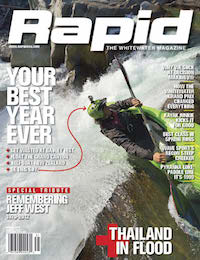
This article on Jeff West was published in the Spring 2013 issue of Rapid magazine.This article first appeared in the Spring 2013 issue of Rapid Magazine. For more great content, subscribe to Rapid’s print and digital editions here.

Thailand: Searching for Whitewater in Monsoon Season

All photos this page: Tyler Fox
Thailand: Searching for Whitewater in Monsoon Season

Known for its hot, sunny beaches, Thailand is an idyllic travel destination for most of the year. During the three-month monsoon from July to September however, tourists run for cover. As copious amounts of rain falls, streams, creeks and rivers swell creating the ideal conditions for a kayaking trip.

Most tourists go to Thailand for its rich history of Buddhism, agriculture and dynasty. As a kayaking destination, it’s still in its infancy and the abundance of steady, virgin whitewater makes it appealing. The underdeveloped paddling scene offers an element of exploration— as long as you are willing to put in some effort to seek out the runs, you will be rewarded.

Screen_Shot_2015-08-10_at_9.23.38_AM.png

STARTING THE ADVENTURE

Our adventure started the moment we stepped off the plane in Bangkok. We made it our mission to get out of Bangkok as quickly as possible with plans to return later in our trip once we grew more accustomed to traveling in Thailand. For the moment, we focused on making our way north to Chiang Mai, home to the country’s best whitewater. There’s a direct train that takes passengers across the 750-kilometer stretch of jungle and countryside to Chiang Mai but our group of four hired a rental car. We craved the freedom to explore the rivers and falls along the road north.

Finding a quality rental car in Bangkok was easy; the hard part was getting it out of the city. Traffic signs are written in Thai and we shared the road intimately with thousands of bicycles, mopeds and tuk-tuks—moped taxis. I felt confident navigating my way through Bangkok’s narrow, congested side streets, my passengers with their heads out the windows making sure I didn’t run anyone over. Then I merged onto the highway. The congestion didn’t disperse. Instead, still more cars and mopeds packed even closer together and moved at a much quicker pace. The blood finally returned to my fingertips when I loosened my white-knuckle grip 20 kilometers outside the city.

UNDERSTANDING NAMTOK

As we made our way north, our time and budget allowed us to chase the great white namtok—the Thai term for waterfall. With the motivation to get off the beaten path and a penchant for mischief, it wasn’t hard to get sidetracked for a couple of days.

We quickly developed a love-hate relationship with the signs the Thai people have erected to celebrate their beloved falls. A road sign marks almost every drop in the country. After passing a handful, we finally decided to turn off the highway in search of a runnable waterfall.

We followed the signs to an obscure trailhead and down a path. The beauty of the trail was overshadowed by the soupy midday humidity. Still we excitedly ran the final 100 meters to the water’s edge. Only a few of the dozens of signs we followed gave any more information than the waterfall’s name, so it took us a moment to realize that the shallow brook trickling onto a pile of rocks in front of us was the main attraction.

With no well-established source for river beta and our elementary command of the Thai language, we were skunked more then once. However, failures like this were always quickly forgotten. Every beautiful drop, big and small, is hidden away in a jungle paradise.

EXPLORING CHIANG MAI

Chiang Mai is a great base for paddlers looking to spend an extended period in the area as it’s central to a good deal of the known boating in northern Thailand. The city itself was built in 1292, complete with surrounding moat and defensive wall to keep out the encroaching Mongol empire. Nowadays, it acts as the northern hub for commerce, tourism, and religion. We settled into our cheap rooms. At 200 Baht per night—just six bucks—the place was no Hilton, but offered a satisfactory place to sleep and beat overnighting in the car.

On good information from a friend, we made our way to the Siam River Adventures Center in downtown Chiang Mai. We were met by the lovely and hospitable owner Lah, who quickly set us up with a shuttle to the top of the river. The last leg of our route was by elephant, kayaks and all.

Travelers visiting Thailand on a shorter trip wanting to pack in as much paddling as possible will find everything they need in Chiang Mai. Like most kayaking destinations in and around the equator, flow is very dependant on rainfall. Luckily, it comes down in bucket- loads this time of year. Even during dry spells, though, there is still one really good option close by. The commercially rafted Mae Tang River—technical and boulder-strewn in low water and raging big-volume in high water— is just north of the city.

Chiang Mai also has plenty to do during time off the water. We took time to explore some of the city’s 300 Buddhist temples, indulging in the amazing cuisine and immersing ourselves in the vibrant Thai culture.

Screen_Shot_2015-08-10_at_9.24.20_AM.png

UNPADDLED WHITEWATER AND LOCAL AUTHORITIES

We spent much of our time hunting unpaddled whitewater, but when the big rains came, it was impossible to resist the known quality runs within a couple hours’ drive of Chiang Mai. Our first stop was the Mae Pan waterfall located in Doi Intatnon National Park.

After hurrying our boats and gear down the short trail to the falls, we quickly roped our kayaks to the top of the drop. I found myself sitting above a gorgeous horizon line, blasted by the mist from the thunderous 100-meter falls in the backdrop. We ran the 15-meter Mae Pan Falls and regrouped for high fives and hugs in the pool below before paddling the section’s remaining rapids. Energized from the morning’s session we quickly headed to the neighboring, equally spectacular Mae Klang River to round off an awesome day of paddling.

The region is teeming with other amazing pool and drop sets that would certainly be classics if anybody really paddled there. We hit the Mae Sa, a river that feels like a waterslide amusement park. Its put-in is at the Queen Sirikit Botanical Gardens, with boofs and slides past greenhouses, around bam- boo huts and through dangling jungle vegetation. Elephants trudge along the banks as the river passes through the Mae Sa Elephant Camp, eventually winding its way into the national park ending at the Mae Sa waterfall.

The Mae Sa run ends in a picture-perfect, six-meter drop. Park rangers stopped us moments before we could huck the drop, afraid we would be washed over the falls to our death. After some failed negotiating, they politely escorted us out of the park and back to our car, cutting the day short by one rapid.

Unable to explain our intent and that we are a group of experienced, capable and safe boaters, we decided on an it’s-easier-to-beg-forgiveness-than-ask-for-permission tactic. On some occasions we were able to persuade the rangers to let us back on the water, but a smile and double thumbs up only got us so far. Many of the park rangers carry machine guns, which made the whole begging for forgiveness thing a little dicey.

THE PERFECT WHITEWATER DESTINATION

Thailand offers lots of options for those with a bit more time on their hands looking to diversify their trip. Paddlers often jump the border into Laos to try one of that country’s many multi-day runs through undisturbed rainforest. Away from the whitewater, travelers flock south to the renowned warm, sandy beaches of Phuket Island where they kick back and relax, enjoy some world-class snorkeling, scuba diving and bumming around the beach. Those not into relaxing can join the 30,000 revelers who gather at Koh Phangan for the epic full moon parties that happen every 28 days.

Whatever your schedule, save at least a day or two before heading back to the airport to enjoy the circus that is Bangkok. It is an experience in and of itself. We hung out on the Khao San Road strip, the epicenter of tourist activity. With plenty of good restaurants and bars, and more cheap street vendors than you can shake a stick at, we explored a different kind of jungle. The nightlife wasn’t too bad either.

Thailand is much more than your standard kayaking destination. Rivers unfrequented by paddlers, more than enough spectacular attainable waterfalls and warm hospitality make it a perfect whitewater destination. Our trip was as much about the culture, cuisine and countryside as it was kayaking and we weren’t disappointed. When monsoon is listed as the reason, I now know to ignore the “When not to go” section of my guidebook. 

This article on Thailand's whitewater was published in the Spring 2013 issue of Rapid magazine.This article first appeared in the Spring 2013 issue of Rapid Magazine. For more great content, subscribe to Rapid’s print and digital editions here.

Nova Craft Canoe: Never Say Die

Photo: Beth Kennedy
Nova Craft Canoe: Never Say Die

The Ocoee rides again. Proclaimed one of the best solo whitewater open boats of all time, the Ocoee was rereleased this February by Nova Craft Canoe.

Designed by the late Frankie Hubbard and Dagger in 1996, this remarkable recreational open boat was the first to transition from a shallow arch hull to a flatter bottom—the Ocoee had hard edges in a world where rounder, softer edges were the norm. When Dagger got out of the open boat market six years ago, Bell Canoe Works picked up the mould, only to cease production four years later. The Ocoee’s absence from the mar- ket has been keenly felt since.

“The Ocoee has a cult following,” says Joe Pulliam, co-founder of Dagger. “To this day it’s considered one of the benchmarks in high-performance, whitewater solo boating.”

Famed for its high waterline, hard chines and extreme rocker, the Ocoee has been embraced by aggressive paddlers, and made a meal of out more than a few beginners. It’s been used for everything from winning rodeos to class V creeking. Voted the best open boat of all time in 2012 by readers of Rapid magazine, the fact that the Ocoee is easily cus- tomized and a favorite of instructors has further boosted its popularity.

“This is big news for open boating,” says Emma Stinson, a whitewater canoe instructor and one of almost 50 paddlers to pre-order an Ocoee. The re-launch news ended Stinson’s four-year hunt for the perfect boat. “I love the secondary stability, the gorgeous lines it carves, the way it handles big water—I can’t wait to get out in it.”

“Dagger had some wonderful canoe designs and I’m really happy to see those great designs still in production,” says Pulliam. He’s not her- alding this as the rebirth of open boating, but he does believe competi- tion will be good for the open canoe market. “More competition could drive more sales and interest.”

Roch Prevost of Nova Craft Canoe, anticipates their first year sales to be overwhelming—“the joke is we hope we’ll still sell some in the second year.”

He’s expecting to sell close to 100 Ocoees in 2013—a big deal for a small market. “The Ocoee is one of the best canoes for solo paddling. Because it hasn’t been available for two years, there’s a high demand.”

Paddlers can expect Nova Craft’s Ocoee to be available in two lay-ups and in red, green and burgundy. It comes standard with vinyl trim and roto- molded decks. Ready for outfitting, it retails for $1,499 CAD. 

This article on Nova Craft Canoe was published in the Spring 2013 issue of Rapid magazine.This article first appeared in the Spring 2013 issue of Rapid Magazine. For more great content, subscribe to Rapid’s print and digital editions here.

Face Your Freshwater Fears

All photos this page: Virginia Marshall
Face Your Freshwater Fears

At a time of the year when bitter winds and frosty mornings are driving most paddlers south to more inviting locales, a young event lures a hardy tribe north. For a restless week in the autumn of 2012, these wind chasers convened on a seven-acre point of surf-pounded rock and dumping beaches on the north shore of Lake Superior. 

SECOND CLASS CITIZENS

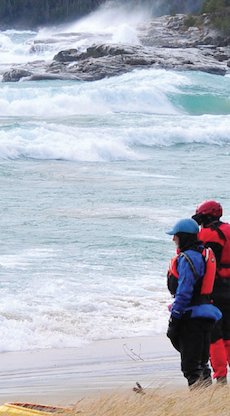
People standing at Lake Superior“I signed up for this by mistake,” Susan confides, her secret feeling safe within our intimate huddle. Nervous laughter sends puffs of condensation into the chill air. We’re pressed beneath a malevolent sky, shoulders braced against a biting wind that cuts through our layers of fleece and wool, Gore-Tex and neoprene. Booties crunch on pea gravel coagulated with ice as we bob up and down, trying to get warm. Susan is the only one who’s said it, but I scan the pinched faces of the others, wondering if I will see it written there. Mistake.

Moments later, having finished our round of class introductions—“Hi, my name is Virginia. I’m just here to watch… really, if you guys want to practice rescues and swimmer landings, I’ll just shoot photos”—we’re using paddle blades to chip ice off our seats. Lead coach Shawna Franklin demonstrates “speed launching” and invites us to follow suit. The maneuver involves shooting your empty kayak into the water, diving after it to belly flop onto the deck, and then rodeoing your butt and legs into the cock- pit whilst gliding serenely away from the beach.

Hmm, I see what you’re doing here, getting us wet now so it won’t come as such a shock later… very clever.

Still, Franklin, a BCU 5-star coach and co-owner of Body Boat Blade International in Washington’s San Juan Islands, makes the maneuver look so graceful we can’t help but try to do the same, with varying degrees of success.

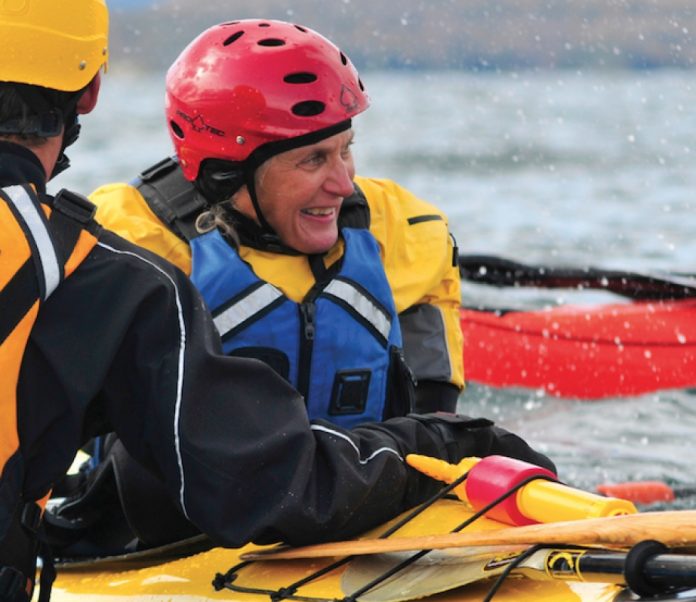
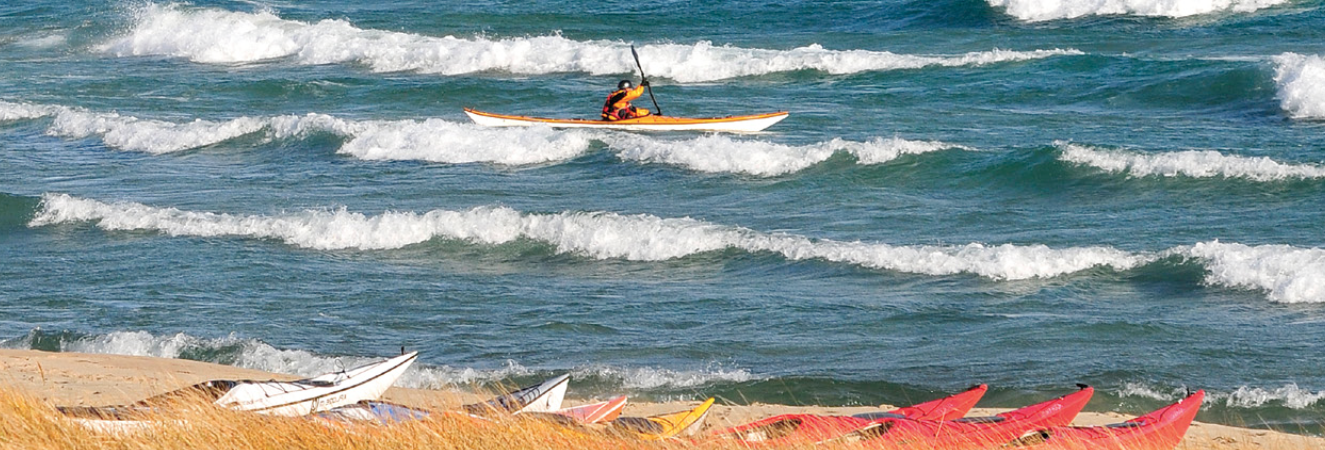
It’s our second morning at the Gales Storm Gathering on Lake Superior and the weather has been typical for October: 35-knot winds, heavy swell and bone-chilling temperatures. It’s just these types of conditions that event organizers were counting on when they invited top coaches from across the U.S. and Canada and as far away as Wales to their second-annual rough-water sea kayak festival at Michipicoten Bay on the lake’s Ontario shore.

“Most symposiums are in the summer and you’re paddling on flatwater,” explains Gales co-founder Keith Wikle, a freelance instructor and GoKayakNow.com blogger from Kalamazoo, Michigan. In 2011, Wikle partnered with Ryan Rushton of Chicago’s Geneva Kayak Center and together they conceived an event where Great Lakes paddlers could train in ocean-like conditions under the supervision of top-level coaches.

“We wanted to create a venue where you can take that next step in real conditions, with a safety net so that if you do have a swim it doesn’t end up being a fatal one,” Wikle says.

The pair borrowed the event’s name from the annual Gales of November Rendezvous, a carnage- heavy rough-water gathering organized by Great Lakes sea kayaking pioneer Stan Chladek in the early 1980s. The Halloween weekend meet-up was an informal, invitational get-together based around Agawa Bay, 50 miles south of Michipicoten. In its heyday in the early ‘90s, some 50-odd expert paddlers from around the world would join Chladek for epic tours and close calls in the surf.

Now in his seventies, Chladek still gathers the troops—today a handful of old friends and local paddlers—every October 31st, but Wikle and Rushton imagined a Gales that was accessible rather than exclusive. Yes, they would still invite some of the world’s best paddlers, but they would shift the focus to coaching and open the sign-up sheet to advancing beginners and experts alike, so long as they had a thirst for Superior’s notoriously rough fall waters.

“We make it clear that you need to be into wind and waves and even snow,” says Wikle.“You’re going to be cold and wet. It’s a smaller number of paddlers who are willing to embrace that.”

The inaugural Gales Storm Gathering drew some 45 participants and 15 instructors to Superior’s south shore in Marquette, Michigan. But while the city’s inner and outer harbors and proximity to the Menominee River offered an ample variety of conditions, Wikle and Rushton always planned to move locations from year to year.

“Moving the event makes it accessible to different groups of people and showcases the tremendous variety of paddling environments on Lake Superior,” says Wikle.

“ This is a rare opportunity in this part of the world with these coaches,” agrees Alec Bloyd-Peshkin, a guest instructor from Chicago,“and the venue is a huge highlight.”

Wawa doesn’t have a paddling town vibe. A blink-and-you-miss-it community amid the North Shore’s seemingly endless cyclorama of scraggly black spruce and stoic Shield lakes, the town’s primary attractions are a giant roadside likeness of a Canada goose and the mountainous, dollar-scoops of ice cream at Young’s General Store’s mock trading post. Several dirt road miles and 350 feet downhill at Michipicoten, however, is some of the finest kayaking on Superior. 

Rushton and Wikle found a keen partner in David Wells, owner of local sea kayaking outfitter Naturally Superior Adventures and 2012 Gales host, Rock Island Lodge. Situated at the mouth of the mighty Michipicoten River, Rock Island is wreathed in the often-turbid waters of one of the lake’s largest tributaries. Here, three-mile-per-hour currents collide with autumn swells reaching 10 feet or more, born from the longest fetch on Superior—nearly 350 miles to Duluth. The site promised just the sort of ocean-like exposure and challenging conditions the organizers wanted to showcase when they invited their coastal comrades to the Inland Sea.

“We often feel like second-class citizens because we’re on freshwater,” Wikle says,“But the Michipicoten has enough current to create tidal race conditions. That’s the Lake Superior we want to show off, especially to paddlers from the coast.”

Along with Franklin and Body Boat Blade partner Leon Sommé, headline instructors at Gales 2012 included Wales’ Nick Cunliffe, Halifax’s Christopher Lockyer, BCU senior coach Scott Fairty and around-Ireland paddler Sam Crowley. “ These are the leaders in our community,” says Wells. “Of course we have something to prove.”

Person kayaking on Lake Superior

“WHAT KIND OF FLOWERS DO YOU WANT AT YOUR FUNERAL?”

Michipicoten is a long drive from anywhere. I roll down the narrow causeway onto Rock Island at dusk after a full day behind the wheel. Beyond my passenger window the surf dumps explosively on the steep gravel of Government Beach. Out the driver’s side, even the sheltered bay just inside the river mouth is tossed with whitecaps. I drive past a line of tents clinging tenuously to the beach, park behind a windbreak of twisted cedar, throw my sleeping bag in the back of my van and fall into dreams of being blown out to sea on a Therm-a-Rest.

I’m grateful for a slow start the following morning. Gale-force winds have stymied the morning workshops and the final evaluations for the score of participants who signed up for a pre-symposium coaching week. After four days of drilling, they gather in the lodge around the warmth of a roaring fire, content to merely watch a frenzy of white horses galloping across Michipicoten Bay as the wind tosses horizontal sheets of rain against the windowpanes.

Conversation circles from the weather, the schedule and the best gear to anxieties about their impending assessment. Inevitably, there’s some light-hearted jesting. “Are you ready for the night navigation exercise tonight?” Steve asks Tammy as 11-foot breakers thunder up the river mouth. Without missing a beat, Tammy retorts, “ What kind of flowers do you want at your funeral?”

A petite woman in her late sixties, Tammy took up paddling after retirement and is now a sea kayaking junkie. She drives all over the East to train with many of the sport’s best coaches. After eight days of Gales, she’s heading down to Georgia’s Tybee Island for a week of Greenland-style instruction, and then pushing into South Carolina for several days of private coaching with Scotland’s Gordon Brown. Tammy’s paddling knowledge now extends well beyond strokes and rescues; she can also tell you the strengths and weaknesses of a regular who’s who of top kayaking brass.

It’s the calibre of the instructor roster, she tells me, that drew her to Gales. The event brings together instructors from BCU, ACA and Paddle Canada doctrines, allowing participants to sample the field. “It’s wonderful to be exposed to so many different instructional styles,” Tammy says. She describes BCU coaching week lead, Nick Cunliffe, as “an amazing instructor with really helpful feedback,” a senti- ment echoed by many of the other Gales students about their respective coaches.

Okay, so it’s a privilege to be under the wing of such accomplished paddlers and teachers. But as we gather on the rocks at the river mouth to watch Cunliffe and Sam Crowley, owner of Michigan-based Sea Kayak Specialists, poke their bows into a 40-knot s’wester, I wonder if part of the attraction is in witnessing the masters made mortal.

As Cunliffe and Crowley edge further and further into the crashing waves, Steve calls a play-by-play commentary: “Oh, Sam is out of his boat!” he yells when Crowley pushes too far and is caught between an avalanching set and the steep face of surf-washed beach. Moments later, he’s crowing, “Now I don’t feel so bad!” as a soggy Crowley staggers ashore sans kayak. 

A SOCIAL VENUE

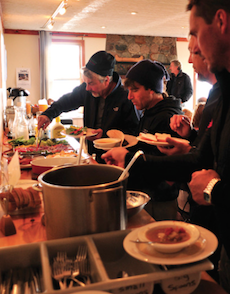
People eating dinnerWikle is expecting 40 participants for the rough-water weekend, and when they join the nearly 20 coaches in the lodge’s dining room for lunch, the scene resembles a crowded school cafeteria. Or a class of ’83 reunion— the demographic at Gales is typical for sea kayaking; clearly adrenaline-charged surfs aren’t just a young person’s game.

With the wind still gusting to well over 30 knots, the river mouth remains a no-paddle zone. Most head upriver for workshops on paddling in current, maneuvering in wind and waves, and practicing advanced rescues, while a handful of keeners convoy to nearby Sandy Beach for a surfing lesson. With its long, shallow approach, Sandy is a “spilling” beach—the waves break gradually, dispersing their energy as they roll ashore—making it a more forgiving training ground. Even so, with the intense onshore wind, students and coaches alike are soon exhausted. It takes every last ounce of effort to merely hold position in the shore wash, let alone punch out through the breakers. Spinning a 16- or 17-foot craft 180 degrees to surf back in is all but impossible.

Eventually, a couple of participants abandon their boats on the sand in favor of body surfing. Like a massive heat sink, Lake Superior maintains its summer temperature well into the fall, making the famously cold lake feel comparably balmy on bracing autumn days. In drysuits, we discover, being in the water is more comfortable than being on it. Before long, the whole class is belly flopping into the surf, our unflappable coaches leading the charge.

Like the animated scene in the dining room earlier, the impromptu body surfing session demonstrates that Gales is as much a social venue as it is a place to hone rough-water skills.

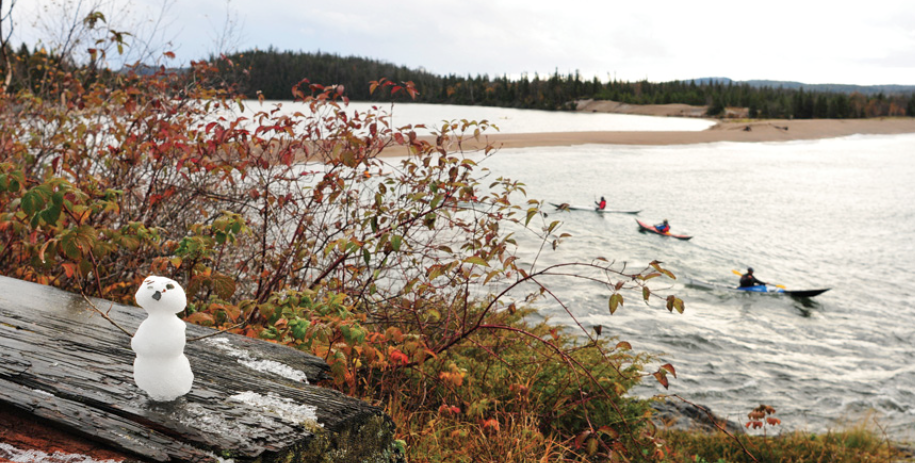
By day two the wind has abated to a manageable 10–15 knots and the coaches are able to move their classes out into the bay. While I’m watching Franklin speed launch, Wells wanders over. Gazing across the frozen beach at the colorful clusters of shivering figures and rime-crusted boats, he marvels, “Look how many people are on the water in sub-zero temperatures—it’s frickin’ awesome!”

Tracing a coastline of long, gravel beaches and billion-year-old bedrock points, Franklin leads our group through a progression of landing and launching exercises. Then it’s the students’ turn. Franklin asks Susan —the Ann Arbor, Michigan, paddler whose mistake, it turned out, was clicking ‘Register Now’ on the Gales website before she had all the facts—and two others, Tom and Sue, to direct an “emergency” group landing on an inhospitable, rocky spit exposed to the swell.

So far we’ve excelled as students, but it quickly becomes apparent that our leadership needs some work. A confident and capable paddler from Minneapolis, Sue doesn’t think there’s a safely manageable landing for a group on the point. Tom, a local in his mid-forties, disagrees but doesn’t want to be the first to land—inexplicably, he suggests Sue lead the assault. Meanwhile, Susan says little—later she’ll tell us she felt excluded by her co-leaders.

We bob around in the unsettled waters for what feels like an eternity, our designated leaders mired in indecision. Finally, Franklin tosses them a lifeline,“You could ask your group to help, and send one of your strongest students in first to land the others… you can send me if you like.”

Franklin sidles up to the rocks and steps nimbly onto a sliver of ledge, timing her exit with the surging rise and sucking fall of the waves against the smooth-polished stone. Sue lands next and suddenly our leaders are working together—if not a well-oiled machine, at least one that is no longer seized.

By evening, snowflakes are filling the air. We carpool into Wawa for dinner, heaters blasting as we bounce up the potholed track away from the lake. Dashing across the parking lot beneath the wall-eyed gaze of the Wawa Motor Inn’s 15-foot rooftop goose, we escape the flurries in the restaurant’s warm, woodsy sanctuary.

Over a basket of the Motor’s famous wings (chicken, not goose), Jeff, one of the coaching week students, fills me in on his assessment.“I worked really, really hard to learn I can stay [at the certification level] where I’m at,” he confesses. Jeff and his wife Michelle drove from Minneapolis to be at Gales, but he isn’t angry or even disappointed with this outcome.“Sam and Ryan didn’t just say ‘nope, you’re not good enough,’” Jeff says of his coaches. “ They gave me honest, useful, realistic feedback so I came away with a list of areas for improvement—somewhere to go from here.” 

MEMBERS OF AN ELITE TRIBE

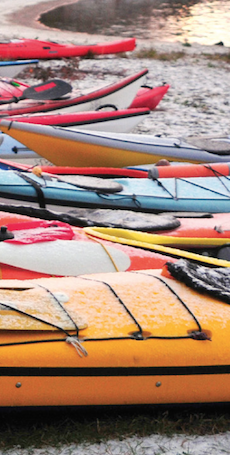
Snowy kayaks by the beachSunday morning, sudden squalls alternate with sunshine and whitecaps are building beneath the schizophrenic sky. Superior has kept the coaches on their toes all weekend. Every day begins with an instructors’ planning meeting—a dozen of the international sea kayaking community’s brightest luminaries gathered around a battered wooden table and blazing woodstove in the lodge’s steamy kitchen. As you might expect, there’s plenty of discussion: stay and play at the river mouth? Carpool to a nearby beach? Or try to paddle to the beach?

Eavesdropping on the coaches’ discussion, I can see that this group— even with their tremendous cumulative skills and experience—is grappling with the same challenges as yesterday’s student leaders. The same challenges faced by all kayakers: complex environments and decisions, fatigue and uncertainty.

Wikle tells me later that, even more than the curveballs thrown by the weather, the skill level of the participants has surprised his guest coaches. “I’m told it’s quite high compared to other parts of the country,” he says,“it seems Great Lakes kayakers take developing skills and seamanship more seriously than many of their counterparts on the West Coast.”

Later that afternoon, the current flooding out of the river mouth pushes against the incoming swell, forming steep glassy rollers. The conditions are fleeting, with the wind returning before long, but it’s time enough for many of us to sample rough-water paddling at its rollicking best. Eager to catch long, cruisy surfs for ourselves, we crowd close together in the line-up—the area just outside where the waves begin to break.

Rushton takes off on a wave and I catch a steepening face just behind him. Accelerating into the trough ahead as the wave breaks, my kayak broaches and suddenly I’m side surfing—an out-of-control, Hail Mary move known as a bongo slide in surf parlance. Rushton’s ride has already ended and I’m sweeping towards him, pushed by the freight-training wave at an alarming speed. He looks up and we lock eyes— each seeing that I’m about to steamroll over him. Then, at the last possible moment, my bow veers back down-wave and I carve away, missing his boat by a few scant feet. When I see Rushton later in the line-up, he’s smiling,“There’s nothing like when your eyes meet on a wave.”

Riding waves with our mentors is both liberating and uniting.“An ‘aha!’ moment,” as Mark, a soft-spoken retiree and first-time surfer from Washburn, Wisconsin, puts it later.

After dinner, the lodge’s dining room is cleared for slideshow presentations. Local instructor and author Conor Mihell reads a chapter from his book The Greatest Lake, a history lesson on Chladek’s original Gales, accompanied by archival photos from those early years. Mihell pauses frequently for appreciative “oohs” and “ahs” from the audience as slides of cartwheeling kayaks appear on the screen behind him. We’re now members of the same elite tribe. 

Little snowman by the beach

A FRESH AND QUIET CONFIDENCE

Gathering for Wikle and Rushton’s event wrap-up Monday afternoon, we are tired and stiff-limbed. But there’s something else engraved in the weary visages—a fresh, quiet confidence that wasn’t there before.

Most of us have tripped on the Michipicoten’s fickle currents, or wiped sand from our ears and eyes when the fleeting union of wave and kayak eluded us. But we have also learned the unforgettable, inimitable sensation of harnessing that power and riding a peeling left all the way to the beach, of rolling effortlessly on a pillowy foam pile. Of being soggy and tired and heading back out for one more ride.

Before we part ways, Tammy tells me a story. She met a young woman this weekend, a recent inductee into the paddling community. The woman told Tammy that, contrary to the opinions of non-paddling friends back home, she didn’t believe she was addicted to kayaking. She pulled on a wool hat as she spoke, finished dressing for a rough-water rescues workshop. The lodge’s thermometer read 23 degrees Fahrenheit.“If you’re going out today,” Tammy told her,“then you’re addicted to kayaking.” 

This article on conquering freshwater fears was published in the Spring 2013 issue of Adventure Kayak magazine.This article first appeared in the Spring 2013 issue of Adventure Kayak Magazine. For more great content, subscribe to Adventure Kayak’s print and digital editions here.
12 Adventures for Your Best Paddling Year Ever

Photo: Fredrik Marmsatar
12 Adventures for Your Best Paddling Year Ever

A life list can be daunting. Its very name suggests a time frame that’s difficult to imagine, and certainly hard to plan for. Calling your register of dreams a “bucket list” only adds a looming air of finality and regret. Not helpful at all.

Which is why we’ve taken the idea and ideals of a life list and applied them to a single year. Because we believe you don’t have to settle for the trip of a lifetime—you can enjoy an outstanding adventure each month, and make every year your best year ever.

JANUARY: BUILD YOUR OWN KAYAK

“It’s a real high to build a boat, put it in the water and paddle away,” says Dan Jones, a veteran builder who lent us a Pygmy Murrelet. Kits are available to suit every design preference; all you need is time and a warm workshop. Start your project after the holidays—planning to begin earlier can lead to procrastination or, even worse, cut into time on the water. Start too late and your hot new ride won’t be ready for spring—count on two or three months if you’re only working on it evenings and weekends. Once you slip into your gleaming labor of love, how- ever, you may be hooked: Jones is already planning his 12th home-build. Accelerate your project with a weeklong workshop. Try Maine’s Wooden Boat School, Port Townsend’s Pygmy Kayaks or Peterborough, Ontario’s Bear Mountain Boats. 

www.thewoodenboatschool.com | www.pygmyboats.com | www.bearmountainboats.com

FEBRUARY: VAMOS AL SUR! 

Escape the winter blues and head south for sun, surf and salsa. With bountiful marine life, endless beaches and an established sea kayaking scene, the

Sea of Cortez in Baja is a favorite destination for many migrating paddlers. For kayaking that will blow your mind, travel south to Patagonia’s fiords and paddle past the snow-capped volcanoes, towering waterfalls and inviting hot springs. Ever try paddling at altitude? Located at a literally breathtaking 12,500 feet between Bolivia and Peru, Lake Titicaca is the world’s highest navigable lake and a truly unique kayaking destination.

www.bajakayakadventures.com | www.exchile.com | www.titicacakayakadventure.com

MARCH: PADDLE WITH MANATEES 

Once mistaken for mermaids by lovelorn (or desperate?) sailors, the admittedly curvaceous manatees make fascinating paddling companions. During

winter cold snaps, hundreds of these gentle sea creatures gather in the warmer waters around natural springs in Florida’s Crystal and Homosassa rivers. Paddling through the crystalline shallows is a low-impact way to enjoy these herds of inquisitive animals—manatees are under threat from powerboat traffic and other human activities—and hook your kids or friends on the joys of kayaking.

www.floridakayakcompany.com

APRIL: SAIL DOWN UNDER 

With over 25,000 kilometers of coastline from tropical Queensland to the storm-tossed Great Southern Ocean, Australia is a magnet for surfers, sailors and kayakers alike. Paddle the white sand beaches of the Whitsunday Islands at the heart of the Great Barrier Reef—one of the Seven Wonders of the natural world—to get up close and personal with sea turtles, manta rays and whales. Take advantage of Tasmania’s location in the notoriously windy Roaring 40s and try your hand at the classic Tassie Rig for some wild kayak sailing, Aussie-style. Across the Tasman Sea, Kiwis love to sail almost as much as their neighbors. Fill your sheet on the sun-kissed waters of New Zealand’s Abel Tasman coast.

www.saltydog.com.au | www.roaring40skayaking.com.au | www.abeltasmankayaks.co.nz

MAY: SPRING TUNE IT UP

Looking to venture into exposed waters, improve your roll or practice rescues? Hone rusty skills and learn new ones with a few days of spring training—for specific course offerings in your area, check out the websites of the American Canoe Association, Paddle Canada and BCU North America. If the kayaking bug really has you bit, sign up for an instructor or guide course—teaching and leading will test your ability to effectively commu- nicate key points and can help fine-tune your own skills. 

www.paddlingcanada.com | www.americancanoe.org

JUNE: RACE OF A LIFETIME 

For the ultimate mental and physical challenge, sign up for the Yukon River Quest—the world’s longest annual canoe and kayak marathon. Competitors race in solo, tandem and voyageur divisions, and must complete the more than 700 kilometers from Whitehorse to Dawson City in 72 hours or less. Competitors range from capable novices to internationally ranked professional athletes; however, many have discovered that wilderness experience and mental stamina count for as much as extreme fitness. Prepare yourself for amazing camaraderie, utter exhaustion and bizarre hallucinations as you race around the clock and under the midnight sun through some of Canada’s most beautiful landscapes. Toast the ghosts of the Gold Rush and celebrate your successful finish with a wild night in Dawson City.

www.yukonriverquest.com

JULY: FIND AN ICEBERG 

Every spring, bergs calved from the 15,000-year-old glaciers of western Greenland drift south on the Labrador current into Newfoundland’s famous Iceberg Alley. Kayaking the wild coast of the Rock in early summer will let you catch the tail end of the iceberg season and—if you are lucky—some precious sunny days. In the long summer sunlight, each iceberg—from intimate Toblerones to superstore-sized monoliths—glows with a thousand subtle shades of turquoise and sky blue. For icy encounters on the West Coast, head to Alaska’s easily accessible Mendenhall Lake in Tongass National Forest or venture into Prince William Sound to encounter icebergs birthed by the tide-water glaciers of the immense Chugach range.

www.nfkayak.com | www.sea-quest-kayak.com

AUGUST: DISCOVER THE BIRTHPLACE OF THE KAYAK 

Voyage past the Arctic Circle to start your journey in Pond Inlet on Baffin Island or the Scoresbysund fiord system in Greenland. Paddling these harsh waters during the brief ice-free season will give you a deep appreciation for the resourcefulness and courage of the people who dared hunt whales from their small skin crafts. On your trip, you’ll share this wild land with narwhals, musk oxen, arctic fox and polar bear—to say nothing of the plentiful and delicious Arctic char.

www.blackfeather.com

SEPTEMBER: CAMP ON YOUR OWN ISLAND

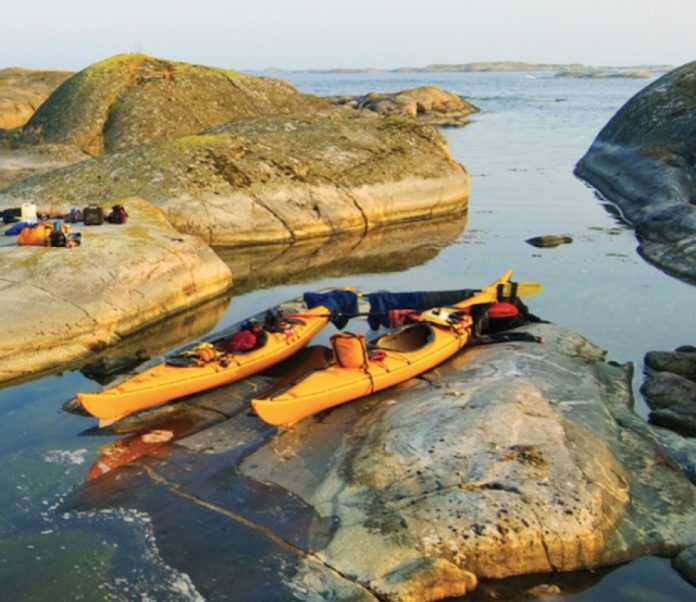
Sunny days, warm water, no crowds—with a bit of luck, early fall can be the perfect season to find your ultimate island paradise. Plan an after-Labor Day getaway to Georgian Bay, the Southeast’s Barrier Islands, the St. Lawrence’s 1000 Islands, Vancouver Island’s Broken Group or your nearest popular archipelago. Whether you go for a quick weekend trip or a longer adventure, the odds of claiming a private island paradise are in your favor. Enjoy the last days of summer by sunbathing, skinny dipping, cooking an unhurried feast over your driftwood fire and sleeping under the stars. Best of all, no mosquitoes! 

OCTOBER: LEARN TO SURF

As the fall storms blow in and the swells grow larger, a strange epidemic sweeps the kayaking community: Honest, hard-working folks mysteriously start calling in sick—a pattern that correlates directly to local wave size and wind strength. And who can blame us? October is jam-packed with opportunities to stretch surf skills. For surf-specific workshops and an all-around good time, sign up for a rough water festival. Try Oregon’s Lumpy Waters Symposium, Connecticut’s Autumn Gales, Georgian Bay Storm Gathering, Gales Storm Gathering on Lake Superior, or even the UK Storm Gathering in Wales. 

www.galesstormgathering.com | www.lumpywaters.com | www.kayakwaveology.com | www.ukstormgathering.blogspot.com 

NOVEMBER: STRETCH YOUR SEASON

For many paddlers in northern climes, November means a sad farewell to your kayak until spring. But with the right gear and a cozy fireplace (or sauna, or hot tub…) awaiting you, the off-season can be a memorable time to go paddling. Nothing compares to gliding across a wintry lake to the crystalline sound of wafer ice shattering beneath your hull. Rediscover familiar landscapes transformed by a fresh layer of snow or heavy frost. Appreciate the intricate beauty of water rivulets freezing on your paddle. Pack your pogies, fill your Thermos and make this the year you stretch your season. 

DECEMBER: HOLIDAYS IN HAWAII

Alternately caressed and pounded by the powerful Pacific Ocean, the Hawaiian Islands are blessed with diverse and awe-inspiring coastlines. The turquoise waters of Kailua Bay on Oahu are sheltered by outlying reefs and easily navigable even when other parts of the island are exposed to heavy swells. After launching in Kailua, paddle to Lanikai Beach, ranked one of the top beaches in the world, and play in the surf at the twin Mokulua Islands. Winter is big wave season in Hawaii—save remote and rugged paddling expeditions like the fabled Na Pali Coast of Kauai or the North Shore of Molokai for next year’s summer vacation.

www.kayakkauai.com | www.kailuasailboards.com

Charlotte Jacklein has spent the last decade researching this article by guiding and traveling in Hawaii, Newfoundland, Australia and Central America. She’s built her own boat, paddled through ice floes and competed twice in the Yukon River Quest. 

This article on your best paddling year ever was published in the Spring 2013 issue of Adventure Kayak magazine.This article first appeared in the Spring 2013 issue of Adventure Kayak Magazine. For more great content, subscribe to Adventure Kayak’s print and digital editions here.