Home Blog Page 333

Midnight Madness: Yukon River Quest

Photo: Alison Wood
Midnight Madness: Yukon River Quest

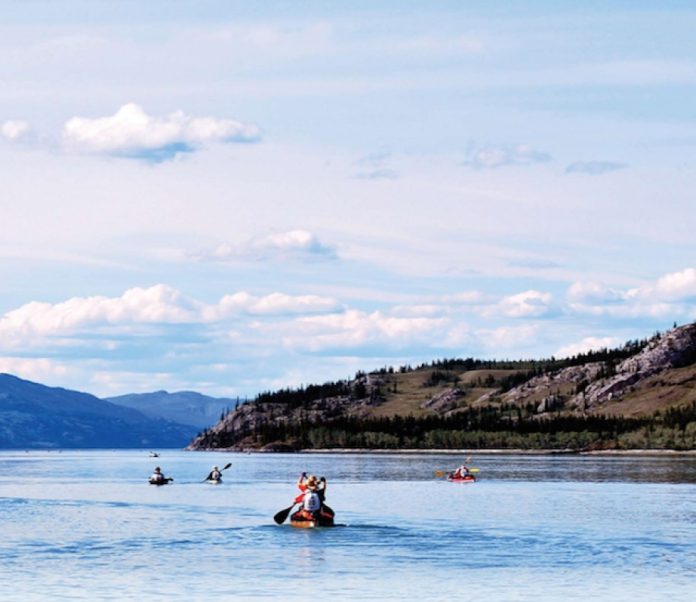
I am surrounded by beauty. The still aqua water lies like a sheet of smooth glass, stretching farther than the eye can see. Sharp, craggy rocks jut out from a dense line of trees along the shore. As we travel slowly by motorboat up and down Lake Laberge, we are encased in raw, natural history—brought to life by our guide, Mark Stenzig, who recites The Cremation of Sam McGee by Robert Service.

“…But the queerest they ever did see
Was that night on the marge of Lake Lebarge
I cremated Sam McGee.”

If there is a more fitting introduction to the Yukon, I can’t think of one. It’s day two of al- most a weeklong adventure covering The 11th Annual Yukon River Quest (YRQ): Race to the Midnight Sun—an epic 740-kilometre canoe and kayak race beginning in Whitehorse and ending in Dawson City.

I’ve travelled 5,500 kilometres from Toronto to be here with a handful of other media. But racers have come from across the globe to take part in what is the longest race of its kind. Some seasoned veterans arrive well in advance to rest and set up, aided by friends and family. Others cut it fine, like the teams I am following, who pull in with just over a day to spare, kayaks strapped tightly to a rented SUV and no entourage in sight.

I met Peter Whaley, Jamie Playfair and Matt Gunning a few days earlier at one of the rest points in their long journey from Halifax to Whitehorse. Just three regular guys looking to finish the race within the four allotted days. Twenty hours into their drive, they are giddy with fatigue but pumped at the thought of racing with 72 other teams made up of 171 paddlers—each of whom will be navigating the same historic wilderness route of the Klondike gold seekers, in search of their own gold.

So what makes a person enter such a gruelling competition—one that is as brutal on the psyche as it is on the body? Whaley, who has spent most of his life guiding and travelling canadian waters, is quick to answer.

“As one approaches the pinnacle of life and starts to visualize the backside, it’s time to ask whether you will succumb to the proverbial slippery slope or dig your heels in,” quips the 48-year-old owner and operator of coastal Spirit Expeditions from River John, Nova Scotia. “Racing the Yukon River quest is my way of strapping on the crampons, grabbing the ice pick and digging in with reckless abandon!” 

Gunning, a 33-year-old owner of a used car dealership in Pictou county, started kayaking 14 years ago to build strong core muscles to support a back injury that resulted in a fused spine. He took one of Whaley’s kayaking courses, which led to more over the years. completing the triangle is Playfair, who also found his sea legs thanks to Whaley. For seven years, the 40-year-old art director has been navigating Nova Scotian waters. Both men guide for Whaley on occasion.

The three friends made the pact to enter the race after a pleasure paddle on the cari- bou River in Pictou county in November, 2007. “After we got off the water, we went for a beer and the ideas started flowing. And scar- ily enough, no one was backing down,” laughs Gunning. “Right there we committed to entering the 2009 race.”

Paying the registration fee is one thing. Training for a competition of this magnitude is another. The paddlers spent four months on dry-land cardio, strength and core workouts. Gunning also worked out with a kayaking simulator he concocted from an old bench, a kayak seat and bungee cords.

Once the ice broke, they moved into sprint interval training for strength, and distance conditioning for stamina. Since mental fatigue is common during long, solo paddles, the trio group-trained to make sure they all would be safe on the water.

Gunning isn’t the only one needing to baby an injury. Playfair has niggling pain in his right rotator cuff, and years of repetitive use has left Whaley with tearing in both of his. cranking up his training aggravated the injuries even more and he questioned whether he could handle the 700,000 paddle strokes from start to finish. After learning that the race spits out even the most fit, Whaley made the decision to move from a K1 into a K2 with Gunning.

Fast forward to Sunday, June 21, 2009. The Nova Scotian contingent is ready to put their physical, emotional and mental preparation to the test. Some early arrivals take advantage of the paddling clinic and training runs. Tuesday kicks off with boat measuring and gear inspec- tion, which requires a first aid kit, map, PFD, extra paddles, adequate food and water, and more. 

“The inspectors went through all of our supplies from stem to stern,” describes Playfair.

A mandatory pre-race briefing rounds off the afternoon. Some paddlers, such as Brad Pennington from Houston, Texas, continue preparing well into the evening. Pennington won last year’s race in the solo kayak category, after finishing fourth in 2007. Most others like Whaley, Gunning and Playfair opt to eat and sleep.

Wednesday, June 24: race day breaks beautifully crisp and clear. The mammoth Voyageur boats are launched and moved to their starting positions in the Yukon River, while solo and tandem boats are arranged by number on the Rotary Park lawn: Whaley and Gunning are number 24 and Playfair is 25. Final inspection is underway and pre-race jitters are building.

By 11:30 a.m. paddlers have shifted their boats to their assigned spots on the riverbank and are at the starting line, bibs on and excite- ment at an all-time high. The half-hour wait until race time is probably the toughest to handle. Like gated greyhounds, these paddlers need to be let loose.

Twelve noon. The horn blares and racers sprint the 100 metres to the launch area, where they jostle for space in the mad rush of boats on the river. “The feeling as the energy built at the start line was one of the coolest things I’ve ever experienced,” says Gunning.

Although their plan is to not get caught up chasing the leaders, Gunning and Whaley soon get into their groove and pass racers. Only a few K2s dot the water in front of them. Playfair finds his own inner rhythm, settling into a comfortable pace. But halfway through immense Lake Laberge, Gunning and Whaley feel the fatigue. Whaley’s shoulders start seizing. He stops paddling at times, letting Gunning pick up the slack. Their pace slows and boats blow by them.

The first night is the worst. Gunning is the first to hallucinate, convinced the shores are lined with crowds of people cheering them on, winner Carter Johnson. From their standing in carmacks, team organizers expect Whaley and Gunning to arrive in Dawson City early afternoon. But the team starts picking off boats one by one. Early Saturday morning, they quietly pass the finish line, exhausted but exalted—55 hours and 16 minutes after they paddled out of Whitehorse.

In total, 56 of the 73 teams complete the 2009 race, with a Voyageur team from Texas taking the top title. But Whaley and Gunning didn’t just finish, they triumphed, coming third in the K2 category—just two minutes shy of the K2 winning team.

One year later, all three agree the mental challenge was the most difficult to overcome. While physical conditioning is necessary, emo- tional strength is key. It propelled Whaley and Gunning to keep going, finish the race—a considerable achievement on its own—and underlay the competitive shift they felt late in the race. They now crave an even greater title.

Playfair, while understandably proud of his quest, also longs for a second chance. “I left something on the river which will play with my mind until I get the opportunity to try this again,” he sums up. “The landscape was breathtaking, the people were warm and hospitable and the race only added to a spectacular adventure we will all speak of for years to come.”

Alison Wood is a freelance writer, a mother of three, and the editor of Today’s Parent Toronto. 
Screen_Shot_2015-07-27_at_12.46.47_PM.pngThis article first appeared in the Early Summer 2010 issue of Adventure Kayak Magazine. For more great content, subscribe to Adventure Kayak’s print and digital editions here.
Contentment via Kayak

Photo: Ginni Callahan
Contentment via Kayak

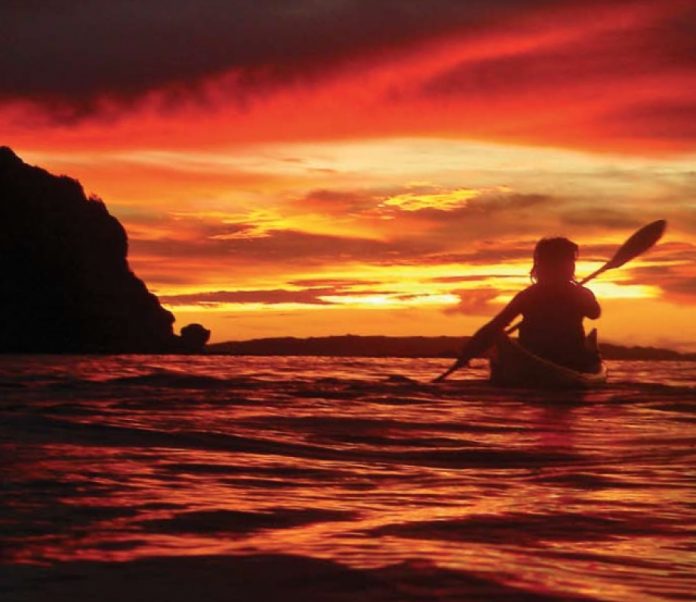
Night air cascades down the Giganta Mountains and out to sea. It’s a cold and starry launch at 4:48am onto the blue- sparkling water. The bow cuts a neon line and paddle blades punctuate the bioluminescence. A shooting star slashes the heart of Scorpius and is forgiven. cancer the crab hides quiet over my shoulder in a crevice of the sky, in the company of mars.

Walk with hips. Push forward, extend the catch. Pop the exit.

Away from the mountain wind, I’m sweating now, working the technique, mesmerized by the sparkles of my passage and the occasional reflection of Antares on a broken piece of sea. In the star shadow of Danzante Island, waves on shallow rocks make flames of leaping blue. Fish stir nebulous galaxies in the deep.

First leg: four nautical miles, 56 minutes.

Scorpius’ tail is lost in the pre-dawn glow where the moon should be showing its last thin crescent. Another shooting star writes its story on the night page with disappearing ink and is forgotten.

Morning paddles around Danzante Island are my training runs. Start in darkness, transition into day, timing the loop so the sun is never in my eyes. Eleven nautical miles, almost three hours of paddling in paradise before breakfast. It’s exercise. It’s meditation. It’s freedom. It’s a celebration of nature and health. A song of thankfulness belted out from every muscle of my body, to the rhythm of the sea.

An orange cream horizon is broken by distant islands, monserrate and catalina. Over monserrate a light appears, a fire, growing taller. I turn to watch a fragile, curving tower emerge from the black island silhouette. I cheer for its perfection. The crescent moon climbs, chased by dawn, and I paddle on.

Second leg: four nautical miles, 53 minutes. Slight current assist.

A fin breaks the water close to the rocks. Dolphin. A pod of them. Several little puffs of breath, backlit in front of a shadowed cliff. A baby surfaces beside its mother, an arc of grace and playfulness. I stop paddling to drift and they come around on both sides, moving slowly in the same direction. One grey adult floats on the surface for a few moments, curious. They swim along with me, then outpace me, then circle away. What fluid power. What simplicity to move like whispers through the water carrying everything they need without a single drybag.

Somehow I never struggle to justify my existence when I am on the water. Later in the day I will sit behind a computer in the office growing a sallow-eyed patina of grumpiness despite intentions to the contrary. But right now, this is soul food. This is contentment.

Contentment is a lifestyle, a choice. It feels like joy, ripened slowly on the vine. Contentment is a state of mind cultivated gently out of rocky soil. contentment is acceptance that what is, is just right.

I turn for home, around the north point of Danzante. The mountains before me glow with sunrise. Posture up, hands high. Work the core. Time melts away and the feeling inside is right.

Ginni Callahan is a sea kayak guide on the Sea of Cortez, Mexico, in winter and on the Columbia River and Oregon coast in the summer. She owns Columbia River Sea Kayaking and Sea Kayak Baja Mexico. 

Screen_Shot_2015-07-27_at_12.46.47_PM.pngThis article first appeared in the Early Summer 2010 issue of Adventure Kayak Magazine. For more great content, subscribe to Adventure Kayak’s print and digital editions here.
Rock the Boat: Got GAS?

Illustration: Lorenzo Del Bianco
Rock the Boat: Got GAS?

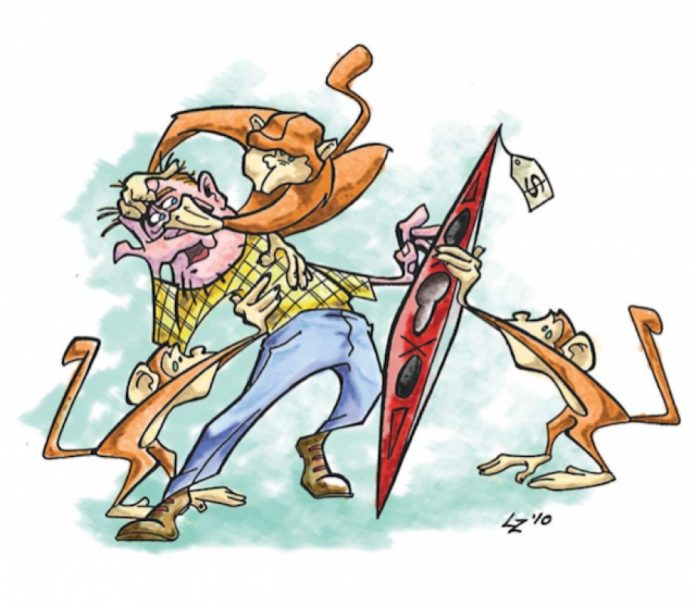
I love kayaking. Which is great. But I also love kayaking gear, which is a love with far more sinister consequences. In fact, at a recent social gathering (people referred to it as “an intervention” for some reason) my friends even claimed that I love kayaks too much, and that the desire to acquire more and more boats can be a slippery slope.

Classical addiction in individuals is characterized by “compulsive desire, loss of the ability to control the dose, and persistence despite ad- verse consequences to themselves and others.” A classical addiction to gear manifests itself as what I now refer to as GAS, or Gear Acquisition Syndrome.

You know you have GAS when:

  • You own enough kayaks and gear to run a commercial kayak touring company, despite the fact that you do not own a commercial kayak touring company.
  • You keep purchasing more and more kayaks, but never sell one.
  • Your backyard’s perimeter is effectively fenced by kayak racks.
  • You stock more boats and gear than your local paddlesports retailer.
  • Other paddlers come to your house to “see the fleet” as if visiting a major museum collection.
  • You find yourself in desperate negotiations with your bank manager, seriously trying to sell him on the idea of accepting a kayak in lieu of the more traditional cash mortgage payment.
  • Your wife routinely shouts things like “it’s me or those damned boats!” before departing on protracted visits to her mother.

Consider my own behaviour as a case study. I was recently browsing used kayaks online, as I often do. I find idly skimming through the ads both interesting and oddly soothing. Used-Victoria.com, craigslist, MEC’s Online Gear Swap—they’re all good for a quick fix. I wasn’t jonesing for another boat (after all, I have a garage full of them), but it’s always interesting to know what’s available. And besides, it’s a totally harmless diversion. I waste a little time, but I’m not buying anything, right?

Then I noticed a classic Nordkapp for sale. I’d always been curious about the original Nordkapps. Some say that once you’ve tried one you’re hooked for life.

It was like showing a marijuana cookie to a Grateful Dead fan.

I revisited the ad the following day purely as an act of academic curiosity, and amazingly, a full 24 hours later, the ad was still there. And the price had actually been reduced!

Reduced? This was like what crack did for cocaine prices. my pupils dilated, my pulse raced and I broke out in a cold sweat.

I thought that perhaps I just might call the seller, if I had time. Even though I wasn’t going to buy anything.

As luck would have it, I did happen to have a lull in my day in which to call the seller repeatedly, and after a great many attempts I finally managed to talk to him and arrange a time to see the boat. Purely out of curiosity, understand. I did not wish to waste the gentleman’s time. After all, I wasn’t in the market for another boat.

I cut work and headed over.

Now, it’s obvious that travelling across town, with cash in hand, in a vehicle equipped with racks, to see a used kayak that is for sale, but with no intention of purchasing it, is an awful lot like going to a whorehouse and expecting only to get kissed.

I of course bought the boat. But as we huddled in this man’s dingy garage and I laboriously counted out a stack of crumpled bills and change that I had filched from our holiday savings jar, I had a moment of clarity.

Acknowledging the fact that you have a problem is the first step.

To paraphrase what they say at AA meetings: “Hello, my name is Alex, and I love kayaks”. 

Alex Matthews lives on Vancouver Island where he actually doesn’t own that many boats—so he says. Tests have confirmed that he suffers from a bad case of GAS. 

Screen_Shot_2015-07-27_at_12.46.47_PM.pngThis article first appeared in the Early Summer 2010 issue of Adventure Kayak Magazine. For more great content, subscribe to Adventure Kayak’s print and digital editions here.
Surf Expands its Turf

Photo: Malte Danielsson/Point 65 Kayaks
Surf Expands its Turf

The traditional image of sea kayaking is idyllic floats on mirror-calm water. Filmmaker Justine Curgenven famously began This Is The Sea, tongue in cheek, with “Ah, sea kayaking. Old men with beards, enjoying nature.” But that’s all changing.

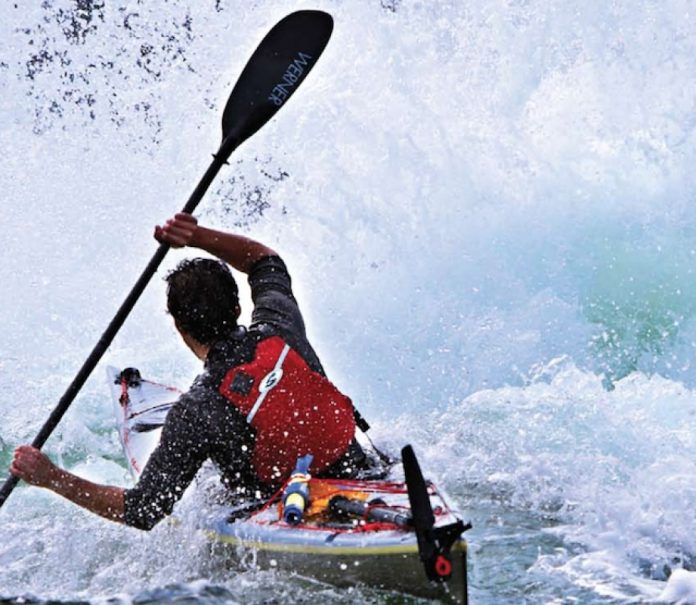
A rough-water trend has been growing con- tinent-wide. Take the Lumpy Water Sympo- sium, a new event organized last October by Oregon’s Alder creek Kayak and canoe. Held amidst a nasty recession, with equally nasty conditions—strong winds and big choppy surf—the event sold out, with a waiting list. And it was dominated by new folks.

Nor is the trend limited to the West Coast. The Maine Island Kayak company has an intermediate-level Rough Water Symposium planned for June 2010 in Rhode Island. Ontario has the three-year-old Georgian Bay Storm Gathering as well as Naturally Superior Adventures’ Surfing Superior confluence. British Columbia’s Coast Mountains Expeditions is planning their first-ever “whitewater sea kayak” festival in Surge Narrows in June of 2011.

This isn’t the first time that sea kayaking has ventured down the rough-water path. The legendary Gales of November gathering, organized by Stan Chladek on Lake Superior’s North Shore, just celebrated its 24th anniversary. Fifteen years ago we had the Tsunami Rangers, a frenetic group of california pad- dlers wearing motocross body armour and addressing each other by naval rank. But the old-school focus on extreme sea kayaking and the resulting carnage never caught on.

So why the renewed interest in the rough stuff? Some attribute it to the popularity of video productions by the likes of Justine Curgenven and Bryan Smith, or the growth of the British canoe Union’s instructional system, influenced by its homeland of strong tidal cur- rents and exposed waters. Other factors include the growing variety of nimble, highly rockered boats increasingly available in plastic that ap- peal to budget-conscious rock-bashers. As with any trend, it’s tough to sift cause from effect.

Busy schedules may also be a factor.“People seem to have less time to take extended trips, so they compensate by packing a lot of paddling excitement into a smaller challenging, thrilling and satisfying daily package,” says David Wells of Naturally Superior Adventures.

Also, where the Tsunami Rangers and the Gales of November were invitation-only gatherings of elite professional paddlers, this new crop of events isn’t just for the top level. “The biggest reason we had success was the inclusive nature,” says Paul Kuthe, an instructor at Lumpy Waters whose talents appear in Bryan Smith’s Pacific Horizons and The Season. “We provided something for all skill levels and made sure people knew that they would be successful whatever their goals.”

Not everyone agrees that the rough-water trend is the future of sea kayaking. Dave Slover, owner of Alder Creek Kayak and canoe, notes that “of the thousands of boats we have sold over the years very few people move on to paddle in rough conditions.” But kayaking in general is growing. According to the Outdoor Industry Foundation, the number of kayakers nearly doubled from 2006 to 2008. So even if the percentage seeking aerated water remains the same, it’s on a sharp upward trend that may be approaching critical mass.

And with much of the North American coast guarded by surf, rough-water experience opens a huge door. The next question is: What does it take to nurture and sustain a strong rough-water sea kayaking community?

The obvious elements are access to condi- tions and good instruction. But there’s more. “Successful rough-water communities develop when opportunities for growth and skill build- ing are combined with beer and socializing,” says Kuthe. “Kayaking is similar to Harley motorcycle gangs in that the people that par- ticipate don’t just think of themselves as people that kayak. They are kayakers.”

So venturing into rough conditions may forge sea kayaking from recreation to passion and then to identity. Keep it up and maybe someday we’ll need leather jackets as well as drysuits.

“It always annoys me when people think of sea kayaking as boring,” Kuthe says before leaving for yet another rough-water symposium under the Golden Gate Bridge, where he’ll no doubt show people otherwise. 

Screen_Shot_2015-07-27_at_12.46.47_PM.pngThis article first appeared in the Early Summer 2010 issue of Adventure Kayak Magazine. For more great content, subscribe to Adventure Kayak’s print and digital editions here.
Towing: Mind Over Matter

Photo: Lyn Stone
Towing: Mind Over Matter

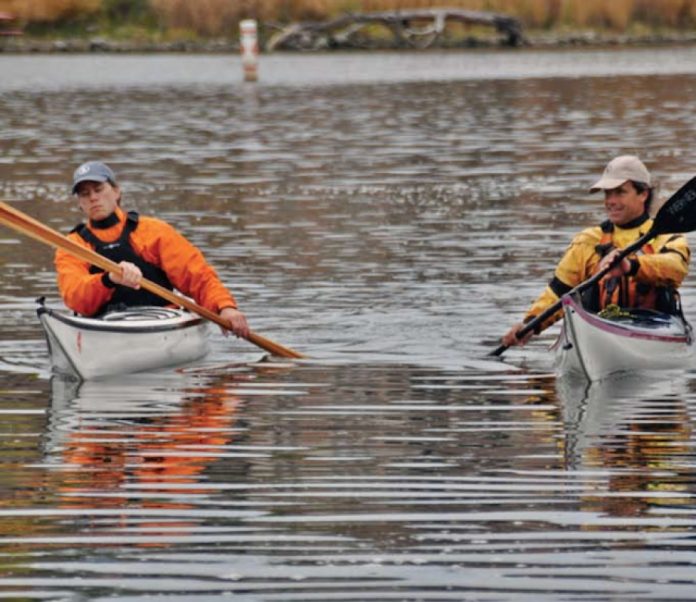
When we consider towing, we tend to think about rope. We carry a tow belt with a sturdy carabiner as well as a short, deck-mounted tow rope with a quick-release, and we use them to help paddlers who are exhausted, overwhelmed, injured, or drifting into a danger zone.

We wouldn’t paddle without these essential pieces of safety equipment. But sometimes, we can best help a timid or tired paddler with the most powerful piece of equipment in anyone’s kit: the mind.

Robert Schrack, co-owner and chief instructor at Adventure Crafters Paddle Centre in Maryland, coined the term “psychological tow” to explain this technique. If you’re an instructor or guide, or a skilled paddler who has taken less experienced people out on the water, you may already have used this tow without realizing it. But recognizing what it is and when it’s appropriate can enable you to bring it out more quickly and use it more effectively.

Frequently, inexperienced paddlers reach their limits before others in a group. They may be freaked out by waves or wind, or simply tired out by too much exertion or the conditions they find themselves in, and they need some help to complete the planned journey. You can usually see evidence in their posture, strokes and demeanor. They may lag behind the group, wobble, use tentative strokes or be unusually quiet.

We’re often taught that this is the time to tow them. Sometimes it is. But doing so has a downside: It can embarrass or discourage the struggling paddler when he may be capable of rising to the challenge. And in the case of rough water, it might make things worse.

Instead, you can use the psychological tow: “Keep going. Keep your hips loose. That’s great. Keep paddling. Nice work. It’ll be easier if you get your entire blade in the water.”

Youcaninstructthemabit,encouragethem a lot, and help them focus ahead on where you’re going instead of on where they are.“You see that tower? We’re going to land just to the right of it.” You can also point out interesting features of the place you’re paddling. “That lighthouse over there has the largest Fresnel lens on the Great Lakes.” By paddling close to them and sounding relaxed, offering a mix of small talk and advice, you can enable them to make it on their own.

That’s the psychological tow. Having a term for it is not only satisfying, in the same way as knowing the names of birds or mushrooms. It’s practical.

By placing the psychological tow in the category of tows, it reminds us to try this first before a more invasive intervention. And it gives the struggling paddler a well-earned sense of accomplishment. 

Screen_Shot_2015-07-27_at_12.46.47_PM.pngThis article first appeared in the Early Summer 2010 issue of Adventure Kayak Magazine. For more great content, subscribe to Adventure Kayak’s print and digital editions here.
Reading the River

Photo: flickr.com/raybouk
Reading the River

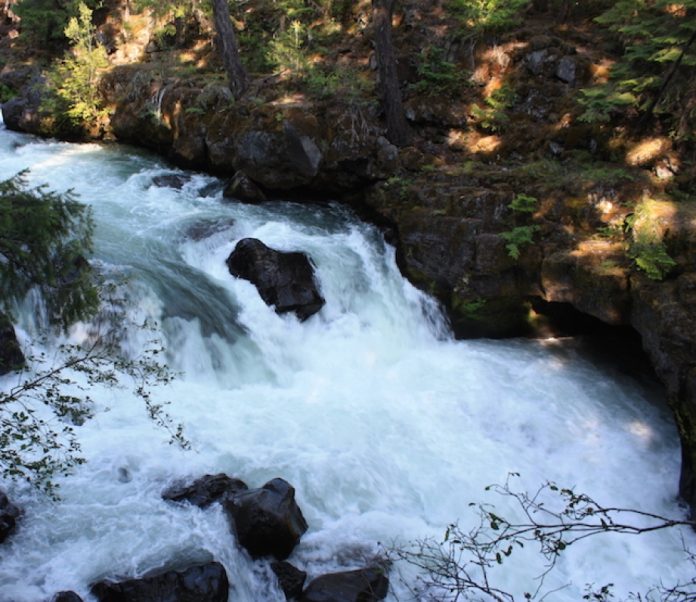
For nearly 30 years, the great rivers, lakes and forests in my beautiful home province of New Brunswick have been telling me stories. They tell tales of patient grandfathers, with their grandsons, baiting hooks and cleaning fresh trout, that teach about love and family. They also tell despicable stories about polluters and the ugly things poachers do with spotlights and axes and .410 rifles.

If you listen close enough, the Canadian landscape will reveal to you the truth of your own humanity. For nearly 30 years, I did not listen. In fact, it wasn’t until May 18, 2008, that I was forced to sit up straight and pay attention.

As I was coming about to help my best friend, Jay, who had capsized when a quartering wave caught him trying to fasten his stern hatch, I too flipped over and plunged into the six-degree water of the Kennebecasis River in Rothesay, N.B. where we stayed, clinging to the hulls of our kayaks, for nearly 45 minutes.

When their efforts to help us climb back into our boats failed, my wife, Carrie, and Jay’s wife, Danielle, through their tears, paddled hard into the wind and made for shore in their tandem. By the time the rescue boat reached me, my muscles had begun to seize up and my speech was impaired. The ambulance attendant told me another 20 minutes in the water could have been fatal.

Though it’s almost impossible to glean all that nature has to teach when you’re wrapped up in the present moment of a life or death situation, time can reveal many life-lessons to you about the role our human potential can play within the environment.

For instance, time has provided me with the opportunity to hear Jay’s story of how when the rescue boat stopped to pick him up, he waved them on, telling them to get me first. It has allowed me to watch carrie bravely relive those desperate minutes as she told her story of their stoical, two-kilometre race to shore and the helpless feeling of leaving Jay and I clinging to our kayaks in the middle of that churning river. Furthermore, in the two years since it has happened, I have learned to be more present with the people in my life, particularly with my wife. I’ve discovered that our bond has strengthened because we’ve shared an experience that was so rife with raw human emotion. I don’t remember a time before when either of us had ever been so disarmed and so present with one another. The only other time that has happened since was when our son, Hunter, was born almost a year later.

Henry David Thoreau wrote that “we are enabled to apprehend…what is sublime and noble only by the perpetual instilling and drenching of the reality that surrounds us.”

I believe that our environment provides opportunities for us to explore the nuances of our own humanity, to discover truthful narratives about ourselves as we evolve within the landscape and, hopefully, by listening to the stories, we might all discover those qualities of beauty and nobility. 

Richard T. Sparkes is a writer, teacher and avid outdoorsman who lives in rural Prince Edward Island with his wife, Carrie, and their son, Hunter. 

Screen_Shot_2015-07-27_at_12.46.47_PM.pngThis article first appeared in the Early Summer 2010 issue of Adventure Kayak Magazine. For more great content, subscribe to Adventure Kayak’s print and digital editions here.
Editorial: The Slow Kayaking Manifesto

Photo: John Irvine
Editorial: The Slow Kayaking Manifesto

Foodies know that faster is not necessarily better, but do kayakers?

Carlo Petrini founded the Slow Food movement in Italy in 1986 to recapture the pleasure of eating from the incivilities of fast food culture, to “seek a slower and more aware pace of life.”

According to the movement’s founding document, The Slow Food Manifesto: “We are enslaved by speed and have all succumbed to the same insidious virus: Fast Life, which disrupts our habits, pervades the privacy of our homes and forces us to eat fast foods…. Homo Sapiens should rid himself of speed before it reduces him to a species in danger of extinction.”

Maybe it’s time for a Slow Kayaking Manifesto. There’s no better time than now, in this issue where we have a feature focusing entirely on going fast.

Hey, I’m not saying I know how to relax. Just ask my wife. She’d tell you to rip out this page and use it to fertilize your vegetables. I have a long history of speed addiction, on and off the water.

That’s why I know that we need to be extra careful not to always carry the hamster wheel mentality of our work lives into our recreation.

In these days of adventure racing mania and the media obsession with speed expeditions (always easier to report on than just another great trip) I think we need to pause to remem- ber the value of going slow.

This summer we are witnessing yet another record attempt around Vancouver Island, with the indefatigable Joe O’Blenis setting out to beat Brit powerhouse Sean morley’s 17-day circumnavigation.

Then we have Freya Hoffmeister for whom it wasn’t enough to be the second person in his- tory, and first woman, to kayak around Australia. She called her expedition a “race” and set out to beat a time set by only one other kayaker a quarter century ago.

Why should the people who go the fastest get all the attention?

Wouldn’t it be better for our sport to be known for its lifestyle, the way surfing is with its culture of Jack Johnson tunes, board shorts and scruffy kids on skateboards—a culture of leisure?

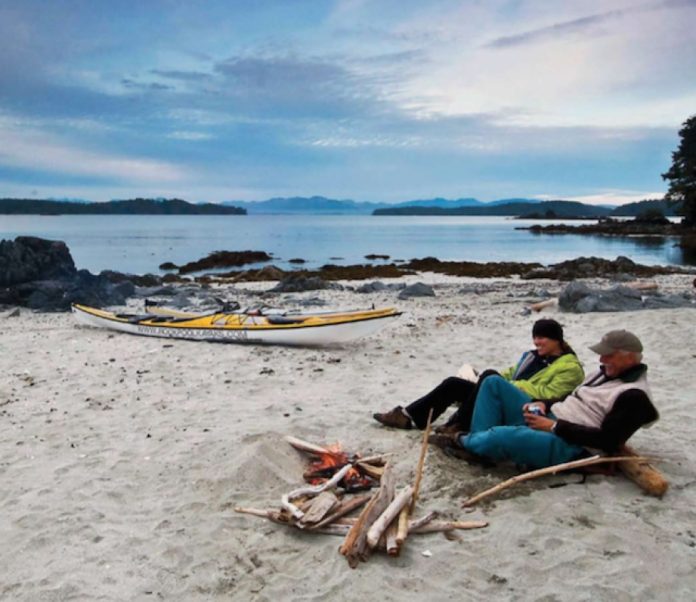
Leisure is the polar opposite of trying to paddle as fast as possible around a landmass. It’s a near spiritual state of mind—a state of play, a creative and meditative mindset. It’s apart from and opposite to the ultra rational state of mind that dominates our everyday lives—in which time is better spent at a desk earning money than it is walking outside breathing fresh air— and dominates our society that values fast cars more than the clean efficiency of bicycles.

I would rather people look at sea kayakers and say, “I want to live like that” than “those dudes are crazy!”

Yes, partly I’m just jealous. When I read about morley or O’Blenis racing around Van- couver Island, I wish I could be there with them. Taking time away to do nothing but paddle is a dream. I’d love to know how fast I could go. And even at top speed, kayaking is still leisure.

But let’s also celebrate our slow side.

In the words of The Slow Food Manifesto: “may suitable doses of guaranteed sensual pleasure and slow, long-lasting enjoyment pre- serve us from the contagion of the multitude who mistake frenzy for efficiency.”

By all means, perfect your stroke, push yourself to the pleasure of exhaustion, but also take rest days. Kick back and read about somebody else’s epic. The coast will wait for you as it always has.  

Screen_Shot_2015-07-27_at_12.46.47_PM.pngThis article first appeared in the Early Summer 2010 issue of Adventure Kayak Magazine. For more great content, subscribe to Adventure Kayak’s print and digital editions here.
Open Boat Creek Technique

Photo: Megan Richardson
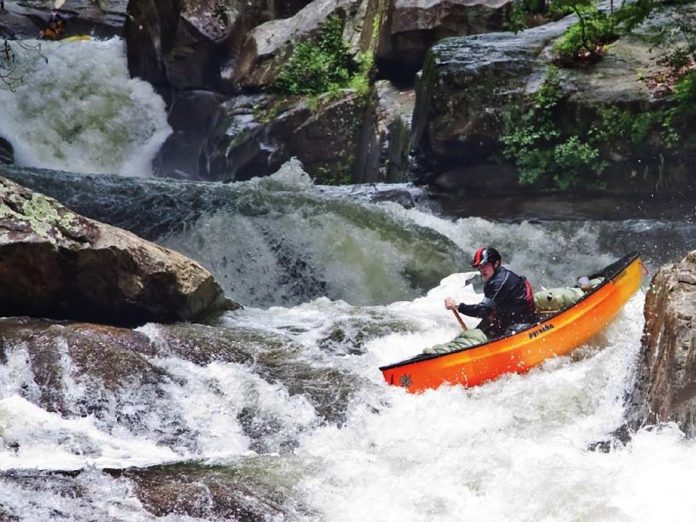
A whitewater open boat canoeist drops into a big rapid.

Open boat canoeing changes from big river boating to creeking styles only in matters of timing. These expert tips are skills that will help you stay sharp no matter where you paddle.

Practice hole escapes

On larger rivers where you are dealing with lines that are five to ten feet wide (go five feet to the left of that hole) it’s fairly easy to avoid getting stuck in a hole. On creeks, the lines can be inches instead of feet (clip the side of that hole on the left). Consequently, getting stuck in holes is part of creek boating and it’s pretty hard to surf your way out of a big hole if you spend the rest of your time avoiding them.


Bombproof your roll

Playing in spots with good recovery areas offers a great way to transition your pool roll to a river roll. You flip so frequently when playboating that you get used to the feeling of being upside down in your canoe, dealing with currents to reach the set-up position and hit your roll.


Run slalom gates

One of the greatest challenges on difficult creeks is catching must-make eddies. Often micro eddies that fit kayaks can be difficult to squeeze into with a longer canoe. Entering local slalom races is an effective way to practice making difficult ferries and catching tricky eddies on the fly.

Most courses are on class II–III water so the consequence of missing an eddy is hitting a pole rather than slipping backwards into a rapid that you were hoping to scout.


Take on water

Prepare for continuous creeks by paddling boogie sections of familiar runs without stopping to empty out. It takes practice, but you can control most shorter whitewater canoes even when they are almost completely full of water. Just keep the boat pointed downstream, start any turns far in advance and maintain momentum since acceleration will be difficult.


Ride the eddy lines

On continuous creeks, the driest canoe lines often hug the eddylines to skirt most holes and pourovers. The challenge with this technique is to avoid eddying out unintentionally mid-rapid.


This article originally appeared in Rapid, Early Summer 2010. Download our free iPad/iPhone/iPod Touch App or Android App or read it here.

Running Waterfalls

Photo: Patrick Camblin
Kayaking waterfalls

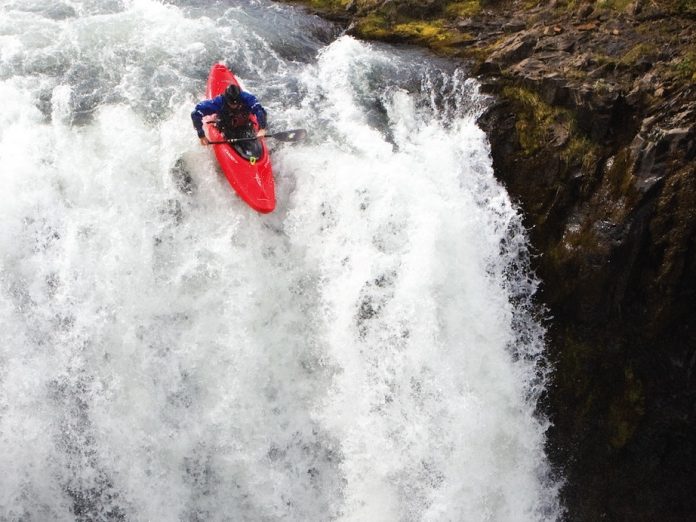
Every waterfall is unique. Running falls with consistent success means tweaking your technique to suit the drop. The strategies outlined here have seen me safely through over 15 drops in excess of 70 feet.

The art of running waterfalls lies in an intimate communication between you and your kayak— having a poised sense of boat angle in freefall. Maintaining boat angle at the point where the waterfall’s lip becomes vertical and you enter freefall is crucial to a successful outcome.

I like to enter freefall with a neutral, nearly straight body position. Depending on how I left the lip, I will adapt my body position and the speed or delay of my tuck to maintain the right amount of boat angle. The sensation is of a balancing act. The goal is to make sure you’re tucked safely to your front deck when you land in the pool below, protecting your body against the force of impact.

The most straightforward drops are those with lips that gradually transition to vertical. Oregon’s 70-foot Metlako Falls is a perfect example of an easy, rolling lip. On falls like Metlako it is actually important to not do too much—the waterfall sets your angle perfectly. Ride down the lip with a neutral body position—using a stern rudder to control side-to-side angle as necessary—and slowly begin to tuck as the waterfall becomes vertical to maintain a good entry angle.

It is usually a very bad idea to run a waterfall when your boat might connect with a rock at the lip. My definition of a shallow lip waterfall is when the river goes over a shelf just deep enough for a kayak. Sahale Falls, another 70-footer in Oregon, extends over a 30-degree shelf for 15 feet then immediately drops to vertical. This waterfall is more difficult because you can’t simply tuck at the lip. To avoid boofing as you fly off the shelf, you must delay or slow your tuck and let the bow drop so you are reaching full tuck as the boat becomes vertical. A strong sense of your boat angle and knowing how your body’s position affects this angle is the crux to running waterfalls of this nature.

Waterfalls with tight lines demand more precise placement and concentration to put you on the correct spot at the lip. My descent of Washington’s 186-foot Palouse Falls had a tricky thread-the-needle line between a pitching hump on the left and a kicker into space on the right. The lip at Palouse was one of the most difficult I have ever run—I lined up with a rudder and held a stationary stern draw to stick the right to left orientation of the lip. Lining up the lip is the most intimidating part of running waterfalls—it is very important to have good points of reference at the lip so you know exactly where you are dropping over. I usually spend more time scouting the lead-in to the lip than the actual drop.

Whether the drop is categorized as deep or shallow lip, rolling or abrupt, your reaction as you begin freefall is critical. Visualization plays a very important role at this stage. Visualize sticking the line, then focus on this image until it is embedded in your mind. When you are running the waterfall there is no space for conscious thought about right or wrong reactions—they must simply happen in immediate response to the present situation.

Visualization is also invaluable when deciding which waterfalls to run. If I cannot visualize myself running a waterfall successfully, I won’t attempt it. My best advice is to start small and work up to larger drops—nothing can replace personal experience.

Tyler Bradt hails from Missoula, Montana, and began kayaking at age six. He enjoys long walks on the beach, wine by candlelight and watching sunsets. [He also holds two waterfall world records]. Learn more about his new film at www.dreamresultmovie.com.

This article originally appeared in Rapid, Early Summer 2010. Download our free iPad/iPhone/iPod Touch App or Android App or read it here.

Lake Huron: a Solo Adventure

Photo: Stephen Brede
Lake Huron: a Solo Adventure

The long-time journalist and photographer, 58, quit his job and was the first to accomplish what no other person has done—canoe around Lake Huron. The 1,200-kilometre solo circumnavigation, inspired by the iconic canoeist, Verlen Kruger, is part of dream to canoe all the great lakes.

Talking with the self-assured yet humble Brede, no one would have ever guessed he had reservations about being able to complete the trip. On september 19th, 2009, 12 weeks after waving goodbye from the western tower of the Mackinac Bridge, Brede rounded Lake Huron, conceding that, “instead of washing out, I was sucked in.” 

I spent years dreaming about this trip, ever since I read an interview with Verlen Kruger, late in his life, about a challenge he wished he could have undertaken—to circumnavigate the Great Lakes. Although Kruger likely paddled as many miles of Great Lakes shoreline as anyone, paddling the entire loop remained undone when he died in 2004.

I discovered a Kruger Sea Wind on Craigslist for $3,500. Back in Michigan, my wife, Ruth, and I started taking our solo Krugers on day trips around Little Traverse Bay. The boats handled beautifully, and I began to believe I could make it around at least one of the Great Lakes.

My body needed to go outside and stretch. My ego wanted to do something no one has ever done. I wanted to come to Canada because the canoe is revered for its role in the nation’s history.

You assume all responsibility in a solo boat. River right or river left. Pry or draw. Go for it, or portage. Tandem paddlers engaged in the “blame game” have ruined trips and friendships. If couples paddled solo boats, “Divorce River” would likely disappear from maps.

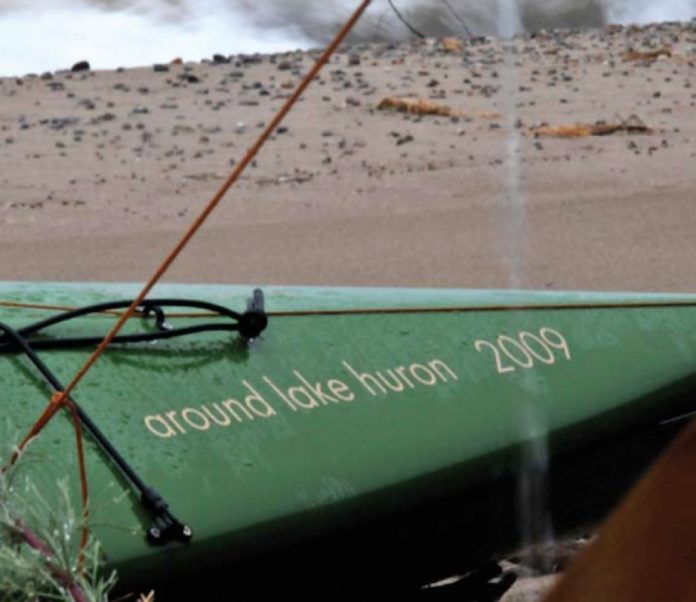
It was suggested that I look for sponsors, but I felt better going “no logo.” A boatload of gear purchases later, I quit my job, poked a peace pin on my PFD, and stenciled “Around Lake Huron 2009” on the stern.

Mosquitoes were my nemesis. Michigan has about 60 species of mosquitoes. One evening, between the mesh body and the fly of the tent, I counted 200. I squashed them all, and within five minutes another 200 filled the space.

Initially, I stayed close to shore. As I gained confidence in my canoeing ability and the weather forecasts, I began paddling from point to point. My longest open water stretch was about nine kilometres, when island hopping from Tobermory to Manitoulin Island.

I wasn’t afraid, but was very cautious. I always wore my PFD, which had a knife and whistle attached, and signal mirror, SPOT locator and cell phone in its pockets. A couple of times, when the waves were big and I felt there was a chance of swamping or capsize, I clipped on my VHF radio, strobe light, and a 15-metre floating orange banner I could deploy. I would also clip my bow line to my PFD, so I wouldn’t become separated from the canoe if I went over.

Noise pollution was almost everywhere. Cars, trucks, cement plants, mining operations, power plants, lawnmowers, chainsaws, Jet Skis. I could hear power boats 15 kilometres away. The silence on the North Channel, after Labour Day, was bliss.

Her name is Seaweed. Derived from the canoe model name Sea Wind, her colour green, and the old hippy at the helm. I hesitated, however, when the Canadian border officer asked, “What’s your boat’s name?” I figured Seaweed might raise a red flag. Our website, greatlakescanoe.com, is stenciled on the canoe, so I told her Great Lakes Canoe.

I wish I could have brought national health care across the border when I returned to the U.S. I had asked about 15 Canadians what they thought of their health care system. They all said that while it wasn’t perfect, they were glad to have it. I also asked if they would consider trading it for the U.S. system. Everyone answered that with a resounding “No!”

The one camping meal I never tired of was breakfast—a cup of tea and granola from my local food co-op, mixed with fresh fruit and powdered milk. The best fish and chips I had was at Purdy’s Fisheries in Grand Bend, Ontario.

It felt like my days were spent floating in outer space and as the sun set I returned to earth for the night.

My advice to canoeists wishing to take on an expedition is to read all you can by, or about, Verlen Kruger, Valerie Fons, Joanie and Gary McGuffin, Cliff Jacobson, Bill Mason, Becky Mason and Howard Rice. Study wind and waves. Pack light. Leave no trace. Wear your PFD. Have faith in the kindness of strangers. Breathe.

My next canoeing adventure is to paddle around a second great lake. 

This article on canoeing Lake Huron was published in the Spring 2010 issue of Canoeroots magazine.This article first appeared in the Spring 2010 issue of Canoeroots Magazine. For more great content, subscribe to Canoeroots’ print and digital editions here.