Home Blog Page 341

Traditional Paddling with a Punch

All photos this page: Reid McLachlan
Traditional Paddling with a Punch

“Keep your stroke short, it’s more efficient and relaxing,” Dad suggested as we paddled the flatwater stretches of the trip. It was 1983, and we were on the Nahanni River preparing me for a summer of guiding. I fondly remember my dad’s voice as I paddled in the stern of the canoe. Being a teenager, I rolled my eyes at his instructions and was determined to prove him wrong. With stubborn resolve, I pulled with both arms and lengthened my stroke. Dad’s stroke was smooth and relaxed even as he took two strokes to one of mine. I watched him more closely just as he had learned by studying a First Nations paddler. This short stroke, which I now call the traditional stroke, has become an important forward stroke in my flatwater repetoire. 
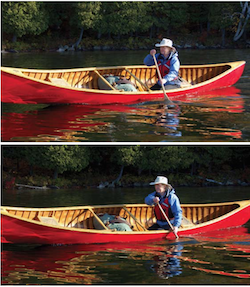
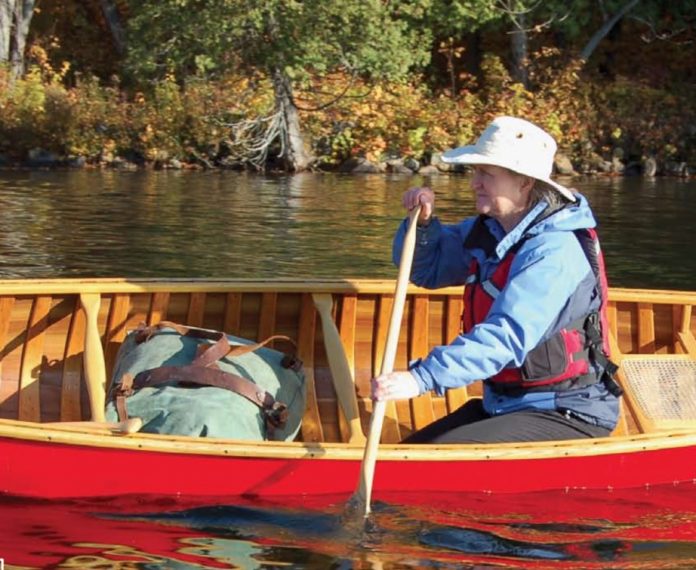
Becky Mason demonstrates the traditional forward strokeMaster the Traditional Stroke

  • Start with the blade in the water at your knee and your grip hand at your chin.
  • Punch your grip hand forward and down towards the onside gunwale creating a lever with your lower shaft hand as a travelling fulcrum. Rotate your torso to put some bodyweight behind the punch. 
  • As your grip hand gets closer to the gunwale start to roll your thumb down setting up the blade for the correction stroke. Having your grip hand over the gunwale ensures that the blade is close and parallel to the hull throughout the stroke.
  • After the grip hand punch is accomplished relax your arms, let your bottom hand trail smoothly behind you and do your correction stroke.
  • Return to an upright position and feather your blade out on the recovery knife the paddle in toward your knee to start the next stroke minding that your grip hand doesn’t creep up over your head. 

To get the feel of the punch with power, try this learning technique. Hook your shaft hand thumb onto the gunnel to force yourself to create a fulcrum, punch your grip hand from your chin all the way to the gunnel until your knuckles touch. Repeat this a few times and you’ll be well on your way to mastering this relaxing traditional stroke.

Becky Mason is a canoeing instructor based in Chelsea, Quebec. She has contributed to several books, produced an award-winning video, Classic Solo Canoeing, and presents workshops throughout North America. Find her at redcanoes.ca

This article on canoe technique was published in the Spring 2010 issue of Canoeroots magazine.This article first appeared in the Spring 2010 issue of Canoeroots Magazine. For more great content, subscribe to Canoeroots’ print and digital editions here.
Risk Management: Squeezing the Lemons

Photo: Scott MacGregor
Risk Management: Squeezing the Lemons

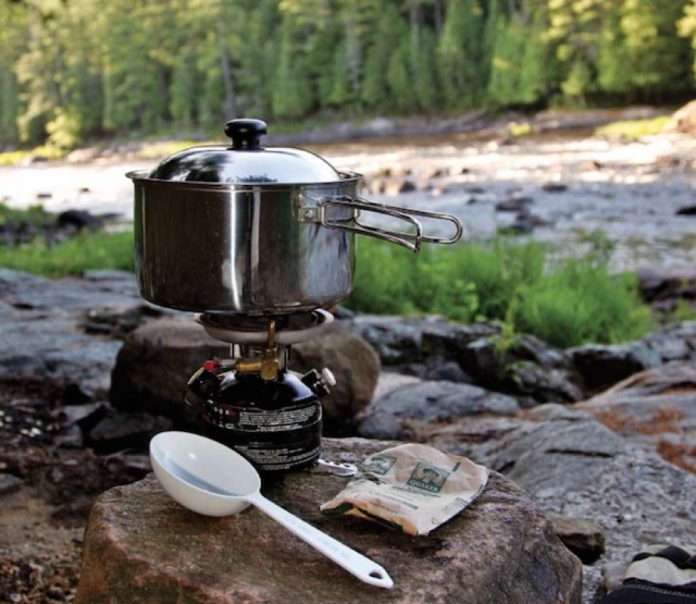
As I quickly approached the accident scene, I could see that my paddling partner was in considerable pain. I gathered that the overturned canoe, spilt pot of steaming spaghetti noodles and the string of choice expletives pouring out of his mouth added up to a cooking burn.

“How bad is it?” I asked. “The pot caught me on the back of my leg,” he responded, with a painful twinge in his voice. An examination revealed that the second-degree burn was severe, ending the trip and requiring an evacuation over the next two days.

I frequently use this story as my introduction for risk management seminars. What I’ve found interesting is how the discussions that follow have changed, over the years, from one paradigm to another—from lemons to systems.

In 1987, James Raffan introduced a risk management theory referred to as the Lemon Theory. The Lemon Theory’s premise is that during the course of an outdoor trip a sequence of events occurs, that if left unchecked, can lead to a crisis. Raffan uses the analogy of the slot machine that if too many lemons line up—jackpot, an incident occurs.

Counting Lemons

The genius of lemons is that they serve as an easy symbol to incorporate into day-to-day tripping activities. Canoeists, kayakers, mountaineers and skiers across North America spend their trips counting lemons—literally.

In our scenario above, it was late in the day, lighting was poor, equipment was new and unfamiliar and dehydration put pressure on my partner’s judgment. All these lemons would have been manageable, if the proper routines of setting up camp and creating the conditions to safely operate the stove had been established.

Today’s risk management paradigm recognizes that we no longer have to identify and pre-empt all those lemons and instead, we should work to establish a series of systems.

By focusing on systems, we don’t need to account for every interaction that could lead to a jackpot. Once implemented, these routines create the conditions to have safe and fun adventures.

Matt Cruchet is an educator, consultant and co-author of the new book Managing Risk, which is an exploration of systems planning, applied to outdoor adventure activities. 

Betcha Didn’t Know About Pitcher Plants

Photo: Virginia Marshall
Betcha Didn't Know About Pitcher Plants
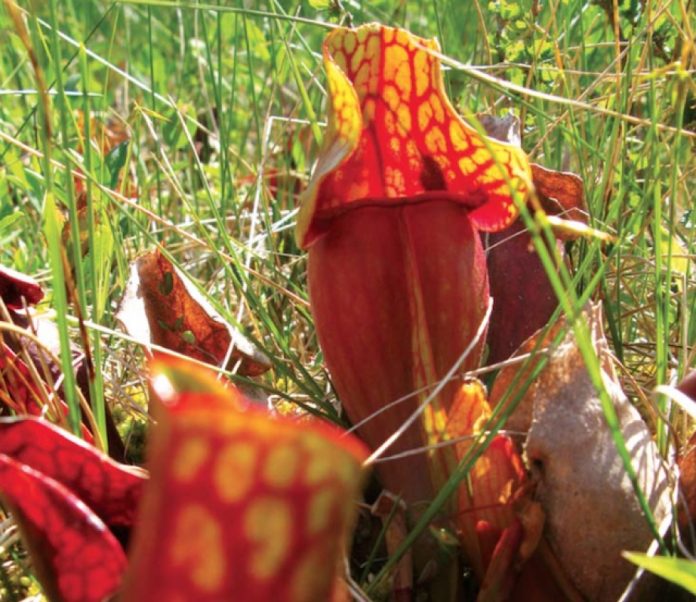
  • Pitcher plants are carnivorous. Although they may not feast on drive-thru Big Macs, they trap insects, spiders, newts and even small frogs for their protein-rich meals.
  • Colourful deep red and purple veined pitchers attract prey and entice them to rest on the slippery leaves at the top of the plant. The prey falls into the pitcher and becomes trapped in the digestive juices below. Escape is futile—little downward-pointing hairs block any retreat.
  • Gigantic man-eating plants exist only in Hollywood thrillers, like Journey to the Center of the Earth—the box office hit in which actress Anita Briem plays a tasty snack.
  • The pitcher plant is the official flower of Newfoundland and Labrador, symbolizing the inner strength and willful determination of Newfoundlanders.
  • The pitcher was historically used as a drinking cup (perhaps another reason why it’s Newfoundland’s official flower).
  • For a one-time, low price of $2,149.95 you can purchase one of the world’s purest 99.999 per cent gold coins from the Royal Canadian Mint. The 12th coin in this series is pressed with the symbol of the pitcher plant.
  • Pitcher plants grow in wet, acidic soils that are deficient in nutrients such as nitrogen and phosphorous. They are found in marshes and bogs throughout Canada and the eastern United States.
  • The largest pitcher plant, Nepenthes attenboroughii, was discovered in the Philippines in 2007. Named after the famous BBC Planet Earth broadcaster, David Attenborough, this plant has large enough traps to consume a rat—hey, a mousetrap that empties itself!  

This article on pitcher plants was published in the Spring 2010 issue of Canoeroots magazine.This article first appeared in the Spring 2010 issue of Canoeroots Magazine. For more great content, subscribe to Canoeroots’ print and digital editions here.
My Love-Hate Relationship with Portaging

Photo: Christopher Pratt
My Love-Hate Relationship with Portaging

Portage.

That’s what lakewater trippers do—we portage. From lake to lake, into remote wilderness, we heft mounds of stuff, all intricately organized into wannigans, canvas packs and polyethylene barrels. Yokes dig into our tired muscles as 60-pound canoes balance precariously on our shoulders. We are like oxen plowing the last furrow of the day, ready to unburden our load.

Many sport enthusiasts willingly subject themselves to torturous masochistic prac- tices—boxers accept head punches, cyclists wear tight spandex and canoeists…well, we portage.

It’s no wonder the word portage is often synonymous with gruelling pain and agony. As renowned canoeist Bill Mason once reminded us, “…portaging is like hitting your- self on the head with a hammer: it feels so good when you stop.”

So, when it came to planning a 200-day ca- noeing expedition, my husband and I found a way to paddle days on end, enjoying wide-open views, endless scenery, crystal clear wa- ter and the full gamut of weather conditions with no portages. Well…except for one. I will get to that later.

If you are a serious lakewater tripper, you must travel some of the coastline of the five immense lakes that shape the heart of North America—the Great Lakes. Vast and diverse, they are the largest chain of freshwater lakes on the planet, holding 20 per cent of the world’s freshwater.

Over the last three summers, we paddled this ancient waterway, travelling the entire 4,000-kilometre coastline of the Canadian Great Lakes from the Pigeon River, west of Thunder Bay, to Kingston on Lake Ontario, where the Great Lakes flow out the St. Lawrence River.

Along the way, we paddled the shores of Lake Superior, Lake Huron, Lake St. Clair, Lake Erie and Lake Ontario.

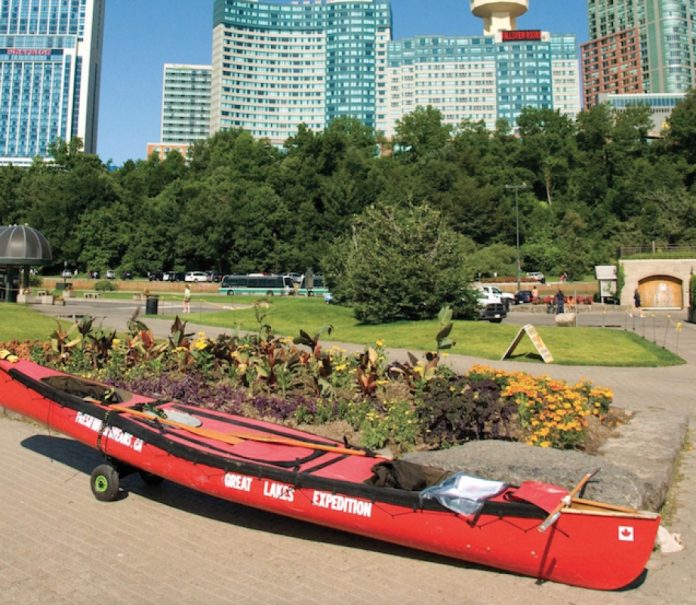
Each lake lives up to its great reputation. Lake Superior is the deepest, its greatest depth at 406 metres. Lake Huron is home to Manitoulin, the largest freshwater island in the world. Lake Erie boasts endless sand beaches around Long Point, Rondeau and Point Pelee and supports the richest aquatic life of all the lakes, a total of 46 million fish. And Lake Ontario offers its own challenges when your route takes you right through the busy city waterway of Toronto harbour. Oh, and there is only one portage. It happens to be 25 kilometres long, around a pretty major waterfall—Niagara.

THE COUNTDOWN TO P-DAY

After two blissfully portage-free summers, preparations for our third summer had begun and we were inadequately prepared for the 25-kilometre hike ahead. The longest portage in our combined portfolios was a mere three kilometres, but we felt confident in the helping hands of friends and family eager to lend their support in what was soon coined, P-Day.

As P-Day drew closer, however, our helpers dropped faster than the 100,000 cubic feet of water that flows over Niagara’s brink every second. We heard the full range of excuses, from dentist appointments to busy work schedules. Instead of a brigade, we were reduced to three helpful saints, who made the one-day carry possible. Portage technology had also advanced since the fur trade and we were well equipped with a modern canoe trolley that proved invaluable. Some call it cheating, but after a few kilometres, I call it smart. I’ll bet not one voyageur would rather carry a barrel of whiskey than roll it.

The Niagara Falls Review, the oldest newspaper in Ontario, reported that no one had portaged the route in recent history. It’s estimated that the last portage taken was over a hundred years ago. The ancient trail, however, is still intact—now paved and suitably bearing the name Portage Road.

As we approached the brink of Niagara Falls on foot, with our canoe in tow, citizens and vacationers sent worried glances in our direction. It was understandable considering that, in their lifetimes, more people have paddled over the falls than portaged around them. Within minutes a police cruiser pulled up and out stepped two straight-faced uniforms.

“I hope there’s no law against portaging, officer,” my husband said with a smirk. After telling our story, the police were delighted to help us out, making routine visits throughout the day. “I’m happy we weren’t the first portagers to be arrested,” I said as they sped away to another call.

The busloads of tourists filling the sidewalks proved no more difficult to navigate than overgrown balsam on a seldom-used trail. The crowds also made for an interesting portage, as we were an attraction ourselves, posing next to our canoe for hundreds of snapshots.

Stops at places like the Hershey’s Chocolate Factory and Candy Planet fuelled the journey. The 25 kilometres rolled on and by the end of the day we rested and dined lavishly at Peller Estates Winery. With a fine glass of private reserve, barrel-aged golden Chardonnay, we toasted our fun-filled day, a bit sad that it was all over. Because as Bill Mason also wrote, “It’s the portage that makes travelling by canoe unique.”

Stephanie Park is the new editor of Canoeroots magazine and has rekindled her love of portaging.

This article on portaging Niagara Falls was published in the Spring 2010 issue of Canoeroots magazine.This article first appeared in the Spring 2010 issue of Canoeroots Magazine. For more great content, subscribe to Canoeroots’ print and digital editions here.
Lake Huron: a Solo Adventure

Photo: Stephen Brede
Lake Huron: a Solo Adventure

The long-time journalist and photographer, 58, quit his job and was the first to accomplish what no other person has done—canoe around Lake Huron. The 1,200-kilometre solo circumnavigation, inspired by the iconic canoeist, Verlen Kruger, is part of dream to canoe all the great lakes.

Talking with the self-assured yet humble Brede, no one would have ever guessed he had reservations about being able to complete the trip. On september 19th, 2009, 12 weeks after waving goodbye from the western tower of the Mackinac Bridge, Brede rounded Lake Huron, conceding that, “instead of washing out, I was sucked in.” 

I spent years dreaming about this trip, ever since I read an interview with Verlen Kruger, late in his life, about a challenge he wished he could have undertaken—to circumnavigate the Great Lakes. Although Kruger likely paddled as many miles of Great Lakes shoreline as anyone, paddling the entire loop remained undone when he died in 2004.

I discovered a Kruger Sea Wind on Craigslist for $3,500. Back in Michigan, my wife, Ruth, and I started taking our solo Krugers on day trips around Little Traverse Bay. The boats handled beautifully, and I began to believe I could make it around at least one of the Great Lakes.

My body needed to go outside and stretch. My ego wanted to do something no one has ever done. I wanted to come to Canada because the canoe is revered for its role in the nation’s history.

You assume all responsibility in a solo boat. River right or river left. Pry or draw. Go for it, or portage. Tandem paddlers engaged in the “blame game” have ruined trips and friendships. If couples paddled solo boats, “Divorce River” would likely disappear from maps.

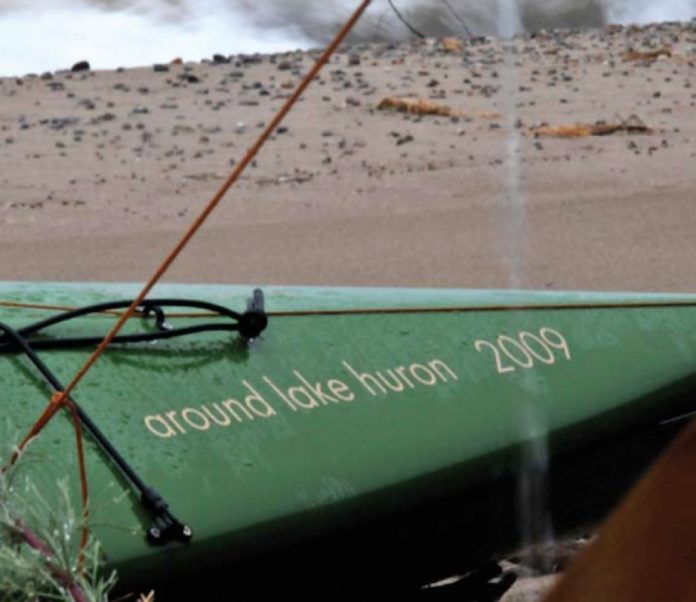
It was suggested that I look for sponsors, but I felt better going “no logo.” A boatload of gear purchases later, I quit my job, poked a peace pin on my PFD, and stenciled “Around Lake Huron 2009” on the stern.

Mosquitoes were my nemesis. Michigan has about 60 species of mosquitoes. One evening, between the mesh body and the fly of the tent, I counted 200. I squashed them all, and within five minutes another 200 filled the space.

Initially, I stayed close to shore. As I gained confidence in my canoeing ability and the weather forecasts, I began paddling from point to point. My longest open water stretch was about nine kilometres, when island hopping from Tobermory to Manitoulin Island.

I wasn’t afraid, but was very cautious. I always wore my PFD, which had a knife and whistle attached, and signal mirror, SPOT locator and cell phone in its pockets. A couple of times, when the waves were big and I felt there was a chance of swamping or capsize, I clipped on my VHF radio, strobe light, and a 15-metre floating orange banner I could deploy. I would also clip my bow line to my PFD, so I wouldn’t become separated from the canoe if I went over.

Noise pollution was almost everywhere. Cars, trucks, cement plants, mining operations, power plants, lawnmowers, chainsaws, Jet Skis. I could hear power boats 15 kilometres away. The silence on the North Channel, after Labour Day, was bliss.

Her name is Seaweed. Derived from the canoe model name Sea Wind, her colour green, and the old hippy at the helm. I hesitated, however, when the Canadian border officer asked, “What’s your boat’s name?” I figured Seaweed might raise a red flag. Our website, greatlakescanoe.com, is stenciled on the canoe, so I told her Great Lakes Canoe.

I wish I could have brought national health care across the border when I returned to the U.S. I had asked about 15 Canadians what they thought of their health care system. They all said that while it wasn’t perfect, they were glad to have it. I also asked if they would consider trading it for the U.S. system. Everyone answered that with a resounding “No!”

The one camping meal I never tired of was breakfast—a cup of tea and granola from my local food co-op, mixed with fresh fruit and powdered milk. The best fish and chips I had was at Purdy’s Fisheries in Grand Bend, Ontario.

It felt like my days were spent floating in outer space and as the sun set I returned to earth for the night.

My advice to canoeists wishing to take on an expedition is to read all you can by, or about, Verlen Kruger, Valerie Fons, Joanie and Gary McGuffin, Cliff Jacobson, Bill Mason, Becky Mason and Howard Rice. Study wind and waves. Pack light. Leave no trace. Wear your PFD. Have faith in the kindness of strangers. Breathe.

My next canoeing adventure is to paddle around a second great lake. 

This article on canoeing Lake Huron was published in the Spring 2010 issue of Canoeroots magazine.This article first appeared in the Spring 2010 issue of Canoeroots Magazine. For more great content, subscribe to Canoeroots’ print and digital editions here.
Rock the Boat: Wish You Were Here

Illustration: Lorenzo Del Bianco
Rock the Boat: Wish You Were Here

My wife enjoys kayaking, but not as much as I do. She approaches the activity with moderation, whereas I’m consumed by it. She’s a fair weather paddler, disdaining bigger mileage days and lumpy conditions. And so, inevitably, I tend to do my longer, more ambitious trips without her.

This always results in the same dynamic. When I return from a trip, be it a weekend or a month, and tell her that I’ve missed her greatly, she never believes me. Despite my protestations, she remains certain that I had such a great time without her that I never thought of her once. Not once did I even pause to consider how incredibly lucky I was that she deigned to be with me at all. Never mind that I called or emailed at every opportunity. No amount of cajoling or assurance can shake her conviction that she ceased to exist for me the second I walked out the door. That is, of course, until I finally returned home to find some vaguely familiar woman in my house, who I then remembered was my wife.

In her version of events, I arrive home without a proper greeting, drape stinking paddling gear throughout the house, ask immediately what’s for dinner and expect sex on demand.

She knows only too well that I am a cad. I have committed the gravest sin of all. I have had fun without her. Worse still, I have done it for a sustained period of time. (The fact that she didn’t really want to come on the trip, and wouldn’t have enjoyed it anyway, is immaterial.) I am a selfish, thoughtless bastard. But she is far too classy to come right out and say so. Instead she will give me subtle hints to remind me of my transgression in the coming days, weeks, months and years.

But now I have hit upon a simple and highly effective strategy for promoting domestic bliss after returning from a paddling trip without my sweetie. A few simple steps can neutralize her you-never-even-thought-of-me-did-you-you-callous-slob-my-mother-was-right-I-never-should-have-married-you sentiments.

While the following strategies do require a small amount of effort and forethought, the payoff is so significant that they must be incorporated into any trip you do without your significant other. If applied correctly, these tips will not only mollify your partner; they will actually win you brownie points.

Here’s the secret: Document yourself missing your partner. 

The best way to accomplish this is via photos. It’s easy. Build a little sign out of beach debris that says “X loves y” (inserting your names where applicable) and take a photo of it. Write your names in the sand (adding a heart with an arrow is always good) and snap a couple of photos of that. Take pictures of yourself miming a message of love to your spouse. Get your paddling buddies to each hold up a por- tion of a sign with a message just for him or her. find a heart-shaped stone, photograph it, and bring it back as a keepsake.

That’s all there is to it. Indisputable documentary evidence is the cornerstone to your assertion that you missed your sweetheart in the moment. you will be amazed how this photographic proof of your devotion and longing can offset even a lengthy absence. And the invest- ment of your time is negligible: 15 or 20 minutes every few days is all that it requires. Just don’t take all the photos in a row. Spouses are way too smart for that. Digital cameras record date and time. Spread the evidence out over days to prove that you were thinking of them early and often.

Just in case you’re thinking that this is just a cheap device to get off the hook for a long absence, think again. The coolest part of this strategy is that it works both ways. Once you get on board, you’ll find yourself trying to come up with more and better ideas of how to miss your partner and how to create memorable images that you can bring back and share. Pretty soon you’ll be thinking of them more often than ever. And you really will miss them if you didn’t already.

I may be cheeky now and again, but I’m no cad. And I’m definitely not insincere. I love my wife and I miss her when I’m away. So I make the effort to let her know just how much. And that’s always the right thing to do. even if she doesn’t believe me. 

Screen_Shot_2015-07-24_at_1.21.54_PM.pngThis article first appeared in the Summer/Fall 2009 issue of Adventure Kayak Magazine. For more great content, subscribe to Adventure Kayak’s print and digital editions here.
River Alchemy: Reading Between the Lines

Photo: Philth Quinn
River Alchemy: Reading Between the Lines

Whitewater rivers are one part water and one part rock, tilted downhill. No one understood this better, and explained it more clearly, than William Nealy. His book, Kayak, The Animated Manual of Intermediate and Advanced Whitewater Technique (1986, Menasha Ridge Press) is a classic. If you are unfamiliar with Nealy’s book, note the words classic and animated: classic as in still relevant and highly recommended, and animated – hand drawn and hand printed, unlike anything you would find today.

While kayaking has changed immensely since these early days, rivers have not.

It is Nealy’s understanding of “hydrotopography,” as he aptly calls it, which illustrates his brilliance and the staying power of his work. With his keen perceptions and black pen, he removes the water from the river and illustrates rapids as conveyer belts, geometric shapes and arrows. He explains better than anyone:

How well a boater can read the topography of this complex terrain and extrapolate what’s going on underneath the surface can make the difference between a good run and a bad run… Being able to look at a rapid and know what’s happening both on and below the surface…is the mark of the advanced kayaker.

Kayak is one of the earliest kayak manuals, and certainly the most read and longest lived. Nealy’s revealing illustrations informed generations of paddlers’ understanding of whitewater. This three dimensional understanding and appreciation of rivers is being lost.

New paddlers now access whitewater via DVD instruction and YouTube. Lost is the self-paced, engaging, imaginative, cerebral and committing study of written manuals such as Nealy’s.

Over the last five years or more, paddling has centred on a few familiar and well-travelled destination rivers. Boat designs have been feeding this narrowly focused park and play trend. Even institutional kayaking’s push to get newbies surfing amounts to minimizing a river to only its play spots.

In this new paddling world, scouting is optional and therefore becoming a lost skill.

The ability to analyze the current and understand the rocks and riverbed below is being overlooked for superficial, immediately self-gratifying, two-dimensional thrills.

The last couple seasons have, for the good I believe, seen a resurgence and renewed interest in river running. With river running comes exposure to different rivers and different rapids; with that comes the need to scout and develop a sense for what the current is doing. This, as Nealy believed, is best done with an understanding of what is going on beneath the surface. This three dimensional view is integral to the whole river experience.

Guiding on Idaho’s Middle Fork of the Salmon, I remember one rock in particular. It was pyramid shaped and reaching to within arm’s length beneath the surface of the fast moving, crystal clear water. Tumbling in the submerged eddy current was the material of a living river: bits of bark, dirt and bugs. In that instant, for me, the river became a three-dimensional being much greater than just the surface features with which I formerly had been preoccupied.

Nealy wrote that to understand and appreciate what goes on “both on and below the surface” is the sign of a good kayaker. I believe that when someone understands (or at least tries to understand) the whole river, that person becomes not just a good kayaker but a true river person.

Jeff Jackson is a professor of Outdoor Adventure at Algonquin College in Pembroke, Ontario. William Nealy died July 19, 2001. Kayak has sold over 250,000 copies and been translated into five languages. 

This article on William Nealy was published in the Fall 2009 issue of Rapid magazine.This article first appeared in the Fall 2009 issue of Rapid Magazine.
 

Open Canoe Technique: Lateral Thinking

Photo: Scott MacGregor
Open Canoe Technique: Lateral Thinking

When you first start paddling it’s great fun and recklessly easy to blast straight downstream. That’s okay until you need to avoid obstacles or go somewhere other than directly to the bottom of the rapids. Three or four hundred pounds of paddlers and canoe barrelling downstream has a lot of momentum, making your straight-shot more Jon Voight in Runaway Train than Bill Mason in Waterwalker.

One of the Golden Rules of paddling is to point your boat where you want to go.

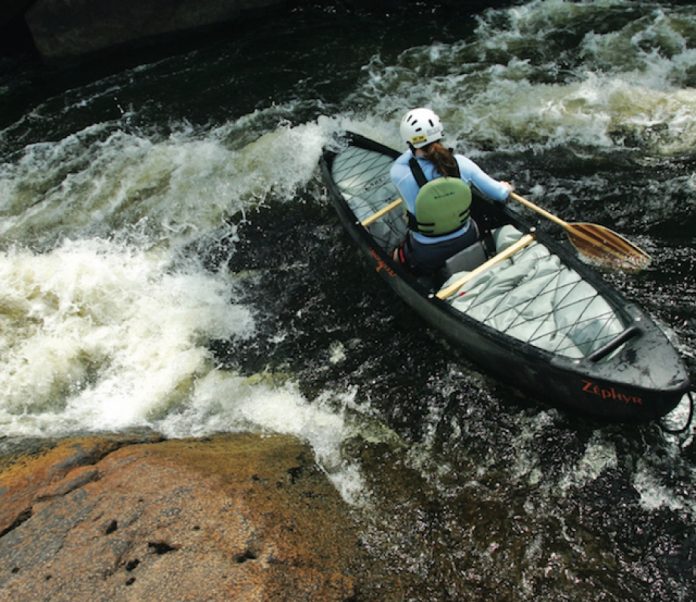
It seems obvious and you have no doubt heard it before, but learning to travel laterally across rapids is a mind-bender for the newly initiated and a concept that should be frequently revisited and practiced by paddlers of all levels. Pointing your boat where you want to go and travelling laterally allows you to move around the river for cleaner, drier lines and is the only way to access mid-rapid eddies.

Your first goal should be setting your angle across the current in one stroke.

However, radically changing your boat’s angle—for example, from pointing downstream to pointing across the current—does not alone change your direction of travel. Imagine standing on a moving sidewalk, looking straight ahead. You can turn your body to face left or right but you are still moving forward. To move laterally you need to step in that direction. Pointing your boat in one stroke allows you to immediately start building momentum in the new direction. This does not mean that you need to start paddling at warp speed, but you should at least be ready to start moving your boat in the new direction—across the river.

Timing is a key issue when developing lateral momentum.

Once your canoe is pointed at a destination like an eddy, green tongue or slalom gate, you need to ensure that your speed matches the angle and distance to your target.

Let’s look at a midstream eddy behind an exposed rock as an example. The water accelerates around the rock that forms the eddy, so you may need to increase your momentum as you approach. Conversely, if you build momentum too far upstream, have too open of an angle or you’re simply moving too fast across the current, you may come in too high. This could result in pinning against the rocks or ricocheting off and sliding down the eddy with zero directionalmomentum. In these cases, ease your lateral momentum by relaxing your stroke rate or pause and wait for the eddy to come to you. Keeping your eyes on the eddy and being aware of distance versus cross-current and downstream vectors will help you judge when to back off and when to pour on the power.

Advanced solo and tandem boaters may also use a trough or foam pile of a standing or crashing wave to funnel their boats into an adjacent eddy. To try this, develop some cross-current momentum and fall sideways into the wave. Make sure you drop into the trough flat rather than with the customary downstream tilt to prevent the wave from dumping in your boat. Ride the wave’s trough or tube like an on ramp into the eddy, or use the power of the wave to kill your downstream momentum, allowing you to move across into the eddy.

This article on turning your canoe was published in the Fall 2009 issue of Rapid magazine.

This article first appeared in the Fall 2009 issue of Rapid Magazine.
 

Editorial: A Complete Sentence

Photo: Scott MacGregor
Editorial: A Complete Sentence

Welcome to the women’s issue. Or is it the woman’s issue? One thing it is not is the womens’ issue. That’s because even though there is an exception to punctuation rules which says the apostrophe is supposed to come after the final s of a pluralized possessive noun, “women” is an exception to that exception, because it is a plural that doesn’t end in an s. There is no such thing as a group of womens, despite public places being filled with washrooms for them.

This is how an editor makes a living. Most people just pick up a magazine and leaf through, looking for a good place to begin reading—the tip on where to hang a food pack comes to mind. Editors have to think about not hanging modifiers. How low can a preposition dangle before a bear can reach it anyway?

Careful readers of this magazine might be skeptical about claims of grammatical vigilance. I encourage sticklers (and I use that term with respect) to write and point out all the errors of usage and style in this issue. It would be a great way to welcome the new editor and instill a sense of high standards. You see, for this issue I’ve been concerned not just with apostrophes, but also with periods, the things that come at the end of a sentence. Or fragment. Or job. 

With two new small but squirming items to carry over the portage now I’ve decided to shake up my life a little. After five years of editing Canoeroots I’ll be leaving it to a new editor to steer through the February issue and beyond. 

Five years doesn’t sound like much perhaps. After all, it’s only twice as long as one of the canoe trips featured in this issue. But it was long enough to change at least one paddler’s perspective on the sport. When I started at Canoeroots I considered canoeing and isolation to be a natural fit. A canoe was something to take you away from other people. Now I know canoes are even better at bringing people together. The canoeing community is strong when it is connected. As the article on the weakening of the Navigable Waters Protection Act shows, that is important if the values we share and the wild spaces we enjoy will have any supporters.

So by all means, write and tally up all the sentences in this issue that start with a But or an And. Whatever you write, it is a pleasure to know that there are people at the other end of the presses who love canoeing like we do. And now that no one remembers how small the print size was in the Spring 2006 issue, reader emails are our favourite kind. Until I become editor of Friendly and Interesting People Monthly, I won’t expect to be in regular contact with such a great group of readers and enthusiasts.

Finally, I should thank publisher Scott MacGregor and, of course, Bill Gates. To MacGregor for starting Canoeroots and making my job possible; and to Gates, for refusing to add a Canadian dictionary to Microsoft Word’s spell check and making my job necessary. 

This article was originally published in the 2009 Summer/Fall issue of CanoerootsThis article first appeared in the Summer/Fall 2009 issue of Canoeroots Magazine.

 

Paddle to the Amazon Again

Photo: Don Starkell
Paddle to the Amazon Again

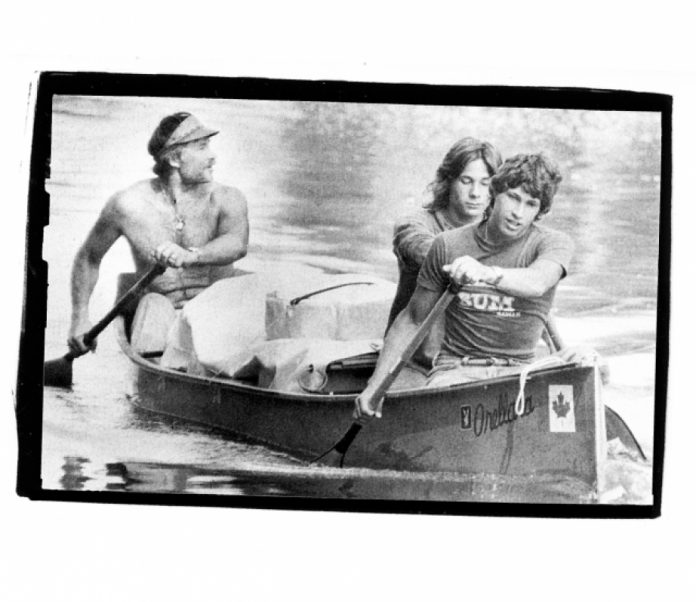
In 1980, Don Starkell and his son Dana embarked on what became the longest—and in another sense the largest—canoeing adventure ever. The two started from home in Winnipeg and finished in Belem, Brazil, a world-record-setting 19,603 kilometres later. 

Don’s book about the journey, Paddle to the Amazon, became an instant classic in paddling circles thanks to its tales of pirate attacks, near starvation, accusations of espionage and threats of execution.

Despite this, Starkell has remained largely out of the pantheon of better-known adventurers like Steve Fossett, Sir Edmund Hilary and Colin Angus.

Starkell might soon be getting more widespread credit, thanks to filmmaker Chris Forde and his soon-to-be-released documentary. Forde is hoping Starkell’s book publisher will let him borrow the same title for the film.

Forde interviewed the main cast of characters including Starkell’s other son Jeff, who abandoned the trip halfway through. The film, however, is more than a regurgitation of the book. 

As it turns out, when the project began the Starkells were re-tracing a section of the original trip. This excursion became the backbone of Forde’s documentary. 

“It gives the viewer the feeling that they’re going to go all the way down the Mississippi with them.” Forde explains.

In addition to this more recent footage, the film captures the dangers of the original route through some of the most politically unstable countries in the world. A particularly chilling moment occurs when Starkell talks about the dangers he expected to face on the trip.

“I had a list of things I thought would be hardest to endure,” says Starkell. “First off, I said weather, insects and water supplies. But as I got further in the trip—and it didn’t take very long—man went right to the top.” Starkell claims to have been shot at 14 times and at one point he and Dana were dragged into the jungle and almost killed.

Forde wanted to reveal the real motives behind this “family trip” that took 10 years to plan and two years to execute, but he had to question Starkell repeatedly.

“He offered all sorts of reasons why he did the trip: he got divorced, he wanted to do something with his kids and he wanted to inspire his kids,” Forde explains. “I sensed he would get close to the real reason and then veer off.”

“Finally, on the last day on the Mississippi, he told me. He wanted to test his limits. He wanted to know how far he could go before he actually died. This is what the trip was ultimately about to Don.”

Similarly, when Forde is asked about why he undertook the documentary he gives a reasonable answer about increasing awareness.

“This story should be a part of our culture, everybody should know about this. We have Terry Fox. Starkell should be right up there,” argues Forde.

When asked again however, he digs deeper. 

“I wanted to meet Don. I think more than anything I wanted to meet my hero.” 

This article was originally published in the 2009 Summer/Fall issue of CanoerootsThis article first appeared in the Summer/Fall 2009 issue of Canoeroots Magazine.