If you visit the Atlantis Kayaks workshop, you’re apt to be under-whelmed when you see that it amounts to a small barn in a field near Nanaimo, B.C. Inside, however, the electricity meter is whirling like a dervish, driving heaters and floodlights and other apparatus of industrial boat production. The two-storey shed hums with the mounting intensity of pre-season orders, and you realize that this is what it looks like when big kayak companies get their start.
Atlantis Kayaks is Robin Thacker, a moulding expert who came to kayak building by happenstance. He once moulded parts for jet engines and has another business building scale models of multi-million dollar flight simulators. In his spare time he races bathtubs, but that story will have to wait for another review.
[ Paddling Buyer’s Guide: View all sea and touring kayaks ]
Thacker discovered kayaking when he moved to B.C. in the 1990s. As a builder, he wasn’t about to buy a boat from somebody else. He went ahead and designed his own, selling the Aurora design to Seaward five years later when he was through. But Thacker had caught the bug and in 2003 he started Atlantis Kayaks.
So, a novice kayaker designs his own kayak. At first this story sounds like the episode of The Simpsons where Homer gets to design a car for the common man. His tacky La Cucaracha air horn and shag carpeting didn’t catch on.
But Thacker is one outsider who knows the right way to bring fresh perspective to an industry. Why not add an integrated GPS system? Why not find a way to attach foot braces to a boat without drilling holes in the hull? And why not ask the outfitters what they want in a kayak and then build it for them?
On The Simpsons, Homer’s car cost $82,000 and bankrupted a company. In real life, the Thacker kayak is competitively priced and appears to be propelling Atlantis toward mainstream success.
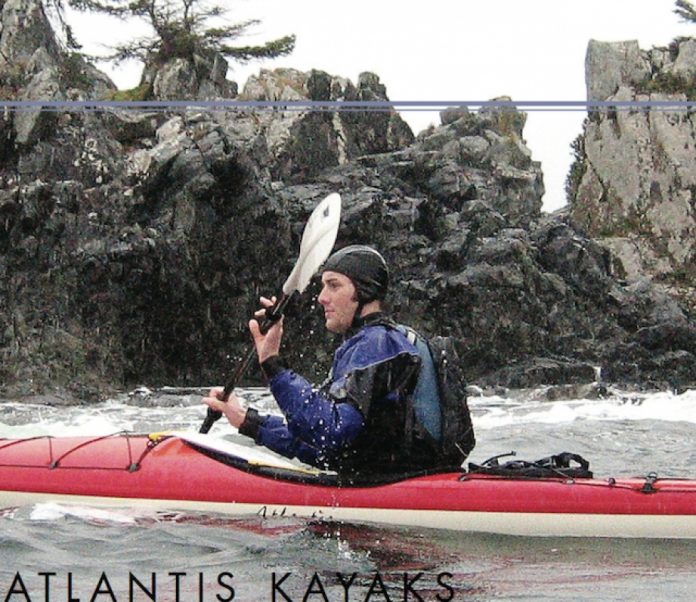
The Titan VI is a low-volume version of Atlantis’ flagship Titan. It’s the Titan hull with a lower deck for a tighter fit and sportier feel. Our test confirmed what Atlantis’ outfitter customers already know: Titans are super-stable, beginner-friendly, roomy, durable and attractive.
Fully loaded, our Titan VI took a lot of work to flip over. It tracked easily and heavier paddlers could tilt it and shorten the waterline for tighter turns. We had a comfortable ride in 5-meter seas and 20-knot winds and felt relaxed enough while drifting to take photographs in conditions that would have made for white-knuckle paddling in many other boats.
The Titan VI is 24 inches wide but cruised for us at speeds similar to narrower kayaks of its length. “It’s not the width that determines speed,” the designer explains. “It’s the footprint.” Maybe that’s a bathtub-racing secret.
Medium to large paddlers seeking an expedition-capacity kayak should take a close look at the Titan VI. This is a classic North American-style design that excels in comfort, capacity and stability, with innovative construction and clever features that set it apart from the competition.
Unlike Homer Simpson’s bells and whistles, Robin Thacker’s extra features are intelligent and practical. Consider the unprecedented option of an integrated GPS cradle for $295 CAD (GPS not included).
Photos: Tim Shuff
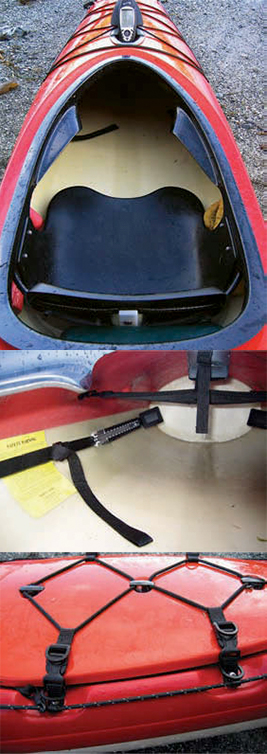
The stiff fiberglass seat back provides great support, although it may get in the way during rescues.
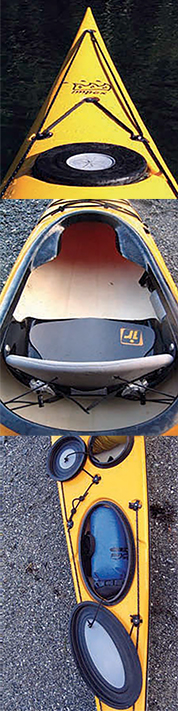
Everything but the Super Big Gulp holder (middle)
Comfortable, padded thigh hooks and a low deck provide a sporty fit for a large-volume boat. The Werner foot rails operating the Feathercraft rudder screw into a moulded insert in the hull and connect to a strap offering a second foot adjustment that’s always within reach. We’d like to see a deeper, grooved cradle for the rudder on the rear deck to prevent the foot pedals from moving when the rudder isn’t in use.
Excellent detail work includes fiberglass-taped inner and outer seams and bulkheads; Kevlar-reinforced bow and stern; standard cockpit cover and optional underdeck mesh bags in the cockpit and rear hatch ($109.90 CAD).
Cucaracha proof and then some (bottom)
The 72-liter bow hatch and the 120-liter stern hatch (shown here) are sealed by a two-piece system of airtight neoprene with a flush fiberglass cover. D-rings allow paranoid paddlers to attach padlocks to their hatch buckles—a deterrent to anyone coveting the reserve gummy bear stash. A fishing rod, paddle or tripod could be stowed under the hatch bungees.
This article was first published in Adventure Kayak‘s Early Summer 2005 issue. Subscribe to Paddling Magazine’s print and digital editions here , or browse the archives here.
Some boat manufacturers try to please everyone. Impex has taken a different tack with the Outer Island. This new boat will be to Impex what so-called halo cars are to automakers—an outstanding specialty design that draws attention to an entire brand, whether or not it’s a big seller by itself.
The Outer Island already has a loyal following. Connecticut-based Greenland kayaker Jay Babina perfected the Outer Island over four years starting in 1995, and handmade wooden versions have since earned a reputation for being fast, stable and easy to scull, brace and roll. Impex sparked a buzz in the Greenland scene by announcing it would reproduce Babina’s design with only minor modifications.
The Outer Island’s West Greenland pedigree includes exceptionally low windage, low volume, a long waterline, minimal rocker and a slick pancake of a rear deck (only seven inches deep) to facilitate traditional techniques like layback rolls and balance braces. Impex has already signed Cheri Perry onto their team, a Greenland Kayaking Championships paddler who enthuses that this is the first composite kayak in which she can perform the majority of competition rolls.
Impex Outer Island Specs
Length: 18′
Width: 21.5″
Depth: 10″ (mid-ship), 7″ (rear deck)
Weight: 55 lbs glass
Total volume: 220 L
Total storage: 114 L
Cockpit: 30″ x 16″
MSRP: $2,695 USD glass
It remains a surprisingly dry ride while knifing blithely through steep and deep seas. Initial stability is unexpectedly good for such a narrow boat, surely due to the shallow-V cross section.
Unlike many Greenland designs that echo skin-on-frame lines, the Outer Island has a soft chine, which rolls very smoothly in a tilt from primary to secondary stability.
Even novices will be able to make the Outer Island track straight and win races. It’s very fast and has the unwavering temperament of a good sled dog, but it takes real skill to make it turn.
Where a hard-chine boat tilted on edge tends to carve all the way through an outside arc with little help from the paddler, the Outer Island veers ever so slightly, following its forward inertia unless you throw in a few sweeps to coax it around. It’s clear why Babina’s original design didn’t have a skeg. We only dropped ours once, during a difficult 15-knot rear quartering wind and large ocean swell.
Impex slots the Outer Island into their specialty touring category alongside its alter ego, the playfully rockered Susquehanna.
So what’s the specialty? The Outer Island is one of the best production boats for small to mid-sized paddlers for real Greenland paddling, racing and short-duration touring—at very competitive Impex prices. Add $200 CDN for an expedition layup, $600 for Kevlar and $1,000 for carbon Kevlar.
Bow to the king of logos (top)
The Impex name is said to derive from “import-export,” adopted when Mid-Canada Fiberglass was looking for a U.S. tag for
its Formula Kayaks line. Now, the moniker with the monarchical ring has conquered all and every new MCF kayak bears the Impex crown—three wave crests bejewelled by little kayaks and water droplets.
An eight-inch round cover allows access to the 48-litre front hatch. All deck fittings are recessed and the heavy-duty bungees are well laid out for paddle stowage on the front deck. Bow and stern toggles attach to a simple loop threaded through the end pours.
In the throne room (middle)
In the cockpit you’ll note the beefy construction: taped seams, reinforced keel, rigid fibreglass mat deck and funky semi-transparent fibreglass bulkheads curved to flex and absorb forces through the hull. High marks for outfitting too: Werner foot braces, padded thigh hooks and a comfortable, low-profile whitewater-style ratcheting backband with matching seat pad from Immersion Research.
The short, contoured seat felt a bit high to some testers, rising slightly in the middle where seats are typically bucket-shaped. A slider on the right controls the cable skeg. The low deck and thigh braces and short keyhole cockpit suit smaller paddlers, yet there’s still plenty of legroom for beanpoles well over six feet tall.
[ Paddling Buyer’s Guide: View all touring kayaks ]
Rear wing of the castle (bottom)
The Outer Island is quite suitable for tripping. Volume is larger than it looks, thanks to its 18-foot length, and performance is equally good with or without a load. Imagine endurance trips where you want to travel light and cover long distances in a few days or a week. We easily packed for four days, putting larger items through the oval rear hatch. All hatches are recessed with drains around the rims.
This article originally appeared in Adventure Kayak’s Early Summer 2005 issue. Subscribe to Paddling Magazine’s print and digital editions here, or browse the archives here.
Spencer Cox and Sean Allen stand on a moist ledge above a big drop in the steep Beauty Creek Canyon in Jasper National Park. It’s not the drop they’re concerned about so much as how the water below belches from the undercut.
Brock Wilson was thinking about the same thing in 1986 when he and, then Jasper local, Stuart Smith ran the drop. “I watched Stuart pencil in and get stuffed under the overhang,” Wilson remembers. “I wanted to land flatter, but I landed too flat and wrecked my back.” The waterfall became known around Jasper as Lumbarsis.
Eighteen years later, Spencer and Sean are weighing the pros and cons of boofing and compacted spines. Reflecting on the fortunes—and misfortunes—of the past is happening a lot around here these days.
Locals like Sean and Spencer, along with a handful of other paddlers born in, raised in, and forever tied to Jasper, are rediscovering its formerly-prized creeks and rivers and picking up where early kayaking pioneers left off.
Jasper, British Columbia: The second coming of a paddling town
As a birthplace of extreme kayaking in Canada, Jasper was as much an international whitewater destination in the 1980s as Squamish and Whistler are today. Paddlers can access at least 12 high-quality class III–V rivers within an hour of the national park’s tourist centre. Jasper offers everything from steep bouldery creeks to ledgy waterfall runs and big volume rivers.
In the 1990s, while playboating fervour engulfed North America, Jasper’s kayaking scene was caught in a whirlpool. The downward spiral began when Parks Canada closed a popular local river and accelerated with the death of a local paddler. Many paddlers had also reached a zenith in their paddling careers and shifted toward city life, chasing well-paying careers rather than first descents.
Feature photo: Ryan Creary
First descents were exactly what a group of Germans were looking for when they came to the Rockies with their boats in the late 1970s. In search of challenging Canadian rivers, members of the German Alpine Kayak Club had no clear idea of what they could run. The locals weren’t much help. Although skilled, the Jasper paddling scene was stuck mostly in fibreglass slalom boats.
The Germans were more interested in paddling class IV and V rivers than running gates. A vanguard film called Challenge the Canadian Rockies, produced in the early 1980s, featured these bearded kayakers, wearing wool sweaters and baby blue neoprene dropping 30-foot Overlander Falls accompanied by a symphonic score.
The falls look small compared to the steady stream of 60-footers on today’s techno-driven, small-boat paddle porn, but the Germans’ sense of adventure shook the locals out of their slalom slumber. Many started scouting the landscape with a magnifying glass, combing the mountains that surround Jasper and paddling everything they could. In 1982, a mixed-nationality team of Krauts and Canucks calling themselves the Suicide Six claimed the first descent of the cascading Bighorn River. The German blitzkrieg had succeeded. From the mid-80s to the mid-90s Jasper ranked high among world-class whitewater destinations.
Established as the National Park’s town in 1907, Jasper has long been a mixture of terra cotta souvenir-hocking buildings, 100 per cent genuine Alberta beef steakhouses and depression-era Parks Canada structures with faded cedar shake awnings. It hasn’t changed much since the Germans were here, except that now a McDonald’s restaurant stands brazenly in the middle of town. Tourists, it seems, are hungry for cheeseburgers after long days of discovery in the undisturbed scenery just outside town limits.
I’m leaning against the faux-log façade of McDonald’s when Sean Allen rolls up in his dented grey truck. With his pale complexion, fiery eyes and dark goatee, he looks like he belongs on the seat of a Harley. He traded in his motorcycle after hitting a bus. Now he throws himself off bus-sized pourovers instead.
On a motorcycle or in a kayak, Sean is a hard-living guy. He’s taken some big hits since he started paddling in 1999. During a one-week stretch, he took two of his most severe beatings. One of them happened on a high-water mission to the Bighorn when he landed slightly crooked under a waterfall. The river squashed him to the bottom as if being pressed to the pavement by the boot of a Hells Angel. That slowed him down for a while. His skill has since come to match his nearly fearless demeanour.
[ Browse the widest selection of boats and gear in the Paddling Buyer’s Guide ]
We leave the processed putridity of McNuggets behind to meet Spencer and take advantage of the long central Albertan day. Just five minutes outside town, the Maligne Canyon is the after-work creek run of choice. When I first came here a few days ago, the place was like an attraction at Disneyland. Swarms of tourists dangled themselves over the safety railings to capture a digital image of our show.
“Are these extreme kayakers?” inquired a voice from the mob. The eddy I paddled into certainly felt extreme. What should normally be a calm backwater was actually a boiling, spitting current. “There’s an underground cave system that drains Medicine Lake,” explained Sean as he watched me flail away. Cracks in the limestone walls fill the canyon about every 100 metres. The one-kilometre creek run starts out 10 feet wide, but by the end it’s a legitimate river.
We started running the canyon one drop at a time,” explains Spencer, the other prime mover behind Jasper’s himself. He tumbled around in the hole until he resurgence. “We ran the bottom drop one night then went home. Eventually we worked up to the class V Sickle. Now we run the canyon every night. I’ve probably run it a thousand times.” I assume he’s exaggerating, but his detailed knowledge of every rock and eddy tells me he’s not.
I think back to two days earlier when Spencer led us to a put-in that was crawling with signs of grizzlies, banging his boat with his paddle and brushing sun-bleached hair out of his eyes. Though he doesn’t let grizzlies keep him from paddling, Parks Canada has been a little more troublesome.
Just upstream of the canyon is one reason why Jasper’s kayaking scene went south. A steep and technical run flows between Maligne and Medicine Lake. It’s a two-kilometre tour de force of class V whitewater within a half-hour of downtown Jasper. In 1993, new park regulations prohibited boats on this stretch during May and June to protect harlequin duck nesting. By 1999, a restricted activity order completely shut down paddling between the lakes. Parks Canada cited a drastic increase in rafting traffic as a major disturbance of duck activities. While it is true that the number of rafts floating the river in a year had risen from 10 in 1986 to 1,600 in 1991, the ban included the lower behind-the-mountain run even though it wasn’t commercially rafted.
“We never did see any harlequins on the lower stretch,” commented Al Colwell, junior representative for the nearby Hinton Strokers Kayak Club, adding that the closure pulled their most important intermediate and advanced river right out from underneath them.
While the river is occasionally poached on stealth missions, the Strokers are adhering to the regulation and teaching in less ideal places.
With the closure, paddling in Jasper began its march to the basement, a trip sped up by a 1999 run down the McKale River that ended in tragedy. Jasper’s Mark Oddy was no stranger to high water or steep descents when he entered a sticky hole to knock his paddling partner loose. Though successful at bumping out his friend, Oddy was caught in the mess himself. He tumbled around in the hole until he disappeared. Despite extensive multi-agency searches, his body has never been recovered.
“The death of Mark Oddy had a big effect on the kayaking scene in Jasper,” explains Sean soberly as we wring ourselves out from the evening Maligne Canyon run. “Anybody that was halfway into paddling around here just pulled right back. There was hardly anybody left.” The Jasper River Runners, a club that once filled an entire CN Rail hangar, faced financial troubles and closed its doors soon after.
While many others lost their passion or moved away, Sean and Spencer, spurred on by the paddling pantheon that is Jasper, picked up a video camera and teamed up with locals Logan Rutherford and Mark Basso to film their favourite runs. After a summer of marathon paddling weekends all over B.C. and Alberta, they had enough footage to release the video Entropy. Circulated mainly in Calgary it quickly sold 200 copies and is now in its second printing. A fringe benefit of the video was its showcasing of the filmmakers—virtually unknown until then—as stellar paddlers from a forgotten corner of Alberta.
Entropy also spawned kayakwest.com, a website full of useful information about the runs around Jasper and the West. “Guidebooks only cover a tiny chunk of Western Canada,” says Spencer who runs the site that averages 1,500 hits a month. “Kayakwest encourages people to get out and explore or look at some pictures and river descriptions to see if any given run is something they want to try. There is life in Alberta and B.C. outside of the Kananaskis.”
[ Plan your next British Columbia paddling trip with the Paddling Trip Guide ]
One of the rivers featured on the website is the Fraser. One hour west of Jasper, carving sharply through the rotten rock below Mt. Robson, the Fraser is still 1,000 kilometres from its deltaic mouth in Vancouver but it’s already big and wide. the Fraser’s raft run put-in is the site of Fraser River Fest, a relaxed and fun event organized by Spencer to showcase his favourite backyard runs: a technical class IV series of boulder gardens with trashy surf waves, a terrifying canyon and a big volume play run. Attendance ballooned from just 12 paddlers in 2003 to more than 50 in 2004.
Energized with the same drive to explore whitewater as the Germans, Sean and Spencer are prodding Jasper’s paddlers toward a rebirth. They have outlasted a boom and bust kayaking scene, where ducks ruled rivers and paddling partners were scarce.
If you show up at Beauty Creek this year when the water is just right there’s a good chance you’ll see Jasper’s local boys standing above Lumbarsis, thinking about that undercut.
Raymont Schmidt is a writer living in Canmore, Alberta.
This article was first published in the Spring 2005 issue of Rapid Magazine. Subscribe to Paddling Magazine’s print and digital editions, or browse the archives.
As long as humans have held whitewater paddles in their hands, they’ve asked the question, “At what angle should I cross an eddy line?” Some have said 45 degrees is the best angle, others argue an approach of 90 degrees is the only way to carve smoothly into an eddy pool. The controversy has spanned several generations of paddlers, yet remains unresolved. Until now.
The solution to this mystery lies in looking closely at the eddy line itself. When you do, you’ll see that the eddy line is not really a line at all. It is actually more like a wedge pointing upstream.
In the photograph, the widening area between line A and B is what we commonly refer to as the eddy line. This eddy line, or wedge, is an area of chaotic water made up of boils and vortices. The upstream end of this wedge, often immediately downstream of a rock, marks the origin of lines A and B. Line A is the current side of the increasingly wide eddy line and line B is the eddy side.
So, how do you decide on an angle to cross the eddy line when it is actually made up of two diverging lines? To answer this, it’s best to work backwards from the eddy pool. At the end of an eddy turn, your canoe should be in the pool pointing upstream. Prior to this, the last point where the canoe was in contact with the eddy line was somewhere along line B. The most efficient entry into the eddy pool is a 90-degree turn off of line B. Any angle larger than 90 degrees results in an unnecessarily wide turn, and any angle less than 90 degrees means front ferrying over the eddy line, which is entirely too much work. The 90-degree crowd is nodding and saying, “I told you so!”
So what about line A? Is it really so important what angle you use to approach this initial eddy line? Anyone who has ever spun out on an eddy line knows it can be very important because of the influence the boils can have on the path of a canoe. As soon as the bow of your canoe touches these boils it will want to turn and face upstream. The risk is that the canoe will face upstream before it makes it to the eddy pool.
The solution is to approach line A with an angle sharp enough to cut a path across the boils so that you can still cross line B at the magic 90 degrees. Since lines A and B diverge, your approach angle will depend on how far you are from the top of the eddy. If you are very close to the top of the eddy (where the lines are close together) you can approach line A at close to 90 degrees. If you are at the bottom of the eddy (where the two lines making up the wedge are further apart) then you should approach the eddy at an angle of 45 degrees. The 45-degree folks are smiling in satisfaction.
So, the whole angle debate boils down to how high or low you hit the eddy. Choosing an approach angle depends on which part of the eddy line you are aiming for. Look carefully at the eddy line and identify both the current side and eddy side of the wedge, break out a protractor and carve a perfect arc into the pool. Mystery solved.
Andrew Westwood is a frequent contributor to Rapid. He’s an open canoe instructor at the Madawaska Kanu Centre and member of Team Esquif.
This article first appeared in the Spring 2005 issue of Rapid Magazine. For more great content, subscribe to Rapid’s print and digital editions here.
Though we may often take the vastness of our country for granted, I expect that deep down most of us are proud of our great landscape and the role it has played in shaping the history of our country. This pride shows itself as a fierce love for free flowing rivers, nearendless mountain ranges, and the vast boreal wilderness. And while it may be true that we are better positioned than others to gain a meaningful knowledge of the shape of the earth, it is a knowledge that still has to be actively sought. In Canada, a vague and passive appreciation of the land is easy, too easy.
From the seats of our little boats, we have reduced our rivers to a short section between put-in and take- out, a linked series of playspots and ledges. For us, a river becomes a familiar, sometimes memorized sequence of moves that hints at adventure. It is a snapshot, like a photo of a person that in no way indicates health, happiness or history. This limited knowledge weakens us as paddlers and members of a community. Who are we to speak for a river if we only know eight kilometres of it?
Sliding into the water at a put-in I can’t help but wonder what lies upstream, or where the river goes when it flows around a bend and out of sight at the take- out. Do Ottawa River paddlers know anything of the roaring Culbute Rapids, or the many drops at the Swisha? What about the mountainous waves of Clarke’s Folly in spring flood?
To really understand rivers requires commitment, time and even intimacy. To understand a river is to understand something about all rivers, and to understand rivers is to understand geography.
At one time I pursued an encyclopedic knowledge of rivers — wavelengths, gravel bar formation, erosion, particle capacity. This was an exercise in frustration. I came to see that, without connection to whole rivers, these facts are meaningless.
It was not until I explored my own river — not my local whitewater run, but the stream that runs through the culvert down my road — that I began to understand rivers, and therefore geography, in the broadest sense.
My stream is unremarkable in every way except that it is my own. It shapes the landscape I look onto every morning when I wake up and defines the place where I live. If we don’t really know where we live, then it doesn’t matter where we live.
Understanding local streams matters. We need to know our rivers to care for our rivers. News of dams on the Magpie or the Churchill, or a hundred other rivers, means more than the loss of whitewater runs, mere places to play. Dams portend a drastic alteration of geography, and with it an erosion of the knowledge that is our birthright. In backing up the water, dams dry up our sense of place.
Our predecessors travelled without maps and knew their rivers top to bottom. They understood flow through the seasons, the length, breadth and character of a river. Compare this to playboaters who have a bottomless depth of knowledge for a handful of features on a river, yet are oblivious to what lies 100 metres upstream or down.
It’s an oblivion that has to be recognized. Paddlers are the chosen ones. In a world of bulldozed suburbia we view the world with wet hands and water in our eyes. We feel the connection to the Earth through the grip of the current. We must not ignore the geography that created that current and the geography that the current creates.
Paddle past the take-out.
Jeff Jackson is a professor of the outdoor program at Algonquin College in Pembroke, Ont.
This article first appeared in the Spring 2005 issue of Rapid Magazine. For more great content, subscribe to Rapid’s print and digital editions here.
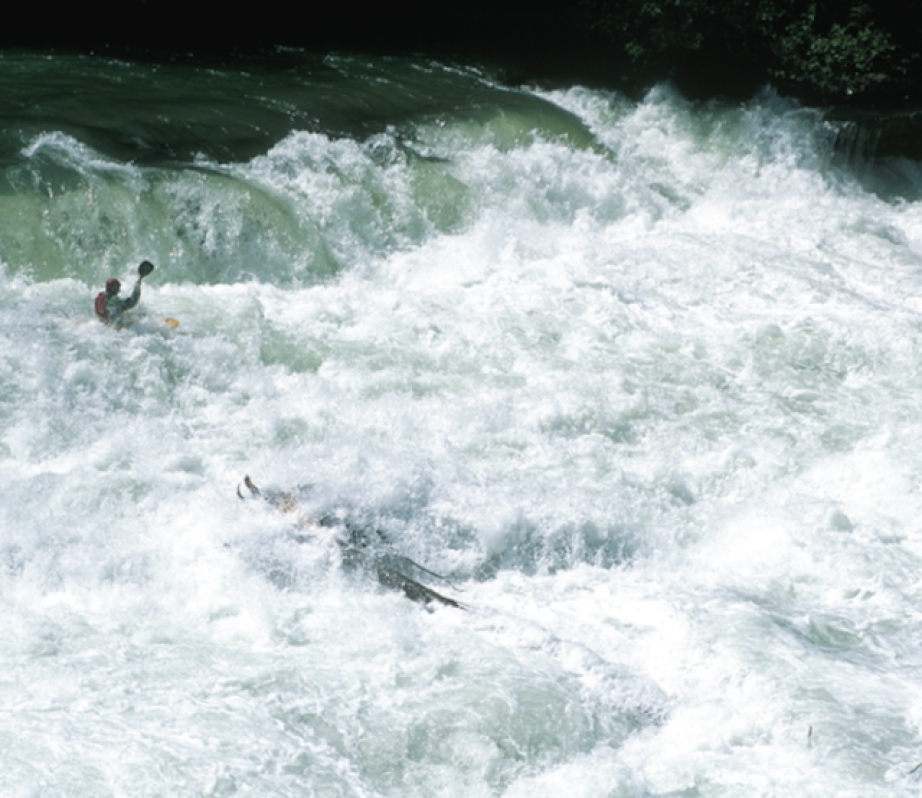
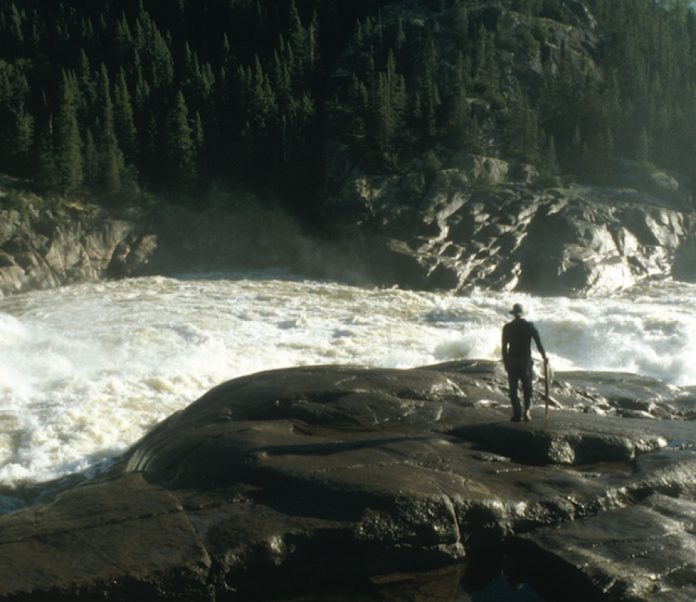
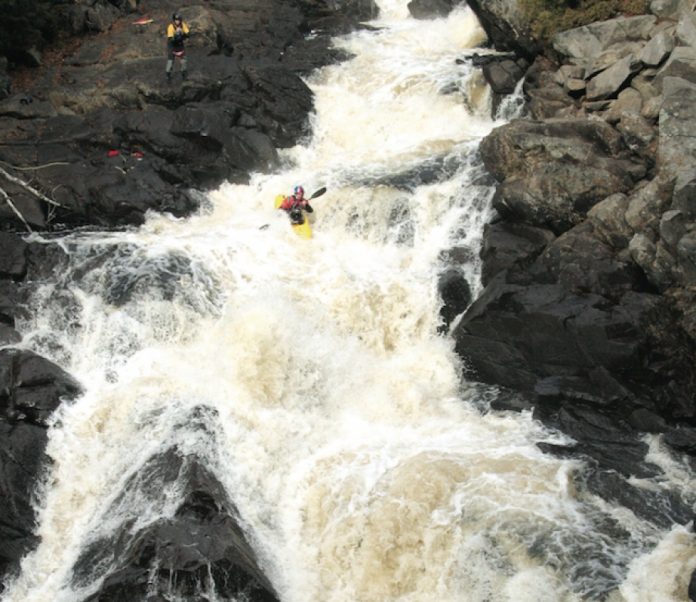
Everyone knew someone would run it someday. Twisting, steep and ugly, Ragged Falls had festered in the psyche of southern Ontario paddlers. Dropping 85 feet in less than half a kilometre, the falls had repelled any attempt at a complete run, until last November when Billy Harris notched the first full descent.
Just a kilometre off busy Highway 60 as it runs into the southwest corner of Algonquin Provincial Park, Ragged Falls was the most prominent drop in southern Ontario that had yet to feel the caress of plastic.
It is a complex, gnarly, multi-stage drop with plenty to make a sane boater walk away.
“There is lumber, pin spots, rooster tails. When she is crankin’, sphincters are all puckered,” says Harris. “It is a white monster with teeth, scales and attitude.”
Harris had a clean run, only getting into trouble at the bottom when he was drawn toward a lumber yard after starting the celebration too early.
Dale Monkman and Rapid columnist Ben Aylsworth followed shortly after, getting into a few tight spots but escaping unscathed.
In the spring of 2003, Rapid reported on an exploratory attempt by Brent Cooper and Paul Muegge. The pair started at the bottom and progressively ran from higher and higher up the falls before halting their progression still 40 feet below the top.
Gord Baker, a manager at Algonquin Outfitters just down the road from the falls, was watching that day. “If it is in fact runnable top-to-bottom, it would be a dangerous undertaking, one with great risk of injury or death,” said Baker.
While that may well be true, it’s time to take the conditional clause off that quote.
The exploits appear in Ben Aylsworth’s new film H2-HO.
This article first appeared in the Spring 2005 issue of Rapid Magazine. For more great content, subscribe to Rapid’s print and digital editions here.
If I were a rat, my paddling gear would be neatly folded and stacked in a plastic bin labeled, Scott’s Paddling Gear. The bin would be in the basement among other gear bins—bike apparel, camping equipment, ski wear—all labeled clearly and arranged according to season. I would probably even have a bar of apple-scented soap inside to keep my paddling gear smelling sweet over the winter.
I’ve tried a couple of times to be all Martha Stewart-like in my basement. It’s just no use. I like to stretch my paddling season as close to winter freeze-up as possible. Just when I think it’s time to put my gear away we get a warm December day and it all gets dug out again. Even after the mercury falls, and paddling seems to be out of the question, I can’t bring myself to admit the season is over. The bag of soggy gear just gets tossed in the garage until spring.
This is where I get back to my point about not being a rat.
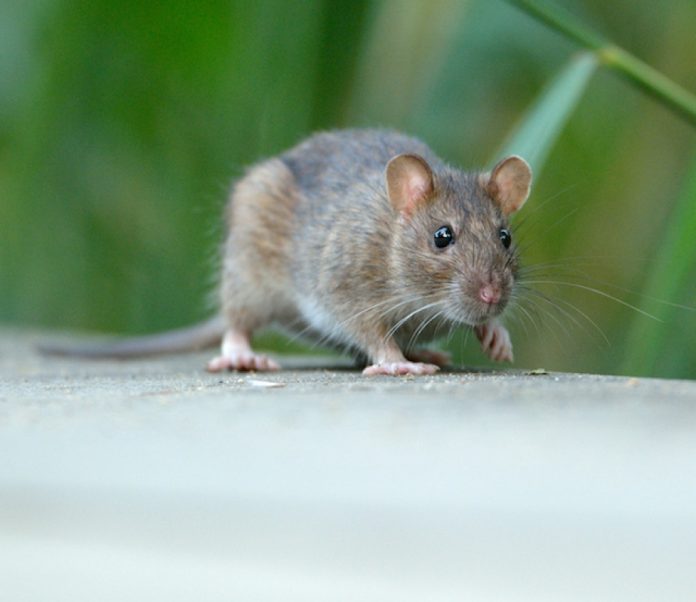
If I were a rat, I would have learned my lesson by now. I know this because researchers study rodents in laboratories, testing their capacity to recognize and avoid unpleasant smells. In one study, rats quickly learned to associate a poisonous drink with its particular odour and soon knew enough to leave it alone. (Paddlers haven’t figured this out yet, but this is another story altogether.) In another laboratory test, rodents demonstrated a near-perfect memory when it came to avoiding odours.
Scientists, and the rats, tell us there is a direct connection between our sense of smell and memory, and I believe it. The smell of fresh-cut cedar reminds me of the cottage, pipe smoke evokes my grandfather and black felt-tip markers bring back memories of my grade-two art class with old Mrs. Greener. And every spring, when the sun shines, eaves start to drip and creeks overflow their banks, I load my boat and go in search of my gear. Knowing not to look in the basement, I head for the garage, where I fumble around, looking here and there. Then I smell it.
When I unzip my paddling bag to check that everything is inside, my first memory isn’t of walking through an orchard of green apple blossoms.
Like a hurricane through a Stilton cheese factory, the smell of my gear blows up my nasal passage to the odour receptor cells that pass on the sig- nal to the limbic system in my brain that catalogues my memories. A few neu- rons fire and then I smile. “That was a great day,” I say to myself as I remember that last paddle in December.
Rats learn to avoid putrid odours after one or two exposures. They would learn after their first paddling season. They would wash their gear in little rat washing machines and fold it into little rat plastic gear bins labeled, Rodney and Roxanna Rat’s Paddling Gear.
Rats, I guess, are smarter than me. But rats don’t get to paddle late into the fall.
I’m glad I’m not a rat.
This article first appeared in the Spring 2005 issue of Rapid Magazine. For more great content, subscribe to Rapid’s print and digital editions here.
I had never thought of the ice as a noisy thing. Then again, I had never paddled at the foot of an actively calving glacier. A set of unfamiliar sounds—icy groans, pops, rumbles and cracks—emanated from Greenland’s Knud Rasmussen Glacier as it fell, piece by piece, into the fjord. As my head spun back and forth following each new percussive effect, my arms were on auto-pilot, bracing against the mish-mash of waves pushing out from wherever the enormous chunks of ice crashed into the water.
Our group of seven had already spent more than a week paddling the Tunu district of eastern Greenland, a barely-populated maze of fjords straddling the Arctic Circle. The east side of Greenland has always been less populated than the west coast due to the huge amounts of drifting polar ice which congest the shoreline, making transportation routes unreliable.
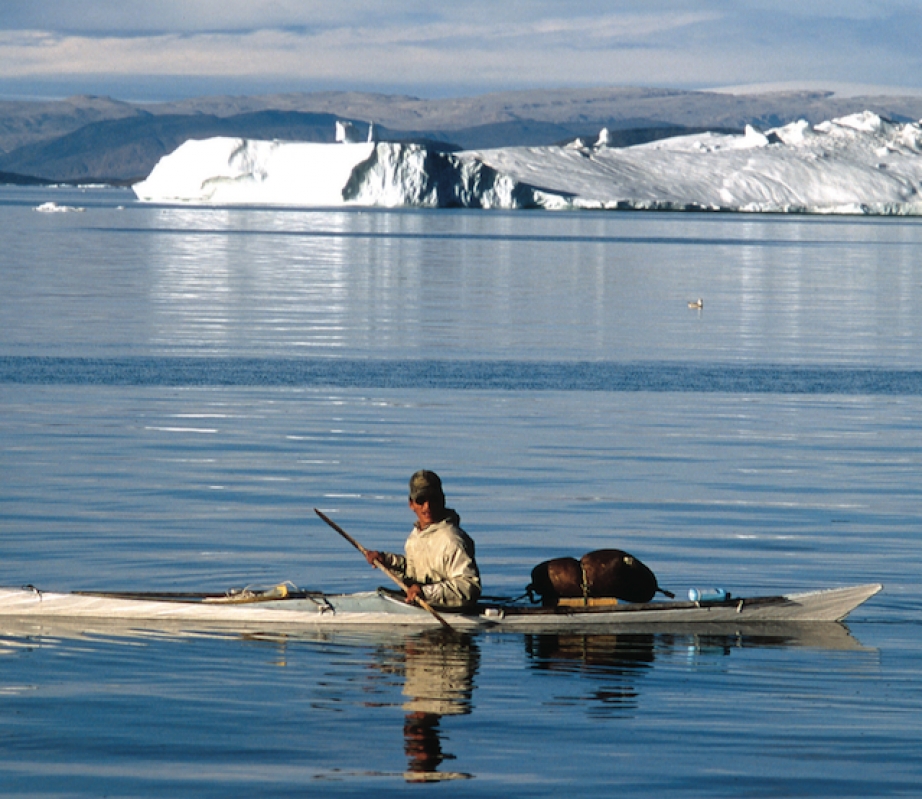
Paddling about 20 kilometers a day in our folding kayaks, we had travelled 180 kilometers through a maze of fjords, working our way north from Kulusuk to Sermiligaq.
Feature photo: Wendy Killoran
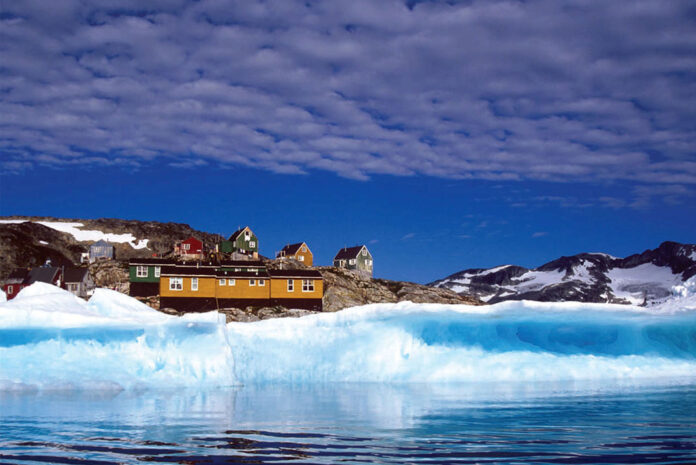
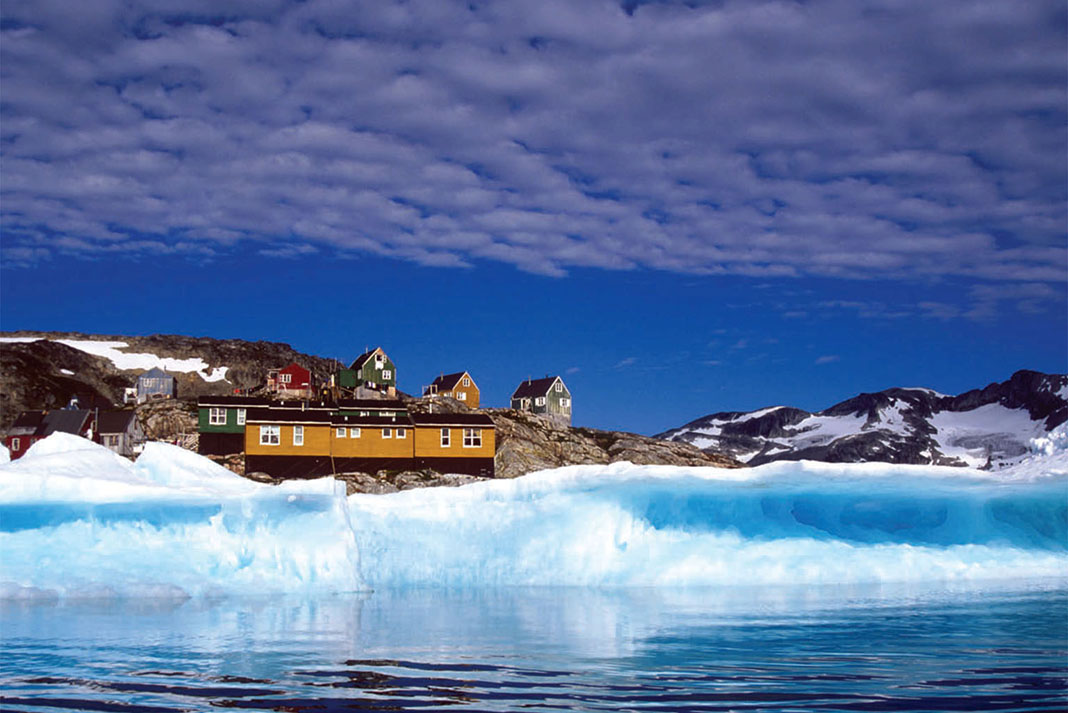
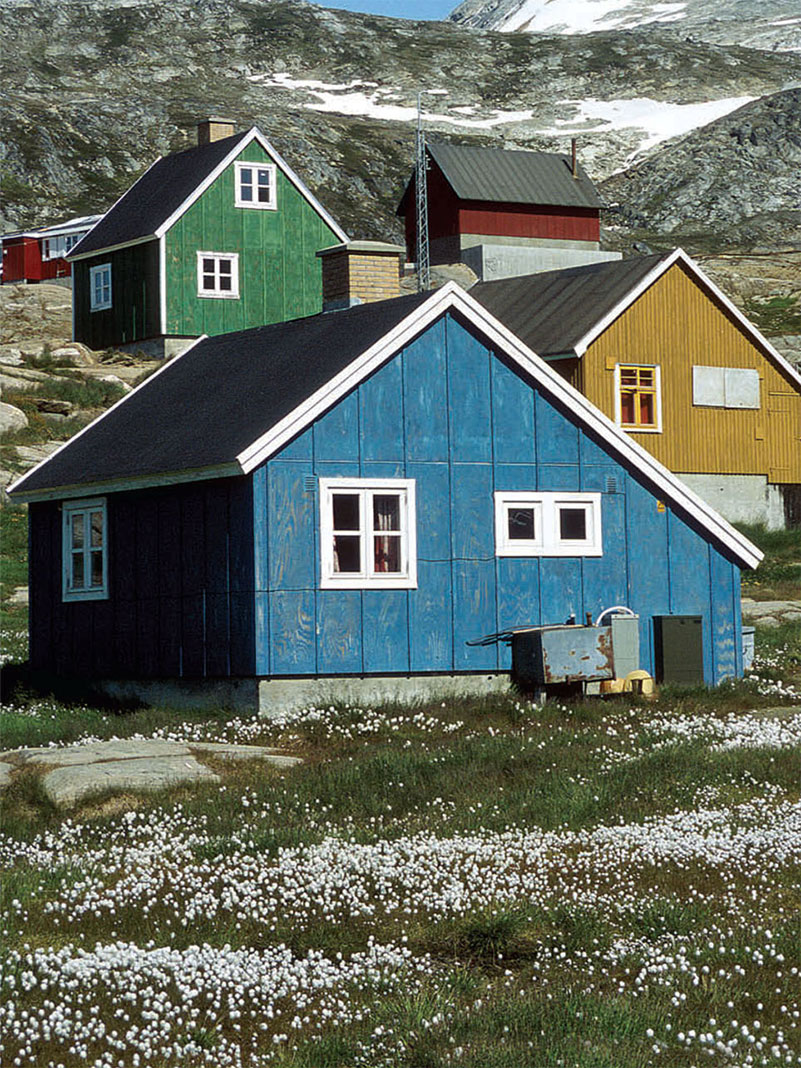
Along the way we had passed a handful of picturesque villages of colourful wood houses, barely clinging to the steep shoreline between the mountains and the water’s edge. It is only the coastal mountains that are habitable; the other 85 per cent of the island is blanketed by the Greenlandic Ice Sheet. At a maximum thickness of three kilometers, it depresses the land beneath and squishes out the mountains that fringe the country. Valley glaciers flow to the sea through these mountains, scouring jagged peaks and creating long, u-shaped valleys and fjords.
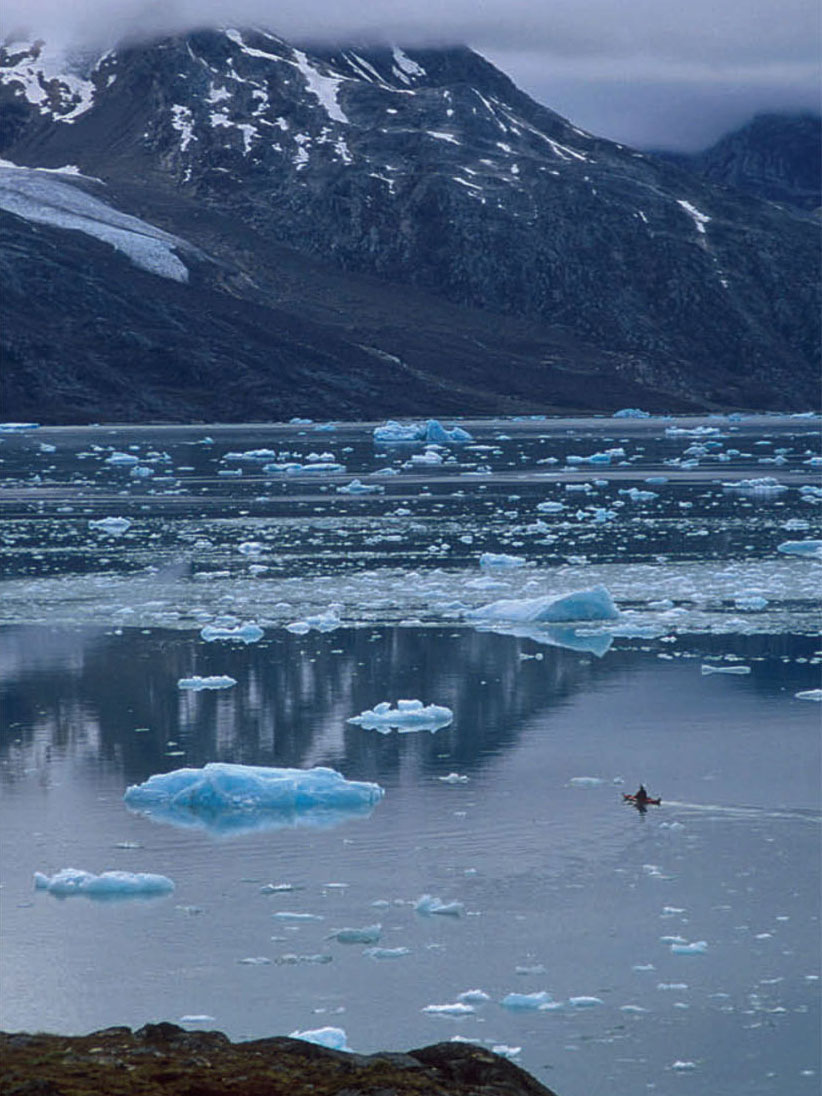
This icy kingdom revealed itself as I paddled beneath snow-capped mountains, beside sculpted icebergs and drift ice, to the base of immense glaciers. Despite the frozen backdrop, we were warmed by sunny, calm conditions for most of these last two weeks of July. Even mosquitoes wilted from the heat, and stayed tucked beneath cool leaves.
[ Plan your next sea kayaking adventure with the Paddling Trip Guide ]
I wasn’t about to dismiss the mosquitoes as wimps. I’ll tip my bug hat to any insect that can survive in the midst of so much ice. Erik the Red was displaying a firm understanding of irony when he gave the misnomer Greenland to the newly-colonized island in AD 985. Perhaps the exiled Viking was trying to entice others to settle on the inhospitable island with him.
Houses in Greenland are squeezed between mountains and ocean. | Photo: Wendy Killoran
Ice from the Knud Rasmussen chokes Sermiligaq Fjord. | Photo: Wendy Killoran
At home in Greenland, a culture in transition
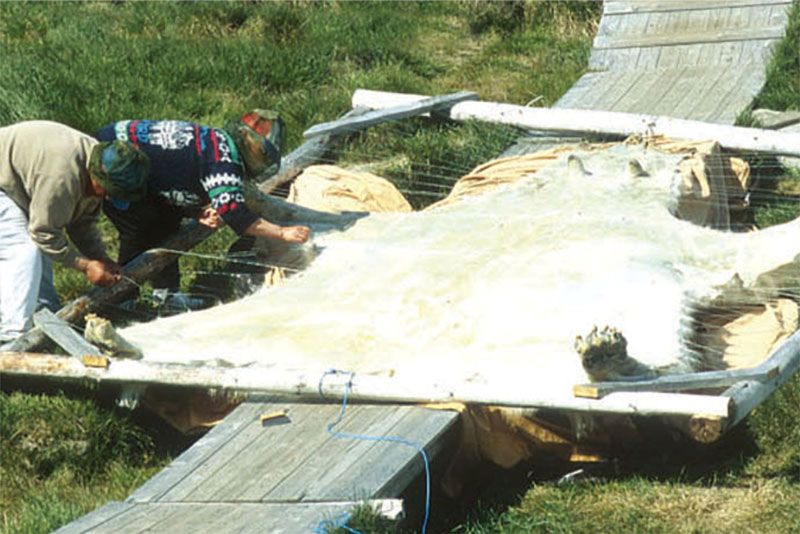
Inhospitable may be a word used only by visitors. Various Inuit cultures have populated eastern Greenland’s shores on and off for 2,000 years. The Thule people arrived in the 14th or 15th century and developed the skills and customs that made survival possible, inventing the kayak, harpoon and dogsled. One of the first things I saw upon arriving in Kulusuk was an Inuit couple stretching a polar bear skin across a driftwood frame. According to Inuit custom, the hunter who first sees the bear has rights to the skin and half the meat.
While watching the enormous white coat stretch out in the sun, it was easy to grasp that the villagers of Kulusuk have only emerged from what we’d call a stone-age existence since 1958 when the United States established an international airport and radar station (truly, a cold-war outpost).
Even today infrastructure is minimal with the majority lacking running water and most using a bucket for a toilet. Chained sledge dogs, fur matted and unkempt, easily outnumber the 350 villagers. I watched my step. The dogs should not be handled, unless one is willing to forfeit a hand.
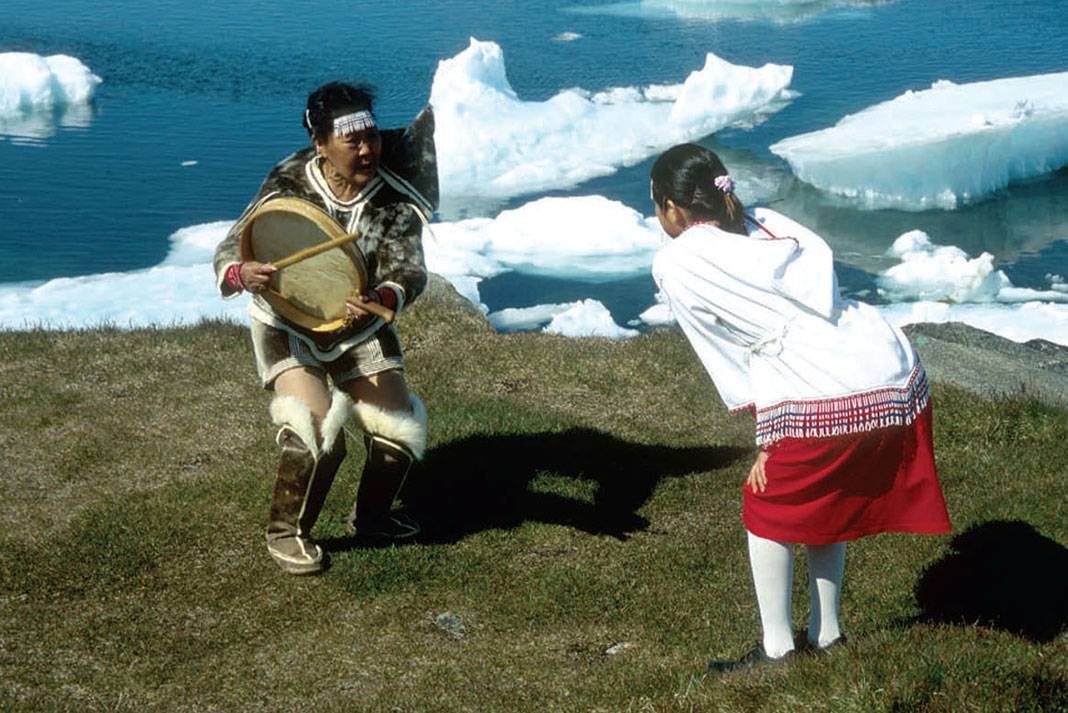
Drum dancing is an increasingly lost art in Greenland. | Photo: Wendy Killoran
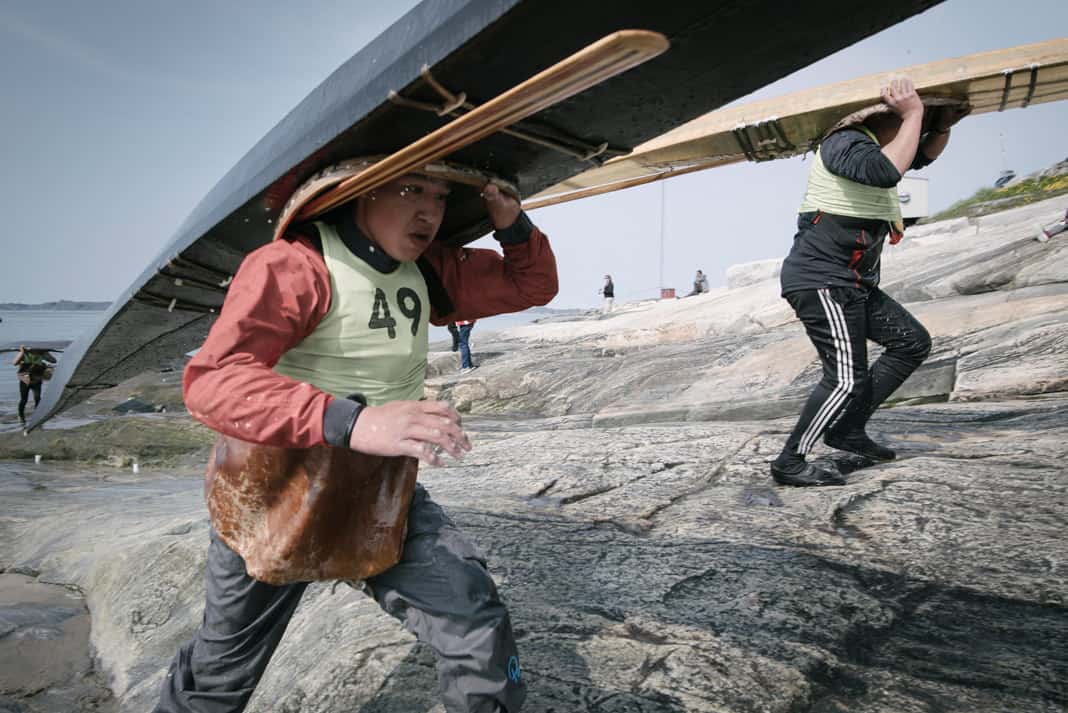
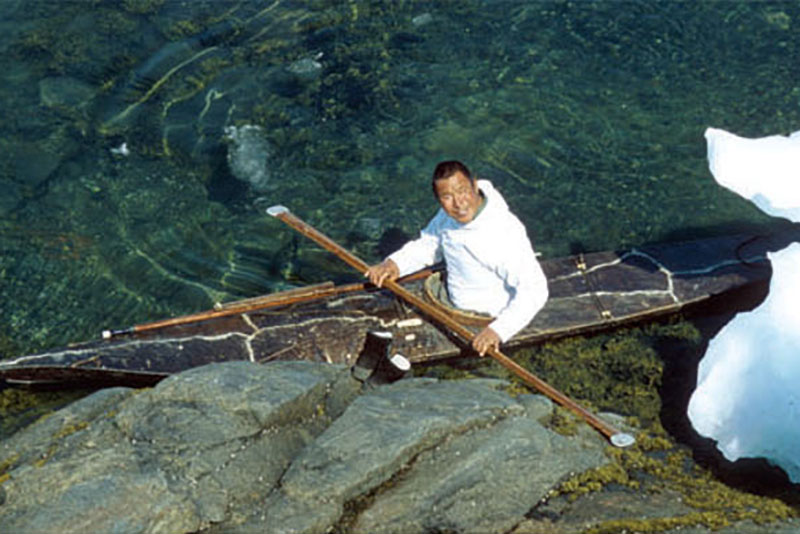
Demonstrating the more utilitarian origins of kayaking in a handmade traditional kayak. | Photo: Wendy Killoran
The hunter who first sees the polar bear has rights to the skin. | Photo: Wendy Killoran
Before we set out on our trip our outfitter arranged for a demonstration of the more utilitarian origins of kayaking. Pili Maratse carried his handmade traditional kayak—sealskin stretched over a driftwood frame—to the rocky shoreline where he removed his shoes and wiggled into his custom-fitting boat.
His boat darted through a puzzle of drift ice as he showed us how to chase and harpoon narwhals and seals. Maratse’s kayak moved nimbly compared to our modern kayaks, heavily laden with highly engineered camping gear that suddenly seemed excessive.
Life here is about more than just survival. Kulusk is fortunate to have Anna Kuitse, who has been teaching village youngsters the ancient Inuit tradition of drum dancing. Dressed in a sealskin anorak and shorts with sealskin kamiks she joined Tinka Mikaelsen, a young adolescent girl with glossy, raven-black hair, clad in a white cotton anorak and an intricately beaded fringe necklace and head piece.
His boat darted through a puzzle of drift ice as he showed us how to chase and harpoon narwhals and seals.
As they danced they provided a glimpse of this art form that has died out in most other regions of Greenland. Though a particular island way of life is still somewhat intact, the ancient culture has undergone incredible changes in the last half-century. With technological and material advance comes a severing of cultural identity. Modern conveniences ease some of the hardships that come with living here, but they have the potential to break the Inuit’s traditional connections with the natural environment, detaching them from their cultural uniqueness. With global trade and communications shrinking the planet, Nike shoes and NBA t-shirts are starting to replace sealskin and polar bear garments. And with global warming making the traditional hunting and fishing lifestyle more difficult, the central pillar of Inuit culture may be facing the same fate a glacier faces when it reaches the sea.
Paddling into the funnel-shaped fjord
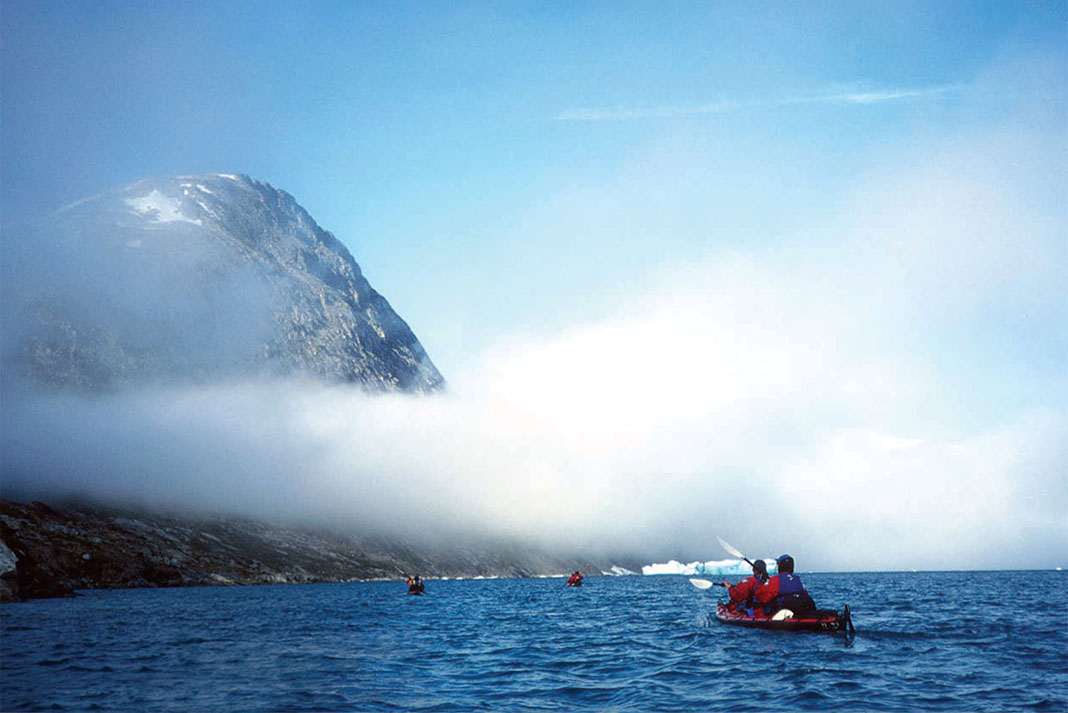
As soon as we left the cove in Kulusuk, we entered a fantasyland of ice. We wove our way through corridors barely wide enough for our kayaks. Bergy bits moved about at the whim of the currents, tide and breeze.
Through the process of calving and melting, each iceberg or bergy bit becomes unique. The forces of sun, wind and water combine to sculpt unique creations. Mushrooms, castles, spires, arches, triangulated slabs, ribbed platforms and circular holes bobbed in every direction. Some were clear, others white, fewer were toothpaste blue, and even fewer were translucent sapphire blue. These sapphire bergs are often younger than the white variety and appear blue because of a lack of trapped air bubbles reflecting white light.
Apart from being beautiful, the floating obstacles made travel difficult. Pathways closed in around us, causing us to retrace our path and find new routes through this icy maze. It seemed that the Tunu Fjord was simply too congested to navigate, but while we lunched on a small knoll of rock we watched the ice slowly spread apart as the tide rose. Because the fjords are funnel-shaped, the tides can be significant, often ranging between three and four meters. The increased surface area of the fjord allowed us to make progress through the sprawling gallery of ice sculptures.
I peered inside a burial chamber where a weathered human skull lay encrusted with lichen.
With the tidal currents making the fjords resemble ever-changing rivers, the trip was dictated by tidal cycles. My mindset followed along and I got used to thinking according to these short time frames. But compared to just about anywhere else on earth, Greenland is frozen in time.
We came across the ancient ruins of homes and burial sites on a promontory overlooking the Angmagsallik Fjord. Stopping to investigate, I peered inside a burial chamber where a weathered human skull, believed to be at least six centuries old, lay encrusted by lichen.
As old as this skull seemed to my New World mentality, my temporal perspective received another shock after huffing and puffing my way up a mountain overlooking the y-shaped Sermiligaq Fjord. The fjord is y-shaped with a glacier spilling into each branch, the Karale Glacier from the west and the Knud Rasmussen Glacier from the east.
Midnight in the Sermiligaq Fjord. | Photo: Wendy Killoran
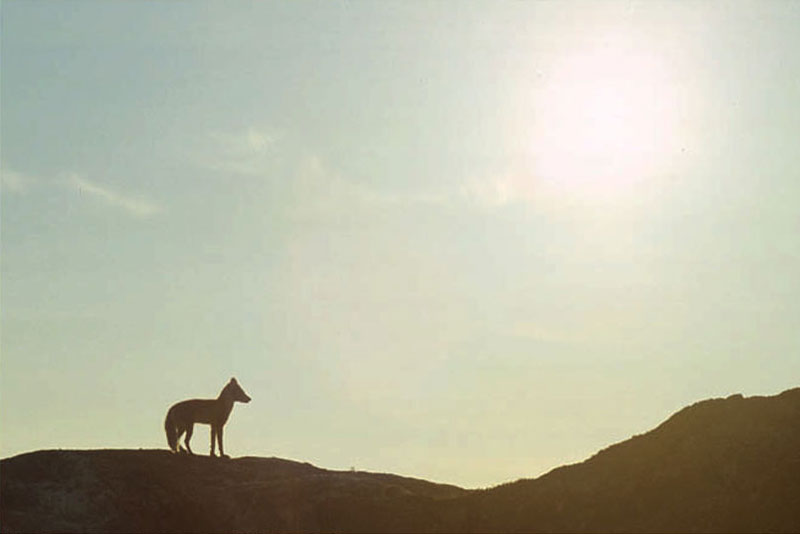
Arctic foxes make curious interlopers. | Photo: Wendy Killoran
Creeping glaciers return to the sea
As a curious Arctic fox hovered nearby, I looked down on the supposedly moving glacier and tried to contemplate the process by which falling snow becomes part of a glacier and gradually returns to the sea. Snow that falls on the ice sheet is compressed into ice when the weight of more snow presses down from above. As the thickness of the ice increases, the compressed snow becomes viscous, flowing through valleys as glaciers, eventually reaching the coast deep in a fjord. The process may take up to 10,000 years.
As eye-opening as the glacial panorama was, it wasn’t until we were paddling at the glacier’s terminus that I truly appreciated that glaciers are moving, active things.
After shoving off from our beach campsite in Sermiligaq Fjord, the four-kilometer-wide, 100-meter-tall face of Knud Rasmussen was an easy target. But first we had to wend our way through a glacial soup of bergy bits, drift ice and cathedral-like icebergs. Diffused sunshine glistened on these sculptures causing meltwater to trickle into the icy, inky water below.
Tendrils of fog obscure the peaks of Ikateq Fjord. | Photo: Wendy Killoran
Nearing the wall we saw ivory gulls feeding at the rambunctious base. Did the glacier’s calving stun the fish and create easy fishing? I wasn’t sure, but it was a good reminder to stay back at least three times the height of the calving wall.
We travelled as a group and listened to growls and rumbles followed by clouds of white spray, captivated by the cacophony of roars and the curiosities of deep crevasses. Huge sections of the glacier wall were a vitreous blue with deep chasms split into this wall, resembling palatial chambers.
The rumbles, growls and roars increased in frequency. Clouds of icy spray burst from the fjord below. Rolling waves spread out as larger chunks of ice spilled into the water. And then a massive, thundering bang released a sapphire chunk of ice the size of a multi-story apartment building that toppled over in slow motion. A three-meter wave spread from the foot of the glacier and rolled towards us. The fjord was alive with sounds and motion. Slurps, sloshes, crackles and slaps drowned out the sound of our rushed paddle strokes as razor sharp shards of ice engorged the fjord. Bergy bits danced all around.
We retreated, grinning foolishly, feeling reverent. The thrill of sitting at the base of a frozen wall, calving enormous chunks of millennium-old ice was pure exhilaration. Greenland was actively sharing its timeless grandeur with us, in both beauty and power.
Wendy Killoran wrote about paddling Iceland’s coast in Adventure Kayak’s Early Summer 2003 issue.
This article was first published in the Spring 2005 issue of Adventure Kayak Magazine. Subscribe to Paddling Magazine’s print and digital editions, or browse the archives.
Beach Combing: Discovering What the Currents Bring
I’m not an ideal kayaking partner. It’s not as though I lack good judgment or conversational skills, but when it comes to helping set up camp, you can forget about it. I’ll be long gone, scanning the beach.
I comb beaches in hopes of finding intriguing items like crab traps, a message in a bottle, a really thick chunk of rope or even (I’m crossing my fingers here) a can of Lucky Lager.
Most of the time I find nothing but junk, like that knotted piece of driftwood that resembled Jean Chrétien.
Above all, I’m obsessed with glass fishing floats that have escaped from fish nets in Asia, hopped aboard an ocean current, caught just the right wind and wave combination and washed up on a beach instead of a rock. They’re hardly worth a cent, but after surviving that ride they’re priceless to me.
Despite the complexity of ocean currents, they’re driven mainly by nothing more than wind. When weather patterns are such that strong winds regularly prevail in one direction, these winds push water along with them and create currents that swirl around the oceans in regular patterns.
The journeys of my glass floats begin off the coast of Asia when, one way or another, they escape from fish nets. They enter the Kuroshio Current which carries them northeast across the Pacific before arcing south along the west coast of North America—all at less than 16 kilometres per day, the maximum speed of an ocean current. A few years later, they skirt the coast of Vancouver Island. If the wind and waves cooperate, they are blown out of the current and wash ashore. If not, it may be years before the right conditions conspire to wash them out of the current and into someone else’s campsite.
I’ve found all my glass floats along a 20-kilometre section of coastline. That’s not surprising, according to Curtis Ebbesmeyer, a Seattle-based oceanographer.
“Beaches are like restaurants. Some serve Thai food, some Indian or Chinese food,” he says. “Each beach interacts with the currents, winds and waves in a unique way.”
The interplay of these forces and the buoyancy of the objects explain how some beaches are well known for their glass or driftwood artifacts, while others trade in more pedestrian goods: running shoes, for instance.
In 1992, the Hansa Carrier freighter encountered a storm in the middle of its run from Korea to the United States. Several containers were washed overboard by massive waves and an estimated 60,000 Nike shoes spilled into the Pacific. The next winter errant sneakers, still in good condition, began washing up on beaches in British Columbia, California and Hawaii. Studying their distribution, Ebbesmeyer was able to further map the Pacific’s currents.
While glass floats and running shoes often wash ashore on B.C. or Washington beaches, other currents might carry cargo to another ocean all together.
A load of bath toys washed off a container ship bound for Seattle in 1992. Ebbesmeyer followed their progress through reports from beachcombers and lighthouse keepers. Instead of a leisurely tour around the Pacific, the rubber duckies ended up bobbing through the Bering Strait between Alaska and Siberia where they were likely frozen in pack ice. The Arctic Ocean’s pack ice drifts eastward and Ebbesmeyer expects the first rubber duckies to thaw, navigate the currents of the Atlantic and wash onto beaches on the east coast of Canada any day now, more than a decade after they first swam free.
Unlike most beach booty, the rubber toys are actually worth something. The first person to find a duck on the east coast will win a $100 reward.
Whether it’s a $100 ducky, some glass artifact, a solo salty sneaker or a driftwood gargoyle, value is truly in the eye of the beachcomber. I’m thrilled with a worthless glass float, and, as Ebbesmeyer says, “Poor people around the world know, if you need a pair of shoes, you go to the beach.”
Ryan Stuart lives on Vancouver Island and still hopes to find a rubber ducky.
This article first appeared in the Spring 2005 issue of Adventure Kayak Magazine. For more great content, subscribe to Adventure Kayak’s print and digital editions here.
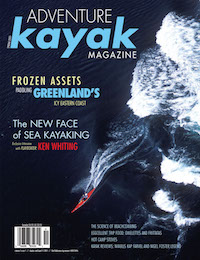
Editorial: If I See One More Reality Show, I’m Going Paddling
I’ve been thinking lately about the word adventure. Five years ago we gathered around a kitchen table brainstorming titles for the launch of our new magazine. The obvious kayaking magazine titles were taken. We had to be more creative—we had to think outside the box, as they say.
Adventure to me is something I like to add to things others would have enjoyed. For example, imagine a wintry afternoon walk down a well-used trail at a local conserva- tion area. Fresh air and exercise sure, but rather predictable wouldn’t you say? I’d suggest trudging through the valley because there looks to be a goat path on the far side below the cliffs. And that goat path, I bet, leads to the bottom of the frozen waterfalls; wouldn’t it be cool to climb around on them?
My wife Tanya considers herself wiser now. She’s rappelled off icy bluffs, walked out from the bottom of the wrong mountain bowl, forded streams with her mountain bike over her head and paddled into camp late, cold and hungry, one too may times. All this because I said, “Ah come on, where’s your sense of adventure?”
We still climb, ski, bike and paddle together, but my little adventures, as she calls them, are now something I do alone or in the company of other like-minded bush-whackers.
Wendy Killoran is a bushwhacker on a global scale. Being a schoolteacher by day leaves her plenty of time to be a die-hard paddler. I’ve heard her boast at symposiums that she paddles over a hundred days a year and gets in her boat at least one day every month; no small feat on the Great Lakes in February.
Wendy was the first woman to race in Iceland’s Hvammsvik marathon. This past summer Wendy found adventure on the east coast of Greenland floating among thousands of “bergy bits.” In her story “Frozen Assets” it’s clear that for her adventure is about landing on a gravel strip outside Kulusuk on the backside of Greenland, a place where the locals still paddle in skin boats.
Not everyone needs to be lost in the fog or feel the thunder of calving glaciers. Adventure, according to reality television shows, requires just two things: young, good- looking people and a beach. In that respect Ken Whiting fits the bill, except instead of battling conniving contestants for a million bucks, Whiting is making a modest living publishing books, producing paddling videos and playing in the surf. Whiting isn’t a circumnavigator of remote islands, he’s a whitewater playboater turned sea kayaker, finding his adventure in the surf zone, tidal rapids and currents.
Ken told us he thinks sea kayaking is poised to see a huge growth in people paddling for fun—paddling, maybe, in the same spot all day, surfing the same break, going nowhere exotic, never being lost. If you think this sounds boring and devoid of adventure, like the walk in the park I was trying to avoid above, you need only watch Justine Curgenven’s new video This is the Sea. If you don’t think playing in surf is an adventure, try standing an 18-foot sea kayak on its nose.
Hours before our premier issue rolled off the printing press we settled on the name Adventure Kayak. Five years later, I still think it’s a good choice. Kayaking adventures aren’t always on the sea, nor are we always touring in our kayaks. It’s a great name because adventure, just like kayaking, can be so many things. We design the magazine to be like those books we read as kids, so that in each issue you can choose your own adventure.
This article first appeared in the Spring 2005 issue of Adventure Kayak Magazine. For more great content, subscribe to Adventure Kayak’s print and digital editions here.



 The Impex name is said to derive from “import-export,” adopted when Mid-Canada Fiberglass was looking for a U.S. tag for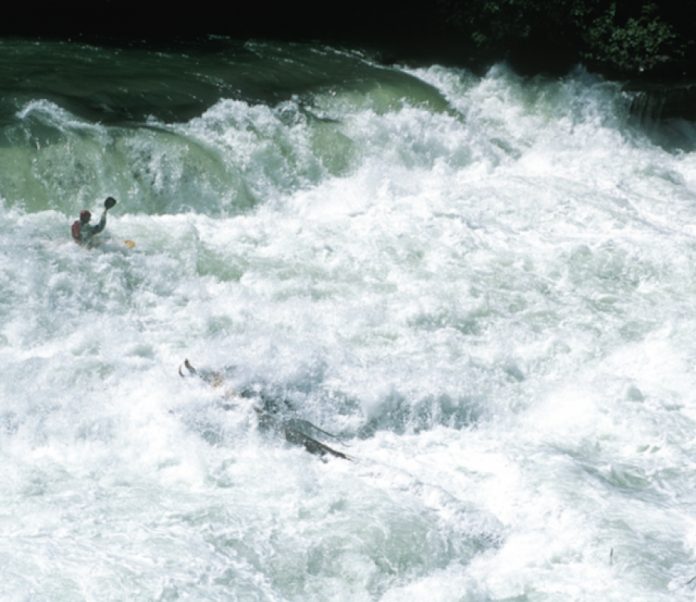
 This article was first published in the Spring 2005 issue of Rapid Magazine.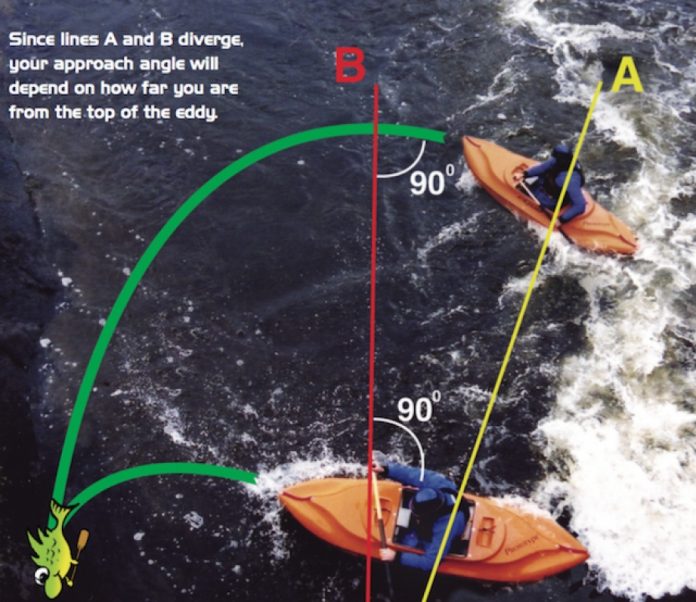
 This article was first published in the Spring 2005 issue of Adventure Kayak Magazine.