Eight hundred and fifty thousand years ago, three quarters of a million years before our species, Homo sapiens, evolved, Homo erectus built boats and went to sea. Many of us inherited this yearning to sail, paddle, float or zoom across the earth’s abundant waterways.
Two thirds of planet Earth is covered by glistening lakes, gurgling brooks and azure seas. Unless you live in Saudia Arabia’s Empty Quarter, chances are good that there is some waterway near you, perfect for a weekend getaway or a major expedition.
How to plan your expedition
The first task in planning a journey is to select the right adventure and danger level for your personality. The idea is to maximize fun—for your individual brain and your DNA—not to try to accommodate some marketing agent, boyfriend or girlfriend.
If you’re not sure what fits, err on the conservative side at first, and then ratchet things up bit by bit until you maximize your fun.
Fun of course is personal; is it a cozy peaceful afternoon, an exhilarating level of fear, or abject terror? Only you can decide.
Planning requires an ability to sit at home and accurately predict how a body of water will behave when you are bobbing around in an absurdly small boat like a kayak or a canoe.
Waves, currents and wind make water dangerous, but it’s easy to determine the frequency, probability and intensity of all three. Data on tidal currents is available from any fishing or boating supply near your proposed location. Pilot Charts are the penultimate source for wave and wind data. These are available from the U.S. National Geospatial-Intelligence Agency. In an intricate series of maps, you can obtain information on wind speed and direction for just about any ocean location in the world, for any month.
Feature photo: Chris Seashore
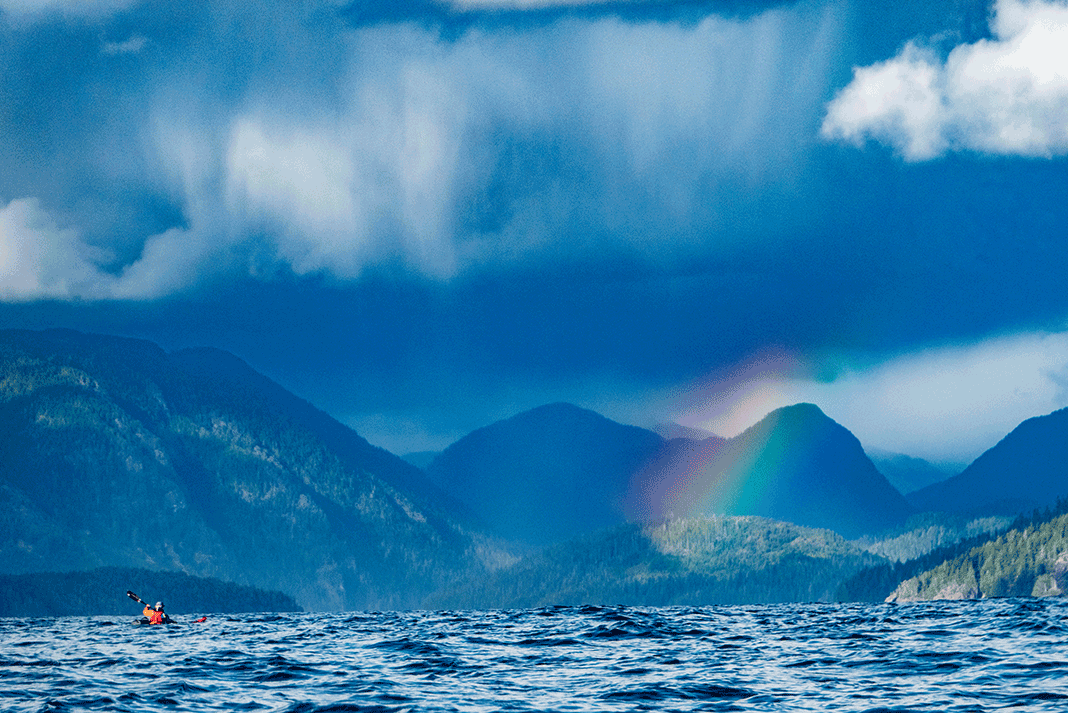
A few pieces of advice: For starters, choose a region where the gale frequency is zero and the wind will be blowing primarily from your back. Wave height is dependent on the wind speed and duration and on the distance that the wind has travelled, called the fetch. If you’re on the open ocean, where the wind can blow 6,000 kilometres before it reaches you, you’re likely to get huge waves and violent surf. Paddle in an enclosed bay and even a strong wind will produce only small wavelets. This factor is intuitive: enclosed bodies of water are safer than exposed ones.
When currents collide with waves, the waves develop a steep face and become much more dangerous than rounded waves of the same height.
A kayak is the most versatile watercraft in the world, capable of navigating shallow mangrove swamps and the open waters off Cape Horn. Humans are the most diverse species on the planet, with an almost incomprehensibly wide range of personalities and desires. Match the two and you’ve got a wondrous gambit of journeys and adventures. The only important adage is to go out—and have fun—whatever that means for you.
Jon Turk’s first expedition was paddling the coast of B.C. and Alaska in a Grumman canoe in 1974. He has kayaked from Ellesmere Island to Greenland, made two trips to Cape Horn, and in 2000–01 paddled 3,000 miles across the Pacific Ocean from Japan to Alaska, the subject of his book In the Wake of the Jomon.
This article first appeared in the Spring 2006 issue of Adventure Kayak Magazine. For more great content, subscribe to Adventure Kayak’s print and digital editions here.
Expedition Planning: You Don't Have to Quit Your Day Job
How many times have you heard someone say, “I would love to go on a long kayak expedition, but I just can’t get the time off work”?
Vancouver paddler Colin Mahony didn’t let his job as a forestry consultant stop him.
Colin’s dream was to paddle around Vancouver Island—up the relatively sheltered waters of the Strait of Georgia and Johnstone Strait, then down the extremely exposed icy waters of the island’s surf-washed west coast to Victoria, and finally across the Strait of Georgia back to Vancouver.
Giving up his job was not an option. So he just broke the expedition up, paddling most weekends as well as in longer stages whenever he could get the time off.
Colin set out northward from Vancouver in early April, 2005, paddling on his days off and then finding a place to stash his boat each Sunday night to catch a ferry back to Vancouver.
Over the summer, he was able to take four separate weeks off which, with weekends, gave him up to nine days of paddling at a stretch.
The week that he planned to round the fearsome waters of Cape Scott, known for their nasty tidal rip and the wild weather that spins off Vancouver Island’s northern tip, the forecast called for 50-knot winds and ocean swells up to eight metres. Luckily, Colin was able to reschedule his time off and go the following week instead.
One of the greatest challenges he found was, after days of solitude, pushing himself to be outgoing when paddling into some unfamiliar remote community. One Sunday afternoon near the end of the journey, he found himself on the outside of Vancouver Island, still on the water. He had to be back in the office on Monday morning. Port Renfrew lay ahead, and the one bus left there at 4 p.m.
“I landed on the beach, found a phone booth, and started calling around. I needed somewhere I could leave my boat. Someone said, ‘Call Rick.’” Rick was happy to help (it turned out that Colin had landed right in front of his house anyway) and offered him a beer.
“So I missed the bus,” continued Colin, “and got out on the road. It was getting dark, but I ended up getting a ride all the way to Victoria that night, right to my friend’s door.” He caught the first ferry in the morning, and made it to work on time.
“The logistics of this trip forced me to rely upon the kindness of others,” he said. “It created these wonderful situations where I would meet people.”
Now, having completed his journey, he says that the people that he met and the friendships that resulted are what really defined this trip for him.
Colin paddled back into Vancouver Harbour on Labour Day weekend, five months after he set out. In a total of 42 days on the water, he covered 1,200 kilometres.
This article first appeared in the Spring 2006 issue of Adventure Kayak Magazine. For more great content, subscribe to Adventure Kayak’s print and digital editions here.
My hand curled comfortably around the paddle shaft, a month’s worth of calluses finding their place for another evening’s work. The blade bit into rippled water and my muscles fell into rhythm. As we moved out from the safety of the cove, we knew we were in for it. Dark sentries of swell marched steadily across the exposed mouth, growing like anthills under time-lapse photography.
The forecast called for a huge northwest sea of three to four metres, with waves up to twice as big on the faces.
Highs and lows in Haida Gwaii
When I’d planned the circumnavigation of Haida Gwaii five months earlier in a skid row diner in Vancouver, I envisioned a journey that would take me away from the crawling city and bring me face to face with raw nature, far from help or hindrance. I wanted to go to a place where I was a mere speck of dust, something that could be absorbed in an instant without the surrounding ecosystem missing a beat. Now the bleak thought squeezed into my brain, “Frank, you should be careful what you ask for.”
We had holed up in Mike Inlet for the afternoon, hoping the building seas would calm. The 4 p.m. forecast on the VHF didn’t bring the news we wanted. But with only six kilometres to go—a mere six kilometres!—we chose to push on to Puffin Cove anyway.
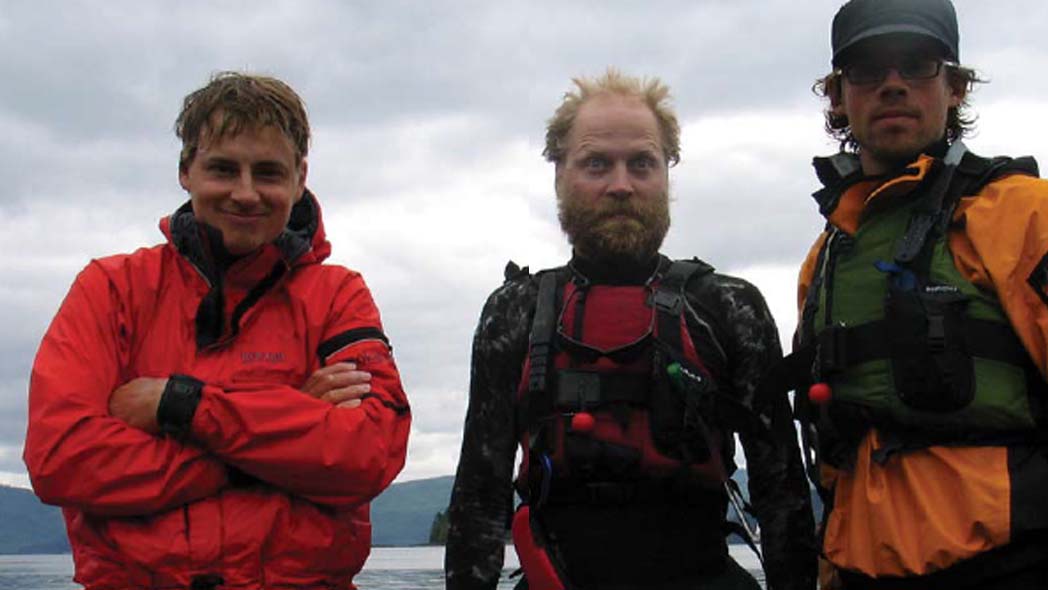
Puffin Cove is where local legends Neil and Betty Carey built a cabin and homestead that they lived in from the 1960s to the early 1980s. Keith had read Neil’s book Puffin Cove and was eager to see the place. Todd had read Bijaboji, Betty’s account of her 1930s canoe trip up the Inside Passage, and become somewhat smitten with the adventurous lady. In Mike Inlet, the black flies were brutal and the camping marginal at best—and love, well, a man in love will not be denied. We stuffed scattered, drying belongings from the pebble beach into our kayaks and were ready to go in half an hour.
Photo: Keith Klapstein
Photo: Keith Klapstein
When Todd, Keith and I had started our trip 30 days earlier, the packing process had taken more than twice as long. We split the expedition into two parts, first going counterclockwise around Graham Island, returning to our starting point in Queen Charlotte City to re-supply, then continuing in the same direction around Moresby and Kunghit islands. Paddling 460 kilometres around Graham had worked out all our packing kinks for this second leg of the journey.
The proving ground to reach Puffin Cove
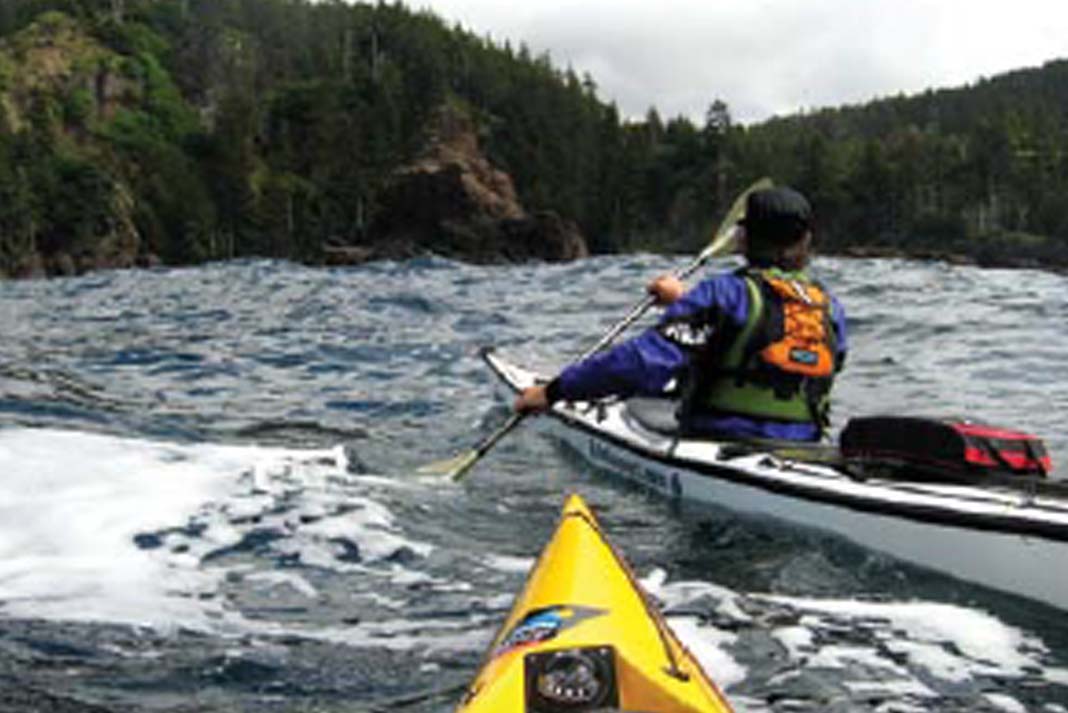
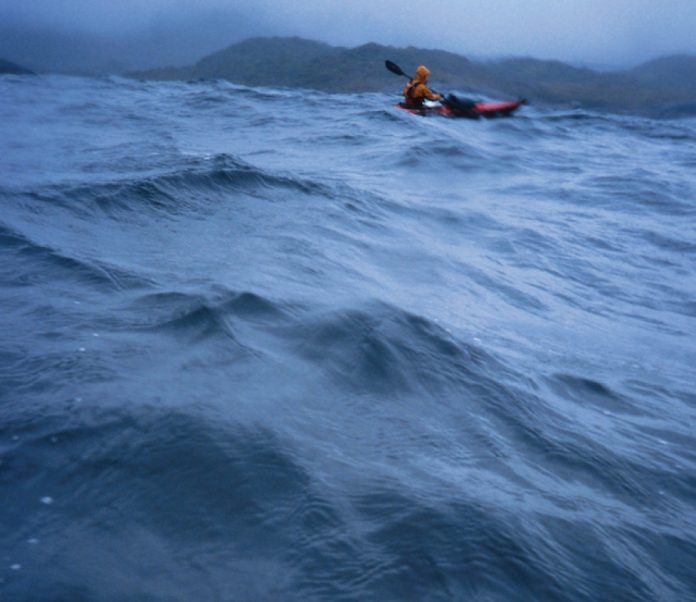
Breaking out from the shadow of the mountains, we joined the big blue at its huffing, puffing best. Thirty five-knot gusts drove the swell and began to shove us inexorably toward Puffin Cove. The wind and waves were so strong that within a couple minutes of leaving Mike Inlet it was impossible to backtrack. We were committed. It was six kilometres of huge water or bust. Mike Inlet is one of a handful of safe coves that cut into the 3,000-foot, storm-scraped San Christoval Mountains.
Dropping straight down to water level along the west coast of Moresby Island, the mountains are stark in their nakedness. They were named in 1774 by Captain Juan Perez after St. Christopher, who was known for his protection of travellers. Now we hoped the peaks would cast some of that saintly cover over us.
In between bays on the west coast of Haida Gwaii, rolling buses of swell crash relentlessly against jagged rock, creating boomer zones and clapotis that test even the most skilled paddlers.
Feature photo: Keith Klapstein
Rounding Hippa Island two weeks before, I was pounded over a shallow reef by a rogue, Jaws-sized wave that broke unexpectedly, jettisoning me from my boat. The experience instilled in us a respectful fear every time we ventured out along the perpetually exposed coast.
Ever seen the movie Castaway? There’s a scene where Tom Hanks’ plane has just crashed into the ocean during a storm. He’s clinging to a little yellow rubber raft, the camera pans away, and all you see is this little speck bobbing up and disappearing behind mountains of water in the middle of the sea. That’s what it felt like watching Todd and the Keith, their kayaks seeming more like little paper boats made by children.
Trying to draw focus away from the growing knot of fear in my gut, I looked ahead at the beehive-shaped island that indicated the entrance to Puffin Cove. Gripping the paddle shaft so tightly I thought it would shatter in my hands, I crushed every stroke like it was my last.
Time ground to a halt, our destination only a dream. Though we were hauling ass, it felt like we were paddling on a treadmill. Every time I looked up, the distant cove remained static.
Photos: Keith Klapstein
If I let the waves take me, I’d instantly surf seven metres down the face and pound into the trough at the bottom, submerging my kayak halfway. The best thing to do was backpaddle when the wave broke from behind, let it wash over and then stroke like mad before the next one broke. We all tried to stay close—but not too close, as we could end up harpooning each other with our boats. After 40 minutes that seemed like 400, the biggest, baddest wave appeared just as we were about to turn into the lee of Puffin Cove. With Todd and Keith just behind me, a behemoth that was literally 20 metres wide and who knows how high passed underneath and then broke only 10 metres ahead of us in one simultaneous explosion that seemed to turn the entire ocean white. It was a little bon voyage kiss from the North Pacific. Moments later we were in Puffin Cove.
In the Careys’ lagoon, a pioneering life preserved
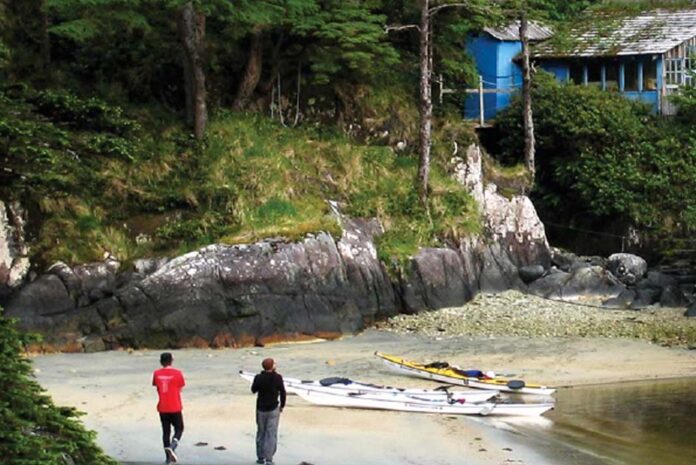
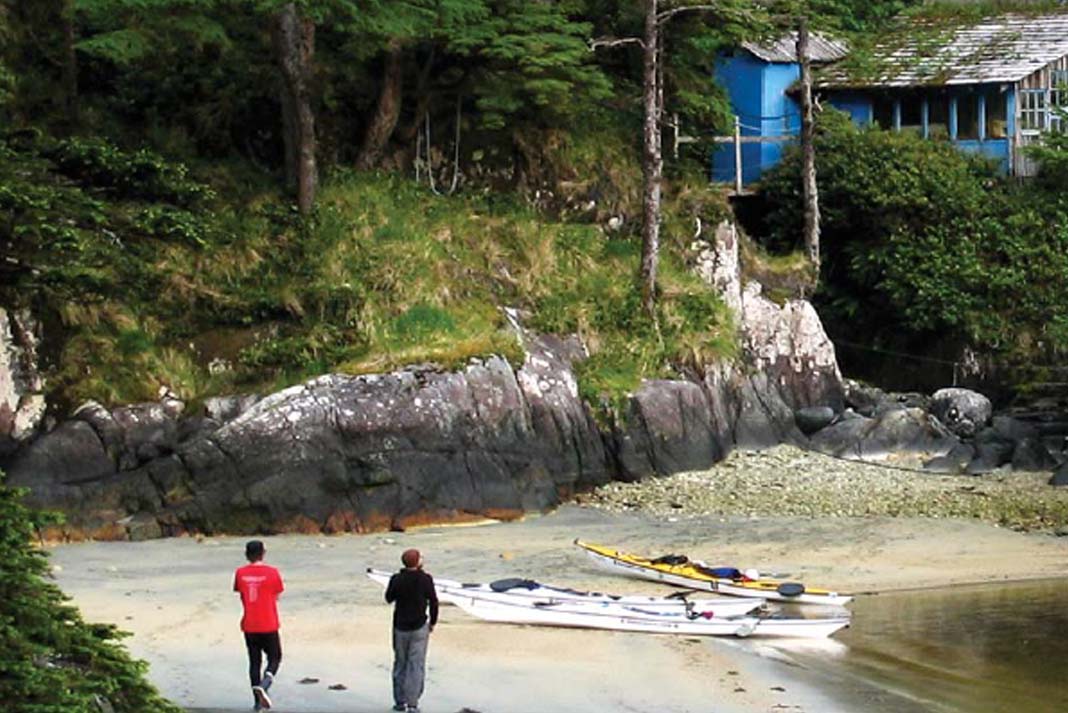
A narrow channel brought us into a placid lagoon and our jaws dropped. Encircled by perfect powder sand and protected by an amphitheatre of rock, it was like we’d entered Fantasy Island.
I half expected a flock of bronzed women in hula skirts to run down to the beach, greet us with hugs and put leis around our necks. At any moment Ricardo Montalban would appear in his white suit to welcome us while diminutive Tattoo would cry out, “THE KAYAKS! THE KAYAKS!”
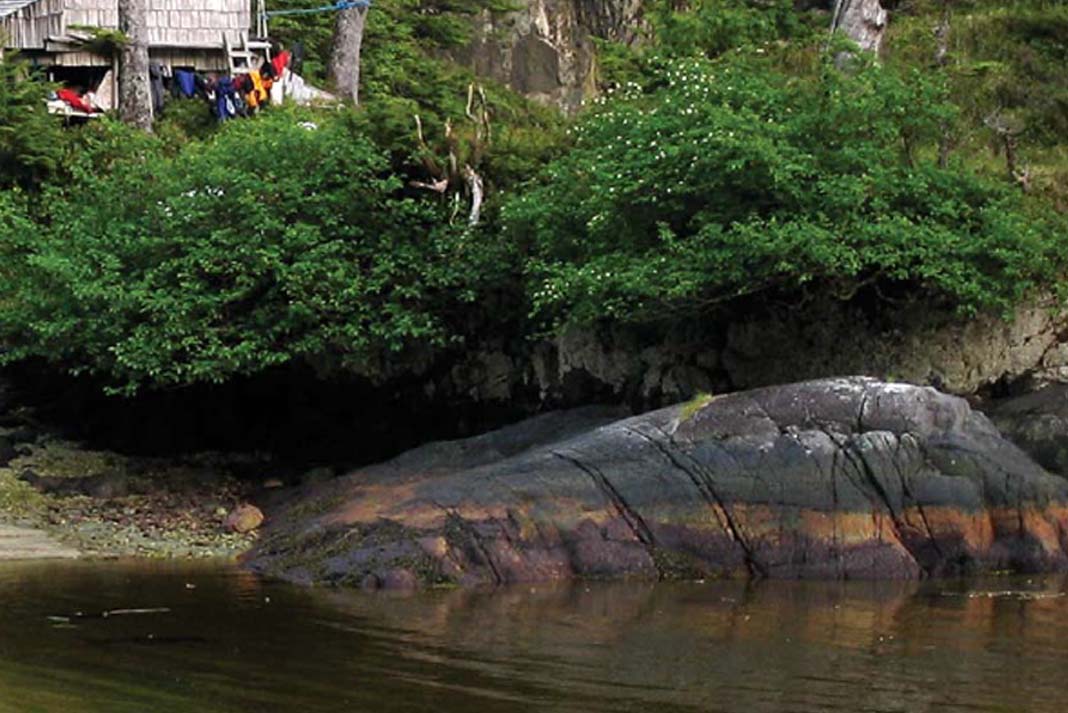
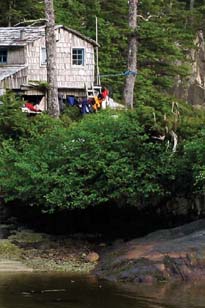
The Careys were Americans who sought out a life away from the hustle and bustle of California. After years of searching, they found Puffin Cove. Their cabin is still there, fully intact after 40 years, perched up on a bluff in the corner of the lagoon.
Incurable beachcombers, they accumulated piles of fish floats, buoys, glass balls and other flotsam and jetsam that remain stashed around the foundation. We entered through a trap door via stairs underneath the 12-foot-by-12-foot, greying cedar structure. For all we could tell, Neil and Betty might as well have stepped out a few minutes earlier. Seashells were displayed neatly on the left wall, rows of books and Reader’s Digests lined a ring of shelves. A little wood stove sat in the corner across from the kitchen table, a double mattress and a kid’s bed. Faded bottles of bug repellent, sewing kits, fishing hooks and other bric-a-brac sat around waiting to be used.
Nothing post-dated 1987, the date the Careys’ lease ran out and Parks Canada took over the land to make it part of Gwaii Haanas National Park. For over two decades, the Careys fished, foraged and explored a forgotten coastline, pioneers in every sense of the word.
A logbook indicated we were only the 14th party to visit there in five years. Though we were in one of the world’s great parks, the committing nature of the outer coast deters most kayakers from exploring beyond the sheltered archipelago on the eastern shore of Moresby.
Photo: Keith Klapstein
The Careys’ haven is one of the few nooks along the West Coast where there wasn’t once a Haida village. This is most likely because the whole lagoon dries out at low tide, making for poor water access for natives going on expeditions in 100-foot-long cedar canoes. At the height of their civilization, the Haida numbered 20,000 but dwindled to as low as 600 by the mid-20th century, victims of a smallpox epidemic introduced by European traders.
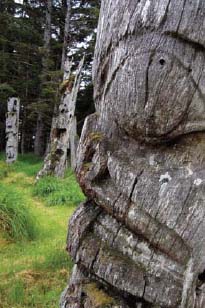
Weathered totems and remnant longhouses remain as the only evidence of their millenia-long inhabitation of a shoreline now patrolled only by black bear and whale.
Even though they weren’t physically visible to us on the outer part of the archipelago, we could feel the spirit of the original people flow strongly through every rock, tree and living being on Haida Gwaii, which means, literally, “Haida Homeland.”
A fitting place to linger before journey’s end
On day 18, we crossed paths with a “super pod” of over a hundred transient orca, their man-sized dorsal fins dropping and rising on all sides of us. Like an ancient tribal greeting party, they came out from a bay in front of the abandoned village of Tian, where archaic totems carved with clamshells and stone still stand.
We bobbed breathlessly amid the procession, staring in wild awe as the creatures disappeared ephemerally into the navy horizon.
The conditions outside Puffin Cove were good for paddling the next day but we decided to linger. With most of the difficulty behind us, we wanted to savour the remaining time we had in that magical land. Lingcod and rockfish practically begged us to throw our lines out, there was endless reading to be done, and we soberly realised we were only a couple of weeks from the end of our journey.
I contemplated what a month of paddling had taught me, how emotions on the outer coast swing between extremes that lead to the purest form of euphoria. One minute you’re paddling for dear life, and the next you find yourself relaxed in a secluded nirvana, your mind bathed in endorphins.
That afternoon, Todd grinned as he served me up a fillet on the beach, fried over fire in one of Betty Carey’s old pans. Keith slowly chewed the white, flaky flesh, gazing quietly out at the breadth of the North Pacific.
This article originally appeared in Adventure Kayak’s Spring 2006 issue. Subscribe to Paddling Magazine and get 25 years of digital magazine archives including our legacy titles: Rapid, Adventure Kayak and Canoeroots.
In the dead of wInter a couple years ago, at the end of a slow day in the office, I went out on a limb and dialled the number for Eric Soares of California’s tsunami rangers.
Kayaking was a magic word. all I had to do was introduce myself and my half-baked dream—“just something in the back of my mind,” I downplayed it—to unleash a flood of information and friendly advice from the opposite side of the continent, from a man I’d never met.
eric had just had heart surgery, wasn’t paddling much, and it was like he was passing on all his enthusiasm for exploring the coast to someone who could still go out and do it.
“the hardest section will be the great wide open stretches of beach around the Columbia riv- er where waves pound in at five to six feet most of the time, 12 or 15 or more sometimes. the best part will be the rocky sections, mid-Oregon and northern California. redwood national Park. the Lost Coast. Mendocino. Sonoma. Marin. San Mateo, Big Sur…”
A half-hour conversation was all it took to exponentially increase my knowledge about paddling from Vancouver to Mexico and make my dream start to feel real.
rob walker and Karen holm call this part of the planning process “project-based learning.” In rigorously researching their Chilean Passage expedition, they learned so much about the Patagonian coast that it felt familiar before they left home.
“We went and paddled one of the most remote and tempestuous places on earth for six months, and as crazy as it sounds, it was like we had done it before because we were so well prepared.”
Planning is at least half the journey.
Once you get a trip idea in your head, get on the phone and talk to the people who can help you make it happen. this is how expeditions begin, and the dark days of February are the best time to start.
A few years ago, a phone call to my buddy Dave with the words “let’s go this summer” launched a charmed existence of reading charts, packing food, the happy knowledge that we’d be checking out of civilization come June for 80 days on the B.C. coast.
My phone call to Eric planted the seed of a bigger trip that I may someday do. he knew two men who’d done the trip I proposed—a friend named Andy Taylor, and Ed Gillet. He gave me Andy’s phone number in Mendocino and told me to look up Ed in the San diego phone book. I added two more names to my list of contacts and the snowball started rolling.
Finally, just straightforward and friendly, as if anyone who’s going to paddle his coast is someone he will let into his house, Eric extended an invitation to a complete stranger.
“If you find yourself in half Moon Bay, give me a call. we’ll come pick you up, give you a place to stay, whatever you need.”
Expedition dreams open conversations and open doors. I still haven’t taken the first paddle stroke to Mexico, but in my mind I’m halfway there.
This article first appeared in the Spring 2006 issue of Adventure Kayak Magazine. For more great content, subscribe to Adventure Kayak’s print and digital editions here.
While most of us agree that safety has more to do with judgment and skill than equipment, there may come a time when you will need to call on gear to get yourself out of a situation.
The coast guard requires all kayaks to have a minimum of safety gear including: a PFD, heaving line, bailer, whis- tle and flashlight (when paddling at night). Beyond this, the list of specialized and high-tech safety gear available to you grows every year.
Though the decision of where—on your body or boat— you carry any required or extra gear is not dictated by authorities, it’s a decision that can render the gear either useful or completely useless. A pump nestled in your back hatch won’t do you much good when your cockpit floods.
So, what extra safety gear should you carry and where is the best place to put it? Two leading kayakers share their thoughts.
Leon Sommé
My waist tow belt has been more practical and useful than any other item. With it, I can quickly pull somebody out of a dangerous situation like a riptide or rocks. After that my list would include spare paddles, a knife, a VHF radio and emergency tape to patch holes in a boat or paddling jacket.
I try to keep as much as possible on my body, so I have large pockets on my PFD. Hatches can quickly become flooded if they are opened in raging seas.
Whatever doesn’t fit on my PFD still has to be within an arm’s reach or it is no good in an emergency, so I keep the next most important items in my day hatch. Items include: extra clothes, chemical hand warmers, a jack- knife, a VHF radio, a flare bag, water, and a repair kit.
On my boat, I keep the decks mostly clear. Items can get washed away very quickly so I only keep a spare paddle, tow line, deck-mounted compass and my nau- tical chart.
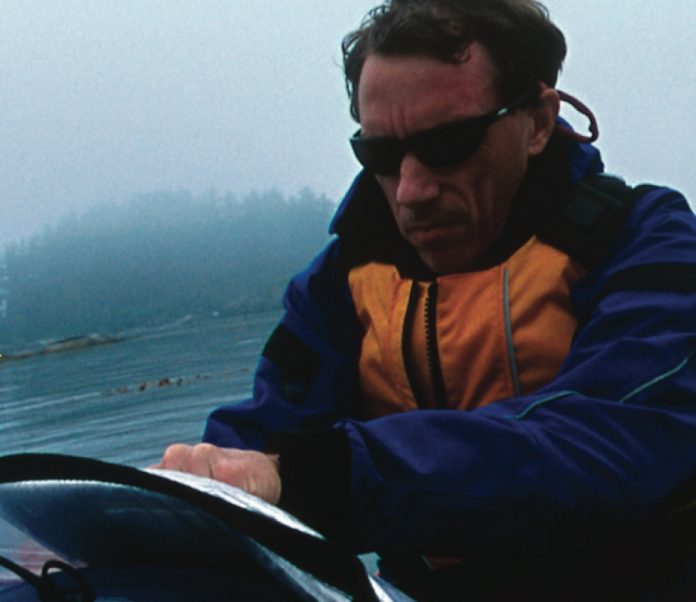
An excellent training activity was to sit in my loaded boat on the beach. I assessed my set-up by seeing how easily I could solve common scenarios such as dealing with blisters, towing, and fixing a damaged boat from my cockpit.
Doug Alderson
If safety gear is not an integral part of my attire or my kayak it will likely get left behind. And if rescue gear is not on me or within very close reach it’s likely it will be unavailable during a distress. I learned this from paddling in rough seas and wanting to contact members of the group during a serious rescue and realizing my radio was in a hatch. Another time I got very cold sup- porting a seasick paddler. I had no immersion clothing within reach and my hands became unusable for pad- dling.
Fortunately, my foot pump and compass are part of my kayak and not removable. Beyond that, the specific gear I pack, and where I pack it, changes depending on what type of paddling I am doing. If I am teaching, I keep my towlines ready. In open water courses, I have my VHF radio turned on in a PFD pocket. I also carry extra clothes, first aid, food and water.
When touring with experienced senior paddlers, I keep very little gear on deck. I keep copies of my float plans and log books in the boat. If I am just out for the day, most of my gear stays at home. But I do always carry a small first aid kit and a bag of bivouac supplies, just in case.
Leon Sommé is a certified BCU 4 sea coach and ACA instructor. He has logged thousands of coastal kilometres on expeditions, including the successful 2003 circumnavigation of Iceland.
Doug Alderson has been a contributing member of the Canadian Recreational Canoe Association since the inception of the national sea kayaking program and is a CRCA senior instructor trainer.
This article first appeared in the Fall 2005 issue of Adventure Kayak Magazine. For more great content, subscribe to Adventure Kayak’s print and digital editions here.
An artificial flood from Arizona’s Glen Canyon Dam led paddlers to comb through records from the past. | Feature photo: Vicente Villamón/Flickr
This July I made my usual stop at the Burger Bus, just south of Bancroft, Ontario, on the way to the Gull River Festival. The Bus is right beside Dimples Mini-Putt. It was hot and there was no one on the course, so while I waited for my dinner to fry I wandered over to see if the resident pro would let me have a crack at the fourth hole.
When Peter Karwacki and his family, also on their way to the Gull, rolled into the parking lot, I wasn’t hard to spot—skinny man bent over a child’s putter ricocheting balls off a spinning windmill in front of a truck stacked with boats.
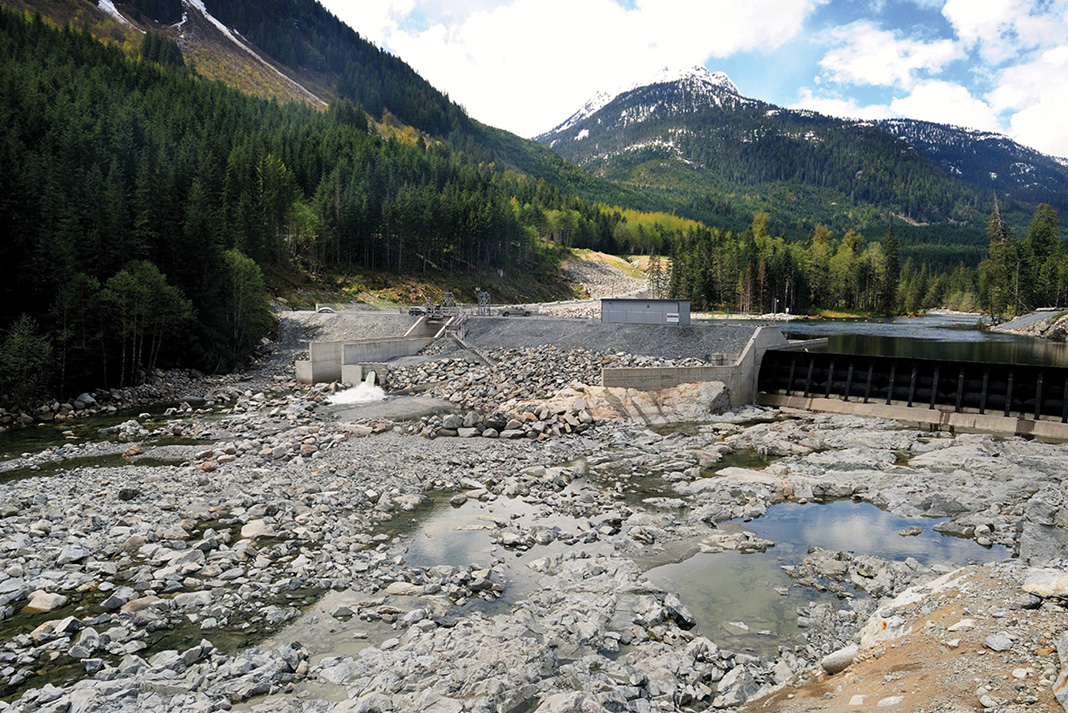
I had seen Peter a week earlier at the 19th Kipawa River Rally. As I toyed with the putter, Peter told me he was pleased that 640 people had paddled the Kip during the rally, meaning Les Amis de la Rivière Kipawa had raised some money to continue their struggle. Despite their ongoing efforts, the Kipawa River will soon fall victim to the one-two combination punch of a nearby hydro project and dam reconstruction. The Kipawa River will never be the same river again.
“I had never paddled a river for the last time before.”
When I realized I’d never paddled a river for the last time before I started calling friends who I knew were on the Kipawa last weekend with a camera. The photos taken at this year’s Kipawa River Rally may be the last documentation of me on this classic run; more importantly, these will be the last photographs of the river as we know it.
An artificial flood from Arizona’s Glen Canyon Dam led paddlers to comb through records from the past. | Feature photo: Vicente Villamón/Flickr
As I was sorting through this year’s “Photo Annual” submissions I thought a lot about the Kipawa and began to think about each photograph as a historical record of a river—how each one looked at a moment in time, say at high water, or in drought, or before thousands of cubic yards of concrete were poured into it.
Almost 10 years ago the Colorado River ran at high water levels, levels no one had seen for 40 years, except in pictures. To help build beaches and habitat in the Grand Canyon, water managers released an artificial flood from the Glen Canyon Dam to mimic the high flows of historical spring runoffs. The last two generations of raft guides had no clue what to expect. Commercial rafting companies and private paddlers with permits scrambled through black and whites photo archives from the early 1960s in search of the old high water lines. I wonder if in 40 years, paddlers will be asking me for pictures of the Kipawa.
Friends in an unequal fight
Peter isn’t sure about what the next move of Les Amis will be. He sighed, thanked me for Rapid’s editorial coverage of the issue through the years, but admitted, “Quite frankly Scott, I’d rather have had the coverage in the Globe and Mail.”
I joked with him, suggesting that maybe Rapid should just buy the newspaper. He laughed, waved, and drove off to the river with his family.
A whitewater magazine buying a national daily newspaper is about as likely as a band of old-school river runners stopping a Hydro-Québec project or me getting a hole-in-one on Dimples’ windmill-choked fourth hole. But, I thought to myself teeing up another ball, it doesn’t mean we should stop trying.
This article was first published in the Fall 2005 issue of Rapid Magazine. Subscribe to Paddling Magazine’s print and digital editions, or browse the archives.
An artificial flood from Arizona’s Glen Canyon Dam led paddlers to comb through records from the past. | Feature photo: Vicente Villamón/Flickr
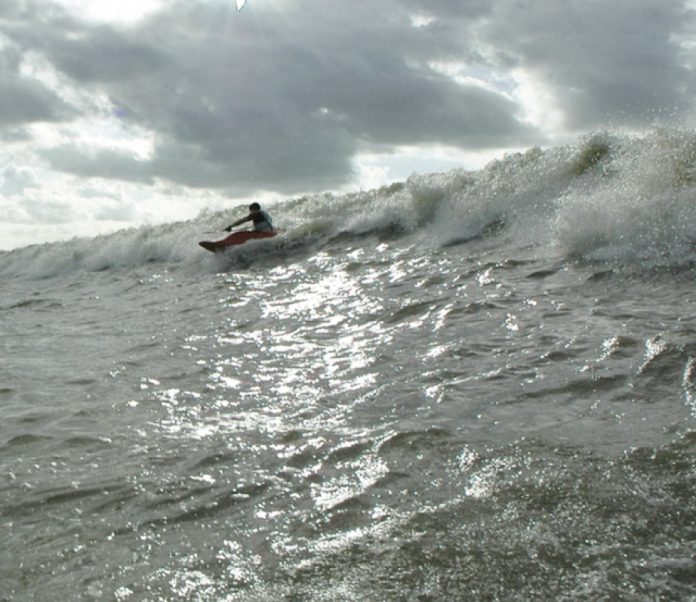
Kayak surfing the Porocora (“Mighty noise” in the local Tupi dialect), a two-metre-high tidal bore wave up to two kilometres wide.
Tidal bore waves form when the ocean’s incoming tide pushes into a river’s mouth and collides with the river’s outflow. With the weight of the ocean behind it, the tide forces itself over top of the river and a single wave moves upstream as fast as 25 kilometres an hour. Bores in some Amazonian rivers travel as far as 200 kilometres inland.
Where
The Mirian River, at the end of a long seldom-travelled road in Brazil’s Amazon Jungle.
When
Twice a day, but best around new and full moons.
Who
Corran Addison, Dan Campbell, Rusty Sage, Steve Fisher and Mirco Garoscio.
How
Corran Addison: “Surf kayaks were best for the wave. Playboats lacked speed and flushed quickly. We had support boats to drop behind the wave and pick us up when that happened, but you could be in the water for 20 minutes waiting for the boat to get through a break in the wave.”
How many
Even when all five paddlers were on the wave at once, there was still room for another 661 kayaks.
Why
Addison: “We had 15-minute rides that were a mix of surfing both a river wave and an ocean wave. The wave shape, and the way we surfed it, was much like a river wave, but you could actually see the riverbank zooming past you as you surfed, and you had the sensation of moving across the water like on an ocean wave.”
“The sheer roaring size of it as it worked its way upriver is guaranteed to make any man’s heart beat faster.”
Why not
Addison: “The dangers are the stuff of jungle legend, but that doesn’t mean that they aren’t on your mind. In the water there are anacondas, piranhas, crocodiles and candiru fish, which colonize your urinary tract. There’s a lot to think about when you’re sitting out there all alone waiting to be picked up after flushing.”
Ben Aylsworth’s Re-Actionary column has generated more letters to the editor over the last seven years than anything else in the magazine. Why? He thinks it’s because he finds the kernels of truth in our river culture that the rest of us are too scared to talk about. Or maybe we get letters because he’s just a class V jackass. Here’s a look back at what you might call the best (or worst) of Re-actionary and then, of course, it is up to you to decide.
CANOEING
Dinosaurs once ruled the Earth. They, like whitewater canoes, were big, slow and dumb. The world underwent radical change. For dinosaurs it was a meteor the size of Texas; for the Prospectorasaurus Rex it was the development of the second blade. The only dinosaurs that exist today are in museums. Come to think of it, isn’t there a national canoe museum?
Oh, one more thing, duct tape isn’t cool!
FAMILY LIFE
It’s not waterfalls or boulder-choked creeks, it’s chicks and newborn babies that are the most dangerous things that can happen to paddling guys. Chicks love that you love the outdoors. But they have an agenda. It’s lonely on the couch, and they will soon start resenting your paddling trips and your friends. So you go on walks, plan picnics, meet her parents and spend 20 bucks on romantic comedies starring Hugh Grant.
Babies are no different, except you can see them coming. Tick, tick, tick… you have nine months. Then when the one-day wave is up where are you? Lamaze.
NEW WAVE RIVER CULTURE
In the old days, when passing another car stacked with boats you could always count on a friendly wave from a comrade in arms. You were just saying, “Hey there fellow paddler, I love you,” and then you’d drive on past. It gave us the warm fuzzy feeling. Maybe the impersonal mentality that wafts up from the sewers of Toronto’s egocentric culture has finally poured its foul odour of indifference into our rivers.
GOOD OLD RAFTING BUDDIES
Gorbies are just awful. Where does all that white trash come from? How many times do you have to tell people that cotton isn’t an insulator? No, you can’t wear your high heels in the raft. What do you mean, how deep is the river? It’s as if when they bought their Styrofoam coolers they left their brains as a deposit. So where do they come from? I imagine a school bus outside Wal-Mart with a sign, “Rollback Rafting—$9.99.”
E-PADDLER NETIQUETTE
Paddling message boards are riddled with idiots. The guy answering the post is often as ignorant as the one asking the question. Remember that you are asking people who post under names like Yakinman, Phittybones and Mothra. Are you really going to buy a boat recommended by a guy named Rattso_del_Flatulato?
THE LOCAL PADDLERS
Beware of big fat liars! You ask a local paddler, “So what’s this run like?” His reply: “Oh my God, it’s this full-on colon-purging run that never ends. What boat are you paddling? Oh, that’s not good.” You have to ask yourself, can this inbred even paddle? I mean look at him in his coveralls playing his banjo. He wants you to believe his river is tougher than yours.
Hey Billy Bob, things are tough all over.
SLALOM
I’ve never really bothered writing about slalom; they are all jacked-up, whey-protein-enhanced egomaniacs. Then there’s kayak polo… Don’t get me started.
RIVER DOGS
It might paint a nice picture—rugged-looking, forty- something man wearing a plaid shirt, his vintage cedar strip by the placid lake, hearty fire casting warm light onto the obedient hound at his feet. What a load of crap! There is no peace or tranquility whilst your mutt rummages through my dinner scraps, howls at the moon and pisses on my tent. What do you mean, “What did I expect leaving my plate on the chair?” Oh, that’s right, it’s my fault he ate my plate of beef stroganoff.
KAYAK RODEO
Cowboy rodeo brings animal abuse to your local fairgrounds. They set up a corral and fill grandstands. Nobody watches kayak rodeo because to get to the event site you’ve got to have a master’s degree in orienteering and be sleeping with one of the organizers (I use the term “organizer” loosely). Take the freestyle team trials, the biggest event in the country. They’re usually held on the Ottawa River, an hour-and-a-half drive from anyone with teeth. You have to know the river, paddle to the site, and then hope the judges show up.
“Dude, like why isn’t your mom here to watch?” “Dunno.”
BIG ATTITUDE
I’m talking about little freestyle rats who believe that because they can air-blunt, they are super-fly Mac Daddies. The truth is Mr. Pimpleface, real Mac Daddies are driving tricked-out Mercs with lots of dough. You’re barely making it to the put-in in your mom’s shit-box Mazda, flat broke, with only your left hand to love you.
EXTREME ATHLETES?
We’re not young, hip or extreme. We’re 30 pushing 40, with desk jobs and sensible cars with baby seats. With white knuckles and nails dug-in we cling to the idea of being young. But we’re a far cry from the skateboaders and surfers of the world. It’s almost embarrassing. But to start telling the truth would mean we’d have to notice that the nachos we’re scarfing are pointing right at our shapely love handles sagging over our boardies.
DRIVING IN QUEBEC
Ten years of public school French classes amount to no help whatsoever. You’re in the woods, lost, confused and hungry and you’re dancing in tight black fuzzy rubber trying to show, with body language, the words you cannot say in French. Try acting out W-A-T-E-R-F-A-L-L, P-U-T–I-N and B-O-O-F to a grizzly lumberjack wielding a chainsaw in one hand and a cigarette, a can of 50 and a family-sized poutine in the other. You might be surprised to find out how much it looks like you’re saying, “I want to sleep with your wife.”
A LIFE ON THE RIVER
At the end of a life on the water there is no job, no recognized education, and few prospects. Only aching bones and outdated boats will remind you of all you have given to what we love. Like supermodels, pro boaters, raft guides and instructors are only as good as their last ride.
The true cost of paddling is more than the price of a new boat and gear. It can cost you your soul. Spend it wisely.
This article first appeared in the Fall 2005 issue of Rapid Magazine.
Winds of Change: Can the Writings of Buddha Help Build an Environmental Ethic?
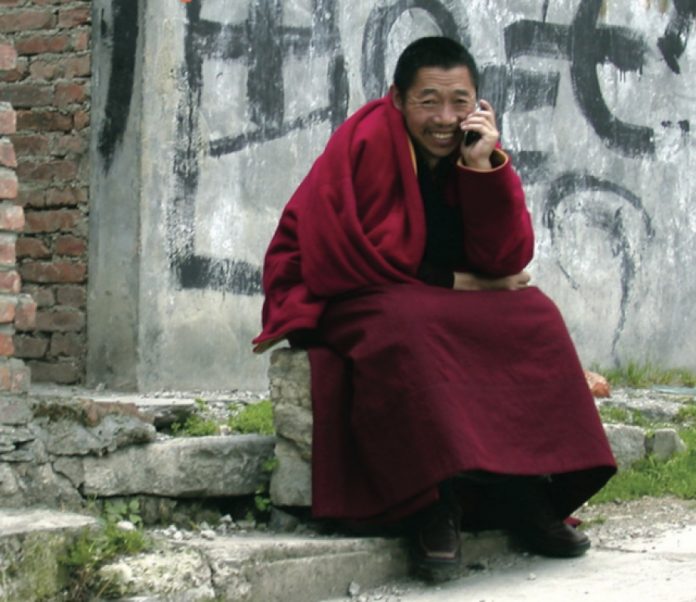
I write this from the eastern edge of the formerly independent region of Tibet. The small city of Kangding is tucked into a snow-capped valley just below the rim of the treeless, windy Tibetan Plateau. The ZeDuo River bisects town at a steep and constant class II then cranks up to class V below town before dumping into the big and surly Dadu River, which has the look and feel of B.C.’s Fraser River in flood.
I’m here as an ecotourism consultant at the request of the state government. Though it’s an area far off the beaten path, one where others rarely travel, the regional authorities are eyeing ecotourism as a means of conserving their beautiful landscape while providing sustainable economic growth. For the last two weeks I’ve worked with officials, entrepreneurs and educators to develop ecotourism training programs.
Workshop participants are eager to record my every word in their intricate Chinese script. They write busily and without discussion, unwilling to show disrespect by questioning ‘Teacher Jeff’. Occasionally, during frequent cigarette breaks, someone will apologize and slip my interpreter an anonymous note. On the second to last day I was asked: “How do we get local citizens to embrace environmental protection?” I didn’t have a meaningful answer.
At 1.3 billion people and an economy growing at 10 per cent annually—four times faster than any other developed nation—China has some of the most severe environmental problems on the planet: air pollution, erosion, loss of biodiversity, toxic water, river diversions, salinization and the
plain accumulation of trash are worse here than anywhere else I have been. As China accelerates towards “First World” status, and embraces the consumption that apparently goes along with it, all of these problems will get worse, possibly doubling the environmental impact humans inflict on the planet.
Officially, environmental protection is a vested national principle, but it has always taken a back seat to economic development. It’s a principle that has tangible meaning, however, to rural and traditional villagers, who have worked hard to conserve their landscape in order to hand it on to future generations. Folk songs swoon over the beauty of the Tibetan mountains and rivers, but they don’t mention the raw sewage, construction debris, animal guts and trash being dumped directly into the rivers in accelerating quantities. The ZeDuo is awash in garbage. Plastic bags mark the waterline, advertising in bright blue their slow degrading presence.
Canada was in a similar situation once, albeit with a fraction of the population on a bigger land mass. A concerted effort by activists and the integration of environmental education into the school system has slowly moved our national consciousness forward, although we still have a long way to go. Note the number of coffee cups floating in your home river.
China has markedly low education rates, having 20 per cent of the world’s population but spending only 1 per cent of the world’s education budget. In many cases, environmental degradation is the outgrowth of ignorance in people who have never been to school, nor been very far downstream to see what happens to the shit they throw in the river.
But with development also comes some progress, progress rooted in tradition. Liu Hong is a 30-year-old visionary who speaks fluent Tibetan, Mandarin, and a smattering of English. He travelled six hours by bus to come to one of the workshops. He has written a book on Tibetan culture, and won an award for his educational efforts.
Hong travels the countryside teaching locals how to preserve their culture in the face of massive economic change, and urges them to preserve their landscape. How does he do this? He invokes the writing of Buddha, who wrote that to pick a flower is to take a life. Liu builds on this idea within modern contexts and encourages communities to make their homes a place for “100,000 flowers to grow.” For this, he promises, they will be rewarded. My visit there was proof that some part of the state government thinks he is right.
The next day I shared the story of Hong with the last workshop group, including my anonymous question writer. It brought appreciative nods from all, and I could see thoughtful recognition on the faces of many. An environmental ethic is not about right and wrong—it is about making people proud of who they are, and proud of their home. It is as true in North America as in China, and it was as true in Buddha’s time as it is today. Liu Hong is reminding people of this, and is making a difference in the grasslands of Tibet.
Jeff Jackson is a professor of the outdoor program at Algonquin College in Pembroke, Ontario.
This article first appeared in the Fall 2005 issue of Rapid Magazine. For more great content, subscribe to Rapid’s print and digital editions here.
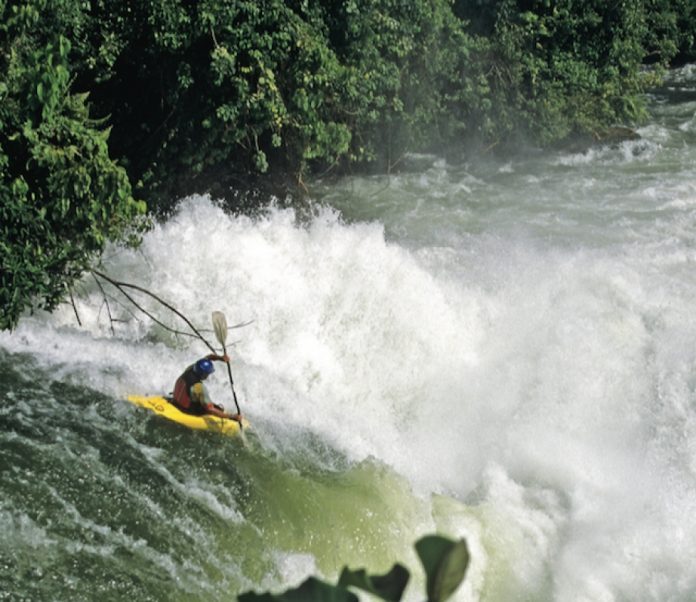
A whitewater kayaker paddles over the lip of a waterfall.
On large-volume rivers the predictable constants of rock and earth are submerged and replaced with the increasingly chaotic forces of moving water.
Properly assessing one’s mental preparedness and physical fitness, the rapid’s geographic remoteness, and the ability to set up adequate safety are the first steps in deciding to attempt any run. When the run involves extremely large holes, however, there are specific technical variables to consider, including the behavior of the water, your equipment, and your paddling technique.
Being able to see where the current pushes down- stream through a large-volume hole is the greatest challenge when scouting a feature because this flow will often be covered by a large reversal. You can usually tell where the passing current exits the foampile by identifying where the water boils up most significantly on the downstream side of the feature. By connecting the current’s entrance to the exit, you’ll identify a potential passage beneath the whitewater.
{loadposition PTG_RP_Midcontent}
Any path through the feature will almost certainly be deep if you are scouting a truly big hole. Properly aligning your boat with this downstream flow will allow you safe passage by sending you beneath the oncoming speed and power of the recirculating whitewater, not through it or over it.
Your boat is the second variable and the choice you make depends on your ability to read the water. Assessing how deep you will need to go for safe passage through the hole dictates the size and shape of the best boat. The physical properties must provide not just the appropriate buoyancy, but also the tracking ability needed for you to stay online and establish the necessary momentum. Smaller boats are less buoyant and better for subbing out in the deep flow, but lack speed and momentum. Big boats, on the other hand, provide plenty of momentum for punch- ing medium-sized holes, but because of their buoyancy can prevent you from flushing through a hole with the passing current.
The final tactic to employ is proper paddling technique. Aggressive vertical forward strokes and sweeps at the bow will position your boat properly in the current with the correct momentum for entry. A good “tuck and duck,” in which you kiss the skirt and line the paddle up parallel with the prevailing current, will prevent de-limbing. Initiate your exit strokes as a continuation of your tucked paddle position, which will usually be a low brace using the blade behind your hip or a forward stroke using the blade in front of your nose. Placed properly, these strokes will help propel you past the boil point of the hole along with the current continuing downstream.
Above all, remain rational and confident when choosing to lose yourself in a big water giant. The human desire for increasingly larger challenges should be tempered with humility, and knowledge gained from experience. Keep your head by being in the right place with the right people for the right reasons at the right time.
Scott Doherty, who has a master’s degree in education and is an ACA kayak instructor, did the research for this piece on the Stikine and White Nile rivers.
This article first appeared in the Fall 2005 issue of Rapid Magazine. For more great content, subscribe to Rapid’s print and digital editions here.


 This article first appeared in the Spring 2006 issue of Adventure Kayak Magazine. For more great content, subscribe to Adventure Kayak’s print and digital editions here.
 This article first appeared in the Fall 2005 issue of Adventure Kayak Magazine. For more great content, subscribe to Adventure Kayak’s print and digital editions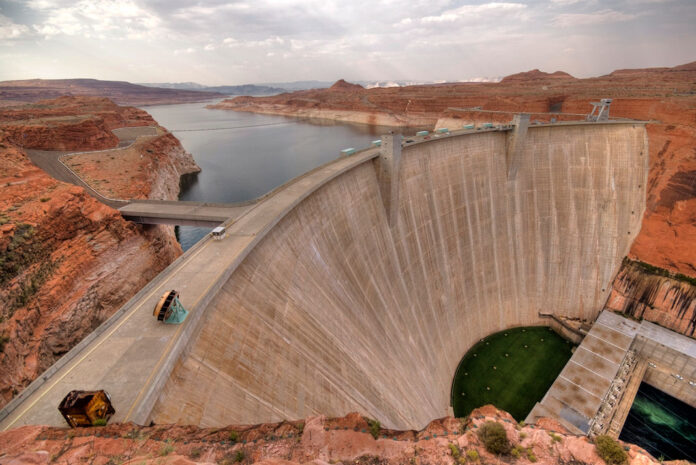

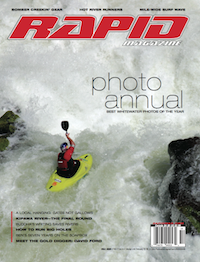 This article was first published in the Fall 2005 issue of Rapid Magazine.