Home Blog Page 375

Why Do We Paddle the River?

Photo: Brian Shields
Why Do We Paddle the River?

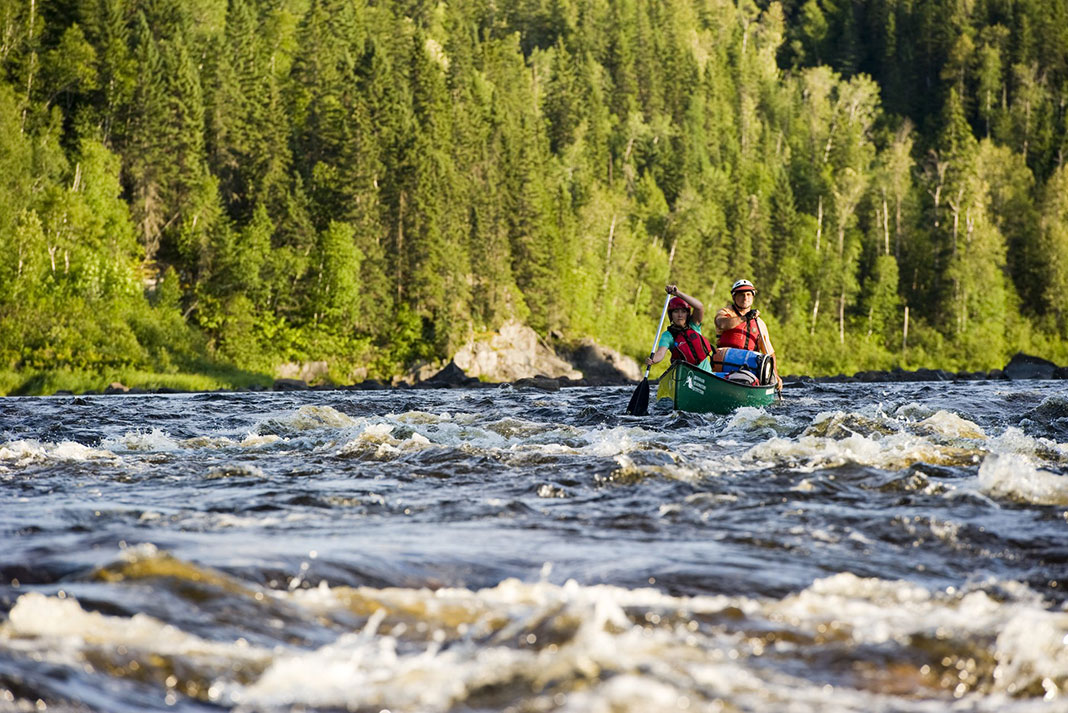
Why do we do it? Why do we paddle remote rivers every summer, year after year? Why in February, when the snowdrifts still sit hard-edged in the backyard and the light comes charging back, do we river runners feel the unspoken dread of a summer without a river? The new light mixes memory and desire, tumbling old friends and rivers of the past in winter reveries. Paddling partners reach out to each other, questioning, proposing, easing each other’s fears of being left behind to tend some scorched and mundane bit of a garden in the oppressive summer heat.

Perhaps travelling rivers is an excuse to dream. The river I am thinking of this time is the Mouchalagane, last year’s antidote to urban boredom. By spring, after months of planning, we nickname it the “Mouchie”, a name well-suited to some pet that is always there to lift your spirit in the pewter-coloured days of late winter.

The Mouchalagane is a tiny blue line on the map. Beginning on the high, sparse plateau west of Labrador City, it falls southward only 130 kilometres, tumbling, rocky and narrow through most of its length. For a two-week trip the pace is languorous. Our only deadline is making a float- plane rendezvous on Manicouagan Reservoir—the flooded meteor crater at the end of the river. 

The time available transforms the trip. It means that we rarely pass a breath-catching campsite without pitching the tents. And we only look at our watches to confirm why we’re hungry. A great deal of time is spent staring at the river, and this is seen as a perfectly normal pastime. We talk to each other and reveal the little secret things that we often keep hidden even from ourselves. Books are passed around through many hands and are mostly read as close to the river as possible, often well into the night. And the inconceivable happens: the ever-early risers often sleep late.

Maybe we escape to the wilds to play hunter-gatherer. With all our extra time, the fishermen in our small group pretend to be predators, endlessly wearing out the speck- led trout in a laughable game of catch and release. They often leave at first light, and working up or down through the limitless eddies, come back late for breakfast wearing satisfied cat-grins and carrying only their fish stories. Fishing lessons take place and soon everyone is playing the game. It seems only the fish are not having a good time.

Or it may be that we simply need to feel something different, to escape a life lived on claustrophobic acres of windless office carpeting in some highrise centre of power and influence. We enjoy marking the passing of the grey days with rain-fires, sheltered under a spark-ravaged wisp of a tarp, creating a rough comfort in the dampness and wind.

It is, we think sometimes, for the water that we drive for days and push the confines of credit limits to pay for floatplane charters. We are whitewater paddlers, and we travel in the company of fellow zealots, each infatuated with making the move, sacrificing the boats on the “Mouchie’s” rocky altar and scouting every wave of every set so that it can be played like a piece of music.

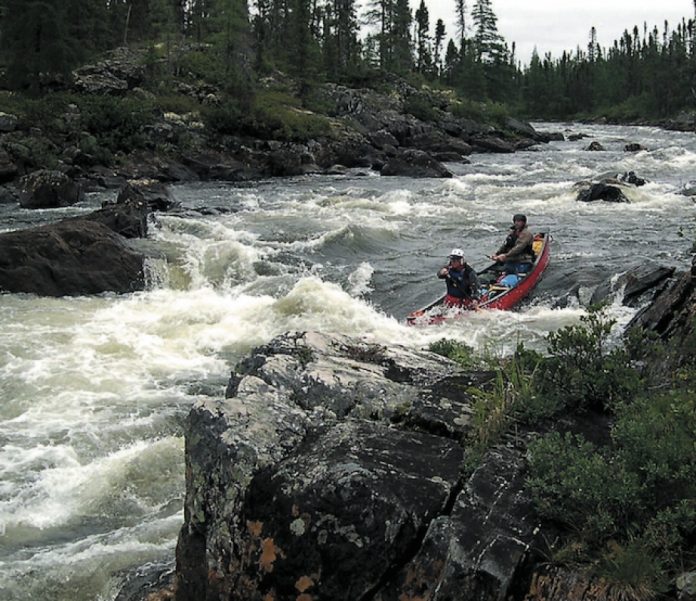
The Mouchie has numerous stretches of water rated beyond the limits of most open canoes. We run all the scary stuff for the camera and bounce out at the ends pumped with adrenaline. Spontaneous war cries leap out, euphoria finding a voice over the sound of moving water. Yes, this high could be the reason we do this.

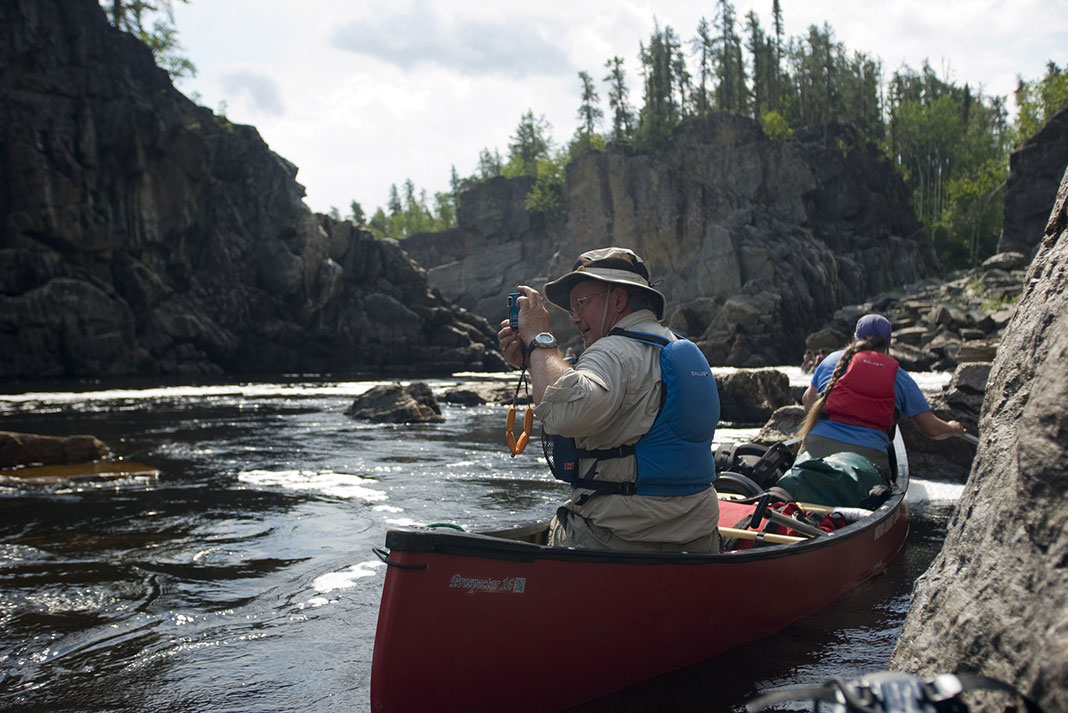
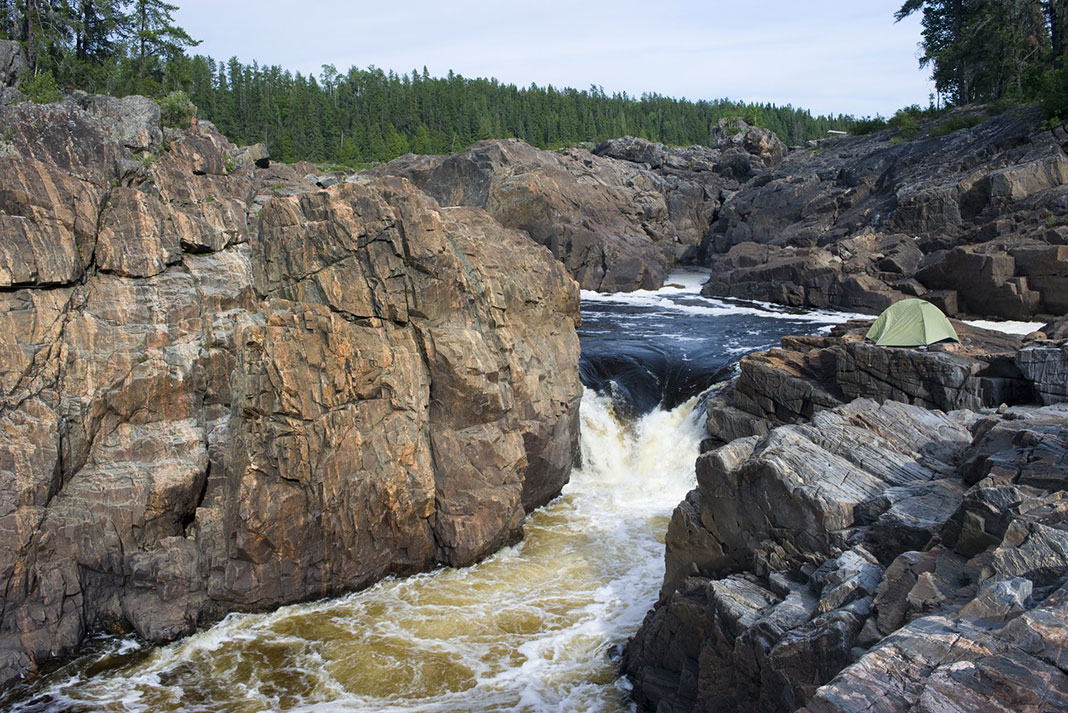
Finally, there is a stretch of river that drives the boats to shore. The land falls away and the water begins to scream and consume itself. Like giddy children, we skip along the wide granite edge of its spring floodplain, picking flat rock campsites, and then again and again finding better places, as we laugh into the deep rock rooms hid- ing under immense overhanging slabs. The river noise fills us and the water tears past so fiercely that the mind will not allow the eyes to look even for fantasy lines out among the madness. The hypnotic river draws us to its edge, sits us down gently and sucks our minds dry. At a time like this, we don’t ask why we’re here. We know we’re about to camp in Heaven.

And it is for this reason that I am tempted to say it is the campsites. For when our bruised canoes are back on their racks, stored for another winter, and our memories of the Mouchie are aged and mellowed, it is the campsites that we seem to most remember. It is the rolling Amazon forest of caribou moss that we sleep on again in our reveries and it is our dramatic camp in front of the dark and comforting rock rooms on the river’s floodplain that is always the first retreat for the mind.

But isn’t it all these things and then some? The winter dreams, the languor of river time, the adrenaline of whitewater, the campsites—all of this makes the river something we turn to each year. We paddle because we have come to know that a remote river always asks us who we are, and given a canoe, always answers by trans- porting us so far beyond the bonds and the shackles of the ordinary. Our time spent together on the Mouchie is enough to sustain us for another year, until our hemi- sphere tilts back toward the sun, igniting the fire within us for another wild river.

Brian Shields is a retired sport-fishing guide who presently fritters away his life in his solo boat, trying to perfect his cross-forward stroke. 
Screen Shot 2015 12 23 at 10.17.01 AMThis article first appeared in the Summer 2004 issue of Canoeroots Magazine. For more great content, subscribe to Canoeroots’ print and digital editions here

What Every Hobbit Should Know About Paddles

Photo: flickr.com/usfwsnortheast
What Every Hobbit Should Know About Paddles

Canoe paddles propel us across the lakes and down the rivers of Middle Earth but they also hang in university dorm rooms and are proudly displayed above mantles, reminding us of adventures past. Canoe paddles are woodsmen’s tools and scholars’ art, they are swords of freedom and portals into memories of the past.

Where do you buy such a mythical thing? Our paddle buyer’s directory introduces you to the makers—from large companies with magical worldwide distribution to the garage-based wizards in your shire. Before you delve into our directory or speak with your local peddler, your first step in buying a paddle is to determine the size you require and type of magic you wish it to perform. 

Sizing Your Sword

Choosing the correct paddle size can be as simple as walking up to a rack and finding the one that stands to between your chin and your nose. This old camp standby is a good rule of thumb for sizing your first paddle.

Other paddlers spend their lifetimes working out complex equations, calculating such variables as torso and arm length, shaft diameter and shape, curve of the blade, activity type, seat style and height above the water. Granted these are all valid considerations, but the ultimate deciding factor is usually personal preference developed after a few adventures.

Types of Paddle Magic

Recreational

Recreational canoe paddles are general-purpose tools made of inexpensive materials such as aluminum, plastic and cheaper woods. Wood recreational paddles often come in the same blade shapes as lakewater tripping paddles. Aluminum and plastic paddles come in a variety of shapes and are inexpensive and very durable. In either case, what you save in cost you give up in performance and aesthetic appeal. When was the last time you saw a plastic paddle hanging over a fireplace?

Lakewater Tripping

Traditional designs such as ottertail, beavertail and voyageur have long, narrow blades for smooth, repetitive strokes on deep, flat water. They are most often made of wood, for tradition and aesthetics more than any other reason. One-piece or laminated paddles made of woods such as ash, cherry, mahogany, maple, walnut and poplar offer lightness and beauty finely crafted into wonderful shapes. Wood paddles require a bit of care. Dents and scrapes at the end of the blade should be sanded and varnished or oiled to prevent splitting.

Whitewater

Whitewater paddles generally have short, square blades for quick and powerful strokes in aerated, shallow water. Whitewater blades are most commonly flat or spooned to “catch” more water and built tough to withstand abuse. They can be made of wood, fibreglass, carbon or Kevlar with metal or resin-reinforced tips. While other paddle types have a variety of contoured grip shapes such as pear grips, whitewater paddles usually have T-shaped grips for leverage and a precise, secure feel.

Performance

Performance canoe paddles are built for speed and often used in racing or fitness paddling. Weight and efficiency are more important than price, allowing manufacturers to use more expensive materials, such as carbon and Kevlar, and experiment with a variety of blade shapes. Bent-shaft designs set the blade at a slight forward angle to help keep it vertical through the most powerful portion of the stroke. When the clock is ticking, every little bit helps. 

Screen_Shot_2015-12-23_at_10.17.01_AM.pngThis article first appeared in the Summer 2004 issue of Canoeroots Magazine. For more great content, subscribe to Canoeroots’ print and digital editions here

Ashuapmushuan River Daze

One evening in early June, I had just finished shooting some photos with Dale Monkman and we chatted about where the next place he and the “Island Boys” were heading to paddle.

“Lac St-Jean, Quebec,” he said. “Tomorrow.” They would paddle and practice for a few days in the small town of St-Félicien prior to the town’s annual whitewater rodeo.

Dale and a few others had gone to paddle the Ashuapmushuan River in Quebec’s Saguenay–Lac St-Jean region for two years previous and it had become something of a tradition, returning each year with more people to scout more rivers and find more of the undiscovered, un-run gems in Quebec’s whitewater Nirvana. Like most of the crew, I was out of a job, so I decided to tag along. Dale assured me the water is still high in early June and I’d get some sick shots.

Dale and I hooked up with Laura Nash, Nick Miller, and Aussie Anthony Yap the next morning just east of Ottawa for the daylong drive. En route we joined fellow Canadians Justin Thompson, Dave Tiedje, Mitch Braun, Patrick Camblin—plus Americans Marlow Long and Brooks Baldwin who were planning to do some shooting for Young Guns Productions’ next video offering. Some were veterans of the area, others were following Dale’s version of the gospel of St-Jean—Laura Nash included, who said she’d been hearing Dale rant all spring about the “Aswapmuswam” River. 

This is a tight group of boaters at the forefront of Canadian freestyle of which the central core—Dale, Patrick, Dave, and Nick—are some of the original “Island Boys” of the Ottawa River. They have paddled and competed together for several years on the international stage, and their cohesiveness is obvious as they share and swap gear, food and boats as only a tightly knit bunch of paddle gypsies could.

Brooks managed to travel the whole way and back without remembering to pack shoes, thus spending the whole time walk- ing gingerly barefoot. Somehow he still managed to get into restaurants—perhaps an advantage of not understanding French.

The seven-hour drive from Ottawa to St- Félicien is a picturesque adventure along some of Quebec’s “pedal to the metal” superhighways leading progressively to twisty-turny logging truck–travelled backroads (where it is still “pedal to the metal”). The scenery is fantastic views of lakes, hills and cliffs, and there are many nice French Canadian towns along the way.

In total, 45 rivers empty into Lac St- Jean—a basin smaller than the city of Toronto. And all are accessible within about 100 kilometres’ drive in either direction along an encircling network of roads. And three large and powerful northern Quebec rivers—the Ashuapmushuan, the Mistassini and the Mistassibi—pour the combined spring runoff of a decent-sized European country into the lake’s northwest corner near the small town of St-Félicien.

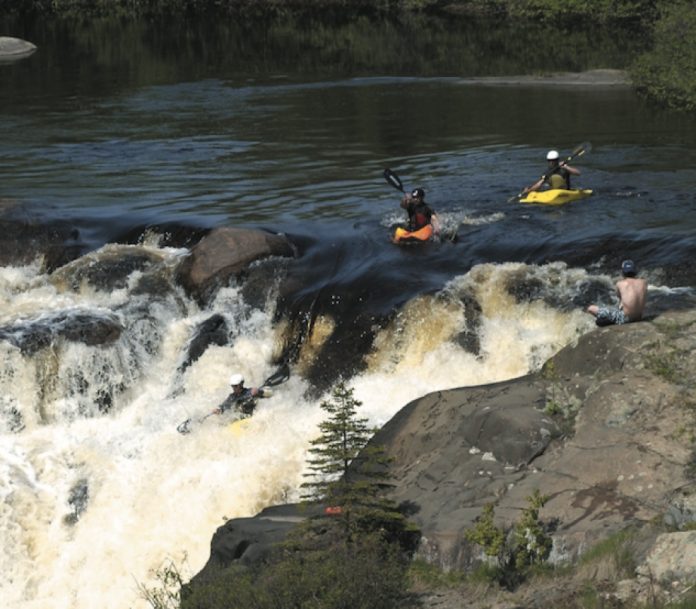
These rivers drop down to the lake level over well-polished outcrops and giant bread-loaf boulders of Canadian Shield granite, bringing paddlers’ dreams to life along the way. Amazing playboating waves and holes, big technical and pushy water, waterfalls, steep chutes, and big-water runs compare with classics like the Ottawa or the Slave.

The guys described the Ashuapmushuan (ass-whupin’, you swam) as like an Ottawa River without the crowds—starting off like the class IV Garvin’s Chute “on steroids” followed by a high-water Coliseum—and surrounded by other rivers and more potential first descents than anyone could paddle in a lifetime. Patrick Camblin noted,

“The paddling in the Lac St-Jean region is second to none…. You could run a new river or section of river each day for a week and not have to travel more than an hour to find it!”

The Saguenay–Lac St-Jean region is also the de facto blueberry capital of Canada, with many commercial farms near the lake. The local communities have combined forces to organize a 250-kilometre cycling route around the lake dubbed the “Blueberry Route.” Women in the region outnumber men three-to-one, though these ladies may be of a certain age—Dave Tiedje reported finding “a fantastic over-40s bar filled with too many cougars (if there can ever be too many of such a thing).” In other words, there’d be no shortage of things to keep you busy if you weren’t busy paddling.

We spent most of our days cruising up and down the Ashuapmushuan where it flows past the town of St-Félicien. We stayed at a free public campsite, conveniently right beside the rapids at the Chutes à Michel, a small river-wide rapid that features a ledge drop and a manmade fish ladder (three quar- ters of Lac St-Jean’s cherished landlocked salmon spawn up this river).

Chutes à Michel is the put-in for the short playboating run of the lower Ashuapmushuan. Not far downstream is a pair of huge hole fea- tures below a railroad bridge which provides a great overhead viewpoint for scouting and photos. The run finishes off at the Vague Arcand, an impressive breaking wave. Vague Arcand is the site of St-Félicien’s rodeo and our group’s “king of the wave” wars—an elbow-to-elbow surfing tradition imported from hanging out on the Ottawa.

We found a plethora of other paddling options only a short drive away, including the spectacular rapids and slides at the massive Chute à l’Ours, not far upstream on the Ashuapmushuan.

Down Highway 169 from St-Félicien, near Roberval, we spotted a waterfall drop on the Ouiatchouaniche River right beside the road. It was an easy line down a 15-foot slide that shoots into a 10-foot waterfall to a calm pool. Everyone ran multiple laps with the cameras rolling. Dave and Justin both ran a different line at the same time and others threw hero moves on the drop.

Out of town to the northeast are big-water runs on the Mistassini and Mistassibi where the two large rivers flow side by side through the twin towns of Dolbeau and Mistassini.

We spent several days playing around, longboarding in the parking lots in town to get away from the mosquitoes (many rivers = many bugs), stoking blazing campfires at the campground and prying secrets of the un-run from the minds of the few local paddlers we could find—most notably Gino Thibeault, organizer of the St-Félicien rodeo.

A teacher in Jonquiere, Gino spends his summers guiding punters down local rivers in Topo-Duos and living in a tiny cabin beside the Ashuapmushuan. He has probably scoped the area’s whitewater more than anybody. After consulting some topo maps, Gino and Dale teamed up for a run of the Petite Chute à l’Ours further up the Ashuapmushuan—a likely first descent.

Off-river days were spent driving around in a state of general awe at the size and gradient of the region’s other rivers and eye- balling ballsy imaginary lines through rapids that were bigger than many of us had ever seen.

“Perfectly steep, green waves taunted us from between killer holes and pourovers,” mused Laura. “It was like being in the land of the giants.”

Dale and the boys will probably come back again next year for more relaxing days on the Ashuapmushuan and more exploratory runs of the surrounding rivers. In time, more and more paddlers will probably slap on the DEET and make the pilgrimage to the land of blueberries and first descents. Maybe Lac St-Jean will be discovered and its single women will be wed, but I doubt its rivers will ever be crowded. 

Ottawa-based photographer Rob Faubert is a regular Rapid contributor.  

Screen_Shot_2016-04-21_at_11.48.50_AM.pngThis article first appeared in the Early Summer 2004 issue of Rapid Magazine.
 

Skills: A Bag Full of Tricks

Photo: Scott MacGregor

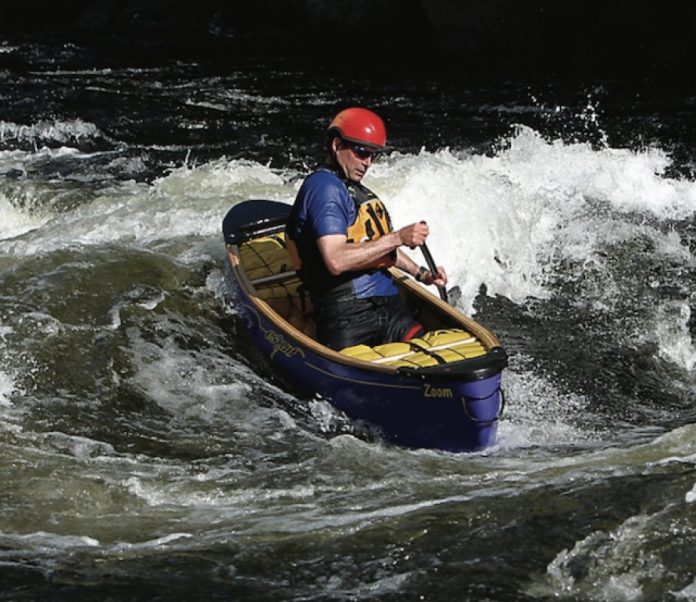
Front surfing your canoe on a large wave feels as close to flying as you’re going to get with a paddle in your hands. Controlling your surf on small waves may seem as simple as ferrying your boat. However, on large waves you need a full bag of tricks to maintain your surf for extended periods of time. To really fly on a wave you must carefully control your boat speed, your position between crest and trough, and be able to delicately turn left and right without blowing off the wave. Sometimes, even getting on the wave can be a huge challenge! Consider the following essentials for surfing bigger waves. 

THE BOAT

Having the right canoe for the task will be a significant asset. Lengthy boats tend to dive low into the wave trough becoming difficult to control. Once the bows of these canoes plow into the wave upstream of your surf wave it is often ‘game over’. Shorter canoes are much easier to control and fit better on almost any surf wave.

Flatter hulls respond better to rudder strokes used for steering on surf waves. Smaller boats are also much easier to trim front to back on steep waves which helps you control your speed.

THE WAVE

The best surf waves are ones that have a wave face that is equal to, or longer than the length of your canoe. This provides the surface area nec- essary to support the whole boat. A wider and longer wave face gives you room to manoeuvre on the wave—both side to side and up and down. Shorter waves can be surfed provided that they are not too steep. Side to side ‘shredding’ will help prevent the bow from getting stuck in the water upstream of the surf wave.

THE TECHNIQUE

Once on the wave, keep your canoe moving. Ferrying back and forth helps you to stay in control of your speed and your positioning between the wave crest and trough. Gentle side-to-side movement keeps your bow clear of the upstream water while allowing you to stay low, near the trough on the wave. Aggressive left to right play surfs you closer to the crest and helps maintain a free and dry bow on steep waves. Keep your tilts to an absolute minimum. Even without boat tilt, once you turn your canoe, the contour of the water beneath your hull will cause a carve on your downstream edge—very cool!

GETTING ON THE WAVE – WITHOUT STRUGGLING

  • Approach from the eddy pool adjacent to the surf wave.
  • Enter by paddling into the trough that feeds the surf wave.
  • Your speed should match the current so you nei- ther climb upstream past the wave, nor drift down- stream away from the wave.

ACCELERATING – TO HELP STAY ON THE WAVE

  • When near the wave crest, straighten your boat and point the bow down to the trough.
  • Lean forward slightly and use a rudder for directional control.
  • Lower your T-grip hand and place your paddle shaft against the gunwhale.

SLOWING DOWN – TO KEEP THE BOW DRY

  • If you’re heading low into the trough straighten your canoe.
  • Slow the boat by leaning back. This pushes the stern deeper into the wave crest and decreases downward trim of the hull.
  • Push your blade forward using the non-power face as if to do a reverse stroke.

SHREDDING – CONTROL SIDE TO SIDE MOVEMENT

  • Position your canoe between the crest and trough
  • Lift your bow so that it is free to turn.
  • Use a rudder and push or pull the T-grip to turn left or right, much like a stern pry or draw 

Andrew Westwood – instructor at Madawaska Kanu Centre, Esquif team member, Rapid columnist. 

Screen_Shot_2016-04-22_at_3.53.38_PM.pngThis article first appeared in the Fall 2004 issue of Rapid Magazine.
 

Paddling’s Black Holes

Photo: Ryan Creary

Whirlpools have always held a strange fascination as black-hole vortices into which things disappear and don’t return. Rumors of thirty-metre fishing boats disappearing in seconds, counter-rotation whirlpools in the southern hemisphere, and the elusive “floater” that never flushes down, have all been dispelled as local folklore and myth. Or have they? 

To river-people, whirlpools have always had a mystic aura surrounding them. However, it is possible to understand these behemoths and the forces that influence them. Whirlpools are, believe it or not, consistent river features. Playing in whirlpools adds a new dimension to river running, building your understanding and making you feel more comfortable when acciden- tally dropping into them. Playing in whirlpools increases bracing and rolling abilities, and sometimes, in a really big one, increases your lung capacity.

WHIRLPOOLS: MORE THAN YOU WANTED TO KNOW

Formation

Whirlpools generally occur along strong eddylines where two strong, opposite flowing currents collide. When the two currents converge, the centrifugal force (force away from the centre of the circle) creates a low-pressure area in the centre of the circle. Water wants to move from high-pressure areas to low pressure areas and this is what creates the centripetal force (force towards the centre of the circle) in the whirlpool establishing the spin-momentum of the water. Gravity affects the spin-momentum creating the downwards flowing tendency of the vortex, and accentuating the spin.

Progression

Once a whirlpool forms, its longevity depends on its spin-momentum and interaction of the two opposing currents. Very strong opposing currents form a whirlpool which spins extremely fast, and due to the increased centrifugal and centripetal forces, a very tight, deep whirlpool is the result. Slow moving, opposing currents form a very shallow, wide whirlpool without much downwards-sucking motion.

Whirlpools move downstream along the eddy line. The reason is, downstream flowing current always moves faster than the upstream flowing back eddy. The whirlpool progresses downstream along the eddyline because of the difference in force between the two currents acting on the vortex.

Dissipation

Whirlpool dissipation is a result of a loss of spin-momentum and the two opposing currents no longer being in opposition. The friction of the water on itself causes the spinning forces to stop. Dissipation of the whirlpool occurs as whirlpools move laterally away from the eddyline into the downstream or eddy current, or as they move to the downstream end of the eddy where the eddy current is not strong. 

PADDLING INTO THE VORTEX 

The Slingshot Technique

The first thing to know about kayaking around whirlpools is that a whirlpool on river left will always spin counter-clockwise and a river-right whirlpool will always spin in a clockwise direction—the bottom of the whirpool is flowing into the eddy. This knowledge about whirlpool spin direction, and knowing that whirlpools form and move downstream, enables you to actually use whirlpools to accelerate into, and out of, eddies.

To enter a strong eddy with a large boil-line, paddling into the eddy just downstream of the center of the vortex allows you to use the laterally flowing water as a slingshot to increase speed into an eddy. Paddling out of an eddy and into the current, being just upstream of the whirlpool vortex will increase lateral momentum into the main current. This technique enables you to cross eddylines, which would otherwise be very difficult to cross due to large boils.

Whirlpool Pirouettes

Whirlpool pirouettes are an extremely fun and unique kayaking experience. Pirouettes are very easy to initiate and maintain because of the sucking action of whirlpools. To initiate, simply expose your bow or stern to the centre of the vortex. Using cross-bow pirouette strokes or stern squirt strokes get the boat vertical and spinning. Being able to bow stall or continue your squirt rotation is beneficial, though not necessary.

Mystery Moves

Mystery moves, or disappearing underwater while still in the boat, are easy with whirlpools. To maximize downtime keep the kayak sitting flat, which increases the amount of surface area the river can use to pull the boat under. Important note: once under water, spinning the boat using the paddle, and sitting upright, help you to return to the surface upright.

Getting Worked

Flipping in whirlpools is part of the freestyle experience. Waiting upside down to be released by the whirlpool is not the best option. Although this may work, provided the whirlpool dissipates quickly.

When upside down in the bottom of the vortex, the water around the edges of the whirlpool is spinning faster than the upside down kayaker. Reaching to the surface and changing the blade angle to catch faster-flowing water, the current in the vortex assists your roll by increasing the water-pressure on the paddle blade.

Oh Yeah, Safety for the Black Hole

There are two things necessary before playing in whirlpools to ensure the whirlpools will be a fun experience. The first is to choose a good location. Big whirlpools are fun, provided they form quickly and dissipate quickly. Tight, deep whirlpools will maximize downtime, which can be a good thing or a bad thing, depending on how long the water continues to revolve.

Secondly, remember that a whirlpool is startlingly similar to a black hole—an object whose gravity is so strong that the escape velocity exceeds the speed of light. Some whirlpools can suck a paddler and kayak under for 15 seconds. Large whirlpools like this are incredibly dangerous to paddlers out of their boat. Prepare mentally to stay in your boat and have a good spray deck. Swimming is not an option. 

Screen_Shot_2016-04-22_at_3.53.38_PM.pngThis article first appeared in the Fall 2004 issue of Rapid Magazine.
 

Pyranha’s H:3 River Running Kayak: Review

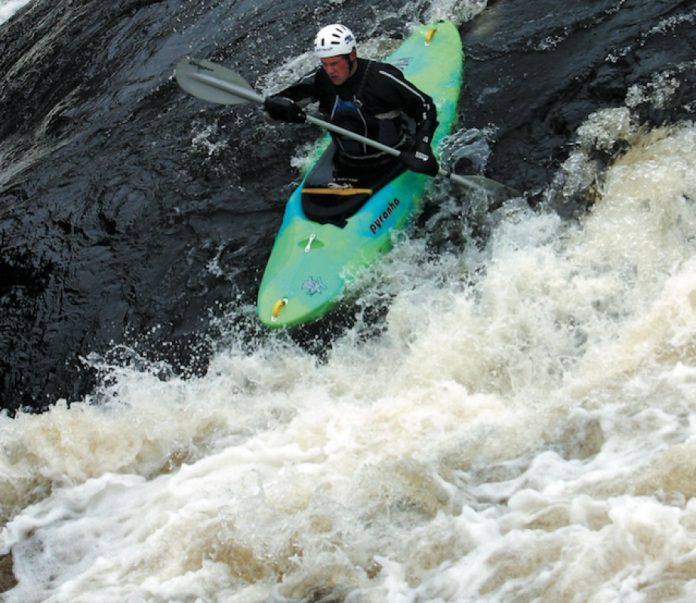
kayaker paddling down a rapid in Pyranha's H:3 river running kayak
Run the river until the river runs dry. | Photo: Scott MacGregor

In 2003 Pyranha updated and replaced its H:2 river runner with the new H:3. If you know Pyranha’s I:3 series—the boat formerly known as Ina Zone (arguably a river runner itself)—and their Micro creek boat, you would rightly guess the H:3 fills the pushy class IV–V water in between.

Specs (H:3 235 / H:3 245 / H:3 255)
Length: 7ft 8in / 8ft / 8ft 4in
Width: 25in / 25in / 26in
Volume: 59.4gal / 67.1gal / 80gal
Weight: 41.1 lbs / 42.7 lbs / 46.2 lbs
MSRP: $1645 CAD, $1095 USD
pyranha.com

The H:3’s outfitting is a combination of proven technology, innovation, and safety. The bulkhead-on-a-rail includes two sets of rotomoulded bulkhead pods so that different sizes of paddlers are ensured the safety of a full-plate footrest.

Pyranha’s H:3 has a nice blend of hand-friendly rubber grab loops and bombproof clip-in points. Co-designed and manufactured by the climbing company DMM, the paddler-accessible rescue points immediately in front of the cockpit and both sides behind the cockpit are mounted over-generous carabiner-specific recesses.

Kudos to Pyranha for providing a rigid bow pillar with “step out” safety ladder for hands-free egress from a stuck boat. A factory bow airbag is another industry first and a nice touch, as is the innovative space for a Pelican box between the seat and rear pillar. Clever.

Pyranha has gone a bit too far with their Hooker thigh grips. The sliding/rotating/pivoting thigh hooks are overkill and unnecessarily finicky. Although you won’t move it once set, the Hooker system is an instructor’s day-one nightmare. Most paddlers are still prone to forgetting their skirt, top, and noseplugs, let alone the three separate tools required for outfitting adjustment.

The Pyranha H:3 stability inspires an aggressive tilt

On the water, the Pyranha H:3 flies downstream with a wonderful feeling of glide. Paddlers more used to pushing around slow playboats will find themselves unintentionally surfing small features when ferrying across the river—needing to open up their ferry angle to take advantage of the H:3’s speed.

Great secondary stability inspires the confidence to aggressively tilt and carve the H:3 in and out of eddies. It holds an edge well with enough stability to allow you to make long, cruising carves into deep, fat eddies. It doesn’t spin-turn flat as easily as a highly rockered, dedicated creek boat, or pivot-turn like a playboat, but it eats those boats alive on long ferries and river-wide moves.

Pyranha’s H:3 is a rock-steady river running kayak. The long-running length and consistent rocker profile mean there is no sudden break to deflect you off course. The stern carries enough volume and raised edges to keep it high and less susceptible to boils. It’s a “pick a line and nail it” type boat—and one of the best at punching holes.

[ Paddling Buyer’s Guide: View all river running kayaks ]

Want to take the Pyranha H:3 playing? The planing hull allows you to lay down a mean carve on a long wave and you can still mush it around flat if things are too steep. Realistically though, the H:3 plays about as much as you would on a river running trip.

This is a river running kayak with creek boat tendencies and a desire to travel. Technically minded paddlers will love it. So will those running big water with must-make moves and creekers paddling everything but the tightest and near vertical. But what really fired the imaginations of the test crew was the H:3’s speed, all-day comfort, and volume. It’ll become a classic overnighter.

Run the river until the river runs dry. Feature Photo: Scott MacGregor

Liquidlogics’ Lil’ Joe Kayak: Whitewater Kayak Review

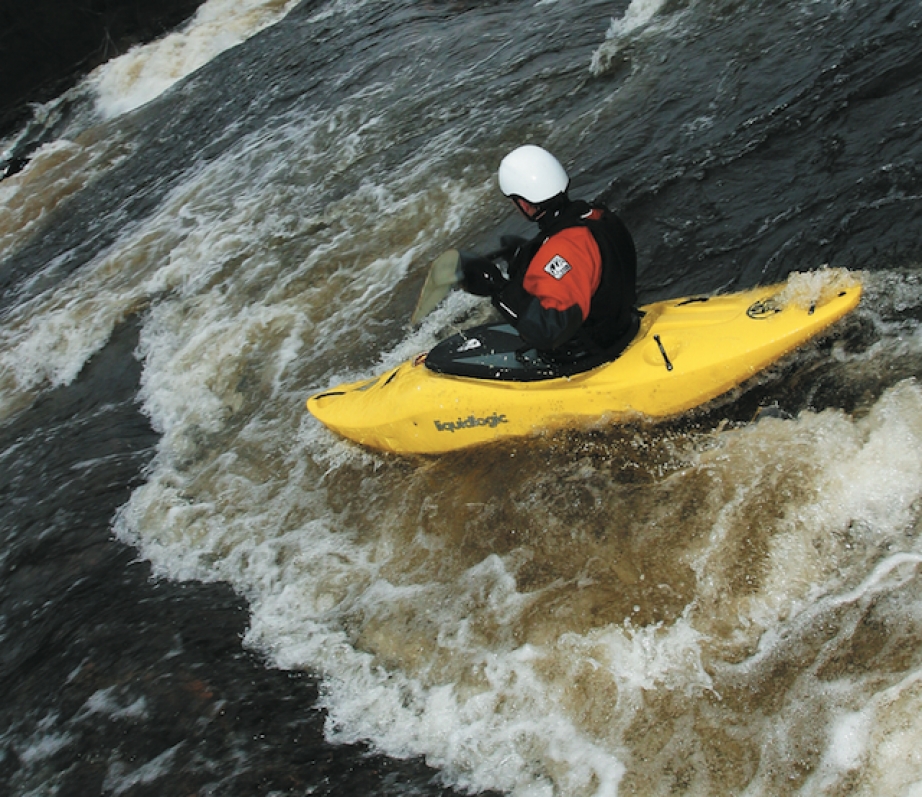
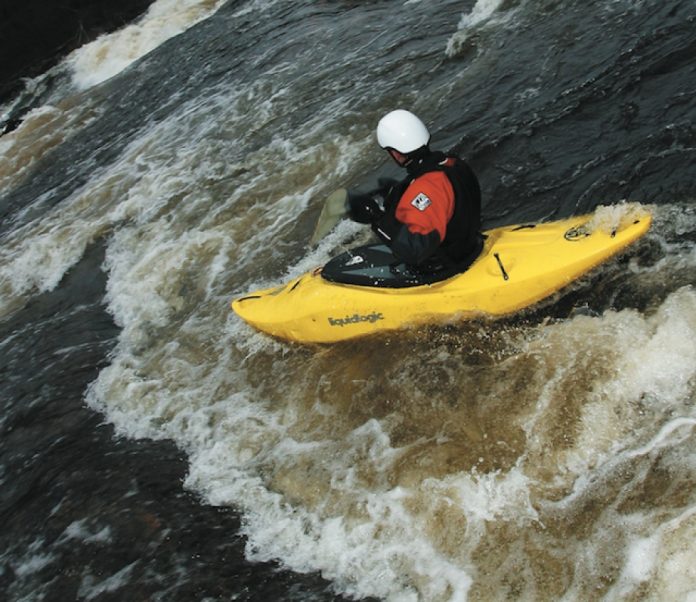
Kayaker paddling Liquidlogics' Lil' Joe kayak down whitewater
Liquidlogics' Lil' Joe whitewater kayak is going to accommodate your surfing pals and your river running pals so you never have to choose. | Photo: Scott MacGregor

Liquidlogic launched onto the paddling scene with the cart before the horse. It hit the freestyle and creek markets hard with the Sessions, the Skip and Pop, followed by last year’s Space Cadet and its stubby brothers, and the creekers, Gus and Huck.

Kayaker paddling Liquidlogics' Lil' Joe kayak down whitewater
Liquidlogics’ Lil’ Joe whitewater kayak is going to accommodate your surfing pals and your river running pals so you never have to choose. | Photo: Scott MacGregor
Specs (Lil’ Joe / Hoss)
Length: 7 ft 7 in / 7 ft 10 in
Width: 25 in / 26 in
Volume: 60 gal / 70 gal
Weight: 34 lbs / 36 lbs
MSRP: $1275 CAD, $995 USD
liquidlogickayaks.com

Whether it was a marketing strategy or the guys just building the boats they wanted (I suspect the latter), Liquidlogic succeeded in staking claim to real estate in a sparse whitewater frontier without the horse or better yet without the cash cow—a river running all-rounder that lasts a few seasons and leads in sales. Allow me to introduce a couple of thoroughbreds, Hoss and Lil’ Joe.

Liquidlogic’s comfortable kayak seats and accessories

Outfitting is the first thing anyone notices on boat test days and its what testers are bitching, or in this case raving, about on the ride home. Liquidlogic has nailed down a simple but highly effective system. The IR back-band is stiff, stays put vertically and is comfortable even when cranked super tight. The seat and hip pads were magically set in the right place for everyone who paddled it. The ergonomics are superb.

We like the simple things like pillar retention ridges, molded in instead of using screws and more plastic. The five Black Diamond safety bars are more hand-friendly than the previous LL bars. Two are positioned on the back deck for swimmer rescue and the Bucket Hand Hold on the bow deck is designed for easy grip during T-rescues. Overall, there is an industrial fugliness (functional ugliness) to the boats, but only until you get them on the water.

I asked Liquidlogic’s marketing man, Woody Callaway, what they had in mind with the Lil’ Joe and Hoss: “We took the hull of our play boats, which surf waves like mad, and the volume of our creek boats, and married them together. The Hoss and Lil’ Joe are our [modern] version of the RPM.”

Liquidlogics’ Lil’ Joe is a playboater’s river running whitewater kayak

The Lil’ Joe is without a doubt a playboater’s river runner. Its a full-on planing hull with sharp rocker break that paddles like your favorite “spud” boat. You’ll notice the familiar feeling of planing up quickly on a ferry, and settling down just as quickly once into an eddy—great for sticking eddies, but you’ll have to work to cruise old-school S-turns.

[ Paddling Buyer’s Guide: View all our kayaks used for river running ]

Like on a playboat, you can activate different parts of the hull. Lean forward and the boat stays flat, holds a line and carves predictably into eddies; lean back and the nose rides over waves, raised eddy lines and reactionaries. Leaning back also allows/causes the boat to carve less and spin more. Surprisingly, given the volume, you can still engage the stern and pivot-turn, especially off the top of waves.

The Lil’ Joe we paddled is a nice surfing kayak. You can engage the playboat hull for either aggressively carving off the front edge or pulling the bow around, carving off the stern. Side surfing and spinning are as good as it gets in a longer boat—smooth so long as you keep flat and don’t let your ends trip you up.

At the roundup, here’s what our testers said about who should buy Liquidlogic’s Lil’ Joe and Hoss: Good choice for playboaters running more challenging lines… I’d say 160 pounds is about the max for the Lil’ Joe for anything steep… It fits between a proper creek boat and a proper playboat… Perfect beginner to intermediate boats that could be used on advanced rivers… Great instructional boats for both instructors and students… The Lil’ Joe is a river running boat that feels a lot like my playboat!

Liquidlogics’ Lil’ Joe whitewater kayak is going to accommodate your surfing pals and your river running pals so you never have to choose. Feature Photo: Scott MacGregor

Editorial: Back Out in the Open

Photo: Jason Chow

“Are you ready?” asked some racer’s kid holding our stern by the grab loop. The shallow, swirling eddy waters below Whitehorse Falls on the Gull River were further confused by the other 23 bobbing open canoes waiting their turn to be released.

“Are you ready?” the kid asked again waiting for some acknowledgement, like a yes, so the man beside him with the clipboard and walkie talkie could begin the countdown.

For me, the countdown began six months earlier when I hung up the phone with Andy Walker who called to ask if I’d paddle the North American Open Canoe Slalom Championships in the bow of his Caption. I told Andy I was flattered; he told me that everyone else good already had a partner. It will be fun, he said, and besides he’d heard that at one time I was pretty good.

For the sake of every now-overweight high school football hero—elbows on a bar shelling peanuts, bragging about the good old days—I said yes.

“Hey, Mister! Ready?”

Sculling to keep the boat pointed toward the first gate, I felt like a six foot two inch praying mantis perched on an eight-inch foam pillar. It hadn’t occurred to me until just then that I hadn’t been in a open canoe in four years, seldom paddled in the bow, never paddle on my offside and had never run slalom gates.

Andy must have told the kid we were ready. The guy with the stopwatch yelled “GO” and as we wobbled toward the first gate, I realized what Andy had heard was right. I was pretty good… at one time.

At one time I was, at least in my own mind, a pretty hot open boater. Together, my old Ocoee and I danced, it following my lead, matching every step. Since then, paddling progressively shorter, lighter and “cooler” C1s, I’d lost my open boater self to planing hulls and too many squirt turns and cartwheels. Now I was back in my old neighbourhood but it wasn’t the same.

Dizzy, with arms like over-cooked spaghetti, and soaking wet, I dragged Andy’s boat up the stone dust trail beside the racecourse. I wasn’t disappointed in our time, by how many gates I slammed into, or that we rolled mid-race and floated the last two gates full of water. I was actually reasonably pleased with all that. What bothered me was that I’d lost that feeling, the strength, balance and unquestionable confidence that I once had.

That day at the OC Championships I knew, like every aging athlete, I had to make the choice: Get back in the saddle or take up my stool at the bar. 

Hey, buddy! Pass the peanuts! 

Screen_Shot_2016-04-21_at_11.48.50_AM.pngThis article first appeared in the Early Summer 2004 issue of Rapid Magazine.
 

Re-Actionary: Roadside Charades

Illustration: Paul Mason

There are many obstacles to paddling in Canada: variable water levels, seasonal issues (a.k.a. winter), the Prairies, and the fact that all the great rivers are in Quebec! 

Quebec’s beautiful, sure, but the people smoke like chimneys and drown fries in gravy and cheesy curds. They pride themselves on that stuff. “Vive la difference,” they say. When you’re there, you’re different. You’re the “squarehead”—the outsider. And there’s nothing that protects their rivers from us paddling squareheads more than the language problem.

Driving to the rivers in Quebec is almost impossible. They all drive like maniacs. The drunken streetlights lie on their sides, and who knows if and when you can turn right on a red? Worst still, you’ll be following translated directions from one of your French paddling friends. The sounds “h” and “th” are very tricky for them to say. So a sentence like, “Head through the thoroughfare then hang a hard right to the thruway for half an hour” comes out like, “Ead roo dee orrow pass, en ang a ard right to dee drooway for aff an our.”

You thought he said, “Dead Rudy passed away, his angered wife is a drooling wafer shower,” and you’re thinking, “Who’s Rudy?”

Your friend’s map scribbled on le hotdog napkin says turn on Rue Tabernacle, but the road sign is nonexistent. So you’re lost. That’s a problem anywhere. But in Quebec it’s a problem with a particularly dire edge to it—when you finally ask for directions, no one in la belle province seems to speak English. You’ll be disappointed to know how 10 years of public school French amounts to no help what-so-ever. “Au claire du la luna” or “Frere Jackass” don’t amount to much when you’re deep in the pepper pickies.

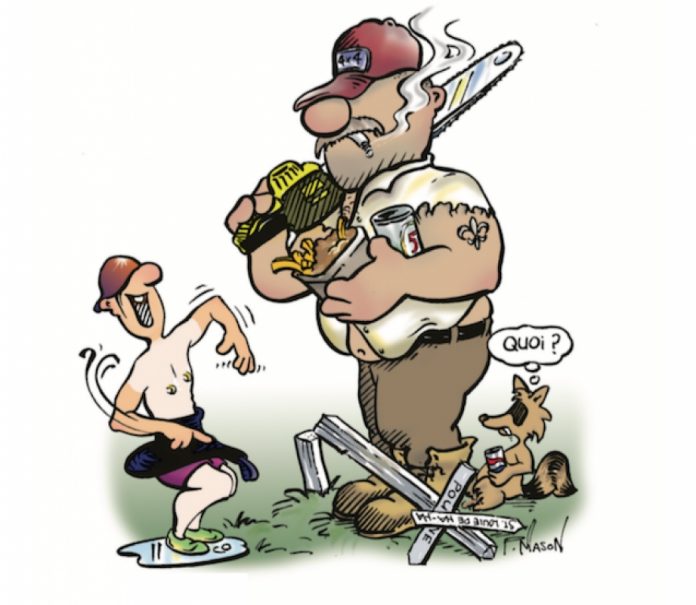
Reluctantly you’re forced into roadside charades. You’re in the woods, lost, confused and hungry and you’re dancing in tight black fuzzy rubber trying to show, with your body, the words you cannot say in French. Try acting out W-A-T-E-R-F-A-L-L, P-U-T I-N and B-O-O-F to a grizzly lumberjack wielding a chainsaw in one hand and a cigarette, a can of 50 and a family-sized poutine in the other. You might be surprised to find out how much it looks like you’re saying, “I want to sleep with your wife.”

The language barriers don’t stop at the put-in—if you make it that far. Paddling requires knowledge and communication. It’s important to know where the blind drops are, where the sieves are, that sort of stuff. And all those peppers know this stuff, of course, but it’s locked in their tetes (no, not teats).

You ask them, “Hey Jean Claude, Guy, what’s around the corner?” And they just smile and nod. That’s their answer. But, my Anglo friends, it is the wrong answer. I once asked a guy, “Francois, will I surely die if I paddle around this next bend?” He just smiled and nodded.

Maybe the paddling peppers know exactly what you are asking. Maybe they don’t want to give us directions to the best lines, choice campsites, and funkiest discos, so we won’t come back. After all, we all like to keep our favourite runs a secret, don’t we?

That’s why when an American asks, “Y’all know wheres I can find the Ah-to-wah-wha Rivah?” I tell him to head north past the guys in toques drinking beer and playing hockey. When you see the beavers, go west. This, my Yankee squarehead friend, is where you’ll find all the best paddling—Saskatchewan!

Ben Aylsworth likes Quebec and likes Quebec rivers but loves Quebec women. 

Screen_Shot_2016-04-21_at_11.48.50_AM.pngThis article first appeared in the Early Summer 2004 issue of Rapid Magazine.
 

Bringing A River To Life: A Storyteller Saves The Missinaibi

two people paddle through rapids on the Missinaibi River
Feature photo: Courtesy Destination Ontario

“So many stories! And the players we had were no slouches, eh?” That’s how my interview with Michel Lepage began. With an opening line like that, the storyteller could go just about anywhere. Lepage, Northern Ontario’s master storyteller, chose to take me down the river, or through the history of his favourite river, to be exact. The “players” go by the names of George Atkinson, Ed Jarvis, David Thompson and “Alex” Mackenzie. They span over 200 years of history and 400 kilometres of Ontario’s longest free-flowing wilderness river, the Missinaibi.

Bringing a river to life: A storyteller saves the Missinaibi

Lepage is at the same time brilliant, generous and self-deprecating; a visionary, business guru and whitewater paddler. His impressive resumé lists, among other things, VP Consulting of the prestigious accounting and consulting firm BDO Dunwoody. But Lepage humbly deflects any individual praise and passes it on—he claims a past of “more canoes than brains!” (followed by a belly laugh). Born and raised in Kapuskasing and Hearst, close to the Missinaibi, he has found the time during his high-profile career to come home and paddle the length of his favourite river almost a dozen times, researching and becoming an expert in the waterway’s history.

two people paddle through rapids on the Missinaibi River
Feature photo: Courtesy Destination Ontario

As the shortest route between Lake Superior and James Bay (using the Michipicoten River to connect), the Missinaibi has over 3,500 years of human past in its flow. Red ochre pictographs left by early Ojibway and Cree, a Hudson’s Bay fortified trading post, and portage trails packed hard by thousands of feet are only a part of this vein that feeds a giant roadless tract of Ontario’s North.

Long known to Lepage and his paddling friends (who first paddled the “Miss” in 1977), this was a jewel to be preserved. They were not alone, as groups such as Sierra Club International were also lobbying to have the Missinaibi protected. And it was—with 1988 Provincial Waterway status. In the same year, the Ontario government nominated the river for the Canadian Heritage Rivers System. The nomination gets completed to full designation with an approved comprehensive management plan based on community consultation and consensus—local participation is key.

Sixteen years later, the Missinaibi holds the dubious honour of having the longest time elapsed between nomination and designation. The requisite management plan is being tabled this May, in hopes of finally receiving full heritage designation. If the river does win its heritage status, it will be in no small part due to Lepage, who was pivotal in promoting the Missinaibi to the people who ought to know it best—the northerners who live in its watershed.

He did it by telling stories.

“My role, and you’re never alone in this, was making the river come alive.” His intimate knowledge of the river and his love of history led him to become the spokesperson for the Missinaibi in the North.

[ Plan your next Northern Ontario & Manitoba paddling adventure with the Paddling Trip Guide ]

“I pulled out certain characters [from history] and followed them. I took the dryness out of it and made it a story, and that’s when people could relate to it.”

Probing into old Hudson’s Bay Company archives from Winnipeg, and Ministry of Natural Resources archeology sub-studies, Lepage set out to make the story of the Missinaibi known, especially to those who lived in nearby towns like Hearst and knew the river only from the glimpse offered by bridge at the Highway 11 crossing in Mattice.

From 1990 to 1993, Lepage’s Trials and Tribulations of John Thomas appeared as a running series in the Hearst newspaper, recounting tales from the river’s past based on the life of a Hudson’s Bay Company representative trading on the river in the late 1700s.

“People could read it week by week and say, ‘What the hell’s going to happen to this guy?’” These stories finally brought the river local and regional attention, which built support for the Canadian Heritage River nomination.

Lepage has a vision for the future of the North that includes the rivers, lakes and tourism. By sharing the stories of their past, he is helping identify opportunities in northern communities, such as his present consulting with the Constance Lake First Nation on a $10 million aboriginal interpretive centre on the banks of the Shekak River, just west of the Missinaibi. This, like Canadian Heritage River designation, is a way stories can build into a tangible touchstone— providing a place for people to touch the past and the historic value of the land around them.

“My role was making the river come alive.”

Our conversation was a roller coaster, or time machine, that wove the Missinaibi’s heritage status, the 1776 mapping of the river from its headwaters, Hudson’s Bay trading history, his survey of the river for the Ministry of Natural Resources, pre-contact aboriginal culture, “blah blah blah”—as Lepage often says. I sensed I was being taken for a ride, with casual but carefully placed Quebecois slang. “I’m French, I can talk until you die!” Lepage speaks with exclamation marks.

For Lepage, the Missinaibi River is alive, alive with history and a breathing landscape, which is the motivation for what he does. Whether the Missinaibi ever makes full Canadian Heritage River status is almost beside the point. It is the stories of the past that are the foundation for a new future in the North. Michel Lepage, master storyteller, is doing his part to make this happen.

Jeff Jackson is a professor in the Outdoor Adventure Program at Algonquin College in Pembroke, Ontario.

Cover of the Early Summer 2004 issue of Rapid MagazineThis article was first published in the Early Summer 2004 issue of Rapid Magazine. Subscribe to Paddling Magazine’s print and digital editions, or browse the archives.

Feature photo: Courtesy Destination Ontario