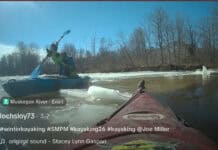
Kayakers Kevin and Joe Miller were paddling on the icy Muskegon River in Michigan when the the day turned nearly deadly – as chunks of ice flowed down the river, the current caught Kevin’s kayak and a surge of ice hit, sending him into the water. Kevin was then sucked beneath a sheet of ice and swept down river.
Stuck under an ice sheet on Muskegon River
“It started with an incredible experience of floating on an iceberg for nearly 25 minutes,” wrote Kevin on Facebook. “As the ice began to break up, we slid back into the water exactly as planned.”
It was here, back in the moving current that things began to go awry. In attempting to maneuver to where Joe was positioned on another sheet of ice the current caught Kevin’s kayak and ice hit his kayak, causing Kevin to capsize into the icy water.
Data from US Geological Survey (USGS) shows that between March 3 and March 10, 2026, Muskegon River levels near Croton, Michigan rose from approximately 5.2 feet to nearly seven feet. Additional data shows that water temperatures were 35 degrees Fahrenheit (2 degrees Celsius) between March 4 and March 7, 2026.
@lochsloy73 #winterkayaking #SMPM #kayaking26 #kayaking @Joe Miller
A video posted by the pair illustrates the extremely dangerous river environment at play the day of the incident. River ice out conditions, or the breaking up and melting ice paired with moving water and strengthening currents, created a serious hazard for the paddlers as large chunks of ice mixed with strong currents and debris. Spring paddling on rivers as ice conditions change can be especially hazardous, as some sections of the river may look clear, while others are choked with ice. The ice itself can act as a surface-level strainer as current rushes beneath it.
“Before I could react, I was sucked under the ice,” wrote Kevin, adding that his inflatable PFD deployed, but he lost his glasses.
Kayaker grateful to be alive after nearly a minute trapped beneath the ice
Kevin estimated that he was trapped beneath the ice for 45 seconds and was swept 40 to 60 feet downstream.
“I tried to break through the 6-8”of ice wherever I saw light, but it was impossible,” shared Kevin. “Just as I reached the point where I could no longer hold my breath and had accepted the situation, I saw light above me.”
Kevin surfaced to the sound of Joe and bystanders on shore shouting to each other, altering everyone that Kevin had surfaced. Joe had positioned his kayak so Kevin could hang on to the bow and be transported and swim to shore.
“A bystander helped pull me onto the shore and up the hill to safety. EMS arrived shortly after to assess me,” wrote Kevin. “Miraculously, my only injuries were some abrasions to my face, bruised hands from fighting the ice, and a few bumps on my head that required three staples.”
According to a comment by Kevin following the incident, Kevin shared that he was wearing neither a drysuit nor wetsuit during the incident and his core temperature emerging from ten minutes in the river was 98.2 Fahrenheit.
Kevin shared that he now plans to purchase a drysuit, and that he and Joe were able to recover his kayak but his paddle, glasses and spray skirt were lost.
“All in all, it was an amazing day and I am incredibly grateful to be here,” wrote Kevin.
Lived experience of paddlers acts as a valuable community case study
“It took courage to post this. You could very well save a life by allowing others to learn from your close call,” wrote commenter Mick Hansen.
Other commenters noted clear lessons from Kevin’s experience.
“First, I am glad you survived,” wrote Rick Greenwald, before noting a few takeaways from the experience including avoiding paddling on moving current with thick ice sheets, the importance of a drysuit in winter paddling conditions and the importance of a foam PFD for paddling in cold conditions.
“You are also brave to put this out here in this group. Take what you’ve learned and share it with others so that you might prevent someone else from making the same mistakes,” concluded Greenwald.
Henry Davies, who shared that he regularly paddles with ice on Lake Superior, noted that floating and drifting ice can be one of the most dangerous aspects of winter kayaking.
“Even a gentle breeze can move the ice around and block you from your takeout,” wrote Davies. “The best plan if things are iffy is to leave the kayak on the car.”
Another commenter recommended Kevin buy a lottery ticket.
Feature Image: The ice-choked Muskegeon River. Joe and Kevin Miller | TikTok