Home Blog Page 138

The New Rules Of Wildlife Ecotourism

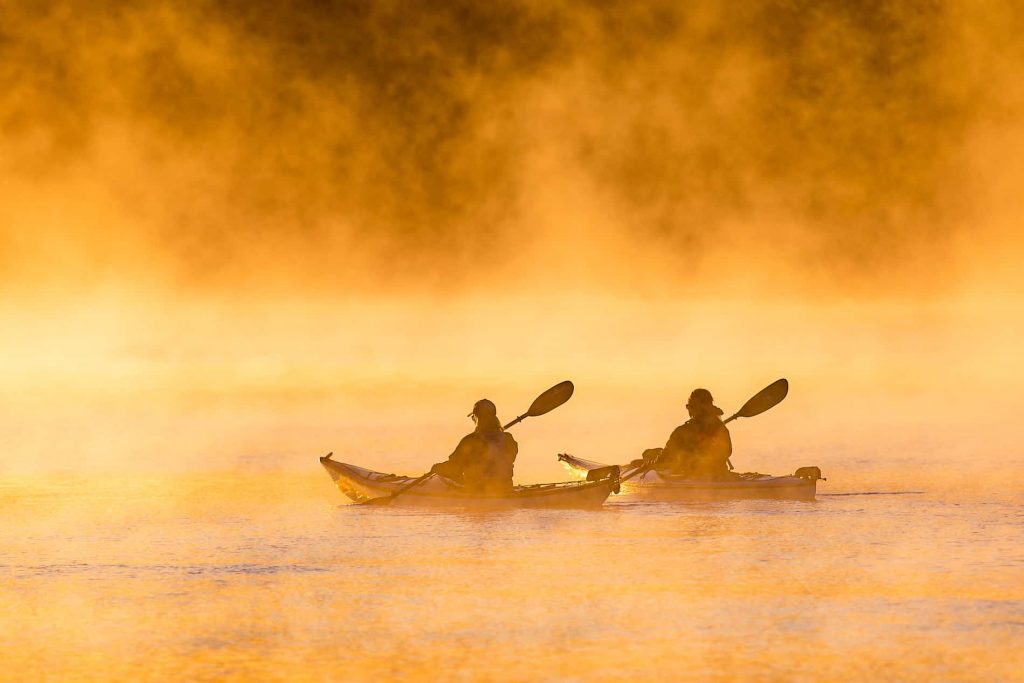
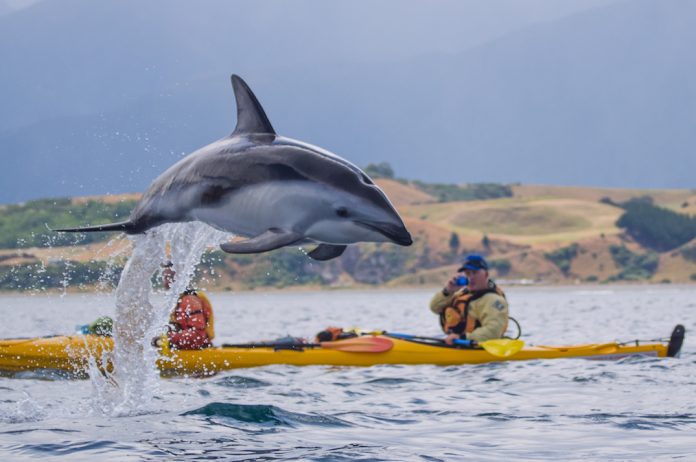
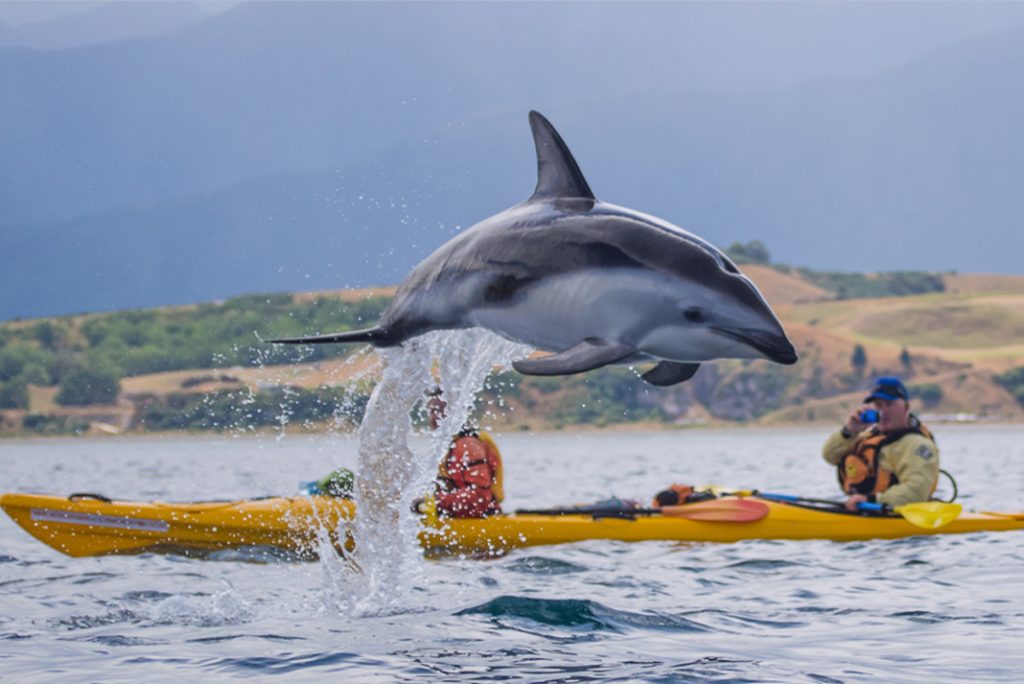
Kayaking with dolphins in Kaikoura, New Zealand.

We’ve nearly given up hope and are about to paddle back in, when off in the distance, we spot a fin near where the estuary meets the sea.

“They’re headed this way,” our guide calls out, setting off.

We paddle to join him, hoping to get a closer look at the estuarine dolphins. Yet, every time we get closer, the dolphins change course. Paddling back and forth across the water, we try to predict their movements in the setting sun, until time runs out. From afar, we watch the dolphins disappear up the estuary in the fading light.
Wildlife ecotourism
Responsible paddlers endeavor to maintain distance from marine animals at all times, and rare and exceptional encounters like this do not represent a typical paddling experience.| Photo: Kaikoura Kayaks

I’d driven up the coast to the twin towns of Agnes Water and 1770 (the latter named for Captain Cook’s date of arrival) in Queensland, Australia to get a better perspective on how paddlers can engage with wildlife in the most ethical manner possible. But trying to get closer to the dolphins made the premise seem laughable. What effect—if any—could paddlers possibly have on wildlife, particularly when the animals in question can swim up to 40 kilometers per hour?

Earlier that morning, 1770 Liquid Adventures co-owner Janina Speck had taken me for a morning paddle along the mangrove edges. Originally from Germany, Speck—a diving instructor by trade—decided to settle in Agnes Water due to its proximity to the Great Barrier Reef. Operating a kayaking company was a natural extension of Speck’s love for marine conservation, since it would allow her to engage with a wider audience.

When I ask her about the impact of kayakers on marine wildlife, our conversation instead quickly turns to poor conservation practices of recreational fishermen.

“There’s really no need for rules for kayakers because we move so slowly,” she says.

It was a sentiment I’d heard before—many kayakers, canoeists and standup paddleboarders I spoke with had echoed these thoughts. Kayaks and canoes are eco-friendly, while motorboats and personal watercraft destroy fragile ecosystems. It’s a somewhat absurd dichotomization to make—akin to cyclists versus drivers—but is there any truth in it?

With paddlesports on the rise—kayaking is still one of the fastest growing sports in North America, according to the Outdoor Industry Association—and tour operators worldwide expanding to new regions, the question of our impact on waterways is more pressing than ever. It could be easy enough to say we’re not part of the problem, but research has a very different message. Paddlers, without question, have the potential to alter the behavior and ultimately the well-being of marine animals, however their actions exist in a grey zone when non-endangered species are concerned.

Kayakers have the benefit of moving quietly and not emitting gases or by-products into the water—but animals aren’t living in a vacuum.

“Kayakers have the benefit of moving quietly and not emitting gases or by-products into the water—but animals aren’t living in a vacuum,” says Rick Snowdon, co-owner of Spirit of the West Adventures, a British Columbia-based company specializing in whale watching. “If we’re not mindful of how we behave on the water, we certainly have more of an impact than some of us would believe.”
whales and kayakers
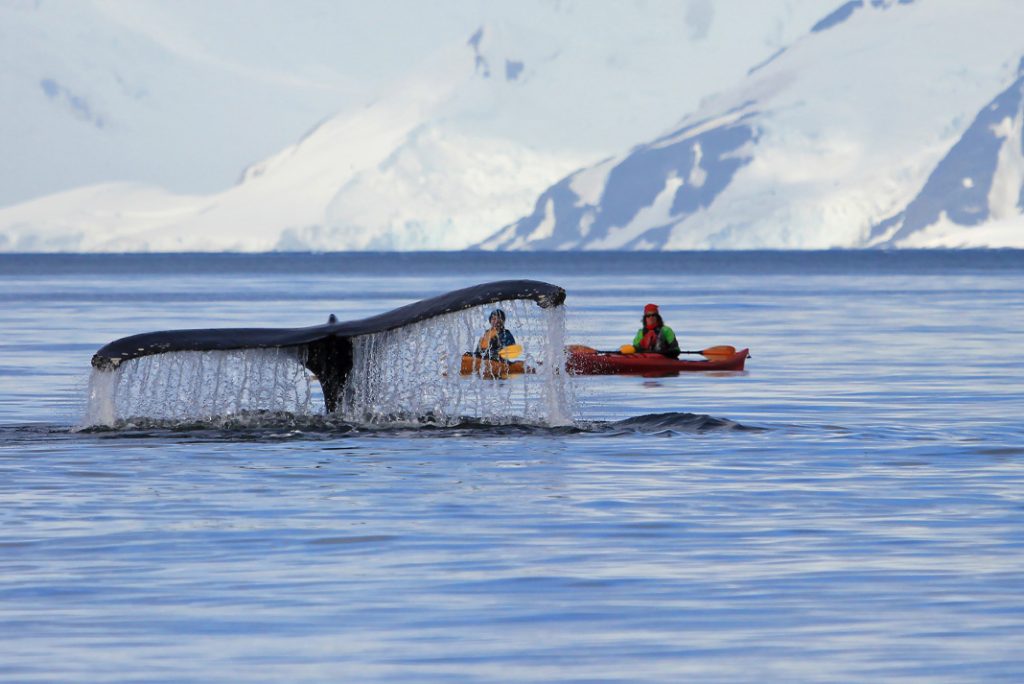
The guidelines of the International Association of Antarctica Tour Operators include not approaching cetaceans within 330 feet (100 meters). | Photo: istockphoto.com/reisegraf

A whale of a problem

One lazy Sunday, I headed to Rapaki, a small Maori settlement on the edge of the Banks Peninsula, just 15 kilometers from the city center of Christchurch, New Zealand. Luck was on my side. New Zealand’s “long white cloud” broke for the first time in weeks, bathing Whakaraupo Harbour in sunshine.

Out on the water, it wasn’t long before I put down my paddle to soak it in. Waves gently lapped at my kayak as it drifted. I didn’t notice I’d floated close to a set of sea caves until it was too late—I was already under attack.

With a shrill squawk, a gull flew up from the shore. Agitated, it swooped down over my head—low enough I had to duck—before circling back and swooping down again and then again.

The scene felt familiar. A couple of months earlier, I’d spoken with Jon Marin, owner of Immelns Kanotcenter, a popular canoe center in Sweden’s Lake District.

“People tell me they had the most amazing meeting with an osprey circling their canoe because it was so interested, and they stayed a long time to enjoy the show,” he told me. “I then tell them the osprey circles not because it is interested or playful, but because it feels threatened.”

Sure, it was a single gull and probably a hypocritical one at that. Gulls aren’t exactly a species known for respecting personal space. And sure, I was just one kayak. But the caves were likely a nesting site, and how many kayakers pass too close to this same shoreline every day?

It’s in this—the cumulative effects on wildlife—paddlers are arguably just as culpable as motorized boat users. It’s easy to rest on one’s laurels and assume moving slowly and quietly isn’t harmful, but research demonstrates the very opposite may be true.
wildlife ecotourim
Marbled Godwit roost in Elkhorn Slough, California. | Photo: Gary Luhm

Take the case of California’s Alcatraz Island, which is a nesting site for Western gulls, cormorants, snowy egrets and other waterbirds. Since 1991, Point Blue Conservation Science—a nonprofit wildlife conservation and research organization—has been monitoring the site. What it has found is of all disturbances, including those from land, air and sea—yes, including motorboats—the nesting birds are most disturbed by the approach of kayaks. Put off their nests, birds risk losing their young. It only takes 25 minutes for an egg to cool, particularly on a windy day, and that’s if an opportunistic predator doesn’t eat it first.

It’s not just nesting birds responding negatively to paddlers. According to a 2011 Audubon Society study, non-motorized boats caused waterfowl and diving ducks to flush when only 99 meters away, on average. In one recorded instance, a single kayak resulted in 600 cormorants flushing.

The exact ecological cost of these types of disturbances remains largely undocumented, but there are some safe conclusions biologists can draw. One of the biggest concerns, writes Kathi L. Borgmann, author of the Audubon Society paper, is a loss of foraging time.

“Because flying is energetically expensive, birds flushing in response to disturbance will need to acquire additional resources to compensate,” writes Borgmann. “Thus, disturbance, especially if frequent, could…potentially impact populations.”

It might be hard to imagine people actively paddling up to check out a gull, but the same can’t be said of sea otters. It’s hard to resist trying to get a closer look at these puppies of the sea.

According to biologists at Monterey Bay National Park, continual interactions with paddlers are akin to “death by a thousand cuts.”

When approached, otters typically dive or swim away, costing them valuable energy only recouped by hunting and fishing, rather than resting. The ensuing weight loss can open up to risk of infection and diseases. Chronic disturbances, including those by kayakers, account for 40 percent of all the violations recorded each year in Monterey Bay.

“A lot of the time, it’s out of ignorance,” says Snowdon. “People aren’t willfully going out of their way to harass an animal.”

It’s an ignorance Snowdon believes is only perpetuated by the quest for all-important likes; one that compounds when social media influencers are imitated.

[Paddling Buyer’s Guide: View All Sea Kayaks]

“You see examples of it all the time,” says Snowdon. “Anytime there’s a viral video getting shared of ‘look at this kayaker paddling over top of a killer whale’ it makes me pull my hair out.”
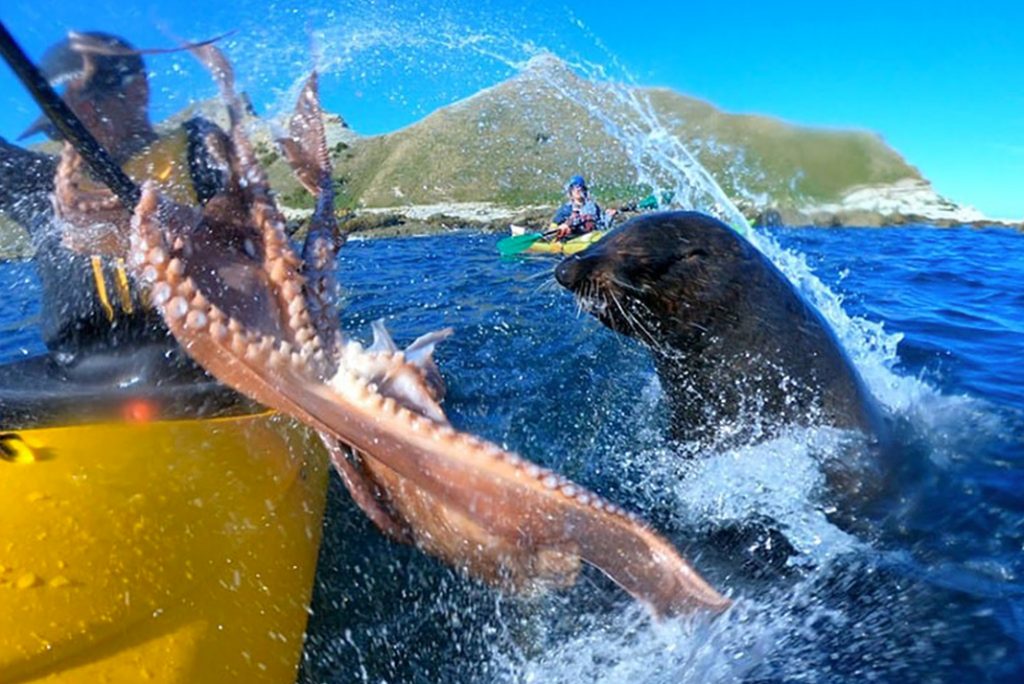
seal slaps kayaker with octopus
Screen capture extracted from the infamous seal slaps kayaker with octopus video. | Photo: @barekiwi/@taiyomasuda/@gropro

Crossing boundaries

Perhaps no viral video in recent history better captured this tension than the “seal slaps kayaker with octopus” video. It was late in September when Kyle Mulinder, a GoPro ambassador, set out with Kaikoura Kayaks, a tour operator based on New Zealand’s South Island. He was seated in the back of a tandem kayak when—as described in the video’s title—an octopus was flung at his face by a feeding fur seal.

The video was picked up by the Guardian, BBC and the New York Post, and within days, it had hundreds of thousands of views. It was indisputably an incredible interaction, made all the more incredible by the fact it was caught on film. But for guides such as Snowdon, it raised questions. Namely, why had the group been paddling so close to foraging animals, which is generally considered one of the cardinal sins of ethical marine wildlife viewing?

It’s a grey day when I head to Kaikoura Kayak’s outpost, located just off the beach town’s main strip, hoping to answer this question. On the wall, a whiteboard shows the tide times (4:30 p.m.), swell forecast (East, one meter) and recent hazards (“octopus slapped in your face”).

I’m greeted by Conner Stapley, the same guide who took our Mulinder’s group.

“It was my five minutes of fame,” he jokes when I ask about the incident—he had five before that, too, when he discovered geothermal bubbles following an earthquake in the area in 2016. Although Stapley says his motto is, “selfie sticks sink boats,” it hasn’t stopped tourists from requesting to be slapped in the face by an octopus.
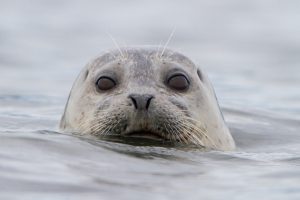
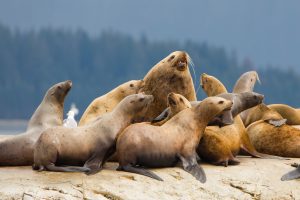
Kaikoura Kayaks has also been cashing in on its fame by actively promoting opportunities to get up close to New Zealand fur seals while they forage. In doing so, they’re not actually in violation of any of the three marine wildlife viewing permits they hold.

Mulinder’s group was kayaking so close to the seals that day, I learn, simply because they legally could. Strict regulations exist in New Zealand for how close watercraft can come to the seals on land, but none exist for seals in the water. Stapley says this is because seals are considered to be adept swimmers—if they didn’t want to be near the kayaks, they would just swim away.

According to John Baston, a kayaking guide who spent 10 years working as a park ranger in six American national parks, that’s why the problem isn’t with individuals, but with legislation. Rigid regulations exist for endangered species—with steep fines for infractions—but don’t cover others, such as intertidal animals or common birds. And while tour operators may require permits, there’s little education of independent paddlers.

Similarly, the majority of waters worldwide remain unprotected. This is more to the point for paddlers, since they’re able to access wilderness areas larger watercraft can’t.

For example, at Alaska’s Glacier Bay National Park, where Baston guides with Mountain Travel Sobek, the water is protected. But just beyond, it’s maintained by the State of Alaska.

“They might have some loose regulations about how you’re supposed to treat animals, but there’s no enforcement. You won’t see any boats or rangers,” he says.

Even for those waters closely monitored, there’s still a lack of accountability. In January 2018, the Soundwatch Boater Education Program—an initiative of Washington State’s up-to-date Whale Museum—released the findings of an 18-year-long study on whale interactions in the Salish Sea. The results were alarming; not only had the number of kayakers increased by 30 percent, so too had the number of kayakers coming too close to critically endangered pods of whales. The paper’s authors noted regardless of the mode of transport—motorized or non-motorized—these interactions interrupted the feeding, travel and socialization of orcas.

“What we have seen is kayak incidents increasing because they are a lower priority, from an enforcement standpoint,” Elizabeth Seely, the paper’s lead author on the paper, told the Seattle Times. “Some kayakers are not abiding by laws, paddling out to the killer whales to get closer to them; it is really upsetting to see. And they don’t have any consequences for it.”

This is why it’s so important paddlers do their homework and opt for tour operators who have conscientious standards and can provide guidance on how to interact with each species.

Just last July, Canada strengthened protection for marine mammals, madating a 100-meter approach distance for most whales, dolphines and porpoises, which is inclusive of kayakers. However, this inclusion is uncommon. The reason authorities ignore paddlers may be the same reason paddlers ignore the rules. Some say blanket regulations don’t make sense when kayaks and canoes don’t have the same speed or maneuverability as a high-speed boat. After all, what do you do if a whale approaches you directly?

That’s the argument Peter Grubb, founder of ROW Sea Kayak Adventures, an operator with tours in North America, Latin America and Europe, makes. He insists whales approach paddlers out of curiosity and playfulness, not the other way around.

“Whales don’t have to come over near us in the first place. It defies common sense to say there’s something wrong or unethical about that,” says Grubb. “It creates a more powerful experience. If anything, it creates stronger advocates for the protection of the animals.” ROW is a member of the Responsible Whale Watch Partnership, which aims to raise the standards of whale and dolphin watching worldwide. Their global guidelines recommend motorboats keep a distance of 100 meters from whales and 50 meters from dolphins, however don’t have specific guidelines for kayaks.

I’m not sure how Grubb’s opinion sits with me. Hasn’t history demonstrated any time wild animals get comfortable with humans, it doesn’t bode well for either party?
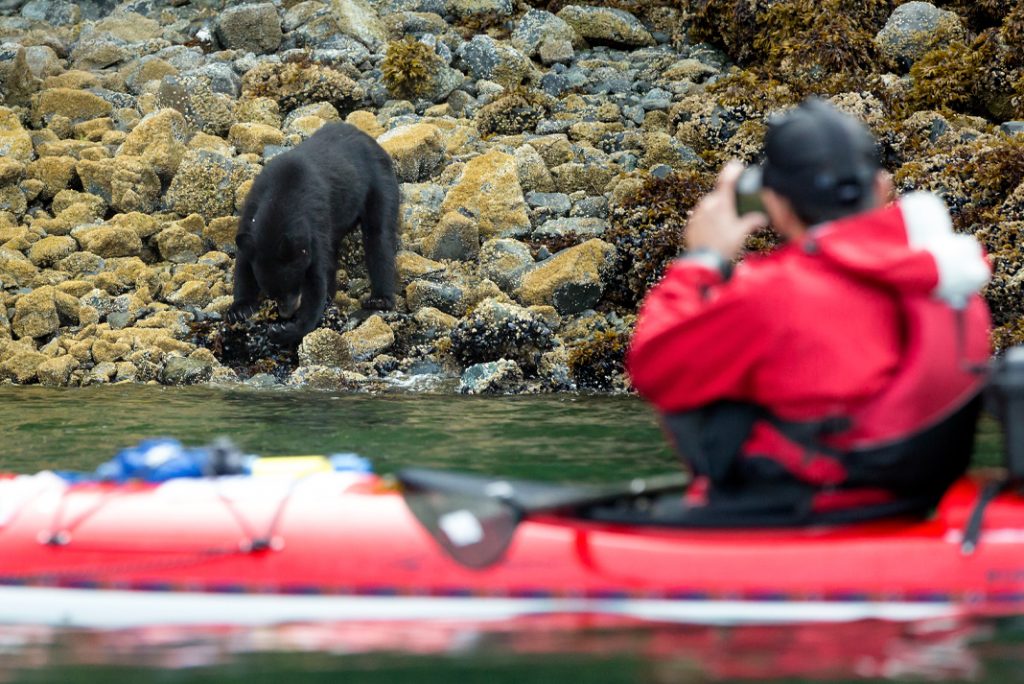
A black bear spotted foraging on shore in the Great Bear Rainforest on British Columbia's coast. | Photo: Dustin Silvey
A black bear spotted foraging on shore in the Great Bear Rainforest on British Columbia’s coast. | Photo: Dustin Silvey

Close encounters

This is weighing on my mind as Stapley and I splash through the surf at Kaikoura. We’re in a tandem sea kayak looking for little penguins, when Stapley spots a small pod of dusky dolphins. They’re swimming through the rolling swell about 150 meters away. We’ll never be able to paddle closer to them in time, I think, remembering my experience in 1770.

Then, the first dolphin’s fin appears next to my paddle, close enough I could touch it. I let out a surprised yelp. It’s joined by others and in no time, we’re surrounded. The dolphins chase each other, flipping playfully on their backs under the water, exposing the white of their bellies.

It’s mesmerizing. Suddenly, I get what Grubb meant. No matter which way we paddle, the dolphins follow, staying with us for more than 20 minutes. We couldn’t stay 30 feet away from them if we tried.

It’s then I remember something Baston told me. At Glacier Bay National Park, the Huna Tlingit people are once again allowed to collect plants and gull eggs within the park.

“Nature writer Barry Lopez said one of the biggest mistakes the Europeans made when they came to North America was they mistook it for a wilderness. People had been living there, changing the landscape and killing populations of animals for a long time,” says Baston. “Things have been altered and manicured by humans for a long time—and I think it’s that way on the sea coast.”

Wherever there is water, people have paddled for thousands of years—and the onus is on us to protect those waterways for another thousand.


Jessica Wynne Lockhart is a freelance journalist who splits her time between Canada, Australia and New Zealand. The contributing editor of Verge Magazine, a publication devoted to travel with purpose, she’s passionate about ethical and responsible adventures.

Eye to eye with a harbor seal, near Protection Island in Washington state. Many photos of paddlers and wildlife we see have been taken with a telephoto lens and cropped. | Photo: Gary Luhm
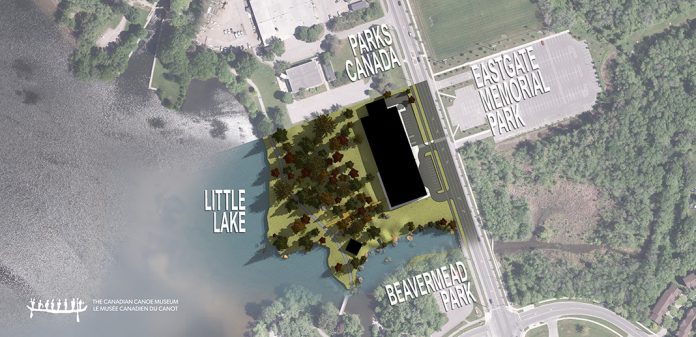
Canadian Canoe Museum Confirms Location Viability For New Museum Build

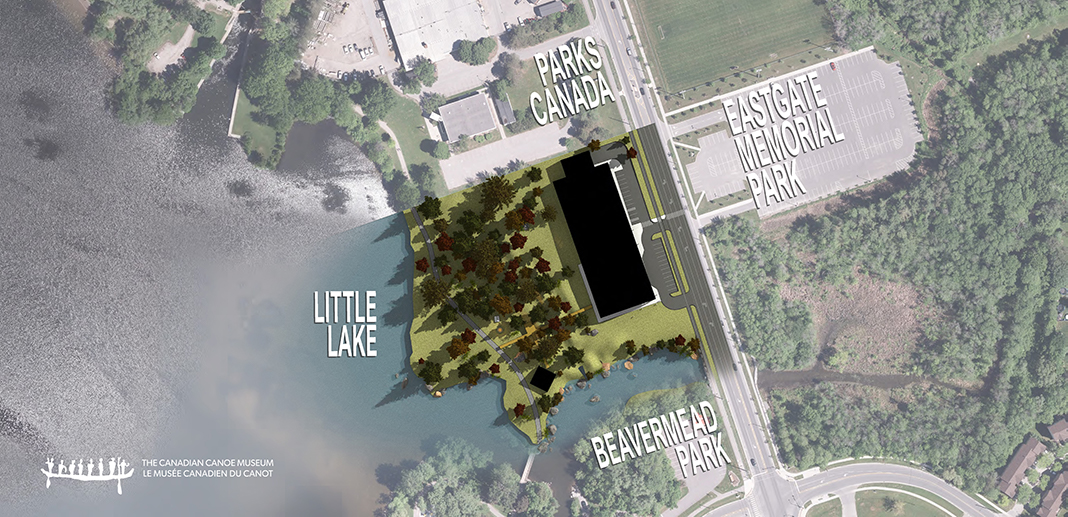
PETERBOROUGH, ON – The Canadian Canoe Museum (CCM) announced today that Johnson Park, the City-owned property at 2077 Ashburnham Drive in Peterborough, ON, has been deemed viable for the building of its new canoe museum.This confirmation clears the way for moving to the next phase of feasibility activities and determining next steps with the City of Peterborough. Johnson Park is situated on Little Lake, north of Beavermead Park and south of the Parks Canada-Trent Severn Waterway head offices.

“We are thrilled that recently concluded due diligence explorations, environmental assessments, testing and feasibility studies have substantiated the Johnson Park location as a viable site for the building of the new world-class canoe museum,” confirmed Carolyn Hyslop, executive director, The Canadian Canoe Museum. “The museum will now enter the next phase of feasibility and validation activities. This process will help us fine tune budget and overall costs, design and the project schedule with a view to being shovel-ready by the end of 2021,” said Hyslop.

Leading with environmental stewardship in mind, the new museum will be built on a flat portion of the property, away from the floodplain, on the open land along Ashburnham Drive. This will preserve the existing trail, shoreline and natural waterfront.

To assist CCM with the realization of a new creative vision suitable to a fresh waterfront site, the new museum will be designed by local, award-winning Lett Architects Inc. (Peterborough, ON). With experience in completing cultural projects for nationally recognized institutions, Lett will bring a strong collaborative and engaging approach to the project.

“Lett Architects are thrilled to be working with the Canadian Canoe Museum on a new home for their comprehensive collection and programming,” said Bill Lett, managing principal, Lett Architects Inc. “As a local studio, we are excited for the opportunity to design this new facility and for the first-hand chance to experience its positive impact on our own community.”

Hyslop went on to note that the original goals and vision continue to guide the new museum build project. In particular, the desire to establish a home for 100 per cent of the museum’s canoe collection that meets Class A conservation standards, directly on the water, which allows for increased on-water and in-person programming while being a key cultural tourism driver in what will become a vibrant community hub on the waterfront.

“In a year that has brought every manner of exceptional challenges to us all, we are delighted to close out 2020 with positive and hopeful news. Having found a viable site for this extraordinary project that will see the new museum situated on the shores of Peterborough’s Little Lake – what a terrific kick off to 2021!” concluded Hyslop.

About The Canadian Canoe Museum (canoemuseum.ca)

With a world-class collection as a catalyst, The Canadian Canoe Museum inspires connection, curiosity and new understanding. In partnership with individuals, groups and communities – locally, provincially and nationally – we work to experience and explore all that our collection can inspire. This sees students opening their minds in our galleries; community members connecting through artisanry; people of all ages getting on the water and learning to paddle; and exhibitions and events that spark conversation and collaboration.

Speed Champion Lina Augaitis’ Guide To Making A Comeback

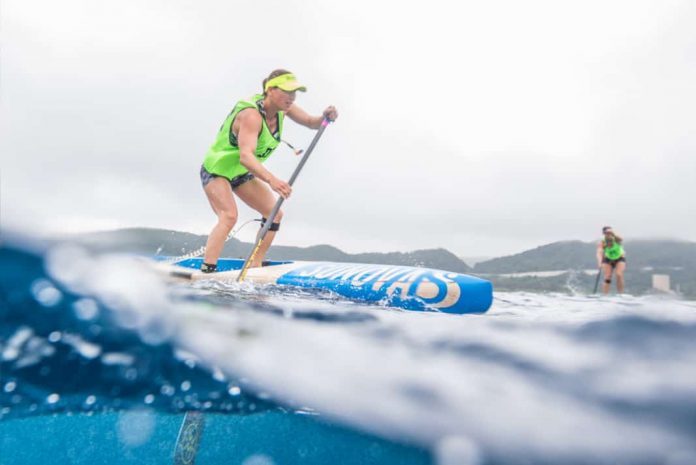
Lina Augaitis training near Japan’s Zamami Island 2018. | Photo: The Paddle League/Georgia Schofield

Lina Augaitis is no stranger to the podium. But where she used to thank her sponsors and husband in post-race interviews, now she has another important part of her team to thank: the babysitter.

A world champion standup paddleboard racer, the Ottawa native now lives in Vernon, British Columbia and has a new focus as a mother of two young children. It’s a shift for a woman who helped shape the sport of SUP racing and was declared the fastest female paddler on Earth in 2014 and 2015.

“Four years ago, I could do whatever I wanted,” Augaitis says during a late-evening interview after her kids have gone to bed. “It’s 100 percent different now.”

Rewind to 2014, and Augaitis was not only Canada’s top SUP racer, but she was one of the world’s best. She was unstoppable. Wins in the distance race of the ISA World Championships, the massive Battle of the Paddle race and podiums in just about every race she entered proved it.

[Paddling Buyer’s Guide: View All Racing Paddleboards]

While she went on to win the sprint race title at the 2016 ISA worlds and she was the first female paddleboarder to complete the 750-kilometer Yukon River Quest officially, her biggest priority soon became starting a family. Tavas was born in December 2015, and Aiste followed in October 2017.

Parenting meant stepping away from the paddleboard racing for much of 2016 and 2017, as the training and travel required to compete at the sport’s top level were not an option. And while sleep was diminished, Augaitis’ competitive drive wasn’t. She continued to run, cycle and cross-country ski to maintain her fitness and, in March 2018, she signed to paddle for Team Sunova, an innovative SUP manufacturer based in Thailand.

A high school teacher by trade, Augaitis took an extended leave to focus on raising her young children and training for her return to the sport. The delicate balance between the two priorities meant being creative and managing time effectively.

“From 8 a.m. until 5:30 p.m. when Andrew is at work, I have the kids,” she says. “We’re just an average family. It’s not like I can hire a full-time nanny to follow me around.”

Training sessions take place before her husband leaves for work or late at night after the kids have gone to bed. There are also mid-day sessions in the basement weight room while the kids are having afternoon naps, or heading outdoors with Tavas and Aiste along for the ride in a Chariot stroller. But clearly, the training paid off.

As if to announce her return to the sport, Augaitis swept the Canadian National Championships in May 2018, winning the sprint, technical and distance races, and earning a spot on the national team.

Fast forward to December and Augaitis wrapped up her 2018 and comeback to the sport by finishing third at the Pan Am qualifiers in Peru, securing her a spot at the 2019 Pan Am Games, when the sport of SUP racing will make its debut. Many paddleboard pundits believe the Pan Am Games are the first step in adding paddleboarding to the Olympics in the coming years.

“I think it is the greatest thing that could have happened for SUP racing,” she says of the sport’s inclusion in the Pan Ams. “It will be attached to all these other mainstream sports, which will give it more knowledge and respect. Especially if one of us medals, it’s going to be a huge eye-opener in Canada. That’s what’s super exciting for me.”

Augaitis also hopes the increased international attention of SUP racing could mean athletic carding for SUP racers in Canada. Olympic athletes receive national funding allowing them to focus on training. It’s not much, but it helps.

And there are other opportunities, as well.

“My interest eventually is to have more kids grow into the sport. I want someone to follow me. I want this country to have strong SUP athletes beyond what I can do,” she says.


Lina Augaitis training near Japan’s Zamami Island 2018. | Photo: The Paddle League/Georgia Schofield

The Long Paddling History Of Australia’s Murray River

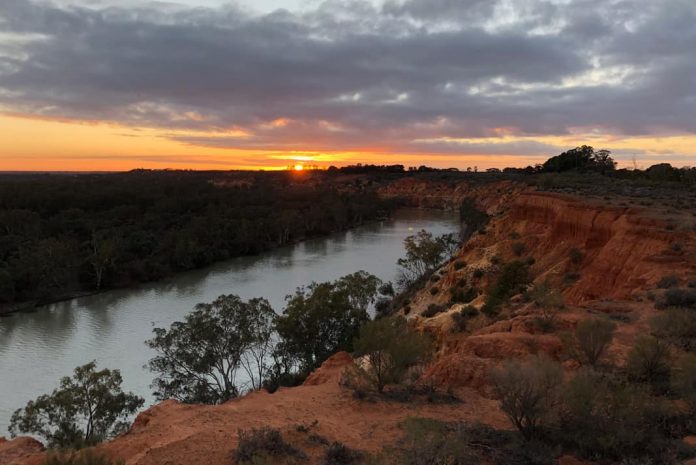
Passing through three states—New South Wales, Victoria, and South Australia—the Murray boasts a wealth of historical towns, first-rate wine regions and wilderness areas. | Photo: Jessica Wynne Lockhart
Watch Out
Except for Lake Alexandrina, the Murray’s waters are generally safe and calm, and can be traveled end-to-end on the main channel without portaging, though you’ll have to master the locks. In summer, the likelihood of snake encounters increases, but there are no crocodiles this far south.
Don’t Miss
The iconic Massive Murray Paddle marathon (massivemurraypaddle.org.au) stretches 250 miles. Raise money for charity and test your stamina against the hundreds of participants who flock to the five-day event each November.
Diversions
Understanding how the Murray is connected to the land requires getting off the water. The award-winning Murray River Walk (murrayriverwalk.com.au) offers a three-day, 25-mile interpretative tour of the floodplains, bush and cliffs surrounding the Murray and its backwaters.
Outfitters
In addition to a prime put-in spot, Canoe the Riverland (canoetheriverland.com) offers onsite camping, guided tours and maps of the region. For a plush and on-theme stay before or during your paddle, bunk down in their refurbished paddleboat B&B.
Must-Have
Cell phone service throughout inland Australia is spotty. A satellite communications device and snakebite kit are a must. In addition to Renmark-area maps produced by Canoe the Riverland, pick up River Murray Charts for South Australia, New South Wales and Victoria (rivermurraycharts.com.au).

There are few places where you can see history written on the walls—or, as is the case along Australia’s Murray River, carved into the trees.

Paddling through the Murray’s milky-green waters, it’s easy to spot one of the ancient “canoe trees”—so named for the yards-long scars marking their surfaces. For hundreds of years, this is where Aboriginal people painstakingly carved their watercraft from a single piece of river red gum bark.

But despite the area’s long paddling history, the waterway hasn’t always existed. Well, not technically. When explorer Charles Sturt charted it in 1830—describing it as a “broad and noble river” on which he allowed his boats to “drift along at pleasure”—it was flowing. But had he arrived in another month or year? It could have just been a trickle across a dry floodplain.

Once ephemeral, the Murray only became a permanent fixture of the otherwise sunburnt landscape when a series of locks were constructed in the early 20th century. Today, it’s the third-longest navigable river in the world, stretching for over 1,550 miles from the Snowy Mountains to Lake Alexandrina in the south, near Adelaide.

Like Sturt’s crew learned, the Murray is best enjoyed when you drift along it at pleasure. Leisurely days paddling alongside sandstone cliffs the color of orange creamsicles are punctuated only by passing houseboats and occasional sightings of emus drinking from the river’s sandy banks. Countless winding backwaters allow for close-up interactions with birds, kangaroos and echidnas.

“You can spend days out there. You can daisywheel and come back,” says Ruth Roberts, owner of Canoe the Riverland, who finished paddling the entire river from mouth-to-sea in 2013. “It’s the most remote and unspoiled area.”

If you have a half day:

Renmark, South Australia, is the ideal jump-off spot for day trips, including into the Murray’s serene backwaters. Launch at Plummers Creek and paddle your way into the Horseshoe Lagoon, where you may spot mistletoe birds, yellow rosellas or red kangaroos hiding amongst the trees on the nearby floodplains.

[Paddling Trip Guide:Explore More Paddling Destinations]

If you have a day:

Eliminate the need for a shuttle with a nine-mile loop of Ral Ral Creek. Starting directly in Renmark, paddle up toward Kylie Creek and loop around the first island before shooting back out onto the main channel towards town. Nearby Bulyong Island is a favorite amongst local paddlers—separated from the mainland, this national park and waterfowl habitat is only accessible via watercraft.

If you have a weekend:

Two days gives you time to explore both the river’s expansive main channel and the winding backwaters of Chowilla Creek (pronounced “chow-la”). Making your way downstream, stop at Headings Cliff Lookout for sublime views. After passing by the shipwreck of SS Kelvin, set up camp at Wooleneck Bend. Once the site of a World War II internment camp, ruins still remain.

If you have a week:

Not for the faint-hearted, the most remote section of the river, between Wentworth and Paringa, is worth the effort. Once a shipping route, this secluded 137-mile stretch of water starts where the Murray and Darling Rivers meet in New South Wales, and ends at South Australia’s Customs House, the historic toll point for paddle steamers.


Passing through three states—New South Wales, Victoria, and South Australia—the Murray boasts a wealth of historical towns, first-rate wine regions and wilderness areas. | Photo: Jessica Wynne Lockhart

Taking a Paddling Trip Down Memory Lane

“Sometimes you will never know the value of a moment until it becomes a memory.” —Dr. Seuss | Photo: Andy Zeltkalns

What value do wilderness trips have in your memory?” I ask my wife, Tory, over a Saturday afternoon lunch in our urban backyard as we contemplate the coming summer and the paddling trips we have planned.

Tory lets out a deep sigh, as if I’m asking her to lift anvils.

“You are the most philosophical person I know,” she groans, taking a bite of her B.L.T. “I don’t know how you live with yourself.”

“I can’t help it,” I tell her. “Seriously though, what do your past trips mean to you? Do they have any present value?”

I have been dredging up notebooks and memories of my 80-day kayak trip on the West Coast because I want to write a book about this 17-year-old adventure. I think of it as a midlife-crisis project. The trip seems extra valuable to me now simply because it would be so impossible to repeat.

When my paddling partner, Dave, and I had boastfully called it the trip of a lifetime, we couldn’t have imagined how right we were. Who has that kind of time now? Not a home-owning, forty-something-year-old dad of two.

The central question I’ve been struggling to answer before I can write about my trip is what relevance the memory of it has to my life now. Thinking about this has made me hyper-aware when we go on trips, we do not just have experiences, we’re also creating memories. Yes, this seems dully obvious, but how often do you think about what the point of a trip will be once it’s over? Would we approach trips differently if we were conscious we were in the process of creating memories?

“Well, I guess trips are mementos of a life well-lived,” Tory concludes.

[Paddling Trip Guide: View All Kayaking Trips]

“So, does it matter how many you went on, or could you have just gone on one?” I’m looking around at the city backyards surrounding ours. The neighbors’ houses overlook us like we’re in a fishbowl, contrasting sharply with the contents of my thoughts—deserted and wave-battered Pacific Coast beaches, granitic islands rising out of Canadian Shield lakes, sheltered by towering white pines.

“No, it matters. The more, the better,” she tells me.

“So, trips are like the contents of a treasure chest or a storehouse of memories you horde?”

“Yes, like shiny pebbles or a squirrel’s nuts. I can bring them out and shine them and admire them from time to time.”

“But you’re not admiring them now?” I ask.

“No, not at all. I only really think about them when I’m going on another trip. That’s my opportunity to bring them out and look at them again,” says Tory.

This is a big difference between Tory and me. She tucks her trip memories away like the way she folds her smoky quick-dry clothes into a bottom drawer, and dutifully busies herself with the alternate reality of city life. Her memories are like photos stored away in an album—nice to have but usually forgotten. Whereas I’m always turning mine over and caressing them like Gollum’s one ring, pondering their meaning, wondering if my current life does them justice.

My relationship to memories is not as pragmatic as my wife’s, but I can’t imagine life any other way. Trip memories are my guide and inspiration—for the work I do, our choice to live close to the lake, the dwarf white pine planted in our front garden beside a chunk of granite we hauled home in a canoe barrel from Temagami. Wilderness memories shape who I am.

My friend Dave says thinking about the 80-day trip we shared makes him feel melancholy because it was the best 12 weeks of his life. But it’s also inspiring, a constant reminder of how good things can be.

Trip memories make me frustrated too, because I compare the shortfalls of my current life to the highlight reel of my past. I sometimes run roughshod over my days, castigating them precisely because I’m not outside on a kayaking trip or in a beautiful wilderness area. But of course, why else do we go on trips than to seek experiences that will stand out as extraordinary and more memorable than regular life?

I recently reminisced with a friend about a trip to France. I remember hiking the glaciated flanks of Mont Blanc and the white cliffs of the Mediterranean Sea. He can remember every model of Peugeot and Audi we drove. Human perception is selective. We only notice a small fraction of what is going on, and we only remember what we notice.

paddling trip memory
“Sometimes you will never know the value of a moment until it becomes a memory.” —Dr. Seuss | Photo: Andy Zeltkalns

Thinking about this conscious creation of memory gave me reason to pause the other day on the way home from dropping my kids off at school. I anxiously waited for the light to change to cross the street, annoyed at wasting 30 seconds. Then I had a meta-awareness of some future time when I will struggle to remember this particular day. “I’ll probably wish I’d been a bit less impatient and actually noticed something,” I thought. I took a deep breath and looked around. It was a dull grey spring morning. Cars zipped towards downtown in rush-hour traffic. People stood idly at the bus stop. A billboard advertised a new brand of watch. That was weeks ago, and I can still remember it crisply.

We can choose what and how we remember. And we should choose wisely because memories are the building blocks of our selves—our identity, our choices, our perception of what we can and can’t do. “Knowing I can do things next year even if I was scared of them last year,” is my 10-year-old’s response to my question about trip memories. “Like the jumping rock. I know I can do it this year because I did it last year even if I was scared, and it was really fun.” Her trip memories are place markers of where she left off the summer before.

Our family trip this summer involves a very long journey to a hard-to-get-to lake in the heart of the Boundary Waters wilderness. This is Tory’s inspiration. We could go anywhere, but this lake is calling to her, out of her metaphorical treasure trove of memories. She went there as a teenager on summer camp trips, and she brought me there the year we were engaged. Now we’ll return with our kids, to the same perfect island campsite with a good jumping rock.

It will feel magical to arrive at this place we’ve been holding in memory for the past 13 years and discover that it’s still there, like we’re paddling into some parallel universe where all our dreams exist in reality. We’ll set up our tent in the same flat spot and tie our hammock to the same trees overlooking the water, and in the process knit our new experiences together with the previous ones. We’ll tell our kids about the times we went there before, so our stories will become a part of their memories too. They’ll measure their boldness against the jumping rock. And then we’ll all return to our regular lives, each carrying something slightly different home with us. And long after our sunburns fade and the seasons change, this will remain.


Tim Shuff is a former editor of Adventure Kayak magazine, and a firefighter on the north shore of Lake Ontario.

“Sometimes you will never know the value of a moment until it becomes a memory.” —Dr. Seuss | Photo: Andy Zeltkalns

Sea Kayaking In Antarctica: Small Spaces, Tall Places

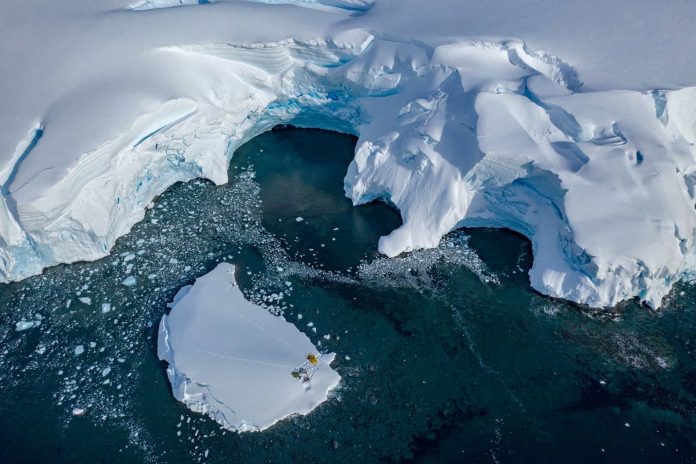
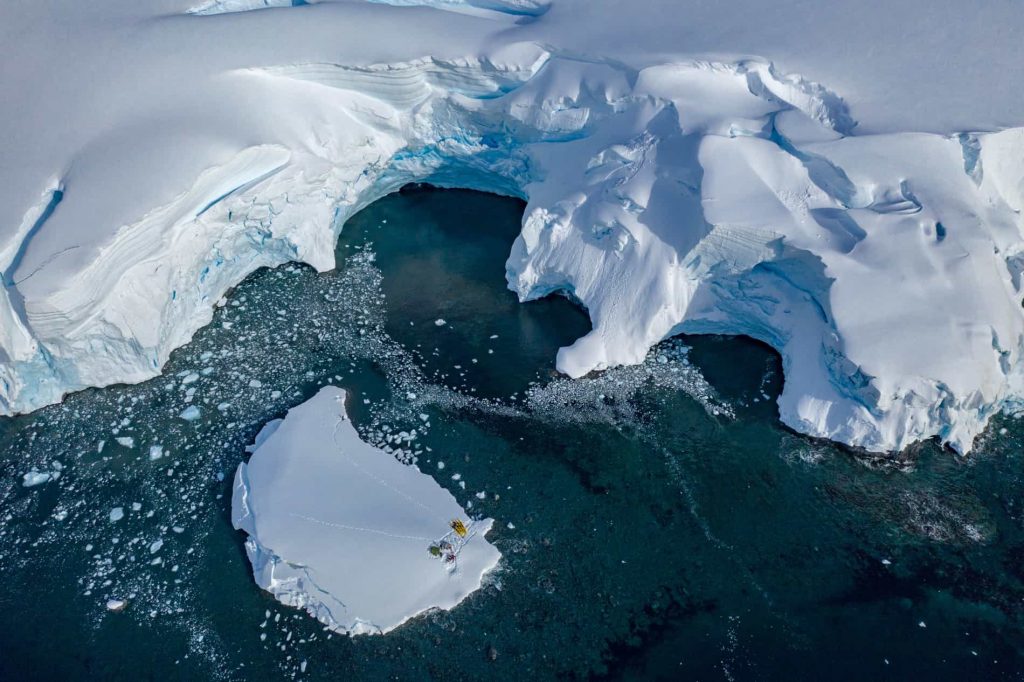
Antarctica is the coldest, windiest, driest and highest continent. Who’s in? | Photo: Steve Ruskay

With the main sail full of wind and favorable seas, the last mountain peak of Cape Horn dipped below the northern horizon. The sleek hull of the Spirit of Sydney, an open 60-foot aluminum sailing yacht, slid easily through the waves and swell. Our fleet of kayaks was secured to the forward deck for the journey south. Destination: Antarctica, 500 nautical miles across the Drake Passage.

The Spirit of Sydney is an Australian-flagged, single-mast sailing vessel retrofitted for Antarctic charters. With a crew of four and five keen passengers, it set sail from Ushuaia, Argentina, fully laden with provisions to be self-sufficient for the 25 days.

I felt small at sea, especially on the infamous Drake Passage. The raging seas here have helped keep the continent a pristine, natural wonder. It’s the largest protected ecosystem in the world, and one of the most fantastic sea kayaking destinations.

Access to Antarctica is strictly regulated. Most travelers prefer the luxury and comfort of a cruise liner. However, vessels with more than 12 passengers face additional regulations, which limits where and how kayakers can travel or conduct expeditions. Small sailing yachts provide access to more remote and less-traveled areas, as well as the freedom to paddle out on multi-night kayak camping excursions. Traveling on small vessels also eliminates the noise and bustle of large ship excursions.

[Paddling Buyer’s Guide: View All Sea Kayaks]

Waking up in a tent beside the largest piece of ice on Earth is an indescribable feeling. Camping in Antarctica is a thrill just a tiny fraction of Antarctica’s 45,000 annual tourists experience. An expedition here requires a great deal of skill and planning. Landing options can be hazardous, and the weather and ice conditions can quickly turn. On this early season trip, the seasonal snowpack proved to be a challenge. At high tide, beaches and intertidal zones vanished, and the water met the three-meter-deep snowpack. The first order of business when setting camp was to dig a way up on to the land and eliminate any snowfall hazards. Mechanical haul systems helped raise the kayaks off the beach. Using snowshoes, the team created a small kitchen area and tent platforms. This was full winter camping from a kayak, and we followed stringent leave no trace regulations.

Antarctica is the coldest, windiest, driest and highest continent. Who’s in? | Photo: Steve Ruskay
Antarctica is the coldest, windiest, driest and highest continent. Who’s in? | Photo: Jerry Ricciotti

In the Peltier Channel, spectacular mountainscape meets wild seascape. The nine-mile paddle towards Port Lockroy is one the most fantastic kayak excursions any paddler could dream up. Towering jagged peaks have marked the entrance for mariners for more than 100 years. Massive glacier-clad peaks rise out of the ocean, and gentoo penguins playfully swam around our kayaks. Humpback whales have recently arrived in these rich waters and are busy feeding. The cove was frozen with seasonal sea ice, which made for a perfect and smooth landing for our kayaks, and a BBQ off the after deck of the Spirit of Sydney, as she was safely nosed into the sea ice as well.

Pleasant weather must be enjoyed to the fullest because it’s never long before another storm is on the horizon. Preparations made and hatches battened down; careful calculations determine when the optimal weather window is to start the return voyage back to South America. And then we return North.

While I’ve have had the opportunity to travel on several ships, by far, a sailing vessel offers the best travel off the beaten path in Antarctica. Small spaces sometimes get you to the tallest places.


Steve Ruskay is a Kokatat ambassador, the lead guide for Black Feather, and an expedition guide aboard the Spirit of Sydney.

Antarctica is the coldest, windiest, driest and highest continent. Who’s in? Photo: Jerry Ricciotti

The Antidote To Soft

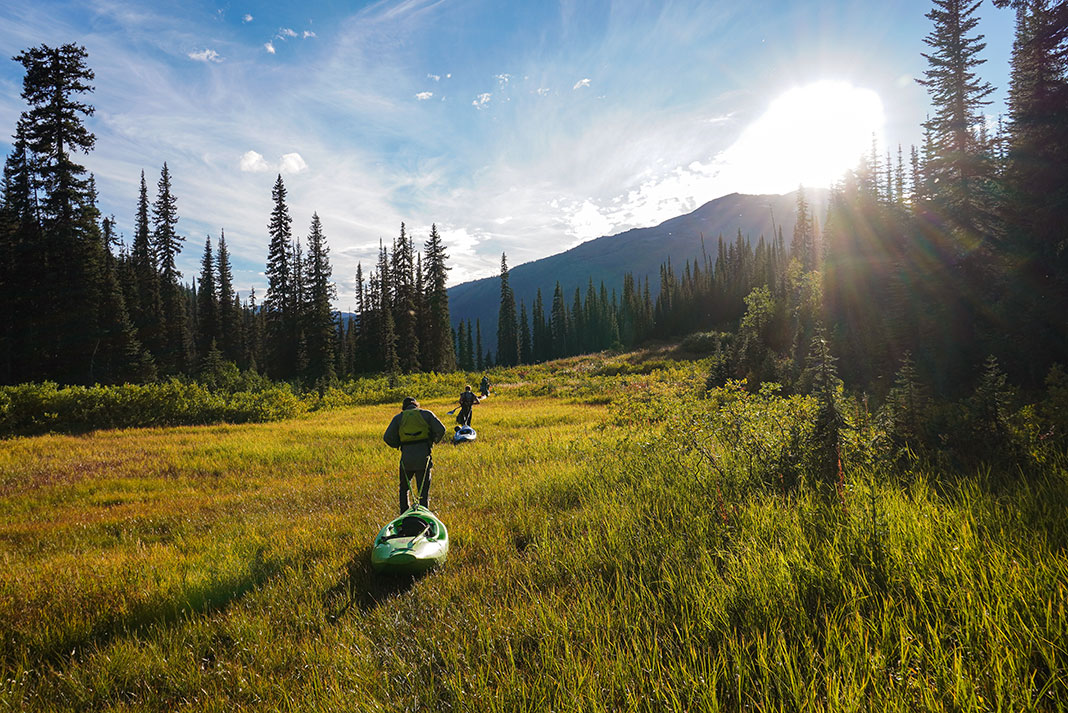
people tow whitewater kayaks on portage through a grassy field in the hills
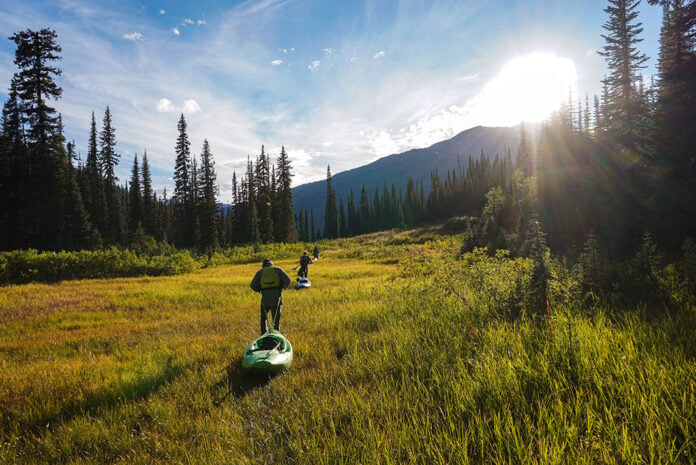
Jeremiah Say wrote, “Complaining is an energy-draining habit. Redirect that energy towards things that bring you joy and growth.” Like say, the river, if we ever find it. | Feature photo: Oliver English

Recently, I read irreverent travel writer Chuck Thompson’s To Hellholes and Back, a hilarious account of his pilgrimage to the world’s most ill-reputed places—the Congo, Mexico City, India, Disney World—and started thinking about how being a good paddler is like being a good traveler, which, in turn, is like being a good citizen.

The antidote to soft

Thompson explains this journey was inspired by a belief that “there’s value in doing things the mind cautions against… Comfort is the enemy of creativity.”

He goes on to lament: “We’ve become soft. Like Jell-O. You. Me. Everyone… Our edges have been beaten away by trophies handed out just for showing up; schools that no longer make kids memorize multiplication tables; doctors who pass out brain meds like Skittles; and therapists who indulge the public’s every impulse to whine and wallow in self-obsession.

people tow whitewater kayaks on portage through a grassy field in the hills
Jeremiah Say wrote, “Complaining is an energy-draining habit. Redirect that energy towards things that bring you joy and growth.” Like say, the river, if we ever find it. | Feature photo: Oliver English

“We’re turning into a nation of fearful twats, obsessed with supposedly tragic childhoods, lousy parents, career disappointments, social outrages, political grudges and long lists of personal grievances that until recently were collectively known as the human fucking condition.”

[ Browse the widest selection of boats and gear in the Paddling Buyer’s Guide ]

Thompson is ranting in his typical style: opinionated, abrasive and, unfortunately, largely accurate. He concludes with this pearl about his travels: “…while not always pleasant, [they] usually end up leading to some surprising and enlightening discoveries.”

The river toughens us up

Paddling, too, is a departure from our everyday marshmallow constitutions. We are forced to consider the well-being of others in our fraternity on the river—not doing so could literally be life or death. We must shed the self-absorbed, cut-off-thy-fellow-driver, too-lazy-to-hold-the-door existence of civilized life. On the river, there’s no pouting on the bench, no adjusted average grades, no second and third changes. No hand-holding.

When even breathing the word discipline can have teachers thrown out of their classrooms and social workers knocking at your door, we are not accustomed anymore to our actions eliciting real, palpable—and sometimes painful—consequences.

The river demands our full attention, our best performance. It does not hold back, carelessness and indifference are punished. The river is the anti-soft.

The river demands our full attention, our best performance. It does not hold back, carelessness and indifference are punished. The river is the anti-soft.

As paddlers, we willingly embrace the discomfort, danger and demands of the river. It’s the same quest for personal challenge driving mountaineers to the Eiger North Face, sailors to the Sydney-Hobart Yacht Race and cyclists to the Tour de France.

Tough guys. | Photo: Steve Rogers

As citizens, we could all do well to toughen up. I don’t mean we should strive to be fearless or hard-core. Just that we should frequently, and purely for our own growth, leave our comfort zones and face that which scares, or worries, or even merely surprises us.

Where Thompson endured 18-hour flights in coach cabins, explosive digestive ailments, “synthetic American culture at its overcrowded worst,” rampant Congolese corruption and intimidation, run-ins with handless Mumbai beggars and jostling with 50,000 “shitfaced soccer hooligans” in a Mexico City stadium, we paddlers need only the river.

Class III or class V, 10-footers, numb toes, long swims, white-knuckle shuttles, blown tires, missed take-outs, gasket rash, soggy sandwiches, warm beer, muddy walks out after dark…it’s all there—the antidote to soft.

Virginia Marshall’s first article for Rapid Media appeared in the Spring 2007 issue of Adventure Kayak. She went on to become editor of Rapid and Family Camping for the Spring 2009 issues, and eventually editor of Adventure Kayak and Canoeroots in 2011.

Cover of the 2023 Paddling Trip GuideThis article was first published in the Early Summer 2012 edition of Rapid Magazine and was republished in the 2023 Paddling Trip Guide. Subscribe to Paddling Magazine’s print and digital editions, or browse the archives.
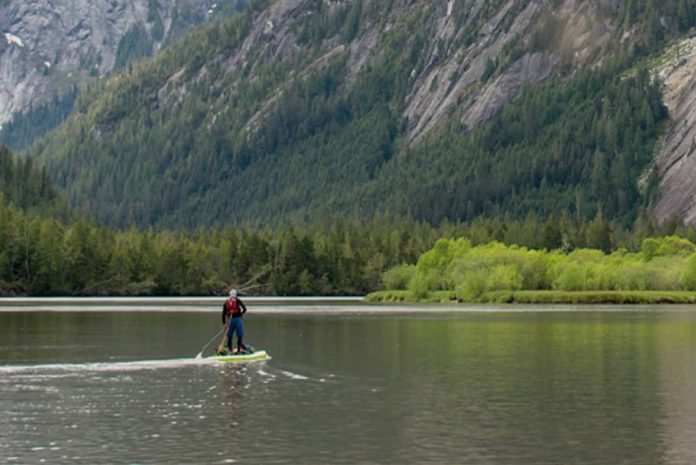

Jeremiah Say wrote, “Complaining is an energy-draining habit. Redirect that energy towards things that bring you joy and growth.” Like say, the river, if we ever find it. | Feature photo: Oliver English


Where The River, Ocean And Mountain Gods Meet

Sup in the mountains
A moment as perfect as we have ever known. | Photo: Bruce Kirkby

This past spring, Norm Hann and I set out from the Gitga’at community of Hartley Bay, tucked in the deep fjords of northern British Columbia’s Great Bear Rainforest. Our goal was to follow an ancient and long-disused section of a traditional Grease Trail, once employed by Coastal First Nations carrying oolichan grease to the interior, where it would be traded for furs and meat.

For years, Norm—the pioneer of the Stand conservation project and an adopted member of Gitga’at Raven Clan—had heard whispers of the route. Traveling up the Quall River, the path led over a portage, into the mysterious Ecstall drainage, and finally down to the Skeena River. Being long-time SUP expedition enthusiasts, Norm and I saw it as a perfect test; taking us upstream, through rugged bush, down unknown rapids, and finally out onto the open ocean. After receiving the blessing of Gitga’at elder Helen Clifton, and invaluable route advice from community members, we set out, carrying seven days of food and minimal camping equipment on inflatable paddleboards.

For two days, we pushed up the Quall, as it slowly shrank into an ankle-deep creek. With fins off, we dragged our boards over rocks, across tumbled log jams, and through thickets of prickly Devil’s Club. Soon exhaustion set it and progress slowed to a crawl. Shins and forearms grew scratched and bloody. It took three hours to cover a kilometer.

[Paddling Buyer’s Guide: View All Paddleboards]

“You’ll know the portage trail when you see it,” Spencer Greening told us, a young First Nations archeologist working in the region. “You’ll know many feet have walked there.”

I wondered how a trail could still exist after a century of neglect, but Spencer was right. Abruptly, amidst rocky slopes and Avatar-like Sitka spruce, an unmistakable trail materialized, leading over the mountains and to the sandy banks of Ecstall. That night we camped in the shadow of a driftwood log, 10 feet in diameter.

The next day we launched in drizzle, unaware and unprepared for the wonders awaiting us downstream. The river was playful, weaving and turning as it descended class III boulder gardens. Elsewhere it was glassy-smooth, a crystal-clear conveyor belt, carrying us into the largest intact-yet-unprotected old-growth rainforest on the British Columbia coast. Amid this world of tangled brush, lush green and constant birdsong, the overriding sensation was not the uniformity we have grown accustomed to in second and third growth stands, but rather an unspoiled wildness; the sense that everything was exactly where it was supposed to be.

Where the river, ocean and mountain meet
A moment as perfect as we have ever known. | Photo: Bruce Kirkby

For three days the waters of the Ecstall grew until it felt more like a fjord than a river. Silt caked the banks. Tides pushed and pulled us back and forth. And it seemed we had left the great, hidden wonders behind. Then we rounded a corner and came face-to-face with granite monoliths of a scale and grandeur rivaling Yosemite. Paddling to the base of the steepest cliffs, we lay speechless on our boards for hours, warmed by the sun, munching on energy bars, while gazing upwards at the impossibly sheer walls of rock. It was a moment as perfect as I have ever known.

We would later press on, past log booms and busy shipping-container ports on the ocean, to the First Nation village of Metlakatla, north of Prince Rupert, but by then, the wilderness had released us.


Bruce Kirkby is a photographer and writer living in Kimberley, British Columbia. A Starboard team rider, his third book, Kingdom of the Sky, will be released in fall 2020.

A moment as perfect as we have ever known. | Photo: Bruce Kirkby

National Boating Industry Safety Award Winners

National Boating Industry Safety Awards Logo

Southold, NY, December 10, 2020 – The Sea Tow Foundation and its North American Sober  Skipper Advisory Council announced winners of the  National Boating Industry Safety Awards  which recognize the best boating safety work in the for-profit section of the recreational boating  industry. Sponsored by  KICKER Marine Audio , the six top contest winners were revealed in a  special awards recognition segment held during the Marine Retailer Association of America’s  virtual Dealer Week on December 10, 2020.  

The  Top Powerboat Manufacturer Award  was presented for the second year to  Sea Ray Boats. 

Sea Tow Foundation Executive Director Gail Kulp said, “Sea Ray’s messaging clearly shows a  corporate commitment to a strong boating safety culture with a special emphasis on new  boaters,” she said. “They successfully incorporated the COVID-19 pandemic into their safety  messaging through multiple platforms including videos, photos, customer emails and social  media posts.” 

Another second-year repeat winner is  MarineMax  who took home top honors in a new category  for the  Top Marine Retailer with More Than Three Locations.  

“MarineMax showcased a solid, proven plan for providing boating safety education and they were able to adapt this to the constraints imposed by the COVID-19 Pandemic,’ said Kulp. “While previous years allowed for their educational classes to be conducted in person, their virtual classes attracted as much boating participation if not more than previous years.”  

National Boating Industry Safety Awards Logo

A new category was  Top Marine Retailer with One to Three Locations,  and it was won by  Bridge  Marina, Inc.  of Lake Hopatcong, NJ.  

“Bridge Marina, Inc. clearly put a lot of work into creating a multi-faceted safety program  specific to the area and type of boat people are using,” said Kulp. “They have developed an  integrated marketing campaign including web, social, phone follow-up and in person that  appears to be quite successful in reaching the intended audience. For a small company with  limited resources, their campaign represented an impressive effort to promote boating safety.” 

Due to the important role marine media play in how they position boating safety among their  readership or viewership, the Sober Skipper National Advisory Council created a special  category last year to recognize top media for their outstanding contributions in consumer  education and marketing. The 2020 award for  Top Marine Media Outlet Award  was won by  Rapid Media  which focuses on the human-powered/paddling market. 

Kulp noted, “Rapid Media offered a solid campaign featuring a mix of digital ads, pre-roll, video, e-blasts, newsletters and contests to promote their boating safety messaging to the paddling  community. Their videos were especially well done, relevant and authentic.”  

The  Top Marine Marketing and Outreach Award  was won by   Freedom Boat Club  who last year  received a special Sober Skipper Award for its national adoption of the Sober Skipper program.

Said Kulp, “Freedom Boat Club delivers clear, concise and consistent safety messaging and  programming to a well-defined and highly targeted audience. They utilized every touchpoint  available to communicate their messaging, coupled with a solid national boater education and  training program. Safety is clearly a big part of their overall operation.” 

Another new category for 2020 and one of the highest scoring submissions was the  Top Gear &  Equipment Manufacturer Award  won by  FELL Marine. 

“FELL Marine knows its core demographic and provides outstanding demonstrations on their  website to educate customers on how to install and use a wireless man-overboard device,” said  Kulp. “They provided a diverse selection of many high-quality advertising materials to review and  outline future business opportunities to increase the adoption of their product and further  promote boating safety.” 

“Our Sober Skipper Advisory Council and Sea Tow Foundation are extremely pleased by the  growth of this awards recognition and the quality of the work being done by recreational for profit, boating industry organization to promote boating safety,” she said. “We also appreciate  the hard work of our council members in judging this year’s competition and the support of our  sponsor KICKER Marine Audio in making this year’s competition even more outstanding.” 

For more information about the North American Sober Skipper Advisory Council and the  National Boating Industry Safety Awards, visit  www.boatingsafety.com/awards  where a video of  the awards presentation from Dealer Week will be available along with future highlights of each  award winning company and campaign.  


Members of the Sea Tow Foundation’s North American Sober Skipper Advisory Council  include  David Connolly, Thomas H. Connolly and Sons; David Dickerson, NMMA; Jim Emmons, Water  Sports Foundation; Kevin Falvey, Bonnier/Boating Magazine; Adam Fortier-Brown, MRAA; Mike  Hankins, American Marine Sports; John Jost, Ken Cook Company; Captain Keith Lake,  MarineMax; TK Krumenacker, Admiral’s Insurance Corp; Dave Marlow, Brunswick Corporation;  Tyler Mehrl, Mercury Marine; Mark Pillsbury, Cruising World Magazine; Angie Scott, The Woman  Angler & Adventurer; Eric Shepard, retired; Captain Frank Stoeber, Regal Boats; Nic Thomas,  Freedom Boat Club; Stephanie Vatalaro, RBFF; Annamarie Worrell, Emerald Coast Marine Group;  and Leslie Zlotnick, Yamaha Watercraft Group. The council’s executive committee includes  Kristen Frohnhoefer, Sea Tow Services International; Gail R. Kulp and Michael Wesolowski, Sea  Tow Foundation; and Wanda Kenton Smith, Kenton Smith Marketing.  

Sea Tow Foundation 

With a focus on safe boating practices that result in fun on the water, the Sea Tow Foundation – a 501(c)(3) nonprofit organization – was established in 2007 by Sea Tow Founder Capt. Joe  Frohnhoefer. After his passing in 2015, Captain Joe’s legacy continues as the Foundation brings  attention to the number of preventable boating-related accidents, injuries, and deaths, and  directly addresses prevention methods through education and awareness. More than 750 life jacket loaner stands are now available across the United States and the Foundation’s Sober  Skipper program continues to grow. For more information on the Sea Tow Foundation, please  visit BoatingSafety.com.

11 Top YouTube Canoe Channels According To Kevin Callan

Just half-a-dozen years ago, paddlers had only a few channels on YouTube to binge-watch to get inspired for the next canoe trip; mini video celebs like Maddy the Goose and the then-up-and-coming Joe Robinet filled the void. Now we have a seemingly endless list of paddling personalities filming their time out canoe tripping. And there’s enough subscriber swag out there to fill a 17-foot prospector—twice.

Some are big stars, like the Baird brothers and Les Stroud. Others are diamonds in the rough, like Single Malt and Maps, Pray for Nathan, Kevin Outdoors, Canoe The North and PineMartyn. Some dwell mostly on how-to tips and tricks. Others share extensive wilderness journeys. Some do both.

[Discover the best gear of the year in the Paddling Buyer’s Guide]

Below are 11 of my favorites that tend to pop up in my recommended pile more often than not. They’re not necessarily the vloggers with the most followers, but they are enthusiastic paddlers armed with a video camera and a solid data connection, who make excellent paddling content with soul. 

Jason’s films—I wouldn’t call them mere videos—are a work of art. This guy is amazing. He captures the true essence of wilderness canoe travel like no other. I literally jump with joy when I get a notification that he has another trip account up on his channel. I just wish he had more.

Daryl Phillips channel has stunning visual content, heartwarming soundtracks, and absolutely pure and honest (and sometimes spiritual) motivation to get you, and especially your family, out paddling.

Chris is an amazing filmmaker and storyteller. Her channel will captivate you. Guaranteed. The videos are a mix of Chris’ outdoor travels with her spouse, Julia, and son, Cedar. My absolute favorite are the Algonquin canoe trip series—and when her and Julia go and cut their own Christmas tree and portage it in a canoe barrel. Totally awesome!

Alex Traynor and Noah Booth are two young, enthusiastic outdoorsy guys who have taken on some major remote canoe trips. The footage is great, editing and music superb, the fish they haul into their canoe are huge, and their enthusiasm for being on trip is absolutely genuine.

Jonathan Kelly, as well as his partner, Erin Elizabeth, have gained incredible popularity with Backcountry Angling Ontario. Jonathan has an addiction to the backcountry that is irreversible, intense and insatiable. It’s obvious he loves being out there, especially on a secluded lake with a canoe rod in his hand. His work has a poetic flare to it, with a voice-over tone similar to Bill Mason’s Waterwalker.

Brad Jennings started up his channel a few years back after a television pilot, shot with his dad Wayne, got kiboshed. He then turned to YouTube – and hasn’t looked back since. The excursions now include Brad’s wife, Leah Schmidt. Together, they embark on countless adventurous and exploratory canoe trips, mostly rediscovering long forgotten ‘lost’ routes. Brad should be applauded for all his work on getting attention to places less paddled.

A woman solo canoe tripping seems to be a rarity on YouTube, but Christina Scheuermann is helping to change that. Thanks to her and the solid trips she embarks on and documents for others to enjoy, there’s sure to be a lot more solo women on the portage. 

Dennis Rogers’ channel has a blend of trips and tips, but his claim to fame is his weekly Canoehound’s Outdoor Adventure Show where he livestreams interviews with a mix-bag of paddlers (with audience participation). It’s an addictive show. I’ve been on it so many times he’s started labelling me his Ed McMan, of Johnny Carson fame. Dennis offers solid content that shouldn’t be missed.

Hailey Sonntage is a recent graduate from Mohawk College’s Television Broadcasting and Communications Media and now runs Run Wild Media. However, she has her own personal channel documenting all her outdoor trips and tips. She has a few backpacking treks with her mother, but by the look of her facial expressions throughout, you can tell she prefers making canoe videos. 

Justin Barbour

Justin sure makes his home province of Newfoundland proud. His charisma and spunk shine in every one of his arduous canoe tripping series where he paddles across the remote and beautiful landscapes of Newfoundland and Labrador. Each video exemplifies true wilderness canoe tripping.

Waboose Adventures

Cobi Sharpe is probably more known in the canoe world for her photographs and blog. Not sure why? Her YouTube channel really does an amazing job defining what a normal canoe trip is all about – and she has some amazing tips added along the way as well.

Main Image: Courtesy Ontario Tourism