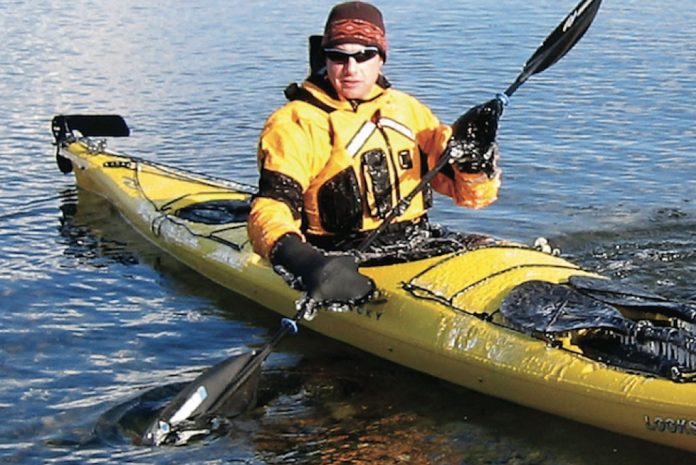
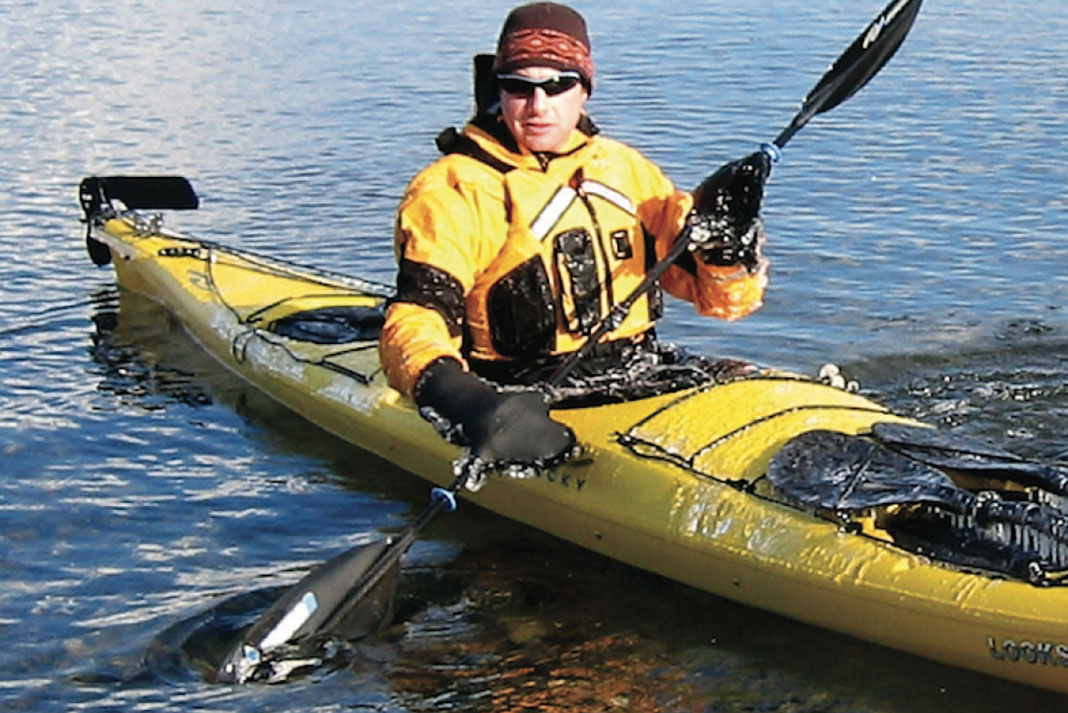
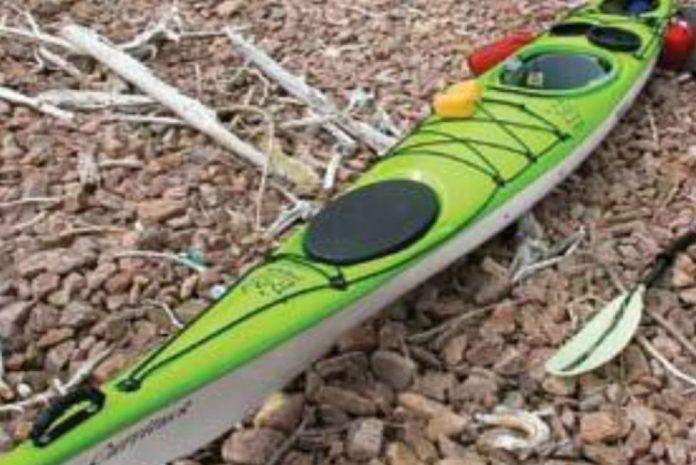
We recently took the Impex Currituck (formerly the Formula Pursuit in Canada) on a two-week trip to the Southeast Coast of Newfoundland, where it was paddled by our photographer, who had limited sea kayaking experience.
Impex Currituck Specs
Length: 17’
Width: 21.5”
Cockpit: 16” × 30”
Volume: 80 U.S. gal
Weight: 55 lbs (fiberglass)
MSRP:$2,995 USD or $3,095 CAD
[ Plan your next Atlantic Canada sea kayaking adventure with the Paddling Trip Guide ]
The Currituck performs with ease
The Currituck is the third largest of Impex’s four “performance touring” kayaks which emphasize a balance of turning and speed for all-around use. Impex bills it as a “performance Greenland-style boat that is easy to paddle.”
We chose the Impex Currituck because with bow, day and stern hatches of 57, 34 and 72 litres respectively, the Currituck has excellent capacity—slightly more than the popular expedition kayak the NDK Explorer—yet is built for average-sized paddlers. It’s rated for paddler weights of 150 to 220 pounds, and the metal foot pegs are set for shorter than six feet tall. The “ideal” Impex Currituck paddler would be about 5’9” and 160 pounds.
[ Paddling Buyer’s Guide: See all sea kayaks for average-sized adults ]
At 17 feet the Currituck falls neatly between the lengths of popular, comparable boats like the Romany (16’) and Explorer (17’8”).
Among the swells
On day one, we paddled in five-metre swells in the wake of a tropical depression, thus confirming the boat’s user friendly performance in high seas. The Valley hatches proved to be completely watertight, keeping the camera gear dry.
Shortly after, we permanently kinked the skeg table and thus learned the Currituck performs reasonably well in crosswinds and following seas, weathercocking only slightly.
The medium-hard chine and shallow-V hull provided a combination of primary stability for taking photos, and secondary stability for easy edging and predictability in rough water. Some find it slightly tippy unloaded (which facilitates edging), but stable when loaded. A few testers observed that the Impex Currituck’s secondary stability has some “falling points” through a roll, as opposed to smooth transitions, but most were impressed with its edging, rolling and sculling performance.
The two other boats on our trip were Valley Nordkapps, which are unfairly eight inches longer and renowned for speed. The Currituck was of average speed by comparison, but easier to manoeuvre with its shorter length and harder chines.
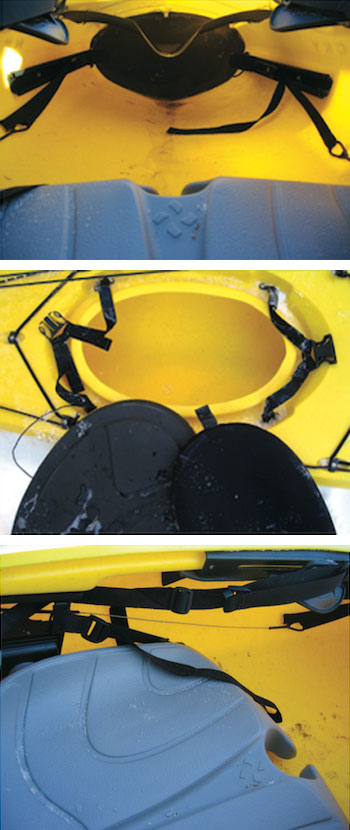
Impex kayaks, made in Ontario, Canada, were among the first in North America to have fiberglass bulkheads and seams and are one of the few that still have fiberglass seats. The seat is comfortably padded with an Immersion Research neoprene pad and a very cushy, adjustable, gel-core back band.
Among the Currituck’s many features are two sets of carrying handles, one for rescues and the other for boat carrying. Rounded, duckbill-shaped ends also make it easy to grab the hull to carry a fully loaded boat.
Get all-around performance with the Impex Currituck
Overall, the Impex Currituck delivers a textbook compromise between touring capacity and playfulness, between tracking and turning. Justifiably popular, this is an excellent, full-featured, all-around touring boat at a reasonable price, suited for midsized paddlers of all abilities.
This article was first published in the Spring 2008 issue of Adventure Kayak Magazine. Subscribe to Paddling Magazine’s print and digital editions, or browse the archives.
A name like Booster would be almost condescending if not for Riot’s sculpted detailing, superhero graphics and metallic finish that make sitting in the boat feel like you are in Batman’s secret new play machine. With the Riot Booster kayak, angular edges and crisp detailing are maintained while adding some innovations that push the limits of forward-thinking outfitting.
River Running Capacity:
80-130 / 130-180 / 170-220 lbs
MSRP:$1,495 CAD
[ Paddling Buyer’s Guide: See all kayak playboats ]
Strap in with the Riot Booster
The first thing you will notice about the Booster is Riot’s new Elastomer Outfitting, a totally new concept in kayak cockpit design. It looks like a rachet-buckle-crazed snowboarder outfitted the boat. There are five beefy rachet buckles: two on the backband, one between your legs for the adjustable bulkhead footrest, and one on each thigh strap, yes thigh straps. You just sit down on a sculpted foam seat and start cranking ratchets to dial in your fit without spending a day working with bulk foam and contact cement.
Rethinking the kayak cockpit
The thigh brace system is the largest departure from traditional outfitting. You still use the inside of the deck as the primary thigh braces, but the thigh straps stay in contact with your legs when you relax them. We couldn’t quite figure the system out, so we contacted Corran Addison for his design perspective.
“It’s like wearing a soft snowboard boot rather than a hard boot. The soft boot has hard contact points under the boot, and the high back behind the boot. But the boot itself flexes and follows your movements, while a hard boot simply restricts them.”
Does it work in kayaking? Well, we’re not sure the thigh straps contribute to more boat control but we didn’t notice any lack of control either. It just feels different. We did notice a comfortable, flexible feel while sitting in the eddy and despite all the ratchets and buckles you don’t need to be a whitewater Houdini to enter and exit the Riot Booster.
[ Plan your next kayak river running adventure with the Paddling Trip Guide ]
The rigid backband is mounted to a fixed plastic pillar keeping the backband in position. Add a vertical height adjustment and this is an ideal system that we’re sure will be ripped off.
The Booster makes smooth transitions
Riot is known for edgy, high performance hull designs that are more than a handful for your average paddler. But not the Riot Booster kayak. It is forgiving, super stable, and predictable due to a softer edge between the release chine and the sidewall of the boat. Riot has always had low, sharp seam lines—the Booster has a higher, softer seam line. At first it feels like Riot may have tuned the performance out of this boat to make it easy to paddle. Not true.
A playboat isn’t just about busting moves on a wave, it is about transitions—getting out onto the wave, recovering from a move not-yet-nailed, and getting down-river to the next spot. The Booster makes all the transitions that much easier, helping you save your energy for on-the-wave fun. The Riot Booster planes into a slightly nose-up position riding over seams and deflection waves. Hitting eddies is confidence inspiring, with no secondary edge grab common with many high performance boats.
The Booster has less of the super fast carve of many Riot kayaks, but is no slouch in a good play spot. If you want more play than river running, get in the smallest size you can. The Booster cartwheels at any angle, which allowed testers to ease from flat spins into more vertical moves. Once vertical the Booster is stable and easy to control because of a very even taper from the ends of the cockpit—no cockpit bubble, so no bounce. The large planing surface and rockered ends free of harsh edges makes spins super easy with the trademark Riot ability to carry a spin through the sideways position that carries other boats off the waves.
Overall, the Riot Booster kayak fits into a popular performance category somewhere between the Pyranha Inazones, and dedicated park-and-play boats. If you are looking for more play than your old river runner, but still want to run rivers with confidence there is now a Riot boat for you.
This article was first published in the Early Summer 2005 issue of Rapid Magazine. Subscribe to Paddling Magazine’s print and digital editions, or browse the archives.
When Rocky Balboa hit theatres in 2006 after 16 years sans Rocky, film aficionados scoffed that Stallone had tried and failed to recapture lost glory. Still, we bought tickets and watched anyway. Where the Rocky rebootfailed, kayak designers seem to have scored a knockout with reconceived designs like the Pyranha Z.One kayak, a resurrected version of their InaZone playboat.
[ Paddling Buyer’s Guide: See all Pyranha kayaks ]
Pyranha returns to one of the best
According to Pyranha, when the InaZone was introduced in 1999 to a market predominated by Necky Jives, it quickly became the most popular planing hull boat in the world. Playful and user friendly, it was the kayaking everyman’s do-it-all boat.
In our 1999 freestyle kayak test, Paddling Magazine stated the InaZone was “well on its way to being the best all-round playboat.” Playboating (now Canoe& Kayak UK) magazine even awarded the boat their Kayak Design of the Decade award in 2004 before the InaZone was outmoded by rodeo fever and newer freestyle designs.
The Pyranha Z.One is fun for all levels of paddler
With the Z.One, Pyranha designer Graham Mackereth says he wanted to create a kayak that was more stable, manoeuvrable and comfortable than its predecessor. He set out to design a kayak that would help beginner and intermediate paddlers improve their paddling, but also feel familiar to fans of the InaZone. “We wanted the Z.One to be a really sporty classic kayak that could catch waves, surf, eddy hop and just make it fun to carve your way down a river,” he says.
Mackereth began by tweaking the InaZone’s hull shape—lengthening it and increasing bow rocker to give it greater speed and lift—then moving on to the deck where he raised the knees and rounded out the sidewalls.
Nimble but not unpredictable
Offered in three sizes that stretch from 8’1” to 8’7”, the Pyranha Z.One kayak’s length is compensated by a highly rockered stern that creates a surprisingly short and nimble waterline. Mackereth says softer edges and a loose hull make long surfs on even shallow, fast waves a breeze and the slicey, low volume tail is quick and stable to squirt.
Feature Photo: Virginia Marshall
Our testers noted that the Z.One’s narrow, fast hull accelerated like a rocket on peel-outs and made for quick and slick transitions when carving in and out of eddies or working a surf on a dynamic wave. The Pyranha Z.One’s fast hull also means that the kayak carries its speed and direction after just a few strokes, giving developing paddlers a predictable platform from which to focus on the river.
[ Plan your next kayak river running adventure with the Paddling Trip Guide ]
Work the surf with the Pyranha Z.One kayak
Mackereth says there’s one more important demographic he had in mind while designing the Pyranha Z.One, “Older paddlers who want a cool kayak that allows them to surf and play a bit without hurting their body or ego.” In appealing to these Rocky fans on the river, Mackereth has created a real contender for the modern river play belt.
This article was first published in the Early Summer 2009 issue of Rapid Magazine. Subscribe to Paddling Magazine’s print and digital editions, or browse the archives.
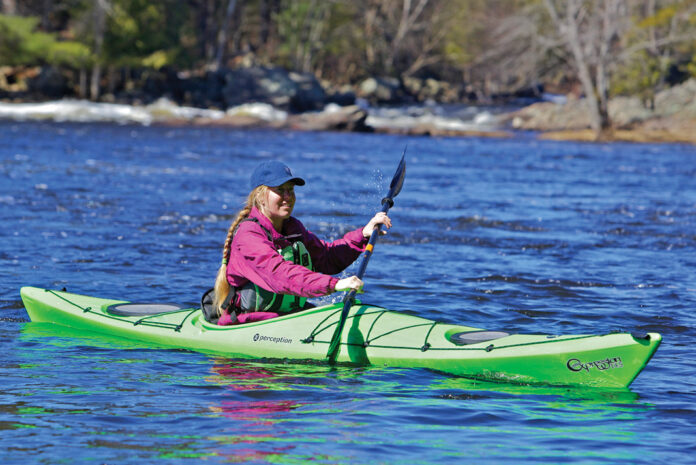
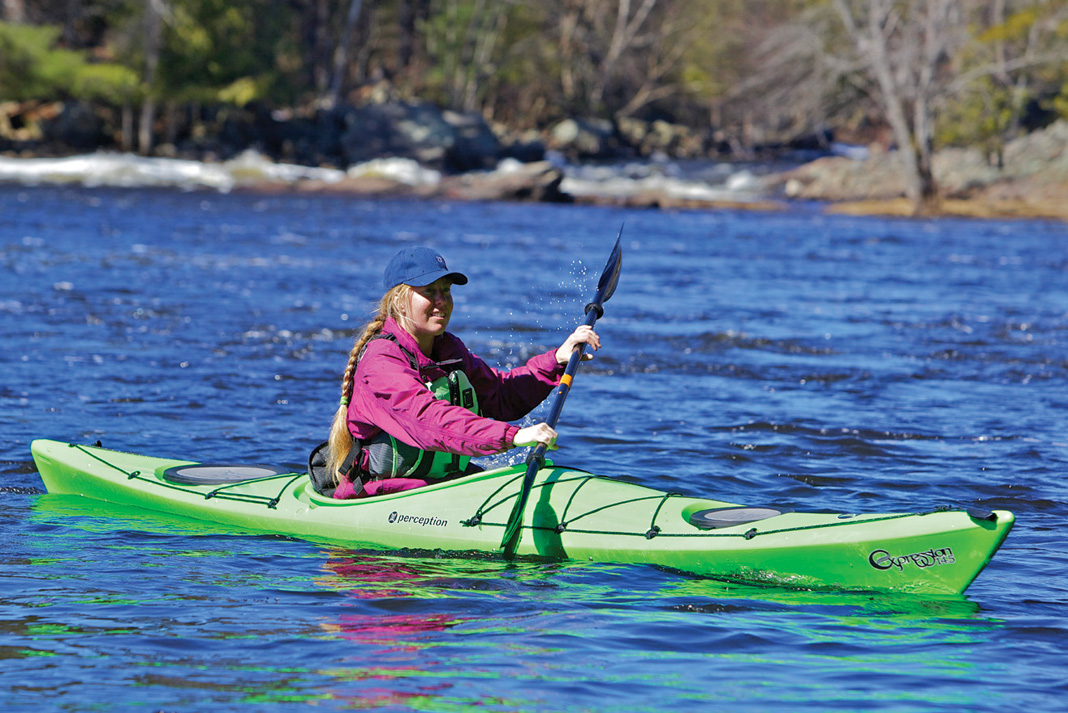
What’s the biggest complaint of aspiring kayakers on a tight budget? For many, the answer is ill fitting or poorly equipped boats that plateau skills development, or worse, quash the pleasure of paddling all together. Fortunately, the Perception Expression 14.5 fills the void for enthusiasts who want a kayak that feels both sporty and stable.
[ Paddling Buyer’s Guide: See all Perception kayaks ]
Grow your game with the Expression 14.5
More and more kayak manufacturers have recognized that not all paddlers will make the leap from box store rec boats to pricey touring designs. Enter the Expression 14.5 from Perception Kayaks, with the bells and whistles of boats with longer waterlines and larger price tags. The 14.5 model we tested is a perfect fit for smaller-framed folks and will stash easily in the garage or under the deck. A 15-foot version is also available for bigger and taller paddlers.
Perception Expression 14.5 Kayak
Perfect for casual or committed kayakers
The Perception Expression 14.5 takes its design cues from classic British-style touring designs—soft chines, a shallow V hull and moderate rocker give it a responsive feel without sacrificing stability. Whereas many Brit boats are a twitchy 20-to-22 inches wide, the Expression adds just enough width for rock solid initial stability. The 23-inch beam is reassuring for novice paddlers, but low volume in front of the cockpit makes this boat feel more like its skinny cousins when sprinting forward or tucking for a roll.
Equally impressive is the hull’s secondary stability, which allows intermediate paddlers to explore edging, bracing and carving turns with confidence. Acceleration and glide are adequate for keeping pace with most boats this length, and the Expression’s low front deck means you can practice perfect forward strokes without reaching around the boat.
Perception’s Zone DLX outfitting is comfortable and customizable for a variety of paddler preferences. Multi-position thigh braces work with the adjustable seat riser to cradle your legs and keep you locked in for bracing and rolling, or you can dial back the fit for all-day touring comfort.
Our one grievance in the cockpit is the high seatback. While it is supportive and La-Z-Boy laidback for casual rambles, it hinders spray skirt fit, rescues and re-entries. We recommend ordering the Expression with Perception’s optional low-profile backband if you’re keen to progress these kayak skills.
The rope-and-cleat skeg control is kink-proof and easy to use, and the skeg keeps you on track in tricky winds. Dual bulkheads, two rubber hatches and full reflective decklines equip the Expression for day or weekend tours on open water.
[ Plan your next kayak day touring adventure with the Paddling Trip Guide ]
The Perception Expression 14.5 will put a smile on your face
For budget-conscious novice and intermediate paddlers looking for a user-friendly kayak to grow their skills, the Expression 14.5 from Perception Kayaks is a well-priced day tourer. It puts the only expression on your face that matters: a smile.
This article first appeared in the Early Summer 2015 issue of Adventure Kayak magazine.
Subscribe to Paddling Magazine and get 25 years of digital magazine archives including our legacy titles: Rapid, Adventure Kayak and Canoeroots.
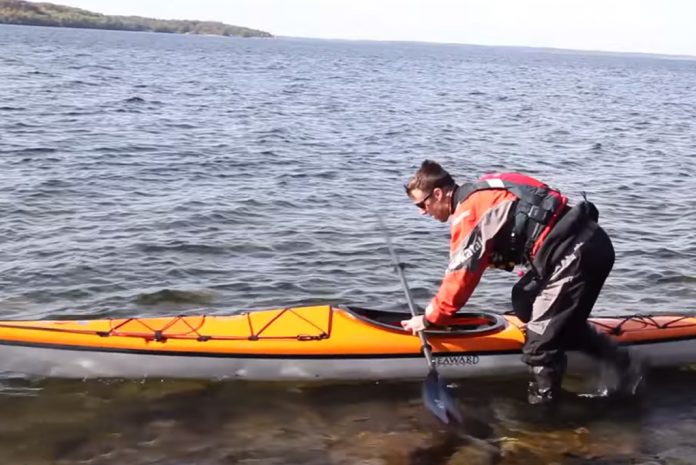
Launching your kayak from a rough shore or in rough weather conditions can be difficult and even dangerous if you don’t know what to do. But if you follow these steps, with a little practice you will learn how to launch a kayak safely anytime and anywhere.
[ See the largest selection of kayaks in the Paddling Buyer’s Guide ]
How to launch a kayak
1) Position your boat
First, put your kayak completely in the water. Then position your boat away from the rocky shore and pointed into the wind.
2) Get seated
Next, sit on the back deck of the boat, so you can slide down and be fully seated inside the boat.
Once seated, bring your legs inside the boat. Then paddle the boat to an area that you can safely attach your sprayskirt.
Video: How to launch a kayak in rough conditions
For a more in-depth demonstration, instructor Steve Ruskay joins us from Black Feather Adventures near Parry Sound, Ontario. From the waters of the Georgian Bay Biosphere Reserve he demonstrates how to launch a kayak from a rough shore or in rough conditions.
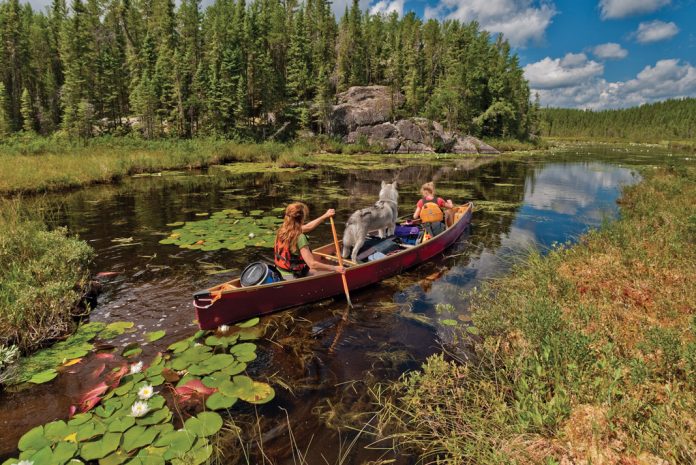
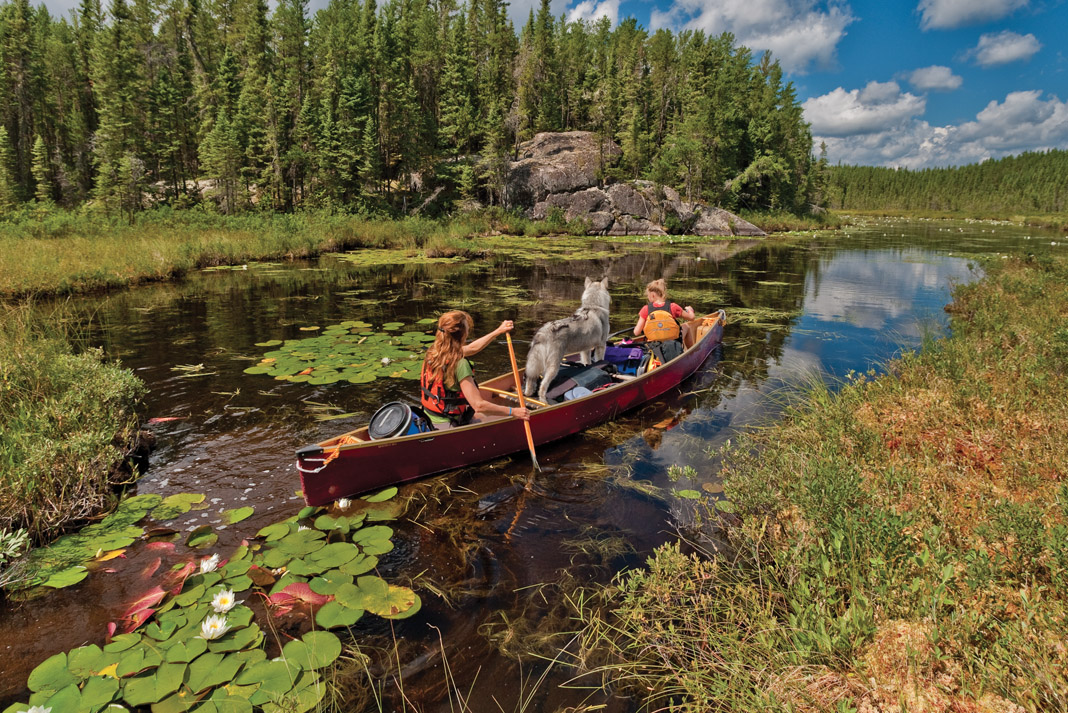
Since having kids, my wife and I have taken our family on a canoe trip every year. And so we find ourselves with all the cooler-toting anglers, moose hunters and other parents of young children in need of a Really Big Canoe. There are fewer canoes in the three-seater, R.B.C. category, so it’s no surprise that we stumbled upon what is likely the most popular of the bunch: the Souris River Quetico 18.5.
Souris River Quetico 18.5 Specs
Length: 18’6”
Width: 36.5”
Depth: 14”
Rocker: 2”
Weight: 49 lbs
Material: Kevlar
MSRP:Starting at $2,995
[ Paddling Buyer’s Guide: See all 18-foot or longer canoes ]
Souris River takes the all-around approach
While many classic, flatwater tripping canoes built in the Boundary Waters tradition are racing-inspired—long and narrow—Souris River founder Keith Robinson decided to take a different approach when he started canoe building in Atikokan, Ontario, a quarter-century ago.
Robinson is an ex-racer who knew all about sharp entry boats, says Souris River sales manager Wayne Docking, “but he didn’t want to build them.” Robinson aimed more for the optimum all-arounder, “the ultimate tripping canoe” comfortable, durable, and very novice and outfitter-friendly.
The Quetico 18.5 joins the family
The Quetico 18.5 is the longer, wider cousin of the best-selling Souris River Quetico 17 canoe. Docking describes the Quetico 18.5 as “middle of the road,” an “ideal compromise between stability and speed.”
“It’s a mum, dad and two kids kind of boat. It’s a family boat,” confirms Docking, describing my needs to a T. “The outfitters really like it for that reason plus they can put a couple 260-pound bass fishermen in it. If you’ve got big bodies, lots of packs and a few cases of beer, you put them in an 18.5. It’s very, very stable.”
Outfitters account for about half of Souris’ sales, and it’s common to find used Quetico 18.5 canoes when outfitters clear out their fleets, although Docking cautions that one year of outfitting use adds up to a lifetime’s worth of normal wear and tear.
“If you’ve got big bodies, lots of packs and a few cases of beer,
you put them in an 18.5. It’s very, very stable.”
From what I can tell Souris River canoes are up to the abuse, built of aircraft-quality epoxy resin, heavy gauge aluminum and four full layers of Kevlar on the entire hull. So far my canoe displays exceptional build quality and durability and is living up to Docking’s claims that Souris River builds the toughest Kevlar canoes on the market.
Light when empty, heavy when full
With its wide, nearly flat bottom and straight sides, our family found the Quetico 18.5 also lives up to its reputation for stability.
The Kevlar construction makes it incredibly lightweight, well-balanced and a pleasure to carry. It also means it’s designed to be paddled loaded. Empty, it’s a leaf in the wind. Loaded, speed and handling are on par with what we achieved in our similarly shaped 17-footer, despite the larger load.
[ Paddling Buyer’s Guide: See all Kevlar canoes ]
With just two inches of rocker—the same as the Quetico 17 despite the extra length and compared to four inches on the Souris River Prospector 17.5—the 18.5 tracks as straight as you’d like and expect for lakewater, family tripping.
The rounded entry bow and stern shape is comfortable with lots of room for legs, kids dogs or gear.
Feature Photo: Gary McGuffin
Any port in a storm
The Souris River Quetico 18.5 is designed to ride drily over waves rather than punch through them and take on water. Or so the theory goes. Just don’t expect a completely dry ride if you’re loaded up with 500-pounds of family plus two-weeks’ of food and equipment. On our last trip’s windiest paddling day, heading into one-foot of chop on a large lake, stability was rock solid but we were still taking on some water over the 20-inch-deep bow.
On that windy day we simply paddled close to shore, hoping the waves wouldn’t get larger. If they had, we wouldn’t have wanted to be on the water anyway. This confirms the Quetico 18.5 is up to just about anything its target users are.
[ Plan your next canoeing adventure with the Paddling Trip Guide ]
Souris River’s Quetico 18.5 is your floating family room
For running rivers or paddling on big lakes, nimbler handling, more rocker and deeper, drier sides might be on the wish list, but that would veer the 18.5 away from its intended purpose. It would certainly mean sacrificing some of the boat’s middle-of-the-road appeal.
With the Quetico 18.5, Souris River Canoes offers everything you need for a comfortable family canoe trip: initial stability, tracking, speed—and most importantly, lots of room.
This article was first published in Issue 51 of Paddling Magazine. Subscribe to Paddling Magazine’s print and digital editions, or browse the archives.
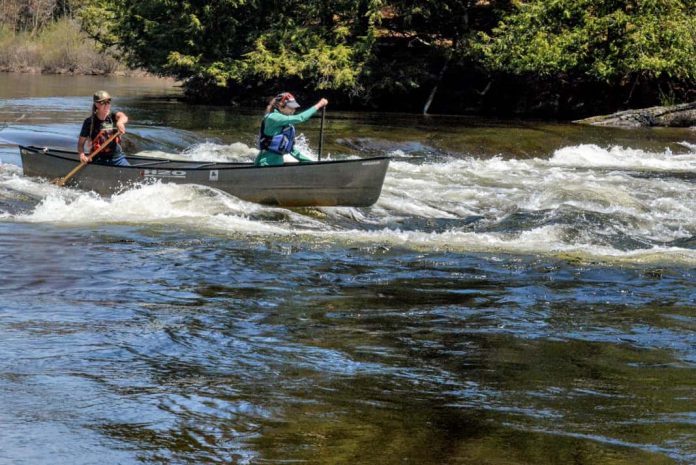
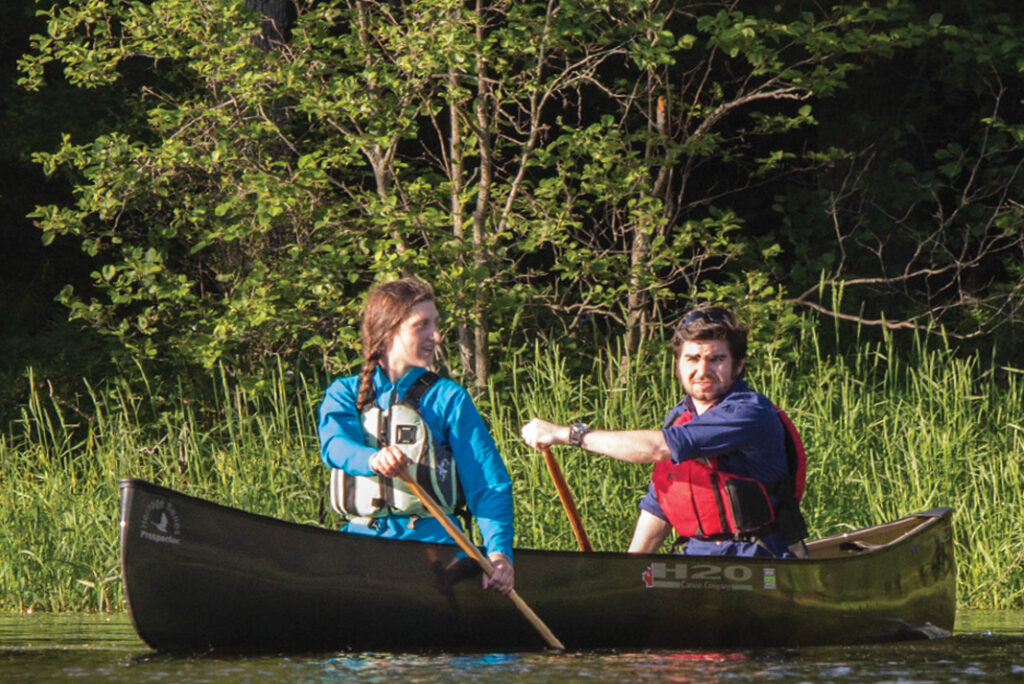
Who wouldn’t want to go river tripping with a canoe that gives you all the performance, but less weight than usual? That’s the promise of H2O Canoe Company’s voluminous 17-foot river tripper, the H2O Voyageur 17 canoe.
H2O Voyageur 17 Specs
Length: 16’11”
Width: 37”
Weight: 49 lbs
Material: Brute Force
MSRP:$3,495 CAD
[ Paddling Buyer’s Guide: See all canoes from the H2O Canoe Company ]
The H2O Voyageur 17 is light and tough
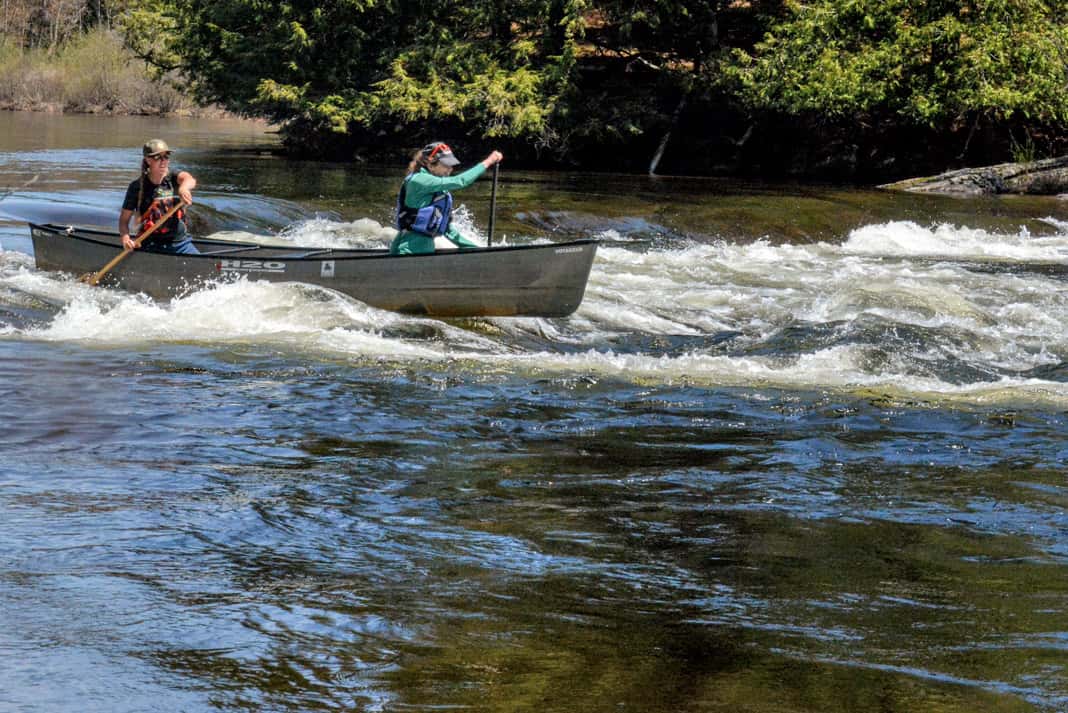
The H2O Voyageur 17 canoe caught my wandering eye early this spring as local runs began to flood. Rather than lug my trusty ol’ 80-pound Royalex behemoth to the river’s edge, I visited H2O founder Jeff Hill at his workshop in rural Tavistock, Ontario. I brought back with me the lightest heavy-duty river tripping canoe any of the Paddling Magazine editorial staff have ever paddled. Not to mention, we’ve never used the words lightest, canoe and heavy-duty in the same sentence before.
Origins of the Voyageur 17 canoe
The shape of the H2O Voyageur canoe was sketched out more than two decades ago. Back in 1997, celebrated boat designer Skip Izon dreamed up a tripping canoe for London, Ontario-based rowing shell manufacturer Hudson Boatworks. Izon had the goal of creating a canoe that excelled in whitewater, while remaining efficient on the flats. In the 21 years since, his design has been known by many names and manufactured by four companies.
We first reviewed Izon’s design back in the spring 2003 issue of Rapid Magazine, when it was called the Nemesis and manufactured in Royalex by Raven Works. After Raven Works folded, the Nemisis mould went to Scott Canoe where it was used to produce a canoe named the Missinaibi—its namesake a northern Ontario river known for its excellent whitewater and lengthy flats. Then Scott Canoe’s parent company, Mid-Canada Fibreglass, closed its doors in 2013.
H2O acquired the original cedar strip prototype from Izon’s workshop—Izon was still paddling it all these years later. Using the original plug to create a mould in 2016 Hill started manufacturing another new canoe in an ultra-durable composite construction. Two decades after the original incarnation, Izon’s design lives again, this time modernized in material but traditional in name—the Voyageur.
New Brute Force Innegra layup
Thanks to H2O’s proprietary Brute Force layup, the Voyageur dropped 25 pounds compared to its previous Royalex incarnations—as a point of historical reference, that’s roughly one-third of a voyageur’s bundle.
In the Brute Force layup, polypropylene-based Innegra fibers are woven with basalt mineral to make an outer and inner skin. A center layer of Kevlar and Kevlar ribs laminated with an impact-flexible epoxy resin round out the composite sandwich. Certainly, the svelte 49 pounds is impressively light for such a large and tough whitewater canoe.
H2O debuted Brute Force in 2016, back when the canoeing market was still reeling from the loss of Royalex. It was a dark but exciting time in canoe history. Manufacturers were experimenting with all sorts of different composites to find a suitable replacement for plastic recreational canoes and river trippers. However, the release of a Royalex-alternative material later the same year swung much of the market interest back to plastics, says Hill. But not all.
“There was a period of time when everybody was looking for composite solutions. Now many of those same people just aren’t in the market anymore. There’s a familiarity factor with plastics, but also the price of plastic canoes is lower,” says Hill. “Our audience in 2018 is middle-aged and older people who are not interested in river tripping with an 80-pound canoe.” He can add to his list one 30-something editor.
Brute Force can handle just about anything the river throws at it, says Hill. Of course, just like any composite canoe, the H2O Voyageur 17 isn’t an ideal canoe to simply bash down your local run—the material will stand up best in competent hands with intermediate skills.
You will have to learn to turn and pick your lines,” says Hill. “The Voyageur is capable of handling any level of paddler, but it’ll demand you develop your skills too.”
Negotiate rapids with ease
On flooded spring rivers following a late ice out, we found this tandem tripper to be all Hill—and Izon before him—promised.
Thanks to aggressive four-inch rocker in the bow and two inches in the stern, the Voyageur is a quick-turning canoe for a 17-footer, carving in and out of eddies with ease. It’s a dry ride, with plunge-resistant overhangs and flare in the bow and stern.
“The Voyageur is capable of handling any level of paddler,
but it’ll demand you develop your skills too.”
Izon kept the waterline sharp for flatwater and flared above the waterline for crashing through big standing waves. The H2O Voyageur 17 is also a deep canoe, with 21 inches in the bow and 15 inches at center. An ultra-broad 37-inch beam makes the Voyageur feel oh-so stable at any time, and tumblehome in the paddling positions narrows up the width for easy strokes.
Feature Photo: Rapid Staff
The Voyageur 17 is flatwater-friendly
Few good rivers trips are all rapids.
The Voyageur was also designed with flatwater efficiency in mind. This shows in the sharp entry lines of the bow and stern. At the waterline, the H2O Voyageur 17 is more reminiscent of my touring canoe rather than my bulbous weekend playboat.
[ Plan your next canoe tripping adventure with the Paddling Trip Guide ]
“It’s a big, friendly boat. It’s easy to design a big canoe to carry a lot of stuff, and make it very maneuverable,” says original designer Izon, who restores canoes and rowing shells in his Grand Bend, Ontario workshop. “The challenge was to build some speed into it.” He used his expertise in designing rowing shells to shape the Voyageur’s bow for optimal glide.
I’d be remiss not to mention the extravagant interior space the Voyageur provides. I think I could fit a quartered moose in here or 1,000 pounds of fur pelts and salted cod. For sure it fits four blue tripping barrels—if that’s more your style.
“We often refer to the Voyageur by the name Skip affectionately gave it early in the design stage—Big Mama,” says Hill.
The extra room at the center of the boat is appreciated because the sharp entry lines at bow and stern cut down on usable storage space in those areas. You won’t notice this if you’re packing flotation, as Hill recommends. Our loaner came standard with webbed seats, ash yoke and aluminum trim. For serious river tripping, we’d recommend whitewater outfitting, including knee pads, straps and air bags.
“We often refer to the Voyageur by the name Skip affectionately gave it early in the design stage—Big Mama.”
Try out the H2O Voyageur 17 canoe
“I’m just happy she’s found a home all these years later,” says Izon of the H2O Voyageur 17 canoe. In his garage, Izon has a new Voyageur hanging next to the original cedar strip prototype he loaned to Hill. It’s white, made of Kevlar and he calls it Big Mama, too.
“It’s my favorite canoe,” he says. “I have the first one and the latest one.”
This article was first published in Issue 54 of Paddling Magazine. Subscribe to Paddling Magazine’s print and digital editions, or browse the archives.
Video of H2O’s New Voyageur 17 and Brute Force Lay-Up:
Sometimes it seems like kayak designers share the same obsession as the magazine headlines at the grocery store checkout. Everything’s getting skinnier. At almost 24 inches wide, the Necky Looksha V is one boat that’s bucking the diet trend.
Necky Looksha V Specs
Length: 17’4”
Width: 23.75”
Depth: 13.5”
Weight: 65 lbs
Cockpit: 33” × 17.25”, 155 L
Bow Hatch: 16” × 9.5”, 63 L
Stern Hatch: 16” × 9.5”, 85 L
MSRP:$1,619 USD or $1,999 CAD
Necky’s Looksha V offers a roomy ride
There is an undeniable pride and grace to be felt slipping into a kayak that’s nary wider than your hips. But there may come a time when you paddle your 21-inch-wide kayak through a four-foot chop and notice your paddling partner blithely snapping photos and popping his skirt to pull out a snack while you’re white-knuckling your paddle and grinding the enamel off your teeth to endure the pain of cramping obliques. And it will be quite likely that your grinning buddy will be paddling the Looksha V, the latest in Necky’s popular Looksha series of multi-chined tourers.
[ Paddling Buyer’s Guide: See all touring & sea kayaks ]
Economies of scale
The heft of a 17-foot polyethylene hull (the only material currently offered) is undeniable, but so is the surprise of its speed and manoeuvrability. At tripping speed, the Necky Looksha V has no problem cruising alongside those calorie-counting kayaks with British accents.
Feature Photo: Liz Burnside
The wider girth has the advantage of providing a more rounded rocker on a tilt—the Looksha V spins quickly on its side—yet tracking is excellent, obviating the need to deploy the rudder except in some following seas and rear quartering winds. Initial stability is moderate to high and secondary stability is exceptional—you really have to throw your weight around to flip over.
The “Extrasport XtraComfort” foam rubber seat integrates a water bottle holder. Foot braces are shock-corded on the bow end and connect to the rudder cables with adjustable straps. A clever under-deck shelf keeps pumps and other essentials out of the way yet accessible.
Large, easy-to-pack oval hatches incorporate the tried and true combo of a neoprene seal and a rigid plastic cover to protect from sun and waves, all secured by the bra-like “Cross-Lock” four-strap system that does up with one quick clip.
Adjustment options in the cockpit of the Necky Looksha V will leave you agog: one strap on each side for seat bottom angle, backrest angle and foot pedals. Plus a six-point height adjustment on the backrest, sliding thigh braces, and comfy under-deck foam padding.
[ Plan your next sea kayaking & touring adventure with the Paddling Trip Guide ]
Take a closer look at the Looksha V
The Necky Looksha V promises to be a reliable workhorse for outfitters and mid- to large-sized paddlers looking for a durable, affordably priced ride with a rich array of features.
This article was first published in the Early Summer 2006 issue of Adventure Kayak Magazine. Subscribe to Paddling Magazine’s print and digital editions, or browse the archives.
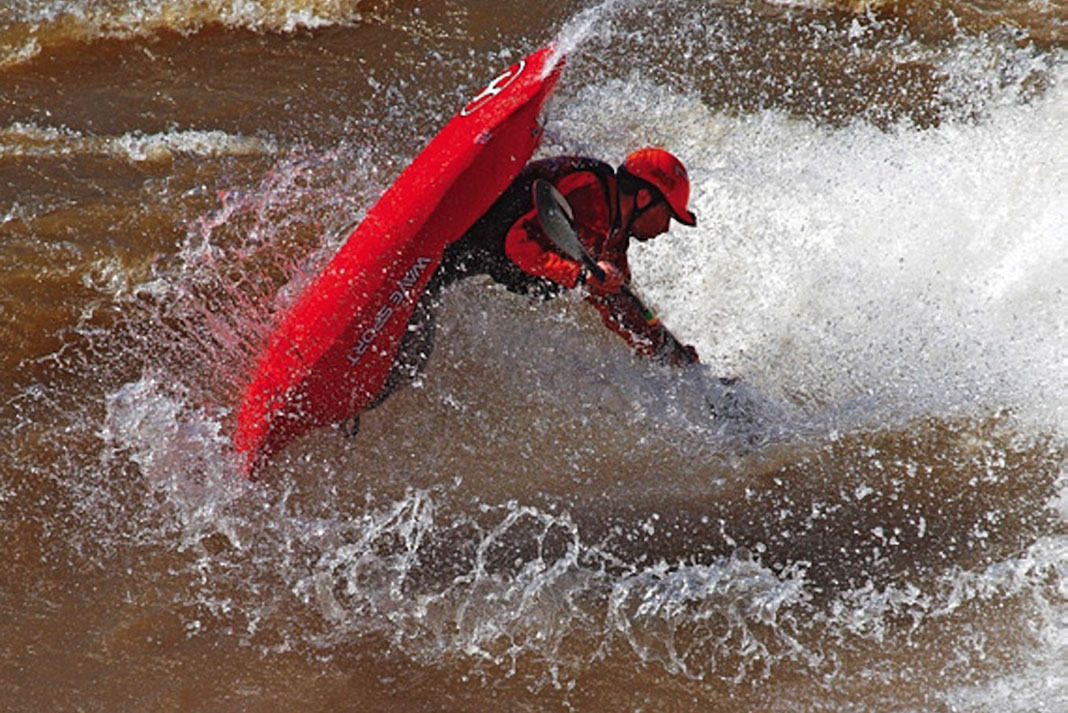
This winter witnessed two milestones at WaveSport Kayaks. First, the release of a long-awaited new freestyle design—the WaveSport Project X. And second, just days later, the departure of longtime WaveSport lead designer Robert Peerson. The timing may be a coincidence. Or it may be that Peerson wished to see through this one last project before moving on.
[ Paddling Buyer’s Guide: See all freestyle kayaks ]
WaveSport’s Project X has come to fruition
The beginnings of the Project X and Peerson intertwine, stretching back to 2004 when the young designer stepped in to fill the shoes of previous WaveSport lead designer Eric Jackson and the wildly popular X and EZ playboat series. That year, Peerson worked with Team WaveSport to develop the very successful ZG (Zero Gravity). Two years later, he reworked that platform and helped usher in a new era of big-air freestyle with the WaveSport Project. In 2008, seeking to evolve the Project design and demonstrate the potential of an emerging material in freestyle construction, Peerson and WaveSport produced the limited edition, carbon composite Project 54 Cx.
The WaveSport Project X draws on this wealth of design research, along with a half-decade of paddling the much-loved Project in every kind of play feature imaginable.
The new boat shares the original Project’s trademark WaveSport drop chines, smooth deck lines and propensity for flight, with major changes focused on the rocker profile, ergonomics and volume distribution.
The result is a hull that planes up to speed faster, pearls less when surfing and suits a wider range of paddlers across three size options than its predecessor. Bryan Kirk, WaveSport team manager and top freestyle competitor, says that centering volume around the cockpit addresses the demand for quick and easy directional transitions integral to new school combo moves.
Feature Photo: Shane Grooves
The volume distribution also makes the WaveSport Project X a monster in holes. Throwing it around our local, spring-melt play spot, we found it explodes out of the water for loop tricks and the slicey ends feel well-balanced for cartwheels, stern squirts and bow pivots—an exceptional combination for moves like McNastys and phonics monkeys.
Peerson and the design team also looked beyond the river for inspiration—to the wave-loving, hard-carving surf-shoe kayaks used for ocean play. We’re glad they did—the Project X is fast, loose and carves in response to the subtlest edging. This boat rips on fast waves, where lightning quick edge-to-edge transitions enable huge bounces.
A drier, lighter playboat
The new WhiteOut outfitting combines classic WaveSport comfort and functionality with dazzling white vinyl that looks sexy and repels water for a drier, lighter boat throughout the day.
From the outset, Peerson’s design team sought to balance no-holds-barred performance with user-friendly, first-kayak appeal for budding playboaters. “We paddled five separate prototypes on waves and holes of all shapes and sizes until we had a design that no one could find fault with,” says Kirk. From Skookumchuck to the New River Dries to the smallest competition-style holes, WaveSport took the Project X everywhere its future paddlers—from beginners to top athletes—might.
[ Plan your next whitewater kayaking adventure with the Paddling Trip Guide ]
Go for a rip in the WaveSport Project X
The WaveSport Project X is comfortable, forgiving and stable for a freestyle spudster, but if these are your top criteria, look to WaveSport’s river play Fuse instead. For those who enjoyed the original Project, or who simply love to rip, Peerson’s final WaveSport project is worth the wait.
This article was first published in the Early Summer 2011 issue of Rapid Magazine. Subscribe to Paddling Magazine’s print and digital editions, or browse the archives.
When H2O Canoe Company owner, Jeff Hill, dropped off a fleet of three Prospectors at Paddling Magazine’s riverside office, there was one design that immediately caught my eye: the H2O Prospector 15-4 canoe.
[ Paddling Buyer’s Guide: See all canoes from the H2O Canoe Company ]
The H2O Prospector canoe is sleek and nimble
Sleek. Black. Sexy. The H2O Prospector 15-4 canoe in carbon is surely the Corvette of the tandem-tripping world. Given Hill’s background in manufacturing world-class composite rowing shells, the svelte and speedy shape of the 15-4 should come as no surprise.
Blending old and new
A scaled down version of H2O’s bestselling 16-4, which takes its lines from a Chestnut Canoe Company original, the 15-4’s symmetrical hull and two-and-a-half inches of rocker in bow and stern create a nimble craft. Its initial stability may feel loose for beginners, but more advanced paddlers will appreciate its maneuverability and responsiveness to tilt. I was impressed with its ease of handling while paddling upriver solo and unloaded, in a headwind.
[ Plan your next canoe tripping adventure with the Paddling Trip Guide ]
Modernity and tradition meld in this design. The dished yoke and molded carry handles are made of durable poplar and stained near black. H2O’s attractive integrated composite gunwale system is ultra stylish, featuring a foam-cored gunwale wrapped in carbon, with an outer aluminum trim—it cuts the weight of regular aluminum gunwales almost in half.
Yet, for such a contemporary canoe, the H2O Prospector 15-4 retains elements of its heritage—there’s a gentle re-curve in the bow and stern, and the sharp entry lines of its traditional shape flare out quickly.
Clear Carbon lay-up is a winner
Celebrating its 10th anniversary this year, H2O has made a name for itself producing lightweight, high-end composite canoes. New for 2015 is their Epoxy Pro Series, of which our tester is a part. This premium series features three all-new lay-ups, each of which combines Kevlar, carbon and a basalt-Innegra blend in varying degrees to get different combinations of strength, impact resistance, weight and price.
Our 32-pound Clear Carbon tester, the lightest and priciest in the series, boasts a primarily carbon hull with a carbon-Kevlar interior and basalt-Innegra lining. The H2O Prospector 15-4 canoe is also available in a mostly basalt-Innegra composite, the toughest lay-up in the Epoxy Pro Series and weighing in at 40 pounds, as well as a mostly Kevlar lay-up, a compromise between weight (37 pounds), durability and price.
H2O was one of the first canoe manufacturers to integrate ultra-tough basalt-Innegra blends into their hulls, a move that is a growing trend in the industry. It’s because H2O is a smaller company that they’re able to adapt and incorporate material innovations quickly, Hill tells me. “We’re becoming the biggest little company; if there’s something out there, we’re going to try it,” says Hill.
Big plans for our H2O Prospector canoes
The H2O Prospector 15-4 is a stylish and maneuverable composite canoe perfect for tandem trippers. The Clear Carbon lay-up is a lightweight dream, sure to help you power through portages. As for the other two Prospectors H2O loaned us? We have plans to paddle our H2O convoy on a long weekend summer trip—stay tuned for more.
Video of the H2O Canoe Company’s Epoxy Pro Series:
Scott MacGregor speaks with H2O Canoe Company owner, Jeff Hill, about the all-new Epoxy Pro series. Using a combination of new and traditional hull materials, the H20 team set out to design 30- to 40-pound boats that have the strength and durability associated with far heavier layups. Hill showcases the all-new light and durable series, including the H2O Prospector 15-4 canoe:
This article first appeared in the Fall 2015 issue of Canoeroots Magazine.
Subscribe to Paddling Magazine and get 25 years of digital magazine archives including our legacy titles: Rapid, Adventure Kayak and Canoeroots.


 This article first appeared in the Early Summer 2015 issue of Adventure Kayak magazine.