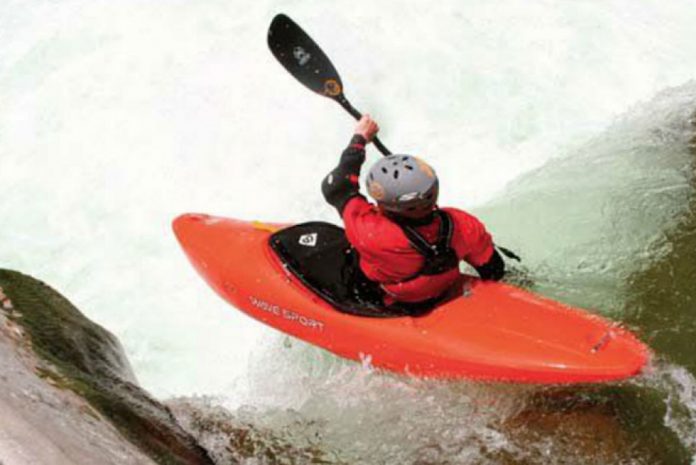
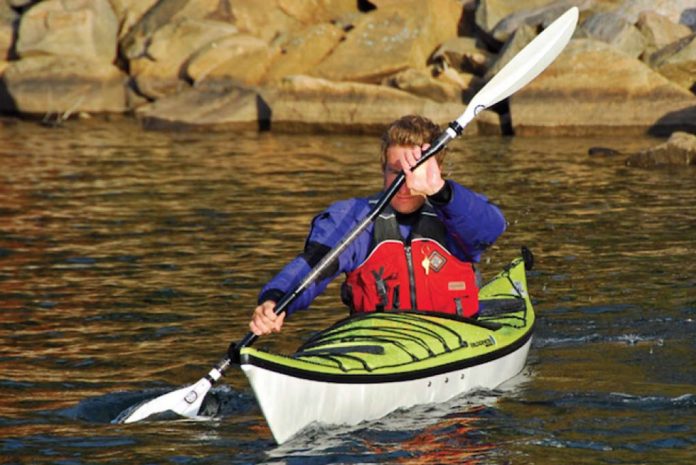
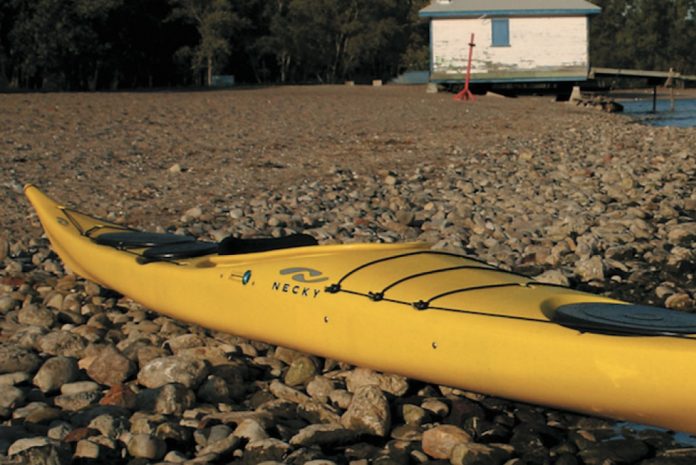
WaveSport began hyping its first real creek boat, the “Y”, way back in the 1990s. Since then, we have watched as the Y remained WaveSport’s trusty creek boat while they introduced and replaced seven different freestyle models. Creek boat sales don’t merit the same research and design budgets as freestyle, and the Y lived on by popular demand. Now it has a worthy successor in the new WaveSport Habitat kayak.
WaveSport Habitat
74 / 80 Specs
Length: 8’ / 8’4”
Width: 25” / 25.5”
Depth: 13.5” / 14”
Weight: 41 / 42 lbs
Volume: 74 / 80 gal
Paddler Weight: 100-200 / 150‑260 lbs
MSRP: $1,000 USD or $1,249 CAD
[ Paddling Buyer’s Guide: See all creek boats ]
The WaveSport Habitat is at home on the creek
Robert Peerson, WaveSport’s head designer, has been working on Habitat prototypes for more than two years. He has finally decided on two sizes, the 74 and 80, that Peerson says give him some flexibility in the design.
“Although both are based off the same design principles, the smaller-sized Habitat with its shorter length and volume distribution lends itself to smaller paddlers and tight and steeper creeks. The larger Habitat, with its longer length and high float volume distribution, lends itself to larger rivers with a lot of storage capacity for overnight trips.”
Creek boats like the Pyranha Micro and Dagger CFS are great for very tight technical rivers but were virtually impossible to pack gear inside. Today, the trend for creekers is to carry a little more hull speed and more gear. The WaveSport Habitat borrows from Liquidlogic’s lead by making the stern easy to access with a snap-away back band and low-profile seat. Small items can be packed under the seat through slots at the front.
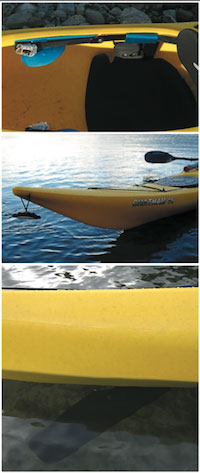
In the past 10 years the most important creek boat design advancements have been in paddler safety. WaveSport has created its own plastic front pillar that aids a pinned paddler in stepping out of the cockpit and doubles as a wonderful handle when portaging.
On the deck of the WaveSport Habitat you’ll find the now-standard five grab loops and anchor points—two at the ends and three around the cockpit. The metal bars are sexy and surely strong but bbrrr, they’re cold. A rubber tube slide over top would have been a nice touch. To finish off the outfitting: the recess’ drain plug is well protected and using the hull to hold the stern pillar results in fewer holes and hardware.
Lay it flat or get on edge
The Habitat is noticeably asymmetrical, with the widest and flattest point around your knees. We suspected this was to produce a fish-form shape to increase speed, but Peerson says the volume and width up front is for stability. As you move back to the stern, the hull becomes more displacement-like with high chines. “This shape allows you to use the edges for tracking and stability to carve into turns. Placing these edges high helps me keep them out of the way when scraping down shallow slides,” Peerson says.
It’s almost like the WaveSport Habitat is two completely different boats, depending whether or not you are using the chines. Keep it flat, and it feels like a spinny, high-volume, forgiving creek boat. Lay it over on edge and it wakes up, carving into edits more like a hybrid river-runner such as the Diesel. On edge it feels like it increases the waterline and jumps up to a faster hull speed and carve.
Need a reliable, modern creeker? Get in the Habitat
WaveSport needed a new model with performance and safety features of a modern full-on creek boat, plus the accessibility of an overnight duffel. Did WaveSport nail it? There is no doubt in our minds the Habitat will stand the test of time and provide you with years of reliable creeking.
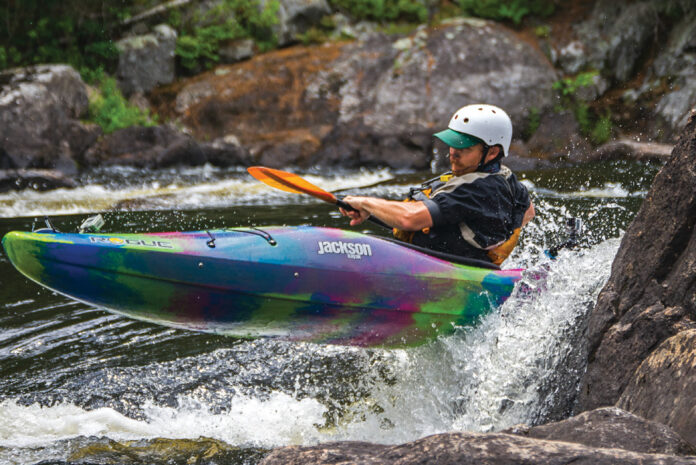
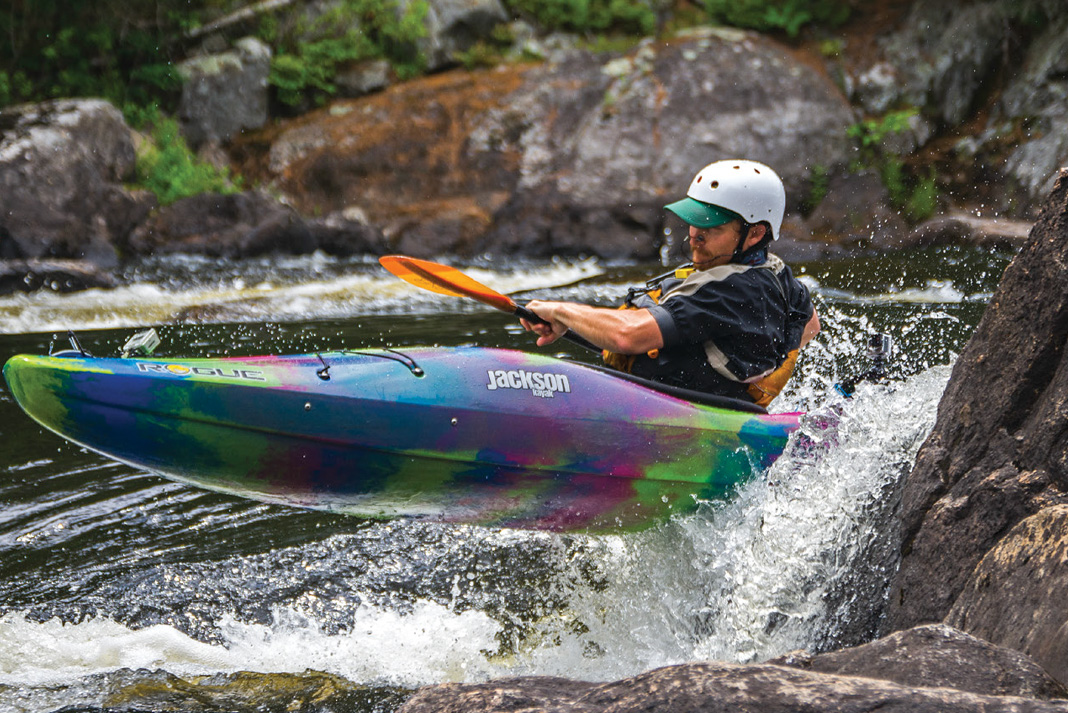
Jackson Kayak Rogue 10 | Feature Photo: Rapid Staff
When I hear someone described as a rogue I conjure up an image of a trail-worn cowboy. If he wants to roam the dusty streets looking for trouble or spend weeks in the canyons under the desert stars it’s up to him. Jackson Kayak may have had the same image in mind with the Jackson Rogue 10.
Jackson Rogue 10 Specs
Length: 10’1”
Width: 28”
Cockpit: 34.75” × 20.25”
Weight: 48 lbs
Capacity: 160-285 lbs
MSRP: $1,099
Jackson Kayak’s Rogue 10 is rough and ready
The cowboy image kind of fits. Just as the rough-and-tough cowboy does things by his own rules, so does the Rogue. If you are looking to venture out on easy flatwater day tours or multi-day river-cruising trips, the Jackson Rogue 10 could be your trusty companion.
Comfortable, no-nonsense outfitting
Within the first few strokes two things immediately become apparent—the Rogue is comfortable and stable. Like all Jackson kayaks, they’ve kitted out the Rogue with the no-nonsense sure-lock backband system. This simple rope and cleat system allows you to quickly and easily snug up, or loosen, your backband to get the perfect fit. I’m a minimalist and I like that there are fewer moving parts to worry about breaking. It gives me peace of mind on longer trips.
The Rogue 10 also has my vote for most comfortable foot options. A quick lever squeeze allows you to adjust the foot pegs giving a solid platform to push against when the water gets rough but are out of the way so when you want to stretch your legs you can. To keep with the cowboy analogy, these are the stirrups of the boat. Adjust your hip pads and add in Jackson’s Sweet Cheeks beanbag cushions to prevent saddle sores and you’ve got the boat that I’d choose if I wanted to ride some serious miles.
The Jackson Rogue 10 also comes with deck rigging for items you want close while you float and a large, easy-to-open-and-close dry hatch for any other gear you are bringing along.
Jackson Kayak Rogue 10 | Feature Photo: Rapid Staff
Rolling with the Rogue
During some bigger water testing (and rolling) a small amount of water did find its way into the compartment. We couldn’t figure out if it was the hatch cover, bulkhead or skeg box. No matter, packing non-waterproof items in a dry bag is always a good idea. And speaking of the skeg, we did manage to snap it off. To be fair, we can’t say if this has anything to do with the design or if we forgot to raise it before hitting the rapids. The latter is a definite possibility and something you need to be mindful of in any crossover. It looks to be a five-minute fix to install a replacement.
Flipping over is actually hard to do in the Rogue because it is so stable. It bulldozes through the rough stuff without much worry about catching edges. It rides high above all but the biggest boils and swirly eddy lines. If you are already a hard charging whitewater fan you’ll find you need to be more aggressive to get more responsiveness out of the Jackson Rogue 10.
Ride off into the sunset with the Rogue 10
The Jackson Rogue 10 can be run down some pretty serious whitewater but is probably best suited for the class I to class III+ rivers of the world. If you are looking for a boat that can handle day trips on a lake or multi-day rivers with some moderate whitewater you may just want to ride a Rogue off into the summer sunset.
Looking to Jackson for a more whitewatery crossover? We’ve heard there is something in the works that has the hull speed of their Karma and Zen but with more room and storage.
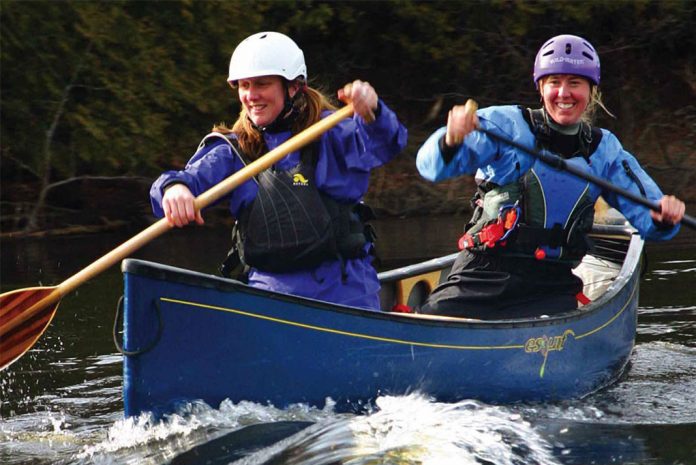
Over the last 10 years, Esquif Canoes of Frampton, Quebec, has assembled a line-up that blows every other whitewater canoe manufacturer out of the water. Given their birthplace, it’s fitting that nearly all of these boats fall into two distinct streams: whitewater play and river tripping. While a few versatile designs have blurred this distinction, none does so quite as smoothly as the Esquif Pocket Canyon canoe.
Quebec’s plentiful big-water play spots, backyard runs and remote northern rivers have no doubt inspired Esquif’s relentless innovation and 28 (and counting) available river tripping and whitewater designs. As you may have guessed, the Pocket Canyon is a downsized version of its big sister, the bestselling Canyon.
While the 16.5-foot Canyon has long been a popular choice of paddlers looking for an expedition-oriented, but still whitewater capable boat, Esquif owner and designer Jacques Chasse thought it was time to create a new niche for moving water canoeists.
“Looking closer at their needs, I realized [most paddlers] might use the Canyon’s expedition potential once in their lives, so I decided to offer them something more adept at playing on the river and canoe camping for a weekend or week,” says Chasse.
Chasse describes the Esquif Pocket Canyon canoe, released in 2008, as a “smaller, lighter and smarter version” of the Canyon. Its intelligence lies in the versatility of the design—it paddles well both tandem and solo, in rapids and flat water, and for shorter tripping and playing.
[ Plan your next canoe tripping adventure with the Paddling Trip Guide ]
Esquif places the Pocket Canyon in its river tripping line, but it really fits somewhere in between tripping boats like the Canyon and dedicated whitewater saddle tandems like Esquif’s Vertige X or Mad River’s Caption.
The Pocket is nimble and adaptable
At 14.5 feet with four inches of rocker bow and stern, the Esquif Pocket Canyon canoe is supremely maneuverable and flat spins in a hole or surfs on a wave with ease. With an extra two feet of length and 16 pounds of heft, the Canyon simply can’t touch its nimble pocket sibling when it comes to playing your way down a river.
Standard webbed seats can be outfitted with thigh straps for whitewater and allow the Pocket Canyon to be used as a competent and comfortable tripper.
Paddle it backward and you have an extremely solid solo boat for extended river expeditions. There’s enough room for two large canoe barrels, one fore and one aft of the contoured yoke. Hull speed and stability, both loaded and unloaded, are very good for a boat of this length. Soft chines make it easy to initiate and hold a carving edge.
Dump your kit and go surf
We paddled the Pocket Canyon in our backyard river, the Madawaska, and found it well suited to the moderate rapids of this classic weekend trip. Loaded with gear, it handles like a small, stable tripper.
Once at camp, however, you can dump your kit onshore and the Pocket Canyon transforms into a fun, agile playboat that will have you surfing and spinning long after dinner. For sheer fun and versatility, the Esquif Pocket Canyon canoe is hard to beat.
[ Paddling Buyer’s Guide: See all Esquif canoes ]
Hit the waves with the Esquif Pocket Canyon canoe
If you’re coming from a tripping background and aren’t keen on paddling a canoe with saddles, yet want a multipurpose tandem that can handle much of the same water as a dedicated whitewater boat, the Pocket Canyon is definitely worth a look.
This article was first published in the Early Summer 2010 issue of Rapid Magazine. Subscribe to Paddling Magazine’s print and digital editions, or browse the archives.
Looks like rain tonight: innie or outie? Answer on page 90. | Photo: Francois Leger-Savard
Few topics get backcountry paddlers more fired up than debating the ethics of burning garbage on trip, or contesting the best way to bear-proof your camp. Mention canoeing and firearms in the same breath, and some paddlers are apt to go ballistic. Ditto for sharing hidden gems on social media, or practicing survival bushcraft on public land. Should wearing a PFD be optional or mandatory? Does your groundsheet belong under your tent, or inside?
Explore paddling’s most enduring controversies, get advice from the experts, and then decide where you stand on these crucial issues.
Looks like rain tonight: innie or outie? | Photo: Francois Leger-Savard
Controversy: Burning Garbage
Are there exceptions to the pack-it-in-pack-it-out rule?
Survey any group of backcountry paddlers, and the subject of burning garbage is sure to be a hot topic. Hard-line LNT (Leave No Trace) followers advocate packing out everything you pack in, while many wilderness users still adopt an “if it burns, burn it” attitude. Taking the middle ground, guidebook authors and veteran expedition paddlers Laurel Archer and Cliff Jacobson suggest burning food scraps and paper waste in a small, hot fire while observing minimum-impact camping practices.
Location
First, consider whether it’s safe (and legal) to start a fire. Check fire danger ratings and open-fire bans for the area you will be paddling. Also, check local camping regulations; for example, in Minnesota’s Boundary Waters Canoe Area Wilderness the burning of any garbage is prohibited. You’ll need a compact wood-burning stove to contain compost and rubbish fires in fragile ecosystems or on remote northern trips above treeline.
Trip Length
Campers on both sides of the debate cite the length of trip as a deciding factor. If you are only out for a few days, repackage food so scraps and trash are minimal and easily packed out. Waste management on extended trips is more challenging, argues Jacobson. “On a long trip, you will accumulate quite a bit of paper and plastic trash, some of which may contain grease or remnants of food attractive to animals. If you don’t burn this stuff, you’re asking for trouble!”
Bring the Heat
Any low-impact fire should burn hot enough to leave only fine, white ash—this includes your watermelon rinds and spaghetti leftovers. A well-built campfire can reach temperatures exceeding 600°C (1,112°F). This is approaching the threshold (650°C/1,200°F) recommended by the Nunavut Department of Environment, where burning household waste is practiced in remote communities. Generally, if your combusting rubbish produces visible smoke, your fire is not hot enough.
Dirty Deeds
A U.S. Forest Service study found significant traces of heavy metals and other toxins in the ash of campfires used to burn plastics, tin and aluminum foils. Rather than “burning clean” cans and foil, wash and pack out these items. Never burn plastics containing chlorine—most commonly PVC and Styrenes (numbers 3 and 6, respectively, in the plastic ID code)—which produces highly toxic, bioaccumulative dioxins and furans.
Packing heat in polar bear country. | Photo: Virginia Marshall
Controversy: Bringing a Gun
Does a firearm make you safer in the backcountry?
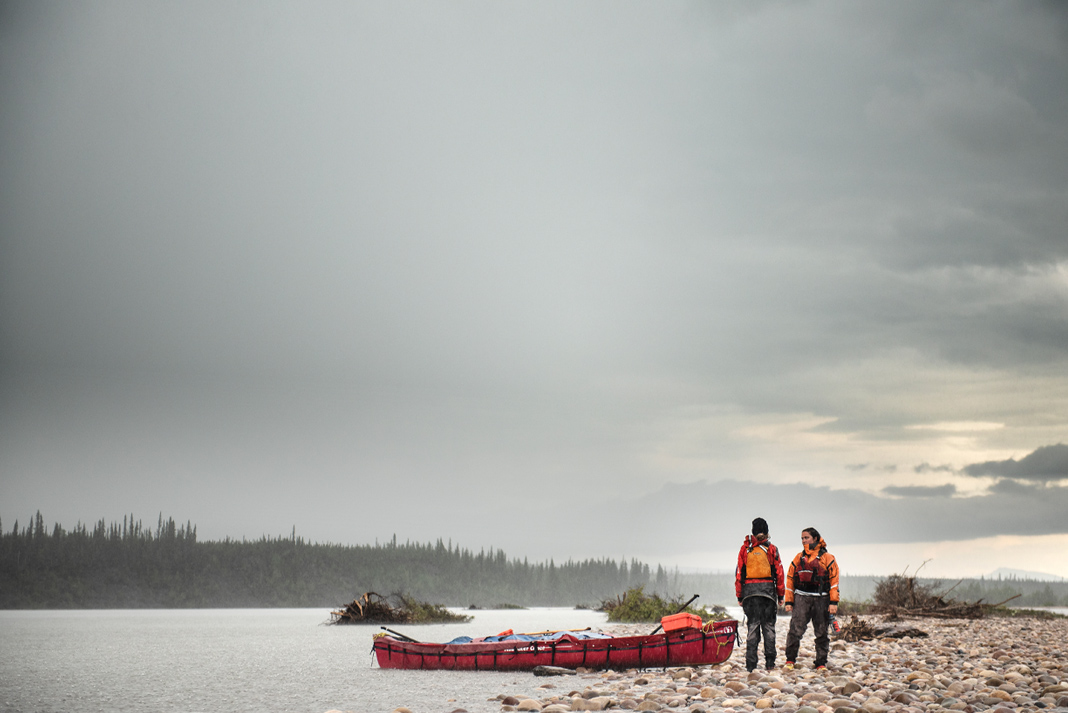
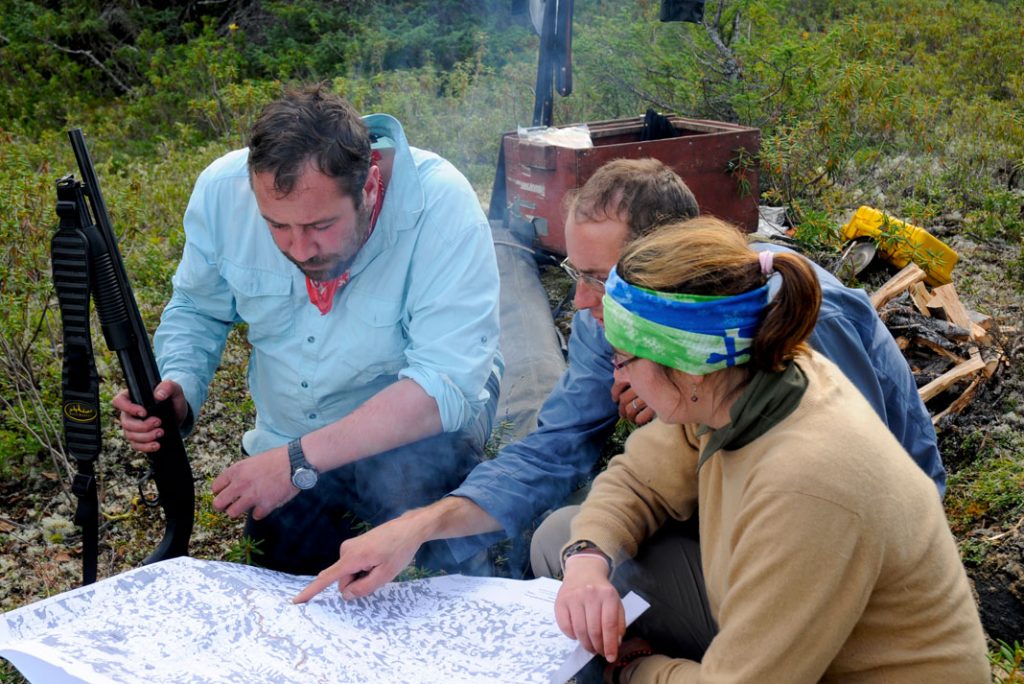
Last summer, two American canoeists made international news when they were rescued from a barrenlands river in the Northwest Territories after a grizzly bear destroyed their tent and canoe. One of the wildlife officers involved in the rescue told reporters the couple seemed to do everything right—other than not having a firearm with them. Yet there’s ample evidence to suggest if they had, the outcome could have been far worse.
Bear Spray vs. Bullets
In Bear Attacks: Their Causes and Avoidance, Canadian bear biologist Stephen Herrero found a person’s chance of incurring serious injury from a charging grizzly doubles when bullets are fired versus when bear spray is used. While his research didn’t reveal a single case where spraying the bear with pepper made it more aggressive, evidence suggests shooting a bear can escalate the seriousness of an attack. These findings are echoed by a U.S. Fish & Wildlife Service review of human-bear encounters since 1992. “Even a skilled marksman with steady nerves may have a slim chance of deterring a bear attack with a gun,” concludes the report.
Other Considerations
“I stopped taking a gun on trip because of the weight and general nuisance trying to keep it from rusting,” writes author and wilderness guide, Hap Wilson. Cans of bear spray require no maintenance and are compact enough to be carried by each member of your party. “Leave guns at home if you are not well practiced with them, or if your friends don’t feel comfortable around them,” advises Cliff Jacobson. Know the law: Firearms are illegal in many parks and recreation areas.
Exception
Many paddlers, including Jacobson, choose to carry a shotgun or high-powered rifle for trips to Hudson Bay. Unlike the vast majority of black bear and grizzly encounters, which are defensive in nature rather than predatory, polar bears may view humans as a potential meal.
Whatever you do…
Don’t handle firearms without appropriate training and licensing. Plinking a few cans in the back forty doesn’t qualify you to bring a gun into the backcountry. In polar bear country, it’s safer to hire a qualified, armed “bear monitor” to accompany your group—a measure required by some northern parks.
A fed bear is a dead bear. Keep campsites clean and secure food and scented items by any means necessary. | Photo: Follow Me North Photography
Controversy: Bear Proofing
To hang or not to hang?
What’s the best way to bear-proof your food at camp? Don’t get hung up on one way of doing things, say the experts; outsmarting bears means adapting to the environment and following a few simple rules.
Many camping books, parks and publications advise hanging your food packs from a rope suspended between two trees or from a sturdy tree limb out of a bear’s reach—typically 12 to 15 feet (4 meters) off the ground and 8 to 10 feet (3 meters) from the tree trunk. Canoe guide Hap Wilson derides such tree hoists as “bear piñatas.” Expedition paddler Cliff Jacobson agrees, “In my experience, the outfitter- and government-recommended rigmarole of caching food packs in trees is a waste of time and energy. Most campsites don’t have a lot of good, high bear trees. There’s often only one suitable tree that’s used by everyone. Once a bear has discovered this special tree, he’ll tear apart whatever you hang in it.”
More Options
Alternatives to tree hangs rely on the idea that if bears and other animals can’t smell your food, they won’t get into it. “On the barrens, there are no trees; you have to cache your food on the ground,” points out Jacobson. Seal all food, pots/pans, eating utensils, garbage and toiletries in scent-proof sacks or bear-resistant canisters and stash these at least 300 feet (100 meters) from your sleeping and cooking areas. Standard blue canoe barrels—while more critter-proof than a canvas pack—are by no means bear-proof. Park staff in popular areas like the Boundary Waters report some bears now associate blue barrels as a source of food. Many touring kayakers store drybags of food in their boats’ watertight hatches, but consider this: if a bear does find your food, your kayak is history.
Whatever you do…
Keeping a clean, odor-free campsite and stashing food securely is done for the bear’s protection, not your breakfast’s. Once a bear becomes conditioned to human food sources, it’s potentially dangerous and must be relocated or destroyed. In 2017, conservation officers in British Columbia killed nearly 500 habituated and food-conditioned bears.
A cairn marks a coastal route in Newfoundland. | Photo: Virginia Marshall
Controversy: Cairn-kicking
When is a cairn not a cairn?
The issue of building cairns in the backcountry may seem trivial, but there’s more at stake than a little rock geometry. Cairn-builders see themselves as helpful (marking a portage trail, for example) or harmless (leaving a stone figure to greet the next campers at a site). Those opposed have taken up cairn-kicking—the practice of toppling and scattering these stone homunculi—to better preserve the wilderness experience. Both are problematic; here’s why:
Location
On the tundra and in other remote areas, cairns may be centuries old, built by Indigenous peoples as way-markers or direction indicators. It’s both disrespectful and dangerous to alter these traditional structures—either by removing or adding rocks. Park staff and trail builders also use cairns to mark routes in treeless areas. Knocking these down or constructing your own in the same area could misdirect other backcountry users.
A Matter of Principle
Guidebook author Laurel Archer cites this principle of low-impact travel practices and ethics: “Don’t change the environment. Leaving rock cairns by the portage trail may seem like a grand and even helpful idea, but maybe the person behind you wants to find his or her way just like you did.”
Tear it Down
If you can’t resist building your own structure, do so on a beach and disperse the stones before you leave so the site remains as wild for the next visitor.
Be Considerate of Others
Moving rocks disturbs natural ecosystems—salamanders, insects, snakes and spiders may be sheltering beneath, and the delicate lichens on those stones may have taken hundreds of years to grow.
What’s wrong with this picture? | Photo: Virginia Marshall
Controversy: Wearing Your PFD
On your body or in your boat?
In both the U.S. and Canada, the law requires carrying a life jacket or PFD for each person in your craft. Wearing it seems like a no-brainer, yet still 15 percent of participants surveyed in the Outdoor Foundation’s 2019 Special Report on Paddlesports & Safety feel personal flotation devices are generally unnecessary. That’s roughly 3.4 million paddlers taking needless risk on the water.
Trust the Numbers
The report notes “while paddling activities appear low-risk, an alarmingly high 29 percent of incidents reported from 2015 to 2017 resulted in a fatality.” Data published by the U.S. Coast Guard for the same period recorded 758 paddlesports deaths, with 79 percent involving drowning. Of those drowning victims, 74 percent were not wearing personal flotation devices. In a 20-year study published in 2016, the Canadian Red Cross estimated 85 percent of boating deaths were preventable if victims had been wearing life jackets.
Fair Weather Fallacies
More than three-quarters of reported paddlesports incidents occur when there is good visibility and benign water conditions.
Whatever you do…
Always wear a coast guard-approved life jacket or PFD. United States federal law requires children under 13 to do so. For the rest of us, it’s the smart choice. Modern, paddler-specific vests are comfortable to wear for all ages, and low-profile inflatable models provide a lightweight option for hotter climates. Learn more at www.saferpaddling.com.
Bushcraft masters like Ray Mears demonstrate skills in an ecologically sustainable way. | Photo: Goh Iromoto / Ontario Tourism
Controversy: Bushcraft
Timeless skills or thoughtless thrills?
It seems wherever you look these days, there’s a wilderness survival series or Internet vlogger showing off his self-proclaimed proficiency in the woods. That’s led to a resurging interest in bushcraft, the use of traditional skills and available natural resources to live comfortably in the outdoor environment. Skeptics argue today’s brand of popular bushcraft is incompatible with low-impact practices, or worse.
The Good…
Bushcrafters like Ray Mears—founder of Britain’s Woodlore School of Wilderness Bushcraft—demonstrates these skills in a thoughtful, ecologically sustainable way. “Bushcraft is the term I employ to describe a deeper knowledge of the wild and of nature,” explains Mears in the film, We Belong To It. “It is a huge tree that branches out in many directions to botany, zoology, craftwork, outdoor leadership and countless other divisions. Everyone who visits wild places will benefit from bushcraft knowledge.”
The Bad and the Ugly
Pointless pillaging results when wannabe bushcrafters head into the woods without the requisite knowledge. In a forum debating bushcraft versus Leave No Trace on the outdoor site Trailspace.com, users highlighted some common offenses: using a hatchet or saw to cut down live trees, “especially when done for a brief Daniel Boone moment,” and creating additional fire pits at a campsite with an existing fire ring. One incensed camper described stumbling across such a setup in Tennessee’s Citico Creek Wilderness: “It looked like a weekend wet dream to emulate TV idiots.”
Location & Impact
In a time of diminishing wilderness and increasing use, how can bushcraft be reconciled with the low-impact guidelines established to protect these places? Christian Noble, founder of MasterWoodsman.com, argues both sides need better education. “There is no such thing as leaving no trace. No matter what you do, you will be making an impact,” he contends. Examples of low-impact bushcraft are using downed wood rather than harvesting live trees, and practicing responsible, low-trace fire building. Bushcraft should be practiced away from any areas experiencing heavy use, and is not permitted in many wilderness areas or national parks.
Whatever you do…
Don’t leave your ad-hoc construction for others to admire—especially if your idea of bushcraft involves miles of yellow utility rope and acres of blue poly tarp. Dismantle and pack out.
A five million-star site. | Photo David Jackson
Controversy: Campsite Permits
Does backcountry site selection put paddlers at risk?
Depending on where you paddle, your backcountry permit may allow first-come camping on any available site, secure camping on a particular lake, or reserve a specific campsite for your group. While each system has its pros and cons, some backcountry paddlers believe site-specific permits come at the cost of spontaneity and, more importantly, safety.
Risk vs. Reward
Site-specific permits can offer paddlers peace of mind. You can plan a longer day or enjoy a late start, knowing “your” site will be vacant when you arrive. This system takes the guesswork (and the fun) out of campsite selection. But many scenarios could prompt paddlers to pull off the water earlier than anticipated. Declining or dangerous weather conditions—such as strong winds, poor visibility in fog, and thunderstorms—are especially problematic in exposed coastal areas with few safe landings. Injury, exhaustion or upsetting in cold water can curtail your plans no matter where you’re paddling. In such cases, pushing on to reach “your” campsite puts everyone at unnecessary risk.
What’s the Alternative?
Different parks have different approaches to managing backcountry use. Paddlers in Ontario’s provincial parks must negotiate all three systems: site-specific permits are issued in busy southern parks like Kawartha Highlands and The Massasauga; Algonquin and Killarney employ lake-specific permits; and canoeists on the French or Spanish rivers enjoy the freedom of first-come, first-served camping. While it makes sense parks with heavier use employ a more rigid approach than remote, lightly used areas—that isn’t always the case.
Before Booking Campsites
Be realistic about how far you can (or want to) travel in a day. A more conservative distance or route allows time for inclement conditions and rest days, without falling behind schedule.
Whatever you do…
Don’t keep paddling when it isn’t safe to do so, and don’t turn away a group who arrives at your site in treacherous weather.
Don’t do it just for the ‘gram. | Photo: Virginia Marshall
Controversy: Insta-damned
Is social media killing the backcountry?
Sharing a wanderlust-inspiring selfie on social media is hard to resist, but posts revealing too much about secluded lakes and obscure routes are harming the very places we love (paddlingmag.com/0078). In 2017, a group calling themselves Hikers for an 8th Principle launched a campaign urging the Leave No Trace Center for Outdoor Ethics to update their guidelines to address a growing 21st-century issue: Rapidly increased traffic to vulnerable places, driven by social media posts.
Finding a Balance
It’s no surprise there’s a heated debate around this issue, with social influencers, media outlets like The New York Times and Outside, conservation groups, tourism boards and users of all stripes joining the conversation. Those opposed to the group’s message say it amounts to elitist censorship. Supporters—among them users and land managers who have witnessed the damage resulting when a location goes viral—say it’s about striking a balance. Calling for “obscurity, not secrecy” proponents say sharing your experiences with friends and followers is fine, as long as you do it in a socially and environmentally responsible way.
The New Rules
Popular Instagram users are moving away from geotagging specific spots, and so should you. Avoid a stampede by naming just the park or region, rather than disclosing an exact lake, canoe route or fantastic campsite. Social media guidelines introduced by the LNT Center in 2018 also ask posters to be mindful of what their images portray—consider what your photo may encourage others to do, and set a good example.
Whatever you do…
Don’t give too much away. Geotagging images or providing turn-by-turn directions not only promotes overuse of fragile ecosystems, it also deprives other visitors of the sense of discovery that makes backcountry adventures so special.
Footprints are designed to go under the tent, but there’s more to the debate. | Photo: Caleb Gingras
Controversy: Innie vs. Outie
Should a groundsheet go inside the tent or underneath?
Most tent manufacturers sell a waterproof nylon footprint accessory for use under their tents. The footprint protects the interior from ground moisture and the bottom of the tent from abrasion. However, some argue optimal waterproofing is achieved by simply lining the interior of the tent with a plastic groundsheet.
The Dry Goods
A vocal proponent of the innie method, Cliff Jacobson is quick to say those who have camped out a lot and in a lot of rain understand why groundsheets should go inside. “Old ideas die hard. A ground cloth outside is the same as pitching the tent on a slab of concrete. It won’t keep you dry when the ground is flooded. Water will get in between the footprint and the tent and get inside.” Jacobson has camped out for thousands of nights and claims he hasn’t been wet in his tent since he was 12 years old.
Don’t Be A Wet Blanket
Instead of shelling out an additional $70 for a branded footprint accessory, Jacobson suggests cheap, clear hardware store plastic, about a foot larger than the tent all around. “You run the plastic up the sidewalls, like a bathtub,” he says. A benefit to the innie method is dirt and debris inside the tent are easily removed by pulling out the groundsheet, and so long as the topside of the groundsheet stays dry, you’ll have a dry floor at the next camp.
Some ultralight sil-nylon tents feel so delicate they should never directly touch the earth, but Jacobson argues zippers and UV proofing will fail on most tents well before the floor.
Whatever you do…
Know that if a river runs through it, no footprint will keep the interior of your tent dry. Campsite selection is the first step in waterproofing any shelter. However, “If you get days and days of rain, the only thing that will save you is a groundsheet in the tent,” declares Jacobson. —KP
All poopers welcome. | Photo: Sue Sheppard // suesoutdoorcrew.ca
Controversy: Potty Talk
What is the correct name for a backcountry toilet?
Which Way to the…?
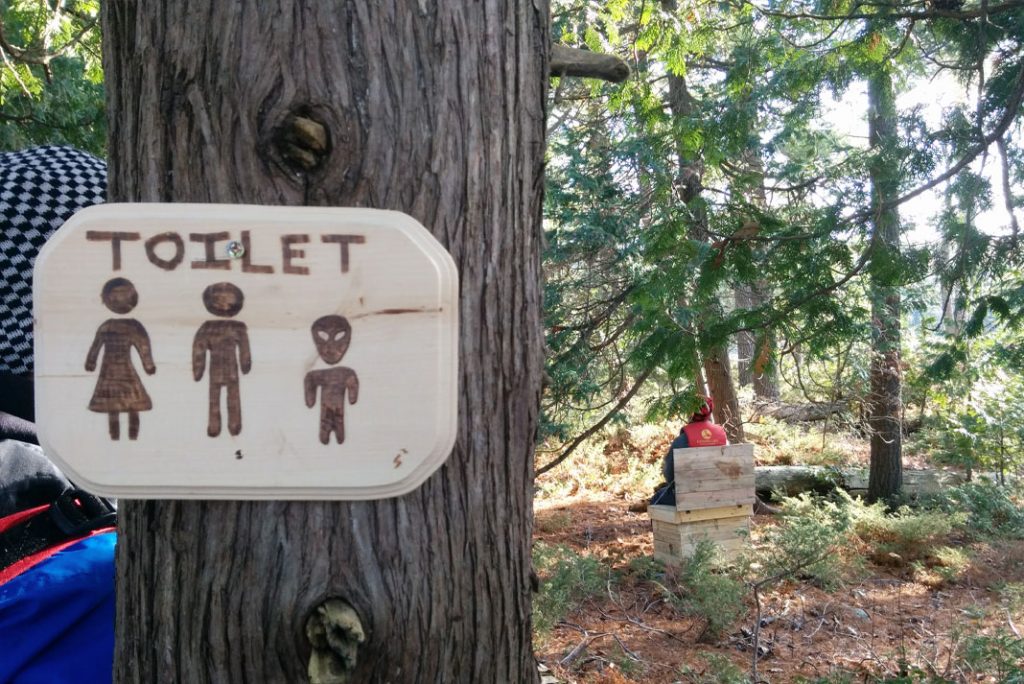
The humble pit toilet may be known variously as a treasure chest, thunderbox, KYBO (Keep Your Bowels Open), squatty potty, privy, vault, boom box, long drop or latrine. To avoid controversy—and get where you need to go—learn the local dialect.
This article was first published in Paddling Magazine Issue 62. Subscribe to Paddling Magazine’s print and digital editions here, or browse the archives here.
Looks like rain tonight: innie or outie? | Photo: Francois Leger-Savard
Many paddlers will remember the loss of venerable canoe brands Scott Canoe and Bluewater Canoe when parent company Mid-Canada Fiberglass went belly up and closed its doors in 2013. Well, Bluewater’s Saugeen fleet lives again in the Abitibi Saugeen canoe.
Abitibi Saugeen 16.6 Specs
Length: 16’6”
Width: 35”
Weight: 50 lbs
Capacity: 350-550 lbs
MSRP: $3,299 CAD
In early 2015, a pair of young Quebecois men, Guillaume LeBlanc and JD Petite, purchased the precious Mid-Canada moulds and assets—including the Saugeen—and formed the new Abitibi & Co. canoe company. Now entering its third year of operation, Abitibi & Co. is re-issuing classic designs from Bluewater and Scott with a modern flair—and they look better than ever.
Taking the Saugeen for a spin
Last fall, I had the opportunity to test a shiny new 16.5-foot Abitibi Saugeen, the mid-size version of the three Saugeens available once again.
Unable to travel far from home on a sunny September weekend, my partner, Geoff, and I added a bike shuttle twist to a local lazy river we’ve paddled a dozen times.
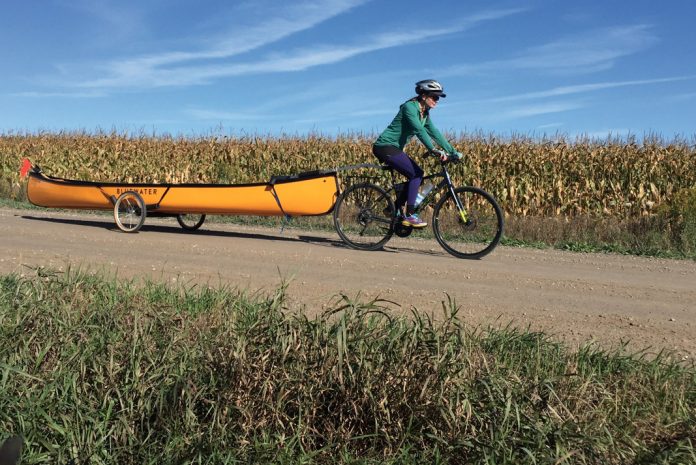
For the first 20 kilometers of our adventure, our sunny Saugeen was simply baggage, cradled gently by a canoe cart on loan from Wike Trailers.
The Saugeen trundled along behind us without complaint, our paddles gently ratatat-ing against its interior.
Ferry a heavy load
Midday found us riverside, disassembling our bikes and Tetris-ing them into the hull, taking care with derailleurs, and trying to slide frames under thwart or yoke. We were pleased to find two paddlers, two touring bikes, panniers, canoe cart and a backpack could fit inside the Saugeen’s beamy 35-inch wide hull just fine. On the water, the combined weight of paddlers and gear must have been approaching the Saugeen’s recommended max carrying capacity of 540 pounds.
With some of our awkward load riding high above the gunwales, we were always stable—even in swifts. An inch of rocker in the Saugeen’s profile creates enough maneuverability for tracing sharp bends in the shoreline and avoiding the odd downed tree, while maintaining excellent tracking.
At the end of 30 kilometers of twists and turns, I was sold.
Tandem or solo, the Saugeen 16.6 does both
The Abitibi Saugeen offers great versatility in an all-round package. I can understand why the design was one of Bluewater’s most popular traditionally shaped boats. The Saugeen is ideal for someone who does a little bit of a lot different things on the water, including wanting a tandem canoe offering solid solo performance.
I put this theory to the test a few weeks later on a solo, meandering creek excursion. Then we took the Saugeen out on a portage-heavy weekend trip, and on Christmas Day for a merry spin on a frigid ice-choked lake. It’s a friendly boat. Even on the 1000-meter-long portage from my house to the lake, the Saugeen’s 50 pounds rode easy thanks to a deep-dish ash yoke, which balanced well on my shoulders.
The cheery canary yellow exterior looks smart paired with the standard black anodized aluminum gunwales. Webbed seats, ash carry handles and thwarts, and protective composite skid plates round out the package. Vinyl and ash are trim options Abitibi & Co. also offers.
True to the original design, our Saugeen features a keel. The keel is primarily to protect the canoe against grounding, according to Abitibi & Co. “On a flat-bottomed boat, a keel will be damaged first and protect the rest,” adds LeBlanc.
Canadian-made with style and flair
Our Saugeen came to us straight from the manufacturing headquarters in Rouyn Noranda, Quebec, just inside the Quebec-Ontario border. Five years ago Guillaume LeBlanc was a paddling enthusiast and mechanical engineer looking for a career change. When he contacted Mid-Canada Fiberglass he was hoping to assist with reinvigorating their failing canoe brands. Instead he wound up purchasing their assets and molds with business partner and marketer JD Petit.
Marketing flair is visible in Abitibi & Co.’s attention to aesthetic in its boats, website and catalogs. Their moody and evocative images drip Instagram fame. The brand also produces an outdoor lifestyle magazine, Beside, and manufactures a line of heritage-inspired hand-painted canoes in collaboration with Montreal-based paddle maker Norquay.
“People talk about the features of a canoe—the weight and length—but they buy one because of the feeling they want to get in it,” says LeBlanc.
From products to digital properties, the Abitibi & Co. strategy is to stir up our wanderlust, transmuting what were utilitarian and purpose-driven canoe designs in the hands of Bluewater and Scott into art and inspiration on water. It’s kind of their thing.
When we took over production, we changed
the branding, layups, colors, finish and design
From the 100 or so Mid-Canada Fiberglass molds available when LeBlanc and Petit purchased the assets, Abitibi & Co. is now only manufacturing three-dozen canoe designs, including Bluewater’s Scout and Tripper, as well as 16-foot versions of the Peterborough and Prospector.
Abitibi & Co. bring start-up energy to the Saugeen
Despite building on the decades-long history of the canoe moulds and the Bluewater and Scott brand names, LeBlanc says Abitibi & Co. still feels a lot like a start-up.
“When we took over production, we changed the branding, layups, colors, finish and design,” says LeBlanc. The brands had 50 years of production behind them, but they were stagnant over the last 10 years, and so there was 10 years of catch-up to do while taking back production.
Color schemes have been updated and are more varied. Abitibi & Co’s construction process reflects sustainable and environmentally-friendly best practices. Like Bluewater before them, Abitibi & Co. offers the Saugeens in a Kevlar layup. Resin is infused into the fabric via vacuum bagging, then a gelcoat is applied.
“Without the gelcoat, you have a light boat but there is no repairability. We always want to be able to repair, so all our boats have gelcoat,” says LeBlanc. At 50 pounds and 16.5 feet, our loaner Abitibi Saugeen is not the heaviest or the lightest Kevlar canoe on the market. “We’re hoping to hit a sweet spot and make boats which will last for forever,” says LeBlanc.
Imagine this. There’s a roar approaching and a storm is near. Waves hammer the side of your boat—time to get to shore. Light a fire, eat some food, drink a tea, and stare at the towering waves. The squall lasts long enough that you’ve finished your book. Now what? To pass the time we suggest you partake in a time-honored skill and learn how to whittle a canoe.
[ Plan your next adventure with the Paddling Trip Guide ]
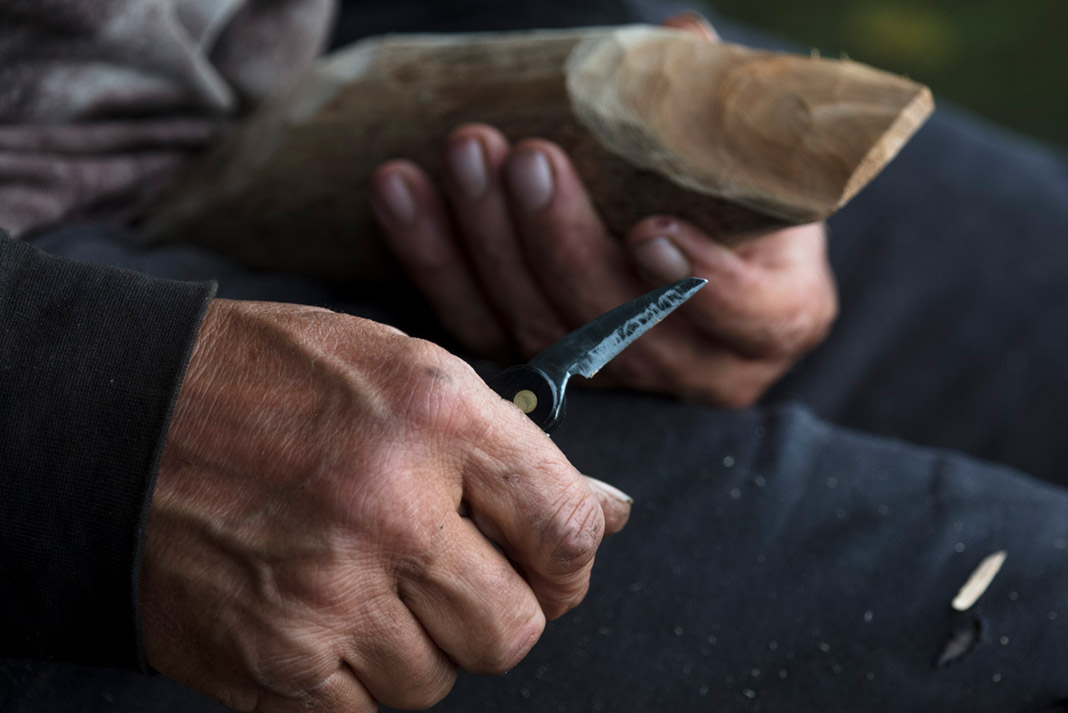
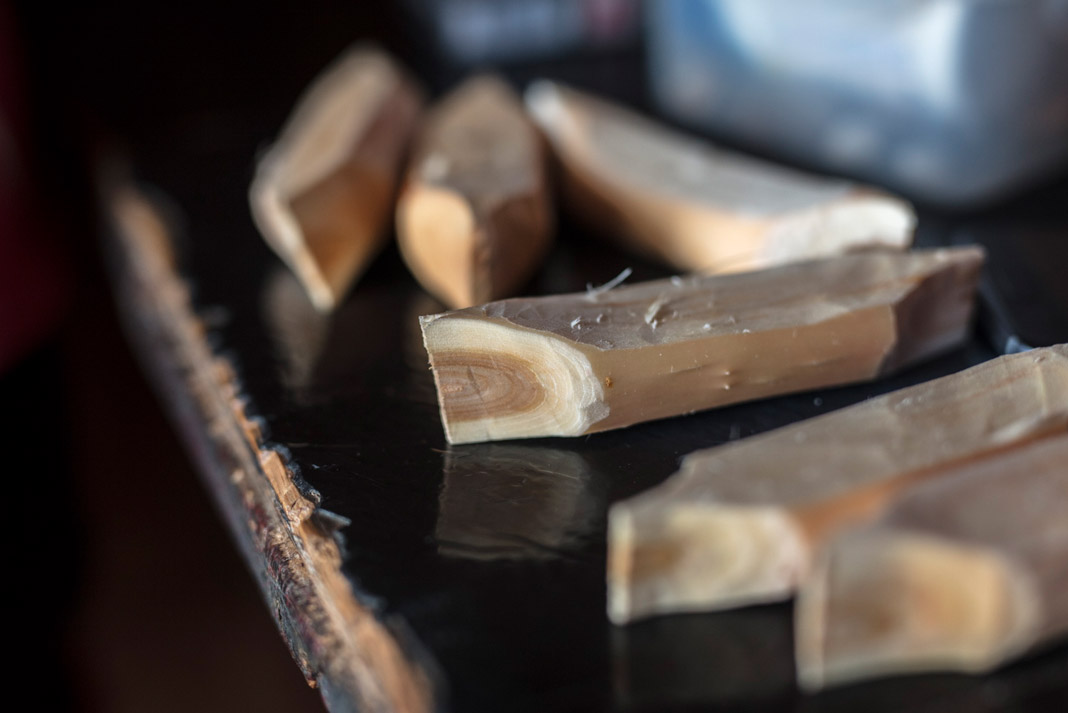
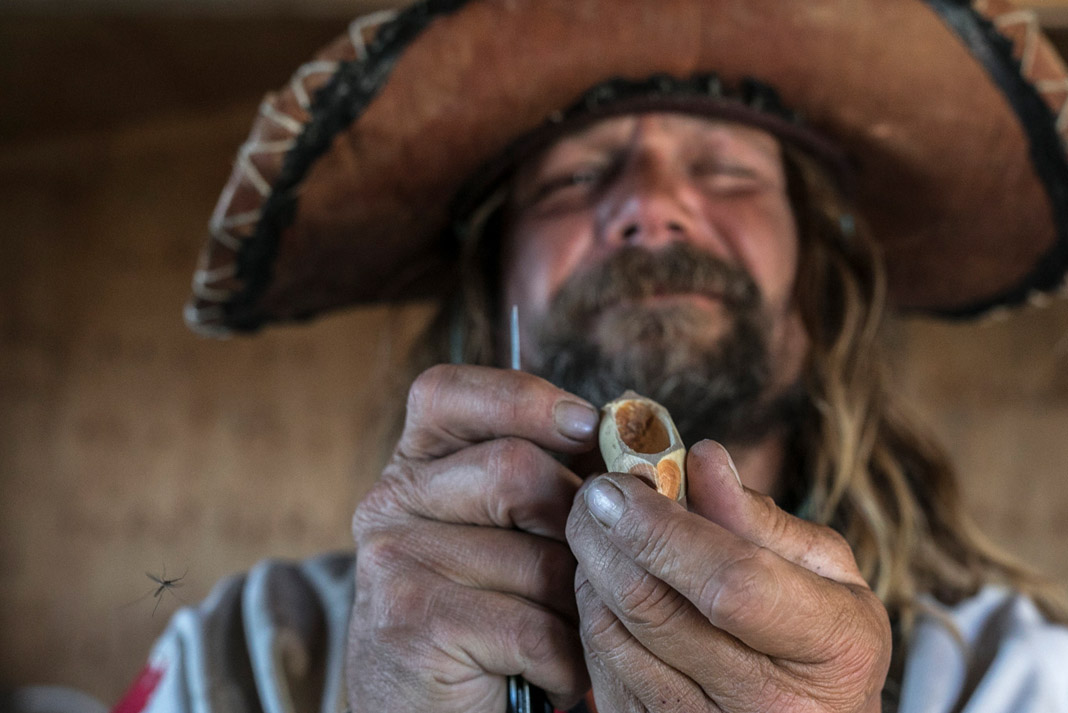
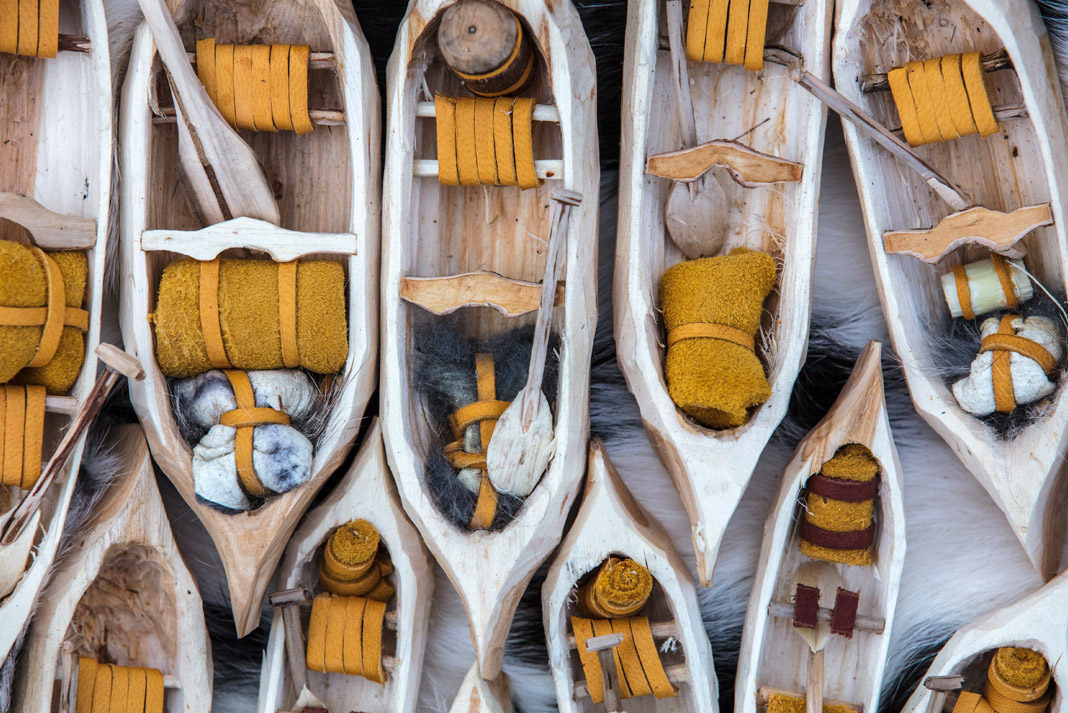
When canoe tripping, every extra luxury means added weight and space used. For Mike Ranta, Canada’s cross-continental voyageur, being pinned to a shore on some of the world’s biggest lakes means an opportunity to whittle away time by crafting his signature tiny canoes.
To whittle these tiny canoes, Ranta uses a Flexcut Carvin’ Jackknife. Any wood will do—from willow on the Saskatchewan River to a chunk of oak from Lake Winnipeg’s south basin. Here’s Ranta’s advice on how to make your own wood canoe in 60 minutes or less.
Using a hand saw, cut a portion of a small branch so it sits nicely in your palm. The bigger the piece, the more whittling necessary; start small and hone your skills.
Second step. | Photo: David Jackson
2. Make your marks
With your knife blade, notch the wood where the bow and stern positions should be.
Third step. | Photo: David Jackson
3. Shape the exterior
Ranta first flattens the bottom of the hull, then carves away at the bow and stern until he’s achieved as close as he can to a symmetrical line.
Using a flat blade, he carves what will become the inside of the boat, from bow to stern, revealing the first look of a pint-sized canoe.
Fourth step. | Photo: David Jackson
4. Hollow out the interior
Once the line seems just right, Ranta switches to his digging blade and begins shaping the inside of the canoe. The trick is to make the hull as thin as possible, but not puncture through the wood and ruin the little creation.
Fifth step. | Photo: David Jackson
5. Look to the sky
A great way to check if your walls are getting too thin is to hold the canoe up to the sky and see if there are any spots where the sun bleeds through the wood. This means the walls are getting too thin.
6. Finishing touches
When the canoe is dug out, make some final touches to fine-tune the design and fix any blemishes.
Extra steps. | Photo: David Jackson
Whittling a canoe: Extra steps
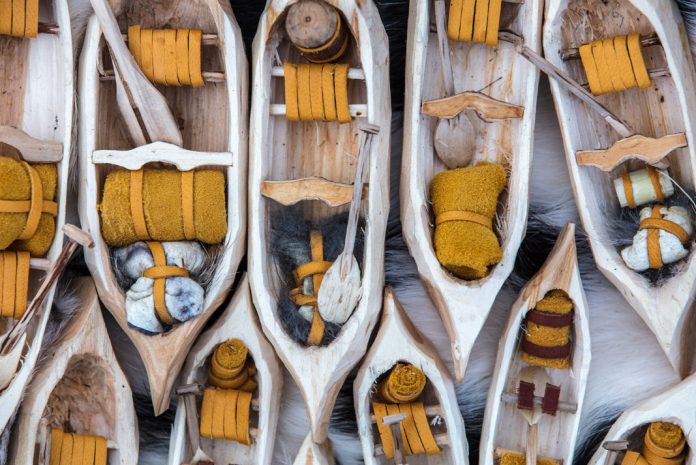
Ranta goes one step further and crafts miniature paddles, a thwart and seats, which he glues into position. When time permits, he adds little voyageur sacks, finished with tiny pieces of rabbit fur and lashed with hide.
When the waves have subsided, in your hand is a beautiful little piece of art for a mantle, or a tiny toy for a child dreaming of flowing rivers and sprawling lakes.
Beware, whittling knives are exceptionally sharp, and a slip can lead to deep gashes. It’s imperative to be patient and have a first aid kit. Consider going one step further and purchasing a whittling glove. The last thing anyone wants is to be evacuated because of a carving accident.
This article was first published in Issue 55 of Paddling Magazine. Subscribe to Paddling Magazine’s print and digital editions, or browse the archives.
There’s a subculture of kayaking known by few and understood by fewer. The paddlers don diving goggles and neoprene and slide into thin, uncomfortable boats not meant to float but designed to sink. Below the waterline, their goal is to stay underwater as long as they can. This is squirt boating.
[ Paddling Buyer’s Guide: View all rafting gear ]
After squirt boating’s heyday in the early 1990s, the scene has all but disappeared. But when it comes to the history of squirt boating, the legend starts with Jim Synder. The Mystery offers a rare glimpse into this obscure sport and the dedicated few who continue to keep the tradition alive.
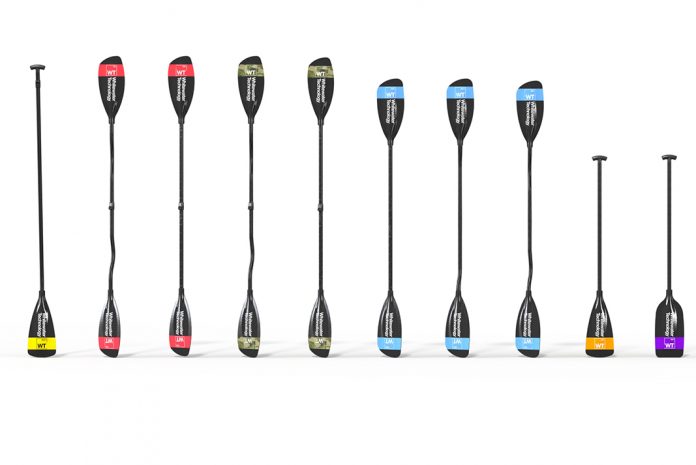
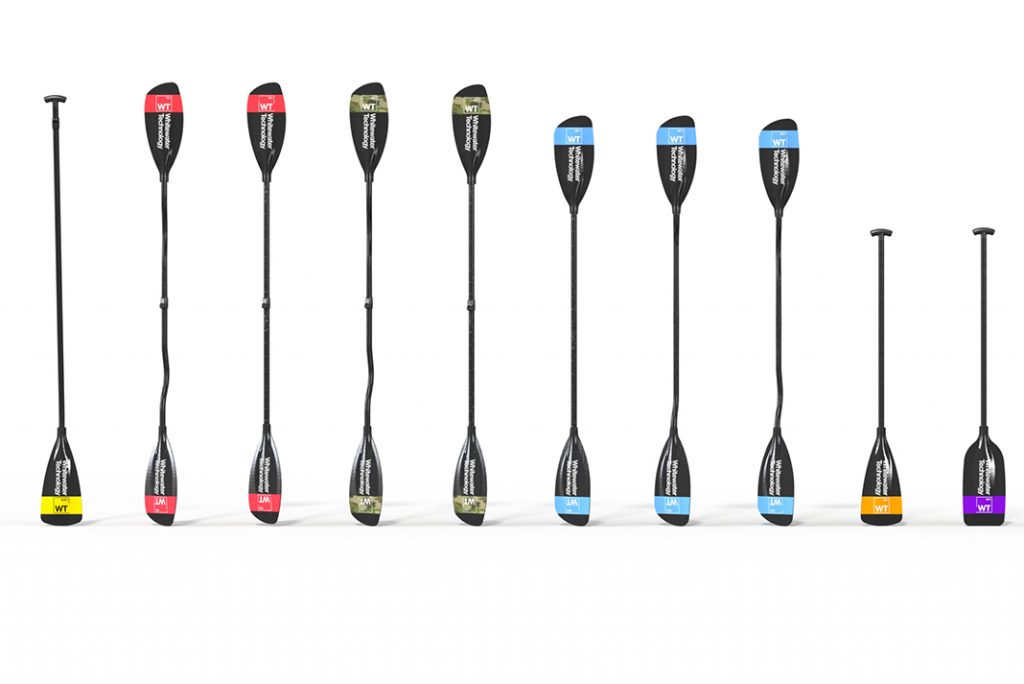
Whitewater Technology launches it’s debut paddle range featuring high performance paddles made with recycled carbon fiber & 5 year warranty. | Photo: Whitewater Technology
Greenville, SC – October 28th 2021 – Whitewater Technology, a new entrant to the high performance paddlesports market launches its first 100% made-in-USA, recycled carbon fiber paddle range with an exclusive pre-sale on whitewater-technology.com.
The range which features paddles for all disciplines had been designed by leading advanced materials engineer and whitewater kayaker Ollie Wainwright. Using his composites background in the motorsports industry, WT’s first paddles are the result of 2 years of intensive R&D into the use of recycled carbon fiber in high performance outdoor & sporting goods.
Whitewater Technology launches it’s debut paddle range featuring high performance paddles made with recycled carbon fiber & 5 year warranty. | Photo: Whitewater Technology
“As both a serious paddler and materials engineer I had grown frustrated with the lack of a sustainable high performance paddle option. We’re out there in nature every weekend using a product that ultimately ends up in landfill.. So a few years ago we set out to try and change this.”
Photo: Whitewater Technology
“We’re really pleased with the results and what we’ve been able to accomplish in designing a more sustainable paddle that performs and we’re stoked to share this with the paddling community”
WT’s paddles utilize a custom made, high impact, non-woven composite that combines 40% recycled carbon fiber with a thermoplastic resin system and an aramid puncture resistant layer. The result is a high performance paddle with identical weight, strength and stiffness properties to a non recycled product.
Photo: Whitewater Technology
Available initially as a pre-order via the WT website in addition to specialty retailers, the range includes paddles for; Whitewater, touring, fishing, SUP, rafting and canoe with a variety of adjustable length and shaped shafts.
Pre-sale pricing starts at $240 including free shipping, 5 year warranty and crash replacement.
Derived from the name of the Latin and Greek gods of the west wind, in English “zephyr” means “a gentle breeze from the west.” The Zephyr 160 Pro from Wilderness Systems adopts the name to suggest that this kayak, while sizeable, provides a light and airy ride for medium- to large-sized paddlers.
Wilderness Systems Zephyr 160 Pro Specs
Length: 16’
Width: 23”
Depth: 17”
Weight: 54 lbs
Capacity: 300 lbs
MSRP: $3,150 USD / $3,700 CAD
The Zephyr 160 is indeed light, being composite, and is airy in substance—like its namesake it can be everywhere at once and refuses to be nailed down on the spectrum of kayak performance. No kayak can do everything, but the Zephyr comes close to a quiver-of-one.
The Zephyr 160 is a big‑time performer
Its 16-foot length puts the Zephyr smack between day-touring and expedition classes, offering a mix of nimbleness for tootling about and storage capacity for ambitious trips. Similarly, the 23-inch width makes it neither torpedo nor tanker, swinging the needle just slightly to the side of playfulness by presenting a more rockered profile on edge. This tubby belly with a taste for rock-garden mischief spins like a dervish on a steep edge and makes room for paddler and gear.
Plenty of room to spare
The Zephyr’s cockpit is cavernous and welcomes rec kayakers making the transition to a high-performance boat. A six-foot-two paddler had the foot pegs four to five notches back from max and could barely toe the bulkhead. But there’s no sacrificing a snug fit, even for medium-sized seamen, thanks to the adjustable outfitting.
Smaller testers found the 17-inch deck a bit high, however, confirming that this is a performance punt for paddlers on the large side. We noticed that the cockpit opening seemed poorly positioned relative to the seat, or vice versa, with several inches of space behind the seat back making it harder to get a sprayskirt on.
On the go, the hull tracks straight on an even keel and holds its own, speed-wise, amidst a fleet of expedition boats. On a tilt, there’s a direct relationship between degree of edging and willingness to turn. The point-of-no-return is a point of mega-turns, providing you have a handy brace. Initial stability is more solid than its sister ship the Tempest, while secondary on this softer chine is less defined: the Zephyr 160 is friendlier to beginners, but its edging less precise.
Years ago, Wilderness Systems’ adjustable outfitting migrated over from its whitewater designs to sea kayaks and has been improving ever since, providing lickety-split customization of thigh brace position, hip pad width, and leg support height. We like.
Shallow-V hull and soft chine make for good initial stability and soft secondary—increasing degrees of edge give greater turning speed with no obvious point of resistance. When deployed, the plastic skeg felt loose and could be heard wiggling when rocking from edge to edge. Oddly, the Zephyr is available in Kevlar for the same price as fiberglass.
Attractive deck layout with generous bungee tie-downs and three waterproof rubber Kajak Sport hatches. The 10-inch bow hatch is less convenient to pack than an oval hatch, but provides greater security in rough seas. A compass mount is recessed ahead of the front hatch.
Ride like the wind with the Zephyr 160 Pro
On the Greek theme, the Zephyr 160 sticks to Aristotle’s golden mean in both capacity and performance. Also available in rugged plastic and a sportier 15.5 length suited to smaller paddlers, the Zephyr succeeds as the do-it-all high-performance kayak that Wilderness Systems claims it to be.
This article was first published in the Spring 2009 issue of Adventure Kayak Magazine. Subscribe to Paddling Magazine’s print and digital editions, or browse the archives.
A few new things going down at Necky this year: The introduction of a new layup process called “resin infusion” that makes its composite boats lighter, and the surprising move to drop its Kevlar line entirely in favour of carbon. The venerable kayak builder has also joined the latest North American trend and put out a British-inspired boat, the Necky Chatham 16.
The Chatham 16 comes complete with a skeg, gracefully upswept “Greenland style” bow and stern, a playful rocker, steep chines, a low, streamlined deck and whitewater-inspired outfitting. This so-called British trend is a lot like low-carb dieting: some say it’s just a silly fad that’s sure to pass, while others say it’s a sign that North Americans are finally smartening up.
[ Plan your next adventure with the Paddling Trip Guide ]
Paddle the Necky Chatham 16 and you’re likely to side with the latter. The Chatham is simply a joy to paddle in wind and waves and poking around in tight places. At 16 feet, she truly fits her billing as more of an ocean playboat than a long-distance tourer. Although our poly test model did not feel especially fast, it excelled in agility. On edge we could spin in place or carve 90-degree turns with one or two well-placed strokes.
The Chatham’s initial stability feels moderate; secondary stability is remarkably consistent in any degree of lean through to a complete roll, thus the Chatham is remarkable for practicing fancy sculling and rolling, almost as much fun underwater as above.
Shedding pounds and dollars
The composite Chatham that we didn’t test is likely all the more nimble at 49 pounds. Necky’s new layup technology goes a step beyond traditional vacuum-bagging to suck air out of the mould first, before injecting resin into the fabric. Necky claims there is significantly less resin in the finished product than with their old hand layups, arriving closer to an optimum resin-to-cloth ratio without the extra weight or strength-sapping brittleness of excess resin.
Amazingly, Necky’s fiberglass boats now weigh about the same as last year’s Kevlar. Prices have also slimmed across the board. Take the Tahsis, which this year dropped five pounds and about $200. Customers still happy to pay the Kevlar price can opt for the new carbon layup instead—allegedly lighter, stronger and longer lasting than Kevlar ever was.
Necky’s robust outfitting suits the “ocean playboat” theme. The seat of fabric-covered minicell foam is very comfortable and easy to customize. Hip pads attach to the aluminium stays on either side of the seat. The slim 15-inch-wide cockpit is the Chatham’s limiting factor for larger paddlers. There is, however, plenty of room for long legs. Padded aluminium thigh braces provide secure contact and are easy to adjust in multiple directions. Ski boot-type ratchets on each thigh brace wrap around to micro-adjust the backband—oodles o’ hardware, but it does the trick. A smooth aluminium slider beside the cockpit controls the lifting and lowering of the skeg.
All three storage compartments stayed dry beneath the rubber hatches by Valley Canoe Products. Necky provided the unique advantage of a front hatch that’s as big as the 16-inch-long rear—much easier to pack than a standard eight- or nine-inch round British bow hatch. A low, flat deck and high bow show off Greenland provenance. A sunken compass mount graces the deck fore of the bow hatch. Comfortably moulded hand toggles hang loose according to the traditional British prescription that they be easy for a swimmer in rough seas to grab and to hold, even while the paddler performs a roll.
The Chatham 16 is outfitted with a plastic skeg that can be fully or partially deployed to aid tracking in following/quartering seas. Ours wagged a bit and sent a very slight vibration through the boat at certain speeds. But the skeg was quite effective at preventing weathercocking, which was noticeable in a crosswind if the skeg was not down. The paddler’s feet are free to be securely braced on the aluminium foot pegs.
[ Paddling Buyer’s Guide: See all sea kayaks with skegs ]
Go all day in the Chatham 16
For smaller to medium-sized folks who fit into it, intrepid beginners or energetic experts, the Necky Chatham 16 is a slim and sporty choice for most types of serious sea kayak play, from day trips to medium-length tours.
This article was first published in the Summer 2004 issue of Adventure Kayak Magazine. Subscribe to Paddling Magazine’s print and digital editions, or browse the archives.