Home Blog Page 166

Boat Review: Ocean Kayak Malibu Pedal

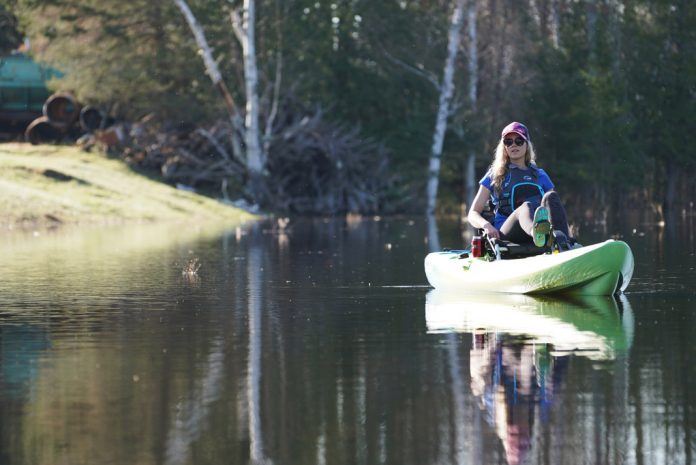
woman paddling a green ocean kayak

What do I know? I’d like to begin my review of the Ocean Kayak Malibu Pedal recreational boat with a short story of youthful ignorance.

Ocean Kayak Malibu Pedal Specs
Length: 12’
Width: 34.5”
Weight: 100 lbs
Capacity: 450 lbs
MSRP: $2,199 USD / $2,899 CAD
[ Paddling Buyer’s Guide: See the Ocean Kayak Malibu Pedal ]

Malibu Pedal and the arrogance of youth

Once upon a time I started kayaking and embarked on an expedition through the Great Lakes. I’d just received three degrees and was paddling from my university on the northern tip of Superior to my hometown, 2,500 nautical miles to the southeast. My father was a huge supporter of the trip. He was a truck driver, a non-swimmer and a fisherman. He was not a paddler. And my father didn’t go past grade 12 in school.

“You kayakers are crazy,” he told me on the drive to the city of Thunder Bay to begin my three-and-a-half month trip. “You’ll just be sitting there not using your legs. And you can’t even fish because you’re holding your paddle all the time. You should invent a kayak you can pedal.”

“Then it wouldn’t be a kayak,” I told him, surely rolling my eyes. No serious kayaker would use it. It wouldn’t be kayaking. What did he know?

The pedal drive has its place in kayaking

Fast-forward 23 years to being married and shopping with my wife for a new family vehicle. I thought she should get another sporty five-speed stick shift. They’re fun to drive and offer more control on our snowy winter roads. What I hadn’t considered is the needs of others—standard transmission does not offer an easy way to drink coffee and accelerate through the gears.

And so, with an open mind, I present my enlightened and humble review of the Ocean Kayak Malibu Pedal, a recreational kayak propelled with legs, leaving hands free to fish or drink morning coffee, or both. And if that’s not enough reason for you to believe Ocean Kayak is going to sell thousands of these suckers, read on.

The Malibu is a trusty pedal pusher

The Malibu Pedal is the first Ocean Kayak to offer a pedal drive, but they started with the proven design borrowed from Old Town’s trusty Predator PDL fishing kayak.

[ Paddling Buyer’s Guide: See all Ocean Kayaks ]

Ocean Kayak designers cut the overall size of the system to fit in the smaller, lighter Malibu Pedal. The 24-inch, one-piece shaft drops down through the hull where a 12-inch propeller pushes the boat either forward or reverse, depending on which way you spin the bicycle crank. The system is pretty much what my dad had scribbled on the inside flap of an empty cigarette pack he found on the dash of his pickup.

Outfitting that anticipates your needs

Ocean Kayak borrowed the same broad frame seat from their fishing kayaks and covered it with swimsuit-friendly, breathable mesh. They call it the Element Beach Seat. Picture a cut-down church picnic aluminum lawn chair, but with high-end deck furniture fabric. The seat has 13 clicks of fore and aft adjustment to get the leg length just right. My 35-inch inseam had the seat about half way, and moving it forward for shorter testers didn’t seem to affect the trim of the boat in any significant way. The seat itself is easily tipped forward to access a storage area or removed completely for transport.

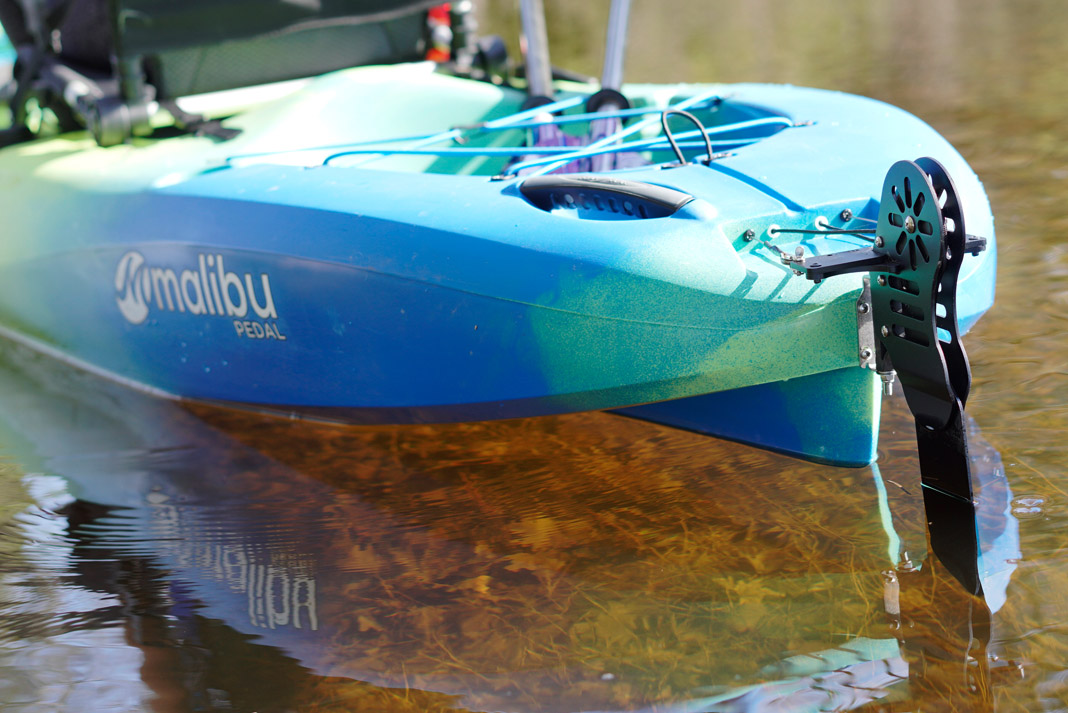
On the right of the seat you’ll find a massive eight-inch lever connected below the deck to internal cords running to the stern so the rudder can be easily raised and lowered. Because your feet are busy spinning the pedals, pivoting of the rudder and steering of the kayak is done with a control knob on the left-hand side of the seat. So it’s not as hands-free as the brochure may indicate, but it does allow you to drink coffee or fish with your right hand. Guess which side the integrated drink holder is on? On the right side, of course. Ocean Kayak has thought of everything.

The Malibu Pedal’s flared bow is designed for pedaling through shore break and cutting across open water—what you’d expect from a brand with “Ocean” and “Kayak” in the name. It’s sort of a tri-hull design that looks like a rippled potato chip. All the angles make for a very rigid boat, and the volume on the outside ripples make the Malibu a wildly stable pontoon boat for standup sight fishing, or to pop up the drive and standup paddle through shallow sections of river.
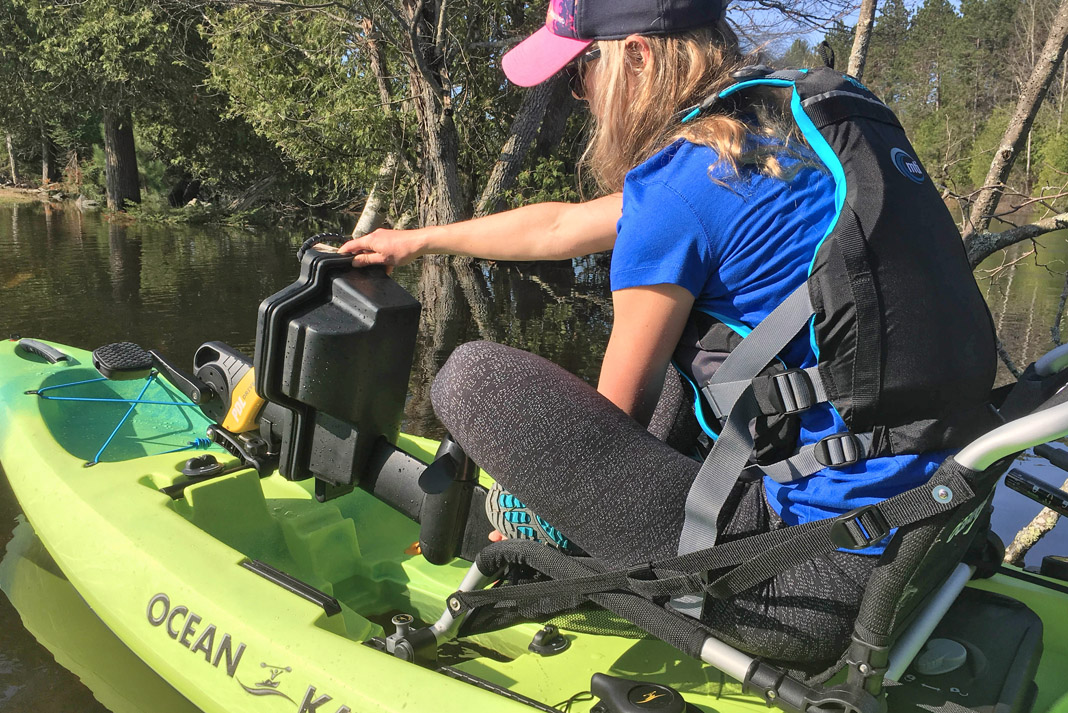
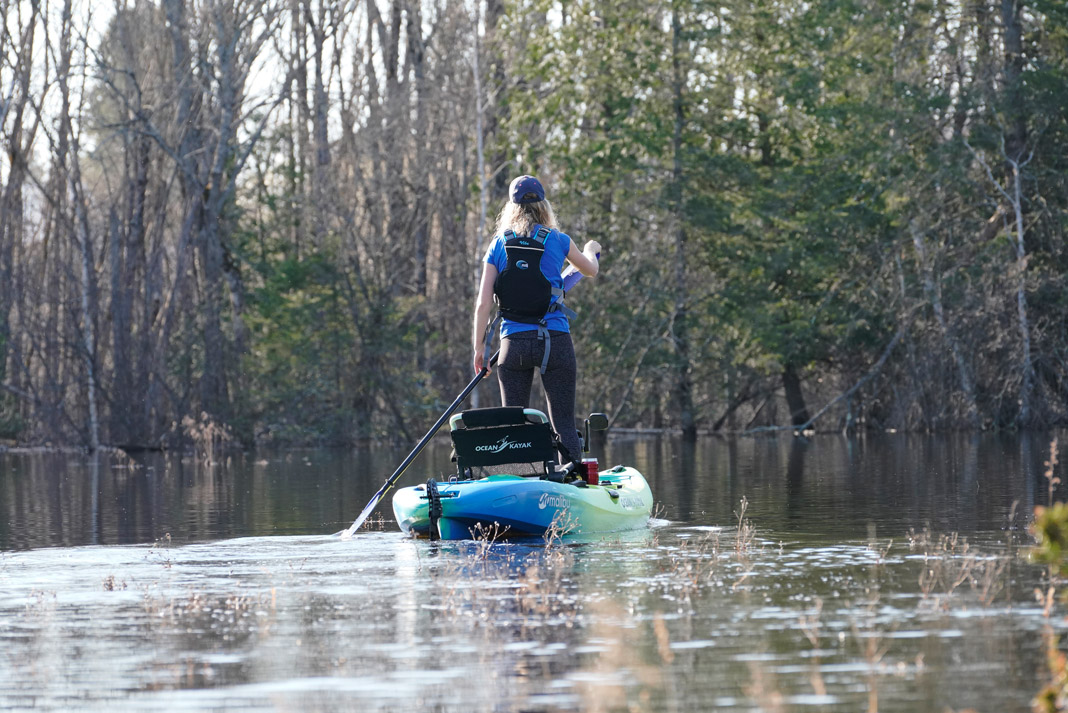
At the back, Ocean Kayak integrated a replaceable keel piece, because like you, we dragged the Malibu down to the water. And like all good sit-on-top kayaks, the Malibu has six scupper holes to allow rainwater or water crashed over the deck to run back out where it belongs.

This rig makes wide turns

Growing up a truck driver’s son in the 70s, one might expect I’d know the words to The Willis Brothers’ country and western hit, Give Me Forty Acres To Turn This Rig Around. Get the Malibu out on the open road and you can put the hammer down to comfortably knock off the miles. But around the launch I’m humming the next line in the song, “…It’s the easiest way that I found.”

Short of 40 acres, or the Malibu’s 30-foot turning radius, it’s easiest to put the coffee cup down, grab the paddle from its clip, tilt as far as you can and throw in a few good sweep strokes. Or so says the kayaker in me. But compared to other pedal drive fishing kayaks, the 12-foot long Malibu turns tighter than most.

Ocean Kayak’s Malibu Pedal is a convenient ride

So what do I know? I know my dad was right about the potential popularity of a pedal drive kayaks. I know I was right too; it’s not expedition kayakers who are going to be buying thousands of Malibu Pedals. I know my wife has an automatic Toyota 4Runner parked in our driveway. And I also know our Malibu at the Paddling Magazine office is the boat most often skidded into the river for early morning trips.

Maybe it’s because the Malibu Pedal is novel. Maybe it’s because it allows you to drink a coffee. More likely it’s because at that time of day when the sun is casting a golden light across the water, it’s not about kayaking for kayaking’s sake. It’s about just being on the water either to wet a line or raise a coffee mug to celebrate the coming of a new day.

This article was first published in Issue 54 of Paddling Magazine. Subscribe to Paddling Magazine’s print and digital editions, or browse the archives.
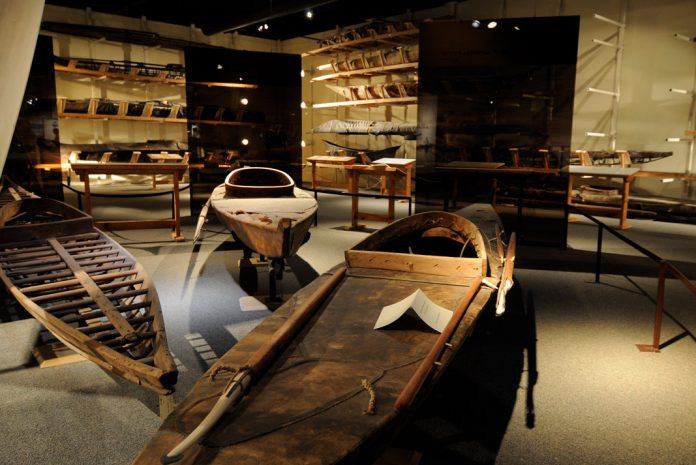
 

The Canadian Canoe Museum launches three-part video tour of world-class collection

Photo: Virginia Marshall
History comes alive at the canadian canoe museum. Photo: Virginia Marshall

The Canadian Canoe Museum, which recently reopened, has launched a new three-part video series, allowing the public to get up close and personal with three iconic canoes in the museum’s collection.

Featured in the video tours are the stories of William and Mary Commanda’s birchbark canoes, whose work in revitalizing the cultural practice of canoe building in Indigenous communities has been nationally and internationally recognized; the titular “Canary Yellow Canoe” belonging to Gordon Lightfoot that he memorialized in a song; and, the artistic interplay between May Minto, a female canoe builder, which was uncommon at the time, and wildlife painter and environmentalist Robert Bateman.

[ View all canoes in the Paddling Buyer’s Guide ]

“We often are asked, “Why collect canoes?”, and the answer is that we don’t – or rather, that we believe the canoe to be more than the sum of its parts. The canoes in our collection carry rich, significant stories that collectively tell the history of Canada by canoe,” shares Jeremy Ward, the museum’s Curator. “Whether the stories they tell are of ancient connections to waterways, the latest high-tech innovations at the Olympics, or they are expressions of cultural reclamation, pride and endurance of Indigenous peoples today, canoes let us form new understandings of connections to our environment, other people and ourselves”.

Summer is typically the busiest season for visitors to the Canadian Canoe Museum, with regional and international tourists contributing significantly to the approximately 40,000 annual visitors to the museum. While the Canadian Canoe Museum reopened this past weekend, the museum recognizes that not everyone will be able or willing to return to indoor public spaces just yet, and in response, are continuing to find innovative ways to share this world-class collection virtually.

The virtual video tours were produced by Birchbark Media, with funding provided by Kawarthas Northumberland, and in collaboration with Peterborough & the Kawarthas Tourism, to showcase the vast opportunities there are to explore arts, culture, and heritage in the region – whether in-person or online.

The video tours can be viewed at canoemuseum.ca/CCM-from-Home

About The Canadian Canoe Museum

The Canadian Canoe Museum, located in Peterborough, Ontario is a unique national heritage centre that explores the canoe’s enduring significance to the peoples of Canada, through an exceptional collection of canoes, kayaks and paddled watercraft. Through inclusive, memorable and engaging exhibits and programs, we share the art, culture, heritage and spirit of paddled watercraft with our communities.

Kokatat releases 5 Decades limited edition collection

Photo courtesy of Kokatat

In 1971, Steve O’Meara founded Blue Puma as an outdoor gear company to help get people in Humboldt County California outdoors. Soon after he renamed the company Kokatat as the company shifted focus completely to Paddlesports. In celebration of its 50th Anniversary, Kokatat is introducing a limited-edition capsule collection featuring the original Blue Puma logo and a commemorative 5 decades wave graphic treatment.

“This collection captures so much of our legacy and future,” said O’Meara.

[ Paddling Buyer’s Guide: View all Kokatat’s products ]

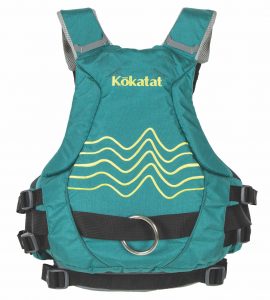
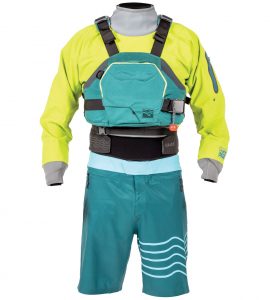
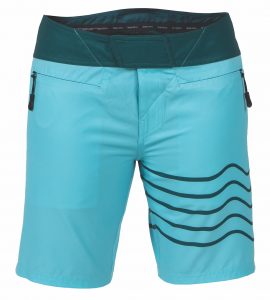
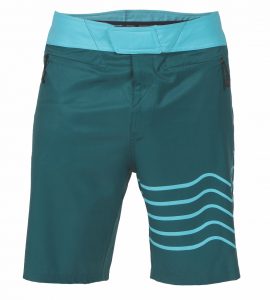
The 5 Decades Limited Edition Collection includes three pieces that feature special dew (teal) and mantis (yellow) colorways and a 5 decades wave graphic treatment, with each wave representing a decade. The collection includes a HustleR rescue vest, the new ŌM dry top, and a new paddling short that Kokatat developed in collaboration with dewerstone. The Kokatat X dewerstone Life Short and ŌM dry top are offered in men’s and women’s specific styles.

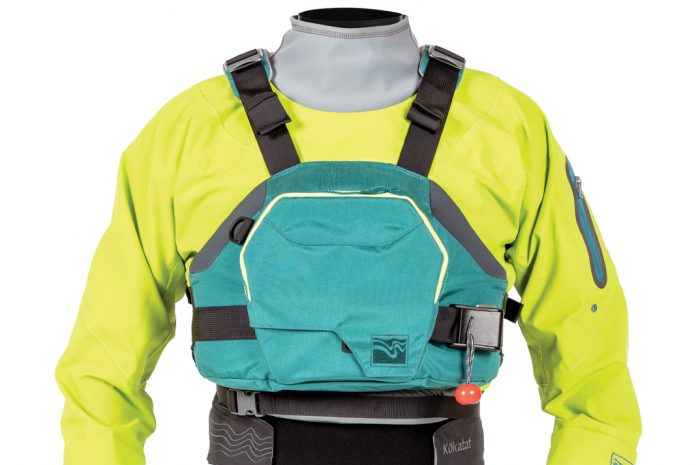
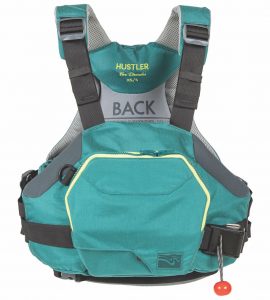
The limited-edition HustleR has all the features that has made the HustleR Kokatat’s most popular rescue life vest including its ability to fit a wide range of torso sizes, rugged 500 denier Cordura face fabric, quick release chest harness, and D-ring attachment for standard cow tail or river tow tether. Along with the special colorway and 5 decades wave graphic on the back, an original Blue Puma logo sits along the top edge of the internal organization pouches inside the large, extra-deep clamshell front pocket.

The LE ŌM dry top pays homage to Kokatat founder Steve O’Meara and Kokatat’s 50 years. The LE ŌM and the new regular version ŌM are made with the latest GORE-TEX PRO material that is lighter weight, more rugged and durable. The result is Kokatat’s most advanced dry top to date.

[ Paddling Buyer’s Guide: See all dry tops ]

They feature a new pattern for improved fit and mobility over past designs as well as Page ( ) – 5 decades Limited Edition Collection 2 neoprene over-cuffs on the neck and wrists and a self-draining pocket on the left shoulder. The adjustable double tunnel waist now features Ariaprene, a sustainable alternative to neoprene, and provides an infinitely adjustable perfect fit. LE ŌM features the 5 decades wave graphic on the waist closure and the Kokatat logo treatments and zipper accents are highlighted in the new dew colorway.

Photo courtesy of Kokatat

Rounding out the collection is the sustainable and comfortable Kokatat X dewerstone Life Short 2.0, designed in collaboration with dewerstone of Devon, England. The 4-way stretch short, made entirely from recycled plastic bottles and recycled polyester, moves easily with each paddle stroke and provides the perfect fit every time with its infinitely adjustable and secure surf leash inspired closure system. The Life Short is available in men’s and women’s, dewerstone’s first women’s short offering, and features the 5 decades wave graphic around the left thigh.

The Kokatat 5 decades Limited Edition Collection will be available at Kokatat dealers nationwide and on Kokatat.com in Spring 2021.

For more details on Kokatat, its products, and its 50th Anniversary visit kokatat.com.

About Kokatat Inc.

Kokatat has been manufacturing paddling gear in Arcata, California almost 50 years. At a time when many technical apparel brands were moving manufacturing offshore, Kokatat continued to invest in infrastructure in the United States. Kokatat founder Steve O’Meara was committed to the development of the finest and driest paddling apparel in the world and recognized the need to control and continually evolve the development of our dry wear. In the early days, Kokatat worked closely with W.L. Gore & Associates, makers of GORE-TEX®, to refine the sewing and sealing techniques required for full immersion suits and tops. Today, our hands-on approach to manufacturing continues to set standard in paddling apparel. Into the water with Kokatat! Learn more at kokatat.com.

New virtual tours by The Canadian Canoe Museum engage seniors, reduce isolation

Canadian Canoe Museum Hero

Seniors in Peterborough City and County will now be able to visit The Canadian Canoe Museum without leaving the comfort and safety of their residences, thanks to new funding.

Intended to reduce social isolation, and provide opportunities for community interaction, The Canadian Canoe Museum’s new virtual tours will engage seniors who are in longterm care, retirement residences, and living independently. The live virtual tours will connect seniors with a museum guide as they explore exhibits and artifacts, providing an opportunity to interact with museum staff and each other.

“We know that the need to self-isolate during COVID-19 has had a significant impact on the lives and mental health of seniors,” says Karen Taylor, Director of Programs. “The Canadian Canoe Museum is excited to develop new programming that will provide stimulating and enriching entertainment for local seniors who are unable to visit the museum at this time. While we have been offering virtual field trips for students for years now, this will be the first time we are able to offer virtual tours for adults! I am looking forward to sharing the collection’s stories with seniors in our community, and, above all, to fostering new ways of connecting with each other.”

[ View all canoes in the Paddling Buyer’s Guide ]

Funding for this new initiative has been provided by the Government of Canada’s COVID-19 Emergency Community Support Fund, which is being dispersed locally through the United Way of Peterborough.

More information is available at canoemuseum.ca/virtual-tours-for-seniors or by contacting Karen Taylor by email (karen.taylor@canoemuseum.ca) or phone (705) 7489153 ext. 203.

PETERBOROUGH, Tuesday, September 15, 2020

Boat Review: Dagger’s Mamba Kayak

Whitewater kayaking in the updated Dagger Mamba
Tackle whitewater with confidence in the Dagger Mamba kayak. | Photo: Mike Kobzik

The old adage “if it ain’t broke, don’t fix it” is advice many adhere to, while others seem determined to prove it wrong. The new Da­gger Mamba falls into the latter category, showing paddlers that it is indeed possible to take something great and make it even better.

Dagger Mamba Specs
Length: 7’7” / 8’1” / 8’6”
Width: 25.5” / 26.75” / 27.5”
Volume: 64 / 77 / 89 US GAL
Weight: 41 / 44 / 46 LBS
Paddler: 120–170 / 150–220 / 175–260 LBS
Forward hatch: 10×8 in
MSRP:  $1,049 USD
www.dagger.com

Dagger first launched the Mamba in 2005 as a river runner that was designed to inspire confi­dence in paddlers whether they were learning the basics, figuring out how to spin, or already drift­ing over horizon lines.

With three sizes to choose from and a choice of creek or play outfitting, Dagger had a clear winner—so why the change?

We spoke with Dagger team manager Andrew Holcombe and he told us the new and improved Mamba is a little more aggressive for those who want it, has extra safety features, looks sleeker, fits better and is more comfortable for more paddlers—they’re just tweaking an already good boat.

Features of the Dagger Mamba

Greater size and volume

The most obvious change to the Mamba is bigger sizes across the range.

Increased length and vol­ume accommodate a greater paddler range and the extra volume around the knees makes for a very comfortable and aggressive seated posi­tion. Added volume in the stern keeps the boat floating higher so the ends stay clear of grabby eddylines and boils.

The planing hull is sandwiched between long carving rails that extend almost the full length of the boat, tapering off into the rounded bow and stern. This allows you to aggressively carve across eddylines, wave faces or out of holes and yet still spin, side surf and cross currents without worry of window shading.

Improved strength and handling

Other improvements push the capabilities of the redesigned Mamba toward more difficult whitewater.

These include repositioning the ex­isting front safety bar and adding a second bar for easier carrying, dragging and extractions. The creeking outfitting also now features a molded-in stern foam wall mount to boost structural integrity.

Charging down steeper class IV–V rapids, we loved how this Mamba handled holes. Although a bit slower than Dagger’s displacement hull creek boat, the Nomad, it carved out of holes that would’ve had Nomad paddlers looking for a rope. The Mamba’s narrow, sleek bow punches holes and deflects smaller, choppy waves so the river doesn’t high five you in the face every few seconds. Boofing is a breeze, although on some higher volume runs we had to aggressively lean forward to avoid surprise stern squirts.

Customizable outfitting

Comfortable and easy-to-adjust outfitting means you can paddle all day without needing to get out and stretch every 10 minutes.

Spend some time adjusting the seat placement, as slight changes in positioning dramatically affect how the rails work and the boat performs.

[ Paddling Buyer’s Guide: See all Dagger Kayaks ]

Summing up the Dagger Mamba

The tweaks to the Mamba allow paddlers to charge harder whitewater than the earlier version and we suspect some paddlers will make this their dedicated creek boat. Responsive han­dling should make it a go-to ride for the big water crowd and improved stability and predictability make it a solid choice for developing paddlers.

With this Mamba, Dagger could coin a new ad­age: It ain’t broke but we made it better anyway.

Follow us on Instagram @paddlingmagazine for all your whitewater updates.

Tackle whitewater with confidence in the updated Dagger Mamba kayak. | Feature Photo: Mike Kobzik

Boat Review: The Storm Sea Kayak By Current Designs

Kayaking in the redesigned 2004 Storm Sea Kayak by Current Designs

The Current Designs Storm has been completely redesigned for 2004. Brian Henry designed the original Storm, the first rotomolded polyethylene kayak from Current Designs, in 1994. It was based on the template of his flagship composite design, the do-it-all, beginner-friendly Solstice GT.

Current Designs Storm Specs
Length: 17’ 1”
Width: 24”
Depth: 14.75”
Weight polymer: 64 lbs
Cockpit: 32.5” x 17.5”
Rear hatch: 15” – oval
Forward hatch: 9” – round
Total volume: 394 litres
MSRP: $1,349 USD / $1,999 CAD

Plastic was difficult to shape in the same lines as fibreglass, so the original Storm was a compromise with a slightly more rounded cross section and more rocker than the Solstice. It had a little less tracking and stability, but was still a great all-around touring kayak. The public quickly fell in love with the Storm.

[ Paddling Buyer’s Guide: See All Sea Kayaks ]

Now, with over 5,000 well-loved Storm kayaks in use, there were bound to be a few complaints. Common nitpicks about the old Storm were “oil-canning” (concave denting of the hull, once common in plastic boats), weathercocking and the finicky nature of the neoprene inner hatch covers on plastic lips.

What’s new with the Storm

Current Designs has addressed the rigidity issue by introducing stiffer materials in recent years. Other wishes on the list have been ticked off by this year’s complete redesign. Newer rotomolding technology allow the new Storm to be shaped closer to Brian Henry’s original vision.

With a tad less rocker and a flatter hull, the new Storm paddles more like the Solstice, with steady tracking and a minimal tendency to weathercock into a crosswind. The old neoprene hatches have been replaced. Other tweaks include lower decks fore and aft of the cockpit for ease of entry and layback rolling, and a more streamlined feel. Designers retained the roomy cockpit by moving the volume outboard towards the chines.

While predictable and stable, the Storm is also a graceful kayak that’s as fast and manoeuvrable as any boat in her class. This durable, affordable plastic kayak offers room to carry gear on extended voyages. Little Goldilocks might want a smaller boat like the Current Designs Squamish, but for any mid- to large-sized paddler, the boat that was “juuust right” to begin with is now even better.

Notable features of the updated Storm sea kayak

Screen_Shot_2015-07-02_at_2.18.57_PM.png

Klutz-resistant hatches: The old Storm’s finicky neoprene hatches have been replaced by the rubber Kajak-Sport hatches found on many high-end composite kayaks. Ours lived up to their watertight rep and were remarkably easy to peel off or thump back on. The front hatch is protected by a plastic cover that’s flush with the rest of the deck, adding to the clean lines and overall dry ride.

Groovy rudder: The rudder uphaul/downhaul system is a pair of lines on the rear deck threaded with large red baubles. The lightweight plastic rudder sits firmly into a molded groove in the deck that flares near the stern so that you don’t have to look behind you to centre the rudder when you pull it up. The foot pedals are mounted on a sturdy aluminum rail and are smooth and easy to adjust.

Roomy cockpit: The Storm’s cockpit is generous, with ample room to lift the knees out while sitting and lots of volume in the sides of the boat for long legs and big feet. Foam-padded plastic thigh braces are bolted under the coaming. They don’t provide the stiff, aggressive support of the latest whitewater-inspired outfitting, but they do give adequate, comfortable thigh contact and fit long legs well. Over the years Current Designs has made its seats longer and less deeply bucketed, eliminating pressure points and providing good support under the thighs.

Follow us on Instagram @paddlingmagazine.

How to decide between blue barrel and canoe pack

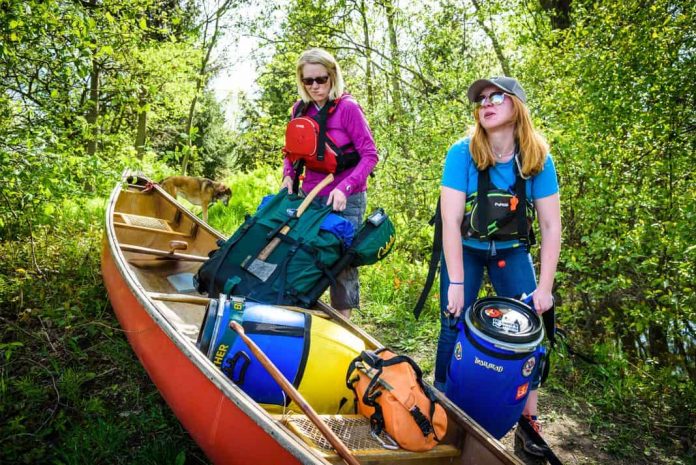
Unloading canoe packs and blue barrels from a canoe
It’s heavy either way. | Photo: Robert Faubert
The Official Scorecard
Comfort

No amount of money spent on barrel harnesses can overcome the physics that make a canoe pack more comfortable. Canoe packs are flatter, so the weight is closer to your back where it won’t swing around and send you off balance. True, you have to be sure not to pack your grill so it digs into your back, but that’s part of the fun.
WINNER: CANOE PACKS

Animals

Yes, barrels will keep your granola safe from rodents, and all but the most devious raccoons. No small victory there, but don’t be among those fooled into thinking they are impervious to bears. To a bear, a barrel is a blue taco shell.
WINNER: BLUE BARREL

Price

Prices are generally comparable. Understanding there is a huge range of canoe packs available, most fall in the same $150-$200 range you will pay for a 60-liter barrel and decent harness.
WINNER: TIE

Weight

No contest here. Not only are canoe packs lighter, they also shrink in size as you eat your way through a trip.
WINNER: CANOE PACKS

Waterproofness

The raison d’etre of barrels is their impermeability. Just be sure there is no debris in the gasket groove, and don’t store them with the lid securely on, lest the gasket get compressed.
WINNER: BLUE BARREL

Convenience

Getting into a barrel is a two-step process, release the clasp and pop the lid. Canoe packs often have multiple buckles and folded flaps, and a myriad of stuff sacks within.
WINNER: BLUE BARREL

Packability

A circle might be the perfect shape, but not when it comes to accepting cooksets, tents and tackle boxes. A properly packed canoe pack will have less wasted space than a rigid barrel. Soft items can be stuffed hard into barrels.
WINNER: TIE

Seating

For families accommodating paddling kids in the middle of a canoe, there is only one choice. Sitting on a soft, squared off canoe pack beats the bucking bronco that is a blue barrel every time.
WINNER: CANOE PACKS

A barrel’s ability to keep cargo safe and dry in whitewater has been evident since 1901, when Annie Taylor stuffed her ruffled dress into a wooden barrel and floated over the lip of Niagara Falls.

For the last 30 years, serious whitewater trippers have been using the seemingly bombproof blue barrel to keep their down sleeping bags and toilet paper dry as they crash down rivers in semi-swamped canoes. But what about flatwater trips? Do barrels’ attributes of security and convenience outweigh their uncomfortable, cumbersome and, some would say, ugly nature? Consider the ups and downs when deciding if you should roll out the barrel.


Blue barrels

Though exotic varieties exist, barrels commonly come in 30- and 60-liter sizes. Inside a groove on the black lid is a soft gasket, which is compressed to create a seal when the metal ring clasp is fitted and snapped closed.

Barrels are often given pantry duty, carrying food you don’t want to be crushed. The combined weight of 60 liters of food often crushes food from within, so packing food properly requires some care. Consider compartmentalizing the contents with supported internal tiers or dividers if you want to get fancy—and we know some of you “systems” types do. And definitely bag complete meals together for ease of retrieval.

Often overlooked is the barrel’s convenience around a campsite. If you use it for general camp gear like clothes, it can act like a Rubbermaid bin. Stand it upright in the campsite, and it will hold lots of stuff you need on an off-and-on basis, and it has a lid to rest on top keeping it all dry. Better than the half-dozen crammed stuff sacks living in your canoe pack.

The most important part is the gasket. If yours degrades it will let in water. You can order replacement lids online. The second-most important part of a barrel is a harness. Some are engineering marvels. Buy the right one, such as the Quick Haul Harness from North Water, and you might not hate carrying this chubby beast.


Canoe packs

On the other hand, no one ever smelled their canoe barrel when packing for a trip and got excited in a way that’s encouraged by the evocative aroma of a seasoned canvas and leather canoe pack. Supple packs don’t just look more at home in a canoe, they have undeniable advantages over barrels when it comes to their lighter weight, versatility, flexibility and packability. Despite not being aromatic like the traditional type, modern nylon packs don’t absorb water, and they have comfortable harness systems and plenty of compression straps for securing a load.

[ Paddling Buyer’s Guide: See all canoe packs ]

If you want to keep your gear totally waterproof from rain or floats down rapids, you’ll need to invest in a set of smaller, high-quality drybags or a liner, and do a little hoping for the best.

Making your choice: Canoe pack or blue barrel?

Rubberized canoe packs might seem like an appealing hybrid option between the two, but they suffer on scores of durability and waterproofness, and trying to pack items in nylon stuff sacks into that grabby rubber interior can be frustrating. Advice? Make room in your canoe for a barrel, even if just a 30-liter for select food items, and make it complement your other pack choices.

This article was first published in Issue 58 of Paddling Magazine. Subscribe to Paddling Magazine’s print and digital editions, or browse the archives.

It’s heavy either way. | Feature Photo: Robert Faubert


The Final Answer On Feathered Versus Unfeathered Kayak Paddles

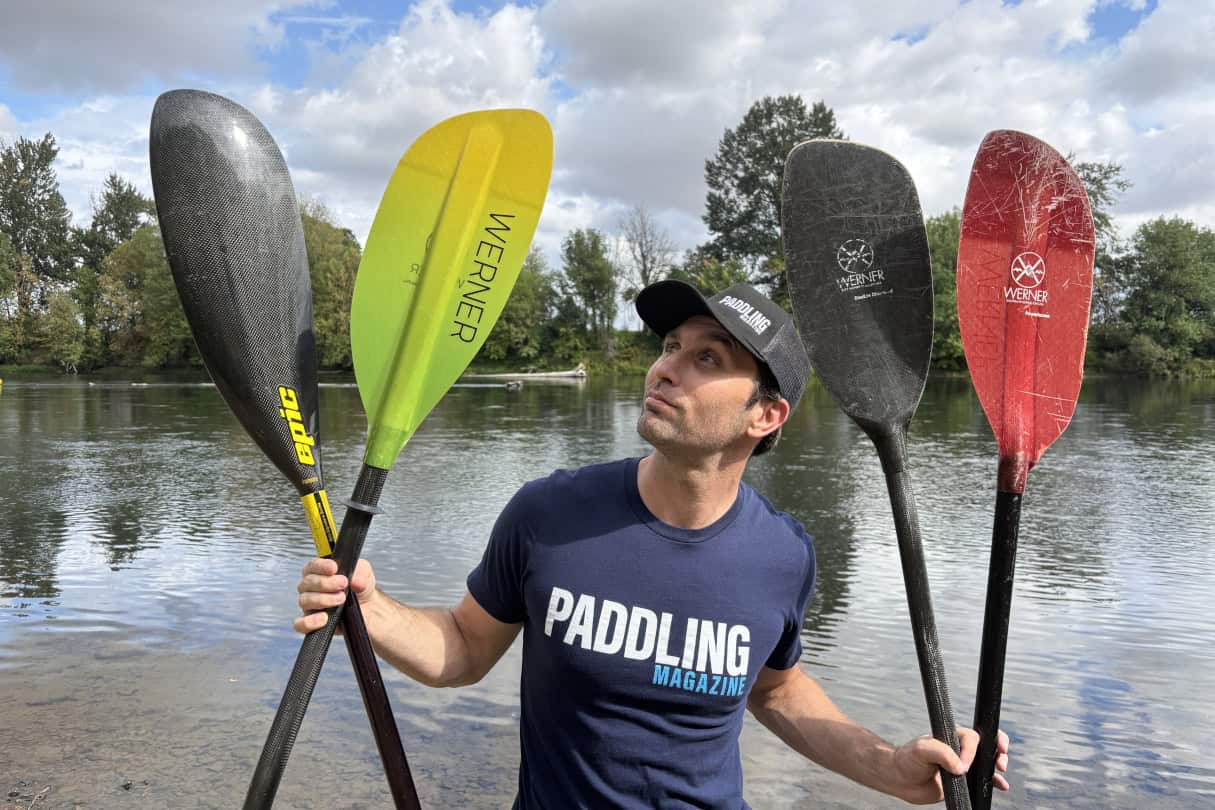
Whether or not you use a feathered paddle should depend on your paddling style and paddle length, according to author Brian Day. | Photo: Andrew Strain

The first time somebody put a kayak paddle in my hand was almost 30 years ago. The kayak paddle chosen for me was feathered, 230 centimeters long and had a blade angle of 80 degrees for right-hand control. My paddling mentor gave me a simple set of instructions: line up your knuckles here and when you want to take a stroke on the left, twist your wrist back and put the paddle in the water.

Feathered vs. unfeathered kayak paddles

I got started with a feathered paddle because that’s what everyone around me was using, but it wasn’t long before I realized there were a whole bunch of people who thought unfeathered paddles were the way to go. I wanted to know who was right and which blade angle was truly best.

In search of the answer, I dove into the available resources, reading books by John Dowd, Derek Hutchinson and Nigel Foster. I dug into obscure magazine articles. I even carved a Greenland-style paddle and used it until I felt I had the hang of traditional sea kayaking.

Kayak paddle blade angles

By the late 90s, I had set aside the Greenland paddle and started whitewater kayaking. I saw whitewater as a way to improve my rough water sea kayak skills. Since whitewater paddles were feathered I figured it was sensible to standardize my equipment, so I switched to shorter touring paddles and used an 80-degree feather on everything. I was firmly convinced feathered paddles were the way to go.

Woman paddles a touring kayak
What’s the right paddle angle for you? | Photo: Courtesy of Old Town Canoes and Kayaks/Carlisle Paddles

I had to be dragged kicking and screaming away from my 80-degree paddles, but dragged I was. The first challenge came when my favorite sea kayak paddle manufacturer switched their standard blade angle to 60 degrees. The lower angle was said to be easier on the wrists and was still effective in a headwind. I didn’t have much choice, so I made the switch.

Whitewater came next. When I broke my favorite 60-degree whitewater paddle the manufacturer told me they would replace it with a 45, but not a 60. Forty-five, apparently, was easier on the wrists and most whitewater paddlers had switched over. Following the trend, I went and shifted down to 45.

At 45 degrees I noticed a strange thing. I no longer had to twist my wrist to change the angle of the blade on the left side. In fact, as soon as I raised my right hand to my shoulder the left paddle blade automatically squared itself to the boat, ready for a forward stroke. My top hand had a completely straight wrist.

Ergonomics and feathered kayak paddles

I had quite a bit of wrist pain in my early touring years, and it completely disappeared by the time I had eased my way down to 45 degrees. As far as I could tell, it was twisting my wrist over and over that was giving me trouble, and the 45-degree paddle eliminated this motion.

With the pain gone, I started to reevaluate what I wanted in feather angle. Instead of performance in a headwind, I decided I wanted something to keep me paddling without pain. I knew 45 degrees was better than 60, so less was better—but how much less? I tried some whitewater paddles down to 30 degrees and they were just as neutral on my wrists as the 45-degree feather. Twenty years into my quest to understand kayak paddle blade angle I started to wonder if maybe unfeathered paddles were the answer.

The answer is no.

Why not? Well, with a short paddle, once you drop below about 30 degrees of feather, you need to start tweaking your wrist again. Not back like in the old days, but sideways in an awkwardly cocked position that risks a repetitive use injury. If a neutral wrist is the best way to avoid tweaking yourself over time, then feather angles below 30 degrees don’t work.

Don’t work, that is, with a short paddle. I’d been using short, feathered touring paddles for years because they were similar to my whitewater paddles, but the Greenland paddles I used back in the 90s were long, unfeathered and seemed to work fine. What was the difference?

Photo of kayaker with paddle
Whether or not you use a feathered paddle should depend on your paddling style and paddle length, according to author Brian Day. | Feature photo: Andrew Strain

Feathering and paddle length

There’s a meme in the sea kayak world used to describe different forward stroke styles. Paddlers using short paddles are said to use a high-angle forward stroke. This stroke has the top hand at shoulder level and is very powerful. It’s the stroke I use for whitewater and touring and there is no question it is an effective technique.

That being said, if you’re holding your top hand at shoulder level you engage your shoulder muscles more. This is fatiguing over time, and while you can always buy a lighter paddle, many people prefer to use a lower top hand position that is less powerful, but also less fatiguing. This technique is frequently referred to as a low-angle paddling style.

The traditional Greenland style paddling I experimented with in my 20s is the ultimate in low-angle paddling. The hands are held very low, just above the sprayskirt, and the paddle is long and unfeathered. What you’ll discover about the Greenland forward stroke, should you try it, is your wrists stay completely straight throughout the stroke. The shoulder, elbow and wrist are aligned differently when the hands are held low. I discovered a similar effect when I experimented with longer modern sea kayak paddles: long unfeathered paddles keep your wrists straight.

So, there you have it. There isn’t one answer to the feathered versus unfeathered argument—there are two.

What about long feathered paddles? As it turns out, if you use a long paddle and hold your hands low you need to twist your wrist back with even the slightest feather angles. Long paddles, straight wrists and feather angles, it appears, are entirely incompatible. If you go with a long paddle and a low hand position, you’re better off unfeathered.

Final verdict: Feathered or unfeathered kayak paddle?

So, there you have it. There isn’t one answer to the feathered versus unfeathered argument—there are two. If you want to avoid repetitive use injury, you should try to keep your wrists straight during your forward stroke, and there are a couple of ways to do it.

Which kayak paddle blade angle is best? If you prefer a short paddle for maximum power, use a feather angle between 30 and 45 degrees. If you would rather use a long paddle allowing your hands to be held low, an unfeathered paddle will keep your wrists straight. That’s the answer. Keep your wrists straight and keep paddling.

This article was first published in Issue 58 of Paddling Magazine. Subscribe to Paddling Magazine’s print and digital editions, or browse the archives.

Whether or not you use a feathered paddle should depend on your paddling style and paddle length, according to author Brian Day. | Feature Photo: Andrew Strain


Boat Review: Necky Looksha IV Kayak

Boat Review: The Looksha IV Sea Kayak By Necky

This summer we spent a week touring the Tangier area north of Halifax with a great mix of boats, including the Looksha IV, a 17-foot sea kayak by Necky. During our combined holiday and boat test adventure we evaluated the kayak’s performance, comfort, and ease of use for paddlers of different abilities.

Getting to know the Necky Looksha IV

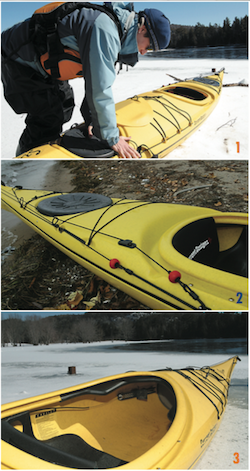
The polyethylene Looksha IV—like its composite cousins—has low profile decks, a double chine and a rockered hull. Yes, multi-chine hulls have many performance advantages, but they also allow Necky to produce a pleasingly rigid plastic boat. All the deck fittings around the cockpit are recessed into the plastic to prevent snagging during from-water re-entries. We did notice the lack of a perimeter grab line, which is now part of all the Necky’s newer designs.

Necky Looksha IV Specs
Length: 17’
Width: 22.5”
Weight polymer: 62 lbs
Cockpit: 18” × 31.5”
Rear hatch: 14.5” × 10.5”
Forward hatch: 10” × 8”
MSRP:  $1,899 CAD

Inside the boat

The large cockpit and seat will accommodate just about any sized paddler, although comfort was hit and miss. The backband will adjust up and down by removing a couple screws and reclines forward and back on a rope and cleat system. The storage compartments on the Necky Looksha IV have foam bulkheads and the hatches are sealed with a double hatch system of neoprene and hard polymer covers secured with two webbing straps. This hatch system is simple and stayed dry for four days of normal touring conditions and seeped only slightly after extended rolling and playing in the surf.

The foot pedals are attached to the rudder wires with nylon webbing. There is a ladder lock adjustment ahead of the seat, which was greatly appreciated by tall paddlers who usually have to climb inside the cockpit head first to properly set the foot pegs. With the rudder locked in the up position and using the pegs to transfer power to the boat, we noticed the nylon straps stretched giving a spongy brake feeling with each stroke.

Stability and handling

The most noticeable handling characteristic of the Looksha IV is the inspiring secondary stability—the type of stability generating confidence in paddlers who are not used to tilting to improve boat turning radius. Even our least skilled paddler was cranking the Looksha IV over and sweeping it around. In fact, we found that it takes more than a concentrated effort to push the Necky Looksha IV past its stability zone, and when loaded with gear it’s next to impossible.

During our rolling practice we noted the Looksha IV had similar righting characteristics. You had to keep your head down, righting the boat by pushing past its edge, and then rolling your body up. Rolling the Looksha is by no means difficult, it’s just different.

Between the secondary stability zones the Looksha is very nimble feeling and one of the quickest turning seventeen footers any of the paddlers have paddled. Straight-line tracking was moderate and easily controlled by either quick tilts and minor correction strokes, or by simply deploying the standard rudder. The Looksha was not left behind when tossed in with larger composite touring boats on our casual touring trip. Where it fit in the pack depended more on who was paddling, rather than the length or construction material.

[ Paddling Buyer’s Guide: See all sea kayaks ]

Summing up the Necky Looksha IV

The Looksha IV sea kayak was the only plastic boat on our trip and it was a favorite of all the paddlers. This nimble and stable kayak is capable of carrying its fair share of gear. If the polymer Looksha IV gets the new upgraded outfitting we’ve seen in Necky’s new composite boats, it will be one of the best general purpose touring boats around.

Follow us on Instagram @paddlingmagazine.


11 Things You Don’t Know About Dane Jackson

Dane Jackson kayak athlete

Fans of freestyle kayaking will know Dane Jackson as a long-time fixture in the winners’ circle. Dane’s exploits on and off the race course are splashy and celebrated, following in the footsteps of his Olympian father. However, you might not know these fun facts about the whitewater wunderkind.

11 Things You Don’t Know About Dane Jackson

1

Days In The Water

Dane spent 270 days on the water in 2013 (yes, he kept count). “It was a slow year,” he says, disappointed by a number below 300.

2

Golf

He may have surpassed his father in freestyle scores at the 2013 ICF Freestyle World Championships, but he can’t beat EJ in a round of golf—a primary pastime at the Jackson compound in Rock Island, Tennessee.

3

 Pump Up Playlist

Dane listens to the same pump up playlist before every competition—a mostly Dubstep tracklist, including mind-blasting beats from Rusko and Flux Pavilion. The first track is Krewella’s Play Hard.

4

Severe HearingLoss

Dane has severe hearing loss. It’s only about 30 percent of what it should be, he says. “Reading lips is a big part of being able to communicate.” From a kayak he can read the lips of someone standing on shore. EJ has similar troubles hearing, but for Dane, being born three months premature exacerbated the problem.

5

Career

Dane is incapable of imagining himself in a non-athletic career. When asked (in 10 different ways) what conventional career he’d pick if he had to spend his life off the water, his answer was “a boulderer.”

6

Since dominating in one extreme sport isn’t enough, Dane wants to take the world of competitive climbing by storm. Climbing started as a cross-training exercise to strengthen his shoulders for kayaking, but a new sport is fun, he says, because when you’re used to being a pro, “sucking at something” is a serious motivator.

7

Secret To Crushing Competition

His secret to crushing competition? Relearn every move for each individual feature. “I forget everything I know and relearn it to get it to work for that hole,” he says. He started from scratch with the McNasty at the Nantahala Outdoor Center to train for the Worlds.

8 Favorite Freestyle Trick

He says his favorite freestyle trick is the Lunar Orbit.

9 Family Man

Also eluding him are the steps towards his eventual goal of being a family man like EJ. “The problem with how much I travel and how I live in the middle of nowhere when I’m home, is that a girlfriend is definitely not super easy to find.”

10

Dane was homeschooled in the Jackson family’s RV

Dane was homeschooled in the Jackson family’s RV, but the sound of the river made it hard to do his homework. “It was really hard to want to do school when I could just walk out the door and go kayaking,” he says. He was far enough behind by tenth grade that he decided to make paddling a full-time gig.

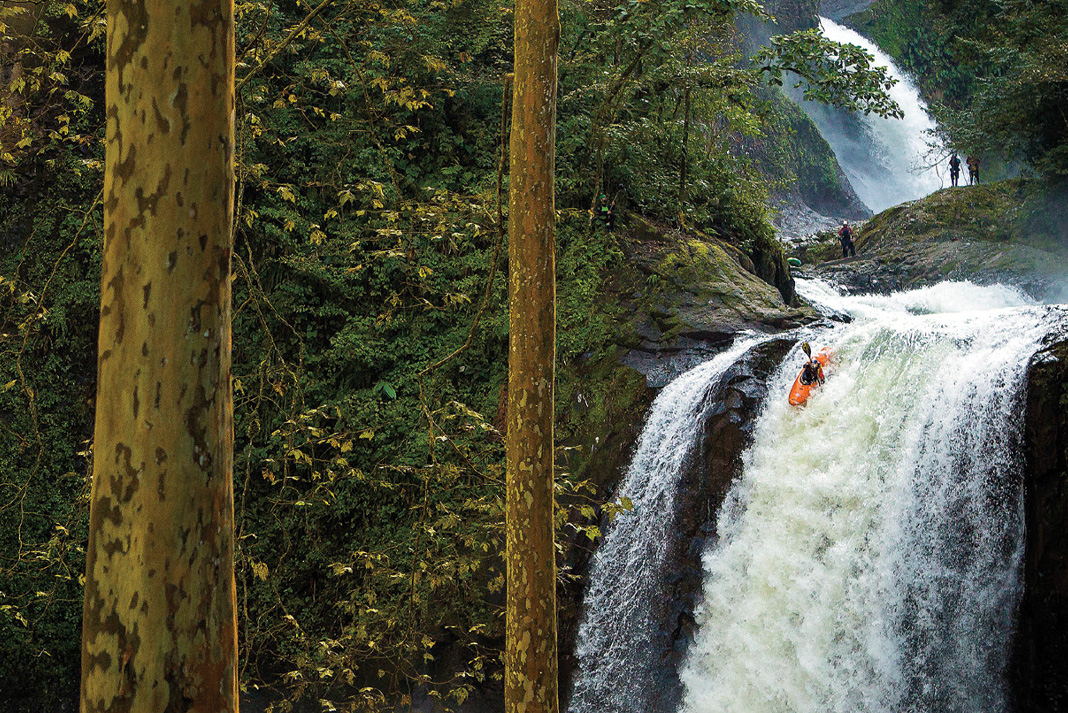
DROP 10 OF 10, TLAPACOYAN, MEXICO. SEE #11. | PHOTO: COURTESY JOHN RATHWELL / RED BULL CONTENT POOL

11World Travels

In his 20 years on planet Earth, Dane has been to six continents, 20 countries, has paddled on approximately 200 rivers, dropped 10 different waterfalls (only counting ones over 40 feet high, of course), broken three paddles, zero bones, and gotten eight sets of stitches.


This article first appeared in the Early Summer 2014 issue of Rapid Magazine. Subscribe to Paddling Magazine’s print and digital editions, or browse the archives.