Picture this. You pack everything for your camping and kayaking trip into a helicopter in Vancouver, British Columbia. The helicopter then takes you through the mountains giving you some of the nicest views you can possibly find on your way to your first campsite. The helicopter lands on an island on a lake that is so remote, no one has ever seen it. You spend a few days here before taking the scenic route back, making a quick pit-stop to paddle the waters of a glacier. Does it get much better than this?
For those looking for an epic and unique travel experience to pad those Instagram accounts, you might be interested in trying out a camping and glacier kayaking trip by helicopter.
[ Plan your next paddling adventure with the Paddling Trip Guide ]
Compass Heli Tours is a company based in Abbotsford, BC that does a variety of unique experiences by helicopter. How much fishing pressure do you think a lake gets when one of the only ways to access it is a helicopter? Not much.
While the environmentally friendly side of me says that this shouldn’t be a thing, I can’t help but think about how cool this experience would be. Maybe when electric helicopters become more prominent it will be a little easier to fully support this idea.
This company does everything from basic sightseeing tours (that really aren’t so basic) all the way to the extraordinary camping and kayaking trips that are featured in the above video.
[ Paddling Buyer’s Guide: See all inflatable kayaks ]
The only downside is the price tag that comes along with these adventures. A simple tour of Abbotsford starts at $500 and packages then increase to over $7,000 for the overnight camping adventures. While these are some hefty prices to pay for an overnight trip, it’s hard not to appreciate how epic a trip like this would really be.
Most paddlers who run self-supported trips down the Colorado River would be looking to bring a combination of rafts and kayaks. That isn’t the case for this group who decided to run the river in tandem canoes, which included regular Paddling Magazine contributors Caleb Roberts and Willa Mason. This is believed to be the first tandem canoe descent of the Canyon. And watching the video, it’s not surprising why.
This entertaining capture of their 26-day wild ride down the Colorado makes one wonder why they would have ever decided to bring canoes on this trip in the first place. Watching as they crash through the big waves of the fast-flowing river you will find yourself wondering how they made it through some of the waves that they hit.
“I had the grand pleasure of boating down the Colorado River this past January for 26 days with seven other friends. A trip that all of us decided to do in proper Canadian style by taking tandem canoes and doing the river as a self-support canoe trip,” says videographer Roberts.
Though there are many sets of rapids along this river, the group claims to have only capsized 11 times between the two canoes. Each time they were able to self-rescue. This is a success. The capsizing section in the video also happens to be our favorite part of this short film. We feel it perfectly captures the fun that can be had when a group of friends set out to achieve what may seem to be unattainable.
Getting visits from more than five million people per year, the Grand Canyon is no doubt a tourist hot spot. Featuring endless hiking, biking, and paddling opportunities, outdoor enthusiasts flock to the Grand Canyon for its stunning views.
[ Plan your next paddling adventure with the Paddling Trip Guide ]
If you are looking to paddle the Colorado River that flows through the stunning canyon walls, you either need to pair up with a company that runs commercial trips down the river, or apply for a permit if you are looking to do a self-supported trip.
As more states and provinces declare emergencies and people practice social distancing due to the spread of COVID-19, the ripples are being felt across the paddling world.
Here are the latest updates:
March 19: The Yukon River Quest has cancelled the longest annual canoe and kayak race in the world for 2020. World SUP Cup in Germany is cancelled and will return in 2021.
March 18: Old Town Canoes and Kayaks is suspending operations at its Old Town, Maine, location until April 5. All Ontario Provincial Parks are closed, including for day use and backcountry use until April 30. All MEC retail locations closed until March 30. The Yukon 1000 is postponed until 2021.
March 17: SUP’s Carolina Cup postponed until November,
March 15: All 162 REI locations closed until March 27.
March 13: Banff Mountain Film Festival screenings suspended.
Canoecopia Cancelled
March 12: In the evening on March 12, 2020, Paddling Magazine reached Canoecopia organizer and Rutabaga Paddlesports owner Darren Bush who confirmed the annual Canoecopia show has been canceled, less than 24 hours before it was set to open.
From March 13 to 15, 2020, paddling enthusiasts were set to descend on Canoecopia in Madison, Wisconsin, the largest paddlesports consumer event in the world, featuring more than 50,000 square feet of boats and gear and 180 educational seminars and clinics. In a year without the coronavirus concerns, 15,000 to 20,000 people could be expected to come through the doors.
“We had to call it, there’s just too much at stake”
“We had to call it, there’s just too much at stake,” said Bush. “We saw the COVID-19 develop so rapidly, we decided to do the right and safe thing. The paddling community is so supportive, I’m confident we’ll recover quickly. We wanted our customers and staff to be safe, full stop.”
Bush said it was too soon to say whether the event was being postponed or outright canceled for the year. However, Canoecopia tickets purchased for 2020 will be honored in 2021, according to the Canoecopia website. An official announcement hasn’t been made at the time of writing, but will be located here.
Prior to Bush’s statement, Canoecopia organizers noted, “About a dozen [exhibitors] have had to pull out due to travel restrictions from the corporate office or from government agencies.”
“If you are concerned, especially if you are from a high-risk group, have family members who are high-risk, consider staying home this year,” it continued. On March 12, Wisconsin Department of Health Services announced an additional two cases of COVID-19 in the state, bringing the total to eight confirmed cases.
Canoecopia’s Facebook post on the subject has several comments from attendees stating they had canceled their travel plans.
Nova Craft was among the exhibitors who declined to attend Canoecopia, releasing this statement via Facebook on Thursday, March 12:
Presenter and guidebook author, Kevin Callan, also canceled his attendance on March 11, 2020, in the wake of a request from his employer to avoid out of country travel to conferences. He hopes some tech-savvy folks at Canoecopia will be able to video conference him in. Presenter Camper Christina also canceled her attendance.
Ontario Backcountry Canoe Symposium Cancelled
The coronavirus outbreak is affecting other gatherings as well, with the Ontario Backcountry Canoe Symposium announcing it is canceling their April gathering in Ontario.
Many in the outdoor industry are waiting to see how the coronavirus might affect the summer tradeshow season. A statement from Outdoor Retailer on March 4, 2020, said organizers were monitoring how the outbreak might affect the June 23-25 tradeshow in Denver, Colorado, but did not “forsee any changes at this time.”
The Big Gear Show Coronavirus Update
The Big Gear Show’s Kenji Karoutunian told Snewsnet.com on March 4 that:
“There are questions coming in from retailers and we’re addressing those; mostly, people just want to know what the plan is, what to tell staff and families. We’re trying to communicate to them that we’re on top of it, we’re gathering info from the city of Salt Lake, the CDC, the various regional jurisdictions. We have retailers registered in 38 states for BGS, so watching things carefully is important. But we’re trying to send out a more level-headed, factual kind of communication.”
Concerned paddlers can get updates and advice for preventing illness from the CDC here and the Government of Canada.
Is your paddling event being postponed or canceled due to the coronavirus outbreak? Send us a tip at editor [at] paddlingmag [dot] com.
There's a whitewater rafting trip close at hand no matter where in Colorado you're headed. | Photo by: Bill Wilson // Flickr
Colorado is home to some of the most popular whitewater rafting in the world. With over 150 named rivers, one of which being the mighty Colorado that carved the Grand Canyon, and rapids that range from family-friendly to dangerous, it’s no wonder the Centennial State has gained so much attention among avid rafters and vacationers alike.
If you’re thinking about going whitewater rafting in Colorado, check out the most popular rivers, best guided rafting companies, important points about safety and general trip planning information below.
Best whitewater rafting in Colorado
The following rivers and areas of the state will give you a good jumping-off point for figuring out where exactly you want to go rafting in Colorado. Ranging from short, exciting trips the whole family can enjoy to extreme, full-day journeys, you’re sure to find a river and trip that suits you.
Arkansas River
Performance Tours – The Arkansas River provides some of the best get-your-heart-pumping whitewater rafting in the state. The Numbers section is a particularly popular one among avid rafters. Although Performance Tours doesn’t state that you need previous whitewater experience for their half-day tour of this area, it would probably be wise as you will be paddling hard over class IV and V rapids continuously. This trip is recommended for people age 16+ and starts at $85 per person.
Royal Gorge Rafting – With half- and full-day options available, Royal Gorge Rafting offers tours of the world-famous Royal Gorge along the Arkansas. Thrill-seekers will navigate rapids ranging from class III to V as they whiz by steep canyon walls and under the tallest suspension bridge in the world. The minimum age for this trip is 13 to 16+ (depending on water conditions) and starts at $89 per person.
Breckenridge
Performance Tours – For another exciting tour through Performance Outfitters, check out the Browns Canyon National Monument Three-Quarter-Day trip. Before departing on your adventure, you’ll enjoy a provided lunch before hitting the class III rapids. This trip is acceptable for ages 7+ ($110 each) and first-time adults ($115 each).
Breckenridge Whitewater Rafting – Although the Blue River has a short season for rafting, this Breckenridge Whitewater Rafting trip is just minutes from town. The Blue River offers intermediate rafting and incredible views of the Gore Range along the way, making it a great family-friendly trip on the water. Prices start at $66 per person (ages 5+).
Buena Vista
The Adventure Company – For a more personalized experience rafting the popular Numbers section of the Arkansas River, check out the options The Adventure Company offers. Choose from a half, three-quarter or full day on the water, as well as a small group (one to five people), medium group (six to nine people) or large group (10+ people). Prices start at $86 for half-day trips and 14 is the minimum age suggested to navigate these class IV rapids. First-timers in good health and veteran rafters are both welcome.
American Adventure Expeditions – Another great outfitter for Browns Canyon trips based in the Buena Vista area is American Adventure Expeditions. Whether you choose the half-day or full-day option, you’ll enjoy intermediate rapids mixed with calm stretches, where you can take in the awesome views of the Rocky Mountains. Half-day trips start at $79 per person for ages 7+. This trip is perfect for first-time rafters and families.
Clear Creek
Colorado Adventure Center – No matter what level of difficulty you’re looking for on Clear Creek, Colorado Adventure Center has it. For hardcore adventure-seekers, try out a half-day trip down the most extreme, technical stretch of the river. Be ready to get wet on this fast, wild ride through class IV and V rapids. This tour is recommended for ages 16+ with prior whitewater experience, strong swimming abilities and good physical health. Prices begin at $79 per person.
Adventures in Whitewater – For a more relaxed adventure on Clear Creek, check out the Beginner’s Bonanza Tour through Adventures in Whitewater. The class III rapids are great fun for the whole family along this calmer six-mile stretch of river. Enjoy an in-person look at the gold rush days as you raft past as well. This three-hour tour is $49 per person and kids age 6 and up can enjoy the ride.
Colorado River
Adventures in Whitewater – Departing from Kremmling, CO, Adventures in Whitewater’s half-day (four-hour) float trip is perfect for the entire family. You’ll tackle class II and III rapids that are exciting and fun, but not overly difficult and technical. According to their website, children weighing a minimum of 30 pounds can join in on the fun, with their tickets starting at $54 and adults at $59.
Timberline Tours – For another fun, family-friendly raft trip on the Colorado, head to the popular Vail area with Timberline Tours. This 4.5-hour float includes class II rapids and plenty of great scenery along the way. Prices for children (6 and under) start at $55 each and $105 per adult (13 and older).
Colorado Springs
Raft Masters – Looking for a multi-night rafting trip? Plenty can be found from numerous outfitters around the state, including Raft Masters. Their two-day, family-friendly trip will take you through an easy class II and III section of the Arkansas River known as the Bighorn Sheep Canyon. Your guides will even set up camp for you and make your dinner! Children must weigh at least 50 pounds and prices for both children and adults are $399 per person. This trip begins in Canon City, about an hour and 15 minutes southwest of Colorado Springs.
Echo Canyon Rafting – For something a little more adrenaline-inducing for intermediate to experienced whitewater rafters, check out the Royal Gorge tour through Echo Canyon Rafting. One of the most popular whitewater rafting locations in the state, the vertigo-inducing cliff walls and class III and IV rapids on this section of the Arkansas River are sure to thrill anyone. This trip is recommended for ages 14+ (dependent on water conditions) and starts at $89 for half-day and $149 for full-day.
Denver
Geo Tours – For a manageable, but fun, trip on nearby Clear Creek, look into the Mountain Lion tour through Denver’s Geo Tours. First-time paddlers will get their feet (and everything else!) wet with class III rapids, navigating Castle Falls, Dizzy Lizzy Rapid and even one called Twister Rapid. Children 50 pounds and above are accepted and half-day prices begin at $49 per child and $55 per adult.
Denver Adventures – For a super adventurous trip on Clear Creek through the Rocky Mountains, head out with Denver Adventures. Dive right into the class IV rapids on this relentless trip through the mountains. This tour is for experienced rafters only and available only during times of optimal water levels, so be sure to check in before you plan or book your trip. Call 303-984-6151 for prices.
Estes Park
Rapid Transit Rafting – What could be better than a whitewater rafting trip? Getting to take a peek at the sights of Rocky Mountain National Park on the way to your launch site! Colorado Wilderness Rides & Guides offers a full-day experience on the Colorado River’s class II and III rapids. Pass by some old miner’s cabins, look for bald eagles, and stop for lunch along your route. This is a great trip for families and prices start at $120 per person.
Colorado Wilderness Rides & Guides – For a more intense trip, head out on Clear Creek for a half-day trip with Colorado Wilderness Rides & Guides. You’ll navigate class II, III and IV rapids, with the majority being the latter two. This tour is available to people aged 15+ and open to ambitious first-timers and experienced rafters alike. Call 720-897-1210 for prices.
Idaho Springs
Rocky Mountain Whitewater Rafting – If you’re looking for a calmer trip on Clear Creek, check out the beginner trip from Rocky Mountain Whitewater Rafting. The class II and III rapids are thrilling and fun enough to keep everyone entertained without being too scary as you float past an old gold mine and mill, and look for bighorn sheep along the way. This trip is available to kids and adults age 5 and over. Prices begin at $49 per child and $58 per adult.
AVA – For an all-day adventure on some of Colorado’s best whitewater, look into the Phoenix Full-Day trip from Ava. Travel down 20 miles of non-stop Clear Creek class IV and V rapids (don’t worry, you’ll get a break for lunch near Idaho Springs). This trip is open to people aged 15+, but it is noted that you should be in good physical condition due to the length and strenuousness of the paddle.
Glenwood Springs
Defiance Rafting – Looking for a beginner-friendly, but adrenaline-inducing Colorado whitewater rafting trip through another popular rafting area in the state? Join Defiance Rafting on their Glenwood Canyon half-day tour, navigating class III and IV rapids. This trip is open to guests 50 pounds and above. Children start at $49 and adults (13+) are $59. Price includes snacks and drinks.
Whitewater Rafting LLC – For an even more intense whitewater experience, raft the Shoshone Rapids with Whitewater Rafting LLC. This tour only lasts about two hours, but you will be paddling your heart out the entire time… twice over! Once you get through Shoshone, Tombstone, The Maneater and more, you’ll shuttle back and go a second time on an even more challenging route. Rapids range from class III to IV, depending on the season, and the tour is available for ages 5+, though it is recommended for fit individuals due to the constant paddling and having to help carry the raft a short ways. Prices start at $45 per child and $50 per adult.
White River
Although at this time there do not appear to be any outfitters offering guided trips on the White River in the northwestern part of Colorado, this guide from Colorado Mesa University is an excellent resource in planning your own whitewater rafting trip. It includes obstacles to look out for, shuttling options, maps and more. Rapids on the South Fork of the river range from class III to IV, so you should be an experienced rafter in good physical condition, a strong swimmer, and capable of self-rescue before attempting your trip.
Although some outfitters suggest bathing suits as being acceptable attire on whitewater rafting trips, it may be a better idea to rent a neoprene wetsuit and booties as the water temperatures range between 48 and 65°F and you WILL get wet. Here are some other items to wear/bring with you on your adventure.
Towel
Sunscreen
Sunglasses (with a band to prevent losing them)
Warm/dry clothes to change into afterward
Water shoes or sandals with straps (again, to prevent losing them during your trip) or tennis shoes you don’t mind getting wet
Quick-drying shorts and t-shirt (no cotton clothing)
Many tour companies will offer paddling jackets for rent or include them in the price of your tour.
When is whitewater rafting season in Colorado?
The answer to the question of when to go whitewater rafting in Colorado depends on what kind of trip you are looking for. In general, the rafting season runs from May through September. Springtime is perhaps a better time for those with previous whitewater rafting experience to visit as the snowmelt on the mountains makes for higher water levels and increased flow in rivers.
The water levels become much more manageable in the summer, making it a better time for beginners or families with children to go. The season typically wraps up around Labor Day but, depending on water levels, can last into October. This River Runners article offers more detailed information on typical water conditions by month. Be sure to check with your outfitter of choice before planning your trip.
How much is whitewater rafting in Colorado?
The above-mentioned tours offer a wide array of options, giving you a good idea of what to expect to pay for a rafting trip. In general, tours run between $50 and $150 per person. Prices are dependent on a number of factors, including the length of trip, difficulty, age of the participant and location. Keep in mind these prices may or may not include things such as snacks and paddle jackets, which may cost extra.
How dangerous is whitewater rafting in Colorado?
With above-average incidents of whitewater rafting deaths in the early season of 2019, there has been some speculation about the safety of the activity in general and the precautions Colorado outfitters are taking on their guided tours. However, the majority of the deaths last year were individuals going out on their own; only a handful happened on outfitted trips. Likely, these incidents were caused by the wet winter and spring Colorado experienced, increasing the water levels of the rivers more than usual.
If you’re more of a numbers person, here are some general whitewater statistics to consider. Between six and 10 deaths occur for each 2.5 million user days on guided tours according to American Whitewater. This is one death for every 250,000 to 400,000 person visits. Interestingly, 30% of these are due to heart conditions and heart attacks, which is why it is always emphasized that you be in good health when choosing to participate in a whitewater rafting trip.
Here are some things to keep in mind when choosing the whitewater trip that is right (and safe) for you and your group:
If you are inexperienced and/or have children in your group, choose a trip with lower-class rapids (III and under)
Always check water conditions with your outfitter of choice before your trip to make sure they will be safe for everyone in your party
Choose a reputable company with experienced guides that have lots of knowledge of and experience on the river you are rafting. Look for a company whose guides are certified in CPR and First Aid. Guides should provide safety briefings before you embark on the water.
PFDs should be provided by all tour companies, with most offering helmets as well
A good outfitter will raise the age limits based on water levels and conditions. They will also be able to help you ascertain which river, section, trip offering, etc. is right for you or your group. (i.e. lower-class rapids for families with young kids). It is also wise to look into a company’s safety record, years in business, safety certifications, and guide training procedures when possible. Licensing and safety inspections are conducted yearly by state forest rangers.
Whether you’re looking for a “splashy fun” whitewater adventure to experience with the family or a challenging, relentless run down one of Colorado’s most popular rivers, you’re sure to find the whitewater trip of a lifetime in the Centennial State!
There’s a whitewater rafting trip close at hand no matter where in Colorado you’re headed. | Feature photo: Bill Wilson/Flickr
Nancy Rubens’ “Big Edge” is made of 200 canoes and is located in front of the Vdara Tower in downtown Las Vegas. | Photo: Courtesy Las Vegas News Bureau
Try out this topic at your next campfire discussion—what is the greatest canoe landmark in the world? The more I think about it, the more I come back to the motto of the world’s smallest record store in Toronto, which is: “We’re not big but we’re small.”
As for the Taj Mahal of canoe landmarks? Hands down, it’s sculptor and Naples, Texas’ own Nancy Rubens’ “Big Edge” in Las Vegas. You’ve never seen canoes doing this! Nancy took almost everything under the sun—not yet kitchen sinks—including televisions, small appliances, trailers, hot water heaters, mattresses, aircraft parts and, yes, canoes to make arresting public art. Leaving aside the sociocultural significance of the choice of canoes as a component in a giant ergodynamic sculpture on Turtle Island, if you haven’t seen the visual “explosion” of canoes that is this Nevada landmark then you might want to scope out “Monochrome I” in Buffalo or “Monachrome II” in Chicago. Or check out related and possibly derivative canoe works such as Victoria Fuller’s “Canoe Fan” in Ann Arbor, or Christopher Fennell’s “Waves” in Lewiston, Idaho.
[ See the largest selection of canoes in the Paddling Buyer’s Guide ]
And if the multi-canoe landmark is not your thing, there are many single canoe landmarks worth investigating. Douglas Coupland’s traffic-stopping “Red Canoe” in Toronto is a 30-foot-long canoe in a downtown public park where, apparently, it’s a bit of a thing for Torontonians to affirm their citizenship under cover of darkness. Slightly more obtuse, but no less arresting, each in their own ways, are Isla Burn’s “Carvel” on the plaza outside Edmonton city hall and Illarion Gallant’s “Commerce Canoe” hanging over Bastion Square in Victoria, British Columbia—all landmarks in their own right.
Landmarks can be geographic. Think Grand Canyon, Mount Fuji, maybe even Machu Picchu in southern Peru. Canoeing has its landmarks of this sort as well, and most of these have to do with nasty portages between major watersheds, like Grand Portage, along the Pigeon River near the eponymous town in upstate Michigan. Or a slightly more obscure but nevertheless significant place between Arctic and Pacific waters called The Committee Punch Bowl on the trail between the North Saskatchewan River and the Columbia River on the Alberta/British Columbia border in Athabasca Pass, so named by 19th century Hudson Bay Company Governor, Sir George Simpson.
And, of course, landmarks can be architectural as well, and canoes have their marker buildings too. Happy to hear of yours, dear reader, but my particular favorites are the Canadian Museum of History in Canada’s national capital on the Ottawa River, designed by Douglas Cardinal featuring a grand exhibit hall built in the shape of a big canoe, complete with upended paddles to hold up the roof. Another notable and far more literal interpretation of canoe as architectural form is the roof of Northlands College in La Ronge, Saskatchewan, which might as well be a big beautiful tin canoe repurposed to keep the rain off young scholars in the boreal wilds of the Canadian west. Oh yes, and if you’re looking for something a bit more urban, check out the Hyatt Hotel in Calgary, whose lobby is a giant upturned canoe.
But “greatest” according to whom? Let’s be honest and agree all of these feats of amazing natural and cultural design have a certain subjectivity to them when it comes to calling them out as globally significant.
[ Plan your next paddling adventure with the Paddling Trip Guide ]
When I think of canoe landmarks, I think of an outcropping of Precambrian granite on the shore of Cranberry Lake in eastern Ontario where I live. Our home in the Rideau Lakes district is situated in what’s called “The Land Between,” meaning it spans the limestone and clay soils of the Great Lake St. Lawrence Lowlands and the older, harder rocks and acidic soils of the Canadian Shield.
As it happens, the predominant landform experienced on a paddle here is more limestone and clay, more Holstein than moose or wild wolf. We can hear loons calling throughout the seasons and we do hear packs of roaming coyotes howling at the passing moon from time to time but the only physical manifestation of the Shield’s blue-lake-and-rocky-shore is one relatively tiny granite cliff that, for me, is the best canoe landmark of all. Like the world’ smallest record store, it’s not big. But it’s small. That’s mine. What’s yours?
James Raffan is an explorer, author and former executive director of the Canadian Canoe Museum.
Nancy Rubens’ “Big Edge” is made of 200 canoes and is located in front of the Vdara Tower in downtown Las Vegas. | Photo: Courtesy Las Vegas News Bureau
The flagship model of the new line is the Autopilot. | Photo by: Old Town
In fishing, secrets are hard to keep. Take a buddy to your favorite spot and soon enough the place is blowing up all over the internet. Secrets are hard to keep in the fishing business, too.
I first caught wind of Old Town Canoe’s plans for a new line of boats late last year. But OT’s people kept their lips tight; they were afraid to divulge too much about the project. I had to sign a non-disclosure agreement before they would even tell me they had a secret project.
Immediately following the first hints, my mind started to race. I considered all the trends in kayaks. I looked for holes in Old Town’s line. Then I had a eureka moment, “It’s got to be a motorboat!”
Old Town Canoe and sister company Ocean Kayak turn out high-quality, smart fishing kayaks. I knew their next boat would have to be significant. Their last motorized kayak, the venerable Predator MK, came out years ago and needed updating. Mating a Minn Kota trolling motor with a proven Predator hull resulted in a sea-worthy motorboat that was a little too big and bulky to be practical for every-day anglers.
Recent changes in tournament rules now allow electric motors in many events. Competitive anglers looking to stay at the top of the leaderboard are almost forced to go motor power. The market is wide open for a pimped out, high-quality, reliable motorized kayak designed as a perfect platform for bass fishing. Taking in the sport’s landscape and scrolling through Old Town’s line-up, I figured the next logical step would be an ultimate motorized kayak.
[ See more Old Town kayaks in the online Paddling Buyer’s Guide ]
My first peek came early 2020. Kayak Angler photographer Jason Arnold submitted images from an undercover photoshoot. “Got to keep these photos under wraps until March,” he warned me.
I opened the file, excited to see the new boat. Ugh! Arnold captured breathtaking over/under images of an angler fighting a fish framed by blue sky and clear green water. Great shot. But the waterline covered the kayak. Ugh! I couldn’t see the boat. But, zooming in to the waterline, I got a glimpse of a propeller.
Even with my suspicious satisfaction and my curiosity further piqued, there were still a lot of blanks to fill in. Those questions were answered a few weeks ago, when Old Town finally pre-released information on their all-new expanded Sportsman line.
Breaking down the Sportsman line
While I was expecting one new boat, Old Town has released seven new models, expanding their Sportsman line to four paddle kayaks, four PDL pedal models and three new motorized boats.
Introducing: the paddle and pedal models
On the paddle side, the new Big Water 132 is a Predator-based model that joins the Discovery canoe/kayak hybrid and the popular Topwater 106 and 120 as practical fishing platforms.
On the pedal side, the Salty PDL 120 is a modified Topwater PDL 120 and the Bigwater PDL 132 is based on the flagship Predator PDL 132.
The Sportsman models are capable versions of more expensive and feature-rich Predators. The removable accessory plates on the Predators are replaced with composite gear tracks. The seats are simpler and there is less padding on the deck. The new models offer an easy-entry option for anglers looking for the performance of a Predator at a lower price. All of the models use Old Town’s best-in-class PDL pedal system. The system is completely sealed, precluding any maintenance outside a freshwater rinse. I always carry extra propeller pins and tools in case I hit an obstacle. I’ve never had to use it. In fact, the system is so reliable, Old Town backs the PDL with a five-year warranty.
Joining the no-nonsense Topwater models with their top-of-the-line Predator cousins creates a family of kayaks for any purpose. Old Town brand manager, Ryan Lilly, says the line was developed to meet the needs of a wide range of anglers.
“The Old Town Sportsman line was the result of extensive consumer research,” he explains. Leaning on years of experience and exploiting trends emerging in the modern design, the line captures the latest features and capabilities available in a human-powered fishing platform. Lily explains, “Understanding what motivates fresh and saltwater anglers drove us to develop a line of truly innovative products.”
Introducing: the motorized models
The real excitement is on the motorized end of the Sportsman line. Old Town is releasing three brand-new motorized kayaks powered by modified Minn Kota power plants. Minn Kota, a Johnson Outdoors sibling of Old Town, contributed a 45-pound thrust motor working with Old Town engineers to integrate the motor with the kayak design.
The Sportsman 106 in action. | Photo by: Old Town
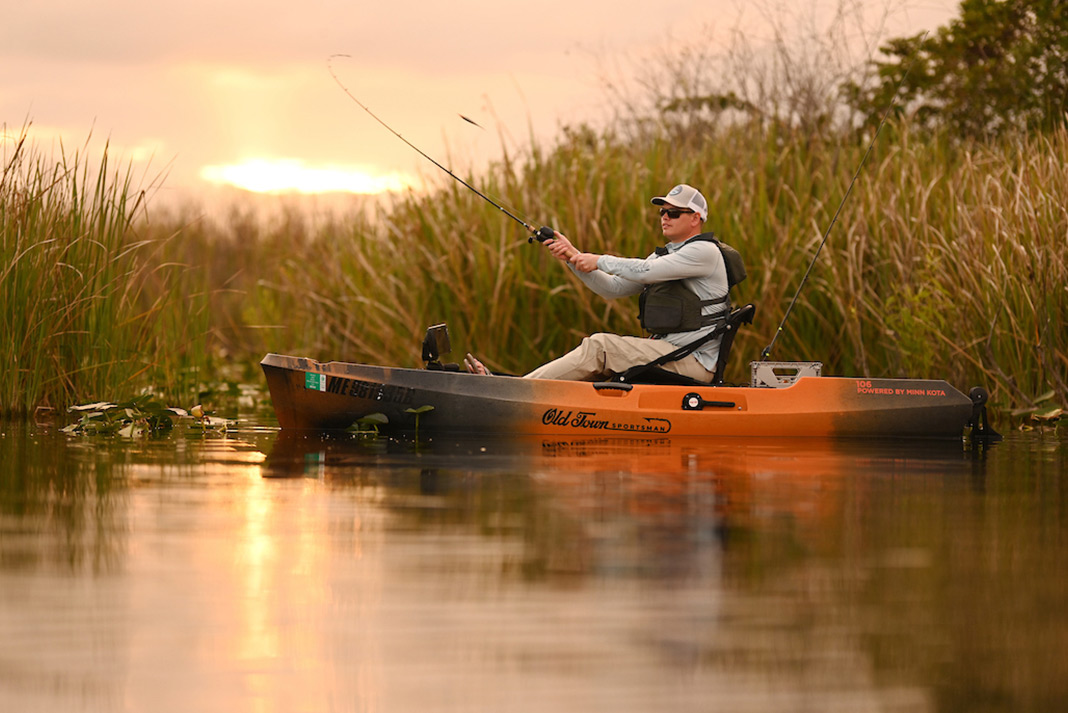
The new Sportsman 106 with Minn Kota is a pocket-sized motorboat. Based on the Topwater 106 design, the motor is mounted on a pod that fits through an opening in the deck. The power cables are plumbed through the hull for trouble-free rigging while the oversized rudder is operated with foot pegs for hands-free fishing.
Reminiscent of the system on the Predator MK, the Sportsman 106 pod has a lower profile, almost flush with the deck, for more space in the little boat. At 104 pounds when fully assembled and only 10 feet, 6 inches long, the boat offers one of the lightest, most compact motor options for cartopping and off-grid launches.
Introducing: the Autopilots
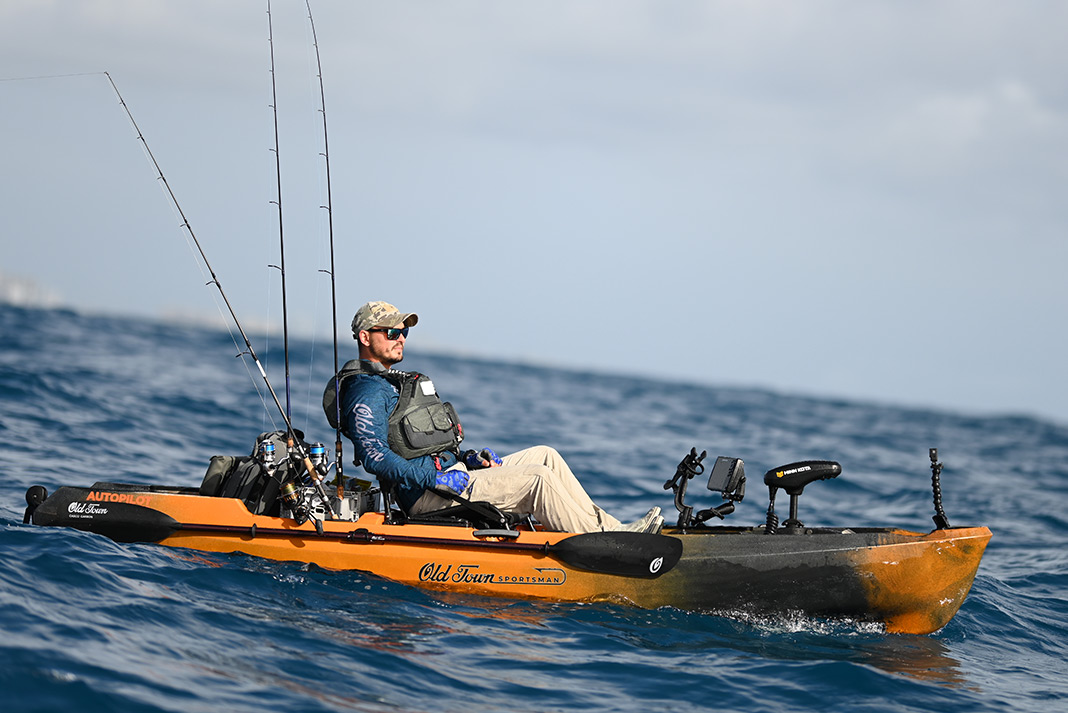
But Old Town saved the best for last. In response to the growing demand of tournament anglers and inspired by a new generation of micro skiffs, Old Town and Minn Kota pushed their talents to the limit to design an ultimate motorized, solo-angler fishing machine. The new Autopilot 120 and Autopilot 136 will set the highest mark for kayak performance and functionality.
The completely new boats are purpose built for motor power, the wide-open, padded deck and expansive crate well offer maximum room for fishing. An extra-large rudder controlled with foot pegs facilitates hands-free fishing. Rod holders, cup holders, gear tracks, cubbies, hatches, and a premium mesh and padded seat highlight the fishing features borrowed from other Old Town models. Old Town pulled all the stops to design the topside for total fishability and open-ended customization.
The Autopilot’s most exciting feature is the motor. Lately it seems like everyone is slapping a trolling motor on a kayak. Aftermarket motors use complicated systems with quirky external rigging to bastardize a paddle-minded boat into a motor-powered platform. But no one has a match for the Autopilot system.
The Sportsman Autopilot, with 45 pounds of thrust, can be controlled with an i-Pilot wireless remote. In addition to steering the boat with a rudder, the operator can also turn the engine with a handheld controller. This means the angler can zoom to the fishing hole using the rudder to maintain course, then snake into the tightest structure with the motor control. The Sportsman can go forwards, sideways and backwards without the paddle.
When the fish start biting, break out the Autopilot’s most amazing advancement. Push a button on the remote and the GPS-controlled motor will hold the boat in one place. No anchor or push pole; the motor spins and turns to keep the kayak locked.
Imagine the advantage for tournament anglers. They will be able to not only beat paddlers and pedalers to the best fishing, but also stay on the fish without expending time and energy. For fun-fishermen, the Autopilot series completely removes the challenges of kayak fishing. No worries about wind, current or other obstacles that limit the range of a pedal or paddle boat.
The Minn Kota motors can be powered by a 12V marine battery or comparable lithium-ion battery. Despite the extra cost, significant weight-savings make the lithium-ion option optimal.
The incredible level of functionality is housed in a platform that can be loaded into the back of a pickup or wrestled onto cartop racks. For the quickest and easiest transportation, I recommend a kayak trailer. Carrying the Autopilot on a trailer allows me to leave the battery in the boat, install the seat and motor, and then back the trailer down the ramp and float the boat to the dock.
The Autopilot 120 in action. | Photo by: Old Town
Taking the Autopilot 120 for a test-drive
A week ago, the anticipation finally came to an end when Old Town delivered an Autopilot 120 to the Kayak Angler office. Unwrapping the kayak and assembling the components, I dreamed of goals this boat would realize. I can finally reach distant grass beds I’ve mapped on Google Earth satellite images. I can finally take my 80-year-old dad kayak fishing. My friends were bugging me to borrow the AP120 for upcoming tournaments. But that would have to wait for my first test drive.
On a small, hidden lake, (I was still bound by the non-disclosure agreement) I launched the Autopilot 120 to zoom around and test the systems. As promised, the boat is fast, stable and functional. The i-Pilot remote is easy to learn—I didn’t even read the instructions—and fun to figure out. Combining the motor control with the rudder allowed the kayak to move in ways never experienced in another motor or pedal kayak. The boat is high, wide and heavy; great qualities for performance and sea-worthiness, but impossible to move on a non-motorized boat.
Push a lever and the prop lifts up through the hull for instant shallow-water clearance. It takes just seconds to remove and install the motor. The Autopilot includes a plate to cover the motor well and turn the boat into a paddle kayak.
With the powerful Minn Kota motor pushing the Autopilot 120, the 12V battery provided more than enough range for several days of fishing. After preliminary tests, I’m satisfied the Autopilot 120 will set a new mark for motorized kayaks. The hull is shaped to handle the weight and speed of a motor. Most important, the Autopilot 120 is outfitted with a reliable motor that can go anywhere, hold the kayak in one place and run all day. The whole system is integrated and easy to install.
Zipping and spinning on the little lake, I recalled the first I heard of new boats from Old Town. Recognizing the company’s commitment to make great boats for everyone, I knew the news would be good for the growing army of kayak anglers. From value-priced to pimped out, all-around to purpose-built, and meeting the needs of big water and little water anglers, the new Sportsman line offers a perfect platform for any angler.
As I expected, the top-of-the-line Autopilot 120 and 136 will take motorized kayaks to the next level. Secrets may be hard to keep, especially when they are as big as seven new designs from one of the most respected kayak companies. After months of anticipation, I’m glad the cat is finally out of the bag.
_______
PRESS RELEASE
Meet the Old Town Sportsman Line—seven boats, three ways to travel, one passion. Old Town leverages 122 years of boat building innovation with something for every active water-lover.
“The new Old Town Sportsman Line was born from extensive consumer research,” says Ryan Lilly, Brand & Product Manager of Johnson Outdoors Watercraft (Old Town). “Understanding what motivates fresh and saltwater anglers drove us to innovate a lineup of truly amazing products.”
“Old Town’s new line-up of fishing crafts provides seven different models for sportsmen and women of all abilities and interests. Whether you’re a weekend warrior who loves the access of a small watercraft, an avid angler who demands hands-free fishing, or someone who just wants to take advantage of nearby water access, the Old Town Sportsman Line has a model that suits your pursuits,” Lilly continues.
The flagship model in the Old Town Sportsman Line is the exciting, all-new Autopilot, a state of the art fishing kayak that delivers the ultimate hands-free fishing experience. Available in two sizes, the Old Town Sportsman Autopilot 136 & 120 use fully integrated Minn Kota 45-pound thrust saltwater-safe motors with GPS Spot-Lock virtual anchoring to put the craft exactly where you want it. Controlled with the touch of your thumb using the iPilot remote, your hands remain free to catch fish. In varying tide, current, or wind conditions the Old Town Sportsman Autopilot 136 & 120 will change the way you fish from a kayak.
Also new to the line-up, the Old Town Sportsman 106 Powered by Minn Kota delivers a plug-and-play, easy-to-use motorized kayak experience. This 10-foot, 6-inch hull, based off of the popular Old Town Topwater 106, features a seamlessly integrated Minn Kota electric motor console. Simple and intuitive, the Old Town Sportsman 106 Powered by Minn Kota features an all-new throttle style thrust control for simple forward and reverse maneuvering and speed control. Additionally, the foot brace rudder steering ensures an intuitive hands-free fishing experience. The shorter hull and lower weight make this kayak a breeze to car top and transport.
Built on a legacy of quality and innovation, the Old Town Sportsman line is manufactured in Maine. All models from the Sportsman line boast a lifetime hull warranty and share an impressive array of features. EVA foam floor pads and upgraded breathable seats provide all-day comfort and support whether you’re sitting or standing. At least one forward-facing rod holder and a branded tackle box makes changing your lure or landing a fish a breeze. Full-length accessory tracks paired with intuitive storage options allow for full customization and accommodation of your favorite accessories.
To learn more about the new Old Town Sportsman Autopilot, 106 Powered by Minn Kota, the fun and zippy Salty PDL 120, Discovery Solo 119, or any of the Old Town Sportsman line visit oldtowncanoe.com or demo one at an Old Town dealer near you.
JOHNSON OUTDOORS is a leading global outdoor recreation company that inspires more people to experience the awe of the great outdoors with innovative, top-quality products. The company designs, manufactures and markets a portfolio of winning, consumer-preferred brands across four categories: Watercraft Recreation, Fishing, Diving and Camping.
JOHNSON OUTDOORS WATERCRAFT RECREATION includes Old Town canoes and kayaks, Ocean Kayak, and Carlisle paddles. Old Town canoes and kayaks have created genuine watercraft with innovative designs for over 120 years.
A sprayskirt is a worthwhile investment if you'll be paddling in any waves or cold conditions.
If you’re new to kayaking, you may keep hearing the word skirt or sprayskirt. And you may be wondering, what is a kayak skirt? Depending on the kayaking you’re doing, a kayak skirt can be an essential piece of gear.
How does a kayak skirt work? Well, when you sit in the cockpit of your kayak without a skirt, there is an open space between your body and the kayak shell. If you end up in any kind of rough water, this is where your vessel will take on water. With water in your boat, you’ll lose buoyancy, which will make the boat capsize easier. And if the water is cold, it’ll take all the fun out of kayaking.
The kayak skirt essentially seals this hole, making you and your kayak one solid piece of gear and preventing the majority of the water from getting into your boat.
Do I need a sprayskirt for my kayak?
Whether you need a kayak skirt or not really depends on the kind of kayaking you’re doing. If you’ll be in warm, sheltered, flatwater lakes for the majority of your paddling, you can get away without one. Likewise, if your kayak is a cottage toy where half the fun is tipping and falling out of the boat to go for a swim, then you’re all good.
If you’re just out for calm sunset paddles, sometimes it’s nice to have a skirt to keep yourself warm and dry, but not entirely necessary. A skirt can also be helpful if you have a couple items in your kayak you want to keep dry.
But if you plan on doing some whitewater runs on a river, exploring the choppy Great Lakes, or touring on the ocean, a skirt will make your kayaking experience a safe and enjoyable one. Any time there are waves, chop, windblown water, or rushing river water, using a skirt is essential. If the water is cresting the bow, it’s coming in your boat. And there is a limited amount of water you can have in your boat before you start getting into trouble.
Just like buying any kind of gear, there will be an endless number of options when you start looking for a skirt. How do you size a kayak sprayskirt? First off, you’ll need to figure out the size of your cockpit. How do you size a kayak cockpit? Great question. The easiest and most surefire way to do so is by contacting your kayak’s manufacturer. Their website will usually have this information on it; just be sure to find your boat model and size. If you have an obscure kayak you can always just measure the width and length of the cockpit and use these measurements to find the correct skirt.
Secondly, you’ll need to make sure the waist size is correct. Think about what you’ll be wearing while paddling so you get the right size.
The way manufacturers size their skirts varies, but if you go to their website they should have decent sizing charts. When they write about “tunnel size” this is the size of the part of the skirt that goes around your waist, while “cockpit size” is the size of your boat’s cockpit.
Neoprene vs. nylon
Kayak sprayskirts are usually made of either neoprene or nylon. There are pros and cons of each. Recreational and touring kayak skirts are often made of waterproof, breathable nylon. Sometimes they’ll have suspenders, which you can adjust for ventilation. These skirts generally have an elastic drawcord that seals around the rim of the kayak’s cockpit. Nylon skirts aren’t completely water resistant, but are comfortable and practical for less extreme kayaking.
Neoprene is used for whitewater skirts and some touring sprayskirts. Neoprene has a lot of stretch to it and creates a very secure and watertight seal to your boat. Some skirts are reinforced to keep them stiff and attached while being pounded with waves. The one hindrance of neoprene is it can get pretty warm and offers no ventilation.
What to think about
Again, depending on what kind of kayaking you’re doing, the way the skirt attaches to your boat becomes important. Many of the recreational skirts use a draw cord. This makes fitting the skirt a bit easier, but has more chance of letting water in.
Whitewater skirts tend to use what is called a rubber rand—a stiff rubber edge that lies flat under the rim of the cockpit. It’s completely watertight and resists being torn off by moving water. Getting the cockpit sizing right on neoprene skirts is essential because of this tight fit.
Best sprayskirt brands
There are plenty of brands manufacturing kayak skirts these days, but the following are some of the best when it comes to quality and functionality:
Advanced Elements
Delta Kayaks
Level Six
North Water
Perception Kayaks
Wilderness Systems
Kayak skirt reviews
Here are a few sprayskirts our team at Paddling Magazine has reviewed:
The first time you put on a kayak skirt it may seem like the most difficult thing in the world. But it’ll get easier with time and practice. First, with your paddling wear and PFD on, you step into the skirt and get it roughly situated and tightened on your waist. Then you step into the boat.
Sitting in the boat, you’ll need to get the skirt under the rim of the boat behind you. It’ll feel like you’re doing some kind of painful yoga, but you’ll get it. Once it is under the rim at the back, use both hands to push the skirt under the cockpit rim, moving both hands forward (right hand on the right side, left hand on the left side), and work your way slowly up to the front. Be sure the grab handle is on top of the skirt when you get the final few inches at the front of the skirt under the rim. Then tighten up any suspenders or waist adjustments until you’re comfortable.
How to make a kayak skirt
If you’re the DIY type, then you may be wondering about a DIY kayak skirt. And yes, of course you can make your own. You’ll need some sewing skills and sewing equipment, and you’ll need to source your own materials. Whether the time and effort involved will save you any money is totally debatable, but we too love a good challenge.
There may be better resources out there to get this done, but a quick search found these two resources:
Waiting near the Via Rail train station in Bathurst, New Brunswick, digging down in my pocket scrounging enough change for a cup of coffee, my hand emerged a few bucks richer and with flakes of aromatic cedar shavings.
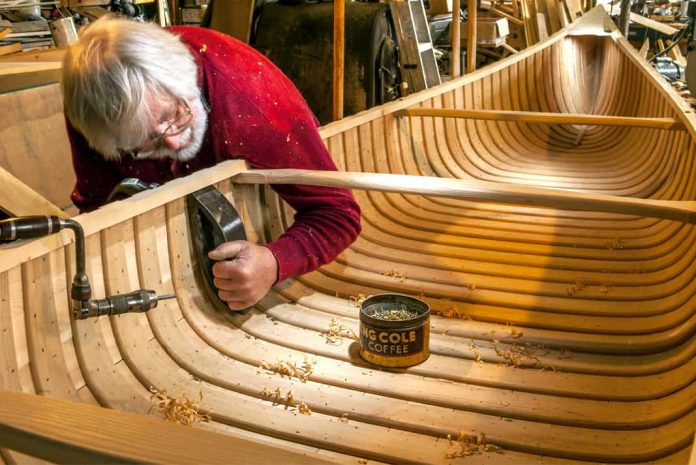
I was on my way home from visiting Bill Miller, the dedicated canoe builder whose father helped pioneer a style of East Coast river canoe in 1925, and already the memories were falling all over the ground. What’s so special about wooden canoes and their builders is when you leave the shop, you go with a sliver of their craft. The aroma of cedar and varnish, a dusty hat, and a few token brass tacks jingling in my pocket are a reminder of the magic of wooden canoes.
In our world of carbon fiber gunwales, tough stuff hulls, and sub-30-pound canoes, it’s easy to forget the origins of these new-age boats, and to glance over the passing generations who toiled over the crafts we adore.
When Miller built his first canoe, it was off a mold his grandfather, William Vic Miller, had hued out with an ax at his home on the Tobique River in Nictau, New Brunswick. Miller Canoes were designed with a purpose—to pole sportsmen and freight up or down the shallow, swift rivers nearby. This meant a hull wide enough to stand and maneuver from, and enough length and depth to displace heavy loads through rapids.
A wood canoe begins well before the shop. In the case of Miller’s boats, the first stage starts in the woods behind his home. Each time a canoe is purchased, Miller walks to his backyard, chainsaw in hand, studies a cedar which he has often watched grow up, and admires its straight grain and lack of visible knots. When Miller fells what he refers to as “a perfect canoe tree,” the life of another has begun.
From the mill to the planer, every bit of the canoe, save brass tacks and marine varnish, is created in the workshop. Seats are hand fastened and meticulously caned, gunwales are cut from 21-foot spruce or ash tree lengths. Every detail is hand manipulated by an old-time master.
There are still workshops where these experiences are lived on the daily, places such as Headwater Canoes, Bear Mountain Boats, and in Miller’s dusty, 94-year-old shop. There’s a feeling of homecoming here, like a church on Sunday or the river when the level is just right.
I’ve been back to spend time with Bill Miller every year since my first visit some six years ago, and I’ve collected quite the arsenal of treasures from his gold chest of a canoe shop. From handcrafted bird’s eye maple paddles he helped me shape, to a miniature 15-foot Miller I paddle and adore when visiting my family’s home in the Ottawa Valley.
There’s nothing, however, I treasure as much as the little Ziploc bags full of shavings I’ve collected from the shop, or my dusty Miller Canoes hat. For every time I catch their whiff, I’m reminded of life’s important, albeit dusty, places.
David Jackson is a writer and photojournalist living in Thunder Bay, Ontario.
Last month, Esquif Canoes of Frampton, Quebec, announced David Hadden joined their team as Director of Business Development. Esquif owner Jacques Chasse is looking forward to working with Hadden to grow Esquif’s presence in the U.S. market.
Chasse says that while Esquif has a strong market presence in Canada, it has limited penetration into the U.S. market. “We don’t cover the U.S. as well as we would like,” said Chasse. He’s optimistic Esquif can move into new U.S. storefronts based on the strength of their canoe designs and the performance advantages of T-Formex, a high-impact ABS plastic laminate aiming to fill the void Royalex left when discontinued in 2013. Chasse sees Hadden as a central part of this push.
Hadden comes to Esquif with 30 years of experience in the paddlesports industry. He grew up in Vermont as an avid canoeist and landed his first job with Mad River Canoe in 1990. Since then, his career has included roles with Dagger, Wenonah and Current Designs, Walden, Emotion, Heritage and, most recently, Johnson Outdoors. Along the way, Hadden had the opportunity to learn the ins-and-outs of everything from sea kayaks to fishing kayaks, but canoes have always been close to his heart. He’s excited to be back in the world of specialty canoeing at Esquif.
“It’s fun to return to my roots,” he said.
For Hadden, T-Formex fills an essential niche in the world of canoeing. He points out Royalex was a popular material because of its toughness, versatility and performance on the water. “There was a need for Royalex in the past and there’s a need for T-Formex now,” said Hadden. “Hands down, there is no better material for being on a river and moving water.”
The challenge for T-Formex, said Chasse, is reintroducing paddlers to the benefits of the material. When Royalex disappeared, explained Chasse, it left a hole in the market dealers and manufacturers tried to fill with other materials. Those materials had a few years to build momentum while Esquif worked to perfect T-Formex. Now, Esquif is playing catch-up.
“We have to overcome three years of marketing,” said Chasse.
Chasse’s approach to this challenge is to take his canoes to a broader audience by expanding his dealer network in the U.S. “We believe enough in T-Formex that we want to take it directly to paddlers,” said Chasse. “You need boats on the water where they’re proven to be tougher.”
The toughness of T-Formex is something Hadden says serious users are asking for. He’s spoken with livery operations resorting to buying used Royalex canoes online to keep their fleets at full strength. He’s confident there is pent-up demand for Royalex that can only be filled by T-Formex.
Hadden isn’t just enthusiastic about the prospects for Esquif’s new material, he’s excited to see the innovation coming out of specialty canoe manufacturers, including a resurgence of lightweight pack boats and a renewed focus on sporting canoes. Hadden hopes to incorporate the best features from the kayak fishing world, including tackle organization systems and lightweight electric motors, into new canoe designs.
According to Hadden, Esquif’s focus on T-Formex gives the brand advantages over its competitors, even those who use T-Formex in their own designs. Hadden explains Esquif canoes are designed from the ground up with a focus on T-Formex, which is the primary material the brand employs in its designs. This focus allows the Esquif design team to create hulls that are optimized for T-Formex, rather than adapted from composite designs.
The success of Esquif with T-Formex is part of a trend Hadden sees within the paddlesports industry, namely, smaller manufacturers that focus on a specialty aspect of the market have an advantage, regardless of whether manufacturing high-end composite canoes or specialized fishing kayaks. To Hadden, specialization is key.
“The paddlesports companies thriving are the ones bringing consumers a solution to a problem,” he added. “Durability without sacrificing performance and maintaining a reasonable carrying and transportation weight has always been an issue. We believe T-Formex is the answer.”
Some whitewater canoe designs appear to be timeless.
I remember the excitement when another canoe instructor, Curtis Berryman, and I pooled our resources to buy an old Mad River Explorer canoe. At that time, it was the boat of choice for local whitewater canoe trips as well as introducing newcomers to whitewater.
Affectionally nicknamed the Starship Enterprise, its stable, moderate V hull helped us scrap through a number of misadventures as we pushed our version of the sport of whitewater canoeing. We accomplished, sort of, our first tandem enders in the Starship. A less than joyful experience for the bow paddler since the length of the canoe meant the bow would hit bottom, thus pinning the bow paddler to the bottom of the canoe until we resurfaced again.
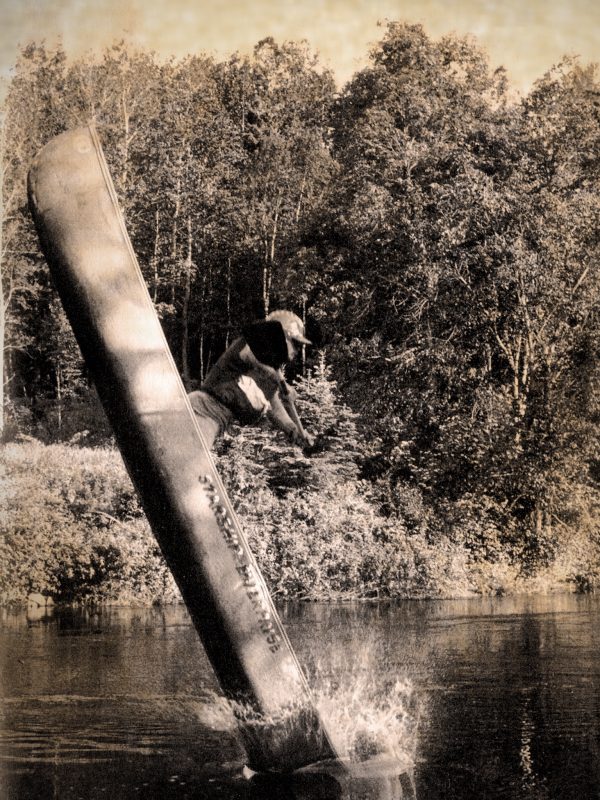
The Starship was our craft for our first attempt at boofing. Mark Scriver and I launched Curtis off a bridge, from the top of our car, in the Starship. Rest assured, the car wasn’t moving. We’re not crazy!
The Starship Enterprise in action. Photo: Paul Mason
Eventually, my father, Bill Mason, arrived home with the first solo whitewater playboat any of us had seen. Nolan Whitewall’s radically short 14-foot Descender. The Starship was relegated to a tandem-only boat. Over time, its bent gunwales and 100-pound patched hull resulted in it spending more and more time in the old canoe pile.
Almost 20 years later, I needed one more canoe for a tandem canoe course. Out came the Starship. A little vinegar, acetone and soap cleaned off most of the moss from the hull. Fresh knee pads to replace the squirrel-chewed ones, some airbags and it was ready for the mission.
[ Discover the best whitewater canoes of the year in the Paddling Buyer’s Guide. ]
With our new approach to using the MITH technique (momentum, initiate, tilt, hold), the emphasis is on maintaining tilt while carving turns. The crew in the Starship kept losing their carve, after employing my best coaching techniques… to no effect. I hopped in and tried it.
Gee, I’d like more tilt for this demo, but I can’t make it tilt farther, I thought to myself. It must be because it’s so heavy.
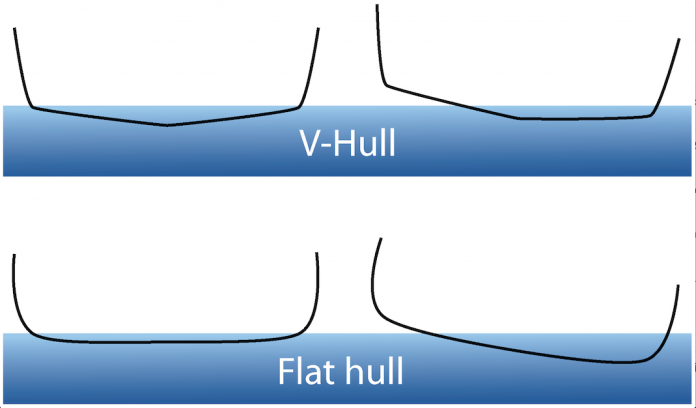
The next time I was out, my daughter, Willa, was with me. An experienced instructor herself, she couldn’t make it carve very well either. We concluded the V-hull, which feels so reassuring and covered up many of our errors in the old days, was now preventing the boat from carving. Tilting resulted in the canoe riding on the flat side of the V. No carve at all!
We know the way to stop carving is to flatten your boat on the water—which is to say, no tilt. That’s exactly what was happening.
Whitewater canoe technique has changed, and the demands of our craft have too. Make sure your choice of canoe is enhancing your experience, not sabotaging it.
Paul Mason’s list of canoe courses for 2020 is available at www.canoeinstruction.co.





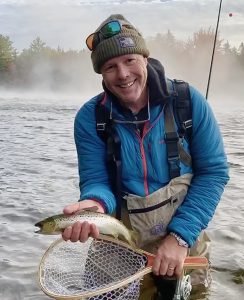 Hadden comes to Esquif with 30 years of experience in the paddlesports industry. He grew up in Vermont as an avid canoeist and landed his first job with Mad River Canoe in 1990. Since then, his career has included roles with Dagger, Wenonah and Current Designs, Walden, Emotion, Heritage and, most recently, Johnson Outdoors. Along the way, Hadden had the opportunity to learn the ins-and-outs of everything from sea kayaks to fishing kayaks, but canoes have always been close to his heart. He’s excited to be back in the world of specialty canoeing at Esquif.
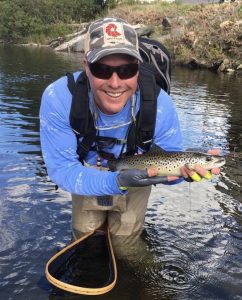 The toughness of T-Formex is something Hadden says serious users are asking for. He’s spoken with livery operations resorting to buying used Royalex canoes online to keep their fleets at full strength. He’s confident there is pent-up demand for Royalex that can only be filled by T-Formex.