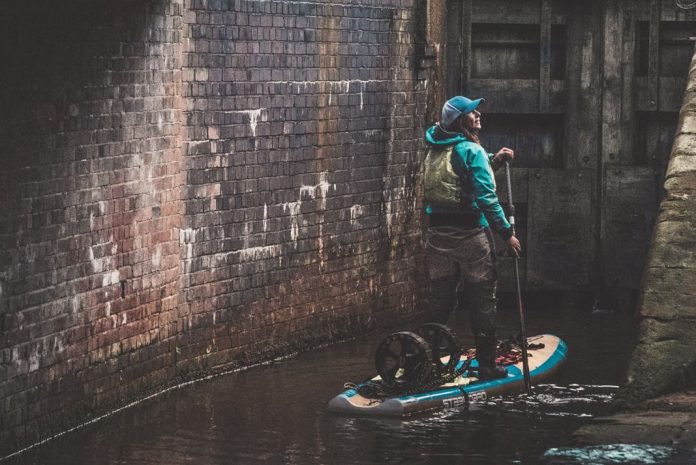
It Might Look Like A Strange Place For A Paddleboard, But What Appears To Be A Dead End Is A Common View For Welsh Paddler Sian Sykes. In May she became the first person to paddleboard around Wales via its canals, rivers and open coast.
Locks were just one of the many obstacles Skyes faced. The 1,000-kilometer two-month journey was unsupported and included paddling in fast flowing water, across busy shipping channels, through a military shooting range, and along exposed headlands.
“It’s exceeded my wildest dreams,” said a cheery Sykes when reached by phone on a dreary weather day more than halfway through her trip. “I never want to stop. I’ve seen dolphins and seals and I get a bird’s eye view of the water—it’s been a wonderful way to reconnect with my country.”
Euphoric natural connections aside, Sykes’ aimed to use the expedition to highlight the problem of marine litter, and single-use plastics in particular.
The SUP expedition against SUP (single-use plastics)
There’s no end to the plastic she found on route. “What gets dropped on the ground ends up in the waterways and in the sea,” she says.
The grim facts Sykes discloses are softened by her effervescent personality. She’s quick to tell me the United Kingdom discards a whopping 38.5 million plastic bottles each day, 80 percent of marine litter originates from land-based sources, and one million sea birds and 100,000 mammals die every year from marine litter. And that’s just skimming the surface of the plastic pollution problem.
Sykes also shares these facts with fishermen, dog walkers and boaters—anyone she meets along the way. This isn’t simply awareness raising—she also asks everyone she meets to make a pledge to give up one single-use plastic item. “To use milk from jars instead of cartons, or a shampoo bar instead of a plastic bottle, or to stop buying single-use water bottles altogether. People are doing, not just talking,” she says.
To Practice What She’s Preaching, Sykes Went Without Single-Use Plastics On The Expedition. Alternatives to everyday essentials—like a bamboo toothbrush—were easy. Compactly managing all her food in reusable containers took more research.
“If I can go on a challenging expedition for two months without single-use plastics, no one else has any excuse,” she says.
Photographer Ian Finch followed Sykes from shore on three two-day stints throughout the expedition. He took this photo in Grindley Brook Lock. Sykes had already portaged her kit up the three-tiered lock when he grabbed this snap.
It’s a special expedition,” Finch says. “I hadn’t spent time with someone who was so knowledgeable about plastic pollution in the United Kingdom. Just two days had a profound impact on how I use single-use plastic in my world and changed the way I buy food.
If I were going to choose two wheels as a method for transportation, derailleurs, disk brakes and a drop-post would make up some of the parts list. It would be very inefficient to include a canoe by itself in that scenario.
Enter Two Wheels That Will Make Your Canoe Trips More Enjoyable, Easier On The Lumbar And Open Access To More Wilderness Areas
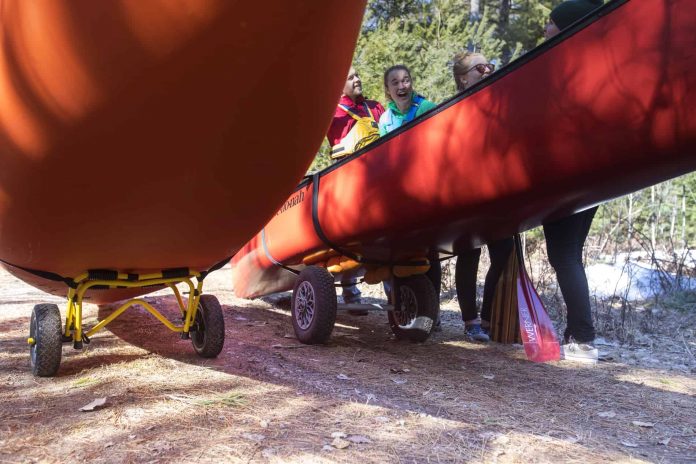
If you want to go fast and light or take time over rough terrain, here are two canoe carts for a solo or tandem adventure. The bike and canoes are not included.
1. Heavy Weight
Expedition Canoe Cart
The Expedition Canoe Cart from Western Canoeing Manufacturing is built to turn heads for reasons other than its looks. The burly appeal of this cart accurately represents the fact that it’s in it to endure abuse time and time again. The fat bike-worthy four-inch-wide tires are 16 inches in diameter providing almost eight inches of ground clearance. Reduce the tire pressure in soft terrain and a smoother ride. These tube-style tires will not slip off the rims.
The UV resistant orange bubble foam encompasses the tubular, stainless steel frame to cradle your canoe. Solo loading is manageable as the foam grips the hull to prevent a slide when securing. Tandem loading? It’s a breeze. The strap system is simple and intuitive. Drape over the gunwales, thread through the buckle and tighten. The narrow wheelbase is advertised for low-speed travel only. So if you decide to pair the Expedition Canoe Cart with a bike shuttle— and we know you will—keep in mind it’s a bit tippy. Note, you’ve been warned. With a 350-pound load capacity, rest assured the Expedition Cart will easily follow you well off the beaten track.
Price:
$289
Weight:
21 lbs
Capacity:
350 lbs
Wheel Size:
16″x 4″
www.westerncanoekayak.com
2. Light Weight
Suspendz Smart Airless DLX Cart
What’s yellow, black and will never give you a flat tire? The Smart Airless DLX Cart from Suspendz features solid wheels so you can leave the flat-tire worries at home. Set up and breakdown can be done the second time around with your eyes closed. Simply pull the pins to remove wheels and it folds into itself.
The cradling platform is 13 inches by 18 inches and packs down into the included mesh bag for convenient at-home and on-trip storage. The arched axle provides generous leeway for moderately smooth portages.
Ideal for kayaks or pack canoes, the Airless DLX features a strap system some may find cumbersome. I had to incorporate a couple extra strap lengths to securely fasten the cart to the center of the hull.The kickstand comes in handy for solo use but is not suited for canoes more than 15 feet in length. Superbly light and compact, the 150-pound weight capacity would be more than sufficient for an extended solo adventure or a couple’s weekend trip.
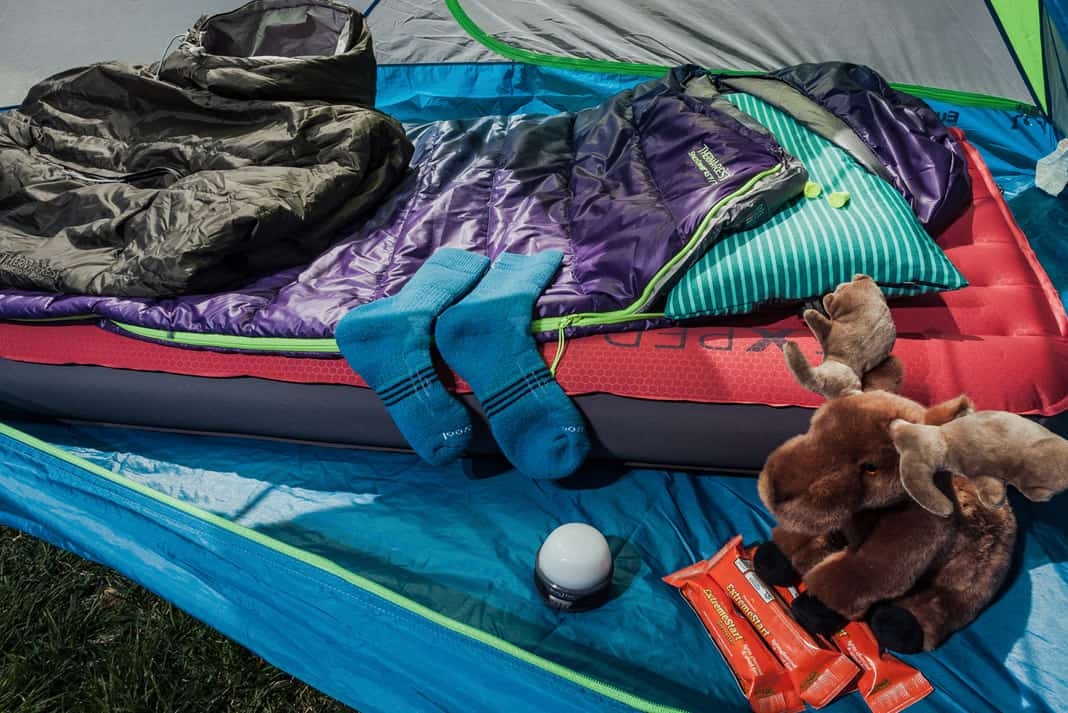
Having the right gear can turn a good camping trip into a great one. | Photo: Matt Stetson
When it comes to kayak camping, space is a precious commodity. Ensure you’re making the best use of it by packing gear that’s not only compact, but is going to make your trip as good as it can possibly be.
Whether it’s your first time out, or you’re in need of an upgrade in equipment, this selection of kayak camping gear will make the backcountry feel just like home.
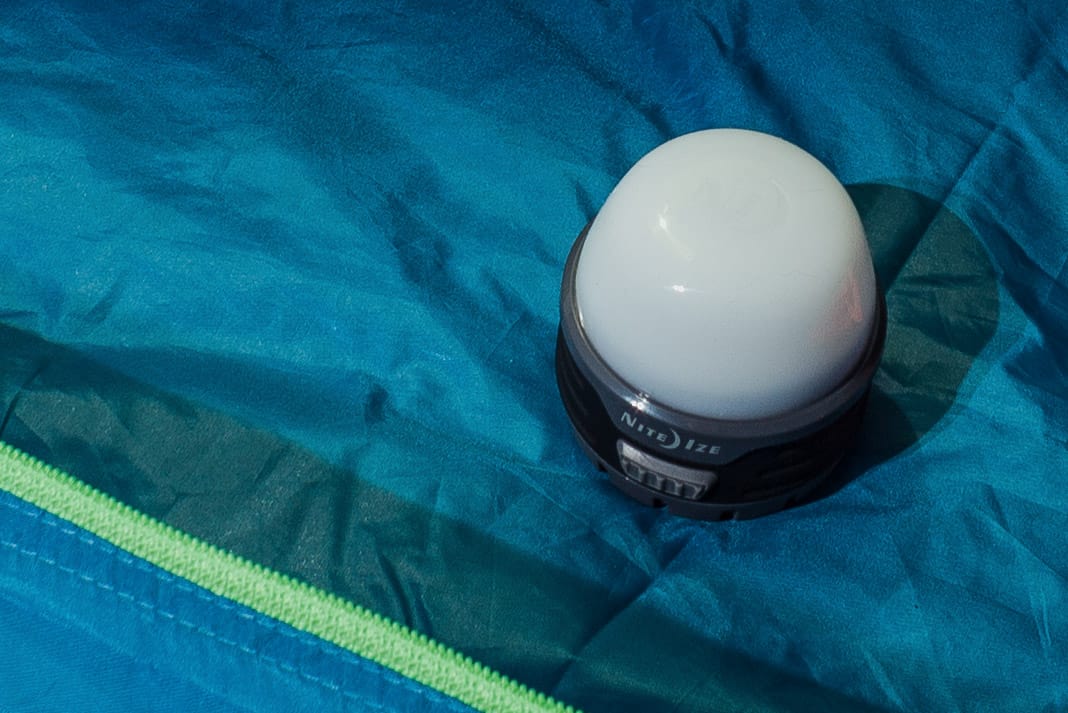
Stay up past dark with this mini lantern. | Photo: Matt Stetson
This palm-sized lantern packs a diffused 100-lumen glow, perfect for evenings reading in the tent or playing cards by the campfire. Thanks to its soft silicone dome, it can squish down for extra compact stowing. The Radiant features high, low and red LED modes, and we love the folding carabiner hook for easy attachment anywhere. Powered by three AAA batteries.
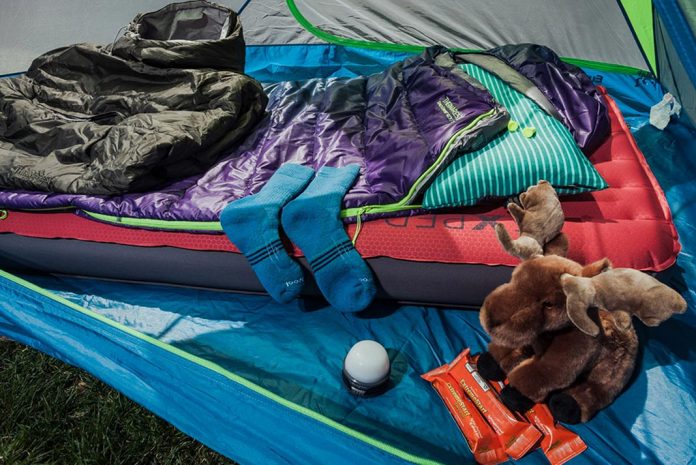
A sleeping pad that might be more comfortable than your mattress at home. | Photo: Matt Stetson
A word of warning—this pad may be more comfortable than your mattress at home. Exped’s MegaMat Lite 12 offers an opulent four inches of cushion between sleeper and the cold, hard ground. Though it’s heavier than the average ultralight sleeping pad, and more comparable to the size of a Nalgene bottle rather than a can of Coke, the MegaMat is without question absolutely worth it. We love its velvety soft fabric and the super easy Schnozzel Pumpbag for fast inflation. Never mind kayak camping, we’d carry this backpacking too.
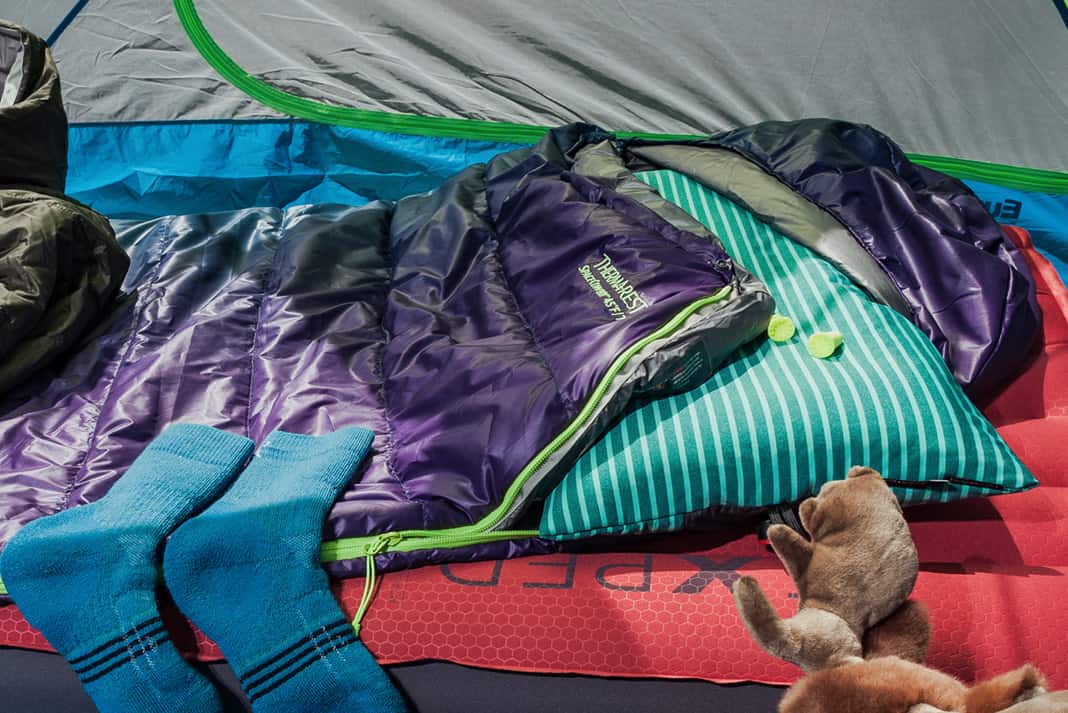
Stay warm without the added weight with this sleeping bag. | Photo: Matt Stetson
The ultralight Space Cowboy weighs just a pound and packs down to the size of a small melon. Reflective ThermaCapture lining harnesses body heat to keep campers warm without adding weight. Designed with cowboy camping in mind, the Space Cowboy features water-resistant synthetic insulation and an exterior to repel morning dew. This makes it extra suited to water-based adventuring. Rated to 45°F.
Have it all with this feature-packed tent. | Photo: Matt Stetson
For six pounds the Midori 3 offers stately volume, with expansive shoulder room and 45 square feet of floor space. Compared side-by-side with some other so-called three-person tents, the Midori feels comparatively palatial.The body of the tent is mostly mesh, maximizing airflow and offering great stargazing opportunities when pitched without the fly. It features two large doors, and its roomy vestibules are complemented by a large loft-style cargo net for storage. A full-coverage fly protects in rainy weather.
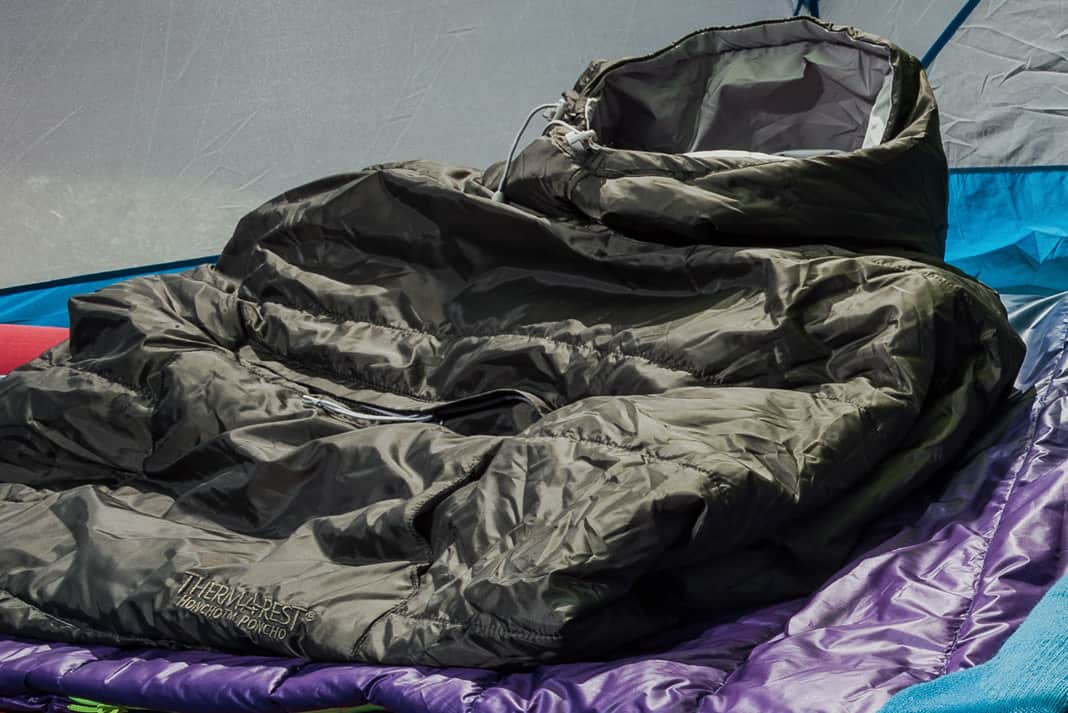
Northern nights are no match for this jacket. | Photo: Matt Stetson
Be crowned king or queen of the campfire with Therm-a-Rest’s versatile Honcho Poncho. This unisex design might not win any fashion contests, but this insulated and breathable layer offers extra warmth and water resistance for northern nights, and it can even double as a blanket. Features a cinchable hood, kangaroo pocket for toasty hands and a top zip pocket for stowing a headlamp and snacks.
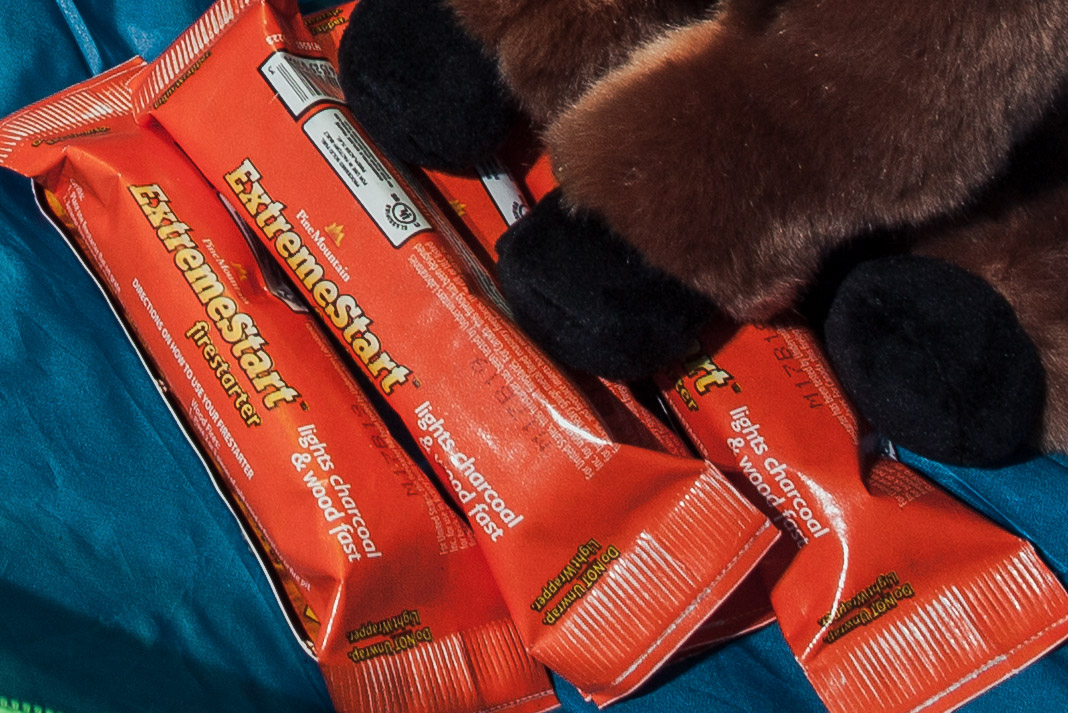
Starting a fire is easy with these sticks. | Photo: Matt Stetson
Did you know it takes the average American six minutes or more to start a charcoal or wood fire? Struggle no more. Just like a fire log, light the wrapper on an ExtremeStart Fire Starter and your blaze will be hot in minutes, without needing to find and chop kindling. Your bushcraft instructor would disapprove, but these sticks offer the luxury of a good fire with a simple match strike—anytime, anywhere.
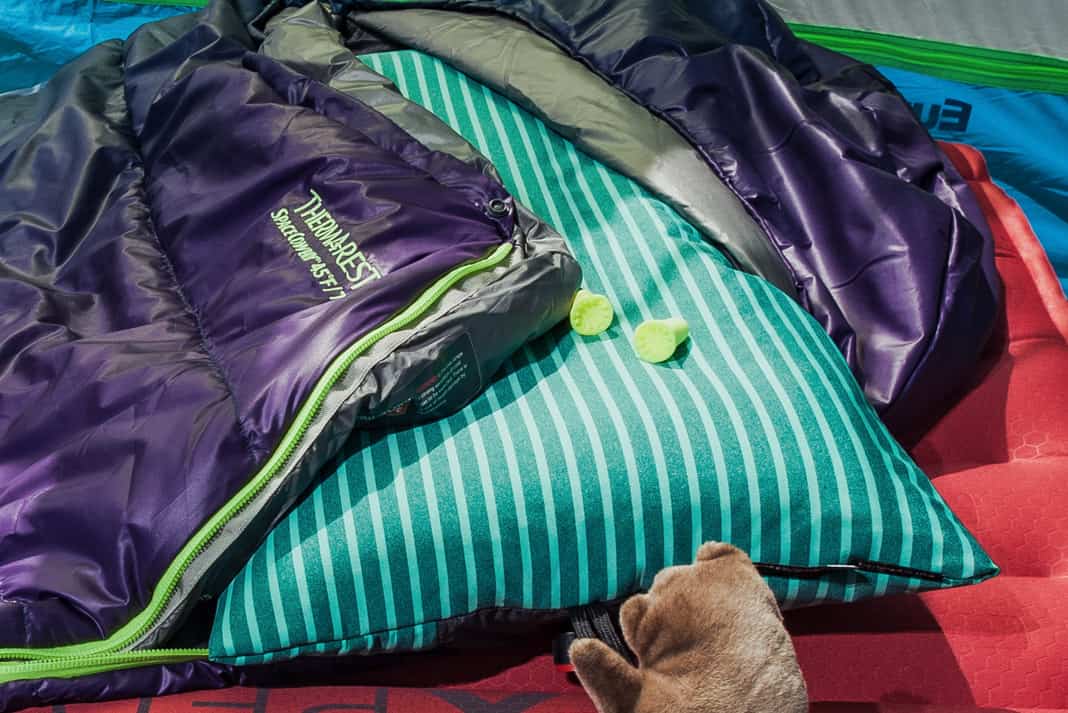
A compact pillow filled with lots of wow-factor. |Photo: Matt Stetson
This pillow got an out-loud “wow!” during unboxing. The Fillo Elite Luxury backpacking pillow is the ultralight version of Nemo’s award-winning Fillo. At just four ounces, it offers impressive height and cushion despite its ethereal weight. It’s the size of a perfect lime when packed in its stuff sack. Three-inch baffled air cells provide impressive loft and avoid the beach ball experience of non-baffled pillows.
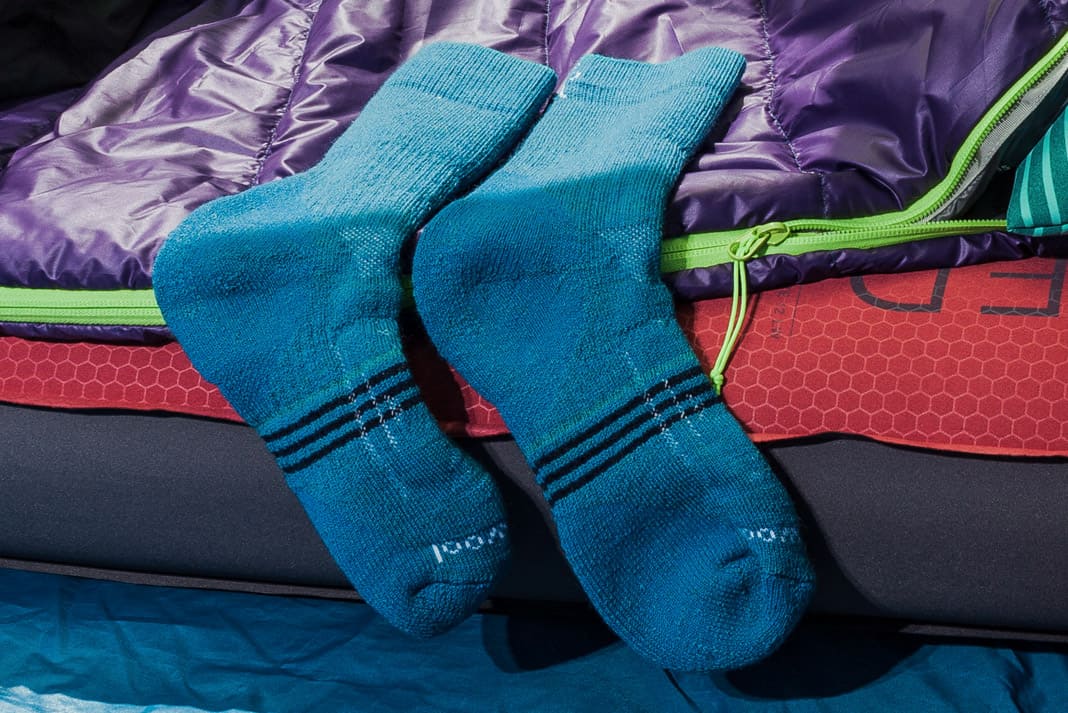
Cozy socks are non-negotiable. | Photo: Matt Stetson
No matter the time of year, we’re of the opinion no one is truly cozy without a plush pair of socks. The heavy cushioning and the wicking power of Smartwool’s merino wool socks keep feet warm, dry and comfortable around camp.
The secret to a sound sleep in the backcountry. | Photo: Matt Stetson
Romantic notions about sleeping under the stars die a quick death for light sleepers kept awake by hooting owls and peeping frogs. Foam ear plugs work by stopping sound vibrations from entering the ear canal. You won’t hear little noises—like mice sounding like bears scurrying by your tent—but for better or worse, you can rest assured loud noises—like a real bear rummaging through camp or the 200-pound man snoring next to you—won’t go unnoticed.
What do the Porsche Cayenne and the Stellar SILV have in common? More than you may think. | Photo: Scott MacGregor
I remember thinking when Porsche released the Cayenne back in 2002, why would anyone buy a mid-size luxury crossover sport utility vehicle?
Stellar Kayaks’ Intrepid LV Sea Kayak Specs
Length: 16 ft 10 in
Width: 20.9 in
Weight: 40.3-43 lbs Capacity: 245 lbs
Paddler Size: 5 ft-6ft 2 in
Price:$3,280-$5,439 USD stellarkayaksusa.com
It didn’t make any sense. Not like I was in the market for a German sports car or a luxury mid-sized SUV. Even on principle I thought this a silly idea—dude, buy a performance vehicle or a station wagon, don’t slam them together.
I felt the same way in the ‘70s about the Chevrolet El Camino. I believed compromise was when nobody wins.
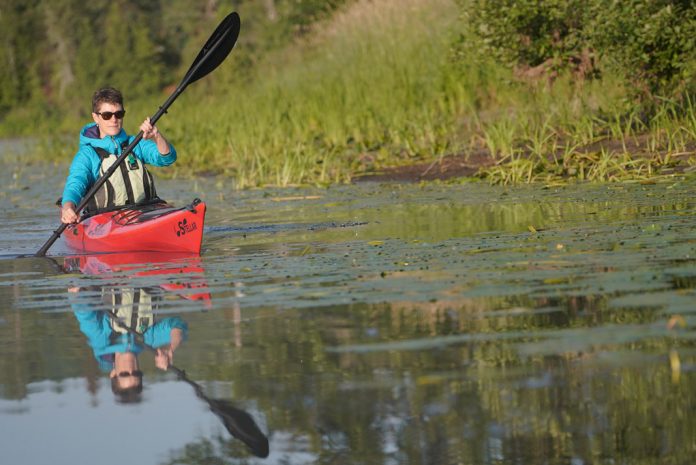
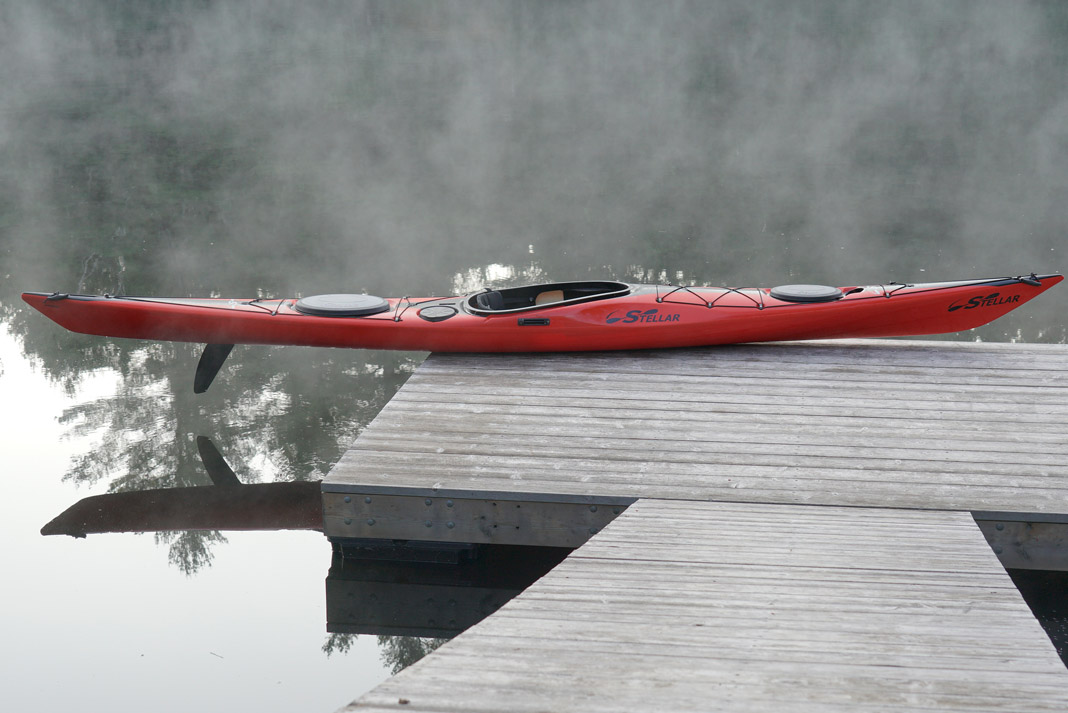
Yet the blending of category lines continues in automobiles as much as it does in kayak design. Stellar Kayaks’ Intrepid LV is a touring kayak from a Surfski manufacturer blending high performance, British-style lines and a hint of Greenland heritage.
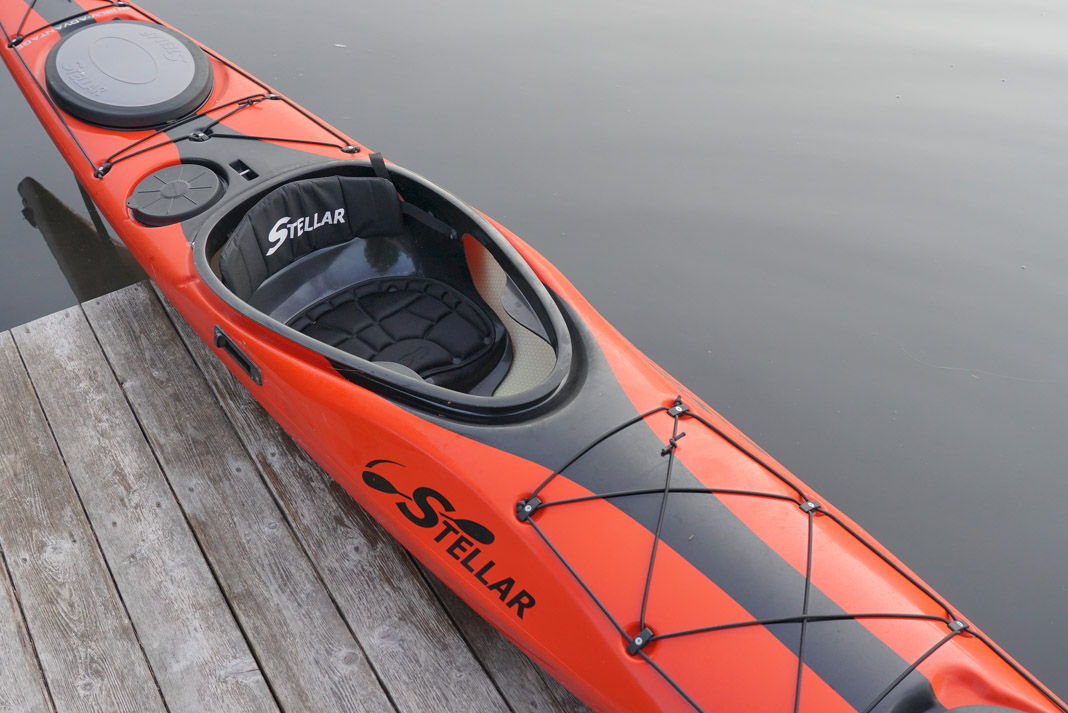
Let’s play a game. See how many different design elements you can spot in Stellar Kayaks’ intrepid LV 17-foot low volume sporty SUV. | Photo: Scott MacGregor
An aesthetically pleasing sea kayak
In 2002, I’d have rolled my eyes at the Intrepid LV. But these days soccer moms can do zero to 60 in 3.7 seconds and hit top speeds of 177 miles per hour so why wouldn’t they want a high performance, fun to paddle, aesthetically pleasing sea kayak with room for a week’s groceries.
The intrepid LV or SILV is the little sister of Stellar Kayaks’ popular SI18 kayak, scaled for small to mid-sized paddlers. The LV is for low volume. I’m a six-foot, two-inch tall dude with 35-inch legs and I still fit comfortably inside with one more click left in the SmartTrack foot braces.
Being connected to this boat is fun.
The SILV has a slightly shorter and narrower cockpit rim and is 20.9 inches wide compared to the SI18 with a beam of 21.3 inches.
The LV is almost two inches shallower with a reasonably low stern deck. My wife, Tanya, and I both loved the fit of the LV, sacrificing only carrying capacity and storage space—more on this later.
Stellar Kayaks keeps their comfortable kayak seats
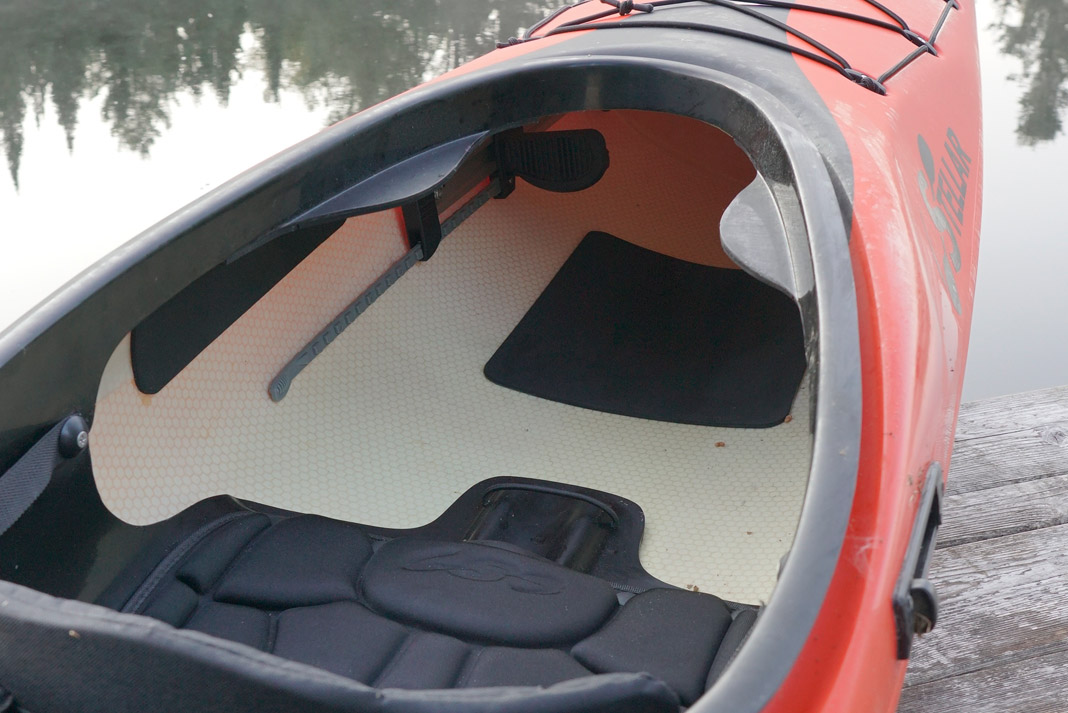
One thing I don’t think Stellar changed is the seat pan and cushion. The entire seat can be unbolted and moved forward or back three holes in one-inch increments to adjust trim.
I asked Stellar Kayaks owner David Thomas if it could also be tilted to provide more leg support to hold my thighs up in the thigh braces. Not so, leaving Intrepid owners to build the seat up and pad it out from the sides with foam for a truly custom fit.
Does anybody do this anymore? You should, especially in a boat like the SILV. Being connected to this boat is fun.
Stellar Kayaks borrowed from their surfs designs and added cutaways on the bow deck. The Intrepid LV sea kayak seat adjusts forward and back in three one-inch increments, you’ll want to glue in some hip pads, this boat is fun to paddle. | Photo: Scott MacGregor
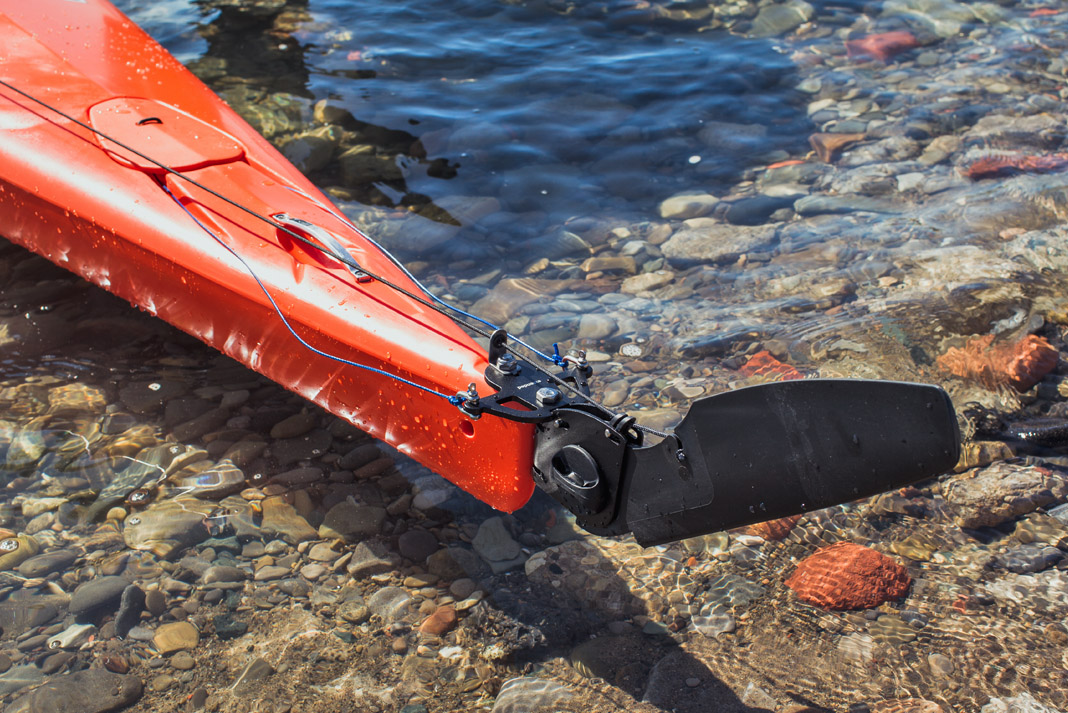
Inside Stellar Kayaks’ intrepid LV sea kayak you’ll find plenty of room for size 10.5 feet and 35-inch legs on the smarttrack foot braces. Rather a rudder? Sure, whatever. Stellar plumbs the Silv with rudder-ready tubes. | Photo: Scott MacGregor
A stylish and efficient touring kayak
So here goes the performance mash up. We have a longer waterline than a traditional 17-foot British-style boat, so it’s faster. It has an upswept bow, moderate rocker and softer chines than most British boats.
Softer chines means less surface area and increased efficiency. On top, Stellar borrows from their surfski heritage with cutaways in the bow deck allowing for a more vertical forward stroke catch placement. And they look pretty cool.
[ View all of our touring and sea kayaks in our Paddling Buyers’ Guide ]
The SILV gets full deck bungees, perimeter lines and toggle handles, compass recess and three watertight hatches—the bow and stern hatches are oval for easier loading of awkward items like tent poles and ukuleles.
The Intrepid LV comes with a Kajaksport skeg. But, to confuse the categories even more, the LV comes rudder-ready plumbed with an integrated rudder tube.
Stellar Kayaks’ British-styled sea kayak
If you’re wondering who installs rudders on a British-styled sea kayak, I was too. Apparently, it’s the Australians. These days, anything goes.
When I called David Thomas with a few questions about materials he was 12 time zones away and just going to bed as I was pouring my third cup of orange pekoe.
All Stellar’s Surfskis and touring kayaks are manufactured at the Flying Eagle Boat Co. factory near Hangzhou City, China. Flying Eagle has over 25 years of composite boat building experience, a global distribution network and an annual production capacity of 3,000 kayaks.
[ View all of Stellar’s sea kayaking and touring boats in the Paddling Buyer’s Guide here ]
Thomas says the wide array of items being produced under the parent company Sino-Eagle group allows Stellar to tap into fruitful synergies allowing creative advancements and innovations in his kayaks.
Thomas told me I was test paddling the SILV in his Advantage layup coming in at 43 pounds and $3,280. For a couple hundred bucks more, you can upgrade to his Multi-Sport layup which has the Advantage deck but is carbon and Kevlar below the seam.
What do the Porsche Cayenne and the Stellar SILV have in common? More than you may think. Feature Photo: Scott MacGregor
Full disclosure: aside from whitewater open boating, I’ve never paddled a true solo canoe. A built-for-one, single-seat lakewater cruising canoe has simply not been within my reach.
Swift’s Cruiser 16.8 Solo Canoe Specs
Length: 16 ft 8 in Width: 29.5 in Weight: 29 Pounds Material: Carbon Fusion MSRP: $4,595 CAD/$4,195 USD
Blame my ingrained frugality on a lifetime of prioritizing freedom over paychecks. I’ve grown accustomed to compromise, a diehard acolyte of the one-canoe-to-do-it-all ethos.
If you’re like me, you probably have one of these in your backyard: 16 feet long, medium-weight layup, designed for two but manageable—most of the time—for one.
Recently, however, I had a revelation. Earlier this spring, I was invited by the composite wizards at Swift Canoe & Kayak to paddle their new, race-inspired solo tripping canoe.
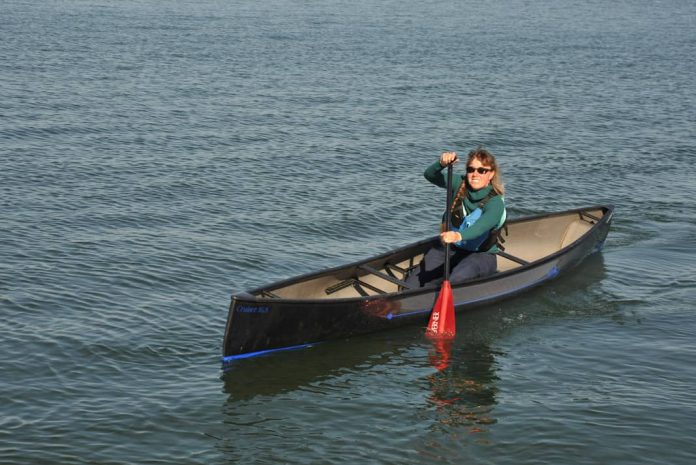
The Cruiser 16.8 is the antithesis of my utilitarian, do-almost-everything canoe. It is sleek. It is specific. It looks like a cruise missile-shaped from yards of shimmering carbon fiber.
Credit for the Cruiser 16.8’s sophisticated lines goes to David Yost, one of the most prolific small boat designers of all time. With something like 200 canoe, pack boat and kayak designs to his credit, Yost has a particular flair for crafting solo canoes.
In the 1960s, Yost was competing in marathon canoe racing. To save a few bucks—a kindred spirit!—he began building his own solo boats to race. Soon, he was designing racing canoes for friends. A solo tripper followed, the first of many Yost designs as adept at hauling gear as they were keeping pace with tandem paddlers.
Yost’s latest design honors those roots—fast, seaworthy and privileging the solo paddler—while incorporating more than four decades of design experience and material innovations. Swift Canoe & Kayak owner Bill Swift says the genesis for the Cruiser’s shape started with one of Yost’s earlier marathon racing canoes, the Sawyer Shockwave. Then, he says, “We gave the Cruiser more rocker and volume, and we carried that volume up further so it would be more stable and controllable in wind and waves.”
Crafted in Swift’s Ultralight Carbon Fusion layup, my sapphire-blue-and-black Cruiser 16.8 feels even lighter than its listed 29 pounds.
Fusion refers to the layers of carbon, Kevlar and Innegra cloth fused around a foam core and ribs with high-impact epoxy vinylester resin. Gelcoat on the hull below the waterline adds a splash of color and an extra layer of abrasion resistance.
Paddling stern first in my trusty tandem, I consider myself a competent solo tripper, shifting packs and barrels to trim the canoe, a cherry ottertail and relaxed J-stroke propelling me lazily across the lakes. The Cruiser 16.8 is outfitted with a sliding tractor seat and carbon foot bar, suggesting a very different style.
“This is a fantastic tripping canoe for someone using a bent shaft paddle who wants to travel quickly and efficiently,” confirms Swift.
Armed with a borrowed bent shaft to match my borrowed boat, the urgent rhythm of the sit-and-switch paddler—stroke-stroke-stroke-switch!-stroke-stroke-stroke-switch!—feels awkward and slow to me. The bow veers drunkenly between the banks of my local river, swollen with the spring freshet. My top hand fumbles the paddle grip when I swing the blade across the bow, an indignity every bit as mortifying as a missed high five.
After a couple hours, trapezii muscles burning, I am beginning to find my tempo.
The Cruiser 16.8 is a forgiving first solo canoe, deftly bridging the realms of recreational racing and lakewater cruising.
[ See all solo canoes in the Paddling Buyer’s Guide ]
The nearly flat hull curves into generously rounded chines so the boat feels stable in spite of its slim width, even in bumpy conditions. An inch of bow rocker and half that in the stern make for a design which prioritizes tracking and speed over agility, but heeled over the Cruiser carves graceful edged turns.
Acceleration is a delight; a couple strokes on each side and the eponymous Cruiser is swiftly up to speed. The greatest pleasure of Swift’s new solo boat may be that it maintains the glide of a fast 17-footer, while scaling width and depth to perfectly suit the lone paddler.
Also check out the Swift Cruiser 14.8 in the video below.
Bill Swift describes the Cruiser as having “a very narrow paddling station” for maximum efficiency.
“You can keep your stroke right next to your body,” he says. Yost achieved this by combining ample tumblehome with recurved gunwales tapering together near the paddler’s feet and flaring back out behind the seat. My bottom hand slips neatly along the pocket of hull created by the tumblehome, seemingly close enough to catch a stray thumb in my belt loop. Swift Canoe’s mastery of composite trim makes such radical shaping possible. “It would be difficult to get wood or aluminum to bend like this,” adds Swift.
[ Plan your next paddling adventure with the Paddling Trip Guide ]
Further efficiency is provided by the carbon foot brace, which allows effective power transfer and stability when seated. Outfitting adjustments are straightforward: the foot brace uses two quick release pins; the carbon seat can be moved on-the-fly by simply unweighting it and sliding. Trimming the seat fore or aft accommodates a wide range of paddler sizes and variable conditions and gear loads.
Those keen to explore the Cruiser 16.8’s tripping potential will find there’s plenty of room for packs or barrels in the spacious stern and long, narrow bow.
Together, the hull speed and storage capacity also make this an exciting new option for soloists competing in endurance races like the Yukon River Quest or Missouri River 340.
Turning toward home after a lengthy and tiring upstream tour, I experience an illusion of radically improved technique as the Cruiser 16.8 accelerates with the assistance of the river current. I slip effortlessly past the backyards of cottage country, waving victoriously at weekenders toiling in their gardens or lounging on their decks. For a few giddy moments, I imagine I am gliding across some far-flung finish line.
A man raking leaves pauses from his work to gaze appreciatively at my speedy passage. “You’re the first boat I’ve seen this season,” he calls to me, raising his index finger emphatically. “You’re number one.”
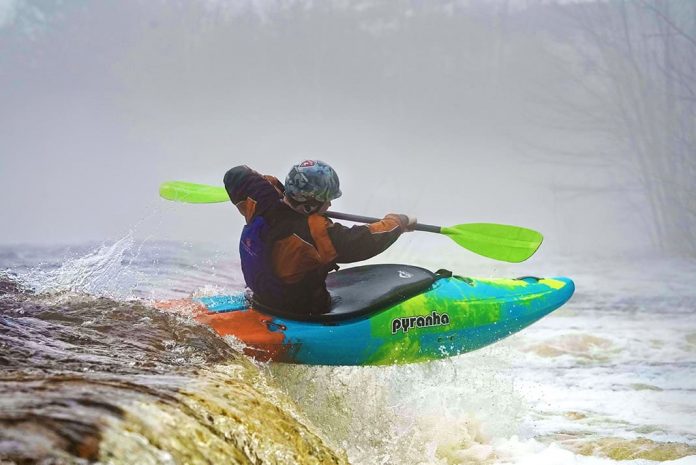
Let it rip in the Pyranha Ripper. | Photo: Paddling Mag Staff
Sometimes combining two things together from seemingly very different starting points can produce something magical. The most obvious example—for Napoleon Dynamite fans anyway—is the liger. “What’s a liger? It’s, like, pretty much my favorite animal.”
Pyranha Kayak’s Ripper Specs
Sizes: S | M | L Length: 9 | 9 | 9 ft Width: 23 | 24.5 | 25 in Volume: 57 gal (US) | 62 gal (US) | 72gal (US) Weight: 44 | 44 | 46 lbs Optimum Paddler Weight: 88-165 | 143-198 | 165-275 lbs MSRP: $1,249 USD
Legend has it, if you put a male lion in a room with a female tiger, add some flickering candles and soft music, you’ll eventually end up with the largest living cat on the planet. Maybe you’re thinking, “Of course, two great, big cats make an even better, huge cat.” Things don’t always work out as planned. Ever hear of the mighty tigon? Not really all that mighty.
For several years now, whitewater kayak designers have been experimenting With mating creek boats and throwback playboats. For the most part, I’ve regarded these innovations a bit like pussycat tigons. Cute maybe, but I’ll stick to the originals, thanks.
If I’m being honest, when I first saw the Pyranha Ripper I was expecting more of the same. Big cat yawn. A few quick turns and one rapid later I changed my mind—this boat is purebred liger.
“We were looking for a fast, easy edge-to-edge hull with a playful stern,” says designer Robert Pearson. “We took the 9R rocker, dropped the bow by an inch, keeping the bow volume relatively the same while removing volume from the stern to make it playful. A few width tweaks and rail changes helped us to get the performance we were after.”
Pyrahna’s Ripper kayak comes in three sizes
All measuring nine feet in length, but with different volume and width distribution. At the time of testing, only the small and medium versions were available, with the largest size set to hit North American dealers at the end of May.
I tested the medium, the first size to start shipping from the U.K. At my winter weight of 180 pounds, I land perfectly in the sweet spot between creeker and play. Pyranha’s posted range for the large begins at 165 pounds and tops out at 275 pounds, whereas the small is 88 pounds to 165 pounds.
With the three sizes on offer, you’ll soon be able to choose the Ripper that suits not just your weight but also your style. If you want to get into something a bit more playful and less creeky, I’d drop down a size. If your local runs are mostly class IV to V with a few good waves and eddylines, I’d probably go larger.
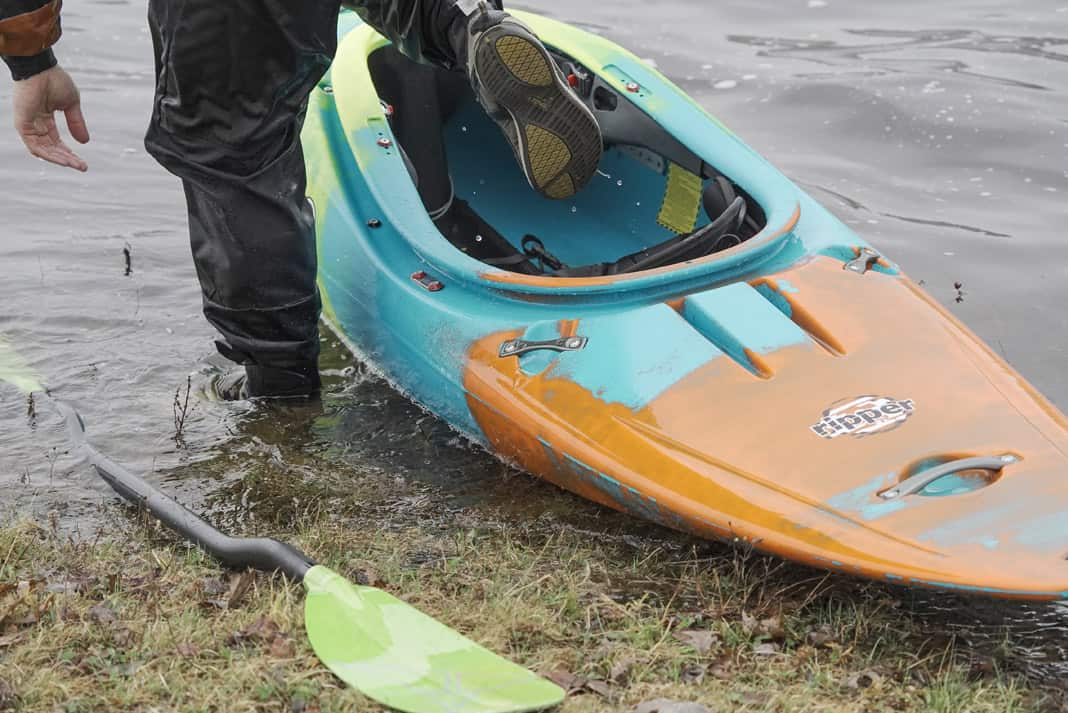
Pyranha’s stout 2 outfitting includes an ergonomic padded seat with trim adjustment and height adjustment shines; oversized hip pads come with adjustment shims for a snug fit; padded full length contoured thigh braces and a padded backhand with ratchet adjustment support rounds out a solid outfitting package we only dreamed about the last time slice boats were cool. | Photo: Gabriel Rivett-Carnac
Loaded up with Pyranha’s Stout 2 outfitting, the Ripper’s outfitting is easy—it’s quick to adjust the thigh braces, shim out the hip pads and ratchet myself securely in place with feet firmly on the full-width footplate. In 30 seconds I feel locked in and ready to rip. A far cry from the last time slicey sterns were the cat’s meow.
Picking the Ripper off the ground, I immediately notice another one of my favorite things about it—it’s lighter than I expect from a nine-foot boat. In fact, all three sizes weigh in around the mid-40-pound mark.
While some bigger boats take more muscle to get moving, thanks to the combination of light weight and hull design, I get the Ripper going in a hurry. I’m surprised at the speed I can achieve in only a few short strokes. The Ripper has a narrow bow helping punch through holes and keep paddlers on track. Pearson and his design team managed to keep enough volume up there to ride over waves and give my toes a decent amount of wiggle room too.
Moving back toward the cockpit, I like how easy it is to get nice vertical paddle strokes right alongside the boat thanks again to the narrower-feeling width. At 24.5 inches wide, the Ripper is not actually much narrower than my playboat, but the deck profile and volume distribution makes it feel smaller. The trade-off is my legs are a bit straighter, translating into a less aggressive position than I’ve become accustomed to.
Moving around the river, I’m impressed by how easy the ripper is able to carve in and out of the current and hang out in even the smallest eddies. When I tilt the boat, the edges bite hard and carve in a nice satisfying arc.
And if your paddling skills are a bit rusty and you missed your mark at the top of the eddy, the Ripper attains back up with ease. Barely a few strokes and I’m taking a break in my intended eddy, whereas in most boats I’d either have to work harder or pretend I didn’t want to hit that eddy anyways.
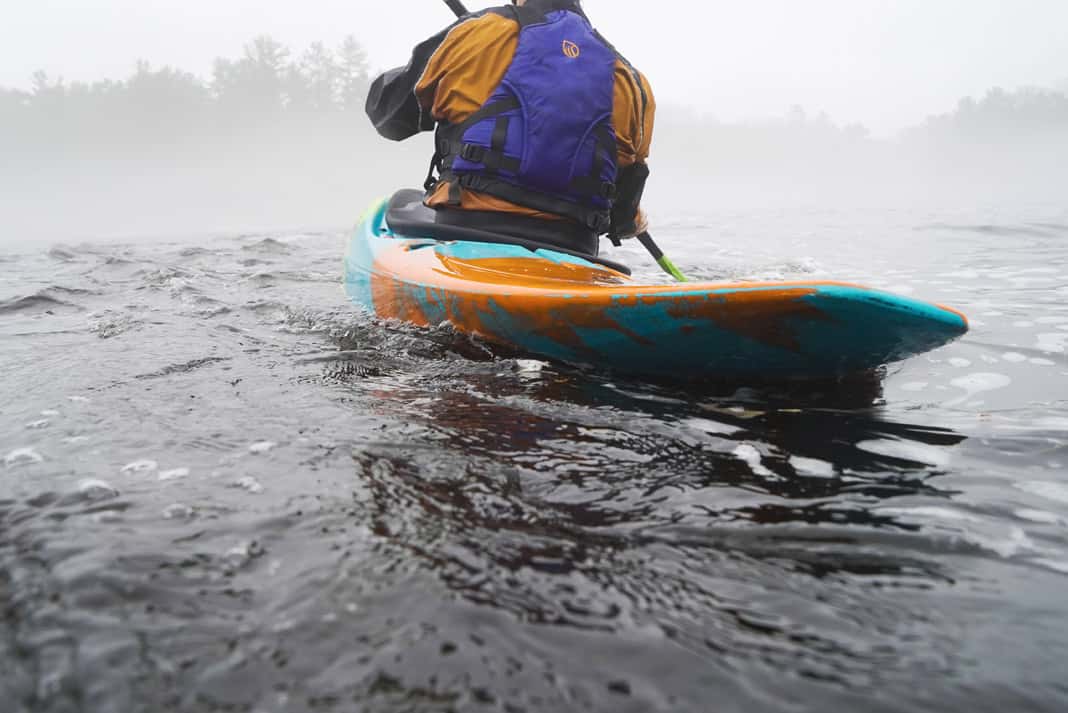
So, what about the slicey stern deck? Most of the contemporary kayaks I’ve paddled with a slicey squashed deck are a bit—let’s say—unforgiving in the boily areas of the river. And so, I intentionally spend a lot of testing time in the crazy water below big sets. To my surprise—and relief with water temperatures just above freezing—I don’t flip once. The rocker profile keeps any of the water from piling on to the back deck.
What happens when I intentionally dip those outside edges in?
The Ripper’s low-decked stern is ideal for unhindered back deck rolls and kick flips. The carefully tailored slice edges butters downriver pivot turns and vertical eddy and rock moves. The Ripper is kinda like the mid-90’s again but with a flatter bottom. | Photo: Gabriel Rivett-Carnac
This is where the Ripper’s vertical playfulness gets unleashed. Stern squirts are controlled and fun. With dialed-in technique, you can change course midcurrent on a dime. Pretty fun and handy in a nine-foot boat. The super flat deck also helps with rolling, as well as some downriver moves like kick flips, where there is an advantage to having your body as low and flat as possible.
The Ripper’s steep bow rocker coupled with great top-end speed and a big planing hull mean the Ripper is equally fun performing boofs and rock moves as it is surfing and downriver play. It was easy to catch smaller features on the fly. Long live soul surfing with the odd spin thrown in for good times. Even if I edged a bit too hard and came off the wave I could usually find my way back up.
Like many, I am sometimes skeptical when things get mashed together because too often we end up with something underwhelming.
Every now and then we get something arguably better, like the mighty liger, and like Pyranha’s new Ripper, pretty much my favorite animal, bred for its skill in magic. For more top picks and expert reviews, check out Paddling Magazine’s guide to the best whitewater kayaks here.
Dan Carr is a professional photographer based in Whistler, British Columbia. | Featured Photo: Daniel Carr
To an outsider, the life of an action sports photographer looks glamorous, but I reached a point where I was feeling stuck in a rut.
My career revolved around photographing the best skiers in the world, from Japan to Alaska, and in my own backyard of Whistler in British Columbia. It was great, but I wanted to explore more in the world of photography.
One area had always interested me—wildlife photography. What photographer doesn’t harbor a dream of seeing work in National Geographic with their name under it? Making the leap, or even a tentative step from one genre of photography, can be a tricky thing.
With my mind set on the wildlife world to expand my photographic horizons, I knew my first expedition was going to have to be a good one. After some research, I decided to keep things local and photograph grizzly bears in northern British Columbia. This has been done many times before, so I wanted to think of something to help set my work apart from the many others who had gone before me.
With the salmon run about to start, I knew I would be photographing bears fishing in the water and I wondered if I could float quietly amongst them in a kayak.
Dan Carr is a professional photographer based in Whistler, British Columbia. | Featured Photo: Daniel Carr
Photographing wildlife from a kayak
I purchased my very first boat—a big, stable sit-on-top kayak—specifically for this first weeklong expedition. It wasn’t just a wildlife photography learning experience for me. The beauty of photographing bears from the water level is the images seem much more intimate. As a viewer, you really get a sense you’re sharing a small part of the bear’s world for a few moments, rather than looking down on them from the shore as if at a zoo.
[ See the largest selection of boats and gear in the Paddling Buyer’s Guide ]
Bears don’t have any natural threats in the water, so they actually turned out to be relatively unconcerned with my presence if I kept my distance and stayed quiet.
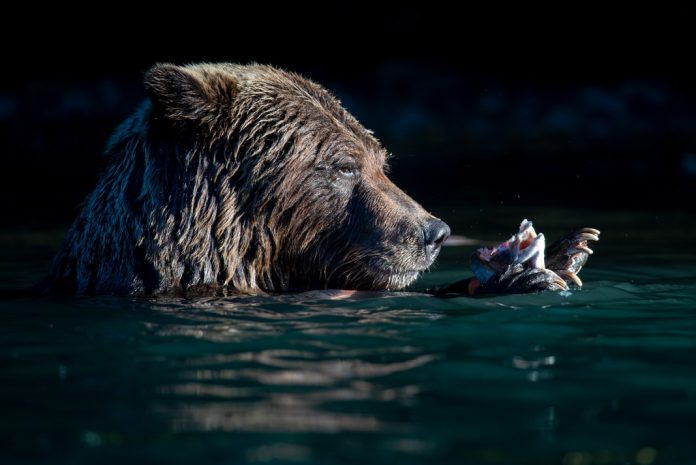
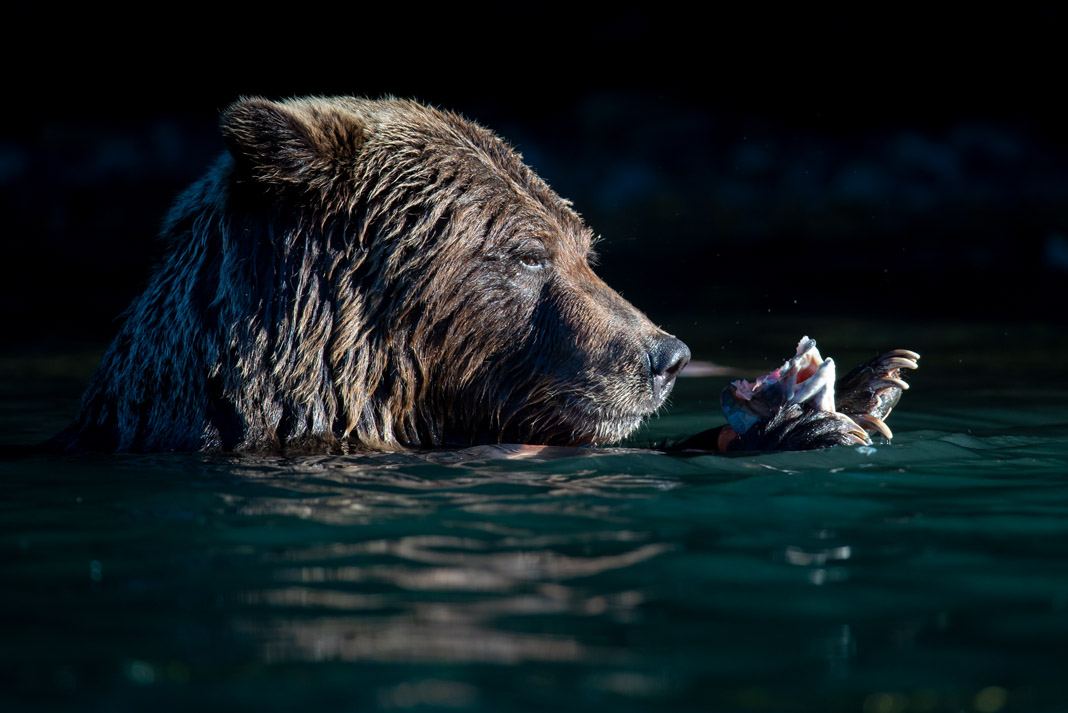
On this particular day, I found a bear wading around through the water in the shadows. A single stray patch of sunlight was filtering through the trees and hitting the water nearby, so I sat in the shallows and waited. I was hoping he would walk through the sunlight, knowing the effect would be incredibly dramatic with such a dark backdrop.
[ Plan your next paddling adventure with the Paddling Trip Guide ]
I couldn’t believe my luck when he not only walked into the light but grabbed a salmon and started eating it right there. I knew right away it was a special moment—it gave me an adrenaline rush comparable to all of the action sports adventures I’d been on in the past.
Incredibly, my first trip turned out to be one of the most successful photographic adventures of my whole career. Ever since, I’ve factored wildlife photography into my work on a regular basis.
Dan Carr is a professional photographer based in Whistler, British Columbia. | Featured Photo: Daniel Carr
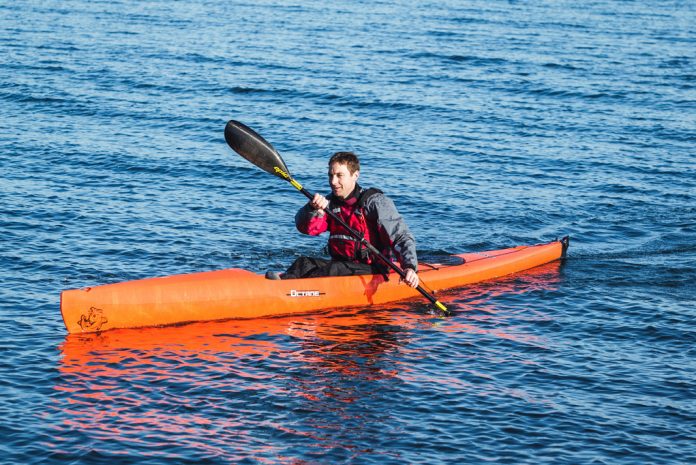
“Surfski is really blowing up,” says Chris Hipgrave, sales director for Pyranha Kayaks, when he explains why the guys at a whitewater kayak manufacturer dreamed up the Octane 175 surfski.
“We’re seeing a lot more races, and a lot more surfskis on the water, but they’re typically expensive. A competitive surfski is $3,000 or more so we wanted to produce one to introduce the sport to the masses,” he adds.
The Popularity Contest of Surfski
Pyrahna’s High-Octance Surfski
Length: 17 ft 8 in Width: 20.9 in. Weight: 51 lbs. Weight Range: 130-253 lbs. MSRP: $1,499 USD (under stern rudder)/$1,629 USD (over stern rudder)
Pyranha collaborated with Canadian surfski specialists Think Kayaks to jointly design an accessible yet high-performing rotomolded polyethylene surfski at an entry-level price. Pyranha, along with sister brands P&H Sea Kayaks and Venture Kayaks, paired its plastics expertise with Think’s knowledge of surfski design and the result was co-released as the Pyranha Octane and the Think Nitro. Yes—same boat, two names.
The High-Octane By Pyranha
The Octane gives Pyranha an entry into the burgeoning race and fitness market to balance out P&H’s traditional sea kayak offerings, and the Nitro gives Think a gateway boat to battle its competitors’ plastic skis, like the Epic V7. As a seasoned kayaker and recreational racer who could be described as surfski-curious, I’m the target demographic for the Octane. I’ve briefly paddled some full-on race skis, but I’m more likely to fall for something friendlier, more multi-purpose and less committing, which aptly describes the Octane.
When I test paddled the Octane on the frigid waters of Lake Ontario in early spring, I didn’t want a seat full of ice water any more than an unplanned swim. The Octane didn’t let me down or tip me over. It was reassuringly stable and dry—more stable than many sea kayaks I’ve paddled, despite being more than an inch narrower. The Octane features confidence-building initial stability and even more solid secondary stability, and its high-sided cockpit stays dry even when heeled over to 45 degrees.
I tried really hard to capsize and the Octane kept right on resisting—right until I fell out of the cockpit. There’s no reason the boat might flip without throwing some waves or current into the mix. Any water entering the cockpit can be quickly sucked out by the cockpit bailing system, which opens and closes with a nudge from your hand or heel. I tend to think of surfskis as torpedo-shaped, one-track speedsters, so I was surprised to find my Octane’s hull has semi-hard chines in the mid-section and quite a bit of rocker in the stern. It’s reminiscent of its playful sea kayak cousin, the P&H Delphin.
While the voluminous bow rides over waves and resists pearling, the stern rocker makes the Octane highly maneuverable, able to skid an instant 90-degree turn with a flip of the rudder. Speaking of which, the rudder comes either in a retractable over stern SmartTrack version or with a fixed under stern one. Our loaner featured the over-stern version, which was easily controlled by a lightweight carbon fiber footplate and pedals with enough range to fit paddlers of almost any height. I’m six feet two inches tall and I had four clicks still to go on the pedals.
The sleek Swede form of the hull, with its widest point behind the midpoint of the boat, is accentuated by the cockpit shape, which has a generously proportioned bucket seat. This will fit all but the very largest paddlers. A much narrower leg section allows contact with the boat, and cutaways either side of the deck encourage a high and aggressive catch.
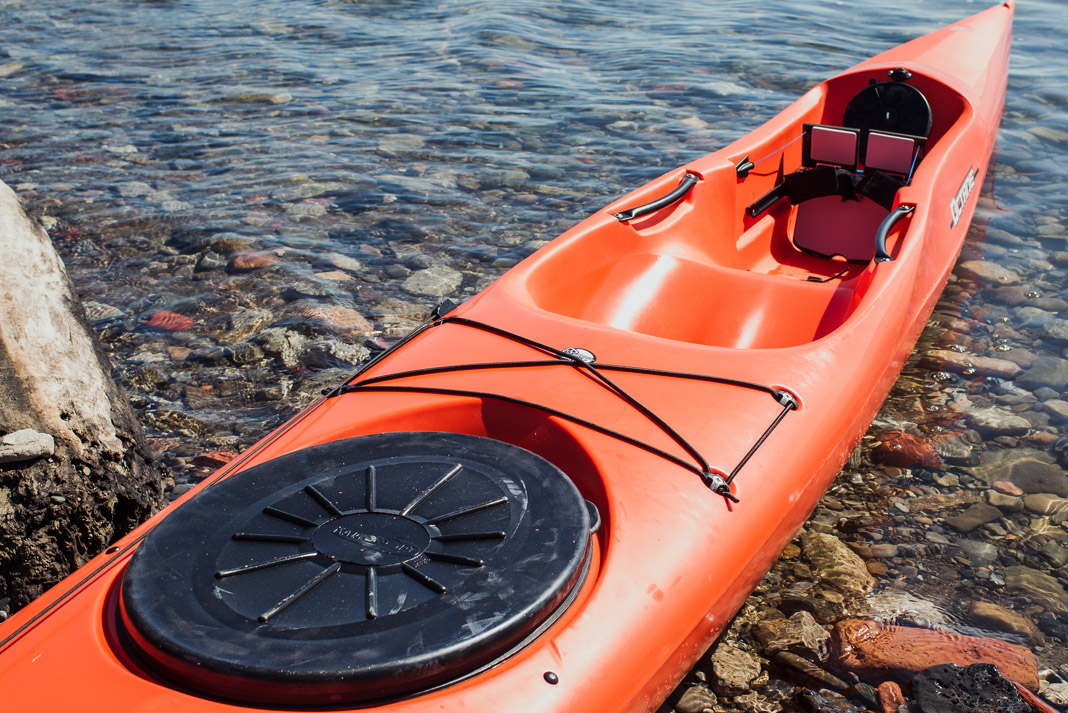
A waterproof rear storage compartment, forward day hatch and deck bunnies make the Octane 175 more than just a weekend racer. Want more storage? The Valkyrie with full sea kayak deck and Octane hull is coming soon. |Photo: Matt Stetson
The Octane comes with a choice of this smart track retractable rudder for shallow water and rivers, or a traditionalsurfski under stern rudder. |Photo: Matt Stetson
Recreational racers looking for a secret weapon to beat most sea kayaks will be pleased. The Octane is fast, cruising comfortably at nearly nine kilometers per hour, and closer to 11 kilometers per hour in short flatwater sprints. Though it doesn’t have the pop at the catch or the top-end speed of a composite competition surfski, you’d never expect it to. The Octane’s appeal is as a kayak alternative with greater versatility and durability than a pure racer, as long as you don’t mind the 51-pound lift. Although the Octane is made with Pyranha’s Corelite polyethylene foam sandwich construction, getting it on and off the water is its own kind of workout. The recessed handles beside the cockpit are finely crafted but I found too far forward for proper balance, and the bow and stern handles are small to grip. Minor concerns, unless you’re carrying long distances.
The large rear hatch features a waterproof Kajaksport rubber cover, and a front day hatch and rear deck bungies enable daylong expeditions or short overnights. Combined with the durability of plastic, the option of an over stern rudder for shallow water and rough landings, and molded-in bow inserts customized to fit P&H’s sailing system from Australia’s acclaimed Flat Earth Sails, and there’s endless possibilities beyond what a traditional surfski can do. Where can you use a more stable, nimble surfski able to take a beating? Hipgrave uses his to run class II and III whitewater on the Nantahala River. Online you’ll find tales of an Octane sailing to offshore islands in Wales. Just think of the downwind rides you could catch with the speed boost from a sail.
The Octane’s multiple personalities blur the lines between what a surfski and a sea kayak should do. In fact, P&H just announced they’ll be producing an expedition-style sea kayak with an identical hull to the Octane, called the Valkyrie. I say why distinguish between surfskis and kayaks anyway—soon buying one will be like ordering at Starbucks. Would you like a closed-cockpit or a sit-on-top with that?
Some might choose the Octane over a sea kayak simply because they prefer an open cockpit, or vice versa with the Valkyrie. Just as this issue went to press, Pyranha announced the production of the Octane had been temporarily halted.
“The molding process for the Octane is too long, so continuing through peak summer months when we have to optimize efficiency would cause us to let too many customers down for other products,” says Pyranha’s managing director, Graham Mackereth. “Not molding the Octane is the best of the bad options available.” Production will resume in September. Until then, the only concern is how long the existing inventory will last.
If you’re drawn to the Octane’s unique combination of high performance, durability, and versatility get one fast or be left behind until the fall.
Welcome to the jungle, we take it day by day, of you want it you're gonna bleed but it's the price to pay. —Guns N' Roses | Photo by: Jon Williams
“I reckon the Darien Gap may be a bit too intense for an expedition right now, but I’ve got a really good idea for a jungle expedition. Do you want to hear it?”
I’m sitting opposite Laura Bingham in her kitchen, unsuccessfully pushing away one of her enormous, drooling Newfoundland dogs. She looks up from a steaming mug of coffee and smiles, her eyes gleaming.
“It’s the third largest river in South America. We can eat what we find in the forest and fish from the river every day. There are jaguars, piranha and little caiman. It will be like Pocahontas, just in real life.”
Bingham’s so-called little caiman are in fact 20-foot-long black caiman—just one size down from an African crocodile. But as an adventurer and wildlife lover, this is a main selling point for me. I’m in, I tell her.
Intrepid Trio Paddles World-First Descent of the Essequibo River
The expedition plan
Don’t be fooled by the Disney reference. Laura Bingham is tough as nails and when she has an idea, you know it is going to be a good one. The 25-year-old English explorer has a habit of hunting down unique journeys around the globe. Her last expedition saw her cycle 7,000 km across South America without touching any money.
It was Bingham’s husband, survival expert and television host Ed Stafford, who first turned her attention to Guyana. He’d been to the South American nation a decade prior to film Lost Land of the Jaguars. He came back raving about the extraordinary and remote jungle, and his close encounters with its wildlife.
The interior of Guyana has an extraordinarily rich and diverse ecosystem with an expansive area of pristine virgin rainforest. It’s one of the few remaining unexplored regions of the world.
“I’m thinking of doing a world-first descent,” she tells me.
The Essequibo River, which runs the length of the country from south tonNorth, had never been descended from source to sea.
In fact, the source of the 1,000-km-long Essequibo River had never officially been documented. The last attempt to identify the source was made in 2013 by a German team, but was unsuccessful. When we set out on February 1, 2018, we aimed to be the first team to document the source, and then descend the river to the sea.
The team of paddlers
In addition to Laura, our trio of adventurers was rounded out by Pip Stewart, a British writer and adventure cyclist with experience pedaling in the Amazon, and me—an endurance athlete with a love for the jungle. Though I’d previously paddleboarded 1,000 miles down the Missouri River, kayaking was new to all of us.
Essequibo team member Pip Stewart. | Photo: Jon Williams
Expedition leader Laura Bingham. | Photo: Jon Williams
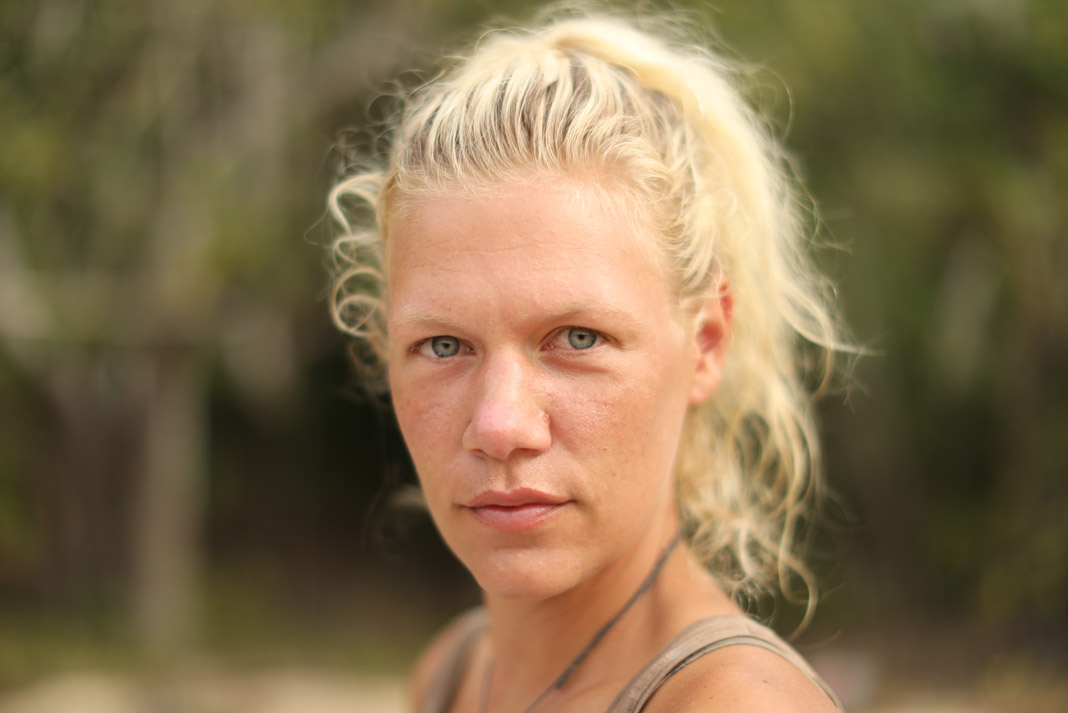
Essequibo team member and writer Ness Knight. | Photo: Jon Williams
Prior to departing for Guyana, we spent weeks practicing whitewater paddling skills and swiftwater rescues. On—and sometimes in—the frigid rivers of Wales in winter. Though Wales was a convenient meet-up location for us three Britons, admittedly, it was a strange place to train for a jungle expedition.
[ Paddling Trip Guide: View all whitewater kayaking instruction and skills clinics ]
What the three of us lacked in kayak experience, our trio would make up for with our shared extensive experience with remote travel. We didn’t need to be world-class sea kayakers or whitewater paddlers to descend 1,000 km on Essequibo River—a successful expedition would come down to persistence and good risk management.
The headwaters of the Essequibo
Our journey began on the banks of the Essequibo River in Masakenari, a remote Wai Wai village located in the south of Guyana, near the border with Brazil. Masakenari can only be reached by chartering an internal flight on a small aircraft, landing on a short, dusty clearing called Gunn’s Strip, which is flanked by thick walls of near impenetrable jungle. Lush greenery carpets the landscape from horizon to horizon.
Throughout our journey, we collaborated with the Wai Wai, an Indigenous community who live within and manage a vast stretch of remote rainforest. World-class jungle survival experts themselves, we teamed up with Wai Wai guides to show us how to thrive in the jungle—from how to machete a path to tutoring us on all manner of poisonous frogs, venomous snakes, toothy fish and the many insects that would bite and burrow into our skin.
“We’re ordinary people, we just choose to chase extraordinary things,” says Ness Knight (center). “We just had this crackers idea to do something and we did it.” | Photo: Jon Williams
No one expected just how complex and arduous an endeavor it would be just to get to the source of the Essequibo.
For three weeks we pushed upstream as the broad expanse of river narrowed and the jungle closed in around us. Our team hauled two heavily laden dugout canoes under and over fallen debris. Our Wai Wai guides bared gritted teeth as they machete’d, chain sawed and axed through more than 200 enormous tree trunks barring the upstream path forward.
This section of the rainforest is Guyana’s first Community Owned Conservation Area (COCA), and the largest protected area in the country managed exclusively by an indigenous community. As we traveled, the Wai Wai investigated for signs of illegal mining operations. The threat of small-scale illegal mining is very real in remote regions, and recording the GPS coordinates of recently cut trails is critical to stopping it.
From dusk till dawn each day, we painstakingly edged our way west toward the river’s source in the Acarai Mountains. For two weeks the canopy was impenetrable and we didn’t see the sky. Some days we made it just 2 miles. Black humor and stubbornness was our fuel.
When the river was too chocked to travel farther upstream by boat, we set up a basecamp. We cached half our equipment and finished the steep trek by foot, cutting a line through dense undergrowth with machetes.
At its furthest source the mighty Essequibo is just a trickle, but that didn’t dampen our enthusiasm for finding it. Now we just had to turn around and paddle 1,000 km downstream to the sea.
One thousand to go
A month after setting off from the community of Masakenari we arrived back, having successfully located the source of the Essequibo River with five Wai Wai community members.
Just a month in the jungle and our bodies were already battered. Pip had a gnarly case of trench foot. We all had sores and various insects taking up residence in our skin. And Laura missed her 8-month-old son fiercely.
After finding the source of the Essequibo River, expedition leader Laura Bingham’s husband, explorer Ed Stafford (standing), visited, bringing their 8-month-old son. “Without a doubt the hardest bit of this expedition is not the infected bites, rotting feet or sore arms—it’s missing my son. But the sacrifice will be worth it, and life cannot just stop now that I’m a mum,” Bingham wrote on Instagram. | Photo: Jon Williams
This is when expeditions get interesting.
It’s not brawn carrying explorers through to a successful expedition. It comes down to mental strength and the ability to stay optimistic and resolute.
Years ago, I only did solo journeys. Out there on my own, I knew there was no one to trust and depend on but myself, and this feeling was a real fascination for a time. I also learned through my solo journeys that there is only so far you can go alone—if you want to achieve a huge dream what you need is a fantastic team.
Faced with hardships, our friendship came into its own. We rallied around one another and belly laughed our way from source to sea, guffaws echoing across the jungle. We formed a sisterhood we could lean on during the inevitable down days, battling exhaustion, illness, infections and mental fatigue.
The ancient forest
Leaving the community of Masakenari for a second time, we again entered into the unknown. Hundreds of kilometers of uninhabited and untouched rainforest and river lay ahead of us, much of it undocumented.
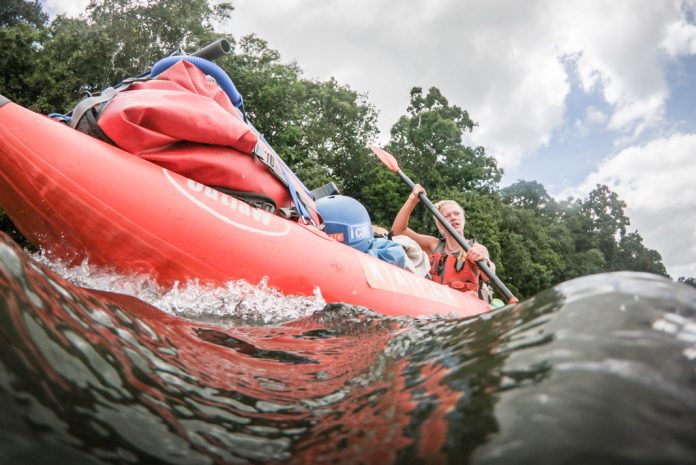
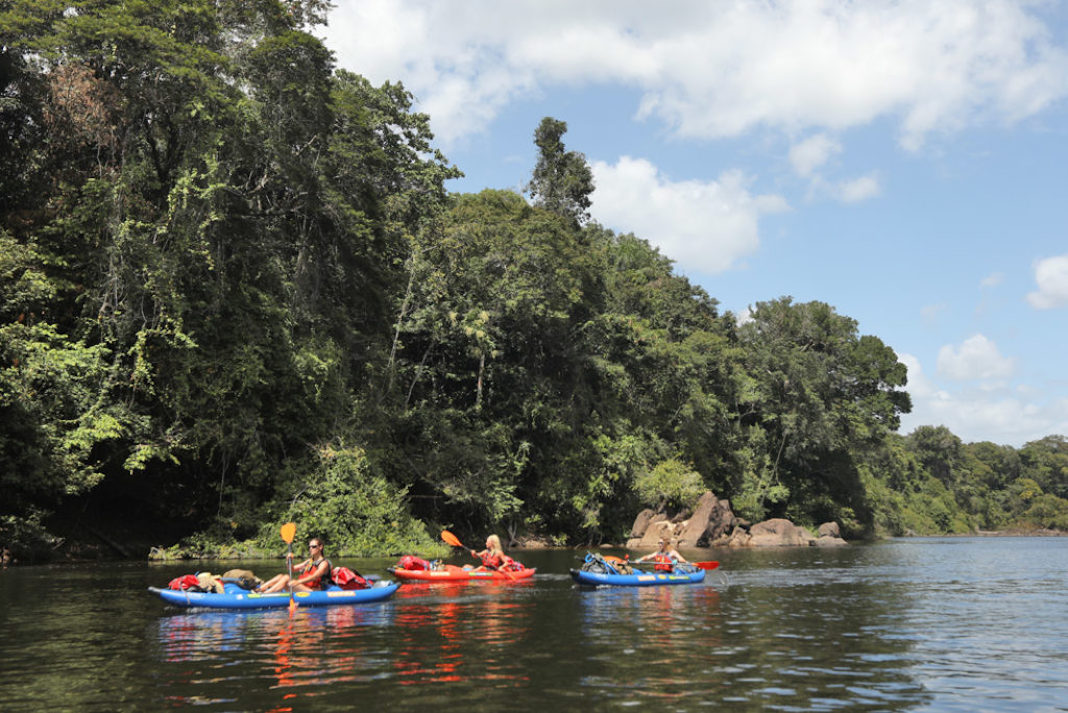
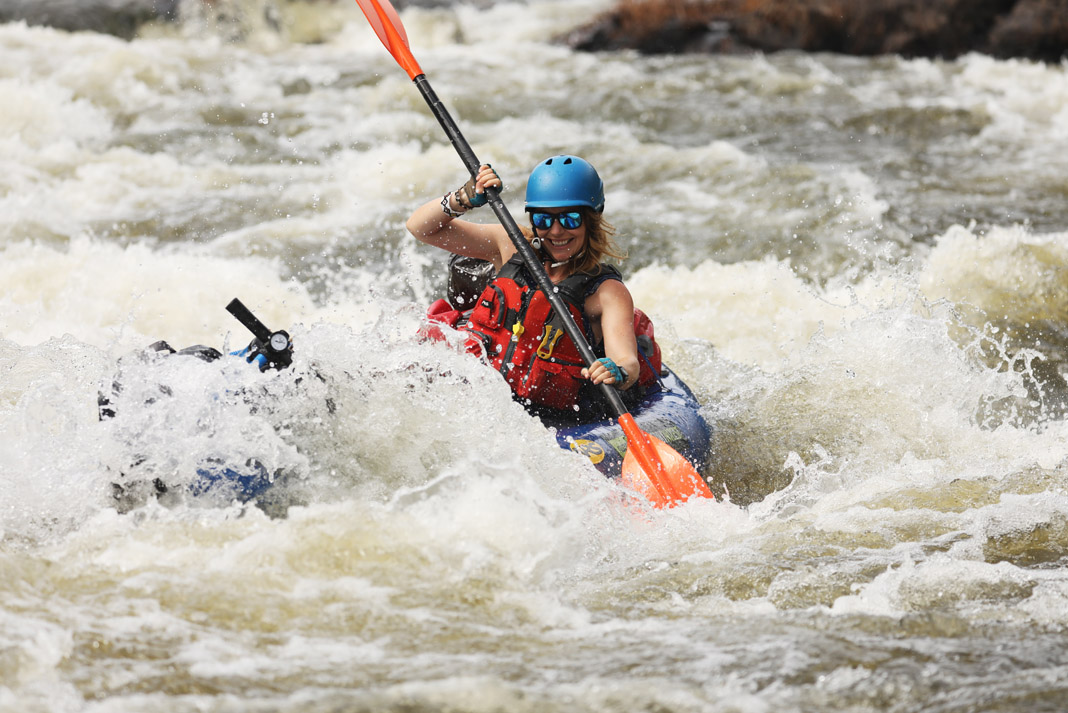
Our daily challenge shifted from hoisting dugouts over logs to portaging around waterfalls and navigating 20-km-long rapids in inflatable kayaks. One morning, I looked up to see two colossal boulders looming over the river, each standing guard on its own bank. The bulky black masses looked like molten rock had dripped down from the heavens to settle in enormous folds and mounds.
As we passed between them a silence descended upon our group. The landscape mesmerized us. I felt we’d entered into a very ancient place; as though we had stepped into Jurassic Park, complete with macaws shrieking an eerily appropriate soundtrack overhead. I half expected to see a flock of pterosaurs skimming the canopy tops and a Tyrannosaurus rex burst through the trees.
The jungle family
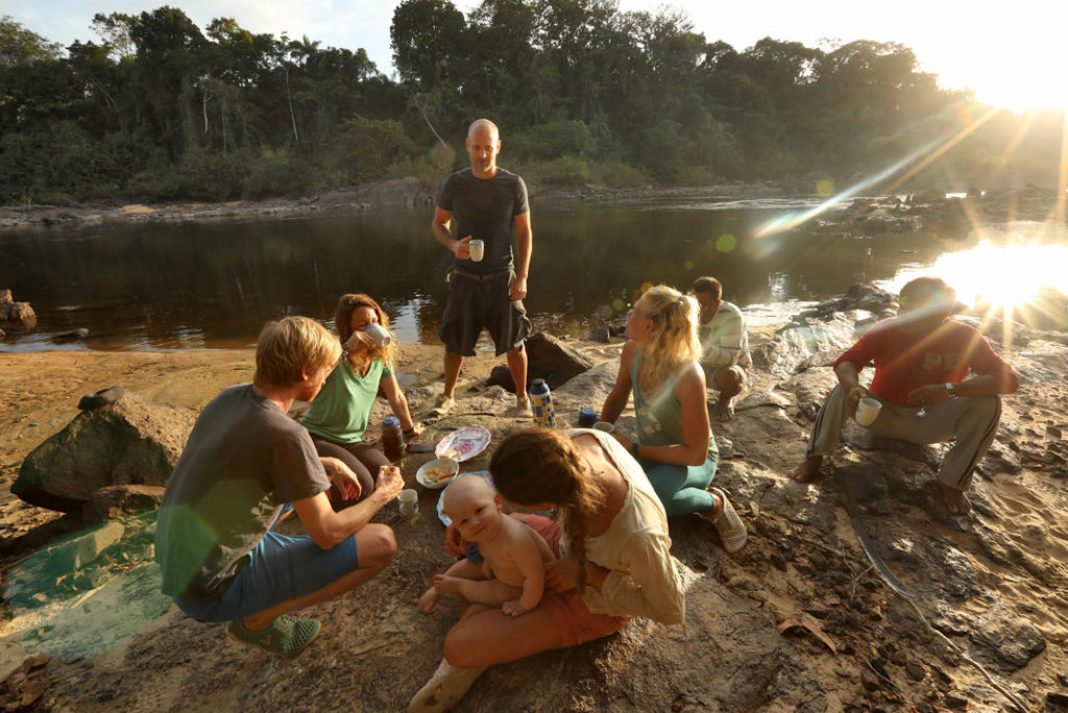
Most mornings on the Essequibo we awoke to the guttural, primal roar of a single howler monkey. Its call built to a crescendo as the whole troop joined in the dawn call. Time to rise, light a fire and set the water to boil.
Over breakfast we’d discuss the new footprints in camp, telling us a tale of the menagerie wandering past through the night—labba, tapier, scorpion, jaguar, caiman or armadillo. Then we’d huddle around paper maps and GPS, analyzing the topography and running through the day’s anticipated route.
With camp packed, we’d push off into glassy water and soak up the stillness, the calm before the first rapids. Our Wai Wai guides often had their eyes on the banks, watching for wildlife, catching even the smallest movements and listening for the stories being told well beyond the visible banks. Their awareness of the wildlife surrounding us was like nothing I have ever encountered.
Many days on the Essequibo River consisted of simple flatwater paddling.
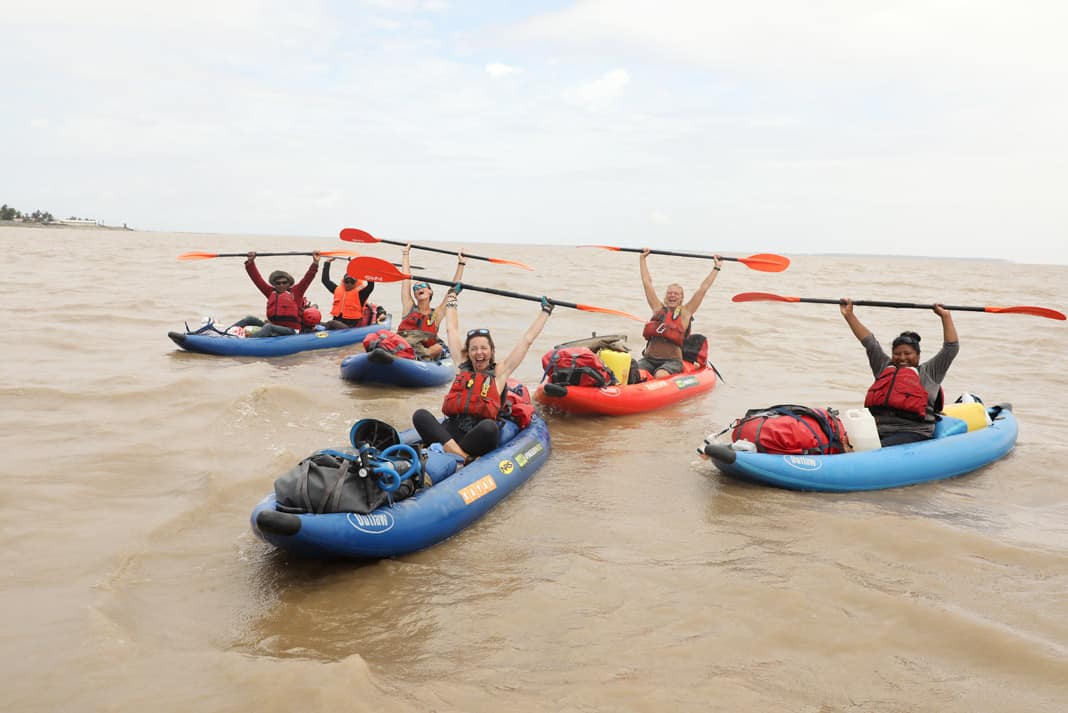
The team celebrates reaching the Atlantic Ocean on day 72. | Photo: Jon Williams
Rapids provide a welcome respite from seemingly endless flatwater river bends. | Photo: Jon Williams
Others had us navigating thrilling rapids, or spectacular waterfalls and tricky portages.
As we descended farther north, the river began to mellow and widen and we saw signs of people again. We stopped to meet with communities when possible, listening to success stories about the foundations of sustainable ecotourism being built in Guyana.
Most days, we began the search for camp in mid-afternoon. By six o’clock our hammocks were slung, the fire crackled and we lined up, waist deep in the river, rinsing the day’s sweat and grit from our skin.
There, we regaled each other with tales from the day—the emerald tree boa wrapped tightly around a branch overhanging the river; or our guide, Rummel, going broadside down a rapid, paddle in one hand and a fishing rod in the other, whooping at the enormous fish he caught. We compared war wounds—grossing each other out with the worms, cysts and infections we had to squeeze, dig out and douse in iodine. In the jungle, we were perfectly pink and fleshy hosts. We took to giving our parasites names—Borris lived in my ankle for nine weeks despite my best efforts to evict him. Laura’s armpit was home to Donald for three weeks.
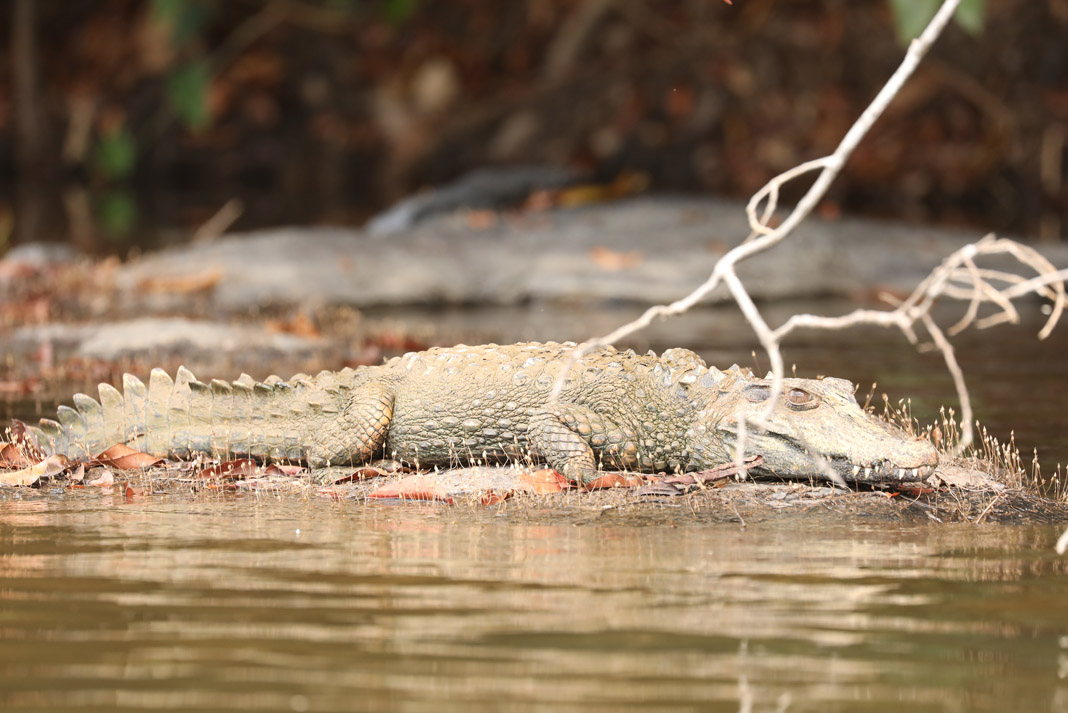
Sometimes bathing was cut short by the arrival of a 12-foot caiman, a bit too curious and close for comfort.
There are six species of caimans found in the Amazon jungle. This is a dwarf caiman who will only grow six feet long. | Photo: Jon Williams
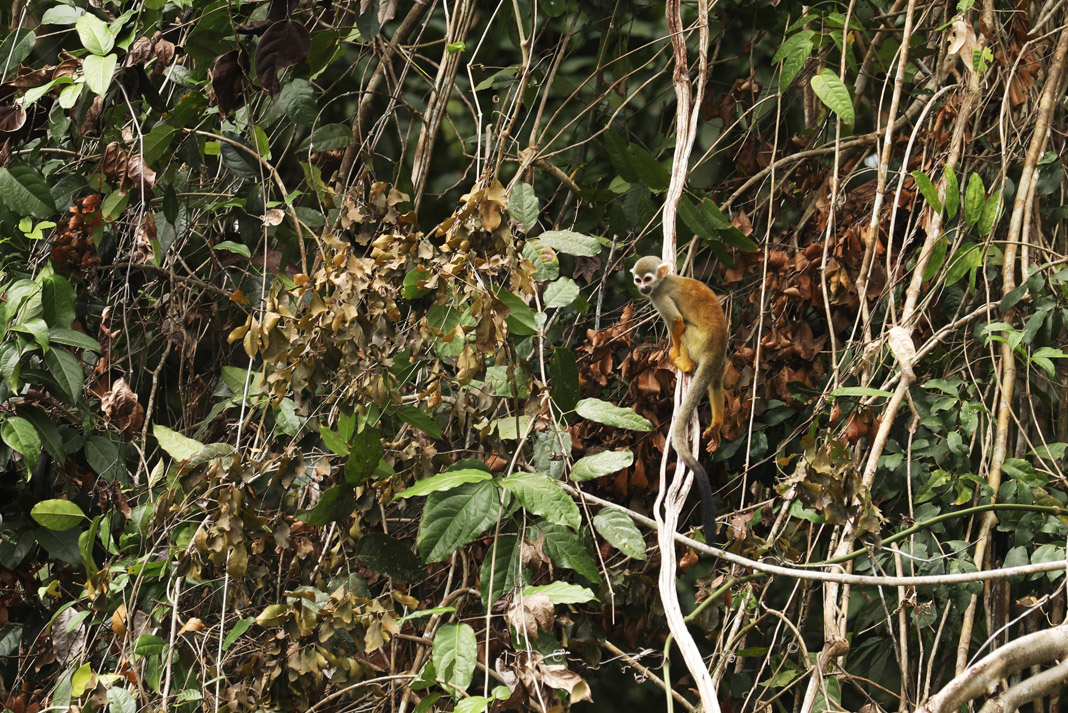
The common squirrel monkey is just one of the nine types of monkeys native to Guyana. | Photo: Jon Williams
We’d bound for shore then turn on our heels to see the sun sink below the horizon. As daylight faded, the glowing red eyes of curious caimans often shone back at our torches from the river.
Once dinner had been inhaled, one by one we would each peel away to our hammocks to settle in for the night. Our days were bookended with the drifting notes of our Wai Wai guides—Ant’s flute sharing the stories of jungle animals, or Jackson and Nereus’ voices singing traditional songs.
One night, the final goodnight comes from the low grunts of a jaguar in the near distance. Tomorrow we get to wake up and do it all again. The wildlife, the forest, the mighty river, the Wai Wai and this deep sense community have given me more than any of them will ever know.
Ahead of us still lay the final 400 km to the mouth of the Essequibo.
We would navigate through a labyrinth of islands as the river broadened before the home stretch, a 150-km slog to the Atlantic Ocean through relentless headwinds and rough sea conditions. But that’s all still to come.
In the meantime, I fall asleep to the sounds of the jungle, nestled into a camp tucked in amongst the giant rainforest trees, slung side-by-side with my team. My little jungle family.
The team successfully reached the Atlantic Ocean on April 17, 2018, 72 days after setting out. The trio is the first group to descend the Essequibo River from source to sea. Author Ness Knight is also the first person to cycle solo and unassisted 2,000 km across the Namib desert of Namibia and the first woman to swim the United Kingdom’s Thames River from source to London. She has her sights set on becoming the first woman to row solo across the Pacific Ocean.
This article was first published in the Early Summer 2018 issue of Paddling Magazine. Subscribe to Paddling Magazine’s print and digital editions, or browse the archives.
Welcome to the jungle, we take it day by day, of you want it you’re gonna bleed but it’s the price to pay. —Guns N’ Roses | Feature photo: Jon Williams
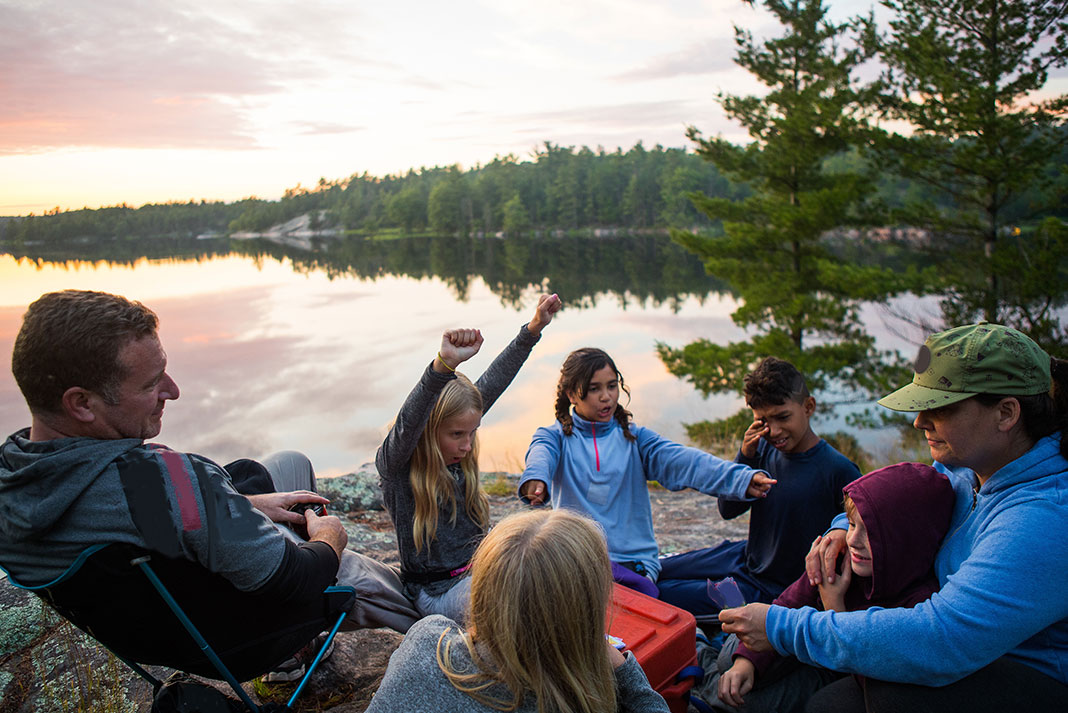
Nothing worth doing is easy, so might as well bring your kids along for the ride. | Feature photo: Ariel Estulin
My son was just 16 months old and still crawling when we took him on his first overnight canoe trip. His grandparents were aghast, and they weren’t the only ones. Conventional wisdom dictates an adventurous life is over once kids enter the equation, but nothing is further from the truth when it comes to taking kids kayaking or canoe camping.
Of course, taking your kids along for the ride isn’t without challenges. You may need to adjust the length, speed and difficulty of your trips, at least for a few years. Use these tips to overcome the most common barriers to canoe camping with young kids and get back into the woods. One day, your kids will thank you for it.
Challenges of canoe camping with kids
1 All that gear
Say goodbye to your dialed-in and ultralight gear system and to single-carry portages, too. Factor in a mountain of must-have toys, bedtime books and diapers, and a toddler can amass as much gear as any tripper. And that’s after considering toddler specific gear like life jackets, watershoes, and layers.
The number of things needed for such a small human can be truly staggering. Accept this new reality and the double-carry portages coming with it. Adjust your route and choice of canoe accordingly. Go slower.
Nothing worth doing is easy, so might as well bring your kids along for the ride. | Feature photo: Ariel Estulin
2 On-water boredom
It’s tough being a kid just sitting in a canoe. Even the littlest ones want to imitate their parents, so keep ‘em engaged by giving them a kid-sized paddle. The result may only be a handful of strokes, but that’s another story. Simple games, like a stick or rock pile to splash and throw in the water, can be hours of fun.
Keep snacks and toys accessible in the canoe. A slow pace and lots of shore breaks help—there are so many interesting things to explore when you view the world through a kid’s eyes.
3 Biting bugs
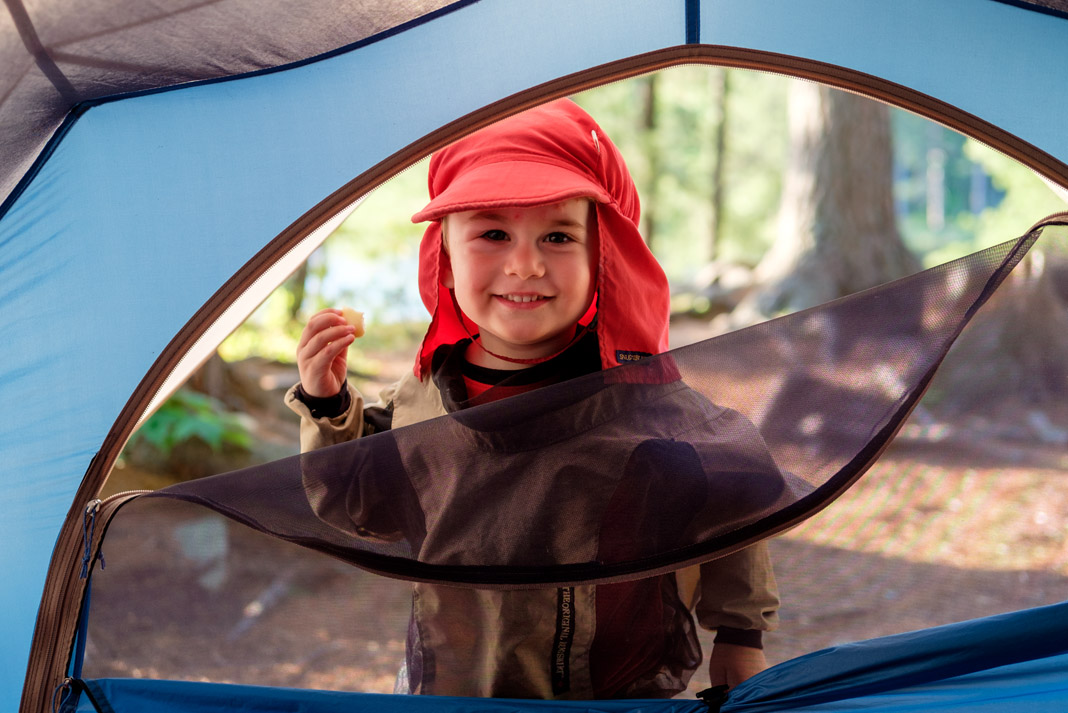
Itchy kids are unhappy kids. Kid-sized bug jackets and a screened shelter for cooking and playing games can save a buggy trip. Don’t forget a peaked hat to keep the bug jacket mesh off a kid’s face.
Barrier methods are extra important for protecting kids from biting insects since some repellants, like DEET, aren’t safe for tiny tots and shouldn’t be used regularly for kids under 12.
When bites do inevitably happen, have a plan B to take the itch out, such as Afterbite or an antihistamine.
4 Throw-down tantrums
Always keep a snack, or five, handy and ready at a moment’s notice to diffuse tantrums. Some of my favorites include M&Ms, gummy bears and beef jerky—anything I’d never feed my son at home.
Tantrums are inevitable whether you’re at home or in the woods, so don’t let this be a reason not to take your kids outdoors.
5 Lengthy portages
It’s one thing to put your head down and grind out a tough portage, it’s another when you’re dealing with an irrational child. I can confirm, “Suck it up, buttercup,” is not an effective strategy with a two-year-old.
Keep portages short when possible and break longer ones up with lunch or fun activities, like exploring a marsh. Save the three-kilometer portages for later—kids just don’t appreciate type two fun.
A toddler might love the idea of sleeping in a tent, but the actual transition can be a challenge without the familiarity of home. Pre-trip, set up the tent in your backyard and get in there with your sleeping bags—maybe even spend the night.
On trip, keep bedtime routines similar to home—wash up, pajamas, books and songs. For naps, set up a cozy place in the canoe and try to time longer stretches of paddling with regular nap times.
7 Nature’s call
While adults might find a certain freedom in being able to drop trou and go about their business in the woods, for younger kids this can be an intimidating and finicky mess.
Offer support, give encouragement, swat away those pesky bugs and accept your perfectly toilet-trained child will soil their last clean and dry pair of pants on the buggiest portage imaginable. True story.
This article was first published in the Summer 2018 issue of Paddling Magazine. Subscribe to Paddling Magazine’s print and digital editions, or browse the archives.
Nothing worth doing is easy, so might as well bring your kids along for the ride. | Feature photo: Ariel Estulin



 This article was first published in the Early Summer 2018 issue of Paddling Magazine.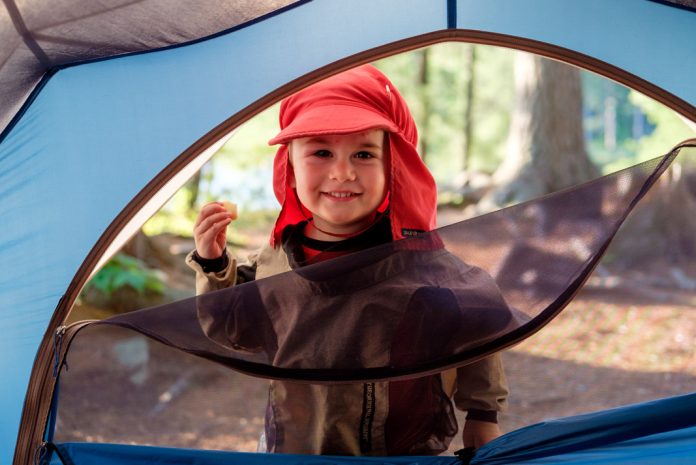
 This article was first published in the Summer 2018 issue of Paddling Magazine.



