1. The Woods brand, relied upon by early explorers, pioneers, adventurers and outdoorsmen, has recently been purchased by the national department store chain Canadian Tire, which now produces nylon tents lucky to last a drunken long weekend with the boys.
2. Pablo Picasso’s Nude, Green Leaves and Bust was painted in 1932 and auctioned in 2010 at Christies in New York City for $106.5 million. This oil on canvas painting set a new world record price for a five-foot piece of durable plain-woven fabric.
3. While canvas was traditionally made of hemp, modern canvas is usually made of cotton or linen fibers. These fibers are woven in two basic types: plain and duck. The threads in duck canvas are more tightly woven. The term duck comes from the Dutch word for cloth, doek.
4. Brown duck canvas was the creation of Hamilton Carhartt. Carhartt’s overalls for railroad workers were first advertised in a 1929 catalogue. These trendy “new 10-ounce brown duck bib” overalls revolutionized clothing for the working class and dirtbag paddlers everywhere.
5. The keel on the bottom of a cedar canvas canoe is primarily to protect the canvas during launchings and landings. Some paddlers argue the benefits of a keel for increased tracking and straight-ahead paddling. You will find these canoeists circling neighborhoods, going door to door to drum up support for their misguided opinions.
6. Local governments in the United States have passed laws to limit Americans’ ability to canvas. In 2002, Justice John Paul Stevens reconfirmed the Supreme Court’s conviction that canvassing is protected by U.S. First Amendment rights.
7. Recanvassing, on the other hand, is a completely natural process of rejuvenation. Headwaters Canoes of Wakefield, Quebec, says new canvas, filler and three coats of paint will cost $850, or $950 if it’s not one of their canoes. “We have rebuilt canvas canoes which have been blown off roof racks, run over by cars, crushed by falling trees, scorched by vandals, and smashed around on bedrock by severe winds.”
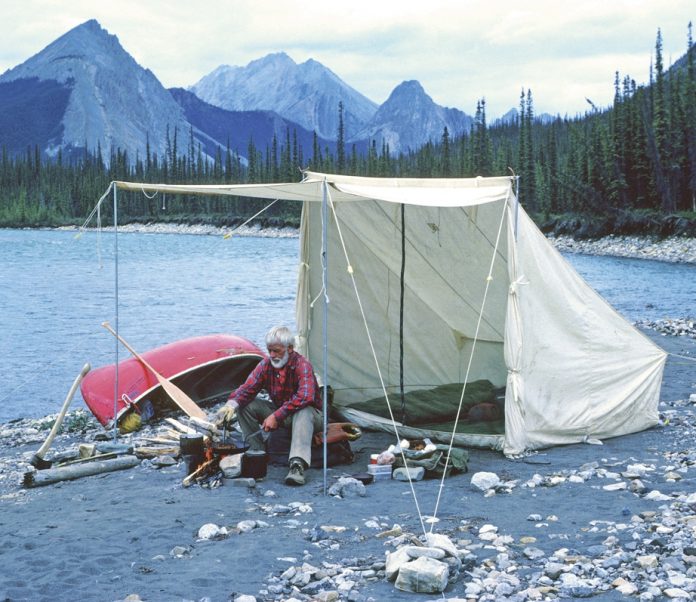
8. Bill Mason’s famous baker style campfire tent was not made of canvas, but rather, cotton. We think Bill would have appreciated Egyptian cotton. It is a difficult fabric to find, yet Egyptian cotton is strong, abrasion resistant and has a natural tendency to repel water. The tight weave makes it windproof but still able to breathe. A two-person baker style canvas tent weighs about 24 pounds whereas one sewn of Egyptian cotton is only 14 pounds. On long portage trips, I’m with The Bangles and would rather, “Walk Like An Egyptian.”
Scott MacGregor is the owner and publisher of Rapid Media, based in the Ottawa Valley on the banks of the Madawaska River.
This article first appeared in the 2015 Paddling Buyer’s Guide. Subscribe to Paddling Magazine and get 25 years of digital magazine archives including our legacy titles: Rapid, Adventure Kayak and Canoeroots.
Traci Lynn Martin standing on a beach next to her kayak.
On October 15, Traci Lynn Martin became the first person to circumnavigate North America’s three largest lakes in one season.
It was the 221st day of Martin’s controversial expedition, a trip that has been a source of much debate in the sea kayaking community. The original goal of the trip was to beat Freya Hoffmeister’s unofficial world record of longest solo sea kayak trip, made when Hoffmeister paddled 8,570 miles unassisted while circumnavigating Australia in 2009.
After unexpectedly frequent flares from rheumatoid arthritis, a chronic illness causing Martin extreme joint pain, she scaled back her plans. She decided instead to shoot for breaking the record of longest journey by surf ski, her craft of choice, currently held by Gerhard Moolman at 3,822 miles.
Martin’s background is in surf ski racing, which explains her unconventional choice of vessel for a multi-month expedition with major open water crossings. In fact, Martin’s original route had her circumnavigating all five Great Lakes and passing Prince Edward Island before paddling down the coast of Nova Scotia and Maine.
This is Martin’s first major expedition. At home in Kansas City she works as a neonatal nurse. She’s quick to admit to unwisely approaching this expedition with a racer’s mentality, having planned to simply power through challenges to get to the finish line.
In March, after two distress calls relating to ice and inexperience with dead reckoning navigation—one resulting in a rescue from Lake Huron’s icy waters—the Huron County Sheriff threatened to confiscate her kayak if a third call was made.
In the seven months since those incidents, Martin has learned much about expedition paddling. She’s circumnavigated Superior, Huron and Michigan during a spring and summer plagued by strong wind and heavy rain. Though she continued to push her own limits—her longest paddling day on this trip was 50 miles—she now knows when conditions are too bad to venture out.
The journey has come at personal cost—to fund the trip Martin spent from her retirement fund, left behind her family, and has been advised by her doctor the expedition could be doing long-term damage to her joints.
When I spoke to her on day 228 of her trip, she sounded exhausted and humbled. Here, in her own words, are answers to some of our more pressing questions about a trip that’s earned both harsh criticism and heartfelt congratulations from the kayaking community.
WHY A SURF SKI?
A surf ski is just a faster boat; it’s not debatable. I started out trying to do all five Great Lakes in one year and time is not on my side. I’m racing against the clock and racing against the seasons, so it makes sense to be in the fastest boat possible.
WHAT’S YOUR APPROACH TO SAFETY?
I have an eight-foot safety line, one end attached to my boat and the other end attached to the strap of my lifejacket. There have been instances of failure with the traditional Velcro leg leashes used on surf skis and I didn’t want to take that chance. There’s a second line attached to my boat and paddle. I have a backup paddle, which I switch to if my shoulders start hurting. I have all the essentials I need in my two hatches, so if I can’t make it to where my support driver is going to be, I’m always okay to pull off and camp.
WHO’S DRIVING YOUR EXPEDITION?
It’s important for others to know having a chronic illness doesn’t mean you have to stop living your life. When I was 20 years old I wanted to join the Peace Corps and explore the world. I saw myself as a strong, capable individual—nothing was going to stop me. I’ve always wondered what my life would be like had I taken that route. I’m 50 years old now and I’ve got rheumatoid arthritis. Every day it’s harder to get up and move. This was the last chance to prove to myself I could have been that person. That’s what drives me not to stop. I want to see if I’m as strong as I think I could have been on a different path in life.
WHERE DID YOU PROVE THAT?
Throughout the trip I’ve conquered things other people would not have done. By the time I finished paddling the remote waters of Lake Superior on the Canadian shoreline, I felt I had proven to myself that I have the resilience and the internal strength that can get lost when living in modern society.
WHEN DO YOU RESPOND TO CRITICISM?
I don’t. Looking back on the icy days in March, I know I’m more knowledgeable about what I’m doing. Now that I’ve paddled 3,500 miles, I know I did put myself in harm’s way. When the ice comes back, I’m done—I’m not going back out on that water.
This article first appeared in the 2015 Paddling Buyer’s Guide. Subscribe to Paddling Magazine and get 25 years of digital magazine archives including our legacy titles: Rapid, Adventure Kayak and Canoeroots.
The sound that means adventure is about to be had. | Photo: Destination Ontario
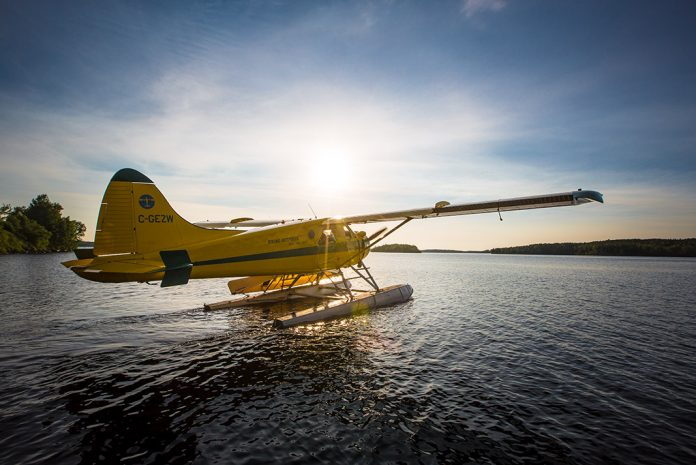
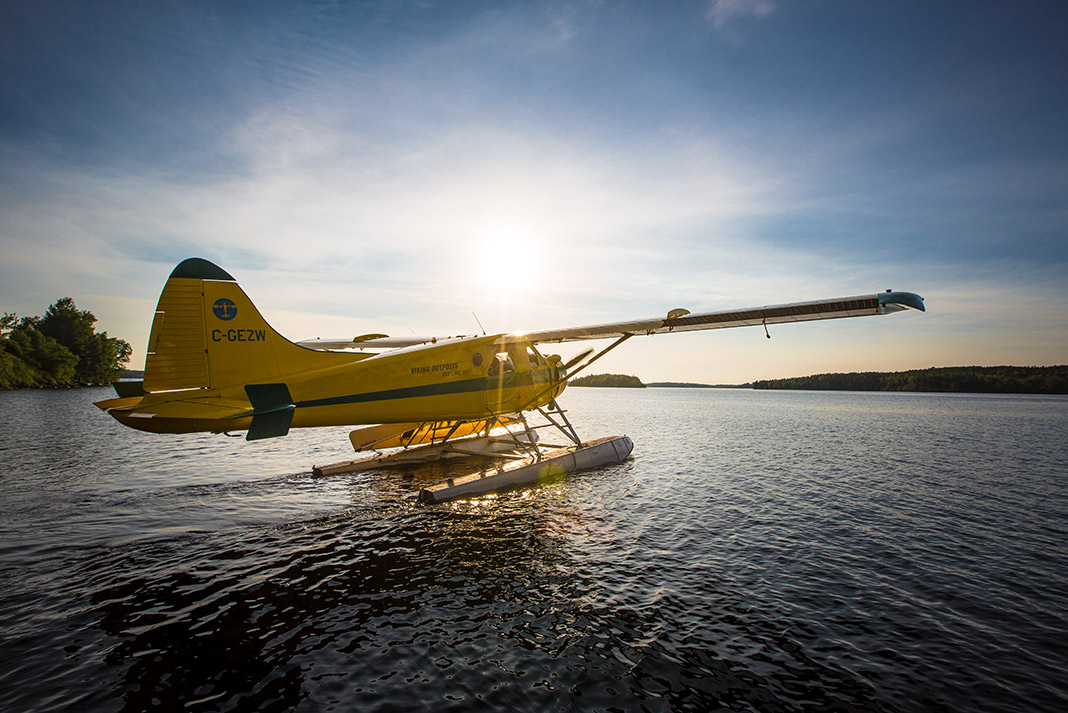
This past August, I found myself puddling around the harbor in Prince Rupert, British Columbia. I was on a standup paddleboard painting the hull of a ship called the Polar Prince. And there came on the wind the unmistakeable cough of a de Havilland Canada DHC-2. I could hear it long before I could see it.
As the aircraft taxied away from the wharf and into view in the main harbor I was hit by a tidal wave of nostalgia. Like an old auntie whose means have made possible just about every canoe trip I’d ever been on, that old floatplane—the de Havilland Beaver—is part of my family and an integral part of the lingering lore of a lifetime of wilderness travel.
For a moment, it looked as if the plane was going to run right into our ship. Instead, the pilot, Murray Hamer, shut down the engine and stepped out onto the pontoon and skirled a bag pipe serenade, presumably in recognition of the fact Polar Prince had just nearly completed a circumnavigation of the world’s longest coastline—from Toronto, Ontario to Victoria, B.C. In response to this salute, Jim Pearce, the chief mate of the Polar Prince, himself an accomplished strangler of the three-legged swan, struck his pipes and responded in-kind to the roar of the Beaver pulling away.
Standing there, looking down on my long paddle and lime-green inflatable SUP, then up at the pontoons still dripping as she headed off into the blue, the whole scene made my heart skip a nostalgic beat. I thought of Sir George Simpson, governor of the Hudson’s Bay Company, arriving by canoe at posts from New York to York Factory, Astoria to Alaska with his personal piper playing in time to the swinging of voyageur paddles. I thought of the opening of North America by canoe and how, since World War II, it’s difficult to think about backcountry paddling, trekking, prospecting, hunting… backcountry anything… without simultaneously paying homage to the aircraft which, more than any other, has been responsible for dropping us there.
The cool thing about de Havilland Beavers is they are so much a part of the story of accessing trackless ground all over the world—by the end of production in 1965 there were more than 1,600 Beavers working in 63 countries around the globe—fanatics record their life stories.
A quick Google search reveals the Prince Rupert plane—C-FIAX— was born in Malaysia on July 27, 1951, arriving by sea in crates from Toronto. After a full hitch in the South Pacific, she worked all over Australia for Snowy Mountain Hydro, Aerial Agriculture and Barrier Reef Airlines among other outfits, before being dismantled, repacked and shipped back to Canada. And yet, there she is 68 years later, in the shining colors of Ocean Pacific Air, still lifting people and freight into out-of-the-way places.
On floats, skis and wheels, Beavers have been to the North Pole and the South Pole and almost everywhere in between. The U.S. Army purchased hundreds of Beavers for military assignments, particularly in Korea. Beavers have delivered people and they have rescued people. They have had folding canoes in them. And they have had canoes and ATVs and kitchen tables tied to their pontoons. Even iron clawfoot bathtubs and upright pianos. They have been crashed and they have been rebuilt, re-engined, repurposed and reskinned. And the Beaver has been mythologized by every adventurer whom has ever strapped themselves inside one.
Perhaps the most famous Beaver in the paddling world is Bradley Air Service’s C-FODA. It carried generations of whitewater and wilderness canoeists into the wilds of West Quebec from its base at Rapides des Joachims on the Ottawa River, flown by legendary bush pilot Ronnie Bowes. When it came time to put a Beaver on a new set of millennial edition Canadian coins, in honor of Ronnie’s 21,400 hours in the air—reputed to be the world’s highest time for a Beaver pilot on a single aircraft—a likeness of C-FODA, including its registration, was engraved and minted by the millions for circulation during the final months of 1999.
The sound that means adventure is about to be had. | Photo: Destination Ontario
For anyone who has flown over the threshold of wilderness in a Beaver; for those of us who get all misty-eyed at the very sound of the 450 horsepower, nine-cylinder, air-cooled Pratt and Whitney radial engine, it’s important to acknowledge we passed a family marker date this past summer.
Back on August 16, 1947, the de Havilland Beaver aka DHC-2, was born in Downsview, Ontario, with World War II flying ace, Russell Bannock, at the controls. This summer, my friends, Old Auntie turned 70.
Here’s to the venerable Beaver and to the dedicated characters who fly them, still. Many happy returns.
James Raffan is a regular contributor to Paddling Magazine and the former director of the Canadian Canoe Museum in Peterborough, Ontario. He stepped out of his canoe for five months in 2017 to be the Zodiac driver, bear guard and musical consort to the Arctic icebreaker, Polar Prince. Find more of his articles here.
This article first appeared in the 2015 Paddling Buyer’s Guide. Subscribe to Paddling Magazine and get 25 years of digital magazine archives including our legacy titles: Rapid, Adventure Kayak and Canoeroots.
THE SEND BOYS ON WHY UNLEASHED WILL THRIVE WHERE THE WHITEWATER GRAND PRIX DID NOT | Photo by Seth Ashworth
There’s no doubt Unleashed has balls. The question is, does it have legs? The brand-new, self-supported, multi-stage kayaking competition is a who’s-who of big water boating. Fresh off its success from the inaugural event in Quebec this past spring, Unleashed is now preparing for its second event in Uganda in January. The invitation-only event is the love child of the SEND crew members, Bren Orton, Adrian Mattern, Dane Jackson and Kalob Grady.
While events like Sickline and the Freestyle World Championships challenge creek boaters and play boaters respectively, Unleashed took a cue from the dearly departed Whitewater Grand Prix (WWGP). Unleashed rolled big tricks, boatercross and giant slalom into one 10-day event, awarding victory to the best all-around kayakers. To no one’s surprise, of the 15 men and five women competing in four stages and battling for cumulative points, Dane Jackson was crowned king in 2017.
With DIY logistics and transparent management, the boys behind the event are keen to keep it simple by eschewing sponsorship, hoping by starting with a low-budget approach this competition can survive to see many seasons. Here the foursome undress Unleashed, revealing the ingredients having made it successful so far.
HOW DID YOU PULL OFF UNLEASHED 2017?
We did the entire thing self-supported in an attempt to start fresh and see how this kind of thing works. Athletes were responsible for [paying for] themselves and we did everything from the blog posts to online edits. Bren and Adrian were up till 3 a.m. after each stage producing media. —Dane Jackson
Unleashed was strung together with absolutely no budget. Thanks to a select group of competitors who believed in us, we managed to pull off the first event and lay the foundation for what we hope will become the sickest event in kayaking. —Bren Orton
WHAT DOES THE FUTURE HOLD FOR UNLEASHED?
We don’t see Unleashed as just another kayak competition. We see it as a platform to push kayaking to new levels. During the first stage [of the 2017 event] at the Ruins, we witnessed multiple three to four trick combos from top athletes. They were going for it because everyone else was going for it. That’s the atmosphere we are striving for. —Kalob Grady
Where most events have to worry about finding good whitewater sections near a town to make it spectator friendly, we simply got the competitors together and chased the best section or feature the area had to offer, using social media to share the day’s events. Having this freedom allowed us to adapt to the conditions and host events on the best waves or biggest water. —Dane Jackson
IS UNLEASHED JUST ANOTHER VERSION OF THE GRAND PRIX?
We were collectively devastated when the WWGP was cancelled. It provided a unique platform for kayaking to progress. We wanted nothing more than to see the return of WWGP but when the return looked bleak, we decided to step up and hold our own event. —Bren Orton
Unlike WWGP, the organizers of Unleashed did the judging, but we put a lot of effort into making things as transparent and as fair as possible. We agreed on which tricks would score highest and used video replay if needed. There was not a single complaint about the results during or after Unleashed, so I feel we did a fair job. For future events, we aim to bring in impartial judges to ensure the best and most neutral judging possible.
—Adrian Mattern
THE SEND BOYS ON WHY UNLEASHED WILL THRIVE WHERE THE WHITEWATER GRAND PRIX DID NOT | Photo by Seth Ashworth
WHY WILL UNLEASHED SURVIVE?
Having four events in 10 days gives us the timeframe to move events forwards or back a day or if water levels will deliver a bigger or better option, or if hazards, such as ice, prevent us from holding an event. —Adrian Mattern
Instead of going big [and needing sponsorship] straight out of the gate, we are starting small by being self-supported, with plans to add on to the event each year. Our hope is as the event grows, we will add on more in terms of athlete support and media coverage, while maintaining a strong foundation and understanding of what’s essential and what’s extra. —Dane Jackson
This article first appeared in the 2015 Paddling Buyer’s Guide. Subscribe to Paddling Magazine and get 25 years of digital magazine archives including our legacy titles: Rapid, Adventure Kayak and Canoeroots.
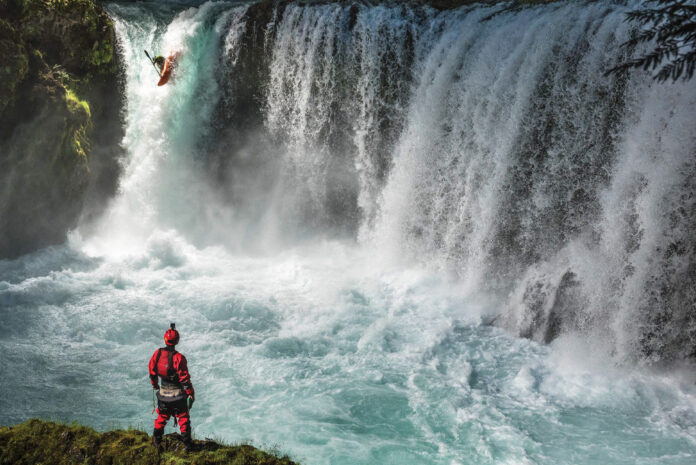
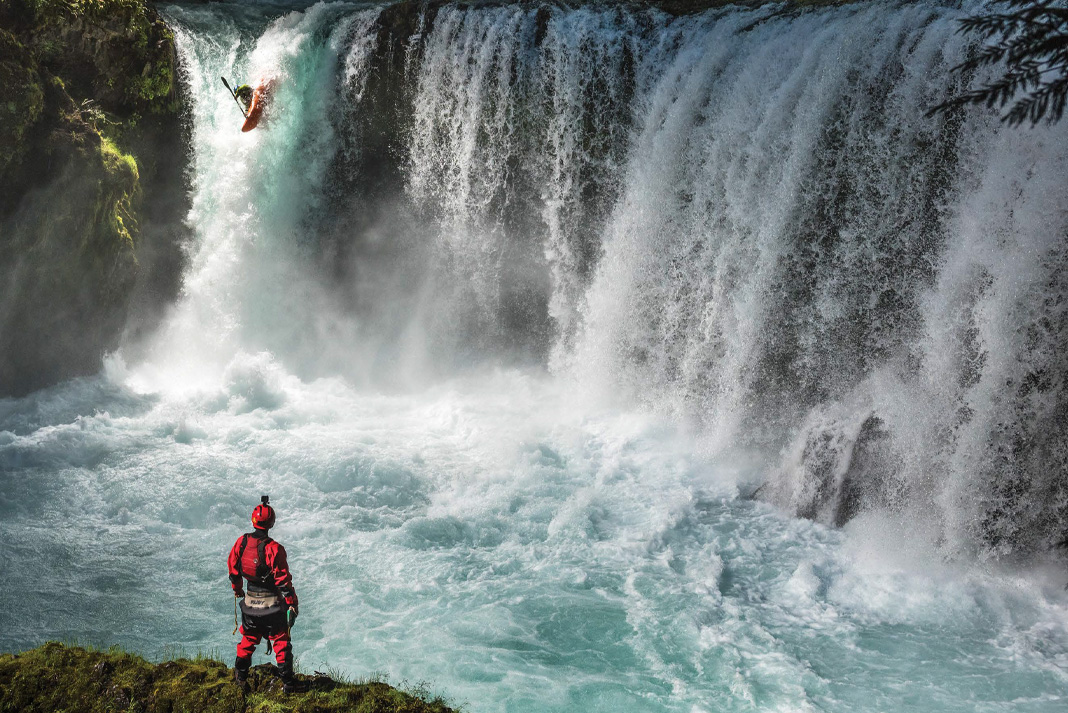
What do you get when you combine world-class kayakers, a high-tech team of photographers and a brighter-than-the-sun camera strobe? Magic. Last May, Rafa Ortiz, Rush Sturges and Liam Fields teamed up with veteran photographer Michael Clark to showcase the power of Elinchrom’s new flash technology.
“It is one of the best assignments of my entire career,” says Clark, a 21-year veteran of adventure sports photography. “This kind of photo was impossible to do in the past. We wanted to show off the strobe by stopping motion—to have all this water flying everywhere frozen in the air, and the kayaker frozen too.”
“What makes these photos so unique is the flash overpowering the ambient lighting,” says Clark. Even at a distance of 100 feet the strobe is powerful enough to overcome direct midday sun.
The strobe let Clark capture the action at super high shutter speeds ranging from 1/2,500th of a second up to 1/4,000th of a second, giving the shot a hyper-realistic feel.
This isn’t the first time photographers and athletes have collaborated to create some truly cool shots at Washington state’s Spirit Falls. The waterfall is ideal because it combines gorgeous natural scenery, a relatively accessible location and a short 40-foot drop, which allows paddlers to run it multiple times to capture the perfect image.
During the two days of shooting the drop, Ortiz ran the falls 15 times, and Sturges and Fields more than a dozen each. “This takes a toll on their bodies. Running it once is similar to the forces of being in a car accident, so to run it many times in two days is pretty amazing,” says Clark.
Because it takes two seconds to recycle the flash, Clark could only get off one shot during each run, raising the stakes for both photographer and athlete to nail their execution perfectly every time.
“What people don’t understand is how collaborative the process is,” says Clark. “The athletes are working too, not just to have perfect technique, but they’re also sharing ideas and then really excited to see those ideas come to fruition.”
Lighting the Spirit | PHOTO BY MICHAEL CLARK
Going into the shoot Clark envisioned replicating ice climbing images he created at the same location a couple years prior. “The series of ice climbing shoots really gave me a sense of how I could approach this,” says Clark. Spirit Falls drops into a basin, allowing 270 degrees around the waterfall to set up camera angles and stage lights.
To get this photo of Sturges standing safety as Ortiz drops over the falls, Clark positioned himself to the far side of the gorge, so he was straight on with the waterfall curtain and used a 70-200mm lens. “These images show the entire waterfall and give a better sense of the height and the kayaker’s position on it,” he says.
This article first appeared in the 2015 Paddling Buyer’s Guide. Subscribe to Paddling Magazine and get 25 years of digital magazine archives including our legacy titles: Rapid, Adventure Kayak and Canoeroots.
On a scale from one to 10, how much happier would you be if you could buy any boat in the hundreds of listings in the Paddling Buyer’s Guide? I know the answer, and it’s going to shock you. Not much happier at all.
Let me explain.
Back in 2002 there was a psychology study conducted at Harvard University. Volunteers were enrolled in a semester-long black and white photography course. At the end of the course, each student chose their two favorite pieces of art. The researchers told the students both prints would be enlarged and framed at the university’s expense.
[ View all canoes in the Paddling Buyer’s Guide ]
Then the students were split into two groups. The students in the first group could choose only one print to take home, but if they ever changed their minds the university would swap photos with them. The other half of the class was told their decisions were final. The photos they were donating to the university would be sent away and never be seen again. All the students wanted to be in the first group.
Six months later, who was happier with their chosen photographs? Take a guess.
“There’s just too many options. There’s no one best boat,” Dave told me. And he’s right. Perfection is impossible.
“People who made an irrevocable decision were much happier with their choice,” said researcher Dan Gilbert on NPR’s Hidden Mind podcast. Gilbert is a neuroscientist who studies happiness. You might recognize him from the very first TED Talk ever filmed, which now boasts 15 million views.
At the time of the Harvard study, Gilbert had been living with his girlfriend for more than a decade. Upon reviewing the results of his study, a friend of his joked this explained the difference between cohabitating and being married.
“That had never occurred to me,” says Gilbert on Hidden Mind. “I went home and proposed.”
Much of Gilbert’s academic research indicates people are terrible predictors of their own future happiness. Though we profess to prefer more choice, more often too many options makes us doubt our decision-making abilities.
More options not equaling greater happiness isn’t breaking news. This paradox of choice is widely known thanks to Barry Schwartz’s 2004 bestseller. In The Paradox of Choice, Schwartz suggests the more choices we have, the more unhappy we are with the choices we make. Why? Because we’re always wondering if the grass is greener.
Schwartz goes as far as to suggest the current state of unbounded possibilities is a factor in why North Americans have never seemed more miserable, despite living in an age of unprecedented abundance. We simply have too much of a good thing.
In the Paddling Buyer’s Guide, you’ll find more than a hundred drool-worthy canoes. Boats for lakewater canoeing, canoe tripping, kayak fishing, hunting, picnicking, river running, racing and more.
Prepare yourself.
Composite or polyethylene? Vinyl or wood? 15 feet or 17? Bench or bucket? Traditional or modern? An inch of rocker or two? Red or green? These are just some of the choices on the very first page. Schwartz likely believes canoeists would have been happier with their purchases back in the ‘60s, choosing between only wood-canvas and aluminum.
What if you buy a sleek carbon model, only to wonder if you’d perhaps get more use and have less stress with a rugged polyethylene model? Or worse perhaps, buy the rugged poly hull, and then curse the extra 50 pounds on portages and wonder if you’d go tripping farther and more often if you’d chosen a featherlight boat?
Stop that.
A friend of mine was in this quandary. Last year’s Paddling Buyer’s Guide sat on his living room coffee table all winter. Pages were dog-eared and shortlisted canoes circled in black Sharpie. As spring bloomed into summer and then faded into fall, his roof racks ran empty. Paralysis by analysis.
Spoiled for choice. | Photo: Nancie Battalgia
“There’s just too many options. There’s no one best boat,” Dave told me. And he’s right. Perfection is impossible.
Schwartz’s antidote to limitless choice is to get comfortable with imperfection. “Good enough is almost always good enough,” advises Schwartz. “You don’t need to find the best. There’s virtually no difference between the best and any number of alternatives which are almost as good as the best. If you’re looking for good enough, choosing becomes a lot less onerous.”
There’s no single boat boasting the fastest speed, most maneuverability, best stability, lightest weight, greatest durability, prettiest aesthetics and lowest price. There’s no so-called best canoe, yet any canoe is better than no canoe.
So, to all the Daves out there, buy a canoe. You’ll be much happier for it. If you don’t believe the research, just go paddling.
Kaydi Pyette is the editor of Paddling Magazine. For the record, she has more than one canoe. But over the last year she’s applied the “good enough” advice to buying kitchen appliances, a touring bicycle and a 2003 Subaru Outback. So far, she says, good enough is pretty great.
This article first appeared in the 2015 Paddling Buyer’s Guide. Subscribe to Paddling Magazine and get 25 years of digital magazine archives including our legacy titles: Rapid, Adventure Kayak and Canoeroots.
THE ENDURING ICE EXPEDITION TEAM NAVIGATES THROUGH A NEVER-BEFORE-SEEN “POLAR SLURPEE.” | PHOTO: ENDURING ICE EXPEDITION
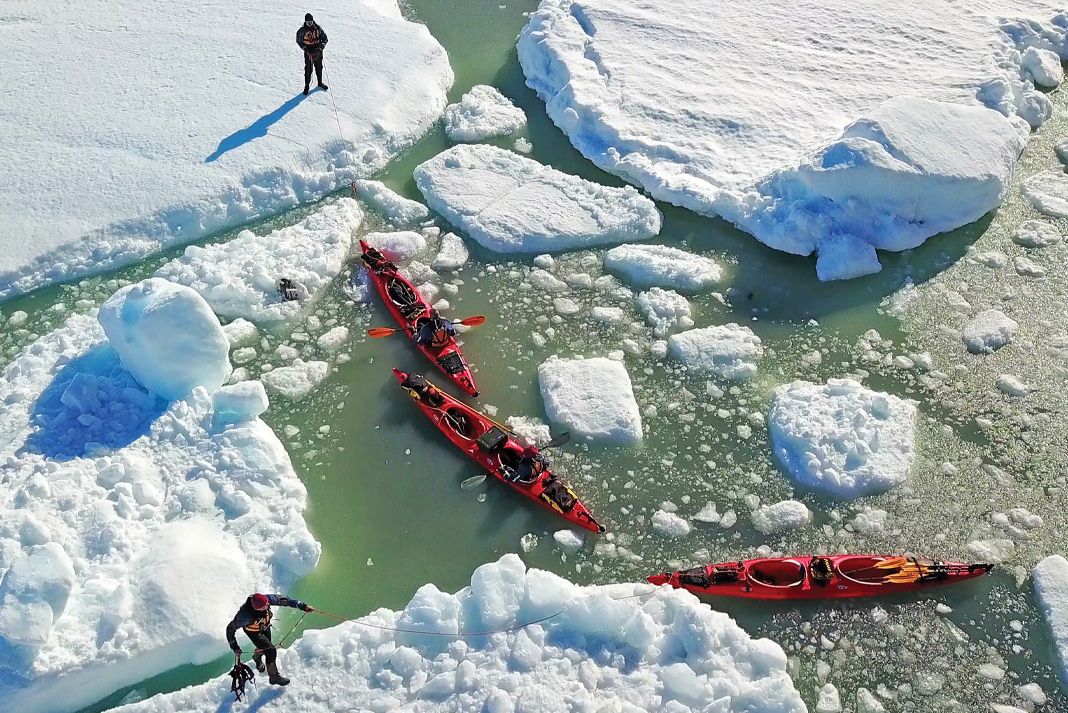
As we watched the de Havilland Twin Otter fly off, circling over the still frozen Lady Franklin Bay, realization set in. For the next five weeks, we would be some of the most isolated people on earth. It was July 2 and we were at Fort Conger on Ellesmere Island, 500 nautical miles from the North Pole. We were embarking on a kayaking expedition through Nares Strait, the channel between Canada and Greenland.
We expected to cover roughly 500 kilometers. Our team of five included experienced polar explorers and a polar oceanographer. With us were 1,096 pounds of food and equipment, packed into our ultra-tough Prijon tandem kayaks.
Our goal was to get footage for our documentary, Enduring Ice, a film to draw attention to the darkening Arctic.
In the past 40 years, Arctic sea ice volume has declined by 72 percent. Most polar scientists now predict the Arctic Ocean will soon be ice-free in summertime. With that change, the Arctic Ocean is no longer the solar reflector for the planet like it once was. Our concept for the film was to use the excitement of an extraordinary adventure as a way to raise awareness about the essential role the Arctic’s sea ice plays in keeping our planet cool.
Based on past experiences in Nares Strait, our team imagined ice conditions might be different from previous expeditions, but still recognizable. They weren’t.
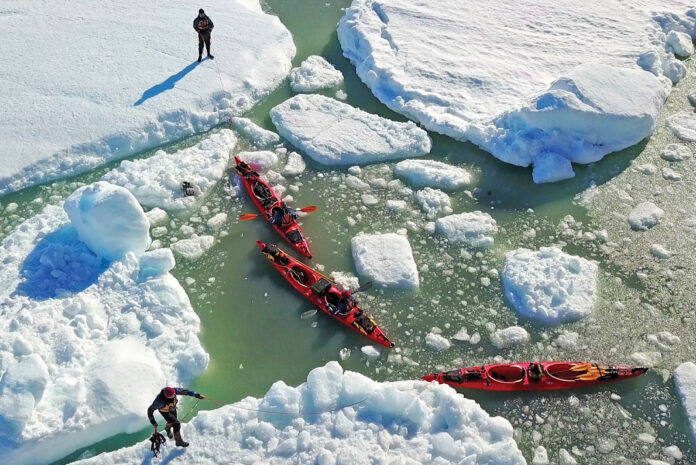
What we encountered was something new—a polar slurpee. A mess of unconsolidated ice that made travel by foot or paddle nearly impossible. Gone were the large solid ice floes. The conditions were especially surprising to the polar oceanographer on the expedition, who was accompanying us to add to his research on sea ice floe size distribution.
THE ENDURING ICE EXPEDITION TEAM NAVIGATES THROUGH A NEVER-BEFORE-SEEN “POLAR SLURPEE.” | PHOTO: ENDURING ICE EXPEDITION
With ice conditions so challenging, we were mostly forced to follow the icefoot, that narrow band of sea ice frozen to the shore. However, because Nares Strait had not frozen across last winter, the icefoot was a mess. Giant blocks of ice tossed up during winter storms were stuck in place, and often impassable. We were completely beset by the deteriorating ice conditions we had come to document.
This image extracted from drone footage is of us navigating our kayak around one of these sections of almost impassable shore. It took 33 days to travel just 100 kilometers. Carl Ritter Bay, the closest landing strip, became our absolute goal.
Learn more about the Enduring Ice project and get updates on the documentary at www.enduringice.com.
This article first appeared in the 2015 Paddling Buyer’s Guide. Subscribe to Paddling Magazine and get 25 years of digital magazine archives including our legacy titles: Rapid, Adventure Kayak and Canoeroots.
ENTERTAINING CROWDS SINCE 1982. | PHOTO: KEVIN CALLAN
Alex Traynor and Noah Booth are up-and coming video bloggers who call themselves the Northern Scavengers. When I loaned these two weekend warriors one of my canoes for their latest big trip in the far north, I insisted they take one of my lightweight and durable Prospectors, rather than their sinkable, flat-bottomed scow. They couldn’t thank me enough and I think revered me as some kind of Jedi of the canoeing world.
They even called me Uncle Kev, as in, “Thanks for the canoe, Uncle Kev.” That was awkward.
The Word Is: Experienced
I get it. I’m a year away from getting a senior’s discount at my local pharmacy. I’ve been writing and making presentations at shows for well over 30 years. Traynor and Booth are 26 years old. My first book came out in 1990. For three decades I’ve been traveling the country convincing others to get outside and paddle. Sometimes I feel like I’ve seen it all.
I can remember running rapids without a helmet. I know the feeling of a cold butt from the seat of a Grumman. I was a member of a canoe club that wouldn’t allow kayakers to join.
I attended the grand opening of the Canadian Canoe Museum. I not only remember the end of Royalex, I remember early Old Town ads introducing the revolutionary new material. I cried the day Bill Mason died.
I’ve lived through the era of Deliverance inspiring new paddlers to get out onto rivers. I’ve also witnessed the growth of websites having the word paddle in the title but nothing to do with the kind of watersports I enjoy.
I’ve watched the cult-like fervor for paddling books fizzle. I’ve seen canoe movies go from Beta and VHS to DVDs to YouTube. I got excited once filming a documentary in Quetico Provincial Park with a state-of-the-art high-definition camera. I just recently returned from filming a documentary in Nova Scotia with a 360-degree virtual reality camera.
I used to load actual 35mm film into the back of cameras. Dan Gibson nature sounds were once used while editing actual movie film instead of downloading your choice of digitally mastered loon calls served up by Google.
My first book, Killarney, was written on a type-writer. My second book, Cottage Country Canoe Routes, was saved on 5 1/4-inch floppy disks. A Complete Guide to Winter Camping was typed on a computer, saved digitally and uploaded to the Cloud—not one word scribbled on paper.
ENTERTAINING CROWDS SINCE 1982. | PHOTO: KEVIN CALLAN
I showed trays of slides during presentations. I learned PowerPoint. Now I just Bluetooth my presentations from my phone—imagine saying that to an A/V guy in the ‘80s.
Radio shows have turned into podcasts. And these days, I do more live streaming on Facebook than face-to-face interviews on television morning shows.
Canoeing Will Never Die
Through all of this I’ve listened over the years to crusty, bearded, Tilley-capped men in plaid proclaiming, “Canoeing is dead.” They used to mail me letters. Then emails. Now I receive these doomsday decrees through Facebook Messenger. They write to tell me kayaks and standup boards will rule the world. They say canoeists will just fade away.
Take it from an aging canoeist who’s been around the bend on a lot of rivers—they’re wrong. Canoe sales have increased 110 percent since 2016. Canoeing has increased 40 percent, especially among young families and Millennials, since 2014.
Take for example the Northern Scavengers. Here are two guys roughly the same age as me when I launched my first book. They’re creating a community, with the technological tools of today, where campers of all levels can come to give or gain a little insight on anything backcountry related. On the Northern Scavenger website they’ve written, “The best way to appreciate the raw beauty is to immerse yourself in it. Camping is an unparalleled physical journey that can connect us to the land in the most organic way, and can bring us to places unbothered by the modern world.”
Bill Mason died 29 years ago and before the Northern Scavengers were born, but the boys have this Mason quote on their About Us page: “The canoe feels very much alive, alive with the life of the river.”
Canoeing will never die.
Kevin Callan is the author of 16 books, including the bestselling, The Happy Camper and Wilderness Pleasures: A Practical Guide to Camping Bliss. He is still presenting across North America and has been a key speaker at all major canoe events. Butt End first appeared in Canoeroots magazine 16 years ago.
This article first appeared in the 2015 Paddling Buyer’s Guide. Subscribe to Paddling Magazine and get 25 years of digital magazine archives including our legacy titles: Rapid, Adventure Kayak and Canoeroots.
Adam Johnson on Crooked River, New Zealand | Photo: Tegan Owens
Certainly, you’ve heard the well-worn trope, “We learn from our mistakes.” It is the mantra of experiential learning. That we learn something from mistakes is taken as fact, and justifies a wide range of trial-and-error approaches to everyday life.
However, what it is we actually learn is sometimes up for debate.
Do We Learn From Our Mistakes?
It’s hard to imagine having a close call on the river and not coming away affected. Like most long-time whitewater paddlers, I can come up with a pretty good list of my close calls. These are the stories we all tell each other on tailgates and bar stools. But what do we actually learn?
Way back in 1943, psychologist John T. MacCurdy coined “near miss,” a term we still use today in the field of safety and outdoor risk management.
MacCurdy was studying survivor responses to the World War II London air bombings. He was trying to learn more about the nature of fear and morale in society—the war being an unfortunate but convenient experiment for him to observe. While MacCurdy’s near miss term lives on, his more important findings did not.
MacCurdy recognized two groups of people living in London at the time of the night bombing raids. The near misses were the individuals closest to the bombings, the ones who could actually “feel the blast and see the destruction.” These people survived powerfully influenced by the events, having experienced real fear. He used the word “impressed,” to mean “the event created a very strong impression on the individuals’ memories.”
The second group MacCurdy called the “remote misses”. This group and the term itself were left behind as his ideas carried forward through the years.
The remote misses were the individuals who heard the air raid sirens, saw the Germans fly over, but did not experience the destruction of the bombs themselves. These individuals, it surprised MacCurdy to learn, were left with “a feeling of excitement with a flavor of invulnerability.”
The remote miss individuals didn’t pay the price of the bombing, nor were they exposed first-hand to the devastating losses. Their impression was the exact opposite to those in the near miss group. The German’s air raid strategy of instilling shock and fear failed dramatically. For this much larger portion of the population, the London bombings were actually kind of thrilling. What MacCurdy stumbled upon was an unlikely sense of invulnerability accompanying knowing destruction is all around, but coming away unscathed.
And so it was with me. And MacCurdy’s research would suggest it was, or will be, with you too.
My first run down the magically deceiving Dragon’s Tongue at Garvin’s on the Ottawa River left me beat down in the hole at the bottom, dragged to shore by my buddies and euphorically buzzed. I probably high-fived somebody. I survived and it wasn’t so bad. Actually, it was kind of thrilling. Even fun.
I have quite a long list of these beat-down-to-fun-buzz scenarios. So what did I learn from my mistakes? Throughout my intermediate years I learned getting surfed, stuck, semi-pinned and swimming is not so bad. I learned I could actually screw up pretty good and get away with it.
Are these the lessons I should have been taking away from my mistakes? Are these the lessons building a competent, safe paddler? Of course not.
Looking back, what I should have learned over and over again, is I was missing some key river reading skills and I did not have a complete understanding of controlling momentum. I got away with it for a long time. Until I didn’t.
My first real near miss was a good whack on the head in a big, ugly hole in the Elora Gorge at flood level. It really wasn’t a miss at all, but a full hit that could have been much worse. Those river reading lessons I was ignoring caught up with me, put me where I was not supposed to be, and I paid with a lost paddle, rock climb out of the gorge and a nagging three-day headache.
Adam Johnson on Crooked River, New Zealand | Photo: Tegan Owens
My near miss left me deeply impressed and with a large dose of residual fear. Hundreds of runs later I still conjure up that memory on the approach to any gorge run.
Fifty years before the Internet, MacCurdy pointed out that unless we pay some price, leaving us significantly impressed, we are likely to be learning the wrong things from our mistakes.
By watching our friends make mistakes on the river and getting away with it, our sense of invulnerability is further reinforced. Watch 75 horrible lines over Fowlersville Falls turn out okay at New York State’s Moose Festival and we wonder what the fuss about safety is all about.
Or worse, turn to social media where we can stream hundreds of miraculously close calls happening every day. For many of the sorry souls involved, these beat downs leave them very impressed. But as remote watchers of the highlight reels, it only builds in us an unhealthy confidence of what is possible to get away with.
Until we don’t.
Jeff Jackson is a professor at Algonquin College in eastern Ontario and consults on safety and risk management.
This article first appeared in the 2015 Paddling Buyer’s Guide. Subscribe to Paddling Magazine and get 25 years of digital magazine archives including our legacy titles: Rapid, Adventure Kayak and Canoeroots.
For years the growth of canoeing has been flat. The activity enjoyed mainstream popularity in the 1970s and ‘80s after John Boorman’s Deliverance sent Jon Voight, Burt Reynolds and Ned Beatty into the soon to be dammed Cahulawassee River Valley. Thousands of Baby Boomers across North America flooded the rivers and lakewater routes on their own wilderness canoe adventures.
In 1960, two percent of Americans participated in canoeing and kayaking. Twenty years later by the early ‘80s, thanks to John Boorman, the development of a revolutionary, inexpensive and virtually indestructible canoe material and Baby Boomers venturing into the backcountry with their young families, the national canoeing participation number had risen to eight percent. Canoeing was hot.
It was a pretty good 20-year run for canoe builders. But between 1998 and 2002, kayaking took hold of the paddlesports market. During that period, The Sporting Goods Manufacturers Association recorded a 59 percent growth in kayaking participation. Conversely, canoeing dropped in popularity with a 20 percent loss in participation. The ubiquitous, fringe sport of wave surfing with a paddle turned mainstream with the advent of the standup paddleboard. According to Google Trends, “SUP” searches grew 61 percent between 2004 and 2016. Searches for “canoes” decreased 80 percent in the same period.
In 2006, a mere 3.3 percent of the United States population participated in canoeing. By 2014, the participation number was 3.4—up slightly but not by a significant margin.
Finally, after years of stagnation, early signs suggest canoeing is peaking people’s interest again. For the first time in more than two decades, the future of canoeing looks bright.
The adventurers of the 1970s and ’80s are replacing their canoes with lighter and expensive ones, because they can. | Photo by: Mike Beedell.
The First Indicator the future of canoeing participation is looking up seems to originate from the fact that people are once again buying canoes.
Jason Yarrington, founder of the Trailhead Paddle Shack in Ottawa, says he’s seen canoe sales rise by 20 percent in the last two to three years. “The original Kevlar canoes are on their dying legs,” says Yarrington. “They’re starting to wear out and people are now looking at new canoes 15 to 20 years later.”
Even if these old canoes aren’t wearing out, canoeists aren’t hesitating to replace them, or buy more. Manufacturers too, are noticing the early stages of what they are hoping is a trend.
“This year seems to be a boom canoe year,” says Bill Kueper, vice president at Wenonah Canoe. “There seems to be resurgence especially for high-end boats.”
“This year seems to be a boom canoe year,” says Bill Kueper, vice president at Wenonah Canoe. “There seems to be resurgence especially for high-end boats.”
Lightweight and performance canoes are what Kueper says prospective canoe buyers are looking for.
“People are getting really nice boats; they’re investing in it,” says Kueper, who predicts continued growth in the future canoe market.
Not only are sales increasing because old canoes need replacing, Kueper thinks this boom is due to an entirely different factor—young adults with money. “They’re looking at canoeing as a viable place to put some of their hard-earned dollars,” says Kueper.
In past years, Wenonah Canoe’s average customer was anywhere between 40-65 years old. “I think now we’re getting customers younger than that,” says Kueper.
“If you listen to the public dialogue, your typical canoeist is old and male,” says Jason Zabokrtsky, owner of the Ely Outfitting Company. He has been guiding canoe trips in Minnesota’s Northwoods since 1997. “That message is so prevalent, I’ve had people come off the trail and comment on how many young people they encountered.”
During the 2016 canoe season, Zabokrtsky collected user data from 1,000 clients at the Boundary Waters Canoe Area. What he found was surprising. The average age of Ely Outfitting Company customers was 29.
“We’re not positioning ourselves to target young people,” Zabokrtsky insists. “But they’re coming as couples and groups of friends. They are driving up from the cities to go on canoe trips and are willing to pay for full outfitting and great rental equipment.”
Zaborktsky, who in 2016 outfitted twice as many under-30 Millennials as 50-plus Baby Boomers, is one of many outfitters witnessing a younger generation discovering canoeing.
The Baby Bust generation rolls into the family canoe buying years, finally. | Photo by: Scott Macgregor.
A closer look at the data seems to suggest the Millennial magic is real. According to the 2017 United States Physical Activity Council Report, canoeing made the top-10 list for “activities of interest” for people aged 25-34. Canoeing was rated seventh on the list, higher than using workout machines or weights and fishing. According to the same study, 57 percent of Millennials participate in outdoor sports, compared to only 39 percent of Boomers. Toss in the simple fact that there are half a million more Millennials than Boomers in America and the growth potential of canoeing looks even brighter.
With the younger generation comes an obsession with social media. Rather than a distraction,
this is actually helping boost the popularity of canoeing. The sport is increasingly appearing in online listicles, Pinterest DIY projects and in dreamy wanderlust photos floating around social media feeds. On Instagram, the hashtag #canoe has reached nearly 650,000 posts.
Ever heard of a lumbersexual? According to Urban Dictionary, a popular tongue-in-cheek online dictionary, this common outdoor stereotype is defined as “A not-so-manly man dressing like a lumberjack, sporting a beard that has the volume of a lumberjack’s beard and the groom of a hipster.”
Although these types may seem a nuisance, riding their squeaky vintage bicycles through city streets radiating faux-moss musk, their rustic image is actually helping canoeing regain its lost popularity with the masses. Aside from man buns, lumbersexuals don’t look much different than canoeists from the heyday of the ‘80s.
Vacation time is in short supply these days. The Project: Time Off Coalition, a group of organizations committed to changing the behavior of Americans about their vacation time, found that Americans today are taking less time off work. This may be one factor contributing to canoe trips that are on average shorter now than they were 20 years ago.
The Project found that in 2000, vacation lengths began a steady decline. America’s average vacation usage is 16 days per year, almost a full week less than the average during the canoe boom years of 1978 to 2000.
Tierney Angus, 29, and her 30-year-old fiancé Andrew Bell, don’t let busy work schedules discourage their shared passion for canoeing. As youngsters, Angus lilydipped at the cottage and Bell went to summer camp.
“The majority of our friends only get two weeks off from work and that’s it,” says Angus, a Humber College journalism student. “They get out on weekends and maybe for four- or five-day trips. It’s definitely difficult to find larger chunks of time to devote to paddling. But the more canoe trips they go on, the more they want to stay out for longer.”
Angus and Bell devote as many free weekends to canoeing as possible in preparation for one big trip each year, usually lasting a minimum of 14 days.
“It’s like anything else,” says Jaime Capell, retail manager at Algonquin Outfitters Oxtongue Lake store on the west gate entrance to Algonquin Provincial Park. “When you don’t get to do it as often, it’s pretty exciting when you do get to go.” Shorter trips or not, outfitters are having banner years. Capell says 2016 was excellent for Algonquin Outfitters.
“It was probably one of the best seasons we’ve had,” says Capell. “And this year, so far, is looking positive.”
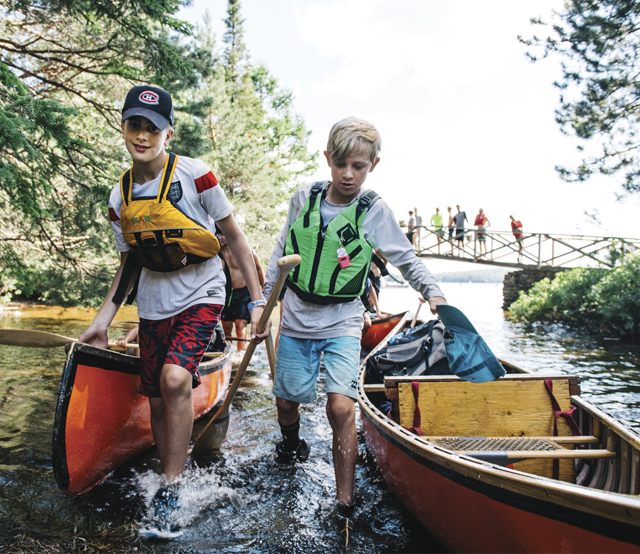
Summer camp enrollment is up. Say hello to tomorrow’s guides, instructors, builders and parents. | Photo by: Mike Last.
For busy parents with younger children, summer camp is an increasingly appealing option to get kids outside and on the water. Today, this tradition with century-old roots in Ontario, New England, Illinois, Minnesota and Wisconsin, has become a critical antidote to electronic gadgetry.
“Camp has always been a way to get the kids off the couch,” says Nick Georgiade, the North Carolina-based director of Camp Temagami, a canoe camp located in northern Ontario. “But now parents are concerned their children are unable to handle face-to-face social interactions.”
Like most summer camps, Georgiade outlaws mobile devices at his facilities on Lake Temagami and on the camp’s two to six-week long canoe trips. “Kids are forced to look at each other and get along,” he says.
“Camp has always been a way to get the kids off the couch.” But now parents are concerned their children are unable to handle face-to-face social interactions.”
Beyond the traditional camp selling points of self-confidence, teamwork and encounters with nature, unplugging has become “a bigger and bigger deal” for parents, Georgiade says. Meanwhile, enrollment at youth camps is surging. Camp Temagami’s jumped 30 percent in 2016, including a growing number of young women.
Increased enrollment is a parallel trend. “In the last five years we’ve seen a huge resurgence,” says Andy Gruppe, General Manager of Ontario’s YMCA Wanakita. This year, Gruppe says the camp filled up one month ahead of its regular time. He estimates enrollment to be up by 70 campers.
According to a 2015 report prepared by American Canoeing Association’s research assistant Cait Wilson, camper enrollment is also on the rise. Eighty-two percent of camps reported overall enrollment as the same or higher than in 2014. Additionally, 44 percent of camps reported the summer of 2015 as having the highest enrollment in the last five years. Kids, too, are getting bitten with the proverbial outdoor bug early. The report found that 71 percent of campers are now aged 12 and younger.
Study after study shows that adults who were exposed to the outdoors as children were more likely to participate in the outdoors during adulthood. In fact, 37 percent of adults who were introduced to the outdoors during childhood grew up to enjoy outdoor activities as adults. Increased summer camp enrollment can be nothing but good news for canoeing down the road.
The Outdoor Foundation’s Outdoor Recreation Participation Top Line Report released in April, 2017 pegged canoeing along with running and jogging, hiking, backpacking and fishing in the top ten most appealing aspirational activities among every age group from 25 to 45-plus.
Canoeing is cool again and there exists a huge opportunity for manufacturers, outfitters and canoe clubs to engage these non-participants. Combine this mass appeal with Baby Boomers upgrading boats, Busters getting around to having kids, and Millennials carving out a few days here and there, one might say that canoeing is trending. #canoeinglives.
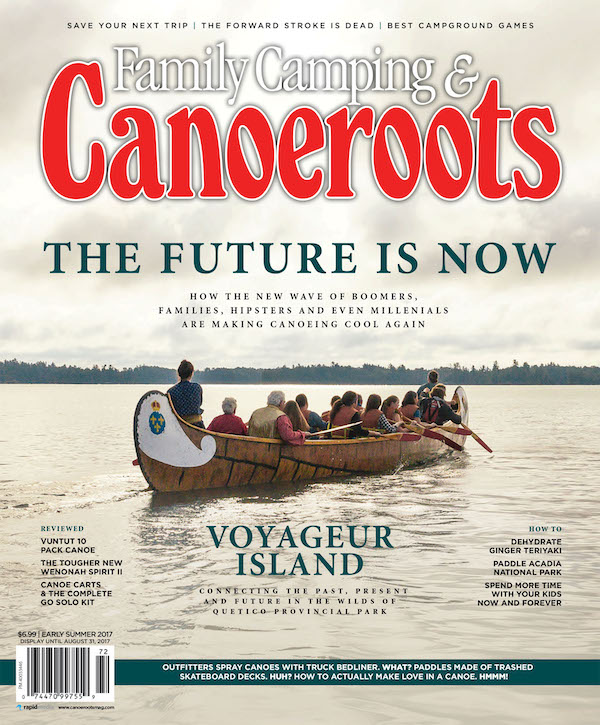
This article originally appeared in Canoeroots Early Summer 2017 issue.
Subscribe to Paddling Magazine and get 25 years of digital magazine archives including our legacy titles: Rapid, Adventure Kayak and Canoeroots.


 This article first appeared in the 2015 Paddling Buyer’s Guide. Subscribe to Paddling Magazine and get 25 years of digital magazine archives including our legacy titles: Rapid, Adventure Kayak and Canoeroots.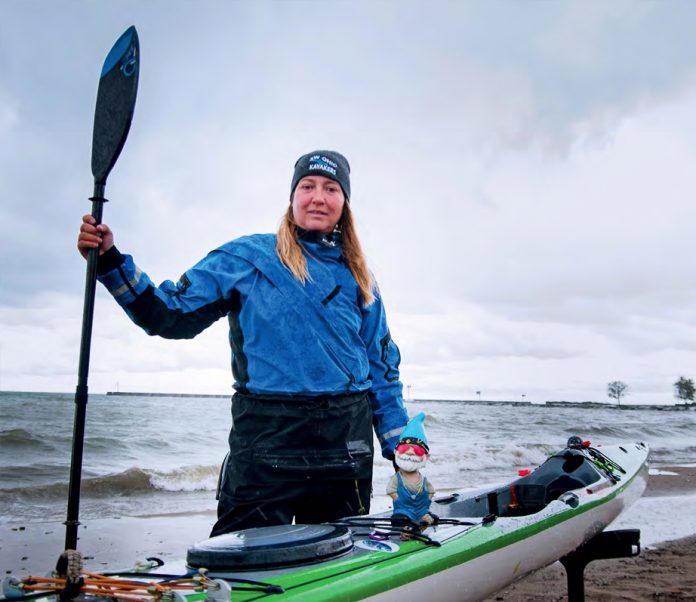

 This article originally appeared in Canoeroots Early Summer 2017 issue.



