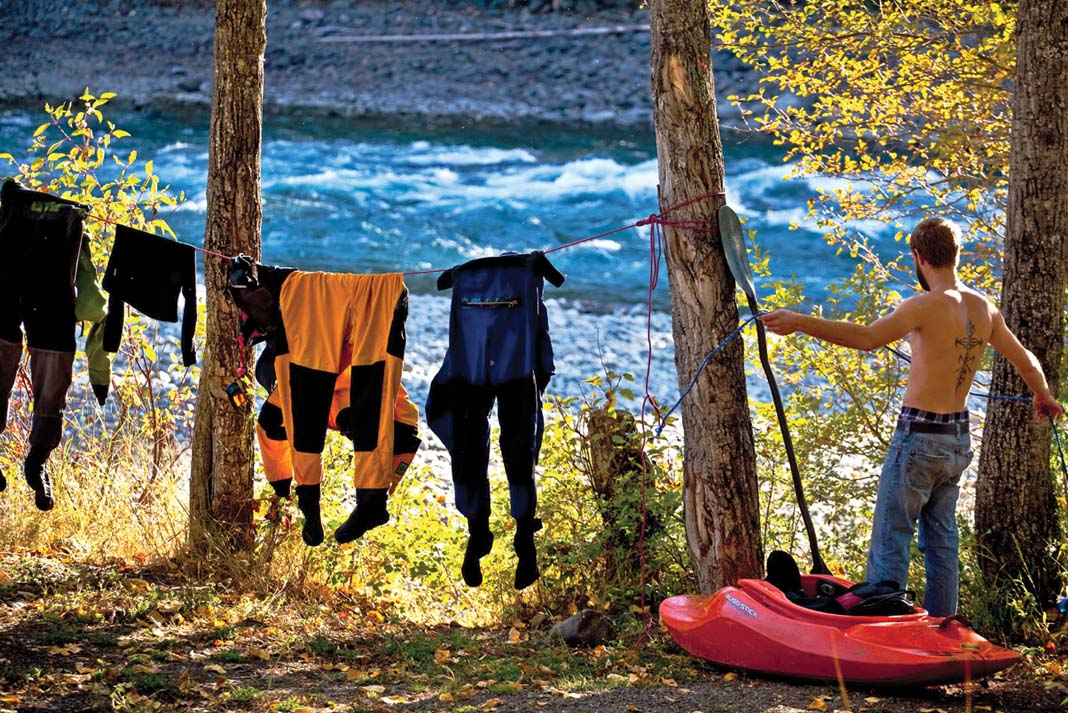
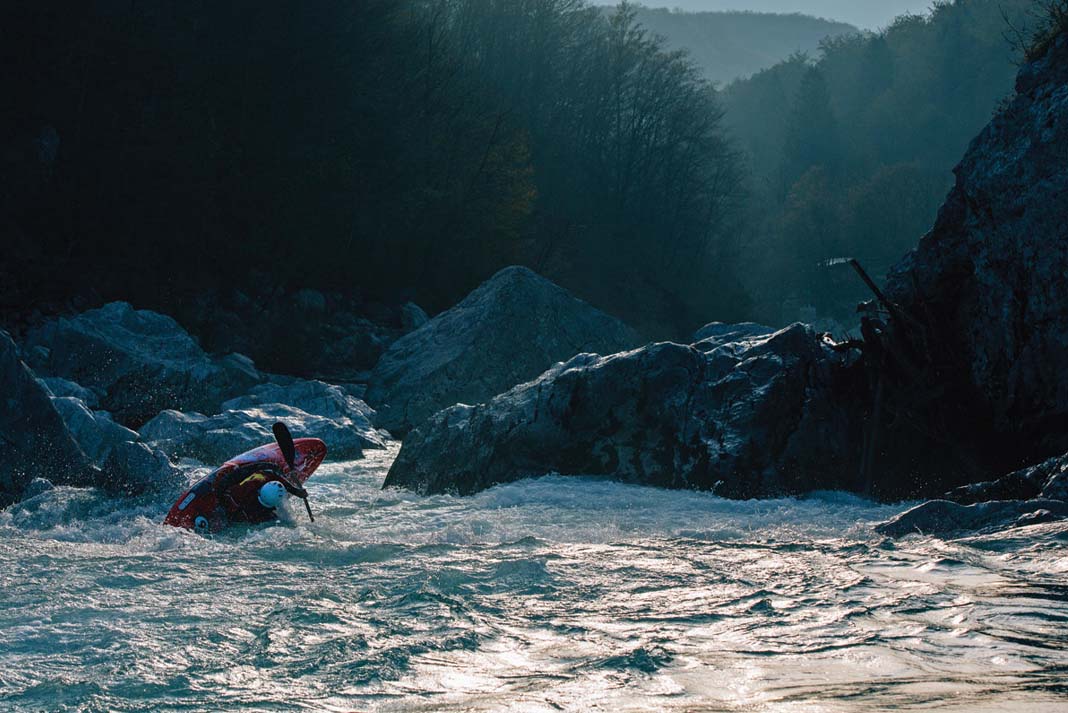
Multi-day river trips require careful preparation and organization not only to make sure you and your paddling team have everything you require, but to ensure it all fits in the kayaks. We scouted out all the coolest gear on display at Outdoor Retailer Summer Market 2016 and chose items that we think are necessary for your next multi-day river trip.
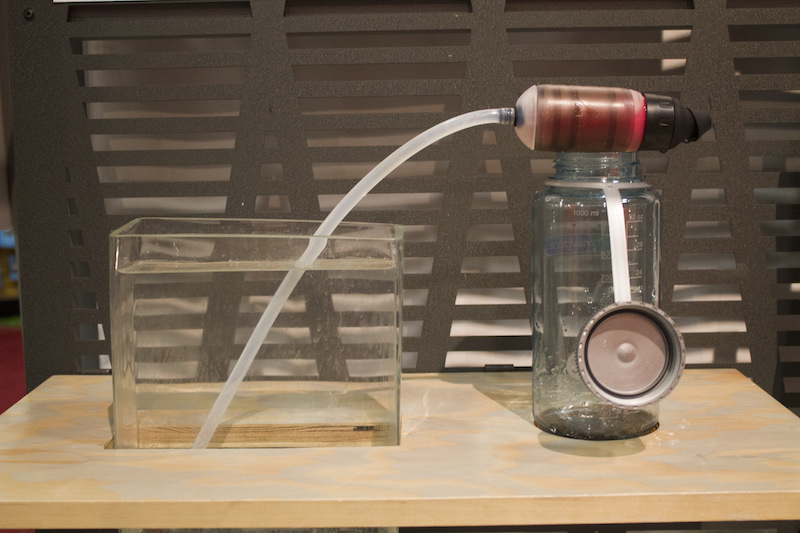
MSR Trailshot Microfilter
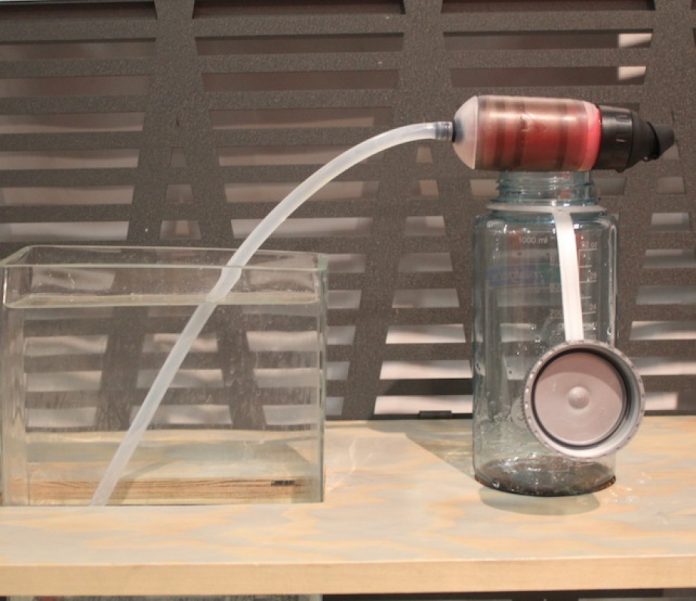
Having a solid plan for water treatment on your multi-day river trips is crucial, and having a super-effective and fast one is important. The MSR Trailshot Microfilter won an Outdoor Retailer Best of Show for it’s lightweight pocket-size design and quick functioning. The 142-gram filter can fill a one-liter bottle in 60 seconds, treats up to 200 liters and disappears inside a pocket. You can clean it simply by giving it a few shakes to restore flow rates while in the field. The best part? You can walk up to a stream and drink straight from it (or just lean over your kayak!). The Trailshot Microfilter will be released in 2017 and retails for $49.95.
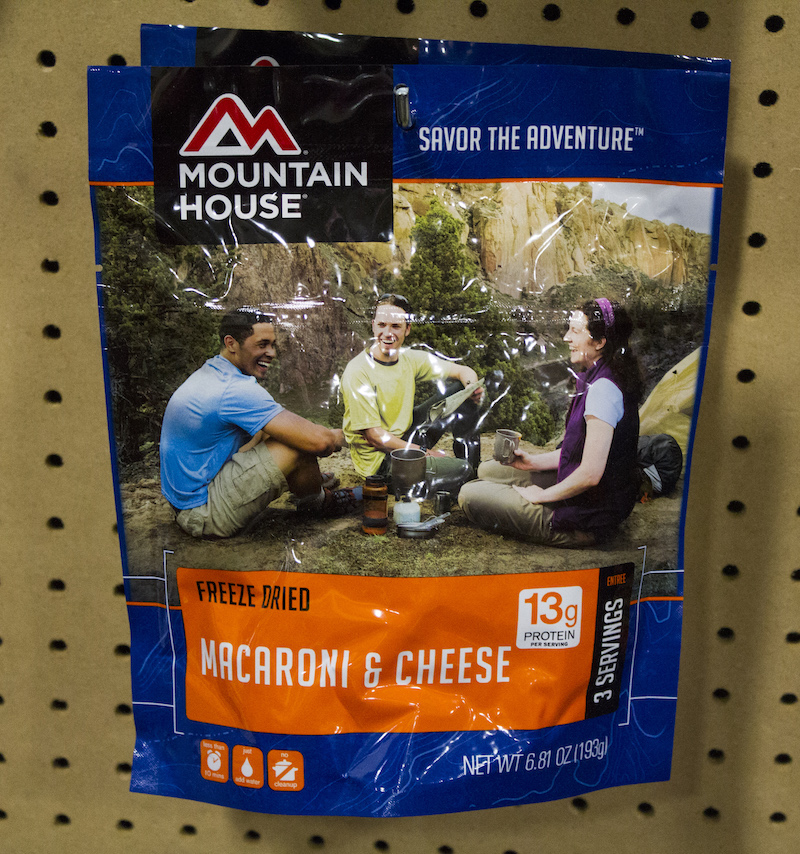
Mountain House Backcountry Meals
After a long day of scouting and paddling rapids, every kayaker will crave a nutritious and flavorful meal around the fire. If you are looking to reduce the weight in your kayak, want lightweight emergency meals or are simply stoked about good food, Mountain House’s freeze dried food packs should go with you on your multi-day trip. Our favorites we saw at Outdoor Retailer were the macaroni and cheese and beef stroganoff with noodles. If you really want to celebrate that killer drop you pulled off during the day, try one of their freeze dried ice cream sandwiches.
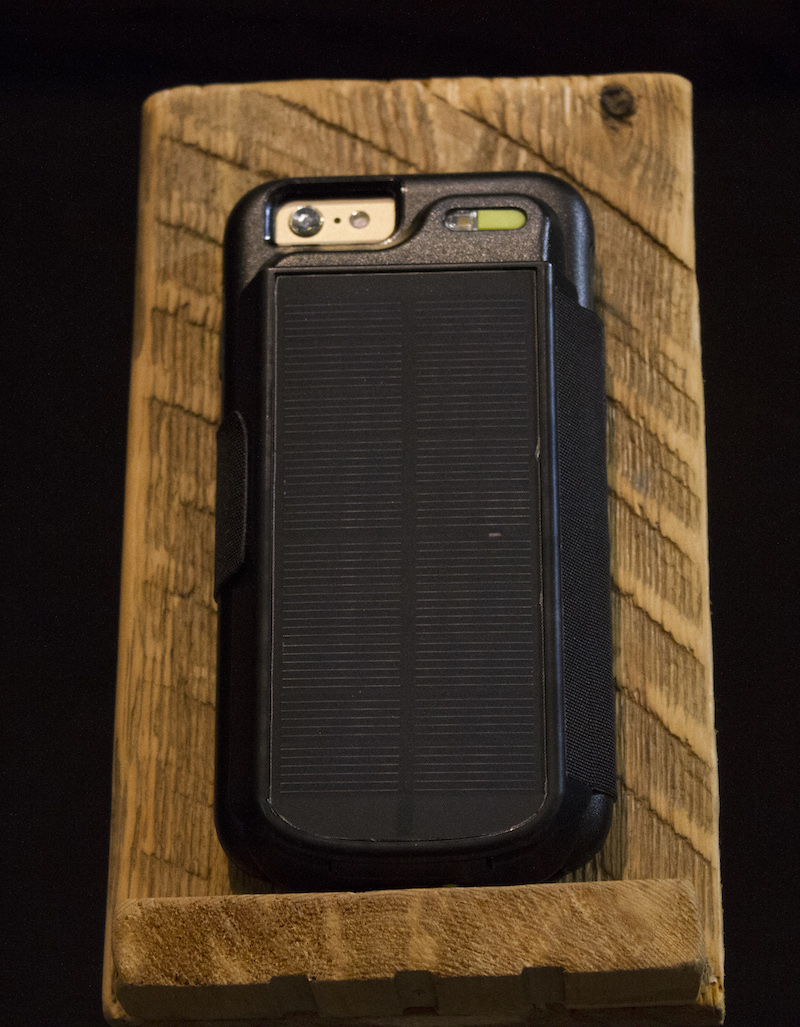
Goal Zero Slide Battery
Whether you are bringing your phone of the river with you to shoot photos of you styling the waves or as a just-in-case means of communication, Goal Zero’s Slide Battery will give your phone extra life. The Slide Battery is in collaboration with OtterBox’s uniVERSE case, and slips seamlessly behind the case and provides power for your phone. The Slide Battery gives your phone one extra battery charge and also comes with an integrated kickstand so you and your paddling friends can lean back and review video from the day’s whitewater fun. The Slide is available for iPhone 6/6s and iPhone 6 Plus/6s Plus and retails for $54.99 and $59.99 respectively.
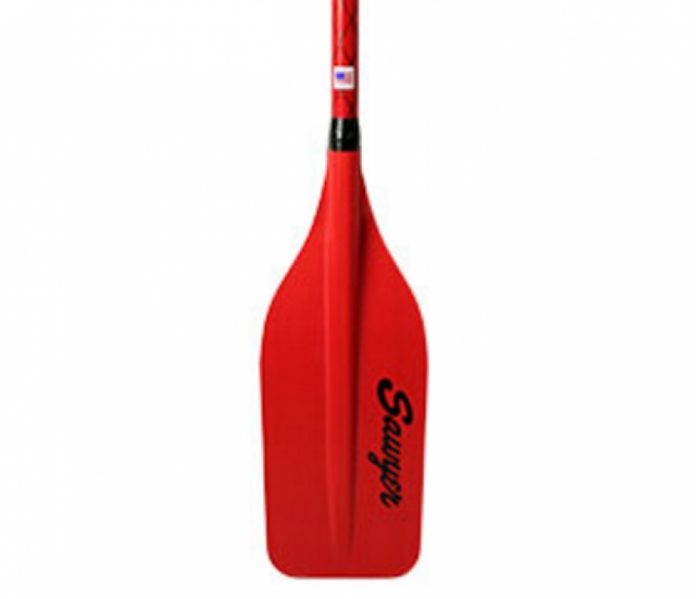
Sawyer Paddles & Oars is introducing the Angler Pro Oar Blade, a design based on feedback from fishermen who desired a more buoyant oar. The Angler Pro is composed of carbon fiber laid over a hybrid Ash reinforced composite core with Dynel and Kevlar ProTip reinforced edges. Sawyer’s Zac Kauffman says fishermen will love the same high performance they know in other Sawyer blades combined with increased buoyancy.
The Angle Pro Oar Blade comes in a 30-inch and a 24-inch with two different profiles, and the shorter blade is intended for more shallow water. The blade retails for $169.99 and is a 2017 product but will be available this month.
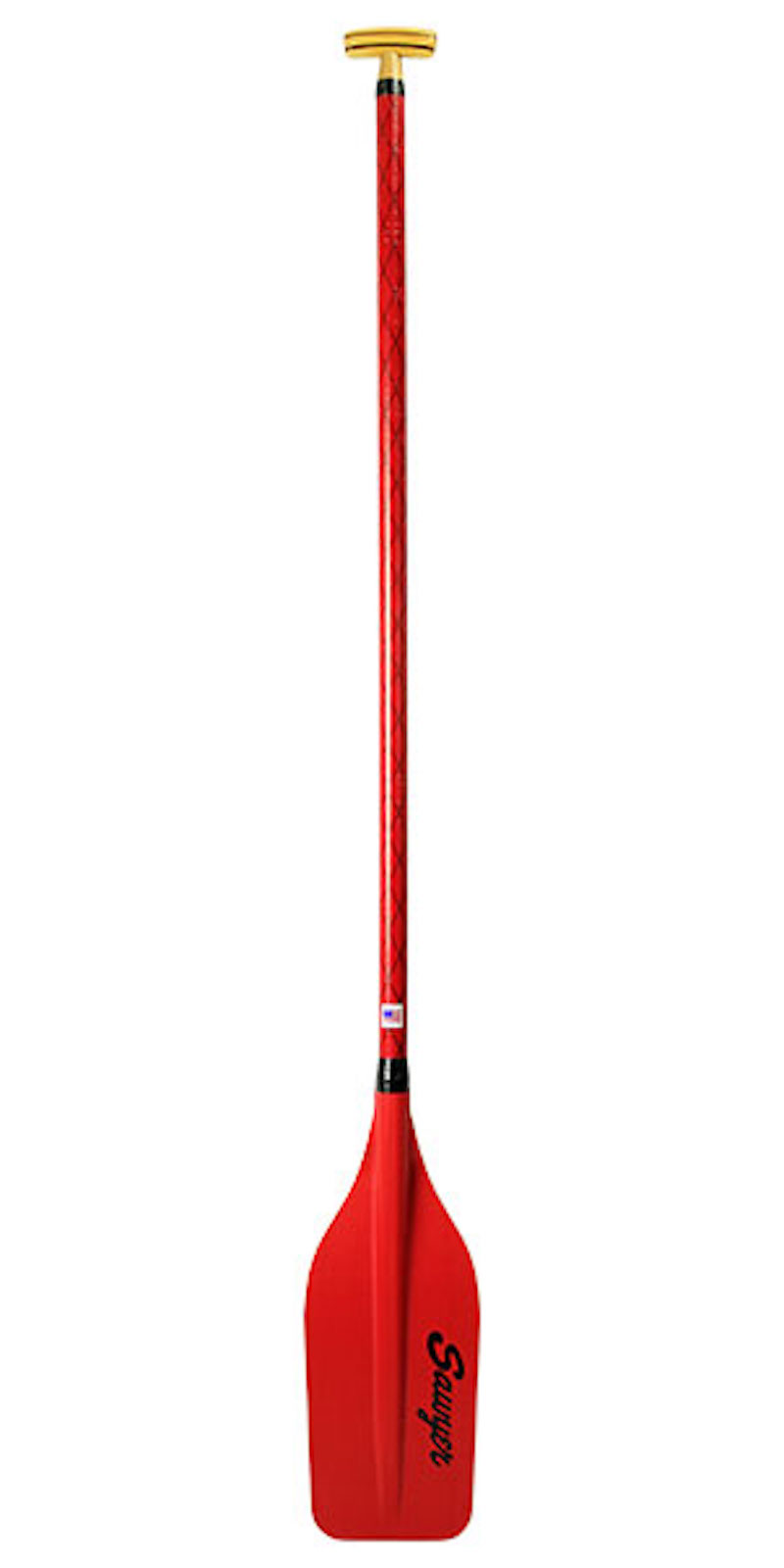
Sawyer is also excited about two new spring releases—the Pro Stick Raft Paddle and the Lightweight SST Oar. Kauffman says the Pro Stick is a guide paddle composed of continuous woven fibre and comes in red, black, or yellow blade and unlimited choices for shaft color. A unique feature is the option to have Sawyer laminate any fabric into the shaft—think of your favorite plaid shirt—for a completely individualized design. “It’s a simple way for people to have a one-of-a-kind product,” says Kauffman. An added bonus is that the customized shaft will make it more difficult to lose your paddle or have it stolen.
The Pro Stick Raft Paddle
The Small Stealth Oar is designed for small prams, pontoon boats and fishing cats. It is built with a reinforced fiberglass shaft and continuous fiber reinforced blade construction. The shoal cut blade design makes it perfect for quietly sculling into fishing destinations.
Kauffman also spoke about the Freefall, a whitewater paddle designed for the extreme whitewater following. He explains that some paddlers in this category don’t want the scooped blade found on the Whitewater Pro Stick, and prefer the Freefall’s flat one. The Freefall has a solid Ash core and carbon fiber overwrap on both sides of the wood core blade. It is extremely stiff and responsive and has a reinforced ProTip.
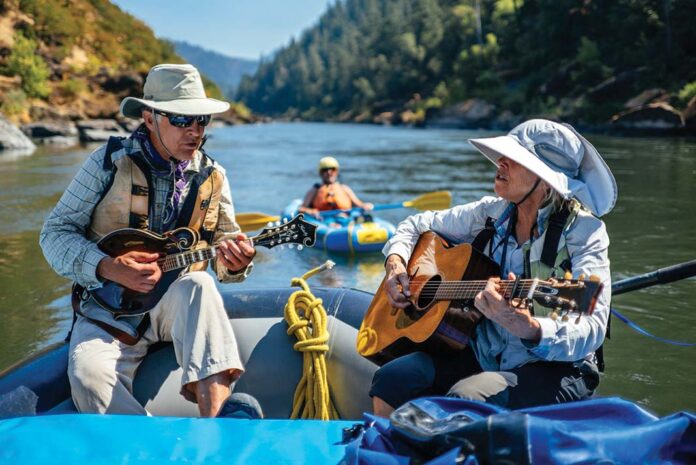
Tom Rozum and Laurie Lewis, fixtures of the West Coast folk music scene, have been playing together for almost 30 years, and serenading river runners for more than 20.
“The combination of beautiful days on the water and nights under the stars mixed with acoustic music really grabbed me,” says Lewis of her inaugural rafting adventure, a run on the Rio Grand in Big Bend in 1992.
The trip led to a longstanding partnership with Northwest Rafting Company. Every year, the musical mates join for a trip down Oregon’s Rogue River or Idaho’s Middle Fork of the Salmon.
Jam sessions echo through the canyon walls by day, Lewis and Rozum play a set after dinner and, as the sun sinks below the rim, the stage is set for a talent show.
“There are no stage lights out there, so the group just gathers up in a big circle and we’ll add a campfire of lanterns as the sun goes down,” says Nate Wilson, long time Northwest Rafting Company guide and outdoor photographer. “It might not have the acoustics of an indoor venue, but listening to the music in a wilderness river canyon is hard to beat.”
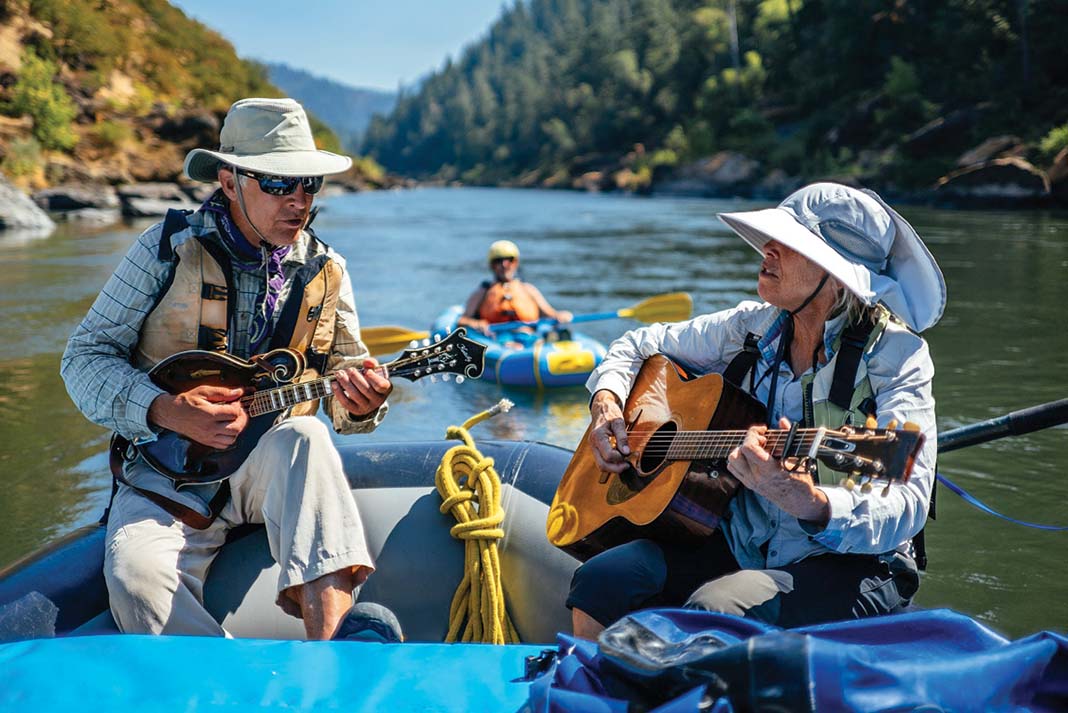
RIVER JAMMIN’ Slide| PHOTO BY NATE WILSON
“Every time down the river is a new experience,” says Lewis, whose acoustic tunes are brimming with vivid natural imagery. “I love the play of light on the water, the wildlife, the constantly changing scenery, and the interesting array of people who are drawn to rivers and rafting. Acoustic songs played on fiddle, mandolin and guitar seem to really fit in the setting of a river valley.”
Wilson captured this photo in Flora Dell canyon on the last day of a Rogue River trip, the final set before the take-out. “The tighter river canyon encountered upstream gives way to lush, rolling coastal mountains,” says Wilson. “We spent a few minutes strapping the rafts together into a big flotilla, and then headed on.
“Drifting through, we passed a few nice waterfalls and other guests on the trip jumped in the water or floated on inflatable kayaks to get closer to the music.” Emma Drudge
This image was the winner of the 2015 Guide Vibes photo contest by NRS, for perfectly illustrating the essence of the river lifestyle.
This article originally appeared in Rapid Early Summer 2016 issue.
Subscribe to Paddling Magazine and get 25 years of digital magazine archives including our legacy titles: Rapid, Adventure Kayak and Canoeroots.
Sustainability visionary, brown bear whisperer, solo expedition paddler and Zen master of Lemesurier Island—where he’s lived alone for nearly two decades—Bob Christensen, 47, is a good candidate for the most interesting man in Southeast Alaska. Twenty-five years ago, Christensen built a traditional baidarka from modern materials and paddled it, alone, from Alaska’s Prince of Wales Island to Bellingham, Washington. The trip marked the first time he’d ever sat in a kayak. These days, Christensen can be found commuting by small boat to ports all over Southeast Alaska, helping develop more sustainable communities.
Who lives alone on an uninhabited island?
I did months-long, solo kayak trips for five summers throughout Southeast Alaska. Jigging for halibut in front of the historic Willoughby Cabin on Lemesurier Island, I hooked into a big one. The fish dragged my boat around the kelp forest. I had broken my pole and started wrapping the line around my arm when the people inside the cabin paddled out in their double Klepper to help land the fish. I ended up camping down the beach and we spent three days eating that halibut. The next year, they offered me the job of caretaker. Deep isolation like that leads to a lot of self-reflection and spiritual contemplation. It was the same on my kayak trips, but when I planted myself on the island that first winter, it was amplified tenfold.
What brought you to Southeast Alaska?
In college, I became interested in human-nature interactions and designing sustainable communities. The vision was, my college friends were sending me off to Alaska to find a piece of property to buy and send a note back saying, “Okay, let’s build it.” Of course, that never happened, but hiring on with a variety of wildlife projects was a way to continue studying nature while holding onto that vision. It was two years after the Exxon Valdez spill, and I took a job surveying the beaches of Prince William Sound. I met a biologist who invited me to Southeast Alaska to participate in cave exploration on Prince of Wales Island. Later, moving to Lemesurier Island seemed like an ideal short-term solution to the challenge of finding an inholding to develop into a sustainable community.
Photo: Bob Christensen
When did you overcome your fear of bears?
After the caving expedition, I paddled back to Bellingham. I had no experience in bear country. I remember stupid things like, after days of banging my pots and pans together in terror, finally figuring out the noise I was hearing in the shrubs was a winter wren. I focused on learning where not to camp, which started teaching me how to read bear sign. The fear turned into a personal study reading patterns of use. I’ve had many experiences that could have gone bad but didn’t. Once, on Chichagof Island, I was lying down with a migraine headache and a bear came up and sniffed my face.
Where do you find inspiration?
My inspiration comes from the beauty of nature, not just the aesthetic, but how eloquent the ecology, the interaction of life, is. It also largely comes from the people I’m working with. There’s a lot of angst in our culture right now about humanity. Whatever the nasty stuff is that we focus on in the news, it hurts our spirits. When I talk to people about their vision for sustainability in their communities, I see them light up.
Why focus on community sustainability?
In 2008, I was working with the Community Forest Project in Hoonah, Alaska. The Southeast Alaska Conservation Council, the Wilderness Society and other philanthropically funded entities were trying to get a big wilderness bill passed. It wasn’t working. Investors wanted to do something that addressed human wellbeing alongside conservation. The only thing that came close was the Hoonah Community Forest. We expanded to form Sustainable Southeast Partnership with a much more comprehensive vision that included food security, economic development, energy conservation and renewable sustainability as core elements. It’s the culmination of my life’s work.
This article originally appeared in Adventure Kayak Early Summer 2016 issue.
Subscribe to Paddling Magazine and get 25 years of digital magazine archives including our legacy titles: Rapid, Adventure Kayak and Canoeroots.
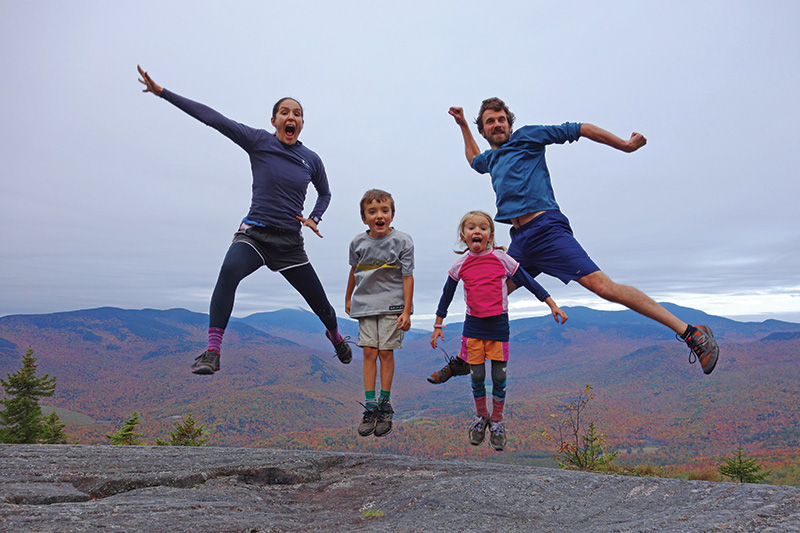
EXTREME SUMMER VACATION.| PHOTO: THE PORTLAND PRESS HERALD
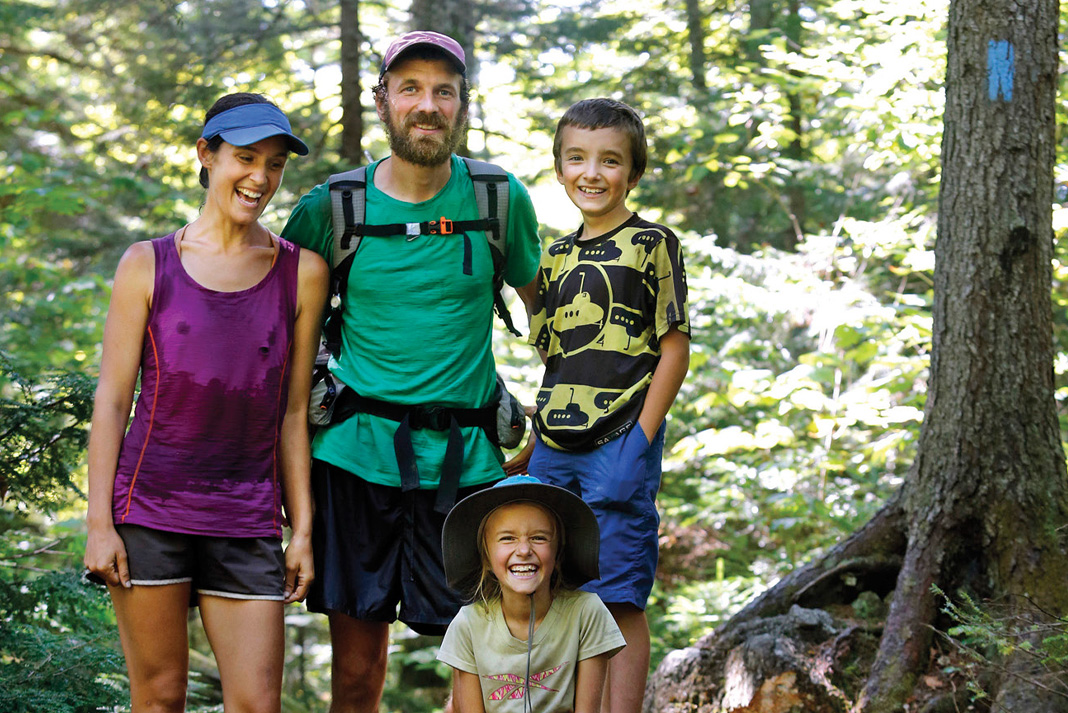
Over the course of five months, my seven-year-old daughter and nine-year-old son walked the entire length of the Appalachian Trail, from Georgia to Maine. For their short legs, those 2,185 miles measured somewhere around 10 million steps.
Of course, they didn’t walk all that way alone. My wife and I went with them—we even brought the family dog. When we started, the odds were we wouldn’t finish. In any given year, only one in four thru-hikers make it the whole way, and only 16 young families are known to have completed the entire hike in its 77-year history.
Five months of spending almost every minute of every day together is a whole lot of family together time. In the beginning, the kids were dependent on my wife, Emily, and I for everything. They needed us to cook and organize camp. When the climbs were too much, we’d take the kids’ packs, or let them use the dog’s leash as a towline off our backpacks. By the end of the trail though, they were carrying all their own gear, which included their clothes, their sleeping bags and even their shelter—about five to 10 pounds each.
Early on, we all struggled with the trail’s discomforts. The early spring and Georgia’s 5,000-foot peaks brought cold rain, turning to sleet, then hail, then snow all in a single day. Temperatures dipped into single digits, freezing solid wet socks and shoes. In the morning, it was the adults who thawed things out in our sleeping bags and got up early to build a fire to warm socks and shoes so we could get them back on our feet.
THE ODDS WERE WE WOULD NOT FINISH. IN ANY GIVEN YEAR, ONLY ONE IN FOUR THRU-HIKERS MAKE IT THE WHOLE WAY, AND ONLY 16 YOUNG FAMILIES ARE KNOWN TO HAVE COMPLETED THE ENTIRE HIKE IN ITS 77-YEAR HISTORY.
By the end of our hike, our daughter, Maddie, was wringing out her own wet socks the night before, and stuffing them into her own pockets so they’d be warm in the morning. By then, the kids were setting up their shelter in the evening and helping cook dinner. In the morning, they’d break camp and pack their own gear.
The kids were inspired to persevere by the people they met and befriended along the way. We watched our kids interact with adult hikers as peers, something that’s uncommon in our age-stratified society. They would walk up behind someone and set out to learn everything they could about the hiker in the uninhibited way only kids can, sharing their own life stories in the unfiltered way that kids do. What’s your name? Where are you from? Where did you start today? Do you like hiking? What do you do when you’re not hiking?
“My name is Nathan,” I once heard my son introduce himself. “The other day I caught a rainbow trout and we made fish tacos for dinner. I like hiking because it means I don’t have to shower. I wanted to go four states without showering but my parents wouldn’t let me.”
Unfortunately, our kids shared tidbits about us in the same unfiltered way. “The longest I went without showering wasn’t even on the trail, it was while my mom was away for work,” continued Nathan. “I went 17 days. My dad didn’t even notice!”
They received equal candidness in return. They earned the respect and friendship of the adults by hiking the same trail, doing the same miles and setting the same pace. Those hikers challenged their comfort zones in a way that we as parents never could.
Photo: The Kallin Family
Our first 20-mile day wasn’t my idea. It was inspired an the investment banker turned-long-haul truck driver on a downhill out of the 6,500-foot-high Smokey Mountains. He didn’t coddle our kids the next morning when they excitedly shared their accomplishment with him. Instead, he grinned and ribbed them: “That’s great! And no one will ever mention that it was all downhill!” The next night he taught them to play Texas Hold’em using Skittles—they cleaned him out.
Our first 27-mile day wasn’t my wife’s idea either. It was inspired by a substitute teacher-turned-long-distance hiker we met along the way. Wired was a star on the trail, having already hiked the Pacific Crest and Continental Divide trails. The kids wouldn’t accept her assertion that she wouldn’t see them again because she was going to get up early and hike a long day. Instead, they woke up throughout the night to keep watch. When one of them noticed that she was stirring, they sounded the alarm and sprang into action. When Wired was ready to go early that morning, there they were, their bags packed and breakfasts in hands. They stayed at her heels for all 27 miles, happily chattering away the whole time.
Our first—and only—30-mile day certainly wasn’t my idea. It was a goal the kids set for themselves, one they had heard other hikers aspire to, but which few actually accomplish. They didn’t give up, even when their friends hiked a shorter day to spend time swimming at a waterfall. They were deservedly proud at the end of that 30-mile day. Maddie was glowing as she rolled into camp and announced that until the last half hour, she didn’t think she would make it—but once she realized she could, those minutes were the best of the entire hike.
EXTREME SUMMER VACATION.| PHOTO: THE PORTLAND PRESS HERALD
Though we were constantly impressed by their resiliency and enthusiasm, the trail wasn’t about how many miles the kids could hike. Nor was it about watching our children grow to be self-sufficient and confident little people. Instead, it was a rare chance to enter a place where all distractions fell away. We could focus on where we were and who we were with; celebrate our connection with one another and the beauty of the world that surrounds us. As the miles of the trail transformed us, our family was brought closer together.
Early in the 20th century, conservationists Benton MacKaye and William Welch fought to create the Appalachian Trail and protect the wilderness surrounding it. Now, in the early 21st century, there are many similar fights to protect wild spaces raging across the continent. From my family to yours: Go find your wild places, protect them and embrace them together. And if it takes five months and 10 million steps to do so, all the better.
David Kallin is a Maine lawyer by day, who focuses his practice on land use and conservation.
This article originally appeared in the Canoeroots Early Summer 2016 issue.
Subscribe to Paddling Magazine and get 25 years of digital magazine archives including our legacy titles: Rapid, Adventure Kayak and Canoeroots.
Maybe you are a new paddler beginning the process this season, or perhaps you are a waterlogged pro with several decades of boofing, creeking and river booties behind you. No matter where you are in the life of your whitewater kayaking pursuits, you will be able to relate to these 10 whitewater learning moments.
1. You will get stuck in your drysuit
Drysuits and tops are amazing for cold weather kayaking missions, but they aren’t the most intuitive to wriggle out of. Flush wrist and neck gaskets make removing them an acquired skill, so don’t feel too bad if you spend most of your time at the take-out doubled over with your hands pulling at your collar trying to escape.
You hear those cool professional paddlers saying it all the time in kayaking films and spot the word in the pages of Paddling Magazine. Maybe you’ve been too nervous to ask your paddling friends for a definition of this kayaker’s verb. Once you launch over a small drop with a perfectly-timed stroke at the feature’s lip with your hips forward and hear the telltale sign of your kayak hitting the water, you’ll get it.
3. You will struggle rolling… until you don’t
Rolling is one of the toughest parts of learning to kayak, and even with great instruction it can be extremely difficult to conceptualize the technique from above the surface of the water. Many people spend days, weeks or even months working towards a solid roll. This can mean a lot of time swimming and chasing your boat, but once it clicks, the roll is hard to lose and will make kayaking incredibly fun.
Deciding not to scout a new rapid can happen when you get overconfident or are with a group who know the area well. While it can be tempting to just wing it, a big swim or hanging out in a sticky hydraulic can remind you why it’s so important to view river features and plan your line pre-run.
5. You will get stuck in a hole
Before you start paddling whitewater, rapids all look the same. Once you enter the sport however, you begin to pick out holes dotting the rivers you love and know the best lines to choose to avoid them. Part of learning is making mistakes though, and you will definitely gain first-hand insight into the retentive power of holes.
6. You will learn why your team is so important in this “individual” sport
In many ways kayaking is an individual pursuit where your actions and maneuvers just affect you. It is also very much about the group you are with, and there is no quicker way to learn how dependent you can be on your kayaking buddies than by needing a rescue, losing your boat or spending a few minutes being recycled.
Maybe it was planned. Or maybe you got spun around backwards on a rapid and ended up inadvertently pulling off a sweet surf. However you got on that wave, the unexpected stasis and floatiness you feel while water flies underneath you is addictive and will have you hitting up park and play spots in no time.
8. You will have a scary swim
When you begin kayaking and don’t yet have a bombproof roll, there is always the chance you will end up swimming the rapids you had hoped to style. Having a scary swim—cold, long, rocky or just full of big water features—can be terrifying, but it’s also a valuable experience for understanding our vulnerability on rivers and practicing proper swimming in whitewater.
You stand at the river’s edge feeling prepared to kayak. Your PFD is snug. Your paddle is in hand. Helmet is securely fastened. Drysuit zips are up. As you sit in your resting kayak and get stoked to join your friends, you face the seemingly endless struggle for beginner kayakers: putting on your skirt. It may seem too small for your kayak, or not the right shape, or too slippery. Trust us—your arms will get stronger and it will get easier.
10. You will mess up the shuttle
The concept of a shuttle is simple. Leave one car at the put-in and one at the take-out to bring everyone back. But that simplicity can become muddled with all the gear necessary for kayaking trips. After one too many moments at the take-out realizing you have no shoes, towel or dry clothes, you may start meticulously organizing drybags or backpacks designated for each end of the shuttle.
Follow us on Instagram @paddlingmagazine to discover more about paddling and what other kinds of fun trouble you can get into.
I’LL BE THERE FOR YOU. FOUR DAYS A WEEK. FROM 9-3:30.| PHOTO: KAYDI PYETTE
When dam operators are receiving thank you notes from the paddlers downstream, something is awry.
Flowing east out of Algonquin Provincial Park, the Madawaska River is an Ontario whitewater hot spot, famous for being one of the best places in the country to learn to paddle. Thousands of boaters got their start on the mighty Mad and, with its friendly class II to technical class IV, it draws kayakers and canoeists year after year.
It’s here that one of Canada’s best-known paddling families has taken things to the next level in terms of cooperation with the provincial power company.
It may come as a surprise that celebrated slalom paddler Claudia Kerckhoff-Van Wijk, who owns and operates the Madawaska Kanu Centre (MKC) with her husband Dirk Van Wijk, speaks highly of the folks at Ontario Power Generation (OPG), who control the dam upstream.
Following in the footsteps of her parents, who started the paddling school in 1972, Kerckhoff-Van Wijk has fostered a unique relationship with OPG that’s helped build and sustain the area’s thriving whitewater industry.
When her parents emigrated from Germany to Canada and set up their school on the Madawaska, the patchy and inconsistent flow made it difficult to build a business that relied on the river. They approached OPG and asked if they could condense the necessary 26 hours of flow per week—the minimum requirement to fulfill sewage demands, hydro production and environmental needs—into just four days a week, from May to August, so the flow would be substantial enough for good paddling on those days.
I’LL BE THERE FOR YOU. FOUR DAYS A WEEK. FROM 9-3:30.| PHOTO: KAYDI PYETTE
OPG agreed, at no cost. “Sometimes very small changes in when a power company operates their dams can have huge economic and social benefits that really are just no skin off the power company’s back at all,” says Kevin Colburn, the national stewardship director of American Whitewater.
South of the border, Colburn works long and hard to negotiate releases with power companies to guarantee water for paddling communities and the river ecosystem. However, he says it’s unusual for things to go as smoothly as they have at MKC—more often than not, interests do not align.
Understanding all the stakeholders involved is key, says Kerckhoff-Van Wijk. From there, it’s a matter of clear negotiation and constant communication. It doesn’t hurt that in her case, the relationship has some history. “My parents were way ahead of the curve,” says Kerckhoff-Van Wijk. “There was less red tape and fewer parameters then, but it is still possible today if you listen, do research and share your resource.”
Kerckhoff-Van Wijk encourages her students to send the dam operators thank you notes after they’ve enjoyed their time on the Madawaska. An OPG employee confirmed they have a stash of emails from athletes, adventurers and vacationers alike thanking them for their cooperation with the whitewater community.
OPG has 240 dams in numerous communities in the province, each of which has its own management plan. “It’s a balancing act,” says OPG spokesperson Neal Kelly. “It’s an ongoing relationship we have with businesses, community members and elected officials in communities where we operate.”
Of course there are many factors that will determine whether an arrangement like this one will work. The stars have to align for such anarrangement to be struck, says Colburn. But the MKC deal is a promising precedent.
“If you don’t have that conversation about interests and what people want and need,”says Colburn, “than you’ll never figure out those easy wins where interests actually do align.”
This article originally appeared in Rapid Early Summer 2016 issue.
Subscribe to Paddling Magazine and get 25 years of digital magazine archives including our legacy titles: Rapid, Adventure Kayak and Canoeroots.
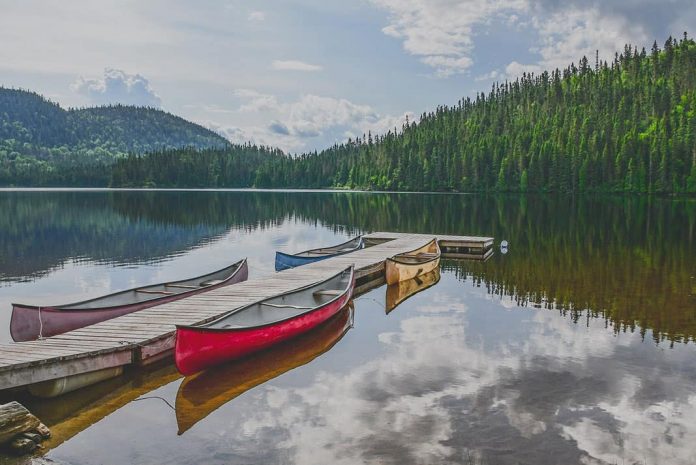
Brush up on your canoe terminology. | Photo courtesy of Pixabay.
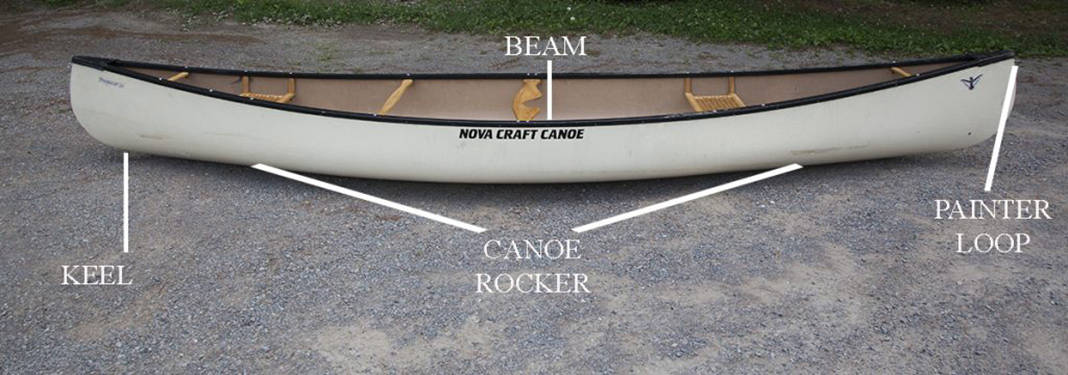
Whether you are completely new to canoeing or an enthusiastic novice who wants to brush up, knowing all the parts of the canoe will make you a more knowledgeable paddler.
It will also help you make better decisions when purchasing a new or used canoe and provide a foundation for you to learn from. Use this guide and brush up on the specifics of each canoe part with our terminology list below. Happy canoeing!
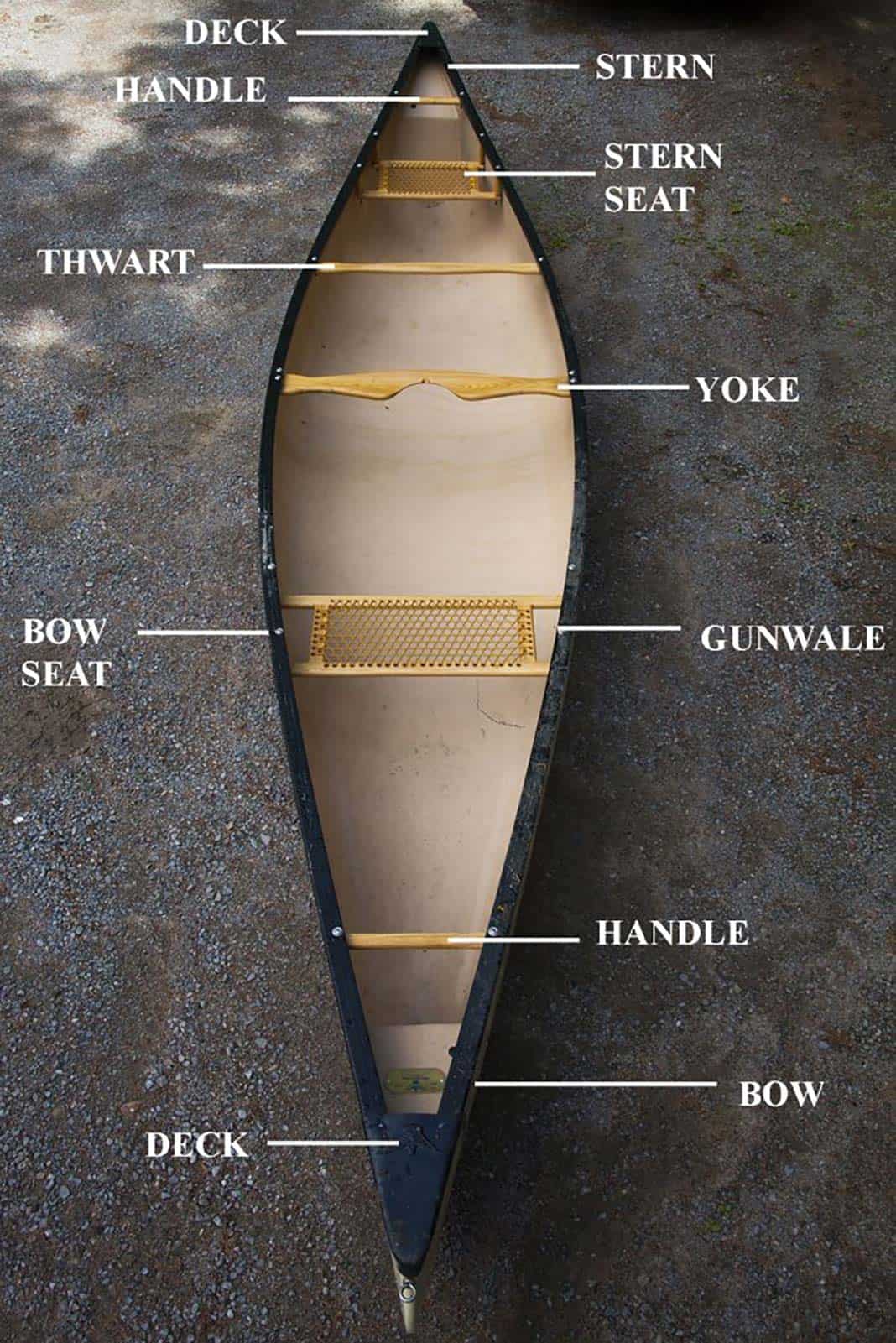
Knowing more about the craft you are paddling will make you smarter on the water. | Photo: Paddling Magazine
Basic parts of the canoe
Deck:
A triangular covering at the bow and stern of the boat where the gunwales are attached. It may be made of metal, wood or plastic.
Stern:
The back of the boat. When in a tandem canoe, the stern paddler will use strokes that control the direction of the boat.
Bow:
The front of the canoe. You can tell the stern from the bow because the bow will have lots of space in front and behind the seat, while the stern seat has almost no space behind.
Gunwale:
Gunwales run from bow to stern along the sides of the boat and meet at the decks. They are often made of plastic or wood.
Hull:
The hull is the main structure of the canoe and encompasses the exterior of the boat and the interior. The hull shape affects how the canoe performs on the water.
Thwarts are cross braces that stretch from one side of the boat to the other. They strengthen the canoe.
Yoke:
The yoke is a thwart that stretches from one side of the canoe to the other and has a small semi-circle cut out that allows for more comfort when a canoeist carries the boat on his or her shoulders while portaging.
Some boats will have handles next to the decks that allow for easier transportation and carrying of the boat into and out of the water.
Seat:
The seat allows the paddler to sit comfortable and at a good distance from the water while paddling. There is a large selection of solo canoes, but most canoes have two seats.
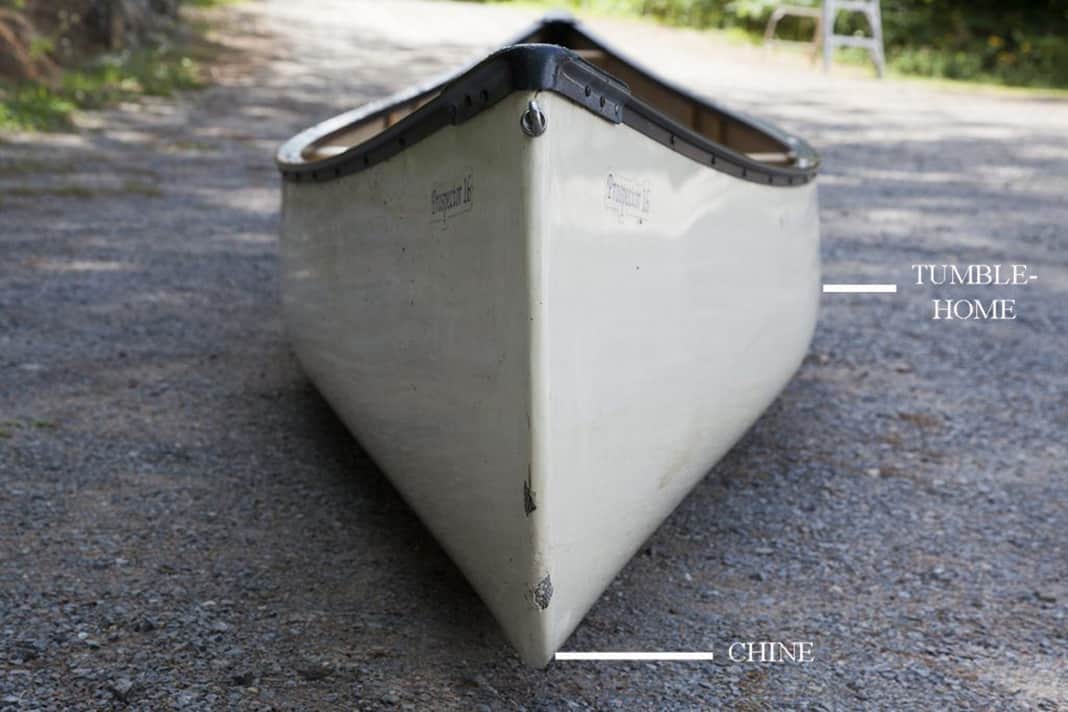
Know your terminology. | Photo: Paddling Magazine
Tumblehome:
Tumblehome is identified by the width of the canoe being narrower across the gunwales than the waterline width. Boats with a tumblehome can be more stable to paddle.
Chine:
The chine is the part of the canoe where the floor becomes the wall. The shape of this transition varies, and a more angular, sharper one is referred to as a hard chine while gentle curvature is soft.
Knowing the parts of the canoe is just as important as the trip you are planning. | Photo: Paddling Magazine
Keel:
A keel is the centerline that joins the two halves of the hull and runs bow to stern on the canoe.
Painter loop:
Painters are ropes that are attached to the canoe that can be used for tying, tracking and lining or to aid in tricky situations like a capsize. Painter lines can be attached through rings or holes in the bow of the boat.
Rocker is the amount of curve in the keel line of the boat from bow to stern. If a boat has a lot of rocker, less of the hull sits in the water and it will maneuver quickly but not track straight as well as a boat with less rocker.
Beam:
Beam refers to the width of the canoe, and the measurement is taken at the boat’s widest point.
Destination: anywhere. | Feature photo: Ryan Creary
Engineers have created a 15-foot commercially runnable waterfall, you will take 462 river selfies before you have your first child, our boats are 28 percent fatter than just 15 years ago, and 23 other things you probably didn’t know about whitewater today.
Back in the day, if you wanted to whitewater kayak you built your own fiberglass boats. Nowadays, if you want to win slalom at the Olympics you paddle a carbon fiber boat. The origins of modern freestyle are in squirt boating—also all-composite boats. Carbon composite boats won most of the medals at the 2015 Freestyle World Championships. Carbon is also in carbon dioxide, the colorless and odorless gas exhaled in excess when paddlers fortunate enough to paddle such boats go off about how much better their boats are than yours.
“The C-to-C roll was popular in the ‘90s,” says Charlie MacArthur, who’s been teaching whitewater kayaking for the ACA since 1990. “It worked best with low-decked and narrower boats. I will still happily work with a student to help hone their C-to-C, but people generally take to the sweep roll due to its speed and friendliness in wider modern boats. Less flexibility is needed for the sweep roll technique, and there are fewer shredded thumbs from rubbing on harder chines.”
Destination: anywhere. | Feature photo: Ryan Creary
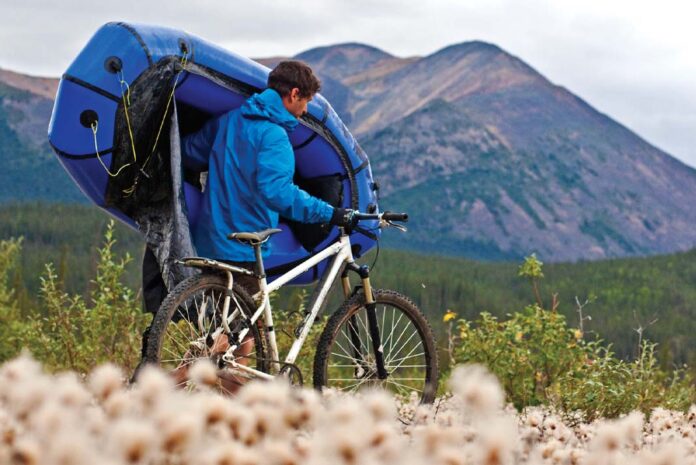
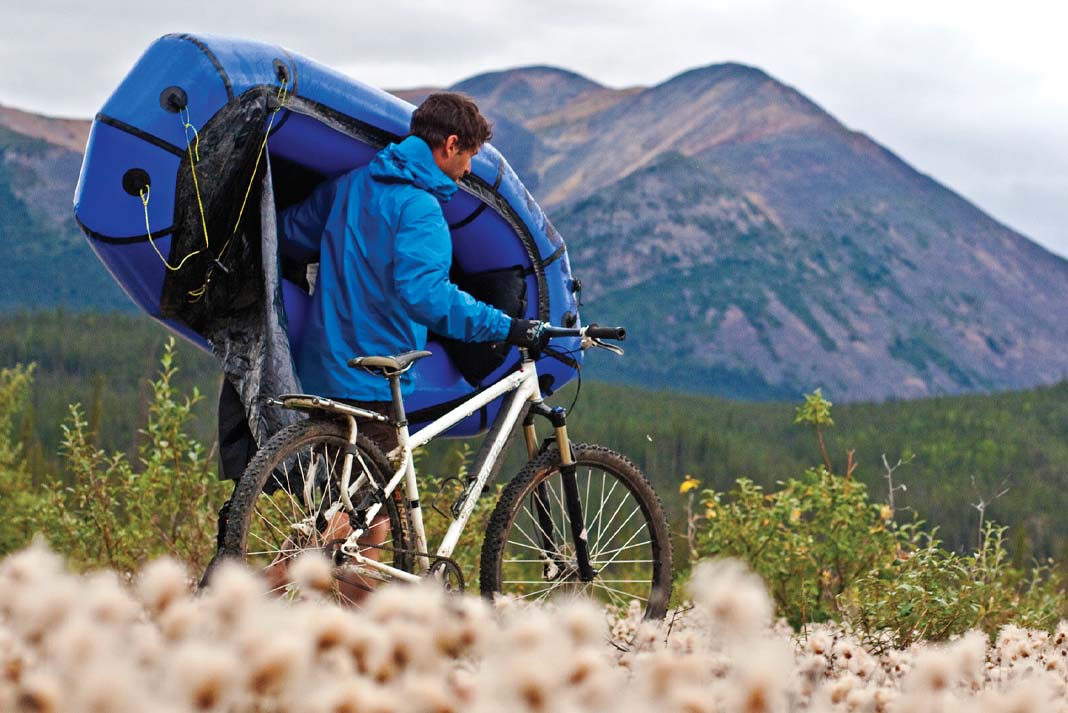
If you could put your seven-pound whitewater boat on your bike where would you go? Before you can go where you could not, hmmm. Yes, to get that last sentence we used the official Yoda-Speak Generator. Herh herh herh.
4 Outfitting
“Gear used to be a big liability,” says long-time ACA instructor Kent Ford of the kayaks he was teaching people to paddle back in the 80s. “The worst part was that the boats didn’t fit larger people, and nearly everyone was tippy because outfitting forced the knees close together—it was like paddling a tightrope,” says Ford. “Even the first plastic boats, the Dancer and Mirage, had terrible outfitting.” These days outfitting is so user-friendly there’s no excuse for having an ill-fitting kayak. The trouble with outfitting today is that it’s so comfortable people don’t take the time to really dial it in. In the little mesh bag lays the secret to greater boat control. No contact (cement) high required. Too bad.
The closer, the better. | Photo: Ryan Creary
5 Live near a river
If you spend more time driving to and from the river than on the water, it’s time to move. And we’re not the only ones who did. River towns are exploding everywhere.
This new rule-of-thumb for rescue gear popped up six years ago and has changed the way we carry our equipment, right? “It can all fit in your pocket and on your person,” says Dan Kirvan, regional manager and Whitewater Rescue Technician instructor at Raven Rescue. Since pulleys and quality ropes have gotten smaller, and PFDs are designed to accommodate this kit, “You no longer have all your rescue equipment in one boat, which is invariably the one that will need help,” says Kirvan.
Selfie game strong. | Photo: Nick Troutman
7 Selfies
Millennials are people between the ages of 18 and 34. Whitewater paddlers are generally people between the ages of 18 and 34. A recent study found that a Millennial may take up to 25,700 selfies in his or her lifetime. If a Millennial paddled 15 weekends per year every year from high school to a mortgage with children, he’d take an average 462 whitewater selfies. So, you are probably wondering, if you didn’t take a selfie on the river did the trip really happen? Yes.
8 Stop paddling harder
“Really, really, really, really inaccurate teaching.” That’s how instructor Andy Convery describes the old school “Power, Angle Tilt,” tool for teaching new paddlers. “We used to say, ‘Go in at 45 degrees to the eddy line. Unless the current is super fast, then go less. Or if the current is super slow, then open up a little more.’ So, what we were basically saying was, ‘just make it up and paddle harder.’”
“Now we look for wave troughs as the gateway of entry to current. The new rule is ninety degrees to the trough. Don’t worry about eddylines or the rocks or the beach or the dog on shore, just look at the trough. When you start using that, you can be very accurate. It’s a tool to develop judgment about how much momentum you need instead of just yelling, ‘Go hard! Go fast!’ which makes people think if they’re not strong, they’re not going to be able to paddle whitewater.”
On the Green River, we’re now 13 seconds faster than we were in 2010. | Photo: Scott MacGregor
9 Paddle faster
The Green River Narrows Race is an annual gauge for advancements in our sport, and race times are sneaking up on the coveted four-minute mark. The 2015 co-champions, Eric Deguil and Dane Jackson, clocked in at a record-breaking four minutes and thirteen seconds, while a total of 60 participants finished in less than five minutes. For some perspective, in ’99 when Rapid was launched, Tommy Hilleke’s time in the open class was five minutes and three seconds in a Prijon Tornado. It’s a little known fact that the Tornado has eight open class wins, followed by Dagger’s Green Boat and Liquidlogic’s Stinger.
Photo: Pascal Girard
10 Bye, bye, American pry
“We used to focus on this perfect, mechanized, robotic forward stroke and what needed to be a super precise, impeccable stern pry,” says long-time open canoe instructor and owner of Echo Paddles, Andy Convery. “Of course, stern strokes in a solo open canoe still have their place, but when should you use them? Only when you absolutely need them. We’ve tried to move away from using them as a crutch because they rob valuable momentum. The goal is to recognize that momentum is hard-fought and maintain it when at all possible. When you’re in control, stay up in the bow and adjust your line with bow strokes.”
11 Enough about sex
We’re past an important tipping point, so read carefully: Ladies charging hard is so much of a thing now that it is not actually a thing anymore. Celebrating women’s accomplishments on the water because they’re women just feeds old-school gender stereotypes. It’s 2016. We’re all paddlers. Move on, please.
There’s a reason certain people clean up at competitions. What do Nouria Newman, Pat Keller and Katrina Van Wijk have in common? Hours and hours running gates. With downriver races growing in popularity, it’s never too late for gates. Green down. Red up.
13 Straps
Before NRS cam straps there was rope and these three knots: bow line, trucker’s hitch and half hitch.
Advocacy 2.0. | Photo: Dylan Page
14 Access
“It’s great to say you’re a conservationist and then go out and huck some waterfalls, but I didn’t want to be that guy who said I stuck up for something and then just jumped in my kayak and drank beers at the take-out,” says whitewater filmmaker Mike McKay, whose films are now largely conservation themed. There have always been hardworking river advocates. Now it’s expected of us to fight for what we love. Talk is cheap, and so is tweeting.
Yes, you should carry a rope and a knife even if you don’t know what to do with them. We’ve evolved past the old argument that rescue gear, in untrained hands, will do more harm than good. Yes, a rescue course is still the best idea, but having basic tools on hand provides options in an emergency and ups the odds that someone will be able to respond. “At the very least, this rule reinforces the moral obligation we have to our fellow paddlers,” writes Jeff Jackson, risk management author and Rapid magazine columnist.
Tyler Bradt holds the world record for tallest waterfall kayak descent with his 2009 drop of Washington’s 186-foot Palouse Falls. Brad McMillan set the open canoe record in 2014 with a descent of Alabama’s 70-foot Desoto Falls. However, it’s not just the world record holders who are going bigger.
“In the early days you never had people arriving [to courses] with intent to paddle the steeps,” says ACA instructor Kent Ford, who’s been teaching kayaking since the ‘70s. “They are obsessed with waterfalls,” agrees World Class Academy teacher Crista Wiles of her students.
The WCA up-and-comers attribute the trend to the fact that big drops are a fairly recent development, so it feels like the next step up in whitewater. “Playboating has been replaced—by many, though not all—with downriver freestyle,” adds Wiles. “Waterfall running is what gets all the glory with kayaking at the moment.” And, to avoid triggering the ongoing is-going-bigger-good-or-bad-for-the-sport debate, let us say that class III is still as good as ever.
Quack. Quack. Splat. | Photo: Ryan Creary
17 Why duckie style is all wrong
You’ve seen it. It goes something like this: The instructor—Mama Duck, as he’s almost certainly referred to himself—runs a simple center entry, makes a wide arc around a rock garden to the deeper left channel before heading to the river right eddy. Mama Duck knows the line. One by one the ducklings follow, getting closer and closer to the rocks until poor duckie number four gets hung up. A pile up on the rocks ensues. The end-of-the-line duckies didn’t stand a chance.
This follow-me approach to teaching whitewater needs to go away. We must end the Duckie Dynasty! Sure, it gets people down the river quickly, but it’s of little service to our students and friends. We used to scout everything so everyone knew the lines. As soon as duckies are following Big Mama, they stop trying to read the water, they stop paddling for themselves, and they stop learning. In this case, the old rule should be the new rule.
18 Go green
From fuel-free stoves to recycled underwear (really), there’s now more outdoor equipment that helps us keep the planet clean.
19 BioLite stoves
Time to replace white gas with teeny twigs. Boil times are comparable to your average camp cooking setup, and these stoves also harness the power of the mini fire to juice up your USB chargeable devices.
20 Goal Zero chargers
Even your headlamp batteries can be rechargeable. Goal Zero chargers are light, portable and weather resistant. Stay charged even on longer trips with the simple power of the sun.
21 Patagonia panties
Patagonia recycles soda bottles, manufacturing waste and worn out garments to make polyester without relying as heavily on petroleum-based products. The result is a light, moisture-wicking fabric perfect for paddling pursuits.
The power of POV. | Photo: Tegan Owens
22 Sponsor me
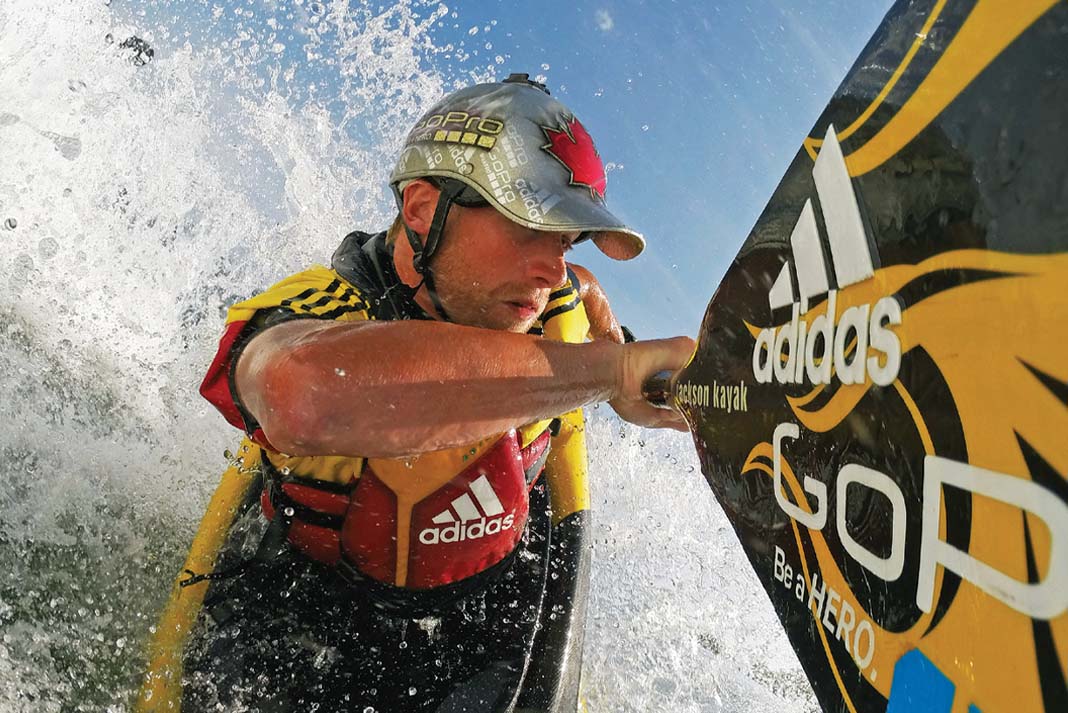
Notwithstanding selfies (above), capturing your life on a POV camera is the way to score sponsorships in the digital age. “Everyone thinks it’s about how big you can airscrew, but these companies might not even know what an airscrew is,” says Nick Troutman, who appears heavily branded by GoPro, Jackson Kayak and Adidas in just about every photo you see of him. “It’s not as much about skill level as it is about what you can bring to the table for a company,” says Troutman. “It is a bit tedious to keep it going when I’d rather just be kayaking or spending time with my family, but it’s a job I’m very willing to do to be able to kayak as a career.”
Photo: Courtesy Vector Wero Whitewater Park
23 Paddle parks
The very first man-made whitewater run in North America was created in 1966 in Kernville, California. A flood had destroyed the Kernville Bridge and the Army Corp of Engineers made a channel to flow around. The late Tom Johnson didn’t want to see the paddling go away so he worked with paddlers and fishermen to construct wing dykes to create eddies.
There are now dozens of dam release, flow diversion and city tap waterfed courses across the continent. Think conveyor rides to the top and bladder-controlled features. The $45 million Oklahoma City project with its raft-in movie theatre opens May 7, 2016. The U.S. National Whitewater Center in Charlotte, South Carolina claims to be the most used and most profitable whitewater venue in the world.
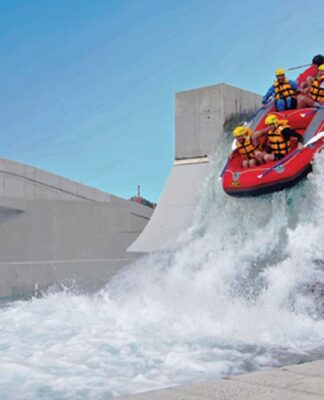
Yeah, but they don’t have waterfalls. Auckland, New Zealand does. Whitewater Parks International just opened the taps at Vector Wero Whitewater Park’s 4.5-meter (15-foot) manmade commercially runnable waterfall.
Spinal Tap’s Marshall amplifiers are not the only things with more volume. A 2001 creek boat review in Rapid had Pyranha’s Micro 240 at 257 liters. Today, Pyranha’s three sizes of their Shiva creeker are 280, 305 and 348 liters. In the same test, Dagger’s CFS creeker held 284 liters. The three sizes of Dagger’s all-new 2016 Nomad are 292, 326 and 363 liters. It may be worth noting that while the Tesla Model S’s volume control knob does go to 11, more volume in contemporary creek boats is better than cranking the parody British heavy metal band’s Hell Hole in an electric luxury sedan. Larger volume creek boats in Hell Hole on the Ocoee River, however, is a whole other kind of spinal tap.
Long live the onesie. | Photo: Ryan Creary
25 It was colder then
It used to be that newbie paddlers froze their asses off in hand-me-down neoprene. Few invested in the Holy Grail of whitewater equipment: the drysuit. Not anymore. We can attribute the drysuit’s rise in popularity, at least in part, to the enormous improvements in quality.
Let’s not forget that early drysuits were urethane-lined nylon—“Big bags with zippers on ‘em,” says Jeff Turner, sales manager at Kokatat. Gore-Tex changed the game in 1989 with waterproof breathable fabrics, and continuous innovation has turned drysuits into tailored-fitting pieces of customized equipment. These days you can even pick color and almost every entry imaginable.
Pyranha’s 9R race machine. | Photo: Anze Osterman
26 Growth
Some 2.4 million Americans, 0.8 percent of the population, went whitewater kayaking in 2014 according to the most recent Outdoor Industry Association’s Special Report on Paddlesports. While these numbers don’t do a great job at illuminating the experience of enthusiasts (those stats include people who tried the sport even once) they do help us broadly gauge the general population’s engagement with whitewater. The numbers represent only marginal growth in participation for whitewater kayaking in the last few years, but have doubled since the lonely days of 2008 when only 1.2 million Americans tried whitewater kayaking. As for open boating? Let’s just say we’re still all on a first name basis. Just the way we like it.
This article was first published in the Early Summer 2016 issue of Rapid Magazine. Subscribe to Paddling Magazine’s print and digital editions, or browse the archives.
Destination: anywhere. | Feature photo: Ryan Creary
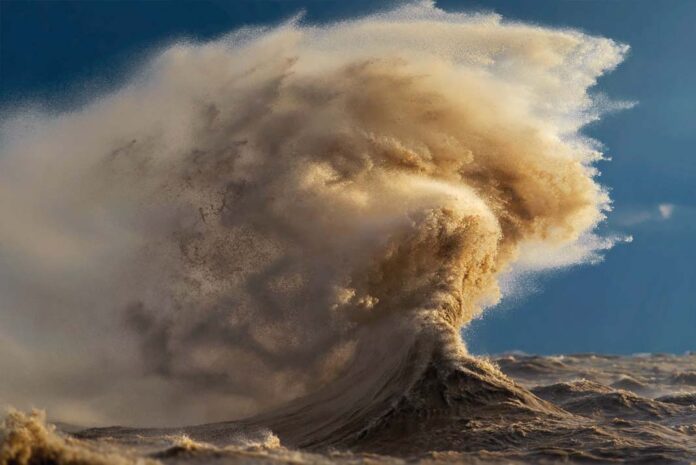
With warm, breezy sunshine a distance memory, autumn’s dark, cold and windy days transform the Great Lakes into wild and churning frenzies. Mariners refer to these winds as the Witch of November, testament to the gales’ often devastating wickedness. On Lake Erie—the shallowest of the five Great Lakes with an average depth of just 62 feet—treacherously steep waves form, responsible for some 2,000 shipwrecks.
Last fall, I took a break from professional sports photography to capture the Witch as she raged across Erie’s north shore. The small, lakeside community of Port Stanley is notorious for its powerful rip currents, and the wave pattern becomes extremely erratic here. With air temperatures dropping below freezing at night and daytime highs hovering just above, the town’s sandy shore was vacant as I suited up each day to enter the fray.
Capturing the true size of monster waves 500 feet offshore is about finding the right perspective. Being at water level brings the horizon lower in the frame, giving a more accurate idea of the size and scale of these 25-foot freshwater freaks. Depending on wind speed and direction, I decided if conditions were safe for me to wade into the near-freezing water, or if I should shoot from shore.
Photo: Dave Sandford
Armed with wetsuit, neoprene gloves, booties and hood, I used an Aquatech waterproof housing to shield my Canon EOS-1Dx and telephoto lenses—a 70- 200mm and a 400mm—from the elements. Being tossed around as if in a washing machine, and sandblasted by wind gusting to 60 miles per hour, made this shoot both physically and mentally demanding.
Leviathan waves rise and explode in the blink of an eye. Coping with the cold for up to eight hours a day, waiting for these fleeting moments, takes a great deal of concentration, awareness of surroundings and patience.
Waves may look similar, but no two are ever the same. When that beautiful banshee swoops in over the lake next November, I’ll be waiting.
See more of Dave Sandford’s spectacular storm wave images at www.davesandfordphotos.com.
This article originally appeared in Adventure Kayak Early Summer 2016 issue.
Subscribe to Paddling Magazine and get 25 years of digital magazine archives including our legacy titles: Rapid, Adventure Kayak and Canoeroots.


 This article originally appeared in Rapid Early Summer 2016 issue.
 This article originally appeared in Adventure Kayak Early Summer 2016 issue.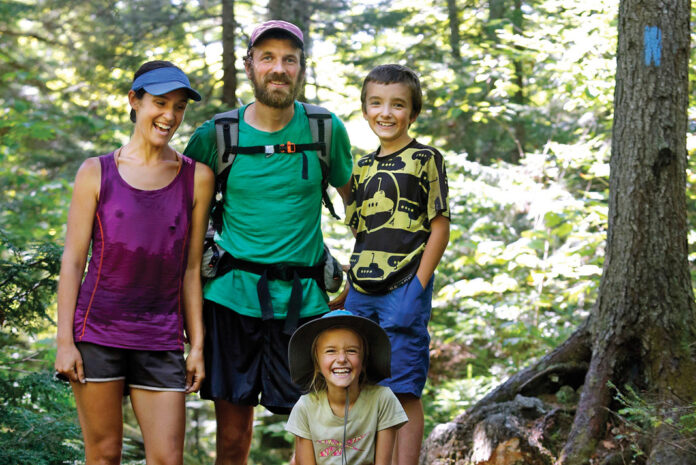
 This article originally appeared in the Canoeroots Early Summer 2016 issue.