Home Blog Page 252

Visionary Design Announced for Canadian Canoe Museum

Visionary Design Announced for Canadian Canoe Museum
— The following is a press release from the Canadian Canoe Museum —
 
Members of the Architect Selection Committee and the Board of Directors of the Canadian Canoe Museum are proud, honoured and excited to announce that visionary architects heneghan peng Architects (Dublin, Ireland) and Kearns Mancini Architects (Toronto, Ontario) have won the international competition for the new $45-million Canadian Canoe Museum to be located at the majestic site of the 1904 Peterborough Lift Lock National Historic Site.
 
An elegant, serpentine glass pavilion graced by a two-acre rooftop garden has been selected as the winning design in the two-stage international competition. The design to house the world’s largest collection of canoes and kayaks presents a Canadian game changer that organically and boldly curves out from the drumlins beside the Trent-Severn waterway. Envisioned with and for the community, the museum embraces aboriginal wisdom to live and build lightly on the land.
 
The Irish-Canadian design team brings to the Canadian Canoe Museum its rich experience in the design of high-profile museums and visitor centers in Toronto and around the world. Heneghan peng’s competition-winning Grand Egyptian Museum is currently being constructed in Giza, Egypt at the foot of the Pyramids. Their stunning Giant’s Causeway Visitors’ Center in Northern Ireland folds its dramatic geometry into the hill above unique basalt stone cliffs at a World Heritage Site. Kearns Mancini Architects work includes dynamic university buildings in Canada as well as the award-winning Fort York Visitor Centre that inserts a powerful Cor-ten steel and glass volume below the Gardiner Expressway in Toronto.
 
The heneghan peng/ Kearns Mancini submission stood apart from the other submissions as the design works organically with the land rather than overwhelming it. In an era of climate change, its intelligence on sustainability impressed the design jury in many ways, not only for its geothermal heating/cooling and reduced energy costs. The embedded design has inherently lower operating costs with only the east and south glass walls exposed to the elements.   Inside, the 80,000-square-foot single floor design offers a flexible floor plate, allowing the Museum to adapt to changing expectations and technology over time through the ability to reconfigure the Museum experience and offerings by changing internal partitions.
 
The organically-shaped volume banded on its top edge with local hardwood is embedded within the site’s drumlins, allowing the museum’s light-sensitive collections of historic birch bark canoes that date back to the 1780s and aboriginal artefacts to enjoy energy-passive, naturally dark spaces. The museum’s stunning two-acre green roof will provide the community with the possibility of creating edible gardens, native flower pollinators and aboriginal three sister plantings while facilitating efficient management of storm water and fantastic views to the Lift Lock.
 
“The design looks forward to the importance of sustainability, respect and responsibility as we move forward as a Nation to the Sesquicentennial in 2017, and beyond,” says Richard Tucker, executive director of the Canadian Canoe Museum. “The design speaks to the importance of the contents, programming and messages conveyed by the Canadian Canoe Museum and its craft to all Canadians.”
 
The Architect Selection Committee is chaired by Lisa Rochon, Senior Fellow, Global Cities Institute, University of Toronto and formerly the award-winning architecture critic for
The Globe & Mail. The Selection Committee included Chief Williams of Curve Lake First Nation, representatives from Parks Canada, the City of Peterborough, business leaders and museum staff.   Members met over several months to hear presentations from the five short-listed teams, and to give serious consideration to all of the exceptional designs during meetings at the Canadian Canoe Museum and at Curve Lake’s Business Centre.

 
During the spring of 2015, the Canadian Canoe Museum was honoured to receive over 97 high-quality Stage 1 submissions from leading firms located all over the world. From that elite group of submissions, five leading firms were selected to submit designs for consideration by the Canadian Canoe Museum based on a 300-page design brief that laid out in detail the requirements of the Canadian Canoe Museum, Parks Canada and the City of Peterborough including First Nations, environmental, operational, functional, heritage, programming and planning considerations. Short-listed teams submitted their schemes mid-August, 2015.
 
As an enhancement to the rigorous review by the Architect Selection Committee, the submissions underwent a dynamic and instructive community engagement which included a popular public presentation by the competing architects in September at the existing Canadian Canoe Museum, as well as on-line media polls, emails, and letters.
 
The Canadian Canoe Museum is deeply impressed by the detailed thought, scope, creativity and quality of the submissions and the team’s commitment to the process.  All five teams are to be recognized, commended and lauded for their achievements in this competition.
 
There will be a public presentation of the award of the contract to heneghan peng Kearns Mancini team held at the Canadian Canoe Museum at a date to be announced.   We encourage the public, volunteers, members and staff to come out and meet the design team and share their aspirations for new programming at the Museum.
 
In accordance with the Memorandum of Agreement signed in 2015 between Parks Canada and the Canadian Canoe Museum, the design team will immediately move ahead with preparing a planning submission to the City of Peterborough and Parks Canada as the first step towards the construction of the new Canadian Canoe Museum.  The Canadian Canoe Museum will continue to ramp up the capital investment campaign that will be necessary to fund construction of the new museum building on the contributions from the City of Peterborough and Founders that have supported our success to date. 


Workshop Confessions: What It’s Like To Build A Pygmy Kayak

woman works on building a Pygmy Murrelet kayak in a workshop
The author’s Pygmy kayak begins to take shape. | Feature photo: Virginia Marshall

Surviving self-doubt, limited skills and a busy schedule Adventure Kayak’s intrepid editor and rookie boat builder, Virginia Marshall, learns that bringing a wood kayak into the world takes passion, persistence and above all, patience. Which, as it turns out, is not her strongest suit.

What it’s like to build a Pygmy kayak

“I really believe John Lockwood is the best kayak designer in the world,” boat-building instructor Dan Jones proclaims on the first day of the Pygmy kayak workshop I’ve traveled to southeastern Ohio to attend. “His boats just work.”

Jones’ praise for Pygmy Boats’ 73-year-old founder and designer is a sentiment I’ll hear him repeat to the stream of appreciative visitors who drop into the workshop throughout our six-day course. Jones, 71, should know—he’s assembled 14 of Pygmy’s wood kayak kits himself and assisted friends and students with a dozen more.

So I’m surprised to learn he’d never paddled a kayak before building his first Pygmy—the Queen Charlotte, a higher volume tripper with the lines of a traditional Greenlandic skin-on-frame kayak—in 1989 while living near the Maine coast. After slipping it into the frigid Atlantic to quietly explore among fog-shrouded archipelagos, Jones was hooked.

The Queen Charlotte stayed behind with a friend when Jones moved west to Marietta, Ohio, but more Pygmys soon followed.

Heading south beyond the sprawling congestion of Cleveland and Columbus, I climb into the verdant hills and secreted valleys of Appalachia and roll off the I-77 into historic Marietta, a town of around 12,000 founded in 1788 by veterans of the Revolutionary War.

I meet up with Jones and his partner and co-instructor, Teresa Griffith, 59, out front of our unconventional workshop—a former J.C. Penny downtown department store. Just down the block, the Muskingum River slides lazily past leafy, redbrick streets lined with immaculate Victorian homes. In the dusty, disused accounting offices on the second floor, tall windows stream sunlight into a long room containing twin worktables and the piles of plywood sticks that I and one other student will transform into kayaks.

exterior shot of a Pygmy kayak under construction with Gorilla Tape holding it together
Gorilla Tape replaces many of the wires typically used in stitch- and-glue construction. | Photo: Virginia Marshall

Build a boat on your own, or with a workshop

For about half the price of a premium plastic kayak—or a quarter the cost of a comparably lightweight, high-performance composite boat—Pygmy kayak kits include pre-cut, plantation-grown African mahogany plywood panels, swaths of silky fiberglass cloth, coils of wire, jugs of epoxy, bags of wood flour, latex gloves, syringes and a 46-page instruction manual.

The only other tools Pygmy’s comprehensive builder’s guide promises I’ll need for the job—drill, file, wire snippers, pliers, hot glue gun, clamps, sandpaper, masking tape, utility knife, paint rollers and foam brushes—I assemble from neglected corners of my basement, closets and kitchen drawers.

Most Pygmy paddlers are reasonably enterprising individuals with the gumption—builders need not have any woodworking experience, everyone I talk to is quick to point out—to tackle the 80- to 100-hour commitment of building a stitch-and-glue kayak on their own. Many folks diligently cobble together months of evenings and weekends to complete these masterpieces. Helpful staff at Pygmy’s oceanfront headquarters in Port Townsend are only a phone call away should builders run into difficulty as their kayaks take shape in basements, garages and home workshops.

For perennial procrastinators, however, or those who are nervous about building a kayak on their own, Pygmy began offering weeklong workshops at Port Townsend’s Northwest Maritime Center in 2010. The classes, which are limited to six participants, have sold out for the last five years.

Laura Prendergast, marketing director at Pygmy, says students come from many different backgrounds, from teachers and truck drivers, to doctors and do-it-yourselfers who love the idea of a rewarding vacation where they come home with a kayak.

“For a lot of people, joining a class removes their fear,” she explains. “We’ve found the typical incubation period from when people learn about our kits to when they actually build a boat is about four years. But with the classes, we’ve had people learn about us for the first time and say ‘sign me up’ that day.”

When I heard that Pygmy had expanded the workshops for 2015 to include venues in Maine, Florida, Oregon and Ohio—and that Jones, who loaned Adventure Kayak the lovingly crafted Pygmy Murrelet to review, would be teaching the Marietta class—I called Prendergast and registered without hesitation.

“You don’t need any skill to build these boats, just patience,” Jones told me on our first fateful meeting. “If I can do it, anyone can.”

Since Lockwood launched Pygmy Boats from his garage in Port Townsend, Washington, in 1987, his designs have multiplied and diversified to include a fleet of 22 different kayaks, a wood canoe and a wherry rowing boat. Each promises the resourceful self-sufficiency of its creator. Lockwood, a nomad turned anthropologist-computer programmer turned boat designer, built his first stitch-and-glue kayak in 1971 after a five-month stint living off the land in a homemade teepee on the wild shores of British Columbia’s Queen Charlotte Islands.

Front of a fancy house with flags hanging in Port Townsend, Washington
History… | Photo: Virginia Marshall

The story behind Pygmy Boats

It may be the more-fantastic-than-fiction trajectory of Lockwood’s life, as much as the allure of wooden boats, that captured Jones’ imagination, and mine. After several years of wandering the world’s wild places, first as a young itinerant and then serving in the military, Lockwood’s peregrinations ended abruptly in 1967 with a fall at a construction site, resulting in a shattered hip and a long-term dependence on crutches.

Four years later, armed with a Harvard education and a Klepper folding kayak—and seeking escape from academia, increasingly crowded wilderness and the limitations of his injury—Lockwood landed in the remote Queen Charlotte archipelago. The wood kayak that he built was light and tough to enable dragging over the islands’ barnacle-encrusted shores while hopping on his good leg.

The story might have ended there were it not for a decade-and-a-half journey that lead Lockwood south to Seattle, into the offices of IBM and Boeing as a computer programmer, and finally back to the water when he developed cutting-edge software for naval architecture. With this powerful tool, he could also design precision-cut plywood hulls on his personal computer. Lockwood sold three Queen Charlotte kits in 1986; a year later Pygmy was born and he shipped 45 kits to the company’s first crop of would-be builders.

Building a Pygmy boat

My first day in the workshop, I discover that I’m not quite as handy with a carpenter’s square, or as hopeless with a block planer, as I’d imagined. I’ve misused the former with some frequency, but I’ve never used a planer before beveling the edges on five of the kayak’s 15 delicate, plywood panels. Wood shavings fall in curlicues to the floor as the deck and hull panels are prepped to fit neatly together at the sheer line.

The 17-foot-long panels flop off either end of the table and must be carefully supported at this stage. “It’s the wood that gives a boat its shape and beauty,” says Jones, but four-millimeter plywood on its own is not particularly robust. “The fiberglass gives a boat strength and the epoxy binds everything together and makes the shell waterproof.”

We’re using Pygmy’s pioneering new Gorilla Tape method rather than the classic stitch-and-glue assembly. Instead of the hundreds of painstakingly twisted pieces of wire used in the stitch method, strips of super-sticky tape placed every few inches hold the panels together before the seams are joined with epoxy. It’s faster, less fiddly and works well for the rapid build of a weeklong workshop.

After putting in a full day in the workshop, I join Jones and Griffith for a tour of Marietta from the water—down to the confluence of the Muskingum and mighty Ohio rivers, and upstream to view the town’s historic paddlewheelers. I paddle Jones’ beloved Osprey HP, his second Pygmy build and still his favorite. The HP is “straight and fast, and doesn’t turn worth a damn,” he tells me, “but I’ve been in the shit in that boat and it performed beautifully.”

The class’s only other student, Richard Webber, is a quiet, fit, 67-year-old who has driven three days cross-country from Boulder, Colorado to build his kayak under Jones and Griffith’s watchful tutelage. He looks surprisingly refreshed.

Webber unpacks his old tools from new Tupperware containers. He builds Greenland and Aleutian paddles in his spare time, he tells us, which he uses for rolling and other traditional tricks. Like me, he’s never built a boat before. Also like me, he’s building the Murrelet 4PD—a performance touring and rolling design that he paddled only briefly at Pygmy’s Port Townsend showroom. He’s unhurried and efficient. He says “darn,” not “damn it,” even when he breaks a wire or snaps his third 1/16th bit. My concerns that the class will feel like a race melt away. Even with only two students, the workshop has a collaborative feel rather than a competitive one.

Day two brings the new challenge of working with epoxy. With eight long strips forming the multiple chines and shallow V, my hull actually resembles a boat now—an overturned half-boat, but a vessel nonetheless. We mix epoxy thickened and fortified with wood flour and shoot the seams using dental syringes.

At day’s end, I’m cross-eyed and head sore from nine hours of focusing on seams six inches from my face. My feet hurt. But nobody complains. We’ve joined what Griffith calls the Pygmy cult—building these boats feels like a privilege, no matter how painstaking.

I’ve been in love with the Murrelet’s lines since I first laid eyes on Jones’ boat two-and-a-half years ago: the sweeping bow, the cutaway front deck, the way the rear deck scoops gracefully down behind the cockpit for effortless rolling.

Jones describes assembling the Murrelet’s intricate cockpit area as a “wrestling match,” but it flows together nearly seamlessly. Pygmy kits don’t require the wood to be tortured—bent or manipulated into form—but instead fit perfectly together like puzzle pieces. And like Lockwood’s designs, the panels are almost miraculously well engineered.

By day three I have a full boat, but the accomplishment is temporary. Tomorrow we’ll remove the deck to complete interior work, then put it back on (then take it off again). Each step is logical, methodical, necessary. I’m learning boat building involves nearly as much tearing down as building up. I’m learning patience.

The days begin to blur. Our concentration is so absolute, an hour can pass without a word being exchanged aside from brief instructions—or more often, Jones’ Socratic questioning, “What’s the next step?”

On day four, we roll epoxy over the inside of the deck. The resin brings out the manuka honey-hued beauty of the Okoume mahogany’s grain—what Pygmy calls a “bright finish.” Webber mentions maybe painting his hull later for an alternative finish. Sacrilege.

three people apply fiberglass and epoxy to the inside of a kayak deck
Webber, Jones and Griffith apply fiberglass and epoxy to the inside of Webber’s kayak deck.| Photo: Virginia Marshall

Day five’s main event is glassing the inside of the hull. First, however, the interior must be sanded to remove all bumps, divots and ridges. When it’s as perfectly smooth as a still pond, Jones calls in a friend and fellow builder from the Marietta Rowing and Cycling Club to assist with glassing. The fiberglass is a 24-foot-long by several feet wide roll, and it’s slippery as an eel. We drape it over the boat, coaxing it into the keel and chines.

“When you do your outside deck and hull at home, get some friends to help. Make it a glassing party,” advises Jones. “It just makes it so much easier. You want five people: two to roll on the epoxy, two to follow with squeegees and brushes to work out any air pockets, and one to mix epoxy.”

It’s a wonderful vision: the glue saturating the fiberglass and turning the cloth translucent to reveal the golden mahogany. Rollers fly, elbows bump, heads bow and the hull glows. My latex-clad fingers stick to the roller handle. When I try to pass it to someone, I find it’s glued to my hand.

“This is the most perfect inside hull glassing I’ve ever seen,” Jones says when we’ve finished with my kayak. Webber’s face crinkles into a smile. “I thought this was the practice boat,” he teases.

person paddles a wooden kayak from Pygmy Boats in shallow water with autumn reeds behind her
Who wouldn’t want to build (and paddle) this boat? | Photo: Virginia Marshall

Taking it home

One week is just enough time to assemble the kayak’s basic structure. Major finishing steps like sanding and glassing the exterior, cutting hatches and installing the coaming and outfitting must still be completed in students’ basements and garages. Theoretically.

“We should offer follow-up classes for all the folks who take them home and never finish them,” muses Griffith. She cites students and friends who are still tinkering—or procrastinating— six months, a year and two years later.

Inwardly, I worry this will be me. “Well, life gets in the way,” Griffith concedes.

“Then you’ve got your priorities wrong,” Jones retorts, only half kidding.

Webber tells me that he plans to finish his boat as soon as he gets back to Colorado. “I want to paddle it this summer,” he enthuses. I think of all my other obligations when I return home— my priorities will be a juggling act. I hope I don’t drop the ball.

On the last night, Jones and Griffith invite both of us for dinner— delicious New Mexican cuisine, a throwback to Jones’ boyhood in Albuquerque, and Sangria with home-brewed Moscato wine. Over green chili sauce-drenched enchiladas, Jones reviews the steps we’ll follow to complete our boats, adding his own tips and tricks to the Pygmy manual.

Two weeks later, when I hit hour 16 of a marathon sanding session to prepare the kayak for final glassing, I’m wondering—as Webber did in class so many days ago—‘how smooth is smooth?’ This time, I don’t have Jones’ knowledgeable hands to caress the sanded seams and give a pleased nod or shake his head and join me with his own rasp.

Finally, I do the sensible thing. I call Jones for reassurance, then Webber.

Jones is sympathetic but firm. “Scraping the seams is a pain in the ass, it really is,” he admits, before coaching me on tools and technique. I’m starting to feel better.

Webber shares the highs and lows of his own sanding trials—from hours of fruitless hand sanding and resigning himself to hiding the imperfections with paint, to embracing the power sander and finally getting the hull fiberglass- and varnish-ready. “I’m anxious to get it in the water,” he concedes, but like me, he’s learning patience.

woman works on building a Pygmy Murrelet kayak in a workshop
The author’s Pygmy kayak begins to take shape. | Feature photo: Virginia Marshall

Before the course, Webber says he was intimidated by the idea of building a kayak on his own. Empowered by our time in the workshop, he’s pushed past those fears. “But I’m still feeling nervous about this next step,” he confesses.

I now feel much better. We promise to exchange photos of our finished kayaks at the end of the summer.

Joining this workshop, I realize, has brought more than just another kayak into my life—it’s also connected me with a wonderful community of builder-paddlers who, like my nascent Murrelet, I’ll cherish for years to come.

Cover of Adventure Kayak Magazine Fall 2015 issueThis article was first published in the Fall 2015 issue of Adventure Kayak Magazine. Subscribe to Paddling Magazine’s print and digital editions, or browse the archives.


The author’s Pygmy kayak begins to take shape. | Feature photo: Virginia Marshall


Video: Tips and Tricks for Rolling Your Whitewater Kayak

Bombproof your kayak roll in whitewater with these tips from Thea Froehlich, guest instructor at the Madawaska Kanu Centre (owl-mkc.ca/mkc).

Rolling is simple once you understand it’s a combination of hip movement and a sequence of placements of your paddle. Follow these easy how-to’s to get your first whitewater roll, or perfect your technique.

Video: Easiest and Safest Way to Lift and Portage Your Canoe

Learn the safest and most efficient way to get your canoe on your shoulders. Canoe tripping guide Erik Fenkell, an experienced guide at Temagami Outfitters (www.icanoe.ca) in Temagami, Ontario, shows you how.

Sander Jain’s Terrifying Sasquatch Encounter In Clayoquot Sound

Sander Jain paddles in Vancouver Island's Clayoquot Sound before his bigfoot encounter
The dramatic fjords of Clayoquot Sound humble a lone paddler. | Feature photo: Sander Jain

Paddling up the inlet feels like a reverent intruder entering a magnificent throne room. Along the fiord’s steep sides, bald eagles stoically perch on ancient treetops protruding from the fogged mountain slopes. From this high vantage, they stand sentinel, guardians of a sacred place that keeps nature’s secrets…”

I wrote these words in summer 2012, after falling in love with one of Clayoquot Sound’s remotest corners. A pristine region on Vancouver Island’s west coast, the inlet radiates the mystical air of the Pacific Northwest more than any other place I have visited. A dramatic topography covered in an exquisite expression of the ancient temperate rainforest ecosystem, the river valley and adjacent fiord are powerfully humbling.

The wild charm of the place cast a spell over me. After venturing out there on kayak trips and camping in the valley for one or two nights, I knew I would return some day to spend much longer.

Sander Jain’s terrifying Sasquatch encounter in Clayoquot Sound

In early summer 2014 everything seemed to fall into place. I prepared for a stay of one to two months. A solitary, hidden cabin clinging to the vastness of the wild scenery and representing the only human trace in this realm would act as a perfect home base. My intention was to explore the nature of wilderness living, tune in with this region’s pristine air, observe wildlife and sharpen my senses in interplay with the natural world. I wanted to deeply connect to the feeling of being in this place and situation rather than exploring the place itself.

MORNING FOG LIFTS TO REVEAL ANOTHER DAY IN PARADISE. | Photo: Sander Jain
Morning fog lifts to reveal another day in paradise. | Photo: Sander Jain

The spirit of this trip would be quite different from my past wilderness journeys, in that I wasn’t looking to go on an ambitious destination-driven adventure. My aim was simply to see what I could learn from being myself in my favorite wild place.

I found myself heading out into the sound on a sunny morning in mid-July. When the shuttle boat I had hired entered the mouth of the inlet, I felt the overpowering dimensions of the place reduce our human scale to insignificance.

A rustic cabin in the woods

The cabin nestled secretly between the waterline and steep forested mountain slopes behind. I unloaded my kayak and boxes full of gear, waved at the driver and watched his boat disappear into the distance. This had been my dream for two years. I moved into the cabin, settled in and started the simple, rustic, yet very comfortable and gentle way of wilderness living I had imagined.

“I was rudely awakened from my dreams into a nightmare. I sensed
this is what mortal fear feels like.” | Photo: Sander Jain

The cabin was an ideal home base and a safe shelter. The days were sunny, without a single cloud in the sky, the nights starlit and cool. I observed the morning fog lifting off the mountains and the fiord when I awoke, saw the tides roll in and out in front of the cabin, watched the light revealing the many different facets, shades and moods of my favorite place.

In most wild and abundant places, you rarely see the wildlife, although it is there on its elusive missions, defying human understanding. Here, however, bald eagles, kingfishers, gulls, ducks, seals, sea lions and river otters revealed themselves quite frequently. The haunting call of a loon traveled across the water from the estuary in the evening, and often I could hear the deep booming of male sooty grouse resounding from deep inside the mountain valleys.

I paddled to the river estuary each day and evening, quietly sitting in my kayak, observing and listening. After dark, I ate dinner by candlelight inside the cabin, and then switched on my headlamp to write wildlife reports and journal notes. Later, I lit incense sticks to keep the mosquitos away and fell asleep comforted by the solitude of this remote place, so used to echoing back at itself without the attendance of a human witness.

[ Paddling Trip Guide: View all kayaking trips in British Columbia ]

My mind was free of distractions, and time seemed to stretch—four beautiful days of living in the moment felt like weeks. I came to realize that part of the beauty of my favorite place and its appeal to me was its unapproachable seclusion. As much as it was a place of bright beauty, abundance, peace, retreat and serenity, it also carried an obscure air of reticence, inaccessibility, twilit hostility and deep mystery.

I could sense nature’s inexhaustible potential and energy there. It was wild. A place for humans to visit but not to remain.

Boulders rolling in the night

On the fifth day, I lay down for a nap in the afternoon and awoke to the filtered light of early evening. I launched my kayak and went for my customary paddle to the river estuary. When I returned, I noticed the first weather change since my arrival. After dinner, I stepped outside onto the front porch. The clouds were a lid sealing the roof of the fiord and making the standing air close and muggy. In the pitch-black beyond the porch, the night was conspicuously silent. The water was still, there wasn’t a breath of wind, and I couldn’t hear any bird calls or seals catching fish close to shore like the previous nights.

the view outside Sander Jain's remote cabin on Vancouver Island before his bigfoot encounter
A place for humans to visit but not remain. | Photo: Sander Jain

I went back inside and exchanged texts with my friend in Tofino on my satellite communication device. Then I heard a strange sound somewhere in the distance. I stepped back out onto the porch and listened carefully. Yes, there it was again. It sounded as if big rocks or boulders were being turned over or thrown.

It must be a black bear looking for a late night snack in the intertidal zone, I reasoned, or perhaps rocks loosened by the change in temperature falling out of the cliffs. I strained to hear any other clue as to the source. That’s when the strange, owl-like vocalizations started. It seemed like several of them replying to each other from different locations in the distance. Between these sounds was absolute silence.

Half an hour later, the tumbling boulder sounds continued. Brushing my teeth, I tried to convince myself that the periodic silences were peaceful rather than strained. Suddenly, one of the rock sounds erupted with the intensity of an explosion.

It was much closer than before!

My toothbrush nearly fell out of my mouth. My hairs stood on end. Was I not alone? Was there illegal logging nearby? I hadn’t seen any lights, no traces of human activity at all. It couldn’t be, especially not at 11:45 at night. No, I was completely alone in this remote corner of Clayoquot Sound. And I was beginning to feel it.

My instincts told me to retreat into sleep. I had probably just allowed myself to get spooked. I felt almost comfortable retiring to the cozy half-attic under the roof, away from the dark window panes that stared blindly out into the raven-black night from three sides of the cabin. Very soon, I drifted into sleep. The rock sounds and eerie calls continued cutting the silence outside.

“I was rudely awakened from my dreams into a nightmare. I sensed this is what mortal fear feels like.”

I was rudely awakened from my dreams into a nightmare. Fully and immediately present, my eyes opened widely, my breath came to a stop, my heart pounded wildly and I felt a torrent of adrenaline flood my body. I was petrified. My senses had never been more acute. I sensed that this is what mortal fear feels like.

a view of forest and mountains in Vancouver Island's Clayoquot Sound
The Sound is a stronghold of beauty, peace and deep mystery. | Photo: Sander Jain

Loud stomping on the ground right next to the cabin’s surrounding boardwalk shook me to the very core. Each stomp made the cabin tremble. The massive force applied and its rhythmic nature were absolutely intimidating. More than that, they were beyond anything that I could associate with the animals you would usually expect to encounter in these forests.

The stomping was joined by the most horrifying vocalizations— disturbingly erratic and deliberate at once, tribal, not quite like human speech but similar enough to recognize certain elements. It sounded as if something was trying to speak, shout, articulate itself without quite mastering the language.

It is our senses that are the primary knower of truth and not our mind. Even before my brain jumped in with a thought, my senses understood the message: Clear out! Go away! Leave! We are here! You cannot be here!

I suddenly yearned to start a life in the city and work in the safe boundary of an office, drawing a heavy curtain around everything that is wild.

After several seconds of this turmoil, I heard them leave with emphatic steps. Two bipedal creatures erratically running off with tremendous speed and agility, each footfall causing the ground and the cabin on it to tremble.

I pressed my hands against my ears as hard as I could. I wanted to seal off my senses. I hid under my sleeping bag in the darkness, every muscle in my body strained, fully covered in cold sweat. For the next few hours I remained frozen, still pressing my hands against my ears and vowing that I would leave as soon as the light of dawn released me.

Man sitting at table in a cabin reading a book by headlamp.
You are not alone. | Photo: Sander Jain

Getting on the first flight out

My love of adventure stems from challenging situations that make me present in the moment, but this experience was way too visceral, and my passion for adventure faded in those moments. I suddenly yearned to start a life in the city and work in the safe boundary of an office, drawing a heavy curtain around everything that is wild.

That night I tried to send 17 messages on my satellite device, daring only to lift one hand to text my friend 55 km away: “I NEED A PICK UP RIGHT AWAY. PLEASE SEND A FLOATPLANE!!!”

Of course, I didn’t have a clear view of the sky from my hideaway under the roof. Still, I prayed that the messages would somehow send through the tiny air circulation window under the gable. I couldn’t imagine moving to a more exposed spot.

As dawn slowly seeped into the cabin, I carefully allowed my ears to listen again and my eyes to see again. I tentatively climbed down the ladder into the main living area and started packing the most necessary things into a few immersion bags. The floatplane wouldn’t be able to transport all my gear, but I didn’t care about leaving things behind.

I didn’t dare look outside.

Finally, I received a message back from my friend: “I’m on my way down to the dock. I’ll send you a floatplane!” An hour later, I heard the plane descending into the gigantic scenery of the fiord. I stepped outside into the overcast morning without turning back or looking around the cabin, walked down to the water and caught the pilot’s attention with my red rain jacket.

“How are you doing?” the pilot asked, searching my face for clues.

“I’m alright,” I lied. “Just didn’t feel safe here last night. The ground was shaking and I heard the sounds of moving boulders. Might not be a good thing to be trapped in this spot in case of an earthquake or landslide, right?”

There was no way I could tell him the truth without seeming crazy. But he pressed me, curious to learn more about the sounds I had heard. I described them more precisely.

“Hmm, that sounds like Sasquatch to me,” the pilot offered. “I hear stories from people up around here who see them turning over boulders on the shoreline.”

The dramatic fjords of Clayoquot Sound humble a lone paddler. | Photo: Sander Jain
The dramatic fiords of Clayoquot Sound humble a lone paddler. | Feature photo: Sander Jain

Later, my friend in Tofino would echo the pilot: “I guess there’s a reason why the First Nations call that place Home of the Sasquatch.”

The plane turned down the fiord, picking up speed and lifting into the cloudy Clayoquot morning. We flew over the dense and mysteriously fogged forest cloaking the inlet’s mountain slopes. For the first time, I saw the waters, mountain ranges, cliffs and river valleys of my favorite place from the air. I couldn’t peel my eyes away. A mere four hours before it had taught me what real fear is, and now I fell hopelessly in love with it all over again.

Sander Jain is an outdoor photojournalist with a focus on wilderness, natural history and conservation topics. His work has appeared in GEO, explore, Adventure Kayak, Natural History Magazine and Kanu

Cover of Fall 2015 issue of Adventure Kayak MagazineThis article was first published in the Fall 2015 issue of Adventure Kayak Magazine. Subscribe to Paddling Magazine’s print and digital editions, or browse the archives.


The dramatic fiords of Clayoquot Sound humble a lone paddler. | Feature photo: Sander Jain


Winter Gigs

All photos this page: Annabell Plush
Winter Gigs

“What are you tree people doing?” the woman peering in the window of our colorful trailer asked. She took in the multi colored prayer flags, the bright yellow curtain blowing lightly in the breeze from an open window, and my expensive coffee grinder (I believe everyone gets a luxury).

“We’re being tree people!” I reply, to her confused look.

Of course she’s confused. Every year, a week before Thanksgiving, groups of Carhartt wearing men and remarkably strong women take up residence in tiny trailers in parking lots of grocery stores and hotels across the nation. Our forearms get covered in sap as we hustle Christmas trees for four weeks to make the money needed to travel for months. We tell tales of kayaking in South America all winter: “Winters? What are those? We chase an endless summer.”

Screen Shot 2015 12 22 at 9.26.31 AM

As long as I’ve been kayaking, even before I became a “dirt bag”, I heard stories of the fabled “trees”: a side gig most kayakers have had at some point to fund travel.

People like Brad McMillan, who holds the world record for an open boat descent, have been working this gig for nine years. He started out selling trees on a lot, then began doing the behind the scenes work. After a couple years he made his way up to managing the shipping and receiving end. In the past he’s used the funds he makes working trees to compete at events like the Teva Mountain Games. This year he plans to use his money for a Grand Canyon trip with his girlfriend and then return to school in the spring.

This year Rowan Stuart worked on our lot. She flew in from where she had been competing in the United Kingdom on Thanksgiving Day to work for a little over a week. We squeezed her onto a shelf in the back of the trailer, and displayed her First Place trophy in the window.

Screen Shot 2015 12 22 at 9.34.27 AM

Trees are hard work, but don’t get me wrong, we make the most of it. We transform stark work trailers into warm, cozy living places, with rugs we roll out at night and pictures on the walls, torn from travel magazines, of the trips we pine after. Once the lots slow down for the night, we gather in the small living space. Empty milk crates turn into game tables, beer flows abundantly, and a couple times a week we all pitch in for a family meal made in our cast iron skillet.

We swap stories from the day, telling each other about the artist who came looking for the “ugliest tree on the lot”, or the couple from Canada who argued in Romanian over stands. As the night winds down, we roll up the carpet, sweep the floors and begin pulling down beds from where they’ve been stashed during the day. Settling into our somewhat lumpy air mattresses and Paco pads in our various perches, we rest our bones and get ready for another day. In a few shorts weeks, we’ll be headed to Ecuador and the Grand Canyon for the winter, where crystal clear waters will reward us as pay off for the weeks we spend living in parking lots. 

Video: How To Repair Gelcoat

Photo: courtesy Nova Craft Canoe
A man stands beside a red canoe making repairs to the exterior hull.
[iframe width=”560″ height=”315″ src=”https://www.youtube.com/embed/fQOA4ILZ9Cw” frameborder=”0″ allowfullscreen ]

This video from Nova Craft Canoe shows you how to do a simple gelcoat repair.

The canoe in the video is made from Aramid Lite, but the same technique can be applied to any composite canoe with a gelcoat finish including fiberglass, TuffStuff, TuffStuff Expedition, and Blue Steel.

The Man Who’s Been Mapping Manitoba’s Canoe Routes Since 1962

man's hands drawing a map
Feature photo: Mike Deal/Winnipeg Free Press

He’s a local treasure, mapping a labyrinth of canoe routes that crisscross Manitoba, and inspiring countless paddlers to discover the wilderness via river byways. Many consider Réal Bérard’s hand-drawn maps to be works of art. Not intended as navigational charts, each is annotated with Bérard’s illustrations, old trapper songs, botanical notes, recipes, historic anecdotes, biographies, as well as markings for every waterfall, rapid and portage—measured out in paces like the Voyageurs—along Manitoba’s rivers.

Réal Bérard: The man who’s been mapping Manitoba’s canoe routes since 1962

man's hands drawing a map
Feature photo: Mike Deal/Winnipeg Free Press

“When I first put my hands on one of his maps, I was transported to the rivers,” says Jonathan Berger of Philadelphia, author of the extraordinary Canoe Atlas of the Little North. “His drawings give me my aesthetic lens through which I view the North.”

Bérard got his route mapping start when he snared a summer job with Manitoba’s Department of Natural Resources in 1962. That season his supervisor sent him and two others on a 500-kilometer canoe trip.

[ Paddling Trip Guide: View all paddling adventures in Manitoba ]

From notes and sketches to full-fledged maps

It was a dry summer and the canoeists were ostensibly to help extinguish any forest fires they came upon. The trip took a month, ending at the mouth of Berens River at Lake Winnipeg. They never saw a single forest fire.

In those days, conservation staff was required to keep daily logs, which Bérard dutifully did. A few years later, with Bérard now a full-time employee, the supervisor asked him to make a canoe route map from his notes and drawings, as a way of encouraging people to experience Manitoba’s wilderness.

Bérard made his first map, and filled in the margins with local lore and history. He continued mapping waterways for the province for the next 20 years, producing 13 maps to date. They include dominant rivers like the Assiniboine and Winnipeg, and well-known canoeing routes like the Bird and Manigotagan rivers. Most have a central theme specific to that area, exploring native culture or the fur trade for example.

Pencil—and paddle—still in hand

A full-time artist since 1990, Bérard’s other artistic endeavors include being an award-winning ice sculptor. He has also been the political cartoonist for 30 years at La Liberté, a weekly Francophone newspaper in Manitoba.

And he still canoes. Last year, Bérard, 79, and a friend, an 82-year-old trapper, paddled for a week on a loop that starts on the Nelson River in Northern Manitoba. He is currently making a map of the little-known route, which is an easy trip, accessible by road and without rapids.

“When I first put my hands on one of his maps, I was transported to the rivers.”

When asked if he isn’t a little old to be making such treks, he responded in his characteristically unconventional way: “I’d rather be eaten by wolves and ravens, than by maggots.”

Order Réal Bérard’s maps from Paddle Manitoba.

Cover of the Fall 2015 issue of Canoeroots MagazineThis article was first published in the Fall 2015 issue of Canoeroots Magazine. Subscribe to Paddling Magazine’s print and digital editions, or browse the archives.


Feature photo: Mike Deal/Winnipeg Free Press


Meet The Survivors: Celebrating 7 Tales Of Extraordinary Comebacks

man stands at water's edge with a kayak in dramatic cloudy lighting
Rather than turning his back on the water, Paul was inspired by his father’s love of canoeing and kayaking to pursue life with a paddle in hand. | Feature photo: Steve Rogers

From a paddler trapped underwater and a river so polluted it literally caught fire, to creatures and craft rebounding from the edge of extinction, we celebrate seven tales of extraordinary comebacks.

Meet The Survivors: Celebrating 7 Tales of Extraordinary Comebacks

man stands at water's edge with a kayak in dramatic cloudy lighting
Rather than turning his back on the water, Paul was inspired by his father’s love of canoeing and kayaking to pursue life with a paddle in hand. | Feature photo: Steve Rogers

1 Bereaved

Paul Kuthe keeps paddling past tragedy

Paul Kuthe lost his father to a heart attack on the river while whitewater kayaking together. He was just 12. Rather than turning his back on the water, Paul was inspired by his father’s love of canoeing and kayaking to pursue life with a paddle in hand, from class V West Coast whitewater, to the endless surf of Oregon’s Shi-Shi Beach.

Trapped in his kayak underwater, Rowan Gloag finds time stands still
Gloag’s struggle didn’t look like much above water, but below the surface it was a very different experience. | Photo: Jordan Manley

2 Stuck

Trapped in his kayak underwater, Rowan Gloag finds time stands still

Forty-seven seconds doesn’t seem like a long time, but it felt like an eternity that day.

It was late October and I was in Tofino with friends for our annual autumn surf trip. It was a classic West Coast fall day—cold, wet and windy. Usually, I love these days but today was different. I was frustrated, things were not going my way. I had already endured countless beatings, broken a paddle and nearly swam.

Common sense should have told me to give up and go in for a beer. But I was too frustrated to quit, and despite being tired, I stormed back up to our camp, grabbed a new boat, and headed back to the grey and cheerless beach.

It took me five minutes of shifting and squeezing to force myself into the small, plastic surf boat I had hastily selected. I paddled back out through the breakers to try and regain some kind of control over my day. Nothing changed. The first wave ran me over. After a few more beat-downs, I realized that my head just wasn’t in it, I wasn’t focused, and I needed to get off the water. So I headed in.

With fixed fins mounted in the hull of the surf boat, I couldn’t run it up on the beach. I paddled into waist-deep water, popped my skirt off, put my hands on the coaming and pushed…nothing. There was no movement at all. I was stuck. As I pushed again, I felt a wave lifting the stern. I reached down to grab my paddle but it had vanished. It must have slipped off my boat while I was struggling to free myself and now it was gone. The wave picked me up, dumped me on my side and I capsized.

I pushed harder. Still nothing. I pushed again, nothing. I reached down with one arm and pressed off the sand to catch a breath. The boat started to fill with water as I slipped back under. I pushed with everything I had. I could hear my groans vibrating in my head under the water.

I reached for the sand again, pushed and came up for a half-breath. Now I could feel my fingers dragging ineffectively along the bottom, losing traction as I was pulled out to sea. I lost my grip on the sand and slid under a third time.

Now I fully understood the severity of my situation. If I couldn’t get out now, I wouldn’t get another chance. Seawater would flood my lungs and I would drown just a stone’s throw from the beach.

I pushed with every ounce of strength and desperation. My hips slid a bit as my right knee twisted painfully. It hurt, but it was working. Feeling the tissues in my knee starting to tear, I gave a final determined push and popped free.

I took a ragged, grateful breath and looked around. It was still raining, still grey; my friends were still enjoying the surf. I felt strangely calm—neutral, not happy, not sad, just calm. Kim and Whirlson were on the rocks filming. As my eyes caught theirs, my friends yelled out, “What are you doing?”

Couldn’t they see the chaos? Didn’t they know what had happened? What had very nearly happened? I didn’t know how to respond. So I yelled back, “Going in for a beer.”

When I got home I reviewed the footage of the trip and there it was… 47 seconds of me splashing around in waist-deep water. The video didn’t look like much, just the hull of my kayak shifting around in the surf. But I can tell you this: it was a very different experience below the surface.

Forty-seven seconds doesn’t seem like a long time, but it was nearly an eternity that day. —Rowan Gloag

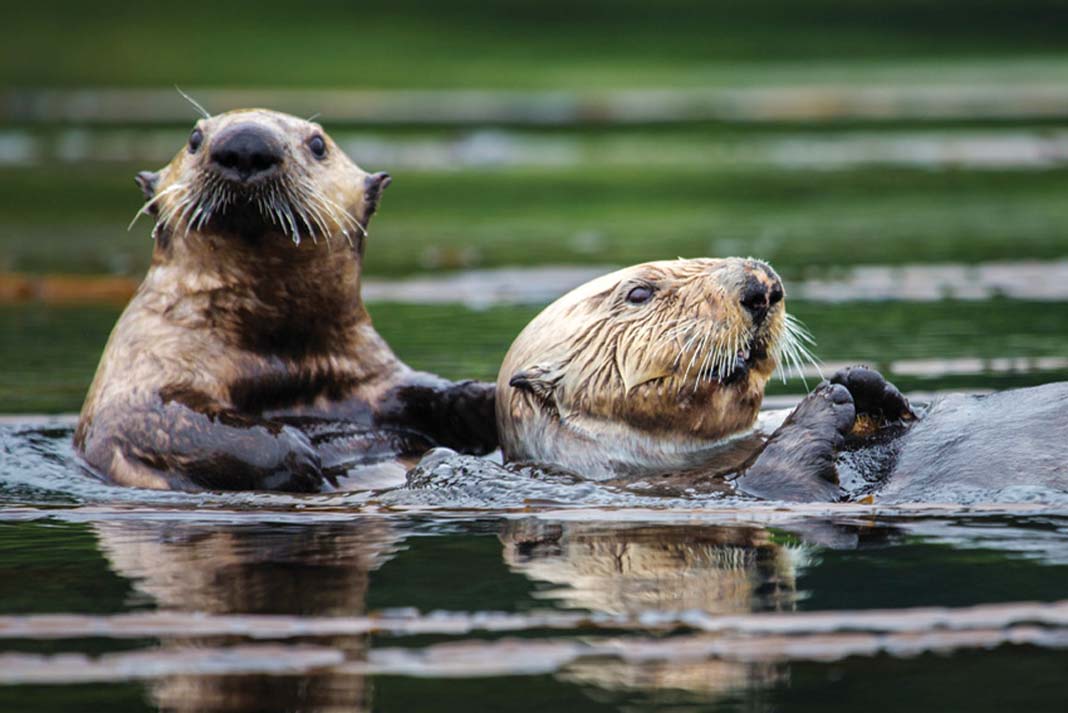
sea otters float on the water's surface
Saving the sea otter has triggered a positive chain reaction in a finely balanced ecosystem. | Photo: Timothy Wills-DeTone

3 Endangered

Sea otters rally from edge of extinction

Environmentally speaking, our species is not doing well. In the past four decades, half of all the wildlife on earth has vanished; there’s talk of us triggering the planet’s next mass extinction.

There is now hope we can turn things around, and good reason to try re-wilding the earth. Witness the remarkable return of sea otters to the Pacific Northwest, where the luxuriously furred creatures are rebounding in a relative jiffy. From a North American population of 300,000-ish when Captain James Cook started trading pelts on Vancouver Island in 1778, the cuddly mammal that shucks shellfish on its belly was hunted to near-oblivion. By the 1920s, otters were almost completely wiped out from California clear to Alaska and the global population plummeted to fewer than 2,000.

Hopeful biologists reintroduced small numbers of otter in the late ‘60s, and with legislation to stop hunting and the coastal environment still relatively pristine, the new couples proliferated quickly. At last check, British Columbia populations had rebounded to 5,000; in Alaska, 12,000—and rapidly counting.

But there’s more, thanks to the sea otter’s linchpin role. Saving the otter triggered a chain reaction. Otters eat sea urchins, urchins eat kelp, and kelp is the basis of a finely balanced ecosystem. The wild West Coast as we know it isn’t how it’s supposed to look—it’s an urchin barren, a dead zone where unchecked urchin populations have clearcut the kelp forests.

Bringing back the otter puts the urchin back in its place. The kelp returns along with all the fish, animals and birds right on up the food chain to soaring bald eagles. By fixing our otter mistake, we’re gradually flipping the on switch for a complete near-shore ecosystem.

Bonus: we’re also making a friendlier environment for ourselves. Because as any open coast paddler knows, kelp helps dampen the waves. —Tim Shuff

4 Forgotton

The kayak is our sport’s greatest survival story

Before there was land, there was water. Before there were creatures that walked, they paddled about. Before the wheel, there was the boat. For those of us born pre-digital, there is deep comfort in a basic tool that is fundamentally unchanged from something in Grandpa’s shed, or his great-grandpa’s distant memory.

When the first restless, striving Europeans brought the wonders of the modern world to indigenous peoples, our neighbors in the North already had this marvelous craft called a kayak. Born of a watery planet and an elemental need to move, it’s an idea as old as fire and wood, sinew and skin. The aquatic equivalent of walking, perfectly calibrated to the speed of thought.

[ Browse the widest selection of boats and gear in the Paddling Buyer’s Guide ]

Like popcorn and chocolate, potatoes and peanuts, the first peoples gave us this happy invention. It takes us to dream places, relaxes us from the world our anxious genius has wrought, and cradles us like Moses when that world fails.

The kayak has floated since time immemorial. Then, suddenly, it declined when its inventors and their traditional way of life were decimated. Remembered and cherished by a few, and later embraced by recreationists, it’s now been on the upswing for half a century. Consuming nothing to operate, depreciating slower than inflation boosts its resale, kayaks are practically free to paddle and own.

As long as there are people and water, the kayak will thrive. And in our most utopian dreams, the kayak will dominate. —Tim Shuff

Fresh run of Boréal Design boats in a warehouse, ready to hit the water
Fresh run of Boréal Design boats ready to hit the water. | Photo: Elisabeth Cloutier / Courtesy Boréal Design

5 Bust

After shutting its doors, Boréal Design returns as an industry heavyweight

Boréal Design was a well-respected, Canadian-based brand in the challenging longboat sea kayak market when it went into receivership in early 2012. Its wide-ranging lineup—including the aggressively rockered Vaag ocean playboat and unique, reverse hard-chine Greenland-style designs like the Baffin and Ellesmere—had a loyal following among dedicated sea kayakers, particularly in eastern Canada and Scandinavia where the brand had a solid foothold and a promising future.

But, the company’s bankruptcy halted production at Boréal’s Quebec City manufacturing facility, put long-time employees out of work, shut down its local retail store, and froze the existing inventory before it shipped to dealers, jeopardizing not only the 2012 season but the very existence of the 21-year-old brand.

Marc Pelland, president of Kayak Distribution, heard that various bidders were stepping up to fight over Boréal’s vital organs—manufacturers wanted the molds; industrial equipment dealers, the machinery; kayak dealers, the inventory.

“I’m not sure how that would have turned out, or if it would have still been Boréal Design as people understand it,” muses Pelland. There were no other serious bidders to revive the company in its entirety. The remaining inventory might have been blown out in a sale. The factory and retail store would have remained shuttered.

Kayak Distribution stepped in to resuscitate the brand—a big leap for Pelland’s company, which at the time only manufactured Riot and Azul Kayaks—outmaneuvering other bidders to buy Boréal intact.

“It’s not like a whale came up and ate a minnow. We’re a small company with a small staff. It was a huge chunk for us to take on,” says Pelland. “The advantage is we have a much faster decision-making process than a large company.”

Kayak Distribution’s next move was to scramble to save the brand’s 2012 season, shipping boat orders to dealers out of the existing inventory, rehiring employees and transitioning production to its own factories.

Pelland isn’t sure what drove Boréal to bankruptcy, but suggests that the company was on a downward trajectory. “The products were very high quality but for many they were kind of overpriced. Retailers were going, ‘Well, I love the product but it’s too expensive for my market. People won’t pay for it.’ And this gap was growing so they had reached what they could do retail-wise.”

Kayak Distribution positioned Boréal Design as a premium brand in its lineup, but at more attractive prices. Now all Boréal Design boats are built overseas—plastics at Kayak Distribution’s own brand new factory near Shanghai, composites in Estonia—and pushed out through an extensive global distribution network. Kayak Distribution recently placed Boréal Design in a new market, Russia, and vastly stepped up distribution in Australia.

Last year, Kayak Distribution purchased all of Seaward Kayaks’ thermoform molds and is quickly integrating those designs into its Riot and Boréal brands. Sales manager Mark Hall says Boréal will also release two new 17-footers for 2016. All this while maintaining two of its own Boutique Boréal Design retail stores back home in Quebec City and Montreal, employing some of the original staff to nurture sea kayaking’s local roots.

By the year after next at the latest—five years after the brand threatened to disappear forever—Pelland estimates Boréal Design will be bigger in every way than it was in its pre-bankruptcy heyday.

“We stepped up and made a big bet on this company whose products we thought were great. We kept the boat afloat, worked like hell and transitioned it into a competitive company that we feel can be a global leader.” —Tim Shuff

6 Stranded

One bad decision leaves Jaime Sharp clinging to the rocks with no escape

Jaime Sharp knew he was in trouble the moment he realized the wave would catch him right in the gap he had entered amongst the jagged rocks.

Two and a half hours earlier, Sharp and his two companions—all experienced rough water paddlers—had departed under clear skies and light winds for a day trip around the imposing headland of Oregon’s Cape Falcon.

With fine August weather and no specific plans to rock garden or surf along the way, Sharp wore fleece-lined shorts and light layers under his anorak and chose to paddle barefoot—common kayaker dress code in his native New Zealand. As always, he also wore his ditch kit with extra dry clothes, snacks, cell phone and VHF radio. He buckled his helmet to the back deck, just in case.

It was still there when he followed fellow Kiwi kayaker Tara Mulvany into the gap.

“When I saw the wave, my first thought was ‘I’m not wearing a helmet, I’m dead,’” Sharp recalls. Despite the wave’s modest size—Sharp estimates its height at four or five feet—his position on the shallow reef, surrounded by sharp volcanic rocks and sea stacks, made him extremely vulnerable. With just a foot of water under his hull, Sharp was certain he’d be knocked unconscious if he capsized.

“I ended up bongo sliding [side surfing], trying to protect my face and keep my body between the rocks and my head. Next thing I know, I’m wedged up against a sea stack, with the wave sucking out and the boat locked upside down.

“I was totally gobsmacked that I managed to get washed up on the rocks without even a scratch. I tried a roll but the boat was jammed. The next wave in the set would be bigger, and I couldn’t risk getting smeared across the rocks again without a helmet. I dropped out of my kayak into a pool of water just as it hit.”

After several attempts to retrieve his boat—each scramble leaving him more bruised and battered—Sharp abandoned the kayak and climbed to temporary safety on a sea stack. With his companions unable to get close enough to assist, Sharp made the decision to call the Coast Guard on his VHF. It was now 20 minutes since his capsize.

When a nearby fishing vessel responded and reported that it could not safely approach closer than half a nautical mile, the Coast Guard told Sharp that a helicopter was on its way. An hour later, the bird arrived.

Watching the Coast Guard Aircrew’s rescue footage, Sharp can be seen hunkered atop an almost impossibly craggy and precipitous spire, framed by larger, similarly toothy black rocks. The eight-foot swell explodes as it runs up against Cape Falcon’s basalt sentries, sending white plumes above Sharp’s head.

“I don’t see any other way of getting this guy off of here,” a member of the aircrew can be heard saying as rescue options are discussed and a rescue swimmer on a hoist is mobilized. He goes on to describe the operation as “a bit of a risky evolution” for both the rescuer and the “survivor.”

The view over the rescue hoist operator’s shoulder out the heli door is mesmerizing: whitewater swirls around the dark crags, Sharp a mere speck of red Gore-Tex. After three attempts, they snatch him from the rocky perch, haul him up the cable to the heli, and a pair of rescuers drag him like a slab of Angus beef across the chopper’s threshold and into the safety of its cabin. Sharp is obedient, almost limp, allowing himself to be manipulated onto a bench for the ride back to Tillamook Bay.

He was surprised to receive praise, rather than a scolding, from the Coast Guard technicians. “As far as they were concerned, I had all the appropriate gear to deal with that environment.”

Sharp is less forgiving of himself. The simple act of putting on his helmet before entering the gap could have given him the protection to attempt a second roll after his capsize. Similarly, his lack of immersion gear ruled out a long swim in the 60°F water to the fishing boat or the other kayaks.

Sharp’s biggest takeaway from his close call relates to judgment, rather than equipment. Assumption and complacency, he says, were the chief errors that day.

“When you’re paddling with strong peers, you sometimes assume that those people are making a good decision, and you don’t necessarily have to make your own. If I’d assessed the situation myself, made my own choice, waited and noted where my safe zones were—rather than just following Tara through the reef—none of this would have happened.”

As skills and experience increase, so do comfort and confidence in more challenging environments. “You can become overly comfortable in moderate conditions and not take the necessary precautions,” says Sharp. “You forget that all it takes is that one unexpected thing and you’re out of your boat.” —Virginia Marshall

The skyline of Cleveland along the Cayuga River at dusk
From mistake on the lake to environmental poster child. | Photo: Christina Spicuzza/Flickr

7 Polluted

Cleveland’s Cuyahoga River leads the Rustbelt Revival

As in most great stories of transformation, Cleveland’s greatest ignominy was also the beginning of its comeback. June 22, 1968, is the day the Cuyahoga River caught fire.

The event is immortalized in a folk song, Burn On, appears on cheeky “Burning River Surf Club” tourist T-shirts, and is remembered as the nadir of the period Clevelanders called their city, “The Mistake on the Lake.”

“Of course Cleveland hit rock bottom when they had a fire break out on the river, but that was a driving force in a very positive way,” says author Doc Fletcher, who profiled the Lower Cuyahoga among six urban Midwestern rivers for his new book Paddling & Pastimes.

“That got a lot of notoriety well beyond Cleveland and was a major factor in passing the Clean Water Act in the early ‘70s and the International Joint Commission for Great Lakes water quality. You can even say that it was a major driver for the creation of the EPA.”

We can all thank Cleveland for a cultural and political shift toward river stewardship that’s part of a larger trend of urban and environmental renewal across the so-called Rustbelt, and continent-wide.

Akron, Ohio, upstream of Cleveland on the Cuyahoga, is another city undergoing a multidimensional overhaul and turning a caring eye to its river. The source of the Cuyahoga’s worst pollution—spilling raw sewage into the river for more than a century—Akron’s undertaking a “big dig” to revamp its sewers and treat 100 percent of its outflow by 2027.

Fletcher observed the same pattern of renewal in Detroit, Minneapolis, Pittsburgh, Chicago and Milwaukee. Pittsburgh’s Allegheny River held only one species of fish in the 1950s; today it’s home to 53.

Dan Hudak, owner of River Cruiser Kayaking, regularly reels edible large- and smallmouth bass out of the Cuyahoga while guiding clients through the city’s industrial heartland. His three-hour tour from Harvard Avenue to Lake Erie takes you on a flashback to the late 1800s.

As you pass 900 acres of smoke-belching factories at ArcelorMittal, one of the world’s largest steel companies, you vividly witness the industrial bustle that once drove the river’s decline. But you’re floating on water that’s cleaner than it’s been in a century. Nearing the Lake Erie mouth you’re more likely than ever to see people out dipping paddles and oars into the water, or even swimming.

“Back in the ‘70s there were just motorboats and people partying and drinking. Now it’s the opposite,” says Hudak. Canoe and kayak registrations statewide doubled in a decade from 50,000 to over 100,000.

A citizens group, Friends of the Crooked River, rejoiced when two dams were demolished along the Cuyahoga’s length. The river had nine dams choking its 100-mile course until 10 years ago. Now four have been bypassed or pulled down, replacing brackish water with healthy, oxygenated flow and clearing the way for fish—and paddlers. All but two remaining dams are now slated for removal.

Friends of the Crooked River is turning the Cuyahoga into a state water trail, and publicizing the watercourse’s turnaround from a symbol of shame, to one of pride. In the words of spokesperson Elaine Marsh, “It’s becoming a real river again.”

Cover of the Fall 2015 issue of Adventure Kayak magazineThis article was first published in the Fall 2015 issue of Adventure Kayak Magazine. Subscribe to Paddling Magazine’s print and digital editions, or browse the archives.


Rather than turning his back on the water, Paul was inspired by his father’s love of canoeing and kayaking to pursue life with a paddle in hand. | Feature photo: Steve Rogers


Rollin’ with the Kids

Photos: Courtesy Andy Parry
A child smiles underwater as he prepares to roll his kayak in a pool.

Getting kids into kayaks, let alone practicing skills in them, parents and adults have to lead the way by example. When Andy Parry is in his kayak, he acts like a big kid. With high energy and a contagious smile he blends into the swarm of kids that paddle and play around him.

Born and raised in the UK, Parry paddled at the national and international level and is now a Physical Education teacher, with a degree in Sports Coaching. He is the owner and main instructor for the Muskoka Kayak School where he incorporates fun and learning into each session on the water. When it comes to paddling with kids, laughter and goofing around are all part of the lesson. Parry shares his knowledge – as a professional coach but also as a father – on how to get kids in, on and around whitewater.

BRING A FRIEND

“I think the key is getting youngsters in paddling is to have their friends there too,” says Parry. “It’s such a social thing for them.” Being on the water with friends helps diminish fear and apprehension and also helps with progression.

“Kids that are of the same ability start to push each other more to progress. Kayaking is no different than any other sport–making sure they have friends to paddle with them is so important,” he says.

FOCUS ON FUN, NOT WHITEWATER

Parry now calls Port Sydney, Ontario home and paddles there with his eight-year-old son and five-year-old daughter. “The first time the kids got in kayaks was on the river,” says Parry, referring to a section of slow, moving water along the Muskoka River where he holds many lessons. When you get on the river with kids, make sue the focus is fun. “Take their mind off being in whitewater,” says Parry. “The key is to make it normal for them. Don’t make a big deal. Don’t worry about it and don’t be scared yourself. If it’s scary to you, then they take on that fear.”

Substitute the bigger, more technical whitewater you like to paddle for something more forgiving and gentle. “Take them places that aren’t scary, don’t take them places you want to go,” Parry suggests. “You (the parents) need to be okay with not having any fun yourself – you have to take on their fun, to eat their fun.”

Parry’s son Daniel paddled the gentle whitewater of Palmer Rapids on own at six.

GEARING ‘EM UP

Paddling gear for growing kids can be costly. But the proper gear is important for a good day on the water. “Boats are really important,” says Parry. “They can’t be small adult boats, they need to fit the children. But then you are talking expense.”Parry does not encourage parents to go out and buy new boats. In fact he doesn’t approve of kids paddling new kayaks. But he does recognize that kid-sized boats are hard to come by, especially if there isn’t a whitewater club nearby. Affordable alternatives are becoming more common. “Not many people know that the Daggar Axiom 6.9 exists,” say Parry of the youth-size whitewater boat.

Paddles and proper layering is also important. “Hand size and grip size are really important when it come to paddles,” he says. “It should feel like you are holding a teaspoon when you pick up a kids paddle.” Layers of non-cotton clothing are vital to keeping kids warm on the water. “Spray skirts…don’t bother,” says Parry. “They don’t need it.” He gives his students the option but feels that they skirts can sometimes contribute to fear.

A child edges his kayak in a pool as he prepares to roll a kayak.

POOLS, ROLLS AND WHITEWATER

Encouraging you child to get comfortable on whitewater can be done very informally. “Find some moving water where they barely notice that it’s moving and they just learn to adapt to the water,” says Parry. Kids begin learning to read water by feel, without knowing it. “If they are in a suitable boat, in a suitable river then kids are often better than adults,” he says with regards to whitewater newbies.

“They will have mega amounts of fun on the tiniest amount of whitewater that you wouldn’t even notice.”

If winter has set in, or whitewater is far away, hit the pool. “Pool sessions provide a warm and user-friendly environment to practice all skills,” he says. Play around. Make your own fun. “Just play with the boats: on, in, around them,” he says. “Fill them up with water. It all builds confidence and that in turn builds confidence in whitewater.”

When do you start teaching kids to roll? “When they ask,” say Parry. “If you teach them to roll, that’s all they will end up doing. If you teach them to stay upright, that’s what they’ll do. And that’s what we want!”

“If they have friends to paddle with them and you can keep them warm, then normally, they make their own fun!” Try Parry’s approach. If you can think like a kid, paddle like a kid and show them how much fun whitewater is, you will be on your way to raising a life-long paddler.